Showing posts with label Rakhee Gulzar. Show all posts
Showing posts with label Rakhee Gulzar. Show all posts
We all have rough edges; I'm glad cinema is now embracing that reality-Madhuri Dixit
8:30 AM

Renuka Vyavahare (BOMBAY TIMES; July 1, 2026)
One look at Madhuri Dixit Nene, Indian cinema's timeless icon, and you're struck by her seemingly effortless perfection, the radiant smile, unmatched grace, and captivating screen presence. Yet, a conversation with her reveals a different perspective. The celebrated actor believes that true strength lies not in perfection, but in embracing one's flaws.
In a candid conversation with Bombay Times, Madhuri spoke about her recent film, Maa Behen, directed by Suresh Triveni, and how Hindi cinema's portrayal of mothers has evolved over the years. Excerpts...
A scene in Maa Behen shows your character warning her wayward daughters that if she goes to jail, they'll go with her. The writing portrays mothers as ordinary people capable of making mistakes, doesn’t it?
When we think of mothers in Indian cinema, the first name that comes to mind is Nargis ji in Mother India. Then there are iconic performances by actors such as Rohini Hattangadi in Agneepath, Nirupa Roy in Deewaar, and Rakhee Gulzar in Karan Arjun and Ram Lakhan. These characters were powerful and memorable, but they were also idealized. Mothers were often placed on a pedestal. They couldn't do anything wrong. They were expected to sacrifice everything for their children. What struck me about Maa Behen was its realistic approach. My character isn't the ideal mother or wife. She's independent, chaotic, and imperfect. Despite belonging to a dysfunctional family where everyone is constantly at odds, she deeply loves her children and will do anything for them when it truly matters.
As you mentioned, there's a moment when she tells her daughters, "Main jail jaaungi toh tumko lekar jaaungi." That's not something you'd traditionally hear from a cinematic mother. Characters today feel more real and relatable. These are women you encounter in everyday life. Everyone is flawed, and flaws are wonderful. We all have rough edges, and I'm glad cinema is finally embracing that reality.
You have ruled the film industry for decades. People often associate you with perfection, whether in your work or your appearance. Yet you see imperfection as a source of strength.
Beauty lies in the eye of the beholder. And honestly, imperfection is power. I don't believe perfection truly exists. No one can be perfect. My journey has always been about striving for excellence, about trying to give my best in everything I do. The pursuit itself is what fascinates me. The process of constantly learning, improving, and challenging yourself is far more meaningful than achieving some impossible standard of perfection.
As a Bollywood superstar, does working in the streaming space feel more liberating since there is no box-office pressure?
There is certainly a sense of freedom in the OTT space because you're not bound by commercial expectations. It is more relaxing. You're not worrying about how many crores a film or series will earn. The pressure of delivering a blockbuster doesn’t hang on your head. Instead, the focus shifts to creating something meaningful and engaging, something audiences genuinely enjoy watching. The goal is to tell compelling stories and create content that feels relatable and authentic.
What kind of work excites you at this stage of your career?
I want to explore characters that are different from anything I've done before. I enjoy challenges, whether it's learning a new dialect, stepping into unfamiliar territory, or portraying someone completely unlike myself. Anything that pushes me out of my comfort zone and makes me feel vulnerable, fascinates me as an actor. That's where growth happens. I have no reservations about playing any role, as long as it is well-written and offers something meaningful to explore.
Nobody can force me to do a film-Rakhee Gulzar
10:21 AM

Niharika Lal (BOMBAY TIMES; December 3, 2024)
Rakhee Gulzar attended a press conference at IFFI for her upcoming Bengali film Amar Boss (2024). When asked about her return to films after a long time, she initially refused to comment, saying, “I will not say anything about it.”
After repeated questions, she said, “I have not come back. I have not gone anywhere. I am there. I am still in the film industry. My daughter is there, I know who is doing what, who is upcoming, I keep track. But choosing a film to do – I will do that. Nobody can force me. I wanted to do this film; I did it. Usmein aap koi bhi lollipop de do toh nahi chalega chahe woh paisa ho, chahe woh kuch aur ho, it’s not going to work. First, give me the subject. The main important factor is subject.”
‘For me, new technology was a little difficult’
Sharing one of the reasons she hasn’t been doing films, the veteran actress said, “Aur ek darr tha – new technology. Hamare time ka camera, sound – ye sab alag tha. Jab main meri beti Meghna (director Meghna Gulzar) ko dekhti hoon – tab mujhe darr lagta hai – main kar sakungi kya? Ghabra gayi thi main. Main uss zamane se hoon jahan director, cameraman, sound recordist even the lightmen and the total unit would be together. Otherwise, it wouldn’t work.”
She elaborated on how technology has changed, saying, “It’s very easy for them, but for me, to digest and take it like that – it was a little difficult.”
The core of my existence remains my daughter, Meghna-Gulzar
9:36 AM

Natasha Coutinho (BOMBAY TIMES; June 13, 2024)
Gulzar’s home in Mumbai is called Boskyana, and it’s named after his daughter Meghna, whom he lovingly calls Bosky. “The core of my existence remains my daughter,” says the celebrated poet, lyricist, screenwriter and director, who was feted with the Jnanpith award earlier this year.
“I had already imagined becoming a father to a girl child much before she arrived. Once she was born, she became the apple of both our eyes – her mother Rakhee and me. Rakhee was a working mother, and I would take on the role of both a father and mother when she was away on shoots. I believe there is a strong maternal side within me. I remember how she was upset with her caretaker on one occasion because she wanted two plaits. This is why I learnt to braid her hair,” remembers Gulzar, sitting in his cosy library, sipping on green tea.
When it was time to put Meghna in school, she was taken to a kindergarten that she loved so much that she didn’t want to leave it, though other schools were available in the Bandra-Khar area.
Gulzar shares, “We decided to admit her there. Later, I found that it was run by actor Pran’s daughter. I also loved taking her along to buy books – be it from the stores or on the pavement. Once, when she was still a child, she confidently asked the shopkeeper if he had Hans Christian Andersen’s book of fairy tales. The man was surprised that a child was familiar with the author’s name!”
Talking about how Meghna grew up to become a confident young woman, who made her own decisions, he says, “She and her friends decided to join St Xavier’s College and her mother was worried how she would travel. But she learnt to take the train instead of going by car. I wish she had taken to sports, but her interest lay in dramatics. She also met her then-boyfriend and now husband Govind during that time. Like the daughters from film families, she started getting movie offers, though she wanted to complete her studies. I found out about her interest in filmmaking after she started assisting Saeed Mirza,” he recalls.
When it came to going abroad, Meghna had already decided on an institution and did not allow either parent to recommend her anywhere. “Both she and Govind moved to America. Both Govind’s parents and we knew they would marry someday and did not pressurize them,” Gulzar says.
He will turn 90 this year, but the ability to see the humorous side of life hasn’t left Gulzar. “There is the famous story of the cat and the tiger. The cat teaches the tiger all sorts of survival skills, but finally, the tiger pounces on the cat. Seeing the danger, the cat climbs a tree and escapes – and the tiger realizes that he’s not been taught this skill. Meghna learnt all the other skills I have on her own, but even today, when it comes songwriting for her films, she comes to me. She does not let me read her scripts before they are ready, but I’m proud of her journey from Filhaal to Sam Bahadur. The best gift she has given me is my grandson, Samay Gulzar Sandhu,” he tells us.
I am a headstrong director, and as a lyricist, my father always offers me that space: Meghna
“Though both my parents are famous people, I’ve had a very normal upbringing. It was nothing like today’s celebrity kids. They were always very present, and I never felt that either of them was not there for me. It isn’t easy for a father to raise a daughter, but he would tie my sash and do my pigtails just the way I wanted them. He would hold me from the back when I went cycling down the slope… these are precious memories. My parents raised me in a way that I could make my own choices and live with them. It was equal parenting and positive reinforcement – that’s how I would describe it,” says Meghna.
She adds, “Though my father writes my film’s songs, he keeps egging me on to write my own songs. I think in English, so when one of my films needs lyrics in English, I do my own writing as well. I am a headstrong director, and as a lyricist, he always offers me that space and courtesy. I hope my son, Samay, imbibes the same values, though he is developing his own personality. Samay and he share a unique bond that’s independent of me or my husband.”
When R D Burman died, I lost both that friendship and creativity we shared-Gulzar
8:31 AM
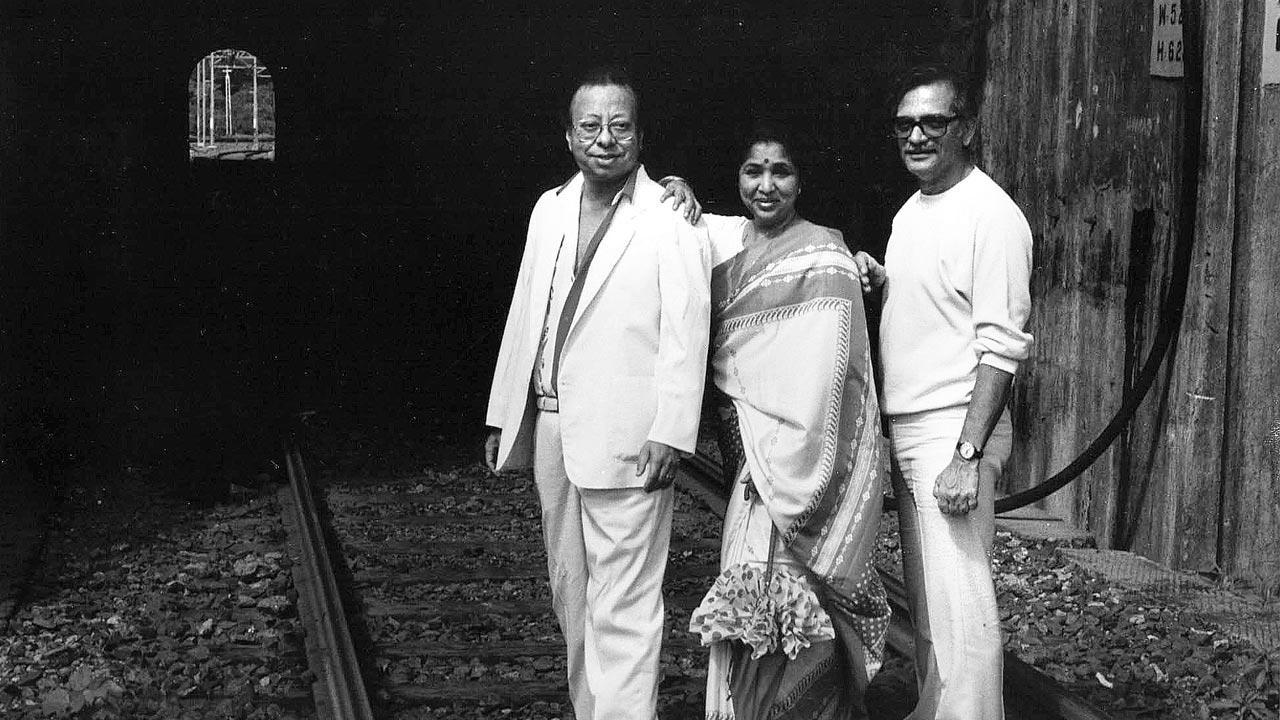
Gulzar with his music composer friend R D Burman and Asha Bhosle. Pic courtesy/Gulzar; Actually... I Met Them
When R D Burman died, a large part of Gulzar departed with him. In a new memoir, the veteran lyricist remembers his dear friend, who gave wings to his song-writing journey and the magic they created together
Jane Borges (MID-DAY; October 17, 2021)
The first rule of journalism is to remain objective, always—something, this generation of “news-breakers” are already grappling with. But, speaking with veteran film director-lyricist-poet-author Gulzar for the third time now, this writer’s struggle has never seemed more real. We can’t really put a finger on why that’s the case. Though, we must admit that when we were two years old, Lakdi Ki Kathi from the film Masoom (1983) was played on loop on our TV set — the number of rewinds terribly reduced the life of the video cassette—as the song made our toddler self dance with glee. We didn’t of course know then that Gulzar had penned it. Later, it was the ghazals that he wrote — the album Marasim (2000) being a personal favourite — that preoccupied our teenage heart. So, when the octogenarian, who is blessed with a razor-sharp memory, remembers our meeting from four years ago at his Pali Hill bungalow, we can’t help but smile. Since this time, our conversation is over telephone, we allow this slip. That’s also where we cut-short the impulses of the inner-fan. We are back to discussing his book, a new memoir, which is also several years old. Confusing?
Over three decades ago, Gulzar was approached by Sanchari Mukherjee, then a journalist with a Bengali newspaper’s Sunday edition, for a new column series. “She wanted me to write about my experience of working with veterans from the film fraternity. I told her that’s typical Filmfare [magazine] material. But, she kept insisting,” recalls the 87-year-old.
Gulzar eventually told her that he’d speak about his many interactions with those who had influenced his work. “We managed to work it out. She would fly down to Mumbai, and cover columns for two editions at one time, and leave for Kolkata the same evening. I would narrate my experiences in Bangla, Hindu, Urdu, English and hand gestures, and she’d put it all down in Bangla. She would later send the final piece, and I’d make a few edits, before it got published,” he shares.
This went on for some time, until Mukherjee “went the family way”. The column ended soon after, but took on a new life as a book in Bengali called Panta Bhate, which means “in fermented rice”, a phrase he used in one of his films. Gulzar, however, was adamant about not having it published in English, because he saw himself making new additions to this diverse cast of celebrated artistes mentioned in the original compilation. “The wave of thoughts kept churning, but I never sat down to write. This continued and time passed by.”
It was only recently when Premanka Goswami, the executive editor at the publishing house behind his book, mentioned how he wanted to translate Panta Bhate, and that he knew someone, who had worked on the first two chapters that Gulzar, in a first, re-considered the option. But that was only because the translation by Maharghya Chakraborty had bowled him over. “He had done such a good job, and had remained authentic to the text. I realised that even if I write more, it would not be in the same style.”
His new memoir, Actually… I Met Them (Penguin Random House), though an old one, will thus, for the first time, be read by non-Bangla readers. In essence, they are intimate sketches of doyens who shaped Gulzar’s early decades in cinema—from Bimal Roy, Kishore Kumar, RD Burman, Satyajit Ray, Pandit Ravi Shankar, Sanjeev Kumar to Suchitra Sen and Sharmila Tagore. “Most of them are Bengalis, and [while working on this book] I realised the extent of my collaboration with them,” says Gulzar, who considers himself as much a Bengali, as he’s Punjabi, and has also taught himself to write and speak the language.
The one Bengali who, however, doesn’t have an entire chapter dedicated to her is actress Rakhee Gulzar. He mentions her often through the book—the first time he set eyes on her, the love letters they exchanged, the pranks she pulled on him, driving away with his car with friends to eat paani puri—but beyond that “I am very shy when it comes to writing about my wife.”. We can almost hear him blush over the phone.
When it came to naming the memoir, the celebrated poet says he picked up the last sentence of the introductory note that he wrote for the book. “I find it hard to believe that all these people lived in the same era, and that I had the chance to work with most of them. Sometimes, I have to convince myself that I actually met them.”
These vignettes are unlike any other we’ve read—they aren’t short biographies, neither are they profiles. They are reflections of personal and private moments between two artistes, and show them in new light. Most moving is his relationship with Pancham (R D Burman). When the music composer passed away in 1994, Gulzar writes that “a large part of me departed with Pancham; the Gulzar that remains now is but half-complete”.
“Before my career as director took off, I had written only one song with his [Pancham] father [S D Burman]… my song-writing journey began when Pancham was an assistant with his father, and I, an assistant director. He used to come to our office holding the dugga [the left tabla]. While the grown-ups would continue their discussions, we would go out to take a stroll. A deep friendship formed between us, and I began writing more songs for him. The way I wrote when with Pancham, can’t be recreated. We grew together in this journey. When he died, I lost both that friendship and creativity [we shared],” he tells us.
Gulzar also writes about his disappointment of not being able to complete the script for Amritakumbher Sandhane that Bimal Roy and he were working on, as the former died of cancer. Another huge regret was not being able to land the opportunity to work with Satyajit Ray, an institution in himself. “It would have been like going back to college, and I missed that chance. Another person I wanted to assist was Shyam Benegal, because I admired his modern, new cinema greatly. I requested him twice actually, but he laughed it off,” says Gulzar, being absolutely modest.
He admits he has always been curious about cinema and never shied away from learning. In fact, he tells us that in the early 1980s, by which time his body of work included big hits like Aandhi, Parichay and Mausam, he wanted to study at the Film and Television Institute of India. “I was making Namkeen at the time. I approached Hrishi da [Hrishikesh Mukherjee] who was the examiner at the institute, and asked if there was a possibility of doing a three-year course there.”
He remembers being scoffed at. “Hrishi da said, ‘Huh! Who will write for my films then?’ He joked that grown-ups and married people weren’t allowed here.”
If and when Gulzar writes a Part 2 of this memoir, which he says he will, there will be certain colleagues that he definitely won’t forget to mention. A R Rahman, Vishal Bhardwaj, Shaad Ali, and his daughter Meghna Gulzar. “It might feel like I am boasting. But, I am very, very proud of her [Meghna]. She has really surpassed my filmmaking. Our generation made good films, but we weren’t the original authors — our works were inspired by other literary stalwarts. The new crop of filmmakers author their own films. Cinema after all is about your own expression, commitment and statement.”
A subject’s difficulty makes me work better-Meghna Gulzar
8:24 AM

Prashant Singh (HINDUSTAN TIMES; December 7, 2019)
Back in 2016, when Meghna Gulzar first met Laxmi Agarwal [an acid attack survivor], the filmmaker found her “far more introverted and closed as a person” than what she is today. “She was nowhere in the limelight,” says the filmmaker. Now, of course, Laxmi is an undaunted picture of strength and resilience. And, also the inspiration behind Meghna’s next, Chhapaak, starring Deepika Padukone in the lead role.
“I literally searched for her. At that time, I was looking for subjects after Talvar (2015). So, when I came across a few such incidents [of acid attack], it got stuck in my head that this is happening and there’s a world of these girls, who’ve been attacked by acid, or are acid attack survivors. And we don’t know much about them. More than knowing, it’s to understand why it happens and how it can be prevented. Actually, in a way, it is life worse than death,” she says.
Interestingly, when Meghna along with her co-writer were working on the film’s script about three years back, they had “secret thoughts” about having Deepika on board. “But we’d both never say it aloud (smiles). It seemed implausible that she’d do such a film,” says the filmmaker, adding that when she looked at Laxmi’s pictures before the attack, she saw “an uncanny similarity between her and Deepika.”
She explains: “When I finally met and told Deepika that ‘this is the story, subject and issue,’ she spontaneously said okay to it, at that very moment. She, though, said that she really wanted to do something light after three-back-to-back intense films.”
As for Meghna, after delivering back-to-back hits like Talvar and Raazi (2018), as she readies for Chhapaak, is there any pressure on her? “Honestly, it’d be stupid and dishonest to say that it doesn’t affect you. But would I prefer if people didn’t have any expectations? No. And would I want people or trade to expect a good film out of me? Yes, and I’d work for that. My core intent is to just tell a story, and share what I have learnt, with the audience, with as much honesty as possible. No one sets out to make a failure. At best, you can endeavour that it’s a financially-viable project. But the cost of a film shouldn’t be its burden,” she shares.
Another hallmark of Meghna’s career has been her penchant for taking up challenging subjects. “I think the difficulty of a subject makes me work better and also brings out my craft better,” she smiles.
Or it could be all due to Meghna’s genes, being the daughter of filmmaker-poet Gulzar and senior actor Rakhee. What has been her father’s biggest influence on her? “I’m exactly aware of what his influences have been – it’s simplicity and brevity. Kam mein badi baat keh jaao. These are a few principles I’ve consciously tried to include in my skill set,” she adds.
----------------------------
Working with her mother Rakhee
“I don’t think I need that baggage on the sets (laughs). I’m not, in any way, undermining her talent at all. But if I see something differently [with regards to the part] and I want it to be done that way, how would I tell her that? Isliye nahi ho paayega. I had a story swirling in my head at one point, with her. But the beauty of it is that neither am I consciously working towards it neither is she manoeuvring to make it happen. Hoga toh hoga.”

Raazi was an affirmation that Talvar’s success was not a fluke-Meghna Gulzar
2:27 PM

Niharika Lal (BOMBAY TIMES; November 27, 2019)
 Speaking at a session on filmmaking at the 13th edition of Film Bazaar, organised by the NFDC on the sidelines of International Film Festival of India (IFFI), Meghna Gulzar discussed how Talvar ended “15 years of failure” in her career, being compared to her parents and why she doesn’t like the tag ‘womencentric’. Excerpts:
‘TALVAR WAS A SUCCESSFUL FILM, BUT WE COULDN’T CELEBRATE ITS SUCCESS’
Meghna’s Raazi (2018) bagged Best Film at the 2019 Filmfare Awards, and she also got Best Director award for it. However, Meghna said that Raazi was just an affirmation of her previous work. “For me, the move away from past failures happened with Talvar. It was very peculiar, because Talvar was the kind of film whose success you couldn’t celebrate as it was talking about the tragedy of a family (the Aarushi Talwar murder case). The film was successful but there was a mother and a father (Aarushi Talwar’s parents) who were still in jail. We really couldn’t celebrate the success of Talvar. We were on a recce for Raazi when I got the news that they have been acquitted by the High Court; that is actually when we celebrated the success of Talvar. Raazi was just an affirmation that Talvar (it’s success) was not a fluke.”
‘MY FAILURES WERE MORE DIFFICULT FOR MY PARENTS’
Meghna shared how despite doing very different kind of cinema from what her father Gulzar did, she had to deal with comparisons throughout her career. She said, “There are certain similarities and sensibilities, but otherwise, our cinemas are very different. It took a while for me to gain independence of my cinema. Then again, there was a comparison between children of other filmmakers who were extremely successful.”
Meghna shared that more than her, her failures were more difficult to handle for her parents, Rakhee and Gulzar. She said, “Honestly, if the first 15 years of my career were a failure for me, they were probably 10 times more so for my parents because they were so successful in this profession. To feel that helplessness because there was really nothing they could do to help me was more difficult for them. So (after Talvar) when they were at peace that now there is professional success, that was the biggest validation for me.”
Giving advice to budding filmmakers, she said, “Have conviction in the story you want to tell, rest everything is a byproduct. There were days when I couldn’t do it, I couldn’t stomach the failure anymore. But then you open the document and start writing again.”
 ‘THE STORIES I CHOOSE ARE BEYOND BEING JUST WOMEN-CENTRIC FILMS’
Sharing that she isn’t in favour of branding films as ‘women-centric’, Meghna said, “We all should aspire to be humanists, because if we talk about equality, it is as much equality for a man as for a woman. A film set is extremely gender-neutral. We have female assistants in all departments, female technicians and cinematographers who do the heavy lifting. Nobody is going to hold an umbrella for them, nobody is going to give them a handkerchief to wipe their sweat. Even the stories I choose are beyond being just women-centric films.”
Talking about her upcoming films, Meghna said, “My next film Chhapaak is the story of an acid attack survivor. I have also announced my next film, based on the life of Late Field Marshal Sam Manekshaw. Just because Raazi was a success, I can’t keep making the same kind of films. I have other stories to tell. You need to constantly try and be a better version of yourself.”
‘EXECUTION OF PSAS, LIKE ANTI-SMOKING VIDEOS PLAYED IN CINEMAS, IS OF VERY VERY LOW QUALITY’
At the session, TCA Kalyani, MD, NFDC, asked Meghna, “PSA films, like the no smoking ads that play in cinemas, often contain horrific images. Since your next film is on acid attack survivors, is there a way to make these PSA films look more appealing?”
To which she replied, “Of course, sensibility is very important. These PSA films look like they have been made with disinterest and almost no funds, which is not the case. It’s just that the execution is of very very low quality. Even the National anthem video... I really think that our National Anthem merits better visuals, better audio, better rendition.”
Giving examples from her films, Meghna added, “Talvar had scenes showing throats being slit and yet it got certified as U/A and with no cuts. So there is an aesthetic with which you approach it. I want people to see Chhapaak because it is an important subject. I don’t want people to look away from the screen. I want to make sure that the story reaches the people. There should be enough to disturb but not so much that it is rejected.”
Why should I act in Meghna’s films if I don’t fit into a role?-Rakhee Gulzar
7:51 AM

Rakhee Gulzar and Prosenjit Chatterjee at the Kolkata International Film Festival
Zinia Sen (BOMBAY TIMES; November 15, 2019)
Ahead of Rakhee Gulzar’s press con at the 25th Kolkata International Film Festival Nandan for Gautam Halder’s Nirban recently, the message conveyed to all by the organisers was, ‘No personal questions to Rakheedi please.’ When the actress came, looking pristine in a beige sari, she not only gave Kolkatans information on their city that not many are privy to, won hearts and became everyone’s Rakheedi by the end of it all.
She said, “I came here thanks to the West Bengal CM Mamata Banerjee. She remembered me and called me with a lot of love. I had two reasons for coming here. First was the film festival and the second, the film I am a part of. I have worked in films for many years. But this time, I am doing everything to make this film reach out to all. I want people to see Nirban for the story. I want people to appreciate Bijolibala, not me.”
Based on Moti Nandi’s Bijolibalar Mukti, the film has Rakhee playing the protagonist. About how she landed the role, Rakhee said, “I did not know the director. But the day this proposal came, I was at the hospital. My grandson was born. Later, I called him to my farmhouse and when I heard the story, I suddenly felt like doing it. It’s very relevant in today’s time.”
The actress spends most of her time in Panvel, which is a couple of hours from Mumbai, however she does visit Kolkata regularly. “I roam around quietly. I go to the machher bazar, I know Radhubabur dokan, Tyangra, all the roads… Do you know there’s an amazing fish market after crossing Tollygunge? Not many people can identify me and that’s the best part,” she said, adding that she did not want to do more films. “When people can retire from jobs, why can’t actors do that? I wanted to spend my time amidst nature and with animals and trees, but that didn’t happen,” she said.
Not one to watch Bengali films regularly, she said she really liked a recent movie. “During Durga Puja, I saw a film called Bhooter Bhabishyat on TV. It had already started, but it was such a fun watch.”
On being asked why she hasn’t been part of any film by daughter Meghna Gulzar yet, the actress said, “I did not make Bosky (Meghna) an actress. As a mother, it was important for me to understand her knacks. She does films on serious subjects, a lot of research goes into them. Why should I act in it if I don’t fit into a role? Just because I am her mother? Why should I be a burden for her?”
As an actress, Rakhee said it’s important to know where to stop. “I used to work in cinema when it was very different. But I have no regrets about stopping or, about not working with directors I have not worked with. My favourite director is Tapan Sinha, I love the way he made films for everyone. As an actress, I have had the same beliefs,” she said.
‘RAKHEE AUNTY IS A FABULOUS ACTRESS AND A GREAT COOK’
Rakhee aunty is a family friend. She is a fabulous actress and a great cook. One of our films together — Maa — celebrated its golden jubilee. She would cook for me. I remember her playing a small role in Baghini (1968). From there, she went on to essay lead characters in many, many films. It shows where perseverance can take you
— Prosenjit Chatterjee
Last of the movie moguls: Khalid Mohamed pens a tribute to J Om Prakash
8:17 AM

J Om Prakash with Hema Malini and Dharmendra on the Aas Paas set
J Om Prakash will be cherished for his super hits backed with star power, chartbusters, verdant locations and breezy storytelling
Khalid Mohamed (MUMBAI MIRROR; August 8, 2019)
 Synonymous with a rapid fire series of silver jubilee hits – the buzz-phrase now replaced by the Rs 100 crore club – the monarch of breezy entertainers would sport speckless white outfits and converse in a voice which rarely rose to high octaves.
Through the 1960s spilling over to the next three decades, J Om Prakash would attend his Filmyug production office at Santa Cruz religiously. With advanced age, he handed over the reins to his son-in-law Rakesh Roshan, and basked at his Juhu bungalow in the adulation amassed by his grandson Hrithik Roshan.
As a knee-high child, Hrithik had made flash appearances in a few of his grandfather’s films, drawing rave reviews for his act in Bhagwan Dada (1986).
Affectionately called Om ji, he once spoke to a whiskerless wannabe reporter seeking an elaborate interview for Filmfare. Fixing an appointment for a five-star buffet, he ordered a couple of Camparis, an offer which I tetchily refused.
Try it, it’s like sweet medicine, he had insisted, a way perhaps to ensure that I wouldn’t quote any of his off-the-record statements. The afternoon lenghtened, the drinks swirled on, resulting in, let’s say, an interview brimming over with heartspeak.
Born in Sialkot, Punjab (now in Pakistan) he had none of the rancour of someone who had to start from scratch in Bombay. Shyly proud of his success, he believed that an emotionally stirring story could fit snugly into the commercial groove. “That’s why I produced Aandhi (1975) directed by Gulzar,” he had smiled. “When there was a brief ban over the parallels to the life of Mrs Indira Gandhi, I stayed calm. I would love to produce another film with Gulzar and Suchitra Sen. Although Suchitra has become reclusive, she will never say ‘no’ to me.”
As a producer, he had become a major Bollywood player with the black-and-white Aas Ka Panchhi (1961), directed by Mohan Kumar. Narrating a story about a patriot who wants to join the army, it boosted the careers of Rajendra Kumar and Vyjayanthimala. His innings as a director was initiated with the Rajesh Khanna-Mumtaz-Sanjeev Kumar dramedy Aap Ki Kasam (1974), which touched upon the subject of adultery.
He would use the B-Town formula with a certain playfulness, frequently touching upon the divide between the ultra-rich and the rising middle class. Exploring verdant hill town locations and extracting chartbusters, were his forte.
Coining ‘lucky’ titles beginning with ‘Aa’ or ‘A’, Om ji’s signature began to be identified with the A-list heroes Dharmendra, Rajesh Khanna and Jeetendra. His high glam heroines, kitted in glitzy bespsoke outfits, ranged from Asha Parekh, Saira Banu and Raakhee Gulzar to Rekha, Reena Roy and Sridevi. However, at a point, when Bollywood’s dependence on stars had swelled, the filmmaker was disenchanted, particularly during the protracted making of Aas Paas (1981), with Dharmendra and Hema Malini.
Rakhee Gulzar recalls, “At the early stage of my career, I did one film with Om ji – Aankhon Aankhon Mein (1972). For that, horse-riding and a Bollywood-type dance were required. He made me comfortable. Years later, on my wedding day, he looked after all the minute arrangements like a guardian would. Then he produced Aandhi. We became close family friends. At my suggestion, he bought a farmhouse neighbouring mine in Panvel. Few know that he was extremely knowledgeable and an avid reader of non-fiction.”
Asha Parekh who starred in the musical triptych Aaye Din Bahaar Ke (1966), Aya Saawan Jhoomke (1969) and Aan Milo Sajna (1970), remembers Om ji rushing her to a hospital when she fractured her foot. “For a scene in Aan Milo Sajna, I had to wear tight shoes with Rajesh Khanna carrying me in his arms. The scene was shot with slippers on – a continuity jump, but Om ji didn’t care. No one noticed it in the final edit either.”
Towards his end years, the movie mogul was bed-ridden and couldn’t visit his Panvel farmhouse where he had built a Shiv Mandir. The 93-year-old leaves behind an oeuvre of over 25 films. And he leaves me with that interview topped by Camparis which I have never tried again – wouldn’t be the same without Om ji.
This talk about me quitting acting is wrong-Rakhee Gulzar
11:01 PM

In a rare interview, Rakhee Gulzar opens up to talk about a Hindi-Bengali bilingual which, though cleared by the censors, has been in the cans for the last three years presumably because of political pressures
Khalid Mohamed (MUMBAI MIRROR; January 8, 2019)
Unbeknownst to many, a film titled Nirvan on the subject of communal harmony — toplining Raakhee Gulzar in the role of an orthodox Brahmin widow who adopts the child of a dying Muslim young woman—has been wasting in the cans for the last three years.
“This talk about me being reclusive and quitting acting is absolutely wrong,” the stalwart 71-year-old actor, opens up to Mumbai Mirror in an interview after a long hiatus.
While chatting with her at a suburban hospital, where she is recuperating from a bout of dengue compounded by pneumonia, Raakhee didi as she is fondly called by her peers, points out that Nirvan, made in Bengali and Hindi versions, is a timely film which emphasises the need for secularism today. She agreed to be part of the project, without any fee, as soon as the subject was narrated to her by director Gautam Haldar. Back in 2003, he had made his debut with Bhalo Theko, starring the then little-known Vidya Balan.
Distributors and exhibitors have been shy of releasing Nirvan “which could be out of political pressure,” Raakhee Gulzar remarks. “Perhaps the West Bengal government believes that Muslim viewers could be antagonised. On the contrary, the script appeals for humanism and the need for oneness among all communities.”
She has advised Haldar to find an alternative platform for Nirvan on TV channels or on streaming channels. The cast led by her features newcomers who have performed excellently, she notes, adding, “The film has been cleared by the censors recently. It has been made on a modest budget but looks as technically polished as any big-ticket film. If I may say so, it has been one of my heartfelt, if not best performances since Aparna Sen’s Paroma and Rituparno Ghosh’s Shubho Mahurat.” The latter had fetched her a National Award.
So why is she off Bollywood assignments? To that her famous champagne eyes flash, “But why? There are no roles being written which are commensurate with my age. Moreover, I was comfortable with certain filmmakers who respected my style of working: punctuality, dialogue memorised and no fuss. After I was slapped hard on the face by (director) Satyen Bose for not getting a shot right for my first Hindi film, Jeevan Mrityu, I’ve always held my act together. Since then, I was at home working with a certain set of directors and production houses.”
The stellar list, she cites, comprise Hrishikesh Mukherjee, Yash Chopra, Ramesh Sippy, Vijay Anand, Shakti Samanta, Prakash Mehra, JP Dutta, Subhash Ghai, Rakesh Roshan, Rajshri Prouctions and D Rama Naidu’s Suresh Productions.
“Besides them, I could deliver what was asked of me by Abbas-Mustan for Baazigar and Soldier,” she rewinds. “After that I put a full stop to Hindi films.”
In any case, why has she become reclusive, opting to seclude herself in her Panvel farmouse? “What nonsense!” she ripostes. “I stay by myself in my Bandra flat. You should know that I’m a loner. You don’t expect me to network at parties and wedding receptions, do you? Salim Khan still keeps in touch to know how I’m doing. But that’s all, I don’t mingle with the film fraternity, I never have.”
Raakhee Gulzar continues to maintain cordial relations with her writer-director husband, whom she had separated from 42 years ago. “That’s quite a time span,” she smiles to herself. “By the way he was at the hospital, a few hours ago. He likes to have his afternoon soup here. I live by myself because I’m made that way. Me-time has always been a must for me.”
Proud about her daughter, director Meghna Gulzar, the doting mother says, she has found her niche with Talvar and Raazi: “She’s matured both as a filmmaker and as an individual,” she notes. “And my grandson, Samay, is the joy of my life. Every day at 11 am I drop by to be with him if he’s at home. Like me, Samay is a nature and animal lover.”
The hospital doctors have told the actress that she’s fit enough to be discharged.
“I’m staying on for a day or two till I feel completely rested,” she states. “Or I’ll be back at home pottering away in the kitchen. If there’s one thing I can never give up, it’s cooking. I have a thing about rustling up all my meals myself, even when I’m working at far-flung locations.”
Returning to the stalled release of Nirvan, Raakhee Gulzar comments, “See, an actor always wants to remain active. The camera is addictive. It’s not as if I’m hobbling around. Lekin koi dhang ka role toh hona chahiye. (But there must be a role of some substance). The part of the relgiously bigoted woman, Bijolibala, whose outlook alters completely on facing a human situation, prompted me to rush to Kolkata and complete the film at one go.”
She wraps up with a request: “My appeal to the West Bengal government is to at least have a look at the film and ensure that it’s seen there by the audience which has always had a taste for good, purposeful cinema.”
None of my films have had a premiere at Toronto or at any other international festival-Gulzar
8:02 AM

Meena Iyer (BOMBAY TIMES; September 29, 2015)
Feted, felicitated and
much-loved writer, film maker, poet, author and lyricist Gulzar has many
facets to his personality. His daughter Meghna Gulzar is three films
old, her latest being the muchtalked about Talvar , which recently
premiered at the 40th Toronto Film Festival (TIFF). In a candid
conversation with us, the father-daughter duo speaks on their
professional and personal equation.
Gulzar saab, please tell us about your contribution to Talvar?
I must tell you an interesting story. An alley cat taught a tiger how to hunt and actually go for the kill. After learning the technique, the first person the tiger attacked was the cat. She was smart. To save her life, she climbed a tree. The tiger stood below, looking at the cat and said, “Hey , but you didn't teach me this.“ To which the cat replied, “I could foresee that this is exactly what you would do once you mastered the killing technique. Hence, I didn't teach you this last trick.'' (Laughs) Likewise, I taught Meghna how to pen screenplay, dialogues and script etc. She knows direction and post-production. Now she has become a tigress. But, I didn't teach her how to write songs. So, she still has to depend on me (the cat in this context) for that aspect. I write songs for her films and that is my contribution to her cinema. It is challenging to write songs for her. When she wants something, no one can make her change her mind. She has a passion for movie making. This time around both Vishal (Bhardwaj) and I had to deliver. Sometimes she didn't like the tune, if she liked the tune, she didn't like the lyrics. She is hard to please. Vishal and I had to keep working continuously to present different versions to director sahiba.
Meghna: Papa would hum some words and Vishal sir would compose a tune around it. They would only come to me when it was nearly ready. So, I told them both, “Hello, please include me in your song-making sessions.'' It is a treat to watch them work. When they are working together, there is so much that is left unsaid. Vishal is humming and dad is able to know where the tune is going and throw words at him accordingly. It is not a director thing; it's a purely selfish thing. I wanted to be in that experience.
Gulzar saab, had you followed the Aarushi Talwar case when it happened in May 2008?
I had seen Meghna meticulously making newspaper cuttings of the case. Her involvement and fascination for the subject automatically rubbed onto me. I, too, started taking a keen interest in the subject. I would see her jotting down notes. That is how I followed the case. I knew Meghna was researching the subject. If I came across any snippet or report on the Aarushi Talwar murder case, I would quickly cut it and give it to her. I have seen Vishal and her do a thorough job.
Sir, have you seen a growth in Meghna's graph as a director?
Yes from Filhaal to now, her graph has seen a steady rise. What I like about her is that she is so focussed. She knows exactly what she wants. I have seen her handling her unit also. It so happened that she was shooting in Delhi and she expressed to me that she was missing her son Samay. So her husband Govind, my grandson Samay and I went to the shoot. You know, as a filmmaker, I must tell you that handling a machine is different but handling human beings needs a special tact. I was impressed with the way Meghna did that. I also have deep admiration for her unit. Her cameraman (Pankaj Kumar) is a good listener. He would patiently hear her out before executing the shot. Another assistant who was very attentive and helpful was a guy called Honey. I guess his name is Honey because he is so sweet. Meghna has made documentaries for Saeed Akhtar Mirza. So I know she knows her job. However, in the case of Talvar, this kind of maturity comes only when you have been deeply involved with the project. Like any parent, I, too, was anxious about her. But now I'm less worried because she has taken a step ahead of me. She has actually beaten me to it. None of my films have had a premiere at Toronto or at any other international festival.
Meghna: Papa, you have won an Oscar.
Gulzar: (Chuckles) Now let's see how you achieve that. However, I have made so many movies and I have not been invited to any international film festival. I even got the Dadasaheb Phalke Award but none of my films have had a foreign premiere. As a filmmaker, I'm very happy and confident of this girl's growth.
Gulzar saab, what did you think of Talvar?
Talvar is an important social comment. Everyone knows that the law has long hands; however, no one knew that the law travels through a narrow alley. That is how the song came in, Patli gali aana. I must say that we have good laws, we have a good judiciary but our system of implementing laws is something like what is shown in Talvar. Meghna has put her finger on this. It is not a murder thriller. It is much more. That is why I feel the audience has to be prepared for it. You are not going to see a thriller in which bullets are flying. I'm also happy that the producers of this film (Vineet Jain and Vishal Bhardwaj) had conviction in the story that they were making and have allowed Meghna to make the film the way she knew best.
Meghna, speak about your key cast.
I must start with Tabu. By now everyone knows that she is not playing Aarushi's aunt. She has a special appearance in the film. Though I have made movies in the past, this time around, I felt like I was starting over probably because the genre was new to me. And I couldn't have done this without Tabu. It was gracious of her to accept the small part. The actual shooting was a breeze. It was like two friends (she and I) were catching up for lunch. It was as casual as that.
In sharp contrast, is Irrfan sir who is very tricky. You are well aware that Talvar presents multiple viewpoints on the Aarushi murder case. He plays an investigative officer and till today, I have no idea which side of the story he believes. Throughout the making he was playing the devil's advocate. Every time he would have to do a scene he would question--what if this had transpired like this and not like this? It took me a while to understand that he was asking so many questions so that he could plug all the holes. He took in all the information and then delivered his performance. Irrfan sir has given an evolved performance. The way he has conveyed his sense of restlessness and his appearing distracted, etc. are all things which he has put into his character. This can only happen when an actor internalises not just the part but the entire film.
Gulzar: Irrfan has portrayed the character so beautifully.
Meghna: Neeraj Kabi sir and Konkona (Sen Sharma) have the toughest job in the film because they both play the guilty and the damned. And they have to do both these things convincingly. Moreover, they had to do everything twice over. But I must tell you that their approach as actors was diametrically opposite. There was Konkona (Koko) who would ask what the scene is, seek a few clarifications and say, 'Cool, let's go'. If it was an intense scene, she would cry and when I called cut, she would be smiling with her eyes shining bright. Neeraj sir, on the other hand, is the exact opposite. After the entire briefing, he would ask for 30 seconds. Then he would stroll off to a part of the set where no one was allowed to enter. And then he would come, stand in front of the camera and give the perfect take. From the spot boys to the costume and light departments, everyone would maintain pin drop silence. Honestly, who does this for an actor anymore? I had a really good unit. Neeraj sir also didn't snap out of a shot, after I would say cut. At the end of the day, he would bid everyone goodbye and say, 'See you tomorrow'. Though Koko and Neeraj sir's style of working is diverse, you cannot tell the difference on screen because both of them have delivered pitch-perfect performances.
Meghna, were you prepared for the reactions that you got at TIFF?
Not at all. I knew Cameron Bailey, the artistic director of TIFF, was in Mumbai to look at films but we couldn't connect with him and he went back. It was another festival director who asked if we had sent Talvar to Toronto. It was after this that Vishal wrote to Cameron and we sent a screener within a short time. We had to pull up our deadline by a month. But nothing could have been more worth it than showing our film in Toronto.
How would you describe your relationship with Vishal Bhardwaj?
Meghna: Vishal has done all the rituals as my brother at my wedding. But at that time, we were not as close as we are today. Our personal equation has evolved over the years. I had done a couple of scripts with him in the past, but Talvar is actually our first full-fledged attempt at making a movie. I was to do Timbuktu and Mr Mehta And Mrs Singh for him. Both didn't materialise because I was in my world, making different kind of movies. For me, the biggest learning has been watching him as a writer. You can understand him as a filmmaker when you see his films. He always shares his scripts with dad and me. So, I know the script and I see what he does with his films. Vishal sir writes his characters beautifully. That is his biggest forte. He gives each one a texture. There will always be some distinguishing trait in each character. He brings them to life and that, for me, was a huge learning experience. He visited us on the sets just twice. It was so good to have him there because it felt like someone was standing behind you. I felt protected. Having that sense of support made me do that job better. I must explain to you, the kind of equation I share with Vishal sir. When I was explaining to Sohum Shah, who plays Irrfan sir's assistant in the film on how to approach his character visà-vis his equation to his senior (Irrfan), I gave the example of Vishal sir and me. I explained to Sohum that Vishal and I have dinner together, we crack jokes and laugh, but when he is around on the sets, I always stand there respectfully with my hands behind me and address him as sir.
Gulzar: I'm proud of how Meghna has defined her relationship with Vishal. She has described it beautifully.
Meghna: Everything about Talvar is two-sided, including the relationship between the film's writer-producer and director.
Has your mother seen this film?
Gulzar: Actually, Raakhee is even more anxious about Talvar than Meghna.
Meghna: I have shown my mother the first print that I made for India. I didn't want her to see a subtitled print. However, I had shown my father the first international print with subtitles on August 18. It was his birthday and it was my surprise gift for him.
Gulzar: It was a great gift. Every year we go out to celebrate my birthday. This time she was busy with Talvar but she told me, 'Dad, I will still give you a gift'. I'm a happy man.

It is hugely draining to make a film like Talvar-Meghna Gulzar
8:33 AM

Upala KBR (DNA; September 13, 2015)
Talvar is a movie allegedly based on the Noida double
murder case of Aarushi Talwar and Hemraj Banjade. Directed by Meghna
Gulzar, the film stars Irrfan Khan, Konkana Sen Sharma and Neeraj Kabi. The
director talks about her journey...
What inspired you to make a film on the Talwar case? Why call it Talvar (sword)?
The case is fascinating — in the sense that multiple investigations, a long-drawn trial, a verdict and a sentence have all transpired. And yet, there are many questions that still don’t have entirely convincing answers. The idea to explore this sense of unfinishedness through a film, was un-passable. The title of the film alludes to a dialogue in the film that occurs at a very poignant moment in the film — the dialogue is referring to the sword in the hand of the statue of Lady Justice.
How did you go about the casting? Was Sanjay Dutt earlier supposed to play Irrfan’s role?
As far as I know, he was the only actor approached to play the part he is playing in the film. Irrfan Khan was sent the first draft of the script even before my father was given a copy to read. And I had one meeting with Irrfan and he agreed to do the film.
Konkona Sen Sharma seems relatively young to play the role of a mother.
Konkona is a mother in real life too, isn’t she? And this is me — who’s mother (Raakhee) played Rishi Kapoor’s mother in Kabhie Kabhie when she wasn’t even 40. So I guess that’s the sensibility I come from. When an actor is an accomplished performer, physicality and age are hardly a consideration during casting. At least for me.
Apparently, Irrfan took some time before saying a yes?
Irrfan and I had one meeting. At the end of that meeting Vishalji (Vishal Bhardwaj) called to inform me that he was on board. This was in June 2013. We started filming in June 2014. And Irrfan’s commitment to the film didn’t once waver through that lapse of 1 year.
Have you shown the film to your parents?
I showed the film to my father, on his birthday. We had a technical test screening of our festival print. My mother wanted to see an unsubtitled print, which I haven’t been able to complete before leaving for Toronto. I will do that once we’re back.
When one is making a film based on a real-life story is it tough finding a balance between real-life and reel-life?
If one sets out to make a realistic and authentic film on a real-life event, you have to be as true to the facts as possible. And when the facts are gruesome, you rely on your sensibility and sense of aesthetics to decide how much to show and how to show it. Films on real-life incidents have a large chance of falling into the trap of sensationalism. All of us on Talvar were constantly aware and guarding against doing precisely that.
In Talvar, have you completely kept it as factual as the research as possible or taken cinematic liberties?
The facts and data have not been meddled with. Cinematic tools have been used to give characters more than one-dimension –– like a personal trajectory, and to enhance certain plot-points for a better screenplay graph.
While making the film were you moved at any point? Which scene affected you the most?
It is hugely draining to make a film like Talvar, one based on a real-life incident — the responsibility of recording and recreating a historical occurrence weighs down quite a bit. And when the event is a violent one, it becomes even more difficult. Filming the murder sequences were very tough. From all perspectives. I tried to be as clinical as humanly possible during the shoot of the film.
Earlier were you supposed to make the film with PNC?
Pritish Nandy had once told me, “We want to make all your films!” I gladly echoed his sentiment! We discussed around three films in the seven years between Just Married and Talvar. I believe every film charts it’s own journey, has its own destiny. And so does Talvar.
Bollywood has a low divorce rate, despite all the stories of promiscuity
8:49 AM

Despite all the stories of promiscuity; the innumerable romances and the fly-by-night affairs, Bollywood doesn't necessarily subscribe to the 'D' word
Meena Iyer (BOMBAY TIMES; November 3, 2014)
 Taking stock of B-Town's
divorces post media reports of Hrithik Roshan and Sussanne Khan's
divorce that came through over this weekend, you will notice that the
rate of divorces in Tinseltown is far less than what it would ideally
seem from the outside world.
Raj Kapoor was enamoured with Nargis, and Dev Anand was infatuated with Zeenat Aman; enough to make it seem like both these evergreen superstars would end their marriages. However, when it came to the crunch, neither did.
Marks must be given to their spouses Krishna Kapoor and Kalpana Kartik (Mona Anand) for maintaining the home and hearth of these men whose high-profile link-ups did rock the boat to a degree. But in the end, it was the 'sanctity' of marriage that won.
 Raj Kapoor's oldest-born Randhir's
own marriage hit rock-bottom a decade and a half after he married Babita
in 1971. In fact, this one was a bit of a shock because Dabboo actually
wooed Babita for years before tying the knot. And it did seem like their
match was made in heaven. However, after Kareena's birth in September
1980, this couple saw little happiness.
 But the strange bit is
that even after 40 years, this couple only remains estranged not
divorced. As Randhir has often said, “Babita and I didn't divorce because
neither of us had plans to remarry. Whatever I have today belongs to
her and my two daughters - Karisma and Kareena. Since there is no
inclination to marry or sire children, I never felt the need to
get officially divorced.“ His daughter Karisma Kapoor, who ruled the
roost in the 90s, though, ended her decade long marriage with
businessman husband Sunjay Kapur and is today locked in a custody battle
with him.
 Two other celebrity couples - Gulzar and Raakhee as
well as Rajesh Khanna and Dimple, who married in 1973, also separated
from their spouses. But, in both cases, there was no divorce talk
because none of them showed signs of wanting to marry again.
In fact, Dimple stayed put by her terminally-ill husband's side in the last phase of his life; and Gulzar sahab and Raakhee bond frequently over fish curry even today. They are both crazy about daughter Meghna and their grandson Samay. Their own marriage certificate may have gathered dust; but their friendship can still warm the cockles of your heart.
It can be rightly said that just like in our mainstream cinema, most inhabitants of Bollywood too subscribe to the “we-wish-to-stay-with-one-another till death do us part.“ Unless the compulsions of a second marriage beckon, superstars in incompatible situations would rather let their relationships stay dormant than seek the divorce route.
 In fact, one of the most high-profile
divorces that sent shockwaves in the Hindi film industry was that of
MP-politician Vinod Khanna who divorced his first wife Geetanjali
Taleyarkhan (mother of Akshaye and Rahul Khanna) in 1985. Mithun
Chakraborty's divorce from Helena Luke when he was in 20s went
unnoticed.
 And then the paparazzi went berserk when Aamir Khan
and his childhood sweetheart Reena Datta ended their 15-year-old marriage
in 2002. Of course, both parties ensured it was done in a very
dignified fashion. And today, Aamir and Reena share a healthy
relationship as they continue to co-parent their children Junaid and
Ira.
 Saif Ali Khan who married Amrita Singh, almost a decade his
senior, divorced her in 2004. Here again, full marks to Amrita who
didn't attempt to wash dirty linen in public and instead concentrated on
giving full attention to her children Sarah and Ibrahim.
And if the latest from insiders is to be believed; Hrithik and Sussanne will always remain civil for the sake of their children around whom their world revolves.
STARS WHO DIVORCED
Vinod Khanna and Geetanjali Taleyarkhan: (married in 1971, divorced in 1985)
Aamir Khan and Reena Datta: (married on April 18, 1986, divorced in December 2002)
Saif Ali Khan and Amrita Singh: (married in October 1991, divorced in 2004)
Karisma Kapoor and Sanjay Kapur: (married on September 29, 2003, divorced in June 2014)
Hrithik Roshan and Sussanne Khan: (married on December 20, 2000, divorced on November 1, 2014)
STARS WHO SEPARATED
Rakhee and Gulzar (married on May 15, 1973, separated in 1975)
Rakesh Khanna and Dimple Kapadia (married in March 1973, separated in 1984)
Randhir Kapoor and Babita (married on November 6, 1971, separated in 1987)
Anil Kapoor, Jackie Shroff, Rakhee upset with news of Ram Lakhan remake?
12:37 PM

Upala KBR (DNA; September 6, 2014)
 News of Karan Johar’s remake of Subhash Ghai’s Ram
Lakhan, with Rohit Shetty directing, has not gone down well with at
least three cast members of the original cast — Anil Kapoor (Lakhan),
Jackie Shroff (Ram) and Rakhee (their screen mother). Names like Arjun
Kapoor, Ranveer Singh, Sushant Singh Rajput and Ajay Devgn are being
tossed around as potential casting choices to play the brothers.
What’s the problem?
Says a source, “Anil, Jackie and Rakhee were caught unawares when KJo made the announcement on Twitter. Anil’s been asked about the remake but he expresses his disappointment by refusing to talk about the film. But those close to him reveal that he believes that a film like Ram Lakhan should never be remade. Jackie, on the other hand, is not against remakes per se, but is too attached to the film to see it being remade again.”
Jackie’s two bits
Calling Shetty a shining star, Jackie says, “Rohit’s very good and I have acted in a remake before (Devdas). So there are no issues there. And as long as you’re sincere, it being a remake or not doesn’t matter. I feel Arjun Kapoor as Ram and Ranveer Singh as Lakhan would do well. But my number one choice to play Ram and Lakhan would have to be me and Anil. It always will be. There is no other choice. Ram Lakhan can’t be remade.”
Ghai’s take
Rakhee also is ‘mum’ on the subject of the remake. The director of the original, Ghai, who’s co-producing the remake with Johar, is gung-ho about the film, “Ram Lakhan is being remade by Dharma in association with Mukta Arts. I am curious to know who will come on board as lead actors. Karan can rope in any star...”
In our relationship with Pakistan, there is humour, but also fear-Gulzar
7:56 AM
 Priya Gupta (BOMBAY TIMES; April 26, 2014)
Every time you meet Gulzar sahab, you only come back wondering how a man can retain his purity as much as him. He is so consistent, not with just his writing, but also his starched white kurta pyjama, his golden jootis and his immense warmth. It’s always difficult to write his interview in English as you want to write out every single word in his Urdu the way he speaks it. His every word is poetry. All you need to do is shut your eyes and hear him talking. He is presenting the upcoming film Kya Dilli Kya Lahore and I decided to use that as an opportunity to have my coffee with the man whom I deeply respect. Excerpts from our conversation:
What makes you present the film Kya Dilli Kya Lahore?
I have been inspired by Aman Ki Asha and I have lived with this all my life. The border, and the migration from your birthplace to another place. Even when you move, your roots always remain with you. There may be a plantation here also, but that keeps coming back. And I keep reacting to it. Why do we say partition and not Independence? It’s not about denying the border, acceptance of the border between our two independent countries, India and Pakistan, is the main thing. You have to respect the identity of each other.
When Kya Dilli Kya Lahore came to me as a subject, I liked it as it is a human story about two youngsters one from each side of the border who are actually one. I liked the idea of not treating it with heavy political stuff, but it being a human story. In our relationship with Pakistan, there is humour, but also fear. It’s not all about politics as there is a lot of culture and tradition that we share and exchange.

My grandson Samay is my passion at this point in my life and every thing that concerns him concerns me and that’s a bliss. You will know when you become a grandmother. I think it’s chemistry. There is something that happens when you become a grandfather. Whether zehni tor se hota hai, dimagi tor se ya dil se, kuch andar pighalta hai, risne lagta hai, behne lagta hai and bawajood iske ki mera vyapaar labzo ka hai, labz dhoondhne padh jaate hai. It’s the experience of bringing up a human being, not a child. I feel that I am bringing up Bosky (daughter Meghna’s pet name) twice. Physically you change their clothes and make their hair. I had learnt to make a ponytail for Bosky when she was a kid, which I don’t have to make for Samay. As parents, your responsibility always keeps you tense. To bring up an another human being is an ecstasy, a fear and a responsibility. You want to give them a part of you also and yet you want them to have their own personality. You have to leave the windows open for him to develop, but also leave your shadow on him. You want to teach them to believe in all religions and then you also want them to believe in your religion. We have to give them sanskar from which you need to find your own truth.
Your parents tie you up to so many beliefs in your childhood and when you grow up and become independent, you realise how that was just a bondage. And yet, you repeat the same things on your children, knowing fully well that they too will feel the same thing when they grow up. Everyday, from 5.30pm to 8pm Samay is with me and I enjoy that time the most. I go with him to the park and play with him. He has started playing football and I feel at his age he makes a big kick. He is so fond of pets. We go out to eat out on Sundays and when he sees the security dogs at the hotels, we feel scared, but he rushes towards them. Animals too, have an instinct where they will not attack a child. He loves feeding toasts to Rakheeji’s cows and copies his nani. He loves his fishes and his rabbit. He loves pets just like Bosky used to and like his nani and dadi.
How different were you as a father versus being a grandfather?
As a father I was very polite, while Rakheeji taught discipline. She always said, ‘Bigaadne ke liye aap hai aur savaarne ke liye main hoon.’ I love spoiling children. Even when Rakheeji would tell me don’t buy Bosky more toys, I would tell her, ‘Main Akbar toh nahi hoon magar tu agar mujhse Anarkali bhi mang leta toh main la deta.’ I indulge children. Bosky still remains the core of my life. I feel scared that Bosky could scold both of us, so I explain to Samay that, ‘See mummy is coming, so we can’t do this’, but I feel like doing anything for him. Bosky like Raakheeji is very strict. Again in Samay’s case, the father is polite and the mother is a big disciplinarian. I have great admiration for Bosky’s discipline. She is a total mother. When he was small, she would carry even his vegetables for him in a suitcase if she was going for a holiday. Even today, she cooks for him herself. She has brought him up very well and he is a happy child. Bosky’s sense of creativity is very silent. For instance, she writes poems but will not show it as she feels that I will push her to publish them into a book. I speak so much but she remains khamosh.
You still play tennis everyday?
All my friends are in tennis. We play everyday from 6am to 8am. It’s important for me to do some gupshup with them and we talk about everything under the sun in the morning. That opens up all my windows. Playing tennis, I learn everyday on how to take a defeat. We get angry and cheat and that keeps the boy inside me alive. Bosky did not take to sports. I wish she had as she would then have smiled and fought a little more.
Has Meghna visited Pakistan?
She and her husband Govind want to and they want to go with me.
What does a getting a Dadasaheb Phalke award mean to you?
It means a lot. First of all, it’s a national honour given to you by the nation, a nation full of people for not just one song, but for your entire work and contribution through your medium to society. It’s satisfying when people pat you for your work. It’s an honour and you feel reassured.
Any favourites amongst today’s directors and actors?
Directorially, today cinema is taking the shape with its strong visual language. The language of visual has started taking it over. Earlier, in my period, it was sound — the written word, the audio, the dialogues. I feel that the real cinema is coming out with this generation. They are very strong. Take for instance Mani Sir’s Raavan. I have not experienced that in Bollywood or any other cinema. I still insist on calling him Mani sir and he keeps on feeling embarrassed, but I tell him that his name is not complete without sir. He is a very sweet person and a very good human being. Real cinema needs to be visually supported by sound. And that is where AR Rahman stands out. Again, I appreciate Vishal Bhardwaj’s sound treatment. And then Rakeysh Omprakash Mehra. He has a peculiar sense of image where even for one single scene he will cross over to Siachen to shoot. Amongst the actors, Ranbir Kapoor is very impressive. I have seen him through some of the ads he has done like the old man he played in one of them. It took me time to convince myself that that was him. That kind of performance from inside I used to see in Sanjeev Kumar. Also, I admire Vidya Balan’s ability to play so many different characters with so much conviction and the ability to carry herself so well.
Do you ever feel tired of writing?
I find writing relaxing. I want to be doing two things till I am living. Play tennis and write poetry.
Subscribe to:
Posts (Atom)