Showing posts with label Raja Sen. Show all posts
Showing posts with label Raja Sen. Show all posts
It was beautiful to sit in front of someone who trashed you, and start murdering him on paper-R Balki
8:18 AM
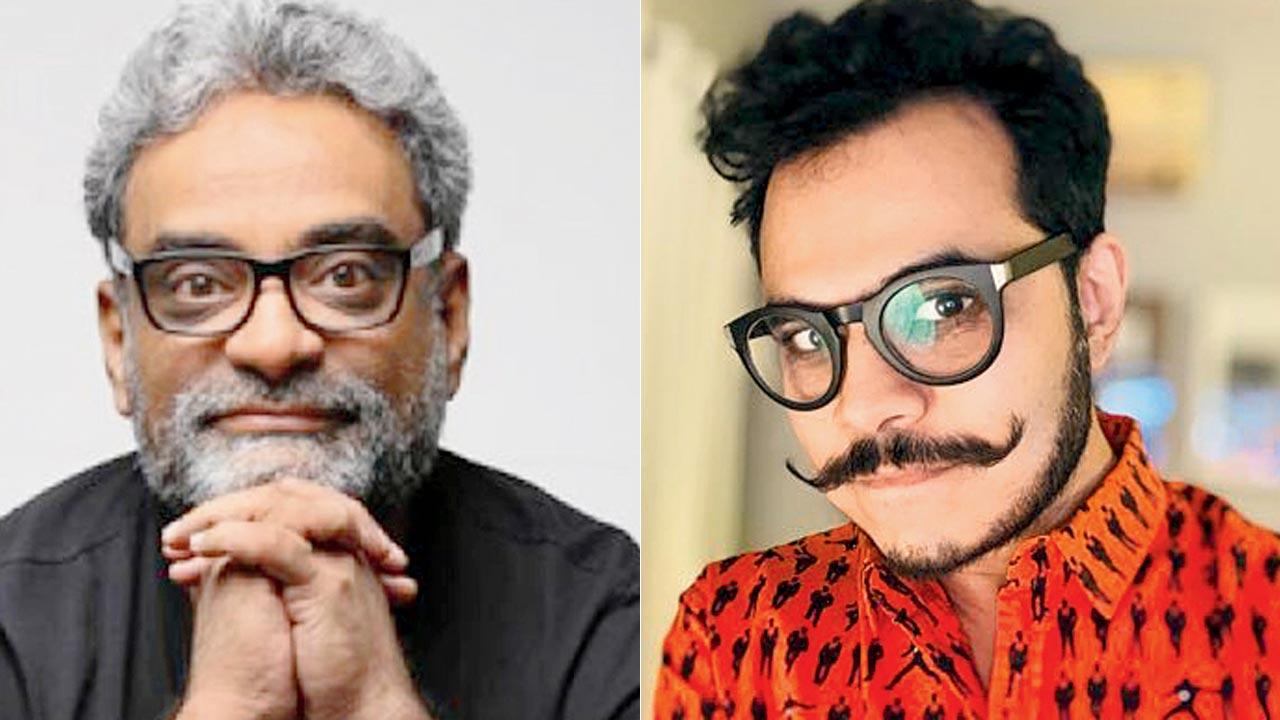
With Chup revolving around reviewers being killed, director Balki explains why he roped in one of his harshest critics to co-write the film
Mohar Basu (MID-DAY; September 28, 2022)
R Balki remembers that one of the early reviews of his directorial debut 'Cheeni Kum' (2007) was so scathing that he stopped reading them altogether. It’s almost his way of delivering poetic justice that in his latest film 'Chup: Revenge of the Artist', a serial killer attacks movie critics. “How can it be such an unfair world where someone can write something and get away with it? It is sometimes agenda-based. I thought of this story in 2010,” he begins.
Even as he sat down to write the script of the Sunny Deol, Pooja Bhatt, Dulquer Salmaan and Shreya Dhanwanthary starrer, the filmmaker knew it had to be a balanced narrative. He didn’t think twice about reaching out to film critic Raja Sen.
“Rishi [Virmani, writer] and I discussed that it’d be nice to have an outside perspective on it. I had not read Raja’s reviews until then. When I called him, he was blown by the idea. I took two days and read everything that has ever been written about me. I discovered that Raja has trashed me the most. It was beautiful to sit in front of someone who trashed you, and start murdering him on paper,” he laughs.
Balki believes the purpose of getting a film critic on board was served, as the movie argues both sides of the case. “I didn’t want to make it from a filmmaker’s point of view alone. What the other side thinks needed to be included as well. Raja gave me insight into what critics feel when they are critiquing.” The intention behind the thriller was to evoke respect for cinema, adds the director.
“As an audience, they have the agency to say what they feel. But a critic is supposed to be sensitive to the art, and guide people to understand the conversation the film is trying to have. He is not the judge.”
Irrfan Khan is a poem. A poem he himself read out loud-Raja Sen
8:14 AM

Film critic Raja Sen pays tribute to the actor who strove for the precise pitch and could make every gesture appear special
Raja Sen (MUMBAI MIRROR; May 3, 2020)
Cocaine. It was the first thing I spoke to Irrfan Khan about. It was 2006, on the sets of Life In A Metro. 20-something and childishly eager, I asked whether he’d done cocaine in order to play an addicted stockbroker in his last, Yun Hota Toh Kya Hota? “Yeah,” he nodded, “I had to.” The recorder was on. Irrfan saw my face and laughed. “See, as an actor you have to understand what it does. To your behaviour, movements. It was new to me toh… examine karna pada.” He didn’t enjoy it (“kaafi hectic hai”) and I wondered why he’d do that for a middling film. “Because it is new! Ek nayi cheez… Why else do we act, yaar? Plus, the film is by Naseeruddin Shah. Who knows what he will notice? What he will expect?” I remember the way he tapped his nose. “Isiliye… homework.”
The way he tapped his nose. Those words make you picture him, visualise how he must have done it, that ephemeral Irrfan-ness rendering the moment impossible to forget or mimic. Where do we begin to talk about an actor who made every gesture special? Perhaps one hails the movements themselves: the way Irrfan sculpted the silent beats, the way he reacted to actors around him when they spoke, the way he let his eyes do the heaviest lifting. Good actors deliver loaded dialogue in ways that make the words sing — Irrfan made us read between the lines.
In The Lunchbox, he unwraps food from a brown paper bag and picks up a novel as he eats. The care with which he smoothens the dog-eared page and straightens his spectacles before he starts shows how ritualistically the widower has done this for years. In Slumdog Millionaire, he supervises the electrocution of the young hero, but finds an instant to look away, discreetly and distastefully. In The Darjeeling Limited, as a villager whose young son’s body is brought to him, his first alarmed act is to lift the entire body, hoisting the boy’s chest to his ear like an errant pocketwatch, to see if he still beats. In Paan Singh Tomar, he collapses after breasting the tape in an early race, taking a telltale pause before he falls, as if looking to see if it’s okay to let go, okay for the runner to finally fall.
Irrfan is a poem. A poem he himself read out loud.
He strived for the precise pitch, the sur, the mot juste. There was always authenticity to be plumbed and sought, and he hungered both to learn and unlearn. He cultivated screen presence to deliver blockbuster punchlines, then discarded it to play an unassuming Bengali man. His was not a linear life, looping from early art cinema to popular television, from independent English films to Hindi masala to global art house success, and then, finally and delightfully, to a confluence of both, commercial and radical cinema hand in hand. The actor of his generation? That feels too prosaic for a man whose performances crept up on us, touching us in ways films or viewers could scarcely predict.
That Irrfan face. Those electric eyes, that slack jaw, the mouth ever ajar, especially in the earlier films, as if unsaid sentences live on the tip of his tongue. His words, deep and lyrical lines delivered with a languor that suggested his mind lay in a hammock. In the real world, he had the swagger of a cowboy, shoulders preceding footsteps, but on screen it was about those he played — the complicated, tentative, un-spotless men — and he gave up his gait for theirs.
In 2016, sitting at his new apartment and discussing the TV series Fargo, I asked him about winning an Oscar — a hypothesis that given his trajectory I considered an eventuality. “That is an award that can change everything,” he had said, briefly chewing on the idea. “It can open up every choice for an actor.” Ah, Irrfan… so many marks left unmade.
Talking to him was always a rush. The self-awareness, the philosophical digressions, the boundless curiosity — how he deconstructed a character, how keenly he engaged with criticism. Fingers perpetually busied with rolling paper, he spoke unhurriedly, with many an ellipsis, plucking the right phrase out of thin air. The mot juste. Even without cameras, there was economy and precision.
Think of Piku. Where he, as the owner of a transport firm, is stung as he sits in the driver’s seat with hired help in the front, while the clients sit behind. He looks pointedly at Deepika Padukone in the rearview mirror. It is a slippery moment; what, after all, is wrong with the boy sitting up front? Irrfan doesn’t glare, instead compels her by holding her gaze. Fury would make his character appear classist, but this quiet, unyielding indignation makes it evident Irrfan is feeling disrespected. He doesn’t start the car till he gets his way. Here, his way is to persuade the audience and win the benefit of their doubt.
That is a masterclass — and that doesn’t just mean something for actors to learn from. Great performers offer up mirrors to lives like ours so we can steal from their characters, from perspectives to mannerisms, from reactions to epiphanies. Irrfan Khan, conqueror of the unknown, gave us all so much to observe, so much to understand. His performances, his fluidity, his tenderness, his existential silences. Thank you for the movies, Irrfan. Thank you for waging a war against the obvious. We’ll watch you forever. We’ll learn, forever. Thank you for the… homework.
From Kal Ho Naa Ho to 2 States, here's how Bollywood has been stereotyping communities
8:32 AM

Stereotyping of communities in Bollywood was more prevalent several decades ago than now
Lisa Antao (DNA; March 12, 2017)
Last month, the Supreme Court refused to pass any order on a writ petition seeking a ban on jokes on Sikhs by advocate Harvinder Choudhary. Choudhary argued that the Sikh community needed a “vigorous” law to protect themselves from being the butt of jokes and asked the court to prosecute websites that carry ‘Sardar jokes’. The court questioned, “Why should the Supreme Court issue guidelines on how people should conduct themselves when they hear jokes?” and also argued that even if any order is passed, it’s impossible to implement it, asking, “Even if we issue guidelines, who will control it?”
If counted as a crime, then Bollywood has long been guilty of portraying and in the process, propagating community stereotypes. Sardar jokes and the stereotype of the goofy dim-wit Sardarji are found aplenty in countless Bollywood movies. However, in Bollywood, it’s not only the Sikh community, but also many other communities, which have been stereotyped galore. For example, the loud over-the-top
Punjabis, all South Indians are shown as idli-dosa eating Madrasis, mad- hatter Parsis, alcohol-swigging and plunging neckline-wearing Catholics to serious, argumentative rasgolla-gulping Bengalis.
Stereotyping of communities in Bollywood was more prevalent several decades ago than now. However, Bollywood doesn’t seem to be entirely purged off it. In recent years, stereotyping of communities has been done in movies like Kal Ho Naa Ho (2013), Finding Fanny (2014), 2 States (2014), Shaandaar (2015). We won’t state the obvious by naming the communities, you can do the math! We asked trade experts for their take on the subject.
A purpose for stereotyping
Amul Vikas Mohan, Editor Super Cinema says that stereotypes in Bollywood have always been there and are not limited to communities. The reason for them being there is to cater to the larger Pan-India audiences, and that they work for the movies. He explains, “Stereotyping works and it’s the reason filmmakers connect with the masses. If it’s an inside joke, everyone won’t get it. It’s never the intention of a filmmaker to hurt a particular community. Certain jokes are made about mannerisms about a particular community. For example, besides being known to be cheap, Sindhis are also known to be loud, rich, flashy and wearing lots of gold. And in the movie Shandaar, director Vikas Bahl has shown this. It made sense because everyone knows this.”
No exclusive targeting
Film critic, Raja Sen adds that there is stereotyping of communities in Bollywood movies, there are various cultural biases that tilt towards the North, which are inevitable. “However, Bollywood being an equal opportunity offender, has stereotyped various communities be it Punjabis, Bengalis or South Indians across the country. It’s not like only a particular community is being targeted. It’s nothing personal and doesn’t need to be taken so seriously,” he says.

Taking offence at the drop of a hat
Amul points out that nowadays people get offended too easily. “If a villain from a movie belongs to a particular community, it doesn’t mean that everyone has begun hating that community. Targeting a particular community is not the motive here. If there aren’t stereotypical jokes in movies, it won’t be funny for the masses,” he says.
Sen says that stereotyping has been going on for a long time now in Bollywood. However, the bigger sin is making bad jokes in movies. Being unfunny is worse than being politically incorrect. “Today, people are taking offence for anything and everything and filing PILs. In that case, even we film critics should file PILs against filmmakers for making bad jokes, bad movies and incompetence. In this quest to please everyone, freedom of speech and creativity is being curbed,” he laments.
Purely for entertainment purposes
Akshaye Rathi, film exhibitor and distributor minces no words and opines that movies are made for entertainment and not for spreading social messages. “Let’s be absolutely clear that movies are not meant for education or to urge people to not to smoke, not to consume alcohol and so on. Movies are purely meant for entertainment. Take the example of displaying those ‘No Smoking’ health warnings before the screening of movies. Has anybody actually quit smoking because of those disclaimers?” he questions.
“Movies are a form of entertainment for the masses. It’s a route for escapism from reality. And let’s just leave it at that. Even these No Smoking health warnings is just tokenism. It has no impact on people. It’s unfair to microanalyse movies like that,” says Rathi. He goes on to cite examples of stereotyping of communities in movies like Kal Ho Naa Ho, of the Gujarati community and in Shandaar, of the Sindhi community in a light-hearted manner. He further adds, “In a comic scene, there’s a joke on a character and that character belongs to some community or the other. Nobody wishes to make a movie to target any community in a negative light. People need to take this with a pinch of salt! It’s entertainment after all!”
Need intelligent humour
Amul does acknowledge that filmmakers and the audience too, need to grow a sense of humour. “Having said that stereotyping does work in Bollywood, personally, I feel that it’s not the right way to go. Filmmakers today need to do away with stereotyping. They need to raise the standard of humour by cracking intelligent, smart, witty jokes,” he says, adding that today’s younger audience is into intelligent humour.
Why is Aditya Roy Kapur making the wrong choices?
7:57 AM

A young director who was on the verge of casting Roy Kapur thinks it’s an error of judgement
Subhash K Jha (DNA; January 20, 2017)
It looks like a sorry 2017 for Aditya Roy Kapur. Not that 2016 or 2015 were any better for him. In 2014 Aditya had a big box office dud with Yash Raj Films — Daawat-e-Ishq, that sank. In 2016 he was in UTV’s big budget bonanza Fitoor, that bombed. And now he began 2017 on the wrong note with Ok Jaanu with Karan Johar that has got a lukewarm response.
A young director who was on the verge of casting Roy Kapur thinks it’s an error of judgement. “Aditya thinks he’s choosing correctly. But he’s choosing the correct banners, not the scripts. By simply opting to work with Yash Raj, UTV or Karan Johar, he can’t ensure a successful film. Only the script can do that.” Says a trade analyst, “All he has to do is to choose the right type of films. He will learn from his mistakes. But yes has to pull up his socks NOW otherwise this industry is very harsh. They will write him off after one more flop.”
Says critic Raja Sen, “I haven’t watched Ok Jaanu, but judging from everything else he’s been in, I haven’t been at all impressed in any way by Aditya Roy Kapur.”
Butt, Seriously! CBFC chief Pahlaj Nihalani defends Ranveer Singh’s rear as seen in Befikre
8:16 AM

Subhash K Jha (DNA; December 13, 2016)
So Ranveer Singh’s butt is finally on display. It had to be in a Yash Raj film. When you are the biggest banner in Bollywood you can get away with bikini-clad heroines in every film and now repeated lingerie shots of the heroine (a lingerie peek in Baar Baar Dekho was censored) and even a butt-shot of Ranveer Singh in Befikre.
Says critic Raja Sen, “It is just a matter of clout. If Mr Nihalani thinks it’s okay for people to kiss in Europe, why did he object to James Bond and Monica Bellucci kissing in Spectre? This CBFC has shown complete inconsistency and arbitrariness in their rulings. Everyone should be measured by the same yardstick.”
Censor chief Pahlaj Nihalani says it (the butt) was put in “a context” and also, a mere fleeting glance. “We shortened Ranveer Singh’s butt shot quite a lot. Right now it’s just a glimpse, no more. What’s wrong with it? He is alone with his girlfriend in a room. They are doing what couples do when they are alone. Why is a butt shot objectionable? We’ve allowed butt shots in some recent Hollywood films. Also in Madhur Bhandarkar’s Jail.”
Nihalani also rises to the film’s smooching spree’s defence. “See, unlike Ae Dil Hai Mushkil, Spectre or Tamasha where the kisses were done in lengthy shots, in Befikre the kisses are scattered and largely fleeting and all over the place. They are part of the narration. As a filmmaker, I know what can be cut without hampering the flow of the narrative. In Befikre there is no way we could cut the kisses without interrupting the flow of the story. Aditya Chopra has treated the kisses as part of the story. If we removed the kisses we’d be hampering the storytelling.”
He reveals that the kisses have been curtailed where they could. “We’ve cut all the close-ups of the kisses and the climactic kiss has been reduced by 50 per cent. The rest we couldn’t cut for apprehension of being accused of creative interference.”
Why Vidya Balan needs to reconsider her film choices
7:53 AM

Subhash K Jha (DNA; December 13, 2016)
Things are not really going well for Bollywood’s ‘female Aamir Khan’, as she has been labelled.
Vidya Balan’s pile-up of failed films at the box-office just got bulkier, with the eagerly awaited Kahaani 2 under-performing at the box-office. This is Vidya’s sixth flop in a row as a leading lady. Earlier, Rajkumar Gupta’s Ghanchakkar in 2013, Saket Choudhuri’s Shaadi Ke Side Effects, Samar Shaikh’s Bobby Jasoos, Mohit Suri’s Hamari Adhuri Kahaani and Ribhu Dasgupta’s Te3n also failed to ignite the box-office.
The film industry’s faith in her copious talent has not translated into footfalls at the theatres. All eyes are now on Begum Jaan (Srijit Mukherji’s Hindi remake of his own Bengali blockbuster Rajkahini) where again Vidya plays the central role. The film opens in March 2017. Srijit says, “Every film has its own destiny. I am not worried at all. Besides, I hear Kahaani 2 has broken even.”
Trade expert Atul Mohan has a pessimistic opinion on why Vidya’s career is on the downslide. “Vidya’s choice of films can be debated. Some — actually many of them — were bad.” Film critic Raja Sen jumps to Vidya’s defence. “I think Balan is a fine and respected actress who has chosen a few exceptionally poor projects. I think the answer lies not in questioning her status but in her doing more films more frequently. The hits will come, but we definitely need her on screen more often.”
But trade analyst Amod Mehra is harsh in his judgment of VB’s career prospects. Dismissing her career as extinct, Mehra says, “The only role she can now play is that of the late Jayalalithaa. Only a miracle can save her career now.”
Pyaar, Dosti, Etc 2.0: Films are reflecting changing definition of love & friendship for the youth
8:10 AM

The definition of love and friendship is changing for the youth and films are reflecting that
Chaya Unnikrishnan (DNA; November 19, 2016)
"I knew the world had shifted when Katrina Kaif and Shah Rukh Khan were shown having premarital sex in Jab Tak Hai Jaan, a Yash Chopra film. It was casual, and there was no comment on it. That’s when the landscape altered irrevocably,” declares well-known film critic Anupama Chopra.
Indeed, when Yash Chopra who’s known to epitomize romance incorporates premarital sex, it becomes a bold move, a defining moment. Something which his son Aditya Chopra has taken forward in the upcoming Befikre, the posters of which have the lead pair Ranveer Singh and Vaani Kapoor smooching in different positions! The trailers too promise some no-holds-barred make-out scenes between the two, who strike up a friendship in Paris and just hang out with sex on their minds — friends with benefits, anyone?
The recently released Ae Dil Hai Mushkil questioned the very definition of love and friendship — pyaar mein junoon hai, dosti mein sukoon — sparking a debate across generations. If in Kuch Kuch Hota Hai, his 1998 debut directorial, Karan Johar showed that you can’t be friends with someone you are in love with, in ADHM, he took a 180-degree turn and showed that a boy and girl can be friends and in love but it need not be a romantic relationship!
Clearly, pyaar and dosti have undergone a sea change in cinema and what was true just five years ago doesn’t hold water now.
Liberal outlook
Says noted film critic Raja Sen, “Earlier, there were certain things that the hero and heroine were not allowed and that line has been blurring over the years. Now, it has come to a point where audience is intrigued by more unconventional cinema, by relationships that are more casually and interestingly depicted.” Take for instance, the upcoming Dear Zindagi. From what we see in the promos, it is evident that Alia Bhatt’s character goes through three romantic relationships and later seeks the guidance of Shah Rukh Khan, who plays her life coach. As Rajeev Masand, Entertainment Editor, CNN-IBN says, “Though I can’t gauge exactly what it is about, it’s definitely a new language, very different from what we were used to seeing back in the day.”
Sex and sexuality
Sex is no longer taboo in films. Since Khwahish that was publicised as the film with 17 liplocks, and Bhatts spawned the era of erotic thrillers, steamy scenes have become de rigueur. Yet, when a Karan Johar brings a gay character in mainstream cinema — Kapoor & Sons — without making it caricaturish and saddling it with clichés, or shows an older woman hooking up with a young lover in Ae Dil Hai Mushkil, it is a turning point. Aditya Chopra moving from pure romance in Dilwale Dulhaniya Le Jayenge to casual sex in Befikre, is a paradigm shift, the genesis of which was laid in his production Neal ‘N’ Nikki. Says Anupama, “Actually it was with DDLJ that the whole exploration — the question of love and friendship — started. It’s not an overnight change, it’s an ongoing process. But yes, sexuality has definitely changed. Even the conversations that happened then (during DDLJ) have a different interpretation now.” Agrees Tushar Joshi, Editor, Bollywood Life.com, “The concept of love in 2016 is different from what it used to be. Films have overcome sexuality, genders and other boundaries set by society. The third spoke in marriage — the extramarital affair that stunned people in Kabhi Alvida Na Kehna is no longer a taboo. In Ae Dil Hai Mushkil, people talked about Aishwarya’s steamy scenes, but they were not shocked that a divorced woman is having a relationship with a younger guy.” Certainly not, when you have the oh-so-beautiful Aishwarya Rai Bachchan and the good looking Ranbir Kapoor doing the deed.

Targetting the youth
With 50 per cent of India’s population in the less-than-25 age group, youth has become omnipresent. The digital platform has already logged in with web series targetted at youth whose concept of love, relationship and marriage has undergone a radical change. Series like Bang Bajaa Baraat and Permanent Roommates which tackle issues close to them like live-in relationships, love and friendship have scored big with the youth. It’s the same demographic that is now the target audience of filmmakers. Says film exhibitor Akshaye Rathi, “Romcoms typically are focussed on the young urban market. With films like Befikre and Ae Dil Hai Mushkil, filmmakers are clearly trying to reach out to the young audience — identifying their taste-buds and catering to them — as they are the ones going to the multiplexes in a big way today.” The phenomenon began in the West eight years ago and five years back in India. Says Rajeev, “Filmmakers have recognised that the paying public is the youth. That is why you see so many superhero films, sequels and franchises in the West. These films cater to the young male demographic and the same thing is happening here.”

Alienating the older generation
While filmmakers haven’t entirely abandoned the older generation, the fact that it’s the youth which goes to the movies the most, is influencing the content. “Films make maximum business on the weekends and fortunately or unfortunately, it’s the youth that still believes in watching movies first day, first show. The elders do not want to rush or jostle for the movie, they will watch it aaram se or even wait for it to air on satellite TV and watch it at home. So, the films reflect what the young college kids want,” says Rajeev. He explains that even in the West, dramas have become fewer in number, coming during the year-end when the Oscars are closer, simply because the older generation is not going to the cinemas. But Anupama feels that all sorts of movies are being made, even dramas, “Some like Sooraj Barjatya go back to the traditional mould, which he projects in his cinema.”
Way ahead
Even as audiences debate over the daring content in cinema, and filmmakers fight with the censor board over cuts, Anupama feels that our cinema is still too timid. “It is not exactly reflecting the reality, when you look at how far urban India has moved in terms of sexuality. For me, the most startling moment was in Ae Dil Hai Mushkil when a younger lover is meeting his lover’s ex husband and the conversation flows in a somewhat mature manner. They are treating each other fine. Where do you have this in Hindi cinema?” It goes without saying that filmmakers have to move with the times and reflect what’s happening around us. As Akshaye puts it, “Kuch Kuch Hota Hai was a rage among the youngsters then, but today’s youth in their 20s with the kind of exposure they have will probably cringe at the film or find it cheesy.”
The Conjuring 2 outperforms the Hindi releases this week
7:49 AM

Subhash K Jha (DNA; June 14, 2016)
 They’ve done it again! One of this week’s
international releases, The Conjuring 2 has outdone the collections of
Hindi releases Te3n and Deepak Tijori’s Do Lafzon Ki Kahani.
 The first day’s box-office collection of Conjuring 2 at the Indian box-office was approximately Rs 4.25 crore rupees, as compared to approximately Rs 2.75 crore for Te3n and around Rs 1 crore for DLKK. A worried producer, who has a major release this year, says, “If this remains a trend, we’ll have to shut shop.”
Trade analyst Atul Mohan says, “Hollywood movies are generating a greater response than Hindi films nowadays. What I believe is that the cinema-going audience is the younger generation, which forms a major part of the population today. The alarm bells are getting louder and louder. The audience wants time-pass and if Hindi films cannot give it, they will patronise Hollywood films.”
Says film critic Raja Sen, “I think Te3n had very little buzz. There were hardly any promotions and people were unaware that it was releasing. Also the strange name might have been hard to popularise. I told people I had to review Te3n and they assumed I was going to watch three movies one after another.”
Anshuman Jha to romance Huma Qureshi, Swara Bhaskar, Pia Bajpai in X: Past Is Present
9:25 AM

Ankur Pathak (MUMBAI MIRROR; February 10, 2014)
 Anshuman
Jha, who shot to fame with Dibakar Banerjee’s Love Sex aur Dhoka, has
four films coming up, the most interesting being X: Past Is Present, the film, helmed by
11 directors. The actor appears in three segments in the film directed
by Nalan Kumarasamy, Hemant Gaba, and critic-turned-filmmaker Raja Sen.
He is seen playing three different ages and romancing three seperate
girls. Jha confirmed the news saying, “Yes, it’s Swara Bhaskar at 16,
Pia Bajpai when I’m 20 and Huma Qureshi when I turn 25. It’s a great
learning experience wooing women older than me,” he laughs adding that
they shot these portions in three different metroes, Chennai, Delhi and
Mumbai.
Which woman did he connect with best? “Huma, since I knew her from my theatre days. We were to do a play Fire in the Rain together, but it didn’t work out,” he says, recalling that while shooting at a Bandra apartment the floor suddenly collapsed. “I was traumatised, thankfully, Huma wasn’t present and nobody was hurt.”
How celebrities, critics react to trolls, hate comments by fans
9:23 AM

Upala KBR (DNA; February 1, 2014)
Trolls are the latest online monsters sabotaging Twitter feeds or Facebook posts with their abusive and angry comments. Usually anonymous, trolls tend to drive their victims crazy — to a point that many a times they delete their original post, which led to trolling. Celebrities have been prey to vicious trolling by many people on Twitter — some of which even include rival camp fans of stars. We speak to some high-profile celebs and film critics who get trolled almost regularly and how they deal with them. Read on...
Raja Sen (Film critic)
 I
can’t think of one tweet per se that has sparked off rage among my
easily-infuriated readers, but being dismissive of Salman Khan usually
gets them frothing at the mouth pretty quick. As a film critic, I’m more
than used to being vilified by people who take stars (and, indeed,
star-ratings) far too seriously. I might have been appalled if the
criticism was coherent, but as a friend once said, ‘I’ve made enemies
among the ungrammatical’. Which is something I can more than live with. I
never block people. That makes the trolls more determined to ruin your
day. It’s easiest to shrug off the nonsense. While it’s easy to label
Salman fans the most vociferous of the lot, I think the Theseus-tards,
if I may, are just as bad as the bhai-tards.
 Komal Nahta
Anything you write about Salman Khan and Shah Rukh Khan, that is perceived as being detrimental to their interests, will evoke a reaction from their fans. Even if you don’t tweet anything against them but just mention that SRK’s film has done so much more business than Salman’s, fans will troll against that. I never block anybody. In extreme cases sometimes I hit back by replying and show them the mirror. I am not scared of trolling and I expose them by showing how idiotic their abuses sound. But mostly I ignore the trolling.
Taran Adarsh (Film critic)
 I can’t
pinpoint but the maximum trolling is when you write about Shah Rukh and
Salman or when I have written reviews on films like Besharam or written
bad things about Akshay Kumar’s films. Sometimes, a rival website with
multiple IDs also troll my reviews. I have realised that you have to be
thick-skinned here. I never react to anyone. I have seen a lot of stars
deactivating their account because of trolling. I am also sensitive but
if you have to be on Twitter you can’t react. The moment you react you
are playing into their hands. I used to block people. Now I just ignore.
I am only doing my job and writing about what I like which is
Bollywood. Sadly Ajay, Akshay, Salman and Shah Rukh are so nice in real
life but their fans don’t realise that. All the top actors fan clubs are
so strong but I say one thing — instead of abusing and fighting, go and
buy a ticket and make the film a hit.
 Amul Mohan (Film production house, Manager Creative)
The best troll was when I wrote on not liking Anurag Kashyap’s The Girl In Yellow Boots and the film not making money. Anurag’s fan clubs and boys abused me a lot. Anurag called me and asked why was I doing this to his film. SRK trolls abused and even threatened me — some even wanted to kill me but I refused to back down! Salman trollers say I am biased and visit Mannat while SRK trollers say the same about Salman. I never block people. All fans are like that but some of the worst ones are of Katrina and Deepika’s.
Miss Malini (Blogger)
 It depends on
the current topic. People get passionate about anything on Twitter!
Deepika Padukone and Katrina Kaif fans are so polarised. Some are just
funny and sometimes I send a slightly cheeky message back. If I explain
my stance with logic they usually understand. The opposite of love is
not hate but indifference. I don’t block anyone ever. It’s hard to say
who are the worst fan clubs — I think Sussanne Roshan has been trolled
the most post her separation with Hrithik.
 Rajeev Masand (Film critic)
Any time you praise a film of a certain actor you get trolled by rivals. I wonder for someone as humanitarian, philanthropic and kind as Salman, how his fans can be so badly behaved? Salman and Shahid Kapoor’s fans are the worst on Twitter. They are very passionate fans and will abuse with passion.
Shobhaa Dé (Writer)
 I have a pretty simple
approach. I say what I have to say. And move on. I don’t read or respond
to comments. I don’t track anybody else’s accounts. It’s a democratic
space. If you can’t handle it, stay out.
Gul Panag (Actress)
When Gul Panag recently tweeted “Mr G may have many talents. The gift of eloquence is not one of them. Nor is articulation,” on Rahul Gandhi’s interview on a TV channel, she was trolled viciously. She says “I don’t get trolled as I am a troll slayer. There’s a reason that I am not afraid to voice my opinion. If somebody questions me I have the conviction to answer them and the gumption to stick to it. I hardly ever block somebody unless they become really nasty.”

Subscribe to:
Posts (Atom)