Showing posts with label Raja Hindustani. Show all posts
Showing posts with label Raja Hindustani. Show all posts
All three films are about ordinary people standing up against injustice-Sunny Deol
9:19 AM
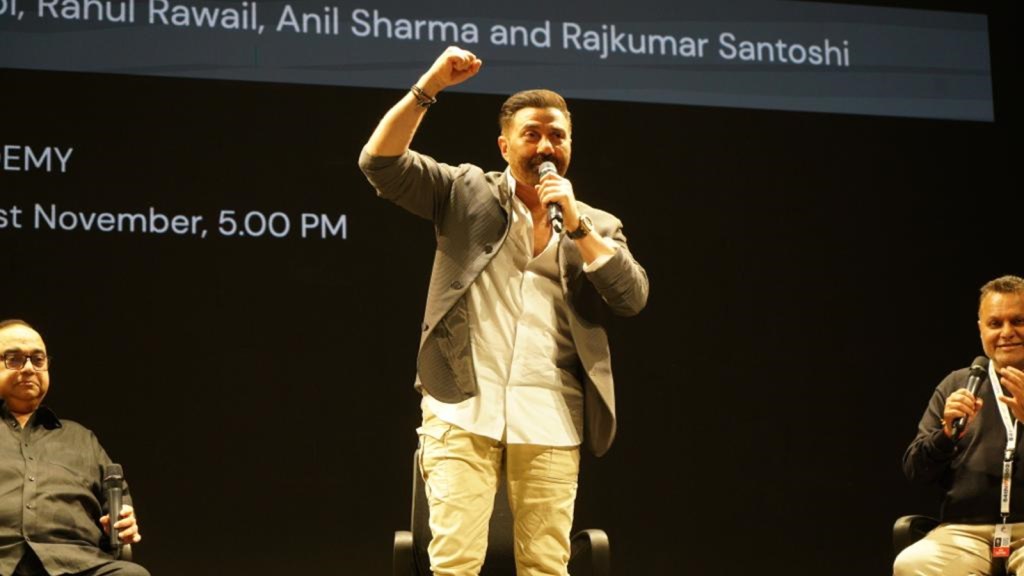
Sunny Deol and Rajkumar Santoshi weigh in on the theatrical re-release of their 90’s hits
Renuka Vyavahare (BOMBAY TIMES; July 23, 2026)
Sunny Deol and Rajkumar Santoshi have given Hindi cinema some of the most popular films of the ‘90s. As the actor-director duo reunites for Batwara 1947, a retrospective celebrating their collaboration will see three of their classics – Ghayal (1990), Damini (1993) and Ghatak (1996) – re-released in theatres from July 24. In an exclusive conversation with us, the duo reflects on their enduring partnership, iconic characters and why stories of ordinary people fighting injustice continue to resonate.
THE ANGER WORKED BECAUSE THERE WAS EMOTION BEHIND IT: SUNNY
Speaking about the re-releases and reuniting with Santoshi, Sunny says, “Our journey began with Ghayal, followed by Damini, Ghatak and now Batwara. We understand each other without having to explain too much, and that’s why our partnership works. There’s an unspoken understanding between us. All three films are about ordinary people standing up against injustice. Times and circumstances may have changed, but that fight never grows old.”
The actor is delighted that younger audiences will now get to experience these films on the big screen. “I don’t usually sit and watch my own films because I immediately start noticing what I could have done better. But seeing audiences, especially younger people, discover these films today is emotional. It tells you that an honest film never grows old.”
Talking about the characters he has played, Sunny says, “People remember the action, but I believe my real strength has always been emotion. The anger worked because there was pain, love or injustice behind it.”
I’VE ALWAYS SEEN THE VULNERABLE MAN BEHIND SUNNY’S STRENGTH: SANTOSHI
Recalling his first meeting with Sunny, Santoshi says it wasn’t the actor’s physique or screen image that impressed him the most.
“It was his honesty. There was an innocence, emotional sincerity and a quiet confidence about him. People see the anger, the action and the larger-than-life moments, but I’ve always seen the vulnerable man behind that strength. That fascinated me. Whether it was Ajay Mehra in Ghayal, Govind Srivastav in Damini or Kashi Nath in Ghatak, they were never superheroes. They were ordinary men pushed to extraordinary limits.”
For Santoshi, reuniting with Sunny after three decades felt surprisingly effortless. “It never felt like 30 years had passed. Both of us have lived through success, disappointments and personal growth.
He adds, “Sunny never tries to impress people. He listens more than he speaks and never wears a mask, which allows a director to shape the character instead of fighting the actor’s personality. He also represents a kind of masculinity that is becoming increasingly rare.”
Are Damini, Ghatak and Ghayal still relevant today?
Santoshi believes audiences may have changed, but human emotions haven’t. “Today’s audiences have access to stories from every corner of the world, but human emotions remain the same. People still experience injustice and betrayal. Earlier, cinema externalized anger through powerful confrontations. Today, it is more internal and psychological, but anger itself hasn’t disappeared. If Ghayal or Damini were made today, I would make them differently because cinema has evolved. But their emotional core would remain exactly the same,” he says.
Aamir and my films clashed at the box office, but I never saw him as a rival: Sunny
Aamir Khan and Sunny Deol have come together for Batwara 1947 — directed by Santoshi, starring Sunny and produced by Aamir. The collaboration is particularly interesting given their legendary box-office clashes over the years — Dil versus Ghayal, Raja Hindustani versus Ghatak, and Lagaan versus Gadar. How different is their relationship today?
Sunny smiles, “I never saw Aamir as a rival. Our films competed at the box office; we never did. Today, it feels wonderful that the same history has brought us together. He heard the story, believed in it immediately and backed it with complete conviction. We may be very different people, but our love for cinema is the same.”
Black & white classics to the ’90s favourites: Nostalgia’s a big hit on OTT
8:37 AM

Several OTT platforms are adding cult classics and evergreen blockbusters to their libraries, as viewers can’t stop watching, and rewatching, them
Niharika Lal (BOMBAY TIMES; August 20, 2022)
From series such as Mad Men, Friends and The Office to rom-coms of the ’90s and 2000s – streaming platforms have been offering a treasure trove of nostalgia to viewers. Streaming platforms’ heads say that they have been continuously expanding their library of old shows and films, keeping in mind the high engagement for this category of content. While in pre-streaming years, reruns on TV were quite common, today streaming platforms are rushing to create a library because the classics have a dedicated fan following.
Mansi Shrivastav, Senior Vice President Content Acquisitions, Alliances & Distribution, MX Player says, “People prefer watching evergreen blockbuster movies that score high on recall and familiarity. Besides, cult classics serve as a breather and become an easy solution to ‘what to watch?’ On MX, library movies from the ’90s and 2000s from both Hollywood and Bollywood are among high-performing content categories.”
Bollywood titles such as Andaaz, Raja Hindustani, Soldier and Baazigar; and Hollywood movies such as Anaconda, Karate Kid, Stuart Little and Street Fighter are popular on the platform.
A Netflix spokesperson adds, “Fans in India love the ability to watch and rewatch their favourite films and shows. We have been building a selection of licensed films and series from across the world from evergreens such as Dil Chahta Hai to international hits like Spider-Man: No Way Home.”
Popular nostalgic content on the platform include Friends, The Twilight Saga and Zindagi Na Milegi Dobara.
Manish Kalra, Chief Business Officer, ZEE5 India, says that nostalgic content always had its audience, but its availability and accessibility were limited before streaming platforms. He adds that they have witnessed that the audience is interested in older content. “The growth of in-home entertainment technologies and the popularity of family watch-time have lured back audiences to binge-watch titles from ’90s and 2000s, which, therefore, generate a sizable amount of engagement,” he adds.
Hindi TV serials of ’90s and 2000s like Hum Paanch and Hip Hip Hurray are popular on the platform.
On MUBI, there has been engagement on films by iconic directors like Krzysztof Kielowski, Satyajit Ray and Agnes Varda. A spokesperson from the platform says, “The reason nostalgia brings audiences together is that there is a sense of comfort and familiarity and we have an extensive library of renowned classics and movies by legendary filmmakers.”
French films top the popularity list on the platform, followed by English and Hindi. The platform has classics like Awara, Mirch Masala, and Salaam Bombay!
Covid claims Bollywood composer Shravan Rathod
7:57 AM

THE TIMES OF INDIA (April 23, 2021)
From Husnlal-Bhagatram to Shankar-Jaikishan, from Kalyanji-Anandji to Laxmikant Pyarelal, Hindi film industry has a rich tradition of musical partnerships. Nadeem-Shravan forged an illustrious link to this abiding chain composing a staggering bunch of chartbusters in the 1990s. On Thursday evening, the alliance was snapped forever as the Coronavirus claimed the life of Shravan Rathod at a Mumbai hospital. He was 66.
Speaking to Bombay Times, Nadeem Saifee said, “My Shanu is no more. We have seen an entire life together. We saw our highs, we saw our lows. We’ve grown up with each other in many ways. We never lost touch and no physical distance could ever separate the two of us. I am in deep pain as I say this but my friend and my companion, my partner of so many years is no more. It has left such a vacuum.”
The pair started off with ‘Dangal’ (1977), the first Bhojpuri film made in colour. ‘Kashi Hile Patna Hile’, a reworked version of the popular folk track, ‘Aarah hile Chhapra hile’, became a sensation. The two graduated to Hindi cinema in the 1980s.
Tuneful melodies for films such as ‘Maine Jeena Seekh Liya Hai’ (1982) got them work but major success eluded them.
The duo hit the jackpot with Mahesh Bhatt-directed ‘Aashiqui’ (1990). Every song in this intense romantic drama, from ‘Dheere dheere se meri zindagi mein ana’ to ‘Bas ik sanam chahiye’—rose to the charts. The film also vaulted Kumar Sanu, who sang a majority of the tracks, to the top. Nadeem-Shravan became a hot property.
The 1990s belonged to them. ‘Saajan’, ‘Deewana’, ‘Dil Hai ke Manta Nahi’, ‘Phool aur Kaante’, ‘Hum Hain Rahi Pyar Ke’, ‘Raja Hindustani’ and ‘Pardes’—they lorded over the decade blending old school melody with modern instrumentation. Songs such as ‘Mera dil bhi kitna pagal hai’ (Saajan) to ‘Pardesi pardesi jaana nahi’ (Raja Hindustani) to ‘Do dil mil rahe hain’ (Pardes) were as popular among the college crowd as the truck drivers on the highway. The pair won the Filmfare award three years in a row, 1991-93, for ‘Aashiqui’, ‘Saajan’ and ‘Deewana’ and again in 1997 for ‘Raja Hindustani’.
It seemed that the two would rule over Bollywood for another decade or two. But things were never the same after Nadeem’s name cropped up in the killing of a music baron and he fled to London. The duo still kept providing scores together in films such as ‘Kasoor’ and ‘Dhadkan’. The two split once, then reunited. This time, sadly, the separation is final.
Censors passed the kiss in Raja Hindustani with 'U' but I had to cut a few frames to reduce the film's duration-Dharmesh Darshan
8:19 AM

Roshmila Bhattacharya (MUMBAI MIRROR; November 14, 2020)

Interestingly, Raja Hindustani had what was the longest kiss in Hindi films at the time, between Aamir Khan and Karisma Kapoor. Dharmesh reveals that he had kept it a little extra at the behest of the producers, who were expecting some editing from the censors. “But they passed it with a ‘U’ certificate and not a single cut. Eventually, I voluntarily cut a few frames from the kiss because the market wanted the three-hours-twenty-minutes film shortened by 20 minutes,” he says.
While he doesn’t mind shortening the kiss without it losing its impact or inviting catcalls, he was heartbroken to leave out a dramatic sequence when on learning that he’s a father, Raja comes to the city to meet Aarti and despite her being out with the baby, barges inside into her room where seeing the cot, toys and clothes, he breaks down. Sensing an opportunity to further drive a wedge between the couple, Aarti’s stepmother Shalu provokes Raja and when he hits out, has him beaten and thrown into a gutter, following which he kidnaps his child. “We’d shot the scene over five days and both Aamir and Archana (Puran Singh) as Shalu were terrific. When I went to Film City to tell Aamir I’d decided to leave it out, he started weeping. I told him that I should be crying too, since I’d written and directed it. But even without that scene, Aamir swept all the popular best actor awards. Maybe that might have won him a National Award,” Dharmesh chuckles wryly.
He also chopped out a silent, almost Chaplinesque sequence of Raja climbing into Aarti’s bedroom through the open window, after a bee, determined that it would not disturb her sleep. “Then, I replaced a song, ‘Tu Bhool Nahin Payegi Mujhko’, getting Kumar Sanu to sing another version of Udit Narayan, Sapna Awasthi and Alka Yagnik’s ‘Pardesi Pardesi Jaana Nahi’ instead. I recorded it with Sanu and Alka alone because Nadeem ji was travelling and Shravan ji was engaged,” Dharmesh reminisces. “Pardesi Pardesi” bagged Udit, Alka and Sameer the Filmfare Award for best playback singers and best lyricist respectively. Nadeem-Shravan were adjudged best music director and Sanu lists it among his best songs.
Karisma also took home the Filmfare Black Lady after being voted the year’s best actress. Dharmesh had planned the film with his Lootere heroine, Juhi Chawla. After she dropped out over some issues with the producers, he thought of his cousin, Pooja Bhatt, who had teamed up with Aamir in Dil Hai Ke Manta Nahin, but the duo hadn’t done another film after that. “I had not written the second half then. When the script was ready, we took it to Aishwarya Rai who had caught the eye in an ad with Aamir. Raja Hindustani was to be her Bollywood debut, but then, as part of her Miss India contract, she went for the Miss World contest, won the crown, and was out of bounds for a year. Since we didn’t want to wait, Karisma entered the picture,” he recounts.
Like he had done with Juhi in Lootere, and later Shilpa Shetty in Dhadkan, Dharmesh transformed Karisma, getting the blue-eyed actress to use hazel lenses, sitting with her make-up man and hair stylist to give her a different skin tone and a different hair style. “I even went shopping with Karisma, insisting that, for the wedding, she go with copper tinted pastels instead of the traditional pinks and reds. Karisma and Babita ji were a little upset but the outfit soon became a rage with brides-to-be and the song ‘Aaye Ho Meri Zindagi Mein’ played at every wedding. I had studied Oscar-winning costume designer Bhanu Athaiya’s work and had Hollywood actresses like Jennifer Lopez in mind for the western clothes. And Karisma became a fashion icon 36 years after her aunt Sadhana, her chiffon saris, dresses and salwar suits setting new trends,” he exults.
One short of a silver jubilee, Raja Hindustani’s music still echoes in collective public memory thanks to its evergreen score. Sanu and Alka’s “Pucho Zara Pucho” played on the radio in a dhaba in Old Delhi in the Jane Campion-directed Holy Smoke, where Kate Winslet meets her mother who has come to India to convince her to return to Australia with her. And “Pardesi Pardesi” featured in Ethan Stoller’s BKAB (Speechful Mix), the 2.27-minute song which appears in the closing credits of the 2005 dystopian political action film, V For Vendetta, augmented by excerpts of speeches by Malcolm X and Gloria Steinem. The film features Hugo Weaving, the actor from The Matrix, The Lord Of The Rings and The Hobbit trilogies, and Oscar and Golden Globe winning actress Natalie Portman of Star Wars, Black Swan and Closer fame. Woah!
This is hopefully the last time people talk about a same sex kissing scene-Jitendra Kumar
8:23 AM

Riya Sharma (BOMBAY TIMES; February 19, 2020)
 He wanted to do an entertaining romantic film, and in Shubh Mangal Zyada Saavdhan, Jitendra Kumar is doing exactly that. The only difference is, instead of romancing a girl, he will be romancing Ayushmann Khurrana. In a chat with us, Jitendra says that SMZS is actually a love story between two individuals with a family bhasad. From addressing homophobia in the film to his family’s reaction to his character, the actor talks about how the film aims to normalise same-sex relationships. Excerpts:
You play Ayushmann Khurrana’s love interest in Shubh Mangal Zyada Saavdhan — was it a calculated risk?
There was no calculation. I got to know that the makers were thinking of casting me in a film on a same-sex relationship, I met them and read some scenes with our writer-director Hitesh Kewalya. Hitesh could see in me what he wanted from the character. Then, I met Aanand (L Rai, co-producer) sir, did one more reading and I was part of the film. I was more keen to know how the story has been written. They were sure that I was the right person to play the character but I wanted to know more about the story. When I got to know the entire story, I really enjoyed it. The most interesting part was how the topic (of same-sex relationship) was normalised visually in the film. Joh hum general ‘conventional’ romance dekhte hain between people of the opposite gender, waisa hi romantic feel iss couple ke saath hai.
Many actors talk about how certain roles can be emotionally draining. In the trailer, we can see your character being beaten and dealing with parental disapproval. You are going through the same emotions that many others go through when they come out to their families. How did you prepare for that emotionally, since your character did not require you to change physically?
I have a few friends who have come out to me. When I got to know their stories, I realised how badly they have been treated by their own family. Mujhe zyada pata nahi tha, par jab Section 377 pe verdict aaya I was shocked to know that having a same-sex relationship was considered a criminal activity till then. As far as the movie is concerned, jab bhi aap ek naya character karne ja rahe hote ho toh aap physically changes laate ho — the way you walk or talk. So I started watching videos of people who are open about their sexuality. While watching their interviews and talks, I also got to know about the pain they went through and I felt emotionally connected to them. Then I realised that there are many who are ‘normal’ in the way they talk and behave and I felt stupid that why was I even looking for such stereotypical things? In the script also, my character’s requirement was that he should look like any other boy.
In metros, people are becoming more open about same-sex relationships. How do you think people in small towns, like the one in which the film is set, will react to two men in love?
This film is about people who have homophobia. And we have no education on the topic. In our textbooks, we are only taught about reproduction with the opposite gender and we get to know about samesex relationships only through negative information. It has been seen as taboo for long, so obviously, people won’t accept it as something natural in a day. This story is about them. I think the movies that have been made so far on the topic have reached only those who already knew about it and were evolved. This might be the movie that reaches the small towns and cities of the country. Ek raat mein kuch nahi badlega par unhe ye zaroor feel hoga ki ek natural cheez hai. It is not even a choice, we say ‘It is a choice, let them do whatever they want to’. But it is natural for them to love people of the same gender. The audience will get to hear these things a lot in the film so I think the next time, they will be a bit more accepting if someone tells them that they are homosexual. People won’t be shocked, kyunki ye movie woh shock khatam karne ka kaam kar degi.
The film has been pitched as a rom-com but the topic is sensitive. How did you maintain a balance and make sure you didn’t offend anyone?
Hitesh had done that as part of the script. When we all heard the story, we felt it was like any other love story. Family ki bhasad hai par romance normal hai. There were a lot of discussions on the set, all of us would give inputs, add a particular word to a scene to normalise the topic.
Your kiss with Ayushmann is being talked about a lot. Why do you think it is such a big deal?
This is the first time the audience has seen something like this on the big screen, and it’s natural for them to react. I remember the kiss in Raja Hindustani (between Aamir Khan and Karisma Kapoor), people talked about it a lot as well. Whenever we see something new on the big screen that we are generally awkward to talk about, toh thodi baatein hoti hai. This is the first, and hopefully the last time, people talk about a kissing scene between two people of the same gender.
How did your family react to it?
When I was finalised to play this part, they got to know that I am doing a lead role in a romantic film, but thodi different romantic film. Of course, my parents were a bit awkward and they didn’t talk about it openly for two-three days, but they were happy. Later, we discussed it and they were okay with it. But I think log ab dheere-dheere evolve ho rahe hai. Jaise meri family, jo middle-class, small town se hai, unka reaction waisa nahi tha jaise maine socha tha. But it is okay for people till the time it is being shown in a movie or is happening with someone else. The real reaction would come when it would happen in our family, but ek raat mein nahi hoga, time toh lagega.

Karisma Kapoor is the epitome of a commercial film heroine, and I loved her films-Bhumi Pednekar
7:45 AM

Juhi Chakraborty (HINDUSTAN TIMES; November 21, 2019)
She is the poster girl of heartland cinema, and after four years and six films in Bollywood, actor Bhumi Pednekar is ready with her ‘most commercial film’ — Pati Patni Aur Woh. And, to hit the bullseye of popular cinema, the actor has taken inspiration from Karisma Kapoor — the leading lady of ’90s commercial Hindi films. Karisma’s 1991 family comedy drama, Biwi No 1, acted as a reference point for Bhumi.
Incidentally, Bhumi is a die-hard admirer of Karisma. “I’ve been a huge fan of her since I was a child. I even bought a dress that was similar to her attire in Raja Hindustani (1996). She’s the epitome of a commercial film heroine, and I loved her films,” says Bhumi.
Gushing about Karisma, the 30-year-old says, “She was outstanding in all comedies and Biwi No. 1 was a huge inspiration to me while I was preparing for Pati, Patni Aur Woh. Her transformation from a simple bahu to a firecracker in the film had bowled me over. She was my reference point to nail my role.”
Bhumi, who is thrilled to play a character similar to Karisma’s role in Biwi No. 1, adds, “It’s a dream come true for me to play a role so similar to hers. I thoroughly enjoyed playing the commercial film heroine for the first time in my career.”
I want to work for as long as I can-Kalpana Iyer
8:19 AM

Two decades after leaving to work in Dubai, “Rambha Ho” girl Kalpana Iyer appealed for decent, substantial roles on the social media
Roshmila Bhattacharya (MUMBAI MIRROR; August 5, 2019)
 Back in the eighties she turned “Hari Om Hari” into a disco beat, then, lip-synced to Usha Uthup’s distinctive, husky voice in the Bappi Lahiri-composed “Rambha Ho Ho” for Armaan to book a place in our collective memory as one of Bollywood’s hottest sirens. A former Miss India who went on to represent the country in the Miss World pageant and made it to the semi-finals, Kalpana Iyer featured in many more special appearance chartbusters, from Disco Dancer’s “Koi Yahan Nache Nache” to Raja Hindustani’s “Pardesi Pardesi”. Towards the end of 1999, she moved to Dubai.
For almost two decades, Kalpana disappeared from the public eye, surprising everyone on Saturday when she resurfaced on Instagram with a post, asking for work. It was not a desperate plea, rather it was a respectful appeal to friends to come through for her. “I have worked for almost my entire life and most of you know me so a CV, I believe, is not really needed for I feel that it would be self-glorification on my part,” she pointed out, proceeding to state in simple terms that she was looking for a job as she wishes to continue working for as long as she can. “I am eager and willing and sincere so please consider this as an appeal to lead my life with dignity,” she reiterated.
When Mirror reached out to her in Dubai, the veteran actress was her usual upbeat, feisty self, pointing out that she had voluntarily left India and Bollywood at the turn of the century even though the offers were still coming in , mostly for TV. “It is not as if I only wanted to do films. But after shows like Banegi Apni Baat, Junoon and Dillagi, the work that was coming my way was not exciting in terms of screen time and substance. Mazaa nahin aa raha tha,” rues Kalpana, who started her career with Rajshri Films’ Manokaamnaa in 1980, a love triangle featuring Shail Chaturvedi, Urmila Bhatt and her as the glamorous London-based fiancée of the hero. Incidentally, her last film before the hiatus was also a Rajshri production—Sooraj Barjatya’s star-studded family drama, Hum Saath Saath Hain, which she describes as a “sweet, decent role” and even though it wasn’t too long, she admits she had a lot of fun on the sets with co-stars Kunika and Jayshree T.
Soon after, a dear friend who was in the hospitality business, invited her to work in his restaurant as a manager and Kalpana migrated to Dubai “I hadn’t expected to stay away for so long. But I liked it there, and though I had a strict boss, I enjoyed the work. Since my family was with me, 19 years passed by in a flash. Around four years ago, the friend closed down his business, but I managed to land a job at another restaurant. Unfortunately, I lost that one too in June. Now, even though I am done with all my responsibilities and have no majboori, I don’t want to take it easy yet. I want to work for as long as I can, I want to stay young at heart,” asserts the sixty-plus lady.
She acknowledges that she’s been away for almost 20 years and since she was not desperate enough to issue any denials and clarifications, many of her former producers were led to believe that she was no longer open to acting and would never return to Mumbai. “There is no reason for me to quit showbiz. I am who I am today thanks to Bollywood and Mumbai. My doors have always been open, so has my heart, but kaam toh hona chahiye, na?” she reasons.
Urged by friends who have been telling her for a while now that it’s time to return home, Kalpana put out the Instagram post and is encouraged by the overwhelming response it has received. “Since I don’t live in Mumbai, this was the best way to catch the public eye,” she says.
In 2017, National Award-winning actress Neena Gupta, then 62, had shared a beautiful picture of hers on the social media with the caption, “I live in Mumbai and working as a good actor looking for good parts to play.” She was rewarded with a strong role in Badhaai Ho as a woman on the wrong side of 40s with two sons in their 20s, who suddenly discovers that she is pregnant again. It bagged her the Filmfare Critics Award for Best Actress. “I want roles like that, roles that are decent in terms of footage and have substance. The budget is not important, nor the platform. Apart from films, there’s a lot happening in television and on the digital media too, I am open to any kind of work. Things are far more professional today, a system is in place, the younger lot is enthusiastic. These are good times for actresses, for women, even those who are over 60. It’s a truly good space to be in so I thought, why not give it a try. Working is my passion, I feel alive and happy when I am busy. After all these years, it’s hard to sit at home with my feet up,” she asserts.
In April 2018, Kalpana had been invited to the launch of Filmfare Middle-East. The editor, Manju Ramanan, had promised that they had a surprise in store for the actress. She did turn up but had hurt her knee badly and was on her way out early when she was persuaded to return to her seat. “Usha (Uthup) invited me to the stage and greeted me with so much grace and warmth, showered me with so much love,” she flashbacks to that evening. You remind her that she had gone “Bang Bang” too with Usha didi and she laughs, “I’ve sung and danced at stage shows before too but that act was not planned. It just happened.”
Any calls from Bappi Lahiri after that impromptu performance? “No, but he knows if he has something for me, I am waiting,” she avers. So, in this age of remixes and remakes can we hope to see her grooving to “Rambha Ho” again? “These days the girls are so slim and trim. If the audience is okay with a plumper Kalpana doing a 'Rambha Ho' I’m game,” she quips.
Quiz her on career highpoints, and she says every single film was an enjoyable experience. “I knew no one, I had no godfather, yet the film industry was good to me, and I am not being diplomatic here. I truly have no complaints,” she asserts.
Kalpana has always been around for her family. But doesn’t she wish she had got married and had a family of her own? “I live with my younger sister. Her son is my son too. My other sister has two kids and they are my own. I have no regrets. It’s been a beautiful life,” she concludes on a high.

Kalpana Iyer in Pyaara Dushman’s ‘Hari Om Hari’; In Raja Hindustani’s ‘Pardesi’
Cinema is more important to me - huge screen, Atmos sound, a richer, larger experience, than a laptop-Aamir Khan
8:13 AM

Aamir Khan kicks off mid-day's unique conversation series, where Mumbai's most popular and sharp creative minds dig deep and decode their art and craft, before a select live audience
Mayank Shekhar (MID-DAY; October 27, 2017)
Aamir Khan came over, rather under-slept, stressing over the release of his latest film 'Secret Superstar'. He spoke in-depth on the economics and craft of filmmaking. And only two days later, he conquered the box-office yet again with 'Secret Superstar', maintaining an unrivalled cent per cent hit-rate as a Bollywood producer
Superstar, filmmaker Aamir Khan kicked off the first edition of Sit with Hitlist - a conversation series with India's top creative minds, before a select audience. We intended to host this freewheeling chat in an auditorium. Date and technical issues did not permit it this time. This was a budget version of 'Sit with Hitlist', held at the mid-day office. But as goes with low-budget ventures, with Aamir in it, we knew the word-of-mouth would ensure mid-day's brand-new property would be a huge hit! It was.
Excerpts from the conversation
The big news of 2017 was of course Dangal, and China. Producer Siddharth Roy Kapur's reason for the film's unprecedented success is the Chinese audiences sensed a common Eastern sensibility in the film's father-daughter relationship. Do you agree?
When I visited China and Turkey recently, I realised that their emotional key is very similar to ours. I carefully noticed the reaction that Dangal got in theatres in China. It was the same as for an Indian audience - they were laughing, crying, and clapping at the same points. There was no difference at all.
Is that true for Indians watching Chinese films? I am not sure I get that sensibility the same way.
Well, I saw Crouching Tiger Hidden Dragon [2000], and loved it. I was clapping and whistling throughout. I didn't come with any pre-conceived notions. I love Jackie Chan movies. I was in college, when I first saw Police Story [1985] - the action was unbelievable. And it's so humorous. I have connected with these films.

Aamir Khan in conversation with Mayank Shekhar at the first edition of Sit with HITLIST, before a live audience, at the mid-day office
Another theory is that the way the kids
get treated in Dangal, and how the father is determined to turn them
into champions, is similar to China - except the father is the communist
state, attempting to turn them into Olympic gold-medalists from a young
age. Do you see a connection?
I never thought of it like that. I've read reactions from Chinese audiences. They apparently watched the film, and desperately wanted to talk to their parents, right after. It is a personal, human connect.
I never thought of it like that. I've read reactions from Chinese audiences. They apparently watched the film, and desperately wanted to talk to their parents, right after. It is a personal, human connect.
Your personal global reach as an actor really began, thanks to the Internet. Is that right?
My assumption is that it happened with 3 Idiots [2009], which became a huge hit on the Internet. Rajkumar [Hirani] and Vinod [Chopra] got to know about it. Someone from China contacted us, and we released the film there a year later, by when most people had already watched it. They started looking for my other films, and now many of them have watched Taare Zameen Par [2007], Lagaan [2001] and Rang De Basanti [2006].

Considering the strong role of Internet, it was a surprise when I read somewhere that you are such a "big screen guy". Would you bypass something like Netflix?
I was talking about myself as a consumer, and not the creator, of content. As an audience, cinema is more important to me - huge screen, Atmos sound, a richer, larger experience, than a laptop. This doesn't mean I wouldn't want to do a Netflix, or TV series, when the quality is equally cinema-like. I have been asked by them [Netflix] to create something. Content for every platform is different. For Netflix, the content cannot be delivered in one session. The narrative needs to be episodic. I would be keen if something like that comes my way. I have watched Breaking Bad. It's my favourite. I like Game Of Thrones and House of Cards.
One of the central themes of your latest release, Secret Superstar, is how Internet can turn you into an overnight star. How do you compare that kind of stardom with yours, at a time when anything can go viral?
Some of the videos which go viral are one-offs, like a cat doing something funny. But then there are talents that people discover on the Internet - it offers great opportunities. The small-town girl in Secret Superstar has no access, but she is full of passion. She doesn't have to break into the limited distribution network anymore.

Back in the '90s when there wasn't so much talk about box-office numbers, how could you tell someone is finally a star?
From the time I was seven, I remember reading Trade Guide, and other box-office journals. We would check out the figures of dad's films, and there would be a circuit-wise break up. Within the industry, the [box-office] knowledge was always there, since cinema has always been around as a business. Today, mainstream media is picking up box-office figures, and that's a choice you're making.
In small towns, for instance, when people didn't know box-office numbers, one way to gauge stardom was if people had begun copying an actor's haircut. True?
There are many yardsticks for measuring how popular a star is. Copying style is one of them. I remember when Mr Bachchan became a huge star, I wanted to get bell-bottoms made like his. For me, it is essentially about how many seats one fills. It means that people love you and your work, and now they want to go and experience it. That's important. We often measure stardom by how big an actor's commercial successes have been. That is a faulty method. PK's or Dangal's business has to do with how great those films and their scripts were. It's incorrect to attribute that to my stardom. My stardom comes into play when I make a bad film that people don't want to watch. They still come because of my name. So if you want to measure an actor's stardom, you should check out how well his flop does.

Aamir Khan signs on a memorabilia, the original poster of his 1994 release, Andaz Apna Apna
In that sense, the Khans have dominated Bollywood for over 25 years. My question to you is: Do you remember the first time you met Salman and Shah Rukh?
The first time I met Salman was at Babla's [director Aditya Bhattacharya's] house, who made Raakh [1989]. Incidentally, Salman and I were in the same class for a year in the second standard [at St Anne's, in Pali Hill]. And we didn't know each other then! I was at Babla's house to discuss a short film called Paranoia, where I was the actor, spot-boy, production head, first AD - all rolled into one. We shot that film for a month. I was 15, and this is the first time I ever acted. Salman was cycling around in Carter Road. He knew Babla too. We stood in the balcony and talked. He told me about how he also wanted to become an actor. I thought of him as a sweet chap. Shah Rukh, I remember meeting briefly, when I was shooting with Juhi [Chawla], somewhere on the road. He had begun shooting a film with her [Raju Ban Gaya Gentleman]. Deewana [his debut, 1992]
hadn't released yet. He was sweet, and it was a warm meeting.
Clearly nothing momentous. Now one of the reasons 2017 has been considered a sub-par year in Bollywood is because the two top stars' films didn't do well - let alone break records. Do you think the film industry has been relying on the Khans for too long to bail them out every year?
There are other hugely successful stars - Akshay [Kumar], Hrithik [Roshan], Ajay [Devgn]…. The three of us [Khans] have been successful for quite a while; it's natural for the trade to bank [on us]. Sometimes films work, sometimes they don't. At one time, Mr Bachchan was huge. None of us will ever see the stardom he has. He once had eight films simultaneously doing really well in theatres. Trade would bank on him for seats and popcorns. Ideally, there should be more stars. But it's a natural process. Becoming a star is an intangible thing. What is it that people connect with me so strongly over? I have absolutely no idea.

Over a conversation in 2011, you'd told us about a bubble in the film industry, referring to studios that paid money assuming the highest possible returns. Effectively in 2016, most studios went bust. Did you predict this?
Who am I to predict? But it's bad business. Say, Dangal has done Rs 385 crore business, and I come with the next film that gets sold at Rs 400 crore, because a studio is willing to pay that much. They assume that my next will be as big or bigger than Dangal, which was huge to begin with. That's not sound business. A studio can't pay on hope. You have to invest on surety. If the lifetime of the last film is Rs 380 crore, then you know that the next will definitely make Rs 200 crore. The upside is then there for everyone to share. This is why I don't load my film with my fee. My model is that I don't charge any money. All the money goes into filmmaking, and fees, of everyone else. And then the first money [coming in] goes towards recovering the P&A [cost of print and advertising]. Eventually if the film tanks, I get zero. That's a risk I am willing to take. I'd rather lose.
And then if the film [Dangal] does Rs 1,300 crore [in China], means you get a good bulk!
Sure, and I bring that value to the table. Investors are completely secure. I take a sizeable chunk. When the film does Rs 1,300 crore, first the government takes a certain tax amount, and a major chunk goes to theatre chains, and the exhibition sector. It's the same with India, except in China, there are also rules on how much people from outside the country can take as share [revenues from a film]. It finally boils down to 12.5 per cent, which is still good.
Did you pick up a mansion from 12.5 per cent of Chinese box-office?
I am not good with money. I don't do investments and I have very few properties. Basically, my mind doesn't work in that direction. I am not a business savvy person.
You're certainly good at film business, with a 100 per cent track record as producer.
Creatively I don't want to mess with what I want to do. So, say, I want to do a Dhobi Ghat [2011], I'll make sure it's made in Rs 5 crore. For the investor, I know this [amount] will come back, and we'll make a little profit. Films will be profitable if you make them economically viable, and this gives me the freedom to make what I want.
Here's how you get it right each time: budgeting, great script-sense, making sure casting, locations are spot-on. The new thing I've learnt is how much emphasis you give to the audience testing the first-cut of your film. Unknown people repeatedly watch it in focus groups, whose responses eventually determine the final cut/edit. Isn't that losing creative control, almost like filmmaking by public consensus? Odd, no?
No. It's not [by] public consensus. I'm not going around asking people what I should do with my film - and they say cut this or that - and I make the changes. The whole basis of testing a film is that we have a story in mind that we're trying to narrate to you. I just want to make sure that what I'm narrating to you, is coming through. Or are you receiving something else? We become so close to our material that while making a film, we're not able to be objective enough to understand how it's being received.
Can you give concrete examples from your films where there was disconnect between what you were saying, and what was being received?
Let me give you two examples. Take Sarfarosh [1999] first, which was a cop film, about policing. At the test screenings, the consistent response was, "Where's the policing? We don't see any. He [the cop] is constantly listening to ghazals!" We were like, "How's that possible - there's the Khera Naka scene, with the entire action, his leg gets broken, he's in the hospital, where he dives, despite the injury - all those scenes were there." While we were befuddled, we knew this was a problem. So we added three scenes to the film. One, in the beginning, we raid a corrupt cop in the tribal belt of Maharashtra, where ACP Rathore [his character] goes through the phonebook, to get whereabouts of Sultan, which he gets after delivering a tight slap to the corrupt cop. Again, while searching for Sultan, we reach his mother's house, where I stop my colleagues from being rough with her. The third scene was about a raid, where we caught two guys, who we interrogated, but we were getting nothing out of them. This is when I fire at one of the guys, just so the bullet misses him. He spills the beans.
Wasn't that guy Nawazuddin Siddiqui [in a split second role, much before he became popular]?
That was Nawaz, which I didn't know! When I was working on Talaash [2012] with Nawaz, is when he told me, "Sir, I've already worked with you!" "Kab?" "Sarfarosh mein. Main wahi tha!" (laughs). So, after inserting those scenes, the problem [over showing policing in the picture] that we were constantly facing, disappeared overnight. Suddenly the film changed.
Another example?
Now the whole thought behind Taare Zameen Par was that one has to be inclusive. Every child has a problem, and you can't segregate them from other kids. What we were arguing for is that special schools should actually not be necessary. All kids should study in the same school. The reaction we would get is: "So, you're saying, Ishan is a special child, so he should study in a special school!" And we were clearly saying the opposite. As were all our lines. We realised there's some miscommunication here, and for the life of me, I couldn't understand why. Now if you remember, the film's title track is shot in a school for special children, where I teach. The school's annual day is going on. The kids are dancing in slow-motion, parents are hugging their kids, I've got tears in my eyes. This is when the song begins. From my face, the screen dissolves to Ishan's face, sitting all alone, lonely and low, in a [regular] boarding school. His parents can't come to meet him, because his brother has a tennis match. We then cut to the brother playing tennis, while his father is upset etc. A friend of mine, Amin Hajee, who played the mute in Lagaan, told me he thinks the problem is in the song: "You're looking at children getting so much love in the special school, and the image dissolves to Ishan alone. It seems you're saying he should be here, and not in a regular school." First I didn't agree with him, because that's not what I was trying to communicate. But, heck, let me try. So instead of dissolving from my face to Ishan's, we cut to the brother, who's not playing tennis well, and then brought in Ishan. We literally changed one thing over 30 seconds. That problem got solved. Nobody made the same point [about the film's intention] anymore. Now with dissolving my face with Ishan's, I wanted to communicate, sub-consciously, that he [Nikumbh, the teacher] actually sees himself in Ishan [he went through the same problems as a kid dealing with Dyslexia]. But I was failing in communicating that anyway. And I've been doing test screenings right since QSQT [Qayamat Se Qayamat Tak, 1989].
Showing the first cut to regular junta, from your first major film onwards?
Yes. Some of the reactions make sense, some don't. Many of which I already have answers to, since the film still has to go through post-production. Again, I'll give you a broad example. Often people say that from a particular point, a film becomes very boring: "The moment the song comes in second half, the film dips." Now most people will feel that they should cut the song. But that won't be the solution. You're feeling the weight over here [in the film's timeline], but the reason for that is somewhere earlier [in the film]. There's something wrong in your structure. You need to figure that out. It's like going to a doctor and telling him your symptoms. Can he treat that? No. He can treat your problem. Likewise, there is a dip in the second half, but the problem is somewhere in the first half, you need to treat that - either you haven't built up the plot properly, or the sub-plot is too weak. You need to understand where the correction lies. So it's not filmmaking by consensus. With Raja Hindustani [1996], we had a very bad reaction [from test audiences]. Dharmesh [Darshan] was like, "Oh God, we're finished!" I told him, according to me, you shouldn't change a single thing about the film. So it's a science: you have to know what to take, or correct.
But who did you show Raja Hindustani to? Can't be a Malabar Hill audience, they'll reject it anyway, it's too massy and hardcore.
Well, we showed it to a hardcore Hindi heartland audience. There was a wedding happening in Dharmesh's family, so people had come in from Punjab, Allahabad, and other places.
Another thing I learnt about you, from my childhood [guitarist] friend, who spent over 10 days in your Panchgani house, scoring music with Amit Trivedi, is that you're seriously hands-on. How important is it for a Hindi filmmaker to know his music?
I am not formally trained in music, and I am not involved in the music of every film, unless the producer/director invites me to be part of the process. When I was working with Mansoor [Khan] on Jo Jeeta Wahi Sikander or QSQT, I was very closely involved. As I am with the films I produce.
What do you mean by involved, do you make suggestions?
I react to the piece and convey to the composer what I feel. I might act out something to tell him what I want. Sometimes I do get technical. I have basic knowledge to make a few suggestions. In Secret Superstar, for instance, the song Main Kaun Hoon (sings it) was at one point going on falsetto. It wasn't sounding right. I requested Amit to change it. He obliged. We already had another track, Main Nachdi Phira, going into falsetto. We couldn't do it for two important songs.
You've spoken at length here about the science of filmmaking. How do you merge that with art? (Mohar Basu in the audience asks)
Let me fine-tune your question. It's not the science of filmmaking, but mass communication, because filmmaking may choose not to be mass communication, and then it won't follow these laws that you're talking about. You are trying to communicate to a whole mass, so you try and reach the common point among all these people. But that's not how I begin. While listening to a script, I become the audience. It's like you watching a film. And at that time, I'm just reacting emotionally to it. For example, when I heard the script of Delhi Belly, I was on the floor, laughing. At that time, I'm not thinking of the science. That happens when I start work on the script, with the director and writer, and say, I check: Have we locked our goal early enough? What is the premise of Delhi Belly? 'Shit happens'.
You keep a one-liner, always?
Yes. The premise and what the film is trying to say are important. A film may not be socially relevant, but it has to say something. So yes, do we have a clear enough premise? Do we want to sharpen it? Is my goal locked, well in advance? There are times when the film is going on and on, and you don't know where it is going, so you start losing interest.
Let's look at Lagaan. The premise is, "Rains aren't happening. You can't pay tax." Gora says, "Lagaan maaf kar denge, if you beat us in cricket." My character says, "Sharat manjoor hai." The moment he says that, my goal is locked. Now, as an audience, I know that cricket main harane wale hain. Now, that journey from goal-locking to the goal has to be exciting, difficult, with a lot of obstacles, which makes it even more exciting. At times, the main plot becomes too boring. Are the subplots getting over, before the main plot? Because if that's not the case, I'm not interested; having reached the goal. The end fizzles out. So these are the basic rules of mass communication in entertainment.
You emphasize strongly on emotional connect, is that something you seek in all your films? (Sonil Dedhia in the audience asks)
All. When I say emotional connect, I don't mean crying, because that's what people often associate with that word - "Oh matlab rona dhona hai." What I mean is some emotion is being tapped into - it's making you feel thrilled, giving you lots of stress, because suspense is an emotion being tapped into, in a thriller. Or it could be fear, because it's a horror film. So, the film connecting at an emotional level is important to me.
A distinction between art-house and mainstream, according to a filmmaking wit I once interviewed, is that with the latter, the audience knows exactly what's going to happen (they like that), while with the former, they don't. In fact, they don't even know if anything will happen in an art-house film at all.
I feel that in mainstream cinema, you should have a sense of where the film is headed. But at each stage, if you know what is going to happen, then the film becomes too predictable, and doesn't engage you enough. So it's important to surprise the audience.
Final question: Honestly, decode your character Shakti Kumarr in Secret Superstar. He's a sleazoid called Shakti, clearly named after Shakti Kapoor. He talks a lot like Anu Malik and Anil Kapoor, both of whom I saw at your film's private screening.
I've taken a lot from various people and built this personality. I've used Anil's style of talking a few times-like in the awards' night scene, where I say, "Awards lete lete thak gaya hoon main." When Anil says bye to you on the phone, for instance, he never says one 'bye'. He goes, "Okay, bye bye bye bye bye bye…". There are some things that stay with me. Jeetu ji [Jeetendra] once came to meet my uncle [Nasir Hussain]. I used to be his assistant at the time. And Jeetu ji is a fab guy, with a great sense of humour. He told my uncle, "Nasir saab, mujhe double role offer hua hai. Mujhse ek role theek se hota nahin, mujhe do role de rahe hain!" But he used a phrase then, "Dekhte hain. Buck up India!" Now whenever I meet Jeetu ji, he says, "Buck up India." He'd ask me, when is your movie releasing? I'd say, December. "Haan, buck up India!" I used that in the film! (laughs).
There's no Anu Malik in it, come on?
Now, don't ask me who all are in it. Okay, there's a little bit of Anu Malik. But I'm not mimicking anybody, because I can't do that.
I call myself a complete misfit-Dharmesh Darshan
7:54 AM

Dharmesh Darshan explains his unannounced sabbatical; why plans of Dhadkan 2 fell through.
Sanyukta Iyer (MUMBAI MIRROR; December 8, 2016)
On Dharmesh Darshan’s 42nd birthday on May 16, 2014, Ratan Jain, who’d produced his 2000 romance drama Dhadkan, featuring Akshay Kumar, Suniel Shetty, and Shilpa Shetty, asked him to announce a sequel. According to Dharmesh, he agreed to come on board as a “director making a comeback” out of sheer respect for his longtime association with his producer friend. Also, he figured he could give the second instalment a modern spin, mounting it on a much bigger budget than the original. However, two-and-a-half years since the film’s inception, Dharmesh has walked out of the project citing differences in negotiations. While he has seceded all association with the development of Dhadkan 2, the producers are now bringing on-board a newer, much younger director, Prem Soni whose last directorial was Preity Zinta’s debut production, Ishkq In Paris three years ago.
“Even though I had said ‘yes’ in principle, I wasn’t too sure after the negotiations that followed. There was a lot of back-and-forth and we worked on the terms of agreement for six months. I had absolutely no need to prove myself — over the years, Dhadkan has become a cult film as well as has made profits via satellite rights. I did not want to make a sequel just for the heck of it,” Dharmesh cleared the air to Mirror, further adding that he went on a sabbatical six years ago after 18 successful years in the film industry. “I was at the top of my game. My directorial debut, Lootere, released when I was 24 and was a super-hit. Four years later, Raja Hindustani made me a leading director at 28. My contemporaries, Aditya Chopra, Karan Johar, and Sooraj Barjatya decided to turn producers and my parents wanted me to follow suit but I didn’t want to chase money,” Dharmesh recalls, noting that he chose to make only seven films, including Mela and Haan Maine Bhi Pyaar Kiya, when he could have directed 70.
Aap Ki Khatir, the 2006 romantic comedy featuring Akshaye Khanna and Priyanka Chopra, would go on to become Dharmesh’s last directorial. On May 9, 2009, his mother, Sheila Darshan, daughter of Nanabhai Bhatt and the older sister of filmmakers Mahesh and Mukesh Bhatt, passed away at 69, making the director retreat into mourning. “My world changed overnight. Two-and-a-half years later, my father (Darshan Sabharwal) passed away on December 31, 2011. In 2007, I had two big-budget films lined up, one whose script I had already completed and was on the verge of taking to the floors. But I returned my signing amount and chose to go a sabbatical in 2010, and have been on a break for the past six years,” he explains, quick to add that there is much more to do besides making films, like teach, and travel and that he has no regrets since he has already broken all box office records of his time and made films like Raja Hindustani and Bewafaa that were “way ahead of their times”. And there’s another reason for his time-off from the film circuit. “In a time of money-hungry producers, everyone courts controversy and everything is about a person’s visibility and validity, I call myself a complete misfit. Fame, name and moolah came to me early on in life, and while they’re important to me as well, I’m not a businessman. Maybe I’m foolish or an artist with integrity,” he asserts.
While he continues to receive offers to remake films or direct sequels, he does not want to touch any of the classics because he believes it is “impossible to redo a soulful film.”
Today, he lives alone, without a partner or any children to cater to. “All artists live through the noise of a film set and the loneliness when in a crowd. While filmmakers manage to work through all kinds of emotions and situations, I cannot exhibit my grief and vulnerability on set. Neither do I crave for the attention anymore, nor do I mind the loneliness,” he says matter-of-factly.
Isn’t the lure of making a couple of crores a tad tempting or worthy of prompting a comeback soon? “Demonetization has proved that anything can happen to your wealth overnight. We’ll never know whether the filmmaker who chased it all was the right one or the one who gave it all up,” he signs off.
RIP Nanda: End of innocence
7:46 AM

Roshmilla Bhattacharya (MUMBAI MIRROR; March 26, 2014)
"Her tinkling laugh still rings in my ears,” says Lekh Tandon, when informed that 75-year-old Nanda had quietly succumbed to a heart-attack on March 25. The actor-director remembers her from the picnics at Guru Dutt’s Lonavla farmhouse where she held court with bestie Waheeda Rehman. The age-defying friendship started when the smiling face of ‘Baby’ Nanda on the poster of the Marathi film Shevgyache Shenga caught Waheeda’s eye every time she passed Plaza Cinema.
After her father, actor-director Vinayak Damodar’s death at the age of 41, Nanda became a child artiste to support her mother and seven siblings.
It was on the stairs of Central Studio that the two actresses first met. Nanda who was filming Naya Sansar greeted Waheeda who was shooting Kaagaz Ke Phool, but the actress was lost in thought and did not respond. The friendship of a lifetime might have been nipped in the bud, had the two not been cast together in Kala Bazaar.
Mohan Churiwala, a close associate of Dev Anand, reveals that Nanda was not keen to play his chhoti behen. Her uncle V Shantaram’s Toofan Aur Diya in ’56, followed by Bhabhi in '57, had slotted her as the long-suffering sister/sister-in-law. Buzz is that the stream of de-glam roles almost triggered off a nervous breakdown.
“Dev saab assured her that he'd cast her as his heroine in the next film and even though the writer of Hum Dono was pushing for Meena Kumari, he signed Nanda as the Major’s ailing wife, while Sadhana romanced the other Dev,” Churiwala says, adding that Dev was wowed by the fact that emotional Nanda continued to shed real tears 10 minutes after a rona-dhona was okayed in Kaala Baazar.
But despite the tears, Nanda was all laughter off-screen. Vijay Anand’s longtime chief assistant Prem Prakash recalls how much she and her elder sister Meena laughed during the narration of Kala Bazaar, recalling the directior as an actor in Agra Road who had accidently dropped his glasses during a comic moment.
 After Hum Dono, Dev signed her for Teen Deviyan,
whose English version, Oh Boy, Three Girls, that never released. These
hits were followed by the song-less Kanoon and
Aanchal which got her the Filmfare Award for Best Supporting Actress.
Suddenly, she was an A-lister but she was always ready to work with
newcomers. “She was lovely and innocent when we did Mera Kanoon Kya Hai,
no airs or tantrums,” says Dharmendra.
After Hum Dono, Dev signed her for Teen Deviyan,
whose English version, Oh Boy, Three Girls, that never released. These
hits were followed by the song-less Kanoon and
Aanchal which got her the Filmfare Award for Best Supporting Actress.
Suddenly, she was an A-lister but she was always ready to work with
newcomers. “She was lovely and innocent when we did Mera Kanoon Kya Hai,
no airs or tantrums,” says Dharmendra.Another newbie was Shashi Kapoor. They worked in eight films together, the third Jab Jab Phool Khile turned the tables for him. Nanda too broke away from her 'gharelu' image with her turn as a glamorous ‘pardesi’.
 Dharmesh
Darshan, who remade the film three decades later as Raja Hindustani,
remembers her admitting at a private preview that she’d wondered what
he'd do to her film. "But after watching it she said I’d made a better
film and liked that I reinvented her role so that Karisma Kapoor was not
just another pampered rich girl.”
Dharmesh
Darshan, who remade the film three decades later as Raja Hindustani,
remembers her admitting at a private preview that she’d wondered what
he'd do to her film. "But after watching it she said I’d made a better
film and liked that I reinvented her role so that Karisma Kapoor was not
just another pampered rich girl.”Later, she gambled with Yash Chopra's Ittefaq which saw her play an “immoral character”, who dies in the end of the film. Then after two more films with Rajesh Khanna, The Train and Joru Ka Ghulam, she announced her retirement in '72 when still at her peak. "She didn’t know how to play the politics and didn’t want to make compromises,” says Dharmesh.
She made an exception for Manoj Kumar, playing a small role in his Shor, followed up with two flops, Chhalia and Naya Nasha, then disapeared, only to return in '82 with Prem Rog, Ahista Ahista and Mazdoor. In all three she played Padmini Kolhapure’s mother. “We had an emotional bond and I'd visit her at her Carter Road bungalow and later in Versova," says Padmini. Ironically, in real life Nanda never married or became a mother.
Years ago, she'd planned a double wedding with Waheeda and insisted it would be a love marriage. She got engaged to filmmaker Manmohan Desai in 1992. They didn’t tie the knot in nearly two years. The relationship met a tragic end when on March 1, 1994, the director climbed the water tank on his terrace and jumped off.

She idn’t make public appearances and made this clear to Dev Anand when he invited her for the premiere of the re-released Hum Dono Rangeen. But she saw the coloured film with his family at a private screening at Ketnav Studio.
During the interval she came out smiling, eagerly awaiting the second half when she comes into her own. She exited the screen teary-eyed and dropped by to visited her co-star at his office two lanes away. “Dev saab hugged her, then much to her surprise, got emotional and started crying. The tears hadn’t stopped even when I returned after seeing Nandaji to her car,” remembers Churiwala.
May be he would have cried yesterday too, when he learnt that his chhoti bahen/biwi/premika was gone. Or perhaps he would've remembered her innocent face and spontaneous laughter and smiled.
---------------------------
The 75-year-old veteran actress passed away yesterday following a heart attack
MID-DAY (March 26, 2014)
 Yesteryear actress Nanda, who is best remembered for her work in films
such as Dhool Ka Phool (1959), Gumnaam (1965), Teen Deviyaan (1965)
and Jab Jab Phool Khile (1965) and later for stellar performances in
films like Prem Rog (1982), passed away on Tuesday morning at her
Andheri residence.
Yesteryear actress Nanda, who is best remembered for her work in films
such as Dhool Ka Phool (1959), Gumnaam (1965), Teen Deviyaan (1965)
and Jab Jab Phool Khile (1965) and later for stellar performances in
films like Prem Rog (1982), passed away on Tuesday morning at her
Andheri residence.According to a friend, she woke up on Tuesday morning as usual, took a bath and had her breakfast. “Post her breakfast, she decided to go back to her room to fetch her medicine. Soon after, she was foundunconscious near her washroom.”
Nanda was born on January 8, 1939 to Marathi film actordirector, Vinayak Damodar Karnataki. She began her film career as a child artiste at the age of eight. After doing some minor roles, it was Nanda’s uncle — actor- filmmaker V Shantaram — who gave her a big break by casting her in the hit film, Toofan Aur Diya (1956).
With over 60 films to her credit, Nanda spent more than four decades in front of the camera. She eventually started appearing in character roles with Raj Kapoor’s Prem Rog being her last celluloid outing. Nanda never married and is survived by two brothers.
She was engaged to filmmaker Manmohan Desai but he passed away before they could get married. Her last rites were performed at 4pm on Tuesday at the Oshiwara crematorium.
Subscribe to:
Posts (Atom)