Showing posts with label Raja Babu. Show all posts
Showing posts with label Raja Babu. Show all posts
Gautam Chintamani on why 1994 was the magical year for Indian cinema
4:52 PM

As told to Niharika Lal (BOMBAY TIMES; December 21, 2024)
What is the first thing that comes to mind when one thinks of the cinema of the year 1994? While you think of 1994’s cinematic legacy, and oh, what a year indeed, ironically, one of the first things that comes to mind is a line from HW Longfellow’s poem, A Psalm of Life – ‘Art is long, and Time is fleeting.’ Think about it – the gap between Hum Aapke Hain Koun..! and today is more than Sholay and Hum Aapke Hain Koun..! One of the reasons that 1994 remains a watershed moment in cinema has to do with the fact that until HAHK, for almost two decades, no other film came close to dethroning the curry-western Sholay that redefined the term ‘box-office success.’
Seen against the releases of 1975, many of 1994’s releases might not have stood the test as well as the former, but with a cult classic such as Andaz Apna Apna, one of the best biopics in the form of Bandit Queen, R D Burman’s swansong 1942: A Love Story, and one of the last paring of the two brightest sparks of parallel cinema, Naseeruddin Shah-Om Puri in Droh Kaal, there is a certain charm nonetheless in the year’s films. It was also the year that Amitabh Bachchan returned briefly to the big screen in Insaniyat after a self-imposed three-year exile.
With Krantiveer, popular Hindi cinema got yet another version of the leading man in Nana Patekar, who combined the Salim-Javedesque angry young man with every man of Basu Chatterjee and Shyam Benegal-Govind Nihalani. With a bevvy of hits between them both — Akshay Kumar (Main Khiladi Tu Anari, Mohra and Yeh Dillagi), and Ajay Devgan, who was yet to lose the ‘a’ in his surname, (Dilwale, Suhaag, Vijaypath) joined the Khans as top box-offices draws and Govinda continued with ‘a-hit-a-year’ delivery scheme in the form of Raja Babu. The year also resonated with the conspicuous absence of Divya Bharti, who had died a year earlier. The success of Mohra, Vijaypath and Laadla, three films that originally featured Divya Bharti, only showed how a promising career was cut short due to her accidental death.
The coincidence of 1994 being equally momentous for Hollywood – with Pulp Fiction, Forrest Gump, and The Shawshank Redemption releasing the same year – often overshadows a more profound truth about Hindi cinema’s paradigm shift. Besides the three standout features, 1994 in a single calendar year witnessed the release of Ace Ventura: Pet Detective, Reality Bites, Four Weddings and a Funeral, The Hudsucker Proxy, The Crow, Little Buddha, Speed, Wolf, True Lies, The Mask, Air Heads, Clear and Present Danger, Natural Born Killers, Quiz Show, Blue Sky, Ed Wood, The River Wild and Bullets Over Broadway. The year’s biggest box office success was Disney’s The Lion King, the last of the great traditional animation films, and even the foreign language film segment was peppered with what are now considered seminal classics.
One of the things that stood out in the films of 1994 was the way they brought a huge segment of viewers lost to video and cable back to the cinemas. With a strong emphasis on ‘family viewing’, Sooraj Barjatya withheld the video release for the first six months after HAHK released and used state-of-the-art technology to keep a check on piracy. Additionally, Rajshri Productions handpicked theatres across the country that had met certain quality standards vis-à-vis sanitation, projection or sound etc. for exhibiting the film. The year’s biggest hit eventually ended up being Hindi cinema’s biggest hit, and Hum Aapke Hain Koun..! continued to hold that distinction till 3 Idiots (2009).
The very next year Dilwale Dulhania Le Jayenge created a divide between not just style or the kind of actors and technicians who worked at either ends, but also a mindset.
Hindi cinema is at another crossroads as we mark thirty years since 1994. What can one say when re-releasing a film from the 1990s generated more enthusiasm than some of the new releases? Ultimately, 1994’s greatest legacy might be how it prepared Hindi cinema for future disruptions. Challenging established norms of distribution, content, and audience engagement created a template for adaptation that continues to serve the industry well.
As we navigate the brave new world of multi-platform content delivery and changing viewer preferences, the lessons of 1994 remain surprisingly relevant. After all, as a 1994 release Andaz Apna Apna taught us – sometimes the best way to predict the future is to invent it.
--------------------------------------------------
The film that gave us iconic lines like Aila! Ooima! and mark idhar hai, has stood the test of time by ‘standing out even today.’ Talking about its timelessness, Amod Sinha, assistant director of Andaz Apna Apna has said, “The film features the most hilarious and iconic fight sequence between Salman Khan and Shakti Kapoor, which was not rehearsed at all. It was a spontaneous decision by the actors. People still remember that scene and talk about it.”
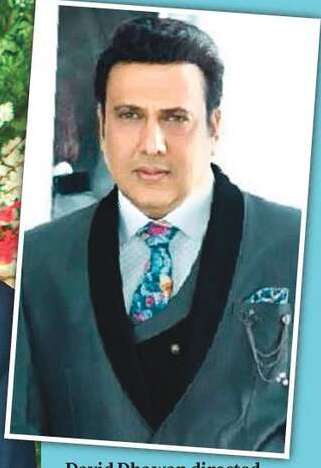
Govinda did not get enough credit; deserves to be called a superstar-David Dhawan
4:10 PM
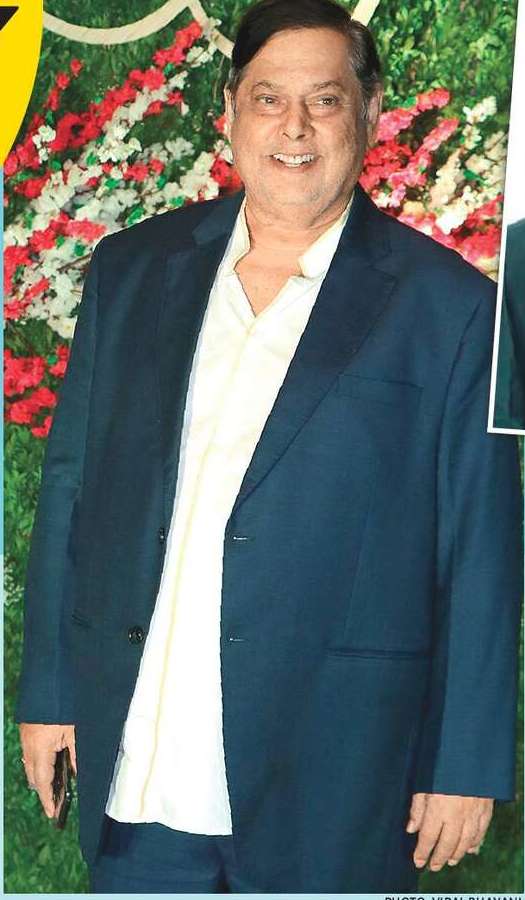
Syeda Eba Fatima (HINDUSTAN TIMES; May 5, 2023)
Ever since his last release Coolie No 1, which came out in 2020, David Dhawan has been on a break. The filmmaker is waiting to come up with something genuinely interesting. “I’ve worked on six-seven ideas and will see which one to take forward first. But everybody is asking for something fresh and I need to be sure of what I am offering them,” says Dhawan.
Making entertaining films, and with the right actors, is not easy, points out the ace director. “Dharmendra used to offer that entertainment, followed by Govinda. Later Salman (Khan) also started doing it in his films. But trust me, it’s not an easy job,” says the director, adding that this was exactly why Govinda was his favourite.
“Uske saath kaam karne ke baad mujhe aagey kisi aur ke saath kaam karne mein takleef hoti thi. He is such a brilliant actor. Performance jo woh deta tha, wo baat mujhe doosri jagah mil hi nahin paati thi. Even while working with Varun (Dhawan, actor and the director’s son), I used to address him as Govinda. Usi ka naam nikalta hai. Govinda is a bad habit — uski aadat lag jaati hai. He is a total star,” shares the filmmaker.
Known for directing over 40 films in his career, Dhawan — who collaborated with the actor in films such as Raja Babu (1994), Hero No 1 (1997) Bade Miyan Chote Miyan (1998), Haseena Maan Jaayegi (1999) and Partner (2008) — is disappointed that the actor never received the position in the industry that he deserved.
“He did not get enough credit for the kind of work he did. People love and remember him even today, but jo credit use milna chahiye, wo nahin mila. He deserves to be called a superstar,” Dhawan says.
With a remake of another of his films, the 1998 action comedy Bade Miyan Chote Miyan, in the works, the filmmaker says he will never remake Raja Babu, one of Dhawan and Govinda’s most-loved collaborations. “Maybe Varun can get into the shoes of Govinda and play that role, but I don’t want to do it with him. I feel scared to touch it because it’s one of my best films. Woh Hindustan ki mitti ki film hai,” he wraps up.
Why Bollywood films need to stop trivialising suicide
8:57 AM

Juhi Chakraborty (HINDUSTAN TIMES; August 22, 2020)

That’s just the tip of the iceberg, as Bollywood films have time and again used the context of suicide as an irrelevant incident or merely for comic relief.
 With the sad passing of actors Sushant Singh Rajput and Samir Sharma, the big question arises whether it’s time for Bollywood to be sensitive in such portrayals.
Writer Kanika Dhillon, who penned Judgementall Hai Kya (2019) which dealt with mental health issues, says, “Whenever we pick up such topics, a certain level of commitment and responsibility should be shouldered so that unknowingly we don’t harm the cause or spread any sort of misinformation. If the conversation around these disorders will be normalised and correct information is imparted, responsible filmmakers won’t reduce these conditions to gimmicky portrayals.”
Filmmaker Alankrita Shrivastava says that she can’t really remember any Hindi film that dealt with mental health or suicide in a sensitive manner.
 “I think this is reflective of Indian society that continues to stigmatise mental illness. It will take sensitive filmmakers and a sensitive audience for things to change. Right now, India as a society continues to be in denial and our cinema reflects that,” the Lipstick Under My Burkha (2016) director muses.
While art reflects society, actor Shweta Tripathi feels somewhere films also are very instrumental in shaping the though process of the society and so the onus lies on filmmakers to take the conversation forward in a non-regressive and casual way.
 “It’s high time that through our films, we open conversations about mental health awareness, issues and illness. Support is very important from our films. When the narrative changes in films, the society will change as well,” she asserts.
While slamming Bollywood for using the tool of suicide just for effect, filmmaker Vivek Agnihotri opines, “It has been happening for a while now. But an incident like this (Rajput’s death) is a rude wake up call to everyone to deal with matter of mental health and depression in a more sensitive manner for sure.”
Dhillon further feels that not just films, but it’s about time that through art, public discussions, awareness drives and any and every means at the disposal of our policy makers, “We as a society need to be encouraged to talk about our issues and disorders without being judged or shamed”.
Anil Kapoor is responsible for many good things in my career-Satish Kaushik
8:03 AM

Meena Iyer (BOMBAY TIMES; August 31, 2015)
How does one introduce Satish Kaushik? In a career spanning 30 years, he has made a sizeable (pun intended)
contribution to Bollywood, theatre, Indian television and international
cinema as an actor, producer and director. Importantly,
even three decades later, he has an insatiable appetite for his craft. As he gears up for the television sitcom Sumit Sambhal Lega, where he
plays Jasbir
Walia, that will air from tonight on Star Plus, this multi-faceted
personality touches on the high and low points of his life and
career. Excerpts from his interview...
You start a new journey on television tonight as Jasbir Walia...
I've been working continuously for 30 years. 24 has paved the way for finite series on TV becoming popular. This entire year has gone in shooting for Sumit Sambhal Lega. It is the adaptation of the American show Everybody Loves Raymond and I play the role of Frank, Raymond's father, in this case Sumit's father. I've made it more obnoxious, more interesting. It is not the central role but it is a juicy one and has a lot of scope. I'm a lazy man from a Delhi household, who talks in the 'aabe tubhe' language. I'm constantly eating and insulting people! It is a character with a lot of layers and though he seems obnoxious on the face of it, he has an endearing quality about him. I accepted the show because I was happy with the brand. Jeremy Stevens, one of the the writers of the original series came over, we had readings and workshops. It is all so well executed.
Three decades as an actor and you're still as excited about this role...
Acting is therapeutic for me. I have made so many names popular. Whether it is Calendar (Mr India), Pappu Pager (Deewana Mastana), German (Hum Aapke Dil Mein Rehte Hain), Jumbo (Gharwali Baharwali), Kunj Biharilal (Haseena Maan Jaayegi), Mutthu Swamy (Saajan Chale Sasural) or Airport (Swarg), people on the street address me by all these names. Something tells me Jasbir will also become as popular as the characters I have named. I've done so much in three decades - from acting in films to producing and directing movies, to producing television shows, theatre and now acting on TV. I've also directed commercials. I always wanted to be busy.
When did the acting bug bite?
I stayed at the Naiwala Lane in Karol Bagh, New Delhi. When I was eight, I told my father - my name should come in the newspaper some day. I was the most ignored child in my school till I did a mono-act play on the last day of Std XI. Everyone was very impressed by it. That very moment I became the star of my school. The claps motivated me to take admission in Delhi's Kirori Mal College, which encouraged dramatics. Amitabh Bachchan is from the same college. Professor Frank Thakurdas, a patron of the arts from our college told me, 'Satish, don't do anything else in life after passing out from here. Become an actor'. I thought he was just humouring me, especially because I knew that I lacked good looks. But my professor turned around and told me, 'Never mind your looks. When I see you on stage, you are the ultimate good-looking person for me.' He is the one who put in a word for me at the National School of Drama (NSD) and this changed my life.
You came to Mumbai next?
I did a six-month course at the Film and Television Institute of India (FTII) and then came to Mumbai. After a year at NSD and a six month stint at the FTII, I worked with the Auroras of D'Decor for a year in their textile mill and earned Rs 400 a month. My first day's job at the mill in Vikhroli was to sweep the dust off the yarn bundles. I had been gloating over the reviews that I got for my plays at NSD and thereafter, the praise I received at the FTII and here, I was being made to sweep in a mill! However, since I knew that I had to survive in Mumbai to pursue my ultimate dream of acting, I just continued. I told myself 'if you sweep the dust off these looms well, your path in Mumbai too will be a smooth one'. This positive attitude is what got me going and paid dividends. My boss saw my play Bichchoo at Prithvi and was mighty impressed. When I reported at the mill the next morning, he said to me, 'You're lacking in the looks department, but you're a terrific actor. Whatever you do, do it with passion.' I became Shekhar Kapur's assistant. I waylaid him at the airport and asked him to take me.
Is Shekhar your godfather in Bollywood?
Frankly, I think Javed Akhtar saab is my godfather. My relationship with Shekhar was very fruitful. I assisted him on Masoom and Joshilaay. Here I met Javed saab, Boney Kapoor and Anil Kapoor. Javed saab asked me not to think small ever. I did one scene in Woh 7 Din and I forged a lifetime of friendship with Shekhar, Anil, Boney and of course, Javed saab. Anil is responsible for many good things in my career.
Any more additions on the friends list?
Yes, Anupam Kher and Jayantilal Gada.
Boney entrusted you with with two big films - Prem and Roop Ki Rani Choron Ka Raja (RKRCKR), right?
Yes, RKRCKR was launched as a magnum opus. But both Prem and RKRCKR flopped. That really upset my morale. I then ventured into television with O Maria, Yeh Shaadi Nahin Ho Sakti and Philips Top 10. I was producing four to five programmes on Sony. But my heart was in films. I was down but never out. The big Bollywood directorial break came again with the Anil-Kajol starrer Hum Aapke Dil Mein Rehte Hain. After that, I never had to look back. I had also become very busy as an actor. I did around 15-16 films with David Dhawan as an actor.
Isn't it true that David actually offered you Raja Babu, the role that Shakti Kapoor later did? Why did you opt out?
David gave me Raja Babu immediately after RKRCKR flopped. At the photoshoot, he wanted me to stand in a striped underwear with a naada hanging down and a Charlie Chaplin moustache. The get-up was very funny but I was nervous, thinking that after such a colossal flop, if I stood in an underwear, people would think I was finished. So, I requested David to give me something else. That's when he offered me Saajan Chale Sasural, where I played a South Indian. I saw this as a tribute to Mehmood, whom I deeply admired and who had played a South Indian in Padosan. It is ironical that both Shakti and I won Filmfare Awards for actors in best comic roles in two consecutive years.
You were fortunate to work with some of the biggest names...
Yes, I worked with Salman Khan (Tere Naam), Anil on several films and Tusshar (Mujhe Kucch Kehna Hai). However, as far as my leading ladies go, I've worked with the most established names including Sridevi, Tabu, Kareena Kapoor Khan, Aishwarya Rai Bachchan and Kajol. I recall I was nervous about working with Kajol in Hum Aapke Dil Mein Rehte Hain. She was fresh from the success of Dilwale Dulhania Le Jayenge and I was thinking, 'God, how will I convince her to do my film.' But the moment I met her on her farm in Khandala and she yelled, 'Aye Pappu Pager,' I knew things would be easier. I realised that when you speak to Kajol, you have to be honest. So, I narrated the script to her without mincing the melodrama. Of course, her first reaction was, 'Satish, it is too melodramatic.' But once she was convinced that there was no other way you could approach the script, she cooperated fully.
Heard you told Anupam Kher once that you would attempt suicide. Is this true?
When RKRCKR failed, I was at a hotel in Hyderabad and was so dejected that I was contemplating suicide. I was newly married and my wife Shashi was wondering what she had got into. Anupam called the general manager of the hotel and said 'please save my friend.' Also, a little later I was at a pub in Mumbai where I met Mahesh Bhatt. I was wearing a dejected expression and told him that I was feeling terrible because my film had flopped. He gave me a smack on my face (albeit playfully) and said, 'your film has flopped, you haven't. Treat films as a part of your life, they're not your entire life.' I came home that day and made a life-graph. I told myself that I had had such humble beginnings. God, my friends and colleagues had paved the way for me to become so successful, then how could I feel defeated just because I had suffered one setback? People who were better-looking and better-off than me were still struggling, while I had managed to reach some place. So, I told myself, 'Satish you need a kick on your arse.' And I picked up the pieces and started again.
You also lost your son Kush to an accident...
The biggest tragedy in my life was losing Kush 20 years ago. Shashi and I could not get over this tragedy. The accident shook me up. I was on top of things as far as my career went. I was elated, when at the premiere of RKRCKR, my wife was pregnant with our first child. And then we lost our son. I realised that as far as destiny is concerned, nothing is planned and fixed. This really shook me up. Today, my son, too, would have been around the same age as Anil's son Harsh and perhaps he, too, may have chosen to be a part of Bollywood. Not a single day goes by without remembering him. Three years ago my daughter Vanshika came into our lives. She is the biggest source of joy for us, the antidote to our sadness. She has filled the gap.
International honour came your way with Brick Lane...
I did Brick Lane and believe me, the producers were in a fix initially on whether a comic actor like me could pull it off. But I had the solid background of theatre. Sarah Gavron's Brick Lane and Dev Benegal's Road Movie opened global doors for me. I met Robert De Niro and Martin Scorsese at the Tribeca Film Festival. I won a lot of accolades at the Toronto Festival for Brick Lane. And I had the privilege of meeting Sir Ben Kingsley at Doha. A new phase in my career began as I started hobnobbing with Hollywood stars at international film festivals. In fact, even before I could approach Ben, he turned around and said, 'Am I meeting this great actor from Brick Lane?' He even introduced me to his wife, who is also a famous actor.
On the social front, you have adopted a village in Haryana.
Yes, I have adopted my paternal village Dhanaunda that is in the Mahendragarh district of Haryana. I got a lot of aid from the local government for making pakka streets and even a sports stadium is being constructed there. I also run a NGO called The Roots that holds workshops in girls' schools. The motto is to tell girls to dream big and become achievers in their chosen field. I believe if God has given you enough, you must give back to society.
Are you planning on directing again?
I have directed around 14 movies and filmmaking remains a passion. The script of my next film is almost ready. It is a gritty drama based on a book. However, I will announce the film at a later day. Acting in television, theatre and films has kept me quite occupied. My play Salesman Ramlal, which is an adaptation of Death Of A Salesman, has kept me fully busy. Besides that, I'm currently doing roles in Abhishek Chaubey's Udta Punjab, where I play Shahid Kapoor's uncle and Wedding Pullav. I also have Ritesh Sinha's Promise Dad, that has an international starcast and is expected to release soon.
You start a new journey on television tonight as Jasbir Walia...
I've been working continuously for 30 years. 24 has paved the way for finite series on TV becoming popular. This entire year has gone in shooting for Sumit Sambhal Lega. It is the adaptation of the American show Everybody Loves Raymond and I play the role of Frank, Raymond's father, in this case Sumit's father. I've made it more obnoxious, more interesting. It is not the central role but it is a juicy one and has a lot of scope. I'm a lazy man from a Delhi household, who talks in the 'aabe tubhe' language. I'm constantly eating and insulting people! It is a character with a lot of layers and though he seems obnoxious on the face of it, he has an endearing quality about him. I accepted the show because I was happy with the brand. Jeremy Stevens, one of the the writers of the original series came over, we had readings and workshops. It is all so well executed.
Three decades as an actor and you're still as excited about this role...
Acting is therapeutic for me. I have made so many names popular. Whether it is Calendar (Mr India), Pappu Pager (Deewana Mastana), German (Hum Aapke Dil Mein Rehte Hain), Jumbo (Gharwali Baharwali), Kunj Biharilal (Haseena Maan Jaayegi), Mutthu Swamy (Saajan Chale Sasural) or Airport (Swarg), people on the street address me by all these names. Something tells me Jasbir will also become as popular as the characters I have named. I've done so much in three decades - from acting in films to producing and directing movies, to producing television shows, theatre and now acting on TV. I've also directed commercials. I always wanted to be busy.
When did the acting bug bite?
I stayed at the Naiwala Lane in Karol Bagh, New Delhi. When I was eight, I told my father - my name should come in the newspaper some day. I was the most ignored child in my school till I did a mono-act play on the last day of Std XI. Everyone was very impressed by it. That very moment I became the star of my school. The claps motivated me to take admission in Delhi's Kirori Mal College, which encouraged dramatics. Amitabh Bachchan is from the same college. Professor Frank Thakurdas, a patron of the arts from our college told me, 'Satish, don't do anything else in life after passing out from here. Become an actor'. I thought he was just humouring me, especially because I knew that I lacked good looks. But my professor turned around and told me, 'Never mind your looks. When I see you on stage, you are the ultimate good-looking person for me.' He is the one who put in a word for me at the National School of Drama (NSD) and this changed my life.
You came to Mumbai next?
I did a six-month course at the Film and Television Institute of India (FTII) and then came to Mumbai. After a year at NSD and a six month stint at the FTII, I worked with the Auroras of D'Decor for a year in their textile mill and earned Rs 400 a month. My first day's job at the mill in Vikhroli was to sweep the dust off the yarn bundles. I had been gloating over the reviews that I got for my plays at NSD and thereafter, the praise I received at the FTII and here, I was being made to sweep in a mill! However, since I knew that I had to survive in Mumbai to pursue my ultimate dream of acting, I just continued. I told myself 'if you sweep the dust off these looms well, your path in Mumbai too will be a smooth one'. This positive attitude is what got me going and paid dividends. My boss saw my play Bichchoo at Prithvi and was mighty impressed. When I reported at the mill the next morning, he said to me, 'You're lacking in the looks department, but you're a terrific actor. Whatever you do, do it with passion.' I became Shekhar Kapur's assistant. I waylaid him at the airport and asked him to take me.
Is Shekhar your godfather in Bollywood?
Frankly, I think Javed Akhtar saab is my godfather. My relationship with Shekhar was very fruitful. I assisted him on Masoom and Joshilaay. Here I met Javed saab, Boney Kapoor and Anil Kapoor. Javed saab asked me not to think small ever. I did one scene in Woh 7 Din and I forged a lifetime of friendship with Shekhar, Anil, Boney and of course, Javed saab. Anil is responsible for many good things in my career.
Any more additions on the friends list?
Yes, Anupam Kher and Jayantilal Gada.
Boney entrusted you with with two big films - Prem and Roop Ki Rani Choron Ka Raja (RKRCKR), right?
Yes, RKRCKR was launched as a magnum opus. But both Prem and RKRCKR flopped. That really upset my morale. I then ventured into television with O Maria, Yeh Shaadi Nahin Ho Sakti and Philips Top 10. I was producing four to five programmes on Sony. But my heart was in films. I was down but never out. The big Bollywood directorial break came again with the Anil-Kajol starrer Hum Aapke Dil Mein Rehte Hain. After that, I never had to look back. I had also become very busy as an actor. I did around 15-16 films with David Dhawan as an actor.
Isn't it true that David actually offered you Raja Babu, the role that Shakti Kapoor later did? Why did you opt out?
David gave me Raja Babu immediately after RKRCKR flopped. At the photoshoot, he wanted me to stand in a striped underwear with a naada hanging down and a Charlie Chaplin moustache. The get-up was very funny but I was nervous, thinking that after such a colossal flop, if I stood in an underwear, people would think I was finished. So, I requested David to give me something else. That's when he offered me Saajan Chale Sasural, where I played a South Indian. I saw this as a tribute to Mehmood, whom I deeply admired and who had played a South Indian in Padosan. It is ironical that both Shakti and I won Filmfare Awards for actors in best comic roles in two consecutive years.
You were fortunate to work with some of the biggest names...
Yes, I worked with Salman Khan (Tere Naam), Anil on several films and Tusshar (Mujhe Kucch Kehna Hai). However, as far as my leading ladies go, I've worked with the most established names including Sridevi, Tabu, Kareena Kapoor Khan, Aishwarya Rai Bachchan and Kajol. I recall I was nervous about working with Kajol in Hum Aapke Dil Mein Rehte Hain. She was fresh from the success of Dilwale Dulhania Le Jayenge and I was thinking, 'God, how will I convince her to do my film.' But the moment I met her on her farm in Khandala and she yelled, 'Aye Pappu Pager,' I knew things would be easier. I realised that when you speak to Kajol, you have to be honest. So, I narrated the script to her without mincing the melodrama. Of course, her first reaction was, 'Satish, it is too melodramatic.' But once she was convinced that there was no other way you could approach the script, she cooperated fully.
Heard you told Anupam Kher once that you would attempt suicide. Is this true?
When RKRCKR failed, I was at a hotel in Hyderabad and was so dejected that I was contemplating suicide. I was newly married and my wife Shashi was wondering what she had got into. Anupam called the general manager of the hotel and said 'please save my friend.' Also, a little later I was at a pub in Mumbai where I met Mahesh Bhatt. I was wearing a dejected expression and told him that I was feeling terrible because my film had flopped. He gave me a smack on my face (albeit playfully) and said, 'your film has flopped, you haven't. Treat films as a part of your life, they're not your entire life.' I came home that day and made a life-graph. I told myself that I had had such humble beginnings. God, my friends and colleagues had paved the way for me to become so successful, then how could I feel defeated just because I had suffered one setback? People who were better-looking and better-off than me were still struggling, while I had managed to reach some place. So, I told myself, 'Satish you need a kick on your arse.' And I picked up the pieces and started again.
You also lost your son Kush to an accident...
The biggest tragedy in my life was losing Kush 20 years ago. Shashi and I could not get over this tragedy. The accident shook me up. I was on top of things as far as my career went. I was elated, when at the premiere of RKRCKR, my wife was pregnant with our first child. And then we lost our son. I realised that as far as destiny is concerned, nothing is planned and fixed. This really shook me up. Today, my son, too, would have been around the same age as Anil's son Harsh and perhaps he, too, may have chosen to be a part of Bollywood. Not a single day goes by without remembering him. Three years ago my daughter Vanshika came into our lives. She is the biggest source of joy for us, the antidote to our sadness. She has filled the gap.
International honour came your way with Brick Lane...
I did Brick Lane and believe me, the producers were in a fix initially on whether a comic actor like me could pull it off. But I had the solid background of theatre. Sarah Gavron's Brick Lane and Dev Benegal's Road Movie opened global doors for me. I met Robert De Niro and Martin Scorsese at the Tribeca Film Festival. I won a lot of accolades at the Toronto Festival for Brick Lane. And I had the privilege of meeting Sir Ben Kingsley at Doha. A new phase in my career began as I started hobnobbing with Hollywood stars at international film festivals. In fact, even before I could approach Ben, he turned around and said, 'Am I meeting this great actor from Brick Lane?' He even introduced me to his wife, who is also a famous actor.
On the social front, you have adopted a village in Haryana.
Yes, I have adopted my paternal village Dhanaunda that is in the Mahendragarh district of Haryana. I got a lot of aid from the local government for making pakka streets and even a sports stadium is being constructed there. I also run a NGO called The Roots that holds workshops in girls' schools. The motto is to tell girls to dream big and become achievers in their chosen field. I believe if God has given you enough, you must give back to society.
Are you planning on directing again?
I have directed around 14 movies and filmmaking remains a passion. The script of my next film is almost ready. It is a gritty drama based on a book. However, I will announce the film at a later day. Acting in television, theatre and films has kept me quite occupied. My play Salesman Ramlal, which is an adaptation of Death Of A Salesman, has kept me fully busy. Besides that, I'm currently doing roles in Abhishek Chaubey's Udta Punjab, where I play Shahid Kapoor's uncle and Wedding Pullav. I also have Ritesh Sinha's Promise Dad, that has an international starcast and is expected to release soon.

Subscribe to:
Posts (Atom)