Showing posts with label Rabindranath Tagore. Show all posts
Showing posts with label Rabindranath Tagore. Show all posts
I’ve been honoured for films songs, but a literary award is special-Gulzar
8:15 AM

Natasha Coutinho (BOMBAY TIMES; February 21, 2024)
As an author, poet, lyricist, director and screenwriter, he wears many hats. But Gulzar says that the Jnanpith – India’s highest literary award – is a special one, since an honour for literature is always close to his heart. Excerpts from a chat:
‘BIMAL ROY GOT ME TO WRITE FOR FILMS’
Gulzar feels that despite a literary body of work that goes back nearly 50 years, he has received more accolades for his film songs.
“I have got appreciation for film songs, but a literary award is special. I felt that maybe my literary work wasn’t reaching people. But then, this award proves that perception wrong, and I accept it with all humility. Literature has always been my principal fascination. In fact, I didn’t want to move to films, but it was (filmmaker) Bimal Roy who held my hand while I was working in a motor garage and brought me to write for films. I did not have much work in the garage so I would spend a lot of time reading. Even after I started working in cinema, I kept writing books.”
‘TAGORE IS A CLASSIC POET LIKE GHALIB’
Even today, the 89-year-old spends a lot of time reading the works of other writers and is aware of latest developments in contemporary Indian literature. He has translated contemporary Indian poetry from 34 languages and the works of nearly 300 poets.
“In recent years, the most dynamic and assertive poetry has come out of the Northeast. I’ve also been reading authors Ashok Vajpeyi, Dilip Chitre and Kishor Kadam, who writes under the pseudonym Saumitra in Marathi. As for writers and poets in Hindi cinema, Javed Akhtar has written poignant poetry in Urdu. Nida Fazli, who left us recently, has a wonderful body of work. Prasoon Joshi is also an important name in the field.”
Gulzar’s appreciation and love for the works of Rabindranath Tagore are well documented, and he has translated two volumes of the Nobel laureate. “Tagore is a classic poet like Ghalib. The more I delved into his works the more fascinated I was.”
‘PEOPLE ASSOCIATE ME WITH ROMANCE BECAUSE OF MY WORK IN CINEMA’
Gulzar has given the film industry some of its most iconic romantic songs. “People associate me with romance because of my work in films but I see romance in everything, even in the pain and struggle, and in my love for the nation. I would like to tell people, have an affair with life, you will enjoy it.”
I’m running to keep up with the audience-Sujoy Ghosh
4:08 PM

Filmmaker Sujoy Ghosh speaks of adaptations, choosing too-pretty-to-leave Kalimpong as location and keeping up with audience tastes in the build-up to his Kareena Kapoor-starrer Jaane Jaan
Sucheta Chakraborty (MID-DAY; September 10, 2023)
“It was a doomed love story and I loved it because the only other love story I could think of in comparison was King Kong,” filmmaker Sujoy Ghosh tells us about his upcoming Netflix film Jaane Jaan, which is based on the 2005 Japanese novel The Devotion Of Suspect X by Keigo Higashino. It’s a book brought to him years ago by friend and screenwriter Kanika Dhillon. He recalls being drawn to it instantly.
“You don’t know whether it’s a good story or a bad story, but it’s a story you have identified with,” he explains. “It really got to me because I saw characters in that book who were big [and] honourable. It was something I was not used to. In Japanese culture, honour is a very big thing and [people are] big hearted. I wish I was like Naren [Jaideep Ahlawat’s character]. I wish I had that kind of honour instilled in me, the values, beliefs and morals that he has.”
Since Anukul, Ghosh’s 2017 short film starring Parambrata Chatterjee and Saurabh Shukla, based on a short story written by Satyajit Ray, this is the first time that Ghosh has adapted a story for the screen. “I was dying to,” he tells us excitedly.
“These people are experts in what they do. They’re born to write stories. I would love to have all my films based on books if I had my way.”
Aranyer Din Ratri, Bengali author Sunil Gangopadhyay’s novel, which was famously adapted for the screen by Saytajit Ray in 1970 has been on his mind for long. “But it is too scary.” There is the burden of responsibility and the need to be loyal and respectful to the source material because there is the looming sense of someone having worked very hard to put the story together. “I shouldn’t be messing with a story just because I can.”
Rabindranath Tagore’s short story Kabuliwala is a work he says he hopes to adapt one day. “I will do it before I retire,” Ghosh smiles. “Have to do one Tagore, at least.”
Jaane Jaan is set in the hill town of Kalimpong in West Bengal, a location that Ghosh has used previously in 2016’s Kahaani 2: Durga Rani Singh. But the Kalimpong of the new film is different. “That’s how it should be,” he insists.
“Even the Kolkata of Kahaani versus the Kolkata of Te3n [which he produced] versus the Kolkata of Bob Biswas [which he wrote and co-produced] are different. At least I hope they are. That’s the whole trick. You should shoot in the same city, but the city should also be a character. The city should reflect the story that you’re telling. My world is very important; it should be a character in the film.”
Misty and far away from the city bustle, Kalimpong in the Himalayan foothills, Ghosh tells us, lent itself perfectly. “I feel any character within a story is believable if the world in which they are is believable. Now, if you’re showing somebody who’s academically inclined, who wants a quiet life, who is looking to restart her life, you would need a world which is smaller. It’s a smaller community where people know each other.”
His own familiarity with the terrain also undoubtedly contributed to his choice. He recalls a time when he and a friend hired a car and went to Kurseong and from there to Kalimpong and Darjeeling. “We kept falling in love with the places and didn’t want to leave, and then my wife had to call us back,” he laughs. “I could do a whole film by the banks of the Teesta.”
While creative concerns and a director’s sense of discipline remain largely the same while making a film for the OTT space, what changes for Ghosh is the way the film is presented.
“If I know that you’ll see my film on a mobile, an iPad, a computer or a television screen, my framing would change a little,” he says, explaining that for a theatrical film he can include more wide shots. “I try to keep that in my mind, but don’t let it dictate me. In Jaane Jaan, you’ll know that the framing is a little different from, for example, a Badla or a Kahaani.”
The process he finds pushes him to think differently, an important requisite “to move with the times”. “We have to learn to serve people who watch films on their mobiles. Whether we like it or not, they do.”
Ghosh began his filmmaking career in 2003 with the ‘cool’ indie musical comedy Jhankaar Beats and has since gone on to make several hit thrillers starring industry A-listers. The biggest change in his life he feels, however, is technology.
“When I started out, technology was never a faculty of filmmaking. Now, it’s as important as editing or cinematography or directing because you have so many possibilities if you know how to harness technology in your film, to create the world, to tell your story. And it’s changing rapidly. A lot of my friends do some amazing things with technology and I don’t know how to, but I would love to learn.”
There is also the matter of the audience’s evolving tastes. Ghosh says that at the time when he started out, people were not that exposed to global cinema. “But now, I’m competing with the evolution of taste. When you see my film, your benchmarks are different. You’re not just seeing a film, you’re also assessing it. Technically, is it sound? How well has he shot it? How good is the VFX? If I give you a lazy film, you’ll be able to spot it a mile away. Their expectations and demands from a film are changing, and I am just running to keep up with them.”
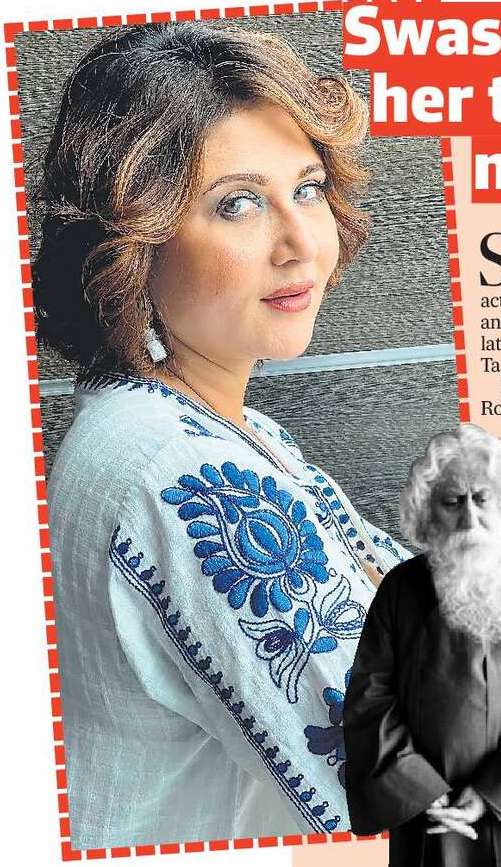
Swastika Mukherjee says her tweet on Rabindranath Tagore was not for Anupam Kher
8:42 AM
Sneha Biswas (HINDUSTAN TIMES; August 4, 2023)
Swastika Mukherjee has reacted to her recent tweet, which came immediately after actor Anupam Kher’s announcement about portraying late noted writer Rabindranath Tagore in an upcoming film.
Her tweet, “No one should play Robi Thakur. Leave the man alone”, was not taken well by the 68-year-old veteran. Explaining her point, Mukherjee tells us, “What I wanted to say is Rabindranath Tagore should be left out of propaganda whether it’s films, books or seminars. I thought of going back (and clarifying) but I was busy with work. I even thought of writing that I was wrong in writing nobody should play Rabindranath Tagore. What I meant was nobody should include him in propaganda.”
Further clarifying that she was not referring to Kher in particular, Mukherjee continues, “But, it just became like I was talking against Anupam Kher. I really like him as an actor. I followed his work since I started watching films. There are so many favourite films of his that I have watched and I still re-watch them. It’s not about him playing Robi Thakur. As a Bengali, I just don’t want him to be included in another propaganda bu**sh*t, that is what I wanted to say. I personally depend on Tagore for a lot of things; he has shaped my childhood, adulthood and life altogether...”
Kher, in an interview to us, had said recently, “They want to be noticed by their negative views instead of their work. Aap criticism ke liye notice hue toh kya hi notice hue. I also want to ask if that concerned person is Tagore’s spokesperson. Going forward, people will tell us not to make any project on Gandhi ji. I found it to be an absurd point.”
What do you mean leave Rabindranath Tagore alone?-Anupam Kher
8:52 AM
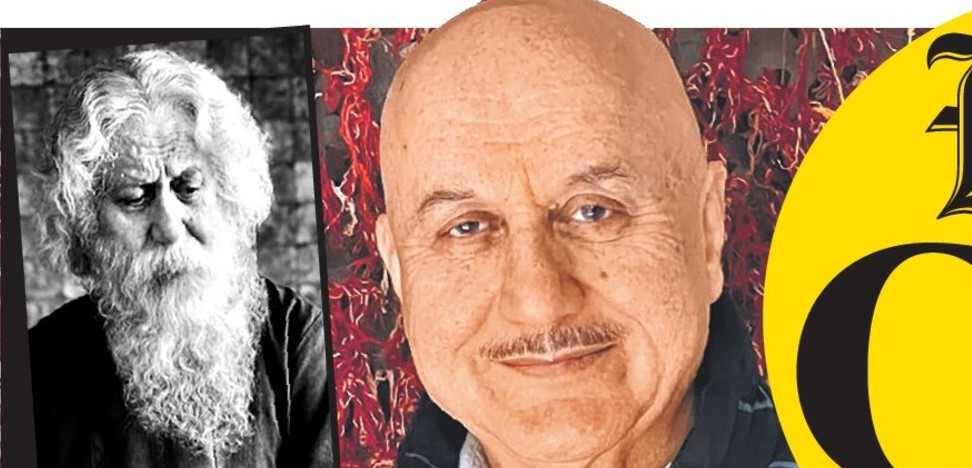
Anupam Kher says he doesn’t have time to waste on negative reactions to him playing the eminent poet
Sugandha Rawal (HINDUSTAN TIMES; July 23, 2023)
Earlier this month, actor Anupam Kher dropped the first look of himself as Nobel Prize-winning Bengali poet Rabindranath Tagore from his next, which got mixed responses from the audience, with some, such as actor Swastika Mukherjee, even rejecting the idea of anyone essaying the eminent philosopher. “No one should play Robi Thakur. Leave the man alone,” Mukherjee had tweeted.
However, Kher stays unfazed and focused on the praise coming his way. “I was very amused by some people saying, ‘Oh, leave Tagore alone’ and that nobody should do this. There are 86,400 seconds in a day, and if someone says such things for 10 seconds, I will not waste my other seconds thinking about it,” adds Kher, wondering if his detractors consider themselves Tagore’s spokespeople.
“Going forward, people will tell us to not make projects on Gandhi ji. I found it absurd. What do you mean leave Tagore alone? Aise toh people will stop making projects such as Schindler’s List (1993) and Oppenheimer and even documentaries. Such remarks hold no importance for me. There is no one in the world that doesn’t get criticized. I can live with it,” says The Kashmir Files 2022) actor, who recalls telling his team to focus on the appreciation coming their way for the look, which took two months to create.
Kher, who has earlier played former Prime Minister Manmohan Singh in the latter’s biopic, The Accidental Prime Minister (2019), adds, “I have a lot of energy but no time to waste on people who are random and have nothing to do but to get noticed by criticizing somebody. Aap criticism ke liye notice hue toh kya hi notice hue.”
The making of Satyajit Ray and the birth of Indian global cinema
7:49 AM

His first film, Pather Panchali, took Indian cinema to a different league and there was no looking back after that. The legend that was Satyajit Ray can perhaps best be understood if one considers the different influences on his life, from Tagore to his illustrious family
Suman Ghosh (THE TIMES OF INDIA; December 5, 2021)
When Satyajit Ray was a little boy, his mother took him to meet Rabindranath Tagore at his abode in Santiniketan. Ray wanted Tagore to inscribe a poem in his notebook. Tagore obliged and wrote this:
Many miles I have roamed, over many a day
From this land to that, ready for the price to pay
Mountain ranges and oceans too, lay in my way
Yet two steps from my door, with wide open eyes,
I did not see the dewdrop, on a single sheaf of rice
After handing this over to the boy, he told his mother: “Let him keep this, and when he is a little older, he will understand this.” Later in life, the boy shook the film world by portraying the story of a small village in Bengal called Nishchindipur in Pather Panchali. He did focus on a “dewdrop” close to his homeland and was able to emanate an effect that inspired generations of filmmakers all over the world, from Martin Scorsese to Abbas Kiarostami, and put Indian cinema on the world map.
The reason I mention the Tagore poem is that it summarises Ray’s philosophy of life and his films. Though very local in nature, his films managed to strike a universal chord, hence were global in reach. Reflecting on the oeuvre of Ray, almost 65 years after the above incident, another Santiniketan protégée, Amartya Sen, delivering the Ray Memorial lecture in 1995 had this to say: “The great filmmaker’s eagerness to seek the larger unit (ultimately his ability to talk to the whole world) combined well with his enthusiasm for understanding the smallest of the small: the individuality of each person.”
Tagore’s influence on the Ray family was since the times of Upendrakishore Roy Chowdhury — Satyajit Ray’s grandfather — who was a writer, painter, singer and a pioneer of the Bengali printing industry. Tagore was an enthusiastic advocate of Upendrakishore’s writing, encouraging him to translate and adapt stories from abroad as well as from Indian legends, but as a frequent visitor to their house, Tagore came to regard Sukumar Ray, Satyajit Ray’s father, as one of his favourite young friends.
Sukumar Ray was a genius himself who excelled in many fields. He graduated with double honours in physics and chemistry from the esteemed Presidency College and also started the Nonsense Club around that time. His nonsense rhymes are folklore in Bengal, reminiscent of Lewis Carroll and Edward Lear. He was an adept photographer, and in 1922, he became the second Indian to be made a Fellow of the Royal Photographic Society. Thus, the influence of both his grandfather, whom he had not seen, and his father who passed away when he was not even three, was evident in Satyajit Ray.
But I also want to emphasise the influence of women in Ray’s life at a younger age, since the portrayal of well-etched women characters — Karuna Banerjee in Aparajito, Madhabi Mukherjee in Charulata, Kapurush and Mahanagar, Sharmila Tagore in Apur Sansar, Devi and Aranyer Din Ratri, to name a few — formed a strong element in his films.
Kadambini Ganguly, who was the first woman physician of India, was one of Ray’s ancestors. It was Kadambini who delivered Ray and although he never knew her (she died when he was only two), he felt her influence through the profound effect she had on all the Ray women, including his mother, Suprabha Ray, who was a very strong and dignified lady. After the untimely death of her husband, she moved to her brother’s house at Bhowanipore with her three-year-old son. As a young widow, she travelled every day by bus during the 1930s and 40s from south to north Calcutta, where she worked as superintendent of the handicraft department at Vidyasagar Bani Bhawan. This reminds one of Madhabi Mukherjee’s character of a working woman in Ray’s Mahanagar.
Ray’s mother was excellent in knitting and stitching, and an excellent sculptor too, whose engraving of Gautam Buddha still finds a place at his Bishop Lefroy Road home (in Calcutta). It was his mother who brought him up, taught him, looked after him, cared for him, and communicated the family’s creative and literary legacy. In fact it was his mother who convinced him to spend time at Santiniketan in the proximity of Tagore at a formative stage in his life. There, he learnt art from the great Nandalal Bose.
In Ray’s Aparajito, world cinema witnessed one of the most endearing mother-son relationships ever seen on celluloid. One wonders how much of it was autobiographical, though the source material is from Bibhutibhushan Bandyopadhyay’s classic.
If one delves into his earliest awareness of cinema, one must date back to his grandfather’s printing press. The printing press in Apur Sansar comes to mind reading about those stories from his childhood. In the block-making section of the printing press there was a huge imported process camera whose operator Ramdohin became his friend. One imagines little Toto in Giuseppe Tornatore’s 1988 masterpiece Cinema Paradiso in such a setting, where the projectionist Alfredo instills a deep love of films in the boy. But the story in his memoirs, which I find extremely cinematic, was a bit later in life at his uncles’ house. At noon when summer rays of the bright sun got in through a chink in the shutters of the bedroom, Ray would lie there alone for hours watching the “free bioscope” created on the wall: a large inverted image of the traffic outside.
Magic lanterns were popular toys in Bengali homes around that period. It was a box with a tube at the front containing a lens, a chimney on top and a handle on the right-hand side. The film ran on two reels with a kerosene lamp for light source. Ray himself suspected that his first inklings of a fascination with cinema started from those images. Ingmar Bergman, another giant of world cinema, also had a similar inspiration through magic lanterns in childhood and subsequently named his autobiography ‘The Magic Lantern’.
A little later in life, Ray infused himself with influences from music, painting, drama, and a host of other art forms which contributed to the artist that he was. His subsequent journey of getting addicted to films and his struggle to make Pather Panchali are quite well documented. His films gathered accolades all over the world and put Indian films firmly in the firmament of cinema history.
I find it quite intriguing that although Ray had straddled disparate subjects in his films, he never ventured out of a classical storytelling style – an orderly unfolding of events with a beginning, a middle and an end; a firm rein applied to emotion, and an avoidance of disorientation.
He never experimented with form and structure in his films, unlike Mrinal Sen or Mani Kaul in the Indian filmmaking context. The famous ghost dance in Goopy Gyne Bagha Byne was the closest foray Ray made into cinematic experimentation. Was it mainly because the films which prompted his interest in filmmaking were of the classical Hollywood tradition — the films of John Ford, Frank Capra or Billy Wilder — or that he was not brave enough to venture out of his comfort zone?
One might get an idea of his thought process from his own writings. He was an ardent admirer of the French New Wave of the 60s and singled out Godard as the thoroughgoing iconoclast. He wrote of how Godard changed basic cinema language in his films. But he was also aware that Godard’s cinema can be boiled down to a cinema of the head, not the heart, and therefore a cinema of the minority. Ray was extremely conscious of the “audience connect”.
So any experimentation with the syntax of film language would alienate the audience, and hence it was not a viable proposition for him. The stigma of esotericism always bothered him. According to him, “avant-gardism” is a luxury which we cannot yet afford in our country. That begs the question, given the strong analytical grasp which Ray had on the craft of cinema, would he have been a different type of filmmaker, experimenting with basic cinematic language at a much deeper level, if he had the luxury which French cinema afforded to the greats? These are counterfactual questions, but worth pondering.

Did Mahatma Gandhi have anything to do with music?
8:02 AM

On his 150th birth anniversary, authors of two new books on the Mahatma discuss how cinema and music of the time, drew inspiration from him
Jane Borges (MID-DAY; September 29, 2019)
 As historian, Lakshmi Subramanian has always been curious about the peculiar—researching odd-ball stories, where previously unrelated facts come together to create a whole. Her new book, Singing Gandhi's India: Music and Sonic Nationalism (Roli Books), is an exercise in that direction. Yet, when she was first approached to write a book on Mahatma Gandhi and music, Subramanian recalls her response as being a "resounding no". "My initial reluctance was partly informed by a sense that Gandhi would have had very little and substantive to say about music per se; and about the complex public history that music threw up in the 20th century. Equally, I was convinced that Gandhi would have unproblematically endorsed the bhajan as it had emerged as a form of marking an exclusive Hindu identity," she shares, in an email interview.
 London-based journalist Sanjay Suri (right)'s tryst with the Mahatma in his new book, A Gandhian Affair: India's Curious Portrayal of Love in Cinema (HarperCollins India), was more organic. "I did not set out to research Gandhi," he admits. The book, he says, grew out of watching hundreds of Hindi films over many years. "Gandhi just kept popping out of them."
Where biographies and academic texts have been forever been engaged with examining Gandhi, the leader, and his role in pre-independent India, close on the heels of his 150th birth anniversary, Subramanian and Suri have explored how he culturally influenced the nation.
A Song For The Community
It was only after Sumbramanian, a professor at the Humanities and Social Sciences faculty of BITS Pilani in Goa, decided to engage with Gandhi's relationship with music that she realised "that not only had he a lot to say about sound and its use in politics, he was curious and inquisitive and inconsistent making his writings a treasure trove for a student of history".
In the book, she writes of how Gandhi was moved, when he first heard 'Vande Mataram' [written by Bankim Chandra Chatterjee] in 1915 in Madras. "You have sung that beautiful national song, on hearing which all of us sprang to our feet. The poet has lavished all the adjectives we could possibly do to describe Mother India," he told the assembly.
Gandhi, she says, saw music as one of the many tools to infuse a feeling of community. "I think Christian singing made a deep impact on Gandhi and the idea of a congregation had definite appeal. This was evident in his experiences in England, and while in South Africa, congregational singing became a form of political communication. The idea was to feel a oneness that went beyond narrow self-interest and work around a moral basis for political action. Prayer, music and spinning were all tools of individual self-regeneration and community building," says Subramanian, who read his collected works in great detail to contextualise her research. Her work also helped quell any misgivings about Gandhi propagating religious music. "At no point did he equate the Hindu religion with music of a particular kind; nor did he espouse the cause of devotional singing in public as an essential feature of the Hindu religion."
Subramanian, however, admits that Gandhi, unlike his contemporary Rabindranath Tagore whose contribution to music nationalism was immense, was not a "rasika". "He did not appreciate the technicalities or even profoundness of the classical traditions in India, but as an inquisitive person responding to debates and public discussions was not unaware of the emerging discourse on music reform and revival. He responded to the emotional dimensions of music and certainly insisted on a trained teacher for his ashram experiments," she says, adding, "He listened to music with great attention and was convinced that it had the power to move millions and to still them into contemplation."

The hero (Dev Anand) of Kala Pani (1958) finally declares satyagraha as his way of securing justice
A Moral Code For Cinema
Suri, on the other hand, discusses how Gandhi's values and virtues were so deeply enmeshed in the Indian psyche that the heroes of Hindi cinema—at least till late into the 1970s—sub-consciously replicated his virtuosity. They did it in two ways, he says. "One, and always, at pivotal points through the scripted story path of the hero. These are the decisive moments when choices have to be made. Those turn out always to be moral choices of a kind—rejection of wealth and a turning away from sex. It's these moral values that turn the plot, and which then give this phase of cinema that feeling of sameness. The hero is always confronted with those temptations, and it is the rejection of both that establishes him as heroic. Those are the very two temptations that Gandhi, the man most sought to overcome," says Suri, who has previously authored, 1984: The Anti-Sikh Violence and After.
He adds, "Secondly, countless invocations to Gandhi himself surface—images of Gandhi show up in one scene or another particularly when the moment of truth comes. These images didn't just happen, in this carefully crafted business of set by set, scene by scene."
According to Suri, Gandhi was far too complex a figure and his experiments in life were both controversial and fascinating. But cinema didn't grapple with any of that. "The Gandhi brought into this cinema is a man identified by a few broad strokes: the one who turned away in his personal life from wealth and sex, the vegetarian who believed in non-violence and who found strength enough through that bare simplicity to take on the greatest power on earth and to dislodge it."
The Hindi film, he feels, that first broke out from this Gandhian narrative was B R Chopra's Ek Hi Raasta (1956). "The hero [Sunil Dutt] is a junior manager killed by a corrupt employee. So she [his wife, played by Meena Kumari] marries his rich boss [Ashok Kumar], and repeats the love song she had sung with the first hero on his bicycle with the second hero in his long American convertible, the kind that ran only in studios. Through a look at the top 10 films of every year from 1948 to 1959, this was the only striking exception to the dominant pattern," says Suri, adding, "We would have to wait for Manmohan Singh to come along for the hero to come into wealth without guilt." While the fascination with Gandhi seemed to have petered out by the late 1980s, Gandhi is once again resurrected in Lage Raho Munna Bhai (2006), where he literally becomes the alter ego of the protagonist, Sanjay Dutt, getting him to propagate the now famous, Gandhigiri.
Did Gandhi ever reciprocate this adulation bestowed to him by cinema? "From what is known, Gandhi seemed to have thought very little of it. But in the invocations to him that followed, in the resurfacing portraits and dialogues, in the binding spell his ideals would have on the hero, Gandhi found a career in Bollywood far from his own world."

Shammi Kapoor, the hero of China Town (1962) is led away from romancing to the path of seeking justice under the watchful eyes of Gandhi. Pic courtesy/A Gandhian Affair by Sanjay Suri, HarperCollins India

The innocent man, played by Raj Kapoor, on the run in Jaagte Raho (1956), finds refuge at last under the blessings of Gandhi
Now, Lillete Dubey brings Devika Rani on stage
8:09 AM

Ira Dubey is the First Lady of Indian Cinema in a play, produced and directed by her mother with Joy Sengupta as Devika’s husband Himanshu Rai; opens in Mumbai on September 7
Roshmila Bhattacharya (MUMBAI MIRROR; July 24, 2019)
 On September 7, Lillete Dubey will bring in her birthday with a new stage production, Devika Rani: Goddess Of The Silver Screen. The actress is directing daughter Ira Dubey who plays the First Lady of Indian Cinema with Joy Sengupta as her debonair filmmaker-husband Himanshu Rai. The play opens at the Tata Theatre in Mumbai, after an inaugural performance in Pune on August 31.
Though Lillete has done many plays based on world literature, the primary aim of her theatre company has been to give a platform to original Indian writing, be it Vijay Tendulkar, Mahesh Dattani or more recently Twinkle Khanna whose short story, Salaam, Noni Apa, from her book, The Legend of Lakshmi Prasad, was adapted by her for the stage. Having already experimented with a play on Gauhar, the singer from Kolkata who popularised Hindustani classical music, Lillete was not in the mood for another biopic. But then, she ran into an old college friend, Kishwar Desai, who was also on the jury of the Montreal English Theatre Awards (META) and confided that along with a book on the 1919 Jallianwala Bagh massacre, she was also writing on the cinema of Devika Rani and Himanshu Rai based on five years of research and several unpublished letters. Instantly excited, Lillete asked her if she’d also like to write it as a play and Kishwar was quick to agree.
“It’s not an already made script which guarantees a safe and successful run. After seven-eight drafts, we’ve finally decided what we want to tell. While we will start with and touch on films with women-centric topics, like Achhut Kannya, the play is not a filmography for the archives. It’s a personal story of a woman who was the grand-niece of Rabindranath Tagore, who’d been educated in London, and who broke the glass ceiling 80 years ago to enter a profession which did not draw women from respectable families then,” she points out. Lillete adds that the winner of the Padma Shri and Dadasaheb Phalke award, did not only act in movies, with her husband she set up and ran India’s first listed studio, Bombay Talkies, which introduced legends like Ashok Kumar and Dilip Kumar. “It’s a fascinating story which unfolds against the backdrop of the Second World War with the studio employing many Germans.”
And will the journey also touch on the big ‘scandal’ of the ’30s, when Devika Rani eloped with co-star Najam-ul-Hasan during the filming of Jeevan Naiya which landed lab assistant Kumudlal Ganguly, rechristened Ashok Kumar, his break as an actor? “Oh yes, and also the reason she returned home, one of them being adultery which was a punishable offence then and she could have been jailed,” she says.
Quiz her on her choice of Ira to play the titular role and Lillete reasons her daughter is a talented actress who speaks flawless English and can be both feisty and vulnerable—demure bride and dragon lady—on stage.
For Ira a biopic is always exciting, particularly one that goes back in time. “In Devika’s case, we know what she looked like and have seen her films so there’s a lot of research involved in getting the way she walked, spoke and dressed right. At the same time, one doesn’t want to make a caricature of a real person. The challenge is to capture her spirit so people believe that this is Devika Rani,” she maintains.
Her director mother points out that Ira is slim, petite and can carry a tune well and for that instant, will convince you it’s Devika Rani sitting on the branch with Ashok Kumar and crooning, “Main Ban Ki Chidiya”. “She’s the right age given the role spans from 18 to 36,” adds Lillete, informing that the play ends with the actress-filmmaker’s retirement from showbiz to marry Russian painter Svetoslav Roerich and move to Himachal where she made documentaries on wildlife, before settling down in Bangalore, where she died at the age of 85, a Garbo-like figure.
Talented Joy, for her, is also apt for his part. “He has the right look to play Himanshu, who was 16 years older than his wife, and shares a great working relationship with Ira. We also have him speaking Bangla in a few scenes,” she smiles, revealing that Kishwar has written the play with almost 50 characters with each actor playing at least three different characters. Pia Benegal is doing the costumes.
A working birthday is not everyone’s cup of cheers, but after three years, it’s become a norm for her. “It means there’s time yet before I have to start thinking of hanging up my boots or should that be sandals,” laughs Lillete, equally kicked about her real-life role of a grandmother to daughter Neha’s 10-month twins. “For the first time in my life I am experiencing pure love. These babies are mine only to spoil and indulge,” she signs off with a smile.
Anurag Basu’s Stories By Rabindranath Tagore, to be available in English, Tamil
7:54 AM

Sumeet Vyas and Radhika Apte in the series
MID-DAY (May 8, 2019)
On Rabindranath Tagore’s 158th birth anniversary yesterday, the series, Stories By Rabindranath Tagore, was made accessible to a larger audience by making it available in English and Tamil, apart from its original Hindi version. Directed by Anurag Basu, the series features Radhika Apte, Sumeet Vyas and Amrita Puri, and has music by Arijit Singh, Shaan and Shalmali Kholgade.
The 26-episode series streams as premium content on a channel. Vyas said in a statement: “Tagore is a national treasure, and getting an opportunity to be part of such a series makes me proud. Most of us have heard about Tagore, but how many of us actually know his work? I think this series will work wonders in bringing people closer to one of the greatest cultural and philosophical minds of our country. The series traverses the expansive frame of Tagore’s writing; brings to life some of his most iconic characters”.
Akul Tripathi, content and programming head of the platform, said it is wonderful to be able to present the stories in English and Tamil and “have them discovered by new viewers”. The 2015 series is set in Bengal 1920, and based on the literary work of the celebrated writer.
Sushant Singh Rajput to play Chanakya, Rabindranath Tagore, Abdul Kalam...
8:38 AM

MUMBAI MIRROR (August 1, 2018)
Sushant Singh Rajput is set to essay 12 real-life characters, including political strategist Chanakya, poet Rabindranath Tagore and former Indian president APJ Abdul Kalam in a series to be launched next year. The yet-untitled project will celebrate Indian geniuses spanning 2,000 years — from 540 BC to 2015 AD. It will be backed by Sushant’s recently launched venture, along with his business partner Varun Mathur.
Commenting on the endeavour, Mathur said, “These 12 geniuses have made a paramount contribution in forming the India we live in today. Sushant has always been extremely passionate about learning new things and following the philosophies of these people, hence, he decided to bring them to life on screen.”
Priyanka Chopra to recreate Rabindranath Tagore’s university for Nalini?
8:25 AM

Mohar Basu (MID-DAY; July 3, 2018)
Priyanka Chopra’s ambitious production, Nalini — based on Rabindranath Tagore’s rumoured infatuation with his tutor, Annapurna Atmaram — faced another hurdle last week when Visva Bharati University barred the makers from shooting on the campus. Now, it has been heard that director Ujjwal Chatterjee has decided to recreate the university at a film studio in Kolkata.
A source reveals, “Old pictures of the university are being collated. A similar set will be recreated at a Kolkata studio, with the help of these photos. The set will take three months to be made. In the meantime, the team will kick off the film’s shoot, with the scenes set in the university being scheduled for the last leg.”
While Chatterjee had procured the permission to shoot in the institution’s premises last year, the university’s new rules structured in February prohibited the plan. The director was apprised of the decision in a meeting with the university authorities last week.
A source close to the production informs, “The director has approached the HRD Ministry to still explore opportunities of filming there.”
Co-producer Dr Madhu Chopra refused to comment.
Priyanka Chopra's trilingual project on Rabindranath Tagore to kick off in September
9:49 AM

Actress’s next regional production, a Hindi-English-Bengali project on Rabindranath Tagore, kicks off in September
Avinash Lohana (MUMBAI MIRROR; June 4, 2018)
Mirror had earlier reported (May 9, 2017) that after backing the National Award-winning Marathi film Ventilator, Bam Bam Bol Raha Hai Kashi in Bhojpuri and Sarvann in Punjabi, among others, Priyanka Chopra will now produce a period romance titled Nalini, which recreates Nobel laureate Rabindranath Tagore’s real-life romance and will be directed by National Award-winning director Ujjwal Chatterjee. We have now learnt that the film will roll in September and wrap up by December. The makers have roped in Bengali actor Saheb Bhattacharjee to play Tagore, while Marathi actress Vaidehi Parshurami has been cast as Nalini.
Confirming the news, Chatterjee says, “I have discussed it with Madhu ma’am (Priyanka’s mother) and while we’re taking the film on the floors in September, the candid shots will begin in July as we require rains for some important sequences in the film.” Prod him on the reason behind the delay and he informs, “That is because we got the permission on the script from Visva-Bharati University only in December last year after submitting three drafts. After that we had decided to make the film in English with Priyanka in it but that didn’t materialise. We have finally decided to make it a Bengali, Marathi, English trilingual. Pre-production is on in full swing right now and I will start workshops with my actors closer to the shooting date.”
In 1878, when Tagore was 17 and staying with Dr Atmaram Pandurang Turkhud at his Mumbai residence, he fell in love with his 20-year-old daughter, Annapurna. She had just returned from England and since she was conversant with English etiquette, she became his tutor. On Annapurna’s insistence, he gave her the name Nalini, and immortalized her in a poem he wrote for her and set to music too. However, Tagore’s father did not approve of his lady love and the liaison ended. In 1880, Annapurna married a Scot, Harold Littledale, and the couple left for England.
“It was a platonic love story and the film will narrate it from the point of view of a young student who visits modern-day Santiniketan and sees a picture of Annapurna captioned ‘Nalini’,” Chatterjee had earlier told Mirror. His wife Sagarika has written the film, while casting director Rohan Mapuskar has also roped in Soumitra Chatterjee, Victor Banerjee, Madhav Abhyankar, Seema Deshmukh, Sukhada Khandkekar and Angad Mhaskar for pivotal roles.
Rabindranath Tagore’s kissing scene in Nalini are factually correct-Madhu Chopra
4:56 AM

Mohar Basu (MID-DAY; July 6, 2017)
Priyanka Chopra’s upcoming Bengali production, Nalini, traces Rabindranath Tagore’s relationship with his teacher, Annapurna Atmaram. The film’s subject [of the legendary writer’s infatuation with his English tutor] has upset members of West Bengal’s Visva Bharati. About a month ago, the university’s approval committee was given the film’s script for validation. They blue-pencilled two objectionable scenes — one where Atmaram shares a kiss with Tagore, and another where she kisses a suitor as Tagore looks on.
In 1878, Tagore visited Bombay before leaving for England. Atmaram, a teenager who was his brother’s friend’s daughter, helped him learn conversational English. She fell in love with Tagore and was named Nalini, the heroine of his first published book of verse, Kavi Kahini.
The committee had requested director Ujjwal Chatterjee to drop the said scenes. They now claim they will move the Kolkata High Court if the makers refuse to oblige. A member of the committee, on condition of anonymity, told mid-day, “Legal proceedings will be our last option. But if all reasoning fails, we will have to go ahead. The scenes are unnecessary. There’s no proof of their authenticity like the director claims.”
Chopra is currently in Paris for an ongoing fashion week, but her mother, Madhu Chopra, told midday, “We are in talks with Tagore’s family members to make the material as authentic as possible. I hope we can retain the scenes. They are factually correct. Ujjwal has been thorough with his research. Unless the censors delete them, we would want to retain them,” she said, adding that the movie will take viewers back to Tagore’s early days and his first tryst with love.
Chopra, also the film’s co-producer, said the scenes are important since they establish the infatuation Tagore experienced for his teacher. “The story is about his infatuation, so we can’t have a holier-than-thou approach. We knew this was a difficult film and it will require permissions because certain sections would be touchy about it, but the hurdles are all worth it.” Chopra argues that the subject was detailed after gathering information about Tagore’s past from reliable sources. “Our argument is simple — we haven’t created this story. There are books on the subject. We aren’t taking cinematic liberties. The story and the script were presented to the university.”
Asked about the possibility of a stay on the film, Chopra said, “If things get out of hand, we might be forced to cheat the kissing. People need to understand that we don’t intend to malign Tagore. I have Bengali roots too. We won’t do injustice to the subject.”

Priyanka Chopra to bring Rabindranath Tagore's real life romance to screen
7:50 AM

The Nobel laureate is the subject of the actress’s Bengali-Marathi bi-lingual which rolls in October
Sanyukta Iyer (MUMBAI MIRROR; May 9, 2017)
 After Bam Bam Bol Raha Hai Kashi in Bhojpuri, Ventilator in
Marathi (which bagged the National Awards for Best Director, Best
Editing and Best Sound-Mixing), Sarvann in Punjabi, the yet-to-release
Sikkimese film, Pahuna and Goan film, Little Joe,
actress-producer-singer, Priyanka Chopra, is now rolling with a
Bengali-Marathi bi-lingual, Nalini, which will also be dubbed in Hindi.
After Bam Bam Bol Raha Hai Kashi in Bhojpuri, Ventilator in
Marathi (which bagged the National Awards for Best Director, Best
Editing and Best Sound-Mixing), Sarvann in Punjabi, the yet-to-release
Sikkimese film, Pahuna and Goan film, Little Joe,
actress-producer-singer, Priyanka Chopra, is now rolling with a
Bengali-Marathi bi-lingual, Nalini, which will also be dubbed in Hindi.The period-romance recreates Nobel laureate Rabindranath Tagore’s real life romance. In 1878, when he was 17 and staying with Dr Atmaram Pandurang Turkhud at his Mumbai-home, Tagore fell in love with his 20-year-olddaughter, Annapurna. She had just returned from England and since she was conversant with English etiquette and the language, she became his tutor. As the classes progressed, an intimacy developed between the teacher and her young student. On Annapurna’s insistence, he gave her the name Nalini, and immortalised her in a poem he wrote for her and set to music too. However, Tagore’s father did not approve of his lady love and the liason ended. In 1880, Annapurna married a Scot, Harold Littledale, and the couple left for England.
“It was a platonic love story and the film will narrate it from the point of view of a young student, who visits modern-day Santiniketan and sees a picture of Annapurna captioned ‘Nalini’,” says National Award winning director Ujjwal Chatterjee, whose wife Sagarika has written the film. “Casting is in progress and the film is expected to go on the floors by October.”
Nalini was initially supposed to be titled Sound of Silence after the Simon and Garfunkel’s classic. Sagarika reveals that they had started writing the film in 2011 and it was expected to be a larger story with Tagore’s first love as only a part of the narrative. “But when we met Madhu Chopra (Priyanka’s producer mother) around two years ago, they wanted to know how much of the story was factually accurate and true. I showed them my research and they agreed to produce the film. It has since materialised into a saga of unrequited love,” Ujjwal informs, while Madhu Chopra adds, “Priyanka wants good stories to reach audiences. Nalini has great potential and is an entertaining subject. We’re happy to be associated with it.”
Shabana Azmi turns singer with Aparna Sen's Sonata
7:43 AM

Roshmila Bhattacharya (MUMBAI MIRROR; September 13, 2016)
It's not often that Shabana Azmi confesses to being terrified. But the actress admitted to Mirror on Monday that she was recording two Tagore songs for Aparna Sen's Sonata in the evening and "I am terrified".
The English film which also features Aparna and Lilette Dubey and is based on Mahesh Eklunchwar's play of the same name, starts shooting from September 20 in a start-to-finish schedule. Shabana and Aparna had earlier collaborated for the latter's Sati, Picnic, and 15 Park Avenue.
"Rina (Aparna Sen) called me in Kashmir in June when I was shooting there for Idgaah. I agreed to do the film without even hearing the script. She is a dear friend and I enjoy her company a lot. I tend to behave a bit retarded in front of her—I don't know why she brings that out in me—and she scolds me but we love each other. We can be frivolous, funny, serious, political and totally supportive of each other," she asserted.
They have been doing workshops with Sohag Sen, a theatre actress and acting coach, so she can get the nuances of the character right. "My character Dolon is funny, warm, demonstrative and volatile while Aruna, played by Rina, is serious and restrained," she informed.
Aparna has bullied Shabana into singing two Rabindrasangeets, "Aaji jharer raate" and "Sokhi andhare" and even got her a coach, Sharoni Sen. "Sharoni has been encouraging and extremely patient. Also, Javed (husband Javed Akhtar) pushed me. When I'm terrified, I feel challenged, but it was because of Rina, Sharoni and Javed's confidence that I was able to pull it off, that made me dare to attempt singing," she admitted, happy that after the recording her director told her "You've sung with feeling".
Shabana is delighted that Aparna's daughter Konkona Sen Sharma's debut directorial, A Death In The Gunj, which will have its world premiere at the Toronto International Film Festival, is getting so much appreciation. "I've read Coco's script. I gave Konkona the name Coco when she was eight, played my daughter in Rina's tele film, Picnic," she reminded.
Victor Banerjee to play Rabindranath Tagore in Indian-Argentinian film
7:53 AM

Subhabrata Guha (BOMBAY TIMES; August 28, 2016)
Three decades after a
challenging interpretation of Rabindranath Tagore's pro-women hero
Nikhilesh in Satyajit Ray's Ghare Baire, Victor Banerjee will relive the
poet's own deep and sublime relationship with Argentine writer and
thinker Victoria Ocampo.
Banerjee was chosen from among stalwarts, such as Amitabh Bachchan, Naseeruddin Shah and Ben Kingsley, to play the role of Tagore in an upcoming Indian-Argentinian co-production. The film, to be directed by Argentine filmmaker Pablo Cesar, will delve into the and relationship between Tagore and Ocampo. Ocampo, whom Tagore addressed in his letters as Bijoya, took care of the poet when he fell ill in Buenos Aires while he was sailing to Peru from Europe in 1924. Tagore spent two months recuperating in a villa in San Isidro in the suburbs of Buenos Aires. Ocampo read French translation of Tagore's Gitanjali in 1914. Tagore dedicated Purabi, a collection of poems and songs, to Ocampo. In 1930, Ocampo organised the poet's first art exhibition in Paris, where they met in person for the second and last time. Argentine actor Eleonara Wexler will play Ocampo in the film that will also have Raima Sen, says JNU alumni and creative director of the film Suraj Kumar.
The 69-year-old Banerjee tells TOI from his Mussorie home that it is an honour to play Kabiguru in an international production. “I am not concerned much about the look. It is not a biopic. It is about Tagore's intellectual pursuit, thought process, his impression on Ocampo. People of Argentina don't recognise Tagore as only a bearded man,“ Banerjee says.
Banerjee was chosen from among stalwarts, such as Amitabh Bachchan, Naseeruddin Shah and Ben Kingsley, to play the role of Tagore in an upcoming Indian-Argentinian co-production. The film, to be directed by Argentine filmmaker Pablo Cesar, will delve into the and relationship between Tagore and Ocampo. Ocampo, whom Tagore addressed in his letters as Bijoya, took care of the poet when he fell ill in Buenos Aires while he was sailing to Peru from Europe in 1924. Tagore spent two months recuperating in a villa in San Isidro in the suburbs of Buenos Aires. Ocampo read French translation of Tagore's Gitanjali in 1914. Tagore dedicated Purabi, a collection of poems and songs, to Ocampo. In 1930, Ocampo organised the poet's first art exhibition in Paris, where they met in person for the second and last time. Argentine actor Eleonara Wexler will play Ocampo in the film that will also have Raima Sen, says JNU alumni and creative director of the film Suraj Kumar.
The 69-year-old Banerjee tells TOI from his Mussorie home that it is an honour to play Kabiguru in an international production. “I am not concerned much about the look. It is not a biopic. It is about Tagore's intellectual pursuit, thought process, his impression on Ocampo. People of Argentina don't recognise Tagore as only a bearded man,“ Banerjee says.
Danny Denzongpa to play lead in film inspired by Rabindranath Tagore's Kabuliwala
7:39 AM

Natasha Coutinho (MUMBAI MIRROR; April 30, 2016)
After several baddie turns,
Danny Denzongpa is getting ready to take on a lead role of a
Biospcopewala in a film by the same name. After a schedule across
Kolkata, the film's team will head to Ladakh for 10 days in May.
The plot is said to be based on Rabindranath Tagore's memorable 1982 short story, Kabuliwala. “Danny plays an Afghani who leaves his home and moves to Kolkata. Prosthetics will be used to show his character's journey from that of a young man to a 70-year-old. The rest of the cast includes National award-winning actress, Geetanjali Thapa, Tisca Chopra, and Adil Hussain,“ a source from the team informed Mirror.
Tisca added, “The shoot has been on since a couple of months now. This character is special to me as I spent my growing up years in Afghanistan. I've worked hard on the part, even lost nine kg for it. My character transitions from 25 years to 50 so there's a lot one can expect from her. After Kolkata and Ladakh, we may shoot in Afghanistan as well, I'm not sure when though. We will also take the film to international film festivals.“
Tagore's Kabuliwala is the story of a Pathan immigrant from Kabul who sells dry fruits in Kolkata and befriends a little girl, in whom he sees a reflection of his own daughter back home.
There have been several screen adaptations of the heart-rending story over the years, including Hemen Gupta's 1961 film featuring Balraj Sahni and Usha Kiran, the Tapan Sinha-directed 1957 Bengali film, and more recently, Soumitra Ranade's animated adaptation, a fantasy retelling developed by the National Film Development Corporation's Children's Labs and mentored by three filmmakers from Europe - Mieke de Jong, Rasmus Horskjar and Anna Tamara Bos.
The plot is said to be based on Rabindranath Tagore's memorable 1982 short story, Kabuliwala. “Danny plays an Afghani who leaves his home and moves to Kolkata. Prosthetics will be used to show his character's journey from that of a young man to a 70-year-old. The rest of the cast includes National award-winning actress, Geetanjali Thapa, Tisca Chopra, and Adil Hussain,“ a source from the team informed Mirror.
Tisca added, “The shoot has been on since a couple of months now. This character is special to me as I spent my growing up years in Afghanistan. I've worked hard on the part, even lost nine kg for it. My character transitions from 25 years to 50 so there's a lot one can expect from her. After Kolkata and Ladakh, we may shoot in Afghanistan as well, I'm not sure when though. We will also take the film to international film festivals.“
Tagore's Kabuliwala is the story of a Pathan immigrant from Kabul who sells dry fruits in Kolkata and befriends a little girl, in whom he sees a reflection of his own daughter back home.
There have been several screen adaptations of the heart-rending story over the years, including Hemen Gupta's 1961 film featuring Balraj Sahni and Usha Kiran, the Tapan Sinha-directed 1957 Bengali film, and more recently, Soumitra Ranade's animated adaptation, a fantasy retelling developed by the National Film Development Corporation's Children's Labs and mentored by three filmmakers from Europe - Mieke de Jong, Rasmus Horskjar and Anna Tamara Bos.
Naseeruddin Shah gears up to play Rabindranath Tagore
7:26 AM

Argentinean filmmaker Pablo Cesar's historical drama will explore the Nobel laureate's relationship with Victoria Ocampa
Sanyukta Iyer (MUMBAI MIRROR; November 27, 2015)
 Argentinean filmmaker Pablo
Cesar, who conducted a special 'Master Class' at the 46th International
Film Festival of India in Goa, revealed that he will be visiting the
festival with a film inspired by Indian culture next year. Cesar, who
has lived on a diet of Indian cinema, rolls with his directorial,
Thinking Of Him, in February 2016. It is based on the life of
Nobel laureate Rabindranath Tagore.
Argentinean filmmaker Pablo
Cesar, who conducted a special 'Master Class' at the 46th International
Film Festival of India in Goa, revealed that he will be visiting the
festival with a film inspired by Indian culture next year. Cesar, who
has lived on a diet of Indian cinema, rolls with his directorial,
Thinking Of Him, in February 2016. It is based on the life of
Nobel laureate Rabindranath Tagore.“The film is set in 1924 when Tagore is 63 and will be shot in Shanti Niketan and Argentina next summer. The scenes showing the present will be filmed in color and the flashback portions in black-and-white,“ he told Mirror.
 Cesar whose repertoire
boasts of internationally acclaimed films like Banks, Hunabku,
Aphrodite: The Garden of Perfumes and Unicorn: Garden Fruit, insists
only Naseer will be able to do justice to the role and is flying down to
Mumbai to meet the veteran actor to lock the project and prep up the
66-year-old-actor to step into Tagore's shoes.
“I am a Naseeruddin Shah fan and have watched Nishant, Manthan, Bhumika,
Junoon and Sparsh many times. He inspires me,“ the filmmaker admits.
Cesar whose repertoire
boasts of internationally acclaimed films like Banks, Hunabku,
Aphrodite: The Garden of Perfumes and Unicorn: Garden Fruit, insists
only Naseer will be able to do justice to the role and is flying down to
Mumbai to meet the veteran actor to lock the project and prep up the
66-year-old-actor to step into Tagore's shoes.
“I am a Naseeruddin Shah fan and have watched Nishant, Manthan, Bhumika,
Junoon and Sparsh many times. He inspires me,“ the filmmaker admits.Cesar who always films in 35mm since he loves the aesthetic appeal of films shot in the smaller format as compared to Bollywood's 70 mm, is basing the plot of his next on Victoria Ocampo. The Argentinian author was an ardent admirer of Tagore who visited Shantiniketan when she was 34 and fell in love with his teaching style and poetry. The film draws extensively from her book of essays, Tagore On The Banks Of The River Plata and another book, Tagore En Las Barrancas de San Isidro' (Tagore On The Ravines Of San Isidro). Next, Cesar will curate an Indian film festival in Argentina in collaboration with the country's National Film Instutute to acquaint the South American audience with Bollywood's new crop of filmakers and Indian culture. “It will showcase the choicest Indian films in different languages. Filmmakers like Satyajit Ray and Shyam Benegal are held in high regard in my home country,“ the filmaker reveals with his brightest smile.
There is more to Rabindranath Tagore than just the National Anthem-Anurag Basu
8:40 AM

Neha Maheshwri Bhagat (BOMBAY TIMES; July 13, 2015)
He is the man with probably
the largest repertoire in the history of literature -be it
stories, novels, plays, poems and songs. Kaviguru Rabindranath Tagore
lived more than 100 years ago in a conservative pre-Independence India,
but wrote stories that resonate even now. Tapping into this reservoir of
literary delights, filmmaker Anurag Basu will take his viewers to
Tagore's Bengal of the 20s and 30s, with his latest outing on the small
screen titled Stories By Rabindranath Tagore. It airs on Monday and
Tuesday at 10 pm on The EPIC Channel, a segmented Hindi entertainment
channel in the space of Indian history and mythology, told in a
contemporary format. It is an era when dhoti-clad men talked about John
Donne and Bankim Chandra Chattopadhyay in the same breath, and women
were still progressive beneath their ghoonghats.
Known for his visual storytelling, Anurag has chosen to translate the stories by the Nobel Laureate in his own unique way, thereby realising his 10-year-old dream. He has handpicked different stories like Chokher Bali, Charulata, Kabuliwala, Detective, Samapti, Chutti, etc, and created a unique background score for them. The show will devote two or three episodes to each novel, while short stories will be narrated in a single episode. However, each novel or story will be linked to the next in an intrinsic way. The narration will be blended with Tagore's songs (either sung or in the background), translated and composed by well-known lyricists and composers of our time. Here Anurag talks about his fascination for Tagore and the significance of his stories in this day and age. Excerpts:
Tell us about your fascination for Tagore and his influences in your work?
I wanted to depict Tagore stories, but never got the chance. I thought that I will never get a chance to fulfill my dream until the channel came with this offer. I visualised and depicted these stories through the show.
Do you think the younger audience will connect to iconic characters like Binodini and Charulata?
I realised that my kids have no literary exposure. And it's my responsibility to introduce them to this rich repertoire. I want to bring these stories close to every Indian, I want Hindi speakers to get to know these stories and that Tagore did a lot more than just write our National Anthem. They might not relate to all the stories, but will find some of them relevant. Tagore stories are an emotional journey and leave you happy. These stories are still relevant in Bengal even 74 years after his death. His thoughts and ideas are still contemporary, and I want the rest of India to get exposed to it.
Will you be staying true to the text?
Since I am making it, there will certainly be some of my own elements. But I have tried my best not to tamper with the stories and depict them as it is. The Bengali culture and the language are very rich. Adapting it in Hindi, while retaining the nuances, is a big challenge.
Our audiences are used to a certain kind of shows and serials on TV. Do you think it'll be able to break through the clutter?
I am a product of television. It has frozen now. They are showing the same kind of shows and repackaging them. We are not trying new things. It's a challenge for me and I am waiting for the response. I am hoping that Tagore will change TV.
Since the first story is Choker Bali, did you fear comparisons?
Rituda (Rituparno Ghosh) had adapted Choker Bali in his style, which was brilliant. But I am sticking to the text as I want my protagonists to have those layers that is in the story.
Did you have any problems in having your heroines 'understand' the char acters as they rather complex?
I didn't have to as there are some really good actors. In fact, it is through Tagore that I discovered new talent.
Your style of projecting a woman is a far cry from what we usually see on TV. They are headstrong and progressive. Given the kind of family drama dominating the TV scene, where does your show fit in?
I have grown up amid headstrong women and the two women - my wife and my mother - around me, are extremely progressive. What's the point if you can't speak your mind? I am a lazy director, and hence, I take references from my real life. I have known strong women all my life. I can't understand regressive characters.
How did you manage to condense one story in two episodes?
Each story will follow the other in a seamless way, before one story ends the other will begin from the narration of the previous story itself. When a scene you've written is taken out and doesn't affect the storyline, then it's not required in the first place. Given the shows today, I think we can remove episodes for an entire week and the storyline will be where it was.
Kolkata and music are always an intrinsic part of all your projects.Comment.
As I said earlier, I am a lazy film director. This is the culture I understand, know of and relate to. I can't justify a Punjabi or a South Indian culture.
How has TV changed since the time you turned director?
TV is more challenging than films. You can do different things. It can keep you on your toes, if one is brave enough to do more. Having said that, TV hasn't changed at all. It's the same with a majority of the shows being similar. The shows I was associated with, were ahead of their time and enjoyed a niche audience. Current television serials are mostly regressive and do not break the mould.
Known for his visual storytelling, Anurag has chosen to translate the stories by the Nobel Laureate in his own unique way, thereby realising his 10-year-old dream. He has handpicked different stories like Chokher Bali, Charulata, Kabuliwala, Detective, Samapti, Chutti, etc, and created a unique background score for them. The show will devote two or three episodes to each novel, while short stories will be narrated in a single episode. However, each novel or story will be linked to the next in an intrinsic way. The narration will be blended with Tagore's songs (either sung or in the background), translated and composed by well-known lyricists and composers of our time. Here Anurag talks about his fascination for Tagore and the significance of his stories in this day and age. Excerpts:
Tell us about your fascination for Tagore and his influences in your work?
I wanted to depict Tagore stories, but never got the chance. I thought that I will never get a chance to fulfill my dream until the channel came with this offer. I visualised and depicted these stories through the show.
Do you think the younger audience will connect to iconic characters like Binodini and Charulata?
I realised that my kids have no literary exposure. And it's my responsibility to introduce them to this rich repertoire. I want to bring these stories close to every Indian, I want Hindi speakers to get to know these stories and that Tagore did a lot more than just write our National Anthem. They might not relate to all the stories, but will find some of them relevant. Tagore stories are an emotional journey and leave you happy. These stories are still relevant in Bengal even 74 years after his death. His thoughts and ideas are still contemporary, and I want the rest of India to get exposed to it.
Will you be staying true to the text?
Since I am making it, there will certainly be some of my own elements. But I have tried my best not to tamper with the stories and depict them as it is. The Bengali culture and the language are very rich. Adapting it in Hindi, while retaining the nuances, is a big challenge.
Our audiences are used to a certain kind of shows and serials on TV. Do you think it'll be able to break through the clutter?
I am a product of television. It has frozen now. They are showing the same kind of shows and repackaging them. We are not trying new things. It's a challenge for me and I am waiting for the response. I am hoping that Tagore will change TV.
Since the first story is Choker Bali, did you fear comparisons?
Rituda (Rituparno Ghosh) had adapted Choker Bali in his style, which was brilliant. But I am sticking to the text as I want my protagonists to have those layers that is in the story.
Did you have any problems in having your heroines 'understand' the char acters as they rather complex?
I didn't have to as there are some really good actors. In fact, it is through Tagore that I discovered new talent.
Your style of projecting a woman is a far cry from what we usually see on TV. They are headstrong and progressive. Given the kind of family drama dominating the TV scene, where does your show fit in?
I have grown up amid headstrong women and the two women - my wife and my mother - around me, are extremely progressive. What's the point if you can't speak your mind? I am a lazy director, and hence, I take references from my real life. I have known strong women all my life. I can't understand regressive characters.
How did you manage to condense one story in two episodes?
Each story will follow the other in a seamless way, before one story ends the other will begin from the narration of the previous story itself. When a scene you've written is taken out and doesn't affect the storyline, then it's not required in the first place. Given the shows today, I think we can remove episodes for an entire week and the storyline will be where it was.
Kolkata and music are always an intrinsic part of all your projects.Comment.
As I said earlier, I am a lazy film director. This is the culture I understand, know of and relate to. I can't justify a Punjabi or a South Indian culture.
How has TV changed since the time you turned director?
TV is more challenging than films. You can do different things. It can keep you on your toes, if one is brave enough to do more. Having said that, TV hasn't changed at all. It's the same with a majority of the shows being similar. The shows I was associated with, were ahead of their time and enjoyed a niche audience. Current television serials are mostly regressive and do not break the mould.

Amrita Puri debuts on TV as Charulata
8:19 AM

Neha Maheshwri Bhagat (BOMBAY TIMES; April 19, 2015)
Amrita Puri, who has
featured in movies like Aisha (2010) and Kai Po Che
(2013), will debut on TV as Charulata, in an episode of Anurag Basu's
show, which is an adaptation of Rabindranath Tagore's novel by the same
name. Says the actress, “Being a literature student, I was excited to be
offered the role. Tagore's work is a legacy and part of history. His
stories are woman-centric and progressive and Charulata is one such
beautiful story.“
How did she groom herself for the part? “I am a method actor and like to delve into the character. However, Anurag works differently. He is spontaneous and goes with the flow. I had to unlearn all I knew to work according to him,“ she says. And didn't the actress feel it's too early for her to step into TV? “For me, the medium is secondary as content is key. Utmost creative satisfaction is derived from content. That's how I choose my projects. Also, the reach of television is greater than any other medium. It's a two-three episode story and suits my schedule,“ she answers.
How did she groom herself for the part? “I am a method actor and like to delve into the character. However, Anurag works differently. He is spontaneous and goes with the flow. I had to unlearn all I knew to work according to him,“ she says. And didn't the actress feel it's too early for her to step into TV? “For me, the medium is secondary as content is key. Utmost creative satisfaction is derived from content. That's how I choose my projects. Also, the reach of television is greater than any other medium. It's a two-three episode story and suits my schedule,“ she answers.
Khalid Mohamed & Durga Jasraj remember Sitara Devi
7:38 AM


By Durga Jasraj [singer and producer] MUMBAI MIRROR (November 26, 2014)
 Kathak queen Sitara Devi breathed her last after a prolonged illness on Tuesday. She was 94. I had almost come to believe
that she would be there for us forever. Even at 94 years of age, she
still had ghungroos tied to her feet and was ever ready to dance to
the song of joy called Life.
Kathak queen Sitara Devi breathed her last after a prolonged illness on Tuesday. She was 94. I had almost come to believe
that she would be there for us forever. Even at 94 years of age, she
still had ghungroos tied to her feet and was ever ready to dance to
the song of joy called Life.I was merely 6 or 7 years old when I first watched her perform. She was accompanied by Ustad Allah Rakha's son on the tabla. She was so impressed with the young tabla player, that she gave him her garland and predicted that he will one day become a great artiste. The boy was none other than tabla maestro Zakir Hussain.
The last time I met her was at Zakir Hussain's house. I thought she would have forgotten me and avoided the formality of reintroducing myself.
However, as luck would have it, while returning home, we were in the same car. She suddenly said: “Why don't you come and meet me Durga? You do so much to promote music, but there is so much to do for dance as well...“ I felt really stupid and sheepishly apologised. It is then that I realised how sharp she was even at that age.
----------------------------------------

By Khalid Mohamed (MUMBAI MIRROR; November 26, 2014)
Scrunched up on a bed, she was sans her mandatory cosmetic coated face. No moon-sized bindi on her forehead either. She was caught off guard and detested that.
I had sauntered, unannounced, into the first floor Napean Sea Road apartment of her musician son Ranjit Barot, who was using a section of the apartment as a recording studio. Sitara Devi was accustomed to the stream of singers and musicians. A journalist suddenly gaping at her annoyed her.“That's mom,“ Barot said quickly hustling me towards the studio. And she laughed, “His mother and a big star in my time. Do you know of me?“ “Yes, of course. Who doesn't?“ I lied shamelessly.
Emaciated with age but her eyes flashing like torches, she ordered her son, “why are you whisking him away? Let me talk.“
Obviously, she liked borrowing an ear. Sitting up, ready for oration, she gestured, “Sit! I know who you are. My son thinks I'm deaf. I'd heard him saying, a journalist was coming over for an interview. Once they wanted to interview me... and I would mesmerise them. Now they come to interview Ranjit and I'm sure they are bored to death.“
Frankly, time had zipped past for one of the first divas, so to speak. She had oozed stardom and seduction in an era, which was a mystery. Or should I say barely chronicled. For the post-independence generation she was a hell-raiser, bold and brazen, as evidenced in the surviving photographs of the whoopee Holi celebrations at the R K Studios. She was a regular having the time of her life, literally let ting her down. For a kid bred on the Mumbai movies and the magazines, trade papers of the 1960s particularly Filmfare and Screen, I'd wonder, “who's she?“ She had appeared in a palmful of films take, Mehboob Khan's Mother India in which she was Lord Krishna to a coy Radha.
That was her last screen appearance, it seems. No, she wasn't a household name. Kukoo and Helen were. And her nephew, Gopikrishna, could dance up a thunderstorm, landing the lead role of V Shantaram's Jhanak Jhanak Payal Baaje. She could never grab that kind of grandstanding, which could have us lamenting her loss today at the age of 94. By 'lamenting' I mean according to Sitara Devi, the adieu, perhaps deserved by her.
Yes, there is no doubt that she was the proverbial woman of substance, fiercely independent and the sort who could drive the men in her life, insane, and bankrupt, or both.
The most vivid, and perhaps, the only pen-portrait of Sitara Devi was authored by Saadat Hasan Manto. It is not a flattering one; Manto makes her out to be a predator, a cougar. The very fact that Manto chose to write about her, indicated that she was not an ordinary citizen of showbiz. What Sitara Devi wanted, Sitara Devi got. Apologies? Forget it.
Her inflexible personality would inspire a spate of biographies in Hollywood, as they did of Jean Harlow and Marilyn Monroe. Besides Manto, no other dared to cross the path.
That day, at the studio-apartment, she wanted to talk about her passion for kathak, about her lust for life perhaps. She saw my eyes go blank, perhaps, as she elaborated on kathak. “You're not interested,“ she said correctly. “Go, go talk to Ranjit about music.“
I bolted from the bed. Ranjit Barot wasn't embarrassed. Clearly, he adored her, but wasn't going to let her hold forth, on kathak, for hours. “Get him a cup of tea,“ Sitara yelled out to the kitchen. “And lage haath mere liye bhi chaai le aana.“ That's the last I saw or heard of her.
Judiciously, Ranjit Barot has never discussed his star mother, rewinding to her glory days. Wikipedia talks about her brief marriage to the movie moghul, K Asif, about her transition from a child artiste to a woman who led her life on her own unwritten terms. Rabindranath Tagore had praised the child dancer. Manto had disparaged the woman, painting her scarlet. And when I pass by that apartment on Napean Sea Road, I feel guilty. Sitara Devi's story from her point of view will remain untold.

Subscribe to:
Posts (Atom)