Showing posts with label R K Studios. Show all posts
Showing posts with label R K Studios. Show all posts
It’s heartbreaking, but the revival of RK Studios isn’t happening-Kareena Kapoor
9:42 AM

Vinay MR Mishra (BOMBAY TIMES; March 23, 2026)
Twenty-six years into her career, Kareena Kapoor Khan continues to reinvent herself with ease. At a recent event in Mumbai, the actress spoke to us about evolving with the times, balancing food and fitness, how her characters become pop culture icons, and why the revival of Raj Kapoor Studios is not on the cards at this point. Excerpts:
‘Perhaps Lolo and Ranbir should think about RK studios’ revival’
Rumours of cousins Ranbir Kapoor and Karisma Kapoor reviving the iconic Raj Kapoor Studios have been rife, but Kareena sets the record straight.
She clarifies, “That’s just not true. It was even being discussed in our family group, and everyone was like, ‘This isn’t happening.’ I feel people really want it to happen. I feel like Ranbir is focused on acting. He loves acting. I think he’s the best actor in India we have today. So, his focus is on that. It’s heartbreaking, but it’s not happening. Maybe Lolo and Ranbir should think about it because I don’t think I can think like a director or a producer.”
‘I’ve always wanted to do a mini series’
As the conversation flows, the actress, who made her Bollywood debut with Refugee in 2000, talks about reinventing herself.
“There is no sketch, but reinvention is trying to do something different every year. I had never worked with Meghna Gulzar. She’s a wonderful director. Our film (Daayra) is topical, and I’m really looking forward to it. My reinvention will come with my character. I am hoping to do something really different this year, maybe a good show, maybe a miniseries. In fact, I’ve always wanted to do a mini series,” she shares.
‘You have to have your own identity, that’s very important’
Many of the characters she played – like Geet (from Jab We Met) and Poo (from Kabhi Khushi Kabhie Gham) – are pop culture icons, leading to many younger-generation women enacting them.
She says, “I don’t see people intentionally trying to do that, but I feel like Poo and Geet have become such pop culture benchmarks that, in 2026, you’re kind of associating with them. But no one really intentionally wants to (ape them), because you have to have your own identity, and that’s very important.”
Bring up the topic of fashion, and Bebo admits there is pressure every time she steps out. “Of course, there is pressure, but I enjoy fashion, so I enjoy it to my comfort. I don’t like doing things or being fashionable because I will still be uncomfortable. I won’t follow a trend or do something just because it’s cool or looks cool. I’ll first see what I want to do. So, there’s never really any plan to make a fashion statement. I feel when you wear outfits that are wearable, fashion becomes a statement,” she explains.
‘I can feel my body transforming again’
Kareena, who started the size-zero trend in Bollywood, is passionate about her food. She confesses that she still loves her parathas.
“I have a great relationship with food and fitness because I like to eat. I had two parathas today. I have to have my parathas. I like to try different workouts and experiment with them, but my heart crawls back to yoga, because that’s where it lies. In fact, in 2026, I restarted my yoga journey, which I started in 2007 with Tashan. I can feel my body transforming again. I’ve tried a thousand workouts, but I always go back there. So, I’m always going to eat my parathas and continue doing my yoga,” she signs off.
I don’t wish to return to acting-Armaan Jain
11:02 AM

Onkar Kulkarni (MUMBAI MIRROR; December 16, 2025)
Armaan Jain, who made his acting debut with Lekar Hum Deewana Dil (2014), says he has no plans to return to acting. He has instead moved behind the camera, finding his calling in production and direction. Armaan recently conceptualized, created and produced Dining With The Kapoors, a one-hour film that brings together the Kapoor family over a meal to mark the 100th birth anniversary of his grandfather, legendary filmmaker Raj Kapoor. The film captures intimate conversations, shared memories and the family’s well-known love for food.
“Saif is a fantastic cook. He loves cooking and does it passionately. His butter chicken and laal maas are excellent,” he said.
Reflecting on his decision to step away from acting, he said he had given the profession a fair chance. “I don’t wish to return to acting. I gave myself a fair shot. I acted in a film, but it didn’t work out. After that, I did several courses and auditions, even signed a couple of films that fell through at the last minute. There will be ups and downs in life. You try for a few years, but there comes a time when you have to start working and earning instead of investing endlessly in classes and auditions.”
After spending four to five years learning production and direction, he discovered a strong passion for creating films and is now focussing on that, apart from his cloud kitchen business.
On Alia Bhatt missing from his film
Dining With The Kapoors also sparked discussion due to the absence of Kapoor bahu Alia Bhatt. Addressing the speculation, Armaan said, “Many family members had travel plans or work commitments. Alia was shooting at the time. She has watched the film and loved it.”
While food is central to the film, Armaan stressed that its deeper purpose is emotional. “In the last six to seven years, we’ve faced many losses in the family and even lost RK Studio to a fire, along with priceless memorabilia and our ancestral bungalow. But what hasn’t gone away are our traditions and values,” he said.
“The intent of this film was to showcase that emotion and culture. It was made purely out of love for Raj Kapoor.”
Mumbai’s studios are running out of takes
9:45 AM

Developers eye prized real estate as Bollywood’s legacy shooting floors fight to stay in business
Jane Borges (MUMBAI MIRROR; October 26, 2025)
At Filmalaya Studio in Andheri West, October’s heat hangs heavy in the air, bringing with it a languid stillness. The Diwali holidays, spilling into the week, have also tempered the usual chaos and bustle of shoot days. It’s the lull before production houses resume business early next week. A staff member guides us through the premises. One floor, he informs, is out of bounds as a set is being built there. The other, on the ground level, resembles a vast, unending warehouse. This is where Bollywood’s biggest fantasies have played out, and where actors have unknowingly scripted their own success stories.
“Stars were born here,” says Samrat Mukerji, managing director of the studio, as he drops the names of Sanjeev Kumar, Asha Parekh, Saira Banu, Bindu among others. Grandson of the late pioneering filmmaker-producer Sashadhar Mukherjee, who established the studio in 1958, and cousin to Kajol and Ayan Mukerji, he is the third-generation torchbearer of the family business. Mukerji is also among the few remaining custodians of legacy studios that once defined the city’s golden film era.
Over the last few years, Mumbai has lost some of its iconic studios — Filmistan in Goregaon West (also founded by Sashadhar Mukherjee) and Famous in Mahalaxmi have officially shuttered. They await a fate similar to that of the iconic R K Studios in Chembur, which, in 2019, made way for plush towers. Soaring real estate prices have made these coveted plots of land highly lucrative, and the unpredictable film business has hardly been able to keep up, admits Mukerji.
One challenge, he says, is to not give in to the pressure. But the other is to constantly reinvent to keep up with the fast-evolving demands of the film industry. “Filmalaya has fought the tide bravely,” he says with a half-smile, acknowledging the studio’s arduous journey. “It has taken a lot of hard work. But my cousins, Monjoy, Sujoy and Ayan, and I are determined to keep the studio going. It’s what our grandfather would have wanted us to do.”
The boom and bust of studios
Bombay’s “studio era”, says Dr Debashree Mukherjee, film scholar and author of Bombay Hustle: Making Movies in a Colonial City, took off in the early 1930s, when the city first saw film companies grow into larger institutions with their own sound stages, equipment, and salaried staff.
“Studios that jumped to capitalize on the talkie transition made their mark quickly, and I’d consider Ranjit Movietone, Sagar Movietone, Wadia Movietone, and Bombay Talkies as the most emblematic and most successful studios of that decade. Their stars and their songs were the talk of every town,” adds Mukherjee, who is associate professor and director of undergraduate studies, Middle Eastern, South Asian, and African Studies (MESAAS) at Columbia University, New York.
Each studio, she says, also had a set of unique advantages that made them thrive: Ranjit had a network of Gujarati credit and finance, BT had corporate and colonial elite networks of modern business, while Sagar relied on a bank of solid stars. Wadia, on the other hand, was incomparable in the genre of the stunt film.
According to Mukherjee, there was no single moment marking the downfall of these studios — there were, in fact, “many moments of boom and bust”. “World War II was a big game-changer. Not only did a handful of studios manage to leverage their influence to get government-rationed film stock and keep the cameras running, many small companies mushroomed overnight, thanks to the huge influx of cash and black money from wartime profiteering. Never had the city seen so many people thronging the theatres,” she says. But the increase in film competition also led to an increased fight to hire the most profitable stars. “And that’s partly how the studio model started to crumble.”
Cinematographer-turned-photographer Hemant Chaturvedi notes that most salaried staff gradually left studios to work independently as freelancers. “Actors could now sign on for multiple films across different production companies simultaneously,” he says.
Interestingly, the 1950s also saw other models of studio success such as Mehboob, Filmistan, and Kamalistan. The rupture between the studio era and independent or runaway production was hence, not clear-cut, says Mukherjee. “They have always co-existed.”
Today, other concerns have caused the studios to take a hit. With budgets having tightened drastically after Covid-19, many production houses now prefer shooting on location or farther out on the outskirts of Mumbai. Bungalows at Madh Island have also become more affordable, especially for smaller productions like ads and web series. Bigger studios — Yash Raj in Andheri West, Mehboob in Bandra, and Film City in Goregaon — have managed to hold fort, but for a city that has been the mecca of Bollywood, having just a handful of studios does a disservice to the industry, say insiders.
Kunal Kapoor, founder of the production company Adfilm-Valas, whose uncle, the legendary filmmaker Raj Kapoor, founded R K Studios in 1948, says that most of the earlier studios were built by “people who actually made films”. “They were passionate, and knew what was expected [from a studio]; they built and modified the spaces as they went all along.”
RK had storage for lights, camera equipment, along with a dedicated section for their costumes, says Kapoor. Filmalaya, Mukerji shares, had its own acting school, which ran for decades and shaped future A-listers. “That breed is no more,” feels Kapoor. Studios that survived struggled with subpar facilities, including non-functional toilets, non-air conditioned sets, and poorly lit makeup rooms, all of which made them less appealing, he adds.
Keeping up with the times
G M Studios in Saki Naka, Andheri East, has been trying to change the narrative. Established in 2009 by Brijesh Maurya, whose family has been in the textile business, the space, spread across two parcels of land and spanning 35,000 sq ft, is one of the few premium studios that offer ready sets for shoots.
In its early years, GM rented out its spaces to television channels. “At the time, we gave out empty sheds,” recalls Maurya. By 2017, he started opening it out for films. But during the pandemic, when the movie business took a big hit, Maurya, having interacted with many filmmakers and understood that there was a major requirement gap, decided to modify the studio to create eight new ready-to-use air-conditioned sets.
When Mirror visited on Friday, Maurya walked us through the sets created across two floors. The spacious Parsi traditional home, which has a vintage early 20th-century vibe with old wooden furniture, large wood-framed French windows, walls decorated with old paintings and black-and-white photographs, and antique glass chandeliers lighting up the space, is the most popular, he tells us.
Maurya has similarly built a New York-style apartment, bachelor pad, a café cum bar, a grand European style duplex, and an office at GM. The latter was where Aryan Khan shot some scenes for the recently released Netflix series, The Ba***ds Of Bollywood. Maurya got a professional film set designer to recreate these spaces, ensuring that the technical aspects of camera and lighting arrangements were properly met. “Depending on the requirements of script, the designers can also change the décor of these spaces, replacing with their own furniture and giving another coat of paint to the walls,” he says.
“These sets are more lucrative. The turnaround is faster, as the production design team doesn’t have to create a set from the ground up, and we can book more shoots per month. “As a business model, this is most viable,” he says. Everyone from Mani Ratnam to Rohit Shetty, who has shot here, has appreciated the attempt to revitalise the studio. The investment has been high, but “if we don’t meet the needs of the industry,” he says, “we risk the fate of other studios.” “Builders are constantly reaching out, but I’m too passionate about films to cave in,” he confesses.
Further north, in Mira Road, K Sera Sera set up a tech-forward facility, Virtual Productions, a few years ago. The space has two large studios, one of which features a state-of-the-art LED VR studio with a green screen. The studio is used for everything from full-length feature films to advertisements.
“We can recreate the Himalayas, Greece, and Dubai — all within the same space — using a software called Unreal Engine,” says Prakash Kutty, cinematographer and head of Virtual Productions. This, he explains, helps save on production costs, because you can access different locations across the globe, without having to physically travel or worry about securing permissions for the shoot. This is also the best option, when the script demands harsh outdoor conditions.
“For example, if you want to shoot in snow, there are many challenges. You have to work within a short window of time because the light fades quickly, and of course, you’re exposed to the elements,” says Kutty, adding that a studio setup like theirs allows filmmakers to replicate the same atmosphere and shoot at one’s own convenience.
Need to start afresh
For Samrat Mukerji of Filmalaya, opportunity can come from the most unexpected places. He says the advent of OTT, microfilms on YouTube and other streaming platforms, and the podcast boom have really opened up newer possibilities for studios. “And we need to tap into it,” says Mukerji, who is also a wildlife photographer and conservationist. Filmalaya is slowly expanding. “We are going to get back into production starting next year,” he says, adding, “I am already working on two scripts.”
There’s also the question of technology and how rapidly it is developing. “Right now, it’s hard to predict the future because of AI,” says Maurya. “A lot will depend on whether people embrace AI-generated movies or still prefer traditional filmmaking,” he says. He feels that government regulation could help reassure studio owners.
Mukerji agrees. “I feel that subsidies and support from the government will also go a long way in protecting this cultural and economic ecosystem. It needs to thrive,” he says, adding that moving the studios out of Mumbai is akin to erasing Bollywood from the city.
Chaturvedi, who was the cinematographer for many large-scale projects, including the Saif Ali Khan-starrer Kurbaan and Vishal Bhardwaj’s Maqbool, says that from a technical point of view, the scale and height offered by a set is nonpareil. “The interesting thing about studio shoots is that the real talent of the cinematographer comes out in recreating natural-looking light artificially.”
Production designer Anindya Choudhury aka Bodo shares the sentiment: “I love creating spaces from the ground up, and giving it a certain kind of personality — that’s always been the endeavour. Lately, however, due to dearth of studio spaces, this has become challenging. We often find ourselves adapting existing spaces which sometimes are not shoot-friendly and don’t offer the same creative freedom.”
As our tour of GM Studios concludes, Maurya leads us through a duplex — one floor a vintage European home, the other a sleek modern apartment. “Just a flight of stairs, and the whole vibe changes,” he says. That’s the magic of sets: they bring us as close to reality — just like the movies.
Anees Bazmee recalls first job at RK Studios, earned Rs 300
9:50 AM

(From left) Anees Bazmee with Rishi Kapoor during the shoot of Prem Rog
Bhool Bhulaiyaa 3 director Anees Bazmee on working with the showman of Indian cinema, Raj Kapoor. He started working there at the age of 16 and would take four buses to reach the studios in Chembur
Komal RJ Panchal (MID-DAY; July 25, 2025)
Most of us remember our first jobs vividly. For Anees Bazmee, his first job remains hallowed ground, and for good reason. The director worked with none other than late Raj Kapoor at the legendary RK Studios in Chembur. The mere recollection of his old self, all of 16, serving as an assistant director at the studio between 1978 and 1981, brings a smile to his face.
“Every day I’d take a bus from Malvani where I lived, to Malad station, then another to Vile Parle, where my colleague K K Singh lived. He later wrote Ram Teri Ganga Maili [1985].” From there, the two would travel together to Chembur. A long commute certainly. “Four buses in total, and one-and-a-half hours, one way,” he broke it down, before saying, “But we never thought of it as difficult. We were working at RK Studios. That was everything.”
The energy was unmatched, remembered the Bhool Bhulaiyaa 3 (2024) director. The reporting time was 10.30 am sharp. Pack-up time, in contrast, was never fixed. It could be 6 or 7 pm, or past midnight. Did they mind the long hours? Absolutely not. “RK Studios felt like home. There were four studio floors, and every day, shoots, rehearsals, and prep would be going on. It was like a creative mela.”
The biggest incentive of being a part of this mela? Seeing the showman of Indian cinema, up-close and in action. Bazmee recalled, “When you entered, Raj Kapoor’s office was to the left. He sat in a way that he could see everyone who came in or went out. So, we were always aware that Raj Kapoor was watching.”
Working at one of Hindi cinema’s biggest studios, that too under the tutelage of the legendary filmmaker, was not only an enriching experience, but it also left him with a treasure trove of stories. The director recounted an incident, where Singh and he were writing the censor script of a film. “It was well past midnight. Suddenly a voice boomed, ‘Who’s there?’ Raj Kapoor had come to check who was still working. We told him what we were doing, and he simply said, ‘Chalo’. At 3 am, he took us to his house, woke everyone up, fed us, and sat with us. That was the kind of man he was.”
The four years he spent at RK Studios went by in a flash. Bazmee may have joined at a meagre salary of R300, but the job felt priceless. “We learned so much about films, discipline, and loyalty. Dabbu sir [Randhir Kapoor] and Chimpu [Rajiv Kapoor] would come often. Chintu [Rishi Kapoor] was a big star by then. Raj Kapoor came every single day. He had a private resting space we called ‘the den’.”
The studio canteen, too, holds special memories. For months, he ate dal and roti as that was all he could afford. “On seeing that, Chimpu got emotional and told the canteen manager, ‘Whatever KK and Anees eat, put it on my tab.’ The very next day, KK went all out, ordering chicken, fish, and parathas. I told him not to overdo it, but he said, ‘Let me enjoy today’,” Bazmee laughed.
In 2019, the studio was sold, thus bringing the curtains down on the place that witnessed the making of classics like Awaara (1951) and Shree 420 (1955), and brought the industry together for the Kapoors’ famous Ganesh Chaturthi festivities over the decades. Bazmee said, “When RK Studios shut down, it felt like my house had been sold. Even now, when I pass by this space it makes me very emotional.”

Anees Bazmee (in a hat) in the company of Rishi Kapoor and Raj Kapoor at RK Studios
100th birth anniversary of Raj Kapoor: The phenomenon of India’s first major global star
9:18 AM
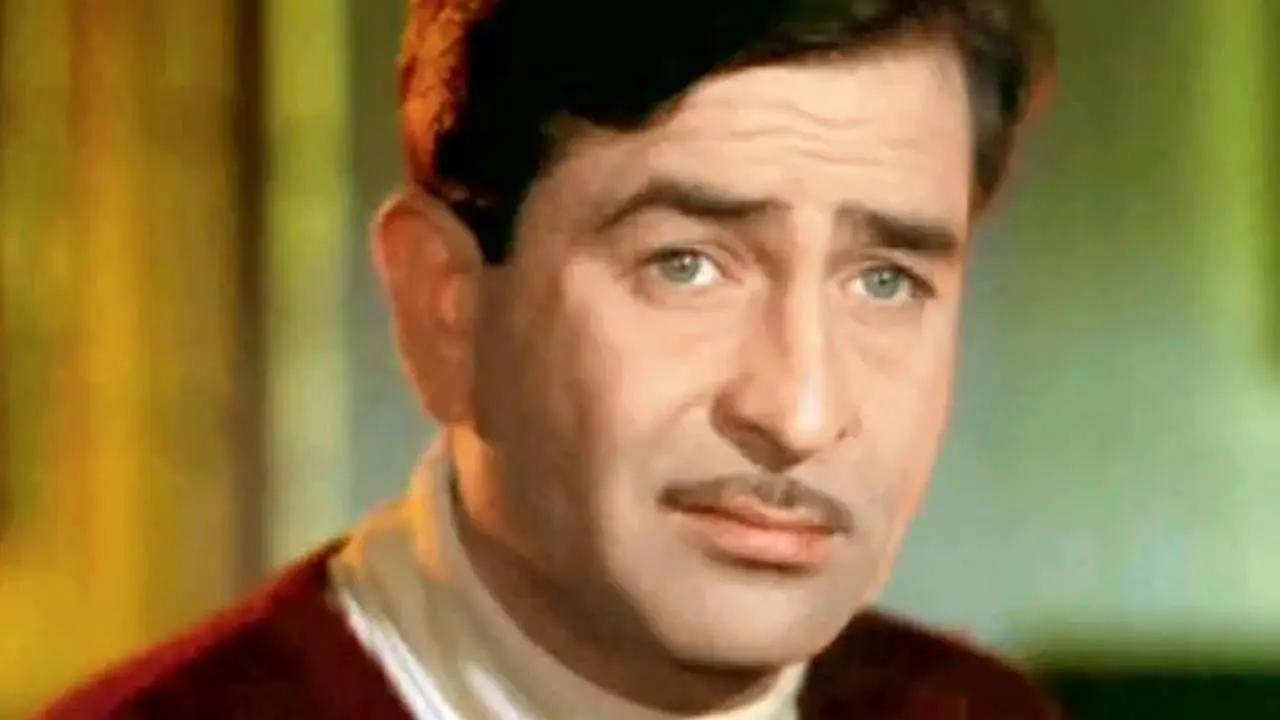
From USSR to North Africa and from South America to Iran, Raj Kapoor’s films swept the world in the 1950s and 1960s. On his 100th birth anniversary today, TOI rewinds to recreate the phenomenon of India’s first major global star
Avijit Ghosh (THE TIMES OF INDIA; December 14, 2024)
On arriving in Moscow in the summer of 1982, Raj Kapoor discovered that he’d left behind his visa papers. The actor-director was stopped by immigration. Frantic telephone calls were made. Nobody was sure what was to follow. But they need not have worried. A senior official soon arrived, embraced Kapoor, kissed him on both cheeks and warmly escorted him out.
“Is there anybody else in the whole wide world who could enter Soviet Russia without a valid visa? You should have seen that sight — it was a sight for the gods,” actor-director Sanjay Khan, who was also part of the film delegation, is quoted as saying in ‘Raj Kapoor: The Fabulous Showman’ by Bunny Reuben.
Another encounter of the fondest kind further underlines how Kapoor continued to command a hallowed place in the land of Tolstoy and Tarkovsky decades after the Awara craze swept the USSR like a forest fire in 1954.
In 1993, Russian president Boris Yeltsin told Kapoor’s daughter, Ritu Nanda, “I was in love with your father Raj Kapoor, and I remember him even today.” The anecdote is recounted in the book, ‘Raj Kapoor: The One And Only Showman’.
It wasn’t just the post-Stalin Soviet Union. In the 1950s, China, Iran, Turkey, Israel, Greece, North Africa and Eastern Europe were captivated by Kapoor’s movie and its title track. Slowly the film and its title song became an unofficial anthem, a cultural marker and a totem of national recognition.
It was also a diplomatic ice-breaker. TOI reported in 1994 that the then Chinese Premier Li Peng recalled Awara and its title track when he met India’s human resources minister Arjun Singh in Beijing. That hasn’t changed. “Every Chinese knows this movie,” goes a comment on YouTube. Awara anecdotes can fill a book.
As the nation today celebrates the 100th birth anniversary of India’s first actor-director who became a major global star in a pre-globalised era, what better time to re-appraise the magnitude of the impact that Kapoor’s movies have had across the world.
Inspiration For Turkish Poets
Awara has provided inspiration to much that is popular in Turkish culture: films like Genclik Hulyalari (1962) and Kader Bu (1976), songs and even novels, Turkey based academic and critic Ahmet Gurata told TOI. “A favourite of my mine,” Gurata said, “is a poem by Lale Muldur, which goes like this: ‘“Awaara hoon / Those kids who neither have a Barbie nor a Ken / They always wanted to be visited by Raj Kapoor one night / They would like him to enter their room and bring milk with gold-leaves... and baklava too / How many stories are embedded in the eyes of those shoeshine boys / Who have been paying the price for their genetic sins, / Did you know awaara hoon?”’
Muldur was born in 1956, a year after Awara was released in Turkey. The poem, taken from her ‘Book of Series’ (1991), is yet another testimony to how the gold hearted tramp continues to stir a generation’s imagination.
In his seminal article, ‘The Road to Vagrancy’, Gurata quotes a newspaper advertisement that says “the film was attended by 100,000 spectators during its first week and another 100,000 were unable to watch the film since it had sold out”. He also notes that Awara was voted as the best movie of 1955 by the readers of the popular daily Milliyet, beating Hollywood films such as Roman Holiday (1953) and Limelight (1952). “The film’s director and star Raj Kapoor ranked third on the list of best actors in the Milliyet survey,” he adds.
The title song was a top-selling record and even featured in official functions. “Several Turkish singers circulated it as a Turkish record in music markets. The song literally became part of folk culture when Turkish folklorist Ilhan Basgoz recorded a folk version in 1957,” Gurata writes.
‘Tramp’ Who Was Irresistible In Greece
Watching it under the title, ‘The Tramp Of Bombay’, Greeks too were besotted by the Nargis-Raj Kapoor pairing. Many Raj Kapoor films such as Shree 420, Aah, Anhonee, Paapi, Chori Chori, Pyaar, Amber, Sangam and Do Ustad made their way across over the next 10 years, film researchers from Greece say.
Indian films were not only shown in Athens, but also in villages at improvised open-air cinemas during summers. The songs were often rehashed with minor variations by Greek composers, creating a subgenre of such songs called Indo-Prepi.
Helen Abadzi and Manolis Tasoulas, who have extensively researched the influence of Hindi films in Greece, have identified at least 25 Greek songs whose melodies come from songs composed by Shankar Jaikishan for Raj Kapoor films.
“For instance, the song, ‘Ramaiya Vastavaiya’, from the film, ‘Shree 420’, became a Greek song titled, ‘When I kiss him and when he kisses me’, and was sung by Achilleas Koulaxizis and Filitsa in the Greek film drama, ‘Why was I born poor’,” Tasoulas told TOI.
Tasoulas also provides a fascinating anecdote that underlines the popularity of the Nargis-Raj Kapoor pairing. When in the early 1980s, Mehboob Khan’s film, ‘Aan’, was rescreened in Greece, the local advertisers wrote Raj Kapoor and Nargis as protagonists, instead of Dilip Kumar, Nadira and Nimmi, in the Greek posters. “Few understood the difference, because many years had passed since Kapoor’s films had been screened in Greece, and fans did not remember their faces as much as their names,” he says.
Sangam, Hindujas and Shah of Iran
‘Sangam’ (1964) floored Iran. Radhu Karmakar, who was Kapoor’s regular cinematographer, writes in his autobiography ‘The Painter of Lights’, that the film was a major hit, especially in South America and Iran, where it ran for over a year. Made approximately on a budget of Rs 1 crore, ‘Sangam’ earned over Rs 12 crore, including Rs 5 crore in foreign exchange, he estimates.
Karmakar remembers how the film’s success helped the Hindujas expand their business. The Hindujas, who distributed the film, invited Raj Kapoor and Vyjayanthimala for the golden jubilee celebrations in Iran and, in turn, got invited to a dinner reception hosted in Tehran by Iran’s ruling family. Karmakar says that the Hindujas “till then were film distributors and contractors, trying unsuccessfully to get bigtime business contracts... The Sangam golden jubilee reception opened the palace doors to the Hindujas and thereafter they moved into the big-time league with large arms contracts and business gains”.
“Everyone also knew the singing-dancing persona of Raj Kapoor in Bulgaria. His popularity was witnessed by many from my generation who grew up in the 1960s. This was mainly courtesy of Awara, which many people had seen more than once,” says Bulgaria-born Dina Iordanova, emeritus professor of global cinema at University of St Andrews, Scotland.
Secret of Kapoor’s Success
Kapoor, who produced and directed the film and played the male lead, was a prodigious 27-year-old when Awara was released in India in 1951. He created a Hindustani Chaplin — a survivor of class inequity and circumstance (Awara, Shree 420) — and the naive and sentimental underdog with a heart of gold who could stray but eventually return (Shree 420). These stories found a global echo, especially in places of limited cultural freedom. The sloshing of socialism and songs with a slice of the sensuous had an affirmative resonance for millions, converting RK Films into a premier banner. His name was synonymous with Indian cinema. As PM Narendra Modi said in his interaction with the Kapoor family on Wednesday, “He created India’s soft power before the term, soft power, was born.”
K A Abbas, who co-wrote the story with V P Sathe, remembered in his autobiography, ‘No Man Is An Island’, what a student told him during their 1954 USSR visit: “We are tired of the war, we went through it, and now must we relive it in every book we read, in every film or play that we see? Instead of war, we want to see love on the screen, we want to see carefree happiness, we want someone to make us laugh. That’s why we are crazy about Awara.”
Many young students bragged that they’d seen Awara 20-30 times. A young Russian interpreter noticed that a dialogue in the film was borrowed from Krishan Chander’s short story, ‘The Night of The Full Moon’. “No one had noticed it in India,” he wrote.
As Kapoor himself said once, “Awara was my little contribution to USSR-India friendship.”.
---------------------------------------------------------
When Kapoor met Chaplin
Ranjan Dasgupta (THE TIMES OF INDIA; December 14, 2024)
Raj Kapoor was a born serio-comedian whose face conveyed every emotion perfectly. According to Satyajit Ray, Kapoor was a better actor than a director. Mehboob Khan once confessed to Film India editor Baburao Patel that Raj Kapoor perfected his shots in fewer takes than Dilip Kumar.
Kapoor understood his limitations well. He modelled himself along the lines of Charles Chaplin. Kapoor always shared fond memories of his interaction with Chaplin at the latter’s residence in Montreux. Along with Dev and Chetan Anand, Nargis, Balraj Sahni, KA Abbas and Bimal Roy, Kapoor was part of the first Indian film delegation to visit Venice in 1953. Chaplin invited the delegation for a discussion.
During the interaction Kapoor spoke the most. He asked Chaplin how serio-comedy could be performed effortlessly. Chaplin was silent for a minute. Then looking into Kapoor’s eyes, he asked him to emote silently. Kapoor obliged the legend for three minutes. Chaplin was deeply moved by Kapoor’s performance and advised him to follow his own instincts. As they left, Kapoor kept waving to Chaplin with tears of joy in his eyes. Nargis simply told Kapoor to control his emotions, laughing her heart out.
The Kolkata-based writer interviewed Kapoor many times
3-day Raj Kapoor film festival to be held in 40 cities and 135 cinemas from December 13 to 15
10:22 AM

A rare picture of Raj Kapoor editing the film Satyam Shivam Sundaram
Niharika Lal (BOMBAY TIMES; December 4, 2024)
To mark Raj Kapoor’s birth centenary, R K Films, the Film Heritage Foundation, NFDC, NFAI and cinemas have come together to organise a retrospective titled ‘Raj Kapoor 100 – Celebrating the Centenary of the Greatest Showman’. The three-day fest will showcase 10 films of Raj Kapoor across 40 cities and 135 cinemas from December 13 to 15.
Earlier this year, the Toronto International Film Festival (TIFF), Festival des 3 Continents, and the recently concluded International Film Festival of India (IFFI) in Goa paid tribute to Raj Kapoor with screenings and discussions. Considered the ‘the greatest showman’ of Indian cinema, Raj Kapoor’s screen characters and films drew a tremendous response from fans not just in India but abroad too, particularly in the erstwhile Soviet Union and the Middle East.
Discussing Raj Kapoor’s films and filmmaking, Ranbir Kapoor admitted at IFFI that he is a bigger fan of Raj Kapoor the filmmaker than Raj Kapoor the actor. He also spoke about how, throughout his entire career, Raj Kapoor's films had messages of socialist reform. Awara addressed casteism, and Shree 420 dealt with greed and so on.
Not just India, but Raj Kapoor's screen characters and films drew a tremendous response from fans abroad. His characters and songs were extremely popular in the Soviet Union and the Middle East.
This month, India will start the centenary celebrations of Raj Kapoor - the actor, director, and producer considered to be ‘the greatest showman’ of Indian cinema. The celebration, titled 'Raj Kapoor 100 – Celebrating the Centenary of the Greatest Showman', is a retrospective of his ten films.
To commemorate 100 years of world cinema in 1990, the then Soviet Union honoured Raj Kapoor alongside eminent global film personalities like Ingrid Bergman, Jean Gabin, Charlie Chaplin and Marilyn Monroe.
Raj Kapoor's stories are timeless and this festival is our way of reliving that magic and inviting everyone to experience his legacy on the big screen: Ranbir Kapoor
"We are incredibly proud to be members of the Raj Kapoor family. Our generation is standing on the shoulders of a giant whose every film spoke of the time that it was made and was the voice of the common man over decades. I think it is our responsibility and our privilege to preserve his films for future generations. His stories are timeless and this festival is our way of reliving that magic and inviting everyone to experience his legacy on the big screen. See you at the movies!”
Raj Kapoor was truly India’s greatest showman: Amitabh Bachchan
"Raj Kapoor was truly India’s greatest showman. His life was a celebration and I am sure he would have been delighted to see his films back on the big screen. Raj Kapoor was an artist who lived for cinema. Even today Awara is a film that is etched in my mind. Made at a time of newly independent India, the film was socialistic, reflecting the mood of the times. Talking about Raj ji’s incredible showmanship, the way he envisioned the dream sequence in the film had never been seen before. You are amazed by his fantastical imagination that visualized the surreal setting, the ethereal Nargis ji emerging through thick clouds of smoke, Raj ji surrounded by demonic figures and burning fires – there is a powerful, mystical symbolism in the dream sequence, and that is my favourite."
Raj Kapoor had an all-consuming passion for cinema: Shivendra Singh Dungarpur, Filmmaker and Director of Film Heritage Foundation
"Contemporary audiences in 40 cities will have an opportunity to watch ten landmark Raj Kapoor films that put Indian cinema on the world map spanning almost four decades. These were films that not only captured the imagination of the people but reflected prevalent social and political themes beginning from a newly independent India. Raj Kapoor had an all-consuming passion for cinema. His unforgettable avatar as a tramp that embodied the common man and till his last film he remained a great showman."
Raj Kapoor was not just a filmmaker; he was a visionary who shaped the emotional landscape of Indian cinema: Randhir Kapoor
“Raj Kapoor was not just a filmmaker; he was a visionary who shaped the emotional landscape of Indian cinema. His stories are more than just films; they are powerful, emotional journeys that connect
generations of viewers. This festival is our humble tribute to the greatness of his vision.”
Celebrations across the globe
- This year, The Toronto International Film Festival (TIFF) screened the world premiere of the 4K restoration of Awara to commemorate the 100th anniversary of Raj Kapoor who directed and starred in the film.
- To celebrate 100 years of Raj Kapoor, the Festival des 3 Continents in Nantes, France conducted a book discussion on Raj Kapoor and Anari, Awara, Shree 420, Jis Desh Mein Ganga Behti hai, Teesri Kasam was screened.
- The recently concluded International Film Festival of India (IFFI) rolled out a tribute to honour the 100th birth anniversaries of four Indian cinema legends including Raj Kapoor.
Honours and accolades for Raj Kapoor
- Raj Kapoor received the Padma Bhushan in 1971 and the Dadasaheb Phalke Award in 1988.
- Shree 420 won a National Film Award in 1955.
- Awara and Boot Polish competed for the Grand Prize at the Cannes Film Festival in 1953 and 1955, respectively.
We had no vanity vans, studio bathrooms were awful-Sharmila Tagore
10:02 AM

Natasha Coutinho (BOMBAY TIMES; January 31, 2024)
Veteran actress Sharmila Tagore and her female contemporaries had a tough time shooting in their heyday without facilities like vanity vans or the large entourages provided to stars today.
Sharmila says, “These days, there is a war over vanity vans. The size of the vanity van symbolizes how big or small a star you are. These days, vans have three to four sections where one can have meetings, get ready, and sleep there. We didn’t miss having vanity vans, except when we had to use the washroom.”
The actress recalls, "The studio bathrooms were awful. R K Studios, Mehboob Studio and Rajkamal Studio had big rooms with clean bathrooms, but Natraj and other smaller ones were bad."
Having no air-conditioners back then, the huge fans at the studios were another concern for leading ladies of the yesteryears.
She recalls, "We had a tough time during the rains and Mumbai is always hot and humid so the weather would ruin our hairdos too. We had huge fans that would ruin our hairdos and we would have to keep redoing them. We did not have air conditioned studios except for Famous Studios back then. While shooting outdoors came with it's own sets of challenges, we had different concerns while shooting at studios."
Raj Kapoor’s Chembur bungalow plot sold to Godrej Properties for Rs. 100 crores
8:32 AM
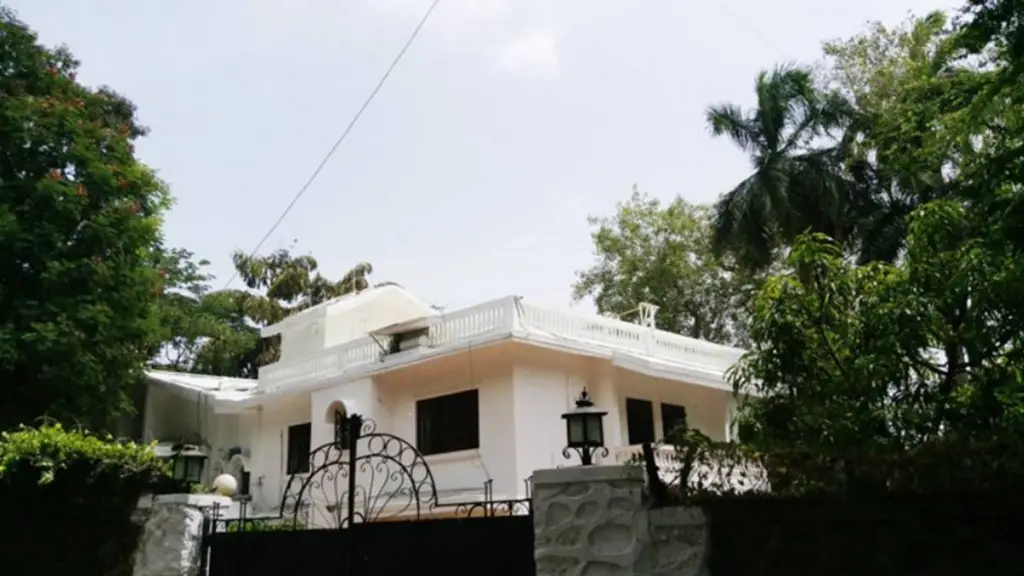
Nauzer Bharucha (THE TIMES OF INDIA; February 18, 2023)
Mumbai: The late Bollywood legend Raj Kapoor’s one-acre bungalow property in the eastern suburb of Chembur has been sold to Godrej Properties for a reported Rs. 100 crores.
The developer plans to develop a premium residential project. “The land is one acre and we expect revenue of approximately Rs 500 crores from the project,” said Pirojsha Godrej, executive chairman of Godrej Properties.
The site is located at Deonar Farm Road, Chembur, and is adjacent to the Tata Institute of Social Sciences, and is considered to be an upscale residential neighbourhood. The land was purchased from the Kapoor family, legal heirs of Raj Kapoor, who was also a prominent film director and producer. More than 20 films were made under the R K Films banner.
“This property in Chembur has been of tremendous significance to my family over the many decades that R K Studios operated from there. We are excited to have chosen Godrej Properties to script a new chapter for this location and build upon its rich history,” said Randhir Kapoor, the eldest son of Raj Kapoor.
Gaurav Pandey, MD & CEO, Godrej Properties, said, “We are pleased to add this iconic project to our portfolio and are grateful to the Kapoor family for entrusting us with this opportunity. The demand for premium developments has been strong over the past few years. This project will allow us to further strengthen our presence in Chembur. We will aim to build an outstanding residential community that creates long-term value for its residents and celebrates the legacy of the site.”
In May 2019, Godrej Properties acquired the 2.2-acre R K Studios in Chembur from the Kapoors for around Rs 180 crore to develop a premium mixed-use project, Godrej RKS. When the studio was sold in 2019, Kareena Kapoor told the media: “The legacy of R K has already been taken ahead with girls like Karisma and I. Now we have Ranbir...Hopefully, our kids will also take it ahead.”
Indian Film and Television Directors Association had appealed to Godrej to build a Raj Kapoor Museum on the site. Raj Kapoor built the studio in 1948 and directed and produced several projects under its banner over the next decades, the last being Rishi Kapoor’s ‘Aa Ab Laut Chalen’ in 1999.
According to news reports, the Kapoor family found the cost of maintaining the studio to be too high.
I can’t explain how much it hurts to not be able to speak to Rishi every day-Randhir Kapoor
7:54 AM

Today marks one year since the death of one of Indian cinema’s most loved actors, Rishi Kapoor. His brother, Randhir Kapoor recently spoke to us about how difficult it has been to move on without his brother-buddy and that life can never be the same without him
Rachana Dubey (BOMBAY TIMES; April 30, 2021)

(Cuts in…) Can you believe it? Dekhte hi dekhte, ek saal ho gaya. In a matter of 10 months, I lost both my buddies, my brothers Rishi and Rajiv. It’s been the most painful year for my family and me. It’s been an extremely sad year for Raj Kapoor’s clan. I loved my brothers dearly. Rajiv and Rishi left us one after the other, and life has not been the same without them ever since. We’re a close-knit family and we spent most of our time with each other when we were not at work. We loved being around one another and our camaraderie was something else. We’d meet for drinks, meals and sometimes, just to talk to each other and relive old memories. Life is dotted with happy and sad moments, but the last 10 months have been a terrible jolt. Life can never be the same without Rishi and Rajiv. I loved them dearly, and I will always miss both of them.
They say time is a healer. How are you coping?
I am not feeling healed. Time is not healing me in any manner. Just when we were slowly coming to terms with Rishi’s passing away, my youngest sibling Rajiv left us. I feel lonely without them. They were not just my brothers, they were my confidants and my closest friends. We grew up together; our parents brought us up in such a way that we grew up to become each other’s pals, secret-keepers and what-have-you. We were each other’s strength and shoulders to lean on. I don’t have them here anymore.
Yes, time will heal us but I definitely feel a vacuum. In Rishi’s case, Neetu, Ranbir and Riddhima have felt a greater sense of loss. Rishi’s absence must be hurting them so much more, every single day. I am slowly coming to terms with his absence, too, but it will take a long time for it to settle in.

We had such great times together. That void of the brother-buddy can never be filled up. For the world, he was a great actor, who left behind scores of wonderful movies to enjoy and love. For us, he’s left loads of happy memories of the times we’ve laughed, hung out, eaten and chatted with abandon. Of course, I can go back and I do go back and watch all his films and that’s how I end up seeing him virtually, every day.
The connection we shared ran really deep. Rishi was a great friend to have - reliable and honest. My sister Rima and I feel his absence all the time. We’re left alone now — out of five siblings, it’s just she and I now. In the last three years, we lost our mom, our R K Studios and millions of invaluable memorabilia, our brothers, our sister and Shashi uncle. It’s all happened too soon. Today, when I watch Pyaar hua ikraar hua from Shree 420, I see my siblings in it and it pains me that memories of that movie have been lost forever. What you see in that song is what we’ve lived by — my siblings and I grew up to respect our elders and be extremely protective of one another.
For us, Christmas was always at Shashi uncle’s house, Holi was at Chembur and Diwali would be at one of our homes. All that is somewhat dwindling now. It doesn’t feel the same anymore, especially without my brothers. There’s hardly anyone there now from that generation of people in the family to which my brothers and I belonged. In this one year, my kids have supported me a lot, ensuring that I don’t feel lonely, but nothing can fill the void that my brothers have left behind. I miss that sibling bonding.
I saw them going in front of my eyes and it pains me to think of those days and times when I had to bid farewell to them. Emotional jolt! Time will heal me, I am sure. But, I can never get Rishi or Rajiv out of my mind. I am hoping that I will come to terms with their absence. The show will go on.
What runs through your mind when you watch their films now?
I almost feel like calling them up and telling them what I feel, and then I realise, it’s not going to happen. There’s not one day when Rishi and I didn’t speak to each other in all these years. There’s been a silence for the last one year. It’s beyond words to explain how much it hurts to not be able to speak to Rishi and share my thoughts with him. The lunch and dinner times, our drinking windows in the day, the time when we would hang out together...there’s not one moment in the day when I don’t miss Rishi and Rajiv. Rishi was so happy about his second innings in cinema with all those lovely roles. He was very pleased with the work that he was getting, all these different characters. He would say ‘Dabs, I can’t imagine myself in some of these roles but yeh directors aur writers toh kamaal kar rahe hain.’ He had loved a whole lot of scripts that came to him even as he came close to his last days. Who knew this would be it? He just could not be there to relish his success in the second innings, which he worked so hard for.
Like you said the show must go on, will you sit back and watch one of your favourite Rishi Kapoor films today?
I will be thinking of Rishi, like every other day, and it’s not a conscious thing. It happens on its own. We were emotionally close to each other. Life will go on, it moves us on. My father (Raj Kapoor) believed that the show must go on and it will. He’s left plenty of great films behind, unko dekh kar yaad karunga apne bhai ko. My brother was such a charming man, a good husband and a loving father. His children made him so happy. C’est la vie... I hope Chintu is happy where he is now.

When not shooting for Halo, I'm washing clothes and shopping for groceries-Shabana Azmi
8:03 AM

Resuming work on Steven Spielberg's Halo in Budapest amid pandemic, Shabana Azmi on enjoying her stint away from home
Upala KBR (MID-DAY; November 19, 2020)
While we continue to be confined within the four walls of our homes, Shabana Azmi has not only dashed off to Budapest but also raced ahead in time to the 26th century. Earlier this month, the actor resumed work on Steven Spielberg's futuristic sci-fi adventure television series Halo, which has been adapted from a video game. The Otto Bathurst-directed venture, also featuring Pablo Schreiber and Natascha McElhone, sees Azmi play Admiral Margaret Parangosky, the head of the Office of Naval Intelligence.
"It's lovely to be back on the set. Pablo Schreiber and Natascha McElhone are wonderful co-stars. We have adopted the bio-bubble mode, and are following several precautionary measures," says the actor, who will be stationed in the Hungarian capital till December. When she is not facing the camera or rehearsing her lines, Azmi jokes that she is busy making errand lists. "I live in an apartment here. I am washing clothes, cleaning and shopping for groceries — something that I never need to do in India. I have a house help who comes to service the apartment. I cannot cook to save my life, so I order in on most days," she laughs, evidently cherishing the experience of living on her own in a foreign land.
The past few months have been hectic for Shabana Azmi — she shot for Nikkhil Advani's web series, Moghuls, before joining the unit of Halo. The actor marvels how the two projects are worlds apart. "One is a historical drama and the other, a futuristic sci-fi show! An actor cannot ask for more diverse subjects," she says, noting that the difference in the working styles of the Hindi film industry and Hollywood is gradually diminishing. "Now, we have proper call sheets. Earlier, that was not the case [in Bollywood]. I remember, Rajesh Khanna and I were shooting a scene in Khar for Aravind Sen's film [Nasihat, 1986] while Kader Khan was writing the next scene in R K Studios, where he was shooting for another film! It's a miracle that we, actors, managed to bring any authenticity at all."
Though the actor missed being part of Diwali festivities in Mumbai, she celebrated it in her own way. "I lit two diyas, wished everybody on Facetime and ordered pizza. It's a strange feeling to be away from home during the festival because we celebrate it in a grand manner."
Irrfan Khan convinced Rishi Kapoor to stay in desert one night-Nikkhil Advani
8:20 AM

As told to Roshmila Bhattacharya (MUMBAI MIRROR; May 1, 2020)
 Today, a scene from my 2013 film, D-Day, flashes through my mind. Irrfan (Khan) looking at Chintuji, and laughing, amazed that they had finally managed to capture this much-wanted terrorist, despite their carefully-laid plans having failed. I remember Irrfan urging me to let the camera continue to roll, and what emerged was this moment of delicious irony.
We were shooting in the desert and while Irrfan and a lot of team bunked out in tents, Chintuji would drive two hours back to the hotel. He was averse to early morning shoots, but there was this sunrise shot we had to shoot with him and he was refusing to comply, saying, “I’m an actor, not a doodhwala.” Irrfan finally managed to convince him to spend the night in the desert with us with the promise of Chicken Jungli and alcohol. It was a near-impossible feat in Kutch, but he delivered on his promise and I got my shot.
Chintuji’s bungalow and our building in Bandra shared a common boundary wall. Every evening, while returning from R K Studios at 7.30 pm, he’d look out for my car, and if he saw it standing, he’d call me and invite me over for a jashn during which he would berate me for that Friday’s release, even when I reminded him I had not made the film. To be fair, he was also wowed by a few young filmmakers. My own Chandni Chowk To China’s trailer had impressed him. He’d called all his friends to say the film was another Sholay and I was the next Ramesh Sippy. After its release, I got an earful from him, saying I had made him look like a ch****a. More recently, he called me from New York, saying “Just saw the Batla House trailer… Fabulous”. Then, adding, “Par trailer toh tu hamesha achcha hi kaat ta hai, hope you’ve not f***ed up the film.”
On Wednesday evening, after speaking to his secretary, Shantiji, I messaged him, “I heard that you are unwell. Prayers and wishes for you always, sir.” The next morning, he was gone...our jashns are over.
Like all Kapoors, Rishi Kapoor loved food-Poonam Dhillon
8:09 AM

As told to Shaheen Parkar (MID-DAY; May 1, 2020)
I have lost count of the number of films I did with Rishi Kapoor, especially in the early '80s. There were movies like Biwi-O-Biwi (1981), Tawaif (1985), Sitamgar (1985), Zamana (1985), Ek Chadar Maili Si (1986), Dosti Dushmani (1986) and many more.
I was a newbie then, but he was willing to work with fresh faces. At that time, he was the only star who had no qualms about teaming up with novices. I would tell him that he deserved to be in the Guinness Book of World Records for collaborating with the maximum number of new heroines. He could rattle off names [of all those he worked with], and would often wonder where some of them disappeared.
He was a natural and spontaneous actor, one who would laugh and fool around with the unit off camera, but instantly [transform] into the character when [we] rolled.
You could see the passion in his eyes as he enacted scenes.
Like all Kapoors, he too loved his food. The most distinct memory I have is going to R K Studios and [enjoying] the lavish spread and hospitality of the Kapoors.
I was in touch with him even when he was in the US for treatment. If I messaged him late at night, he would wonder why I was awake at that unearthly hour. Former minister Arun Jaitley, who passed away last year, was also seeking the same treatment at the same hospital in New York. As I also knew him, Rishi would often tell me that he would invite Jaitley to his home for a meal.
When he came back, we caught up with each other. He was not pretentious. He would not hide that he loved his drink. His wife Neetu would ensure that he had healthy meals, but, as soon as she would leave the room, he would quickly take a bite of [the food he was forbidden from eating]. He was childlike.
Memorabilia of Raj Kapoor films passed on to Film Heritage Foundation
8:00 AM

As RK Studio makes way for residential project, Randhir gives Raj Kapoor's first camera, film posters and other memorabilia to Film Heritage Foundation
Mohar Basu (MID-DAY; September 25, 2019)
 Five months after the iconic R K Studios was acquired by a realty giant for a luxury residential project, the magic of Raj Kapoor's cinema continues to reside in fans' memories. Now, in good news for film enthusiasts, the memorabilia of Raj Kapoor films — including posters, cameras used by the showman over the decades and other artefacts — have been passed on to Film Heritage Foundation for preservation.
Shivendra Singh Dungarpur (left), the founder of the Tardeo-based organisation and archivist, says he is grateful to be the safe keepers of these precious possessions, each telling a beautiful chapter of the showman's life and, by extension, of the evolution of Hindi cinema.
 "Randhir Kapoor gave us most of the materials, including posters, photographs, lobby cards and Raj Kapoor's books. In fact, we also have the camera that Raj saab used to shoot his first film [Aag, 1948]. He used the same camera for several films thereon. These things have to be kept in a temperature-and humidity-controlled environment, and I am grateful that Randhir saab thought that the best place to preserve all of it is with us," says Dungarpur.
A film aficionado, he rues the loss of cinematic gems in the 2017 blaze that reduced the 70-year-old Chembur studio to ashes. "I made a documentary, The Immortals, in which I had shown Raj Kapoor's coat and shoes from the song, Mera Joota Hai Japani [Shree 420, 1955]. We would have loved to take care of these rare pieces, but unfortunately, the entire make-up and costume department got burnt. As for the manuscripts, letters and scripts, they are well-preserved by the family."


R K Studios razed, the iconic gate stays
7:44 AM

Rachana Dubey (BOMBAY TIMES; August 22, 2019)
 It was 71 years ago in the month of August when Raj Kapoor shot Aag (1948) with Nargis, the first film to be produced under his banner R K Films. The movie, shot at the iconic R K Studios in Chembur, gave birth to Raj Kapoor’s company and studio that went on to live for generations, even long after he passed away. In August last year, the filmmaker’s son Rishi Kapoor announced that he and his siblings had decided to sell off the studio, which faced irreparable damage in a fire in 2016.
The studio, which had seen innumerable films and TV shows being shot in its premises, was also home to the Kapoor family’s annual Ganeshotsav in Chembur. Last year, Raj Kapoor’s eldest son, actor Randhir Kapoor, had told us that it was indeed the last of the celebrations in the studio, which had by then, changed hands. When we visited the site of the studio recently, we found that apart from the iconic gate, nothing of the studio really remains. Its canteen (frequented by stars of yore), the shooting floors and recording studios have all been demolished to make way for a plush complex. However, the gate of the studio will be maintained by the new developers as a memory of Mumbai and Hindi cinema’s iconic cinema landmark.
 When we reached out to Randhir Kapoor, he said, “I am sad to see everything has been razed. However, the place will always hold a special place in our hearts because it’s been a part of our lives. It was my father’s legacy. When the studio got terribly damaged in that fire, we had to take a step back and think. Such decisions are not easy to arrive at. It was economically not viable for us to keep the studio, repair it and maintain it because we did not have many takers for the studio floors. The shoots have all moved to the Western suburbs. So, it only made sense to let R K Studios go. The gate, I’m told will stay as is and will continue to remind people of RK Studios. We will be thankful to the developers for that.”
 Actress Padmini Kolhapure, a Raj Kapoor discovery, shot several films at the RK Studio, including her debut Satyam Shivam Sundaram (1978). When we told her about the studio floor being razed, she reminisced the times when she would spend her days working at the studio. “Today, so many memories attached to R K Studios are coming back to me. It’s sad that now whenever I pass Chembur, I won’t find the studio there, but in Raj uncle’s words, ‘The show must go on’. The memories will live on forever. I shot a lot of films there, so much so that I could call the studio my second home. Satyam Shivam Sundaram, Prem Rog (1982), Rahi Badal Gaye (1985), Yeh Ishq Nahi Aasan (1984) are some of my films I vividly remember shooting for at R K Studios. I feel a stronger connection to the place because I was an R K Films’ heroine. We shot 30 per cent of Prem Rog in the studio at Chembur. We had set up massive sets for the songs. I can never forget those days when we filmed Mohabbat hai kya cheez and Yeh galiyan yeh chaubara there. I was virtually living there. Raj uncle would treat us to such amazing food, and their canteen was phenomenal, too. He would often open the theatre for me to watch some of his classics like Awara (1951) and Shree 420 (1955). He loved cinema and he wanted people to acquaint themselves with it. Raj uncle’s cottage (where he would sit and talk to us), his Holi parties, the recording rooms, the canteen — there's no corner of R K Studio that I don’t remember and that I won’t miss. Whenever I travelled to Pune, I made it a point to go past the R K Studios because I would bow before the Lord Shiva idol they have at the entrance. The studio formed a great part of the city’s legacy and I will miss it each time I pass the bend where it once stood.”
 Simi Garewal, who had worked in Raj Kapoor’s Mera Naam Joker (1970), had also made a documentary on the legendary filmmaker's life. She said, “I always thought men go, but their monuments and buildings remain. Now, both have gone. But the memories will remain as long as we live. I don’t mourn the end of R K Studios, the films we made there will remain forever.”
 Filmmaker Imtiaz Ali, who shot a song for his last film, Jab Harry Met Sejal (2017) at the studio, told us, “R K Studios is a hallmark in progressive Indian filmmaking and it’s my privilege to have filmed there. Although it is sad to know that it does not exist physically anymore, it will live on in the ethos of Indian filmmaking forever. I would also like to point out that things change, and filmmaking techniques have changed a lot as well, so from time to time, such hard news is inevitable. I shot a song of Jab Harry Met Sejal there, and I visited the make-up rooms as often as possible in the memory of all the great film personalities like Raj Kapoor and others, who have spent time there.”
IFTDA requests for a museum dedicated to Raj Kapoor at R K Studios site
7:55 AM

Rachana Dubey (BOMBAY TIMES; May 6, 2019)
After several months of speculations, last week it was confirmed that Godrej Properties has bought R K Studios from the Kapoors. As per plans, a business-cum-residential complex will be built on the land that housed the iconic film studio. It was an emotional, but practical call for the Kapoors, who were struggling to maintain it, especially after a considerable part of the studio was gutted in a fire in September 2017.
The R K Studios, which saw a host of landmark films and shows being shot in its premises, was also the venue for the Kapoors’ annual Ganeshotsav celebrations. Years ago, the family also hosted their legendary Holi parties at the studio.
While talking to Bombay Times on Saturday, Randhir Kapoor had said that he hoped that the new owners would respect the legacy of the land that they have acquired. Now, the Indian Film and Directors’ Association (IFTDA) has expressed similar views. They have written to Adi Godrej requesting him to build a museum on the land, and dedicate it to Raj Kapoor to keep his legacy alive.
In the letter, the association states, “We extend our heartiest congratulations to you for acquiring the iconic RK Studios. The devastating fire in September 2017 gutted the studio, which had been built 70 years ago by the legendary Raj Kapoor. The Showman’s name spells magic and reminds one of the cinematic masterpieces crafted by him… Raj Kapoor was an institution in himself, an inspiration to budding directors, a guide to media students, and a connoisseur of music. His legacy has to be protected for the future generations… It’s our humble appeal to you on behalf of the film industry and the IFTDA to spare some area from the 33,000 sq meters, for a Raj Kapoor museum, which will refresh the memories of the filmmaker and actor for the next generations. We request you to pay this tribute to the unsurpassable genius and give a solemn thought to our appeal.”
Ashoke Pandit, president of the association, explains, “We felt that as an association it is important for us to do our best to protect and save the identity of great masters like Raj Kapoor. One feels sad when you see towers and malls built on studio lands in the city. Many studios are being sold to builders for various reasons. These were built by great masters of cinema, whose vision was to keep the craft alive. Hence, they had built these studios, which became our identity. These were places of worship for the film industry. We conveyed our request to Adi Godrej because we know that apart from being an industrialist, he also respects art and culture. We hope that he will consider our request.”
--------------------------
OTHER STUDIOS THAT ARE A PART OF BOLLYWOOD HISTORY, WHICH HAVE DOWNED THEIR SHUTTERS
Apart from R K Studios in the Central suburbs, films were once shot at Famous Studios at Mahalaxmi, and Ranjit Studios, Shree Sound Studios and Roop Tara Studios at Dadar. The location was convenient as a lot of actors used to live in South Mumbai (between Marine Drive and a few kilometres to the North). Another prominent studio in Central Mumbai was V Shantaram’s Rajkamal Kala Mandir in Parel, which was built in 1942.
As the action moved to North Mumbai, the demand for shooting floors in Central and South Mumbai dipped. Some of the studios in these areas are striving hard to stay alive, while others have shut shop. Filmmaker Mehboob Khan did not want to establish his studio in the Northern suburbs where one had many options like Natraj, Swati, Mohan, Essel, Kamalistan, Chandivali, Filmalaya and Filmistan. He zeroed in on a plot in Bandra, a suburb dominated by schools, churches and parishes in 1954. Mehboob Studios, spread over more than four acres of prime land, went on to become a landmark and continues to remain one. The property has survived the builder lobby because it belongs to a trust.
Natraj Studios in Andheri, which was once bustling with action, was sold off to a builder. Another popular location, just a few hundred meters across the Western Express Highway in Andheri was Mohan Studios, which was gutted in a fire.

Selling R K Studios was the need of the hour-Randhir Kapoor
7:44 AM

The actor talks about the sale of the iconic RK Studios to Godrej Properties and how the family believes that the show must go on
Rachana Dubey (BOMBAY TIMES; May 4, 2019)
 After several months of speculations over who would acquire the R K Studios property in Chembur, it is now confirmed that Godrej Properties has bought it from the Kapoor family. The studio, which is counted among the iconic landmarks in Mumbai, was set up by Bollywood’s ace showman, filmmaker-actor Raj Kapoor in 1948.
Over the last few years, the studio’s floors were given out on rent for film and TV shoots. After a massive fire gutted it down in September 2017, the property has been lying vacant. Precious memorabilia and other studio equipment were destroyed in the fire. Last year, Rishi Kapoor, who is currently being treated for cancer in the US, had confirmed that his family was in talks to sell off the property as it was becoming difficult to manage it.
The 2.2 acre-land has been acquired by Godrej Properties to develop a mixed-use project (business-residential). In an official statement, the company has said, “The site is strategically located on the main Sion-Panvel Road and offers an extremely well-developed social and civic infrastructure with multiple schools, hospitals, retail malls, residential, and commercial spaces in close proximity.”
When BT reached out to Randhir Kapoor, he said, “We sold the property about six-seven months ago. It was a decision that we had taken and it was only a matter of time before we would execute things. It was becoming difficult to manage it, although we did everything for its upkeep. The fire in 2017 gutted down everything of importance there, and from that point onwards, it became harder. My father believed in moving on with time; he always said that the show must go on, come what may. That is exactly what we did when it came to R K Studios. We all have an emotional attachment with what our father had built for us, but this was the need of the hour. The property was in good hands in the past and it continues to be in good hands even now. My best wishes are with the new owners. I hope they will respect the legacy of the land that they have bought from us.”

The Kapoor brothers — Rajiv, Rishi and Randhirwith Ranbir Kapoor during Ganpati celebrations at the iconic studio
The final hammer on R K Studios all set to be struck
8:52 AM
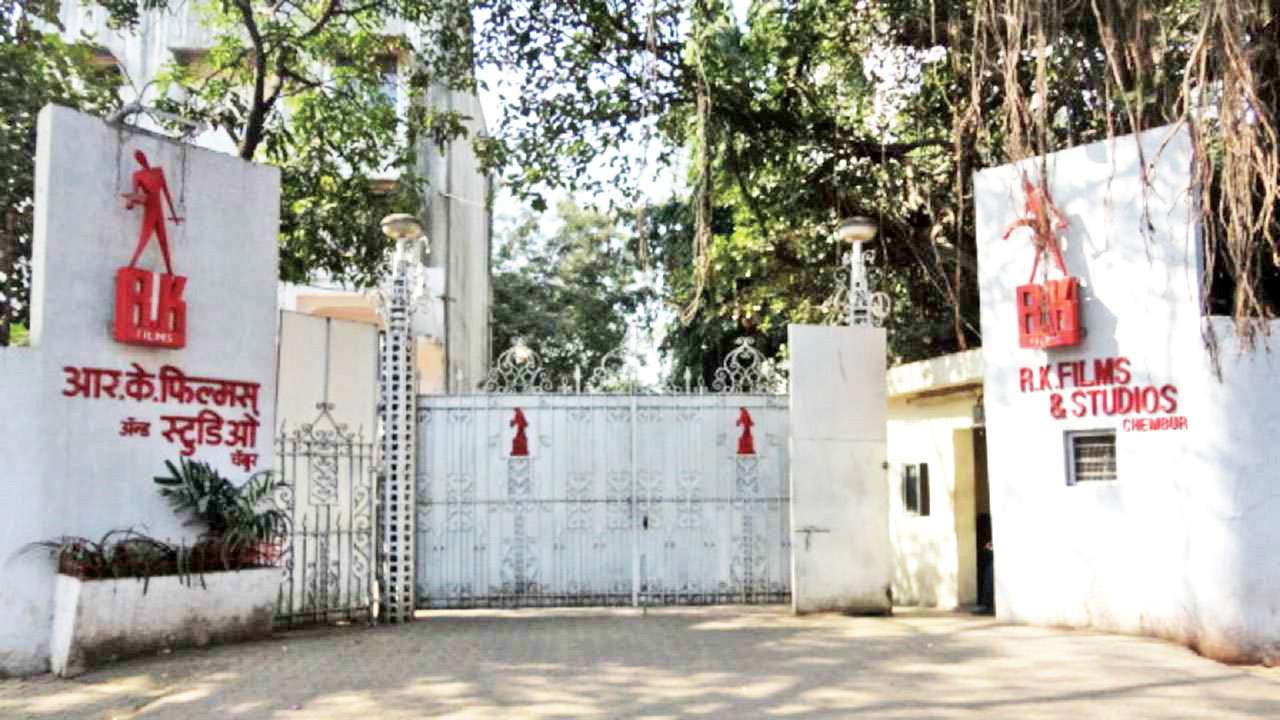
DNA (October 28, 2018)
Somewhere at the start of this year when Rishi Kapoor told us, it broke his heart to reveal that his father’s dream, the RK Studios, was in the process of being sold, we felt his anguish. The studio, which had been built by Hindi cinema’s biggest showman, was with the Kapoor family for nearly seven decades. While their banner had fallen silent in the last 15 years because they were unable to put up a production, it was still a pride for the three Kapoor brothers to be the owners of this iconic address. “If I am in town, I make it a point to come to RK every afternoon,’’ said Randhir Kapoor, who was the defacto head of the place after his father’s death in 1988. His younger brothers — Rishi and Rajiv — also had their offices here and would come to the studio as often as possible.
However, after the fire broke out in September 2017, it was a certainty that the Kapoors would have to either invest huge funds to make it a state-of-the-art facility in keeping with today’s requirement or they would sell it. Guess with the two most active members of the family, Randhir pushing 71 and Rishi at 66 being physically unable to keep the family flag flying high because of their age and health factors, the decision has been made to sell the business to a realty giant for a rumoured Rs 180 cr-plus. Sources say the proceeds will be divided between the five siblings, Ritu, Randhir, Rishi, Rima and Rajiv. Sadly, when this sale goes through, it will bring the curtains down on a golden chapter in film history.
Remembering Krishna Raj Kapoor, Bollywood's Lady in White: A tribute by Khalid Mohamed
9:16 AM

KRISHNA RAJ KAPOOR (1931 - 2018)
Krishna Raj Kapoor was a model star wife for whom the hearth and home mattered above all
Khalid Mohamed (MUMBAI MIRROR; October 2, 2018)
She was married to a showman, but any kind of attention embarrassed her. She was particularly adept at deflecting conversations that harked back to the good and bad old days. Instead, she’d want to know how you’d been doing, why you’d lost weight, and whether you had managed to make another trip to the Nantes film festival in France.
Krishna Raj Kapoor, who passed away following a cardiac arrest at the age of 87 on Monday morning, followed the cardinal rule of speaking only when spoken to. She was aware she could be glorified as a woman of forbearance. She was aware she could be extolled as a woman who remained rock firm against a shoal of calumnies. She didn’t need that. Her silence spoke volumes.
The only time I heard her murmur a sentence of regret, was when she couldn’t retrieve the hundreds of stills clicked by a photographer assigned to cover the studio shoots of the R.K. banner films. “Pata nahin,” she had smiled wanly, “he doesn’t wish to part with them or even make copies.”
Her eyes, though, would disclose a certain tenderness, touched by a hint of melancholia. Her self-discipline in serving as a binding force to India’s greatest showman, Raj Kapoor, must have taken a toll. If he exuded flamboyance, she radiated restraint. You could call it a classic case of opposites attract -- and despite hiccups -- be together till the last breath.
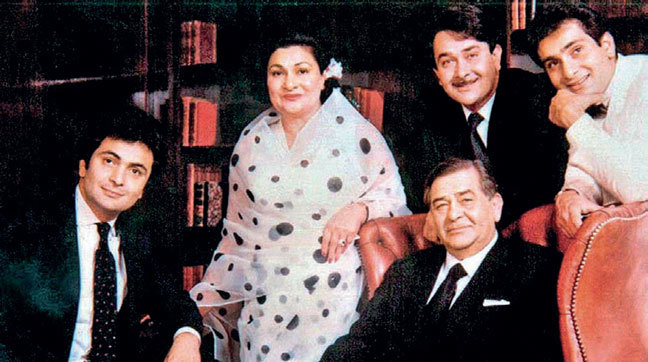
The couple with their sons Randhir, Rishi and Rajiv
Indeed, she became a role model for film star wives, inwardly conscious that it’s ultimately the hearth and home which matter. Subservient she could never be. She was an equal and at points, even the superior one, a status which can now be accorded to her unflinchingly. During her lifetime, she would have been offended by any form of panegyric.
The story of the Rewa born girl is the stuff that love stories are made of. At the age of 16, the daughter of police inspector general Raisaheb Kartar Nath Malhotra, married the upcoming actor Raj Kapoor who was 22 then. The blue-eyed dreamer had seen her play a tanpura on visiting the home of her brother actor Premnath.
Inspector general Malhotra was the maternal cousin of R.K.’s father Prithviraj Kapoor. So, they were distantly related. What is colloquially known as ‘an arranged love marriage’ was fixed. Rewinding to the wedding ceremony, the late thespian Ashok Kumar, would often chuckle, “Krishna peeked at me from under her ghunghat and told Raj, ‘Oh he’s so handsome!’ He didn’t quite like that and must have sworn that he would become much more famous than me. Which he did.”
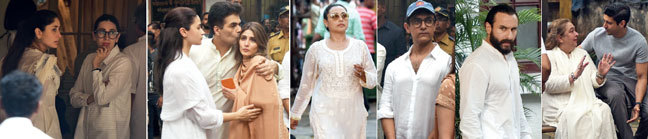
Sisters
Kareena and Karisma rushed to RK cottage with parents Randhir and
Babita in the morning; Karan Johar consoled Riddhima Kapoor-Sahni; Rani
Mukerji, Aamir Khan and Saif Ali Khan were among the visitors who turned
up to pay respects; Farhan Akhtar was seen with Rima Jain; PICS: RAJU
SHELAR
Accustomed to a large family – she had 11 siblings including Rajendra Nath and Narendra Nath who went on to become actors – the bride segued into the patriarchal Prithviraj Kapoor family which had anchored itself in a Matunga neighbourhood.
Raj Kapoor’s career was on the ascent, simultaneously as an actor, producer and director. Her family helped him with a financial loan to build the R.K. Studio in Chembur. “Dad and my grandfather weren’t flush with money those days,” son Rishi Kapoor has recalled, adding, “Relatively, my mother’s family was well-off.”
Raj Kapoor’s spiralling popularity was accompanied by his legendary romance with Nargis. The passion play between the creator and his muse was no secret. The on-screen chemistry, evidenced notably in Barsaat, Awara and Shree 420, was so palpable that the pair became socially acceptable off-screen even in the corsetted 1950s.
Krishna Raj Kapoor didn’t recoil or threaten the showman with ultimatums. Mother to five children — Randhir, Ritu, Rishi, Rajiv and Rima — her winning card was tolerance.

The
Bachchans — Aishwarya Rai, Jaya, Abhishek and Amitabh — arrived for the
last rites; Anil and Sunita Kapoor were among the early visitors, while
their daughter Sonam was also present; Boney Kapoor stayed close to
Salim Khan through the evening, as Arjun Kapoor turned up with sister
Anshula
Tolerance, in such a context, may sound regressive. For a mother, however, tolerance was the unalloyed strength and priority. Within and outside the film industry, polygamy was rampant. Suffice it to say she had to withstand it, an option which is exercised to this day and millennium by Bollywood’s first wives’ club — till it comes to a breaking point.
Raj Kapoor and Nargis parted ways without any demands on the wife’s part. The actress left the banner on her own volition to act in Mehboob Khan’s Mother India. Presumably, the showman was becoming far too possessive, she wanted to strike out.
The breaking point for Krishna Raj Kapoor came with the Raj Kapoor-Vyjayanthimala affair in the course of filming on the overseas locations for Sangam. Whispers about the liaison reached a crescendo point. With her children, Krishna moved out of the R.K. Cottage in Chembur to a suite at the then-Natraj Hotel on Marine Drive. No acrimonious statements, no arguments. Enough was enough.
Inevitably, the Vyjayanthimala chapter came to an end. The R.K children were back where they belonged: home. Other R.K. heroines, Padmini and Zeenat Aman, were linked with Raj Kapoor, transiently. It was the wife who became the irreplaceable Lady in White, an imagery associated with the showman who often showcased his heroines in spotless white costumes.
Krishna Raj Kapoor’s style was timelessly elegant. She would be seen most often in understated embroidered white and pastel shaded organza, chiffon and georgette ensembles. A string of pearls would be supplemented on festive occasions with diamonds. Right till advanced age prevented hours-long, traffic-clogged car rides, she would travel from Chembur to Kemp’s Corner in South Mumbai to get her hair coiffed by Ray George Stevenson of the six-decades-old Raechelle salon.

Varun
Dhawan, Tabu, Maanayata and Sanjay Dutt, Rakesh Roshan, Jeetendra,
Danny Denzongpa, Sanjay Khan dropped by to pay their respects; Kareena,
seen here with mother-in-law Sharmila Tagore and actor Kunal Kemmu
She allowed herself a few pleasures, like hosting a game of cards regularly at the R.K. Cottage. Her circle of friends included her sister Uma Chopra (wife of Prem Chopra), Shukla Kumar (wife of Rajendra Kumar), Salma Khan (wife of Salim Khan), Nirmal Kapoor (mother of Anil Kapoor) and Munni Dhawan.
Unlike quite a few star wives she didn’t interfere with R.K.’s creative process, keeping out of story, music and edit sessions, but ensuring that the bar and kitchen were kept open for the filmmaker’s collaborators around the clock.
Above all, the paramount joy in her life was to see her sons and grandchildren evolve in their careers. For instance, she had jetted off to Lake Placid in the U.S. to wait every evening for Rishi Kapoor to return to the unit hotel from the shoot of Aa Ab Laut Chalen. She’d ask, “Hope it all went off smoothly?” and if the first-time director wouldn’t answer, she’d say calmly, “Don’t worry, tomorrow all will go well.” This, in fact, was her credo.
Grandchildren Ranbir and Riddhima adored her. Although she had to travel in a wheelchair, she was at the centre of the celebrations of Neetu Singh Kapoor’s 60th birthday in Paris earlier this year.
You can detect the same look in the eyes, be it in the photographs of her as a young woman, as a resilient widow when Raj Kapoor passed away 30 years ago, or as a loving grandmother on Instagram.
The movies, star wives, relationships and tolerance levels have kept altering dramatically over time. That look of tenderness — with a hint of melancholia — in Krishna Raj Kapoor’s eyes never did.
Subscribe to:
Posts (Atom)