Showing posts with label Prithviraj Kapoor. Show all posts
Showing posts with label Prithviraj Kapoor. Show all posts
Raj Kapoor’s ancestral Haveli in Peshawar partially collapses after heavy rains, earthquake
8:31 AM

The century-old Kapoor Haveli, once owned by (right) Raj Kapoor, was home to his father Prithviraj Kapoor, the first in the family to enter films. Photos: x
HINDUSTAN TIMES (April 6, 2026)
The historic Kapoor Haveli in Peshawar, Pakistan, once owned by the late actor Raj Kapoor, has sustained significant damage following heavy rains and an earthquake on Friday night.
Continuous rainfall had already weakened the structure, and late-night tremors on Friday further destabilized the building. Shakeel Waheedullah, secretary of the Heritage Council in KPK province, confirmed the damage, saying, “A section of the haveli’s wall caved in after the quake.”
The century-old Kapoor Haveli was once home to late actor Prithviraj Kapoor, the first member of the Kapoor family to enter the film industry. Built by his father, Dewan Basheswarnath Kapoor, between 1918 and 1922, it remains a significant cultural site and was declared a national heritage site by the Pakistan government in 2016.
Over the years, the estate has been visited by several members of the Kapoor family. Prithviraj’s sons, late actors Shashi Kapoor and Shammi Kapoor spent time there before Partition, while Raj’s sons, late actor Rishi Kapoor and actor Randhir Kapoor, visited in the 1990s and urged the Pakistan government to undertake its restoration.
I’m a product of nepotism, but I had to work hard to make a name for myself-Ranbir Kapoor
10:10 AM

BOMBAY TIMES (October 11, 2025)
Ranbir Kapoor spoke at a session titled Tribute to Legendary Filmmakers Raj Kapoor and Guru Dutt, during the Celebrate Cinema 2025 festival at filmmaker Subhash Ghai’s film institute. During the interaction, the actor, who is the fourth generation of the illustrious Kapoor family, called himself a “product of nepotism”. He said, “I’m a product of nepotism and I got it very easy in my life, but I always had to work hard because I realised that I come from a family like this and if I don’t have an individualistic approach and if I don’t make a name for myself, I’ll not succeed in the film industry.”
‘YOU GUYS CELEBRATE THE SUCCESS OF MY FAMILY, BUT THERE ARE FAILURES ALSO’
The Rockstar actor shared how early in life he learnt what goes behind making a film – the hard work and the collaborative efforts of a huge team. “You guys celebrate the success of my family, but there are failures also, and as much as you learn from the success, you learn from the failure, too. What do I feel about being born in this family? For me, it was like any other normal family, I didn’t know any better,” explained Ranbir.
Talking about how he grew up watching music directors, singers and lyricists come to his house to create songs for grandfather Raj Kapoor’s movies, he said, “There used to be a lot of arguments, but not of the domestic kind. They’d debate over a scene or the correct lyrics of a song.”
Recalling the words of his great-grandfather, Prithviraj Kapoor, he said, “Filmmaking is not dictatorship, it’s a marriage of so many people and artistes coming together, and believing in something, and believing in inspiring people.”
‘As actors, you have to be malleable’
Speaking about his approach to acting, Ranbir recounted his experiences of working as an assistant director on Sanjay Leela Bhansali’s 2005 movie Black. He made his debut with Bhansali’s Saawariya (2007), and will be seen in the director’s upcoming film Love & War.
“When I saw him (Bhansali) write scenes and saw the actors perform, I studied them. I was not trying to ape them, but I’d ask myself how I would approach the scene. But once you become a working professional and start acting in movies, every film is different, and there’s no fixed method. As actors, you have to be malleable. You can’t say I work only in this way. Every filmmaker has a different way of telling a story, and filmmaking is a director’s medium. If a director wants it a certain way, then it’s your job as an actor to fulfil that,” he advised budding actors and directors in the auditorium, and added, “We are not selling the world, we are providing entertainment. So, do it to the best of your ability and don’t get stuck with one method.”
It was clear that being scared was a thrill for the audience, says third generation member of India’s first horror family, the Ramsays
2:52 PM
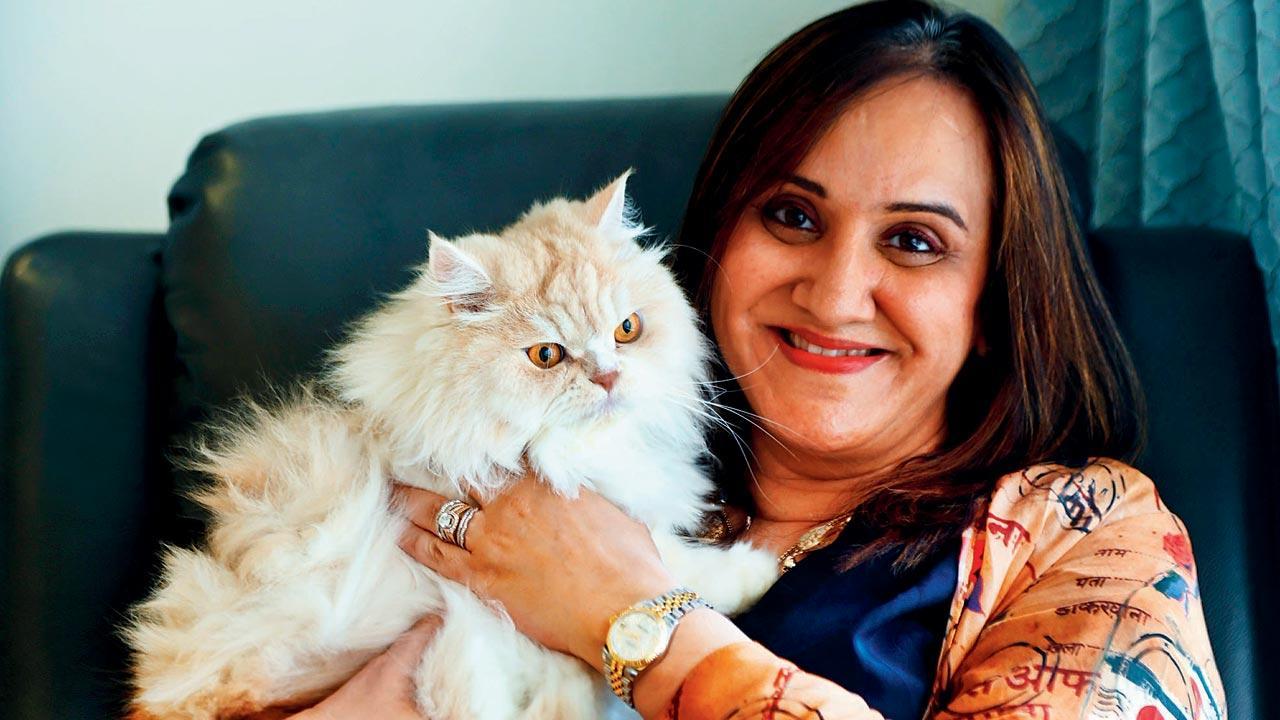
Alisha Priti Kirpalani says she was a sceptic, like most members of the Ramsay family, until she captured a ghost on her video camera, during a visit to Sagrada Familia, Barcelona’s most famous church. Pic/Bipin Kokate
A new book by a third generation member of India’s first horror family reveals how plot lines of their cult films blurred with the paranormal reality they were living with
Jane Borges (MID-DAY; April 11, 2021)
“Why did the Ramsay Brothers choose horror as their speciality?” It’s a question that pops up right in the middle of author Alisha Priti Kirpalani’s new book, Ghosts In Our Backyard (HarperCollins India), after she has narrated several eerie, ghostly encounters experienced by the Ramsays. For Kirpalani, who was born into the family that introduced Hindi cinema to the horror universe, the question seems to be rhetorical.
Having chosen to write an unusual family memoir, which she describes as a bridge between the spirit world and spirituality, the book offers a possible explanation to the inspiration behind the “purani haveli” variety of horror that Indians lapped up through the ’70s and ’80s. The supernatural, she claims, was not just a figment of imagination for celluloid, but also a shadow that followed some members of the Ramsay family, her mother Asha Thawani — daughter of Fatechand Uttamchand (FU) Ramsay — in particular.
Kirpalani’s take is in stark contradiction to what another family member, Saasha, granddaughter of FU and daughter of late filmmaker Shyam Ramsay, recently shared in an interview: “The Ramsay family doesn’t believe in ghosts.” And yet, Shyam’s own account of a ghoulish hitchhiker he encountered on a highway, and which is documented in the book, puts the spotlight on many such bizarre events that Kirpalani says the family deliberately chose to keep secret. Why? “Because, I think they didn’t believe in it themselves. They all thought they were imagining it. When you face the supernatural, you tend to rationalise it. That’s probably what happened in their case,” she tells mid-day. “I don’t think anyone else would have been able to get them to speak about it.” These are very personal memories, she says, and it needed someone from the family to help dredge them up.
The Ramsinghanis—“the family surname had been shortened to the easier-to-pronounce ‘Ramsay’ for the benefit of their British clientele”—originally hailed from Karachi. They moved to Bombay, right after the Partition. FU, who started his career as radio engineer, had to switch to selling fabric to meet the expenses of his large and growing household—he had seven sons and two daughters.
Like most small-time businessmen, FU was drawn towards films. While two of his films, Shaheed-E-Azam Bhagat Singh (1954) and Rustom Sohrab (1963) that starred Prithviraj Kapoor and Suraiya, did well at the box-office, it was Ek Nanhi Munni Ladki Thi (1970), which changed the business of filmmaking for the family. “Both Shyam and Tulsi noticed the audience’s positive reaction to the scene [in that film] where Prithviraj Kapoor wore a scary mask. It was clear that being scared was a thrill for the audience,” Kirpalani writes in the book. That’s when the Ramsays’ tryst with horror began.
FU, a self-taught filmmaker himself, had a unique vision for the movies and saw merit in this new path his sons were seeking.
The brothers’ first was a Sindhi horror film, Naqli Shaan, in 1971. A year later, they made Do Gaz Zameen Ke Neeche, which not known to many, was loosely-based on a story narrated by their sister Asha to her father FU, says Kirpalani. Asha, now 75, we learn in the book, was among the first of the siblings to have witnessed something paranormal as a child, inside a building in Ajmer, where her maternal aunt lived. “When [journalist] Shamya Dasgupta was writing a biography [Don’t Disturb The Dead: The Story Of The Ramsay Brothers, 2017] on the Ramsays, my mother had checked with one of her siblings if he had mentioned to the writer that she was the one who had given the story for that film, and he said, ‘Oh! I forgot.’ I remember noticing my mum’s disappointment, then. While the Ramsay brothers have contributed immensely, there was a Ramsay sister as well, who was an equally gifted storyteller,” says Kirpalani.
Her biggest contribution was to this book, her daughter feels. It was Asha who reached out to her siblings around three-and-a-half years ago, and convinced them to share the strange experiences that some of them had encountered. Kirpalani, a former journalist, went on to do full-length recorded interviews with her uncles, aunts, and cousins. “None of these stories have been made up. One cannot expect Ramsay monsters, of course. But, they are all authentic,” she tells us.
For sceptics, like this writer, a book of this nature might seem perplexing at first. Yet, one cannot discount the cult following the Ramsay brand of horror continues to have. Even though relegated to ‘B-grade’ category, their movies, made with low budgets and small-time stars, managed to hit gold at the box office. Films like Veerana, Purani Haveli and Bandh Darwaaza among others, despite the ghostly makeup that bordered on the farcical, spooked the daylights out of their audience—some credit must go to that iconic, spine-chilling background score, now synonymous with the Ramsays.
Kirpalani too, claims to have never really believed in ghosts. Though she binge watched horror films along with her mother, and even accompanied the family on shoots, she saw all of it as pure entertainment, and nothing else.
“I remember, when my mum would tell me about her experiences, I would do what most members of the Ramsay family did—listen from one ear, and let go out of the other, as they say,” she laughs. Her daughter Tiana too, had had strange paranormal experiences by then, including hearing her dead kittens mewing in their bathroom, hours after they had passed on. But none of it had made her overly anxious.
It was only in 2012, during a family holiday to Spain, when she visited Sagrada Familia, Barcelona’s most famous church that Kirpalani turned into a believer. Documenting “a white translucent hand, its fingers diaphanous” on her video camera, which she says could otherwise not be seen by the naked eye, made her realise she had crossed paths with something unusual. While she had not panicked then, a series of unfortunate events followed, which pushed her into exploring the family’s history, and why, when it came to horror, the Ramsays, had been the chosen one. The book is replete with supernatural incidents that Kirpalani accessed from the family.
She had started researching for the book, when her uncles Tulsi and Shyam, were still alive. The brothers, known as the Kings of Horror, passed away a year apart, in 2018 and 2019. While Tulsi mama, she recalls, had teased her about her attempt, “because he had not seen any ghosts in his lifetime”, her uncle Shyam had been more forthcoming. He shared his highway encounter with a woman “bathed in moonlight” whom he had given a lift to, while returning to Mumbai from a shoot in Mahabaleshwar in 1983. It was only once she was in the car that he noticed her “twisted toenails” and “gravelly voice”. “Inspired by this occurrence, five years later, in 1988, Shyam Ramsay made the film Veerana,” Kirpalani writes in the book.
Even her late uncle Arjun Ramsay had an eerie encounter while shooting in a graveyard.
Rescuing a man, who had fallen into a casket while carrying a very heavy spotlight, “he thought the corpse within had caught hold of his foot”. He later facetiously described it as a “clumsy entanglement with the rattling bones of a skeleton,” but his daughter Tanuja feels there was more to it.
There is also the bhootiya “palace” that Kirpalani writes about, which became a popular destination for the Ramsay shoots, where many a crew member and family, could hear the shuffling of feet from one of the rooms, which had been out of bounds. The caretaker had said that his mentally unstable sister lived here, but nobody had ever seen her. Gopal Ramsay, son of the eldest Ramsay brother, Kumar, had a more sinister account to share. Daredevil that he was, Kirpalani shares how one night, he “snuck into the passage and peeked through the keyhole”. He could hear the same shuffling sound, but didn’t see anyone. “At that very moment, the thick glass of the window in the passageway cracked and then shattered. Scared witless, Gopal raced away and never ventured near that room or the passageway ever again,” she writes. Other members of the family had heard demonic cries in the palace; they were later told that it was of a woman, who had gone insane after being abandoned by her lover. Kirpalani’s sister Jaya and mother too, claim to have witnessed a creature inside a decrepit well—not too far away from the premises—that wasn’t far removed from the bhoot envisioned by the make-up artiste for the film. “The palace was really a ground for mass hauntings. Everyone has had some or the other experience here,” says Kirpalani.
Stranger are the accounts from the Juhu bungalow that Kirpalani’s father Devidas Thawani, son of the late Jotumal Thawani—both of whom were well-known film financiers—had briefly acquired following an unpaid loan by a producer. Her mother had once seen a shadow swirl in the television room in the basement of the building. Another time, the television set in her bedroom switched on, on its own, the sound of the “ear-splitting static” jarring her nerves.
“But, I found Gangu mama’s [second son of FU] story very scary,” says Kirpalani. Her uncle, a cinematographer, and his wife Veena, recounted being chased down by a male apparition while they were walking to their hotel in Mahabaleshwar. “In the dark, it [the head] glowed yellow. It was round, abnormally round, emitting a pasty, jaundiced pallor. The face was bloated like a full moon, and there were no distinguishable features—no nose or a mouth. Though the features were smudged, it had definitely been human once,” Kirpalani writes of the ghost that the couple had encountered. “When I was imagining their situation, my blood turned cold. He is in fact one of the only brothers, who still continues to have strange encounters,” she says.
Kirpalani says that the Ramsay family was quite supportive through her endeavour. “What is strange is that all their experiences have been very alike—the cold air and the pressure in the chest. How is it that everyone is reporting something similar?” she wonders.
Kirpalani is aware that in writing this book, she has probably put her own credibility at stake. “If I have to be authentic, I will have to take risks. Nothing ventured, nothing gained. What’s the worst case scenario? People will think I am cuckoo; I am fine with that,” she says. “But, my purpose [in writing this book] was to create hope, and not fear. The book is more an exploration of life, death and beyond, and how the Ramsays were very much part of this journey.”

Kirpalani with her mother Asha Thawani—daughter of Fatechand Uttamchand (FU) Ramsay—and daughter Tiana, both of whom have claimed to have experienced several supernatural occurrences

For the longest time, the Ramsays lived together at their Lamington Road residence. While the ground floor housed the production office, Ramsay Films, the family inhabited the two floors above. Pic/Bipin Kokate

Posters of Ek Nanhi Munni Ladki Thi and Do Gaz Zameen Ke Neeche, the films which set the wheels in motion for the Ramsay horror genre. Pic courtesy/Dhruv Somani

A young Kirpalani (centre) at her late uncle Shyam Ramsay’s wedding. In the book, Shyam shared his 1983 encounter with a ghostly lady, on a highway. The filmmaker, who helmed many horror movies in his career, passed away in 2019

The late FU Ramsay with Kirpalani’s paternal grandfather, film financier Jotumal Thawani
60 years of Mughal-E-Azam: Why Prithviraj Kapoor’s name preceded Dilip Kumar and Madhubala’s in the credits
8:13 AM

Roshmila Bhattacharya (MUMBAI MIRROR; August 5, 2020)
 The story goes back to 1945. While the Quit India movement was escalating, K Asif was filming Anarkali at Minerva Movietone Studio with Sapru and Nargis as Prince Salim and the courtesan Anarkali, and Chandramohan as Akbar, intent on separating the lovers. The filmmaker had flagged off what was planned as Hindi cinema’s epic extravaganza the previous year in a peaceful India. But following the Partition, Shiraz Ali, who was bankrolling the film, decided to relocate to Pakistan. Before leaving, he set up a meeting between Asif and construction magnate Shapoorji Pallonji Mistry, having decided to settle the latter’s dues against the rights of the underproduction film.
“Shapoorji was a huge fan of Prithviraj Kapoor and would often go to the Royal Opera House to watch his plays. Since they were not ticketed, he would stand outside after the performance, with a jhola for patrons to donate what they wished and Shapoorji would rain money into it,” recounts Deepesh Salgia, CEO and Director of a company in the Shapoorji Pallonji Group.
K Asif was around 25 then, with just one directorial, Phool, behind him. A charmer, he convinced Shapoorji, who had little interest in showbiz, to come on board. There were casting changes, with a more saleable Dilip Kumar replacing Sapru and Ajit Khan coming in for Himalaywallah as his trusted lieutenant, Durjan Singh. Dilip Kumar’s entry led to Nargis’s exit, and Madhubala, a virtual nobody, became an unforgettable Anarkali. “Shapoorji was very close to her father, which is how he convinced Ataullah Khan to let Madhubala continue shooting for the film even though he was irked about her closeness to Dilip Kumar and later his betrayal when he gave evidence against her in court in the Naya Daur case,” informs Deepesh.
Akbar’s big shoes had to be filled too, after Chandramohan suffered a fatal heart attack in 1946. Both Shapoorji and Asif were convinced only Prithviraj Kapoor, impressive as Sohrab Modi’s Sikander, could play the emperor. He lived the role, walking barefoot, in May, for the scene where he goes to Salim Chisti’s dargah to pray for a son.
Shooting resumed in 1951. The film was completed in 500 shooting days, used 1 million feet of negative, and was unveiled nine years later, on August 5, 1960. It made Shapoorji poorer by 3 million USD (Rs 1.5 crore).
The Sheesh Mahal set on which “Pyar Kiya To Darna Kya” was filmed, alone cost him Rs 15 lakh, taking two years to build with glass imported from Belgium.
A 100 dancers were used in the song “Ae Mohabbat Zindabad”, one of 20 recorded, of which 10 were unheard, including “Husn Ki Baaraat Chali”. For the war scenes, 2000 camels, 4000 horses and 8000 jawans from the Indian army were hired. By 1956-’57, the budget had quadrupled and there were times Shapoorji despaired over the escalating costs. But Asif couldn’t be reined in.
When technicolour arrived in India in ’57, he shot one reel in colour in ’58. Impressed with the results, Asif shot three more reels the following year and would have re-shot the full film in colour had the distributors not put their foot down. Mughal-E-Azam released in 15 per cent colour, then, was re-released on November 12, 2004, in full colour with Dolby Digital sound.
Once, when Asif came to him for another Rs 15 lakh, Shapoorji insisted he’d get only Rs 3 lakh. The director immediately screened some rushes for him, deliberately picking scenes featuring Akbar. Every time his producer wah-wahed, he reminded him creative excellence costs money. He got his Rs 15 lakh and left for Jaipur to shoot more war scenes.
Deepesh, whose favourite scene is the one where Akbar comes across the lovers romancing, the drama playing out without dialogue, explains why the title changed from Anarkali to Mughal-E-Azam and Prithviraj Kapoor’s name preceded Dilip Kumar and Madhubala’s in the credits. “While Bina Rai was the protagonist of S Mukherjee’s Anarkali, Mughal-E-Azam showcased the conflict between Akbar’s love for his son and his duty as an emperor. He was livid when the heir to the throne falls in love with a dancing girl and goes through the charade of walling her up, with Salim unaware that she has been safely escorted out through an underground tunnel. Today, the film may well be remembered for Dilip Kumar and Madhubala’s tragic romance, but for Shapoorji, the real heroes were always Prithviraj Kapoor and Akbar,” says Deepesh, asserting that even after 60 years, Mughal-E-Azam’s magic hasn’t dimmed. The film has come back restored and colourised, as a stage play and in the form of books. “Shapoorji would be a happy man today.”
Shyam Ramsay of Ramsay Brothers, who pioneered the genre in ’70s Bollywood, passes away
7:54 AM

MUMBAI MIRROR (September 19, 2019)
Shyam Ramsay who, along with his brothers Tulsi, Kumar, Kiran, Gangu, Arjun and Keshu (collectively known as the Ramsay Brothers), pioneered the horror genre in Hindi cinema, succumbed to pneumonia on Wednesday morning. A few days ago, the 67-year-old filmmaker had been admitted to a suburban hospital.
The filmmakers made their debut with the 1971 film Nakuli Shaan, which tanked at the box-office. According to industry lore, the Ramsays were surprised to see the audience flocked to the theatres to watch a film for a scene in which Prithviraj Kapoor’s character enters a museum in a mask and a scary outfit, and left immediately afterwards. Realising that the average movie-goer was enjoying being spooked, the Brothers followed up their debut with Do Gaz Zameen Ke Neeche in 1972.
Shyam and Tulsi led the family banner, jointly directing horror films, while the other departments were delegated to the rest of the siblings. Kumar wrote the scripts, Kiran handled sound, Gangu manned the camera, Keshu assisted on cinematography and assumed production responsibilities, while Arjun oversaw postproduction and editing.
Banking on a potent mix of horror and erotica, the Ramsay Brothers became synonymous with the genre with films comprising corpses, zombies, among other tropes, delivering films like Darwaza, Guest House, Dahshat, Purana Mandir, Tahkhana and among several others, including Saamri in 3D. With the advent of private satellite channels, they also ventured into horror TV shows.
Tulsi, Shyam’s elder brother and codirector, had passed away on December 14, 2018
-------------------------------------
MID-DAY (September 19, 2019)
Shyam Ramsay (1952- 2019)
Shyam Ramsay, one of the seven Ramsay Brothers known for cult horror films such as Purani Haveli (1989) and Tahkhana (1986), succumbed to pneumonia at a hospital yesterday, his family said. “He was hospitalised two to three days ago as he was not feeling well. He passed away at around 5 am today,” a relative said.
Veteran actors Raza Murad, Puneet Issar and Pankaj Dheer were among those who paid tribute to the filmmaker, remembering him as a “humble” and “polite” man. Murad, who worked with the Ramsay Brothers in the 2006 film, Family: Ties Of Blood, said that despite infusing horror in the hearts of the audience, the entire kin was soft- spoken. “Shyam was respectful, the entire family was. The kind of films they made were amazing. The brothers were sweet; we would joke that we’d get diabetes if we talked to them for five minutes. They were the joint family filmmakers in every department of filmmaking, and were extremely committed,” the actor said.
Murad recounted how Shyam convinced him for Family after he had initially rejected the role. “It sounded like I was just among the men from the underworld. I thought I would be one of the actors who may not get importance, so I turned down the role. Shyam called and narrated the role in detail. He said, I’m sorry I couldn’t narrate it to you. You have an important role and we would never waste you’,” he added.
Issar, who starred in their cult classic Purana Mandir (1984), remembered Ramsay as a “capable technician”. “Shyam ji knew the craft very well. He was a man of few words. He and Tulsi [brother] used to direct together. They had great clarity. It’s such a big loss,” he said.
Director Vikram Bhatt said, “Shyam Ramsay carried the torch of horror films right through the ’70s and ’80s. Even amongst the Ramsay Brothers, he was considered the leader. He was innovative and regaled his audiences with fabulous spooky cinema from time to time. His passing is indeed sad, and his contribution to the dark films will always be held in high esteem,” said Bhatt.
The Ramsay brothers also consisted of Tulsi, Kumar, Keshu, Arjun, Gangu and Karan. Shyam is survived by daughters Sasha and Namrata.
There was tremendous sex appeal in Suraiya's flexible voice-Ismat Chughtai
1:58 PM

In the 70s, iconic feminist author Ismat Chughtai wrote about the legendary actor for a Karachi-based Urdu magazine. Here is a translation of the piece that talked about Suraiya’s attitude towards love
MUMBAI MIRROR (November 25, 2018)
Around the time Suraiya was in her prime, when producers and directors met up, her name would inevitably crop up after a few rounds of drinks. Alcohol along with zikre-Suraiya — to hear all that, it seemed as if much like alcohol, her body and voice were also meant to mislead people. There was tremendous sex appeal in her flexible voice — upon hearing it, instead of soaring to the heavens, one’s emotions were rather drawn towards the soil. Possessing the power to completely take over the senses, it carried daawat-e-gunaah — an invitation to the path of sin. When a bunch of men sit down to drink, their talk rips women to shreds. Yet, the manner in which Suraiya is cut to smithereens is beyond compare. She might not have heard it in person but she would’ve certainly seen its reflection in all those gaping stares. That’s why she could never surrender to love unconditionally. She could never love anyone passionately enough to renounce all she had — her home, her mother and her maternal grandmother… There were other factors too that were responsible for strengthening her ideas of love as something awkward and absurd. In those days, film directors were not so burdened with the responsibilities of production as the present-day ones are. It was not deemed odd for directors to get smitten by their heroines… And how could it be possible to not fall for Suraiya? Nearly all her directors were captivated by her… Although she didn’t name them, I could identify all her suitors, as they would often narrate their stories of heartbreak to me — I knew the silly lengths they could go to in their pursuit. She started laughing uncontrollably at the mention of the wooers.
“There was a gentleman who used to light candles at the shrine of Sai Baba,” she chuckled. I immediately knew whom she was talking about.
“A hero would threaten to jump off the terrace.” The hero is alive and kicking and continues with his habit of leaping about, albeit in films.
“Then there was this man who stationed himself outside my flat and after persisting for many days, eventually consumed poison. A fair bit of trouble later, the police took him away. However, nothing could beat what one gentleman did. It was not uncommon to receive letters that contained suicide threats from deranged individuals, or proposals for marriage. One afternoon there was the sound of some wedding band playing in our vicinity. We thought that the sound came from a radio with some wedding sequence from a play being performed. But it kept on increasing progressively and stopped at our doorstep. The doorbell rang and when the door was opened, we were startled out of our wits. There was a dressed-up bridegroom standing right there, complete with a sehra, accompanied by an entourage of baaraatis and platters full of jewellery and ornamental clothes!
We promptly enquired, ‘Who are you?’ ‘I am the bridegroom. Aadaab arz!’ ‘Bridegroom? Listen brother, what are you talking about? Who is the bride?’ ‘Suraiya Jabeen is the bride. The baaraat has come all the way from Jalandhar.’”
And the entire group rushed inside the house. Suraiya hastily locked herself inside the bedroom while her mother was absolutely flabbergasted — they had brought along expensive jewellery worth a lakh or two and umpteen lavish clothes.
“When I told them that we were simply not interested and they should leave, no one bothered to listen and told us that they’ve travelled a long way to reach us,” added Suraiya’s mother. Recalling the incident, Suraiya rolled over with laughter.
“So, what happened then?” I asked “What else could happen? We tried our best to reason with them, but they were just not willing to back off and even threatened to resort to violence. It was only when we summoned the police that we could ward them off. On top of it, the police inspector told us, ‘Why is there such nuisance at your house every other day?’ Great! It was as if we invited wedding processions by design!” said the mother. All this while, Suraiya was in splits.
It was routine for her to dress up as a bride, get married, and then it was time to take the make-up off. No wonder life starts appearing like a grotesque piece of farce. It gets difficult to segregate reality from fiction, and it results in shaking up one’s ability to take decisions… “Which is your favourite among all your roles?” I asked.
“None!” she shot back at once, but after giving it a thought, added, “Actually, all the roles were fine. The one in Parwana was nice, Kajal was quite good too, and so was the role in Mirza Ghalib.”
“I wouldn’t call Papaji [Prithviraj Kapoor] my hero because I was mighty scared of him. He was a brilliant artiste… and I have a lot of respect for him. Saigal ji was such a lovely man. He was completely oblivious of how big a star he was. Humble to the core, he would speak with a lot of politeness and affection.”
The cheer on Suraiya’s face wilted away as she continued to wistfully reminisce about Saigal. “‘Suraiyaji’,” he would say in such a sweet voice, “‘Achchhi to haiñ na?’” [“I hope all is well with you.”] “I have absolutely no regrets about quitting films. The entire process just got to me,” Suraiya’s voice had turned bitter. “I was sick of shooting all the time. For years I hankered for adequate sleep. I couldn’t even eat properly because I have a tendency to put on weight very quickly. I could only dream of getting to watch films or not shooting. It’s a terrible thing to say but I would be ecstatic when someone in the film industry passed away and shooting was stopped. I would fervently pray that may someone die every day and the entire industry get ruined and destroyed. Tauba-tauba! I don’t know what had come over me. Now I catch up on all the sleep that I can, I go out to shop and have a great time. Though they are few in number, I have some very dear friends. I eat all that I want to and love spending time at my bungalow in Lonavla.”
“Do you still sing?”
“Occasionally.”
Maybe Suraiya still hasn’t been able to disconnect songs from films. She could never embrace acting as a part of her soul like Meena Kumari, whose singular interest in life is acting — for the love of which she came back from the jaws of death.
Had Suraiya wanted, she could’ve come back to films too but then there is seldom a cure for fright. As Suraiya spoke, I couldn’t help but recall a story by Chekov. The young maid swings the cradle, but the baby doesn’t go to sleep and continues to cry. The girl finds her whole existence getting engulfed in the howls. Sleep is pricking away at her eyes but it is destined to elude her forever now. As the child persists with the wails, she covers his face with her hand. The baby goes silent and will never cry again. The young maid calmly goes off to deep, tranquil sleep.
Suraiya also suffocated the chronically whining and groaning child. She sleeps peacefully now. Will she awaken from her slumber one day? Will the magic of her voice be re-ignited? Will she come back to life?
Edited excerpts from Yeh Un Dinoñ Ki Baat Hai: Urdu Memoirs of Cinema Legends (Bloomsbury India), translated by Yasir Abbasi

Family and friends mark 40 years of Prithvi theatre and Prithviraj Kapoor’s 112th birth anniversary
8:04 AM

Avinash Lohana (MUMBAI MIRROR; November 5, 2018)
 It was a double celebration for the Kapoor clan on Saturday when Prithvi
Theatre turned 40 alongside Prithviraj Kapoor’s 112th birth
anniversary. The late patriarch’s grandsons, Randhir and Kunal, and
great-grandson Ranbir, joined thespians and theatre loyalists — Rajit Kapur, Lillete Dubey, Lara Dutta, Shyam Benegal, Ila Arun, Divya Dutta, Gulshan Devaiah and Tinu Anand, among others — to mark the occasion.
It was a double celebration for the Kapoor clan on Saturday when Prithvi
Theatre turned 40 alongside Prithviraj Kapoor’s 112th birth
anniversary. The late patriarch’s grandsons, Randhir and Kunal, and
great-grandson Ranbir, joined thespians and theatre loyalists — Rajit Kapur, Lillete Dubey, Lara Dutta, Shyam Benegal, Ila Arun, Divya Dutta, Gulshan Devaiah and Tinu Anand, among others — to mark the occasion.
The festival kicked off at Opera House with the staging of Prithviraj’s play Deewar, which had first premiered at the venue in 1945. “I am proud that the theatre re-enacted my grandfather’s play. It was a nostalgic moment for the family and festival regulars. Shashi Kapoor and (his late actress-wife) Jennifer had established the theatre and it’s going strong with (their son) Kunal,” Randhir told Mirror.
 Rajit, a long-time associate of the theatre, informed that Deewar,
which revolves around Partition, was co-written by Prithviraj and its
new version is directed by Sunil Shanbag.
“My father once told me that he had watched the original play as a
child in Punjab. Now, it’s commendable that members of the Kapoor family
make it a point to attend the opening night of the festival every
year,” the actor-filmmaker added.
Rajit, a long-time associate of the theatre, informed that Deewar,
which revolves around Partition, was co-written by Prithviraj and its
new version is directed by Sunil Shanbag.
“My father once told me that he had watched the original play as a
child in Punjab. Now, it’s commendable that members of the Kapoor family
make it a point to attend the opening night of the festival every
year,” the actor-filmmaker added.
Rajit, who was recently seen in the Junglee Pictures production Raazi, traced his association with Prithvi theatre back to his college days. “As students, just being at the theatre was a privilege. We volunteered there just so we could watch some plays. I was in the third year of college during my first ever performance, Night of January 16. It was magical,” he signed off.
Vidya Balan and Varun Dhawan have attended Prithvi Theatre's Summertime workshops-Kunal Kapoor
7:46 AM

Deepali Singh (DNA; January 22, 2018)
Kunal Kapoor hates giving interviews, and that’s pretty evident when he settles down opposite us with a can of Coke and coffee (‘double dose of caffeine’, he explains), at his beloved Prithvi Theatre in Juhu. He pretends to get up and scoot when we tell him he’s free to not answer whatever he’s not comfortable responding to. But we can’t let go of him so easily.
The iconic theatre, built by his father the late Shashi Kapoor, and where we sit now, will turn 40 this November. Hundreds of theatre practitioners in the city owe their careers to Prithvi, having worked here as actors, directors or technicians. “What’s interesting is how, right from theatrewallahs to audience, everyone has grown up with Prithvi,” says Kunal. Talking about the Prithvi Festival they held at Dubai two years ago, he recalls meeting expat Indians, who would share with him stories of their courtship, how they would meet their partners at the cafe in the theatre, enjoy the signature Irish coffee and watch plays.
“I got to know recently that actors such as Vidya Balan and Varun Dhawan have attended our Summertime workshops. Anupam Kher, Annu Kapoor and Pankaj Kapur performed here and went on to make it big in cinema. Anurag Kashyap told me recently that when he first came to Mumbai and had nowhere to sleep, my sister (Sanjna) had allowed him to use the shed behind the theatre and the make-up bathrooms in the morning. I said ‘Good you didn’t tell me, I would have thrown you out!’” he guffaws. Over to the man himself...
When you think of the Kapoor khandaan, apart from movies, you realise that they have contributed immensely to theatre too. Do you think in term of legacies at all?
These are words that journalists use, not words that we think about. So if dad built Prithvi, he did it because he wanted to do so. That’s why, it’s not even named after him. I don’t want to give interviews, I want theatre groups to give interviews, because it’s about them, not me. I spend a lot of time, energy and money looking after this place. I’m possessive about it because it’s part of our heirloom, something we believe in. I don’t do it because I’m trying to create an image, but because I care. And fortunately, my kids have the same feeling. They are also proud to be associated with it and are protective about it.
How are your children, Zahan and Shaira, involved with Prithvi?
They are young and are just starting their careers. So they are not involved in the day-to-day activities of the theatre. But during our festivals and Summertime, my daughter designs the decor. The lights are designed by both of them. My son shoots and supervises the video promos. The other day, we had a group meeting and he was a part of it where he was listening intently. So yes, they are not distant from it, but supportive.
Even the extended family is here at the festival’s inauguration and often come to watch plays...
That’s what’s marvellous about our family. This theatre was built by my dad, the khandaan has nothing to do with it. Like the RK Studios was built by Raj Kapoor, it had nothing to do with Shammi Kapoor or my dad. But we are supportive of each other. And we are quick to rally around, just as we can tell each other, ‘Uss film mein tune faltu kaam kiya tha!’ (laughs).
Your father, Shashi Kapoor, passed away last month. Can you tell us how he was as a person and as a father?
My father had an amazing memory. Once at an airport when he was going through security, a guy came running up to him and said that he had met my dad 20 years ago. Dad just said, ‘Ya, your name is Sachin, na?’ That guy literally fell down! (laughs) He knew he was a star but he also knew how other stars behaved with people. He was a genuinely charming, extremely good-looking man and gained a lot of respect because he behaved himself. He was a gentleman, but to me, he was my father. If you see his bedroom, there are only photographs of his grandchildren and his family. His work never came home but it was difficult going to public spaces with him. However, we used to travel a lot and get to spend quality time with him. Even when he had a crazy schedule where he had four to five shifts a day, he would be at the breakfast table at 7.30 in the morning.
His theatre, Prithvi, is a place that’s dear to so many people. What are the challenges that the theatre faces?
This place was built not to make money but to be self-sustainable and a catalyst. It was the birthplace to promote theatre and develop an audience for this performing art. Worldwide, theatre is not a profit-making venture, it struggles to survive. And in India, particularly in Bombay (now Mumbai), there was a time when it had virtually come to a standstill. It was then that my dad built it, because it was his father’s dream to have his own theatre. So what are the problems that we face now? For starters, I would like our festivals to be bigger, to have them not only at Prithvi but at several other venues simultaneously. We would like to have theatre companies, from other cities in India as well as internationally.
Now this costs money and it can’t be paid back by ticket sales. This is where it requires sponsorship, or, I prefer the word patronage, but that’s not forthcoming. I’d like a larger sponsorship for my November festival. Institutions like Prithvi help in development of the arts, which is integral to the development of a civic society. Unfortunately, post-independence, we have paid little attention to that. As a nation which is so rich in the history of the arts, it’s a crying shame that we neglected it. We don’t need a 1,000-seater with big monstrous chandeliers but theatres like this that are 200-300 seaters, with vibrant cafes, bookshops and art galleries, even rehearsal spaces. Mumbai can accommodate at least 20-25 Prithvi Theatres. There are enough viewers and theatre groups.
What do you think has been Prithvi’s biggest contribution to the city?
Naseeruddin Shah had once mentioned in his interview that one of the best things Prithvi has done is, it made going to theatre a habit for the audience. It has created an experience for them. The property is open, it’s inviting, there is free seating and no hierarchy inside. In the 1950s when Prithviraj Kapoor was in the Parliament, he had said while watching a play you’re not bothered about who’s sitting next to you, whether a Hindu is seated next to a Muslim or a Dalit is beside a Christian. It breaks all barriers where you laugh together or cry together. It makes society one. That’s what entertainment does, it builds a healthier society.
A look at the two grand premieres of Mughal-E-Azam in 1960 and 2004
8:02 AM

Roshmila Bhattacharya (MUMBAI MIRROR; August 3, 2017)
August 5, 1960… All roads lead to Mumbai’s Maratha Mandir where K Asif is unveiling his magnum opus, Mughal-e-Azam. From movie moguls to business magnates and politicians, including Chief Minister Y B Chavan and Prithviraj Kapoor’s two sons — Raj, who’s flown in from Czechoslovakia and Shammi from the Far East — are winding their way through bumper-to-bumper traffic towards the theatre dazzling in the glow of a dozen spotlights.
At 9 pm the lights go off. The excitement is palpable as Salim enters the world in answer to his father Akbar’s prayers, grows up into a spoilt little prince and is sent off to war. Fourteen years later, the shehzada returns home to the strains of “Mohe Panghat Pe Nandlal Chhed Gayo Re” as Janmashtami is being celebrated in court. He’s introduced to Anarkali (Madhubala) who as Radha is dancing to Kathak exponent Lachhu Maharaj’s cues. While the song was being choreographed, the late Pakistani Prime Minister Zulfikar Ali Bhutto drove down to Mohan Studio everyday to watch it. He was mesmerised by it. The audience is entranced by the bewitching Madhubala and a suave Dilip Kumar, but after about 30 minutes there are stifled yawns and muted whispers of “boring hai.”
At the end of 19 reels, among the many disappointed faces who file out, is a beautiful teenager who had been bracing herself since a week in the hope of running into Dilip Kumar, whom she’d met at a premiere in London and has fallen in love with. This time the actor stays away and Saira Banu is heartbroken. Years later, she admits that though she grew to relish the dialogue, back then she wasn’t too familiar with the beautiful, flowery Urdu. That, coupled with the disappointment of not seeing her ‘hero’, had spoilt the occasion for her.
There are many like her who fail to comprehend words like “taqliya” and wonder why Akbar keeps asking for a “takiya” (pillow), when he simply wants “to be left alone”. The lukewarm reaction deflates the spirit of the team that had fought valiantly for a decade to live their Mughal dream. Only Asif is unfazed. On the night of the premiere, at the party he hosts, he urges them to eat, drink and make merry, confident the film will be a hit. No one believes him but after a ‘sleepy’ start, the box-office starts jingling, adding up to Rs 40 lakh at the end of the first week.
Cut to 2004. Mumbai’s Eros theatre looks like a Mughal court. An elephant ambles along with a palanquin carrying reels of a colourised Mughal-e-Azam. They are unloaded by soldiers in royal costumes and rushed up to the projection room. The foyer is bustling with guests, among them are Rekha, Sridevi and Aishwarya Rai. Time comes to a standstill when Shehzada Salim walks in, his begum by his side. Forty-four years later, Saira Banu returns home, beaming.
Once scorned, how Peshawaris became Bollywood kings
8:26 AM

Sameer Arshad (THE TIMES OF INDIA; January 24, 2016)
When the
present owner of Bollywood legend Prithviraj Kapoor's haveli in Pakistan's Peshawar tried to demolish it, residents
intervened and had him arrested last Sunday. Haider Qadir was granted
bail a day later along with three other accused after cooling his heels
overnight in prison. The four now face trial under antiquity law for
damaging the three-storey mansion with arched windows and protruding
balconies.
The provincial Khyber Pakhtunkhwa government had in 2011 declared the haveli a heritage site along with the ancestral house of another Peshawar-born actor Dilip Kumar in Dhakki locality. The move recognised the emotional connect Peshawar has with several Bollywood legends, who were either born or have roots in the city.
Peshawar was once known as a cultural powerhouse and nursery for Bollywood, but now makes headlines as a terror-scarred city. Perhaps no other locality has given so many superstars to Bollywood as Peshawar's Dhakki. In the labyrinth of its streets, ancestral houses of the Kapoors, Dilip Kumar and Shah Rukh Khan remind Peshawaris of their rich cultural heritage.
Prithviraj's son, Raj Kapoor, Dilip Kumar, and Shah Rukh's father were born and spent their formative years in Dhakki. The locality is part of Peshawar's iconic Qissa Khwani (storytellers) Bazaar, which American traveller Lowell Thomas has described as Piccadilly of Central Asia. Growing up in the marketplace of storytellers, Prithviraj caught attention for his acting talent while studying at Edward College. But it was not easy for him to find feet in Bollywood, where Pathans were considered uncouth. Prithviraj opened the floodgates for Peshawaris to make it big in Bollywood in the 1930s. He took up Film India magazine editor Baburao Patel's challenge after he wrote there is no place in films “for uncouth brawny Pathans who think they can make it as actors''. Prithviraj told Baburao not to challenge him and vowed to cross seven seas and go to Hollywood to become an actor if there was no place for him in Bollywood. His resolve stood him in good stead as he went on to immorsion of Peshawari stars like Dilip Kumar ruled Bollywood with their killer looks, built, style, dialogue delivery and flair for Urdu.
At least four current Bollywood superstars - Shah Rukh, Aamir, Salman and Saif - have Pathan heritage, something that was unthinkable when Prithviraj was struggling to get into films. His contemporary from Peshawar, Gul Hamid, instantly became all the rage thanks to his stunning looks after featuring in 'Baghi Sipahi' (1936). Hamid died young, but Dilip Kumar and Raj Kapoor kept the Peshawari tradition alive by ruling Bollywood for two decades starting 1940s.
Old-timers in Peshawar remember light-eyed Raj Kapoor as a young boy, who played 'gulli-danda' in the city's streets before shifting to Mumbai in the 1930s. He occasionally visited his ancestral house till partition. His brother, Shashi, and sons, Randhir and Rishi, visited the haveli in 1990. Dilip Kumar last visited his ancestral house, just metres down the street from the Kapoor mansion, in 1988. Shah Rukh stayed at his father's house - a stone's throw from the two havelis - in 1978 and 1979.
Other Bollywood personalities from Peshawar include Prem Nath, Rajendra Nath, Madhubala, Amjad Khan, Vinod Khanna, and producer Surendra Kapoor, whose son, Anil, has maintained the Peshawari moustache tradition. “It is a very Peshawari and Pathani thing. My father, grandfather were all Pathans from Peshawar... they all wore moustaches and that is why I wear a moustache,'' Anil Kapoor had told Pakistan's Dawn News in 2009.
The provincial Khyber Pakhtunkhwa government had in 2011 declared the haveli a heritage site along with the ancestral house of another Peshawar-born actor Dilip Kumar in Dhakki locality. The move recognised the emotional connect Peshawar has with several Bollywood legends, who were either born or have roots in the city.
Peshawar was once known as a cultural powerhouse and nursery for Bollywood, but now makes headlines as a terror-scarred city. Perhaps no other locality has given so many superstars to Bollywood as Peshawar's Dhakki. In the labyrinth of its streets, ancestral houses of the Kapoors, Dilip Kumar and Shah Rukh Khan remind Peshawaris of their rich cultural heritage.
Prithviraj's son, Raj Kapoor, Dilip Kumar, and Shah Rukh's father were born and spent their formative years in Dhakki. The locality is part of Peshawar's iconic Qissa Khwani (storytellers) Bazaar, which American traveller Lowell Thomas has described as Piccadilly of Central Asia. Growing up in the marketplace of storytellers, Prithviraj caught attention for his acting talent while studying at Edward College. But it was not easy for him to find feet in Bollywood, where Pathans were considered uncouth. Prithviraj opened the floodgates for Peshawaris to make it big in Bollywood in the 1930s. He took up Film India magazine editor Baburao Patel's challenge after he wrote there is no place in films “for uncouth brawny Pathans who think they can make it as actors''. Prithviraj told Baburao not to challenge him and vowed to cross seven seas and go to Hollywood to become an actor if there was no place for him in Bollywood. His resolve stood him in good stead as he went on to immorsion of Peshawari stars like Dilip Kumar ruled Bollywood with their killer looks, built, style, dialogue delivery and flair for Urdu.
At least four current Bollywood superstars - Shah Rukh, Aamir, Salman and Saif - have Pathan heritage, something that was unthinkable when Prithviraj was struggling to get into films. His contemporary from Peshawar, Gul Hamid, instantly became all the rage thanks to his stunning looks after featuring in 'Baghi Sipahi' (1936). Hamid died young, but Dilip Kumar and Raj Kapoor kept the Peshawari tradition alive by ruling Bollywood for two decades starting 1940s.
Old-timers in Peshawar remember light-eyed Raj Kapoor as a young boy, who played 'gulli-danda' in the city's streets before shifting to Mumbai in the 1930s. He occasionally visited his ancestral house till partition. His brother, Shashi, and sons, Randhir and Rishi, visited the haveli in 1990. Dilip Kumar last visited his ancestral house, just metres down the street from the Kapoor mansion, in 1988. Shah Rukh stayed at his father's house - a stone's throw from the two havelis - in 1978 and 1979.
Other Bollywood personalities from Peshawar include Prem Nath, Rajendra Nath, Madhubala, Amjad Khan, Vinod Khanna, and producer Surendra Kapoor, whose son, Anil, has maintained the Peshawari moustache tradition. “It is a very Peshawari and Pathani thing. My father, grandfather were all Pathans from Peshawar... they all wore moustaches and that is why I wear a moustache,'' Anil Kapoor had told Pakistan's Dawn News in 2009.
Prithviraj Kapoor's Nanak Naam Jahaz Hai to re-release & clash with Ranbir's Tamasha
8:05 AM

Sanyukta Iyer (MUMBAI MIRROR; November 9, 2015)
Forty-six years after it
bagged the National Award for Best Film, director Ram Maheshwari's 1969
Partition drama, Nanak Naam Jahaz Hai, featuring the late Prithviraj
Kapoor as the patriarch, Gurmukh Singh, returns to the screen, digitally
restored in colour and dubbed in multiple languages. What’s interesting
is that it will open on the same Friday as his grandson, Ranbir
Kapoor’s Tamasha.
“We had initially planned a remake, but then realised that whether it’s a Mughal-e-Azam or a Sholay, it’s always the original film that will be remembered. Also, the Kapoors have always insisted that no one can step into the shoes of Prithviraj Kapoor,” filmmaker Rahul Mittra and head honcho of Raju Chadha’s studio and production house, told Mirror.
The original reels which were with Shemaroo Entertainment, were still usuable and the song, “Re mann Aiso Karr” composed by National Award winning composer music, S Mohinder, had the viewers in tears. While the film was being digitally colour-corrected, son of the original story and scriptwriter, Bekal Amritsari, Santok Singh, dropped by to point out that the opening sequences featured a 24-year-old-Dalai Lama and was shot at the Golden Temple. He also mentioned that Prithviraj Kapoor had never featured in a colour poster. “We immediately incorporated the Dalai Lama sequence into the trailer and created a colour poster featuring Prithviraj Kapoor,” informs Rahul.
The first teaser will be unveiled in Mumbai on November 17 with a ‘Kapoor’ celebration and a langar. Besides the family, veteran actors like Jeetendra and Dharmendra will pay a tribute to the legendary actor. Nishi, who retired after playing Prithviraj Kapoor’s daughter-in-law in the film, will be present with son, and Prem Ratan Dhan Payo actor Armaan Kohli.
“The original had released on the 500th birth anniversary of Guru Nanak. Today with the growing intolerance, we thought it could revive feelings of unity and peace in Punjab. With the film being digitally restored, it's a great watch,” promises Rahul who will also be releasing it in North America, Canada, Russia and UK.
“We had initially planned a remake, but then realised that whether it’s a Mughal-e-Azam or a Sholay, it’s always the original film that will be remembered. Also, the Kapoors have always insisted that no one can step into the shoes of Prithviraj Kapoor,” filmmaker Rahul Mittra and head honcho of Raju Chadha’s studio and production house, told Mirror.
The original reels which were with Shemaroo Entertainment, were still usuable and the song, “Re mann Aiso Karr” composed by National Award winning composer music, S Mohinder, had the viewers in tears. While the film was being digitally colour-corrected, son of the original story and scriptwriter, Bekal Amritsari, Santok Singh, dropped by to point out that the opening sequences featured a 24-year-old-Dalai Lama and was shot at the Golden Temple. He also mentioned that Prithviraj Kapoor had never featured in a colour poster. “We immediately incorporated the Dalai Lama sequence into the trailer and created a colour poster featuring Prithviraj Kapoor,” informs Rahul.
The first teaser will be unveiled in Mumbai on November 17 with a ‘Kapoor’ celebration and a langar. Besides the family, veteran actors like Jeetendra and Dharmendra will pay a tribute to the legendary actor. Nishi, who retired after playing Prithviraj Kapoor’s daughter-in-law in the film, will be present with son, and Prem Ratan Dhan Payo actor Armaan Kohli.
“The original had released on the 500th birth anniversary of Guru Nanak. Today with the growing intolerance, we thought it could revive feelings of unity and peace in Punjab. With the film being digitally restored, it's a great watch,” promises Rahul who will also be releasing it in North America, Canada, Russia and UK.
My family has become what ever they are today because of theatre-Rishi Kapoor
7:41 AM

Priya Gupta (BOMBAY TIMES; November 7, 2014)
 In today's commercial times,
it's impossible to find a place as honest and pure as the Prithvi
Theatre. While ticket prices are kept very basic and the capacity is
limited for any artiste to make any significant money for their
performance, every artiste wants to come and perform here. This is the
only place where they all come together once a year during the annual
Prithvi Theatre Festival that was started by Jennifer Kapoor in
1978.
In today's commercial times,
it's impossible to find a place as honest and pure as the Prithvi
Theatre. While ticket prices are kept very basic and the capacity is
limited for any artiste to make any significant money for their
performance, every artiste wants to come and perform here. This is the
only place where they all come together once a year during the annual
Prithvi Theatre Festival that was started by Jennifer Kapoor in
1978.
As Naseeruddin Shah sahab said, “I feel Jennifer's dreams
have been fulfilled, all credit to Sanjana earlier and now Kunal and to
Shashi sahab who had the generosity to have put in his money. It was a
colossal expense at that time and my hats off to him.“ The festival
this year premiered with the outstanding performance by Naseeruddin Shah
playing Einstein. The opening night saw not just three generations of
the Kapoor khandaan, but also several artistes who were accompanied by
either their mothers, daughters or sons to simply join in the
celebrations of this great institution that is symbolic of the passion
and love for theatre. The souls of Prithviraj Kapoor and his
daughter-in-law Jennifer Kapoor must certainly be very happy up
there.
Excerpts from a conversation with Rishi Kapoor who has just recovered
from dengue. This was his very first outing and his first drink post
getting well:
What are your oldest memories of coming to the Prithvi Theatre?
The Prithvi Theatre, as we know it today, used to be a godown where my grandfather Prithviraj Kapoor would keep all his theatre props. Right opposite to the theatre was the 'Prithvi Jhopda' (the Prithvi hut) as it was called as he lived here. I must have been 12ish then.
Were you a part of any play?
I started my career very early at 20. I got into films and then, never got time. Theatre was my family's bread and butter, but I never missed it as I had never done it. And while I have great respect for theatre artistes, I have no knowledge of it. My family has become whatever they are today because of theatre. Even though my whole family was a part of theatre, unfortunately, when I was at an impressionable age, everything shut down as dadaji had to shut down Prithvi for reasons beyond him. But I did do one play at the Opera House in which my job was to only sleep on the bed. I was so naughty that I would keep my one eye open to watch the audience.
Did your grandfather see you becoming a star?
He died in 1971. We started Bobby in 1972. My grandfather performed the mahurat shot in every RK film. That is why in every RK film, you will see him performing the puja to a Shivling that later became the logo. In Bobby, I remember since he was not alive, my father had made a monument of his giving the mahurat shot and his voice played over that.
Talk about Jennifer and Shashi Kapoor?
Prithvi Theatre was Jennifer aunty's baby and she got it made. They both toiled to make this place happen. Shashi uncle is a great uncle, a great actor and a big star. He used to be working round the clock and whatever money he earned, he put it behind Prithvi.
What are your oldest memories of coming to the Prithvi Theatre?
The Prithvi Theatre, as we know it today, used to be a godown where my grandfather Prithviraj Kapoor would keep all his theatre props. Right opposite to the theatre was the 'Prithvi Jhopda' (the Prithvi hut) as it was called as he lived here. I must have been 12ish then.
Were you a part of any play?
I started my career very early at 20. I got into films and then, never got time. Theatre was my family's bread and butter, but I never missed it as I had never done it. And while I have great respect for theatre artistes, I have no knowledge of it. My family has become whatever they are today because of theatre. Even though my whole family was a part of theatre, unfortunately, when I was at an impressionable age, everything shut down as dadaji had to shut down Prithvi for reasons beyond him. But I did do one play at the Opera House in which my job was to only sleep on the bed. I was so naughty that I would keep my one eye open to watch the audience.
Did your grandfather see you becoming a star?
He died in 1971. We started Bobby in 1972. My grandfather performed the mahurat shot in every RK film. That is why in every RK film, you will see him performing the puja to a Shivling that later became the logo. In Bobby, I remember since he was not alive, my father had made a monument of his giving the mahurat shot and his voice played over that.
Talk about Jennifer and Shashi Kapoor?
Prithvi Theatre was Jennifer aunty's baby and she got it made. They both toiled to make this place happen. Shashi uncle is a great uncle, a great actor and a big star. He used to be working round the clock and whatever money he earned, he put it behind Prithvi.


Yeh Raat Phir Na Aayegi: Haunting melodies, hair-raising memories
7:42 AM

Roshmilla Bhattacharya (MUMBAI MIRROR; March 4, 2014)
Back in 1966, Darshan Sabharwal took the brave decision to make his romantic suspense thriller, Yeh Raat Phir Na Aayegi, in black-and-white at a time when colour exploded on the Indian screen. The suspense drama revolves around a mysterious woman who emerges, so it seems, from the skeletal remains at an excavation site, and bears an uncanny resemblance to a centuries-old statue. “The film is in the genre of Mahal and Woh Kaun Thi and my father felt that the eerie beauty of the subject could be best captured in cinematographer Keki Mistry’s black-and-white frames like the earlier classics,” explains Saberwal’s filmmaker son Dharmesh Darshan.
The film opened two years after Kashmir Ki Kali and transformed Sharmila Tagore from a shy teenager to a courtesan from the Magadh era who supposedly returns to life to reclaim her lover. “Everyone was wowed by her sensuality in an Amrapali costume designed by Oscar-winner Bhanu Athaiya. Since her character Kiranmai was from another world, Bhanuji suggested an Amrapali costume for her which was teamed with exotic jewellery like chokers, dangling earrings and a bracelet that becomes an element in the storytelling. Even the trend of Sharmila’s famous bouffants started with a layered, old-world hairstyle adorned with a piece of jewellery in this film,” points out Dharmesh.

The film co-starred Biswajeet who like in Bees Saal Baad is drawn towards his doom by a sonorous signature tune, Har tukda mere dil ka, and a woman who could be real or ethereal. Mumtaz caught the eye in a role with shades of grey and Prithviraj Kapoor played the archaeologist caught in a web of deceit. “But the story revolved around Sharmila and established her not just as a glamorous star but also as a performer,” asserts Dharmesh, who 30 years later reminded the actress about the film when she made a two-scene appearance in his Dhadkan as Akshay Kumar’s mother.
Yeh Raat Phir Na Aayegi continues to haunt with its charttopping tracks, from Har tukda mere dil kaand Yahi woh jagah hai to Main shaayad tumhaare liye ajnabee hoon, Phir miloge kabhi iss baat ka vada kar lo and Mohabbat cheez hai kya. “There was also a beautiful duet, Huzur-e-waala jo hai ijazat, picturised on Helen and Madhumati for the first time,” says Dharmesh. “Pandit Shiv Kumar Sharma called up Ashaji (Asha Bhosle) from the US after hearing the songs during a drive. They recreated the magic of Ashaji and OP Nayyar.”
Subscribe to:
Posts (Atom)