Showing posts with label Prit Kamani. Show all posts
Showing posts with label Prit Kamani. Show all posts
Ladkiyaan mere peeche bhaagti hain, main unke peeche nahin bhaagta-Prit Kamani
7:53 AM
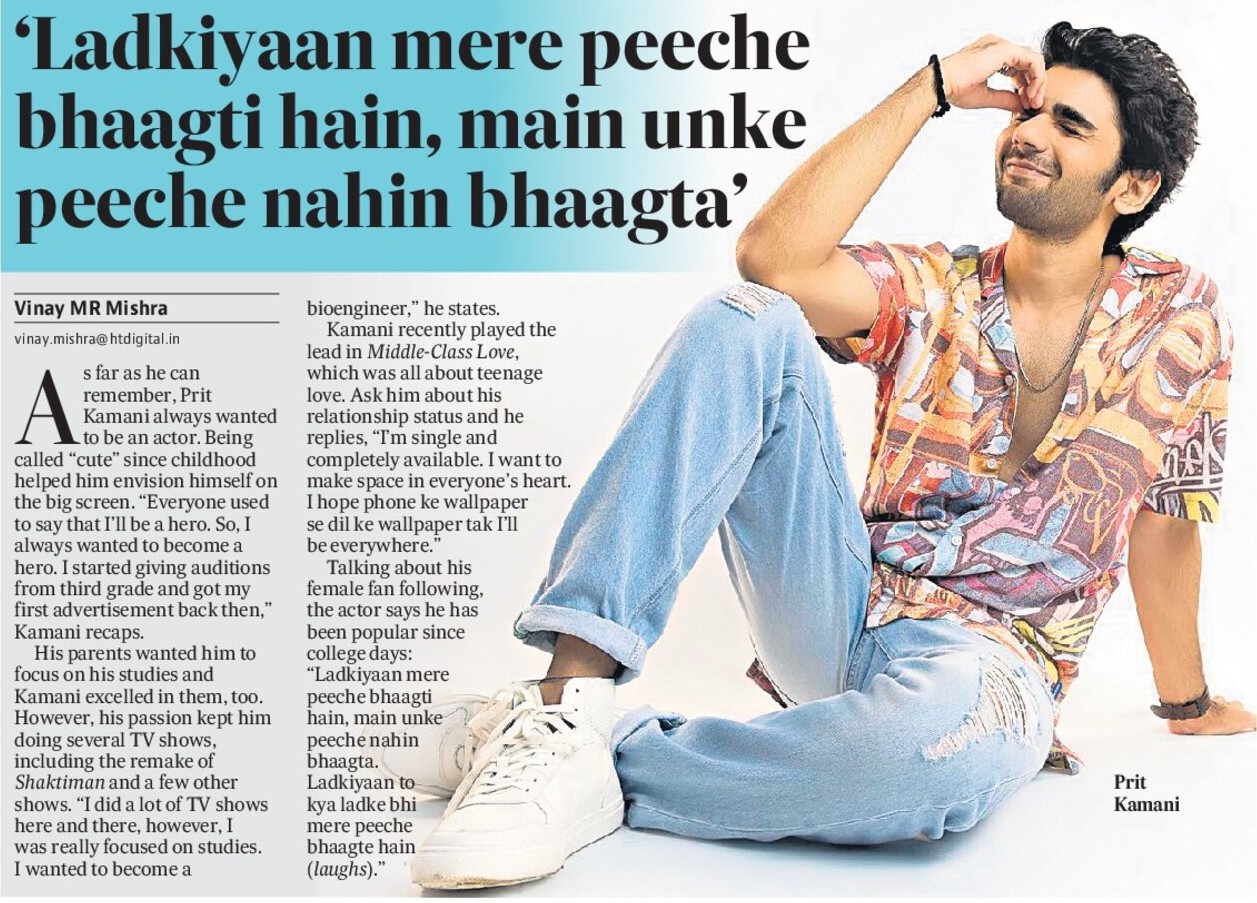
Vinay MR Mishra (HINDUSTAN TIMES; November 30, 2022)
As far as he can remember, Prit Kamani always wanted to be an actor. Being called “cute” since childhood helped him envision himself on the big screen. “Everyone used to say that I’ll be a hero. So, I always wanted to become a hero. I started giving auditions from third grade and got my first advertisement back then,” Kamani recaps.
His parents wanted him to focus on his studies and Kamani excelled in them, too. However, his passion kept him doing several TV shows, including the remake of Shaktiman and a few other shows. “I did a lot of TV shows here and there, however, I was really focused on studies. I wanted to become a bioengineer,” he states.
Kamani recently played the lead in Middle-Class Love, which was all about teenage love. Ask him about his relationship status and he replies, “I’m single and completely available. I want to make space in everyone’s heart. I hope phone ke wallpaper se dil ke wallpaper tak I’ll be everywhere.”
Talking about his female fan following, the actor says he has been popular since college days: “Ladkiyaan mere peeche bhaagti hain, main unke peeche nahin bhaagta. Ladkiyaan to kya ladke bhi mere peeche bhaagte hain (laughs).”
Middle-Class Love director puts no-dating clause in actors’ contracts
8:17 AM

(From left) Kavya Thapar, Prit Kamani and Eisha Singh
Middle-Class Love director puts no-dating clause in actors’ contracts, says co-stars being in a relationship would have ‘hampered the dynamics’
Mohar Basu (MID-DAY; August 29, 2022)
How often have we heard of two co-stars dating ahead of a film’s release? Over the past many years, it has become almost a staple promotional gimmick to grab eyeballs and pique curiosity around the movie. Ratnaa Sinha’s upcoming directorial venture, Middle-Class Love, stands in stark contrast to the practice. Ahead of the shoot of the campus caper that launches debutants Prit Kamani, Eisha Singh and Kavya Thapar, director Ratnaa Sinha and producer Anubhav Sinha included a clause in the actors’ contract that forbade them from being romantically involved off screen during the film’s making.
Ratnaa reasons that the clause, unusual as it may be, was put in place to ensure that the equilibrium on the set was not disrupted. “Right when I hired my actors, I ensured that their contracts have a clause asserting that off-screen romance during the film’s making is off-limits. The film has three leads, and a situation where two of them were dating would have hampered the dynamics. We wanted to ensure that everyone is comfortable and feels like the film belongs to each of them,” she explains.
This isn’t the first time that such a clause has been effected in Hindi entertainment. In 2016, the makers of the show, Rishton Ka Saudagar — Baazigar, had made lead actors Vatsal Sheth and Ishita Dutta sign a no-dating clause. Nidhhi Agerwal, who forayed into Bollywood with Munna Michael (2017), was made to sign a similar contract. In a telling sign of the industry’s patriarchal ways, the film’s hero Tiger Shroff was not bound by such a clause.
In Middle-Class Love, however, Ratnaa asserts that the rule was laid out for all three actors, thus creating a work environment that was transparent and fair. “I am glad we put this rule. The actors were more than forthcoming when this was brought up. They are bright, ambitious, hard-working, and are here to make a career. I was impressed by their work ethic. Now, this is among the things that we all joke about.”
Repeatedly pushing people with limited talent is unfair-Anubhav Sinha
8:17 AM

As he launches rank outsiders with Middle-Class Love, Anubhav says it’s up to directors, press and audience to break B-Town’s cycle of nepotism
Mohar Basu (MID-DAY; August 10, 2022)
Filmmaker Anubhav Sinha has a knack for challenging the norms with his movies — be it Article 15 (2019) or Thappad (2020). This time around, with Middle-Class Love, he is throwing his weight behind rank newcomers Prit Kamani, Eisha Singh and Kavya Thapar. Sinha, who is backing the Ratnaa Sinha-directed offering, begins, “This film demanded newcomers. How else do you make a campus film?”
It’s refreshing to see new names in the billing at a time when it’s common for star kids to bag big-ticket projects. Nepotism in Bollywood has been called out time and again, but there is little on-ground change. “I am not saying that it’s not an important discussion to have, but it mostly gets into mudslinging. There are children who were born in Bandra and Juhu, they played in the backyards of movie stars and filmmakers. It’s only natural that they would get their blessings. [But] repeatedly pushing people with limited talent is unfair. When [it comes down to choosing between] a child from the industry or not, that becomes unfair. I am an outsider, and it’s my responsibility to make sure that whenever I get an opportunity to work with newcomers, I [rope in] people from outside of the industry. I worked with newcomers in Tum Bin [2001], and with Bipasha [Basu] and John [Abraham] in music videos. They became popular, not because of me, but because of who they were. For Middle-Class Love, Ratnaa found these kids who did commercials, television and music videos until they landed a lead part.”
Casting star kids has certain advantages — they grab more eyeballs, thus becoming a more lucrative proposition. However, the filmmaker says everybody, from the media to the audience, has to do their bit to make it a level-playing field for newcomers. “It is more lucrative to [rope in] this one’s son and that one’s daughter from the announcement perspective. But it’s important to choose outsiders. I also blame it on the press. They don’t write as much about the other newcomers. [The press will] blame the readers who don’t read articles about them. It’s a cycle. Ratnaa has made a great film. Now, it’s up to the media and audience to bless the kids because they need those extra blessings.”

From left: Kavya Thapar, Prit Kamani and Eisha Singh
Thankfully, the web world does not typecast an actor-Manisha Koirala
8:13 AM

As she headlines web film Maska, Manisha on why she is enjoying the digital medium more than the big screen
Shaheen Parkar (MID-DAY; March 29, 2020)
Five months shy of turning 50, Manisha Koirala finds herself busier than usual. “I am grateful that I am getting offers at this stage,” says Koirala, who — as a leading lady in the late’ 90s — had witnessed from close quarters how Bollywood could unfortunately be ageist when it came to female actors.
However, with the digital entertainment boom and a new wave of cinema on the rise, she acknowledges that it is a good time for female actors.
If her past outings are any indication, it is evident that she has found her groove in the digital world. Her latest release, Neeraj Udhwani’s Maska, dropped on Netflix over the weekend. Known to dive deep into her characters, Koirala enjoyed the process of playing a Parsi woman, who readies to pass on the family legacy— an Irani café— to her son. “She’s funny, eccentric and traditional. The role provided me an opportunity to do something I had not done before. I had to pick up the strong accent [that] Parsis [employ]. I also visited the various Parsi baugs in the city to observe the community.”
Teaming up with youngsters, Prit Kamani and Shirley Setia, the actor says, “Their energy is infectious.”
Koirala began her tryst with the web world with the anthology, Lust Stories, in which she essayed a banker having an extramarital affair with her husband’s close friend. She is set to reunite with director Dibakar Banerjee for his upcoming Netflix film, Freedom. While she is having a field day choosing roles for OTT projects, her appearances in Bollywood films have been few and far between. Her last memorable role on the big screen was in Ranbir Kapoor starrer Sanju (2018). “I had reservations about [playing mother to Kapoor] as I thought I would be offered only mummy roles thereafter. But thankfully, the web world does not typecast an actor. I want to break the mould. I call myself a hungry actor, and digital films are providing varied roles. What more could I ask for?”
Maska has old ideologies clashing with new-Prit Kamani, Shirley Setia
8:19 AM

Maska actors Prit, Shirley on their Netflix film that follows a cook working at his family restaurant, but harbours acting
Shaheen Parkar (MID-DAY; March 27, 2020)
Singer-turned-actor Shirley Setia and Prit Kamani make their digital debut with Netflix's film, Maska, which drops today. Writer-director Neeraj Udhwani's Mumbai-centric film, which also stars Jaaved Jaaferi and Manisha Koirala, is set in the quaint and dying world of Irani cafés.
"The title has several connotations, and so does the film," says Kamani. "In Bambaiya lingo, lagaoing maska means to butter someone up. Then there is bun maska, a staple fare at Irani cafés. There is also your bread and butter for survival and buttering your bread on both sides to gain from two things," adds Kamani, who plays Rumi Irani, a youngster torn between carrying on the family's legacy and creating one of his own.
Last seen in Hum Chaar (2019), Kamani plays a cook "who has to get his salli boti and prawn patio right because that's what his fathers and forefathers did. I am born to run the family café, but I dream of becoming a movie star," he explains. "Maska has old [ideologies clashing with] new. Rumi is initially lost, and goes off track, but ultimately realises his true calling."
As part of his prep, Kamani learnt how to cook. "And I had a good time eating it," says Setia, who plays Persis, a blogger-photographer working on a coffee table book on Irani cafes. "Mumbai is an integral part of Maska. We play Parsi characters and shot for it across the city," she informs.
Seen as one another's romantic interests, Setia's character enables that of Rumi to find his calling.
To chase her acting dreams, Setia moved from hometown, Auckland, to Mumbai. She makes her big-screen debut with Sabbir Khan's Nikamma, which marks Shilpa Shetty Kundra's return to Bollywood. "I want to sing and act. I have just started acting," says Setia, who runs a YouTube channel that sees her render covers of Bollywood chartbusters.
"We auditioned for Maska and we know that several people before us had tried their luck as well. I met Prit for the first time on the set," she says. "I had heard of her as a singer," chips in Kamani, who will next be seen in an Anubhav Sinha's production.
Check out Manisha Koirala as a Parsi mother in Netflix movie Maska
1:21 PM

Manisha Koirala chronicles her prep for upcoming Netflix film Maska, which sees her parent a confused millennial
Shaheen Parkar (MID-DAY; March 6, 2020)
After Prassthanam (2019), Manisha Koirala is back on the scene with the upcoming film, Maska, which drops on Netflix. Though she has been part of the industry for three decades, the actor found herself working for the first time with newcomers, including director Neeraj Udhwani and co-actors, Prit Kamani and Shirley Setia.
Talking about collaborating with the young breed, Koirala says, "They are clued into everything that's happening, and it is a joy to work with them." She describes herself as "a hungry actor". "Even if the director is satisfied with the shot, I will tell him to take one more."
Koirala plays a Parsi woman named Diana Rustom Irani in the film, which revolves around a confused millennial who dreams of becoming a movie star until his girlfriend knocks sense into him.
Koirala says, "I play mother to a son who has gone off the track. I try to pass on the family legacy — a restaurant — but he doesn't listen. My character has a strong Parsi accent. I visited various baugs in the city where the community stays, to observe their mannerisms."
In the midst of juggling the prep work for this film and the shooting schedules of other projects, Koirala also took off for the Everest base camp with a school buddy. "I was shooting for a film in Atlanta. My diction trainer Monaz Ranina would record the dialogues and send them to me on WhatsApp. This to-and-fro took place till I [nabbed] the pronunciation."
On the set, she had acting coach Ritesh Kant enable her to develop the character. "Maska is a feel-good film which will be relatable to both, youngsters and the old. It talks about dying traditions, and the need to preserve them," says Koirala, who will also be seen in Dibakar Banerjee's Netflix film, Freedom.
Subscribe to:
Posts (Atom)