Showing posts with label Piku. Show all posts
Showing posts with label Piku. Show all posts
My dad told Christopher Nolan he didn’t have dates for Interstellar as he was already committed to another Piku-Babil Khan
10:23 AM

Renuka Vyavahare (BOMBAY TIMES; May 12, 2026)
Comic Con Mumbai kicked off over the weekend, bringing together immersive booths, creators, fans, and cosplayers in a vibrant celebration of pop culture. Babil, who recently returned to movies after a brief hiatus, made a special appearance for BT and soaked in anime culture’s soaring popularity among young fans. Warm and unassuming, Babil happily posed for selfies and responded to every fan who enthusiastically spoke about their love for his father, the late Irrfan.
Babil’s connection with superheroes is also deeply personal because of his father’s association with The Amazing Spider-Man (2012), which starred Andrew Garfield as Peter Parker. Speaking about it fondly, he said, “We know from the Spider-Verse that there’s an Indian Spider-Man. Seeing my dad in the film was surreal, but not as crazy as him telling Christopher Nolan he didn’t have dates for Interstellar because he was already committed to another wonderful film – Piku with Shoojit Sircar.”
He added, “Spider-Man is my favourite superhero because he’s human in a very real way. He goes through all the emotions of being a kid growing up and coming to terms with being handed this immensely heavy responsibility and legacy. I relate to that deeply.”
‘SUPERHERO FILMS INSPIRE HOPE FOR THE RIGHT PATH’
Babil believes the enduring appeal of superhero films lies in the hope they inspire. “I’m not sure if good always triumphs over evil,” he reflected, “but the fact that superhero films make you hope for that is enough to keep you going and striving towards the right path.”
While superhero cinema is often critiqued for relying heavily on CGI spectacle, Babil sees its value differently. “Sometimes, it’s not about how technically sound or inventive a film is,” he said, “Sometimes, it’s simply about the feeling it leaves you with – and superhero films make you want to become a better version of yourself. I think that matters.”
‘Creating worlds and characters is what I do for a living, so I feel at home at Comic Con’
Admiring the passion and effort behind cosplayers’ creations, Babil said, “To believe your way into creating worlds and characters is what I do for a living as an actor, so I feel at home at Comic Con. There’s also a certain bravery and rebelliousness to cosplay. It’s about standing up against the rigidity of reality and refusing to let go of imagination – and all the magic that comes with it. Sometimes, our souls need a little magic.”
For the actor, superheroes represent more than pop-culture. He revealed, “I was always that weird kid no one spoke to. It was difficult for me to make friends. I was often bullied, and for any child going through that kind of loneliness, superheroes and the imagination that came with them became the friends I desperately wanted. They created an inner world for me where resilience became my superpower.”
Kritika Kamra talks about Gaurav Kapur: "Sending reels and memes to each other is our love language"
4:52 PM

Renuka Vyavahare (BOMBAY TIMES; May 3, 2026)
Kritika Kamra’s intimate, no-frills wedding in March to cricket presenter and entrepreneur Gaurav Kapur reflects her belief in living life on her own terms. The actress rose to TV stardom at 18 but soon stepped away to explore more meaningful acting opportunities. After 20 years, her performance in The Great Shamsuddin Family (2025) brought renewed critical acclaim. In a candid chat, she reflects on her marriage and evolving approach to work.
What drew you to Gaurav the most?
He’s the life of the party, while I’m more of a quiet, corner or bar-seat person. It balances out perfectly. He has always been funny, and I love his humour, but he has this deep, sensitive side to him. What really surprised me about him was his emotional intelligence. Women are often conditioned to be the anchor, the wise one while men aren’t as emotional or expressive. But with Gaurav, that couldn’t be further from the truth. He’s deeply attuned to the feelings of others. To me, that kind of emotional intelligence is a true sign of kindness, taking the time and effort to understand what someone needs and then showing up for them, often without being asked.
Having lived independently for so long, does marriage change things by giving you someone to lean on or does sharing a house with someone has its own challenges?
It’s been quite seamless. Just a week after our wedding, we were both back at work. We’re both mature, self-made individuals, so it doesn’t feel like a big adjustment. It’s more like living with my best friend. We both understand how a household runs and what it takes to manage everyday life. Earlier, we were doing everything on our own. Now there are two of us, and that just makes things more efficient. There are no rigid roles or fixed rules in the house. It’s very fluid, whoever has the time takes care of what needs to be done. Nothing is left pending because it’s ‘someone’s job’. I joke that my deliveries don’t get sent back anymore if I’m not home!
You got married in your late 30s... single women often tend to face societal judgment. Did you experience that?
I’ve been privileged to choose my own timeline. There was never any pressure from my family. I stayed single until I wanted to and got married when I felt ready. Financial independence and living on your own shield you from societal noise and are incredibly empowering.
He’s a cricket guy and you are into films. How did you two meet?
We’ve both been in Mumbai for a long time and have mutual friends. It really started with some online banter, and then we met and kept meeting after that. It grew quite organically from there, beginning as a friendship. We were also familiar with each other’s work through social media. While I’m in films and he’s deeply rooted in cricket, there’s actually a lot of overlap in our interests. I’ve always enjoyed watching cricket, even before I met him. And he, on the other hand, is a complete film buff. He remembers the most random film dialogues. Sending reels and memes to each other is our love language.
Your marriage was intimate and low-key. Is that the way you always wanted it?
Both Gaurav and I are huge fans of The Office, so we had the Jim and Pam wedding song playing at ours. It was completely last-minute and unplanned. Someone just asked what we wanted to play, and we went with that. Suddenly, all of Gaurav’s friends were walking us up to the terrace. No one really knew what was happening or what they were supposed to do, but that’s what made it so special and memorable.
Was his proposal as dramatic as Jim’s?
No, not at all! He was actually quite lazy about it but I’m okay with that (laughs).
Your film The Great Shamsuddin Family brought you back into the spotlight. What drew you to the subject?
It’s one of the best things that I have ever done. People discovered it on their own through word of mouth. The performance demanded a certain restraint. In a scene, my character, a single woman, says how she doesn’t want to be strong anymore. Many could relate to that. I didn’t approach the film thinking it would change my career trajectory. I wanted to be a part of it because I miss these slice-of-life films that were made by Basu Chatterjee and Hrishikesh Mukherjee in the 70s. Shoojit Sircar’s Piku briefly brought that sensibility back, but such storytelling has largely been absent. Being part of a film that revisits that space was nice.
Sharmila Tagore told me, 'I don’t know if the audience will accept me as a queer lady character'-Rahul V Chittella
8:00 AM

Niharika Lal (BOMBAY TIMES; October 24, 2024)
Rahul V Chittella’s debut film Gulmohar won three National Film Awards, including Best Hindi Film and Best Dialogues. Rahul, who has worked with Mira Nair for over 14 years, has been producing, writing, and also directing short films.
Rahul says he stumbled into producing by chance when Mira Nair’s producer suddenly backed out. “I didn’t want to produce, but she said, ‘We have no option.’" So, he gave it a shot and ended up enjoying it. He was also all set to produce A Suitable Boy, but then Gulmohar was greenlit.
When Rahul set out to make this film, he knew he wanted it to be about family, as Hrishikesh Mukherjee's films had a huge influence on him. However, the idea of a house being packed up came to him when Mira Nair’s Delhi home of three decades was being sold.
His portrayal of Delhi in Gulmohar is so accurate that people often assume he is from Delhi and lives there. Rahul jokes, “Every time I meet someone in Bombay, they ask, ‘Oh! Aap kab aaye?’ And I’m like, ‘Arey, main idhar hi rehta hoon!’
In a chat after the National Film Awards, the director and co-writer of the film spoke about how Gulmohar came together.
'The idea of a home, family, the warmth comes from the influence of Hrishikesh Mukherjee's films'
Rahul says his approach to family and the warmth in his films is heavily influenced by Hrishikesh Mukherjee, whose films from Chupke Chupke to Guddi he has seen several times.
He shares, "That's where it comes from. I wanted to make a film about family and explore what that means. Mira’s house in Delhi became our home for 12 years. Every time I came from Bombay, I stayed there. My first short film was edited in that house. All our casting used to happen there. So, when the house was sold, it felt very emotional. I remember, one day while we were writing, we didn’t have the idea of a house being packed up. We were just fleshing out the characters. Then the movers came, and suddenly I got this idea of packing up the house as the backdrop. Weirdly, in the film, the packers you see are the same ones who packed up Mira’s house."
'When Mansi told me that Piku's house was not a real Delhi house but a set, I was heartbroken and hired her'
The production designer of Gulmohar is Mansi Dhruv Mehta, who also worked on Piku. Initially, the plan was to shoot the film on a set, similar to films like Roma and Parasite, where most of the action happens on a constructed set of home. Rahul recalls, "Piku’s house was a set built in a hotel in Bandra. When Mansi told me this, I was heartbroken. I thought it was a real Delhi house, but she said, no, it was a set. And that’s how I decided to hire her."
However, due to the pandemic and travel restrictions, building a set wasn’t feasible, and the search for the Gulmohar bungalow began.
In the film, dialogues are woven into the house itself, with stairs playing a symbolic role. Manoj Bajpayee’s character quotes his father, saying that a house with stairs is a sign of success, which made finding a double-storied house essential.
Rahul shares that they needed the house for three weeks and asked the family living there to move out with all their furniture - a tough ask.
Sharing how he got the bungalow, Rahul says, "I’ve always loved the culture of Delhi houses. Aise ghar toh Bombay mein hote hi nahi hain. When I approached the owner, he told me that when he was eight, Sharmila Tagore came to the house and took a photo with him and his family in the front yard. When he renovated the house, that photo got lost. He told me he wanted a photo with her in the same spot. That’s how I got the house - because of the owner’s love for Sharmila Tagore. I got it just three weeks before the shoot. Now, that man has told me he’s renamed the rooms of the house based on Gulmohar's characters."
He adds, "Bollywood is very powerful - we shouldn’t diss Bollywood."
The film also received a lot of praise for its aesthetics, with walls adorned with art, photographs, bookcases, and original paintings. Rahul, who was visiting an art gallery in Delhi before the interview, says, "My DOP Mansi and I are both very fond of art in real life. We had the privilege of exploring and had a lot of fun picking out each piece of art for every corner. I’m very fond of art. One of my friends created original paintings for the house in the film."
'I enjoy dialogues because, ultimately, you’re trying to say something or question something'
Talking about his collaboration with co-writer Arpita Mukherjee, Rahul says, "We have our similarities, and we have our differences, but we respect each other and value our friendship."
Rahul believes dialogue isn’t just about writing - it’s about how the actor delivers it. He says, "I love dialogues. Many times, when we write scripts and send them to colleagues, they say, ‘Arey! Silence hona chahiye, it’s too verbose, this and that.’ But I love dialogues because I have confidence in the actors I cast. The dialogues we wrote for Gulmohar became great not just because of the lines, but also because of how the actors spoke those lines. I had actors who were such good students of text. It’s quite a talky film, with a lot of dialogues, and then my direction came in - to keep it as colloquial and natural as possible. Aisa dialoguebaazi na lage. I enjoy dialogues because, ultimately, you’re trying to say something or question something."
Sharing an example, he says, “Manoj’s dialogue - ‘Do manzilon ka ghar to ban gaya, kamre bhi badh gaye, par iss ek ghar mein na jaane kab hum sabne apne-apne kamron mein khud ke ghar bana liye hain.’ It wasn’t something I consciously tried to write - it just came to me. I called Arpita and said, 'This is what our story is going to be about,’ because we were still trying to figure out the core of the story."
'I think dialogue writing is like conducting an orchestra'
What does he think makes a dialogue click with the audience or the jury? Rahul says, "I think it’s the whole experience of the scene that gets communicated through dialogue. There was another scene where Manoj goes to meet his biological father at a dhaba, and the man says, ‘Aap de sakte hain kyunki aapko di gayi hai.’ That idea came from Arpita, and we both agreed we wanted to show gratitude there."
At a time when silences are often seen as more telling in films and dialoguebaazi is frowned upon, how does a director decide how much the characters will say and what will be left unsaid?
He explains, "It’s not about the length of the dialogue. If you look at Srif Ek Bandaa Kaafi Hai, Manoj’s final monologue is about five pages long. But at the end of the day, it’s about whether that emotion gets communicated through the scene and the story, and whether it hits your heart. I think dialogue writing is like conducting an orchestra - you know when to start, when to slow down, and when to hit that note. In that way, it’s like music. You can’t make it mechanical. It only feels like dialoguebaazi when it’s obvious the line is written."
He says that’s where direction comes in - you direct in a way that doesn’t make it feel like dialoguebaazi. You’re seamlessly fooling the audience and suddenly grabbing them.
When does he know it’s a good dialogue? Giving example, he says, "One of my favourite lines of Sharmila ji in the film is, ‘Kabhi-kabhi zindagi ko apne panne khud likhne do.’ And then, ‘Yeh ghar humne int pattharon se nahi, dil se banaya tha...’ When I’m writing, I’m also visualizing. So, when a line doesn’t land, you have to keep working at it.”
'I feel OTT gives the kind of budget that retains quality '
Rahul says that when you're making a film, you're not going to work any less just because it's on OTT. "In fact, I sometimes feel that making a film for OTT is tougher because anybody can just pause and walk away. It’s much harder to engage and keep the grip. You can't undermine a film because it’s an OTT film - a film is a film."
Giving examples of films like Srif Ek Bandaa Kaafi Hai, Qala, and Bulbbul, he says, "I feel OTT gives the kind of budget that retains quality - not just for the actors but for production quality and standards."
'Love is love'
Rahul shares, "Sharmila ji took three days to read the script and then called me and said, 'Listen, at the end of the day, I’m Sharmila Tagore, and I come with this legacy of work, image, and audience perception. I don’t know if the audience will accept me as a queer lady character.' And I told her, 'Sharmila ji, love is love, just like in the film, and we should treat it like that. We shouldn’t sensationalize it. It’s a personal choice.' And she said, 'Okay, let’s have fun with it.'"
Rahul says that he knew Manoj Bajpayee for a very long time before he approached him for the role. He says, "In fact, there was a film that Mira and I were producing, and we were talking with Manoj. That’s how I met him. He had seen my short film Azad and said, 'Whenever you’re making your first film, I’m gonna do it.' And I thought - these stars, they keep saying it, but he won’t do it. But when I finished the script, Manoj and I read it together for three hours. After that, he asked, 'When do you want to shoot?' So first, Sharmila ji said yes in three days, and right after her, I went to Manoj. These two people I cast in 2019, and they stuck around for so long, saying, 'Whenever you want to shoot, we’ll do it.'"
He shares, "We keep joking, and I told Manoj, 'We’ve only seen you as a normal person, a cop, or a middle-class guy. Only in Zubeidaa have I seen you as a rich person.' He started laughing and said, 'Nobody casts me as a rich person.'
'If you don’t like the actor as a person, it becomes difficult to edit them, and then you’ll start hating the scene'
Rahul shares that he casts every part personally. He says, "Again, because in all the films that Mira and I have done together, we have always been very involved in casting. I thoroughly enjoy working with actors. Also, what people don’t realize is that you have to love your actors for two years - through casting, shooting, and then editing. You have to like the actor. If you don’t like the actor as a person, it becomes difficult to edit them, and then you’ll start hating the scene."
Rahul says that one can't alienate - 'Ye film Bollywood hai, ye un-Bollywood hai. Manoj is as Bollywood as it gets, Sharmila ji is a Bollywood icon. I completely love Bollywood."
---------------------------------------------------------
"The thing with Gulmohar that I realized is that yes, it was appreciated, but it was also deeply loved and watched a lot."
---------------------------------------------------------
"The film was always titled Gulmohar because, during a particular season, Delhi lanes are filled with Gulmohar trees. It’s a very Delhi-specific flower; it’s very poetic," says Rahul. Another reason for the title was his love for Gulzar’s song “Gulmohar gar tumhara naam hota."
Irrfan Khan was just amused ki kya kar rahe hai and it shows in Piku-Juhi Chaturvedi
8:18 AM
Niharika Lal (BOMBAY TIMES; February 19, 2023)
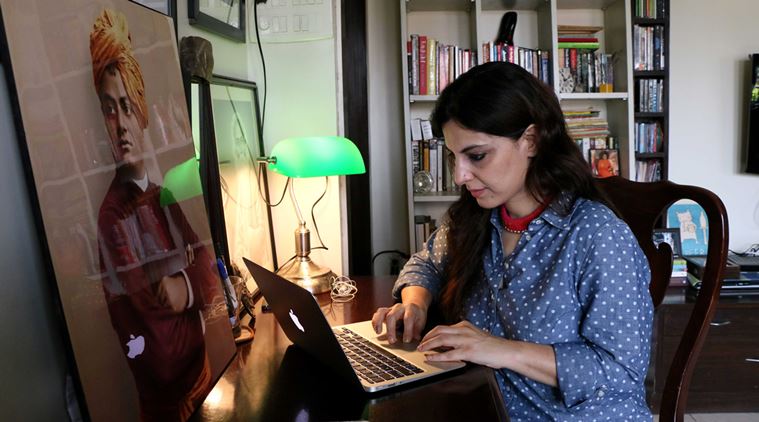
At a session during the Times Litfest in Delhi, writer Juhi Chaturvedi recalled working with Irrfan in Piku. “My first interaction with Irrfan was during my advertising days. It was only a two-day shoot, and one doesn’t recognise the brilliance of an actor in such a short time. When Piku happened, and I wrote Rana (his character), I felt it was a character only Irrfan could do,” she said, adding, “When Irrfan read the script, the first thing he said was, ‘Main karoon agar yeh (role) toh log samajh payenge isko?’ His starting point was not that role itna chota hai, yeh toh actually Deepika aur Amitabh ki film hai aur mujhe toh tum log driver le rahe ho. But he said, ‘Log samajh paayenge iss character ko?’ I said, ‘Shayad samajh hi jayenge. If you’ll do it, then we can see if we should write more about this character’. He was like, ‘Nahi, main lines badhane ke liye nahi keh raha hoon. Lekin itna sa role hai, tum ismein kya soch rahi ho aisa ki main kar doon’. I told him, ‘Sir, maine itna detail mein nahi socha hai ki yeh role aap hi kyun kare, lekin ye insaan aap hi hain’. He said, ‘Achha? Main ek baar aur padhta hoon script’.”
Juhi said that he had a lot of questions to understand Piku (Deepika Padukone) and Bhashkor Banerjee’s (Amitabh Bachchan) characters, adding that since Deepika, Amitabh and Irrfan were working with each other for the first time, “there was a bit of awkwardness”.
“Mr Bachchan would read (rehearse) his lines so loudly on the set that he would shake everyone’s confidence. Language was not on Deepika’s side and there is Irrfan, who is brilliant and she was trying to figure out how she should pitch. Irrfan was just amused ki kya kar rahe hai and it shows in the film. With every scene, he was also trying to decode Mr Bachchan. Their chemistry was amazing.”
Why Bengali films are giving trams a pass now
8:13 AM

Scrapped trams stored at the Tollygunge tram depot
Modern Kolkata Moves In The Metro And App-Cabs While Its People Are Shifting To Highrises. So, The Tram Is Reduced To A Cliche That Appeals To The Outsider But Not Contemporary Bengali Directors
Priyanka Dasgupta (THE TIMES OF INDIA; February 19, 2023)
There’s a West Bengal tourism commercial that shows the city through the lens of a foreigner. Its last sequence features a tram car chugging past the Maidans by night on Route 36. The climax is the spectacular entry of Bengal’s brand ambassador, Shah Rukh Khan, singing Tagore’s ‘Ami chini go chini tomare ogo bideshini’. When the tram car finally chugs out of the frame, the camera zooms in on the words, ‘Experience Bengal: The sweetest part of India’.
Six years since the commercial aired and a pandemic later, Kolkata’s once-ubiquitous trams are chugging out of the city. Even the sound design of contemporary Bengali cinema no longer uses the chimes of tram bells to capture Kolkata’s essence.
Inseparable For Years
Bengali cinema’s tram connection meandered from Satyajit Ray’s ‘Mahanagar’ (1963) to Amitabha Chaterji’s ‘Manohar & I’ (2018) via Buddhadeb Dasgupta’s ‘Kaalpurush’ (2005), Atanu Ghosh’s ‘Abby Sen’ (2015), Nandita Roy and Shiboprosad Mukherjee’s ‘Praktan’ (2016), Srijit Mukherji’s ‘Ek Je Chhilo Raja’ (2018), and Raj Chakraborty’s ‘Parineeta’ (2019).
Not just films, even their opening credits celebrated this connection. Subrata Mitra filmed the two-minute-long title sequence of Satyajit Ray’s ‘Mahanagar’ (1963) by only focusing on a moving tram cable. Once Ray’s credits for the film’s screenplay, music and direction have rolled, the camera moves inside the tram car to freeze on Anil Chatterjee’s tired face.
“Ray used just the electric cable to depict the big city. In the background score, he also changed the tempo and volume of violin, flute and cello to heighten the drama of everydaylife,” said Riddhi Goswami, a member of the Ray Society.
Criss-crossing tram wires form the backdrop for the opening title card of Mithun Chakraborty-Rahul Bose-Sameera Reddy starrer ‘Kaalpurush’. “My father loved everything quaint and old that stood witness to time and defined his Kolkata in its purest form,” said music director Alokananda Dasgupta, daughter of the film’s director, the late Buddhadeb Dasgupta.
Later in the film, Bose falls asleep inside a compartment and has imaginary conversations with his father about his love, hatred, regret and memories. “It is such a vulnerable and sensitive scene. What better than the long-lost tram to act out this metaphor of extended realism in his film,” she added.
Metaphorical Journeys
Ritwik Ghatak used trams in ‘Bari Theke Paliye’ as a metaphor for Kolkata’s mechanical transport. But film scholar Sanjoy Mukhopadhyay said Ray and Ghatak used trams differently. “In Ray’s ‘Apur Sansar’, the tram becomes a space where dreams turn into reality when Apu reads the editor’s letter. In contrast, the tram in ‘Bari Theke Paliye’ symbolizes crude mechanization and not fantasies.”
Trams also appear in Mrinal Sen’s ‘Interview’. “The protagonist nabs a pickpocket in a tram. That was more of an emblem of day-to-day life and living in 1970s’ Kolkata,” Mukhopadhyay said.
Parked In Nostalgia
Once an emblem of modernity and the metropolitan mind, trams now symbolize old-world charm. “People who joined college in the midor late-1980s remember how romantic tram rides were during noon, especially if a couple got the front seats just behind the driver’s cabin,” said Atanu Ghosh, who directed the 2015 sci-fi film ‘Abby Sen’. “As a tribute to my fond memories, I devised the tram ride scene as a metaphor for nostalgia and romance in ‘Abby Sen’. In the story, Abby travels 33 years back in time from 2013 to 1980 and meets his wife in an illusion scene inside a tram.”
Poet-turned-filmmaker Srijato penned ‘Chol rastae saji tramline’ for Srijit Mukherji’s ‘Autograph’ (2010) that highlighted the word tram. Despite the song’s popularity, Mukherji didn’t use a tram shot to picturise it. He waited for eight years to use the tram as the setting for the conversation between Aparna Sen and AnjanDutt in ‘Ek Je Chhilo Raja’. “Tram for me is quintessential Kolkata. I use trams to portray a character of the city which is traditional, old-world, slightly laidback with its own rhythm or something very intimate, quaint and personal,” Mukherji said.
Few contemporary Bengali films use trams for a nuanced portrayal of urban loneliness. One rare exception is a 13-minute-long scene from ‘Manohar& I’, which is among British Film Institute’s 10 great films set in Kolkata. Two strangers-turned-acquaintances hop on to a tram car. The languid pace and the empty space of a tram car allow a lot of time for the characters to communicate. The camera placed up close captures the hoardings and wall graffiti through the huge windows while the protagonist garnishes his narrative with half-truths and yearnings.
“In between their conversation, I deliberately kept some top shots of a serpentine tram negotiating the traffic. The tram becomes a metaphor for Kolkata’s indifference that alienates migrants from the suburbs. The metropolis shuts them up inside boxes. Their existence resonates with tram cars moving around the city like long matchboxes in motion,” director Amitabha Chaterji said.
Iconic For The Outsider
Most contemporary Bengali films steer clear of the tracks to avoid clichés. Besides, their plots have long shifted to highrises where the chimes of tram bells hardly reach. “As a child, I used the tram regularly while commuting. But trams have now disappeared from the cityscape. If I set a realistic film in the city, where is the space for trams since my characters will use the metro and app-cabs?” said director Aniruddha Roy Chowdhury.
But those who haven’t lived in this city as an insider rely on trams, Howrah Bridge and Victoria Memorial to reinforce a stereotype. From Mani Ratnam’s Yuva (2005) and ‘Guru’ (2007), Sujoy Ghosh’s ‘Kahaani’ (2012), Tigmanshu Dhulia’s ‘Bullett Raja’ (2013), Shoojit Sircar’s ‘Piku’ (2015), Dibakar Banerjee’s ‘Detective Byomkesh Bakshy!’ (2015) to Mridul Toolsidas’ ‘Toolsidas Junior’ (2022), Kolkata’s trams and even tram depots remain the perfect backdrop for period films and romantic songs.

It’s nice to share screen space with Deepika Padukone again after Piku-Akshay Oberoi
8:45 AM

Akshay, who plays Air Force officer in Fighter, ecstatic to reunite with Deepika after Piku
Hiren Kotwani (MID-DAY; February 3, 2023)
Back in Mumbai after a holiday, it’s all work for Akshay Oberoi. But he is not complaining. The actor is looking forward to begin shooting for Hrithik Roshan and Deepika Padukone’s Fighter, director Siddharth Anand’s next after the roaring success of Pathaan.
What makes the project all the more exciting for Oberoi is that it reunites him with Padukone after Piku (2015). In Shoojit Sircar’s much-loved comedy drama, he played the role of Aniket, whose date with Padukone’s Piku goes bust.
This time around, Oberoi will be seen as an Air Force officer in the aerial action thriller. Stating that collaborating with such talented actors will be a learning experience, he says, “Acting is a profession where you take inspiration from everywhere, even from your co-actors. It’s nice to share screen space with Deepika again after Piku. Hrithik’s dedication towards work is infectious.”
Anand has a knack for mounting big-budget thrillers, and the actor is glad to be part of his vision. He adds, “The film is an homage to the real-life heroes who have served the nation.”
-------------------------------------------
Rishabh Suri (HINDUSTAN TIMES; February 3, 2023)
Actor Akshay Oberoi says his “slow and steady” approach of honing his craft helped him find a footing in the industry. But seeing the clout social media has these days, there’s been a lot of discussion around how the number of followers determine the kind of work an artiste gets.
Oberoi, who will soon be seen in films such as Fighter and Gaslight, says, “Earlier, people would cast influencers and say, ‘Iske itne followers hain, isko cast kar lo’. Cast karne ke baad phir gaaliyaan dete the. They would say, ‘Isko acting nahin aati’, and then the project wouldn’t happen. Eventually, makers have realised that they need to cast actors, not influencers.”
Recently, actor, singer and YouTuber Bhuvan Bam told us that the focus on the number of social media followers is too apparent. Actor Shriya Pilgaonkar, too, tweeted: “Actors should not be made to feel that they need to have a certain social media following to be considered for projects.” Oberoi also feels that acting has nothing to do with an artiste’s social media presence.
Citing the example of actor Pedro Pascal, the 38-year-old says, “His show The Last Of Us has blown up. But it’s not like he has got big social media following (he has 3.5 million followers). But, he was a part of the biggest projects last year. Makers of films and web shows have now started thinking, ‘Isko acting aati bhi hai ki nahin, fan following ki baat chhodo’.”
My personal favourite Filmfare Award hosts have been Shah Rukh Khan and Saif Ali Khan-Ranveer Singh
8:41 AM
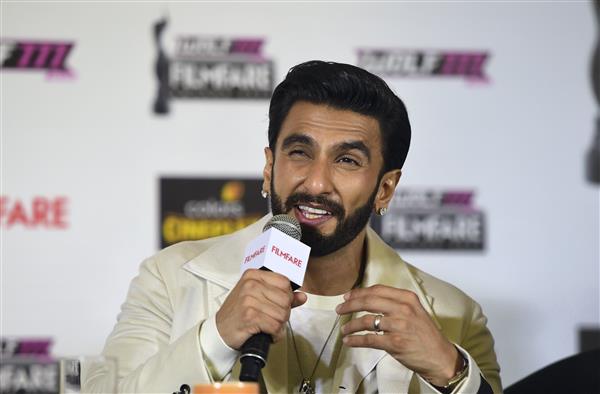
The 67th Wolf 777news Filmfare Awards 2022 were announced at an event in Mumbai where the actor was the guest of honour
Renuka Vyavahare (BOMBAY TIMES; July 30, 2022)
The 67th Wolf 777news Filmfare Awards 2022 will be held in full glory with a live onground show in Mumbai. Taking forward the six-decade-long legacy, the coveted Black Lady will recognize the best in Hindi cinema for the year 2021 at a star-studded event that will celebrate the artistic and technical brilliance of Hindi cinema. The event will be hosted by Bollywood buddies, Ranveer Singh and Arjun Kapoor, at the Jio World Convention Centre, BKC in Mumbai, on August 30. The awards night will see performances by Kartik Aaryan, Vicky Kaushal, Kiara Advani, and Disha Patani to name a few. Bollywood fans can enjoy the show live amidst the stars by buying tickets on BookMyShow.
Bollywood’s powerhouse performer Ranveer Singh was the guest of honour at the press conference in Mumbai on Thursday to make the announcement. The actor is a recipient of four Filmfare Awards so far.
Ranveer said, “It’s an honour to represent and host Filmfare Awards. The legacy of the Black Lady is an integral part of the entertainment industry for the last six decades. This year I am extremely excited to host the show in front of a live audience. The energy in the house will be unprecedented. The team behind the show are some of the best names in the business, and together it is our endeavour to create a magical and memorable evening for our beloved audience and fraternity.”
Calling himself a ‘filmy bachcha, ’90s baby’, the actor shared some lovely anecdotes in his usual no holds barred style. Ranveer, who won his first Filmfare Award for Band Baaja Baaraat (2010), said, “I’ve won the Filmfare Award a few times and some of my most cherished moments in life have been on those awards nights. When I won the Best Actor for Bajirao Mastani (2015), my idol, the one who inspired me to be an actor, Mr Amitabh Bachchan was sitting in the front row. Madhuri Dixit Nene presented the award to me for Gully Boy (2019) and that was a moment of a lifetime for me. When Deepika won the Best Actress Award for Piku (2015), to be there with our families was very special for us. There is some magic around Filmfare, so I am thrilled to be hosting it this year. My personal favourite Filmfare Award hosts have been Shah Rukh Khan and Saif Ali Khan. I have my dearest baba Arjun Kapoor to co-host with me this time. I am looking forward to celebrating excellence in Hindi films.”
Satyajit Ray brought me into my senses. In many of my films, I try to adapt his expressions-Shoojit Sircar
8:12 AM
BOMBAY TIMES (April 30, 2022)
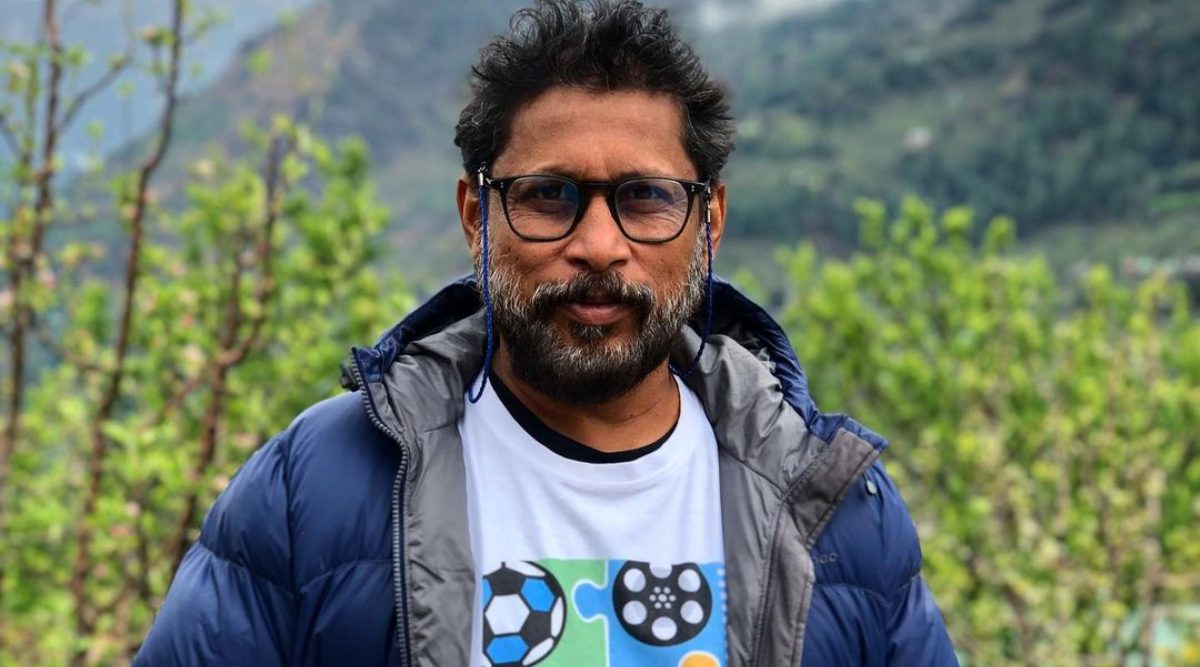
Director Shoojit Sircar, who considers the films of Satyajit Ray as his Bible, feels the maestro may have designed posters and composed music for his movies himself “out of compulsion”, as no one else would have been able to do full justice to the spirit ofhis work.
Delivering the Satyajit Ray Memorial lecture at the 27th Kolkata International Film Festival, Sircar said he cannot work with someone who has not watched the works of the legend.
“Ray is called a multi-talented director...But this may be out of compulsion. He did his own posters because probably he thought others won’t realise it in the same way. He did music in his films as he was not sure if he could explain the context of the music in its entirety to another person. He did not have any casting director either,” Sircar said. The director said that in several of his films, including October (2018), there are silent moments inspired by Ray’s works.
“There are so many jargons about cinema – art, commercial, etc. For me, Ray is more commercial. Someone who would give me lots of positivity and optimism, even if it is a tragedy. Remember the scene of the death of Apu’s mother (in Aparajito)?” he said, referring to its subtlety.
Sircar talked about another scene in Pather Panchali (1955), Ray’s maiden film and the first in the Apu Trilogy. Young Apu and his elder sister Durga were following a sweet seller on a village path. “They are not running behind him to buy something. It is just the hope that they will finally be given sweets. It is just that hope, the everyday reality that is what I discovered in Ray’s works,” the Piku director said, adding, “Many people abroad say there is an element of mysticism in his films. I try to find where is this mysticism? I always think when you are aware of the reality, there lies the mystery. It was there in Ray’s films,” Sircar, who brought references to Ray in Piku (2015), said.
Sircar said he had never studied art and literature. “This man brought me into my senses. In many of my films, I try to adapt his expressions,” he added.
I hope people tell stories that are in their hearts without fear-Deepika Padukone
8:10 AM

Madhureeta Mukherjee (BOMBAY TIMES; February 9, 2022)
We have witnessed many shades of Deepika Padukone unfold on screen — glamourous, romantic, brave, real and royal. And every time, she comes shining through, revealing yet another facet of her talent and her willingness to wade through unvisited territories as an actor. Even if that means going into the deep end, Deepika takes the plunge. With Gehraiyaan, releasing on Amazon Prime Video on February 11, she is taking one of her deepest outings ever. In a conversation with us, she talks about her fascination for relatable stories, what prompts actors to make brave choices, and how we are constantly finding ourselves in everything that we do. Deep, huh? Read on...
You have featured in films like Cocktail and Tamasha, where relationships and love have been explored, but not entirely in the conventional way. Now,we will see you in Gehraiyaan, about which you have said, ‘This is my first of its kind.’ Would you say that you get drawn to subjects that delve into this space with a certain honesty and realism, while breaking barriers on various levels?
I think with Gehraiyaan, I really wanted to work with Shakun Batra and that was the starting point for me. Beyond that, even while growing up, I was drawn to stories that were more relatable and realistic. I think it comes from my fascination with everything that is as close to real life as possible. Even if I am sitting at home and watching a film on OTT, I am more likely to watch something like this versus maybe a fantastical sort of film. In my 15-year-long career, I have done all sorts of films — from a Chennai Express and Yeh Jawaani Hai Deewani to Piku and now Gehraiyaan, and of course, I enjoy all of them, but this genre, specifically, where characters are true to life has a special place in my heart.
You have also played characters that are set in a certain period, which are intense — with the heavy costumes, dance sequences and extensive scenes. While a part like that has its own challenges, would you agree that a role like this one is more internal and intimate, and is set in a space where you can draw from your own life experiences?
That’s the process of an actor. I think you live life and when you are given certain characters, you draw from various experiences. I think that is the natural process of acting. Sure, there are times you don’t relate to certain situations and characters, but that’s your job as an actor — to make it believable, authentic, real and humanise a character.
There will be times when you will get roles and characters that you can relate to, and there will be times you won’t. It certainly comes from a place of different experiences, and not just relationships. It’s not that just because I am doing a relationship drama, I am drawing from my relationships, or necessarily past romantic relationships. You draw from life. Hence, I feel it is important for actors to lead a life that is full of different kinds of experiences, and eventually, from some of that experience, engagement or interaction with someone, you can draw bits and pieces and put them into the work you do.
Shakun Batra roped in intimacy director Dar Gai, who was present on the shoot. Elaborating on that process, during my chat with him, he explained that it is literally about creating a space where people can openly talk about it, as opposed to being shy. How much of that effort, which is a first of its kind for our cinema, helped you pull off this character?
Yes, it is the first time an Indian film is doing something like this, but at the same time, at least in my head, it’s not such a big deal that we have an intimacy coordinator. If we were shooting a song sequence, we would have a choreographer, likewise, if we were shooting an action sequence, we would have an action director on set. So, if we are doing a film that has intimacy, you are going to have an intimacy director on board. So, for me, it’s not any different from any other sort of specialization that you need to bring on to make the characters and story as relatable as possible. But of course, you feel safer. Once you know what you are comfortable with, it’s easier during execution.
Given that this is a zone you have never stepped into before, and given how intimate the story is in the way it is narrated, what was your first reaction when you read the script?
When Shakun narrated the script to me in London (where we were shooting for 83), I remember allowing it to sink in. It’s not that I haven’t played similar characters before, like Veronica in Cocktail, and Piku, which was even closer to real life. However, this was far more nuanced and layered. So, it took me a while to commit to, as I knew that this would take a lot of my mental and emotional energy. But I remember being fascinated by the story. Well, the story has also evolved from there. When you make stories like this, it’s not like a biopic where you don’t have much room to play. In films like this, where the characters are real, you can always tweak, add and refine it. The script that I had heard two years ago was slightly different, we added a lot more layers to it and worked on it during the lockdown when we had time on our hands. I remember falling in love with my character.
The film has an interesting mix of actors — Siddhant Chaturvedi, Ananya Panday and Dhairya Karwa — a fairly new bunch of talent who are in awe of you. Something that they even spoke about in their interviews. How did the equation warm-up on set, as it is evident that the characters needed to share a certain kind of chemistry and warmth?
It was certainly something that I was cognisant of, as at any point, I didn’t want to make any of them feel intimidated or threatened. In fact, I gave Shakun the idea that we all go to Goa earlier and hang out, get to know each other and keep reading the script, as it is the kind of film where the relationships feel extremely real and organic. I would like to believe that I made them feel as comfortable as possible and not think of me with any preconceived idea of who I am. And to sort of connect with me the person, instead of the idea of me that they might have.
Did you do anything specific to help them open up, ease their pressure, or just be able to connect with you?
No, not really. Also, I am not the kind of person who walks into a movie set with the feeling that you have to take me seriously or that I am this actor with 15 years’ experience. I would like to believe that I don’t carry that kind of energy, whether it is on set, or while hanging out before or after shoot, or even during prep. I wanted them to embrace the person that I was. A large part of me is also like that, as I like being very normal. In my routine and the way I am, there are no frills. So, I didn’t have to do anything different. I was just being who I am.
In recent times, we are gradually seeing a shift where various such shades of relationships — complex, confusing, deep, fragile, dark — are being depicted in our cinema and our filmmakers are not as fearful of digging deeper into the human psyche and reflecting the same in their stories. Do you think this change has come about with the evolution in the audience’s choices or that new-age filmmakers now have the courage to venture into these spaces?
I think it is the audience that is giving us cues and telling us that we are ready for content that we haven’t seen before. I am certainly taking my cues from the audience. In fact, I feel they often shun the predictable and the obvious, and they are constantly searching for something new and different. I think that is where actors, directors and writers today are getting the confidence to go ahead with their ideas and being brave in making those decisions and choices.
The pandemic has changed so much for so many people around the world. How much has life and the kind of choices you make for yourself changed — professionally and personally?
The choices I make as an actor haven’t really changed. I was doing this film even pre-pandemic. The difference is that today we can release a film like this on OTT because there has been a boom in the last two years. So, was India headed there anyway like the West was? Certainly, but I think the pandemic only accelerated the growth of the OTT space in India. We didn’t set out thinking this film would be an OTT release, it was meant to be a theatrical release. When we started out two-and-half years ago, no one was thinking of OTT in that sense. I remember doing a meeting with Karan Johar (producer of Gehraiyaan) as he thought that I would resist it. I know he wanted to meet me to convince me, and he was pleasantly surprised when the meeting got done in 30 seconds. He said that he believed that this film was best for an OTT release. I told him, ‘Karan, even I have come here to tell you that this film is best for OTT.’ I would have done this film anyway, so I don’t think the choices have changed. On a personal level, of course, a lot has changed for a lot of people, like the fragility of life and the uncertainty of it all. Now we are more about living in the moment, gratitude and work-life balance. It has opened up people’s minds to a lot more. It’s been extremely rough on people around the world, but hopefully, there is only something to learn from this.
Gehraiyaan also speaks about how we are in many ways continuously finding ourselves. Do you see that process, that kind of evolution happening in your life and relationships continuously?
Of course, we are constantly finding ourselves in everything that we do. In different experiences, relationships, and sometimes, even in crisis situations, you learn so much about yourself and the people around you. So yes, the journey ought to be like that, otherwise, you are going to stagnate, if you are not going to look inwards, learn, grow and evolve.
Do you think this film will pave the way for more mature stories that can be told with sophistication and realism?
Hopefully, people will continue to tell the stories that they want to. Firstly, the audience is ready for it, secondly, you have umpteen number of platforms to tell these stories. I hope people tell the stories that are in their hearts without fear.
I have been offered big money to make sequels-Shoojit Sircar
8:35 AM

Rishabh Suri (HINDUSTAN TIMES; January 8, 2022)
Director Shoojit Sircar’s films have been loved by audiences — right from Vicky Donor (2012) and Madras Café (2013) to October (2018). And the filmmaker reveals that, naturally, people expect him to make sequels to them.
However, he has no such plans, despite being offered big amounts of money by makers. “You need to have a powerful story to do that (make sequels). I think, more or less, we’ve tried to put everything in that one film, so I don’t know what is left for the second film. I also get bored with the same idea, so I need to move on. I have been offered big money to make sequels to more or less all my films — Piku (2015), even Madras Café. People ask me for the next part of Pink (2016). But I have not found any story to move ahead and make a sequel,” explains the director, whose last release was Sardar Udham.
While actors and filmmakers tend to have multiple projects in different stages of production at any given point in time, it’s not the case with Sircar.
Admitting that he has no next project in mind, he says, “I am not a factory that I will keep churning out films. I am studying, doing gardening, playing football, and doing a lot of thinking and discussing. Let’s see what comes out.”
And what happens in a scenario where a good idea doesn’t come to him for years at a stretch? Is he willing to wait that long just for a good subject? Sircar replies in the affirmative.
“At the end of the day, art is an expression. It comes from pure passion, so it is not just my livelihood. Yes, I am dependent on it, but I am not doing all this because I have to churn out films and make sure it (livelihood) is running. It is purely what drives me. Only when it triggers me do I move, otherwise I don’t,” he concludes.
I have not left any single shot in my edit room for the Jallianwala Bagh scene. Everything is used-Shoojit Sircar
8:28 AM
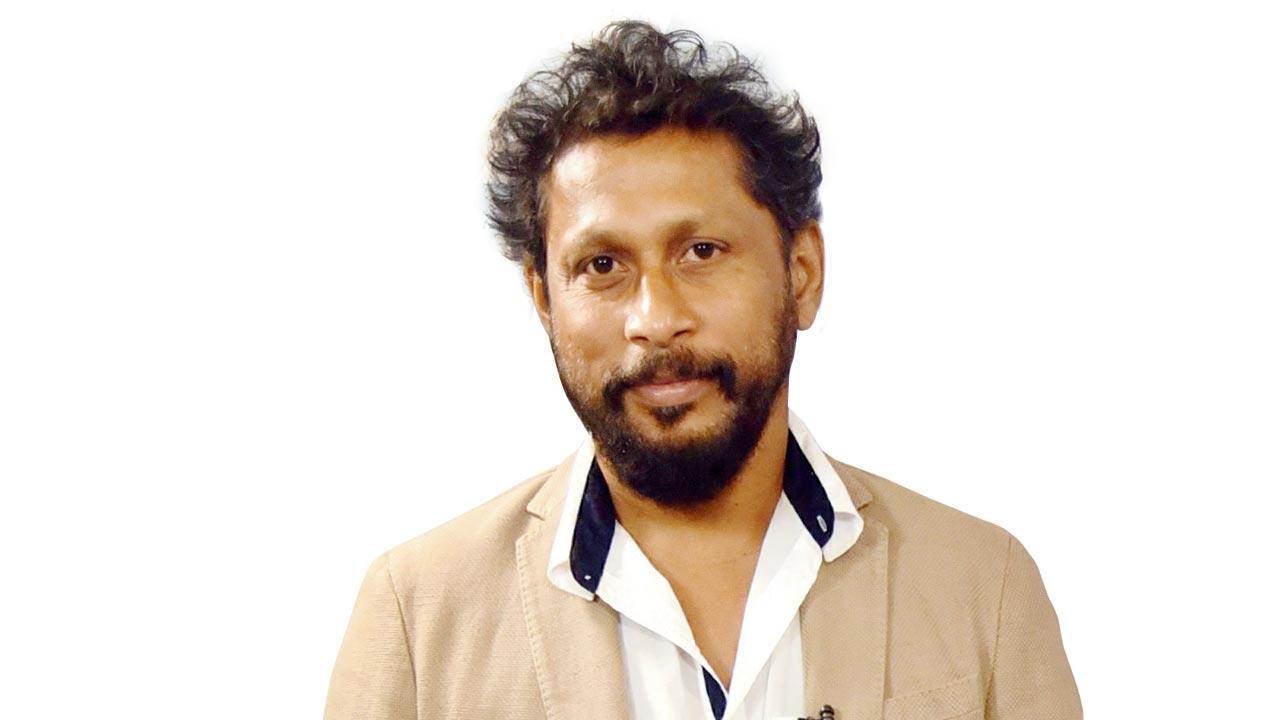
In the latest edition of our award-winning interview series, Shoojit Sircar decodes how he created a hatke brand of commercial Bollywood with an indie heart
Mayank Shekhar (MID-DAY; November 13, 2021)
“But you’re not like this [as a person],” an assistant on the sets of Sardar Udham exclaimed to filmmaker Shoojit Sircar — observing him seated, with two buckets full of fake blood, getting constantly replenished on either side of his feet.
He would dip into it with a mug, splashing that blood to dry earth himself, to get the colour right — all the while operating the camera, filming the Jallianwala Bagh sequence in Sardar Udham (2021).
It’s gory as hell. But Sircar wanted to get April 13, 1919, just right. Martial law in Punjab. Curfew in place. No one allowed to help the injured and dead. One man dealing with dead bodies after dead bodies.
It’s a scene Sircar had been living with, ever since he first visited the actual Jallianwala Bagh site in 1998 — much before he’d even thought of becoming a filmmaker. He’d been going back to that sequestered memorial park, through a narrow passage to the entrance in Amritsar, every year since. It’s a walk down from Golden Temple.
This was his only chance to recreate what he believes was the turning point of India’s freedom movement — the massacre of thousands of people, peacefully protesting the draconian Rowlatt Act, that allowed the British government to incarcerate Indians, without proper trial, under the pretext of ‘national security’: “It gave birth to many unsung revolutionaries, of which we only know about Bhagat Singh, and now Sardar Udham.”
It took Sircar four months to get the colour of blood right. Real blood for shoots is usually imported. They didn’t have the budgets. Jallianwala Bagh is also kinda immortalised from Gandhi (1982), by Richard Attenborough, who had resources to bring down train loads of people from Punjab, to shoot the short scene in Delhi.
Sircar had to shoot in Punjab itself, to get the look of thousands of actors/extras right. He hired locals. Some of them were children trained in Gatka style of martial art. They’d do free-falls and heavy-duty acrobatics, although they’d never faced a camera before.
On day one, actor Vicky Kaushal was his usual enthusiastic self. But as the shoot progressed, with humans being carried like carcasses in wooden carts, and the smell of fake blood and dust around, the cast and crew started getting affected.
Once, when the shooting had packed up for the day, a young girl was still around, that the assistants insisted they should shoot with, anyway. Sircar decided to casually pick the scene, knowing they didn’t need more. Soon as the girl started crying for her mother (in the scene), Kaushal began uncontrollably howling as well. The girl was a little flummoxed. They kept the camera rolling from a distance, most of which made it to the final film.
Every moment in the Jallianwala Bagh scene, step by step, Sircar says, is mentioned in Hunter Commission and the Congress report, besides survivor statements of ladies named Ratan Devi and Attar Kaur. It lasts a lifetime in Sardar Udham: “I have not left any single shot in my edit room. Everything is used.”
Some might dub this as an over-indulgence of sorts. It will remain etched as one of the most haunting sequences in Hindi cinema still. Unsurprisingly we talk about it for a good portion in this conversation. Only as a nod of sorts for the fact that Sircar filmed this one sequence, over 21 days in Punjab!
Sardar Udham is essentially a London-based period film, for which Sircar extensively referenced series such as Peaky Blinders and The Crown to get the era right.
As for a wider inspiration, while there is no direct connection, Sircar calls Sardar Udham “a tribute to Akira Kurosawa’s relatively lesser known film, The Hunters, set in Siberia, filmed as a Japanese-Russian collaboration.”
Which makes me segue into his film company, Rising Sun. Is that a reference to Japan? “Well, we didn’t think about it. My producer Ronnie [Lahiri] suggested Rising Sun. It sounded positive. I asked him to check if there is any other Rising Sun Films. There wasn’t, so went ahead!”
I ask this because over a decade and half, while the eclectic Sircar undoubtedly has belonged to commercial Bollywood, he remains essentially an independent filmmaker, which is an anomaly of sorts.
Throughout, he has teamed with the same producers, Goa-based Lahiri originally from Shillong, and Bihar-born, Russian educated Sheel Kumar, taking care of the finances. Besides more or less the same crew of writers (Shubhendu Bhattacharya, Juhi Chaturvedi), cinematographer (Avik Mukhopadhyay), editor (Chandrashekhar Prajapati), and the like.
He says, “[By independence], you [mean to] do a film on your own terms. Of course, we compromise sometimes. And I have been compromising [as well]. But film after film, I have reduced that. Crafting your own path is a lesson I have learnt from the city [Bombay] itself, and its film industry. Otherwise, nobody will let you be what you are — forcing on to you what works. And in cinema, there is nothing like, ‘what works’ — it is an expression. You do what you are compelled to, from the inside — what you feel like; you do that.”
Which explains how the money being thrown at him to script a sequel to Vicky Donor (2012) is pretty much the budget of an entire film — he doesn’t reveal the number — but he won’t click that bait, simply because Vicky Donor is behind him, and he’s “not that filmmaker anymore.”
The auction is only natural, given that a Rs 4.5 crore Vicky Donor — a slice-of-life comedy on sperm donation, that even Sircar hadn’t imagined would capture an audience beyond those interested in quirky movies — picked up close to Rs. 80 crore at the box-office! This equals ‘family audience’ in Bollywood speak.
Debutant Ayushmann Khurrana was the star. Which also opened up a minor film industry for Khurrana headlining a series of comedies on similarly taboo subjects — balding, old mother pregnant, gay love, etc.
With Sircar, these benefits can be a challenge: “I am actually very scared of the wrong audience, and unnecessary hope. I am openly telling you — with Gulabo Sitabo (2020), I faced so much of that. I was doing a film with Amitabh Bachchan and Ayushmann Khurrana. So people think it is Vicky Donor and Piku coming together! I faced so much flak after [Gulabo Sitabo came out] — this film is so slow, nothing happens… But that is what I had made. I wasn’t thinking [Vicky Donor and Piku] in my head. Don’t expect it. Yet, how do I convey that? It is so difficult. So sometimes, wrong audiences can really harm your film!”
To be fair, Sircar has dabbled in multiple genres, without getting overwhelmed by the success of his previous work. In fact, if you notice, he consciously shifts from light-hearted to serious subjects/treatments — say, a political thriller Madras Café, after Vicky Donor; a strikingly sombre October, after Piku. It’s something he describes as mere coincidence. Rather than an effort to alter his mind space.
“A movie is not like a mask, that you take off after it’s over, and put on another. It stays inside you forever. I am Sardar Udham. I strongly feel about it. I strongly feel about greed in Gulabo Sitabo. I feel for October, because I have been in ICU for three months with my mother. And I know exactly what happens [being around] a comatose patient. I cannot just throw it away.”
Sircar debuted as a feature filmmaker with Yahaan (2005), set in Kashmir, about a local girl and an Army officer, during the height of insurgency/militancy. One of the aspects that stood out in that film was its coolly lit bluish tint, lending a surreal touch to the screen, although the film was shot on actual locations.
I am wondering of this level of visual sophistry had much to do with his work in advertising, which is how he first got into films. Sircar says, if anything, his works are often more informed by documentary filmmaking, which is also what he dabbled in for close to five years before.
Yahaan was also the debut feature film of Swedish cinematographer Jakob Ihre. What’s Ihre best known now for? Shooting the stunning HBO series, Chernobyl. Yup! “Jakob was once in Delhi to shoot a documentary for BBC4. A friend of mine was the sound person for the film, who introduced us. Of course I knew of the Polish film school he was from, which is really good. I did a commercial with him, which was also done on my own terms. The ad was for toughened glass. But the film, for around three minutes, unheard of at the time, was all about reflections. With Yahaan, I was wondering if I would get Kashmir right — I had done a documentary there, and knew what Charar-i-Sharief or Habba Kadal Bridge will look like. I needed a different perspective. The first thing Jakob told me when I took him to Kashmir is it looks like Bosnia, which also had problems going on at the time. In winters, Kashmir, like Bosnia, is brown and silver. Jakob got onboard and shot Yahaan.”
They’ve been friends since. The script of Yahaan “bounced like a ping pong ball” between all the corporate studios in Mumbai, until Sircar first went ahead with it himself, with Jimmy Sheirgill and Minissha Lamba in the lead roles.
Ad films have also allowed Sircar financial independence, and some flex to make only the features he wants. It also turned him into a patron of the arts early on, in the early ’90s, while he worked in an amateur theatre group Act One in Delhi: “I was a mole from my [theatre] group in the advertising industry. I’d make money from ads, and whatever I’d earn, I’d put into theatre. That is what my job with the group was — you make the money, bring it to us, and we will do plays!”
Act One had performers like Manoj Bajpayee, Gajraj Rao, Piyush Mishra, among others, who later moved to movies and Mumbai. Sircar continued in advertising, mitigating the struggle that involves, in hindsight, romanticised notions of stepping into showbiz city, with few rupees in wallet, friends with culinary benefits, and sleepless nights in railway platforms. Sircar has none of those heartbreaking stories of following a personal passion.
In fact, strangely enough for a Bengali, the arts, cinema, and literature were totally external to his growing up years. Football was his life’s primary goal; something he actively pursues at 53 still.
Graduating in commerce from Delhi’s Bhagat Singh College, Sircar was quite comfortably placed as an accountant in one of the city’s top hotels, Le Meridien. Which is a longish walk down from the Capital’s cultural district, that houses National School of Drama, and several theatre performance spaces.
Almost like a turning point of a movie script, a moment of epiphany as it were, Sircar’s friend [his writer now] Shubhendu Bhattacharya asked him once to step out to watch a play, after lunch, during work hours.
That was Satyadev Dubey’s production Andha Yug, written by Dharamvir Bharti, starring Naseeruddin Shah, Amrish Puri, Rohini Hattangadi. He says something happened to him once he watched that 3 pm show. There were no tickets available for the following 6 pm show, but he bribed the guard to enter again. By 9 pm, when he walked back to his office, he had “turned into a zombie.”
Following week, he watched Satyajit Ray’s Pather Panchali at India International Film Festival in Delhi’s Siri Fort auditorium. A film he had repeatedly slept through, during growing up years. The penny had dropped: “Then I started reading and watching with a different eye.” He joined theatre, then ads, thinking little of the debit and credit accounting of such a call.
Which takes us back a little to the film October (2018), one of his most personal works, since as he said, it came from the experience of nursing his mother in an ICU ward. But its setting — the full expanse with doors that demarcate the contrasting inside and outside world of a five-star hotel is clearly from his time from Le Meridien?
“When [writer] Juhi bounced off the structure, character and idea about how the film would be, it clicked: ‘Okay, hotel — I know hotel, so I will go into this’. I had no problem in understanding the hotel. My art team said we will create it. I said, no, you cannot create this. It has to be real.”
As is the story — emotive, seeping through the pores, at every level. Even if there’s a touch and feel of Sircar in the lead character, Dan, the fact is, if you rewind to when the film was being planned, the last person you’re likely to imagine in the lead role is the boisterous Varun Dhawan — of ‘tera dhyan kidhar hai, tera hero idhar hai’ fame! There has to be a story behind Dhawan breaching a likely mental/casting block. There is.
Sircar recalls, “Varun had been calling to meet me for quite some time. I live in Kolkata, and would be in Mumbai for two days and leave, so I wasn’t getting time. Once when I had a flight to catch, I saw his text, “Dada, when is your next?” I told him that I was in town, but leaving in a bit. He said his house was close by. I asked him to quickly drop in. He said he’ll take a shower and come, and that he’d just woken up. I told him nobody will see him: ‘Just walk in as you are’. I still have his picture from that day — he was clumsy, holding a bottle that fell. He said, ‘Sorry, Dada, sorry.’ While talking, he zoned out completely. I don’t know what he was talking to me about. [As an actor], he wasn’t on my radar at all. I looked at his torn jeans. He said, please, don’t look there. He just sat there, said, ‘Theek hai, Dada.’ And left. In the flight I kept thinking about him. As I landed, I called up [writer] Juhi and [producer] Ronnie. This is what the clueless Dan is, you know — he doesn’t know what he’s doing, saying, where he is…”
The unlearning of the Bollywood star started before shoot. For script, Sircar only shared the first half of the film. For prep, Sircar passed on a piece of meditation music to Dhawan and asked him to simply stare at a house-plant every morning with it!
“On the first day, we shot the film’s last day’s conversation with the girl — it’s an important scene. I thought I’ll catch him raw, the way I had caught him in the office that day. He said, ‘Dada I am not doing anything [in the scene]’. We rolled the cameras in the rehearsal take, and used it in the film.”
It’s a little like how Sircar got Ayushmann Khurrana into the infamous sperm donation scene in Vicky Donor. Khurrana had to go to a private room to donate sperm.
Except, there were no instructions on paper about what he’s supposed to do. There were CCTV cameras placed in the room. Khurrana was clueless. He got out of the room and said, “Aise thodi hota hai? (What am I supposed to do; this is not how it happens!”) The cameras captured that actual line.
In Dhawan’s case of course, the idea was to keep him slightly clueless all through the shoot, instead — something the camera captures convincingly in October.
As for another unlikely casting, the one that comes to mind is John Abraham. Abraham incidentally won the National Award for Vicky Donor—as the film’s co-producer. No knock on Abraham. But he isn’t quite the first actor one might have in mind for Sircar’s reasonably intellectual political thriller, Madras Café. It was a deeply researched procedural on the plot to assassinate Rajiv Gandhi, called “the PM” in the picture.
Sircar admits, “You can say Madras Café was one film that I just quickly wanted to make. By 2010, the entire Tamil group [LTTE] had been wiped off. The [assassination] case was completely shut. I just thought I must go ahead and make this [before it’s too late]. I didn’t wait too long. The research and script were quite good. In terms of my craft around making the film, I would do it completely differently now, and with an absolutely fresh mind. It could have been much more powerful. That’s one film I would really want to go back, and remake.”
What would he do differently, in particular? “Of course, I will take real names [of characters], as I did with Sardar Udham. I’ll go with a completely new set of cast. There are many places where I have compromised, in terms of dialogue. Then there is the heroism part of the film. My idea of heroism has changed, from then and now. For me, heroism is not about [being a] hero [type]. For me, heroism is doing the right thing — rather than not. That is what it is.”
That’s of course a film yet to be seen, but from what we have of Madras Café, as it exists, it is by no means even vaguely a low point in Sircar’s career — wonderfully farmed from the Jain Commission Report, it survives as an important, albeit slightly over-the-top document, detailing the assassination of PM Rajiv Gandhi.
If at all, the cursory low point in Sircar’s career might well be a film of his that we haven’t seen. And that’s because it never got released—Shoebite, the director’s first collaboration with Amitabh Bachchan. From my memory of what went wrong with the film was a dispute between two companies, Percept and UTV. The former were first producing the film.
There was a hitch over Bachchan’s remuneration, reportedly. Percept brought on board Anil Kapoor for the lead part instead. Sircar and Bachchan jumped ship together, bringing in UTV to produce the film instead. Copyright issues followed. I needlessly jog my memory for Sircar, who is understandably not so forthcoming on this.
“Well, it’s a long story. But I can tell you where we are now, I think. So, finally, the film is with Disney. And Disney is also Fox, and Disney is also UTV. They can actually release the film. They are still figuring it out. What’s happened in the past is over.”
The Fox angle in the story could have to do with the original concept of Shoebite being Hollywood filmmaker M Night Shyamalan’s. Is that true? “So, the script was adapted by Rensil [D’Silva], who had just done Rang De Basanti. Later we found out that this was an idea by Manoj Night Shyamalan. I stepped back. Then Ronnie Screwvala [UTV boss then] was doing a film with Shyamalan and [our project] restarted. Since the basic idea was written by Shyamalan for a Hollywood film, we requested for a regional version. It was messy. But it is quite sad that the film still in the cans. It should release.”
The other messy stuff that’s made it to print in the past, so far as Sircar is concerned, are cases registered by writers against two of his films, Gulabo Sitabo and October, over copyright infringement. Much talked about before release, allegations hurled, press lapping up.
“It is distressing. When it happened with October (a Marathi filmmaker alleging rip-off), I was completely shaken up. We thought we were creating something absolutely fresh, and new, and everything had come out from my own deepest experiences, and Juhi’s as well. Same with Gulabo Sitabo. This is no way. Tons of stories can stem out of landlords and tenants. But after the film [releases], there is nothing. After the film is gone, there’s nothing. The entire panel of writers’ association has seen the film, and given us a clean chit. What else you can do? I was telling Ronnie the other day: I hope with Sardar Udham, nothing comes up. Ronnie told me I should get used to it. It will come, so it’s okay; be ready for it. It is distressing sometimes. We could not enjoy the release of October, because of this. Normally I go to the theatre and watch the film [with the audience]. We didn’t.”
Thankfully none of the above this has impacted his works consequently. Bachchan, for instance, was happy to sign up with Sircar, despite their first film together having been a non-starter. The released movie is Piku (2015), of course. The brief he gave to his writer (Chaturvedi) for it was long scenes; “sometimes 20 pages long.”
Sircar wanted to stage Piku as a play first — “experience from theatre really helped” — and then cut at the editing stage. The driving force being to test the acting styles of three really diverse performers—besides Bachchan, Irrfan and Deepika Padukone, whose subtly expressive eyes were really the leads as well.
Sircar reasons, “Mr. Bachchan, as a person, is all method—he will rehearse, and be so particular — you can’t use left-hand on the rehearsal, and right-hand on the take. You can’t. On the other hand, Irrfan is someone who just lets go. And he can go on. Deepika is natural. You have to tap into her internally, as an artiste. My instruction was that in this film, nothing is happening, nothing is moving. It’s in the drawing room of a Bengali household. If you notice, there are a lot of silences in the film. And I want audiences to hate this Bengali family. Irrfan, though, had just convinced himself that there will be a love angle to the story eventually: ‘You’ve cast me with Deepika, there will be conversations; of course we’ll get romantic’. I had to constantly explain to him that’s not going to happen. People will define [this relationship] in their own way!”
It’s not like the actors didn’t have other apprehensions. Bachchan, for one, did. Until Sircar practically convinced him by actually enacting his part over a narration — after Big B had read the script, with long notes on side margins sent as feedback. While it doesn’t show, the soft-spoken Sircar does have a stubborn streak. It’s that same indie cinema spirit about working on one’s own terms.
When Piku released, Sircar says, it was being deemed as an altogether Bengali movie: “I said no, it’s a Hindi film.” Unsure why he had to be defensive, because Piku is indeed a Bengali film — so specific, that it’s universal enough.
With the added bonus that most Bengalis I’ve met have so identified with this family — of a cranky daughter, who’s had it with a loud un-selfconscious, child-like dad, obsessed with his bowel movements — that they repeatedly watch Piku, as if it was their home video.
An air force officer’s son, Sircar grew up across defence establishments, given his father’s transferrable job. He spent a lot of time in Delhi. For home, he chose Calcutta still — far from Mumbai’s maddening movie crowd, that he occasionally returns to, for work, and disappears into the “17 football fields” around his Salt Lake, Kolkata address. He says this is also to root his two daughters into a local/Bengali culture — a privilege he didn’t enjoy himself.
But speaking to him for an hour and some, before a live audience, I sense this could be because Sircar, an ardent devotee of Satyajit Ray, is as genially Bengali as it gets. When it comes to the most special skill the community enjoys, no matter where they are in the world — ‘adda’, that long, warm conversation on things from here and there, that can carry on, even when the cameras are switched off. As was the case with this edition of Sit with Hitlist.
Shoojit Da would tell us a thing or two about good health — the importance of walking. Not brisk walk; just walking. And the right posture to hold a phone, which is not to hold it at all — 20 minutes of cellphone on palm plus wrist equals 17 kg burden on the shoulder. I’ll take that advice from a footballer, who can be quite the Dada on a field, dribbling much younger men like Ranbir Kapoor and Abhishek Bachchan into exhaustion.
He’s also happy to heckle on the field. Which isn’t my mental image of him, given the gentle demeanour. Equally unsurprised that his assistant was flummoxed looking at him going absolutely berserk with blood and gore, shooting the iconic Jallianwala Bagh sequence in Sardar Udham.
Irrfan Khan had a mysticism jo kheenchke uske paas leke jaata tha-Shoojit Sircar
8:09 AM

Calling Irrfan God’s special child, Shoojit Sircar, who directed him in Piku, talks about his close bond with the late actor
By Shoojit Sircar (BOMBAY TIMES; April 24, 2021)
‘THE PURITY IN IRRFAN’S THOUGHTS MADE HIM SPECIAL’
I can’t believe it’s been a year since he left us. I recall him as God’s special child. He was that – very pure in terms of his craft, artistry and his conduct. That purity in his thoughts made him special as a person. He was like a free bird. He just always wanted to fly in the sky – ‘let’s fly’ is all that his spirit asked for, and he’d always say things that gave this away.
‘OUR UNDERSTANDING GREW TO A POINT WHERE WE COULD COMMUNICATE WITHOUT A WORD BEING UTTERED’
Our equation started off with work, as an actor and filmmaker. It was after we wrapped up Piku that I could not think of anyone else but him to work with. I wanted him for all my films, somehow. Gradually, our relationship matured into quite a deep friendship where we could see or sense or communicate a lot of things that we wanted to do together. He would talk to me about going back to farming and then, about his many creative pursuits he wanted to complete. It was a pure equation, with no pretences. After he was diagnosed, we got closer to each other. Our understanding grew to the point where we could communicate without a word being uttered. He’d call me and tell me about people I should meet in London who are exactly like me. He thought about me, that matters to me.
‘I’VE STARTED TO BELIEVE IN THE MAGIC OF LIFE THAT IRRFAN BELIEVED IN’
A lot of Irrfan’s personality has rubbed off on me. I sometimes feel guilty I could not work with him again but in the time that I got to know him, I realised that pretty much like him, I’ve also started to believe in the magic that life spins around us all the time. I believe in the magic of life that he believed in.

More than conversations, there are memories I have of him. On one occasion while shooting for Piku, he wanted to wear a particular chequered shirt. He and the costume in-charge for the film, Veera, picked it. They were very happy with it. When she told me about the shirt, I told her to change it to something else. We went back and forth. Irrfan also jumped in to convince me, saying ‘Yeh pehenne do na dada...’. They planned and persuaded me into saying yes. When I see that frame today, he looks so happy, almost like a child getting the toy he wanted. In another scene where he’s leaving Kolkata and Mr (Amitabh) Bachchan is trying to stop him, Mr Bachchan was supposed to be eating a banana that he had to offer to Irrfan. By the time we started rolling, the banana was almost finished. Irrfan noticed it and started laughing. We had to get so many retakes because Irrfan could not stop laughing. When I see that behind-the-scenes moment, he looks so happy and peaceful.
‘IRRFAN BELIEVED IN A KIND OF SPIRITUALITY THAT SHOWED IN HIS WORK AND BEHAVIOUR’
I think he had this mystic quality as an artiste which got you addicted to him as a person. He believed in a kind of spirituality which showed in his eyes and work and his behaviour. He had that mysticism jo kheenchke uske paas leke jaata tha.
— As told to Rachana Dubey

Basu Chatterjee's simplest stories leave sweetest aftertaste-Shoojit Sircar
9:14 AM

Director Shoojit Sircar, who started his career as Basu Chatterjee's assistant, remembers flag-bearer of India's middle-class films
Mohar Basu (MID-DAY; June 5, 2020)
 As many of us romanced the rain from our windows on Thursday morning, listening to Rimjhim gire saawan, the filmmaker who gave us the classic bid adieu to the world. Basu Chatterjee, with his stories that were sprinkled with love and the everyday truths, has inspired an entire generation of artistes. Of the current lot, Shoojit Sircar has retained the beauty of Chatterjee's works, bringing a similar affable quality to his films.
After all, his first brush with movies was through Chatterjee's lens — in the late '80s, Sircar began his career as an assistant on the set of a Bengali series the auteur was helming. "Theatre actor Ruma Ghosh had got me the gig. For the first few days, I didn't know I was on a Basu Chatterjee set. When I finally saw him on the set, I told them I am ready to work for free," says Sircar on phone. The director, then a wide-eyed boy just out of college, remembers his first interaction with the filmmaker. "We were shooting in Delhi's CR Park. I was watching the scene, and he kept shouting, 'Field e achho; bero eikhan theke' [You are in the frame, step out of it]. I didn't even know what a field was."
As an assistant, Sircar's job entailed getting the director to and from the set. "I was also entrusted with arranging a bottle of soda for him every day after the pack-up," he chuckles. The errands may have been menial, but the learning on the set was that of a lifetime. "The first one you work with leaves an indelible impression on you. He was quick on the set, and like him, I don't waste time. He would never shoot beyond 6 pm. Also, his planning had an impromptu quality to it. I have heard stories about how he decided to shoot Rimjhim gire saawan when he saw the downpour. The shoot didn't have an elaborate planning, which is why its simplicity stands out."
In the '70s when action films dominated Bollywood, Chatterjee became a pioneer of the middle-of-the-road cinema, giving us the everyman — the antithesis to the 'angry young man'. From Piya Ka Ghar to Chhoti Si Baat and Swami, the leading ladies in his films were crafted with respect, and had an independent voice. "Baton Baton Mein and Rajnigandha are such lively films. He became a game-changer when he made Ek Ruka Hua Faisla. Like him, I always wanted to make charming movies that have a long shelf-life. When I shot with Moushumi di [Chatterjee] and Mr Bachchan for Piku, they were chatting about him. That's when I realised his legacy of movies cannot be recreated. Films don't always need to be about drama. Sometimes, the simplest stories leave the sweetest aftertaste."
Gulabo Sitabo's OTT release will ensure decent profits for the makers
8:56 AM

Box Office India Trade Network
GULABO SITABO will be screened on Amazon Prime on 12th June and it becomes the first film due for a theatrical release in the Coronavirus lockdown period announcing a digital release and there will be a few more to come. GULABO SITABO was one of the films which was ready when the lockdown was announced and was scheduled for a 17th April release. The film is now an Amazon Prime Original.
The film has fetched a good price from Amazon Prime which is estimated to be in the range of 65-70 crore and the television rights remain with the producer which can be worth another 10 crore considering this digital release. So it will be a recovery of around 75-80 crore film which is a good result and good enough for the makers to take in these uncertain times.
A regular Ayushmann Khurrana film fetches around 30 crore on digital and this one had the support of Amitabh Bachchan which could have pushed the value up another 5-10 crore. So the makers have got around 30-35 crore more here. There would have been a 10 crore spend on PA which is now not there but with a theatrical release that could have been the coverage from Overseas. This means the box office value the film has got is around 70-75 crore nett which would have been the result if it was an average film in content in a normal scenario.
Amazon Prime has a subscription base which is estimated to be around 45 lakhs in India by analysts in US. The actual figures are not given out by any OTT platform in India. GULABO SITABO is very unlikely to find 1 crore plus footfalls in the theatres as Shoojit Sircar's major films range from 30-75 lakh footfalls and this film also looks pretty similar to those in terms of reach. So a film like this can find its audience on Amazon Prime as it was unlikely to do well in the Hindi belt and tier 2 and 3 cities. Hence, it would have sat in that 30-75 lakh range in footfalls, going by results of PIKU and VICKY DONOR which were HIT films by the director of Gulabo Sitabo). The box office range of these footfalls would be around 45-110 crore nett.
GULABO SITABO was always likely to go to OTT if there was no quick clarity on the return of theatres and there are other films where deals have been done and will probably be announced as they are finished with the post production.
Irrfan Khan is a poem. A poem he himself read out loud-Raja Sen
8:14 AM

Film critic Raja Sen pays tribute to the actor who strove for the precise pitch and could make every gesture appear special
Raja Sen (MUMBAI MIRROR; May 3, 2020)
Cocaine. It was the first thing I spoke to Irrfan Khan about. It was 2006, on the sets of Life In A Metro. 20-something and childishly eager, I asked whether he’d done cocaine in order to play an addicted stockbroker in his last, Yun Hota Toh Kya Hota? “Yeah,” he nodded, “I had to.” The recorder was on. Irrfan saw my face and laughed. “See, as an actor you have to understand what it does. To your behaviour, movements. It was new to me toh… examine karna pada.” He didn’t enjoy it (“kaafi hectic hai”) and I wondered why he’d do that for a middling film. “Because it is new! Ek nayi cheez… Why else do we act, yaar? Plus, the film is by Naseeruddin Shah. Who knows what he will notice? What he will expect?” I remember the way he tapped his nose. “Isiliye… homework.”
The way he tapped his nose. Those words make you picture him, visualise how he must have done it, that ephemeral Irrfan-ness rendering the moment impossible to forget or mimic. Where do we begin to talk about an actor who made every gesture special? Perhaps one hails the movements themselves: the way Irrfan sculpted the silent beats, the way he reacted to actors around him when they spoke, the way he let his eyes do the heaviest lifting. Good actors deliver loaded dialogue in ways that make the words sing — Irrfan made us read between the lines.
In The Lunchbox, he unwraps food from a brown paper bag and picks up a novel as he eats. The care with which he smoothens the dog-eared page and straightens his spectacles before he starts shows how ritualistically the widower has done this for years. In Slumdog Millionaire, he supervises the electrocution of the young hero, but finds an instant to look away, discreetly and distastefully. In The Darjeeling Limited, as a villager whose young son’s body is brought to him, his first alarmed act is to lift the entire body, hoisting the boy’s chest to his ear like an errant pocketwatch, to see if he still beats. In Paan Singh Tomar, he collapses after breasting the tape in an early race, taking a telltale pause before he falls, as if looking to see if it’s okay to let go, okay for the runner to finally fall.
Irrfan is a poem. A poem he himself read out loud.
He strived for the precise pitch, the sur, the mot juste. There was always authenticity to be plumbed and sought, and he hungered both to learn and unlearn. He cultivated screen presence to deliver blockbuster punchlines, then discarded it to play an unassuming Bengali man. His was not a linear life, looping from early art cinema to popular television, from independent English films to Hindi masala to global art house success, and then, finally and delightfully, to a confluence of both, commercial and radical cinema hand in hand. The actor of his generation? That feels too prosaic for a man whose performances crept up on us, touching us in ways films or viewers could scarcely predict.
That Irrfan face. Those electric eyes, that slack jaw, the mouth ever ajar, especially in the earlier films, as if unsaid sentences live on the tip of his tongue. His words, deep and lyrical lines delivered with a languor that suggested his mind lay in a hammock. In the real world, he had the swagger of a cowboy, shoulders preceding footsteps, but on screen it was about those he played — the complicated, tentative, un-spotless men — and he gave up his gait for theirs.
In 2016, sitting at his new apartment and discussing the TV series Fargo, I asked him about winning an Oscar — a hypothesis that given his trajectory I considered an eventuality. “That is an award that can change everything,” he had said, briefly chewing on the idea. “It can open up every choice for an actor.” Ah, Irrfan… so many marks left unmade.
Talking to him was always a rush. The self-awareness, the philosophical digressions, the boundless curiosity — how he deconstructed a character, how keenly he engaged with criticism. Fingers perpetually busied with rolling paper, he spoke unhurriedly, with many an ellipsis, plucking the right phrase out of thin air. The mot juste. Even without cameras, there was economy and precision.
Think of Piku. Where he, as the owner of a transport firm, is stung as he sits in the driver’s seat with hired help in the front, while the clients sit behind. He looks pointedly at Deepika Padukone in the rearview mirror. It is a slippery moment; what, after all, is wrong with the boy sitting up front? Irrfan doesn’t glare, instead compels her by holding her gaze. Fury would make his character appear classist, but this quiet, unyielding indignation makes it evident Irrfan is feeling disrespected. He doesn’t start the car till he gets his way. Here, his way is to persuade the audience and win the benefit of their doubt.
That is a masterclass — and that doesn’t just mean something for actors to learn from. Great performers offer up mirrors to lives like ours so we can steal from their characters, from perspectives to mannerisms, from reactions to epiphanies. Irrfan Khan, conqueror of the unknown, gave us all so much to observe, so much to understand. His performances, his fluidity, his tenderness, his existential silences. Thank you for the movies, Irrfan. Thank you for waging a war against the obvious. We’ll watch you forever. We’ll learn, forever. Thank you for the… homework.
Subscribe to:
Posts (Atom)