Showing posts with label Nandita Das. Show all posts
Showing posts with label Nandita Das. Show all posts
I’ve just begun to understand life properly, too early to make a biopic on me-Kapil Sharma
9:00 AM

Vinay MR Mishra (BOMBAY TIMES; February 11, 2026)
For years, Kapil Sharma has been the face of laughter in Indian homes – a comedian who turned everyday observation into prime-time television. In one of his most candid conversations yet, Kapil opens up about family, loss, fatherhood, depression, and the quiet need to do work that will one day make his children proud. He also puts an end to the rumours of a biopic on him.
‘Everything in my life has reached people – the good and the bad’
While reports suggested that a biopic is being made on Kapil’s life, the comedian refutes the speculations. “Those people are actually our friends, the producers. They wanted to make it. But I feel I’ve just begun to understand life properly. What biopic will they make right now? So no, I don’t think so – not at this point. Maybe someday in the future,” he clarifies.
He is equally unguarded about what such a film would or wouldn’t hide. “Once you become a public figure, whatever happens in your life reaches people anyway. Everything in my life has reached people – the good and the bad,” he adds.
‘I think the only certainty in life is uncertainty’
Looking back, Kapil sees his life not as a rise-and-fall graph, but as a series of phases, each with its own meaning. “Every phase had its own charm. Childhood was different. When my father was there, that phase was different. After he passed away in 2004, life went completely off track. Then I got another chance on TV and came back on track. At 36, depression hit me hard and I went completely down. People started saying, ‘He’s finished.’ Then I got married. Then the show came back. Then I did 300+ episodes again,” he recalls.
Perspective, he says, came with time. “I think the only certainty in life is uncertainty. You just keep working with good intentions, and good things keep happening,” he explains.
‘I miss my father everyday’
Talking about his father, Kapil gets emotional. “The past never changes. Those who have gone won’t come back. When I won the trophy (The Great Indian Laughter Challenge Season 3) and got a cheque of Rs. 10 lakh, I cried thinking… If my father were here today,” he says.
He remembers a quiet moment soon after his show (The Kapil Sharma Show) became a nightly ritual. “When my show started, I remember standing quietly outside my house at 9 pm. In every house in the society, TVs were on, and I could hear people’s laughter. I thought to myself, if papa were alive, how happy he’d be. I miss him every day, but some moments hit harder,” he shares.
‘I came here to be a singer’
Kapil’s career, he says, was never mapped out in straight lines. “I came here to become a singer. Then somewhere along the way, I thought, let’s become an actor. I did serious roles, then came into comedy almost by accident. An actor always has that hunger – that another side of him should also come out. But our industry, or maybe human nature is such that people see you doing one thing and assume that’s all you can do. Comedy is acting, and honestly, comedy is more difficult,” he says.
Ask him about what lies ahead and he says, “Life has been long, difficult, fun, messy. Work-wise, I feel blessed. My hobby became my profession. What bigger gift from God can there be? I’m excited about what lies ahead.”
‘My kids shouldn’t feel that their father spent his life doing meaningless things’
Fatherhood, Kapil admits, has changed how he makes his choices. “Sometimes I think that I want to do a certain kind of work so that when my children grow up, they can see that I didn’t just do light or superficial things all my life. Like the film, Zwigato (2022), that I did with Nandita Das, it made my heart feel good. I knew commercially it wouldn’t do anything. But it was a good subject, and I did it because tomorrow when my kids grow up, they shouldn’t feel that their father spent his entire life doing meaningless things – he also did work of substance,” he says.
Why are distributors and OTT platforms not enthusiastic about festival films?
3:16 PM
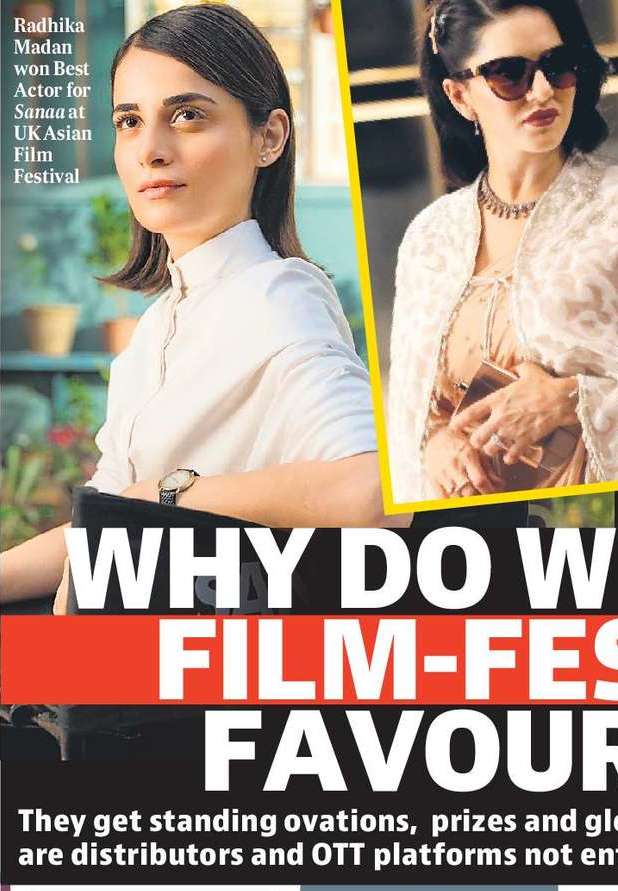
They get standing ovations, prizes and glowing critical acclaim. But why are distributors and OTT platforms not enthusiastic about smaller films?
Mugdha Kapoor (HINDUSTAN TIMES; June 30, 2024)
If you’ve been waiting to watch All We Imagine As Light, which won the Grand Prix at the 77th Cannes Film Festival last month, you might have to wait a bit longer. For several critically acclaimed film festival, AWIAL’s fate depends on if OTT platforms or theatrical distributors deem it potentially profitable.
While the Payal Kapadia directorial might still get a release due to it bagging the prestigious honour, of late films such as Gajendra Ahire’s The Signature, Anurag Kashyap’s Kennedy and Karan Tejpal’s Stolen — all of which have travelled to global film festivals, drawn rave reviews and even bagged awards, are yet to release in theatres in India or find a home on OTT.
Distribution distress
The Indian distribution system “is heavily lopsided in favour of mainstream films” over independent, smaller festival entries, notes film critic Murtaza Ali Khan. The general uncertainty around the return on investment, too, dissuades takers.
National Award-winning filmmaker Sudhanshu Saria, who directed the much-raved-about Sanaa, points out that for middlemen “whose job it is to figure out which film should get to viewers, it seems less risky to go with [films] that feature known faces”.
Actor Adil Hussain, whose Footprints On Water recently won the Audience Choice Award at the Indie Meme Film Festival, says, “How do decision makers on OTTs know a film won’t work, if they haven’t gone all the way, like they would, for a commercial film?”
An expensive market
Actor Shahana Goswami, whose film Santosh had its world premiere in the Un Certain Regard section at the 77th Cannes Film Festival last month, notes that since smaller films are made on modest budgets, they can’t compete with blockbuster releases.
“These films are made independently and there’s very little money to market them well enough, especially since you don’t have big stars. That’s where we fail — because mostly only a small section of people who follow the prestige of it going to an international film festival, know about a film,” she elaborates.
Last year, Stolen, directed by debutant Karan Tejpal, was the only Indian film selected for a World Premiere at the Venice Film Festival. This selection came after a notable three-year absence of Indian films from the festival’s lineup. The film has since travelled to more than 30 film festivals but still it struggles to get a release in India.
“We wanted to go directly to OTT, since we don’t have access to the kind of funding that is required to market and release a film in India. But the pandemic changed it all and the market has suddenly dried up. Maybe we’ll partner with a bigger production house to present the film,” says Tejpal.
They get standing ovations, prizes and glowing critical acclaim. But why are distributors and OTT platforms not enthusiastic about smaller films?
15 months and counting
Nandita Das-directed Zwigato travelled to multiple film festivals over the world before releasing in India in March 2023, to a positive response. But the film has struggled to find a home on a streaming platform.
“We got an amazing response [for Zwigato] not only at A-list festivals like the ones in Toronto and Busan but also from Indian media and the few who saw it in theatres. Yet, we wait for an OTT release. The perception is that films with a unique voice and no mainstream tropes do not have an audience. Barring very few passionate individual producers, hardly anyone supports them.
Censorship woes
Censorship remains another significant hurdle, with outdated regulations under The Cinematograph Act (1952) posing challenges to films that defy conventional narratives. In the past, Fire (1996), Hawa Aaney De (2004) Water (2005), Firaaq (2008) and S Durga (2017) have either struggled to secure a wide release in India or faced obstacles due to their them es, content or controversies surrounding them.
Despite these challenges, Sanaa director Sudhanshu Saria hopes that India’s fantastic run at international festivals — especially in the past few years, with movies such as The Shameless (2024), Sister Midnight (2024), Nirvana Inn (2023), Pebbles (2021) and The Disciple (2020) — “inspires a wave of filmmakers, who were going to give up or not going to work on their passion project, to step out and take that shot”. “I hope it also inspires entrepreneurial distributors to understand that we have a massive audience that is looking for different things,” says Saria.
Nandita Das, who has also helmed critically acclaimed films such as Firaaq (2008) and Manto (2018), remains hopeful of a shift. “We need producers, distributors and platform heads who will have faith and commitment towards diverse stories and ways in which they need to be told. Otherwise, we will keep celebrating the few and far between wins and yet not give the same films the space and respect they deserve in our own country,” she says.
---------------------------------------
The market needs to be tapped by advertising these films, to tell people, ‘Hey, you are missing out on these amazing films’. That’s the job of the business people, not makers or actors.
- Adil Hussain, Actor
Fire actually went through the censor board twice, without a single cut-Deepa Mehta
8:25 AM

Debarati S Sen (BOMBAY TIMES; May 20, 2024)
Deepa Mehta’s Fire, starring Shabana Azmi and Nandita Das, was among the first films in mainstream Indian cinema to explore the topic of same-sex relationships. At the recent Kashish Pride Film Festival at Liberty Cinema, Deepa Mehta and Nandita Das came together for a ‘Fire’side Chat to talk about the impact the film had on the audience and the LGBTQIA+ community 28 years ago.
Nandita, who made her acting debut with Fire and has directed films over the years, said, “Fire sparked a crucial conversation about LGBTQ+ issues at a time when such a dialogue was virtually non-existent. Revisiting this journey at this film festival with Deepa was profoundly moving. It reminded me of the power of cinema in driving social change and the importance of continuing this advocacy.”
Deepa said that when she made Fire, she didn’t think about conveying a message through the film. “For me, it was an exploration, and I didn’t think of it as a queer film then. It was a natural progression in the relationship, where they were emotionally available and sustainable for each other,” she revealed.
Nandita added, “For me, Fire was my first film. Many people said it was such a bold decision to work in a film like this as your first. But at that time, I didn’t see it as an act of courage because I didn’t know there was going to be a second film. I didn’t want to be an actor; I was quite happy working at the NGO after my Masters of Social Work. To me, Fire was a story of love, about something that we weren’t talking enough about. My understanding of queer issues came after the film when I started realising what kind of an insensitive world we were living in, with so many double standards. I became a natural ally without having the vocabulary and the ‘isms’.”
‘Fire went through the censor board twice, without a single cut’
The protests, attacks and vandalism did not begin immediately after the release, but after almost two weeks. Deepa recalled, “Fire actually went through the censor board twice, without a single cut and that we felt was amazing. After the release, I was in Dubai, but was called back to Delhi because the attacks began. There were protestors at the Regal Theatre and Connaught Place. I reached there and was astounded. I wept at what I saw. I saw women with placards that said, ‘We are lesbians and we are Indians’.”
Nandita chipped in, “We knew there would be problems when we made the film. We were prepared for some cuts, but when the Censor Board passed it without a single cut, we were overjoyed. It was released, and there were mixed reactions. On the 13th day, the attacks started with, ‘Yeh hamare culture ke khilaf hai’. What gave us courage was that people took to the streets spontaneously saying that it was their right to be able to watch the film.”
Shabana Azmi lists her five special films from her 50-year career
3:10 PM

Natasha Coutinho (BOMBAY TIMES; March 15, 2024)
Five decades in the movies – and what a glorious journey it has been for Shabana Azmi. “But then, acting can’t be taught in 15 days or a month, that’s not even touching the tip of the iceberg. The greatest resource for an actor is life itself. Getting into the world of the character is not an easy task, just learning your lines is not enough,” she says.
It’s a 50-year career marked with several milestones, from winning a National Award for her debut in Ankur (1974) to choosing to play a queer character in Fire (1996). Here are five movies from her 50-year career that she exclusively spoke on during an hour-long chat.
ANKUR (1974): ‘I TOLD MY MOTHER THAT IT WAS LIKE SHOOTING A SATYAJIT RAY FILM’
I had started shooting for Faslah and Parinay, but it was Shyam Benegal’s Ankur that was my first release (Shabana won the Best Actress National Award). I was an urban, city-bred girl who spoke English and had never gone to a village. Then, Shyam Babu got Lakshmi’s costumes ready and we started working on what her gait would be like. It was interesting working with Shyam Benegal and I told my mother that it was like shooting a Satyajit Ray film. We went to the Berlin Film Festival and it was so glamorous. We got special treatment because Satyajit Ray’s film had been screened there in the past and were widely appreciated. Richard Dreyfuss and I were announced as the talented newcomers. The journey afterwards was a dream, and I was lucky as I faced no struggle.
ARTH (1982): 'EVEN TODAY PEOPLE TELL ME THAT THE FILM CHANGED THEIR LIVES’
One could give up an arm or a leg for my role in Arth. Mahesh Bhatt and I were friends and he excited me as a director. It’s like he would press a button and I would become the character. When the film released, people said it was nice, but objected to the ending – how could a woman not forgive her husband when he was apologizing? We said that we had made the film with that specific ending in mind and thank god for that! I won the National award, and it was a big hit. Even today people tell me that the film changed their lives and gave them courage. It was a small-budget film and many of the clothes I wore were my own. It didn’t have a bound script and kept developing even as we were shooting. One day, I was shooting for another film and Bhatt asked me to come over for 10 minutes. When I reached, he started shooting the important telephone call scene, with just one technical rehearsal. I started trembling, but today I’m glad it turned out that way and I did not over-prepare.
MANDI (1983): ‘I VISITED THREE BROTHELS TO UNDERSTAND THE WORLD OF THE FILM’
There was no question of saying no to Shyam Benegal and I gave 40 days for Mandi. My secretary was baffled and told me that I could’ve finished more films in that time. Most people on set were from FTII or NSD and we had a great time. Smita and I were given cars, but we gave it up to travel by bus with the others. Ila Arun would keep us entertained with her songs. I visited three brothels to understand that world. Faaroq Shaikh took me to Peela House and I noticed the girls were not garishly dressed; they wanted to look like film stars. Amrita Singh’s mother Rukhsana Sultana took me to GB Road, Delhi, that had tawaifs. Shyam Benegal took me to Heeramandi, where the madam asked one girl to perform on Dil Mein Tujhe Bitha Ke (from Fakira, that stars Shabana opposite Shashi Kapoor). Afterwards, she went back to being the person she was, a woman who had to support a family of eight. Pankaj Kapur had one scene but Shyam Babu would like the actors to be around. So he built a volleyball court and a carrom space so that we wouldn’t get bored.
FIRE (1996): ‘IT WAS NANDITA DAS’S FIRST FILM BUT SHE HAD THE COURAGE TO SPARKLE’
People still talk about Fire. It was Nandita Das’s first film but she had the courage to sparkle. We shot in a small house in Lajpat Nagar in Delhi and I knew there would be different reactions. People would be disturbed and overwhelmed, as these subjects were generally shoved under the carpet. The final confrontation between the characters played by Kulbhushan Kharbanda and me, where I talk about desire, was memorable. Deepa (Mehta) described my character as a ‘centred woman’ and for me, that’s when the penny dropped in my head. I don’t like directors showing how to act; one has to inspire the actor – not make them imitate. Having said that, the director is the most important person on the film, it’s their vision. But actors get more credit because we are on camera.
ROCKY AUR RANI KII PREM KAHAANI (2023): ‘KARAN JOHAR WOULD SAY ‘TRUST ME’ AND I WAS HAPPY TO SURRENDER’
Rocky Aur Rani Kii Prem Kahaani was a very different world for me. Karan Johar would just say ‘trust me’ and I was happy to surrender. Karan has kept up with the times and also wanted to bring in the world of Yash Chopra. The film raises such important points on gender roles. On one side I was playing Jamini and on the other side I was shooting for R Balki’s Ghoomer, I was also shooting for Shekhar Kapur’s What's Love Got To Do With It? In the same period.
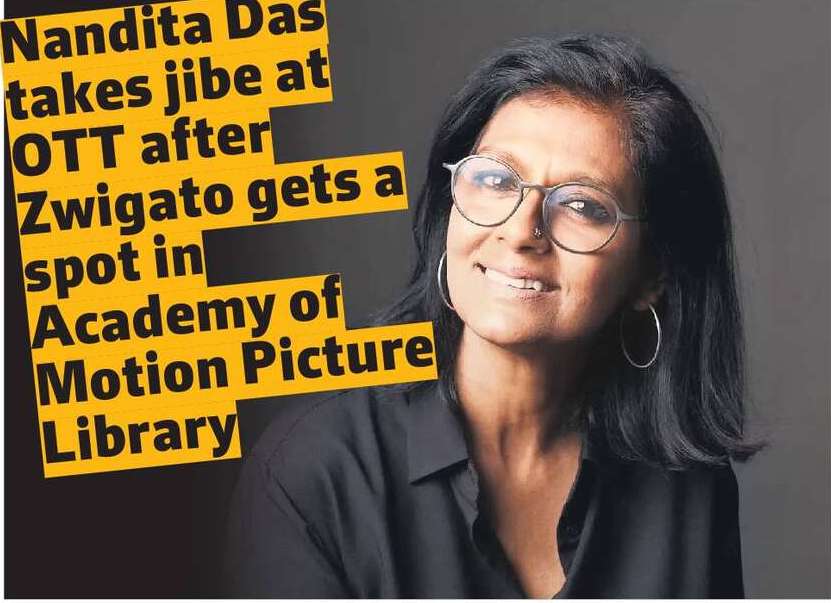
Nandita Das takes jibe at OTT after Zwigato gets a spot in Academy of Motion Picture Library
3:14 PM
HINDUSTAN TIMES (July 13, 2023)
Nandita Das’ directorial Zwigato has bagged a spot in the permanent core collection at the library of the Academy of Motion Picture Arts and Sciences. The film, starring actor-comedian Kapil Sharma in the lead role, hit theatres on March 17. Despite receiving critical acclaim, it has still not been released on a streaming platform.
Das took to Instagram to share the news about the film’s selection.
Taking a jibe at OTT, the actor-filmmaker wrote, “Hope OTT platforms are reading this! I think it’s time to give the audience the opportunity to see Zwigato.”
Along with a poster of the film, she wrote in the caption, “I was most surprised and delighted to receive an email from the Library of the Academy of Motion Picture Arts and Sciences (The Oscars!) about wanting the script of Zwigato for their Permanent Core Collection. It is a happy reminder that the film is relevant and glad we made it. I believe only when stories are authentic and rooted in their own contexts, they transcend cultures and borders and become part of world cinema.”
She added, “I am glad that it will be available in the library for students, filmmakers and writers. The overwhelming response that we have got for Zwigato from both audiences and critics has opened unexpected doors such as this... Thank you Library of the Academy of Motion Picture Arts & Sciences for this honour!”

Why is it a bad thing if women directors have women heavy crews?-Vidya Balan
8:05 AM

Vidya Balan, Nandita Das and Guneet Monga Kapoor discuss gender equality in cinema
Vinay MR Mishra (BOMBAY TIMES; June 30, 2023)
On Wednesday evening, Vidya Balan, Nandita Das and producer Guneet Monga Kapoor came together to discuss the subject of women’s representation in Hindi movies at an event titled Lights, Camera and Time for Action: Recasting Gender Equality Compliant Hindi Cinema. The School of Media and Cultural Studies, Tata Institute of Social Sciences, Mumbai, presented a research which analysed 25 box-office hits of 2019, along with 10 women-centric films that released between 2012 and 2019.
Vidya, Guneet and Nandita were also joined by Shibasish Sarkar, President, Producers Guild of India, Mike Hankey, US Consul General, Mumbai, and Prof Shalini Bharat, Director – TISS (Tata Institute of Social Sciences). The quantitative and qualitative study that was presented at the event was supported by a research grant from the US Consulate Mumbai.
Key findings of the study
- 72% of characters in the analyzed films are played by cis-males, 26% by cis-females, and 2% by
queer actors
- 36% of box office hits and 100% of women-centric films passed the Bechdel test (which tests if a work of fiction portrays women in a sexist manner)
- Women in employment and in public domain work are shown in films, however, the work roles they play are gendered, with a greater presence of women in healthcare, education, entertainment, and journalism
- The most popular skin tone for women characters is fair skin and body type is thin for lead characters and medium for all other support characters
- Women-centric films have greater diversity and explore inbound subjects dealing with relationships, sexuality, motherhood, and other sensitivities
Quotes:
I don’t see why it’s a bad thing if women directors are hiring women technicians & women-heavy crews. Eventually, that will percolate into male-led films also. I have seen that change with movies like Mission Mangal. I am seeing more women DOPs and editors. We need to look at the person for what they bring to the table and not judge them by their gender
In the early years of my career I was playing roles of the romantic interest. It wasn’t satisfying; I wanted more substance. I felt like I wasn’t contributing anything, I was sleepwalking through some of the roles. Ishiqiya set the ball rolling, it was the role of a woman who had agency. I felt reborn as an actor
– Vidya Balan, actress

When there will be more women storytellers, writers, cinematographers and producers, then slowly, it will start showing in the kind of complexities we give to women characters. The portrayal of men has also been controlled for the longest time by men
Anecdotally, we may feel we are far better than where we were, but the research and statistics show us that we have a rather long way to go
– Nandita Das, filmmaker and actress
I absolutely miss a group of producers who are doing independent films. I have seen a lot of them give up after producing one or two. Having produced more than 40 independent films, I think there is a need to have more female producers
I think women are incredible at multitasking and are generally able to run the world better. We are beginning to have a conversation, be more aware and build a safer space
– Guneet Monga Kapoor, producer

Kapil Sharma was the best in the anger scenes-Nandita Das
10:44 AM
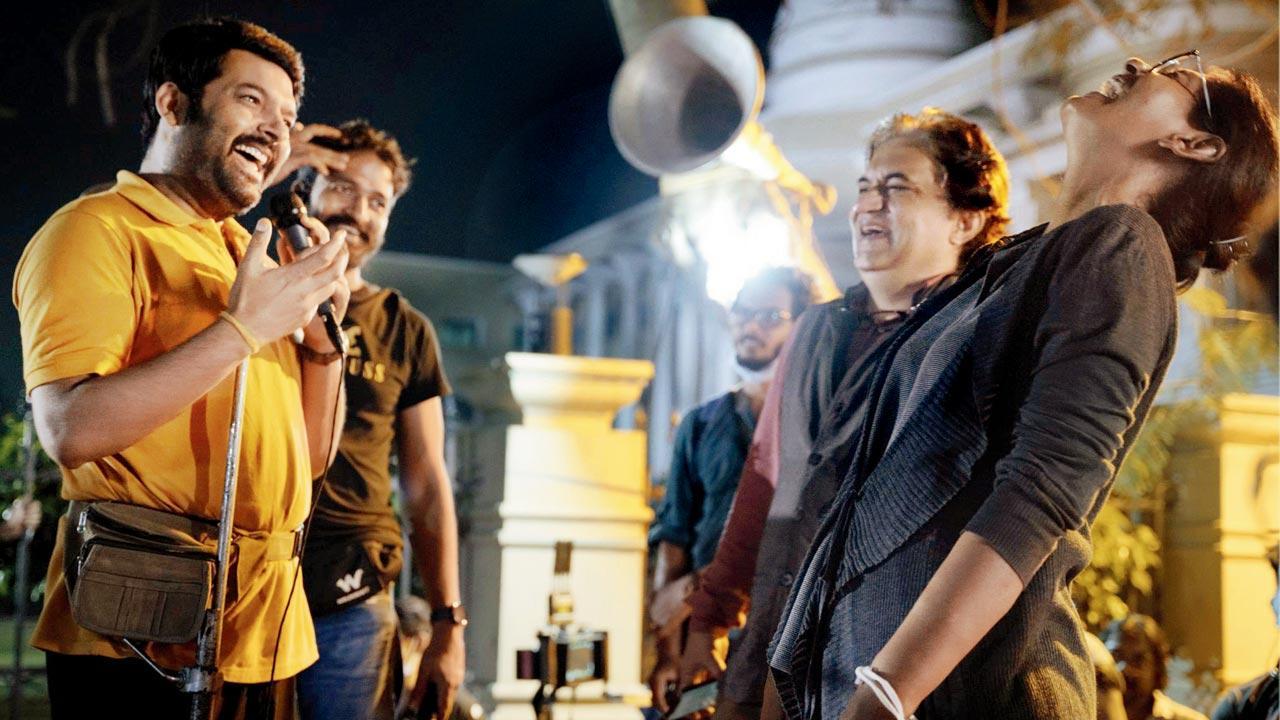
In a most unusual pairing, outlier actor-director Nandita Das directs darling-of-the-masses Kapil Sharma in a touching story about delivery riders. As she says, it became a collaborative effort with his reality overtaking her perception of him
Aastha Atray Banan (MID-DAY; March 5, 2023)
In Zwigato (which we guess is an amalgamation of Zomato and Swiggy), TV host and comic Kapil Sharma plays a blue-collar worker who loses his job in the Coronavirus pandemic, and is forced to work as a food delivery rider. Directed and written by Nandita Das, who last directed Manto in 2018, the film is set in her hometown of Bhubaneswar.
The food delivery executive is an individual we all got to know better during the pandemic as we leaned on them for daily needs. As Das says, “We, as consumers, have much to reflect on as we want things quicker, cheaper and with least effort. We don’t pause to think of those who provide the services we take for granted. I do feel that the film will create a small shift in the way people perceive those who form our world, but remain invisible.”
Edited excerpts from the interview.
The movie is described as one about the “relentlessness” of life. What was your thought when you conceived it?
The relentlessness of life is more acute for those who are more vulnerable. Especially during the pandemic, consumers became more and more dependent on gig workers and less aware of their struggles. Zwigato began as a short film about a day in the life of a delivery rider. Then Sameer [Nair, CEO of Applause Entertainment], who was to produce it, nudged me to expand it into a feature film. As I delved deeper, I was drawn to the human aspects of this collision of new technology and the lives of workers who are just cogs in the wheel. I began exploring the impact it has on them and their families. With the rise of the gig economy, the struggle between man and machine, which [Charlie] Chaplin depicted in Modern Times, has now shifted to one between man and algorithm. But within all this relentlessness, people find shared moments of joy. The film is also about the small things hidden from plain sight: The biases of class, caste and gender that are increasingly being normalized. They have all subtly found their way into the film, making the invisible a little more visible.
Did Sharma surprise you?
Kapil has a natural charm and genuineness, so, it was not difficult for him to get into the skin of the character. He told me that playing an “ordinary” man reminded him of his days of struggle; he drew from that part of life.
He brought vulnerability and authenticity to the character. He is not conscious of his body (he wasn’t as fit then as he is now) nor his looks in front of the camera, which is a rare quality for stars. Also, he is a very generous actor and friendly with his co-actors, disarming. He completely submitted to my process, but it ended up being a collaborative effort since he has a very sharp mind that questioned what didn’t make sense.
The one thing that surprised me was that for a person who laughs easily and is a comedian, he was best in the scenes where he had to be angry. We all have various sides to us, but sometimes perception overwhelms reality.
Describe your research…
The research took about two years, and as I delved deeper, I became increasingly fascinated and disturbed by what I learned about the gig economy. Before the film, I understood the world of incentives and algorithms as little as my protagonist did! We gathered both facts and personal stories by interviewing many riders: Their struggles, dilemmas, fears, and aspirations. We also spoke to ex-employees of food delivery companies and, in confidence, with senior managers in the analytics departments of food delivery apps. We also had to adapt the script to the changing rules of the food delivery apps, right up until the shoot. The real challenge was how to translate all this statistical information into a human story. The mind and heart must come together for a film to really impact the viewer in a deeper way. What moved me the most was their daily struggle—the slow chipping away of dignity. They cannot say or demand anything as they are in the service industry, and the customer ratings make them vulnerable. But, I was also surprised to see how many of them are still so hopeful amidst so much despair.
During COVID, we saw many blue-collar workers shift jobs. It disrupted the flow of things, but also brought a sense of “when in trouble, do what it takes to survive”. Was this movie meant to be about hope?
My films are born out of deep concern and as responses to things that trouble me. However, I do believe that we must never lose hope. So, while it is a rollercoaster ride for most, we also know that human beings are intrinsically resilient. I don’t see a contradiction between remaining realistic and continuing to be hopeful.
It’s also about love, and the true test of a relationship...
You are right. Love doesn’t exist in isolation; context impacts a relationship. When there is anxiety to make ends meet, it impacts everyone in the family. For me, the film is not only about the protagonists, but about the world I set them in, and how layered I could make it. I don’t put my “heroes” on a pedestal because they too are flawed. They are conditioned by the patriarchal system, and therefore, there are some rifts despite closeness.
--------------------------------------------------------------
‘I related to the character as I have been there’
How did a star comic play a food delivery app staffer? Easily, says Kapil Sharma; ‘it would’ve been far tougher for me to play a millionaire’
What were your first thoughts about the character?
Being a comedian, it has become really difficult for the audience to perceive an image of me that isn’t always smiling. So when Nandita ma’am told me what my character is going to be, I was more than happy. As prep, I didn’t have to do much: Once you put on the costume and go on set, the ambience and creative energy starts flowing and puts you at ease; it does most of the job for you.
What do you want audience to take away?
To say, thank you, and be empathetic towards those who work hard to make our lives comfortable—like our house helps, delivery personnel. It makes a huge difference to them. I became more sensitive towards them [after doing the film].
What were the role’s challenges?
Honestly, it would have been a bigger challenge to play a millionaire businessman. Manas Mahto is a simple, working-class man; it was easier for me to get into his skin. Back in the day, I worked jobs that were similar in nature, so in a sense, I understood where he was coming from.
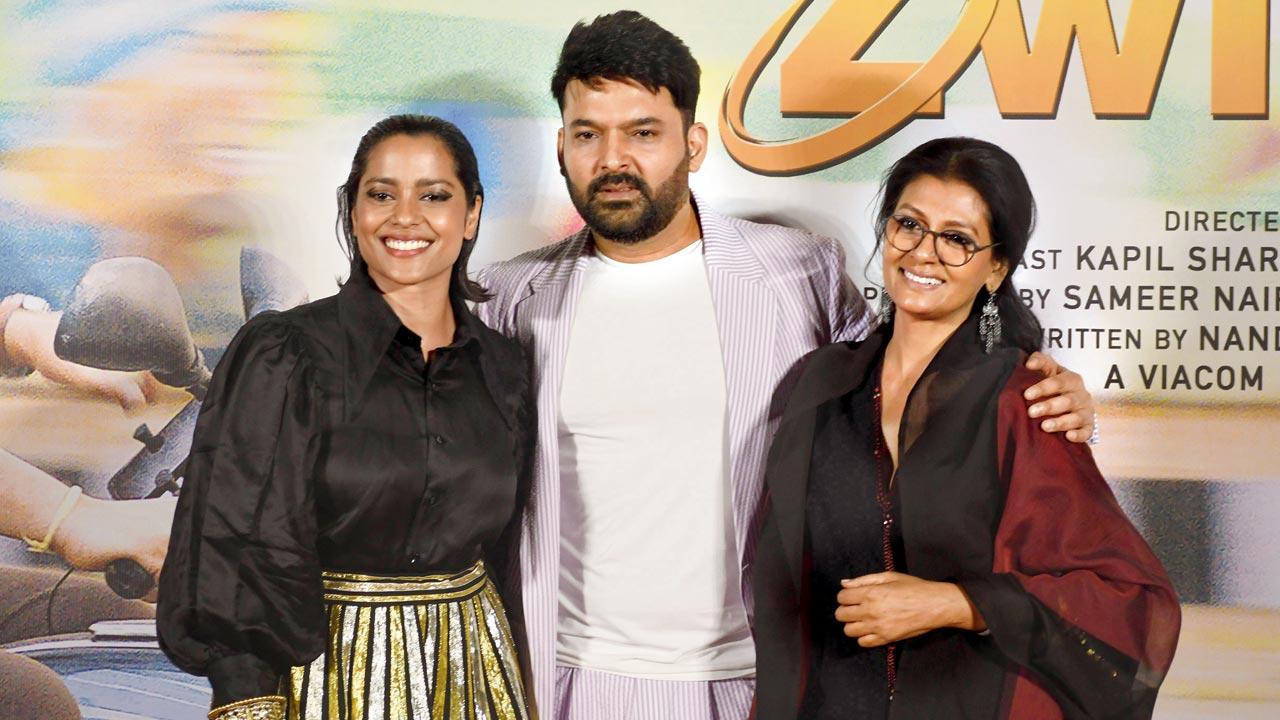
I haven’t worked as a delivery boy, but I have worked as a helper in Coca Cola-Kapil Sharma
8:34 AM
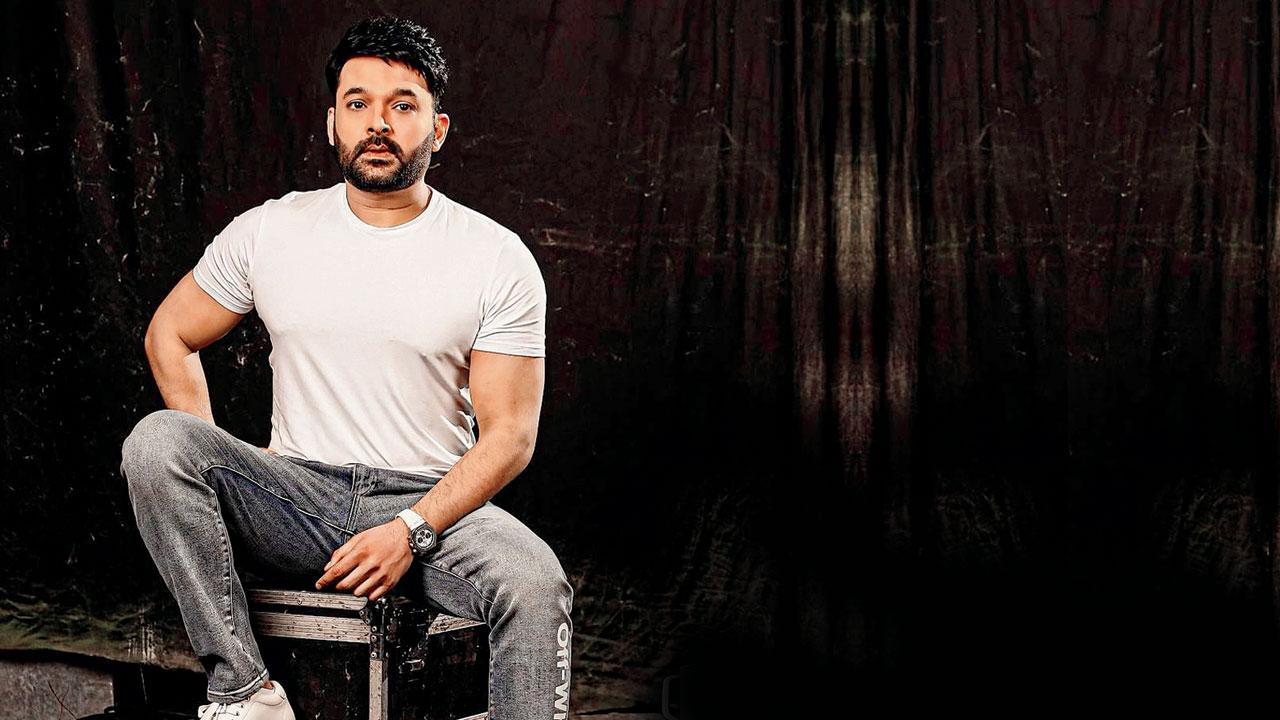
Switching gears to drama with Zwigato, India’s favourite comic Kapil Sharma says his humble beginnings made him identify with the role of food-delivery agent
Priyanka Sharma (MID-DAY; March 4, 2023)
Sometimes, the heartbreaking truths of life are told to us through comedy. So, it shouldn’t really be surprising that India’s most loved comic is bringing to us a poignant story. With Zwigato, Kapil Sharma and filmmaker Nandita Das have put the spotlight on a section of the population that is almost invisibilised. The actor realized he was on to something special the moment Das narrated the story to him.
“People mostly approach me for comedies. I have been doing the same kind of work over the past 15 years. Zwigato was a chance to show my versatility,” begins the actor.
In Zwigato, also starring Shahana Goswami, Sharma plays a food delivery agent who struggles to put food on plate for his family. The daily life of an underprivileged worker spoke to his humble beginnings.
“Honestly, if I were offered the role of a scientist, doctor or businessman, I may have felt uncomfortable. But I come from this world. I haven’t worked as a delivery boy, but I have worked as a helper in Coca-Cola.”
The actor adds that the movie, while highlighting how the working class is exploited, underlines that empathy and respect go a long way in lessening their burden.
Many were surprised by the coming together of two seemingly different worlds, as Das and Sharma joined forces. For the actor, however, working on the human drama felt as natural as a comedy gig. “Both of us are human beings on the same planet. We share the same emotions,” reasons the actor, adding that he surrendered to the world created by his director.
“While making this film, we did nothing else. I shot bank episodes for my show [The Kapil Sharma Show] so that I could fully concentrate on the film.”
The comic-actor has long been a fan of the director’s brave stories, and was happy that Das turned out to be exactly how he had perceived her through her art. “She took time to conceive the story and thoughtfully cast me. Seeing [her dedication], I also put my heart and soul into it. I knew she makes films because she is passionate [about the subjects], and not to make money. She gets involved in each and every department. I learnt a lot from her, even in the littlest of things.”
I have never used a fairness cream-Nandita Das
8:44 AM
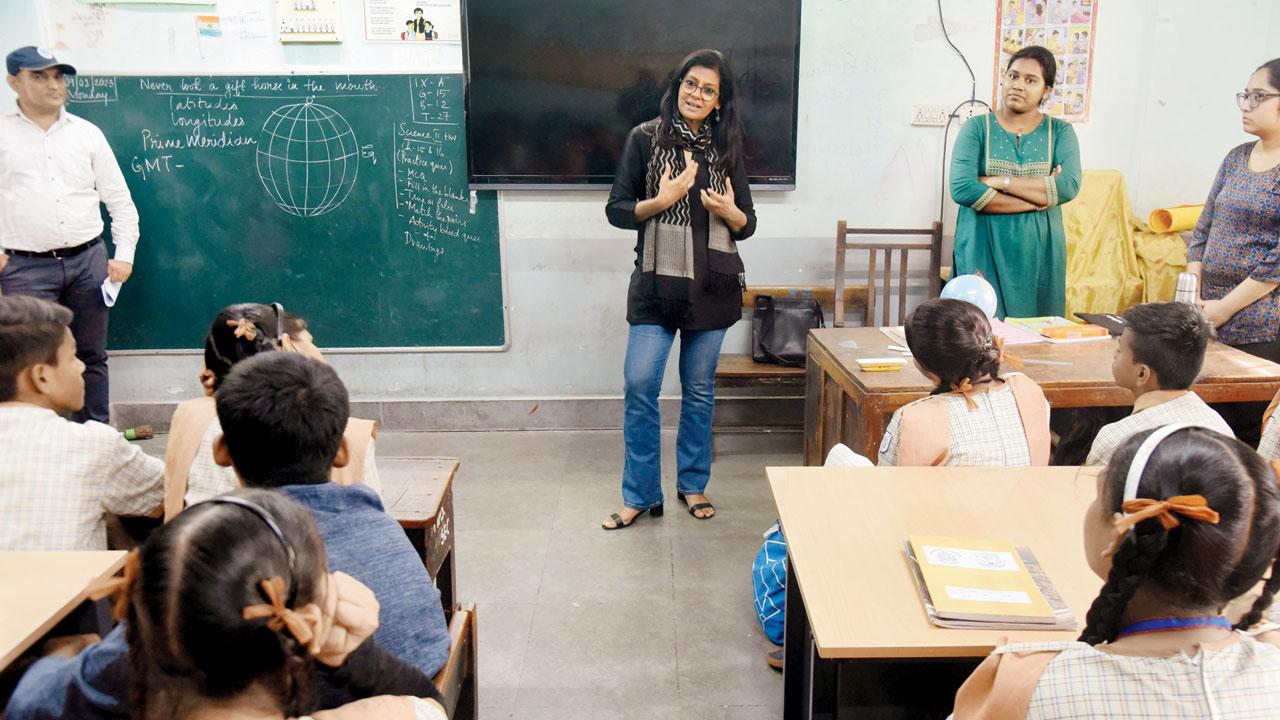
Actor Nandita Das opens windows of the mind with talk on skin colour and other biases
Hemal Ashar (MID-DAY; January 10, 2023)
“Good morning, didi!” chorused boys and girls in unison, standing up to greet actor Nandita Das. Das was “didi” to the Std IX students at Shiv Srushti School in Kurla East on Monday morning. She was the speaker at a programme held by Teach for India. Das headlined a session called: Unconscious Bias: Colourism and prejudices impacting children and adolescents.
Das started with asking the classroom, “Tell me what discrimination means?” When there was silence, she elaborated, “Do you know of a word called differentiate? We often hear statements like: you are very tall, you are short, you are rich, they are poor...these are differences. When we treat a person based on solely these differences as better or not so good, that is discrimination.”
Labelling people
Das, who was effortless in her teacher role, explained that discrimination labels people and reduces them to one aspect, literally confining them to a box. Das spoke from personal experience as she said, “Sometimes, you will hear people say, she is so fair-skinned, like an actress. She is so dark-skinned, how can she be an actress?” She told her listeners, “The media would write in their papers, ‘the dark’ or sometimes ‘the dusky’ Nandita Das. They felt the need to qualify somehow. Yet dark or dusky is just one part of my identity. I love music, nature, I have a Masters in Social Work... These are part of my identity too. Labelling someone diminishes them.” Das added, “The fairness industry is huge. Today we may not have creams that use ‘fair’ in their name, but the aim is the same. I have never used a fairness cream.”
That hurts
Das prodded students to share their experiences. A student remarked, “I have been looked at differently because of my skin colour. My relative said, she is dark, look at her skin colour. It broke my heart. I stopped believing in myself because of these statements.” Das seconded that angst stating, “It does more than just hurt. It makes you start believing you are different and lesser somehow.”
She said about herself, “A relative used to tell me when I was a child, you are too dark, do not play in the sun. I was advised to apply haldi (turmeric) on myself so that my ‘tan’ will come off. When I was older, I used to retort: this is not my tan, I have no need of de-tanning. This is my skin, I have lived with it and will die with it.”
Another student said, “I have had family members commenting: ‘you are fair but you do not look so good, your younger sister is dark... but despite that, she looks good. You are too fat, now you have become too thin.’ I have realized, some people will comment no matter what. I have started responding stating, ‘I am happy my younger sister looks good... she is my sister after all’.” That earned her a round of applause from the class.
Faith bias
A Muslim student then shared how she was chastised by relatives for dressing like someone from another community, as she wore jeans and T-shirts, and not salwar-kameez. That is when the interaction segued to religion, caste and gender discrimination. It could be that the girls were better communicators but it was important to note that it was more girls who spoke up about being judged for what they wore, their skin colour, or how they looked. Das egged on the boys, “The boys need to speak too. If they do not have direct experiences, I appeal to the boys to make a mental list about how their sisters are treated, how their mothers and fathers are treated.”
Lessons learnt
In the end, Das, who had handled the class dexterously, had some lessons for her young audience. She wound up acknowledging the wisdom of children, “Adults do not like to admit that they are wrong, especially to children. I have a 12-year-old son and he, in fact, is my biggest teacher. He looks at the world through fresh eyes. Keep conversations about these prickly topics going. Being equal, just and fair is a lifelong effort. Do not be part of the problem, be part of the solution for a more equitable world.”
NFDC merger leaves industry divided
4:23 PM
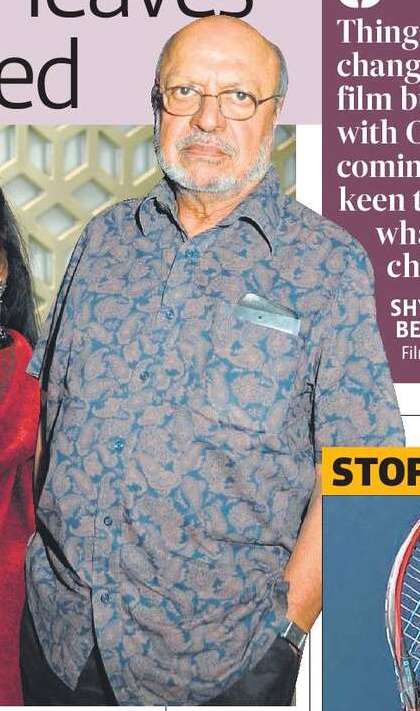
Sugandha Rawal (HINDUSTAN TIMES; January 4, 2023)
The New Year has brought with it a new development for the entertainment industry, as the Films Division, the Children’s Film Society of India, the Directorate of Film Festivals and the National Film Archive of India will henceforth come under the broader umbrella of the National Film Development Corporation (NFDC). This merger has raised many questions in the minds of industry insiders.
“The merger was formally completed on December 31. This step is going to increase transparency in the system with effective utilisation of resources,” says Ravinder Bhakar, MD of NFDC.
When first proposed in December 2020, the idea of a merger was opposed by several filmmakers, including Anand Patwardhan, Nandita Das as well as actor Naseeruddin Shah. Cut to today, the sentiment remains the same.
Das tells us, “The merger is truly distressing. These bodies were created with specific objectives. By merging them, we will be diminishing their unique contributions. The decision was taken without consulting the major stakeholders who would be affected by it, including filmmakers and the hundreds of workers employed in these organizations.”
To this, Patwardhan adds, “These are public bodies made with public money, and now, they are privatized. The most painful thing is the loss of archives.”
However, Bhakar doesn’t understand the discontent: “Earlier, there was a lot of duplication of work. Now, we will be utilizing whatever assets are available with us overall. It is one unit.”
Filmmaker Shyam Benegal says he is keen on understanding the way forward, with the merger in place: “The Films Division has been facing problems for a long time as there is no need for films of that nature. The organization would have shut automatically, had it not been a government body... I am excited to see what changes with the merger.”
Applause and standing ovations for What’s Love Got To Do With It were a pleasant surprise-Shabana Azmi
2:16 PM
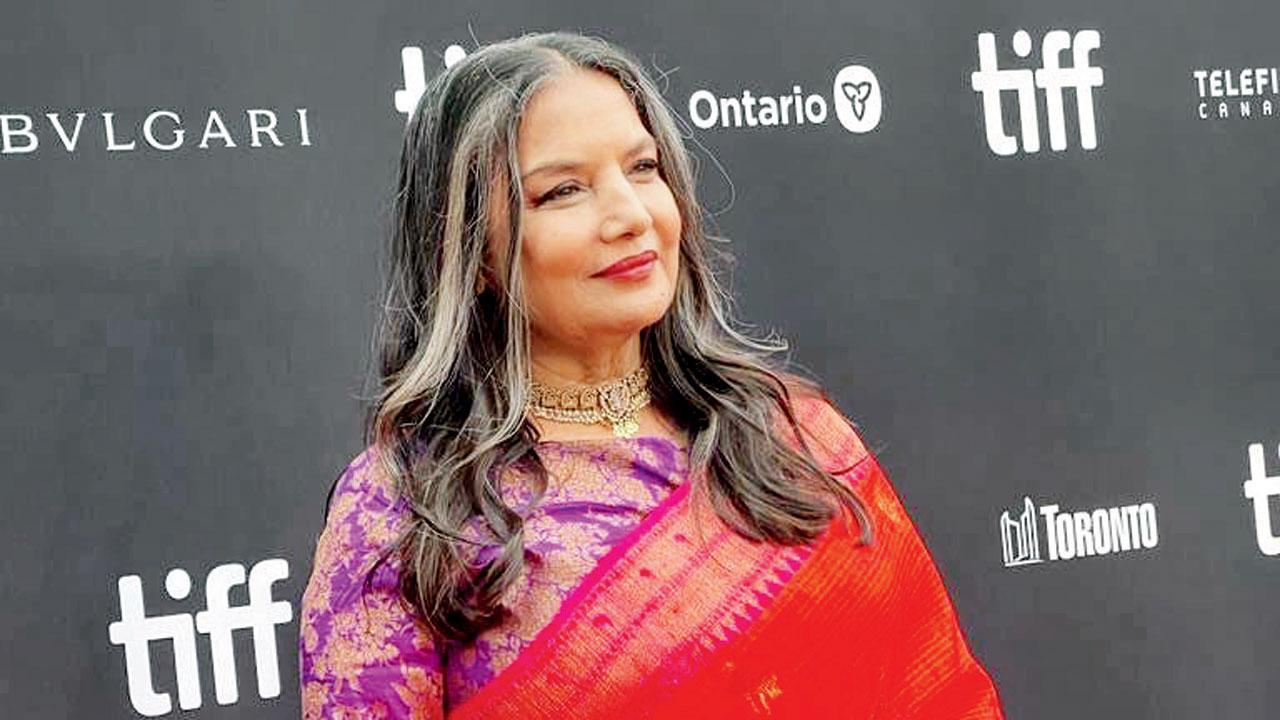
Shabana Azmi on the standing ovations her film, What’s Love Got To Do With It received at TIFF screening
Upala KBR (MID-DAY; September 16, 2022)
It is rare to witness the audience’s reaction to a film these days, but Shabana Azmi, who recently attended the Toronto International Film Festival (TIFF), for the premiere of Shekhar Kapur’s What’s Love Got To Do With It?, was overwhelmed with the response the film garnered. “It was evident that the audience was loving the film,” says Azmi, who was thrilled that “every joke had landed” and people registered the emotions of the film.
“I was watching the film on the big screen for the first time. The thunderous applause and standing ovations were a pleasant surprise. Shekhar reacted to the overwhelming response with equanimity. He was smiling at all the press interactions,” says Azmi.
What’s Love Got To Do With It?, written by Jemima Khan, also stars Emma Thompson, Lily James and Shazad Latif. While Thompson and Latif couldn’t make it to TIFF due to prior commitments, they caught the audience reactions and were thrilled nonetheless. “We missed Shazad. He was gutted because he couldn’t attend,” expressed Azmi.
The actor, who plays Aisha Khan — the matriarch of the Asian family — believes that the audience connected with the movie because they found it “relatable”. “It’s a warm, funny, and emotional film about love, intimacy, and identity. Jemima Khan’s observations of the difference between cultures is laced with clever lines, humour, and compassion. In today’s dark times, it is refreshing to have a film that celebrates life and the family.”
The icing on the cake was when Azmi caught up with her Fire (1996) team at TIFF after ages. “TIFF got us together to celebrate 25 years Of Fire since we first premièred it at the festival. Nandita [Das] was there as a director [for her film Zwigato] and Deepa [Mehta, director] was at the fest for a workshop. It feels great that all of us have our boots on and are still working. Fire has become a cult film. Even today, we receive warm messages from people who say it transformed their lives,” expresses the actor.
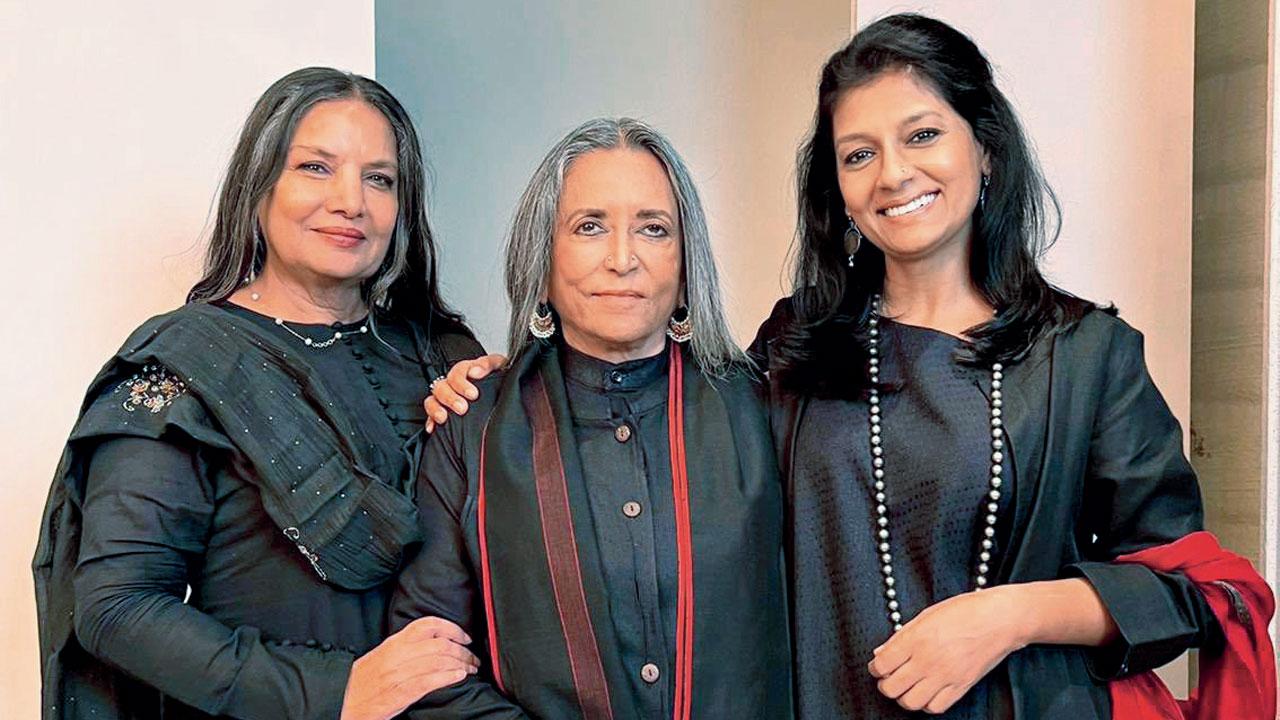
Azmi, Deepa Mehta, and Nandita Das celebrating 25 years of Fire
Together, Ranveer Singh and Deepika Padukone represent glamour and courage-Shabana Azmi
9:46 AM
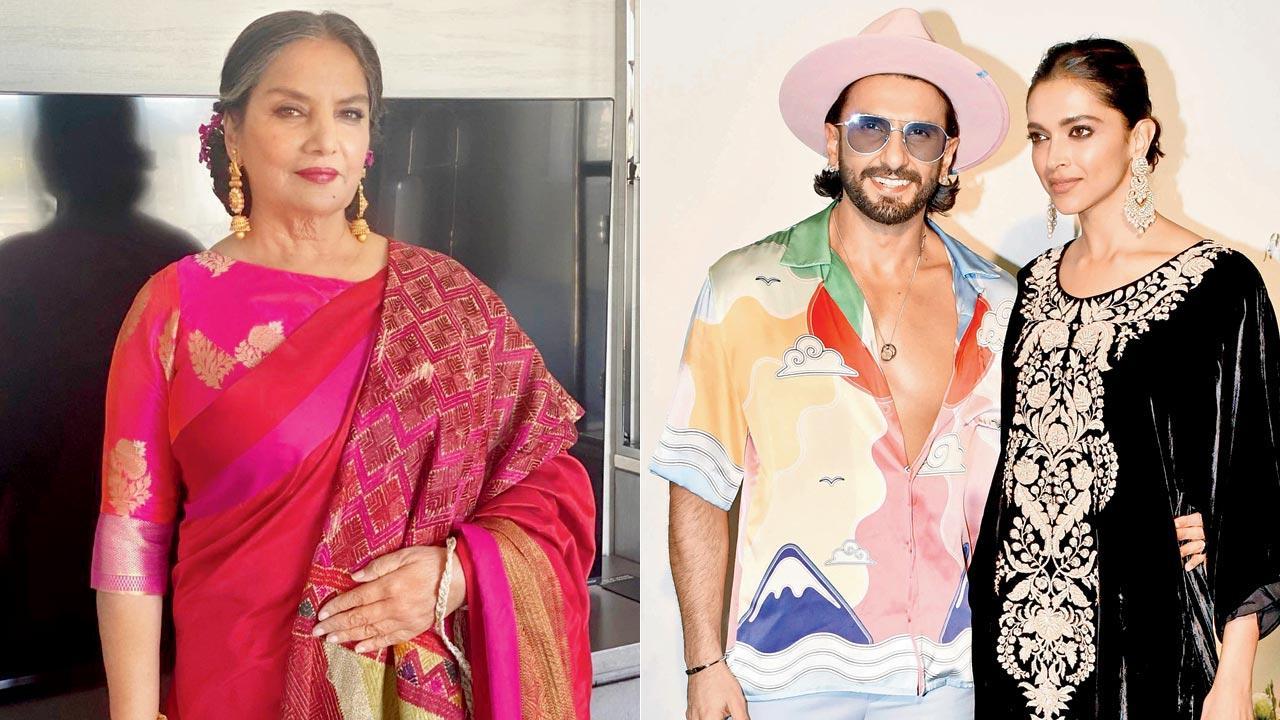
After a three-year break owing to the pandemic, Shabana to host Mijwan Fashion Show on ground, with Ranveer-Deepika turning showstoppers
Upala KBR (MID-DAY; July 21, 2022)
It has been 10 years since Shabana Azmi began the Mijwan Couture Fashion Show, thus putting the spotlight on the village’s women artisans. This year is all the more special as the fashion show will be an on-ground event after the Coronavirus pandemic compelled them to take a three-year break. So, does Azmi hope to return with a bang? Absolutely. “This promises to be our grandest event to date. It’s a white-only collection,” beams the veteran actor.
Bollywood’s power couple Ranveer Singh and Deepika Padukone will turn showstoppers for the evening. The July 29 do will see the industry’s glitterati — from Karan Johar to Vidya Balan, from Farhan Akhtar and Shibani Dandekar to Dia Mirza and Nandita Das — rally behind Azmi for the cause.
While Ranbir Kapoor and Padukone had sashayed down the ramp in the last edition, the senior actor is glad that Singh has taken the baton. She believes that, in many ways, Singh and Mijwan have had a similar journey. “When I requested him to be our showstopper, he said yes in an instant. He had walked for our third fashion show at the start of his career, and today, he is a big star. Ranveer epitomises the fledgling steps we took when we first started, only to become a brand that is recognised internationally. Deepika is sensitive to the cause of empowering women and the girl child. Individually and together, they represent glamour, power and courage.”
When putting together the first show in 2012, Azmi had hardly imagined that it would become an annual affair. “Namrata Goyal [secretary, Mijwan Welfare Society] and Manish Malhotra worked on making it an annual feature. We started with 40 women, and today, we have 400 artisans,” she says.
Having a female protagonist is no longer just an act of tokenism-Rasika Dugal
8:15 AM
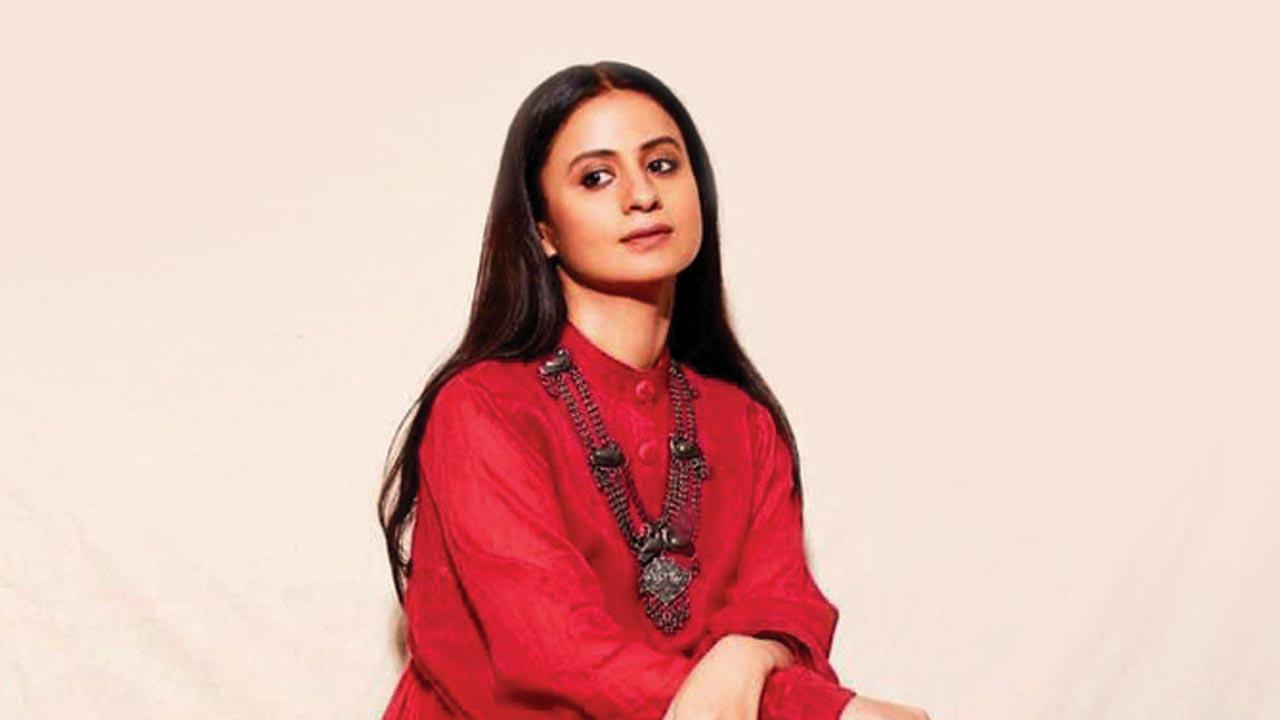
Renuka Vyavahare (BOMBAY TIMES; March 7, 2022)
The portrayal of women in cinema and on web shows has undergone a sea change, but is that enough? Rasika Dugal, who has been a part of films Qissa, Hamid and Manto along with many web series, says, “Storytelling is transforming every day, and it’s heartening to see that not only are there more important parts for women, but they are also more nuanced. Scripts are exploring and celebrating femininity. Having a female protagonist helming a show or film is no longer just an act of tokenism. However, we still have a long way to go in the way we portray female desire. Sometimes, even the most well-written scripts end up with sexualised visuals. Possibly because of deeply-ingrained references. I feel, we find it hard to break away from those.”
The actress also makes a point about feminism. She says, “Feminism isn’t limited to a particular gender and, unfortunately, neither is patriarchy. Women can be patriarchal and men can be feminists. I have been very inspired by some of the people I have worked with — Anup Singh, Mira Nair, Richie Mehta and Nandita Das — for what they bring to their work and for the people they are. I am also hugely inspired by the women I grew up with — my grandmother, mother and aunts. They’re women who made very traditional choices, but lived with the consequences of their decisions with grace and dignity. Growing up, I don’t think I valued that enough. However, later I realised the strength and resilience it took to always be there for the people around you, and in a way, that did not compromise your self-respect even though sometimes that had to be negotiated. I will always have respect for that.”
For Hrithik Roshan to take out time, get my number and text me was incredible-Harsh Varrdhan Kapoor
8:09 AM

Rishabh Suri (HINDUSTAN TIMES; October 5, 2021)
Harsh Varrdhan Kapoor’s slow, but steady approach towards his career seems to be garnering him a lot of support, both from within, and outside the film industry.
Last seen in the web anthology Ray, he reveals the response has been “overwhelming”. “I always knew that Spotlight (a segment in the four-part anthology) was an offbeat film, compared to what I’ve done so far in my short stint. It was the most progressive of the lot. I loved it, but was unsure how people would respond. I expected it to be polarising, but didn’t expect it to be liked so much,” he says.
In fact, Kapoor found an admirer in actor Hrithik Roshan and shares the words of appreciation that he received from him. “I was up early morning, shooting for my upcoming film, when Hrithik messaged, ‘Hey Harsh, is this your number?’ Then he said, ‘I watched Spotlight and thought the film was terrific. Keep doing what you’re doing, it’s the right way. It’s not stereotypical, which audiences are used to, which is why it’ll pay off in the long term’. That’s something I’ve always believed in as well,” shares Kapoor, who feels it was a nice and thoughtful gesture on part of Roshan, which he’ll always treasure in his heart.
“For him to actually take out time, get my number and text me — that was something incredible. A lot of other people... Nandita Das, Ram Madhvani, Sujoy Ghosh, Anurag Kashyap have all reached out. It has been amazing and I’m grateful for it,” he says.
The actor shares that his choice of projects has got to do with the kind of person he is, and he actually listens to the “voice inside” him carefully.
“We are artistes, our confidence does fluctuate, we can feel on top of the world... and then there are days you feel the opposite of that. Within those ups and downs is the unwavering belief in myself, and the path I’ve chosen. I enjoy that challenge,” Kapoor concludes.
We had several acting workshops with Naseeruddin Shah; you will not find this process in any book-Rasika Dugal
7:57 AM
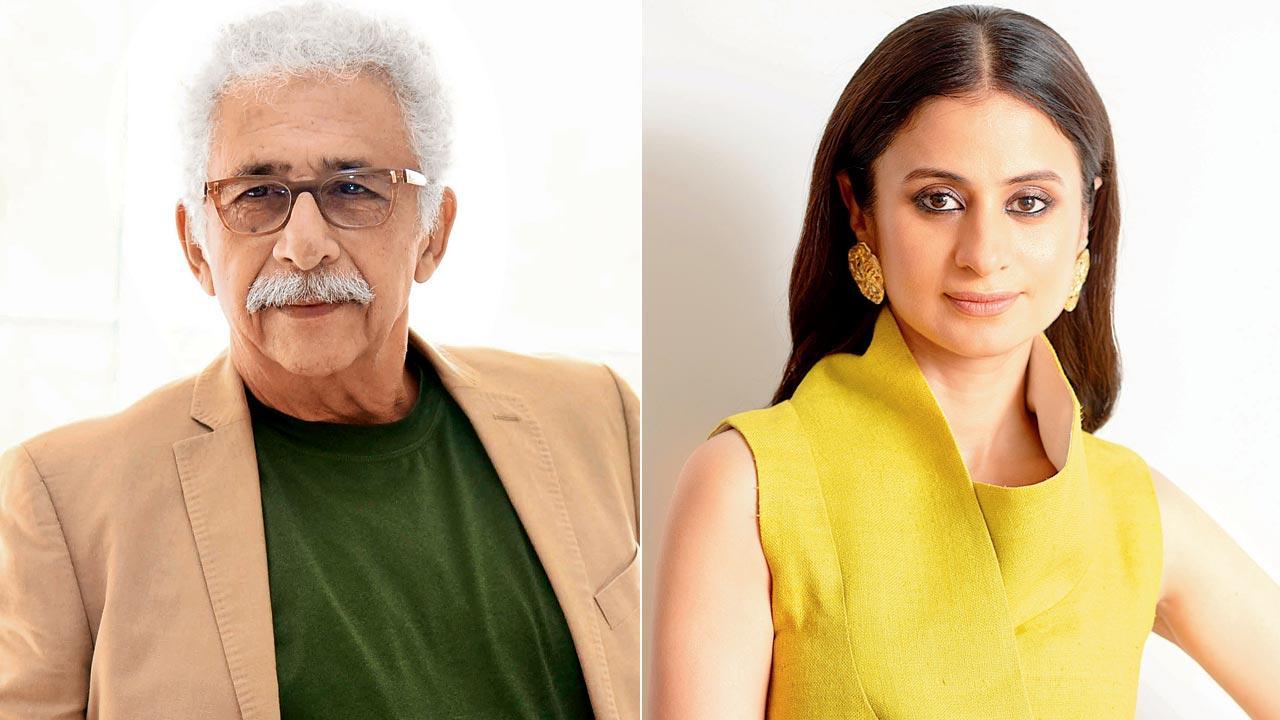
The actress recounts her student days at the FTII and the impact of Naseeruddin Shah on her as a teacher
Renuka Vyavahare (BOMBAY TIMES; September 6, 2021)
Naseer sahab was part of the visiting faculty when Rasika Dugal studied at the Film and Television Institute of India (FTII). While the world knows of his acting prowess, through some very interesting anecdotes, Rasika gives us an insight into Naseeruddin Shah, the teacher. In conversation with Bombay Times on Teachers’ Day yesterday, the actress shared the valuable lessons she learnt from her famous teacher.
The actress remembered, “We were thrilled that Naseer sahab was able to take the time out and come teach us. It is rare for a working actor to make time for teaching. What I found unique about him is the fact that he is as good a teacher as he is as an actor, which is rare. Acting and teaching are two very different muscles, but he is able to navigate them. A great actor and a very focused teacher.”
The actress shared his teaching process and the impact it had on her as a student. She explained, “He has a set process that he would follow with us. We had several workshops with him that went on for 15 days each throughout the year. This pattern is what he had devised. You will not find this process in any book. Every student was nervous in front of him and we all wanted to maximize our time with him to grasp as much as we could.”
Citing examples, Rasika added, “The few things that I learnt from those sessions are fundamental to my craft. To give you an example, I learnt from him that you should never instruct your co-actor. You receive whatever they have to offer. Suppose a co-actor changes a line or says it differently, you don’t stop him and say, ‘Hey, you’ve said the wrong line’. You accept what they give to that scene. When someone throws something new at you and you adapt to it, that’s the actual give and take. And it’s not yours, but a director’s job to control a scene. You just need to be alert and be there for your co-star. It’s easy to say these things, but he taught us to execute them.”
After a brief pause, she elaborated, “Naseer sahab once said in class, that if you want to truly listen to your co-star in a scripted scene, then you must learn the other person’s lines also. At the time he gave this instruction I found it weird. But when I started working, I understood the meaning of it. I shot a short film called The Miniaturist Of Junagadh with him, which was my first professional interaction with him in Mumbai after the FTII. What happened on set was interesting. He asked me, 'Tumko lines yaad hai, na?' I said, 'Sir, aapki bhi yaad hai (smiles).' He laughed because he himself taught us that. He is enthusiastic about learning things and constantly updating his knowledge. He reads stuff in several languages and finds references that can lend meaning to lacklustre writing of a character he may enact, it’s very inspiring. This is what being detailed means.”
Beyond being a fine actor, Naseeruddin Shah is a socially aware artiste, who always speaks his mind. And that’s most inspiring about him believes the actress. Listing it as one of her life lessons, she said, “He always speaks his mind. There is no pretence and I feel that’s a great quality to have. The other person who has this quality is Nandita Das and I had the opportunity to work with her as well in Manto. They don’t believe in hierarchies. They treat everyone as equal and so the honesty.”
Who would take the risk of giving me a comic role?-Nandita Das
8:04 AM

Tejashree Bhopatkar (BOMBAY TIMES; November 20, 2020)
During the long months of lockdown, Nandita Das used the time creatively and effectively. The actress, who has featured in 40 films across 10 different languages, wrote, directed, produced, and acted in a seven-minute short film titled, Listen to Her, that sheds light on the increase in domestic violence and overburden of work that women have been facing during the pandemic.
Talking to ETimes about tran sitioning from acting to directing, she says, “I have always enjoyed doing different things and I hope to continue that. I don’t see any reason why one has to make choices between this or that when one can potentially do this and that. If there are stories that compel me to direct, I will. It was always exciting to watch the rest of the crew work towards shaping up a scene. Often I would get involved with suggestions or just ask questions. Actors are perceived to be larger than what they are, but what people don’t realise is that we (actors) are at the mercy of a hundred factors that shape a film. And so I thought maybe making a film from scratch and having freedom to make what I want to, would be more fulfilling.”
Nandita goes on to say that she doesn’t believe in classifying films in various categories. “I have never classified films as art or commercial, Hindi or regional. I do films that resonate with my sensibilities, in whichever genre it may be. The criteria to choose a film has always been the script, the director, and the role I am offered,” the actress-filmmaker explains, adding, “But I know when I look back at the 30 odd films I have done, many of which are regional films, that they needed to make fewer compromises with the form and content they chose. Of course, they are always struggling with budgets and marketing issues and so the vision doesn’t translate into reality. I would love to do different genres, but who would take the risk of giving me a comedy role?”
Sonakshi Sinha, R Balki, Ashwiny Iyer to narrate motivational stories about their struggles and successes
8:27 AM

Sonakshi Sinha, R Balki, Ashwiny Iyer team up with NGO to launch a podcast to spread the word about human rights
Mohar Basu (MID-DAY; July 2, 2020)
 In putting the spotlight on the racial discrimination in the US, the Black Lives Matter movement has made countries around the globe reflect on the systemic discrimination prevalent all around. To create awareness about the United Nations Universal Declaration of Human Rights and the Indian Constitution, the world's biggest non-governmental human rights education programme — United For Human Rights — has joined forces with Bollywood's bright minds to launch the initiative, Born Free and Equal.
In a podcast series, the artistes — Sonakshi Sinha, Nandita Das, Ashwiny Iyer Tiwari, Shonali Bose, R Balki, and Alankrita Shrivastava, among others — will narrate motivational stories about their struggles and successes. Each story will underline the importance of a specific human right. Sinha is expected to open the series this weekend focussing on the Right to Education.
Sheena Chohan, international ambassador for United for Human Rights, says they partnered with Bollywood celebrities to tap into a wider audience. "Through awareness of these basic rights, we can help bring equality, peace and unity to the country, at this time of crisis."
While it was nothing but a drop in the ocean, every drop brings us closer to the tipping point-Nandita Das
8:40 AM

In a first-person piece, Nandita Das reacts to a multinational company’s decision to drop words like ‘fairness’, ‘whitening’, ‘lightening’ from its line and even rebrand a popular cosmetic product
Nandita Das (MUMBAI MIRROR; June 26, 2020)
In the midst of the Coronavirus pandemic, a number of social wrongs have found a surprisingly sympathetic audience. The announcement today by Hindustan Unilever that they will remove the words ‘fairness’, ‘whitening’ and ‘lightening’ from their line of products, which includes the brand name of their premier skin lightening product, is something I don’t think anyone saw coming. Even though it is more symbolic (after all, they have not discontinued the product, just changed the messaging), it is still a big step forward. Many brands spend hundreds of crores of rupees to spread the absurd message of fair being lovely in a largely dark country. So, when a market leader steps in, at the very least, it will certainly lead to an even wider debate.
The world is ridden with so many forms of discrimination — on the basis of religion, caste, gender, sexuality, language and of course, skin colour. A given identity, that one is born with, has become the most defining factor. But increasingly, it is being challenged, and thankfully, cannot be ignored.
Following this announcement will we only witness a more politically correct world where marketing of fairness products will be less obvious or will there be a shift in the way we define ourselves? That is yet to be seen. Skeptics have mocked the said premier skin lightening product, arguing that it is not even the skincare product it claims to be. Having said that, in a culture where beauty is primarily defined by skin colour, it’s quite lovely that suddenly the billion-dollar ‘whitening’ industry wants to be fair!
The Black Lives Matter movement gained momentum and tipped over into a wider social response after the heartless killing of George Floyd. This kind of violence was not new, but the protests have suddenly found acceptance. It is hard to believe that the change of heart is caused by anything other than a perceived shift in public opinion. And so yes, while it may be a calculated move, it does reflect something positive.
Yesterday, Johnson & Johnson announced that it would stop its line of skin whitening products. Also, that they would add more shades to their Band-Aids outside of the current ‘skin colour’. Whose skin are we talking about anyway! I thought to myself, ‘well, better late than never’. Maybe some in the cosmetic industry are realising that such products and imageries feed racist and colourist stereotypes. But finally, only those with the real intent to change the narrative will make a sustained difference.
It is worth reminding ourselves that the companies that sell products are not the root cause for this discrimination. While it is important that corporations show some responsibility towards social problems, it is fundamentally not an issue in which we should expect them to bring about a difference. We need to solve the problem of fairness obsession we all carry. They are only using the age-old prejudice to sell more creams and fancy dreams to entice more customers. And we are talking about a $4 billion industry here.
The bigger and more pertinent question is: Will the mindset change and to what extent will the change in advertising strategy influence that? But having said that, every step in the right direction needs to be acknowledged. All stakeholders together, will make a difference.
I have always been outspoken about colour bias that is hidden in plain sight for as long as I can remember — not only through my memories, but also through the stories I have heard from women older than me. In 2013, a Chennai-based organisation approached me to support their campaign, Dark Is Beautiful. While I knew that the impact of colour bias is far-reaching, insidious and deeply affects our sense of selfworth and confidence, I didn’t realise it would touch such a raw nerve. It suddenly went viral and brought attention to this prejudice which has been normalised over the years. By default, I became the face of the campaign. Probably because most actors were becoming lighter with every film.
I revamped the campaign in 2019, its 10th anniversary, and called it India’s Got Colour, to make it more inclusive and to celebrate diversity. While it was nothing but a drop in the ocean, every drop brings us closer to the tipping point.
Domestic violence is rampant, across regions and class. The silence around it is unnerving-Nandita Das
8:11 AM

Rattled by the apathy towards domestic violence survivors, Nandita Das makes 7-minute film to encourage them to reach out with help from UNESCO, UNICEF and other UN agencies
Ankita Chaurasia (MUMBAI MIRROR; May 26, 2020)
According to a National Commission of Women (NCW) report published mid-April, instances of domestic violence had doubled across India within just three weeks of the countrywide lockdown, which was imposed on March 25.
On April 6, United Nations chief, António Guterres, too, called for measures to address a “horrifying global surge in domestic violence” in the wake of Coronavirus-induced lockdowns around the world. This, after The World Health Organisation predicted that the risk of intimate partner violence is likely to increase with people being encouraged to practice social distancing.
For actor-filmmaker Nandita Das, the alarming statistics spurred a spontaneous response to the irony of the ‘stay home, stay safe’ phrase. She decided to lend her voice to the issue to encourage women to speak up and for us to listen. Enlisting support from UN agencies like UNESCO, UNFPA, UNICEF, UN Women and the South Asia Foundation (Madanjeet Singh Foundation), Nandita is all set to release her short film, Listen to Her, across social media platforms today at noon. “It was amazing that UNESCO came on board as a partner and their India head, Eric Falt, went and garnered more support from their sister organisations, like UNICEF, UN Women, UNFPA and South Asia Foundation. I am truly grateful to them as they will use the film to sustain the campaign to break the silence. After all it is a call to action with helplines for women to reach out to,” asserts Nandita, urging survivors to reach out on helpline numbers 181 and 112 for help.
So, what prompted her to make a film in the midst of a crisis? “When we speak of abuse, it is not just physical violence, but also emotional and mental abuse. Even before my masters in social work I was aware of what women were going through. Just because we, as a society, fail to speak about this issue enough, does not mean that it doesn’t exist,” she says, pointing out that she has friends and relatives who’ve been in abusive situations and community work brought her closer to such people too, both in urban and rural areas across the country. “It is rampant, across regions and class. The silence around it is unnerving.”
Nandita admits it was creatively challenging to shoot the seven-minute film during lockdown. With no crew, camera, or tripod stand for her phone, she used her old phone to record the sound separately and coordinated with two members of her team on Zoom to view the footage while she was shooting. “It was all shot in my living room. Just me and my son, Vihaan—a cast of two!” she informs, adding that they shot over three mornings with her cook, Bharat, as the camera operator, as she realised that the light changes by noon.
Nandita would perch the phone on stacked-up books, run to her position, give her son instructions, turn on the audio recorder on her other phone, ask Bharat to press recording, clap to call out the shot and the take number, and only then begin to perform. “Amidst all this chaos, it was difficult to remember the dialogues I had written myself, but I managed to improvise as I knew the crux of it. I had to imagine all the sounds—on the phone, the other characters, the whistle of the cooker - everything had to be in my head. This ordeal was a good reminder that filmmaking is, after all, a collaborative process.”
She admits that her favourite part of filmmaking has always been post production—editing, sound and music and some of the best in the industry, readily agreed to contribute to this film remotely. “Their willingness was heartwarming, but it was still tough. So many files were going back and forth, uploads and downloads. I am so not a techie but after this experience I might have just become one!” she exclaims.
Along with inspiring survivors to reach out for immediate assistance, the film, which is a simple story of two women—one overburdened by increased workload, another locked down with abuser—impacting each other, aims to bring about gender equality in the post-Covid world. “This lockdown still seems surreal. None of us ever imagined or experienced anything like this before. Personally, I have nothing to complain about. I largely work from home, so not much has changed except having to engage my son and the umpteen requests for online engagements,” she says, surprised at how quickly everyone is adapting to the new reality. “But what a bubble we live in because this is not a shared reality with millions of people who have nothing to eat, struggling to get home and have no livelihood. These gaps in equality are not a result of the Covid-19 pandemic. They were hidden in plain sight that are simply more apparent in this lockdown. For women in particular, it has been the most difficult,” she concludes.
Many are locked down with violence perpetrators with no escape-Nandita Das
8:13 AM

Titas Chowdhury (HINDUSTAN TIMES; May 8, 2020)
A while back, Nandita Das, along with other actors, featured in a one-minute video to raise her voice against the rise in domestic violence cases during the Coronavirus lockdown and urged people to report such cases around them. Das says that the health pandemic gave way to the shadow pandemic in no time. “We didn’t realise that ‘Stay home, stay safe’ would be a luxury. But the irony of it should not be lost on us as many women battle the situation in their homes. Many are locked down with their perpetrator, with no escape,” she says.
The director-actor says that it’s our responsibility to help those undergoing trauma. She says, “There are many credible organisations working with victims of domestic violence during these times, offering resources, support and counselling services. We should donate as much as we can to them.”
A popular name in the world of theatre, Das is happy with the latest trend of plays making their presence felt on the virtual medium. She opines, “It’s a different experience from being in an auditorium and not necessarily a worse one. So many great plays haven’t been documented and we’ve all missed out on watching them. I wish all the great plays were available online to watch.”
The Manto (2018) director says that with the changing times, one needs to let art branch out to new mediums. “There’s no point being puritanical. During this time, many museums have opened up their collections and many cultural organisations have made their archives available online. Several art institutions are also reinventing themselves, to see how they can share their work and keep the audiences engaged with online theatre, music and dance,” she signs off.
Subscribe to:
Posts (Atom)