Showing posts with label Namak Halaal. Show all posts
Showing posts with label Namak Halaal. Show all posts
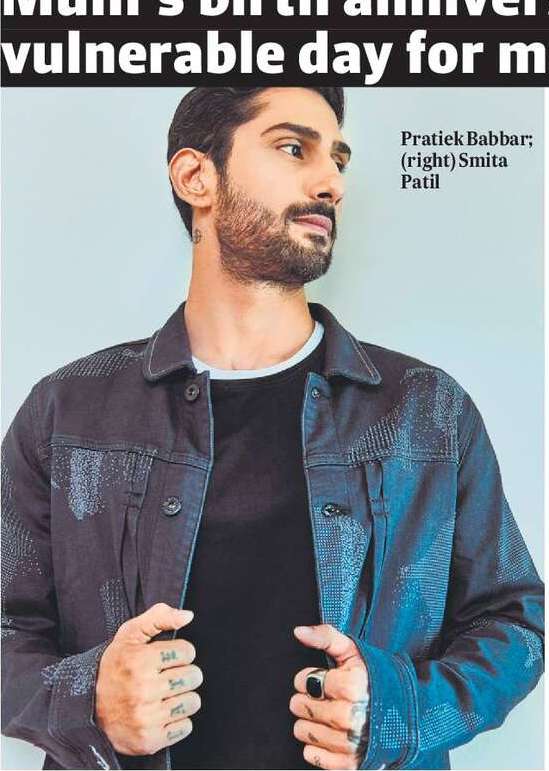
Mum’s birth anniversary is an extremely vulnerable day for me-Prateik Babbar
8:22 AM
Vinay MR Mishra (HINDUSTAN TIMES; October 17, 2022)
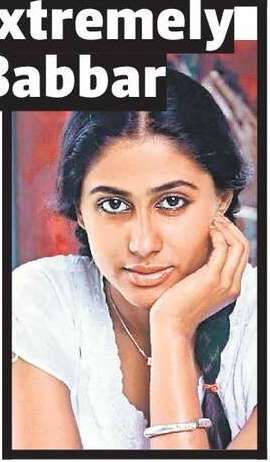
The legacy of late actor Smita Patil lives on through her films, and her son, actor Prateik Babbar, would love nothing more than to carry it on. On her birth anniversary today, Babbar, who is gun-shy about public appearances, will be seen cutting a cake amid fans of his mum as well as the paparazzi. He also plans to commemorate the day with a charity that takes in and feeds stray animals.
“I want to get their (paparazzi) blessings. She was always loved and I want to carry forward that emotion. No one can forget who Smita Patil was. Recently, on Mr (Amitabh) Bachchan’s birthday (October 11), there were screenings of his films. Aaj Rapat Jaye To (a song featuring Bachchan and Patil from Namak Halaal; 1982), got the most whistles and applause. So many people shared the videos from the theatre,” Babbar shares.
Patil died from complications during childbirth and would have been 67 today. Babbar says, “Her birth and death anniversaries are two extremely vulnerable days for me. However, I feel blessed and humbled with all the wishes that pour in. I think about her all day and I feel lost, but there’s always lots of love.”
Don to Namak Halaal: Amitabh Bachchan’s iconic films set to return to the big screen
9:56 PM

To celebrate Amitabh Bachchan’s 80th birthday, the film festival ‘Bachchan Back To The Beginning’, to be held from October 8 to 11, will include screenings of the star’s classic movies in 17 cities across the country
Niharika Lal (BOMBAY TIMES; October 3, 2022)
To celebrate Amitabh Bachchan’s 80th birthday, the Film Heritage Foundation has curated a film festival for his fans titled – Bachchan Back To The Beginning – that will bring the superstar’s iconic films back to the big screen. The four-day film festival will be held from October 8-11 in 17 cities, with 172 showcases. Moviegoers across the country can catch Big B’s classics like Don, Kaala Patthar, Kaalia, Kabhie Kabhie and Amar Akbar Anthony in theatres.
Shivendra Singh Dungarpur, Director, Film Heritage Foundation, says, “Growing up, I was the biggest Amitabh Bachchan fan. I used to break rules to watch his films in my school days. In fact, in college, I was often thrown out of class for sitting on the back benches and writing notes about his films. I am so glad that the Film Heritage Foundation is paying tribute to him on his 80th birthday with this first-of-its-kind, countrywide, four-day festival.”
A special price of Rs. 80 has been decided for each film (as a nod to his 80th b’day celebration), and those who want to watch all the films can purchase a special movie pass for Rs. 400.
IMAGINE LISTENING TO PYAAR HUMEIN KIS MOD PE LE AAYA ON THE BIG SCREEN: SRIRAM RAGHAVAN
Filmmaker Sriram Raghavan, who is a huge Bachchan fan, says, “Shivender Singh Dungarpur’s organisation has been doing wonderful work. Just imagine, you can watch Don, Kala Patthar and Satte Pe Satta on the big screen again! Imagine watching and listening to Pyaar Humein Kis Mod Pe Le Aaya all over again. I have grown up on those movies and I’ve seen most of them multiple times in school and college, sometimes even buying tickets in black.”
Moviegoers from Mumbai, Delhi, Kolkata, Bengaluru and Hyderabad, to Ahmedabad, Surat, Baroda, Raipur, Kanpur, Kolhapur, Prayagraj and Indore, will be able to watch these films.
NEVER THOUGHT THERE’D BE A DAY WHEN ALL THESE FILMS FROM MY EARLY CAREER WOULD BE BACK ON THE BIG SCREEN: BIG B
Amitabh Bachchan says, “I didn’t think that I would see a day when all these films from my early career would be back on the big screen across the country. It is a remarkable initiative by the Film Heritage Foundation to showcase not just my work, but the work of my directors, fellow actors and technicians of the time, who made these films possible. It brings back an era that is gone, but not forgotten. This is why saving India’s film heritage is so important. I hope that this is just the beginning of many festivals that will celebrate the landmark films of Indian cinema (bringing them) back on the big screen.”
The FHF is also planning to curate many more such film festivals. Shivendra says, “I want producers to understand that there is a huge demand for these films and cinema lovers who never got an opportunity to watch these iconic films in theatres would love to do so. There is a need for restoration of our old films.”
Kavita Krishnamurti and Sameer remember Bappi Lahiri
8:20 AM

As told to Soumya Vajpayee (HINDUSTAN TIMES; February 17, 2022)
It’s extremely sad that another great musician has gone. Bappi da had so much music left in him. I have great respect for him. He was like a brother to me for many years. I got the opportunity to sing a lot of songs for him like Tu Pagal Premi Awara, Lal Dupatte Wali, and my Bengali hit, Aami Kolkata Roshogulla. He was so flexible and gave us diverse songs.
He loved his work and treated all of us like his family. Whenever I went to his place, he’d offer me Bengali sweets as I loved them. His family was always affectionate. My heart goes out to them. May his soul rest in peace. These last two years have taken so many amazing musicians from us. I’m sure even the Gods are enjoying their music.
Kavita Krishnamurti, singer
---------------------
Bappi da was like family to me. I’d accompany my dad (Anjaan, late lyricist) for the sittings. Whenever he saw me, he’d remember my father. I’ve had so many associations with him over the years. In fact, he called me a month ago for a project called Pyaar Mein Thoda Twist. But I think he fell ill. I didn’t hear from him after that.
He was an intelligent and multifaceted composer. Once, director Prakash Mehra asked Bappi da to call his mother, who was a classical singer, to compose a song for Namak Halaal. She was nervous as she was not a composer. Bappi da told her he’ll give her a phrase and she can compose it like a bandish. That’s how the original tune of Pag Ghungroo Baandh was made.
He made a mark when many composers were ruling the industry. He was synonymous to disco and the genre will always be associated with him. It’s truly a huge loss to the music industry and I’ll always miss him.
Sameer Anjaan, lyricist

Bappi Lahiri passes away in Mumbai at the age of 69
8:14 AM

Avijit Ghosh (THE TIMES OF INDIA; February 17, 2022)
Music director Bappi Lahiri, who harnessed and harvested the “disco sound” to produce chartbusters in films like Disco Dancer and Namak Halaal but was equally adept in composing gentler semi-classical and folksy tunes best exemplified in the less remembered songs of Aangan Ki Kali, Apne Paraye and Aetbaar, passed away in a Mumbai hospital late Tuesday night. He was 69.
The composer-singer had been under treatment for several weeks. “He was suffering from OSA (obstructive sleep apnea) and recurrent chest infection...He succumbed to his illness at about 11:45pm,” Dr Deepak Namjoshi of Mumbai's CritiCare Asia Hospitals said in a statement.
In the 1980s, a disco track became mandatory in Hindi films after the tsunami-like success of Qurbani’s ‘Aap Jai sa Koi’ (singer: Nazia Hasan, composer: Biddu). Songs became something that you both danced and listened to. For the young and the restless, beat acquired more prominence. And the electronic synthesizer became the busiest instrument. No Bollywood composer understood, captured and expressed the new musical ecosystem like Bappi.
His dalliance with disco started with ‘Hari Om Hari’ (Pyara Dushman, inspired by Neil Sedaka/Eruption’s ‘One Way Ticket’) and ‘Rambha Ho Ho Ho’ (Armaan). Director B Subhash’s Disco Dancer became his high noon. From the title track to ‘Jimmy Jimmy’, every track in Disco Dancer was dancey and delicious. If ‘Awara Hoon’ was Hindi cinema’s major cultural export in the 1950s, ‘Jimmy Jimmy’ remains a musical ambassador even in Vladimir Putin’s Russia today. Just go to YouTube for confirmation.
----------------------------
Bappi Lahiri’s breathless foottappers and Indeevar’s nursery-rhyme lyrics (‘Char baar marenge ek baar ginenge’, Mawaali) in Southern productions defined popular film music in the 80’s. They were integral to mind-numbing entertainers whose plots could match Donald Trump’s statements for incredulousness. Jeetendra’s Himmatwala, Mawaali, Maq sad and Tohfa were all propelled by these tunes. “He was a king in Madras,” director B Subhash told this reporter some years ago.
In the 1980s, Bappi da, as many called him fondly, provided the score for an eyepopping 230 films. In 1985, he gave music to 33 movies: 30 Hindi, 2 Bengali, 1 Tamil; which means a film released every 12 days! The composer lorded over the charts even when some of the songs were copies of foreign hits and desi classics. There was an alternative side to him as well.
In Basu Chatterjee’s Apne Paraye, he surprised critics with his folksy tunes. ‘Shyam rang rangaa re’, where he employed the Bengal percussion instrument khol, has the meditative feel of a Chaitanya kirtan. ‘Gao mere mann’ carries the smell of ponds, banana leaves and 19th century Bengal.
Not many would associate him with songs such as ‘Saiyan bina ghar soona’ (Aangan Ki Kali), ‘Chaar din ki zindagi hai’ (Ek Baar Kaho) or ‘Kisi nazar ko tera’ (Aetbaar). Many of them were sung by Yesudas and Bhupendra.
Born in north Bengal’s Jalpaiguri town to musician parents, Alokesh (his original name) trained under guru Samta Prasad and was hailed as a tabla prodigy at just six. Nanha Shikari (1973) was his debut Hindi film. But the composer made a distinct impression with Chalte Chalte (1976), among his finest scores.
Amit Khanna, who wrote the lyrics, recounts how Bappi got the film. “The film director Bhisham Kohli, also Dev Anand’s nephew, was looking for a music director. He was unable to get R D Burman and Laxmikant Pyarelal. Bappi had earlier come to Navketan looking for work. And I was impressed by some of the tunes I heard. I told Bhisham, why don’t you try him? During the music session, Bappi played the ‘Chalte Chalte’ tune. I wrote the opening lines. And this led to the song,” recalled Khanna.
Slowly, he worked his way up with hummable melodies in low budget action films such as Zakhmee, Ravikant Nagaich’s Surakksha and Wardat and the Ramsay brothers’ horror yarns (Saboot). Disco Dancer elevated his career. But when Prakash Mehra, then Bollywood’s biggest director along with Manmohan Desai, signed him for ‘Namak Halaal’, Bappi entered the super league. The music in Namak Halaal and Sharaabi (both Big B films) were worth the weight of the gold chains he fondly wore.
Namak Halaal’s ‘Pagh ghungroo baandh’ was nearly 12 minutes long but the tune was riveting. ‘Raat baaki’, which he sang with Asha, is a standout. Sharaabi earned him his lone Filmfare award in 1985. He tasted success in the 1990s too: K C Bokadia’s Aaj Ka Arjun and David Dhawan’s Aankhen, to name just two. ‘Gori hai kalaiyan’ (Aaj Ka Arjun) topped the Binaca Geetmala in 1990.
In recent years, Bappi sang in Baaghi 3 and Shubh Mangal Zyada Saavdhan. Last April, he had contracted Coronavirus but recovered well.
Now, the amiable and ever-smiling composer is no more. But the best of his 80s tracks remain groovy as ever. And even today, there’s no better farewell song than ‘Chalte Chalte’.
It was pouring in Mumbai when we made Aaj Rapat Jaye Toh-Bappi Lahiri
8:09 AM

Prakash Mehra, Bappi Lahiri and Amitabh Bachchan during the making of Namak Halaal
As told to Sonam Joshi (THE TIMES OF INDIA; July 18, 2021)
When (director) Prakash Mehra ji and (lyricist) Anjaanji came to my studio, it was raining a lot in Mumbai. Mehra ji told me, “Bappi, can you make a song about this rain?” The lyrics had been composed by Anjaan ji, who was one of the best writers I have worked with. I made a mukhda for ‘Aaj Rapat Jaye Toh’, and when I played it for Prakash ji, he liked it so much that I didn’t even have to try another version.
Though I am credited with bringing disco to India, I also did many numbers inspired by classical ragas. ‘Aaj Rapat Jaye Toh’ was a totally Indian song. I used instruments such as santoor, violin, mandolin and the sitar and the first two helped evoke the mood of the rains. There are very few rain songs which go on to become evergreen hits, but ‘Aaj Rapat Jaye Toh’ went on to become one.
The song’s mazaa (fun) comes also from the singing and dancing. It was sung by Asha ji (Bhosle) and Kishore mama (Kumar) who added their own touches such as the arre, arre, arre in the beginning. Though I composed the song, I do my salaam to both Amit ji and Smita ji (Amitabh Bachchan and Smita Patil) for that outstanding rain dance.
Nowadays, there are fewer rain songs in Hindi films but I believe they will come back in fashion one day. On a personal note, I believe the rains have been lucky for me. I recorded my life’s most memorable song, ‘Chalte Chalte’, sung by Kishore Kumar in the 1976 film of the same name during the rains in July. Now, Namak Halaal is being remade but even if they remix this song, they can’t get Kishore Kumar’s one and only voice. The magic of ‘Aaj rapat’ can’t be copied.
Why Bollywood stopped romancing the rain
8:06 AM

Music maker Shantanu Moitra looks back at era-defining rain songs, and wonders if the lost art of ‘Bollywood & baarish’ can still be reclaimed
Shantanu Moitra (THE TIMES OF INDIA; July 18, 2021)

I was 16 when I first heard ‘O Sajana, Barkha Bahaar Aayi’ from the film Parakh. We didn’t have a TV at home so I had only heard it on radio until I watched the song unfurl as a visual at my neighbour’s house during Chitrahaar. I stood there transfixed that a black-and-white visual could be so colourful. Also that the rains could serve as a metaphor for a woman’s emotions. The sense of reverence, hope and childlike joy in Sadhana with her hands cupped catching rain drops — a classic Bimal Roy shot with hands resembling a womb and water drops symbolic of elixir — remains embedded in my mind as one of the most enchanting rain song moments on screen. Rain songs are usually known to be vibrant, sensuous and outward but this was an example of how subtle and inward a song about the rains could be.
The hottest woman to appear on screen for me has to be Smita Patil in ‘Aaj Rapat Jaye’ in the film Namak Halaal. An incredible song that shattered the myth of Smita Patil as the czarina of alternate cinema. The uninhibited and abashed chemistry between Amitabh Bachchan and Smita Patil — an unlikely couple to frolic in the rain — was simply joyous.
The mad kinky expressions of Kishore Kumar at his flirtatious best in ‘Ek Ladki Bheegi Bhaagi Si’ with a rain-soaked Madhubala out alone on a rainy night, remind you of all kinds of mischief that rains inspire. The rhythm of the song and the idea of having a good time without a care, sums up the beauty, wit and romance of a classic Bollywood and baarish number. Then there’s everyone’s favourite antakshari song — R for ‘Rimjhim Gire Saawan’ where you see the beautiful Mumbai landscape when the city was much emptier with two characters walking down drenched streets.
The song that changed my life was ‘Ab Ke Sawan Aise Barse’, my first ever album. I was a Delhiite at the time. The realisation of what nature and music together could do came to me on a Sunday evening at India Gate. I was out with friends when it suddenly started to pour. People stepped out of their cars to dance to ‘Ab Ke Sawan’ blaring from their car stereos. The fact that I could capture the euphoria of rain through a piece of music triggered in me a sense of responsibility to create music, not just for entertainment but to make a difference.
I heard ‘Bhaage Re Mann’ from Chameli when I had just arrived in Mumbai from Delhi. While watching the song being shot, it was almost like feeling the rain, the shivers and the earthy scent. A song brimming with hope, innocence and fresh starts. Life came full circle when the same Kareena Kapoor brought that playful energy to ‘Zoobi Doobi’, a rain song I made for 3 Idiots.
These songs are just a fraction of the kind of magic realism and fantastical moments that Indian cinema has sparked over the years thanks to the rain. The art of picturising a rain song — in all its gay abandon, innocence and sensuousness — was due to screenplay writers and directors who lived in very different times with very different associations with the rain. What romance would a young filmmaker living in Mumbai today find in the rains when you are surrounded by potholes and construction sites?
When you look out of the window, the changing urban landscape with waterlogging and traffic congestion would naturally disallow the natural thought of rain as a background for two people falling in love under an umbrella. It’s a sad tragedy of our times that I can’t recall the last time a beautiful rain song got made because psychologically everyone’s like ‘who wants to get out in the rain?’ Rampant urbanisation has robbed the cities of their rainy romance and we see its effect in music and movies too. Also, the cinematic technique has changed where filmmakers are committing less and less to songs, especially lip-syncs. Therefore a rain song on its own is a luxury and what we saw in ‘O Sajana’ with rain in the foreground is now a distant backdrop 60 years later.
How I wish that a director would use his cinematic artistry to recreate a musical Singing In The Rain moment today — with a leap here and a splash there on wet streets and puddles — and I am certain the rain song will be back. If it worked then, it will work now. There’s nothing more unifying than the feeling of breaking away, letting go and being cleansed by the rain.
— As told to Mohua Das
Mumbai’s first drive-in theatre had to fight mosquitoes & other villains
9:13 AM

Sharmila Ganesan (THE TIMES OF INDIA; October 16, 2020)
“What are people in cars watching a movie supposed to do during the monsoon—keep the wipers on?” This was among the milder insults tossed toward Mumbai’s first drive-in theatre before it was born in 1977. Not everyone in Bandra owned a car then and Bandra-Kurla Complex—the commercial counter-magnet to bursting South Bombay—was a mere newborn yet to be nicknamed BKC. Beyond the mouth of Mahim creek, a revolving restaurant had manifested atop a luxury hotel built on the rocks even as low-income housing promised for slum-dwellers on both sides of the Western Express Highway during the Emergency preoccupied the city’s conscience. The ’70s everyman viewed the eight-hectare-wide imminent cinema experience meant for privileged car owners with the scorn outsiders now reserve for cine dynasts. Today, a multiplex player is looking to invest in a drive-in theatre at BKC as a safe mass entertainment option.
But back then, “frivolous”, “decadent”, “criminal waste of land”, “project of the upper classes” were the expressions used by the press and the public to greet the 1,000-car monolith. Doomed to controversy from birth and fraught with villains ranging from mosquitoes to resentful hutment dwellers, the arc of the city’s first drive-in theatre in the marshy heart of Bombay is the stuff of OTT docu-dramas.
For one, the ‘bhumi pujan’ happened in 1970 at the hands of then revenue minister HG Vartak even before the commencement certificate was issued for the plans submitted in 1971 by the Indian Film Combine Limited (IFCL) — a company owned by two Gujarati men who ran drive-in theatres in Nairobi, Mombasa and Ahmedabad. An area behind Kalanagar had been leased that year by the collector of Bombay. As it was the first proposal of this type in Bombay and no rules were framed for it, the plan was kept pending. The rules finally came in 1973 and the plan was approved in 1975. The state offered the plot on lease to IFCL for a mere Rs 6 lakh a year.
Rumour had hyped the imminent BKC drive-in to be the first in India though that distinction belonged to Ahmedabad, which boasted a 700-car drive-in theatre. Soon after the theatre was inaugurated by then CM Vasantrao Patil, Janata Party volunteers staged demonstrations against the project whose construction work had been largely completed during the Emergency. “Whom is the drive-in supposed to cater to?” balked a TOI article. “Certainly not the rugged urchins who lived in the shanty towns all around the reclaimed land on which the theatre is coming up.”
The three-tier theatre housed a restaurant that could seat 1,000 people. It had an amphitheatre-like auditorium to seat around 2,000 patrons. Screenings were initially at 9pm daily. Bandra’s Neale Murray recalls getting “plastered with the boys” while watching Jack Lemmon and Walter Matthau movies, and octagenarian Jayant Shetty says they took chairs along to watch the 6 pm show of ‘Muqaddar Ka Sikandar’. But mosquitoes from the marshy area and the TV and video boom of the ’80s put off many visitors from paying Rs 20-odd for a movie. Then, apart from deliberate intervals to make patrons buy dosas and samosas, the sudden hail of stones pelted by rioting workers of a political party would supply unscripted drama. At times, when the canteen staff would leave at midnight, entire reels would be omitted and hordes would start their cars not knowing how ‘Namak Halaal’ ended.
Shetty guesses it was probably the damage to property caused by drunk patrons who would steal speakers that caused the theatre’s undoing. When it failed to rake in profits, the Maker Group of Enterprises, one of the city’s biggest builders known for their clout with the government, bought the place and ran it for two decades before it shut down in the early noughties without fanfare or redemption, its end an omitted reel.
A scream stopped me in my tracks. The airhostess standing at the entrance was in shock-Ranjeet
8:23 AM

Ranjeet with and without wig (right) in Namak Halaal
Roshmila Bhattacharya (MUMBAI MIRROR; May 16, 2020)

That missed opportunity haunts me as much as the white stallion on the charm bracelet had haunted Vijay in the film. That prancing animal had eventually led the brooding cop to his parents’ killer while I was only served a thanda remake of Zanjeer 40 years later. By then, the quest for the story behind a story had started, and this week I dialed yesteryear baddie, Ranjeet, who had worked with Prakash ji in several memorable films, including Haath Ki Safai, Laawaris, Muqaddar Ka Sikander and Namak Halaal.
“Do you know I wore a wig in Namak Halaal? But only in one scene,” the veteran actor revealed, pointing to the sequence where Amitabh Bachchan’s Arjun Singh comes into his office for a job interview and, in response to his “Yeh kis cheez ko le aaye ho?” launches into the now-famous monologue, “I can talk English, I can walk English, I can laugh English because English is a very phunny language.” What happened to the wig? He chuckled, “The next day, I told Prakash Mehra I didn’t care for it and would go with my own hair. He didn’t argue. Those days filmmakers were accommodating because we were otherwise committed actors. That first scene was retained and the dialogue has since gone viral.”
If you think that’s hair-raising then you have to know how the climax of Haath Ki Safai was shot. The run-of-the-mill film revolved around two brothers, Vinod Khanna and Randhir Kapoor, and the lost-and-found theme, with Simi Garewal and Hema Malini as their leading ladies. Ranjeet, who was the baddie, was as busy as these stars. Yet, they managed to finish the film smoothly, with the exception of the climax.
“While shooting a scene in the hills of Khandala, I sprinkled petrol around a car, in which the dummies of the hero and heroine sat, and pressed the lighter to set it ablaze. As the flame sparked, the petrol ignited and a ball of fire rushed at me,” he flashbacked. Though he had a lucky escape, they couldn’t complete the shoot that day or the next. Prakash ji tried to rush the shoot through at the Dadar railway yard, but the presence of stars brought along the crowds. Some of the bystanders started pelting stones and once again, they had to quit midway.
“After that, I flew to Mauritius for Sanjay Khan’s Chandi Sona. On my way to Beirut from there, I had a five-hour stopover in Mumbai. Normally, you are not allowed to leave the airport when in transit, but the producer of Haath Ki Safai (I A Nadiadwala) had got special permission to whisk me off to Panvel railway station to complete the climax,” recounted Ranjeet.
He got into the car to find director Satyen Bose sitting inside, with his cinematographer. “Dada ki korcho?” Ranjeet asked, taken by surprise, and the filmmaker informed that he wanted some close-ups for his film, Mastaan Dada, and had come prepared. “He gave me the eye-patch which was a part of my get-up and the jacket I had been wearing, along with a cigar, and as the car sped along, they clicked several shots of me mouthing my lines. By the time we reached Bandra, he was done. I dropped dada off and sped towards Panvel, a car in front and one behind to ensure that there were no hold-ups along the way,” the actor reminisced.
By the time they reached Panvel railway station, Ranjeet had changed into his costume in the car and was ready for action. He just had to make a run, get fatally shot and fall face-down. End of the story. The scene went off without a hitch and with a flight to catch, Ranjeet dashed off, still wearing the blood-splattered white suit.
He ran into the airport as the last boarding announcement came on. “The security at the gate was shocked by my appearance and asked, ‘Saab, kya hua?’ I told him I’d been shooting and hurried inside. I was the last passenger to board. As I ran up the stairs and entered the aircraft, a scream stopped me in my tracks. The airhostess standing at the entrance was in shock,” he guffawed at the memory, saying it took a while to convince everyone that the blood stains were not real. “Since my baggage had already been checked in and I was not carrying a change of clothes, I had to keep the suit on, scrubbing at the stains with a pile of tissues the air-hostess brought me. They have remained, a memory of Prakash Mehra and Haath Ki Safai.”

A still from Haath Ki Safai
Shahenshah, Satte Pe Satta remakes: Bollywood is ready for the return of Angry Young Man
8:09 AM

With Shahenshah, Satte Pe Satta, among others, B’wood ready for new wave of Bachchan remakes
Himesh Mankad (MUMBAI MIRROR; April 14, 2020)
 After Don, Agneepath, Zanjeer and Sholay, among others, 2.0 versions of several yesteryear hits featuring Amitabh Bachchan are under consideration. An industry source tells Mirror that Tinnu Anand, who directed the 1988 vigilante-drama Shahenshah, has been approached by many for the remake rights of the film. “He is yet to part with them. Another one of his directorials, Kaalia, is also a strong contender, with a lot of industry insiders keen to put a modern-day spin on the action-entertainer,” informs the source.
Meanwhile, we hear negotiations are underway for the rights of Prakash Mehra’s 1982 comic-caper, Namak Halaal, which featured the Big B, Shashi Kapoor and Smita Patil. “It’s a timeless comedy and multiple producers are in talks. If the deal is locked, one of them is looking to approach a top actor-star kid, whose forte is comedy, to step into Bachchan’s shoes,” the source shares.
Bhushan Kumar had announced a remake of Hrishikesh Mukherjee’s Dharmendra and Bachchan-starrer classic, Chupke Chupke, with Rajkummar Rao as botany professor Parimal Tripathi, who masquerades as chauffeur Pyare Mohan to hoodwink his wife’s (Sharmila Tagore) protective brother-in-law (Om Prakash). The actor, who will step into Bachchan’s shoes to play literature professor, Sukumar Sinha, is yet undecided.
Rohit Shetty is bank-rolling a Satte Pe Satta remake, with Farah Khan in the director’s chair. The 1982 original was top-lined by Bachchan in a double role—as Ravi Anand, who lives with his six brothers, and the antagonist, Babu. Farah was keen to have Hrithik Roshan step in for the Big B for the second time after Agneepath. After several rounds of discussions, the actor walked out, reportedly due to differences over the script. The director then approached Salman Khan, who was skeptical about playing a character previously essayed by the veteran actor. Buzz is, the makers are now in talks with Ajay Devgn for the part.
“It’s challenging to get such a huge ensemble in place. An official update on the film is expected once the Coronavirus pandemic subsides,” adds the source.
-------------------------
OTHER REMAKES
SHAKTI
A few years ago, a filmmaker was planning a remake with Bachchan Sr. playing DCP Ashwini Kumar, originally portrayed by Dilip Kumar, and Abhishek Bachchan stepping in to play the son, Vijay Kumar. Sanjay Gupta was to direct the film which was shelved before reaching the rewrite stage.
DO AUR DO PAANCH
In the 2010s, Vashu Bhagnani was planning to revamp the Rakesh Kumar-directed comedy, which also featured Shashi Kapoor, Hema Malini and Parveen Babi. After the success of Karan Johar’s Dostana, the producer approached John Abraham and Abhishek Bachchan but the film, to be directed by debutant Akshai Puri, never saw the light of day.
Images: Kiara Advani does a Parveen Babi and Urmila Matondkar for Indoo Ki Jawani title song
8:37 AM

MUMBAI MIRROR (March 18, 2020)
 After a song for the horror-comedy Laxmmi Bomb with Akshay Kumar in Dubai and another with rumoured beau Sidharth Malhotra for Shershaah in Lonavala in January, Kiara Advani was spotted getting groovy with Aditya Seal last week at Mumbai’s Film City studio. Enquiries revealed that the duo was shooting a fun track for director Abir Sengupta’s Indoo Ki Jawani over a two-day schedule. The shoot began early and continued till 9 pm.
The actors were dressed in representative costumes from films down the decades. While the production crew remained tight-lipped on the subject, the shikara on the lake and Kiara dressed as a Kashmiri girl brought back memories of the swinging ’60s and Shammi Kapoor crooning “Yeh Chand Sa Roshan Chehra” to Kashmir Ki Kali Sharmila Tagore.
Cut to the seductive ’80s and a sizzling-in-gold Kiara was reminiscent of Parveen Babi as the night club crooner of Namak Halaal, luring Shashi Kapoor towards his doom with the husky notes of, “Jawaani Jaaneman, Haseen Dilruba.”
Skip 10 years to the naughty ’90s, and the actress’s mini dress, cap and boots was a shout out to a red-hot Urmila Matondkar in RGV’s Rangeela, with Aditya doing a Munna in sunshine yellow pants and a black fishnet vest. “While their looks are inspired from earlier films, the song is an original,” informs a source.
The Bhushan Kumar, Nikkhil Advani, Niranjan Iyenger and Ryan Stephen production revolves around Indoo’s tryst with online dating after a break-up and how things unfold when she swipes-right on Aditya’s character.

Amitabh Bachchan requested to shoot 'I can talk English' scene the next day-Ranjeet
7:48 AM

Roshmila Bhattacharya (MUMBAI MIRROR; May 4, 2019)
“I can talk English, I can walk English, I can laugh English because English is a very funny language. Bhairon becomes Baron and Baron becomes Bhairon because their minds are very narrow…” You only have to rattle off these lines and though the film opened on April 30, 1982, cinephiles will instantly nail the iconic dialogue down to Prakash Mehra’s action-comedy Namak Halaal.
Yesteryear baddie Ranjeet flashbacks to the hilarious scene when he as Ranjit Singh, the manager of a five-star hotel, encounters Amitabh Bachchan aka Arjun Singh for the first time when he comes to him looking for a job. He is stumped by the man’s verbal diarrhoea in answer to a simple query about whether he can speak English. Those days Ranjeet saab would report for film shoots on an hourly basis and in this case, he had to really juggle his dates to accommodate the film that day. “But after one shot, Amitabh retreated into his make-up room and finally emerged to request his director to continue with the scene the next day, so he could go home and rehearse his lines,” he recounts.
Ranjeet reasons that it was a long monologue with Arjun Singh going on to launch into a rib-tickling running commentary of a cricket match between India and Australia being played in Melbourne with Vijay Merchant and Vijay Hazare at the crease. After much “consideration” the duo took a run and chatty Arjun jumped a decade to another match, The India-Pakistan test match at Mumbai’s Wankhede Stadium with Wasim Bari giving the same “consideration” to his partner at the other end, Wasim Raja. But, this time, in the chaos of considerations, the two players ran themselves out and Arjun finally ran out of breath too. “The next day, the scene went off perfectly and almost four decades later, we are still talking about it,” adds Ranjeet saab.
 The actor was a favourite of Prakash Mehra who, he informs, was at his Juhu residence every evening, at least six days a week, for story sittings, music sessions or just gupshup. “Whether I was in town or not, Prakash ji and many of my co-stars, including Amitabh, Rajesh Khanna, Vinod Khanna, Danny (Denzongpa), Bindu and Prem Chopra would be in and out of my bachelor pad which was conveniently located. That was the kind of camaraderie and comfort we shared. We were one big family and knowing that I was a strict vegetarian and my drinking was limited to a glass of vodka at parties, they would holler for doodh or lassi and some ghaasphus when I was around, along with daaru and non-vegetarian snacks for them,” he guffaws.
It’s nostalgia times for the film’s composer Bappi Lahiri (left) too as “Pag Ghungroo” is one of the golden man’s brightest jewels. The long number was the perfect fusion song, starting out with a two-minute classical sargam by Pandit Satyanarayan Mishra, followed by Bappi da’s trademark disco beats. He recalls that it was recorded over four days with a 100-piece orchestra and took his Kishore (Kumar) mama a full day to dub it, fetching him the Filmfare Award for best playback singer.
 Another experimental track was “Raat Baaki” (right), a Bappi-Asha Bhosle duet. The plan was for Mohd Rafi to redub the male portions but Prakash ji decided to retain Bappi da’s voice. The provocative, come-hither song was filmed on a ‘vampish’ Parveen Babi trying hard to lure Shashi Kapoor to his death. “There is a dialogue track by Shashi uncle (Kisey nahi marne dogi? Yeh kya ho gaya tumhe? Haan! Tumhare maathe par pasina kyun? Kiski maut ke baare mein soch rahi thi? Meri? Huh! Arey meri zindagi aur maut toh ab tumhare saath hai aur pyaar karne wale, maut se dara nahi karte.) I told Prakash ji I wanted to record it musically in the studio with musicians and live beats. Shashi uncle was a little nervous because he had never done this before, but my father Aparesh Lahiri helped him. He had released my album with Baba, Moving Away, in London and they shared a great rapport,” reminisces Bappi da who describes the late actor as the “perfect gentleman” who always had a smile playing on his lips. Prakash Mehra had first offered the role of Raja to Raj Babbar who was a struggler then, but the distributors wanted a more saleable name and that’s how Shashi Kapoor entered the picture.
The rain-drenched “Aaj Rapat Jaayen”, Smita Patil’s first commercial Bollywood song, also clings to our collective consciousness but the bigger challenge for Bappi da was “Jawani Jaaneman” an eight-track experimental song, made memorable by the magical Asha ji. The song was remixed by DJ Jatin for the album Die Hard and more recently Tanishk Bagchi recreated “Raat Baaki” for the Ittefaq remake. Quiz Bappi da on whether “Pag Ghungroo” can have a contemporary spin-off too and he quips, “Why do you need a new version when the original still makes youngsters groove at parties and discos?” Touché.
Everyday 80-90 musicians would gather to play live. Pag Ghunghroo was one of the costliest songs then-Bappi Lahiri
9:19 AM

Roshmila Bhattacharya (MUMBAI MIRROR; February 23, 2019)
To borrow a line from The Sound of Music, let’s start from the very beginning and the genesis of a singer-composer called Bappi Lahiri who would go on to give Hindi cinema a revolutionary new sound with his disco beats in the eighties. Back in 1969, he was just a 17-year-old schoolboy when he landed the Bengali film Dadu, featuring Sandhya Roy and Bikash Ray, big names in Tollygunge studios. He could not do the entire album because he was prepping for his board exams but recorded songs with Lata and Usha Mangeshkar and Manna Dey. “Lata ji had worked with my musician father earlier (Aparesh Lahiri) and she not only showered her blessings on me, but has also helped me in many ways down the decades,” recounts Bappi da.
After Dadu he did a couple of more Bengali films before the need to make music in Bollywood brought him to Mumbai and straight to Sashadhar Mukherjee, who was family. Mukherjee had produced Kangan, Bandhan and Jhoola for Bombay Talkies and Munimji, Tumsa Nahin Dekha, Paying Guest, Dil Deke Dekho and Love In Simla for his own studio, Filmistan. They were working on Ek Musafir Ek Hasina at the time and Bappi got an opportunity to play his tunes to the movie moghul, as also his sons, Shomu, Deb and Joy. Impressed, Shomu who was planning a children’s film, Nannha Shikari with Tanuja, Deb and Laxmi Chhaya, signed him to compose the music. Bappi da recorded his first song, the title track, with his Kishore mama (Kishore Kumar). Fifty years have passed since and Bappi da today is India’s Golden Man.
Coincidentally, Amitabh Bachchan who began his career with KA Abbas’ Saat Hindustani in ’69, also celebrates a golden run in showbiz this year. Bappi da recalls that the first song he composed for Big B was for GP Sippy’s 1979 film, Ahsaas, in October. “Amit ji had a guest appearance and the song was 'Rutho Na' with Calypso style music, recorded at Mehboob Studio with Lata ji,” Bappi da recalls.
The mention of Mehboob Studio also brings back an intoxicating memory of recording “Jahan Chaar Yaar Mil Jaye” with Kishore Kumar and Bachchan for Sharaabi. “That’s a milestone in my life, the other being Geraftaar which featured three superstars, Rajinikanth, Kamal Haasan and Amitabh Bachchan. It had the superhit 'Dhoop Mein Niklaa Na Karo Roop Ki Rani' sung by Kishore mama and Asha ji (Bhosle). I also sang 'Aana Jaana Laga Rahega' for the film,” he beams, reminding you that Sharaabi also had 'De De Pyaar De' which he had sung for his album Super Runa. Amit ji loved it, and Prakash ji (director Prakash Mehra), on his urging, requested me for it. Kishore mama sang it in the film.”
Kishore sang all the songs, including “Inteha Ho Gayi Intezaar Ki”, “Mujhe Naulakha Mangaade”, “Jahan Chaar Yaar Mil Jaye” and “De De Pyaar De” and was the only male playback singer nominated for the Filmfare Award that year, winning it for “Manzilein Apni Jagah”.
Kishore also took home a Filmfare Black Lady for Namak Halaal’s “Pag Ghunghroo”, another Prakash Mehra film featuring Bachchan, with music by Bappi da. “It was a 12-minute song and no one else could have sung it. We recorded it over four days at Mehboob Studio. Everyday 80-90 musicians would gather to play live. It was one of the costliest songs then,” informs Bappi, adding that Kishore’s “Aaj Rapat Jaayein” and “Thodi Si Jo Pee Li Hai” and Asha’s “Jawani Jaan-E-Man” and his “Raat Baki” were equally popular.
Bachchan and Bappi da’s last film together was KC Bokadia’s Aaj Ka Arjun in 1990 which featured the chartbusters “Gori Hai Kalaiyan” and “Chali Aana Tu Paan Ki Dukaan Pe”. Almost three decades have flitted by and Bappi da is hoping to reunite with the actor with whom he struck gold. “Since we are both in our 50th year maybe we can collaborate again, if not on an album, maybe a single. If it happens, it will be another golden memory,” he promises.

“Pag Ghunghroo” (Namak Halaal); “Jahan Chaar Yaar Mil Jaye” (Sharaabi); “Dhoop Mein Nikla Na Karo” (Geraftaar)
From ‘Disco Dancer’ to ‘Sharaabi’, Bappi-Anjaan made musical hits
8:06 AM
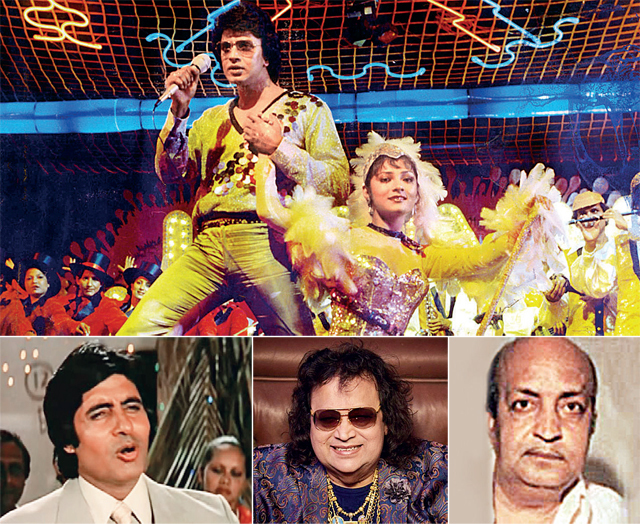
Top:
Mithun Chakraborty in Disco Dancer; (Above from left) Amitabh Bachchan
in Sharaabi; Bappi Lahiri; Anjaan collaborated on several hits
Roshmila Bhattacharya (MUMBAI MIRROR; November 2, 2018)
The name Lalji Pandey will not ring a bell even if you are a Bollywood aficionado but mention Anjaan and he’s not anjaan anymore. One of the most versatile and prolific lyricists, his words spun heart-felt melodies and foot-tapping chartbusters in equal numbers over five decades.
Among his frequent collaborators was India’s ‘Golden Man’, the irrepressible Bappi Lahiri who teamed up with Indeevar for the South potboilers, usually featuring Jeetendra and Sridevi, and scored equally big with Anjaan with Big B bonanzas like Namak Halaal and Sharaabi to name just two. “Indeevar and Anjaan ji were to me what Hasrat Jaipuri and Shailendra were to Shankar-Jaikishan. Anjaan ji and I gave innumerable kamaal ke superhits, including all the Disco Dancer songs, except for one Farukh Kaiser’s 'Koi Yahan Naache'. Hamara choli-daman ka saath tha and it was a proud moment for me to see the Tri Services band marching down Moscow’s Red Square to the beat of 'Jimmy Jimmy Jimmy Aaja Aaja, our song,” Bappida beams. This Disco Dancer track was also used in the Adam Sandler film, You Don’t Mess With The Zohan.
Bappi da goes on to inform that more recently, Dev Patel’s Oscar-nominated Lion also incorporated one of their songs from Kasam Paida Karne Wale Ki, “Come Closer”. Also, a special Hindi promotional clip of Guardians Of The Galaxy Vol. 2 had featured another popular song from the film, “Jhoom Jhoom Jhoom Baba”. The film’s leading man Chris Pratt reacted to it, exulting, “Whoa.. wow… I wonder if it’s too late to put that music in... instead of the music we’ve played... whoa... people are going to flip out!”
Prod the singer composer on the man himself and a picture emerges of Anjaan as a largehearted person with absolutely no ego, sincere and hard-working, who had a way with words. He flashbacks to Prakash Mehra’s 1984 film Sharaabi which bagged him the Filmfare Award for Best Music Director, and in particular “Manzilein Apni Jagah Hain Raaste Apni Jagah” for which Kishore Kumar, who had given playback for the song, took home a Black Lady as well. “Prakash ji gave Anjaan ji a mukhda he had scribbled telling him he could rewrite it if he wanted. Anjaan ji told him, ‘You have written such a beautiful mukhda, let me write the antaras for you now.’ He didn’t change a word of what Prakash ji had written which just goes to show his generosity of spirit,” Bappi da asserts.
He is also all praise for every antara of “Mujhe Naulakha Mangaa De”, saluting the wordsmith with, “Kya baat!” He then goes on to reveal that Amitabh Bachchan had requested Prakash ji to incorporate “De De Pyaar De” in the Sharaabi score. “Anjaan ji had written the song and I had recorded it in London with Runa Laila for the album Super Runa. In the film, they used two versions, one with Kishore mama and the other with Asha ji. Both superhit!” he avers. He adds that their song, “Gori Hain Kalaiyan” for Aaj Ka Arjun, was the No 1 song of 1991 on the countdown show Binaca Geet Mala.
Memories are mixed with melodies as Bappi da goes on to recall how Anjaan ji, when he was visiting him, had requested his singermother Bansari Lahiri for a Rabindra Sangeet. “My mummy sang 'Tomar Holo Shuru, Amar Holo Shara' and he reworked the lyrics to come up with “Chukar Mere Man Ko, Kiya Tune Kya Ishara” for Rajesh Roshan in Yaarana. Bahut pakad thi, he had a tremendous grasp over language. His son, Sameer, is a fabulous lyricist as well, with whom I have done a lot of good work, but aaj bhi main Anjaan ji ko bahut miss karta hoon. When he passed away, my heart broke and for a while I wondered how I would make music without life. Life goes on, but the musical memories remain,” he sighs, crooning “Yaad Aa Raha Hai Tera Pyaar, Kahan Hum, Kahan Tum, Hue Tum Kahan Gum…”
Ittefaq remake to have a recreated version of Namak Halaal’s 'Raat Baaki'
8:13 AM

Avinash Lohana (MUMBAI MIRROR; October 7, 2017)
Abhay Chopra’s remake of the 1969 Yash Chopra directed murder mystery, Ittefaq, was supposed to be a songless film like the original, which had featured Rajesh Khanna, Nanda and Sujit Kumar in the lead roles.
But now, Mirror has learnt that the makers have decided to revisit the popular track, “Raat Baaki Baat Baaki”, from the 1982 Amitabh Bachchan, Parveen Babi and Shashi Kapoor-starrer Namak Halaal, for this one.
However, the Tanishk Bagchi-recreated song will be used as a promotional track. “It’s a masterpiece of a song composed and sung by Bappida (Lahiri) with Asha Bhosle and has a nice, haunting feel. We thought that it was apt for the film. We plan to shoot next week with Sonakshi (Sinha), Sidharth Malhotra) and Akshaye (Khanna),” says producer Juno Chopra, adding that they have stayed true to the original.
He confirms that the song will not feature in the film. “It’s a 100-minute songless film but there is an element of mystery in this song given that Ittefaq is a taut thriller. Shah Rukh (Shah Rukh Khan, producer) and the actors, along with the rest of the team are really excited and hope to live up to the original,” he signs off.
Namak Halaal set to return to theatres on May 21, on its 35th anniversary
8:37 AM

Soumya Vajpayee Tiwari (MID-DAY; May 17, 2017)
"I can talk English, I can walk English, I can laugh English, because English is a very funny language": This iconic dialogue from Amitabh Bachchan-starrer Namak Halaal (1982) still connects with Bollywood buffs.
With the cult classic completing 35 years this month, VKAAO and Shemaroo Entertainment Ltd have joined hands to re-release it across India on May 21. The movie has been restored by Shemaroo and moviegoers can book a private screening through VKAAO. They can also book tickets at the theatre booking counters.
Kamal Gianchandani, CEO of PVR Pictures Ltd, says, “The concept of screening iconic films in theatres is popular in the West; we hope to popularise it in India.”
Directed by Prakash Mehra, the film starred Bachchan, Shashi Kapoor, Smita Patil, Parveen Babi and Waheeda Rehman. The songs — Aaj Rapat Jaayen, Pag Ghungroo, Raat Baaki and Jawani Janeman — composed by Bappi Lahiri were big hits. Lahiri says, “Its soundtrack was one of my best creations in my 47-year film career. Pag Ghungroo was the first 12 minute film song and one of the first fusion tracks.”
Housefull 3 breaks the record of Ready & Namak Halaal
7:48 AM

MUMBAI MIRROR (June 7, 2016)
 Going by the opening day
collection and the total weekend number of Housefull 3, it looks
certain that the film is racing to the top of all comedy films. We
hear that the makers, Sajid Nadiadwala and Eros International are in
celebratory mood and extremely happy with the thundering response that
the film has received amongst the audiences.
This franchise film has already made history with the weekend numbers and now with the way it is going, looks like they will surpass all records ever made in any comedy film. Exhibitors reveal that the film is consistently doing extraordinarily brilliant at the cash counter! Before Housefull 3, films like Amitabh Bachchan's Namak Halaal, released in a time when data and numbers were not recorded and Salman Khan's Ready are the two films that did extremely well. Ready, which was till now the holder of the biggest comedy film ever will be passed on to Housefull 3.
 Trade analysts predict that Housefull 3
will not only break all records and become the biggest comedy film, but
also set extremely high benchmarks for future comedy films. In
today's times, it is Housefull 3 that is raking in the moolah and
steadily inching closer to the top position in the list of super
successful comedy films.
A source close to the industry adds, “Collections are the most objective way in which one can assess the success of a film. And box-office collections prove beyond doubt that HF 3 is the biggest comedy so far. That it will surpass the first two in the franchise viz. Housefull and Housefull 2 is now a given after the huge weekend but it may also mean that it will surpass the total collections of Ready, another hit comedy. Namak Halaal is another successful comedy which comes to mind. Housefull 3 may well become the new comedy benchmark from now on.“
When I saw Kick's trailer, I felt that this is better than any other 'wood'-Amitabh Bachchan
9:03 AM

Priya Gupta (BOMBAY TIMES; July 14, 2014)
You can meet this superstar
as many times, but every time you meet him, you are left struck in awe
by his aura, his professionalism and his humility. As basic as it may
sound, but this tallest legend of India gets his high when he knows that
he has given a good shot. He is impressed by all the new talent around
him and has thoroughly enjoyed working with Anurag Kashyap and Shoojit
Sircar on his upcoming fictional show Yudh.
Excerpts from a conversation with the man you can only respect more and more with each passing day.
Excerpts from a conversation with the man you can only respect more and more with each passing day.
Sir, what does TV as a medium mean for you?
It is something that has been expanding ever since it has been introduced in India. We earlier had only one state channel, the Doordarshan. But now we have 800 channels. And I believe that there are applications for 300 more, perhaps, in one country the number of channels put together as that of the universe. That's one. The other thing is that the turnover of television is three times that of films, which apart from the commercial side reflects that there are a lot of people interested in watching television, which is also a medium that reaches you directly at home. Anything that is happening in the rest of the world today is now accessible to you at a press of a button on your television much like the internet. In time to come, everyone is saying that the mobile will be the final mode of communication but at the moment television is huge. When I did KBC, it was new to me and I was unaware of it and I did it as someone said to me, 'Do it' and I said, 'Fine'. TV is a very potent medium and has a potential to grow even bigger. The very reason that India used to be criticised for its population has today become our USP in many aspects of consumption, be it in consumer goods or entertainment.
While it will be a treat for your audience to see you on the fictional show Yudh on TV, what made you do it?
I was wanting to attempt to do something that has not been done before. And let's see if people get attracted to what we have done. If they like what we are doing, we will be very happy and perhaps do more of it. If not, then we will see where we went wrong and try again. The idea of doing Yudh was to create finite fiction. It is not something that we are inventing every day on set. The decision that the creative team took was that we would shoot from start to finish before we did the broadcast, which is something novel and new. It gives you an opportunity to be in the character and is an extended version of a film that we will be broadcasting over almost two months of time. In a film, you just have two hours to tell a story.
Talk about Anurag Kashyap?
With Anurag, I was getting a lot more time to think out, to feel and invent something that does not necessarily follow the pattern of the written word. And which is the brief that Anurag gave me. He said, 'There are dialogues and a story, but I really would not be too shocked if you were to not say those lines. I would rather you feel what you have read in the form of the dialogue and if you feel like saying something that relates to that, I will be happy with it'. That for me was unique. It's happened for some scenes in the past, but not like this. Javed sahab had said to me for the death scene of Deewar that, 'I can't write for a death scene as I don't know what a man goes through just before he is dying and what he is supposed to say'. So, he gave me a broad concept and then we just adlibbed. The cricket commentary from Namak Halaal - I can talk English, I can walk English... was all spontaneous. It was the first shot of the film. I used to shoot 2-3 shifts in those days. I was in China creek doing an action sequence, came at about 2 o'clock and went to Mohan Studios to shoot Prakashji's (Prakash Mehra) Namak Halaal. Prakashji used to start laughing if he saw something funny being enacted and that would disturb us, so, we sent him out, with him saying, 'Yaar camera on kar do' and I said, 'I will try and make up something'. And that happened. The other factor is that today everything is digital, so you don't waste film. For almost 45 years, we lived with this fear that when you say action, you have to quickly start and the moment you say cut, you have to quickly cut as you are saving film that way. That does not happen today, so, even when they say action, you can take your time to think of what you want to say. Even when you are speaking and there are time gaps, someone like an Anurag will even capture that. Earlier the fear that you have to get it in one take as you may not get that opportunity again. With Hrishida (Hrishikesh Mukherjee), we would request, 'Can we do another one? Please Hrishida'. And he would say no and say, 'Yeh second take ka paisa tum dega'.
Another thing Anurag told me was, 'Sir, never ask me where the camera is and don't perform for the camera'. This again was something that is different from a film where we are told that this is where the camera is and this is where the trolley is. Anurag would say, 'Just do as you want to do. I will place the camera where I want.' So, in a couple of rehearsals he would see me and would then place his camera. With Anurag, even if you are not seen in the camera and you are doing something, it is registering for him. Anurag is very passionate about cinema and that is without a doubt. He is very keen on doing things he believes in personally the content of which he feels the need to put out. And it comes through when I find him on set. I may be the one on whom the camera is on. But if there is somebody sitting out of focus playing around with his fingers, that interests him, he will capture that too. These are little things we observe when we are being directed. The old format was more theatrical as cinema was a replication of theatre at that point in time. So, there was this whole attitude of speaking out your lines in a theatrical manner facing the camera but that's just gone. Now it's about being yourself. It's just wonderful and has been a new and fresh experience for me that I have really enjoyed.
Your experience working with Shoojit Sircar?
I have worked with him on many occasions. He is very sure about what he wants to do. I like his approach. The good thing about Shoojit is that he himself is an actor, so he understands an actor. He will somehow play that moment for you that gives you a kind of a hint on how you should be performing it and that is very helpful. He is very well organised, but yet if you give him an alternative he would gladly accept it and is not rigid. It's a joy for me to be working and interacting with this generation.
Sir, do you find a difference between acting for film versus TV?
The material that I have been involved in, I don't find too much difference. Today, we have the liberty of time to engage in a particular scene knowing fully well that you are not wasting time or film. You are given an opportunity to feel for that moment, rather than feel precise. To give that expression without having time was very difficult. When we were told about Vyjayanthimalaji and her dance expressions and how she had given four expressions in a couple of seconds and that too in one take. That is the admiration we had for an artiste. I remember Raj Kumarji once having a conversation with me. At that time, we used to have the Mitchell camera that was a huge machine. He would say, 'Give a close up on a 75 mm lens on a Mitchell camera and then I will know your calibre'. To express with that huge machine in front of you, it was very difficult. And now you can be by yourself and the camera could be about 100 metres away, but still catch you in close up giving you the space and time to do that.
Sir, would you ever look at doing theatre?
No. I have done amateur theatre, but to do theatre now, it really is the toughest thing in the world. And I really admire those who can do film and theatre at the same time. I have worked with many artistes who do a film and then go and do a show in the evening. How they manage, I don't know. Theatre is very exciting, but most difficult. I really have to find time to do more recitations of my father's poems for which we get requests from across the world. I want to create a ballet for Madhushala.
All youngsters today look forward to receiving your flowers and letter of appreciation for their work. What makes you do that?
I am just overjoyed. And so impressed when I see this talent as I don't have it. They are there in the very first attempt and they are 110% correct. I can't find fault in it and that just amazes me and I just feel like complimenting them and telling them how good they are. We are going through a fantastic period. The kind of artistes we are getting every Friday, somebody new and different, be it a writer, a story or a film. We are going through a great phase where even a small film, which has good content with a small budget, does not need to be looked down upon and there is equal patronage for it just like the big blockbusters, which have an entertainment value. It's just wonderful.
It was so gracious of you to have tweeted for Salman Khan's Kick.
When I saw it, I felt that gosh this is better than any other 'wood'. It looks magnificent. This is the kind of material and finesse that one hopes to be associated with in your lifetime. When you see it in somebody else's film, you cannot stop appreciating it. The way it has been shot... aahhh. In our time, every film did not even have a trailer and even if it did, we never got to see it. We were never allowed inside to see the editing or the camera. You had to feed the unit if you accidentally looked into the camera. It was a penalty. You were not even allowed two miles close to an editing room. Only when the film was out, did you get to see it.
Sir, even after achieving so much, what gives you a high at 72?
You take a project, it's a commitment and once that is there, you want to give it your 100%. You feel nice when you go in front of a camera, get a good scene and you enact it. And that is not necessarily when the whole unit claps for you or the director tells you that you have done well. I think artistes know within themselves whether they have done well or not.

Subscribe to:
Posts (Atom)