Showing posts with label Mughal-E-Azam. Show all posts
Showing posts with label Mughal-E-Azam. Show all posts
My K Asif film is taking as much time as Mughal-E-Azam took to get made, says Tigmanshu Dhulia
10:12 AM

Priyanka Sharma (MID-DAY; September 12, 2026)
Director Tigmanshu Dhulia’s Ghamasaan released on September 11, while his next with Nawazuddin Siddiqui, Woh Phir Kabhi Dikha Nahi, is in the last leg of making. Even as he has been busy with these two projects, a story has remained constant in his mind — the biopic of late filmmaker K Asif of Mughal-e-Azam (1960) fame.
“Ghar bhi chalana hota hai. So, when some projects come my way, I have to halt the process of writing the film,” Dhulia told mid-day.
In his 26-year career, Asif made only five films, of which two were left incomplete. But his one creation — the Prithviraj Kapoor, Dilip Kumar, and Madhubala-starrer, Mughal-E-Azam — catapulted him to a legendary status. The epic famously took 12 years to get made. “This film is taking as much time as Mughal-e-Azam took to get made,” quipped Dhulia, who has been writing it since the project’s announcement in 2024.
He added that he has finished writing 100 scenes so far. “I have finally reached the point when the shoot of Mughal-e-Azam starts.”
Given the magnificence of Asif’s historical drama, opulence comes to mind the moment one thinks of the director. But grandeur is not what Dhulia’s biopic focuses on. Instead, he wants to zoom in on the man behind the filmmaker, whose promising career was marked by movies that remained for years in production and then cut short by his untimely death at 48.
“This film is not about opulence. It talks about Asif as a person. It’s personal in nature,” he reflected.
I myself don’t understand why I have not been getting work on OTT-Sanjay Mishra
8:32 AM
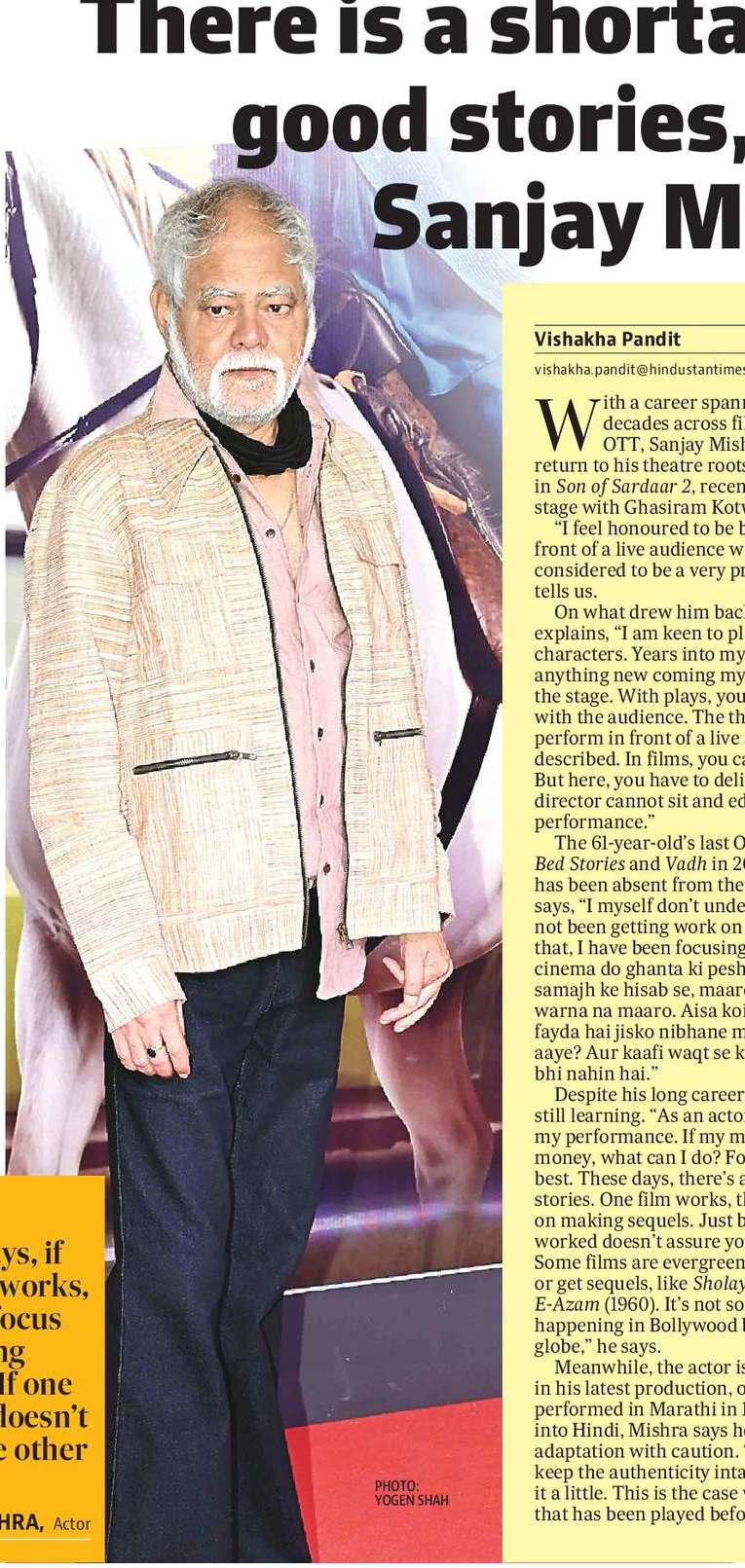
Vishakha Pandit (HINDUSTAN TIMES; August 18, 2025)
With a career spanning over three decades across films, television, and OTT, Sanjay Mishra has chosen to return to his theatre roots. The actor, last seen in Son Of Sardaar 2, recently stepped back on stage with Ghasiram Kotwal.
“I feel honoured to be back performing in front of a live audience with what is considered to be a very profound play,” he tells us.
On what drew him back to plays, Mishra explains, “I am keen to play different characters. Years into my career, I didn’t have anything new coming my way, so I turned to the stage. With plays, you instantly connect with the audience. The thrill and pressure to perform in front of a live audience can’t be described. In films, you can do multiple takes. But here, you have to deliver it to every seat. A director cannot sit and edit your performance.”
The 61-year-old’s last OTT projects were Bed Stories and Vadh in 2022. Asked why he has been absent from the streaming space, he says, “I myself don’t understand why I have not been getting work on OTT. Having said that, I have been focusing on films for a while; cinema do ghanta ki peshkash hoti hai. Meri samajh ke hisab se, maaro toh sixer hi maaro warna na maaro. Aisa koi role karne ka kya fayda hai jisko nibhane mei mazza bhi na aaye? Aur kaafi waqt se kuch interesting aaya bhi nahin hai.”
Despite his long career, Mishra insists he is still learning. “As an actor, I can only focus on my performance. If my movie does not earn money, what can I do? For me, I have tried my best. These days, there’s a shortage of good stories. One film works, the filmmakers focus on making sequels. Just because the first one worked doesn’t assure you the others will too. Some films are evergreen and can’t be remade or get sequels, like Sholay (1975) and Mughal-E-Azam (1960). It’s not something that’s just happening in Bollywood but also across the globe,” he says.
Meanwhile, the actor is immersing himself in his latest production, originally written and performed in Marathi in 1972. Now translated into Hindi, Mishra says he approached the adaptation with caution. “One has to try and keep the authenticity intact, but I try to break it a little. This is the case with any character that has been played before,” he concludes.
Mujhe OTT ke mercy pe nahi rehna hai-Sohum Shah
7:58 AM

Niharika Lal (BOMBAY TIMES; October 16, 2024)
Sohum Shah, the lead of Tumbbad and Maharani, explains why he decided to produce films. During his recent visit to Delhi, he shared, “Cinema ki ye khaas baat hai ki cinema rahega. Itni aafat aayi - piracy, satellite, OTT sab aa gaya, lekin cinema phir bhi hai. The community-watching experience of cinema cannot be replicated. I will always release my films in cinemas. After all, watching a film in a cinema is where it all started for me.” Excerpts from the conversation.
‘Meri jitni education hui hai, woh cinema se hui hai’
Talking about the impact films had on him and how they shaped his understanding of relationships and life, he says, "Mujhe nahi pata aisi film hoti hai toh aise bhai hote hain ya aise bhai hote hain toh aisi film hoti hai. Hum Aapke Hain Koun! dekh ke mujhe laga rishte aise hone chahiye. Mere bhi ek bade bhai thay, toh mujhe itna pyaar ho gaya unse. Hamari relationship itni majboot ho gayi.”
Talking about the impact films had on him and how they shaped his understanding of relationships and life, he says, "Mujhe nahi pata aisi film hoti hai toh aise bhai hote hain ya aise bhai hote hain toh aisi film hoti hai. Hum Aapke Hain Koun! dekh ke mujhe laga rishte aise hone chahiye. Mere bhi ek bade bhai thay, toh mujhe itna pyaar ho gaya unse. Hamari relationship itni majboot ho gayi.”
Sohum says that in the 90s', travelling to foreign country felt like something unimaginable to him.
He says, "Log panditji ko patri dikha ke puchhte thay videsh yatra ka yog hai kya? Dilwale Duhania Le Jayenge showed me how Europe is, those leather jackets, and that people drink beer in cans. It was a fascinating world. Meri jitni education hui hai, woh cinema se hui hai, aur Aamir Khan saheb mere guru rahe hain."
‘Mujhe OTT ke mercy pe nahi rehna hai’
Sohum says that as a producer, he will never choose to release a film on OTT when he can release it in theatres. He explains, "Mera ye hai ki mujhe OTT ke mercy pe nahi rehna hai. Main wohi filmein banaunga (the kind of films I want to be a part of) aur theatre mein lagaunga. Chalegi toh theek hai, nahi chalegi toh theek hai! Main meri property bech dunga, woh mujhe chalega, lekin mujhe OTT ke mercy pe nahi rehna hai."
What’s behind this love for releasing films in theatres?
He says, "Theatres are the seed that helped us reach this point. We watched those films and had the entire experience of watching them. When we watched films like Hum, I still remember the impact those dialogues had on us. I still remember all those lines."
Enacting a scene from Hum, where Amitabh Bachchan’s character screams Bakhtawar, Sohum asks, "Woh experience kaise laptop pe ya TV pe shift ho sakta hai? Jo shuruaat hui hai, cinema se hi shuruaat hui hai. Woh hamare conscious nahi, subconscious mind mein hai. Hamare blood mein hai!"
‘Tumbbad is my Mughal-e-Azam’
Sohum says that, according to him, Tumbbad is their Mughal-e-Azam. He explains, "Like we’ve heard so many stories about Mughal-e-Azam - that the diamonds were real and how the film was made with so much passion and love and took so long. In the same way, the bus you see in Tumbbad is an actual bus from the 1930s, the locks, the gates, the cinematography. If we missed one monsoon, we’d have to wait another year for rain. We did VFX in Sweden and background work in America. Humne bahut shiddat aur pyaar se banayi hai.”
He says that before they started shooting Tumbbad, there were already over five years of work behind it in terms of locations and sketchboards. "When I heard the script, I always had this trust that the film would reach somewhere. I had this trust because I felt the film was strong and unique."
Sohum elaborates, "Jo maine uss waqt socha tha ki filmon ka ek universe (prequels, sequels) ho sakta hai, woh ab ho raha hai."
Talking about the core of the story, he says, "We all know that greed is bad. But somewhere, we are all consumed by greed. And greed, not just in terms of money, but also jobs, cars, followers, validation- in all aspects, it's greed. If one takes a step back, they'd realize that most of us operate out of greed, and hence, the story of Tumbbad about greed becomes quite relevant."
‘Iss industry mein achha kaam karne wale log hi 8-10 hain’
He shares, "I never wanted to be a producer, I had no interest in becoming one. But the kind of films I want to act in, those films weren’t being made. Achha kaam ho nahi raha hai, iss industry mein achha kaam karne wale log hi 8-10 hain, baaki sab mediocre kaam ho raha hai. So, what do I do? When I don’t get good work, I felt like - all right, then I will make the kind of films I want to work in."
"Aamir Khan's 3 Idiots has had a huge impact on the lives of many people. I’d like to share an incident - once, I went to a doctor who told me she was in depression, but when she watched a Shah Rukh Khan film in the cinema, it helped her sail through. Cinema and stars like Shah Rukh Khan and Aamir Khan have contributed to pop culture in a huge way."
Sohum says that being both a producer and actor helps him understand each role better. He explains, "I don’t like holidays, I don’t like to travel, I don’t want to do anything but work - whether I’m acting or producing. I don’t know how to compartmentalize; balancing is a problem for me. I live in extremes. Mera sab kuch ek hai - actor-producer, sab ek hai."
Tigmanshu Dhulia to helm Mughal-E-Azam director K Asif’s biopic
8:20 AM
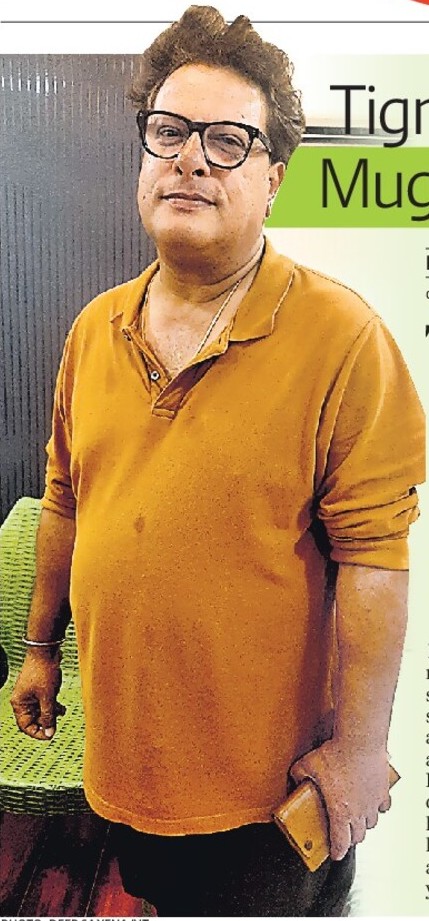
Deep Saxena (HINDUSTAN TIMES; March 23, 2023)
Tigmanshu Dhulia, who won a National Award for his film Paan Singh Tomar (2012), is excited to direct another biopic. This time, his subject of interest is producer-director K Asif, who is most noted for the 1960s classic Mughal-E-Azam.
The filmmaker shares that he has been working on the idea for the past few years, and as soon as he wraps up his film Ghamasaan, he is taking a long break to work on this project.
On his fascination with Asif, Dhulia says, “The film says a lot more than Salim and Anarkali’s love story. Then I came to know about some popular kissey (incidents) about the making of the film as well as K Asif, which intrigued me. Imagine, that man was a Class 5 or 6 dropout; tailoring was his craft, and he made just about two films in his life: Phool (1945), Mughal-E-Azam and Love and God (1986, released 15 years after he passed away in 1971).”
The filmmaker goes on, “The film is said to be a magnum opus, but from where I see it, that man was a magnum opus — his vision, flamboyance, four marriages, fallout with (late actor) Dilip Kumar (who played Salim), and so many other things. Sometimes, I feel that he was sent by God with a farman (order) to make this masterpiece.”
The 55-year-old further informs that “renowned journalist and Urdu exponent Rajkumar Keswani had written a lot about Mughal-E-Azam, its making and people associated with the film in his memoirs”. “Sadly, he (Keswani) died in Bhopal in May 2021 but Priti Sinha (Dhulia’s OTT series The Great Indian Murder producer) had taken its rights when he was alive. We (Dhulia with writers Kamlesh Pandey and Iqbal Rizvi) are working on the story,” says the filmmaker, who is also well-known for his role as Ramadhir Singh in filmmaker Anurag Kashyap’s cult movie, Gangs Of Wasseypur.
When this role first came to me, I was like, ‘No chance! Madhubala is Anarkali’-Aditi Rao Hydari
8:53 AM
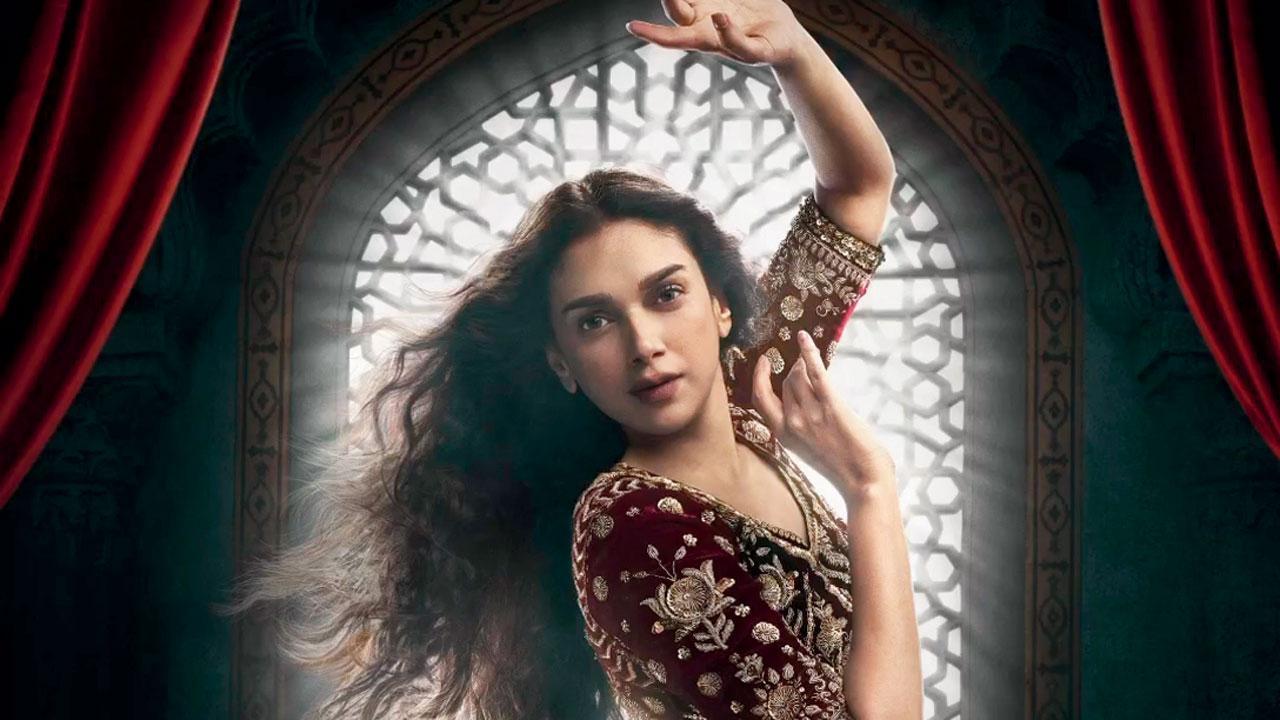
Initially fearing stepping into Madhubala’s shoes, Aditi says she gave her nod to Taj as it focused on family dynamics over Salim-Anarkali’s love story
Priyanka Sharma (MID-DAY; February 27, 2023)
So strong is the memory of the late Madhubala from Mughal-E-Azam (1960) that it’s almost impossible to think of any other actor as Anarkali. Aditi Rao Hydari thought so too when she was offered the role in Taj: Divided by Blood. The actor reveals that she initially rejected the part. “When this role first came to me, I was like, ‘No chance! Madhubala is Anarkali.’ I said ‘No, thank you’ to the makers,” she recounts.
It was only when director Ron Scalpello and his team convinced Hydari that they weren’t revisiting Mughal-e-Azam, but telling a drastically different story, that the actor changed her mind. The upcoming ZEE5 series — also starring Naseeruddin Shah, Rahul Bose, Sandhya Mridul and Aashim Gulati — traces how Mughal emperor Akbar’s sons turned against each other in their bid to succeed to the throne.
Courtesan Anarkali became a disruptor as she fell in love with one of Akbar’s sons, Salim. “Ron and [his team underlined] that they were not remaking the love story. In many ways, they were making a family drama. Also, the way they saw Anarkali was different,” says Hydari, noting that Taj paints a more intimate portrait of the courtesan.
“She doesn’t know she is going to be iconic many centuries later. At the time, she was just a woman held captive, wanting freedom. She fell in love with the prince, and that was her biggest boon as well as her biggest downfall. We look at her as a tragic heroine, but Anarkali was a fearless and spirited woman who stood by her love despite the punishment.”
Hydari’s filmography is dotted with period dramas. While she previously featured in Sanjay Leela Bhansali’s Padmaavat (2018), she will soon be seen in his web series, Heeramandi, and Vikramaditya Motwane’s Jubilee that is set in ’60s Bollywood. What is it about her that makes filmmakers associate her with period offerings? “I don’t know,” she smiles.
“I do love epic romances and period [settings]. I feel happy that filmmakers see me [in that light], and people accept me in these roles. There are certain directors I have longed to work with, whether it’s Mani [Ratnam] sir, or Sanjay sir, or most recently Vikram sir. When such dreams come true, I count them as blessings.”
Worldwide gross: The Chinese and Russian factor
8:42 AM

Box Office India Trade Network
PATHAAN emerged the highest grossing Hindi film in original format last week but there was a little debate within the industry as DANGAL had grossed more if you include the Far East and BAJRANGI BHAIJAAN is also ahead that way. But these numbers are all formats and basically when you do this, it just changes the history of Hindi cinema the way everyone knows it.
The overseas markets had this Russian factor for around forty years and the last decade saw the Chinese factor and both are very similar in almost everything. The difference being that Russia had far more Hindi films released though business could be extreme from crazy levels to practically nothing. Both markets generally have Hindi films on an outright basis as makers see it as extra money and give the film and then the distributor be it Russian or Chinese releases the film on his account. The cost gets higher if the film breaks out but so do the profits.
In Russia, the films was dubbed or subtitled and even cut to suit the needs of the market and it was a different case for different areas. If the film was dubbed, the songs were still left in original Hindi language and this was for all films though a song here there would be cut. It has been the same case in China though here reports are that songs are edited/cut especially if they don't take story forward.
The Russian story was a few prints released which meant very limited revenue but a film could break out into hundreds of prints with huge grosses (though not as high as these $50m, $75m, $100m numbers that go around). Its the same with China, there may be less releases but its about a break out. A difference with Russia is that in Russia, most major Hindi films managed a release
China, meanwhile, is still picky and distributors only pick films which they feel have a chance. PATHAAN will not be one them as it shows the INDIAN as a HERO and the Chinese will not take to that. The Russians were kinder that way as SEETA AUR GEETA, JUGNU, BAROOD and DISCO DANCER were huge but many historic blockbuster films like MOTHER INDIA, MUGHAL-E-AZAM, GANGA JUMNA, MERA GAON MERA DESH, MUQADDAR KA SIKANDAR and KRANTI were debacles there. Even the biggest of them all, SHOLAY, had only decent footfalls in Russia.
Simply put, PATHAAN has moved the benchmarks in Overseas to a different level but if you go by the Far East story then it has not as other films have already grossed more with their various formats. Just like HUM AAPKE HAIN KOUN and DILWALE DULHANIA LE JAYENGE opened up the overseas market in the 90's but if you go by the Russian factor then then many movies had already done higher business decades back.
The films that were released in Russia and then lately Far East are not the same films which were released in India that is why PATHAAN is the biggest Hindi worldwide grosser in its original format. Then taking all formats it can be said that DANGAL is bigger than PATHAAN worldwide, SECRET SUPERSTAR is bigger than SANJU, DISCO DANCER is bigger than KABHI KHUSHI KABHIE GHAM and MAMTA is bigger than MUGHAL-E-AZAM.
The original format of the film is most important and you cant mix up with other versions and then compare. Its like having a bag of Apples on one side and a bag of Apples and Oranges on the other but saying its the same thing. There will be people out there who do but then there are a lot of people who are a bit empty upstairs also.
When BAAHUBALI 2: THE CONCLUSION released and it was put above DANGAL on the site it was asked why it went above DANGAL as Hollywood does not do this but that is because there eventually for the top films, its a level playing field as most will will go to all the major markets. On a lighter note they also know that a edited/subtitled /dubbed LOLITA (1997) is not going to topple their greats be it GONE WITH THE WIND, TITANIC, AVATAR or ET. This is not to say the historic Hindi grossers in Russia and China are LOLITA's (This film is one of the biggest box office disasters in Hollywood if not the biggest).
Now, ENGLISH VINGLISH will release in China and it will do some business as otherwise the local distributor would not have taken it. But if it somehow, it goes on to do $100 million or more, it will NOT become bigger than PATHAAN as in original format you just cant compare the films.
We will see one of the most elusive original release versions of the Awara poster-Neville Tuli
8:18 AM
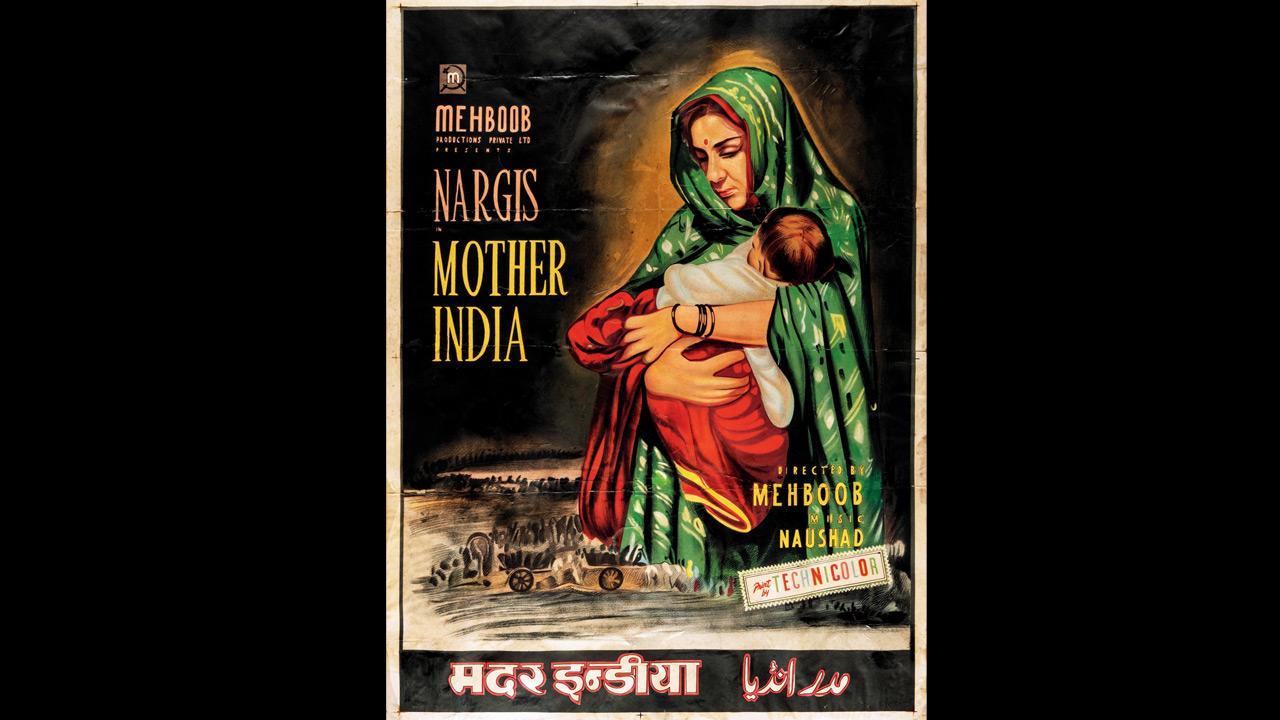
One of the last few countries to keep the film poster art alive is reason enough, says the team behind an upcoming auction, to see original cinema memorabilia as investment
Heena Khandelwal (MID-DAY; April 3, 2022)
After their inaugural auction featuring paintings by leading modern artists F N Souza, M F Husain and V S Gaitonde, among others, online auction house deRivaz & Ives has returned with a focus on cinema. The first auction, scheduled for April 8 and 9, will see over 100 first-release original posters of films like Mother India (1957), Mughal-E-Azam (1960) and Yaarana (1981).
Neville Tuli, founder of Osian’s, chief mentor at deRivas & Ives, says that many of the original posters, like that of Tarana (1951) by S M Pandit—a painter from Karnataka who designed film publicity material for Raj Kapoor and others—are still not available on the Internet. “We still have minimal interest in preserving cinematic heritage. Posters, especially the hand-painted ones, represent a fragility. It is a dead art, which has come back to India in a way; we are one of the last few countries to keep it alive.”
The auction will specifically highlight designers and artists who are not well-known for their work as poster artists, including legendary filmmaker Satyajit Ray. Works of poster designers like D R Bhosale (Main Nashe Mein Hoon, 1959), Pamart Studios (Haqeeqat, 1964 and Khamoshi, 1969), Diwakar Karkare (Sholay, 1975 and Jaane Bhi Do Yaaro, 1973) and C Mohan (Khatta Meetha, 1978) will be up for the sale. “We will see one of the most elusive original release versions of the Awara poster; the imagery seen until now has been of re-release posters,” shares Tuli, adding that there will also be a focus on the first family of Indian cinema, the Kapoors. “Their cinematic journey will be highlighted through their poster art. Three unique versions of Shashi Kapoor’s Juari [1968] will be seen for the first time.”
The aim, he shares, is to establish new world record prices for Indian film memorabilia and get the film fraternity more involved in cinema-related art. While actors like Shah Rukh Khan, Aamir Khan, Anupam Kher and Dia Mirza bid and won art pieces during the Osian’s 2002 auction, the hope is now to widen this group by reaching out to the younger generation of talent. Tuli says, “Once the film fraternity comes on board, the rest of the public will follow.”
WHEN: April 8-9
WHERE: derivaz-ives.com
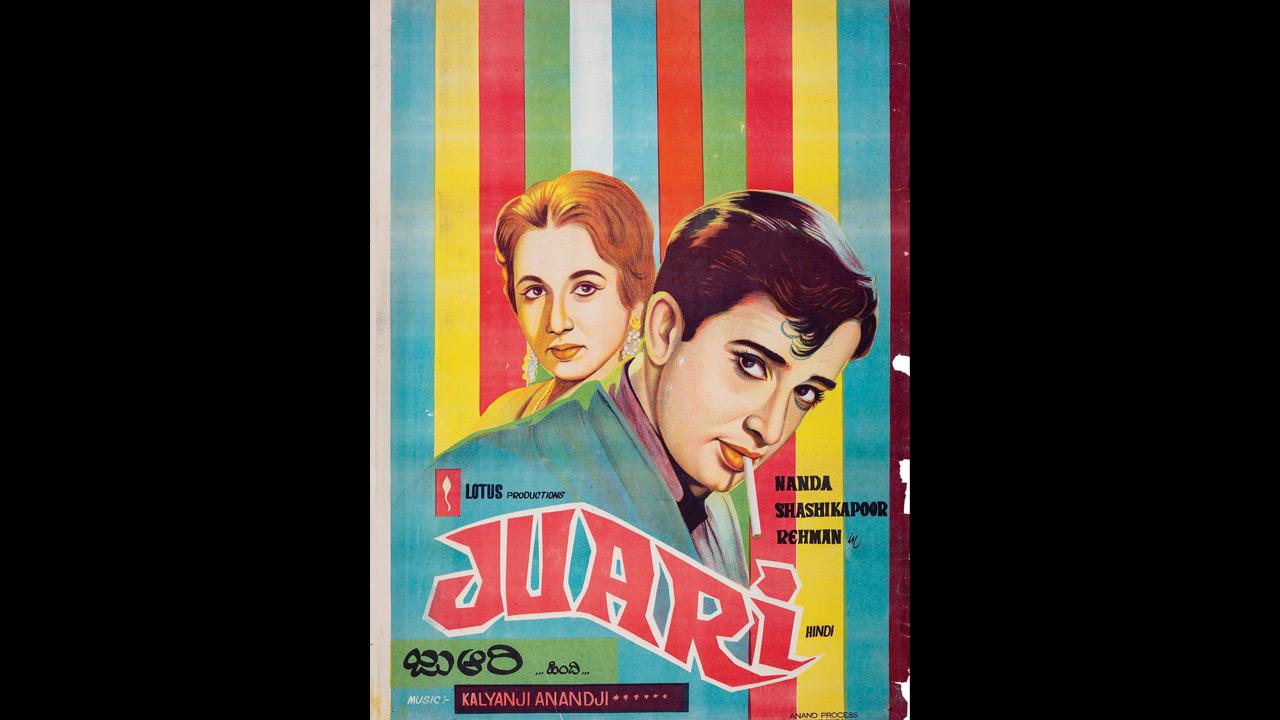
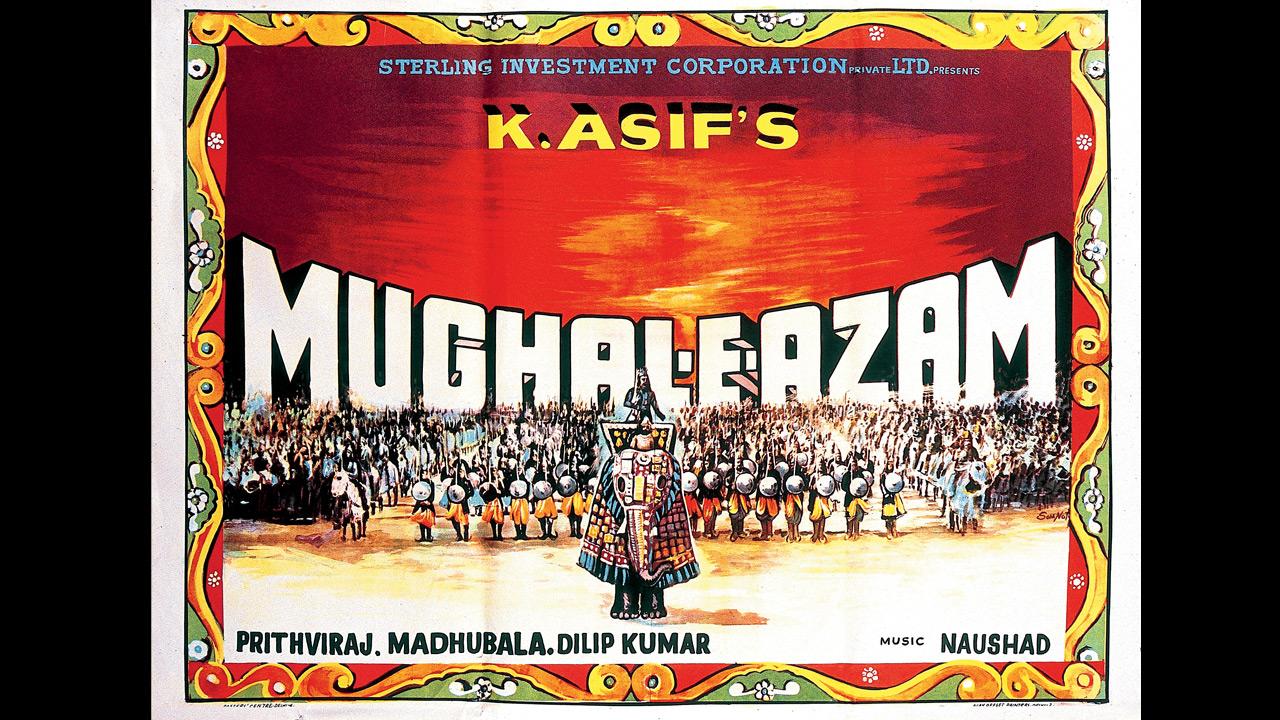
Reliving Bollywood's poster era
8:25 AM

Rachana Dubey (BOMBAY TIMES; April 2, 2022)
From adorning the walls of cinema halls, film posters have over the decades begun to occupy a place of pride in the homes, offices and private spaces of cinema patrons. While buying poster art of the bygone era is not entirely new, the trend has caught on in a big way, owing to availability and exposure the new generation has to the cinema of yore through digital platforms. While the new age, digitised film posters with airbrushed images ofstars are slick and stylishly designed, the hand-painted posters of the past, with dramatic brush strokes and vibrant colours screaming out loud from the walls they were plastered on, are sorely missed. Now with movies making their way back into cinema halls, BT takes a closer look at the art of film posters and how it continues to be an important part in the journey of a film.
‘POSTERS ARE THE PHOTOGRAPHIC SYNOPSIS OF A FILM THAT ATTRACTS THE AUDIENCE EVEN IN THESE TIMES’
Manoj Desai, one of the oldest names in the film exhibition business, who has spent 50 years running Maratha Mandir and the G7 Single Screens says, “I had never seen a phase like the last two years in my 50-year career when we practically didn’t have posters adorning the outer walls of the theatres. My theatre had opened with Hema Malini’s Seeta Aur Geeta and it bounced back to life with Sanjay Leela Bhansali’s Gangubai Kathiawadi. In these five decades, what hasn’t changed is the audience’s love for a great film — something that its poster promises them in one visual. Akshay Kumar, Shah Rukh Khan, Salman Khan or Ajay Devgn, standing with a gun in one hand and his heroine on the side, signifies an action-packed love story even today. It’s the photographic synopsis of a film that attracts the audience even in these times.”
OVER THE YEARS, POSTER ART HAS FOUND A PLACE OF PRIDE IN SEVERAL HOMES
Back in the day, film posters were not designed digitally. Right up to the 1990s, the posters were hand-painted and artistically designed by a rare breed of technicians. M F Husain, in his early years had also designed several movie posters. While current film posters can be accessed at the click of a button, the posters of yesteryear’s cinema have achieved the status of vintage art, especially the hand-painted ones. There are special collectors and restoration teams to keep them in good condition.
In the last two decades, posters of old films with kitschy artwork, loud colours and over-the-top drama have found a place of pride in the homes of thousands of people around the world, including Shah Rukh Khan who reportedly got an original Mughal-E-Azam poster through an online auction, which was later signed by Dilip Kumar. It rests, beautifully framed at his residence, Mannat.
‘ARTISTES CAPTURED RAW EMOTIONS THROUGH THEIR HAND-PAINTED POSTERS’
Hinesh Jethwani of Indian Hippy has been working hard since 2009 to ensure that vintage posters of films are restored, shares, “With the overall art market taking a hit, even the poster market saw a slight slump in sales. However, with most of the businesses moving online, we gradually started experiencing a surge in demand for posters, not just from Indian buyers but also from abroad. This was during the first lockdown. What is sad in all of this is that the generation of painters who created these pieces of art are passing away, without anyone taking the baton from them. Studying this art form takes four to five years — these painters were self-taught, and they used rudimentary techniques which are not taught in art schools. These painters captured the raw emotions of the films from their stills and created these visual treats which have become part of memorabilia today. Today, in the name of a poster what you see is an airbrushed image of a star. The rawness is missing. 100 years down the line, people may not have any reference to the art of creating these hand-painted posters, unless someone steps up and takes the baton forward.”
‘EARLIER,A POSTER WAS THE ONLY MEDIUM TO INTRODUCE A FILM TO THE AUDIENCE’
Filmmaker Ramesh Sippy, whose posters of Seeta Aur Geeta and Sholay are among those that are perpetually in demand, believes that with evolving time and changing technology, poster art will survive, albeit in a different form.
He reasons, “Posters played an important role in the journey of a film and they still do. The digital era cannot be ignored. Those days, there was a poster between a film and its audience, but today there’s a lot more in between. Back in the day, it was so important to sit with the painters and create a visual communication using the characters of the film. Like Sholay’s poster evolved from the time it was in the offing to the time it became a hit. Posters were the promise of a story that a film bore for its audience. They were hand-made then; they’re technologically made now. Styles of pursuing an art can always change but posters continue to be art.”
‘POSTERS OF C-GRADE FILMS ARE IN DEMAND BECAUSE THEY LOOK FUNKY AND QUIRKY’
Mumbai’s Chor Bazaar, even in its redevelopment phase, continues to harbour shops that sell vintage posters. Business may not have been as good as it was once upon a time, but the motivation to keep the shops running is admirable and visible in the way the stores have kept the posters in great shape.
Haji Abu, who possesses over three million Hindi and English vintage film posters, arguably one of the largest collections in the country, has a shop inside Mumbai’s Chor Bazaar, which dates back decades. He says, “Films have been made for more than a hundred years now. A poster is always made with each film. The stars of that era actually command a high market value in the poster business. Posters are also sold for the artistic value they carry. Posters of C-grade films are sold for high prices because they look funky and quirky. ”
‘DIGITAL POSTERS HAVE MADE THIS ART MORE ACCESSIBLE’
Rahul Nanda, who is a campaign designer for some of Bollywood’s biggest films, says that creating posters through digital technology has taken over the hand-painted posters of the bygone era. The impact a poster creates for film promotion is just the same even today. He adds, “A poster is the first piece about a film that people react to. Poster art has evolved with the evolution of content. If a movie is brave, the poster will reflect that. Unlike the past decades, a lot of the poster work is digital and downloadable today, which makes this art more accessible to film patrons.”
POSTER TALES
- C Mohan, Diwaker, Vishnu, S M Pandit, Pandit Ram Kumar Sharma, D R Bhosle and Shrikant Dhongade were among the top-billed artists of that era for poster art. MF Husain painted posters for Novelty cinema before he became a renowned painter.
- In the early 1990s, hand-painted posters were replaced by vinyl, computer-generated designs. Darr and Prahaar are said to be the last of the hand-painted posters.
ARTISTES WHOSE FILM POSTERS SELL THE MOST
- Amitabh Bachchan
- Dev Anand
- Raj Kapoor
- Dilip Kumar
For The Empire, I was inspired by Cate Blanchet’s character in Shekhar Kapur’s Elizabeth-Shabana Azmi
8:33 AM
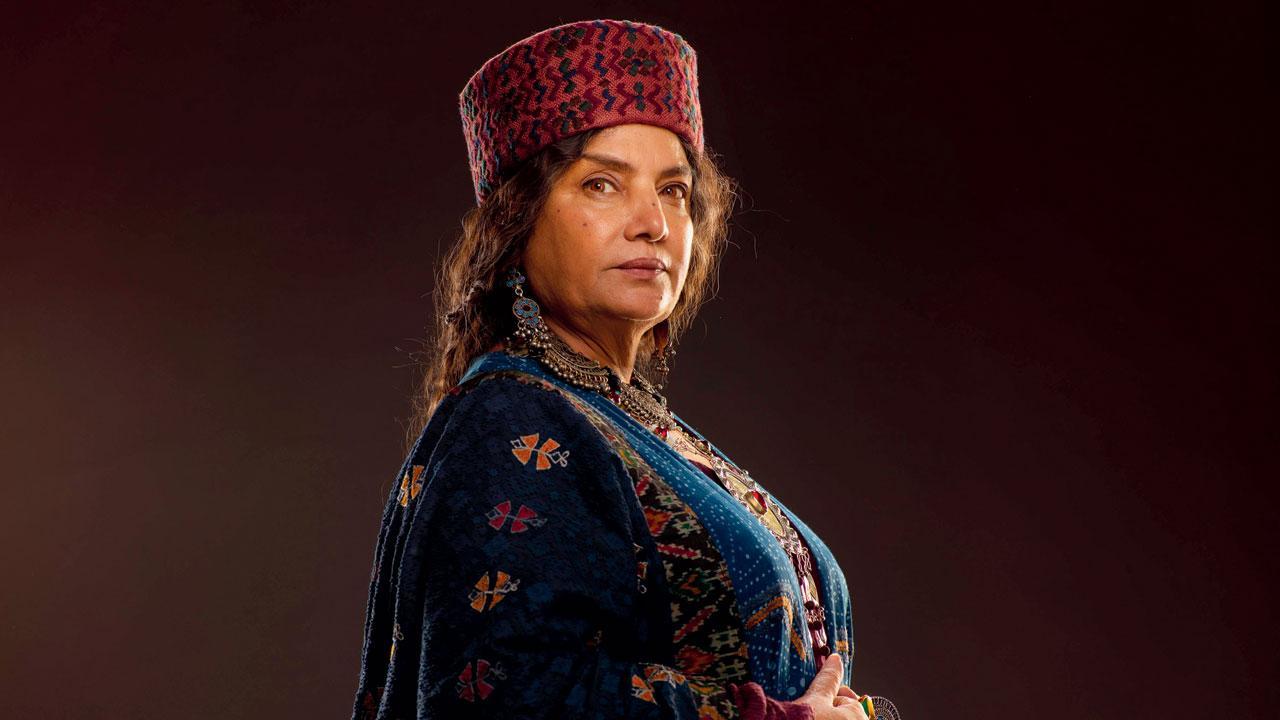
Mid-day and Radio City Hitlist OTT Awards nominee Azmi says techniques learnt to convey illusion of reality helped her in the VFX heavy series, The Empire
Upala KBR (MID-DAY; March 13, 2022)
Nominated at the mid-day and Radio City Hitlist OTT Awards in the Best Supporting Actor (Female): Series category, The Empire actor Shabana Azmi says a fair share of imagination went into filming for the show, which involved VFX. “At FTII (Film and Television Institute of India), we learned that observation, concentration, and imagination are an actor’s tools. Among the earliest exercises given was, looking into an imaginary well and drawing water from it, and conveying the illusion of reality. It takes a lot of skill to prevent it from looking fake,” says Azmi.
As Esan Daulat Begum, the grandmother of the historical character Babur, Azmi says she bagged the chance to play the kind of authoritative figure that is usually reserved for men. “She is the kingmaker and the master strategist—a role that is largely reserved for men. I was intrigued that Nikkhil [Advani, showrunner] chose a woman filmmaker [Mitakshara Kumar] to make her debut on such a huge canvas, but she stood up to his belief and more. I enjoyed working with Mitakshara. She is meticulous and has a strong sense of aesthetics.”
Despite being a master of her craft, Azmi says that it was not a cakewalk to exude the regal persona of her character. “We have a template of Mughal-E-Azam. [Almost] everyone who acts in a historical base their performance on the 1960 film. I tried to break that by adding a public and private persona to Esan. I was inspired by Cate Blanchet’s [character] in Shekhar Kapur’s Elizabeth,” explains the actor.
Cast your vote for the Hitlist OTT Awards
Shabana Azmi has been nominated in the Best Supporting Actor (Female): Series category for The Empire.
The other nominees are:
- Amruta Subhash (Bombay Begums)
- Ashlesha Thakur (The Family Man S02)
- Ira Dubey (Potluck)
- Kani Kusruti (OK Computer)
- Konkona Sen Sharma (Mumbai Diaries 26/11)
- Geetanjali Kulkarni (Gullak S02)
- Supriya Pathak (Tabbar)
Log on to www.radiocity.in/hitlistawards to cast your vote.
You can also vote via SMS. Send HITLIST <space> category name <space> your choice (a/b/c as on the website) to 57575.
Voting lines close on March 18.
I don’t understand where this thought comes from ki hero wali picture zyada chalti hai. It is not true-Sanjay Leela Bhansali
8:32 AM
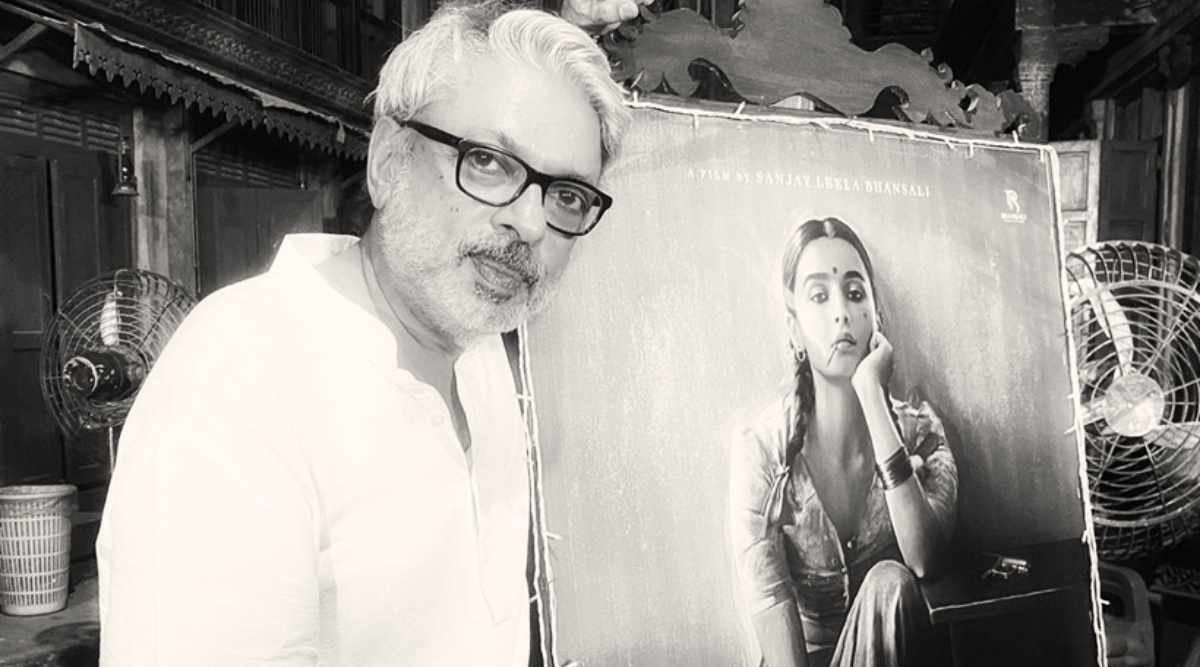
On Women's Day, Sanjay Leela Bhansali slams the perception that it is safer for a filmmaker to invest in a ‘hero-led story’ since the audience prefers that
Anshul Chaturvedi (BOMBAY TIMES; March 8, 2022)
Sanjay Leela Bhansali, whose last two mega projects have been focused on two very different female characters around whom the stories revolved – Rani Padmavati of Chittor and Gangubai Kathiwadi of Kamathipura – is dismissive of the sentiment that has prevailed in Bollywood over the past couple of decades that sees ‘women-oriented films’ succeeding at the Box Office as an exception, while the default setting is that you need a ‘hero’ to get the crowds in.
“Who says that the nation doesn't want to see a women-oriented story or a heroine-oriented story? Who says that they are not going to see it?” fumes the filmmaker, who is fascinated by the work of the veterans of yesteryear and how they weaved together enduring stories centred around women characters.
“There are so many shades of a woman, and this needs to be told on celluloid. I mean, just look at it from decades back Bimal Roy did it and worked on it in Sujata and Bandini. Raj Kapoor did Ram Teri Ganga Maili, Bobby. There were filmmakers who did such wonderful work. V Shantaram ji did such wonderful films on women such as Stree. Mehboob Khan did Mother India. Now why have these -women led films – become a lesser category, I don’t understand.”
He pauses and then reflects on a consistent theme in his filmography – layers and undercurrents. “There are so many layers if I have to tell a woman's story. Shyam Benegal did a lot of women-centred stories like Bhumika. They are the most beautiful characters to tell the story about. There are so many shades. Endless shades! Most celebrated directors have made films on women – from Mother India to Pakeezah to Mughal-e-Azam. Mughal-e-Azam was Anarkali’s story. Even if I make Devdas, it is the story of Chandramukhi and Paro primarily. Or you talk about Sujata and Bandini, they are all women-oriented films. The cinema of Yash Chopra they were all strong women-oriented films. Satyajit Ray made Charulata. Ritwik Ghatak’s cinema. If you look at all those films, they were all beautiful stories of women. This nation has celebrated those filmmakers. This nation has celebrated those films as the biggest hits of the country. As the most landmark films of this country.”
Prod him on why, then, has the belief that it takes a male lead to pull off a commercial hit prevailed in the industry for a while, and he rips into it. “You keep hearing that it is all a hero industry, hero industry I don't know who spread it. Where is this concept of a hero-oriented industry ki hero ki picture chalegi, wahin paisa daalo, heroine ki picture pe mat daalo where has this come from? I don’t understand where does this thought come from that in our industry, hero wali picture zyada chalti hai. It is not true! We are blaming the audience wrongly. A handful of people have just unnecessarily muddled the mind, and constantly keep imposing it on people, on the industry over the years. Especially the 80s onwards. I haven't understood where this comes from. And I hope to do my bit to change it. Padmaavat did great business, despite all the controversy. If Gangubai does well, as it is doing at the moment, more and more, then it will bring in a lot of those wonderful filmmakers who may today feel a little stifled about saying for a film that is centred around a female character kaise banayenge?”
Dilip Kumar’s biographers jog their memory to tell personal tales of the superstar
8:13 AM
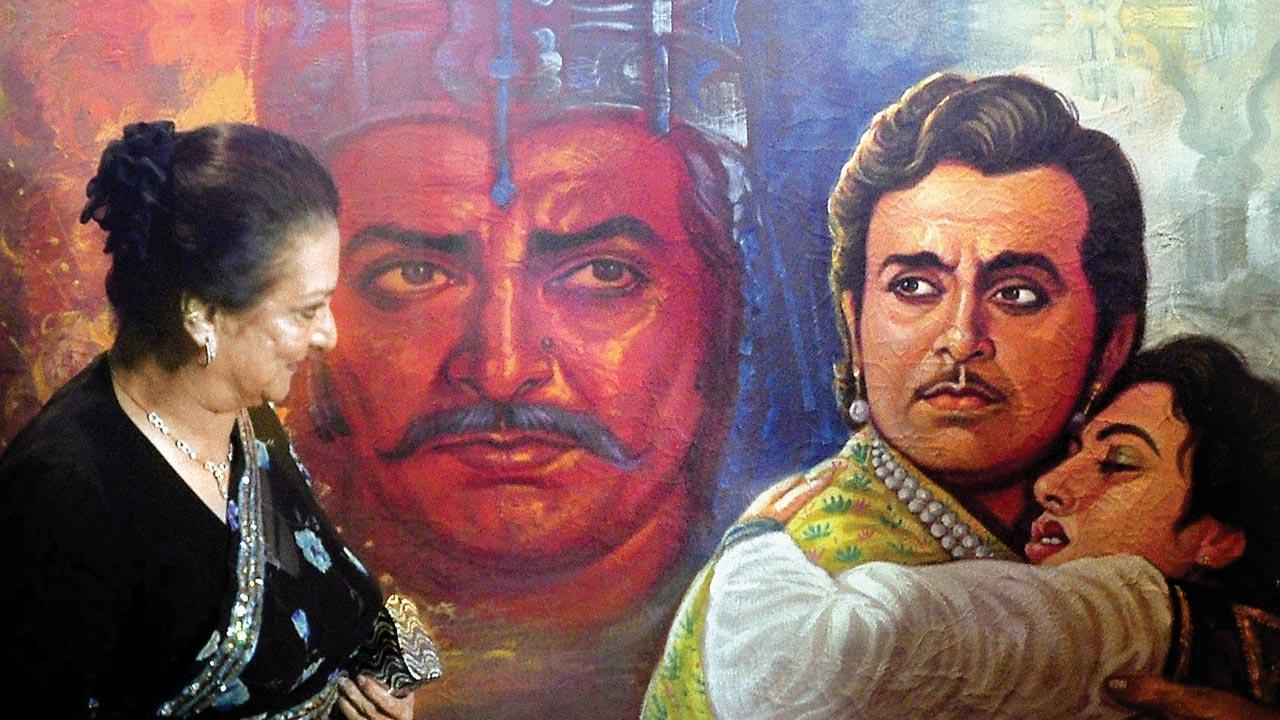
Saira Banu at the inauguration of a collection of cinema artwork of her husband and veteran actor, Dilip Kumar, in Mumbai, in 2015. Pic/Getty Images
Dilip Kumar’s biographers jog their memory to tell personal tales of a man in love with Mr Heathcliffe’s grey persona
Anju Maskeri (MID-DAY; July 11, 2021)

Dr Trinetra Bajpai with wife Kanika, and daughter Anshula, co-author of Dilip Kumar: Peerless Icon Inspiring Generations at the actor’s residence. The two families were close and would end up visiting each other often
‘He wanted Lata ji to sing Jaane Wale Se Mulaqat’
Dr Trinetra Bajpai, author and managing director, ATEC
Co-author, Dilip Kumar: Peerless Icon Inspiring Generations
I fell prey to the hypnotic spell cast by Dilip Kumar way back in 1958 at an [admittedly] impressionable age of nine, while watching Bimal Roy’s timeless classic Madhumati. Ever since, I have with avid interest watched all but two films. Jwar Bhata and Pratima being the only exceptions for reasons of unavailability of his 59 released films, with my wife Kanika, who shares this unabashed admiration in ample measure, as does our daughter Anshula, co-author of our coffee table book, Dilip Kumar: Peerless Icon Inspiring Generations.
One of my most cherished moments was watching him deliver an outstanding speech at Lata Mangeshkar’s live concert at the Royal Albert Hall in London. He spoke with such fluency and command in a mix of Hindi and Urdu that he received a standing ovation. During the interval, I was fortunate to have got a chance to share a drink with him; I remember it was a very rare Scotch. Lata ji was also present, but she doesn’t drink. We talked about her music and he insisted that she sing Jaane Wale Se Mulaqat Na Hone from his 1954 movie Amar with Madhubala. He had some personal memories associated with the song. He winked at me. But she smiled and said, “I’ve not prepared for this [song] and the orchestra too, doesn’t have the notes.”
I would meet Yusuf Sahab quite often. He lived at Pali Hill, and I at Turner Road. He was a huge foodie and would often come over for biryani. I remember, while shooting for Sangharsh at Mehboob Studio, he was not feeling well and said, “I’ll be fine if I eat some fried fish.” And he actually did.
The Bajpai clan has no hesitation in admitting without any qualification that we owe a lot to Yusuf Sahab in shaping our personalities. Dilipian films and his personal activities have deeply influenced countless professionals. In my corporate career of 49 years in the petrochemical industry, I have seen champion professionals imitate Dilipian mannerisms and vocal intonations to their fullest advantage, with telling effect in crucial negotiations and even board meetings. Histrionics apart, he had incredible mastery over the fine arts, linguistics, music [he could sing mellifluously] and above all was a caring human being.
‘He loved grey characters’
Sanjit Narwekar, film historian and documentary filmmaker
Author: Dilip Kumar: The Last Emperor
While re-watching old Dilip Kumar starrers as part of my research for the book Dilip Kumar: The Last Emperor, I realised the late actor’s fascination for negative roles. Dilip Kumar was a connoisseur of literature and, unlike many actors of his era, he was well read. I do not know if Emily Bronte’s 1847 novel Wuthering Heights was his favourite, but he did reprise the character of Mr Heathcliffe in at least three direct remakes (Aarzoo in 1950, Hulchul in 1951 and Dil Diya Dard Liya in 1966) and has used shades of that character in what is his most accomplished performance, Aadmi (1968). Heathcliffe is a man on the edge: spiteful, mad, insecure and thirsting for revenge and, in film after film, Dilip Kumar played it to perfection. In fact, he always preferred to play the hero with a touch of negativism—the anti-hero, if you wish. He was not the first to play such a role—Ashok Kumar had done it in Kismat in 1943—but Dilip Kumar played it with great passion and brought an unparalleled intensity to it.
Recall his work in Babul, Deedar, Sangdil, Shikast, Devdas and the most notable of them all, Amar. In each film, his character toys with a female protagonist, leading her along, making her feel as if he cares when he does not. He himself is tortured by this duplicity, but seems helpless to prevent the inevitable tragedy that lies ahead. And this penchant for negativism is carried forward in his character roles in most of his later films like Vidhaata (1982), Mazdoor (1983), Mashaal (1984), Duniya (1984). This theme of crossing over has its roots in the Marathi play Ashrunchi Jhali Phoolay, written by Madhusudhan Kalelkar and originally played by Ashok Kumar in its Hindi film remake Aansoo Ban Gaye Phool. Having played the wronged man in most of his earlier films, this addendum of crossing over to the other side must have appealed to the actor in him: to play both the hero and villain in the same film must have delighted his histrionic side.
‘She (Saira) is my favourite director’
Lord Meghnad Desai, British economist and former Labour politician
Author: Nehru’s Hero: Dilip Kumar in India’s Life
Dilip Kumar liked to eat samosas, but he knew that Saira ji did not approve of him eating food which she did not know about. So, at the end of the launch [of my book], we escaped to a corner in the hotel, where the function was held and helped ourselves to samosas and drinks. Our friendship grew from then on. In 2005, I invited him to come to London so I could interview him at the National Film Theatre, which is located on the Thames river across from the Big Ben. We had a packed auditorium. At one stage, I asked him who was his favourite director. So he pointed to Saira ji sitting in the front row and said, “That is my favourite director.” So then I invited Saira ji to join us on stage and carried on the conversation with them.
Whenever Kishwar, my wife and I went to see them at Pali Hill, Saira ji was very welcoming. Dilip Saheb would talk about many things and in many languages — Gujarati, Marathi and Urdu/Hindustani. He had such a lovely voice that Kishwar used to say Meghnad’s brain stops working as soon as Dilip Saheb opens his mouth.
Once, when we visited him, he did not immediately recognize us. He was very polite, but soon I realised that something was wrong. He started talking about Pallonji Shapoorji, the son of the Shapoorji who had financed Mughal-E-Azam. Pallonji was planning the technicolour version and he had apparently requested Dilip Saheb to say an opening word. Dilip Saheb was opposed to it. Pallonji had offered a lot of money. Dilip Saheb thought we were Pallonji’s friends and had come to ask him to agree. So he began to talk to us in Gujarati. He told us how much Old Shapoorji loved him and had pampered him on the set. Then he said, “Tell that Pallonji I don’t care about his money.” Then I realised he had not remembered who we were. Soon, Saira ji came and clarified the situation. He then became very friendly because in fact, we had come to invite him to London. He was most charming [during the] rest of the evening.

A photo of Lord Meghnad Desai with Dilip Kumar enjoying samosas post the launch of his book Nehru’s Hero: Dilip Kumar in India’s Life, in 2004
Dilip Kumar will remain the greatest actor ever of Hindi cinema
8:49 AM

Box Office India Trade Network
One of the greatest legends of Indian cinema, Dilip Kumar, passed away at the age of 98 due to a prolonged illness. Dilip Kumar started his career in just before Independence in 1944 with JWAR BHATA and had a defining career of around 55 years and a film count of only 56 films.
His first film JWAR BHATA released in 1944 and success was not too far away as films like JUGNU (1947) and SHAHEED (1948) scored at the box office after which there was no looking back. Although these things are always arguable, the fact is that Dilip Kumar is the greatest actor that the Indian screen has ever seen. The biggest actors who have come after have imbibed from him and even the actors today who may not even be aware that they are being inspired by Dilip Kumar but who they think they looking up to was in all probability inspired by Dilip Kumar. Basically acting in India all started from this man.
There was a phase in the late 40's and early 50's that his films were working only because the audience was coming to see his acting. These slow films which we can call towards the dark side were working just because of the histrionics of Dilip Kumar as no one before had seen such acting. The masses were lining up in cinemas across India to see films which may not be offering huge entertainment but they did not care as all they wanted to see was the histrionics of Dilip Kumar. This was the period where Dilip Kumar got the tragedy king tag. This has never happened with any other actor as they had to be backed by a genre or more commercial elements to pull through and this holds till today.
These films were becoming HITS due to the histrionics and then there were the BLOCKBUSTER films like AAN, AZAAD, INSANIYAT, NAYA DAUR, MADHUMATI, PAIGHAM and KOHINOOR which were more in the commercial element of those times and smashed box office records. These films created Dilip Kumar the Superstar The likes of AAN, AZAAD and INSANIYAT also set the precedent for that big budget Hindi commercial potboiler which was to dominate Hindi cinema for years and still does.
The peak of the career came in the early 60's with films like MUGHAL-E-AZAM (1960) and GUNGA JUMNA (1961) which created history and remain today among the biggest BLOCKBUSTERS of Hindi cinema. The performance in GUNGA JUMNA is also probably the greatest ever by an actor in India. The workload slowed after that though the big HITS still came with RAM AUR SHYAM (1967) and GOPI (1970) but it was difficult now to fit into that traditional hero format due to age.
Dilip Kumar took a break for a few years and then did something that no actor ever managed to do before or after as he returned as more of a character actor. But this character actor was the main lead of these films and drove those films to huge success. Films like KRANTI (1981), VIDHAATA (1982), KARMA (1986) and SAUDAGAR (1990) all were were BLOCKBUSTER films and all driven by Dilip Kumar despite playing older characters. There were others like DHARAM ADHIKARI and KANOON APNA APNA which also saw average success. This was the part of his illustrious career which sets him apart from all other actors as no one else has managed to get such success as a character artist. It has to be said that you have to be a Dilip Kumar to get such roles without being the hero and there has only been one Dilip Kumar.
Simply put Dilip Kumar will remain the greatest actor ever of Hindi cinema unless we see some miracle over the next 100 years.
Renowned film journalist Bhawana Somaaya remembers Duilip Kumar taking her on a ride on Pedder Road
8:25 AM
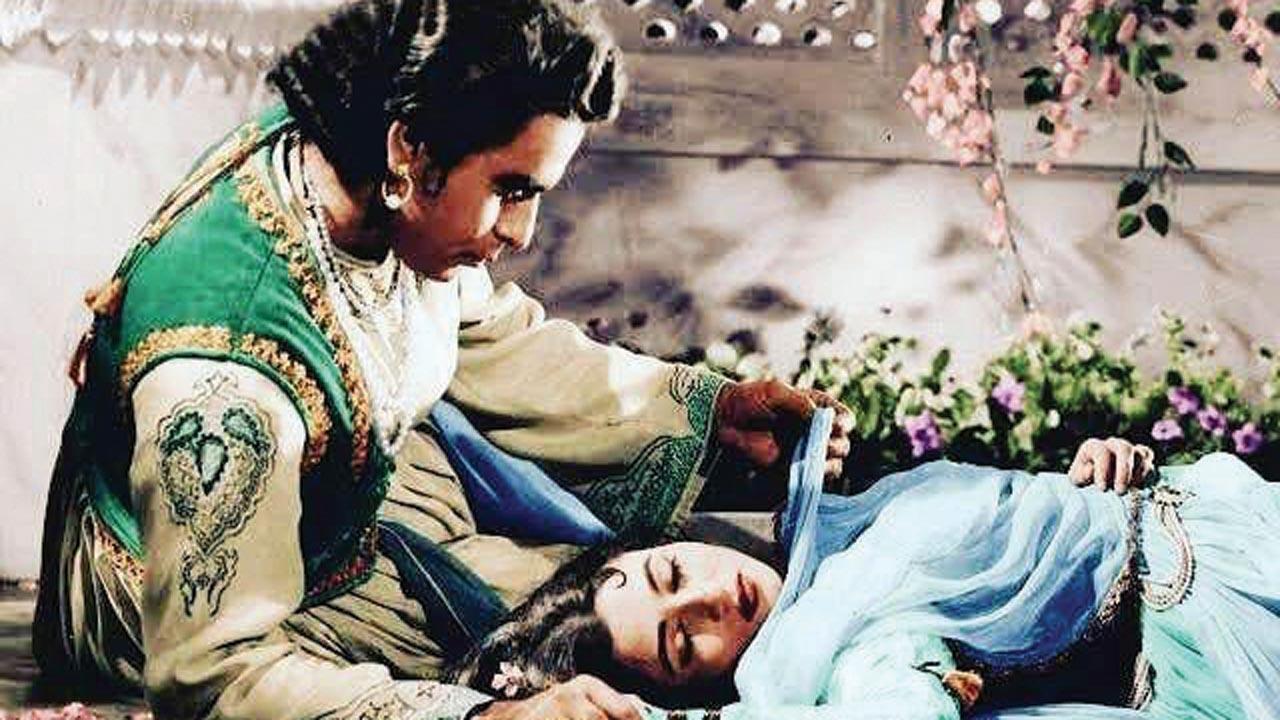
The writer met Dilip Kumar again in 2004 when the digitally coloured Mughal-e-Azam was re-released
Bhawana Somaaya (MID-DAY; July 8, 2021)
It was sometime in the mid ’70s when I first set my eyes on Dilip Kumar. I was doing an internship with a film journal and sent for a press conference. By the time I walked inside the hall, all the seats were taken. So, I stopped half-way and focused on the happenings on stage.
Kumar was seated in the centre and as our eyes met, he succinctly guided me to walk ahead. I did so hesitantly, finding many empty seats in the front row, but was reluctant to park myself. So, I looked up again at him, and he nodded. I nervously sat on the corner chair and tried hard to focus on the boring speeches, but nothing made sense. And then Kumar rose, spoke softly and passionately, and for the first time, I understood the motive behind the conference. The film fraternity disagreed with the newly implemented government policy and declared to go on a strike. He was present on the occasion to support the cause.
I did not speak to any of the association heads post the conference, and did not file a report on the event either. Next evening, around 7 pm, I was near Churchgate station when a shiny black Mercedes stopped before me. The face at the window looked familiar, and as I walked closer, Kumar smiled and opened the door for me. Unthinkingly, I stepped inside the vehicle, but my mind was racing.
Why had he stopped the car for me? Was he mistaking me for someone else? Where were we heading? I am certain he was aware of my discomfort, but continued to converse casually. He spoke so softly that he was barely audible, and to not appear rude, I alternately shook my head and smiled.
When the car reached Pedder Road, he turned to me and said, “My destination has arrived. Thank you for your company”. Still perplexed about the turn of events, I hopped into a cab, unsure if what had just happened was my hallucination or real.
Today, when I am older and more experienced, I look back on the memory with enchantment. Actors are also human beings, and respond to people and situations intuitively. Maybe Kumar sensed my anxiety at the press conference and wanted to put me at ease. As for the car ride, I can only describe it as serendipity — the superstar was spontaneous again and I submitted to the magic!
In 1990, director Subhash Ghai invited me to the shoot of Saudagar (1991) to witness the thespian and Raaj Kumar working together. Call it coincidence again, but as I walked towards the set, I noticed him in costume, walking a few steps ahead of me.
He was about to enter the set, when he noticed the trolley moving and stopped. I stopped a few steps behind him, observing him as he watched Raaj Kumar give his shot. Suddenly, he noticed me watching him and stiffened. He continued to stand in the same spot, staring at the floor. I realized that I had unconsciously interrupted an actor in preparation and trespassed his creative space. The good thing about the awkward moment, however, was that I was privileged to witness the magic!
A few years later, we met again, this time at Rinki Bhattacharya’s newly launched Bimal Roy Memorial & Film Society debut screening of Devdas (1955) at a private theatre in Pali Hill. Kumar and wife Saira Banu were the guests of honour. After the screening, Bhattacharya chatted with Kumar who shared many beautiful moments from the film. He said that projecting silence on screen is the most difficult, and Bimal da was a master of it: “The climax when I travel by train to meet Paro is an immortal sequence. I have never seen something like that on screen again.”
It was a sparkling but strangely reserved evening, where nobody in the audience gushed over the film or his performance. Feeling he looked demoralised, I got up and said that I loved the film, his performance and will love him forever! Suddenly, the twinkle returned to his eyes, and everyone started clapping.
Cut to 2004 when Mughal-E-Azam (1960) was the first black-and-white Hindi film to be digitally coloured and theatrically re-released. I was the editor of Screen at this point, and we decided to celebrate the milestone at our annual awards night. We invited Vilasrao Deshmukh, then chief minister of Maharashtra, to do the honours.
After Deshmukh delivered a terrific speech, it was time for Kumar to speak. He appeared a little lost. This was probably the beginning of his Alzheimer’s, but not many were aware at the time, including us. It was an awkward moment for everyone in the audience, so I hesitantly walked on to the stage and stood behind him. Sensing my presence, he turned around and asked in his inimitable style, “Kaun hain bhai?” On discovering me, he heaved a deep sigh of relief and instantly thrust the microphone into my hand, saying, “Ab le lo bhai. Hum kab se khade hain yahan.” With this, an emotional evening came to a dignified end.
As I write this obit, my mind rewinds to the nubile reporter aided by a charismatic superstar on her first assignment 40 years ago. Can something like this ever happen in present times? I’m not sure, because only once in a 100 years, comes an actor like Dilip Kumar.
Dilip Kumar's realism and brooding screen presence had a seminal influence on generations of actors to come
8:02 AM

Avijit Ghosh (THE TIMES OF INDIA; July 8, 2021)
Dilip Kumar’s best encapsulated the finest in popular cinema. Secure in his craft, he acted only in 60-odd films in a career spanning more than five decades. Kumar, whose real name was Yusuf Khan, even refused the part that made Omar Sharif a Hollywood star in David Lean’s Lawrence Of Arabia.
His brooding intensity and comic flair influenced Bollywood A-listers such as Rajendra Kumar, Manoj Kumar and Amitabh Bachchan. An obsessive perfectionist, he learnt to play the sitar for a song sequence in Kohinoor. Kumar was so immersed in the self-destructive protagonist of Devdas (1955) that he had to undergo psychiatric counselling. The doctor advised comedies as therapy. And he excelled in them too.
In the pre-independence era, Pramathesh Barua and K L Saigal had swayed a million hearts as Devdas. Yet a generation later Dilip Kumar made the part his own. He induced intensity into loving and losing in a way that pain became indistinguishable from pleasure.
His most-remembered performances had distinct tragic undertones. As a conflicted prince who rebels against his father, the emperor, for the woman he loves, Kumar was starch-perfect with his diction in Mughal-e-Azam. A scene with Madhubala, where he fondles her face with a peacock feather, is iconic for its eroticism.
A notable moment in his career came with Ganga Jumna (1961) where he conveyed the despair of the innocent villager forced to become an outlaw. “To me, it was his ultimate performance,” Amitabh Bachchan told TOI in 1990. Ironically, the Censor Board recommended major cuts to it on grounds of vulgarity and violence. The film was released following Prime Minister Jawaharlal Nehru’s intervention. But the struggle to get it exhibited took its toll on him. He never produced a film again.
Like Raj Kapoor, and Shah Rukh Khan, Kumar’s roots were in Peshawar where his father was a fruit merchant. The family shifted to Deolali near Nasik, and Bombay, in late 1920s.
He loved watching movies. Kumar once said he had watched For Whom the Bell Tolls, starring Ingrid Bergman, 21 times in seven days. Among others, he was influenced by the 1930s Hollywood star, Paul Muni.
A chance meeting in Nainital with Devika Rani, a top star of the 1930s who co-owned Bombay Talkies, led to his debut in Jwar Bhata (1944). He picked the screen name from three options -- Vasudev and Jahangir being the others -- provided by renowned Hindi writer Bhagwati Charan Verma, then associated with the film studio, revealed film historian Sanjit Narwekar in Kumar’s biography, The Last Emperor.
After watching it, Baburao Patel, the much-feared editor of Filmindia, whose reviews could make or mar a film those days, wrote, “Dilip Kumar, the new hero of Bombay Talkies, is an anaemic addition…He looks gaunt and famished and strikes one as a long ill-treated convict who has escaped from a jail…His acting efforts in this picture amount to nil.”
But Kumar improved in Nitin Bose’s Milan (1946), a profitable adaptation of Rabindranath Tagore’s Nouka Doobi. Kumar once said, “I learnt from Nitin Bose the value of silence,” as evident in his signature pauses in later films. His first superhit was the tragic Jugnu (1947), with Noorjehan as leading lady.
Historian Ashok Raj describes the years between Jugnu and Ganga Jumna (1961) as “the classical period” of his career, ranging from tragic love stories (Andaz, Devdas), swashbuckling costume dramas (Azad, Kohinoor) and semi-socialist yarns (Naya Daur, Paigham) to the romantic supernatural (Madhumati), the experimental (Musafir), where he sang his only film song (Laagi nahi chhute), and even a Left-leaning project (Footpath), a proto-Deewar.
After Ganga Jumna, Kumar took a break, acting in only two flops in the next five years. His marriage to Saira Banu in November 1966 -- he was 44, she was 22 -- proved lucky for him. Kumar’s double-role venture, Ram Aur Shyam, celebrated its golden jubilee. But by then middle-age had crawled onto his appearance. In the 1970s, Kumar was largely reduced to a yesteryear star.
The thespian made a stirring return in Kranti (1981) and Shakti (1981).The new Kumar was occasionally over the top. But superhits such as Vidhaata, Karma and Saudagar introduced him to a new generation of film buffs. A secret marriage and divorce to a Hyderabadi socialite, Asma, became fodder for gossip magazines during the same phase. There were other unpleasant memories too when he was targeted for his efforts to bridge ties between India and Pakistan.
Now he is gone. But in every movie rerun, Dilip Kumar will continue to astound and enrich us with his gift to lift a scene with silence and soul.
---------------------------

SUHANA SAFAR
- Born as Yusuf Khan on December 11, 1922. He was born in the same month as Raj Kapoor and in the same place, Peshawar, but was two years elder. Yusuf Khan's father was a fruit merchant
- Before joining films, Yusuf Khan worked in a military canteen at Poona; set up a fruit stall next to it with his employer's permission
- He was interviewed for a film career by Devika Rani, wife of Bombay Talkies boss Himanshu Rai. She asked four questions: "Have you ever acted on the stage?"; 'No madam" was his reply; "Would you like to act in films?"; "Yes madam" he said; "Do you smoke?"; "No madam"; "Can you speak Urdu fluently?" "Yes madam"
- He lost his parents and his disabled brother Ayub Khan in rapid succession. This is believed to have deeply affected him in his youth
- The phase from Devdas to Mughal-e-Azam is considered to be the best in his work
- In 1961, he turned producer with Ganga Jumna
- In 1962, he was offered Lawrence Of Arabia, which he turned down. The role was done by Omar Sharif
- In 1970s, his career took a dip with films like Gopi, Sagina and Bairaag failing at the box office. He took a break for six years and returned with Manoj Kumar’s Kranti in 1981
---------------------------

FAMOUS LINES
- Devdas Kaun kambakth hai jo bardasht karne ke liye peeta hai. Main toh peeta hoon ke bas saans le sakoon
- Saudagar Haq hamesha sar jhukake nahin... sar uthake maanga jaata hain
- Mughal-e-Azam Mera dil bhi aapka koi Hindustan nahi ... jispar aap hukumat karein Shakti Joh log sacchai ki tarafdari ki kasam khate hain... zindagi unke bade kathin imtihaan leti hain
- Vidhaata Jagawar agar zindagi mein bada banna hain... toh chhoti harkate chhod do
- Daag Din mein iski zaroorat hoti hai zaalim raat toh khud ek sharab hoti hai
- Aadmi Zindagi bhar doosron ka boj uthataa raha hoon aur aaj khud ek boj ban gaya hoon
---------------------------
FAMOUS SONGS
- Yahaan badla wafa ka bewafai ke siva kya hai Noorjehan-Rafi duet, composed by Firoz Nizami, was from 1947 hit Jugnu
- Gaaye ja geet milan ke Mela (1948) had great songs by Naushad. This one, sung by Mukesh, was memorable
- Meri kahani bhoolnewale Deedar reinforced the tragedy king image. This Naushad tune was sung by Rafi
- Yeh hawa yeh raat yeh chandni Talat Mehmood’s voice suited the thespian; this one by Sajjad Hussain is a classic from Sangdil (1952)
- Aye mere dil kahin aur chal From Daag (1952), composed by Shankar-Jaikishen and sung by Talat Mehmood
- Hum aaj kahin dil kho baithe Naushad’s score and Mukesh’s sonorous voice from Andaz (1949)
- Suhana safar aur yeh mausam haseen One of Dilip Kumar’s personal favourites, from Madhumati (1958), rendered by Mukesh, scored by Salil Chowdhury
- Nain lad jai hain Dilip Kumar did a fast-paced folk dance for this Ganga Jumna (1961) number. Naushad-Rafi combination again

Rajkumar Keswani reveals in his book on Mughal-E-Azam how Madhubala was considered a distraction by K Asif
9:27 AM

Author, poet and journalist Rajkumar Keswani shares lesser-known stories about Indian cinema’s most iconic film, which turns 60 this year
Kunal Guha (MUMBAI MIRROR; September 6, 2020)
When Madhubala first arrived on the sets of Mughal-e-Azam to essay her career-defining role of Anarkali, she brought her usual cheerful personality to work. Known to light up many a room, and to always leave her co-stars and crew rolling on the floor laughing, it dawned on her much later that not everyone was charmed by her ebullience. In fact, filmmaker K Asif found her a bit of a distraction. Soon enough, Madhubala’s shots began getting postponed and she went without shooting for several days. The actor was a little taken aback when, one day, Asif’s assistant Sultan Ahmed informed her that the filmmaker didn’t appreciate her behaviour and expected the cast “to take their job seriously”. The superstar accepted the feedback graciously, submitting to the filmmaker’s approach, and soon, the shoot commenced as planned.
It is anecdotes such as these that feature in plenty in poet, writer and journalist Rajkumar Keswani’s Daastan-e-Mughal-e-Azam, a literary tribute to the iconic film about unrequited love, which clocks 60 this year. Considered a milestone in Indian filmmaking, K Asif’s magnum opus took over 10 years to create. Keswani, who was 10 when it was released, remembers watching the film in Bhopal’s Bharat Talkies. “Those three hours in the theatre changed my life forever,” he says, adding that he was so charmed that he had memorised most of the film’s dialogues.
When he embarked on this project, Keswani’s passion for the film also drew him to follow the life of its director. Music director Naushad told him how Asif had started out as a tailor before going on to weave stories on celluloid when nudged in that direction by his brother-in-law and actor Nazir. In fact, the filmmaker also had a tailoring shop in Dadar’s Khodadad Circle at the time. “Famous heroes of the 1940s, Prem Adib and Jeevan [Narad of the screen], ran a restaurant in partnership in the same locality,” says Keswani about the neighbourhood, which was synonymous with tinseltown dreams at the time.
Most fans will know that development of the feature film began in 1944, but hit a roadblock during the time of Independence, only to commence again with a new cast in 1951. But few know about Asif’s struggle in casting for Anarkali’s role, after Nargis, his original choice, turned it down. Newspapers ads were published across the country, inviting women between the age of 16 and 22 to apply with photographs and biodata. Many actors approached the filmmaker for the role and Dilip Kumar, who was already cast as Salim, recommended the popular actor Vijaylaxmi. But the filmmaker didn’t find anyone suitable.
Asif had tried casting Madhubala for an earlier film, but her father Ataula Khan had set terms that weren’t agreeable with the director. “‘Keep your daughter in a showcase’, is what K Asif told him then,” says Keswani. He adds that the actor was cast as Anarkali only after she reached out to the filmmaker and agreed to work on his terms. “She arrived in her car and the meeting took place in the car itself. She asked him to forget his interaction with her father, and agreed to cooperate with him, because she really wanted to work with him.”
Maratha Mandir theatre, which had planned its gala launch with the release of Mughal-e-Azam had to launch with B R Chopra’s Sadhna (1958) since Asif’s film wasn’t completed by then. The theatre’s leasee owner Seth Mehtabchand Golcha set a clause for every filmmaker who wanted to screen his movie there: When Asif decides to release Mughal-e-Azam, their film would be replaced without notice. And when it did release, it even got travellers from Pakistan who would come only to watch the film. “In fact, Golcha had made special provisions for his Pakistani audience — they wouldn’t have to stand in queue to buy their tickets and could pick it up from inside the theatre itself,” says Keswani, adding that the theatre’s patrons also included filmmaker and actor Guru Dutt and Feroz Khan, who would turn up at Maratha Mandir to watch Mughal-e-Azam every week in the initial months.
“Shapoorji Mistry, the film’s financier, and who famously had several disagreements with Asif over his extravagant production, was no less in love with the director and the movie,” says Keswani. “Shapoorji seth was so obsessed with the dialogues that he would say them aloud as if in an elocution contest.”
Keswani’s book also includes 25 paintings by M F Husain, which were dedicated to Asif and his magnum opus. “Hussain made these paintings during his stay in London, as a guest of K Asif’s son Akbar Asif,” says Keswani of the works, which the renowned artist had gifted to Akbar’s daughter Haya Asif on her birthday.
It took Keswani 15 years to compile his research into a book, but stumbling upon gems about the film made the effort worthwhile. “I didn’t work like a scientist while writing and editing the book. I worked like a passionate lover,” he says.
60 years of Mughal-E-Azam: Why Prithviraj Kapoor’s name preceded Dilip Kumar and Madhubala’s in the credits
8:13 AM

Roshmila Bhattacharya (MUMBAI MIRROR; August 5, 2020)
 The story goes back to 1945. While the Quit India movement was escalating, K Asif was filming Anarkali at Minerva Movietone Studio with Sapru and Nargis as Prince Salim and the courtesan Anarkali, and Chandramohan as Akbar, intent on separating the lovers. The filmmaker had flagged off what was planned as Hindi cinema’s epic extravaganza the previous year in a peaceful India. But following the Partition, Shiraz Ali, who was bankrolling the film, decided to relocate to Pakistan. Before leaving, he set up a meeting between Asif and construction magnate Shapoorji Pallonji Mistry, having decided to settle the latter’s dues against the rights of the underproduction film.
“Shapoorji was a huge fan of Prithviraj Kapoor and would often go to the Royal Opera House to watch his plays. Since they were not ticketed, he would stand outside after the performance, with a jhola for patrons to donate what they wished and Shapoorji would rain money into it,” recounts Deepesh Salgia, CEO and Director of a company in the Shapoorji Pallonji Group.
K Asif was around 25 then, with just one directorial, Phool, behind him. A charmer, he convinced Shapoorji, who had little interest in showbiz, to come on board. There were casting changes, with a more saleable Dilip Kumar replacing Sapru and Ajit Khan coming in for Himalaywallah as his trusted lieutenant, Durjan Singh. Dilip Kumar’s entry led to Nargis’s exit, and Madhubala, a virtual nobody, became an unforgettable Anarkali. “Shapoorji was very close to her father, which is how he convinced Ataullah Khan to let Madhubala continue shooting for the film even though he was irked about her closeness to Dilip Kumar and later his betrayal when he gave evidence against her in court in the Naya Daur case,” informs Deepesh.
Akbar’s big shoes had to be filled too, after Chandramohan suffered a fatal heart attack in 1946. Both Shapoorji and Asif were convinced only Prithviraj Kapoor, impressive as Sohrab Modi’s Sikander, could play the emperor. He lived the role, walking barefoot, in May, for the scene where he goes to Salim Chisti’s dargah to pray for a son.
Shooting resumed in 1951. The film was completed in 500 shooting days, used 1 million feet of negative, and was unveiled nine years later, on August 5, 1960. It made Shapoorji poorer by 3 million USD (Rs 1.5 crore).
The Sheesh Mahal set on which “Pyar Kiya To Darna Kya” was filmed, alone cost him Rs 15 lakh, taking two years to build with glass imported from Belgium.
A 100 dancers were used in the song “Ae Mohabbat Zindabad”, one of 20 recorded, of which 10 were unheard, including “Husn Ki Baaraat Chali”. For the war scenes, 2000 camels, 4000 horses and 8000 jawans from the Indian army were hired. By 1956-’57, the budget had quadrupled and there were times Shapoorji despaired over the escalating costs. But Asif couldn’t be reined in.
When technicolour arrived in India in ’57, he shot one reel in colour in ’58. Impressed with the results, Asif shot three more reels the following year and would have re-shot the full film in colour had the distributors not put their foot down. Mughal-E-Azam released in 15 per cent colour, then, was re-released on November 12, 2004, in full colour with Dolby Digital sound.
Once, when Asif came to him for another Rs 15 lakh, Shapoorji insisted he’d get only Rs 3 lakh. The director immediately screened some rushes for him, deliberately picking scenes featuring Akbar. Every time his producer wah-wahed, he reminded him creative excellence costs money. He got his Rs 15 lakh and left for Jaipur to shoot more war scenes.
Deepesh, whose favourite scene is the one where Akbar comes across the lovers romancing, the drama playing out without dialogue, explains why the title changed from Anarkali to Mughal-E-Azam and Prithviraj Kapoor’s name preceded Dilip Kumar and Madhubala’s in the credits. “While Bina Rai was the protagonist of S Mukherjee’s Anarkali, Mughal-E-Azam showcased the conflict between Akbar’s love for his son and his duty as an emperor. He was livid when the heir to the throne falls in love with a dancing girl and goes through the charade of walling her up, with Salim unaware that she has been safely escorted out through an underground tunnel. Today, the film may well be remembered for Dilip Kumar and Madhubala’s tragic romance, but for Shapoorji, the real heroes were always Prithviraj Kapoor and Akbar,” says Deepesh, asserting that even after 60 years, Mughal-E-Azam’s magic hasn’t dimmed. The film has come back restored and colourised, as a stage play and in the form of books. “Shapoorji would be a happy man today.”
All time runners in Kolkata: Sholay ranks 2nd, Hum Aapke Hai Koun 4th
9:02 AM

Box Office India Trade Network
Kolkata which was the biggest centres for Hindi films till the mid 60's has seen 81 films hit the jubilee mark. Mumbai took over as the biggest centre in the mid 60's and then in the multiplex era it has been Delhi which has become the biggest. These are genuine jubilees in Kolkata where films ran for 25 weeks on four shows a day. There will be some films which got there on matinee shows but that is not a real jubilee. Also there are some films which were pushed on matinee shows for a few weeks by distributors to claim a jubilee but it was just a distributor thing to show his producer they managed a jubilee. These have not been included.
Kolkata was not like Mumbai where every other film was pushed to a jubilee as the perception came from Mumbai for the industry at that time and also Kolkata mostly released weeks or even months after Mumbai so there was never pressure from the producer as pressure of a jubilee was where the early release was. The greatest Hindi film ever SHOLAY released in Kolkata more than 2 months after its initial release in Mumbai and Ahmedabad.
The longest running film ever in Kokata is the 1943 film KISMET which ran for 184 weeks at Roxy though looking at the whole picture in Kolkata in the last 100 years or so then the biggest BLOCKBUSTER of the city has to be BOBBY. The film ran for 52 weeks in the main cinema Metro and then had silver jubilees in a further 3 cinemas which is history not just for Kolkata but for all India. Four genuine silver jubilees in a city without matinee shows and none of the theatres running on deficits.. The last film to get a jubilee in Kolkata was KAHO NAA PYAAR HAI way back in 2000 while the last golden jubilee film was HUM AAPKE HAIN KOUN in 1994 which had a huge 69 week run and another week to make it 70 but those were matinee shows.
The one thing that the list shows is the huge success of love stories in the city. All the great love stories of Hindi cinema are there like KAHO NAA PYAAR HAI, DIL TO PAGAL HAI, DILWALE DULHANIA LE JAYENGE, MAINE PYAR KIYA, QAYAMAT SE QAYAMAT TAK, RAM TERI GANGA MAILI, BETAAB, EK DUUJE KE LIYE, LOVE STORY, ARADHANA, JUNGLEE and the grandest of them all SANGAM and BOBBY. The list is full of love stories and its not just these films mentioned but others as well and this also explains why Shah Rukh Khan has remained the biggest star in Kolkata for the last 25 years. Even though the last years have not been so great he is still the biggest star in the city due to the romantic image which was built in the late 90's.
Dharmendra has the most jubilees in Kolkata with 3 golden jubilees and 5 silver jubilees and that is a case with most cities across India but the biggest stars of the city have been Ashok Kumar, Rajesh Khanna and Shah Rukh Khan. We are talking just the city which is now practically the West Bengal circuit for Hindi films though earlier Hindi films had a good following across West Bengal. Ashok Kumar was a local favorite while Rajesh Khanna and Shah Rukh Khan are probably the biggest romantic stars in history and its this genre which scores big in Kolkata.
The list of jubilees in Kolkata are as follows and the last released film is named first if the films have run for the same numbers weeks though if a film is in more than one cinema than that gets precedence. There is one huge grosser which is omitted and that is MUGHAL-E-AZAM but that film had 24 cinema release in Kolkata which is mad considering it started with 4 in Mumbai and 6 in Delhi. MUGHAL-E-AZAM fell short of a jubilee due to an insane release in Kolkata though despite being a big grosser, its footfalls will still not be among the top 25 in Kolkata though in the whole of West Bengal it would be easily be among the top ten ever. The years are not the release years but when the respective jubilee was celebrated. Also the cinema where it was a jubilee is in brackets. Paradise which is still the leading single screen in the city has the most jubilees with 15 and BARSAAT (released in 1949) being the longest runner in paradise with a 100 week run.
1. Kismet (1947) - 184 weeks (Roxy)
2. Sholay (1977) - 103 weeks (Jyoti)
3. Barsaat (1951) - 100 weeks (Paradise)
4. Hum Aapke Hain Koun (1995) - 69 weeks (Hind)
5. Bandhan (1941) - 57 weeks (Paradise)
6. Shikar (1969) - 56 weeks (Regal)
7. Bhabhi (1958) - 54 weeks (Paradise)
8. Bobby (1974) - 52 weeks (Metro). The film also ran for 25 weeks in 3 more cinemas, Gem, Menoka and Darpan. Probably the biggest BLOCKBUSTER ever in Kolkata.
9. Aradhana (1970) - 51 weeks (Lotus)
- Junglee (1962) - 51 weeks (Roxy)
11. Sangam (1965) - 50 weeks (Orient). The film also ran for 25 weeks in Priya and Darpan
-- Basant (1943) - 50 weeks (Roxy). The film also ran for 25 weeks at Majestic.
-- Yaadon Ki Baraat (1974) - 50 weeks - (Hind)
14. Jis Desh Mein Ganga Behti Hai (1961) - 42 weeks (Paradise)
15. Muqaddar Ka Sikandar (1979) - 41 weeks (Moonlight)
16. Azaad (1956) - 40 weeks (Paradise)
17. Nagin (1955) - 38 weeks (Hind)
-- Achhut Kanya (1937) - 38 weeks (Paradise)
19. Betaab (1984) - 36 weeks (Jyoti)
- Geet Gata Chal (1976) - 36 weeks (Lotus)
21. Nadiya Ke Paar (1983) -35 weeks (Lotus)
22. Dilwale Dulhania Le Jayenge (1996) - 34 weeks (Metro 25 weeks plus 9 weeks at Paradise)
23. Hum Kisise Kum Nahin (1978) - 33 weeks (New Cinema)
24. Ram Teri Ganga Maili (1986) - 32 weeks (Majestic)
25. Ek Duuje Ke Liye (1982) - 31 weeks (Jyoti)
26. Qayamat Se Qayamat Tak (1988) - 30 weeks (Paradise)
-- Dushman (1972) - 30 weeks (Moonlight)
-- Shaadi (1942) - 30 weeks (Jyoti)
29. Satyam Shivam Sundaram (1979) - 29 weeks (Metro)
-- Chaudvin Ka Chand (1960) - 29 weeks (Orient)
31. Anarkali (1953) - 28 weeks (Society). The film also ran for 25 weeks at Purnasee.
-- Love Story (1981) - 28 weeks (Lighthouse)
-- Anurag (1973) - 28 weeks (Jyoti)
-- Ziddi (1964) - 28 weeks (Jyoti)
-- Grihasthi (1948) - 28 weeks (Majestic)
-- Shehnai (1948) - 28 weeks (Paradise)
37. Nikaah (1983) - 27 weeks (Paradise)
-- Ajanabee (1975) - 27 weeks (Jyoti)
-- Zanjeer (1973) - 27 weeks (Opera)
-- Hare Rama Hare Krishna (1972) - 27 weeks (Lotus)
-- Sasural (1961) - 27 weeks (Hind)
-- Naya Daur (1958) - 27 weeks (Majestic)
-- Pyaasa (1957) - 27 weeks (Janata)
-- Actress (1949) - 27 weeks (Paradise)
-- Zeenat (1946) - 27 weeks (Majestic)
-- Kangan (1940) - 27 weeks (Paradise)
-- Bhabhi (1939) - 27 weeks (Paradise)
48. Kaho Naa... Pyaar Hai (2000) - 26 weeks (Hind)
-- Maine Pyaar Kiya (1990) - 26 weeks (Elite)
-- Trishul (1979) - 26 weeks (Majestic)
-- Samjhauta (1974) - 26 weeks (Lotus)
-- Jugnu (1974) - 26 weeks (New Cinema)
-- Amar Prem (1972) - 26 weeks (Paradise)
-- Arzoo (1966) - 26 weeks (Hind)
-- Madhumati (1959) - 26 weeks (Janata)
-- Gumashta (1951) - 26 weeks (Majestic)
-- Chandralekha (1949) - 26 weeks (Orient)
58. Haathi Mera Saathi (1971) - 25 weeks (Regal). The film also celebrated 25 weeks at Priya and Mitra
-- Jai Santoshi Maa (1976) - 25 weeks (Kalika). The film also had a 87 week run in noon shows at Ganesh
-- Dil To Pagal Hai (1998) - 25 weeks (Metro)
-- Sharaabi (1985) - 25 weeks (Majestic)
-- Laawaris (1982) - 25 weeks (Majestic)
-- Naseeb (1981) - 25 weeks (Hind)
-- Kranti (1981) - 25 weeks (Gem)
-- Noorie (1979) - 25 weeks (Majestic)
-- Julie (1975) - 25 weeks (Paradise)
-- Deewaar (1975) 25 weeks (Majestic)
-- Pran Jaaye Par Vachan Na Jaye (1974) - 25 weeks (Regal)
-- Prem Nagar (1974) - 25 weeks (Paradise)
-- Seeta Aur Geeta (1973) - 25 weeks (Hind)
-- Naya Zamana (1971) - 25 weeks (Lotus)
-- Johny Mera Naam (1971) - 25 weeks (Moonlight)
-- Sharafat (1970) - 25 weeks (Moonlight)
-- Milan (1969) - 25 weeks (Hind)
-- Aankhen (1969) - 25 weeks (Moonlight)
-- Khandan (1965) - 25 weeks (Roxy)
-- Jab Pyar Kisise Hota Hai (1961) - 25 weeks (Society)
-- Ganga Jamuna (1961) - 25 weeks (Majestic)
-- Jhanak Jhanak Payal Baje (1955) - 25 weeks (Orient)
-- Lal Haveli (1944) - 25 weeks (Majestic)
-- Punarmilan (1940) - 25 weeks (Jyoti)
I won’t give up on my dream of making a biopic on Madhubala-Madhur Bhushan
7:56 AM

Madhur Bhushan, Madhubala’s youngest sibling, gives us an insight into the iconic star’s life and talks about her passion project – a biopic on her sister
Neha Maheshwri (BOMBAY TIMES; March 3, 2020)
 Paeans have been written about her ethereal beauty and stardom, and odes dedicated to her spirit and passion for life. And yet, destiny was such that her beautiful life was laced with tragedy. At 36, after a nine-year battle with illness, she succumbed to death. Days after her 52nd death anniversary (February 23), Madhur Bhushan (originally Zahida), reminisces moments from her sister’s far too short life, and talks about why Madhubala’s story needs to be told.
She says, “Though she is remembered for her classic beauty, there was so much more to her than her beauty. I want to do something for her before I die. She continues to rule millions of hearts and her story needs to be told.”
However, Madhur’s dream of making this biopic hit a roadblock after her other siblings raised an objection over it. Reportedly, filmmaker Imtiaz Ali who had procured the rights from her for the biopic earlier, recently terminated the contract because of the same reason. But Madhur is not ready to give up on it, yet. “As of now, the biopic has come to a halt because my sisters have objected to it. I find it strange that they don’t want this to materialise…humne uska (Madhubala) namak khaaya hai. Usne apne behnon ko paala hain,” she says, adding, “With the help of my spiritual guru, Arvind Kumar Malviya, who’s idea this was, I want to make this biopic.” Madhur also plans to write a biography on her sister and title it ‘Nine Years of Madhubala’.
‘SHE ALWAYS TOLD OUR DAD, ‘ABBA, MUJHE FILMON MEIN JAANA HAI’
‘It was written in her fate...becoming an actress,’ says Madhur, recounting the turn of events that made a nine-year-old Mumtaz Jehan Begum Dehlavi land in Bollywood. From Baby Mumtaz to Madhubala, her journey could only be described as that of a dance of destiny. She made her acting debut as a child artiste at the age of nine with Basant (1942) and her first appearance as a lead actress was at 13, when she starred opposite Raj Kapoor in Neel Kamal (1947). It wasn’t long before, she became a star and a sensation. Madhur continues, “Madhu aapa was a cute little girl. She would sing, and dance in front of the mirror. She always told our dad (Ataullah Khan), ‘Abba, mujhe filmon mein jaana hai’. However, our father was averse to it because of his conservative background and the belief that girls should not join the industry. But life had plans of its own. Our father lost his job, and eventually, we had to move to Mumbai to survive. At one point, he relented to her wishes and started doing the rounds of studios with her. However, he never dreamt that she would become such a big star.”
With Mahal (1949), she caught the imagination of Bollywood. She became a star, overnight. She was around 16 then. So, did things change at home with this newfound stardom? “Never,” Madhur is quick to point out, adding, “We often felt, ‘Oh my God, she is so beautiful. How can we sit next to her?’ She would put us at ease by saying things like, ‘Main toh actress hoon na, isliye log mujhe mudd mudd kar dekhte hain. Tum actress bann jaoge toh tumhe bhi log mudkar mudkar dekhenge’. She never made us feel any less. She was such a loving daughter and an equally good sister. Unfortunate are those people who ill-treated her or left her to be by herself.”
‘SHE NEVER FELT THAT SHE WAS A STAR AND SHE DIDN’T BEHAVE LIKE ONE’
To the outside world she was an enigma, a mystery. People even said that she was a recluse, but what was the eternal beauty like in real life? Madhur gets nostalgic while taking us on a trip down memory lane. “Hum logon ke saath toh bohot hi masti karti thi — kabhi baal kaat diya, kabhi kuchh kar diya. She loved to have ice-cream and enjoyed listening to music. She would even go to theatres to watch movies wearing a burkha. If you would have met her, aapko aisa lagta hi nahi ki yeh actress hain. She never felt that she was a star and she didn’t behave like one. She wouldn’t wear any make-up; she didn’t need to because she was so pretty. She would only dress in whites and tie her hair up in a simple bun when not shooting. Madhu aapa didn’t need to get dolled up, as my father didn’t allow her to attend parties. He had told her, ‘Maine izzat bohot mushkil se kamaayi hai, Madhu. Court cases jeeta hoon tum bachhiyon ki izzat ke liye. Mere baad koi tum par unlgi nahi utha sakta saying that they were dhandhewali chokris and their father exploited them.’ My sister always abided by him. She was a gharelu ladki,” says Madhur.
‘IT WAS VERY EASY TO LINK HER WITH MEN BECAUSE SHE WAS SO BEAUTIFUL’
With beauty and fame came rumours of her linkups, controversies and heartbreaks. Following a courtship of nine years with Dilip Kumar, the couple endured an ugly breakup and Madhubala finally married Kishore Kumar in 1960. Madhur says, “People have written about her affair with Kamal Amrohi. Baahar jaane ko milta nahin toh affair kaise hoga? Woh toh Dilip Kumar sahab ke saath itni films mein kaam kiya, waise mulaqaat hui aur pyaar ho gaya. She worked with Kishore Kumar sahab in Chalti Ka Naam Gaadi (1958) and Half Ticket (1962), toh pyaar hua. It was very easy to link her with men because she was so beautiful. Prem Nath wanted to marry her, but she told him that our father wouldn’t allow it, because we were Pathans. She was not the kind to have frivolous relationships.”

THE LEGENDARY ROMANCE WITH DILIP KUMAR
However, the highlight of her love life remains her relationship with Dilip Kumar, which made headlines then and continues to pique eveyone’s interest to date.
Most believed that the two of them would tie the knot, but sadly, it was not to be. Was it a misunderstanding, a clash of egos or love gone sour? In the Bollywood thespian, Dilip Kumar’s autobiography, which was published in 2014, it has been stated that things soured between them during the making of Mughal-E-Azam. He stated, “I sensed, Asif (filmmaker) was seriously trying to mend the situation for her when matters began to sour between us, thanks to her father’s attempt to make the proposed marriage a business venture.”
Talking about their bitter-sweet love saga, Madhur recalls, “Dilip sahab and Madhu aapa were shooting for Naya Daur (1957, Vyjayanthimala was cast in her place ultimately). The makers had scheduled an outdoor shoot (the location was where a previous shoot was attacked by dacoits), and our father was not willing to allow her to shoot at that location. He feared for my sister’s safety. He asked them to zero in on an alternate location, but B R Chopra (producer) sahab didn’t budge. That’s when Dilip sahab got involved. His only mistake was that he stood by the producer. Finally, B R Chopra filed a case against my father, which went on for four months, jiske dauraan we heard people say ulti-seedhi cheezein about my father. They called him a dictator and that he wanted to dominate my sister. Finally, the case was resolved, and later, Dilip sahab came home and told Madhu aapa to complete the film, and post that, they could get married. But my sister wanted him to apologise to our father. He flatly refused. We have nothing against him. Had he apologised to my father, aapa would have been Mrs Dilip Kumar. She had immense gratitude for our father, and she couldn’t just let it go.”
‘IMAGINE A 27-YEAR-OLD GIRL BEING TOLD THAT SHE HAD JUST TWO YEARS TO LIVE. WE WERE ALL IN SHOCK!’
It was in 1960, while shooting for a film in South, that Madhubala spat blood. She flew to London the next day, along with her husband, Kishore Kumar. “We were not aware that she had a hole in her heart. When the doctor said that she had a hole in her heat and the operation won’t be successful, we were all in shock! Imagine a young girl of 27 being told that she had just two years to live. She consulted several doctors in India and they confirmed her worst fears. She was advised to take a break, but she had films lined up. She completed a song and a few scenes in Mughal-E-Azam (1960) in that condition. It took about nine years to complete the film and that was the phase when she was suffering. In all those years, she rarely met anybody from the industry, barring Geeta Dutt and Waheeda Rehman. She didn’t want anyone to see her in that state. I was with her through the last few years of her life. I would sleep in the same bed with her.”
‘SHE LOVED THE SONG RULA KE GAYA SAPNA MERA. SHE FELT THAT IT ENCAPSULATED HER LIFE’
It was a life too beautiful, cut too short. Madhur reveals, “You know…She loved the song Rula Ke Gaya Sapna Mera (Jewel Thief, 1967). She felt that it encapsulated her life. She would wait every day for the doctors to tell her that they had discovered a cure for her. She wanted to live. I believe that love heals. Yes, we can’t change destiny, but if she had received more love from the people who she loved so much, then I think she would have had more strength to fight her battle for life, longer.”
Did Madhubala get a chance to interact with Dilip Kumar during the last days of her life? Madhur says, “He once went to see her at the hospital. She sent him a message through someone that she wanted to see him, and he came over to see her. This was before his marriage. Later, he came for the funeral. He immediately flew down from Madras (where he was shooting) when learnt that Madhubala was very critical. But he was late by two hours...she was buried by then.”

‘I WON’T GIVE UP ON MY DREAM TO MAKE A BIOPIC ON HER’
Though she is remembered for her classic beauty, Madhur says that there was so much more to Madhubala than her beauty. She believes that the story of her undying zest for life, fierce loyalty towards her family and quiet courage in matters of the heart, needs to be told to a nation that hailed her the Venus of Bollywood. However, Madhur’s dream has not taken off because her other siblings are not willing to give their consent. But she is not ready to give up on it, yet. She says, “With the help of my spiritual guru, Arvind Kumar Malviya, I am keen to make the biopic, as it was his idea.” Along with her guru, she also plans to set up an old-age home and a school for young girls in Jodhpur. “Madhu aapa would always tell my father, ‘Abba, jab hamare paas bahut paisa aayega na, toh hum log school banaayenge chhoti ladkiyon ke liye.’ She didn’t get formal education herself and this was her dream.

Subscribe to:
Posts (Atom)