Showing posts with label Mrityudand. Show all posts
Showing posts with label Mrityudand. Show all posts
As publicists turn gatekeepers and actors adopt manicured social media presences, is celeb interview dead?
7:39 PM
Imaging/Uday mohite
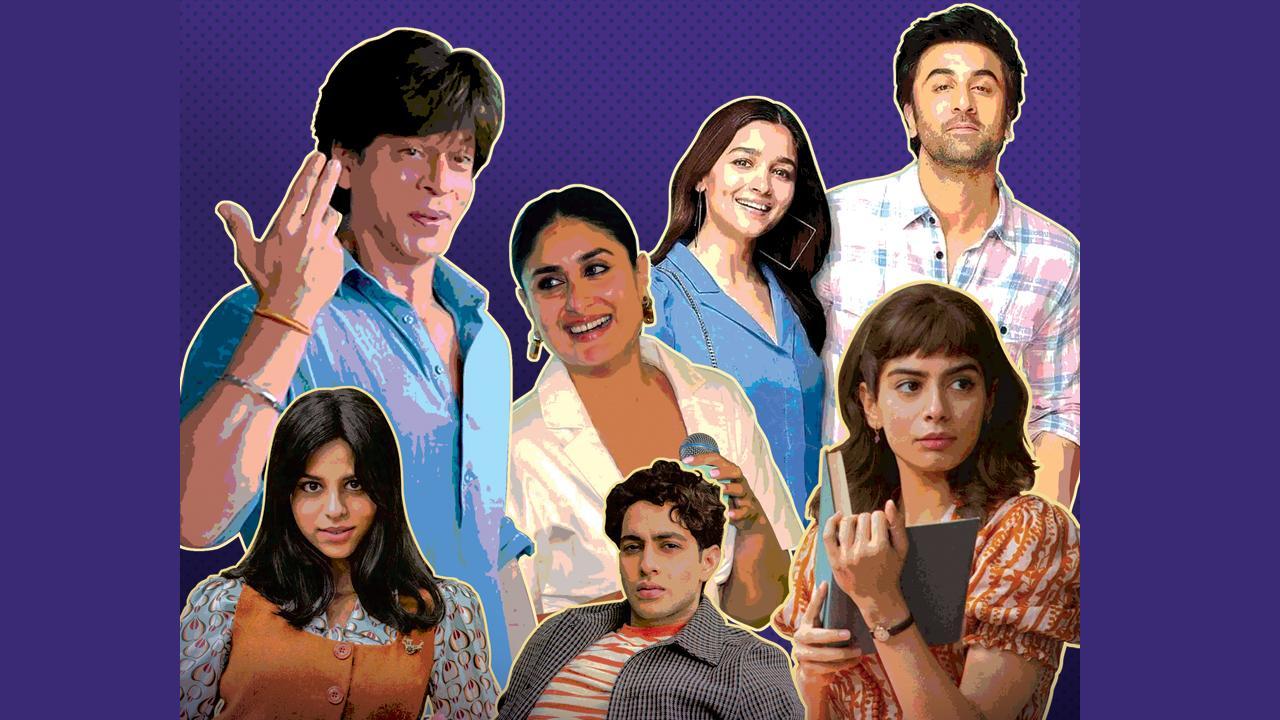
Tabloids and film magazines were a fan’s way of getting to know their favourite stars. As publicists turn gatekeepers and actors adopt manicured social media presences, what’s lost is honest, no-holds-barred conversation
Mohar Basu, Aastha Atray Banan (MID-DAY; January 7, 2024)
The past year was arguably Shah Rukh Khan’s, who delivered three back-to-back hits—Pathaan, Jawan and Dunki—after a five-year break from leading roles. 2023 was witness to the SRK fandom back in action, selling out shows for weeks, creating fan edits of popular scenes and ensuring his songs were hits on social media before the films they were featured in could be released.
But an essential element of the SRK package was conspicuously absent: the uncensored, witty interviews that the actor is known for—the ones where he regales both the interviewer and audience with charm and wisecracks. What happened in the years between 2019, when the actor sat down with David Letterman for a special episode of the TV host’s show My Next Guest Needs No Introduction, and now? For one, Khan and his family were put through a trial when his son Aryan was arrested—and exonerated—in a narcotics case that was fodder for weeks of primetime news debates.
Instead of freewheeling interviews, fans now look forward to the actor’s beloved “Ask SRK” AMA sessions on X, where he—and not the agency who manages him—addresses their questions, concerns and wishes. The simplest, earnest questions are answered. “Love winters. It gives reason to hug your loved ones to keep warm,” Khan wrote to a fan who asked him what his favourite season is.
Is the superstar’s decision to keep away from media interviews also a sign of a growing chasm between Hindi cinema’s biggest faces and the Indian media? Veteran journalist Bharti Dubey is of the opinion that Khan has set something of a precedent. “He didn’t do any press, and yet, his films were super hits. Actually, stars aside from SRK, too, don’t need the ‘interview’ anymore. They can put out material on Instagram. Social media interactions have killed the journalist.”
If she still has access to stars and opportunities to interview them, it is only because of her many years of experience, Dubey admits. But she makes no bones about the reality of the media landscape today: the era of a sit-down chat with celebrities is over. “Now, you are timed. They [publicists and managers] say, ‘10 minutes only.’ But sometimes, it takes 10 minutes just to build a rapport with the interviewee, to warm up.”
As for gossip, gleaned from chance encounters and sources on sets, and presented as blind items—that’s a relic of the past. “What gossip?” Dubey laughs. Whether innocuous, sizzling or vicious, gossip is now considered the jurisdiction of self-styled insiders with massive follower counts on social media, or Bollywood-centric forums on Reddit that keep tabs on and dissect the minutest details.
What emerges from comparisons of the past and present is a dissonance between the press and celebrities—one premised on the guarding of reputations, personal details being turned into clickbait headlines, and a change in the way actors present themselves on social media, on their own terms. As our favourite stars turn the selfie camera on, have we reached a point where it’s no longer possible to have a deep, thought-provoking, or fun chat with the actor of the hour? Is the celebrity interview dead?
Talk of the days when one could walk onto a set and chat with any artist in their view sounds like urban lore. “I’d flash my ID and walk in,” says Kushalrani Gulab, a veteran entertainment writer and editor. She recalls a vivid memory from a junket in Wai, where director Prakash Jha was shooting Mrityudand, starring Madhuri Dixit. She had famously banned all interviews after the name of the man she was dating had been revealed.
“While the writers of Stardust and Filmfare fumed, I chatted with Dixit’s hair stylist. In turn, the stylist invited me into the vanity, and lo and behold, I had an interview. I broke the ice with the actress by speaking about my nephew—I knew that she’d spoken about how much she loves her own.”
Before Bollywood’s wholehearted embrace of social media, the movie-goer and actor needed the press to reach each other. Film magazines and tabloids brought the reader closer to the person they saw on the big screen. They were brokers of opinion, confessions and secrets—there was no other medium for stars to offer snippets of their personal lives or themselves, save for the occasional autograph or meet and greet. It’s no surprise then that fans would throng the lanes of Juhu and Bandra, waiting for the rare sighting of their heroes—as they continue to, even today.
A well-known Bollywood agent with a 20-year career describes how organic celebrity reputations used to be in the 90s and 2000s. “Actors had certain labels—Preity Zinta was ‘bubbly’, SRK was ‘charming’, Juhi Chawla was ‘affable’—they were naturally like this. There wasn’t any machinery working to create these images and ensuring that everything the actor did was in adherence to the image. It’s what Mr Khan says: He is an employee of the myth of SRK. Unfortunately, this myth-making is now a widely adopted idea. Every actor is trying to build their myth and sticking to it,” the agent says.
Social media is the playground where this myth-making takes place, bolstered by complex strategies and image management. The curation concerns everything from the car the celeb will drive, to the food they eat, and the people they rub shoulders with. The agent gives us an example of what such management can look like: “Imagine that you’re a young boy from a small town. It is ideal that you seem relatable. I’ll get the paparazzi to click pictures of you at a local store, or riding in an auto rickshaw. You’ll be seen as one of the boys from the crowd, because you don’t drive a BMW yet. I’ll even get you to post videos about eating streetside chaat. Your interviews will be about the rejections you’ve faced, the trials and tribulations, how the struggles honed you. Soon, you’ll have recall value and land movies that go on to be hits in Tier 2 and Tier 3 cities.” We’re told there’s an entirely different strategy for star kids, centred on making them seem approachable and aware of their privilege.
Murtuza Rampurwala, who handles social media for bigwigs like Rohit Shetty, Sanjay Dutt, and Shefali Shah, as well as the digital side of movie campaigns, candidly expresses why the vibe of celebrity accounts is positive. “Social media, by design, is a place where everyone wants to show the best versions of themselves—they have to be pristine. We delete negative comments, we manage any small-scale trolling,” he says.
As actors become more comfortable with speaking about their personal lives and preferences online, Gulab points out that entire profiles of stars can now be fashioned based on their social media posts, rendering the interview obsolete. If actors now come to the press, it is to extend the narrative surrounding them, providing manicured details that will not deflect from the impression they want to project. All you, as a journalist, are expected to do is type. “There was a time when I’d walked onto a set where Naseeruddin Shah was present. I asked Shah one question, and he launched into a rant about the Hindi film industry. At the time, he needed a journalist’s platform. Now, no one does,” says Gulab.
The senior Bollywood agent highlights that many of the star kids launched a month ago—Suhana Khan, Agastya Nanda and Khushi Kapoor—haven’t even given their debut press interviews yet. “The press’ approval is no longer a mandate from the stars either,” she says plainly.
The void left behind by journalists has been swiftly filled by a more appealing face: the influencer. Production houses and OTT platforms often rope in influencers in the verticals of comedy, pop culture and beauty to interview the casts of upcoming projects. Digital creator, Tarini Shah (508k followers), who has worked with celebrities, says that as influencers, they firstly understand the “other side”. “The point is to create a safer space for the celebrity. We are not here to get tabloid news—we are here to talk about your movies, and work, in the most honest way. Every creator has their own niche—for me, it’s my relatability. I ask questions that I think Gen Z will want to ask about. For me, it’s about giving a safe place where they can be raw and real.”
One of the many things the Bollywood fan looks forward to is a celeb’s soft or hard launch of their beau. Teased, posed for, cheekily confirming rumours—launches of all kinds are lapped up. At the same time, many journalists are held back from asking questions about stars’ romantic relationships. “When they tell me not to ask questions about romantic relationships, I just ask, why? It’s so obvious, it’s all over social media—let me ask the question, and the star can choose to say ‘No comment’ if they want to,” says a senior film journalist who works at a mainstream newspaper.
Till a few years ago, the star had a manager that handled their work—their movies, and everything to do with them, and the production houses set up the interviews, as Yash Raj still does. As avenues expanded and social media entered the fray, the work of a celebrity grew from what they did onscreen to sponsored posts, brand collaborations, and much more. It was then that the PR machinery became imperative—to spread the word.
A PR professional who works at an agency handling Bollywood’s biggest stars says that they are concerned about being misquoted by the press, about their words being taken out of context.
Another publicist, who has been running a boutique PR firm for a decade, says that actors don’t wish to comment on any issues anymore. “The actor I manage may choose to take a hard stand on a trending topic. But the next morning, when hell breaks loose , I’ll have to figure out remedies and make elaborate damage control plans,” the publicist says.
The editor of a well-known website tells us that OTT platforms, too, are using the power dynamic of access to their benefit. “During the press interactions for the AP Dhillon documentary, more than eight journalists found that the footage of their interviews was reduced to half. And I could pin the blame on one platform, but at some point or other, every OTT platform has done this to me. Their reasons for censoring are that our questions weren’t relevant, or that the talent wasn’t comfortable with the answers they gave.”
Former print journalist, the host of a popular chat show and influencer Nayandeep Rakshit says that the dissonance between the press and celebrities is the result of many factors—and holds all stakeholders responsible.
“Journalists have asked very catty questions, assuming they are fun. The stars have even answered these questions. What follows is social media trolling that is hard to fathom. I asked Ranbir Kapoor a question about what he loves, hates and tolerates about his wife, Alia Bhatt. He answered the question, and the next thing we know, there were armies of social media users slandering the actor for being an inconsiderate husband. What followed was toxic, and that wasn’t my intention, and so, I felt horribly guilty.”
Rakshit traces the changed environment of present times to the moment that shook the Hindi film industry—Sushant Singh Rajput’s demise.
“Mainstream news channels were up in arms, to portray Bollywood as a world where actors have no morality. I loved how Karan Johar addressed it in his chat show last season. That said, it has resulted in actors being more measured, more guarded. Anything and everything they say will be held against them,” Rakshit says of the mistrust that celebrities now harbour.
Dubey, who is speaking to us from a press conference, which she rarely attends these days, adds, “Maybe it’s a phase. I have been told it is. It will all calm down. But will it ever go back to how it used to be? I don’t think so.”
Even though I belonged to a filmi family, Dilip saab never backed me or supported me-Ayub Khan
8:08 AM

Tanvi Trivedi (BOMBAY TIMES; April 6, 2022)
Actor Ayub Khan acted in many films like Mashooq, Meri Aan, Smuggler in the 90s and then made an impact with films like Mrityudand and Dil Chahta Hai, but his movie career did not shape up the way he would have liked it to. Today, when he looks back, he feels he probably lacked the flamboyance, which most of the actors had during the 90s.
He says, “I got many opportunities to prove myself and I feel happy that the producers banked on me in all those Hindi films that I did. In fact, I feel sorry that those films didn’t work. I don’t have any other regrets because people never stopped giving me work. Even after my films didn’t do well, I had a Mrityudand or Dil Chahta Hai, where my presence was felt and I made an impact.”
Ayub adds, “During those days, I did not have the guts to experiment or sing and dance like other heroes and that’s what did not work for me in my career. I had a subdued style of acting, I felt that your performance should be subtle and I acted that way, but audiences enjoyed actors’ item songs and colourful costumes and the way they acted in films. I wasn’t cut out for it and so I moved to television. I also feel that the flavour was different at that point of time and I could not gauge the pulse of the audiences.”
Ayub comes from a filmi background —he is late Dilip Kumar’s nephew, and son of Nasir Khan and Begum Para. He says, “Today, youngsters talk about being in an industry where if you don’t have a godfather, you will not succeed. But I want to say that even though I belonged to a filmi family, Dilip saab never backed me or supported me. He used to say, ‘No one ever backed me or supported me, so you should also rise to your level with your own hard work.’ I would like to take credit for what I did supporting me.”
The actor was seen in the TV show Ranju Ki Betiyaan some time ago and is currently seen in Spy Bahu, in which he plays a businessman. He says, “I have done both positive and negative roles, and now I would love to do comedy. Though it is a woman-centric medium, I am glad that I have landed interesting, hard-hitting roles on television.”
If I could pull off Raajneeti, it’s due to Prakash Jha's vocal appreciation & Ajay Devgn’s silent support-Manoj Bajpayee
8:28 AM

Roshmila Bhattacharya (MUMBAI MIRROR; June 8, 2019)
The war of words during campaigning, the wisdom of choices during electioneering and the political wheeling-dealing during government formation are all top of the mind given that it’s not even been a month since the 17th Lok Sabha elections, which makes Prakash Jha’s Raajneeti apt for this week’s column. The film opened on June 4, 2010 and with parallels from the Mahabharat, showcased a bloody battle for power.
“You can’t showcase the Mahabharat in two-and-a-half hours of screen time. But since I was telling a story about family politics, I thought of drawing out the texture of the epic drama which is a part of our socio-cultural fabric and encompasses every aspect of human life. Raajneeti is just a section of the Mahabharat, finding similes in some of its characters and their actions,” Prakash ji points out, almost a decade later.
As the eldest of the 100 Kauravas, Duryodhan, was undoubtedly the muse for Manoj Bajpayee’s character, Veerendra Pratap, the designated Chief Ministerial candidate of the Rashtrawadi Party. “He’s someone destined to be king, till his father takes his legacy away,” is how Prakash ji describes the character. Manoj remembers the filmmaker telling him about the film when he was waiting to receive the National Award for his performance in Pinjar. “It would be a few years before he came to me with the script and insisted on giving me a two-hour narration, asking me which of the roles I’d like to do. I immediately settled for Veerendra Pratap because I felt this would give me a chance to chalk up some grey areas and put across the perspective of Duryodhan, who has always been portrayed and judged as an all-black villain. But the fact is, that if the Pandavas were right, then so was he at times, if they were wronged, so was he,” explains Manoj.
A surprise bit of casting was Arjun Rampal as Prithviraj Pratap, “a contemporary Bheem who bulldozes everyone”, and an even bigger surprise was Katrina Kaif as Indu Pratap aka Draupadi as his wife and the lover of his younger brother Samar, the “reluctant king”, brought to life by Ranbir Kapoor. Quiz him on his unexpected choice of actors and Prakash ji admits that it was intuition which took him to Arjun who when told what he had in mind, asked, “Are you sure I can do this?” Katrina was also a part of the mainstream but then, as Prakash ji, points out, he went to Madhuri Dixit with Mrityudand when she was doing “Dhak Dhak”. “Katrina rehearsed for 25 days before the shoot, working hard on her dialogue which I’d recorded for her in my voice,” Prakashji shares.
Manoj remembers that the shoot in Bhopal was like a mela. Coming from a different kind of cinema, he was overwhelmed to see 20 vanity vans parked on the set, one of them for him. There were also huge crowds at all times and even after all these years, he marvels at Prakash ji’s handling of the star-gazers so there was never any untoward incident and he could pull off the magnum opus according to plan.
One of the highlights of the film were his fiery speeches, including the iconic “Babulalji ki hatya mehengi padegi inko, bahut mahengi…. Karara jawab milega.” Manoj reveals that Prakash ji gave him this dialogue just the night before the shoot and told him they would film the scene the following afternoon. “When I reached, I found he had placed three-four cameras. We did one rehearsal, then, canned the shot in one take. If I could pull off this performance it’s because of Prakash ji’s very vocal appreciation after every shot and Ajay’s (Devgn, who played Sooraj Kumar/Karna) silent support during our many scenes together,” says Manoj.
Prakash ji got drawn into politics, contesting from his native Champaran, but insists there is connect between reel and real-life raajneeti. Manoj confides that since Satya, he has been wooed with really tempting offers too. “But I didn’t come into the film industry to leave it all for politics. It’s been a tough journey to establish myself here despite being an outsider, create a filmography and earn name and fame for my work, and now I’m not going to throw it all away to get into something I have never done,” he reasons.
Meanwhile, Prakash ji admits he’s scripting a sequel. Manoj is excited about it though he’s quick to point out that except for Ranbir’s Samar and Katrina’s Indu all the other characters are dead. “But I’d still like to see Raajneeti 2, I’m curious to see if Prakash ji takes the story forward or scripts a new magnum opus,” he muses. For me too, this Raajneeti is just as exciting as the real thing.
Women should pursue some hobbies, something that they do just for themselves-Madhuri Dixit
7:35 AM

Madhuri Dixit on women, ambition, marriage, and the untimely death of Sridevi
Suman Sharma (TIMES LIFE; July 29, 2018)
There’s something overpowering, overwhelming about Madhuri Dixit. She’s constantly on the bounce, willing to push her limits, willing to try something new. We last saw her on screen in 2014 in Dedh Ishqiya and Gulaab Gang. Currently all set to make her debut in the Marathi film industry with Bucket List.
‘BUCKET LIST KEEPS CHANGING’
You wonder whether she keeps a bucket list in real life too. She laughs at that and answers in the affirmative. “My bucket list keeps changing and as things get ticked off, I add new things to it. I love challenges and I try different things,” she says. The primary thing Madhuri has learnt over the years is to be her own person.
She reflects you must pursue your wishes, your desires and respond to your motivations. She says that women get so involved in bringing up children that they feel a sense of loss when the children grow up and don’t need them as much as they did earlier. One way to counter that emptiness is to tend to your own pursuits. “Women should pursue some hobbies, something that they do just for themselves. When you have an identity, then people respect you. Or else you could be taken for granted,” she reasons.
‘RAM IS SO SUPPORTIVE’
Marriage has worked well for her. She says she has discovered herself after marriage. She was only chasing the arclights before but life with Dr Sriram Nene has been an adventure. She loves Ram for being open minded and encouraging. “Ram is so supportive. If I say today I’m gonna be late, he will do everything for the kids. In him, I have a strong support system. That’s why I can do all these things. My mother-in-law, my father-in-law, my mother, they all help me,” she says. Her mother, Snehlata Dixit, has been her inspiration. She reminisces that when she did Abodh (1984), she was thin and would often get criticised for it. That would leave her upset. “But thanks to my mother’s advice, I learnt to turn a deaf ear to that and just be myself,” she smiles.
The industry has changed since her heyday. Prakash Jha’s Mrityudand (1997) was the first film where she came across a bound script. Till then she mostly worked in projects where the story was in the director’s mind and the scenes were written on the sets. These days the writing is better, the roles are better, the pay is better… and so are the expectations, she says.
‘JANHVI’S GESTURE WAS SWEET’
The talk veers to her other projects. She’s doing Kalank, a role offered to her after Sridevi’s untimely death. They were touted to be rivals during the ’90s but Madhuri says they were always cordial towards each other. “I won’t say Sridevi and I were the best of friends. But we held each other in respect. Her passing away is sad, very unfortunate...” she sighs. After a pause she adds, “Because she was so young. It was too early to go and so suddenly. I still cannot believe that this happened.”
When the makers approached her, she was a bit hesitant. “To step into her role was tough… sometimes the thought overwhelms me,” she confides. She was touched by Janhvi Kapoor’s warm gesture of tweeting about her doing the film. “Janhvi was sweet. She tweeted about it and she conveyed her best wishes,” she smiles.
Do women-centric films translate into tangible gain for the filmmakers?
8:00 AM

Asira Tarannum & Bharati Dubey (MID-DAY; March 8, 2014)
Of the many films featuring strong female protagonists that have come and gone, few have been etched onto our collective memory. It may be pointed out that box office success in Bollywood is attributed mainly to male stars and filmmakers spend big bucks to cast known actors in their films. But on the occasion of International Women’s Day, hitlist explores how some films were exceptional as they defied all trends and norms in Bollywood.
 If we go back half a century, films like
Mother India and Pakeezah — considered two of the finest classics of
Indian cinema — were path- breaking movies. Nargis played Radha, a poor
village woman who fights against odds to raise her two sons, while Meena
Kumari’s Sahibjaan was the epitome of heartbreak. The former killed her
evil son for the sake of preserving justice, while the latter
sacrificed her love in the film.
Both characters set the tone of their respective films and ended up being huge hits too.
But some things changed in the ’80s and ’90s. While parallel cinema still dared to dabble in films dealing with feminist issues, commercially they were duds, however genuine the intention of the film-maker.

However, more recently, the tide seems to be turning in favour of these films with women- oriented scripts gaineing acceptance in the industry.
 On their part,
actresses too are more open to playing protagonists for a change.
Filmmaker Gauri Shinde (left), who made a successful directorial debut with
English Vinglish, vouches for the same. “It was difficult for me to
pitch the film. I was a first-time director and I was not making a film
about a young woman. It didn’t have any item numbers in it, so there
were doubts in people’s minds,” she says, adding that it takes a while
to draw audiences into cinema halls, but once people start liking a
film, word spreads and the film’s collections pick up as well.

And while he concedes that multiplex audiences want to see all kinds of cinema, he is quick to point out that they charge higher ticket rates for male-oriented films and not women- oriented ones. “It is important to market the former in a manner where audiences connect with you,” he says.
Shinde explains that ours is a male-dominated country and the film industry, in particular, is no different. “Most of the audiences are men; they buy tickets at the counter. Besides, there is this perception that women-centric films will be boring and righteous. Unless more women get out on their own and decide what they want to watch, things will not change,” she says.
Actor-producer Dia Mirza, who is now making the film, Bobby Jasoos, with Vidya Balan playing the main lead, agrees. “As our audiences evolve, so do our filmmakers and their ability to tell stories showcasing women in interesting avatars. The new India is eager to celebrate women characters that are nuanced, entertaining and most importantly, real. Eventually it will always be the story that is the clincher, and it’s great to see that we find more and more women now taking our stories forward.”
Vidya Balan, who is known to do women centric films, seconds her. “A good film will irrespective of its theme. People react to human beings and their stories. The only criterion is how well a story is told. How else can you explain that Gravity bagged seven Oscars besides being the sixth highest grossing film of 2013?” she says.
 Prakash Jha, who has
featured strong women characters in films like Mrityudand, blames the
society for its negative approach. He says, “Ours is a male oriented
industry and society, but things are changing now. If a film is promoted
well, it works. I don’t think a film will work only because it is star
oriented.” Shabana Azmi, known for playing a formidable woman in her
films, asks both filmmakers and audiences to be patient. “I think this
is a misconception. Vidya Balan’s women-centric films have had
commercial success, and in the past too, films of Meena Kumari and Nutan
were very successful. I’ve had a fairly decent stint myself. We
underestimate our audiences; they warm up to a good film. What sometimes
fails is the budget, not the film,” she emphasises.
BLAST FROM THE PAST
. 1960s: Bandini, Seema, Sujata and Saraswati Chandra paved the way for women-centric films. Powerful direction by stalwarts like Bimal Roy, coupled with Nutan’s acting ability, took these movies to another level.
. 1970s and ’ 80s: Films like Meera, Khushboo, and Insaaf Ka Tarazu had a strong feminist flavour. While beauties such as Hema Malini and Zeenat Aman upped the glamour quotient, Shabana Azmi and Smita Patil were bracketed as parallel cinema artistes.
. 1990s: Two films from this decade stand out — the Prakash Jha directed Mrityudand and Rajkumar Santoshi’s Damini.
. 2000s: Rajkumar Santoshi’s Lajja put women’s issues back under the spotlight.
. 2010s: With The Dirty Picture and Kahaani, Vidya Balan proved that women-centric films can rake in the moolah at the box- office.
Subscribe to:
Posts (Atom)