Showing posts with label Mini Mathur interview. Show all posts
Showing posts with label Mini Mathur interview. Show all posts
I watched Alliance episodes and thought, ‘Sh*t, Mini, you’ve never looked worse’-Mini Mathur
9:23 AM

Neha Maheshwri (MUMBAI MIRROR; September 30, 2026)
Mini Mathur, who won Alliance, came away from the experience with a reassessed relationship with ageing, vanity and the life choices that shaped her journey. The reality show pushed her to let go of the control and polish that usually accompany a public appearance and embrace a more unfiltered version of herself.
She said, “When you have a camera on you 24/7, you can’t look your best all the time, and I actually embraced that for the first time. I watched a couple of episodes and thought, ‘Sh*t, Mini, you’ve never looked worse.’ It was hard because I was absolutely stripped of everything. But I felt liberated. I learnt a lot about ageing and vanity on the show. Every time I have presented my best version to myself, it has been about how I look. The moment I stripped myself of vanity and everything to do with lines and wrinkles, there I was with the trophy. The real me has value.”
The experience also changed how Mini viewed the choices she made before entering the entertainment industry.
She shared, “I always felt that I entered the industry late because I did my post-graduation and then worked for two years. I felt that somehow all of that was a waste of time and perhaps wasn’t valued enough. But today, I feel proud that every single maths problem I solved and every passion I pursued in life matters. It brought me to tears to realize that all those years I spent thinking, ‘Damn, I should have started 10 years earlier,’ had actually come to something. It’s never too late to learn, apply what you’ve learnt in life and win.”
‘I haven’t come this far in my life in anybody’s shadow’
In a previous interview, soon after winning Alliance, Mini had shared, “I didn’t need this show to revive my career or get millions of followers. I went in because I wanted to challenge myself. I have a 30-year television career behind me, and I didn’t want to do anything that would put what I’ve built over three decades in jeopardy. So, I realized that the only way to play the game was to be my most authentic self because anything else I did would have been called out. I don’t like toxicity, arguments or loud physical displays of aggression, so whenever that happened, I moved away from the situation. But I always put my point across without having to shout anyone down in public. I’m happy that somebody who’s not the reality-show winner stereotype actually won. I’m sure there were other people who were equally deserving, but I fought them tooth and nail, physically and mentally.”
The physical and confrontational nature of the game also brought her face to face with what she sees as a male-centric understanding of power.
She says, “I detest this whole male paradigm that equates power with men, brawn and testosterone-laden bodies. Every time those alliances were formed where a big guy met another big guy and one token girl was included, I thought, ‘I ain’t playing in nobody’s shadow.’ I haven’t come this far in my life in anybody’s shadow. I didn’t come here to play safe. I wanted to be my own power centre and play my own game.”
‘Women are no longer making achars at 50’
Age became another assumption Mini refused to accept. Being told that a woman her age had never reached so far in a reality show only reinforced what she considers an outdated view of women over 50.
She shared, “This is 2026. Women are no longer making achars at 50. At 54, I’m at my sharpest and physically fittest right now. I want to break this mould that women over 50 are weak, don’t deserve space of their own, have to live in the shadows, be nurturers and givers, and that somehow their best is over. Hopefully, my win is a message that you can have main-character energy at 50 and reinvent yourself at any time. You don’t have to be 30 to compete with 20-year-olds.”
Don’t take parenting too seriously. Treat your kids like the cousins from Jalandhar-Mini Mathur
8:54 AM

Her impersonation of Simi Garewal interviewing Mamta Kulkarni had the judges in splits and won her MTV’s VJ Hunt in 1997. Mini Mathur went on to enjoy a successful run as VJ and later hosted popular reality shows such as ‘Indian Idol’. She took on a new role recently, that of a women’s health coach, and has launched a platform to raise awareness about menopause. Mathur spoke to Neha Bhayana about her journey as a woman and mother to Vivaan (22) and Sairah (16)
Neha Bhayan (THE TIMES OF INDIA; July 13, 2025)
After being a television host for three decades, you have launched ‘Pauseitive’, a platform to raise awareness about menopause. Tell us about your journey.
It wasn’t a conscious decision to become a health coach. When I turned 45, I stopped feeling like myself. I’ve always been into fitness — I worked out, ate healthy, and never had any health scares. So when I started experiencing brain fog, low mood, and sudden bursts of anger, I was not happy. I’m a very people-oriented person, but I began feeling social anxiety because I couldn’t remember the names of the people I was talking to. This was quite debilitating, especially for a TV host. I went to many doctors, and they all gave me symptomatic treatments — statins for cholesterol, sleeping pills for insomnia, and what not. But I decided to find a better answer. I started reading and connecting the dots. I realised it was basically a state of perimenopause.
I wanted to understand my condition better. I had gotten into medical college when I was younger but didn’t take it up. I couldn’t go back to that, so I enrolled in a hybrid course with an institution in the US. The 18-month-long certificate course led to Pauseitive, a platform for women over 40, and I hope we can completely change the way women look at their health.
In a way, this mission lifted me out of a strange place, where I felt saturated with everything I’d done in life. Even my kids were ready to go to college. I feel everyone should learn something new at 45.
Women’s perimenopause and menopause years often clash with their kids’ puberty. How can one tackle the raging hormones in the house without wounding the relationship with one’s children?
Let me add one more layer to this — aging parents and cognitive decline. It is a very trying time, dealing with all kinds of hormonal changes in the house. But if you've been the kind of parent who's been continuously in touch with your children's emotions and they come and talk to you generally, then the likelihood is that they're not going to shut you out when they are 16 or 17. I don’t want to sound like ‘Oh, I got mine correct’. Not at all. There's no correct way to do this. But I have parented in a way that my kids feel confident enough to tell me everything that they are going through. I have not tried to set an example. I have shared my mistakes and flaws openly and honestly. If I drink (I'm not much of a drinker) and I feel sick, my kids are privy to that. There was a phase where I used to smoke. I wasn’t one of those parents who went behind some tree to smoke and came back and gave gyaan. I used to tell them that this is a failing I need to get rid of. They were also privy to me giving it up. They've learned from my mistakes. They know every action has a consequence. So, I've worked deep in the trenches to ensure they don't shut me out of their life.
The past four years as I faced changes due to perimenopause, I made sure they are aware of what I am going through. In fact, my son is helping me set up Pauseitive. If I am feeling out of my depth and unregulated, I tell my kids about it and they are like it is okay, mamma’s not feeling like herself right now. Let's just agree with her for now. And I'm sure we'll all work this out a little later. So, they are seeing the seesaw of emotions. They are seeing me be mature about it. I think when you present a picture of being in control all the time, you also become inaccessible to a certain level. But if you are showing your sides to them, which are less than perfect, then I think they'll feel less hesitant about it.
So far, I have managed. I keep telling my parents that I'm blessed that my kids still want to holiday with Kabir and me. Most kids don’t even want to attend parties with their parents. But when my friends come home, these two are out of their rooms and chatting away. My son is currently in New York, having a drink with my friend who just turned 40. They have not even bothered to tell me. I saw their post on Instagram. So, our friends are their friends, and their friends are our friends. I really love it this way. I am also aware that my kids are watching me dealing with my ageing parents and my mother-in-law who is 92 with patience. This is very important because the way I treat my parents and in-laws is the way I'm going to get treated by them.
Both you and Kabir (a film director) have been in the entertainment industry. Are your kids going to follow in your footsteps?
Well, Vivaan had gone to University of South California to major in political science. One year down the line, he discovered they had the best film school in the world and after attending lectures by film grads, he ended up doing a double major to include film. He is definitely going to be directing and producing soon. He's working with studios in Los Angeles right now. Sairah is in Class 12 and hasn’t decided yet. One day she wants to be a sports journalist and the next, a Formula One racer. She will decide when she wants to. One rule is clear. Nobody will do anything till they have finished college. You can’t compromise on college because that’s where you grow up and understand what you are about.
In an old interview, you had mentioned that you went to Malaysia for two months to shoot ‘Iss Jungle Se Mujhe Bachao’ a couple of months after giving birth to Sairah. Was it a conscious decision to not let motherhood come in the way of your career?
The magic word is balance. You have to adjust your purpose and your passion with time. I am not chasing my career. My career has to work for me. It is very important for me to be there for the kids and it is equally important for me not to let go of my last vestiges of self-reliance. I want to earn my own bread, irrespective of what my husband’s position is. He was a documentary filmmaker earlier and he is a big filmmaker now. I don’t need to do this. I can travel to Paris and eat croissants. But do I do that? No.
Luckily, my work as a TV host allowed me to pick projects. And, that is the reason I've lasted 30 years in the business. I did not burn myself out doing back-to-back to back shows when I was flavour of the season. I did enough work to get my visibility on television, my money as well as time with my children. I started hosting ‘Indian Idol’ when Vivaan was just six months old. Kabir was very encouraging. During Season 4, I found out I was pregnant again. I was asked to discontinue because there’s never been a pregnant host on TV. I was heartbroken. Heidi Klum, and Claudia Schiffer were on the runway with pregnant bellies, but I was told Indian audiences won't be ready. But I think Sony felt really bad. The moment I popped the baby out, they gave me a show. I left for Malaysia when Sairah was six months old. Kabir had just finished his film ‘New York’. I had given birth all by myself while he was away shooting so he owed me. The time away from home was so good. I got my body back, because it was a very physically tough show and she didn’t even realise I was gone.
Basically, when I needed to have kids, I did not let work come in the way and when work came to me, I didn't reject it. I have always tried to align my shoot to finish in time for them to come back home. I used to offer to reach the sets by 7 am so I could come back home by 4 pm to be with the kids. Of course, it would not always work out.
Since we are on the subject of work timing, what’s your take on the controversy that erupted after Deepika Padukone demanded an eight-hour work day?
I think it's a very legit demand for any mom and I think the response has been very ungrateful. The boys’ club just went toxic on her. In a country where families are so tight knit and we all have mothers who have nurtured us, here is an actress who is A-plus-plus, who has given us such loved films. She has just had a baby. You should be happy for her. You should give her that grace. If she wants to look after her baby after eight hours of shooting, how does that become a problem? This is why our industry will never progress the way the West operates where you can be openly pregnant, delivering and getting breaks to pump during shoots. Deepika, you don’t need this shit. Go spend time with your baby and work with somebody who thinks you're worth that time. I think she has earned that demand. There are heroes who come on set for two hours when they promised you a 12-hour shift. Here's a woman who's saying for eight hours she will come committed and the powers decided that it was too much of an ask. I think Deepika should just not work with such people.
Was Kabir a hands-on dad?
Well, I think one does not really need to change diapers to be involved. Of course, he did a little bit of diaper duty because that made him feel important. But then he got very busy. He loves babies but he wasn't there to actively look after feeding, burping or homework and school meetings (he has not come for even one). What he did right at that point was that he let me take the lead and he put his entire support behind me. He has never contradicted my decisions whether I have decided that they need to move from ICSE to IB, or that they need to study and can’t go on a holiday or that there will be no sleepovers. He has never come in and said, “You know what, I am the cool daddy, and I will allow you.” He has backed me fully and I am eternally thankful for that. I know enough people who were just not on the same page as parents. He let me play the bad cop which was not nice. But he also came in with the good-cop energy. And yes, I felt bad that I'm the one laying down all the rules but I also knew the kids were blowing off steam with him.
He’s been a much more hands-on dad after they grew up. They bond well and he looks after them emotionally. Now, he sometimes contradicts me and asks me to go easy when I don’t allow them to spend too much on clothes. I believe they should wear brands only when they can afford it. But he is like “thoda zyada ho gaya” (that is a bit too much).
Did you experience the empty nest syndrome when your son left for the US?
I had timed my kids beautifully, so I still had my little one left. She will leave for college next year and Vivaan will be back by then. But I will tell you one thing. I don't believe in the empty nest syndrome. I've spent my life trying to make my kids independent. I made them travel at 12 and 8. Let them live their life. I am very happy. I have my work and my friends. I want to go and spend two months in Goa. I haven’t been able to do that because they had school and exams. I never holidayed while they were at school because I felt it was important that my face was the last one they saw in the morning and the first one they saw when they returned. I've had to literally carve out time for myself. So, I'm looking forward to being free. I don’t want to look at the school calendar anymore. Of course, I’ll miss them, but I’ll travel to where they are.
My husband was very badly hit when my son left. I've seen him cry only twice in our years together, one was when he watched ‘Swades’ and the second was when my son left. He literally stood in the room with tears rolling down his face. So, he was affected by the syndrome much more than me.
What advice would you give to new parents?
Don’t overthink it. I know it is a cliché, but I mean it. I am a parent who has read every book out there, but one thing I got right is that I never took it too seriously. Don’t take parenting so seriously. No child has peed in their pants when they are 30. Some kids take longer, but they all eventually learn to do things. Also, don’t overschedule things for them. I met someone today whose daughter is two and was going to school, play gym, piano lessons and what not. I too have done classes for my kids, but I know they don’t have to be geniuses. Sometimes, parents who push their kids the hardest to be so perfect are the most disappointed at the end. Imagine waking up at 3.30 am and taking the child for swimming lessons and contests. Your kid reaches state-level competitions and then one day, declares he does not want to swim at all. And, all your effort, your entire life seems like a waste. So, don’t change your life. Just treat your kids like you would treat your cousins from Jalandhar who have come to stay with you. That’s what I do. Thoda mazza kar lo, thoda padhne ko bol do and theek thaak nikal jaate hai. (Have some fun, tell them to study a bit. They will turn out fine). They should look at you as people who they can rely on, who they can have fun with and who they want to holiday with. They will learn the drums when they really want to play the drums. We don’t have to make our kids baby Einsteins. We are just going to create nerds. Rather focus on giving them social skills. These days, kids are not talking, they are unable to converse and connect with people around them.
It’s shocking that in an MBBS course, aspiring doctors merely have a two-hour long class on menopause-Mini Mathur
8:19 AM
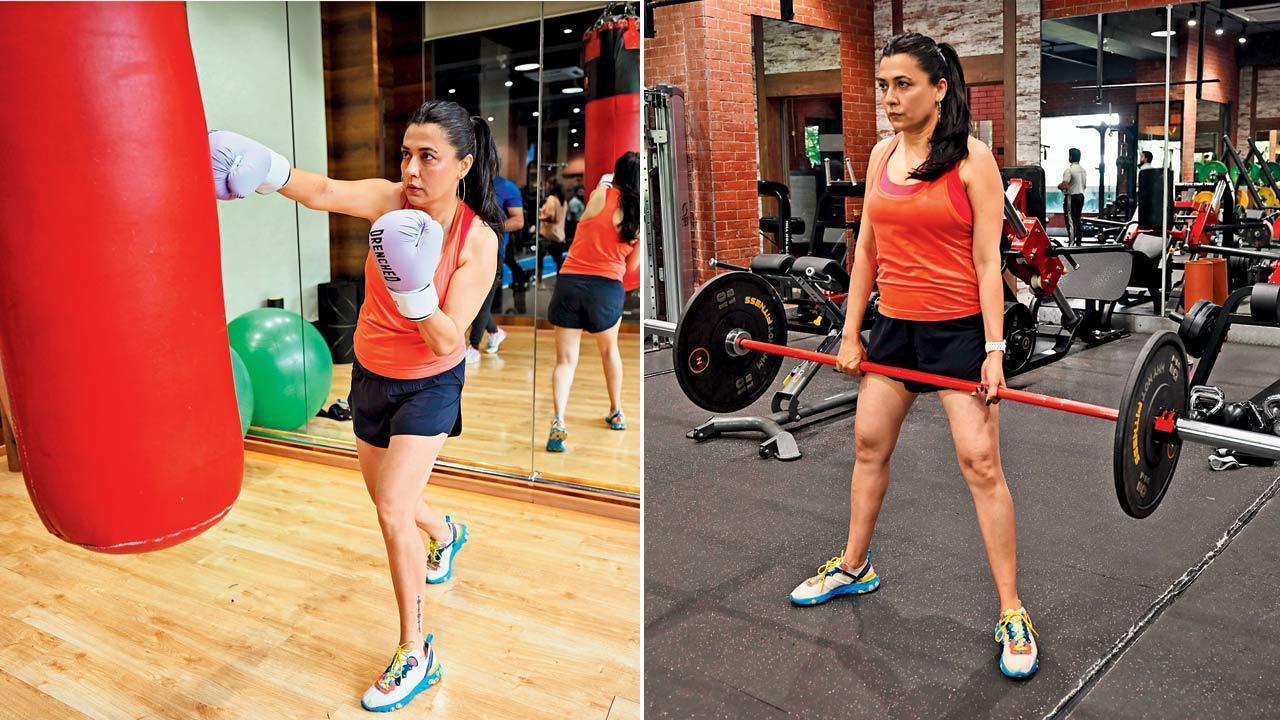
Among the early industry folk to speak candidly about battling perimenopause, host and anchor Mini Mathur opens up on taking Hormone Replacement Therapy, doubling down on her training intensity, and aspiring to help women live a better life
Sonia Lulla (MID-DAY; October 23, 2024)
Several years before she began to experience the first symptoms of perimenopause, Mini Mathur had been advised by a friend who was encountering it at the time. “She told me, ‘Just make sure that when you hit it, you hit the ground running.’ I have held that statement close,” says Mathur, rightly appalled by the insufficient effort that has gone into tackling health-related issues of women.
The television host and anchor may have dabbled in several fitness forms in the years leading up to the age of 50, but it was at that point that she says she “couldn’t recognise my body”. “My knees would hurt, I was gaining belly fat despite not eating too much, and I was having memory loss. I started to feel these symptoms that were alien to me, and that is when I began to research about it.” The interactions she had with her gynaecologists served little purpose. The herbal placebos provided little relief, and so did the recommendations to consume birth control pills.
“I knew that this couldn’t be the solution,” she says, adding, “I felt anger and rage, and if menopause lasts for five years, I knew I couldn’t be living like that for so long. I spoke to my mother and aunts, and they’d respond, stating, ‘We’ve all gone through it. It’s very bad. But what to do?’ But I couldn’t accept that. When I began to research about it, I realized that nobody has focused on women’s health beyond [matters relating to] reproduction and fertility. When oestrogen levels begin to drop, it takes away so much from us, and makes so many changes to our body. The hormone doesn’t only have effects on our reproductive system. It also affects our gut and metabolic rate. I thought it was crazy that the world wasn’t talking about this enough. I think it’s shocking that in an MBBS course, aspiring doctors merely have a two-hour long class on menopause. Can you imagine the little importance [that this matter is given] in the system?”
What Mathur did next reminds us of a news piece that previously hit headlines, when a mother, unhappy with the medical aid that was being provided to her epileptic daughter, sought out to procure a PhD and find a treatment option. “The actual definition of, ‘Fine, I’ll do it myself!’” read a meme on the news piece.
Mathur, in the same vein, was convinced that she needed to be her own guiding light. “I decided to educate myself and found the most comprehensive course in the world for women’s health. It’s an 18-month-long course, and I knew that I would only advise anyone after I had gotten myself certified to do so. I want to focus on telling people about menopause because I need to do something about this. I’ve put together a business plan.”
Mathur’s three-step plan
Mathur was able to address the issue by tackling three aspects. The first thing she did was head to a spa in Austria, where she received Hormone Replacement Therapy (HRT).
“HRT is given such a bad name, with claims that it can cause cancer. Indian doctors are influenced by old research, and I found that many were ambiguous about HRT. They discouraged it, and I kept questioning their decision. When one has a thyroid problem, we provide a [hormonal medication]. When men feel that their testosterone levels are low, they take testosterone, which is also a hormone. So why is it that only oestrogen is a hormone that is demarcated as one that should not be given to women? When I went to the spa, and asked the doctor about HRT, she looked at me and said, ‘What about it?’ I asked her if I could be considered for it, and she said she had already put me on the [treatment]. It was a simple cream that I had been told to apply since a few days prior. HRT involves both oestrogen and progesterone. And I was put on the latter. Both hormones need to be in balance for a woman to feel good. Instantly [my life] turned around. My mood and body felt better, and I was no longer raging.”
Mathur also hit the gym with an intensity that she was, until then, unfamiliar with. “During menopause, your muscle mass [depletes], and bones become porous. So, unless you lift weights, you cannot build bone strength and muscle mass. Your metabolic level [drops to] 30 per cent of what it used to be before you hit perimenopause. So, you have to work much harder to [retain the muscles you have]. Ten years ago, if I trained the way I do today, I’d be a fitness model. I lift more than any other girl in my gym does, including those who are in their 20s. I lift three to four times a week.”
Finally, Mathur revisited the foods she put into her body. Since she was never drawn to alcohol, she found it relatively easy to get rid of it entirely. At the same time, she eliminated sugar, and refined foods, and upped her intake of the “two building blocks”, protein and fibre. Reiterating what has been established by every wellness enthusiast, Mathur encourages individuals to look at their protein intake.
“It is the building block of your muscles. It is essential, especially if you are working out at the gym. If the intake is not adequate, your [muscle mass will deplete] and your effort will be counterproductive.” During the Karwa Chauth celebrations this year, the host and anchor decided to adhere to a 24-hour fast to derive physical benefits from her effort. “I’ve also tried other practices like cryotherapy and infusions of antioxidants. I believe in topping up the body with everything that it lacks. You come out feeling like a new person,” says Mathur, adding that she is now considering undergoing HRT for oestrogen as well.
Mini on a mission
She admits that it is perhaps her husband, filmmaker Kabir Khan’s love for fitness, that has rubbed onto her over the years, but Mathur is now on a mission to help women in need. “I want to make [this knowledge] accessible to every woman. It’s not an urban phenomenon, and I cannot believe that our mothers and aunts had to quietly suffer. Beyond a point, women are made to believe that their opinions are not important, their body is not important, and neither is their size or beauty, because they’ve become mothers and are in their mid-life. That’s bullsh**. That’s why Indian women give up on themselves after a certain time, and wrap themselves in sarees. I want to look toned and muscular, and look like someone who can handle a good run. My family is into adventure sports. We dive, and race with our kids. I want to be active instead of one who can simply fit into a certain gown.”
Mini Mathur and Cyrus Sahukar team up for a show on urban relationships
8:53 AM

Aastha Atray Banan (MID-DAY; June 2, 2019)
"We are in a happy marriage, but are constantly living under fear," says Mini Mathur, as she throws a glance at Cyrus Sahukar, who is sitting across her. "We feel that if we don't work on our relationship, we might end up like our friends, who are divorced. And so, we seek therapy." Mathur is talking about Amazon Prime Video's new original, Mind The Malhotras, adapted from the Israeli show La Familia, releasing this Friday. She and Sahukar play the onscreen couple, Shefali and Rishabh Malhotra, who have three kids — twin girls and a boy.
Directed by Sahil Sangha and Ajay Bhuyan, each episode deals with a different kind of issue that the Malhotras put in front of their therapist — from sex-life problems to Rishabh's annoying mother to dealing with the kids. "It's written in a smart way, and talks of all the pillars of a relationship. What I like about our characters, is that they are regular people. They have all the colourful selfishness, niceness, and weirdness of normal human beings," explains Sahukar.
We are chatting with the two on a hot afternoon at the chic Soho House in Juhu over tea and avocado toast, and it's easy to see their camaraderie. It's VJ/presenter/emcee Mathur's first outing as an actor, and she has long-time friend Sahukar along for the ride. "We came to Mumbai on the same flight decades ago, when we both got a job at MTV. I have known Cyrus since his 17th birthday, so when I heard he was going to play my husband, I had to say yes. When we tell each other, do it this way, there is no malicious intent. It's about making it better for each other."
Sahukar is no stranger to comedy, especially if you remember his avatar as Semi Girebaal. He, thus, became a perfect fit for Rishabh, who he describes as the good guy. "He doesn't really get his family, but he wants to. He wants to do the right thing. Mini was a perfect Shefali, because she is a doer in real life, and in the show as well. If you can marry character to a personality like in her case, there's nothing greater than that," he says. Mathur adds, "It was so good to have him around. One day, someone shouted loudly before a shot, and I was flustered. I asked him 'how do I get back to being in a 'funny' mood now?' He wasn't even bothered! I had to step out, breathe and come back."
The show also offers a funny take on modern marriages. "When the therapist tells them to talk, they figure that they have very little to talk about," says Mathur. "It's like 'I like you, but I have nothing to say'. I don't think it's even about marriage, it's about every relationship. It's the anxiety a couple is faced with, when a TV series they have been watching together, ends," says Sahukar with a deadpan face, as we all crack up.
Ask them what they brought to the show from their own personal experiences, given that Mathur has been married for 21 years and Sahukar has been in a serious relationship for six years, Mathur says, "One of the reasons I jumped at the idea of playing Shefali was because she is so relatable. I asked the makers 'have you put a CCTV in my house?' We did extensive readings of the characters and we have actually put our own filters there. I have said 'I don't think Shefali will react like this'. We are not exactly the same people, but we tried to make it more real and 3D."
But is the show going to make sense to a society, which is constantly getting put off by the idea of love and marriage? In a cynical world, it could be hard selling a story of two people trying to work it out. Mathur is a firm believer in marriage, and says, "I feel there is a merit in love, and that's why the show is so special. Nobody is made for each other, but it's constant understanding. It's not easy, and I have seen people who are lonely, and that's no fun. It's always nice to be in a symbiotic relationship."
Sahukar immediately interrupts, "Of course, it's going to be difficult. You can't even like yourself all the time. How will you like someone else for 50 years?" In the end, all they want is for the show to find resonance with the audience. As Sahukar sums it up, "It's been a lovely experience trying to get it out — like life actually, sometimes it's down, sometimes it's up, and sometimes you get it right!"
Me & Kabir Khan look like Abbas-Mustan - Mini Mathur
3:31 PM

Director Kabir Khan and actor-VJ Mini Mathur on how two strong, highly opinionated individuals can maintain the equilibrium at home
Roshmila Bhattacharya (MUMBAI MIRROR; July 5, 2015)
They walk out of the elevator together, both dressed in white. And like any long married couple, they don't realise that they are perfectly colour coordinated till they are facing the camera when Mini Mathur turns to her husband Kabir Khan and exclaims, "We look like Abbas-Mustan!" Focussed on pulling down the blinds to ensure that the light is right, he's unfazed by her observation.
Khan was freelancing as a cinematographer and making documentaries when he met Mathur, a TV host, in Delhi. A Film and Television Institute of India (FTII) graduate, cinema was on the horizon but still a distant dream. However, soon after they were married, Mathur received an offer from MTV and moved to Mumbai. For a year Khan shuttled, living like a gypsy then, since it made little difference to his international clients where he lived, moved to this city. It was a soft landing.
"There was no 'struggle'. We didn't sleep on the railway platform under the lamp post but under the roof of the house we'd bought," laughs Mathur. "Social networks were in place and we just melted into the pot, which was already brewing."
Khan continued making his documentaries. Two of them, Taliban Years and Beyond and The Titanic Sinks in Kabul, took him to Afghanistan, put him in contact with militants and laid the foundation for not just his first film as director, Kabul Express, but also the one which would follow, New York. And for that, he has his wife to thank.
Mathur was hosting the two month Lagaan world tour and insisted her husband join her. So on September 9, 2001, Kabir landed in New York, joined his wife in Dallas the next day and from there they went to Atlanta on September 11; the day the World Trade Centre went down.
Khan and Mathur, along with the other guests, were herded out of their 40-storeyed hotel till all the planes had been accounted for. Then it was a 14-hour bus ride to Houston where they camped out for a week till the tour and flights resumed. At every airport, over the next month, a new story unfolded.
"Seven of us, including Ali, Kareem and Mohammed Morani, Mazhar Nadiadwala, Bunty Walia, Mini and I, were flying from LA to Washington, DC with 11 other passengers. The plane stayed on the tarmac for 40 minutes before some stereotypical FBI agents walked in and started interrogating us," recalls Khan.
He's still relieved that while the Feds asked about Pakistan, which he has never visited, they didn't mention Israel, Bosnia or Afghanistan which he had, in the course of his travels along with journalist Saeed Naqvi. They were eventually cleared, but a passenger who had complained, resulting in the interrogation, still refused to fly with them and disembarked. "The plane took off after five hours and I continued to be picked up by the Feds for random questioning, triggering off the idea for New York," says Khan.
When he was to travel to shoot the film, Khan was denied a visa and the immigration lawyer he hired told him that his file was with federal authorities who'd raised flags because of his Taliban and Afghanistan connections. They feared that since he was a Muslim, he could be "compromised". Khan countered such assertions with a film, New York. The wheel then came a full circle: he received a call from President Barack Obama's Under Secretary who told him to contact her if he ever had trouble entering the US again.
"His experiences have made Kabir plant all his films in a real backdrop and address questions related to international hostility and peace," says Mathur, pointing to the upcoming Bajrangi Bhaijaan, which revolves around a man intent on reuniting a six-year-old child with her mother across the border.
Question her on any changes she has noted in her husband and Mathur points out that in all these years, he'd grab the newspaper to scan the headlines and international politics. "Now I see him sometimes flipping through the Bollywood pages too and tell him, 'Boss, you have become filmi!'" she laughs, stopping her husband when he tries to butt into her answer.
However, she insists he's still shy but just as secure as he was when she, as an MTV VJ, was more in the spotlight. "He enjoyed my success then, now I'm enjoying his, it's our success at the end of the day and makes us happy," she smiles.
Today, after 18 years of skittering about, Mathur has eased up. She'd rather be with her children. "Kabir took care of them when I was touring the country for Indian Idol or when I was shooting Iss Jungle Se Mujhe Bachao. I'm not going to waste my time reading lines from the teleprompter or watch a Bollywood star being paid Rs 2 crore for the TRP he or she might bring in. I'd rather focus on the film script I've been threatening to write for so long," she says.
She won't give up any more. All she'll say is that since she's a "people person", her script will be "full of human emotions and drama". Will Khan produce it? He quickly points out that while they've always been each other's sounding board, and have even collaborated on two documentaries - one on successful NRIs in England and the other on hand pump mechanics in Banda - they've decided to give each other all the support but also space and not work together.
"I've never taken any career decision without consulting Kabir, who will always be my go-to person if I ever make a film. And I know I'll always be the one he shares every stage of the filmmaking process with, but it's better for the marriage and our kids if we don't bring the work stress home. I've heard too many nightmarish stories of couples who have worked together," Mathur says.
Khan adds that even though they have similar ideologies and tastes in cinema, they are both driven by strong convictions. "So it's better to have two parallel worlds with a great deal of overlap but not without complete juxtaposition," he asserts.
Subscribe to:
Posts (Atom)