Showing posts with label Meghna Gulzar interview. Show all posts
Showing posts with label Meghna Gulzar interview. Show all posts
The core of my existence remains my daughter, Meghna-Gulzar
9:36 AM

Natasha Coutinho (BOMBAY TIMES; June 13, 2024)
Gulzar’s home in Mumbai is called Boskyana, and it’s named after his daughter Meghna, whom he lovingly calls Bosky. “The core of my existence remains my daughter,” says the celebrated poet, lyricist, screenwriter and director, who was feted with the Jnanpith award earlier this year.
“I had already imagined becoming a father to a girl child much before she arrived. Once she was born, she became the apple of both our eyes – her mother Rakhee and me. Rakhee was a working mother, and I would take on the role of both a father and mother when she was away on shoots. I believe there is a strong maternal side within me. I remember how she was upset with her caretaker on one occasion because she wanted two plaits. This is why I learnt to braid her hair,” remembers Gulzar, sitting in his cosy library, sipping on green tea.
When it was time to put Meghna in school, she was taken to a kindergarten that she loved so much that she didn’t want to leave it, though other schools were available in the Bandra-Khar area.
Gulzar shares, “We decided to admit her there. Later, I found that it was run by actor Pran’s daughter. I also loved taking her along to buy books – be it from the stores or on the pavement. Once, when she was still a child, she confidently asked the shopkeeper if he had Hans Christian Andersen’s book of fairy tales. The man was surprised that a child was familiar with the author’s name!”
Talking about how Meghna grew up to become a confident young woman, who made her own decisions, he says, “She and her friends decided to join St Xavier’s College and her mother was worried how she would travel. But she learnt to take the train instead of going by car. I wish she had taken to sports, but her interest lay in dramatics. She also met her then-boyfriend and now husband Govind during that time. Like the daughters from film families, she started getting movie offers, though she wanted to complete her studies. I found out about her interest in filmmaking after she started assisting Saeed Mirza,” he recalls.
When it came to going abroad, Meghna had already decided on an institution and did not allow either parent to recommend her anywhere. “Both she and Govind moved to America. Both Govind’s parents and we knew they would marry someday and did not pressurize them,” Gulzar says.
He will turn 90 this year, but the ability to see the humorous side of life hasn’t left Gulzar. “There is the famous story of the cat and the tiger. The cat teaches the tiger all sorts of survival skills, but finally, the tiger pounces on the cat. Seeing the danger, the cat climbs a tree and escapes – and the tiger realizes that he’s not been taught this skill. Meghna learnt all the other skills I have on her own, but even today, when it comes songwriting for her films, she comes to me. She does not let me read her scripts before they are ready, but I’m proud of her journey from Filhaal to Sam Bahadur. The best gift she has given me is my grandson, Samay Gulzar Sandhu,” he tells us.
I am a headstrong director, and as a lyricist, my father always offers me that space: Meghna
“Though both my parents are famous people, I’ve had a very normal upbringing. It was nothing like today’s celebrity kids. They were always very present, and I never felt that either of them was not there for me. It isn’t easy for a father to raise a daughter, but he would tie my sash and do my pigtails just the way I wanted them. He would hold me from the back when I went cycling down the slope… these are precious memories. My parents raised me in a way that I could make my own choices and live with them. It was equal parenting and positive reinforcement – that’s how I would describe it,” says Meghna.
She adds, “Though my father writes my film’s songs, he keeps egging me on to write my own songs. I think in English, so when one of my films needs lyrics in English, I do my own writing as well. I am a headstrong director, and as a lyricist, he always offers me that space and courtesy. I hope my son, Samay, imbibes the same values, though he is developing his own personality. Samay and he share a unique bond that’s independent of me or my husband.”
Irrfan Khan’s questioning mind has stayed with me, I hope I can emulate it-Meghna Gulzar
8:01 AM

Meghna Gulzar, who directed Irrfan in Talvar, shares memories of the actor from her multiple meetings through the years, and how his questioning mind has stayed with her through the years
By Meghna Gulzar (BOMBAY TIMES; April 23, 2021)
‘HE ALWAYS IDENTIFIED WITH HIS ROOTS, NO MATTER WHERE HE TRAVELLED & WHAT WORK HE DID’
From whatever I understand and know of him, Irrfan sir’s philosophy and nature was to keep things simple and unassuming. He always remained rooted and identified with his roots, no matter where he travelled and what work he did. Whether he was doing an international or an Indian film, commercial mainstream or independent film or any other, he was intensely rooted to the person he was. That is the most special and endearing thing about him that everyone will remember him for.
‘FOR HIM TO PUT HIS TRUST IN ME AS A DIRECTOR & AGREE TO DO MY FILM IS A MEMORY I’LL CHERISH’
I was tremendously in awe of him. I got the opportunity to work with him at a time when my career was not flying high and he was an extremely celebrated actor, well known for his craft. For him to put his trust in me as a director and agree to do my film will be the most cherished moments of my life and career. Talvar was a rebirth for me as a filmmaker, and Irrfan sir being in the film was a big part of that. Apart from that, when we collaborated on Talvar, the relationship we shared was precious, it was extremely professional. It was a tricky subject. Not just as an actor, but even while discussing the case, he would throw questions at me, making me constantly question the knowledge I had and not get complacent at any given point – even though the script was locked and we were shooting. The way his mind worked, and therefore forced my mind to work and to question the alternative, was a precious learning experience for me. role & when he performed, you couldn’t say Irrfan sir was acting
‘THERE WAS NO OFF-THE-SET EQUATION WITH HIM BECAUSE OF THE SHEER AWE I FELT’
I can’t say consciously which part of his personality rubbed off. Unfortunately, our conversations and our equation was limited to working on the film. There was no off-the-set equation with him, not because of anything else, but the sheer regard and awe I felt. I could never think I could have a friendly dinner or a heart-to-heart with him. What has stayed back with me is his questioning mind which I hope I can emulate when the time comes.
‘THERE WAS SERIOUS HARD WORK BEHIND THE SMALL GESTURES, THE TWITCHES, THE CASUAL ONE-LINERS OR REPARTEES’
I met Irrfan sir on and off on my father’s (Gulzar) set when he was playing a part in an episode of Kirdaar. I met him in Vishal (Bhardwaj) sir’s office intermittently. But the first one-on-one conversation I had with him was when I met him at his home for the first time after we had given him the script of Talvar. We spoke about the case; he asked me for my perspective and I asked him for his. It’s ironic that he went through the film, played the CBI investigator and till date, I don’t know what his stand on the narrative, the case is. I know he was proud of the work we had done and the product we had put out, but what was going on in his mind is still a mystery to me. And there was so much going on inside but it all looked simple when he executed it on screen. That is where the unassuming part comes into play.
There was so much nuance and understudy that went into every role and when he performed, you could not say he was acting. The performance was natural, so much so that it made you believe this is how he laughs, gets angry or cries. That’s the facet of him being unassuming as a person but there was serious hard work that went behind the small gestures, the twitches, the casual one-liners or repartees. It never came off the cuff. It all looked effortless and natural when it came out and one could never call it a performance. But it took a lot of research, deep thinking for him. That is what is special about him.
— As told to Rachana Dubey

I couldn't have Vikrant Massey do things that you'd associate with a filmy hero-Meghna Gulzar
8:55 AM

As Vikrant Massey's understated character in Deepika Padukone-starrer Chhapaak wins praise, director Meghna Gulzar discusses writing sensitive parts for men in times of machismo-driven films
Mohar Basu (MID-DAY; January 12, 2020)
 "I did not make this film to specifically give out a message to the men," begins director Meghna Gulzar whose Chhapaak—that highlights an episode of violence against women—has opened to rave reviews. The human drama may be a Deepika Padukone show all the way as she brings alive the story of acid attack survivor Laxmi Agarwal on celluloid, but the deft treatment of Vikrant Massey's character too has earned praise. Through his part, that is modelled on Alok Dixit (Agarwal's partner), the writer-director has given us a strong yet sensitive man, who joins Padukone's character in her fight against the sale of acid.
Ask her if women filmmakers weave more empathetic male characters as they mirror their own projections of what they hope from the men in their lives, and she says, "I don't have the lens for gender. If you can speak to humanity at a generic level, the gender issue will sort itself out. I have been fortunate to write and direct male characters that are noble and sensitive. With Vikrant, we were guided purely by the story we were telling, the real-life reference and the sensibility of the writer and filmmaker involved. I couldn't have Vikrant do things that you'd associate with a filmy hero. Such [supportive] men also exist as much as those we show on screen."
The writer-director has a knack for creating male characters that are refreshingly divorced from the macho parts that Bollywood often churns out. In her last offering, Raazi (2018), Gulzar brought depth to the role of Iqbal, that was enhanced further by Vicky Kaushal's performance. As a Pakistani major who discovers that his wife is an Indian spy, the character of Iqbal was valiant, yet vulnerable. She emphasises, "The acceptance that Vicky's character got proves that there's appreciation for characters that are not larger-than-life heroes. These are real men, and we have to celebrate them."
Acid is going beyond crime against women; even men are being attacked-Meghna Gulzar
8:52 AM

Kavita Awaasthi (HINDUSTAN TIMES; January 12, 2020)
“Chhapaak is an important story and we are all encouraged with the love being showered on us,” says director Meghna Gulzar about her recently released film, which she co-produced too.
While the film is based on acid violence, the issue of women’s safety in India is a burning issue, too. The filmmaker hopes that her film will contribute to the conversation and make people aware about acid attacks. She says, “There is a lot of awareness on sexual assault and rape, which are crimes of violence against women, but acid violence, although it is rampant in our country, there is lack of awareness about it. Acid is going beyond crime against women and being weaponised. Men are being attacked and property disputes end up in attacks. Let’s hope this film starts a conversation on what could be probable solutions.”
They say life imitates art and vice versa. Moreover, how impressionable people get influenced by crime depicted in films or the tube, has always been debated. The filmmaker gives her take, “The sensibility and intent of the presentation is important. Are you going to glorify the crime or the consequences? That approach is critical.”
While her movies, Talvar (2015), Raazi (2018) and Chhapaak have some elements of crime, Meghna says she was never interested in the genre, but has just stumbled into it. “I wrote Chhapaak after Talvar but I shot Raazi. After Raazi, I wrote the script on Sam Manekshaw but made Chhapaak. Scripts have their own destiny. My films straddle two-three genres — such as crime-thriller, social drama, police procedural. I want to give my audience a fuller viewing experience with many elements,” she says.
Meghna, 46, reveals that even before casting Deepika Padukone in Chhapaak, she was impressed with her acting abilities. “I saw her in Om Shanti Om (2007), which is one of my favourite films, and Farah Khan is one of my favourite filmmakers. I love the reincarnation theme that Indian films have and I have loved watching Karz (1980), Madhumati (1958), Karan Arjun (1995). For Deepika, to play a double role in her debut was impressive. She was hilarious in Chennai Express (2013) and adorable in Piku (2015). I was aware of her calibre, but she lived her character and became Malti beyond the transformation,” she shares.
Meanwhile, she is happy with the reception. She says, “It feels nice when your work gets validation, whether it is from actors or producers... the fraternity sending text messages that they loved your work. That pat is very reassuring. Every filmmaker needs validation.”
Why Meghna Gulzar can’t afford to have a ‘relaxed shooting atmosphere’
8:00 AM

Prashant Singh (HINDUSTAN TIMES; December 23, 2019)
She started her directorial journey with films such as Filhaal (2002) and Just Married, followed by the anthology feature, Dus Kahaniyaan (both in 2007). But when Meghna Gulzar returned to the director’s chair after a gap of eight years, she turned her attention towards gritty cinema such as Talvar (2015), Raazi (2018), and the upcoming Deepika Padukone-starrer Chhapaak.
Ask Meghna about her penchant for hard-hitting films, and she says that a subject’s difficulty “makes me bring out my craft better”. She explains: “Somehow, since Talvar, I feel that’s what has happened. In Talvar, for the first time, I was doing a non-fiction, gritty, murder, investigative thriller.”
On one hand, the [film’s] world was “completely different” for her, and on top of that, she was “making a comeback to films after a long time”. She says: “That’s why even the filmmaking process was different. Technology had changed and the team was also new. So, all the odds that could be stacked up against me were there. And I think that made me work harder, which, I feel, showed in the film as well.”
The director feels it all “helped the film and made it better”. She says: “That’s when I realised that the secret is that I need to work hard. I just can’t afford to have a luxurious, relaxed shooting atmosphere (smiles),” says Meghna, adding that since she has a “great team”, it helps her a lot. “I have had the same set of professionals for the past three films. And we are in absolute sync with one another. Be it Talvar, Raazi or Chhapaak, these films require tough shoots. But somehow, that intensity translates to magic on screen,” she says.
Coming to her next, Chhapaak, Meghna feels roping in a big star such as Deepika can go a long way. “Every film has its own destiny. But casting Deepika was significant since the amplification of how horrific this [acid attack] is becomes that much more when you see a face like Deepika’s get disfigured. And hats off to Deepika for taking it head on! In this film, she has shed everything that she is known for — the way she looks, the glamour, opulence and the set-up, the hair, makeup, costume or the jewellery. She is just with her craft,” she says.
And without any doubt, the presence of a top name also widens the reach of a film. Meghna, too, agrees. “At the end of the day, why are we making this film? Because this is something that we want people to know about. And if her being a star widens the reach, it’s great,” she says.
I’ve been making films for 20 years; I fit in now-Meghna Gulzar
7:18 AM

Meghna Gulzar on out-of-the-box choices, her heroines and heroes, and why mother Raakhee and son Samay have yet to see her next directorial
Roshmila Bhattacharya (MUMBAI MIRROR; December 13, 2019)

She’s one of those rare people who text to inform when they’re running late. Then, she gives you all the time in the midst of hectic post-production for a freewheeling chat. Excerpts:
This industry is all about glamour and you’ve taken one of its biggest names, Deepika Padukone—her last film, Padmaavat, was about a Queen known for her beauty—to play an acid attack survivor. What was her first reaction to her prosthetic look in the film?
It takes courage to discard your calling card and bare yourself completely. When you are shorn of all the usual trappings - hair, make-up, costume, jewellery—with only your craft exposed, it’s a brave path to walk and Deepika has done it with flourish. For me, it was important to take a face associated with beauty because when you distort it, like it would happen to a survivor, the contrast and impact is far stronger. Not everybody is Deepika Padukone, but these other girls were beautiful too and didn’t deserve this to happen to them. No girl deserves it going forward. I’m fortunate Deepika agreed to play the part. During our research, we discovered that Laxmi Agarwal’s pictures before the attack are strikingly similar to Deepika’s when she was young. There is an uncanny similarity in their physicality which shows up in the prosthetics. That was my starting point. Then came the larger thought of the impact of the message which would get magnified with her in the lead as Malti (who is fashioned after Laxmi). The idea wasn’t to make Deepika look like Laxmi, but to make her look like what she’d have looked, God forbid, if something like this happened to her. The essence of Deepika is still there, particularly in her eyes.
What was your first reaction to the trailer?
When the first cut came out, it was interesting to see someone else’s interpretation of the film and heartening that it reflected the spirit of the girl. And since it came on its own, I felt that if the film is emanating this, we are in a good space.
One of your earliest gurus, the one with you at each step, is your father. Has Gulzar saab seen the film yet?
Like always, I’d shared the script with him; he saw a preliminary version of the trailer and the off-line edit, and got all emotional and teary-eyed. For me, it’s hard to tell if his reaction was coming from the film or because I had made it. He can be terribly biased, but I’m happy my parents are proud of my work.
So, your mother, Raakhee ji, has seen it as well?
My mother does not like to see a work in progress. She has just heard the songs and is waiting to watch the complete film. When the first copy comes out, that screening is hers.
Filhaal, Talvar, Raazi, Chhapaak… As a filmmaker you are climbing the ladder...
I’m nothing but the stories I tell, and as the stories get more challenging, I push myself more as a writer and a director, so my craft is up to the story I’m telling. I want to be a better version of myself. I don’t want my audience to ever come to see my film with certain expectations and be disappointed. Staying at the same level is stagnating and coming down is not an option.
After years, the Talvar case got a verdict. Acid attack laws have become more stringent since you decided to tell Laxmi’s story. How does it feel when stories you picked up from real life come a full circle and find culmination legally?
I don’t think there can be a better reward or validation. If the sense of a film lasts only as long as a box of popcorn, it’s a humungous waste of so many people’s time, effort and money. There needs to be larger resonance. Unfortunately, our idea of entertainment is so narrow that it’s become only about making the audience laugh. But I can make them laugh, cry, feel angry and disgusted, and still engage them. And if through this journey of emotions, some larger purpose is served, nothing can be better.
It was surreal when on a recce for Raazi, I got the news of the High Court acquittal of the Talwars. I broke down. Even though Talvar was a success because of the nature of the subject, we couldn’t celebrate. I got to experience such intangible rewards which will never go away.
Have you met Rajesh and Nupur Talwar since? Have they seen the film?
We are in touch, but I haven’t met them. Nor have I had the courage to ask them if they’ve seen the film because for them it would be reliving the worst chapter of their lives.
Has Laxmi Agarwal seen Chhapaak?
Both Laxmi and her partner Alok Dixit have, and they loved it. Back in 2016, when we landed in the world of acid violence, it took a while to find them, then, break their cynicism. Film people and the media are not looked at with much regard. Also, Laxmi was far more introverted then. It took a while to win their confidence and convince them that we would not trivialise their story.
The film isn’t even a biopic, we are just using Laxmi as an anchor to tell a larger story about an issue. Once they agreed, we got them to Mumbai and for two-three days, we were holed up at my workplace. She narrated her life story which I recorded, asking specific questions. Then, I met her father’s employer who was critical in getting her medical and legal help, her lawyer and surgeon to get the technical details right, after which Atika Chauhan and I wrote Malti’s story which we shared with both.
How is Deepika, the producer?
I didn’t give her much time from being an actor, but now, this journey from filmmaker to viewer is critical for any film, particularly a film like this, and she’s hands on. She attends meetings, throws ideas around; that investment is special.
Did the commercial success of Raazi make it easier for you to make Chhapaak?
Even Talvar was extremely successful in terms of its budget and the money it earned, and so it was easier to make Raazi which made it easier for Chhapaak. The change largely happened because of the shift in the kind of films we are making today. Actors, studios and producers are getting more experimental in their choice of content.
In this scenario, what’s it like to be a filmmaker?
I feel relieved. I’ve been making films for 20 years, now I fit in. In the last five-seven years, we’ve upped the game. Regional cinema is blossoming too, that’s inspiring.
It must feel great to collaborate with actresses like Tabu, Konkana Sen Sharma, Alia Bhatt and Deepika who could have got lost in song-anddance routine, but have chosen their films with care.
I feel blessed they trusted me. They are women of pedigree, known for their craft. By the end of the first draft, I usually have an actor in mind and if not them, I can’t think of an alternative. I’ve not yet faced a situation where I had to do without the one I wanted.
It’s easy for a woman director making women-centric films to talk only about women. But the men, be it Irrfan Khan in Talvar or Vikrant Massey in Chhapaak, have played an important role too.
Oh yes, I’m grateful to them and to Vicky (Kaushal) for Raazi and Sanjay (Suri) for Filhaal. The choice was even more difficult for them, but thank God, they trusted me or these films would have never got made. These men, as actors and characters, are bigger heroes.
You also have a real-life hero in your husband Govind...
Yeah, and my husband reacts to my films like my father, getting all teary-eyed. We’ve been together for 25 years, he feels proud that the little girl he dated in college is doing this kind of work. And since I can’t see myself without the work I do, it’s great to be able to do it with complete ease of mind, knowing he is fine, my son is being looked after and that when I come home, there’s respect for what I do. I would wish this for every woman, even homemakers because running a house can be a nightmare, yet goes unrecognised.
Has your son, Samay, asked questions about your films?
Unfortunately, he hasn’t seen any of them because he’s not yet 10. When he is 13, I’ll show him Raazi first. I really want him to see what takes me away from home. One day, he asked me why I can’t make a children’s film and it struck me then that we pass off our popcorn entertainment to them.
Raising kids doesn’t just mean giving them pocket money and a cell phone. Their social and cultural nourishment is completely depleted today and they are the future generation. Right now, my mind is in a space where I want to tell difficult stories but maybe one day, I’ll make a film for children; a nice, happy story.
The Field Marshal Sam Manekshaw biopic, with Vicky Kaushal is your next, right?
Yes, we start in 2021, I need a year of prep and some downtime with my family. I’m looking forward to reuniting with Vicky. Some connections that you make transcend the job. I remember I just called Vicky and asked him where he was. When he said he was 10 minutes from my place, I invited him over and offered him the film. He confided then that hearing my stories of the Field Marshal during Raazi, he had wished he could play the part. Then, he saw his picture and discovered he was very fair and was convinced it would never come to him.
Vicky didn’t even want to read the script, just said he was doing the film. He was going to New York, I insisted he read it on the flight. Such trust is precious. This whole journey is about winning the trust of actors, producers and the audience. That’s the biggest earning.
You are coming up against Ajay Devgn’s Tanhaji. Doesn’t that make you apprehensive?
Today, it’s impossible to aspire for a solo release. Talvar came with Singh is Bliing and Haider with Bang Bang. We are a population of over a billion people. Surely, two films can share an audience?

It is a nice coincidence that trailer of Chhapaak is releasing on World Human Rights Day-Meghna Gulzar
8:25 AM

Hasti Doshi (BOMBAY TIMES; December 7, 2019)
 The upcoming film Chhapaak starring Deepika Padukone is based on a real-life incident. The actress is playing a role inspired by real-life acid attack survivor, Laxmi Agarwal, in the film. The makers have decided to release the trailer on December 10, 2019, which is recognised as World Human Rights Day. Talking about this co-incidence, Meghna Gulzar, who is helming the film, said, “It is a nice coincidence that the trailer of Chhapaak is releasing on World Human Rights Day. The story is about the act of acid violence, which violates the life of victims both physically and mentally, thus, taking away their right to life. I couldn’t have asked for better synchronicity of the day for the release of the trailer. This actually was not on our mind, but now that this has happened it’s like a higher-order alignment working out and I am extremely grateful for that.”
Deepika was apparently the director’s top choice to portray this real-life character on screen. Explaining her reasons for it, Meghna said, “For me, Deepika was the right fit for this role. Firstly, for her physicality, as there is an uncanny resemblance between Laxmi and her. Also, I have seen Laxmi’s picture before she was attacked. Secondly, as an actor, the craft that Deepika brings onto a film is very critical for me and the film. That was the kind of performance that was required. I don’t think that I would have made the film without her as I don’t see who else I could have cast for this movie.”
A subject’s difficulty makes me work better-Meghna Gulzar
8:24 AM

Prashant Singh (HINDUSTAN TIMES; December 7, 2019)
Back in 2016, when Meghna Gulzar first met Laxmi Agarwal [an acid attack survivor], the filmmaker found her “far more introverted and closed as a person” than what she is today. “She was nowhere in the limelight,” says the filmmaker. Now, of course, Laxmi is an undaunted picture of strength and resilience. And, also the inspiration behind Meghna’s next, Chhapaak, starring Deepika Padukone in the lead role.
“I literally searched for her. At that time, I was looking for subjects after Talvar (2015). So, when I came across a few such incidents [of acid attack], it got stuck in my head that this is happening and there’s a world of these girls, who’ve been attacked by acid, or are acid attack survivors. And we don’t know much about them. More than knowing, it’s to understand why it happens and how it can be prevented. Actually, in a way, it is life worse than death,” she says.
Interestingly, when Meghna along with her co-writer were working on the film’s script about three years back, they had “secret thoughts” about having Deepika on board. “But we’d both never say it aloud (smiles). It seemed implausible that she’d do such a film,” says the filmmaker, adding that when she looked at Laxmi’s pictures before the attack, she saw “an uncanny similarity between her and Deepika.”
She explains: “When I finally met and told Deepika that ‘this is the story, subject and issue,’ she spontaneously said okay to it, at that very moment. She, though, said that she really wanted to do something light after three-back-to-back intense films.”
As for Meghna, after delivering back-to-back hits like Talvar and Raazi (2018), as she readies for Chhapaak, is there any pressure on her? “Honestly, it’d be stupid and dishonest to say that it doesn’t affect you. But would I prefer if people didn’t have any expectations? No. And would I want people or trade to expect a good film out of me? Yes, and I’d work for that. My core intent is to just tell a story, and share what I have learnt, with the audience, with as much honesty as possible. No one sets out to make a failure. At best, you can endeavour that it’s a financially-viable project. But the cost of a film shouldn’t be its burden,” she shares.
Another hallmark of Meghna’s career has been her penchant for taking up challenging subjects. “I think the difficulty of a subject makes me work better and also brings out my craft better,” she smiles.
Or it could be all due to Meghna’s genes, being the daughter of filmmaker-poet Gulzar and senior actor Rakhee. What has been her father’s biggest influence on her? “I’m exactly aware of what his influences have been – it’s simplicity and brevity. Kam mein badi baat keh jaao. These are a few principles I’ve consciously tried to include in my skill set,” she adds.
----------------------------
Working with her mother Rakhee
“I don’t think I need that baggage on the sets (laughs). I’m not, in any way, undermining her talent at all. But if I see something differently [with regards to the part] and I want it to be done that way, how would I tell her that? Isliye nahi ho paayega. I had a story swirling in my head at one point, with her. But the beauty of it is that neither am I consciously working towards it neither is she manoeuvring to make it happen. Hoga toh hoga.”

Raazi was an affirmation that Talvar’s success was not a fluke-Meghna Gulzar
2:27 PM

Niharika Lal (BOMBAY TIMES; November 27, 2019)
 Speaking at a session on filmmaking at the 13th edition of Film Bazaar, organised by the NFDC on the sidelines of International Film Festival of India (IFFI), Meghna Gulzar discussed how Talvar ended “15 years of failure” in her career, being compared to her parents and why she doesn’t like the tag ‘womencentric’. Excerpts:
‘TALVAR WAS A SUCCESSFUL FILM, BUT WE COULDN’T CELEBRATE ITS SUCCESS’
Meghna’s Raazi (2018) bagged Best Film at the 2019 Filmfare Awards, and she also got Best Director award for it. However, Meghna said that Raazi was just an affirmation of her previous work. “For me, the move away from past failures happened with Talvar. It was very peculiar, because Talvar was the kind of film whose success you couldn’t celebrate as it was talking about the tragedy of a family (the Aarushi Talwar murder case). The film was successful but there was a mother and a father (Aarushi Talwar’s parents) who were still in jail. We really couldn’t celebrate the success of Talvar. We were on a recce for Raazi when I got the news that they have been acquitted by the High Court; that is actually when we celebrated the success of Talvar. Raazi was just an affirmation that Talvar (it’s success) was not a fluke.”
‘MY FAILURES WERE MORE DIFFICULT FOR MY PARENTS’
Meghna shared how despite doing very different kind of cinema from what her father Gulzar did, she had to deal with comparisons throughout her career. She said, “There are certain similarities and sensibilities, but otherwise, our cinemas are very different. It took a while for me to gain independence of my cinema. Then again, there was a comparison between children of other filmmakers who were extremely successful.”
Meghna shared that more than her, her failures were more difficult to handle for her parents, Rakhee and Gulzar. She said, “Honestly, if the first 15 years of my career were a failure for me, they were probably 10 times more so for my parents because they were so successful in this profession. To feel that helplessness because there was really nothing they could do to help me was more difficult for them. So (after Talvar) when they were at peace that now there is professional success, that was the biggest validation for me.”
Giving advice to budding filmmakers, she said, “Have conviction in the story you want to tell, rest everything is a byproduct. There were days when I couldn’t do it, I couldn’t stomach the failure anymore. But then you open the document and start writing again.”
 ‘THE STORIES I CHOOSE ARE BEYOND BEING JUST WOMEN-CENTRIC FILMS’
Sharing that she isn’t in favour of branding films as ‘women-centric’, Meghna said, “We all should aspire to be humanists, because if we talk about equality, it is as much equality for a man as for a woman. A film set is extremely gender-neutral. We have female assistants in all departments, female technicians and cinematographers who do the heavy lifting. Nobody is going to hold an umbrella for them, nobody is going to give them a handkerchief to wipe their sweat. Even the stories I choose are beyond being just women-centric films.”
Talking about her upcoming films, Meghna said, “My next film Chhapaak is the story of an acid attack survivor. I have also announced my next film, based on the life of Late Field Marshal Sam Manekshaw. Just because Raazi was a success, I can’t keep making the same kind of films. I have other stories to tell. You need to constantly try and be a better version of yourself.”
‘EXECUTION OF PSAS, LIKE ANTI-SMOKING VIDEOS PLAYED IN CINEMAS, IS OF VERY VERY LOW QUALITY’
At the session, TCA Kalyani, MD, NFDC, asked Meghna, “PSA films, like the no smoking ads that play in cinemas, often contain horrific images. Since your next film is on acid attack survivors, is there a way to make these PSA films look more appealing?”
To which she replied, “Of course, sensibility is very important. These PSA films look like they have been made with disinterest and almost no funds, which is not the case. It’s just that the execution is of very very low quality. Even the National anthem video... I really think that our National Anthem merits better visuals, better audio, better rendition.”
Giving examples from her films, Meghna added, “Talvar had scenes showing throats being slit and yet it got certified as U/A and with no cuts. So there is an aesthetic with which you approach it. I want people to see Chhapaak because it is an important subject. I don’t want people to look away from the screen. I want to make sure that the story reaches the people. There should be enough to disturb but not so much that it is rejected.”
For me, Malti is Deepika Padukone and Deepika is Malti-Meghna Gulzar
8:11 AM

Meghna Gulzar says her film is an attempt to shed light on the issue of acid violence in the country
Himesh Mankad (MUMBAI MIRROR; June 7, 2019)
 On March 25, Deepika Padukone started shooting for her maiden home production, Chhapaak. On June 4, with her arms around her director and co-producer Meghna Gulzar and Vikrant Massey who plays a character modeled on social activist and Laxmi Agarwal’s partner, Alok Dixit, she announced that it was a wrap for the film. “It was always scheduled to finish in 43 days,” exults Meghna who has been working on the subject for over a year.
The film will open on January 10, 2020, because, as she points out, there is still a lot of work to be done, from editing and special effects to songs and background score. “A wrap is an emotional experience, more so for Chhapaak, because everyone working on it made it their own,” smiles Meghna, quick to say that Deepika’s character will stay with her for life. “There is Malti, and then there is Deepika who became Malti. Malti’s presence on screen reflects the expression in Deepika’s eyes and on her face which comes through the prosthetics. For me, Malti is Deepika and Deepika is Malti.”
It was not easy for the leading lady to transform into an acid attack survivor. Deepika had to sit through two-and-a-half hours of prosthetics every day. “But you won’t see all that she went through behind the scenes on screen. And that’s the most beautiful part,” applauds Meghna.
She informs that that they had been working on Deepika’s look since last September and credits their prosthetic designer, Clover Wootoon, for bringing their vision to life. “I didn’t want people to watch this film with their eyes shut, the idea was not to create Laxmi’s face on Deepika but something that would be Deepika’s face had it been scarred the way Laxmi’s was,” explains Meghna who is partnering Deepika and Fox Star Studios on the project.
Ask her if Laxmi visited the sets and the filmmaker states that the film is not just a biopic of Laxmi Agarwal, but an attempt to shed light on the larger issue of acid violence in the country. “Yes, Laxmi did visit the set a couple of times in Delhi and has been in constant touch through the writing and the prep. She knows the script and screenplay and is happy that the story is being told. But this isn’t just a story based on her life, it focusses on the issue in a larger perspective,” she maintains, adding that she doesn’t tell stories with end goals in mind but stories that resonates with her. “Yes, this is an important subject, but change comes at a later stage. The first step is awareness and acceptance. Everything else will be a result of that.”
After directing thrillers like the Irrfan Khan-starrer Talvar and Alia Bhatt’s Raazi, she’s moved to intense drama with Chhapaak. Was it a planned move? “Even Raazi was touted as a drama before its release, it became a thriller once people saw it. Ditto Talvar. So, I’d want people to see the film before deciding its genre,” she concludes with a smile.
Deepika Padukone has kept the emotions at a distance and is processing the story differently-Meghna Gulzar
9:57 AM

As Chhapaak rolls next month, director Meghna Gulzar charts Deepika Padukone's prep to slip into the role of acid attack survivor
Upala KBR (MID-DAY; February 25, 2019)
It's easy to be burdened by the weight of expectations that rest on Chhapaak — it not only has director Meghna Gulzar coming fresh off the success of the much-acclaimed Raazi (2018), but also sees Deepika Padukone face the camera after over a year. Unperturbed by the external pressures, the director says her sole concern is to be honest to acid attack survivor Laxmi Agarwal's story. Before the drama goes on floors in the third week of March, Gulzar has already begun readings with her cast.
"First, I read individually with each character, then I start pairing them as their combination would appear in the movie. Two to three weeks before the shoot, I will have a cast and crew reading where the entire film will be read. This will also include the technicians so that everybody can hear and see the movie before we roll," says Gulzar, who has co-written the script with Atika Chohan.
While Padukone plays the acid attack survivor, Vikrant Massey's character is modelled on Agarwal's partner Alok Dixit who is the founder of Stop Acid Attacks campaign. "I will facilitate the meeting between the four before we start shooting," says the director, before heaping praise on her leads for gaining complete understanding of their parts. "Vikrant is more external and expressive. In comparison, Deepika's process is far more internalised. With Vikrant, I can hear and see [his emotions] and with Deepika, I can feel them. We will not have too many readings because we want to keep a certain level of spontaneity for the floor."
She reveals that the team has already undergone look tests. Given the nature of the subject, Gulzar admits that prepping for the film has been an emotional journey for Padukone and her. "I don't know Deepika long enough to say this, but I feel that we are similar people. So, I know that the subject affects her. When I met her for the first time for the narration, we both had teared up. Then we quickly composed ourselves and I went on to give her the entire narration. But now, like me, she is also in the execution mode. So, she has kept the emotions at a distance and is processing the story differently."

Vikrant Massey signed opposite Deepika Padukone in Meghna Gulzar's next on acid attack survivor
8:14 AM

Director Meghna Gulzar, who is co-producing the film; informs that it will roll in March and will be shot primarily in Mumbai and Delhi
Roshmila Bhattacharya (MUMBAI MIRROR; December 19, 2018)
 Meghna Gulzar is currently on a recce in Delhi for her next directorial, Chhapaak, the traumatic and inspiring true story of acid attack survivor Laxmi Agarwal (below; left). The film is expected to go on the floors in the third week of March and will be primarily shot in Mumbai and Delhi. As Mirror (October 5) had earlier reported, Deepika Padukone not only plays the protagonist, but is also co-producing the film with Meghna. Now, we have learnt that Vikrant Massey has been roped in opposite her, his character modelled on Laxmi’s partner Alok Dixit.
“The cast is slowly coming together. Vikrant is somebody I’ve wanted to work with since Raazi, after seeing him in A Death In The Gunj. In the film he plays a North Indian boy who used to be a professional before he decided to become an actor, then, started a campaign against acid violence which is how he came to meet Laxmi in real life. I speak for both Deepika and myself when I say that we are both really excited to have Vikrant play this part,” Meghna says.
 On the subject of the film’s title, she says that they were toying with two—Gandhak, the Hindi word for sulphuric acid, and Chhapaak, the sound of a splash. “The latter spoke to me strongly and resonated with everyone I bounced it off as it conveys that the film is about acid violence almost immediately and quite effortlessly,” avers the filmmaker.
She goes on to reveal that it was Vishal Bhardwaj who came up with the idea of making Talvar and threw the project at her. “I thank my stars that I had the presence of mind to say ‘yes’. Raazi again was a story that picked me. Two different producers wanted me to adapt the novel on screen, Calling Sehmat, so I thought I needed to tell it. But after Talvar I was looking to create my own content and while researching something else, I came across different stories of acid attack survivors. Laxmi’s stood out because of how important it has been in terms of its social and legal implications,” she informs.
 After Raazi, Meghna had planned to roll with the Field Marshal Sam Manekshaw biopic, but after she finished the first draft, she realised that given its subject and scale, it would be a while before this film could go into production. Since she had this script, she decided to go with this one first and on a lark, asked for a meeting with Deepika. When she outlined the story to her, the actress told her honestly that she was looking for a lighter subject, having done some intense films in the last few years. But two weeks later, when Meghna narrated the script to her, by the time she reached the end, Deepika had decided she was doing the film. “It was that organic because it’s such a moving story. And the decision to co-produce the film with her also happened organically because I wanted to remain close to it through the entire process,” says Meghna.
During her research, she had seen pictures of Laxmi before the attack and the only person who came to her mind was Deepika. “But I didn’t think even in my wildest dreams that she would agree to do this role. It’s not easy when your face is your calling card. To agree to put that on the line and disguise yourself as an acid attack survivor for a film is a difficult path to tread,” Meghna points out, adding that they are trying to achieve as much ‘live’ as they can, and prosthetics tests are underway. “There are different looks in the film because of the several stages of facial reconstruction. Luckily, we have great technical talent on board,” she adds.
How involved is Laxmi in the film? Meghna whose script is drawn from conversations with her over two years, says she has shared the detailed story and screenplay treatment with Laxmi. “She is happy with what we’ve developed,” the director says with quiet satisfaction. And will there be songs in the film that will bring her father, Gulzar, into the team? “It’s not a subject which inherently lends itself to songs, and that is something that I do to myself all the time, but I’m hoping we will find a place for some songs,” she signs off looking forward to the new year and a new challenge.
There is a shakedown happening. It’s not always going to be pleasant or pretty-Meghna Gulzar
8:13 AM

As part of the group of women filmmakers who look to walk the talk on the #MeTooIndia movement, Meghna Gulzar explains why she wants a safe space for all — not only for women — how she defines ‘proven offender’ outside the legal process, and how she is in the uneasy space of not knowing how she will react if someone she knows personally gets called out
Anshul Chaturvedi (BOMBAY TIMES; October 19, 2018)
What do all of you agree on? Asking you as a representative of all the signatories to that statement.
We do have divergent thoughts. It is not that we all agree on everything. What we do all agree on is that we support the movement, and that there should be no fear of coming out and giving your account of oppression, if you have undergone that, there should be no fear of consequences.
We have taken a stand not to work with proven offenders. Now, the term ‘proven’ has also raised a lot of questions. To my mind, I don’t think we will ever reach a complete agreement among all people on this because this whole area is so ambiguous. It is something very, very new and we are grappling with it – both men and women. Organisations, employees, bosses, partners – everybody is trying to find out some sort of equilibrium in this tumult. And which is welcome, because eventually what is going to happen is that we are going to have a cleaner environment, for both men and women. And I keep reiterating ‘both men and women’ because even though stories of being oppressed have not come out from men, I do know that it happens. Women also use their power to take advantage. They can be manipulative, so it’s not completely a black and white thing.
Which is why I keep saying that it needs to be a congenial and peaceful atmosphere at the workplace, and at home, for both men and women. Coming back to the ‘proven offender’, obviously we’re not going to wait for the whole judicial process to take its course and then decide because that can go on for ten years, fifteen years, and most people will not even want to file a report. But if there are several voices saying the same thing against one person, it leaves very little room for doubt. As opposed to one anonymous post saying something about one person. So there has to be a filter that one has to apply.
These are issues we grapple with, talk about, discuss. There is a shakedown happening. And there is going to be collateral. It’s not always going to be pleasant or pretty. That’s what happens when society goes through a flux. It will reach a point where there will be a complete overhaul, things will go topsy-turvy before they start straightening out. It’s not a sprint, it’s a marathon.
Does the presence or absence of women in positions of power in the industry significantly influence how much of this oppressive / exploitative undercurrent exists? Popular perception is that more women in a system make it more woman-friendly — but there are many women in Bollywood now, and Weinstein’s tenure wasn’t really marked by the absence of strong female personalities in Hollywood.
There are more women in power than there have ever been in the industry. Whether they are heads of studios, whether they are heads of projects, whether they are DOPs, whether they are production managers, whether they are line producers, whether they are costume designers… I mean at one time, when we started, the only female presence in a technical crew was the hairdresser! So, no, I don’t think the presence of women in positions of power is decisive… I don’t think that is it.
Have you ever had to experience anything disturbing?
As much as I feel for this, and it troubles me, and it disturbs me, my whole life experience has been so different. I have always said that I find a film set the most secular and the most gender-neutral place. That is my experience of being in films. We forget what our religion is when we are on set. And when we are shooting in harsh conditions, things don’t get luxurious just because the assistant director’s a girl. Or the director is a woman. A female AD has to stand in the sun just as long as a male. It is extremely gender neutral.
And yes, having said that, there are young people working together, they are all outdoors on a shoot, having dinner together after the day’s work – there will be some kind of a, I call it the mating dance, or flirting, some flirtation. And these are all natural things and they could be from a man or from a woman. What changes the narrative is when the opposite person has a sense of discomfort, and they express it, and it is not paid heed to. Now that person could be a man or a woman. That is what we need to understand, to respect the individual in front of us.
When that’s not happening, mostly, I feel, it’s because you are feeding off a sense of power, or control, I don’t know. I don’t understand it. I don’t understand it because the people who have been called out so far, or are being called out, are already in a position of power. So what kick is it actually? Ultimately it boils down to control. Why would someone in a position of power want to force themselves on another person, or cross the line with another person? What is the trigger, if not a sense of control?
Filmmaking is a largely collective exercise and there are usually many people around on a set. Nana Patekar flippantly made the point of about 200 people being there on the set at the point of the Tanushree dance sequence. How do so many stories happen recurrently despite that?
You know, it’s less now, but in the earlier days, we had water bodies and you had women dumped in them and they were singing in a sari in the rain and whatever, whatever. And there would be takes and takes of that happening - and you would have a hundred people watching. But who would have a magnifying glass on whether the hero’s hand landed exactly where it was supposed to, or did it kind of miss the spot? The fact that this woman is out there, doing this, does not make it acceptable. She is doing her job. Just like everybody else on that set. But the sensibility is not — or hasn’t been — to look at it like that.
We are an inherently chauvinistic society, we are an inherently patriarchal society — we are. We are much better off than we used to be, but we are still inherently a patriarchal society, a male-dominated society. And these are all new learnings for this society, right? Women going to the workplace, women sometimes earning more than men at the workplace.. these all things we are all still cutting our teeth on, as a society.
As you said, the judicial process can take years and waiting for that conclusion isn’t the most practical option for a call to be taken right now. Unlike the corporate sector or the government, where there is some framework of internal redressal, such as an ICC, in Bollywood there isn’t an HR department or a formal panel in most situations, at least as it stands today. Most ‘action’ will actually amount to peer group calls. How will a final call on guilty or not be taken? Will your (women directors’) group be the informal reference point to understand what the industry feels on a specific case?
Not necessarily. We could also have different opinions on a person who has been called an offender. Unfortunately, the circumstances are such that there will never be concrete proof, unless somebody shows you messages, etc, right? What is happening now is that the Guild is putting together a committee, they are ensuring that all production houses hold workshops, they have a committee in place, etc etc. For all that to start functioning… implementation is the biggest problem, right?
Having said that, we have to realise that it is ultimately about economics, right? Suppose one day, there is a big star who is called out on this, I really doubt that the entire community is going to come out and say that ok, in solidarity with the accuser, we will boycott him. I really doubt that. And that’s a very practical reality.
That would mean that when we talk of the accused who get boycotted or penalized, they would be the relatively smaller fish in the pond?
Absolutely. It’s an unfortunate fact but that’s how it is. And why only in our industry? Look at politics. Isn’t that how it happens there as well? If you have the relative of a relatively smaller politician caught doing something illegal, that person is made to resign immediately. The moment it involves a more powerful or relevant politician, the consequences and the reactions are not so swift.
In the midst of this semi-sentimental, semi-practical observation of what is happening, how optimistic or pessimistic are you?
I just keep praying every day that all the people I chose to work with, or reach out to work with, they don’t have stories tumbling out of their closets! What will you do then? Not so much that you will not be able to work with them but like – I mean, till now that hasn’t happened, but I keep wondering how I will react if somebody I know closely or personally gets entangled in this. It’s a very uneasy space to be in. What I can do is take responsibility for what’s happening on my watch and for the people who work with me, both men and women. Subconsciously I think I have always been doing that but now, yeah, I will be more aware of it. I have a practice of hugging my AD team at the beginning of a day of shoot and at the end of the day of shoot. And that AD team consists of boys and girls, men and women. Am I now having to think of whether it’s making any of them uncomfortable? Maybe it’ll cross their mind. I don’t know. But I’m hoping that the way I hug them…
That question will — should — probably come with greater intensity to men in a similar situation?
Exactly. Exactly.
------------------------------------
How did the collective action happen?
It actually started as a WhatsApp group being created. And over conversations and discussions, the overriding feeling was that we need to state something to state our solidarity and declare our stand. A few of us met, some of us could be present, some were busy in work, we will have another meeting in the coming week... We are just throwing thoughts together. Discussing things, pointing out the grey areas. For example, Zoya is part of the group. And because of the charges and accusations against Sajid, because Zoya and Farhan happen to be related to him, it disturbs her the way he (Farhan) is getting trolled.
What is needed is a sense of dignity — a sense of dignity for both men and women, a sense of dignity for those who have felt preyed upon and have come out with their story, and a sense of dignity for those who have been accused of being predators. Because how we treat all this is going to reflect the kind of people we are. We need to be sure that our accusations, and the consequences of whatever they have done – or are alleged to have done — remain streamlined only on to them. Let’s not bring it on to the families — the daughters and the husbands and the wives, or the children. We need to keep sight of these things. As a people there is a certain sabhyata we have that has gotten so severely eroded in the present times. I am just hoping that a sense of civility returns to us, as people.
Has anyone come to you to argue the ‘other side’ — don’t assume all men are guilty, don’t prejudge, that sort of pitch?
Not to me personally, it hasn’t happened. But when we posted that statement on all handles, my little input on that was to make it a congenial atmosphere for all — both men and women. I don’t want special considerations because I’m a woman. I just want equality. And that’s my perspective.
This whole movement — it has a very skewed and dangerous side towards men. When our laws were first changed after Nirbhaya, a lot of those amendments were misused against men. When the law said that just a woman’s testimony is enough to put a man under arrest. A lot of times this (movement) can be misused. Look at Varun Grover’s case. There is a whole flip side to this. And like I said, there will be collateral, because we’re still trying to find an equilibrium in these volatile times. And yet, the shakedown is important.
I would never direct a film on my father. I won’t let anybody do it either-Meghna Gulzar
7:57 AM
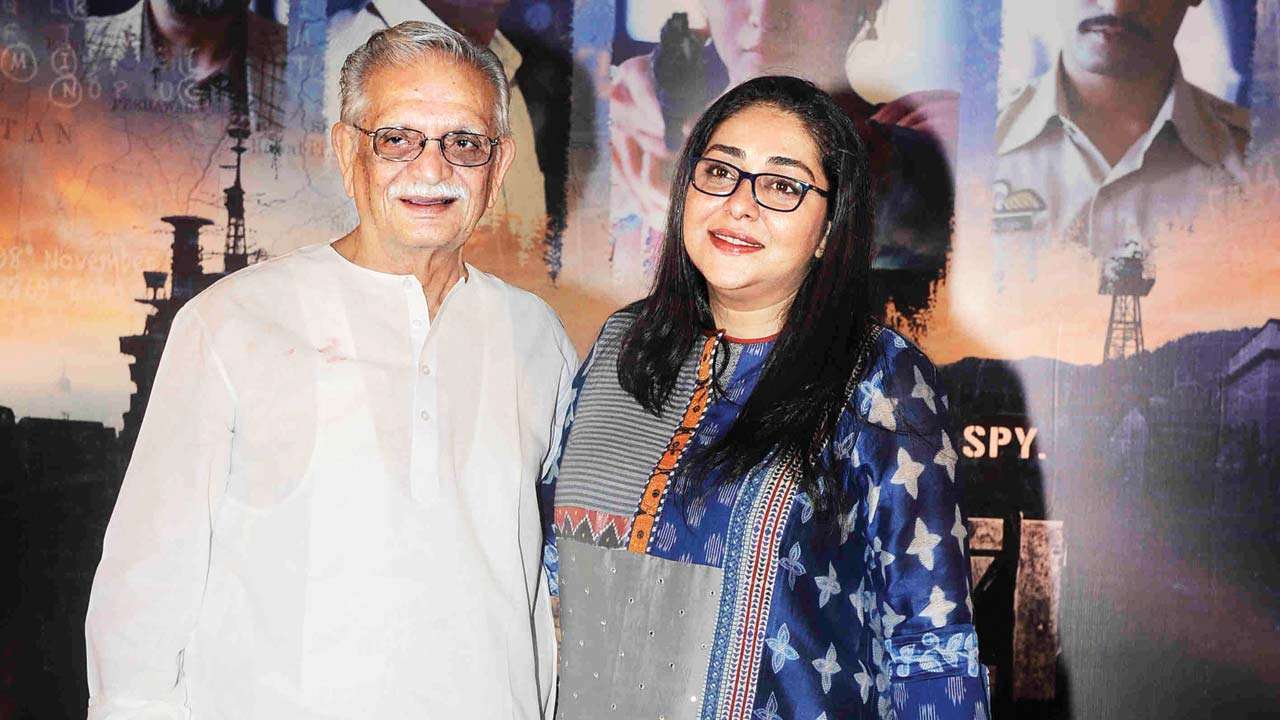
Deepali Singh (DNA; September 1, 2018)
As a school-going child, Meghna Gulzar remembers how her father had learnt to tie her hair in plaits and would do it every morning before she went to school. It’s a little insight into the man, the world knows of, as veteran filmmaker, author and poet, Gulzar. Meghna has tried to encapsulate a bit of her father’s professional and personal life, in the book titled Because He Is.
First published in 2004, the book has now been re-published with additional information and chapters. It is an insightful read into Gulzar’s journey from Dina, Pakistan, where he was born to his migration to India, his entry into films, his friendships, marriage, fatherhood and now, to his experiences as a grandfather to Meghna’s son Samay, and being immersed full-time into writing and poetry. “It’s not an official biography and I can’t call it a memoir,” clarifies Meghna, “I just know people have enjoyed reading it 14 years ago and I hope they enjoy reading it now.” Excerpts from an interview with the filmmaker-author.
What has changed in your father’s life from the time the book was first published in 2004?
In 14 years, a lot has changed or been added to my father’s life, both professionally and personally. He wasn’t a grandfather then, he is one now. In terms of his writing, he was a filmmaker, now he’s a full-time author and poet. So, I think it’s a nice update on many levels.
So much has been written about Gulzar saab. How do you think your perspective as a daughter adds to that?
The book is not talking about him only as a father. It talks of him as a person but from my lens, which is not always anchored at me. I’m sure, as a writer, I have an advantage because there is an intimate and personal relationship between us, but that’s something which can also be a disadvantage because you may not get the objectivity you want. But, this was never meant to be an empirical consolidation of his life and times. I won’t say my insight is better or worse, but it’s definitely more intimate than the others who have written about him.
Your father has had such varied and vast life experiences. What kind of impact has it left on you?
The influence is more because of the parent that he is. Genetically and due to your upbringing, you do pass on similar things because you have a parent-child bond. We happen to be in the same profession, but our sensibilities are similar because we are also father and daughter. I love the simplicity of his work, and that is the only thing I try to imbibe and emulate. He really manages to say very complicated and deep things, very simply. I don’t know how successful I’ve been in my attempts but I will keep trying.
The one thing where you both are really different?
I can talk about difficult emotions professionally. My first film, Filhaal (2002), dealt with the subjects of conception, fertility and surrogacy. Therefore, the dialogues had to be about having sex, taking precaution, what is surrogacy, etc and he wasn’t comfortable with it. He would sidestep it and would want metaphors and I would want to say it as is. Our personalities are also like this. I think I’m a little militant, he is much gentler, a big softie (smiles).
Would you ever like to document his life on celluloid?
No! With books, there is no word or page limit. You can do justice to the life he has lived. You cannot do that in a film. That is the case for a lot of people and stalwarts who have lived really full lives. I feel this way about them. By trying to encapsulate their lives in two-and-a-half hours, it feels that you’re trivialising their being and their existence. Unless, you take a chapter from their life and talk about it. There are so many facets to my father, from moving to India during partition to his entry in films to being an assistant, then a lyricist, dialogue writer, scriptwriter, filmmaker, and all along being an author and a poet. How do you do justice to one chapter and leave everything else out? They are all interrelated to make him the person he is. So no, I would never do it. I won’t let anybody do it either. I don’t think he would like it either. If he does, I’m no one to stop it but I know he wouldn’t.
What was his reaction when he read Because He Is the first time in 2004?
His reactions swing between, ‘Wow, you’re a writer!’ and ‘See, I always told you you’re a writer!’ (laughs).
What about the republished version?
Yes, of course. It would not go into publishing if he did not approve. The foreword was a letter he had written then and now, there’s an afterword. He’s also biased, so it’s really difficult for him to not like something I have done (smiles).
We have a severe paucity of heroes today. Sam Manekshaw was one such real life hero-Meghna Gulzar
8:41 AM

Renuka Vyavahare (BOMBAY TIMES; June 27, 2018)
After the resounding success of Raazi, director Meghna Gulzar is all set to tell the story of Field Marshal Sam Manekshaw, who led the Indian Army during the Indo-Pakistan War of 1971 as Chief of the Army Staff. He was the first Indian Army officer to be promoted to the rank of Field Marshal.
Speaking about what prompted her to tell his story, Meghna told BT, “We have a severe paucity of heroes today. We don’t have any and definitely not from the real world. He was one such real-life hero. Even the slightest mention of him is held in high regard by generations who have known him. Hence, I think that subsequent generations need to know about his life. He was widely felicitated as he was one of the most decorated officers of our country, but it's important for people to know about him today and not let a hero like him fade away in the pages of history.”
 The acclaimed director adds, “What appealed to me the most about him is that he was somebody who would neither take himself or his huge accomplishments, or whatever difficulties he faced in his life seriously. He was someone who could face any situation with a smile. Even if a war was brewing, he wouldn’t snap or get frazzled. He was in complete control of the situation and a hands-on leader, who was aware of ground reality — whether it was about the logistical difficulties his most junior officers faced, concern for the jawans, their health issues or their pension. He was aware of the grass root reality, people’s strength and weaknesses. That’s what made him a great leader.”
The director also explained why the film isn’t a ‘biopic’ per se. She clarified, “I don’t even look at Raazi as a biopic, because we are not tracing the story of her life from her birth to death, in chronological order. You are looking at an event in her life. Similarly, Sam Manekshaw’s life is so vast and full that there is no way you can make a chronological biopic on him in two hours. What we are trying to do is tell the story of this man with utmost honesty, without making it sound like a historical document.”
Talking about the casting for this ambitious project, Meghna who is collaborating with Ronnie Screwvala on the film revealed, “I want to get done with the writing before I go down that road, or else I will get stuck with a name or a face and I don't want that to influence the script.”
MAJA DARUWALA, DAUGHTER OF SAM MANEKSHAW, SPEAKS ABOUT THE FILM BEING MADE ON HER FATHER
‘As a family, we are excited about Ronnie, Meghna and team taking on the important task of reintroducing Sam’s legacy to generations, who never had the chance to know him. His values were values that we all should carry forward. This film will play a great role in ensuring that.’

I don’t think any Indian film has treated Pakistani characters with so much dignity-Meghna Gulzar
8:13 AM

Meghna Gulzar and her lyricist father weigh in on the ethos behind her espionage thriller Raazi, and the creative collaboration between the old and the new guard
Roshmila Bhattacharya (MUMBAI MIRROR; May 12, 2018)
Gulzar saab, from Filhaal (which was about surrogacy) to Talvar (the judiciary), and now Junglee Pictures and Dharma Productions’ Raazi, which weighs loyalty to family against loyalty to country, how do you, as a filmmaker, perceive Meghna’s journey?
Gulzar: She’s always been a brave girl who made her choices independently and we respected them because we trusted her strength. She was fond of singing and would paint with me, but opted for filmmaking and surprised me with her choices. When she told me Filhaal was about a surrogate mother, I didn’t understand what she meant, but knew she was in step with the times unlike our films where if a woman was unable to produce a son, ‘hum doosri le aate’. It was a brave step but she was convinced and convinced everyone else. Then, came Talvar, a comment on the judiciary. When your child is taking a step forward, it’s best to hold their hand and let them lead you into the future rather than hold them back.
Raazi is another step forward…
G: Yes, and the right step after Talvar. I don’t think any Indian film has treated Pakistani characters with so much dignity. I was born across the border and I know Raazi will bring forth friendly voices between the countries.
Meghna, did your papa’s stories of Pakistan help shape your characters?
Meghna: He never spoke of his days before the Partition, it’s an emotional scar he’s still trying to heal through his writing. He didn’t even visit Pakistan for the longest time because he didn’t want his memories to be diminished by the present.
G: But not a day has passed when I haven’t spoken to someone there.
M: And there was so much warmth in his interactions with those who came across as part of cultural exchanges and perhaps subliminally I imbibed that because. For me, a Pakistani was never the enemy or an alien. They are us and we are them, it’s geography and politics that divide us. As Kanwaljeet says in the film, “Jeet ka jashn manate hue yeh yaad rakhna ki humne kya khoya hai.” Every victory comes with a human collateral, whether it’s an Indian, Pakistani, Bangladeshi or Kashmiri.
G: It’s this that makes the film more than another thriller, takes it beyond borders.
You left Pakistan at age eight and returned after 70 years. How did it feel?
G: It was like moving from one room in my home to another that housed people like Ahmed Nadeem Qasmi, a renowned poet in Pakistan and also my mentor. My own writing is published there, including a collection of all my poems. The volume is so huge and heavy that it was difficult to courier even 20-25 copies. So Hasan Zia, a poet himself, who’s like a son to me, took the books to Dubai from where they were dispatched through a friend who travelled to Delhi via Mumbai so he could bring the parcel across. As people, we are the same, bas ghar ke buzurgon ko taqleef hai isliye hum ghar ke bichhde hue sadasya ki tarah bade pyaar se kahin aur milte hain.
M: Yes, when we are in the US, UK or another part of South-Asia, borders cease to exist.
Did shooting in Kashmir enhance the theme of patriotism?
M: I don’t want to highlight this, but it was important to place the narrative in the Valley because today, for many, it’s difficult to say Kashmir and patriot in the same breath. But those who question, or express disbelief need to introspect historically on why people in the Valley feel this way. When we were there, the locals were very welcoming, but also almost apologetic when they asked, “You feel safe here, na? Aapko kisi baat ka dar to nahin?” I don’t think any citizen in any part of the country should be made to feel this way. On our part we were careful to respect the people and the place. If you go in an empowered, entitled way, there will be backlash.
Harinder Sikka had come to you first with his novel, Calling Sehmat. What were your thoughts about the story that Meghna adapted as Raazi?
G: I was committed to other projects then and the love story of Sehmat’s parents’ that he wanted to focus on, seemed juvenile.
M: There are four films in that novel and when I told papa I was adapting it, he couldn’t understand why I’d want to dabble in an action-thriller that had bombs going off. For me the core of the book was Sehmat’s journey and her time in Pakistan. When I sent the first half of the script, which ended with Sehmat realising Abdul is alive, to papa, he responded in less than two hours, saying, “Uff kahan laake chhod diya hai, baki kab bhejoge?” That was a real shot in the arm to me and my co-writer Bhavani Iyer. We immediately got started on cracking the second half.
G: I was stunned, she had found layers we didn’t see. That’s why I say this generation has made better cinema than mine.
Meghna, which is Gulzar saab’s bravest film according to you?
M: Maachis. Since he’s a Sikh himself, the insurgency and 1984 riots were scarring, yet papa made a film which said such strong things in his inimitable soft and objective style. He didn’t glorify the misled youth but simply underlined circumstances which made them feel alienated and take up arms.
Gulzar saab, Meghna has often said that she can’t think of going to any other lyricist for her songs…
G: How can she? Meghna, Shaad (Ali) and Vishal (Bhardwaj) are my children. They wouldn’t be able to bully anyone else the way they do me. Shaad used to ask me for pocket money when he was assisting Mani Ratnam and still gets me to change words like Meghna. Vishal wants the lingo of Meerut; his films are heavy on gaalis.
M: (Laughs) I don’t know how he’s managed it, but papa has written some of his raunchiest songs for Vishal’s films.
G: (Laughs) Yeh bachche badmashi bahut karte hain but they also challenge me.
Writing songs for a film like Raazi must have been difficult…
M: It was but I got all the songs in a day. “Aye watan” happened right here in this room during my first meeting while I was briefing Shankar (Mahadevan), Ehsaan (Noorani) and Loy (Mendonsa). Papa wanted the line incorporated, “Lab Pe Aati Hai Dua Ban Ke Tamanna Meri…”
G: It was a prayer we sang in school, by Allama Muhammad Iqbal, Pakistan’s poet, who also wrote “Sare Jahan Se Achcha”. Poetry and literature cannot be divided. It’s one India.
M: “Dilbaro” was written in the studio. The trio had composed a tune and as it played, papa started coming up with the words… “Ungli Pakad Ke Tune, Chalna Sikhaya Tha Na, Dehleez Oonchi Hai Yeh, Paar Kara De.”
G: In this case it was not threshold of the home, yahan sarhad paar karwana tha. This triumvirate is so creative they make your job easy no matter how big the challenge.
Meghna’s next is Field Marshal Sam Manekshaw biopic, another challenge.
G: Every generation walks its own path. And rather than teach, it’s better if we learn from this new generation of brilliant filmmakers.
M: Usually parents talk down to their kids but papa always said that even if you’re 40, when your child is five, you’re just a five-year-old father. And a child who is raised with this sense of equality, grows up to be a confident individual, secure in his own world and the world beyond.

The misconceptions around Raazi's stand will be cleared after the release-Meghna Gulzar
8:24 AM

Raazi director Meghna Gulzar alludes film not anti-Pakistan following reports of ban in neighbouring country
Mohar Basu (MID-DAY; May 10, 2018)
Even as the Censor Board of Pakistan has slapped a ban on Meghna Gulzar's Raazi citing distributors' apprehension at purchasing rights of a "controversial film", the director insists her film does not take an anti-Pakistan stance. "Purely based on our trailer, it was suggested Raazi may not release in Pakistan. However, no one [in Pakistan] has seen the film. We're hoping that once the film releases, misconceptions about whether or not it is anti-Pakistan will get cleared out," she says of the Alia Bhatt starrer, which revolves around an Indian spy who married a Pakistani army officer during the 1971 Indo-Pakistan war.
Her comments come after reports suggested that senior officials there had referred to India's decision to make controversial films "disappointing". However, Meghna Gulzar says that she has received no intimation of the ban, adding, "There has been no application initiated by us to release it there yet."
With Raazi, she says she has attempted to "remain honest to both" countries." "The situation in Kashmir was different in 1971 than what it is now. The stand that Raazi takes on the India-Pakistan dynamic will be understood by people when they watch the film."

I find real life stories liberating-Meghna Gulzar
10:10 AM

Deepali Singh (DNA; May 8, 2018)
Her last movie, Talvar, which was based on the 2008 Noida double murder case of Aarushi Talwar and Hemraj Banjade, was critically acclaimed. The crime drama won rave reviews for its lead cast’s solid performances as well as the sensitivity with which director Meghna Gulzar handled the subject. With her forthcoming release, Raazi, the filmmaker has picked up yet another true-life story, that of an Indian Kashmiri undercover agent, set during the 1971 Indo-Pak war. The movie, starring Alia Bhatt and Vicky Kaushal, has been adapted from Harinder Sikka’s 2008 novel, Calling Sehmat. Meghna, whose first choice for the protagonist’s role was Alia, tells After Hrs what made her cast the powerhouse performer and why she is drawn to unconventional plots...
What was it about Sehmat’s story that appealed to you?
It’s a powerful tale, which talks about ideals and principles that seem unfamiliar in today’s times. And as it’s a true story, the draw for me was much more complete.
You have said earlier that you couldn’t imagine anyone else but Alia as Sehmat. What does she bring to the table as an actor?
For one, it’s a 20-year-old girl from Kashmir, so the physicality is smack there. I did not see this character as a Lara Croft. I saw a vulnerable, fragile girl who went through a tumultuous journey and that fragility is inherent in Alia. Plus, the performer that she is!
Which of her films have you seen? Any performance that stood out?
I think Udta Punjab. That was on top of my mind. She is fabulous in Highway and even in Dear Zindagi. You can’t call that a performance — it’s like she’s being herself on sets. Of course, she’s good in other films too, like Student Of The Year, Humpty Sharma Ki Dulhania and others. She straddles all these worlds with equal flair, which says a lot about the actor that she is.
You have a talented ensemble cast including Vicky Kaushal, Rajit Kapur, Soni Razdan and Jaideep Ahlawat. That’s something we have seen in your other films as well...
Right from the writing stage, every character has a purpose in the film. If they have a purpose and a consequence, you need to cast them correctly to justify that character’s presence. Also, I like to use faces that haven’t been too exhausted since they resonate better as the character they are playing, rather than the other identities they are known for.
Movies that focus on India-Pakistan generally tend to be jingoistic. How did you approach a sensitive subject like that?
Jingoism isn’t inherent in the story, so I didn’t need to douse the film with it. Plus, it’s not my sensibility. I will go back to Talvar for this because there were two ways that story was dealt with. One was sensational, while the other was sensitive. It comes from the maker’s sensibility or those who are behind it. It’s the same case here. I’m not telling the story for inflammatory purposes.
You started your career with movies like Filhaal and Just Married that explored relationships. Then you moved on to real-life stories. What was the turning point?
The turning point was Talvar and it has to do with Vishal Bhardwaj because it was his suggestion to make the film. I thank my stars I had the wisdom to jump at it without processing too much. I said yes first, and then I started getting scared because it was so out of my zone. The pressure to deliver made me work harder. I find real-life stories liberating because you’re free from the bells and whistles where everyone has to look nice and the hair has to be blow-dried etc. Here, your character can have a sweat patch. You’re focusing on telling the story in the most powerful way possible. Then there is the challenge of the responsibility of telling a true-life tale. I find that stimulating as a filmmaker.
You have assisted your father, Gulzar, on films such as Maachis and Hu Tu Tu. Do you owe your sensibilities as a filmmaker to him?
Our movies are vastly different. As filmmakers, I don’t think our sensibilities are similar at all. Our craft is different as he comes from his life experiences and I come with mine. But I’ve been a student of Sociology, so that connect and that social awareness plays up in everything I do. When you make a film, at the least, there are 200 people working on it for seven to eight months. At the end of the day, if it is irrelevant or so irreverent that by the time the audience has finished the popcorn they have forgotten about it, it’s such a waste. I’m not saying every film has to have a message. We falsify the meaning of the word ‘entertainment’. It doesn’t need to be a slapstick comedy. Entertainment means engaging. You can engage the audience either by frightening them or making them sad, happy or prompting them to think. But that much talent, hard work and money should amount to an end product that resonates, otherwise what’s the point!
When we recently met your dad, he told us that you often reject his work (Gulzar has written the lyrics for Raazi). You even asked him to change the lyrics of one of the songs...
Unfortunately, it has happened with every film of mine (smiles)! Partly because I take a certain latitude as I’m his daughter and I have the right to. But seriously, the beauty of it is that when he is a lyricist for me, he is extremely respectful. He’ll never impress upon the fact that he’s my father. If I have a counterpoint and it’s valid, he will graciously rewrite the lyrics or a line or a song for me. And I respect and appreciate that.
Women in espionage thrillers are too often positioned as femme fatale, exotic dancer-Meghna Gulzar
8:24 AM

Anshul Chaturvedi (BOMBAY TIMES; May 5, 2018)
War, espionage and covert operations often inspire action-packed thrillers or outlandish spy films on the big screen. Rarely does it so happen that a spy mission – and the responsibility to thrill – rests on the delicate shoulders of a newlywed, amateur 20-year-old, who is plucked from college and planted behind enemy lines. Meghna Gulzar’s Raazi , that stars Alia Bhatt as a Kashmiri girl married into a Pakistani family by her father to spy for India before the 1971 war, splinters the narrative that has been written so far for women in spy thrillers – she’s not a lethal weapon, nor a femme fatale, nor the honeytrap. She’s a vulnerable, scared but determined girl who makes this “frightful” decision, and lives by “very high principles” despite her deception. We try to decode Sehmat with Meghna’s help:
If you had to write a one-line message to viewers, saying come and watch Raazi for ‘this’, what would that one thing be?
When I was first asked to give a line to describe the film, I said it was about an ordinary girl in extraordinary circumstances. And I still think that sums it up. That itself is so absorbing and compelling. And then nothing matters. When you are with that girl and her journey, the layers, the politics, the region... none of that matters, at least for me when I was writing the character. It just dissipated.
I know that even I tune out if I hear too many people say ‘never-seen-before’... So I would kind of hesitate to use that term, but it is a fact. Unfortunately or fortunately for us, it is a fact. Because the way she is – feminine, with the long, flowy hair, and the trinkets, and the new bride and the sari – it starts from there and then goes wherever, it is a new physicality of Alia. Here is this girl who’s sent as a spy, who’s going to be doing all these things, but visually, she’s always feminine. Always demure, in these flowy salwar-kurtas, and if you look carefully, she’s always in pastels, through the film. There’s a softness even in the colour. She’s not wearing black anywhere in the film, which is the first thing you would do for an action figure. So it’s a completely different interpretation of everything that we know about espionage or thriller or whatever, so it may take a while to calibrate that.
This ‘recalibration’ extends to how she dresses, even how she talks...?
Oh the talking, yes of course (laughs). I had to... because Alia speaks really fast, and it’s today’s language, and we wanted that 1970s ka lehja, and that thairaav. So the work on this film went on on subconscious, subliminal, visual, obvious, written, intended – all kinds of layers (laughs). But coming to Alia’s audience, as a 20-year-old, you cannot even fathom agreeing to do something like this. This is of another breed, this 20-year-old girl. We do have the spunk and we have the spirit within us, and godwilling we will never have to tap it, but it’s another kind of a role model.
Is that a role model today?
It should be. It should be. (Pause) Because it’s not only about patriotism you know, there’s a righteousness in the character, there’s a devotion in the character to her father, to her mother, there’s an emotional honesty to her wedded family in spite of having her agenda. They’re very, very high principles to live by, almost to the point of making it unreal. And for me as the filmmaker also, when I was cueing the actors for all the scenes that happen in Sehmat and Iqbal’s bedroom – that world is pure. So, when she says that I don’t feel like being alone today, she’s not honeytrapping him. There is that vulnerable girl who has surfaced, when she submits to the man she’s married to. There is purity there.
‘Pastel-clad spy’. ‘Emotional honesty to the wedded family despite an agenda’. What other contradictions, what dualities, do we expect?
The film is full of dualities. And I think I want to decide to not be afraid of that duality, but to celebrate it. So it’s a thriller but not the way thrillers are implemented or interpreted. It’s interpreted differently but it thrills nevertheless. I never thought, with the way we’ve treated the film and the way we’ve shot it ki... ‘edge of the seat’ ‘we were getting nervous’... I didn’t expect to hear this feedback (from the previews). But it’s there. So... okay then! So then let’s talk about the duality. That there is that, and then there is a huge emotional journey or upheaval that goes on along with it. So you are getting tossed around as a viewer, along with the character who is also getting tossed around emotionally through the story.
The actual person who lived this tossed around existence – given that the movie is based on a true story – what do you know about her?
I had to do my own research to figure out whether she even existed. Otherwise the movie would not have gotten made, no matter how compelling the book. I met people.... defence think tanks, former RAW officials. When I got to know that yes, this file existed on this lady, then I said theek hai, now we will make this movie.
Is this a gender-specific story?
No. What do you think?
It seems to be. Would a male protagonist have faced similar emotional challenges?
You know, it could very well have been a male protagonist. We have a true living example of a male protagonist doing this. Not getting married – no, actually there was one who got married and lived there and everything. The point is, it becomes far more dimensional and therefore also intriguing and involving when it’s a woman because with men you think okay, a man has gone to do this, he will single-mindedly do it and come out. The emotional counter-damage or the emotional destruction, you will never consider if your protagonist is a man. Those will get amplified if it’s a woman. But at the end of it, it’s human against human. It’s not India vs Pakistan, or man vs woman, it’s one human against another, it’s cyclical, it keeps going on. Why? We’re still doing this, 40 years later. We’re doing it in different ways, but we’re still doing it.
Isn’t that universally true, beyond the subcontinent?
It is, it is. But... in some places it’s an industrial thing, where you have the entire business of equipment for war – that’s driving it. In another parallel realm, there is the control over oil and resources that’s driving it. What is still driving us, in the subcontinent? Apart from that one daraar, which was drawn by the British before they left – so successfully, I must say – what is it that is driving us? Are we doing it for economics? Are we doing it for industrial gain? Are we doing it for money? What are we doing it for?
Point taken. To come back, philosophically, yes, it’s gender neutral, but for me it’s definitely a girl’s story.
It is a girl’s story. But what I’m trying to say is that the issue that the film is talking about or what the film wants to say is not gender-specific. Of course it’s a girl’s story. It is a girl’s journey and that’s what makes it so fragile and so uncertain, because it’s a 20-year-old girl doing this.
When a male spy is a lead character he’s usually this macho guy, willing to kill, and happily, while women in espionage thrillers are too often positioned as the personification of glamour. A femme fatale, an exotic dancer... It’s very rare to see this sort of female spy – vulnerable, not wearing black boots with a knife stuck in one.
Then deconstructing stereotypes is what we’re good at doing, na. That’s the point of it!
In espionage, you never know when information is going to come in front of you. You’re often just actually sitting and doing nothing... That’s the thing. It’s the interpretation that the audience is going to have to calibrate. The interpretation of a spy, of a pastel-clad spy, in 1971.
Is it a morally appropriate decision for a father to have married his daughter off into ‘enemy’ territory solely on this ground – spying?
It was a toss-up between morality and I’m guessing the onus of duty towards the country. Where he is coming from is one, there is a sense of urgency, you know war is imminent, you know you’re not going to survive. You need somebody to take your place. And yet you know that that person has to be someone who will win their trust immediately, which can be your daughter. But then again, you’re not throwing her to the wolves. You know this person, he’s your friend. At least he thinks he’s your friend, he doesn’t know you’re a double agent. So you know till her cover is blown she will be looked after, she’s not going to be ill-treated. If that is any consolation.
Sending a son to face a bullet, and sending a daughter into a stranger’s bedroom – aren’t these very different benchmarks?
Why? You’re looking at it from the lens of gender. Don’t look at it from the lens of gender. Look at it as parent to child. Remove gender. By virtue of it being a parent to a child, it is a very, very brave and frightful thing to do.

Subscribe to:
Posts (Atom)