Showing posts with label Maratha Mandir. Show all posts
Showing posts with label Maratha Mandir. Show all posts
Ranveer Singh’s Dhurandhar: The Revenge sees sky-high ticket prices, up to Rs 2600 in multiplexes
10:31 AM
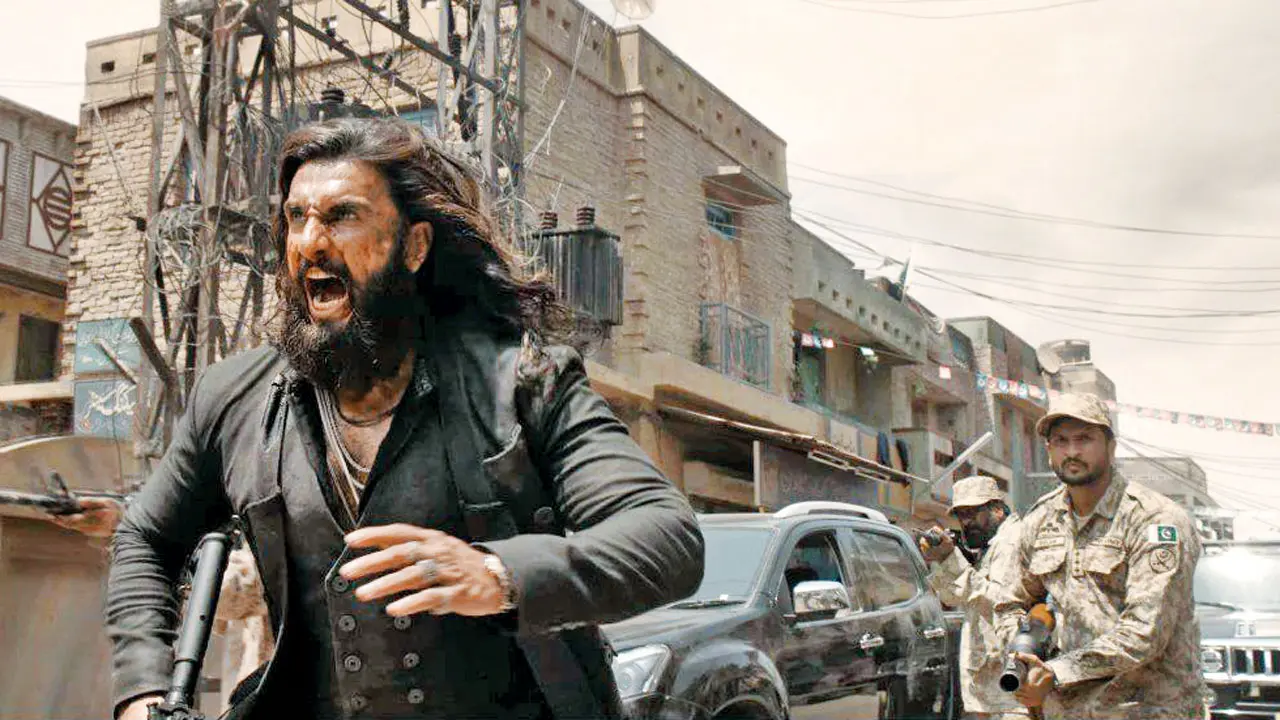
Ticket prices of ‘Dhurandhar The Revenge’ premium shows at multiplexes in Mumbai and Delhi soar upwards of Rs 2K, even as single screens cap it at Rs 300
Mohar Basu (MID-DAY; March 13, 2026)
‘How much did you get your ticket for?’ That has been the question among Ranveer Singh fans as Dhurandhar The Revenge opened its advance booking on March 7. Ticket prices for paid previews and weekend shows have hit a high — in Mumbai, the prices at multiplexes start from Rs 400, going up to a whopping Rs 2600!
Industry insiders say that the demand for the film’s paid preview has pushed multiplexes to aggressively price their premium formats, especially those offering recliner seats or IMAX format. “Such shows are priced between Rs 2200 and Rs 2500 in the Inox outlets of Borivali, Malad, and Nariman Point,” said a source from Inox. Meanwhile, the Luxe show of PVR Icon in Lower Parel has taken it a notch higher to Rs 2600.
However, the strategy has been different for single-screen theatres across the country. According to exhibitors, filmmaker Aditya Dhar’s studio has requested affordable pricing.
A source from Seble Cinemas in Delhi told mid-day, “Single screens have been asked to maintain accessible pricing so the core audience isn’t alienated. Morning shows are being sold at around Rs 220, while late-night shows are capped at roughly Rs 300 depending on the theatre.”
Several single-screen owners in Mumbai confirmed that Rs 220 is the standard fare. Manoj Desai, executive director, Gaiety Galaxy and Maratha Mandir, shared, “Multiplex audiences are willing to pay more, while single screens rely on volume. This approach allows the film to capitalize on demand in big cities without alienating its core audience in smaller centres.”
Buy now or regret later
Inox sources suggest that from March 19, tickets for certain shows will be priced at Rs 3100 and Rs 3500 respectively for top Mumbai and Delhi theatres.
Trade Analyst Girish Wankhede told mid-day, “Such steep rates were expected. Given the film’s hype, the high-end tickets will be priced between Rs 3000 and Rs 3500. This will continue till the opening weekend.”
I’ll continue to slash ticket prices if that results in more people coming to theatres-Manoj Desai
8:15 AM
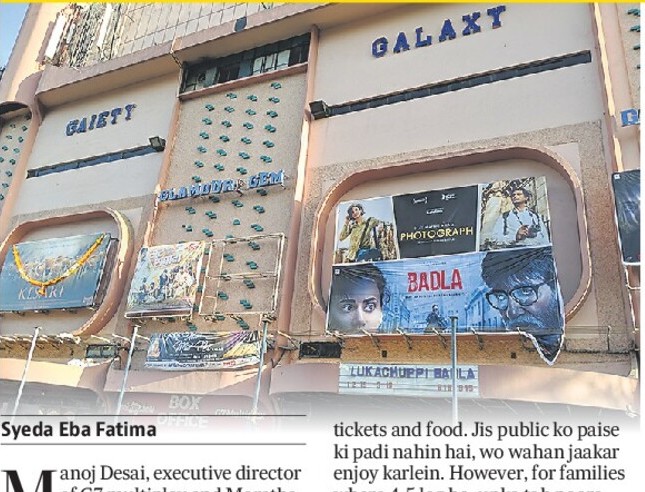
Syeda Eba Fatima (HINDUSTAN TIMES; November 18, 2022)
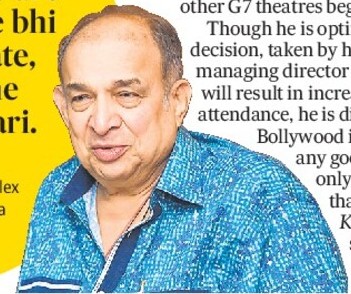
Manoj Desai, executive director of G7 multiplex and Maratha Mandir Cinema, recently announced that he will be slashing the ticket prices of both their single-screen theatres, as the management is fed up with the poor performance of Bollywood films in recent times.
Speaking to us, Desai reveals that following this announcement, he got calls from several multiplex owners who complained about the decision. “I know multiplexes won’t cut their ticket rates. In fact, they’re not liking this step taken by us. I won’t take names, but I got a few calls from people saying things like, ‘Aap prices kam kar lete ho to humein nuksaan hota hai’. But, it doesn’t affect me. I’ll continue to slash ticket prices if that results in more people coming to theatres. It’s better than having vacant seats in the cinema hall,” he says.
Desai believes in bringing people from all walks of life to the theatre: “Multiplexes are for rich people who want to spend thousands on tickets and food. Jis public ko paise ki padi nahin hai, wo wahan jaakar enjoy karlein. However, for families where 4-5 log ho, unka toh poora salary chala jayega ek film dekhne mein. I want Gaiety Galaxy and Maratha Mandir to be the places where people continue to come for experiences.”
After suffering huge losses during the pandemic, he was pressured by distributors to raise the prices in the last four months, but poor film performance has added to the misery. “We are suffering because movies are failing. Hum pehle bhi rate nahin badhaate, but distributors ne dadagiri chaalu kari,” says Desai.
He informs that the prices of Gaiety and Maratha Mandir will be reduced from ₹140 and ₹170 to ₹130 and ₹150 as of November 21. The changes will be implemented in all other G7 theatres beginning today.
Though he is optimistic that the decision, taken by him and managing director Arun Nahar, will result in increased attendance, he is disappointed that Bollywood is not producing any good films: “It’s only the South films that are working. Kantara still has shows with 100% occupancy.”
Almost 30 per cent advance booking of Sooryavanshi is done across seven shows-Manoj Desai
8:20 AM

With theatres operating at 50 per cent capacity, Gaiety-Galaxy owner says advance booking of Sooryavanshi has opened on strong note
Uma Ramasubramanian (MID-DAY; October 23, 2021)
Theatres across Maharashtra reopened yesterday after a seven-month shutdown. While some had doubts whether cinemas would have a fighting chance in the current scenario, the advance booking of Sooryavanshi appears to have quelled all apprehensions. Gaiety-Galaxy, one of the most popular theatres in Mumbai, has witnessed a strong response to the advance booking of Akshay Kumar’s cop caper that is slated to hit the screens a fortnight later, on Diwali.
“It’s the biggest film to release post the lockdown. We were expecting a decent response. Now, looking at people’s enthusiasm for the film, we are hoping to register [strong] footfall,” says Manoj Desai, executive director of G7 multiplex and Maratha Mandir cinema.
He lays out the plan, “We will have eight shows in Gaiety-Galaxy, and three in Maratha Mandir. The safety norm prescribes 50 per cent occupancy. As of now, almost 30 per cent booking is done across seven shows.”
Considering the past 18 months were hard on cinemas, Desai hopes the film will be a “game-changer.”
Check out Hemant Chaturvedi's stunning pictures of Mumbai's single screen cinemas
8:36 AM

Hemant Chaturvedi backgrounded by Capitol`s antique wrought iron and wood balcony. Pic/Suresh Karkera
The silence in an abandoned theatre is louder than any film soundtrack, says Hemant Chaturvedi, on the Bombay leg of a photo journey shooting remains of India's single-screen cinemas
Meher Marfatia (MID-DAY; January 17, 2021)
He must be the only person on the planet who went to the movies throughout lockdown. In a year redefining the phrase annus horribilis, Hemant Chaturvedi trained his Olympus OMD and Pen-F cameras on "beautiful ruins" of single-screen theatres in remote reaches of Maharashtra, Gujarat, Rajasthan, Punjab, Haryana, Delhi, Uttarakhand, UP, MP, Goa and Kashmir.
The result: 55,000 frames from which he will cull the cream for a seminal book and series of exhibitions. Steering his sturdy Force Motors Jeep across 32,000 kilometres, he has uncovered 655 theatres, scouring the country's length and breadth on this remarkable quest.
About 9,710 single screens in 2009 dwindled to 6,300 in 2019. Visiting 500 towns, Hemant discovered each theatre, depending on size and location, had a similar ecosystem, scaled higher or lower by the social demographic encircling it. Ubiquitous chai and juice stalls, paan and cigarette shops touts sidled up to hissing black-market ticket prices were common features.
Interconnected livelihoods sank with shrinking footfall in halls. A teashop owner revealed an 1,100-seater theatre opposite him ran four to six House Full screenings a day, to which crowds of 4,000-6,000 thronged. Even a quarter of them purchasing a cup averaged 1,000-1,500 cups at showtime. Ordering 100 litres of milk daily, the chaiwala currently buys barely five.
From the 1980s-'90s, the slide gradually gutted cinemas in major metros and smaller tier towns alike. While multiplexes brought steep taxes and distributor rates, the shift from celluloid to digital content finally throttled struggling theatres. Seemingly spared halls gasp for survival with B- to C-grade flicks serving erotica, horror, or a steamy soup of both.
"For a book on multiplexes, I wouldn't have wandered but told the story of one multiplex. They're identical," says Hemant. The magic of the movies smote him young, at six, watching an I S Johar film in a makeshift spot in Assam where his Air Force officer father was posted. They squatted on Dalda ghee tins, the reel burnt halfway, the misadventure ended.
The 1980s St Xavier's collegian remembers films at nearby Capitol with enthusiastic, often tipsy, men lolled on wooden benches in a haze of beedi smoke and whirring fans. Describing "the elegance of Regal, the hyperbole of Liberty, the proximity of Metro, the warmth of New Empire", he grades certain differences. "New Empire has an intimacy and calm elegance less stressful on the eye than opulent Liberty."
His is an exacting passion. "Revisiting theatres, I checked my favourite seats: Balcony first row centre, A-24/25/26, gave uninterrupted viewing and as a budding audiophile I thought the sound best in that position. I saw countless movies on chairs with these numbers, skipping shows without seats of my choice."
The Bombay leg is a curious one, says the cinematographer of Company, Maqbool, Ishaqzaade and Kubaan, dedicated today to visual conservation. Rolling from January 2019 in ancestral Allahabad, his efforts to shoot Bombay cinemas were thwarted by apathy and evasiveness of proprietors and managing staff. "Dashing around for a month, I managed three: Mayur in Borivli, Nishat and New Roshan on Grant Road."
Leaving to photograph cinemas in 11 states, he recently resumed the Bombay tryst. "Serendipitously, I found the number of a college friend, Kamal Sidhwa Taraporevala (from the family owning Regal). She led me to her cousin Daisy Sidhwa, who forwarded a mail explaining my project to Saleem Ahmadullah of Globe Theatres. He orchestrated permissions for Capitol and Regal, and Liberty and New Empire from their proprietors. This in a swift hour after 22 months of perseverance. Maxie Cooper of New Empire got me to Fred Poonawala of Edward. Suddenly, I had five iconic theatres in my kitty. In another glorious turn, Sharad Doshi of Central Plaza introduced Ashish Doshi of Royal Opera House."
Bombay's matinee-mad beating heart attracted the cosmopolitan attention this city's cinema scene would expect. Yet, Parsi theatre owners and exhibitors like the Sidhwa, Kuka, Bhavnagri, Dubash, Mody and Bharucha patriarchs stood out as trade pioneers.
Unique to Bombay, halls opened in the late 1800s and early 1900s as proscenium theatres for musical and dramatic performances. Edward, Capitol, Royal Opera House, New Roshan and Nishat are living examples, with classic circular balconies extending close to the edge of the stage and private boxes for affluent patrons.
Theatres with the grand-scale brilliance of Liberty and Royal Opera House are rare. "There was no era-specific architecture after crossing Dadar. Lotus and complexes like Satyam-Sundaram-Sachinam at Worli, and Gaiety-Galaxy-Gemini in Bandra, represent the '70s utilitarian concrete aesthetic. The further from South Bombay, the simpler the structures."
Besides vanishing facades and interiors, Hemant captures stunning details of memorabilia that dodged being sold by weight. Lovingly salvaged are hand-stitched screens, tattered posters, smeared spittoons, brass ashtrays in halls like Liberty's preview theatre and over 400 tickets.
Some cinemas offered free two samosas and two besan laddoos with tickets bought on the first day of a new release. Burning with film fever, audiences hung off balconies, piled impossibly on each other's laps, gyrated boisterously in the aisle and exercised a strange control when songs flashed—"They believed the film flopped if anyone left to pee during a song sequence. Holding it in ensured a hit!" With scatological whimsy are also pasted prints of stars on theatre toilet doors as signage, Tabu and Jayaprada among images announcing the Ladies loo and actors of Sanjeev Kumar's vintage the Gents.
Quirky anecdotes abound. Many ushers flung Coca Cola bottle caps at the screen when popular songs appeared, to incite audiences into thinking these were coins to throw likewise. Post-show, the staff divided the tinkling metal cascade. Then there's the projectionist confessing he misses being roundly abused by irate filmgoers ("Ab toh gaali bhi nahi padti, hum gaali khaane ke liye taras rahe hai")—operating digital projectors means no disruptive film break or flickering screen.
In Gujarat, Nataraj Talkies, from the 1920s in princely Wadhwan, is shut, unsafe from the 2003 earthquake. Its proprietor Bhawani Singh graciously allowed Hemant photos before taking him for a drive. Halting at a stone wall, they stared at the enigmatic entrance and "booking office" of a nameless open-air cinema, circa 1906.
Apparently, the Maharaja of Wadhwan was at Watson's Esplanade Hotel in Bombay on the fateful July 1886 day, when the Lumiere Brothers debuted their Cinematographe in India. Spellbound, the royal ordered the projector. By the time the siblings sailed back to France, the piece was manufactured and shipped, it was 1906. This is the wooden ticket window of the theatre the ruler built to regale his people with silent films.
More movie mania is fanned at The Charlie Circle, started in Adipur, Kutch, by Dr Ashok Aswani. The Chaplin impersonator's appreciation club celebrates their hero's birthday every April 16 with wonderful affection and mixed ethnic gusto. Dressed up with the comedian's typical moustache, top hat and stick, excited kids travel in trucks doing the garba, cut cake and watch a Chaplin flick. Charlie Doctor, as Aswani is dubbed, prescribes anxious patients "Rx: See twice daily, Modern Times/The Tramp". The homeopath was irrevocably Chaplin-smitten in the '70s at a Gandhidham theatre called Oslo—acquainted with the Swedish king and queen, its proprietor had their ambassador inaugurate his cinema.
From Vinay Kumar Chumble, of Vijayanand Theatre in Nasik (Government of India-recognised as the longest running cinema, 1916-2021) came quite a story. On the plot of now extinct Damodar Theatre, Dadasaheb Phalke trundled projector and reels on a handcart, strung a white dhoti between two trees and screened movies. Suspecting him of sorcery, locals ripped the cloth and smashed the equipment. Nasik police intervened, convincing them this signalled modern technology.
Necessity breeds ingenuity. An owner in Maharashtra, gone beyond budget erecting Asha Talkies in the 1940s, was stuck with a single projector. He tided over the minutes to change reels for a restless audience, hiring Lavani dancers. Backgrounded by a halogen spotlight and colourful spinning wheel, they exited stage as that light switched off.
"Every theatre, especially an original structure with minimal renovation, is equally important," asserts Hemant. "Denied access saddens me. All I want are a few photographs. Unimaginably important to Bombay are Maratha Mandir, Naaz, Alfred, Royal, Palace, Central Plaza, Super, Gulshan, Imperial and Deepak. Maratha Mandir is designed by the genius architect W M Namjoshi. I've photographed five of his theatres. Phul in Patiala, Golcha in Delhi, Raj Mandir in Jaipur, the Liberty and New Empire interiors here. Maratha Mandir is critical to the parallel Namjoshi retrospective."
Bharat Mata and Moti are almost done. Hoping to catch scattered remnants of impenetrable properties still high on his Bombay wish-list, Hemant pleads, "I need just an hour for pictures. These buildings will fall. The book is forever, a chance at immortality for theatres."
Nasir Mulla, of Manek Talkies in Akola, cheers the level secularism of shared-screen cinema, telling Hemant: "Other than the seats you can afford, irrespective of caste, creed, race or religion, once the lights dim, everyone is equal. With the same goal—to be entertained. There's no space in the world more socially unifying than a theatre."
Any better reason for the show to go on?


Dilwale Dulhania Le Jayenge to re-release at Maratha Mandir on Diwali
8:24 AM

Himesh Mankad (MUMBAI MIRROR; November 7, 2020)
Shah Rukh Khan and Kajol’s love story, whose 24-year run was interrupted by the Coronavirus pandemic will be back at Mumbai’s Maratha Mandir theatre from November 13 with a daily matinee show. Manoj Desai, the theatre’s delighted executive director, exults, “The Diwali 2020 weekend will mark the re-release of Dilwale Dulhania Le Jayenge after its record run was halted by the lockdown. Now, we will continue with the tradition of matinee shows, uninterrupted.”
He is confident that DDLJ which has a loyal audience base, will continue to attract footfalls with ticket prices reduced to Rs 20 and 25 for stall and balcony respectively. “I have put up a new poster announcing a 25-year celebration of the film with a release date of Diwali 2020. A large chunk of the audience who come to watch the film are from outside Mumbai and the theatre, that’s located close to the Mumbai Central station makes it ideal for them,” he points out.
DDLJ had opened during the 1995 Diwali weekend. This year, on October 20, on the occasion of its silver jubilee, the makers announced that they would be re-releasing the film globally in countries like US, UK, Germany, UAE, Qatar, Canada, Switzerland, Australia, New Zealand, Spain and Fiji, among others.
Rajkumar Keswani reveals in his book on Mughal-E-Azam how Madhubala was considered a distraction by K Asif
9:27 AM

Author, poet and journalist Rajkumar Keswani shares lesser-known stories about Indian cinema’s most iconic film, which turns 60 this year
Kunal Guha (MUMBAI MIRROR; September 6, 2020)
When Madhubala first arrived on the sets of Mughal-e-Azam to essay her career-defining role of Anarkali, she brought her usual cheerful personality to work. Known to light up many a room, and to always leave her co-stars and crew rolling on the floor laughing, it dawned on her much later that not everyone was charmed by her ebullience. In fact, filmmaker K Asif found her a bit of a distraction. Soon enough, Madhubala’s shots began getting postponed and she went without shooting for several days. The actor was a little taken aback when, one day, Asif’s assistant Sultan Ahmed informed her that the filmmaker didn’t appreciate her behaviour and expected the cast “to take their job seriously”. The superstar accepted the feedback graciously, submitting to the filmmaker’s approach, and soon, the shoot commenced as planned.
It is anecdotes such as these that feature in plenty in poet, writer and journalist Rajkumar Keswani’s Daastan-e-Mughal-e-Azam, a literary tribute to the iconic film about unrequited love, which clocks 60 this year. Considered a milestone in Indian filmmaking, K Asif’s magnum opus took over 10 years to create. Keswani, who was 10 when it was released, remembers watching the film in Bhopal’s Bharat Talkies. “Those three hours in the theatre changed my life forever,” he says, adding that he was so charmed that he had memorised most of the film’s dialogues.
When he embarked on this project, Keswani’s passion for the film also drew him to follow the life of its director. Music director Naushad told him how Asif had started out as a tailor before going on to weave stories on celluloid when nudged in that direction by his brother-in-law and actor Nazir. In fact, the filmmaker also had a tailoring shop in Dadar’s Khodadad Circle at the time. “Famous heroes of the 1940s, Prem Adib and Jeevan [Narad of the screen], ran a restaurant in partnership in the same locality,” says Keswani about the neighbourhood, which was synonymous with tinseltown dreams at the time.
Most fans will know that development of the feature film began in 1944, but hit a roadblock during the time of Independence, only to commence again with a new cast in 1951. But few know about Asif’s struggle in casting for Anarkali’s role, after Nargis, his original choice, turned it down. Newspapers ads were published across the country, inviting women between the age of 16 and 22 to apply with photographs and biodata. Many actors approached the filmmaker for the role and Dilip Kumar, who was already cast as Salim, recommended the popular actor Vijaylaxmi. But the filmmaker didn’t find anyone suitable.
Asif had tried casting Madhubala for an earlier film, but her father Ataula Khan had set terms that weren’t agreeable with the director. “‘Keep your daughter in a showcase’, is what K Asif told him then,” says Keswani. He adds that the actor was cast as Anarkali only after she reached out to the filmmaker and agreed to work on his terms. “She arrived in her car and the meeting took place in the car itself. She asked him to forget his interaction with her father, and agreed to cooperate with him, because she really wanted to work with him.”
Maratha Mandir theatre, which had planned its gala launch with the release of Mughal-e-Azam had to launch with B R Chopra’s Sadhna (1958) since Asif’s film wasn’t completed by then. The theatre’s leasee owner Seth Mehtabchand Golcha set a clause for every filmmaker who wanted to screen his movie there: When Asif decides to release Mughal-e-Azam, their film would be replaced without notice. And when it did release, it even got travellers from Pakistan who would come only to watch the film. “In fact, Golcha had made special provisions for his Pakistani audience — they wouldn’t have to stand in queue to buy their tickets and could pick it up from inside the theatre itself,” says Keswani, adding that the theatre’s patrons also included filmmaker and actor Guru Dutt and Feroz Khan, who would turn up at Maratha Mandir to watch Mughal-e-Azam every week in the initial months.
“Shapoorji Mistry, the film’s financier, and who famously had several disagreements with Asif over his extravagant production, was no less in love with the director and the movie,” says Keswani. “Shapoorji seth was so obsessed with the dialogues that he would say them aloud as if in an elocution contest.”
Keswani’s book also includes 25 paintings by M F Husain, which were dedicated to Asif and his magnum opus. “Hussain made these paintings during his stay in London, as a guest of K Asif’s son Akbar Asif,” says Keswani of the works, which the renowned artist had gifted to Akbar’s daughter Haya Asif on her birthday.
It took Keswani 15 years to compile his research into a book, but stumbling upon gems about the film made the effort worthwhile. “I didn’t work like a scientist while writing and editing the book. I worked like a passionate lover,” he says.
On this day, Amitabh Bachchan's first film Saat Hindustani released in Mumbai
8:16 AM
Box Office India Trade Network
On this day exactly 49 years ago the first Amitabh Bachchan film SAAT HINDUSTANI hit Mumbai. The date was 21st May 1971 and the film released at Maratha Mandir in matinee shows only. It was a low key release as it was earlier released in Delhi/UP and fared very badly.
Coincidentally, the film clashed with a release of the box office king of that time Rajesh Khanna. HAATHI MERE SAATHI also released in Mumbai on 21st May 1971 though the film had released earlier in Delhi/UP and East Punjab. This film became the first film in history to collect 1 lakh nett in Mumbai on day one. It was released on 27 theatres and Rajesh Khanna beat his own day one record in Mumbai city which was set with SACHAA JHUTHA in 1970.
SAAT HINDUSTANI was the first release of Amitabh Bachchan but it was not the first time that Mumbaiites got to see the star that was going to become a future megastar. The other coincidence that in Mumbai the first sight of Amitabh Bachchan also came in a Rajesh Khanna starrer which was released a couple of months before Saat Hindustani in Mumbai city. The film was called ANAND.
Another point here is that last year there were celebrations of fifty years of Amitabh Bachchan hitting the big screen and that was not the case. The fifty years were actually hit a couple of months back. It was funny to see fifty years of SAAT HINDUSTANI celebrated when the film did not even release in 1969. It showed a lack of knowledge with these commentators and even the millions of fans but they cant really be blamed as the media has a tendency to follow what is out there rather than actually collect facts. Then the fans follow what the media has to say. Its understandable that the date of the first film is not known of some small actor but this is Amitabh Bachchan who is the biggest star the country has seen till date.
The fifty years of Amitabh Bachchan were hit on 27th March 2020 as SAAT HINDUSTANI first released in Delhi/UP on 27th March 1970. Amitabh Bachchan made his debut in 1970 and not 1969 as it is claimed by the media. The main cinema for SAAT HINDUSTANI was Sheila and it also released in Eros, Minerva, Amba, Ajanta and Radhu Palace as well as some theatres in UP. The release in Delhi of 6 cinemas was a good release as it was a small film and the biggest films released on around 8 theatres in the city at that time. The collections were horrific with just Rs. 10,000 apprx coming on day one with capacity of around Rs. 40,000. The film was out of theatres very fast and next it went to Mumbai a year later but the response in Delhi meant it was more of a token gesture release. The other circuits saw a release when Amitabh Bachchan had become a star with more creative posters keeping in mind the image Amitabh Bachchan but it was a black and white film and pretty much an art film so had no takers.
Just like SAAT HINDUSTANI had no takers, there will not be many takers that Amitabh Bachchan actually debuted in 1970 as there has already been a false picture painted by the media but facts are facts and anyone with access to genuine sources can do the research and easily check what is fact and what is fake.
Akshay Kumar comes to the rescue, promises to help Gaiety-Galaxy
8:32 AM

After paper brings to light how Gaiety-Galaxy owner has to take a loan to stay afloat amid lockdown, Akshay Kumar offers financial aid to help him tide over losses
Mohar Basu (MID-DAY; April 21, 2020)
 Last week, mid-day reported that Manoj Desai, owner of Gaiety-Galaxy, had to take a bank loan to provide salaries to his employees amid the Coronavirus lockdown (How will the show go on?, April 16). Four days since, Akshay Kumar has come forward to ensure that Mumbai's much loved cinema does not suffer a harsh fate as the theatre shutdown runs into its second month. "Three days ago, I got a call from Akshay ji. He offered to provide financial assistance if the scenario continues. It was kind of him to offer help, but we should find a way to sustain ourselves. We have managed to collect enough funds to pay the salaries for this month, but the theatre shutdown will have long-term ramifications. Our focus is to ensure we don't trim staff or resort to pay cuts," says Desai.
Two weeks into the shutdown, Desai and business partner Arun Nair had decided to increase the ticket prices once the cinemas re-opened. However, with the lockdown being extended to May 3, Desai is aware that making up for the losses of 45 days is a pipe dream. "I will head to Gaiety and Maratha Mandir today to finalise our plan of action for May. We are reworking our plans to ensure that we don't have to seek support from the industry folk."

No Aid From YRF?
Desai is also the owner of Maratha Mandir that screened Dilwale Dulhania Le Jayenge (1995) for 25 years, thus making the Shah Rukh Khan and Kajol starrer the longest-running film in the history of Indian cinema. He laments that Yash Raj Films, the studio behind the love story, has not offered a helping hand. "We have been running the film for so long. I can't go begging to them; they should have spared a thought," he said in an interview to mid-day last week.

Passengers boarding evening trains to Gujarat schedule time to catch DDLJ at Maratha Mandir-Manoj Desai
9:49 AM

Manoj Desai, executive director of Maratha Mandir theatre, in the Belgian glass-panelled interior of the 1958-built cinema that creates history this year, screening Dilwale Dulhania Le Jayenge for 25 consecutive years since its release. The interiors are resplendent with the Art Deco ceiling and wall flourishes along the grand staircase
Maratha Mandir Marg was earlier Club Road, at Bombay Central, named for Byculla Club, the city'€s first residential club in 1834
Meher Marfatia (MID-DAY; March 15, 2020)
"Aao, aao, aao…" the husky chant reaches me from the auditorium door briefly ajar for an usher exiting. Other employees of Maratha Mandir solicitously assure I will soon meet the theatre's executive director, Manoj Desai. Meanwhile, I'm fascinated to explore the various foyer levels of a theatre with decidedly more distinguished interiors than its bland facade.
Unravelling inside, the matinee to beat all matinees ticketed averaging an affordable 20 bucks, flashes the pigeon feeding scene of Dilwale Dulhania Le Jayenge, in its unprecedented 25th year. It was an impromptu sequence. Reporting on Aditya Chopra's set ahead of Amrish Puri, SRK started to scatter grain for the birds. Puri came, adding the gravelly "Aao". An earlier Chopra family link here was BR Chopra's Sadhna, inaugurating Maratha Mandir in 1958.
The theatre hugs a corner address, unrecognisably once among Bombay's poshest. Maratha Mandir Marg was Club Road and Club Back Road was subsequently marked by the YMCA. Skirting Lamington Road to Morland Road (present site of the Mumbai Bagh protests), it embraced the wide north flank of elite Byculla Club, the city's first residential club in 1834.
"Indians were prohibited in numerous British clubs. Foremost were the Byculla Club and Yacht Club," writes Advocate Abhinav Chandrachud in An Independent, Colonial Judiciary: A History of the Bombay High Court During the British Raj: 1862-1947. Those discriminatory clubs were classist and sexist too—"The Yacht was a social Mecca, membership to it for a European meant he had socially arrived. The Byculla Club was for men only, useful when 'a man wanted to get away from his wife'."
Rejecting racial segregation, two rival clubs were established for Indians and Europeans. "Founded at the turn of the 20th century by Chief Justice Lawrence Jenkins, with others, the Orient Club was the oldest such in India," Chandrachud continues. "Willingdon Sports Club was set up towards the end of the First World War by the Governor of Bombay, Lord Willingdon because he had a direct mandate from the Secretary of State to do away with the 'damning racial exclusiveness' of European clubs in Bombay."
Sir Stanley Reed recounted how, following the introduction of electricity in town, Byculla Club members "fought against the barbarism of fans in the dining room and when you sat, in came a hamaal with the traditional fan on a six-foot pole, swaying it to and fro behind you at meals." The vast premises eventually closed after World War II.
"Our initial 1930s years were inseparable from Byculla Club," recalls Mehroo Golvala, nee Khambatta. "It occupied a sprawling block with its own stables and hosted grand dance balls. We walked casually to its grounds for games of 7 Tiles and I Spy." The green canopy thickened with the road's raintrees, palms and ashokas. In her Number 10, Club Road garden grew honeysuckle vines and colourful cannas. On a pretty profusion of crepe jasmine flowers crawled caterpillars that kids caught and cared for in boxes with lid holes allowing air, till they transformed to butterflies set free. Trees hung heavy with mangoes, drumsticks, papayas, elaichi bananas. And methi so tender tasting that, plucked fresh to form a base layered over with fried eggs, resulted in "the best 'bhaji per eedu' for miles". The Parsi penchant for eggs over veggies is a standard culinary delight.
The Khambattas of Shirin Villa had memorable musician neighbours in Hetty and Wilfred Fernandes in Meher Villa from 1954. Hetty's internationally renowned pianist daughter, Marialena, writes from the University of Music and Performing Arts, Vienna: "Byculla Club was extremely colonial, stately on a street with hardly any traffic. It stared down on the street habitants, almost artificial for us children starved for noise, laughter, spontaneous fun.
"My mother had a voice not only beautifully inspiring but capable of soothing the disturbed. According to her, I played piano before I spoke. She encouraged me to keep up my talent, to the irritation of my siblings who preferred cricket on Club Cross Road where the Seventh Day Adventist Church still stands. It was even more British than the British, with daily evening ceremonial service, perfectly harmonious choir and representative congregation. In a mixture of mischief and cheap thrill, we peeped through our barricaded windows and front gate, with lights off, so they couldn't see us. Thanks to mom's friendliness, an American Adventist family sold us the first marimba (a percussion instrument of wooden panels on metal pipes, hit with mallets held in both hands) seen in India."
That became the entertaining highlight at their parties, Marialena remembers—"Mom at the piano, me on the marimba, our guests singing loud. People dropped by, joining the community singing in different languages. My mother put us all in the mood and accompanied everything, so great was her ear. My sister Joanne and I sang with her as a trio known as Wilf's Wonderful Women. Dad was Wilfred. A major part of my life, Club Road holds a special place in my heart."
A friend of Marialena's brother Andrew in their schoolboy days, executive search consultant Ramgopal Rao spent his childhood in the iconic RBI Staff Colony across the road. The Raos shifted into the horseshoe-shaped complex's new "M" Block four summers after 1954, when, at the initiative of Sir CD Deshmukh, the first Indian RBI Governor, these quarters rose with the best amenities. "The society was fantastically self-contained, with a medical dispensary, provision store, Irani stall selling cakes and a basement badminton court where the likes of Nandu Natekar came to play," says Rao. The colony was conceived in a utilitarian, civic-minded manner. For instance, chutes from the topmost floors slid garbage smoothly into wheelbarrows waiting below."
A lane-off landmark is Dr Stanislaus Patrao's now dilapidated Byculla Nursing Home, shuttered 15 years ago. The good doctor, Grant Medical College's sole student holding a triple graduate qualification in Medicine and Surgery, was awarded the degree in the Department of Anatomy and Embryology, a First Class with Distinction. Purchasing the property in the 1940s, he shifted his hospital in 1955 from Morland Road to this largely wooden structure with jack arched roofs crowning 18-feet-high ceilings. Once the King's Lodge hotel, the layout was well suited for a hospital, the central lobby and rooms with attached bathrooms on either side, a garage and workers' rooms at the rear.
Where the road behind this nursing home—Souter Street (Meghraj Sethi Marg)—forks, Motlibai Street on the left brings me to Terrace View. Stepping into Soraya and Fabia Postel's penthouse Airbnb atop Noon Baker Apartments reveals uncommon charm. The sprightly mother and daughter lead me to the patio commanding a spectacular east-facing panorama of Baby Garden, Gloria Church and gleaming white Hasnabad dargah, considered the city's Taj Mahal. The Postels' location lets travellers connect within minutes to the bus depot and three stations of Bombay Central, Mahalaxmi and Byculla. "Throwing open our home has been life-changing and given me economic independence," says Soraya. "I have it in me to be welcoming. My parents would always greet me with the warmest smiles at our door."
Not resisting smoked mince samosas from an aromatic kitchen, I bask in the women's effervescent hospitality. A single mother and French teacher, Soraya is as passionate about taking guests on unusual customised "experiences". This week, her Supermen of the City tour has guided a group to understand the vital contribution of ragpickers, cleaners and washermen.
Desis and foreigners post a flood of reviews: "Ending an incredible 80-day journey throughout India—this oasis is the best lodging of my entire trip" and "I was nervous finding my correct train. They actually walked me to the platform and came aboard to make sure." Touched by them driving her to a mango vendor when she mentioned her mother loves the fruit, a Baltimorean looks forward "to be back to my new home in Mumbai".
Passing by a young swain softly murmur the achingly romantic "Palat ke dekhegi" dialogue, I finally enter Manoj Desai's office, crammed with jubilee trophies that celebrated blockbuster hits including Kabhi Kabhie, Mr India, Amir Garib and Coolie. Desai, also executive director of Bandra's G7 Multiplex, reels off real-life dramatic moments. Dilip Kumar rode a horse to K Asif's glittering premiere of Mughal-e-Azam at Maratha Mandir on August 5, 1960. Madhubala shone, vision-like, in a palanquin. The print arrived on festooned elephants.
"Paying cheap prices, labourers from the area are able to relax for three hours with air-conditioned comfort and clean toilets," reasons Desai. "People make plans around DDLJ. Passengers boarding evening trains to Gujarat schedule time to catch our 11.30-2.30 show. Couples who dated here return bringing their children to watch the same. This phenomenon is like no other anywhere."
Imbibing much lively movie lore, I ready to leave. It's the hour of Taapsee Pannu acing the nuanced Thappad. But the craze for one film alone seems seeped into the very walls of this hall. "Come fall in love", the tagline invites. I hail a cab. Whose driver promptly asks, "Kitni baar dekha hain yeh picture aapne?"

Maratha Mandir

Mehroo Golvala, nee Khambatta, in her Pedder Road home. The 1930s resident of Club Road has vivid memories of the lush garden of their Shirin Villa home. The bungalow once belonged to timber merchants. Pics/ Atul Kamble

A stained glass window with the family crest initials of the Colahs who lived at 8, Club Road. From their balcony they clearly saw the Bombay Central Station clock across open maidan stretches and could hear the zoo animals of Rani Baug

A painting of the landmark Byculla Nursing Home, made famous by Dr Stanislaus Patrao. Signed by the artist Trivedi, it wonderfully captures the precinct’s peace and quiet. The Patraos were actually able to see the Trombay gas flares and even flames, so unobstructed were the views all around.

A late 1980s photograph of pianist Marialena Fernandes (in red) with her mother Hetty and sister Joanne, the famous singing trio of Meher Villa, 14 Club Road. Pic courtesy Marialena Fernandes

Soraya Postel with her daughter Fabia on the sprawling terrace of the cosy Airbnb they run on neighbouring Motlibai Street. Pic/ Bipin Kokate
Baba insisted that Pakeezah was a slow poison-Kamal Amrohi's son Tajdar
7:12 AM

Roshmila Bhattacharya (MUMBAI MIRROR; February 8, 2019)
 On February 4, 1972, all roads led to Mumbai’s Maratha Mandir theatre where Kamal Amrohi’s Pakeezah was being unveiled. A chariot driven by six horses came with the print and a navy band played as industry big-wigs strode in to a shower of flowers, the foyer redolent with the scent of kewda and mogra. In the crowd was a boy of 18 who was waiting expectantly for his ‘chhoti ammi’. As soon as her car drove up, he ran down to take her hand as she stepped out. His father who’d been standing quietly in a corner, also moved forward towards his Manju more sedately. As she walked up, ethereal in a white gharara, strands of mogra in her hair, their eyes met. Smiling up at her Chandan, she took his arm and entered the auditorium. At around 9.30 pm, the lights dimmed and the film which had been conceptualised in 1958 in black-and-white, exploded on screen in a profusion of colours.
Everyone sighed as Nargis, a heart-broken tawaif, pines away in a cemetery after being turned away by her lover’s family... They smiled as her lookalike daughter, Sahibjaan, who grows up in a kotha, finds love in a train... The lady in white seemed like she was in a trance, her nails digging into the hand of the man beside her. Her grip must have hurt but he didn’t flinch, only smiled as he gazed down at her.
During the interval, the guests crowded around the couple for autographs and photographs before returning to the movie. As it neared the end, Manju rested her head on the man’s shoulder and said quietly, “Chandan, ek vaada karoge? After this you will not make another film.” He laughed, “Then what will I eat?”
The film ended. The reactions were mixed. Majnu aka Meena Kumari, who for weeks had worried about how she would look in her first role as a nautch girl, was reassured that despite the passage of time and ill health, she had never appeared more beautiful. And while everyone agreed that this was not the same Meena Kumari of Gomti Ke Kinare and Mere Apne, there were many whose compliments sounded insincere to the film’s writer-producer-director Kamal Amrohi’s ears. Like his distributors, they weren’t sure if the late Ghulam Mohammed’s songs would work in the era of Laxmikant-Pyarelal and Johny Mera Naam.
As they drove back home, some wondered if a dancing girl who is covered from head-to-toe even when she croons, “Inhi Logon Ne Le Liya Dupatta Mera” and whose vocabulary reflected an old-world tehzeeb would appeal to the modern-day audience? Wouldn’t the ‘thehraav’ of the film seem “too slow” for viewers speeding down life’s fast lanes? “Baba only smiled at his detractors, insisting that his Pakeezah was a slow poison. It didn’t kill instantly, but would live on with the audience till D-Day and in decades to come, would be listed among the top 10 Hindi films ever,” informs Tajdar, the son of Kamal Amrohi, who’d doted on his ‘chhoti ammi’ since he was five and continues to celebrate the fact that his father’s film immortalised Meena Kumari.
Rumours abound that Pakeezah only picked up after it’s leading lady’s untimely death on March 31. Tajdar dismisses them, arguing that a flop film wouldn’t have remained in the theatres for nine weeks. “The craze began when an all-women audience took over Prakash Theatre in Ahmedabad, and spread across India. Even when the news of chhoti ammi’s death was announced in the theatres, it was a full house. After she left us, her fans returned, again and again, to watch her last film and collections escalated. The investors and distributors got their money but Baba didn’t end up a millionaire. But he’s still revered as the Last Moghul,” avers Tajdar.
On February 3, a Pakeezah boat sailed from Chowpatty to the Gateway of India and back for a week, with half-a-dozen girls on board, some playing the sitar, some swaying to the songs. “No one else was allowed to get on and a boat would go out to the sea to fetch the girls,” recalls Tajdar, adding that no one had seen promotion like this before or since.
On February 11, 1993, Chandan passed away and was buried next to his Manju. Tajdar believes, in another world, his chhoti ammi is singing to his baba, “Chalo dildaar chalo, Chand ke paar chalo, Hum hai tayaar chalo… Aao kho jaaye sitaaron mein kahin, Chhod de aaj yeh duniya, yeh zameen…”
An analysis of the reasonably priced and delicious snacks sold in single screen theatres of Mumbai
2:14 PM

As a salute to the Mumbai's last surviving single screen theatres, we relish the simple and delicious snacks sold at their counters
Suman Mahfuz Quazi (MID-DAY; December 1, 2018)
The posters are peeling, the walls are leaking and the curtains may come undone. The counters are half-empty, the food aplenty, but we're all flocking to over-priced nachos anyway. Welcome to this stupid world.
City historian Deepak Rao is as unhappy as us. "We'd make sure to carry extra pocket money for the chicken rolls at Old Excelsior when we went to watch films as college students," he reminisces, adding, "Watching movies used to be an experience." And we attempted to relive it.
As Eros cinema remains shut behind large doors and Regal, a glittering hoarding in Colaba's iconic skyline, sits on the cusp of an uncertain future, we take a look at the humble and wholesome fare sold at near abandoned food counters of the city's single-screen theatres, before they disappear like the brightness from the Diwali lights you forgot to take down.

Hotel filmistan
 In 1992, when Khuda Gawah, a Bachchan-starrer Bollywood drama, premiered in the now-ageing Maratha Mandir at Mumbai Central, actor Poonam Dhillon had brought along a box of pedhas. The staff ate it up when Dhillon wasn't looking and she let it go with a laugh. Umar Rasool Sunasra (right), 52, food and beverage manager at the theatre, tells us many stories while looking back at his 35 years of service.
"Dilip Kumar was also here. I served him tea," he recalls. Incidentally, the film's co-producer, Manoj Desai, is also the executive director of the movie hall. The canteen is as relevant to their patrons as the box office. And their in-house vegetable sandwich (Rs 20), a humble snack made with bread, tomato, cucumber and green chutney continues to be a favourite. Young moviegoers who are there to watch Rajnikant and Akshay Kumar's new offering, 2.0, flock to the counter for hot and crispy samosa (Rs 30), chips and sandwiches.
 Popular among Mumbaikars for screening a daily show of the 1995 blockbuster Dilwale Dulhania Le Jayenge even today, the cinema hall continues to serve wafers at Rs 10. "If the ticket is Rs 20, the food has to be cheaper, right?" he reasons. And if you ask him what he thinks of multiplex fare, he shakes his head disapprovingly. "Galat baat hai. Nuksaan na humara na customer ka hona chahiye. Tab hi toh woh laut ke ayenge," he says even as he reminisces the golden days of packed shows and surging sales.
AT M M Marg, RBI Staff Colony.
CALL 23070119

En route Pune
 Subhash Bhatia (right), F&B manager at Chitra Cinema on Ambedkar Road, remembers Pune-bound city slickers stopping by to hoard affordable-but-hygienic wafers, sandwiches, and softies, which were a hit during summers in the '50s and '60s, when air-conditioned cars were still a distant dream. Located in a prime location, they still get a decent footfall, but have had to add new snacks like burgers.
The mela-like popcorn machines are a new addition and they have brought on board a different distributor for sandwiches, who serves variants like Russian salad and cheese chutney (Rs 80 each). "The problem is, if it isn't a good film that's playing, customers don't show up, but with a multiplex, they can simply watch another film. Our generation was happy with very little. It's not the same anymore," he shares.
AT Dr Baba Saheb Ambedkar Road, Dadar East.
CALL 24182264

A galaxy for cinephiles
 "Yahan sab gareeb log aatein hai, madam," Babu Shaikh (right), food counter manager at Bandra's Gaiety-Galaxy Complex points out, speaking about why they continue to sell affordable eats, despite a decline in footfall. Their samosa, sourced from Sion's popular street food joint Guru Kripa (who, along with A1, caters to seven single-screens including the ones mentioned here), were once selling like hot cakes. Now, Babu says, "It's hard to sell even 50."
He thinks allowing patrons to bring their own food has lent itself considerably to the fall in sales. Even so, he stands by keeping costs low. "Poor people should have a place they can go to, to enjoy films as well," he argues. At one end of the movie hall's expansive cafeteria, an ice cream counter continues to sell Pastonji's chocolate ice cream (Rs 30) served in old-school wafer cones.
AT Swami Vivekanand Marg, Bandra West.
CALL 26558285

A forgotten landmark
 Ganpati Eesan (right) has been working as the F&B manager at Regal Cinema's counter for 15 years. In a little corner behind the counter, he has set-up a table where he makes the theatre's popular sandwiches. "Back in the day, customers would purchase a ticket only to try the veg exotic sandwich [capsicum, tomato, cucumber and mayo]. We discontinued it three years ago because the ingredients became costlier but we couldn't hike our prices."
Now, they serve only cheese and chutney sandwiches (Rs 70). Looking back at some of the weirdest moments from his time behind the counter, Eesan recalls, "Once a foreigner brought urchins inside for a movie and raided our counter. We thought it was sweet, but didn't know how to respond."
As the PVRs and Cinepolises of the world took over, Regal relegated to the background, forgotten in all its vintage Art Deco splendour.
AT Colaba Causeway, Shahid Bhagat Singh Road.
CALL 22021017
A look at the two grand premieres of Mughal-E-Azam in 1960 and 2004
8:02 AM

Roshmila Bhattacharya (MUMBAI MIRROR; August 3, 2017)
August 5, 1960… All roads lead to Mumbai’s Maratha Mandir where K Asif is unveiling his magnum opus, Mughal-e-Azam. From movie moguls to business magnates and politicians, including Chief Minister Y B Chavan and Prithviraj Kapoor’s two sons — Raj, who’s flown in from Czechoslovakia and Shammi from the Far East — are winding their way through bumper-to-bumper traffic towards the theatre dazzling in the glow of a dozen spotlights.
At 9 pm the lights go off. The excitement is palpable as Salim enters the world in answer to his father Akbar’s prayers, grows up into a spoilt little prince and is sent off to war. Fourteen years later, the shehzada returns home to the strains of “Mohe Panghat Pe Nandlal Chhed Gayo Re” as Janmashtami is being celebrated in court. He’s introduced to Anarkali (Madhubala) who as Radha is dancing to Kathak exponent Lachhu Maharaj’s cues. While the song was being choreographed, the late Pakistani Prime Minister Zulfikar Ali Bhutto drove down to Mohan Studio everyday to watch it. He was mesmerised by it. The audience is entranced by the bewitching Madhubala and a suave Dilip Kumar, but after about 30 minutes there are stifled yawns and muted whispers of “boring hai.”
At the end of 19 reels, among the many disappointed faces who file out, is a beautiful teenager who had been bracing herself since a week in the hope of running into Dilip Kumar, whom she’d met at a premiere in London and has fallen in love with. This time the actor stays away and Saira Banu is heartbroken. Years later, she admits that though she grew to relish the dialogue, back then she wasn’t too familiar with the beautiful, flowery Urdu. That, coupled with the disappointment of not seeing her ‘hero’, had spoilt the occasion for her.
There are many like her who fail to comprehend words like “taqliya” and wonder why Akbar keeps asking for a “takiya” (pillow), when he simply wants “to be left alone”. The lukewarm reaction deflates the spirit of the team that had fought valiantly for a decade to live their Mughal dream. Only Asif is unfazed. On the night of the premiere, at the party he hosts, he urges them to eat, drink and make merry, confident the film will be a hit. No one believes him but after a ‘sleepy’ start, the box-office starts jingling, adding up to Rs 40 lakh at the end of the first week.
Cut to 2004. Mumbai’s Eros theatre looks like a Mughal court. An elephant ambles along with a palanquin carrying reels of a colourised Mughal-e-Azam. They are unloaded by soldiers in royal costumes and rushed up to the projection room. The foyer is bustling with guests, among them are Rekha, Sridevi and Aishwarya Rai. Time comes to a standstill when Shehzada Salim walks in, his begum by his side. Forty-four years later, Saira Banu returns home, beaming.
Shah Rukh Khan-Kajol to launch Gerua song today in Maratha Mandir
8:08 AM

Nayandeep Rakshit (DNA; November 18, 2015)
Shah Rukh Khan will unveil his romantic song in
Dilwale with Kajol this evening. This pair has done six films together
(Dilwale being the seventh!), and they have doen their share of
romantic songs. Their latest romantic track Rang De Mohe Gerua, is the
first love song from the film.
Picturesque locales, scenic backdrops and the evergreen SRK-Kajol combo, bas aur kya chahiye? Filmed in Iceland over a period of 10 days, the Gerua song, is the Suraj Hua Madham of this generation.
Love for Kajol and Shah Rukh began when they turned Raj and Simran on screen with Dilwale Dulhania Le Jayenge. Twenty years later, DDLJ is still running at Mumbai’s Maratha Mandir. And with Dilwale, SRK and Kajol are returning to the place where it all began. The much anticipated love anthem from the film will be unveiled at the same theatre today evening, where DDLJ is still running to packed houses. Kya baat!
Here’s taking a look at the other romantic tracks featuring SRK-Kajol over the years…
Baazigar o Baazigar
The silhouette, the violin… Alka Yagnik and Kumar Sanu’s magical jugalbandi. SRK and Kajol’s dreamy love sequence. We love all that and more!
Tujhe Dekha Toh
Love songs can’t get better than this and it was Shah Rukh and Kajol’s eyes that did all the talking. We came and we fell in love with them. Over and over again!
Rain sequence in KKHH!
There’s no song but just an instrumental piece in this one but the impact this particular scene created is exemplary. Possibly one of the best scenes in the movie, this rain sequence had everything in it — the romance, the passion, the moments and obviously the lethal SRK-Kajol combo at the top of their game!
Suraj hua madhdham
Unarguably their best love song till date, Suraj hua maddham became an instant craze and is regarded as one of the best love anthems of the decade. From Kajol running in the beautiful Egypt locales to SRK doing his signature pose in a transparent white shirt, this song redefined romance and how!
Tere Naina
Soothing and soulful, this melodious track beautifully captures the brewing love between the lead pair. We loves.
Dilwale Dulhania Le Jayenge sugar-coated the lessons in an entertaining package-Natashja Rathore
8:44 AM
An ambitious documentary by a London film student
wonders what makes people drool over DDLJ 20 years after its release
Benita Fernando (MID-DAY; September 13, 2015)
 It is a Thursday morning, and 175 seats at the 1,000-seater Maratha Mandir
at Mumbai Central are filled up for a matinee show of Dilwale Dulhania
Le Jayenge (DDLJ). A confused rickshaw-driver from Bandra loiters by
the ticket window. He is late by an hour. His wife is admitted at the
neighbouring nair Hospital, and he is looking for a little “timepass”.
DDLJ, now in its legendary 1,037th week, seems like a reasonably
distracting option. It is fans like him that fascinate Natashja Rathore,
a postgraduate student from the London Film School (LFS). Since May
this year, she has been shooting with her seven-member crew for a
feature-length grad film that trails the love path of the film’s
protagonists, Raj Malhotra and Simran Singh, played by Shah Rukh Khan
and Kajol.
With six years of film education, the 24-year-old was thinking hard over a subject for her final college submission. “But it wasn’t until Christmas last year, when I was watching Comedy nights with Kapil, that I came across my theme. The episode discussed DDLJ running for 1,000 weeks at Maratha Mandir. I hadn’t heard of a film running that long. Of the 16 films that may release in London each week, few make it for as long as a month. DDLJ, then is a phenomenon,” she says.
Growing up in Singapore, Mumbai and London, Rathore was fed on a Bollywood diet, and had watched DDLJ some 50 times before she decided to make her documentary. “But this is not a soppy fan tribute or a making-of the film. It asks why DDLJ has touched so many hearts. Why is it a success? We want to maintain a balanced perspective.” Presently titled, The DDLJ Documentary, the film features the star-cast and crew of the original film, and has travelled to locations in Switzerland, where Aditya Chopra shot its opening sequences. Expecting a lot of nature and quiet in the alpine country, Rathore says she was overwhelmed to see the milling Indian tourists. “Switzerland is Bollywood, and Bollywood is Switzerland,” is what Rathore realised. The Jungfrau Express is now lovingly called the Yash Chopra Train; there are customised DDLJ tours across the cities, and a humongous cut-out of Shah Rukh Khan and Kajol in a typical Bollywood dance move sits atop Mount Titlis. Recalling the people who have been interviewed for the documentary, Rathore says there was an Indian couple touring Switzerland with an elaborate slideshow featuring them in various Raj-Simran poses as well as DDLJ-curious Americans who wanted to watch it on netflix when they returned home.
Currently wrapping up shooting in Mumbai, Rathore adds that her film about a film is for a Western audience, including a sizeable NRI population, to which DDLJ spoke volumes. “DDLJ was a skillfully made film,” says Rathore, and continues after a thoughtful pause, “for an Indian audience. We don’t realise it but it touched on serious issues that concern young urban India, whether it’s female chastity, double standards in marriage, or the arranged marriage versus love marriage debate. It sugar-coated the lessons in an entertaining package.” Rathore and her college crew have received £4,000 from LFS, like every other graduating student group to support the production. Planned for a running time of 75 minutes, The DDLJ Documentary is as ambitious as any grad film can get.
Most student films are usually shorts, submitted for awards and screened at festivals. apart from following this tradition of premiering at festivals, Rathore’s film aims for a commercial release, even as it struggles for funding. If all goes well, Yash Raj Films might just be the distributor. “The profit will go to LSF, registered as a charity, which plans to announce scholarships for Indian students. Formal film training is crucial but very difficult to get. I want to make the path easier for aspirants,” says Rathore.
Maratha Mandir to extend Dilwale Dulhania Le Jayenge shows for six months?
8:02 AM

DNA (February 27, 2015)
Shah Rukh Khan and Kajol’s cult classic romance Dilwale Dulhania Le Jayenge will continue its run at Maratha Mandir for another six months, confirm officials at the theatre. The theatre first showed the film in 1995 and since then at 11.30 every morning for the last 20 years! When the owners of Maratha Mandir declared that they are going to stop the DDLJ shows last week, thousands of heart-broken fans made requests to keep the film running at the theatre.
210 people saw Dilwale Dulhania Le Jayenge in the last show-Manoj Desai of Maratha Mandir
3:17 PM

Moviegoers across the world were shattered when Yash Raj Films announced that the uninterrupted run of their classic film Dilwale Dulhania Le Jayenge came to an end on Thursday February 19, 2015. The film had recently completed 1000 weeks and it was celebrated with gusto. Also, an assurance was given to the moviegoers that the film, that regularly attracted audiences in sufficient numbers, would continue to be screened at Maratha Mandir.
 So what led to this sudden end of DDLJ's run? As per the official press release of YRF, "Post the 1000 week celebrations last December, the theatre had requested YRF to prepone the DDLJ morning show to 9:15 AM instead of 11:30 AM as it was becoming difficult for the cinema to accommodate multiple new releases every week with just 3 regular shows. Of course YRF obliged from 13th Feb 2015. However, while the theatre management was happy to continue the film for as long as it continued to draw in the audiences, owing to logistical issues of their staff having to work inordinately long hours to accommodate an additional early morning show, it was mutually decided to end the films historic & record breaking run"
Manoj Desai, who runs the theatre, was told that it's unimaginable to know that DDLJ won't be playing in Maratha Mandir. He reacted, "Even I can't believe that DDLJ's run has come to an end. But it's a call jointly taken by us and YRF. And also, since DDLJ was being screened almost 4 times in a week on TV, it was getting slightly difficult to attract viewers. But I am happy that we created a record. We have made a lot of sacrifices to make it happen"
When asked about the last show of the film, he said, "There were 210 viewers in the theatre, that has total 1107 seats". And talking about the plans from tomorrow, he replied, "From February 20th, Monsoon would be screened at 12:30, 3:30 pm and Badlapur will be shown at 6:30 and 9:30 pm"
Someone had to take a stand-Manoj Desai on not releasing PK at Gaiety-Galaxy, Maratha Mandir
8:24 AM

Maratha Mandir owner Manoj Desai upset by Vinod Chopra over hiked PK ticket prices, refuses to release the film in single screens
Subhash K Jha (DNA; December 19, 2014)
Three of the oldest and most strategic single-theatres in Mumbai have decided to forgo the grand privilege of releasing the 'film of the year'.
We're talking about Rajkumar Hirani's PK. Regular patrons of Gaiety-Galaxy and Maratha Mandir (the latter being the venue for Dilwale Dulhaniya Le Jayenge for a 1000 weeks now) will be deprived of watching the new Aamir Khan-starrer.
Reason? Producer Vidhu Vinod Chopra wants a substantially increased price for the film which means a hike in the ticket rates of nearly a 100 per cent for the theatres.
Ostensibly angry Manoj Desai, the owner of the three theatres, says, "That's right we're not releasing PK. The reason is Mr Vinod Chopra is demanding an unreasonable price. We've been trying to reason with him for three days. But to no avail. So now I have no choice but to reluctantly move on. We're screening the superhit Telugu film Lingaa instead."
Does Desai regret not screening PK? "This is one business that goes on regardless of the films that come and go. Mr Chopra doesn't think so. He told me, 'Dekho tum kitne nuksaan mein jaate ho'. But I firmly believe no one loses out by not releasing one film. I tried to reason with him. But he's blinded by the impending success of PK," he says.
In any case Desai thinks it's time someone belled the cat. "Someone had to take a stand. It's painful to see films starring the Khans being pitched at double the normal price. These people should understand that you need to chew on food a little at a time. If you gobble it all up at once you get indigestion. I'd just like to remind them no one is infallible. And no one's shop closes down just because one customer walks away."
Desai feels Aamir with his image of a man of the masses should not be a part of this avaricious practice of ticket price hiking. "Aamirji does a show about the nation's conscience like Satyamev Jayate. It is saddening to see him talk like this."
Gaiety-Galaxy, Maratha Mandir won't screen PK due to ticket price hike
4:36 PM

Aamir Khan and Rajkumar Hirani’s much awaited collaboration, PK is finally set to make its big release tomorrow, the 19th of December The advance bookings have already begun but maybe you didn’t see this showdown coming, the high shot ticket prices are being a major spoiler for the film.
The ticket fares for PK are alarmingly high following the celebrated tradition of Aamir’s previous release, Dhoom3. Hence, some of the leading single screens of Mumbai like Maratha Mandir and Gaiety Galaxy are banning PK from their hub.
Justifying why, here’s what Executive director of Maratha Mandir and Gaiety Manoj Desai had to state. He argued, “I was not allowed to open the advance booking for PK and was asked to increase the ticket price from Rs 80 & 100 to Rs 150 & 250 for stall and balcony respectively. I was given a condition that unless I increase the ticket price I won’t be given the film and hence with due respect to Aamir Khan and Rajkumar Hirani, I preferred shelving the film instead of taking undue advantage of my patrons, my public coming to my theatres by increasing the ticket rates. The discussion continued for two days with Mr. Vinay Choksi of VIP Enterprises who book my theatres, and he was not ready to give me the film if I did not agree to their terms of hiking the ticket rates. Hence, after an unsettled meeting last evening, I decided to shelve the film.”
Confirming the news, PK representative Vinay affirmed, “Yes! PK will not be released in Maratha Mandir Cinema and Gaiety Galaxy – G7. They contribute highest collection only amongst the single screens and not overall. If the exhibitor is ready to let go business and few lakhs does not bother them, then we cannot stop their mind."
BOLLYWOOD LIFE
Shah Rukh Khan reveals Dilwale Dulhania Le Jayenge 1000th week celebration plans
8:16 AM

Nayandeep Rakshit (DNA; November 29, 2014)
An epic tale of romance, Dilwale Dulhania Le Jayenge has become the longest running Indian film and is all set to enter its 1000th week in the second week of December.
YRF has made some extensive plans of promoting the film, once again before the special day reminiscing the fond memories attached with the film. Shah Rukh Khan turns nostalgic and talks about their plans of celebrating the special occasion.
"Few days ago, I had a talk with Kajol. There will be some interviews where we will talk about the film. Also there was 15-20 minutes footage from the film which was edited- that would be shown to everyone. I haven't met Adi for sometime but we are planning to watch the film at Maratha Mandir when DDLJ completes 1000 weeks. Not only for me, Kajol, Adi or for a particular generation, but this film defines an era. Everybody has a certain connect with that film; I still hear stories of people saying that we got married because of DDLJ. So it has now become much more than just a film. Nobody knew the film would have such an impact when we were making it. So the 1000 weeks completion, we believed is the perfect moment for all of us to come together again and feel happy about being a part of such a film. It is definitely a milestone, as well because if I am not wrong, DDLJ is the second longest running film in the world. There would be some celebrations and I am sure YRF will plan it out beautifully as always. I am proud to be a part of such a film. And now that Yashji is no more, toh unki yaad ke liye bhi, we will do something for Dilwale," SRK smiled.
Shah Rukh Khan-Kajol to promote DDLJ's 1000 week run on Comedy Nights With Kapil?
8:11 AM

Vickey Lalwani (MUMBAI MIRROR; November 18, 2014)
Dilwale Dulhania Le Jayenge completes 1,000 weeks on December 12. Recently, Shah Rukh Khan, who played the loveable Raj in the film and paved way for the boy-next-door heroes in the decade that followed, had revealed his wish to celebrate the blockbuster in a grand manner.
Mirror has learnt that SRK, along with his costar, Kajol, who played Simran, the obedient daughter to Amrish Puri, will be making an appearance on Kapil Sharma's show Comedy Nights With Kapil to mark the occasion.
A source close to Comedy Nights With Kapil, said, "The duo plan to shoot on November 30 at Film City. They will talk about the film and share their memories."
This is the perfect platform for the celebration, considering that DDLJ was the first film to have a thirty minute television show chronicling its making which was telecast on the national broadcaster Doordarshan.
Interestingly, film critic Anupama Chopra too wrote a book, Dilwale Dulhaniya Le Jayenge: The Making of a Blockbuster, analysing the film's success.
Mirror has also learnt that a celebration is being planned at Maratha Mandir, which has had non-stop screening of the Raj-Simran love story since its release on October 20, 1995, making it the longest-running film in the history of Indian cinema.
Buzz is, the Bible of Bollywood romance, which is still a crowd-puller in the 11.30 am matinee show, may be pulled out from Maratha Mandir once the 1000 weeks are over. However, theatre owner, Manoj Desai, insisted that they had not taken a call on this yet. "I haven't received any official intimation from the film's makers about whether they want to continue after the 1000 run is over. I don't know what the plans are. I have only been told not to screen any film in the 6 pm and 9 pm slots on December 12."
Subscribe to:
Posts (Atom)