Showing posts with label Manish Gupta. Show all posts
Showing posts with label Manish Gupta. Show all posts
Driver's injury is self-inflicted. This is a false FIR, filed to extort money-Manish Gupta
4:04 PM

Manish Gupta and inset, the CCTV footage capturing his driver
V Narayan (THE TIMES OF INDIA; June 7, 2025)
MUMBAI: An FIR has been filed against filmmaker-writer Manish Gupta for allegedly attacking his driver with a kitchen knife. Gupta had fired the driver on May 30, and the confrontation occurred after Gupta rehired the driver four days later, police said.
According to Versova police, who filed the case on Friday, initial enquiries indicate the clash at Gupta's Andheri (west) residence-cum-office at 8.30 pm originated from a payment dispute with Mohammed Lashkar (38). Police are investigating the allegations. DCP (Zone IX) Dikshit Gedam confirmed that an FIR had been filed at Versova police station.
The director has been booked under Bharatiya Nyaya Sanhita sections for assault, weapon-inflicted injury, and deliberate insult.
Lashkar, who served as Gupta's driver for three years until his May 30 termination, said his Rs 23,000 salary remained outstanding. His statement reads: "There has been instances when the film director used to indulge in fight whenever I asked for my salary which was never paid on time. This time he removed me from the job when I asked for my April month's salary which was yet to be paid."
Lashkar's lawyer Ali Kaashif Khan Deshmukh said that Lashkar was being treated for his wounds. Gupta could not be contacted for comment.
----------------------------------
Renuka Vyavahare (BOMBAY TIMES; June 10, 2025)
An FIR was filed at the Versova police station on June 6 against filmmaker-writer Manish Gupta. He is known for writing films like Sarkar and SECTION 375, while directing Rahasya, The Stoneman Murders, 420 IPC and One Friday Night. Gupta was booked under Bharatiya Nyaya Sanhita sections for allegedly stabbing his driver Mohammed Lashkar with a kitchen knife. According to Versova police, the incident occurred after an argument over the latter's salary at Gupta's Andheri (west) office at 8.30pm on June 5.
According to a report in TOI, Lashkar, who served as Gupta's driver for three years until his May 30 termination, said his Rs 23,000 salary remained outstanding. His statement reads: "There has been instances when the film director used to indulge in fight whenever I asked for my salary which was never paid on time. This time he removed me from the job when I asked for my April month's salary which was yet to be paid."
Gupta has categorically dismissed the allegations. In an exclusive interview with Bombay Times, he said, “It’s a false FIR, filed with an intent of extorting money, systematically played out under the guidance of a criminal lawyer.”
He added, “We are going to initiate criminal proceedings against Lashkar and put him behind bars. I want to expose these false FIRs racket.”
Ahead of narrating the incident, Gupta shared a CCTV footage of the driver leaving the building premises (his back facing the camera) with Bombay Times and documents that reveal his advance salary claim to Lashkar as well as the driver’s speeding tickets for rash driving.
Gupta explained, “He has been working for me for three years. On June 5, around 8.30 pm in my office, he started this bawaal to provoke me. It was very illogical. He wanted to quit my job. I had paid him an advance (Rs 41,500), which was much more than his monthly salary. This has been acknowledged by him on paper. I told him, if you're quitting, obviously the advance is going to be deducted from your salary. That didn’t go down well with him, and this was his way of extorting money from me. I asked him to drop my car keys and leave. He left in a lift and while exiting the lift, held his hand over his stomach as if he was covering a wound, no blood stain is visible in the CCTV footage. The other footage which captures him walking away, shows how normal he seems while walking away. I am sure he went to his people, inflicted a harmless injury to himself and then went to the cops at 2 am. Why didn’t he go to the cops directly? He tried to create this chain of events. When the cops came over to my office the next day to investigate, they also called him, he's walking, holding his stomach, taking the support of some other guy, and he's walking half a step at a time. His actions looked staged. The cops didn’t find any kitchen knife because I don’t have a kitchen in my office. You just get tea, coffee, biscuits. He needed the money badly for his house and daughter’s education and on humanitarian grounds, I gave him the advance, and this is how he repays me.”
Gupta concludes, “I have given my statement to the police. The evidence that I showed you, has also been given to the police. In a nutshell, this is a false FIR, filed with an intention of extorting money. It has been systematically played out under guidance of a criminal lawyer. My lawyer is Dinesh Tiwari, and we are going to initiate criminal proceedings against this person. The CCTV footage of seconds after the incident clearly shows he is walking very normally, very casually and not at all like a person who has been attacked with a knife as he is claiming. It is very clear evidence of his lying, and he has inflicted this injury later on himself in order to build some sort of circumstance to file a false FIR. I want to expose this false FIRs racket.”
The investigation is underway: Police
PSI Nikam from Versova Police Station told Bombay Times, "The investigation is underway. We were at Gupta's office on June 7 for the punchnama after the FIR was filed on June 6. He has been issued a notice according to Section 35 of the BNSS, 2023 (this mandates that before arresting a person accused of an offence punishable with imprisonment for up to seven years, the police shall issue a written notice directing the person to appear before them for investigation). He also came to the police station to provide evidence and CCTV footage. We are looking into the case.”
Raveena Tandon is a brilliant performer with untapped potential-Manish Gupta
8:17 AM

Section 375 writer Manish Gupta on directing Raveena Tandon in his suspense thriller titled One Friday Night
Upala KBR (MID-DAY; December 19, 2021)
While the world is lapping up Raveena Tandon’s effortless performance in her comeback vehicle, Aranyak which, also marks her debut in the digital streaming service space, the actor has quietly shifted focus to her next project. From being the uncouth SHO Kasturi Dogra in a fictitious town of Himachal Pradesh, the actor has shifted gears to play an educated and glamorous elite woman in Manish Gupta’s One Friday Night.
The writer of Section 365, who has earlier helmed films including The Stoneman Murders (2009) and Rahasya (2015) is set to release his suspense drama next year. Gupta claims that while Tandon loved the script of the film, she was hesitant about shooting during the pandemic. “Raveena came on board because she liked my vision as a director. We shot the film in Lonavala through July and August this year after the second lockdown was lifted. There were no junior artistes in the movie and [we ensured] we shoot in controlled locations,” said the director, who believes that the actor’s true potential has not been explored in her earlier films.
“Raveena is a brilliant performer with untapped potential. She has an arresting screen presence, which has been utilised to a great extent in One Friday Night. It’s a performance-driven role.”
Apprehensive about meeting, Tandon couldn’t commit to workshops for the thriller. She resorted to watching movies and attended Zoom calls to prep for the role.
The film is centered on three characters—Tandon, Milind Soman and Vidhi Chitalia. “Milind has done a phenomenal job and will be a surprise package in the film,” reveals Gupta, adding that he conducted a four-day workshop with Soman. “Both actors were sincere. [Their characters] are supposed to hail from the upper strata of society. I have taken these glamorous, good-looking people and put them in a realistic scenario. Although it is a fictitious story, I have researched with doctors and gynaecologists,” says Gupta, while promising to credit the medical fraternity in his film for their contribution to society.
While busy prepping for the release of One Friday Night, Gupta released another film on ZEE5 titled 420 IPC on December 17. “I shot 420 IPC in October and November 2020 after the first lockdown was lifted,” adds Gupta of the film starring Vinay Pathak, Ranvir Shorey and Gul Panag.
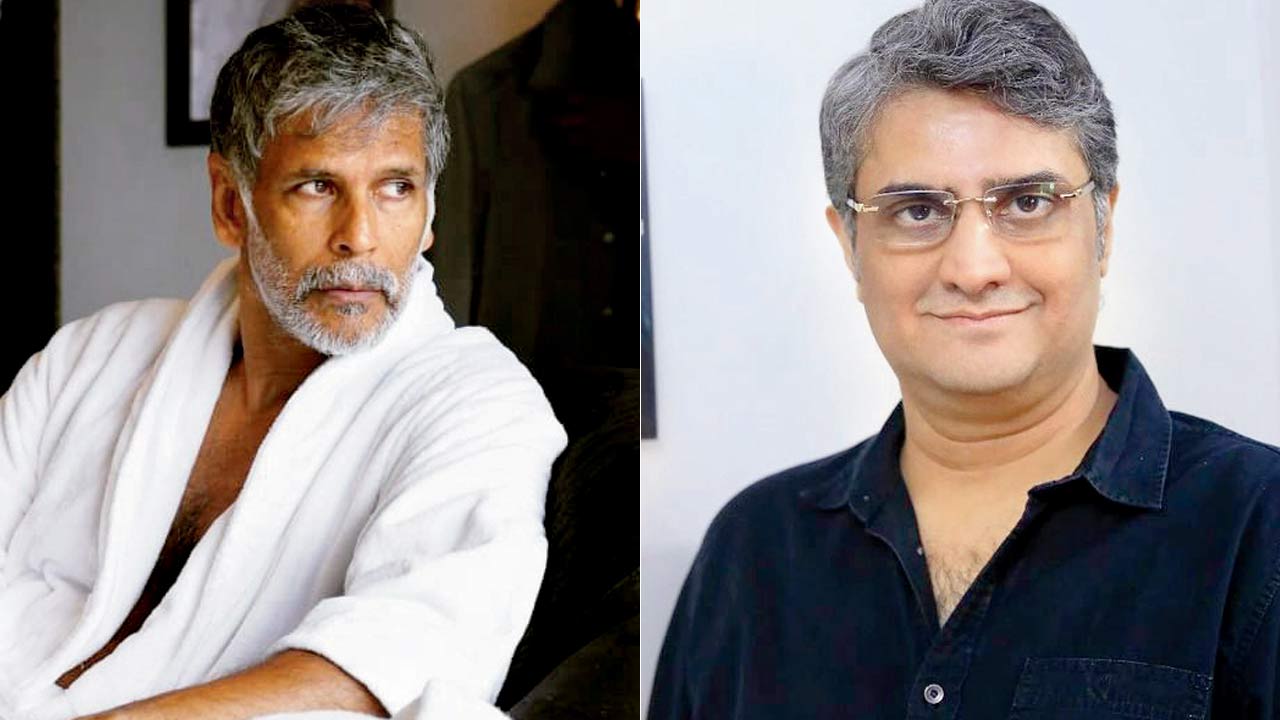
Milind Soman and Manish Gupta
More than 25 films registered with words ‘Section’ & ‘Article’ in titles
8:09 AM

Niharika Lal (BOMBAY TIMES; February 8, 2020)
Section’ and ‘Article’ seem to be the new favourite words in film titles as producers are making a beeline at the production association offices to register the titles of their films. Last year, after the central government revoked Article 370 (which granted Jammu and Kashmir special status), the associations received multiple applications for titles with Article 370 as well as Article 35 A, and Dhara 370 in them. An official of Indian Film and TV Producers Council (IFTPC) says, “Those titles which are registered with us are Section 364, Section 376, Section 302, Section 420, Section 484, Section 424, Article 14, Article 370, Article 35A, Dhara 370.”
An official of the Indian Motion Picture Producers’ Association (IMPPA), says, “IMPPA has received around 20 applications for the title of films which include the words ‘Article’, ‘Dhara’, ‘Section’ in them. As the films Article 15 and Section 375 created quite a buzz, many producers are also interested in having these words in the titles. A committee will look into the plot and other aspects of the films and then decide who should be granted the titles.”
A source from the Indian Film & Television Directors’ Association (IFTDA), says, “We’ve registered 15 titles with ‘Section’ and ‘Article’ in them for feature films. We also have several other applications for titles including Citizenship (Amendment) Act in them.” Gautam Chintamani, a film historian says, “It’s not surprising that filmmakers are making a beeline for these titles because filmmakers and audience both find movies with such titles intriguing. Also, titles with ‘Section’ or ‘Article’ are good for social media campaigns – in forming hashtags and get the film trending, making it topical. Article 15 should get the credit of coming up with the title first.”
PEOPLE INITIALLY WONDERED WHAT KIND OF NAME IS ARTICLE 15 FOR A FILM: ANUBHAV SINHA
While film experts now praise the film Article 15 for its title, director Anubhav Sinha says that his judgment was questioned when people from the film industry first heard about the title of his film. Speaking at a session in Delhi, he said, “When I named my film Article 15, people in the industry were wondering, ‘What kind of a name is this for a film?’ But that film did more business than many big budget movies and what’s more important is that the title Article 15 struck an emotional chord with the audience.”
Ajay Bahl, director of the film Section 375, adds, “When Manish Gupta wrote the film, he titled it Section 375 because that was the story (based on Section 375 of Indian Penal Code) , and it made perfect sense. But honestly, I thought that we should use another title instead. But we couldn’t come up with anything better than this for this film, so we kept it. And it worked.”
Pointing out how Bollywood has the habit of following trends, Gautam Chintamani, says, “Knowing the Bombay film industry, it’s likely that producers will tell the writers to just go through the Constitution and see on which Article/Section a film’s title can be based!”
There are several film producers’ associations and to avoid duplication of titles, all these associations cross-check with each other before registering the film titles.
KEY TITLES REGISTERED AND WHAT THEY MEAN
Section 364: Kidnapping or abducting in order to murder
Section 376: Punishment for rape
Section 302: Punishment for murder
Section 420: Cheating and dishonestly inducing delivery of property
Section 484: Counterfeiting a mark used by a public servant
Section 424: Dishonest or fraudulent removal or concealment of property
Article 14: Equality before the law or equal protection of the laws within the territory of India
Article 370: The recently abrogated article acknowledged the special status of the state of Jammu and Kashmir in terms of autonomy and its ability to formulate laws for the state’s permanent residents
Article 35A: The recently abrogated article empowered the Jammu and Kashmir state’s legislature to define “permanent residents” of the state and provide special rights and privileges to those permanent residents

Producer Viki Rajani signs Manish Gupta to direct two suspense films
7:58 AM

BOMBAY TIMES (November 11, 2019)
After backing films like Munna Michael (2007), Table No. 21 (2013) R…Rajkumar (2013) and Phobia (2016), producer Viki Rajani has signed writer-director Manish Gupta to direct two suspense films based on true events. Manish, who had recently written the story, screenplay and dialogues of Section 375, said, “Viki is a dynamic and visionary producer who has an interesting slate of high content films lined up. Both my films with Viki will create two franchises; one is a murder mystery franchise, while the other is a legal drama franchise.”
Viki added, “I was impressed with Manish’s work in Section 375. I recalled that he had previously written the story, screenplay and dialogues for the Amitabh-Bachchan-starrer Sarkar (2005). When I saw Rahasya that was based on the Aarushi Talwar murder case, which was directed by Manish, I realised that he is has a good hold over the suspense genre. So, I decided to back his vision. I’ve just launched my banner Faith Films P L, through which I’m tying up with various studios and distribution houses. Manish’s films will hit the floors in a couple of months.”
Not working is an uncomfortable experience for me-Akshaye Khanna
8:34 AM

Akshaye Khanna on changing his work strategy, doing more than one film a year and his latest outing Section 375
Sonil Dedhia (MID-DAY; September 15, 2019)
Akshaye Khanna is a man of few words. The actor, who stole hearts with Taal (1999), Dil Chahta Hai (2001) and, more recently, Mom (2017) and Ittefaq (2017), accepts that the nature of filmmaking is changing because the "audience is evolving". Khanna sits down with mid-day to discuss his latest release Section 375, how it's a conversation starter and why the film is open-ended.
Excerpts of the edited interview.
What prompted you to take up Section 375?
I was particularly thrilled with the script because it was well written and an intelligent film, where everything was sketched out thoroughly. As opposed to films which tackle similar topics. Section 375 doesn't take sides or a moral stand. It allows the audience to decide. It takes you through a case and shows the different perspectives of the society, judges and the lawyers. I believe, if a film doesn't take a stand, the audience is bound to make an opinion. I don't know to what extent the film will be watched, but it would be a good thing if it encourages a conversation.
Do you feel that the film can bring about a change in the society?
Having a difference of opinion means controversy and it's not necessarily a bad thing. Controversies have been termed as a bad connotation but in this particular instance, if you would like to label it controversial, which it is, then let's look at it positively and start a conversation about it. It will have an influence on people from the legal fraternity or people in the parliament —basically people who matter. What happened in the Nirbhaya case? The law was forced to change because public opinion was strong and immovable. Section 375 encourages the conversation by citing one particular case.
NGOs and activists have been raising awareness about fair treatment to the victim and accused. They are of the opinion that law is tilted towards women.
As an individual, I am aware that a section of people feel this law is skewed in the favour of women. I am sure people debate over the laws of rape worldwide. These debates will go on as the society evolves. As a collective consciousness, we have to decide the direction in which we need to change.
Did you personally research about rape laws in the country?
It was not required thanks to writer [Manish Gupta] and director's [Ajay Bahl] extensive research.
How did you prep for the role without any homework?
It's difficult to put it in words as it's an internal process for me. As an actor, I am always absorbing things and noticing behaviour. So, I am constantly, but not consciously doing it. For me acting is being in the moment. If I am true to it, then I have done my job.
Since your first film in Bollywood, how do you think content in films has changed?
The audience drives the change in filmmaking. The changes are never internally driven by the film industry. Films are almost like politics. Politicians follow in the direction of the majority. Take the example of Kabir Singh. It has smashed the perception of how a typical Hindi film hero should be. The character was seriously flawed but the film was widely accepted by people; and now you will see many such characters coming in. Even Uri: The Surgical Strike was an amazing subject. Films are breaking stereotypes because the audience is ready to accept them.
Does the success of these films affect your film choices?
Yes, it does influence the decision making. It plays in your mind and registers as important indicators while choosing roles as an actor.
Is it a conscious decision to be less frequent on screen?
It's something I personally want to change. I want to reduce the gaps between films and be prolific in the amount of work I do. I am also open to OTT platforms because it is the future. People are watching more content on the web than the silver screen.
Does it have to do with the fact that you are not as socially active as your contemporaries?
I don't think so. If only everything was in my control, including the scripts. [Going forward] I'd like to do two to three films a year. Contrary to the popular belief, I am not a person who does not like to work. My entire adult life has been about work, so not working is an uncomfortable experience for me. People assume that I enjoy relaxing but that's not true.
Why did you decide to hire a PR manager to promote your work, something you've never opted for in your entire career?
There are certain things I am good at and I am not at the rest. The most obvious one is having a public relations manager. I resisted it for a long time but it is pointless and stupid not to have one now. Instead of doing it myself [interacting with the media], for which I lack skills, it's better to hire a professional. I feel it's a step in the right direction.
The law around rape is being misused by men and women alike-Manish Gupta
7:59 AM

Manish Gupta on the courtroom drama he has scripted, which examines a case related to Section 375 of the IPC
Hiren Kotwani (MUMBAI MIRROR; September 11, 2019)
 Almost a year after the #MeToo movement arrived in Bollywood, filmmaker Manish Gupta is gearing up for his next, Section 375, which revolves around a rape case and features Akshaye Khanna and Richa Chadha as lawyers.
While many had speculated that the courtroom-drama is inspired by the Shiney Ahuja case, Akshaye Khanna, in an interview to Mirror (August 27), had said, “You’ll have to ask the writer. It could be one of the many cases that triggered someone to write a story, I wouldn’t know.” Pose the question to Manish, who has penned the script of this Ajay Bahl directorial, and he clarifies, “Like my previous films, Sarkar (as a writer) and Rahasya (which I also directed), Section 375 is based on my observation of what’s happening around us where the law around a heinous crime like rape is being misused by men and women alike.”
Coincidentally, he was to make a film with Shiney in 2009 and used to visit his wife, Anupam (who was also managing her actor-husband’s work) and him at their Oshiwara home. “One evening, I heard that Shiney had been arrested for rape. I rushed to the Oshiwara police station where the DCP said, ‘We’ve established intercourse, but we are not sure if it’s consensual or forced,’” Manish recalls, adding, “While Anupam explained to me that the DNA report is prone to error, when I read the charge-sheet, the girl’s traumatic statement sent a chill down my spine.”
Manish wrote the script after three years of research during which he attended over 160 court hearings, interviewed criminal lawyers, rape survivors and even the accused. “At the Sessions Court in Kala Ghoda, three courtrooms are dedicated to rape cases. I noticed that many cases had been filed by women against their ex-boyfriends, former live-in partners or even ex-fiancés after acrimonious break-ups. In some cases, they were not genuine accusations and the judges seemed to know this but they were bound by law to prosecute the men,” he shares, admitting that the real rape survivors are the worst affected by this. “The truth of their statements come under doubt due to the overwhelming number of fake cases,” he points out.
When asked if his film takes a stand, Manish states, “As filmmakers, our job is not to pass judgement on anyone but only to educate and entertain while holding a mirror to our society.”
Section 375 row: IFTDA rules in favour of Kumar Mangat, Abhishek Pathak
8:05 AM

IFTDA rules in favour of the producer in tussle over script rights with director Manish Gupta, who now plans to move high court
Natasha Coutinho (MUMBAI MIRROR; July 24, 2018)
 Mirror had earlier reported (February 17) about Akshaye Khanna and Richa Chadha teaming up for Manish Gupta’s upcoming directorial, Section 375: Marzi Ya Jabardasti, to be produced by father-son duo Kumar Mangat and Abhishek Pathak. It was soon followed by the director and producers entering a legal tussle over the film’s script rights.
Over the weekend, the Indian Film and Television Director’s Association (IFTDA) ruled in the favour of Kumar Mangat and Abhishek. “It has been proved beyond any doubt that the agreements of director/writer Manish Gupta with producer (Mangats’) Panorama Studios for film Section 375 and his complaint were contradictory and he simply wanted to harass the producer when he had been paid as per agreements and therefore committed a breach of terms of the agreement,” the ruling stated.
 “Manish had signed an agreement with us stating that we own the
rights to the script. We had begun pre-production when he started
misbehaving with various heads of departments in our office, including
the female staff, which is not acceptable. There were a lot of
complaints coming in and we had to take a stand by showing him the door.
He didn’t take it well and started threatening Akshaye and Richa. He
was the one who approached IFTDA, but they ruled in our favour,”
Abhishek informed Mirror.
“Manish had signed an agreement with us stating that we own the
rights to the script. We had begun pre-production when he started
misbehaving with various heads of departments in our office, including
the female staff, which is not acceptable. There were a lot of
complaints coming in and we had to take a stand by showing him the door.
He didn’t take it well and started threatening Akshaye and Richa. He
was the one who approached IFTDA, but they ruled in our favour,”
Abhishek informed Mirror.
The filmmaker goes on to add that he and his father decided to collaborate with Gupta despite being warned by industry colleagues. “Producers have had issues with Manish in the past, but we went ahead with him anyway, thinking of him as a nice guy. When the film was about to kick off, his behaviour took a complete U-turn. That said, we have invested a lot of money in the film, right from acquiring the script to paying the actors and technicians. Pre-production also costs a lot of money so we are going ahead with the film. We had approached another director to take over the film but Manish started threatening him too.”
The filmmakers want to shoot the film on a grand scale. “We were to start in August but didn’t go ahead with the plan as we thought it prudent to wait for the IFTDA decision. We are satisfied with the development and want to proceed with the film now. It revolves around a great debate because section 375 of the Indian Penal Code puts men in a position where they must defend themselves even if they are innocent. There are several ongoing cases in courts where women have misused the law for revenge. It’s a loophole in the system that we plan to address through the film,” Abhishek informed, adding that the film goes on the floors in September–October after the team finalises a director.
Meanwhile, Manish maintains that he still owns rights to the script and is planning to take the case further, saying, “I own the copyright to Section 375 as per the certificate issued to me by Copyright Office, Delhi. I have returned the signing amount of Rs 3,38,000 to Kumar Mangat. I have informed IFTDA that I am taking the matter to the High Court now and as part of the process I have already sent him two legal notices terminating the writer agreement. To avoid loss of face and to misguide investors they are trying to create an impression that I am no longer part of the project.”
Section 375 row: Kumar Mangat registers a complaint with IMPPA against Manish Gupta
7:52 AM

Hiren Kotwani (DNA; June 22, 2018)
The war between writer-director Manish Gupta and producer Kumar Mangat Pathak post their fall out over Section 375: Marzi Ya Jabardasti, a film they were meant to collaborate on, has taken yet another ugly turn. Yesterday, After Hrs reported how a copy of the script, without the writer’s name on it, was reportedly being circulated by the producers (Panorama Studios) and a bid was being made for another director to come on board instead of Manish.
To us, Kumar maintains that he’s not removing Manish’s name as the writer, though he has sacked him as director. He explains, “I signed Manish as a writer, so his credit will be there. We have sacked him as the director after our first assistant director Raman Kumar and two other ADs, Anugrah Bantawa and Malavika Pillai complained against Manish and resigned.”
The producer tells us that he had signed the Writer’s Agreement and Director’s Agreement separately with Manish. “The Writer’s Agreement had no mention of the Director and the Director’s Agreement had no mention of the writer. The agreement clearly states that if there are wrong-doings from Manish’s part, then we can remove him from the movie,” he says, adding that he himself had contributed considerably to the original script that Manish had submitted two years ago. “About 80 per cent of what he had given two years ago has been changed because of the inputs shared by me,’’ says Kumar, adding, “However, I will still credit Manish as the writer. For any additional dialogues, I will give due credit to the others who have worked on it specifying that is for the ‘Additional Dialogue’.”
When asked about the mail Manish sent him asking to terminate their deal on friendly and amicable terms, Kumar says, “Manish sent that to me after I told him we can’t continue with him as a director because other department personnel had problems with his working style. Since I was out of town, I sent him the termination notice only after my return.”
Kumar says he has registered a complaint against Manish with the producers’ body, IMPPA (Indian Motion Pictures Producers Association) and wants to start the film by the end of August.
Section 375 drama escalates; script copies without Manish Gupta’s name being circulated ‘mysteriously’?
8:17 AM

Hiren Kotwani (DNA; June 21, 2018)
Yesterday, After Hrs reported that writer-director Manish Gupta (Rahasya) had sent a legal notice to producer Kumar Mangat after they had a fallout over Section 375: Marzi Ya Jabardasti, on which they were collaborating. While Kumar told us that he sacked Manish from the film, we have procured the ‘Friendly and Amicable Termination of Writer & Director Agreements’, which the latter had sent to the former by email on May 12 this year and also a copy of the Copyright Certificate that bore Manish’s name, dated May 24, 2016.
An industry source tells us, after Kumar issued a Termination Notice to Manish on May 21, he allegedly started circulating the script to bring a director on board to helm the movie. A source said, “Considering that every writer ensures his name and contact details are marked on each page of the script, some of the directors offered to direct the film were surprised to see that the copies they were given had no mention of the writer. Instead, the copies bore the names of producers Kumar Mangat Pathak and his son, Abhishek Pathak and of their production house, Panorama Studios.”
After Hrs has procured copies of both versions of the scripts — one with Manish’s name on it and the other without it. We hear that two of the directors, one of whom is Shivam Nair (Naam Shabana), was offered to direct Section 375. Apparently, when he learnt that it was Manish’s script and that he had the copyright, he declined to helm the movie. According to the Legal Notice that Manish sent to Kumar Mangat and his company, he learnt on June 7 that the producers had handed the script’s copy to Shivam and it did not bear Manish’s name as the writer. “The differences began when the writer-director sought to amicably end their contract and move on to making the movie with another producer after waiting for seven months as Kumar couldn’t get Akshaye Khanna’s dates or tie up with a studio,” says our source, adding, “Seeing this film slipping out of his hands, it seems Kumar is putting the blame on Manish as stated in the Termination Letter that he had sent to him. But Manish is prepared to fight. He has already sent the Legal Notice to Kumar and his company. He will be moving court against them shortly.”
Section 375: Marzi Ya Jabardasti director Manish Gupta sends legal notice to producer Kumar Mangat
8:10 AM

Hiren Kotwani (DNA; June 20, 2018)
On June 14, After Hrs reported that Akshaye Khanna was to be allegedly thrown out from 'Section 375: Marzi Ya Jabardasti' because the actor was dilly-dallying over dates, asking for changes in the script and supposedly even asked for a fee hike! After long delays, producer Kumar Mangat and writer-director Manish Gupta (Rahasya), who were said to be miffed with the star son’s working style, had apparently decided to oust him from the movie.
However, now we hear that quite a few developments have taken place. This time around it seems like the producer and director are at war with one another. And the latter has now decided to sue the former for wrongful termination of his contract. We also hear that Akshaye Khanna is back in the project and Priyadarshan has been roped in to helm it instead of Gupta.
An industry insider tells us that things started souring between the producer and the writer-director a while ago. “After working on the script for two years and waiting for seven months post signing the contract with Kumar Mangat and his company, there was no progress on Section 375. That’s when Manish started getting restless. First, Akshaye delayed by giving priority to The Accidental Prime Minister and then of course, he was trying to get his terms revised. However, Kumar Mangat didn’t reason with him or try to salvage the situation and instead let the matter escalate. Eventually, Manish expressed his opinion to exit the setup and move on with his script to making it with another producer,” says our source, adding that this didn’t go down well with Mangat.
Our source adds, “Kumar didn’t want to let go of the script and on May 21, issued a Termination Notice to Manish, who owns the copyright/IPR (Intellectual Property Right) of the script. It is Kumar’s desperate attempt to put all the blame on Manish. Having worked hard on it for over two years, Manish isn’t giving up on what is rightfully his. Incidentally, on June 7, he learnt that director Shivam Nair was given the script, without his (Manish’s credit) to helm the movie. That’s not all, he also learnt that various third parties had got copies of Manish’s script with his name removed. So, on June 15 he issued a Legal Notice to Kumar Mangat and his company and is petitioning the Bombay High Court to uphold his right to declare his agreement with Kumar Mangat and his company as ‘Null and Void’. Moreover, he should be allowed to move on and make the film with another producer without any interference by Kumar and his company.” We tried contacting Manish, but he was unavailable for comment.
When contacted, Kumar maintained that he had terminated the contract. He stated, “I got complaints against Manish by my team, in writing, about how he was being high-handed and ill-treating them, making them wait till late night. In our agreements, it was clear that if he indulged in any nonsensical behaviour, it won’t be tolerated. Due to his bad attitude and behaviour with the with the team, I have terminated the contract and asked him to exit the project.”
When probed about making the film with Priyadarshan at the helm, Kumar added, “That’s a different subject that we’re making. As far as Section 375 is concerned, we are looking to sign an appropriate director. Akshaye Khanna and Richa Chadha are very much a part of it. Also, as per the contract, I have the rights to the script.”
Akshaye Khanna ousted from Section 375: Marzi Ya Jabardasti?
7:58 AM

Nayandeep Rakshit (DNA; June 14, 2018)
February earlier this year, it was announced that Akshaye Khanna and Richa Chadha had been signed on for a film titled Section 375: Marzi Ya Jabardasti, which explored the issue of misuse of rape laws by men and women alike. Produced by Kumar Mangat Pathak and Abhishek Pathak, the movie was being helmed by Rahasya maker, Manish Gupta. But ever since, there has been no movement on the project.
After Hrs had reported in March that Akshaye had kept the Section 375 team waiting as he had allotted his dates to The Accidental Prime Minister. Now, we hear there’s another twist to the plot. Apparently, Akshaye is no longer a part of the project. Says a source, “There have been several discussions and disagreements between the actor and the makers. Akshaye has violated the contract and has been unavailable for the longest time. Now, the whole team has decided to replace him in the film. They don’t want to make the movie with him anymore.” Richa, however, is still on board for the suspense drama.
Too many demands
Problems, apparently, started right after the announcement. Our source reveals, “Akshaye had already signed the contract for a certain remuneration that was promised to him. But after he signed another film, he wanted twice the amount. He also asked for several changes in the script, and was disinterested in the project thereafter. He had allotted his dates for the film, but went back on his word. For the time being, the movie has been stalled.”
Earlier, Akshaye had refused to be a part of Raj Nidimoru and Krishna DK’s web series The Family Man, for the same reasons. He had allegedly quoted a ridiculous price for it. Our source adds, “He needs to re-evaluate his market value before making such obstinate demands.”
Legal action in process
The makers of Section 375: Mazi Ya Jabardasti including the director and producer, are reportedly miffed with the Ittefaq actor and plan to take legal recourse. “They are filing a lawsuit against Akshaye for breaching the contractual terms. They are also scouting for another hero and trying to get the film on floors as soon as possible,” our source asserts. We tried to contact Manish, but he remained unavailable for comment.
Akshaye Khanna to play lawyer in a suspense-drama on rape titled Section 375: Marzi Ya Jabardasti
8:26 AM

Manish Gupta’s film touches upon Section 375 of the Indian Penal Code, that defines rape, and also features Richa Chadha as the public prosecutor
Shravan Shah (MID-DAY; February 17, 2018)

“In recent times, there have been a number of cases where it’s ambiguous whether it was rape or consensual sex. The law can be misused by both men and women alike. This film is about how a law against rape made to protect women can also be misused by them,” informs Manish, pointing out that it holds up a mirror to the uncertain times we live in.
The filmmaker attended several hearings in court for two years as part of his research. “There is a special court with a special female judge who only hears rape cases. I have also met survivors, their families, alleged rapists and both their lawyers,” he says. “It’s very disturbing not only for the accused and the survivors but also their families.”
The film which is set in Mumbai has Akshaye essaying the role of a suave SoBo lawyer who is fluent in English. “I did not want a typical Bollywood hero who sings and dances. I needed an intelligent guy, somebody who looks 40, qualities I found in Akshaye,” he says, asserting that till the end you will be left guessing about whether it was a rape or consensual sex. “Both lawyers have strong evidence to back up their respective client’s case, confusing the judge and the audience at every turn.”
Abhishek Pathak who is producing the film with his father Kumar Mangat added that the issue they are trying to raise with this film is that some women misuse the power given to them by the law which makes it difficult for real rape victims. “I’ve seen Manish’s Rahasya and we thought it was an interesting film. We know what he will be able to achieve with the script. When he came to us, we were drawn by the idea of Section 375 and decided to back the project,” says Abhishek.
The film also features Richa Chadha as a public prosecutor.
Rasika Dugal to Manav Kaul: Theatre actors who're making their mark in Bollywood
8:02 AM

Deepali Singh (DNA; June 25, 2017)
A few days ago, director Manish Gupta put up a post on Facebook, informing that casting is on for female actors for an important role in a film he’ll be directing. One of his main requirements for the role? A background in theatre. “Theatre provides you with the tools and skills for acting. When you want a good actor for your film, and don’t want to rely on other frills such as costumes and foreign locations, that’s when the need for an actor from a theatre background arises,” says the filmmaker, who has written Sarkar and last directed Rahasya.
Some of Hindi cinema’s most powerhouse performers have had a connection with the stage. Right from Prithviraj Kapoor, to Naseeruddin Shah, Paresh Rawal, Shabana Azmi, Pankaj Kapur, Anupam Kher, Om Puri, Ratna Pathak Shah and others, many owe their acting careers to the stage. The reigning superstar of Bollywood, Shah Rukh Khan, studied under Barry John and acted in a number of plays during his college days in Delhi University. While theatre actors were few and far between in movies till a couple of years ago, a look at the current crop of films, and you will find that they are peppered with actors who have had their training in theatre.
Whether it is Nimrat Kaur, who received critical acclaim for her turn as the lonely housewife in Lunch Box, or Kalki Koechlin, who made her debut with Dev D as a young girl who turns to prostitution after a leaked sex tape scandal, or Manav Kaul, whose performance in Kai Po Che! as a right-wing politician was appreciated by all, they all have theatre as the common binding factor. Actors such as Radhika Apte, Nawazuddin Siddiqui, Irrfan Khan, Ayushmann Khurrana, Piyush Mishra, Huma Qureshi, Rajkummar Rao, Atul Kumar, Kumud Mishra and Danish Husain among others, have taken their training in theatre and made Hindi cinema richer with their powerful performances.
One with the craft
While producer Tanuj Garg believes that it’d be unfair to generalise, he does agree that theatre, being a tougher medium, creates extremely mature, confident and seasoned actors.
Tumhari Sulu, a movie produced by Tanuj, Bhushan Kumar, Atul Kasbekar and Shanti Sivaram, features Manav Kaul playing husband to Vidya Balan. “Manav has been around as an actor for a while. He has being doing some exceptional theatre and playing small key roles in several renowned films. The casting of Ashok was crucial as we needed a brilliant actor who could match up to Vidya (Sulu). Nandini Shrikent (casting director) worked diligently on this casting. When we saw Manav’s test, we were blown away. His performance was natural, effortless and nuanced. Just the sort of Ashok we needed,” says Tanuj.
Filmmakers are always keen to cast good actors in their movies, and if their training has been in theatre, it helps bring that extra magic to their performances. Madhur Bhandarkar’s next, Indu Sarkar, sees Kirti Kulhari, who comes from a theatre background, as its lead protagonist. Playing Manto’s wife Safia in Nandita Das’s next film as director, Manto, is Rasika Dugal, who too, started from the stage and has done small, but pivotal roles in Hindi films. The filmmaker met Rasika after she had seen her perform in the play Bombay Talkies, which had been filmed for Nandita’s theatre initiative, CinePlay. “I think what makes theatre actors different is that they are regularly in touch with their craft. Even when I didn’t have film work, I was regularly attending rehearsals and doing plays. Being in touch with your craft is extremely important,” says Rasika.
Discipline on stage
Although Dinesh Vijan had not seen any of Jim Sarbh’s theatre performances — he has till now not even seen him play the terrific villain in Neerja — his recently released Raabta had the actor coming in the way of the lead pair, played by Kriti Sanon and Sushant Singh Rajput, another theatre actor turned filmstar. “My process of casting is very instinctive,” says Dinesh, “When I saw the auditions, I saw an unpredictable energy in Jim, an inherent grain that made me feel he was the character.”
Acting, feels Sayani Gupta, like a lot of other things, is all about practice. The actress, who made her debut with the role of a blind activist Khanum in Margarita With A Straw, has a couple of interesting roles lined up, from playing a 14-year-old in Jagga Jasoos to the female lead in The Hungry, also starring Naseeruddin Shah. Sayani, who has worked with theatre stalwarts like Habib Tanvir and MK Raina, believes that theatre has helped hone her acting skills. “The most important thing that theatre teaches you is discipline and respecting everyone equally. Theatre also helps you in persistent rigour and the importance of rehearsing every single day in order to ‘find’ something. Everyday is a new challenge, every show is as exciting and nerve racking. Also, you are thinking on your feet and really learn to ‘listen’ to your co-actors while acting. You are ready to improvise at any time and yet, know the whole play by heart including other people’s lines. All of these count and pay off in acting for any other medium. You just figure out other technical nitty gritties when you face the camera,” says the actress.
Petitions, protests against films may be commonplace but filmmakers haven’t lost faith in judiciary
7:53 AM

Petitions and protests against films may be commonplace now, but filmmakers haven’t lost faith in the judiciary
Anirban Das (MID-DAY; March 4, 2016)
Bollywood films are primarily meant to entertain audiences, but at times, they tend to draw the ire of certain individuals/organisations over sensitive or sensational content. Almost every other month, we see protests and petitions against films — so much so that it seems like a fad now.
The latest Bollywood project to have invited trouble is Shah Rukh Khan-starrer Raees, which is said to be inspired by alleged gangster Abdul Latif, who had an illicit liquor trade in Gujarat during the peak of Prohibition in the 1990s. Latif’s son, Mustak Ahmed Abdul Latif Sheikh has sent legal notices to SRK, his co-star Nawazuddin Siddiqui, director Rahul Dholakia, producer Ritesh Sidhwani and five other prominent persons involved with the project, restraining them from “screening, promoting, releasing, publicising, advertising and exploiting the Hindi film.”
Agenda of extortion
Rahasya director Manish Gupta sees the surge in complaints against Hindi films as an agenda of extortion. “Rarely are the concerns raised by individuals and organisations valid. Filmmakers pump in huge amounts of money to make and promote a film, but such petitions and protests jeopardise it. Court cases drag on for long and that affects the release and thereafter, the box office business. But there have been instances of producers giving in to the protestor’s demands because they have no other option. They sometimes opt for a quick settlement to facilitate a proper release for their projects,” he adds.
Recalling his fight at the Bombay High Court last year for the release of his film based on the 2008 Noida double murder after the parents of slain teenager Arushi Talwar objected to it, Gupta says, “Eventually, I won the case and released my film. But I had to fight for 11 months. After the court gave us clearance, we got only three days to promote the film. So, obviously, we could not make it as successful as it should have been,” says Gupta.
Torturous and tiring
While the business gets affected, it also causes mental stress to filmmakers. Ask Sanjay Leela Bhnasali, whose dream project Bajirao Mastani faced “distortion of history allegations, says, “To have almost five to six cases lodged against you for almost 15 days is traumatic and stressful. It could be for various reasons, which didn’t seem correct. But, thank god for the fact that nothing stopped us. People wanted Bajirao’s story to be told. A PIL can be filed even if a few people want to go against you, or want the film to be stopped from hitting theatre. Or maybe, they just want to get noticed. It could be arm twisting.”
Sigh of relief
While numerous PILs and cases against several Bollywood films have come forth in the recent past, filmmakers haven’t lost faith in the judiciary. “The courts are now quite understanding,” says Hansal Mehta, whose critically acclaimed film Aligarh could not release in Aligarh, Uttar Pradesh despite not facing a legal ban. Millat Bedari Muhim Committee objected to its entry into theatres claiming that the film sullies the reputation of the city. Aligarh is based on Professor Ramchandra Siras who was suspended from Aligarh Muslim University after he was filmed having consensual sex with a man. “They do not stall the release of a film unless the case has been filed well in advance. Earlier, a film used to get a stay just a few days before it hit the marquee. So, it had kind of become a racket to extort money from filmmakers. That has been kept in check now,” explains Mehta.
Bhansali, too, is glad about the courts rejecting petitions that are filed just for the sake of creating a hue and cry. “Many PILs against Bajirao Mastani were thrown out the minute they were heard.”
Biopics of Rajiv Gandhi & Sanjay Gandhi in the pipeline?
3:11 PM

Subhash K Jha (DNA; July 5, 2015)
The Gandhi fixation continues in India — and we’re not
talking about the Mahatma here — but rather, the political dynasty that
stayed in power for several years.
We recently told you how director Manish Gupta has a script ready for an Indira Gandhi biopic starring Vidya Balan, but that the actress will only say yes once the necessary permissions from Sonia Gandhi are in place.
All the way from 2006 to the time of his death in 2011, director Jagmohan Mundhra struggled to bring out his biopic on Sonia Gandhi, but was served with a legal notice.
Then, in 2012 Bhavna Talwar announced a biopic on Sonia’s slain husband Rajiv, but the film never really took off after the scripting stage. While names like Abhishek Bachchan, Colin Firth and Riz Ahmed did the rounds for a while, we learn that Ranbir Kapoor’s name has also been cropping up of late and that the film will finally take shape soon and Abhishek is most likely to be picked.
Now, in 2015, filmmaker Hansal Mehta has just announced his project on Rajiv’s controversial younger brother, Sanjay Gandhi and is looking at names like Rajkummar Rao, Arjun Kapoor and Varun Dhawan. Only time will tell, who makes the cut for the role. Both films are expected to release mid-2016. Will we see a clash of the Gandhi brothers at the box- office?
Vidya Balan interested to play Indira Gandhi in Manish Gupta's next but...
7:57 AM

Director Manish Gupta reveals that he’s waiting for the green signal from 10 Janpath
Nayandepe Rakshit (DNA; June 26, 2015)
Recently, in an interview to After Hrs, Vidya Balan confessed that she’d like to play Indira Gandhi on screen. Soon after, she was approached for a biopic on the former India PM by Rahasya director Manish Gupta. Despite liking the script, Vidya is a little sceptical about taking it up. Manish confirms, “She has liked the script, but hasn’t given a go-ahead yet. Given that the film is on Indira Gandhi, there are precautions needed to be taken before we start.”
Gupta further adds that the script needs to be approved by the Gandhi family. It has been titled Indira. He reveals, “My film will be a tell-all tale about Indira Gandhi — right from her birth to her assassination. It’s the story of her childhood, youth, rise to power as the Prime Minister of India, her fall to near-oblivion, her comeback as PM, her final battle against extremists and her refusal to discriminate on the lines of faith, that eventually led to her assassination.”
VIDYA’S THE ONLY CHOICE
“I approached Vidya almost three-four months ago. It would be wrong if I claim she has okayed the script. She feels it’s a nice story but she just told me, ‘How will you make the film? You don’t have the permission from the family’. I had been trying to get the permission months before I approached Vidya.”
GANDHI FAMILY’S CONSENT — The Hurdle?
Gupta knows that ‘it’s a sensitive issue’ so getting the permission won’t be easy.”I have been in touch with Sonia Gandhi for the last eight months. She is aware that I am doing the film. I want to meet her personally and take a direct commitment from her. That’s what I’m trying to do. Everyone who I have approached to be a part of the film wants a written permission before they can greenlight the project,” he adds.
Gupta has done his research. “I read 26 books about her,” he revealed. Indira, the life of Indira Nehru Gandhi by Katherine Frank, Indira Gandhi — a Biography by Pupul Jayakar, Operation Blue Star— The True Story by Lt Gen KS Brar, Tragedy of Punjab, Operation Blue Star and After by Khushwant Singh and Kuldip Nayar and Durbar by Tavleen Singh are just to name a few books that have been a part of Gupta’s R&D for the project.
But has he spoken to someone close to Indiraji? “I haven’t met or spoken to people close to her, but the books I read are written by prominent people themselves. Pupul Jaykar was very close to Indira Gandhi, he was her best friend. One of the books is written by the army man who led the operation Blue Star. After reading their books, it was easy to create the narrative because they have given a very detailed insight into Indira Gandhi’s life and her political agenda.”
PRODUCERS BHI MIL GAYE
Manish is all smiles as he’s already found a producer to invest in his dream project. “A very big studio is interested in producing the film, provided I get the permission from the family. It’s one of the corporate houses, but I cannot name them because we haven’t worked out the technicalities yet,” he revealed.
NO NAACH GAANA
Unlike other biopics, Indira won’t be a typical Bollywood film. He argues, “The film is not of the typical Bollywood sensibilities. There won’t be any naach gaana in the film. We wouldn’t be showing Indira Gandhi dancing in the film! It’s like a Hollywood movie, much on the likes of a film like Gandhi! It’s on that scale."
RAJIV AND SANJAY THERE TOO!
Other than Indira, there will be characters for Indira’s sons Rajiv Gandhi and Sanjay Gandhi as well. “Obviously, the film will be incomplete without their characters but I have not approached anyone yet because honestly, the movie will focus on Indira Gandhi’s character only. So the other people will be side characters and there won’t be any other A-lister in the film. It will be one of those supporting heroes instead. But I haven’t decided who to cast till now,” he signed off.
Tisca Chopra to play lawyer in Ram Gopal Varma's Affair
9:38 AM

BOMBAY TIMES (March 8, 2015)
Tisca Chopra's recent
perform ances have garnered appreciation from all quarters. Her
last two releases, Rahasya and Qissa, have survived market pressures to
bring in both moolah and critical acclaim. Anup Singh, who directed the
actress in Qissa, says, “Tisca is an exemplary artiste, who can convey
emotions
effortlessly.“
Manish Gupta, who helmed Rahasya, finds the maturity of her craft more impressive.The actress is gearing up for seven releases this year. She is presently working on Ram Gopal Varma's upcoming psychological thriller Affair, where she is required to delve into the gritty character of a top-notch lawyer.
effortlessly.“
Manish Gupta, who helmed Rahasya, finds the maturity of her craft more impressive.The actress is gearing up for seven releases this year. She is presently working on Ram Gopal Varma's upcoming psychological thriller Affair, where she is required to delve into the gritty character of a top-notch lawyer.
High Court clears Rahasya for release; says it doesn't depict facts of Aarushi's murder case
7:39 AM

Sakshi Sem (right) will play Aarushi Talwar (left) in Rahasya
Bharati Dubey (MID-DAY; January 28, 2015)
Director Manish Gupta is a relieved man. Decks have been cleared for the release of his upcoming thriller Rahasya that had met with resistance from the parents of Aarushi Talwar, a Noida teenager, whose murder in May 2008 remains a mystery till date.
The Talwars had blocked the release alleging the film is based on the life of their slain daughter and was unfit for public screening with the case being sub judice. While distributors called it off, the promos and publicity of the film were also withdrawn.
However, Gupta heaved a sigh of relief when the Bombay High Court cleared it during a hearing yesterday. Gupta tells hitlist , “I have spent an entire year fighting this case. I was unable to write or start any other film. The loss to my producer and distributors Viacom 18 has run into crores. But now, Justice V. M. Kanade has ruled Rahasya’s story does not depict the facts of Aarushi’s murder mystery and there is no case made out for a stay or any ad interim relief on the film. As planned, we will release it this Friday.”
In February last year, Aarushi’s mother Nupur had filed a petition in the High Court against Rahasya producer Monica Vimal Maluka demanding a stay on the film’s release and the quashing of its censor certificate. On their part, the makers clarified that Rahasya is a fictitious murder mystery and does not bear any semblance to any person living or dead. As per the Talwars’ request, a special screening of the film was organised but they insisted that there was a similarity to Aarushi’s murder case and continued to demand a stay on the film. In September last year, the court had allowed the producers to go ahead with the publicity, but with a disclaimer.
Talwars continue protest against Rahasya, despite Censor Board's claims
7:51 AM
Rachana Dubey (MUMBAI MIRROR; April 11, 2014)
 Manish
Gupta had heaved a sigh of relief when the Indian Board of Film
Certification filed an affidavit stating that there are no similarities
between his movie Rahasya and the Aarushi murder case. But the respite
was short lived as after watching a preview of the film, the Talwar
family has decided to continue their legal effort to stall the film’s
release.
Manish
Gupta had heaved a sigh of relief when the Indian Board of Film
Certification filed an affidavit stating that there are no similarities
between his movie Rahasya and the Aarushi murder case. But the respite
was short lived as after watching a preview of the film, the Talwar
family has decided to continue their legal effort to stall the film’s
release.
“We are definitely challenging the Censor Board’s claims,” says Vandana Talwar, dentist Rajesh Talwar’s sister who watched the film Rahasya on behalf of her brother and sister-in-law Nupur, who are serving a life sentence in the double murder of their daughter Aarushi and help Hemraj.
“I can’t state which scenes have affirmed this decision because of an affidavit that I signed, which bars me from revealing any details but we are taking this case forward,” she told Mirror.
The case is up for hearing again in the Bombay High Court on April 17. The Talwars had approached the Court to stall the release of the movie produced by UVI Films Production Ltd, on the grounds that it is based on “distorted facts” surrounding the death of Aarushi.
After the Censor Board filed an affidavit stating that there are no similarities between the movie and the murder, the couple sought a screening for a family member.
Talwars’ advocate Anushak Davar has pointed out to a division bench that there were “over 100 similarities” between the movie’s story and the case.

“We are definitely challenging the Censor Board’s claims,” says Vandana Talwar, dentist Rajesh Talwar’s sister who watched the film Rahasya on behalf of her brother and sister-in-law Nupur, who are serving a life sentence in the double murder of their daughter Aarushi and help Hemraj.
“I can’t state which scenes have affirmed this decision because of an affidavit that I signed, which bars me from revealing any details but we are taking this case forward,” she told Mirror.
The case is up for hearing again in the Bombay High Court on April 17. The Talwars had approached the Court to stall the release of the movie produced by UVI Films Production Ltd, on the grounds that it is based on “distorted facts” surrounding the death of Aarushi.
After the Censor Board filed an affidavit stating that there are no similarities between the movie and the murder, the couple sought a screening for a family member.
Talwars’ advocate Anushak Davar has pointed out to a division bench that there were “over 100 similarities” between the movie’s story and the case.
I don’t understand the Talwars’ objection-Sakshi Sem
8:52 AM

Vickey Lalwani (MUMBAI MIRROR; March 10, 2014)
Nupur and Rajesh Talwar, who were sentenced to life imprisonment in November 2013 by a UP court for the 2008 murder of their teenage daughter Aarushi and domestic help Hemraj, have approached the Bombay High Court seeking a stay on the release of Manish Gupta’s Rahasya. The Talwars in their petition claimed that the movie is based on “distorted facts surrounding the gruesome death” of their daughter.
This has put a question mark on the future of the film and Sakshi Sem, the child actor of Darna Zaroori Hai and Raju Chacha, who is playing the lead. Defending the film, 19-year old Sakshi told Mirror, “Rahasya is not based on the Aarushi murder case per se. So, I don’t understand the Talwars' objection to the film. It doesn’t end with Kay Kay, who plays my father, being convicted for the murder. The actress playing my mother is not an accused.”
On February 17, the Talwars sent a legal notice to Gupta and UVI Films Production Ltd asking for a private screening. When they didn’t respond, the Talwars filed a petition in the High Court. They have also challenged the Central Board of Film Certification for clearing the film.
Subscribe to:
Posts (Atom)