Showing posts with label Mani Ratnam interview. Show all posts
Showing posts with label Mani Ratnam interview. Show all posts
I have an issue with it being called Bollywood all the time-Mani Ratnam
9:39 AM
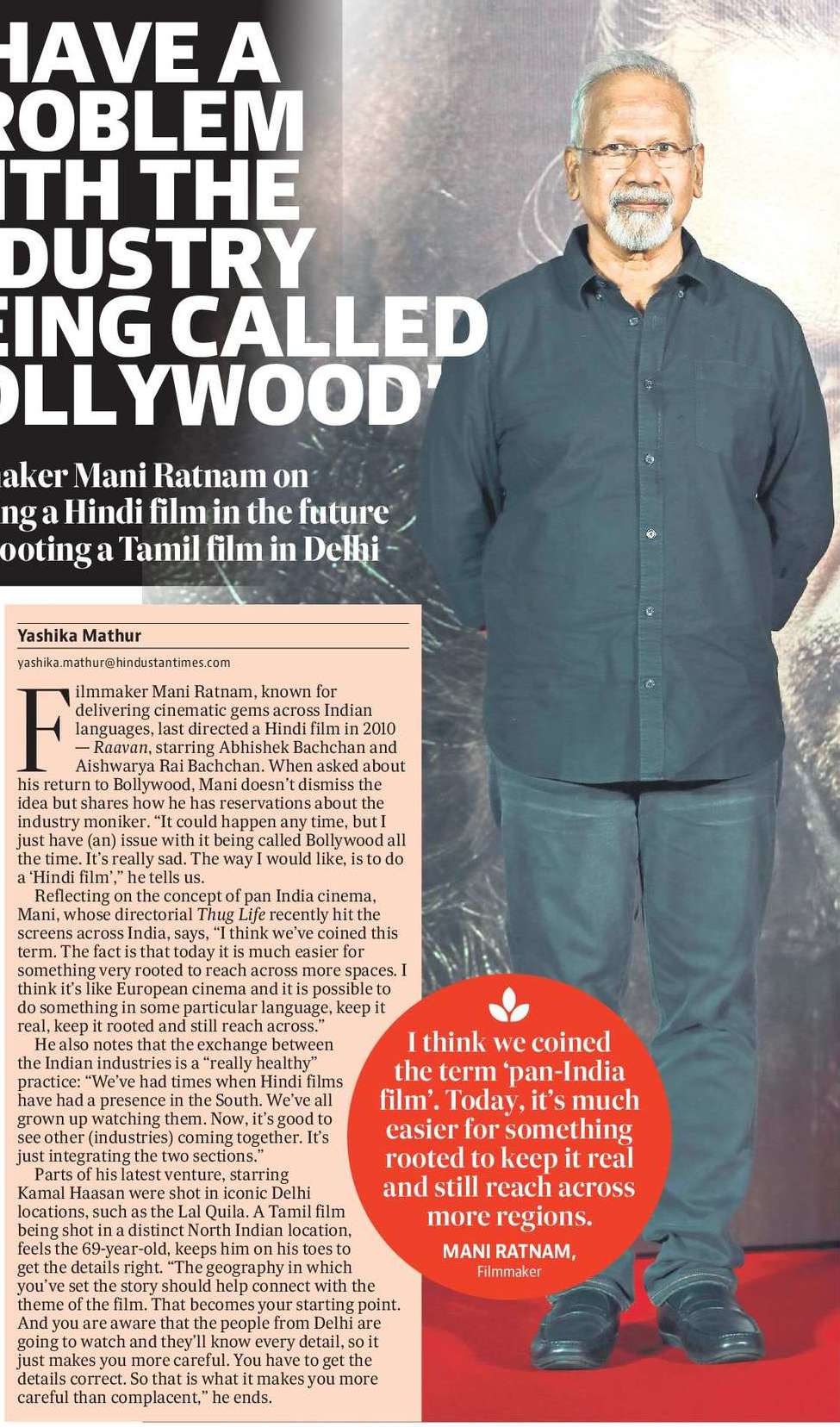
Filmmaker Mani Ratnam on directing a Hindi film in the future and shooting a Tamil film in Delhi
Yashika Mathur (HINDUSTAN TIMES; June 9, 2025)
Filmmaker Mani Ratnam, known for delivering cinematic gems across Indian languages, last directed a Hindi film in 2010 — Raavan, starring Abhishek Bachchan and Aishwarya Rai Bachchan. When asked about his return to Bollywood, Mani doesn’t dismiss the idea but shares how he has reservations about the industry moniker.
“It could happen any time, but I just have (an) issue with it being called Bollywood all the time. It’s really sad. The way I would like, is to do a ‘Hindi film’,” he tells us.
Reflecting on the concept of pan India cinema, Mani, whose directorial Thug Life recently hit the screens across India, says, “I think we’ve coined this term. The fact is that today it is much easier for something very rooted to reach across more spaces. I think it’s like European cinema and it is possible to do something in some particular language, keep it real, keep it rooted and still reach across.”
He also notes that the exchange between the Indian industries is a “really healthy” practice: “We’ve had times when Hindi films have had a presence in the South. We’ve all grown up watching them. Now, it’s good to see other (industries) coming together. It’s just integrating the two sections.”
Parts of his latest venture, starring Kamal Haasan were shot in iconic Delhi locations, such as the Lal Quila. A Tamil film being shot in a distinct North Indian location, feels the 69-year-old, keeps him on his toes to get the details right.
“The geography in which you’ve set the story should help connect with the theme of the film. That becomes your starting point. And you are aware that the people from Delhi are going to watch and they’ll know every detail, so it just makes you more careful. You have to get the details correct. So that is what it makes you more careful than complacent,” he ends.
During Nayakan, Kamal Haasan was a big star, and I was a beginner. But he trusted me fully-Mani Ratnam
4:04 PM
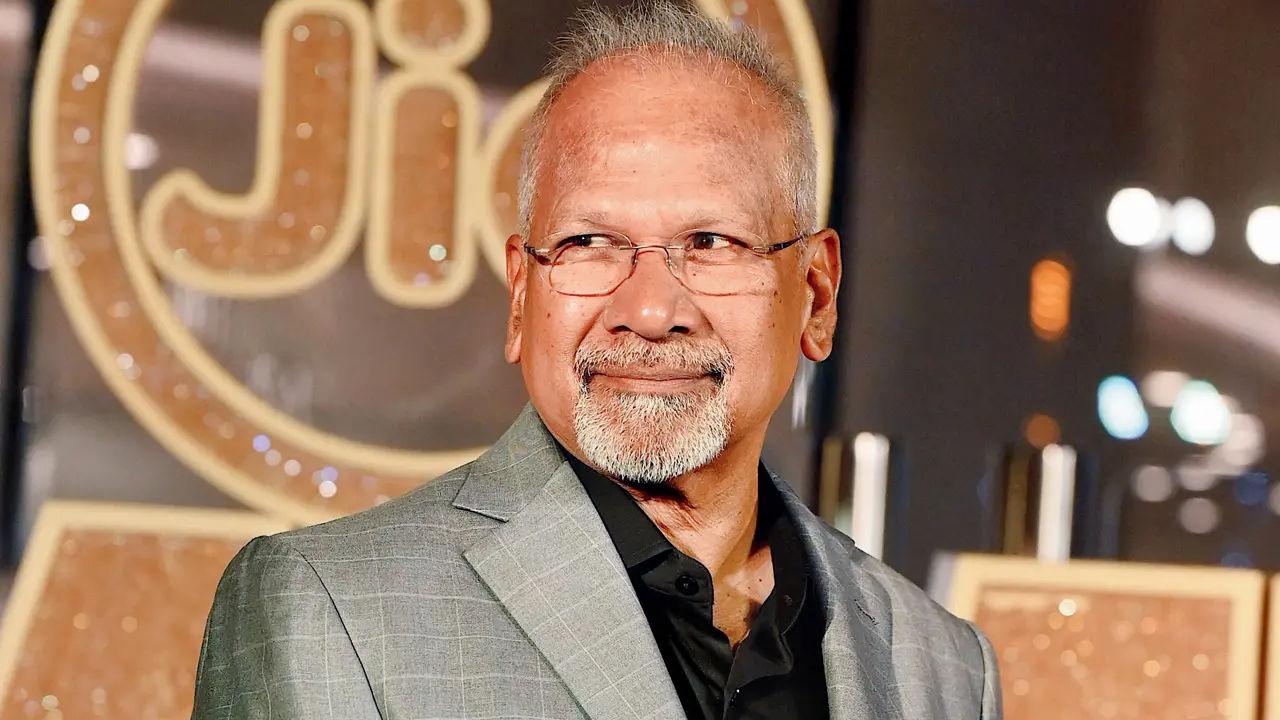
Ready with Thug Life, filmmaker Mani Ratnam on how his experimental instinct and not carrying the baggage of past successes have shaped his rich career
Priyanka Sharma (MID-DAY; May 29, 2025)
Expectedly, Mani Ratnam’s head is always brimming with ideas. And it was, after the release of his last film, Ponniyin Selvan 2 (2023). But the filmmaker points out that his upcoming movie, Thug Life, led by Kamal Haasan, wasn’t one of them.
“This was an idea that Kamal had. We decided to pick this up because something in this idea resonated with me. It had the germ, which I liked,” he smiles.
Thug Life — also starring Silambarasan T R, Trisha Krishnan, and Abhirami — sees Haasan as a gangster, who is forced to turn on his family in the face of betrayal. The June 5 release is pegged as a gangster action drama, but to Ratnam, it is an emotional story that has “a lot of action” in it. Those emotionally charged, interpersonal conflicts are admittedly the “germ” of an idea that struck a chord with him.
“I think action is made for cinema. It has all the elements that highlight the medium fully. I’ve always liked action films, but only when they are an integral part of the film, and not action for action’s sake. This film has action as an integral part of the story. What hooked me were its emotional content, the relationships, and interaction between the characters,” he explains.
Much of the anticipation about Thug Life lies in the fact that it marks the director’s reunion with Haasan 38 years after their maiden collaboration, Nayakan (1987). A lot has naturally changed over the decades.
Has anything remained the same? The trust, Ratnam promptly replies. “When I did Nayakan, Kamal sir had done maybe 100 films. He was a big star, and I, a beginner. But he trusted me fully. He would let us do things exactly the way we wanted. That was encouraging, and it hasn’t changed even today.”
Surely, given Nayakan’s iconic status, the actor-director duo was conscious of the audience’s expectations while making Thug Life. No, says the filmmaker. “You can’t be carrying the baggage all your life. You just try to do the next one. You’re not in competition with your previous work.”
Mani Ratnam agrees that experimenting is risky, especially when the star status of an artiste tempts them to recreate the past glory. But he doesn’t know any way other than experimenting. “It’s a survival instinct, you keep shifting so that you don’t become predictable and repetitive. There is a certain amount of risk [when I do] something new; I don’t know how it is going to be, I have to figure it out. That keeps me excited and fresh.”
This approach has made Ratnam one of the finest Indian directors, with works ranging from a gangster drama in Thalapathi (1991) to a real-life drama in Bombay (1995), from a film about youth politics in Yuva (2004) to a rom-com in O Kadhal Kanmani (2015). Despite the rich four-decade career, the filmmaker confesses to not feeling good enough.
“I am insecure all the time. No artiste would deny that. Insecurity stems from what you think of yourself. I can make a film, and then think I can do better. The standard of cinema around the world is so high. Younger filmmakers are making brilliant movies. So there is always scope for you to push yourself higher, and not settle for where you stand.”
While he keeps mum on what he is planning to do next, we probe about the possibility of him reuniting with his Guru (2007) and Raavan (2010) stars Aishwarya Rai Bachchan and Abhishek Bachchan. The rumours of their potential collaboration did the rounds all of last year.
“I am working on ideas, but I don’t really have something concrete to offer the two of them. If I have something which is right for them, I will call and ask them, ‘Can I meet you?’” But are the ideas he is working on exclusively for them? “They are exclusively for me,” he grins.
Shah Rukh Khan’s Dil Se character was not just an All India Radio reporter, he was everyone’s voice-Mani Ratnam
9:54 AM
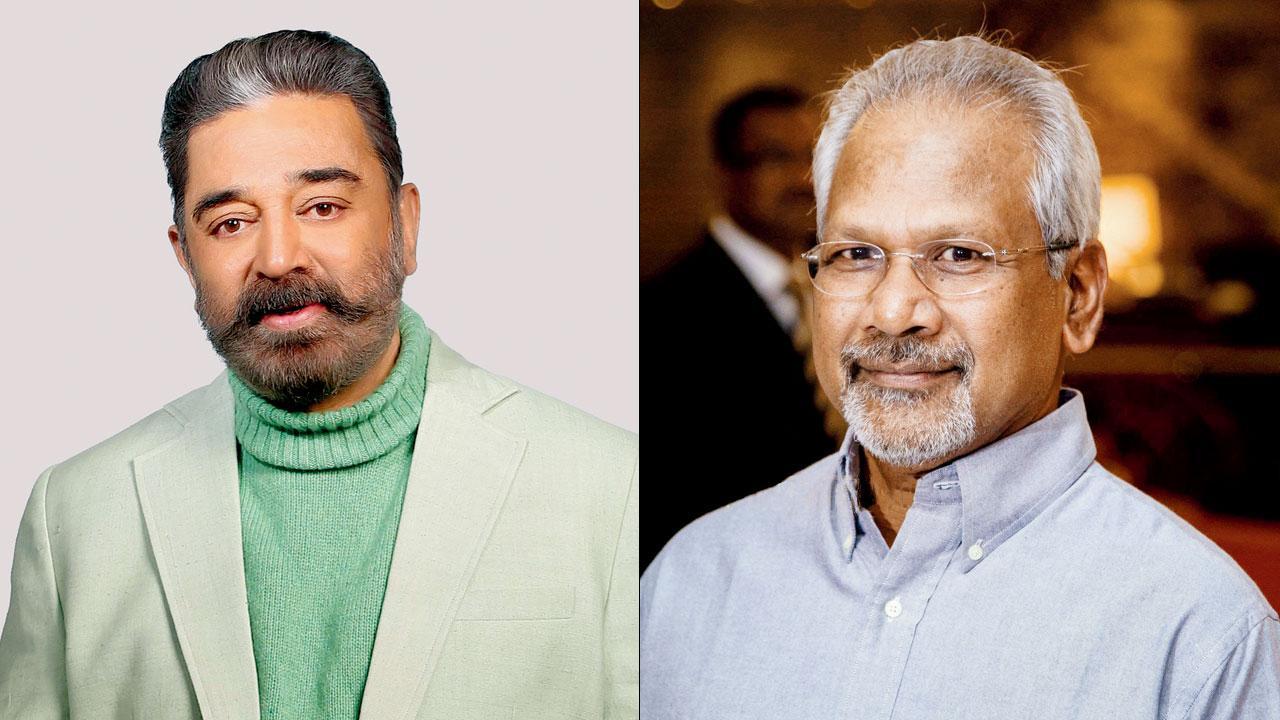
Anees Bazmee backs out of Nawaz’s next; filmmaker wants to ‘focus on other projects’
Renuka Vyavahare (BOMBAY TIMES; October 30, 2023)
An entire screen was jam-packed as cinephiles strived to bag a seat for MAMI Mumbai Film Festival 2023’s first masterclass that saw Mani Ratnam in conversation with Imtiaz Ali. It was a heart-toheart chat with some savage one-liners from Ratnam. Excerpts from the conversation:
‘DIL SE WAS A SOCIAL COMMENTARY’
Talking about Dil Se, he said, “Dil Se was made around India’s 50 years of Independence. It was a reminder that not all corners of the country are liberated as one would like to believe. Shah Rukh Khan’s character was not just an All India Radio reporter, he was everyone’s voice.”
‘MAKING RAAVAN AS A BILINGUAL FILM WAS A MISTAKE’
Ratnam made Raavan (2010) in two languages at a time, not many attempted to do so. The director, however, admitted that it wasn’t the right decision. “Making Raavan as a bilingual film was a mistake. It was a burden because I was literally making two films at a time, and neither the Hindi nor the Tamil audience could completely relate to it. It was a case of neither here nor there,” he said.
‘AS A STORYTELLER, YOU REALISE YOU’RE A SCAVENGER’
Elaborating on filmmakers’ constant hunt for great stories and subjects, Ratnam explains, “As a storyteller, you realise that you’re a scavenger. Even when tragedy strikes, you’re looking for stories and opportunities. I remember witnessing a blast from a close distance, and the first thing that struck me wasn’t the tragedy alone but even the technique. In films, we show that blasts generally happen from a distance, but that isn’t the case.”
‘I DON’T WANT OBEDIENCE FROM MY ACTORS, I EXPECT CONTRIBUTION’
The director, known for his unique vision and extracting the best out of his actors, had an interesting take on teamwork. He revealed, “I don’t want obedience from my actors, I expect contribution. I can always tell you what I want, but what more can you bring to the table? I like actors who give you that little more.” When asked what happens in case of a massive difference of opinion, Ratnam teased, “Then I tell them who’s the boss (laughs)!” Citing examples, he said, “Shah Rukh Khan and Rajinikanth often joked about this. They would say, ‘We can tell you what we feel, but you won’t accept it. This is your film, isn’t it?’”
‘SOMETIMES I WONDER IF I AM A ONE-TRICK PONY’
Despite having made acclaimed films, the director feels that there is still an element of self-doubt. He revealed, “Sometimes I wonder if I am a one-trick pony. I always thought of myself as a fraud director. When I did my first film, I didn’t know how to shoot. I had to pretend that I knew. I remember Kamal Haasan telling me this when I pitched my first film to him. He said, ‘Don’t aim at the heart, aim at the gut and you will make it.’ Haasan suggested that I need to make something that a lot of people can identify with, and how you communicate with the audience is important.”
‘AS AN AUDIENCE, I AM EVOLVED; AS A FILMMAKER, I AM NOT!’
Ratnam says, “My assistant directors don’t hesitate to tell me if something doesn’t thrill them. The day they find mistakes in my work, I know they are potential filmmakers. I used to criticise films when I didn’t even know how to make one. Finding fault is important. As an audience, I am evolved. As a filmmaker, I am not! There is nothing in this art form that can be called perfect. I don’t watch my films after they are released. I can’t take it. I only see the errors and I cringe.”
Pan-Indian cinema is a trend now because people are open to watching such films-Mani Ratnam
8:21 AM

Prakash S (BOMBAY TIMES; April 28, 2022)
Pan-Indian film is a term that has come to be used often now in the Indian film industry, with Bãhubali and KGF franchises, and RRR attracting fans across the country. Though the Tamil film industry is churning out films that promise to cater to the sensibilities of pan-Indian audiences, there is a notion that Tamil cinema is not matching up to Telugu and Kannada cinema in this aspect.
Mani Ratnam, whose movies like Roja and Bombay have appealed to a pan-Indian audience, addressed this concern at an event recently, and said, “This is not something new. Since many films are coming out now and becoming a success in north India, too, we’re talking about it. Earlier, Chandralekha (S S Vasan’s 1948 film), which we made, became successful in north India. No one asked such questions then. Any growth is a positive element and no one can stop this. We’re watching Hollywood films being dubbed in Tamil; so, what’s wrong with watching a Kannada film? If you make good films, then it will become a success everywhere.”
So, if Chandralekha and Roja have done it before, pan-Indian cinema is not new. But why did it not become a trend then and why now? “Well, the first part of the question doesn’t matter anymore. Now, people are filmmakers are also adapting to it,” he answered.
The ace filmmaker further said, “The standard of Tamil cinema is very rich; there are a lot of brilliant filmmakers who are very good. Many young filmmakers are opening new doors for the industry.”
Touching on the role of technology in cinema, Mani Ratnam, whose multilingual period film Ponniyin Selvan – I is in its post-production stage, said, “Any tool which will help us make better films is welcome. Cinema is an expensive art form, and it’s very important to keep the budget under control so we can make better films. It’s wonderful to see a flux of techies entering with innovative ideas to make better cinema.”
You need a certain amount of talent to make masala films, and pull it off well-Mani Ratnam
8:14 AM

Fimmaker Mani Ratnam says objectivity towards one’s own work needs some distance, and that only comes with time
Rishabh Suri (HINDUSTAN TIMES; August 26, 2021)
Mani Ratnam’s filmography boasts of classics such as Roja (1992), Bombay (1995) and Dil Se… (1998) — all critically acclaimed and rooted in real life. While the world accords cult status to his movies, the filmmaker himself feels that he “would want to change” something in “all my films”, if given a chance today.
“When I’m making a project, or anyone for that matter, we go into details. You’re not objective then. You need a certain distance to be able to assess, and that comes only with time,” he expresses.
But given the political situation and the changing times, one wonders how easy or difficult it would be to make these films today. Ask Ratnam if he would take the chance and revisit his own body of work, and he says he doesn’t know if he can make a “blanket statement”.
He elaborates, “I think some films will have difficulty. You have to know that’s what it’s going to be. You have to work around it and still be honest to what you want to say. The only way I looked at it, is doing what I really believe in. If there’s nothing wrong in what you’re saying, you make it with conviction, and hope that will come through.”
On whether he feels that as a filmmaker he has the liberty to explore any subject he wants today, he says it was the same even when he started making films. “Even in those days, some subjects would be a bit of a problem. And people faced these problems before I started making films. Constraints are there. You try to take one step forward, keep trying, and not give up easily,” says Ratnam, 65, who’s currently busy with the Tamil film Ponniyin Selvan, starring Vikram and Aishwarya Rai Bachchan.
And while making films based on real life topics is difficult, he, in fact, shuts down people who feel masala films are easier to make, when compared to the trouble that real stories invite.
Explaining his point, he adds, “You need a certain amount of talent to do that (make masala films), and pull it off well. If you are comfortable and that’s the way you want to say it, that’s the reason why you make films. The reason is you want to tell stories and do it in a particular way. You try different themes within that, and get better each time. It’s a struggle, nothing is easy.”
Sometimes, Mani Ratnam doesn't even tell me the story-A R Rahman
4:43 PM

Suganth M (BOMBAY TIMES; April 7, 2017)
Twenty-five years, 15 film
albums, innumerable chartbusters...Mani Ratnam and A R Rahman are
arguably the greatest director-composer duo of our time. Ahead of the
release of their latest offering, Kaatru Veliyidai, the celebrated duo
takes a walk down memory lane with BT, talking about everything -from
the moment when Mani Ratnam heard Rahman's music for the first time, to
how their composing sessions are today. Read on...
What was the first thing that struck you when you listened to Rahman's music, way back in 1992?
Mani Ratnam (MR): When you listen to music, you listen to music. You like it very much or not. For me, his music was just amazing. It took me out from where I was sitting and transported me to a different world.
A R Rahman (AR): Not everyone gets a Mani Ratnam movie for their first film. So, imagine how cool it must have been for me!
MR: And not everyone gets A R Rahman's first film, too! (laughs)
Did you feel any pressure at that time?
AR: I had a lot of pressure. He was very kind, but outside, they were all looking at me like, 'What! You, composing for a Mani Ratnam film? What are you gonna do?' I wouldn't play the songs to everyone, but some people would come and listen. There was this gentleman who supplied music equipment. He had helped me get all my equipment. So, he came and listened, and he was silent. After a while, he asked, 'What have you done? This is a disaster. Where's the tabla? Where's the violin? They are what make a song. Not this stuff.' I was really concerned and told Mani Ratnam 'I'm going to add tabla and violin', and he told me, 'Don't do any thing. This is perfect.'
Were you concerned if the audience would find Rahman's music for Roja too ahead of its time?
MR: No. I looked at it as a director. And a director is a very selfish person. His first priority is his film. The film was set in Kashmir and the music that he played had the feel of winter - the cold of that place. I thought it was absolutely fantastic and it was just going to lift my visuals.
After Roja came Thiruda Thiruda, which, again, had a totally new sound, again...
AR: I think Roja's success made us work really, really hard. We were kind of masochists, and we were destroying ourselves. Vairamuthu sir, in fact, said, 'Anybody else would have died living up to what we did with Roja'. We were pushing ourselves and I think that's why it still stands the test of time.
MR: It was an experimental album, but we didn't think of it that way then. Still, Rahman tried every thing. The film was a wild film, so he could go that expansive in the music. It was a chance for us to open up a lot more.
Do you choose tunes that would work well in all languages?
AR: It is one of the most torturous things. We didn't even know that the music of Roja was going to work in Hindi, but it was so big in Hindi as well. So, Bombay was a challenge. This is one of the reasons why we settle for phonetics, like Humma Humma or Chaiyya Chaiyya. This way, we get away with not being region specific.
When you have Rahman, people expect songs. Are songs a compromise in your films?
MR: I like songs. It's a weakness that I have. A song is a burden that you carry happily. When you have a song, it is like a mini-film within a film. It has a wholesomeness within itself. And sometimes, the song is so good that it stands out more than the film. You know it is bigger than the film, still you are greedy and try to fit it in as much as you can. It's your love for it that matters.
Where does the journey of a Mani Ratnam-AR Rahman album start?
AR: Anywhere. Sometimes he doesn't even tell me the story.
MR: Yes, these days, I don't.
AR: He will ask me to play the tunes and say, 'I like this tune, this one' and pick them up.
Do you generally have tunes ready for him?
AR: Not exactly. I have a melody element that reflects feelings... like love, passion and so on. I keep sending him ideas and ask him to check them out.
How do you decide that he will like a particular tune?
AR: It's not about him liking a tune. When I compose something, I have to like it first. I have to be proud of it and feel, 'Ah, this is beautiful' or 'This chord progression is nice'... If it emotionally moves me, then I'm sure that he will like it as well. Sometimes, he might not like it, too. For instance, while composing for Kadal, my favourite was Nenjukkulle while his was Moongil Thottam. Both had the same tempo and were on accordion, with extraordinary lyrics. Finally, we ended up using both.
Is there any difference between how your composing sessions were earlier and how they are at present?
AR: I think we used to hang out more. I miss going to Maldives or to Bangalore for such sessions.
MR: Today, Rahman travels all over the world, but that doesn't stop us. He still sends me tunes whether he is here or abroad through Skype.
AR: But for background scores, we need to be face-to face, as the momentum is much better then. For lyrics, again, we have to sit together, which is what is beautiful about the process.
How is a typical session like?
AR: We will show it to you, on Periscope once (laughs). Actually, it is both fun and stressful.
Is the discussion only about the song?
AR: When he is doing a movie, if you talk something other than the subject, he'll just say, 'I don't care what you are talking about. Is it related to my movie?' So, I wander around, but he is very focused.
MR: I think that's good to wander once in a while because Rahman gets some random ideas and they work very well. When the three of us sit together, you can really feel the synergy.
What was the first thing that struck you when you listened to Rahman's music, way back in 1992?
Mani Ratnam (MR): When you listen to music, you listen to music. You like it very much or not. For me, his music was just amazing. It took me out from where I was sitting and transported me to a different world.
A R Rahman (AR): Not everyone gets a Mani Ratnam movie for their first film. So, imagine how cool it must have been for me!
MR: And not everyone gets A R Rahman's first film, too! (laughs)
Did you feel any pressure at that time?
AR: I had a lot of pressure. He was very kind, but outside, they were all looking at me like, 'What! You, composing for a Mani Ratnam film? What are you gonna do?' I wouldn't play the songs to everyone, but some people would come and listen. There was this gentleman who supplied music equipment. He had helped me get all my equipment. So, he came and listened, and he was silent. After a while, he asked, 'What have you done? This is a disaster. Where's the tabla? Where's the violin? They are what make a song. Not this stuff.' I was really concerned and told Mani Ratnam 'I'm going to add tabla and violin', and he told me, 'Don't do any thing. This is perfect.'
Were you concerned if the audience would find Rahman's music for Roja too ahead of its time?
MR: No. I looked at it as a director. And a director is a very selfish person. His first priority is his film. The film was set in Kashmir and the music that he played had the feel of winter - the cold of that place. I thought it was absolutely fantastic and it was just going to lift my visuals.
After Roja came Thiruda Thiruda, which, again, had a totally new sound, again...
AR: I think Roja's success made us work really, really hard. We were kind of masochists, and we were destroying ourselves. Vairamuthu sir, in fact, said, 'Anybody else would have died living up to what we did with Roja'. We were pushing ourselves and I think that's why it still stands the test of time.
MR: It was an experimental album, but we didn't think of it that way then. Still, Rahman tried every thing. The film was a wild film, so he could go that expansive in the music. It was a chance for us to open up a lot more.
Do you choose tunes that would work well in all languages?
AR: It is one of the most torturous things. We didn't even know that the music of Roja was going to work in Hindi, but it was so big in Hindi as well. So, Bombay was a challenge. This is one of the reasons why we settle for phonetics, like Humma Humma or Chaiyya Chaiyya. This way, we get away with not being region specific.
When you have Rahman, people expect songs. Are songs a compromise in your films?
MR: I like songs. It's a weakness that I have. A song is a burden that you carry happily. When you have a song, it is like a mini-film within a film. It has a wholesomeness within itself. And sometimes, the song is so good that it stands out more than the film. You know it is bigger than the film, still you are greedy and try to fit it in as much as you can. It's your love for it that matters.
Where does the journey of a Mani Ratnam-AR Rahman album start?
AR: Anywhere. Sometimes he doesn't even tell me the story.
MR: Yes, these days, I don't.
AR: He will ask me to play the tunes and say, 'I like this tune, this one' and pick them up.
Do you generally have tunes ready for him?
AR: Not exactly. I have a melody element that reflects feelings... like love, passion and so on. I keep sending him ideas and ask him to check them out.
How do you decide that he will like a particular tune?
AR: It's not about him liking a tune. When I compose something, I have to like it first. I have to be proud of it and feel, 'Ah, this is beautiful' or 'This chord progression is nice'... If it emotionally moves me, then I'm sure that he will like it as well. Sometimes, he might not like it, too. For instance, while composing for Kadal, my favourite was Nenjukkulle while his was Moongil Thottam. Both had the same tempo and were on accordion, with extraordinary lyrics. Finally, we ended up using both.
Is there any difference between how your composing sessions were earlier and how they are at present?
AR: I think we used to hang out more. I miss going to Maldives or to Bangalore for such sessions.
MR: Today, Rahman travels all over the world, but that doesn't stop us. He still sends me tunes whether he is here or abroad through Skype.
AR: But for background scores, we need to be face-to face, as the momentum is much better then. For lyrics, again, we have to sit together, which is what is beautiful about the process.
How is a typical session like?
AR: We will show it to you, on Periscope once (laughs). Actually, it is both fun and stressful.
Is the discussion only about the song?
AR: When he is doing a movie, if you talk something other than the subject, he'll just say, 'I don't care what you are talking about. Is it related to my movie?' So, I wander around, but he is very focused.
MR: I think that's good to wander once in a while because Rahman gets some random ideas and they work very well. When the three of us sit together, you can really feel the synergy.
Subscribe to:
Posts (Atom)