Showing posts with label Majid Majidi. Show all posts
Showing posts with label Majid Majidi. Show all posts
Neeraj Ghaywan reminded me of Majid Majidi in many ways-Ishaan Khatter
3:01 PM
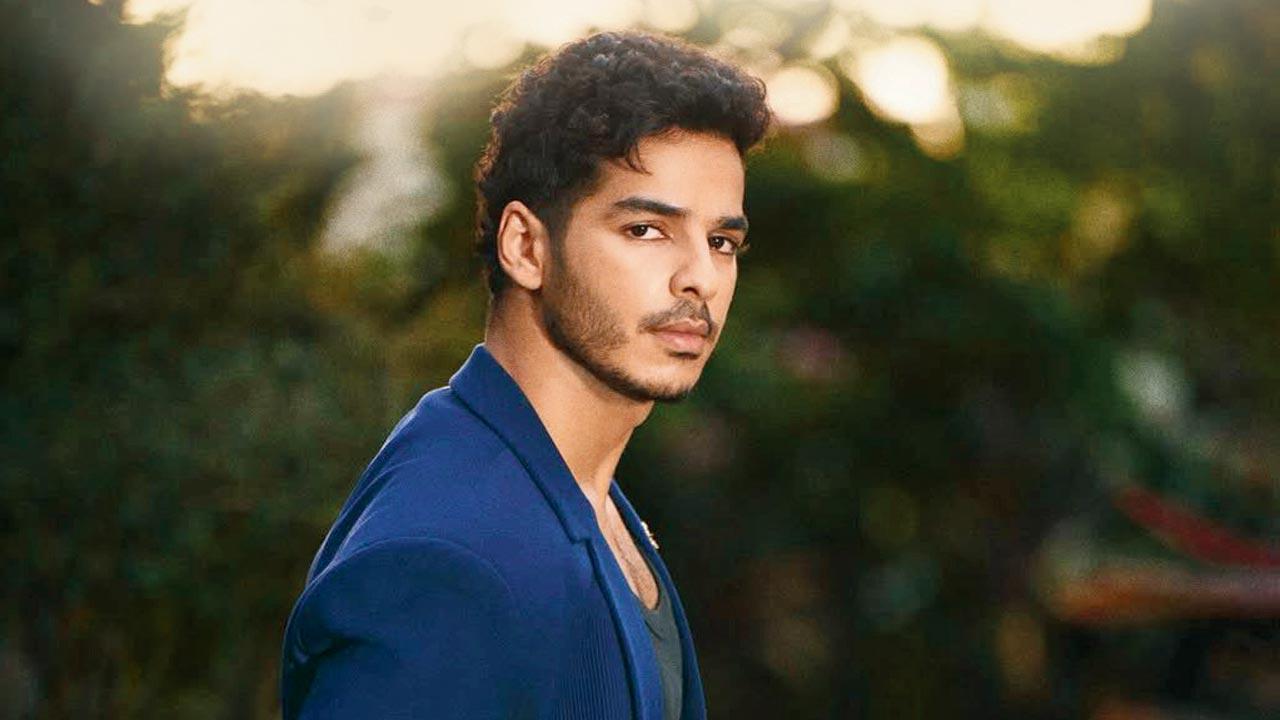
Ishaan Khatter says Homebound’s première at Cannes will help him realize his long-time dream of going to the prestigious gala with a movie and not for a red carpet appearance
Mohar Basu (MID-DAY; May 16, 2025)
Everywhere you go this week, the one man people are discussing is Ishaan Khatter. Some are talking about his washboard abs and the many shirtless sequences in The Royals, others about how droolworthy he is as a romantic hero. Amid all the love pouring in, the actor’s takeaway is simple — “Trust your instincts”. He tells us that he went into the Netflix series, knowing that it would be entertaining. “When reading the script, I went from one episode to the next quickly. Also, it let me explore different facets of myself as a performer — whether it’s the romance, the comedy, or the drama that I tried to bring more of. It gave me all these opportunities in one role, which is rare,” he assesses.
While his chiselled abs became a talking point, Khatter says the emotionality of Aviraaj’s character was beautiful to him. “When people say that, oh, it's one page, it's one minute of screen time. But what if that one line is Rome Burns, that's literally the biggest sequence of your film. The scene where he is going through his father’s stuff, it was not much to look at on the page. But when we shot it, I think we brought that out. My director allowed me to take the lead. There is a deep wound to his relationship with his father because there're so many answers that he never got. And he's still battling it and the inner child in him is still dealing with that. And for me, it was quite simple. Why does he escape? Why he is an escapist is because he's actually deeply emotionally connected and sensitive about his father. And that's why he ran away. And when he ran away, he actually didn't get to be with him in his last moment. So, he has no closure. And the guilt stayed with him. Through the series, you see him get that closure but then also get the shock of his life, obviously. It was essential for you to understand this guy and not just think he's an asshole.”
Director Priyanka Ghose’s rom-com, also starring Zeenat Aman and Bhumi Pednekar, has become widely popular. What does success like this do to Khatter? “It fuels me,” he says, elaborating, “Whatever I do going forward, I don’t want to pressure myself. Let it be the driving force, but not enough to change the way I make decisions. Also, I have to enjoy this moment. I worked my butt off to get here.”
As he revels in this moment, another professional milestone is around the corner. Over the weekend, the actor will head to the Cannes Film Festival for Homebound’s première. Neeraj Ghaywan’s directorial venture, also starring Vishal Jethwa and Janhvi Kapoor, has Martin Scorsese as its executive producer.
“Homebound has already given us so much. Bear in mind it's not released. Nobody has seen the film. We've just had the process so far. But even when I finished the film, I felt my heart was full. Neeraj is a very special director. His set is a beautiful place to be. It reminds you of why you want to do this in the first place. Because there are some people that just give a damn. And a lot of people don't, unfortunately. He really cares about what he's making. He reminded me of Majid Majidi in many ways. In terms of what he did for me as an actor. Not all directors take the responsibility of your acting. People hire professionals to do their job. And that's the job. But he's equally as invested in what you're bringing. It doesn't just extend to the lead actor of his film. It extends to every little detail. And who he is, is what you see in his films. He's very sensitive. He's very thoughtful. He's very empathetic. He observes those little things about life. And he's able to take you through a journey and convey his thoughts and his worldview and his social commentary in his films with such a light hand that it's never a lesson, it's never preaching, it's never a lecture. It's for you to reflect on and take away whatever you want to take from it. I love him. I, at the drop of a hat, like, will do anything with him.”
Khatter will watch Homebound’s final cut for the first time at the prestigious film festival. At a time when many Indian actors go to Cannes to walk the red carpet and make news for their fashion choices, he is among the rare ones to head there with a movie.
“A film festival is for the movies. Cinema is primary. My dream was always to go there with a film. I didn’t want to just go there as an attendee. So, it’s a [dream realized].”
If Bollywood cinema does not improve, it will be a problem-Majid Majidi
8:04 AM
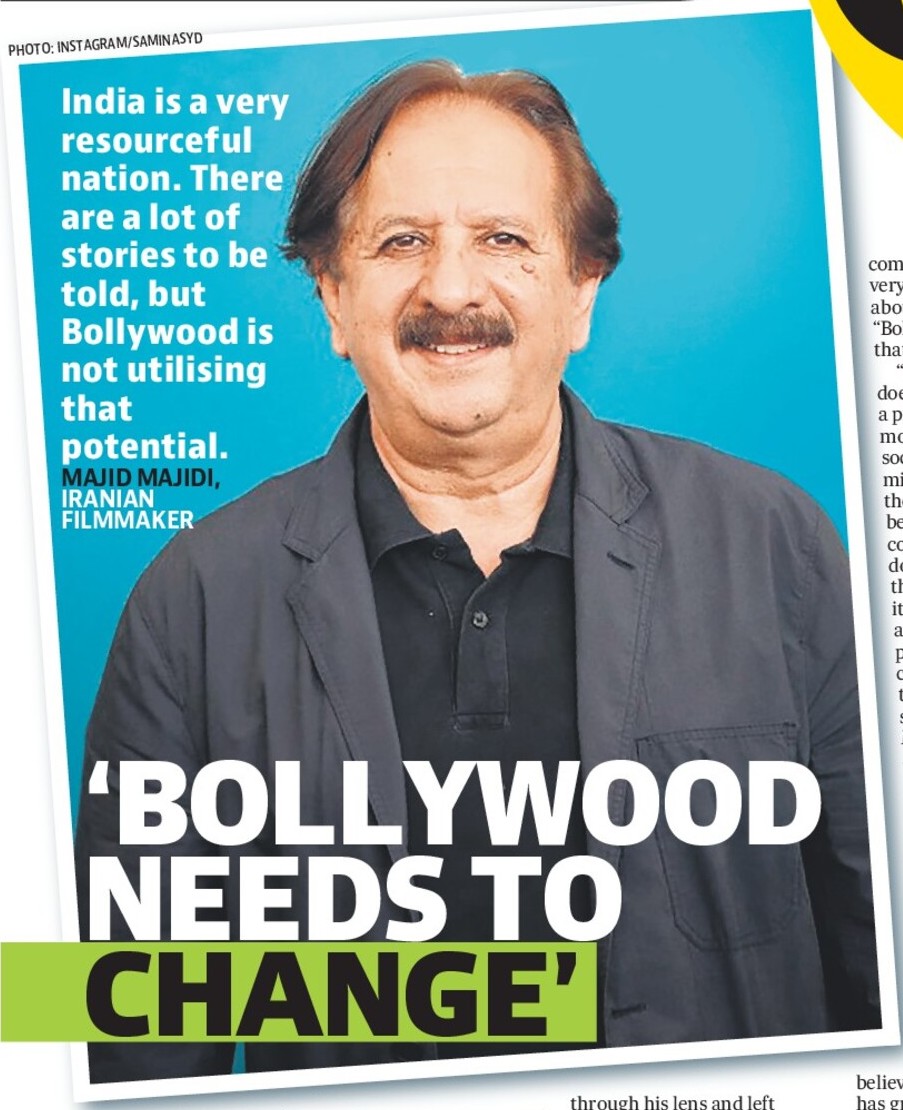
Majid Majidi hopes India’s potential in filmmaking is better utilized
Syeda Eba Fatima (HINDUSTAN TIMES; August 13, 2023)
With Beyond The Clouds (2018), starring Ishaan Khatter, Iranian filmmaker Majid Majidi portrayed an Indian story through his lens and left cinema lovers mesmerized. As audiences await another Hindi film by him, the Oscar-nominated director — who was in Delhi for a film festival — assures that he will “come up with something soon”.
India, according to Majidi, has “great talent and enormous potential when it comes to filmmaking and a very rich culture to talk about”. However, he feels “Bollywood is not utilizing that potential”.
“If Bollywood cinema does not improve, it will be a problem. People today are more aware because of social media. Their mindset has changed and they are more evolved beings. If Bollywood continues with what it’s doing, I am afraid that in the next four to five years, it will not have as much audience as it enjoys at present. It needs to change something about the stories; its content,” says The Children of Heaven (1997) director, adding, “Bollywood should change and make films that can cater to the audience of today’s time.”
Here, Majidi clarifies that he is “not against Bollywood at all”. “There are many filmmakers who are doing great work. However, people across the globe don’t know about them yet,” he says, adding, “I believe this young generation has great potential and if you empower them, they will do wonders.”
Another change he wishes to see is the perception of Bollywood films in society at large. “For them, Bollywood is all about songs and dance. I am well aware that there is much more to Indian movies,” Majidi signs off.
Majid Majidi’s films deserve a lot of love-Ishaan Khatter
8:12 AM

Ishaan Khatter hopes to collaborate again with the maker soon; meanwhile, has a horror comedy and a war drama to resume work with
Akash Bhatnagar (MUMBAI MIRROR; October 7, 2020)
In 2018, Ishaan Khatter came, was seen, and conquered with two back-to-back films, Beyond The Clouds and Dhadak. But it took him over two years to return with his third, the recently released Khaali Peeli. The actor says the actionthriller appealed to him because it’s a perfectly mixed script with all the makings of a quintessential masala film, and a contemporary treatment, making it edgy and cool. “To top it all, my character Blackie was fascinating,” he asserts, admitting that, as part of his prep, he had to master Bambaiya Hindi and undergo a body transformation.
Ever since the film’s promotions began, Ishaan and co-star Ananya Panday had been frequently spotted together. He is all praise for her, raving that she’s a delightful co-star and a warm, kind person. “Ananya’s charming and goofy at the same time, she blends in with different people without losing her own individuality,” he gushes, adding with a chuckle that she’s “the director’s pet”.
Prod Ishaan on his long break and he insists it wasn’t a conscious decision. “I really wanted to do something that excited me and gave me an opportunity to push myself in a different direction. Khaali Peeli came at the right time. This film and Mira Nair’s A Suitable Boy mark a new phase for me as an actor,” he says, insisting that the next year already looks busier than the last.
A quarter of that two-year break was due to the Coronavirus-triggered lockdown and being cooped at home was not easy for the actor. “I’m claustrophobic and very outdoorsy, so it was challenging. But I think I’ve managed to stay busy, watching a lot of films and shows, reading, dancing, training and a whole lot of reflecting,” he shares.
Ishaan believes that books provide inspiring and reliable stories to filmmakers. “It’s like having a blueprint on which you can build a deeper and more layered world,” he reasons. His favourite book adaptations are the first two films in The Godfather trilogy and Arrival based on Ted Chiang’s Story of Your Life. “It would be lovely if we did more adaptations here. Vishal (Bhardwaj) sir’s Shakespeare adaptations have all been so brilliant.”
Dance is Ishaan’s first love and being in a musical is his dream. “Down the years, our films have been musicals, but they’re getting rarer by the day. Music is ingrained in our storytelling, so, I hope we see an evolution rather than a discontinuation of such films,” he says fervently.
Ishaan reveals that Majid Majidi who directed him in his first film, Beyond The Clouds, has been a guiding force and mentor, someone he seeks advice from. “I’ve been in touch with him constantly, but since he’s in Iran, I haven’t been able to see him much,” he sighs, hoping to collaborate with the legend soon. “I just pray it happens in a manner most suiting and satisfying for him. He’s a beautiful filmmaker and his films deserve a lot of love.”
His future projects include a horror-comedy, Phone Bhoot, with Siddhant Chaturvedi and Katrina Kaif and Raja Menon’s war drama, Pippa. “There are some other exciting prospects on the horizon. I won’t take another two years to come out with a film this time,” he promises.
I haven’t been corrupted yet. Corruption, to me, is making a film with wrong intentions-Amar Kaushik
8:32 AM

Neha Maheshwri (BOMBAY TIMES; November 7, 2019)
When your directorial debut turns out to be the biggest sleeper hit of the year, the pressure on the second outing can be daunting. So, how is Amar Kaushik of the Stree (2018) fame dealing with it, now that his second film Bala, which stars Ayushmann Khurrana, Bhumi Pednekar and Yami Gautam, is about to release? Bala has already had its fair share of controversies, including accusations of plagiarism. However, in a chat with BT, the filmmaker says that he is unfazed, and all he cares about is staying true to his craft. Read on...
‘BALA IS NOT JUST ABOUT BALDING’
When producer Dinesh Vijan approached Amar with a rough draft of the story, the latter was entrusted with developing the script, as a creative producer. From there to actually helming the project was a result of him falling in love with the story. Amar says, “The original story was set somewhere else, but I moved it to my hometown, Kanpur. While developing the script, maine isme bahut apnapann daal diya. I showed my writer around the city to make him understand the Kanpur wala vibe, dialect and swag. The process lent a personal touch and that’s when I decided to direct it.”
For him, Bala was never the story of just a man facing premature balding. He wanted to tell a lot more than that, and that’s how Bhumi’s character — that of a dark-skinned lawyer — came into the picture. Amar asserts, “It’s not just about being dark, short or bald. We assume that a fair person has it easy in the world, but by calling him/her gora, aap wahin discriminate kar dete ho. We often poke fun at tall people by asking them, ‘Oopar ka taapmaan kya hai?’ Our conditioning doesn’t let us stop and think that such terms could be hurtful. I have tried to explore all these complexities and not just premature balding in the film.”
‘SMALL-TOWN HUMOUR HAS SHAPED MY SENSIBILITIES’
Having said that, the director is not keen on ‘correcting the wrongs’ of society through his films. Amar tells us that it’s the small-town attribute of not taking oneself too seriously, that has helped him tell stories that people can relate to.
He says, “Preachy isn’t my style. I always try to look at the humour in any situation; it’s easier to empathise that way. I was once partying with a couple of friends till late night when the cops arrived and picked us up. On the way to the police station, the bizarreness of it all hit me, and I started laughing. One of the cops was flummoxed and asked me what I found so funny. I told him that it was quite hilarious to be heading to a police station after partying with friends. He found it funny, too, and dropped us by the road after that.”
‘I HAVEN’T BEEN CORRUPTED YET’
The filmmaker says that he will not choose a script just because it is safe. “Money is important, as you can’t expect your producers to make losses on a film. Mujhe paise nahi kharaab karne, par mujhe apna cinema bhi kharaab nahi karna. I don’t want to make a film just because the script is safe and will work. A lot of people ask me about the Stree sequel, as they are certain that it will work. It would be a disservice to my craft if I start taking popular conjecture seriously and get on with a sequel, even though the script is not in place. That’s when corruption will win over my craft! I haven’t been corrupted yet. Corruption, to me, is making a film with wrong intentions. I have retained my innocence as a filmmaker in Bala. Woh innocence jis din jaayega, main corrupt ho jaaunga aur main kharaab film banaane lagoonga. Following the success of Stree, I felt the pressure to work on a different film, but I realised that I needed to ensure that whatever I am making should have my complete focus and honesty,” he says.
It’s not difficult to figure out the inspiration behind his worldview. He has assisted the likes of Raj Kumar Gupta and Onir, who are known for making films they resonate with. He says, “I feel fortunate to have worked with the right people, who moulded my thought process. They taught me that cinema is more important than making money. I am forever hungry to learn, which is why I assisted Majid Majidi on Beyond The Clouds (2018). I wouldn’t mind assisting renowned filmmakers, like Sriram Raghavan, to hone my skills, whenever I feel that I am slipping. Ek success ke baad aapko bahut chadhaane wale mil jaate hain. So, I have brought my old friends closer, as I can always depend on them for honest reviews.”
‘KUCH TOH AAJ DHAMAAL KARENGE’
Amar says that the absence of a superstar in his cast has never been a roadblock for him. “I haven’t worked with a superstar yet, to talk about the pressure or ease one feels around them. For me, everyone who is hungry to do some good work, and everyone who thinks at the start of their day, ‘Kuch to aaj dhamaal karenge’, is a star. I see that hunger in Raj (Rajkummar Rao), Ayushmann, Bhumi and Yami. When we started working on Stree, we were told that we don’t have a big star. I said that we have so many stars that they will leave us blinded by their light when they shine together,” he reminisces.
‘COPYING SOMETHING IS AGAINST MY UPBRINGING’
The run-up to Bala’s release hasn’t been smooth; the film was mired in controversies after the makers of Ujda Chaman, which also revolves around premature balding, accused them of copyright violations. So, how did he deal with the sudden hullabaloo? Amar replies, “It’s against my upbringing and ethics to copy anything. We spent over six months developing Bala and suddenly, someone calls it a copy… it does feel bad. However, I maintained a dignified silence or it would have turned uglier. After all, you know that you haven’t done anything wrong and people will see it in theatres.”
Ask him if he has watched the other film to understand whether their allegations are justified and he says, “No, I haven’t. I watched the Kannada film, Ondu Motteya Kathe, whose rights they (makers of Ujda Chaman) bought to remake it in Hindi. I realised that we were making a completely different film. They started shooting 20-25 days after we wrapped up Bala. After we announced our release date, they announced theirs, which was scheduled to release before ours. However, that’s a producer’s call.”
With Ayushmann top-lining the cast, did he ever feel that his film has an edge over the other? “If a film is good, it will work irrespective of its cast. So, the fact that Bala has Ayushmann and hence it will do better, didn’t cross my mind,” he concludes.

Ishaan Khatter tells Rajkummar Rao to ‘be wary’ of Janhvi Kapoor
7:45 AM

The actors spilled each other’s secrets during a show recently
Natasha Coutinho (MUMBAI MIRROR; May 9, 2019)
 In an almost unheard-of new friendship in B-Town, actors Rajkummar Rao and Ishaan Khatter made an appearance together on Neha Dhupia’s Colors Infinity chat show as BFFs and had a lot to say about each other.
Ishaan started off by quelling reports that he is dating his Dhadak co-star Janhvi Kapoor by saying, “I am in a relationship with coffee,” going on to reveal that he likes “girls who are honest, funny, real, relaxed, chilled out and passionate. I guess, I would like anyone to be that way. I look for the same qualities in a friend as well.” When prodded by Neha on the matter, Raj said with a chuckle, “Ishaan is a sensible boy. He can find his own perfect girl. He will, or maybe he already has.”
Incidentally, Raj is gearing up to work with Janhvi in Dinesh Vijan’s upcoming horror comedy, Rooh-Afza, which is expected to kick off in June in Uttar Pradesh. Ishaan had an important tip for Raj before he starts work with the actress. “He needs to be wary because she is obsessed with him. She is a keen learner. I think he must’ve already observed that about her and she genuinely is very fond of his work, as am I. Both of us once sat down and watched his scenes closely,” Ishaan said, finally throwing in the towel. “What tip can I give Raj, really? He’s been around and worked with different actors. He would know best. Perhaps he can give me some tips!”
Meanwhile, Raj spoke of the only time he “felt jealous” of the younger actor. It was when he got to work with the acclaimed Iranian filmmaker Majid Majidi in his first film, Beyond The Clouds.
Majid Majidi's second film in India to roll next year?
8:07 AM

The Iranian filmmaker’s second Hindi project is a light-hearted story; will take off next year
Avinash Lohana (MUMBAI MIRROR; February 28, 2019)
Last year, acclaimed Iranian filmmaker Majid Majidi made his Hindi film debut with Beyond the Clouds, which also marked the acting debut of Shahid Kapoor’s brother, Ishaan Khatter, in the role of a street hustler and drug dealer. It also featured cinematographer KU Mohanan’s daughter, Malavika Mohanan.
Now, Mirror has learnt that Majidi is returning to India for his next film. A light-hearted human-interest Hindi film, it is based on true events, and will be produced by Shareen Mantri Kedia and Kishor Arora. A source close to the development informs, “It’s a story that Majidi came across on his previous trips to India and has already started scripting the film. It revolves around a male protagonist in the age group of 25-30 years, is set in a small town and will go on the floors in the first half of 2020. Majidi will first start shooting for his next Iranian film after which he will begin recce and casting for the Indian film.”
Earlier, the producers and Majidi had announced a film titled Gold Mine as their second collaboration, but the source reveals that the filmmaker intends to start on the untitled film before he revisits Gold Mine. Meanwhile, Kedia and Arora are to take Pa Ranjith’s next, which is based on the life of revolutionary leader Birsa Munda, on the floors.
Kedia confirmed the news but refused to divulge further details.
We didn’t make Dhadak to outdo Sairat-Ishaan Khatter
6:52 AM

Neha Maheshwri (BOMBAY TIMES; July 13, 2018)
Ishaan’s choice of his debut film, Beyond The Clouds (BTC), which released earlier this year, was unconventional and rare. However, his performance grabbed eyeballs and he left the audience impressed and eager to see more of him. Now, his second film, Dhadak, which is the Hindi adaptation of the Marathi blockbuster, Sairat, has added to the buzz around him. In an exclusive interview with BT, the young actor talks about Dhadak being compared with Sairat, his equation with co-star Janhvi, who is making her Bollywood debut, and why he is not bothered about being judged. Excerpts…
Sairat had amassed much acclaim from the critics as well as the masses. Since it has set such a high benchmark, are you feeling the pressure to live up to expectations?
Usually, I tend to feel the pressure more for other people than myself. However, this time around, I am feeling more pressure than during my first film, BTC. Having said that, the pressure doesn’t come from a negative space. It’s just that there is a lot of anticipation, nervous energy and excitement. The way the film is being presented and the banner (Dharma Productions) that’s backing it, make it rather overwhelming. Janhvi and I are deeply attached to this film, mostly for what we have been through during its making.
Talking about pressure, how are you dealing with the comparisons between Sairat and Dhadak on social media?
I have been enjoying some of the trolling, but it’s important to maintain your perspective amidst all of that. People are judging a full-length feature film on the basis of a two-and-a-half minute promo. What matters will be the opinions that come after one has seen the film. While the key elements of Sairat have been retained, Dhadak is a new film in itself. In fact, it’s the characterisation that makes it fresh. Shashank’s (Khaitan, director) imprint on Dhadak is huge. He has brought a lot of his own life into it. It’s his interpretation of Sairat, which is also a kind of template for the films we have been watching over the years, be it Romeo And Juliet or Qayamat Se Qayamat Tak. We didn’t make Dhadak to outdo Sairat. The idea is to present a story that will resonate with a larger audience. Sairat was a phenomenal film because besides being engaging, entertaining and artistic, it also had a socially relevant message. However, Dhadak is not its copy or made under its shadow. Sairat has inspired us to do something of our own.
Many feel that Sairat worked because of its raw treatment and the fact that it was a small-budget film. Dhadak, on the other hand, looks mounted on a larger canvas, and with faces like Janhvi and you..
I don’t completely understand the term ‘Bollywoodise’. According to me, it means a certain production value, feel and projection. But I think what’s important is to understand the film that you are making and the reality of the characters and their world. Also, the tonality of our film and the promo so far have been largely of the first act of the film, which is slightly dreamy and fantastical. I don’t think any attempts were made to Bollywoodise this film or to de-Bollywoodise it.
There is a perception that today’s generation isn’t capable of falling in love like the characters in Sairat and Dhadak...
I don’t agree with that perception. We live in a world where there are over seven billion people and there are many stories that make you hopeful and optimistic about love. The fact that we are making a film about love, with conviction proves that it exists. I am not somebody who can trick myself into believing something, though that’s an actor's job. Doing a film, which is primarily about unconditional love, would be a farce if I were just pretending. So, I do believe that the kind of love we are talking about, exists. Love is in smaller gestures. I am a romantic at heart, and I think I can fall in love like my character… I am capable of that (smiles!)

BTC wasn’t watched by a lot of people. Having said that, these are labels that people give. I have heard too many since childhood — star kid, industry insider, so on and so forth. I don’t use these terms. For me, Dhadak is a film and I am an actor. I got the opportunity to do BTC and felt strongly about it. Majidi Sir wanted me in the film and Karan (Johar, producer) was kind enough to allow me to it first. Then Dhadak happened and again, I am very happy to be a part of it. I am just 22 and feel very fortunate that I get to act. I always wanted to start early and I am just trying to grow.
One of the main highlights of Dhadak is your pairing with Janhvi, who is making her debut with this film. Tell us about your equation with her...
Janhvi is quite a comic relief on the set. She keeps doing these funny things unintentionally, cracking all of us up. She might seem a bit quiet, especially when she is representing the film, but that’s because she has her game face on. She is quite notorious (laughs!). When she feels at home, she is her uninhibited best and becomes a prankster. Actually, we played a lot of pranks and had great fun on the set. It’s been perhaps the most delightful experience of our lives so far, if I can say that on her behalf. We had a wonderful time prepping for the characters together. We got a lot of time to understand the cultural milieu, the mind-set of the characters and we also got a feel of Udaipur. We interacted with a lot of local people there. We were able to walk around without any restrictions.
Soon, you will be a known face, who probably won’t be able to walk around the streets without being noticed or being captured by the paparazzi. How prepared are you for this phase of life?
If people have to judge me, let them do it. I do believe that it’s important to protect your personal space. Encroachment into personal life is not something any celebrity asks for. Having said that, it’s important to be aware that people will have an opinion on your personal decisions as well.

Politics has an expiry date, art doesn’t. An artiste should stay away from political games-Majid Majidi
8:02 AM

Madhureeta Mukherjee (BOMBAY TIMES; April 20, 2018)
His stories are deep-rooted in reality; the emotions are raw, unadulterated and simple, yet, they have the power to move you deeply. Iranian filmmaker Majid Majidi has spent the last two decades crafting some of the most enchanting stories (like Oscar nominee Children Of Heaven, The Color of Paradise and Baran), which stem from the culture and fabric of the country he comes from. This time, he has looked way beyond, towards India. In his latest offering and his first Indian film, Beyond The Clouds, he has captured Mumbai’s streets, slums, creeks and chaos with charming realism — which is his forte. Like his other celebrated Iranian films, this one too, reflects the life of those trapped in poverty, but it clutches on to that one word —hope. The filmmaker reminds us, “Hope is the biggest reference point, not only for me, but for whole of humanity.” In an interview with BT, Majid Majidi talks about his views on Bollywood cinema, how he idolises the legendary filmmaker Satyajit Ray, and his perspective on how art and artistes should remain depoliticised. Read on...
Most of your films show compassion for the underprivileged. You seem to have a deep connect with such subjects...
The middle class and the lower middle class form the majority of any society, so from my point of view, they are the most important and the most vulnerable, too. As a society and as filmmakers, we do not pay enough attention to their stories and lives. The people belonging to this level of society do not have as many opportunities to come out and talk about their trials and troubles, so it is our responsibility as artistes to draw attention to their problems. In India, women have a great role to play in society, but at the same time, they are oppressed and become victims in the same environment. My stories shed light on the bitterness that a human being goes through in life. It is common everywhere. Everyone needs hope, and that is my aim; to bring hope in each and every aspect of my character and my film. So, hope is the biggest reference point, not only for me, but for the whole of humanity.
The common thread in your films is the focus on a strong value system within the family and how that can stand the test of difficult times and circumstances…
Family as an institution has always been a very important part of my films. I believe that protecting and preserving this institution is a crucial function of any society. If cracks appear in the institution of the family, it gets reflected in society. Very often, the disorders that we see around us, is a reflection of the state of the family system. I think before we can build a proper society, we need to put our energies into building a solid family.
What were the challenges of shooting in real locations in Mumbai? Did you explore the length and breadth of the city while conducting recce for locations?
The first day when I showed my crew the locations where we would be shooting, they were taken aback. They said, “We cannot shoot here!” Unless there is no option, I shoot on real locations. I really enjoyed shooting at Dhobi Ghat, though it was a big challenge. Now I know Mumbai better than you (laughs!). I visited almost every place in the city during my previous trips, before I started filming. Since then, I have been observing the city and its people closely. Mumbai is a real city. I find it very fascinating to see the wealthy and the poor living side by side and co-existing. You can rarely see this anywhere else in the world. This is a unique and an absolutely remarkable feature of this city. In every other society, there is a clear geographical divide in the city between the rich and the poor, but in Mumbai it is all mixed up, which makes the city so dramatic and fascinating.
You did hundreds of auditions before signing on Ishaan Khatter and Malavika Mohanan. We also heard that you often identify interesting faces and people around you and go ahead and cast them in your movies?
Yes, besides the location, the casting process is very important for my films. My crew helped me a lot by reaching out to different actors, and showing me pictures that fit the brief for my characters in the film. I even met some extremely popular actors like Deepika Padukone, who is a superstar and a loving personality. For this film, there was no opportunity for us to work together; I hope we can make it happen in the future.
We did a lot of auditions and we were facing a tough time finding the perfect male lead. When Ishaan came to me, he was all beefed up and flexing his muscles. I looked at him and said that everything about him was good, except his amazing physique (laughs!). So my brief to him was to lose all the muscle and become a thin-looking boy. Ishaan is a talented actor; he grabbed this opportunity to the fullest. Even Malavika is a fine actress; I think both of them will shine in Bollywood. The child artiste Asha (played by Amruta Santosh Thakur) in the film, I found her playing outside while scouting for locations. I was so fascinated by her that I requested if I could click a picture, as she fit the character in my film beautifully. There is another lovable child artiste Chotu (played by Shivam Pujar), I lost my breath because of him. He was the director on the set, I wasn’t! Whenever we were ready with the shot, he was in a mood to play, so we all had to wait for him. I think everywhere in the world, children are the same. We have to make the environment comfortable to bring out the best in them.
What is your view of Indian cinema? Our country is very diverse, and so is our cinema. The popular Bollywood fare is what rules the box office mostly, though we’ve seen a growing trend and interest in different kinds of cinema , too, which goes beyond song, dance and drama .
India has all the potential to make good cinema; you have good actors, directors and technicians. India also has plenty of great stories that are deep rooted in their culture, which can resonate strongly with the audience. Let’s say that there are about thousand films that are made in India every year, but only about 200 of them are successful at the box office and the rest don’t even make it there. Remember that there are two key players in the global film industry — Hollywood and Bollywood. Overall, Hollywood has been able to strike a balance between commercial and art cinema. Bollywood has been more inclined towards commercial cinema, even though there is some great art house/parallel cinema being made here. So, even while there is an audience for different kinds of films, the balance has tilted in favour of commercial cinema. India needs to find the right balance between mainstream and parallel cinema as it has the potential to emerge as a major player globally. The youth of India have very strong opinions and they know what good cinema is, hence, they need to be shown more of that as they are the future of this country.
Did you ever deliberate over the language of the film, whether it should be made in Hindi or English?
I was contemplating this when I first came here. There were other creative people who said that I should make the film in English for an international audience. I took my time and thought about it. I felt that this is an Indian film and I am making it for the people of India. So, I was ready to take that risk and make it in Hindi. After the film was made and it was translated into English, I knew I had made the right decision.
How important is it for you to see your films reach out to the world, beyond your country? Would you ever make a film with Western sensibilities so that it appeals to a larger section of the audience?
For every filmmaker, it is a dream to be accepted by the audience around the world. But the important thing is that, if a filmmaker wants worldwide acceptance, he needs to tell a story about his or her own culture. Yes, I want my films to be viewed by a wider audience, but I don’t make films just so that they can travel to festivals. I know that all my films are deep-rooted in culture. Even with Beyond The Clouds, I knew that it was a risk making the film in Hindi, but I was aware that it would make it culturally richer and would eventually pay off. For instance, let’s talk about dance. Over the years, you might have seen films which showed their culture through dance. But right now, the dance that we see in movies is very Westernised, which is not a part of our culture. If you want to show that, you can. There’s nothing bad in doing that, but it would also be great to see your own traditional dance forms in your movie.
You have said that you are inspired by the genius filmmaker Satyajit Ray. His stories too, stemmed from the lives of real people, and they were hard-hitting subjects that were a reflection of our society. Is there any one film of his that has impacted you deeply?
One of my favourite Satyajit Ray films is Pather Panchali (1955). It ranks in my top 10 list of most favourite movies. Every time I watch it, I feel like I am discovering something new. Watching Pather Panchali is like going through an entire term of college. I can take a masterclass on the film and discuss every aspect of it for hours and days, because it is not a film, it’s a study of life itself. Even after watching it over fifty times, the acting, direction, cinematography and story doesn’t cease to amaze me.
Iranian filmmakers have often faced opposition and resistance from the government; in some cases they have been banned and imprisoned for their films. Some filmmakers have even moved out of Iran, because of the censorial policies of the nation. Do you ever feel creatively stifled as a filmmaker in your country?
I think art should not be contaminated with politics, because politics is ever changing. So, if I make a movie which makes a political statement, after one year, when the politics change, people will ask, ‘Why did he do this?’ So, an artiste should stay away from politics. That way, your art will not have an expiry date. Politics has an expiry date; art doesn’t. So, an artiste should stay away from political games. I have not seen any successful films by filmmakers who have migrated from Iran to other countries.

Unfortunately in my opinion, Slumdog Millionaire had a very touristy look-Majid Majidi
7:59 AM

DNA (April 19, 2018)
To a cinema-loving audience, Majid Majidi doesn’t need an introduction. His cinema, both Iranian and indi, transcends all barriers. His Iranian film Children of Heaven (1992) got him an Oscar nomination.
And, though Children Of Heaven lost the trophy to Roberto Benigni’s Life Is Beautiful, Majidi’s was the first Iranian film to make it to the prestigious Academy Awards.
The Iranian filmmaker, who has been wooed by Indian studios to make a film here, finally makes his India debut with Beyond The Clouds, starring Ishaan Khatter (Shahid Kapoor’s brother) and Malayalam actress Malavika Mohanan, who is also daughter of cinematographer KU Mohanan (Jab Harry Met Sejal, Raees and Talaash).
We chatted with the celebrated director about his beautiful offering. Excerpts from the conversation...
Beyond The Clouds really touched our hearts. How do you manage to get people moist-eyed especially when you make a film in a language (Hindi) you don’t speak at all.
For years, I have been planning to make a film here in India. I was interested in the ambience, culture and atmosphere here. Do you know that culturally, India and Iran are close? Iran is a very dramatic country as is India. I spent time in Mumbai to get a deep understanding of the vocations here. And what I learnt, inspired me to make a film here. One of the companies here has been following up with me for some years.
So, during my trips to India, I got an idea, which I developed into a script. I did my research in Mumbai, and set it here.
Then came the most challenging part. I decided to make the film in Indian language and not in English. Especially, because of the characters and the cultural aspect, the film had to be a local movie. Language is not a barrier. When you mention emotion, it is very important in the film; you should transport that emotion to the audience.
That’s what your film does..
I believe emotion is the first thing that can touch the audience. That is the most important thing you should do in a film, take the audience with you. I had this concern; that the language of the film should be Hindi, because it is close to this culture. That’s also why I selected my crew from India and not from Iran. They could help translate that cultural and emotional aspects on the screen. This was a big challenge, making the movie in real ambience, real locations and not inside studios. Fortunately, we could make it happen. The other aspect was casting, with the team here I could get the right actors for the characters. I believe a big part of acting is when you select good and proper actors.
Yes, of course. The right actors make that difference.
So, after extensive research and casting correct actors, we mounted the film with Ishaan. As for the other characters, like Jhumpa and the kids; do you know that other little girl? I found her while walking on the streets. She is a common kid.
Even the other boy, in the jail sequences; he is also a fabulous actor.
He was a big challenge as well. He was barely a few years old; and to make him act was very difficult.
While there is no comparison between Beyond The Clouds and Slumdog Millionaire, coincidentally both are based in Mumbai slums. Have you seen Slumdog Millionaire?
Yes, and unfortunately in my opinion, that had a very touristy look.
What has been your approach for the movie?
I’ve tried to take a really realistic and correct look into the city. All the characters are real. In this film, we can see the real Mumbai.
One can feel that besides the actors, the place also is a character and has a soul.
Yes, that was very important for me. I wanted you to see Mumbai through my film.
Is there anything else you consider as a reward or award, having won many awards internationally, like in Montreal, Cannes among others?
Usually, when I make film, I try to reach the common audience and the specific audience. In this case, I’ve tried to keep a balance between both sides. And then, winning or not winning is another aspect.
Considering that you don’t speak the language, how much of Indian cinema have you seen?
I’ve mentioned it before, I knew Indian cinema for long time. I’m a big fan of Satyajit Ray’s cinema. When you watch Pather Panchali, you get such a strong feeling, it’s like magic. After watching the film, you can visualize local Kolkata culture from wherever you are. Mostly, I know the art cinema of India. And Shyam Benegal makes beautiful films.
I’d love to do a film with Shah Rukh Khan or Ranbir Kapoor-Malavika Mohanan
7:57 AM

Nayandeep Rakshit (DNA; April 19, 2018)
People say that children usually follow in their parents’ footsteps. But for Malavika Mohanan, it was just the opposite. While her dad K U Mohanan is a celebrated cinematographer, the young lady is ready for a career in front of the lens. The actress talks to us about her maiden Hindi venture, Majid Majidi’s Beyond The Clouds (BTC), her wish list of actors as well as directors and how she plans to take her filmi career ahead from here. Over to her...
Beyond The Clouds is quite an unconventional choice for a debut. Did you always want it this way?
Like everyone else, even I wanted a grand debut. When I say grand, I mean an A-league team. And it can’t get more A-league than this. I had Majidi sir leading the pack, Vishal Bhardwaj has written the dialogues and Ishaan (Khatter) is a newcomer, but he is a fantastic performer. So the team was kick-ass and it was an amazing experience. Today, even in Bollywood, things are changing and a lot of focus is on performances instead of naach-gaana.
The line between conventional and unconventional cinema is blurring now. Comment.
Previously, there was a strong divide between indie and masala films, but yes, now the lines are getting blurred. The change is great because it opens up different avenues for actors like me who can do a Beyond The Clouds and an Imtiaz Ali film side by side. We can fit into different movies and I hope I get a diverse range of roles. And why not? In Hollywood, actors get all kinds of roles, so it’s high time that in Bollywood, too, we start exploring new stuff rather than just sticking to massy formula films.
Does it mean you are averse to doing a movie in the masala space?
I grew up watching Karisma Kapoor and Shah Rukh Khan’s movies. So, I respect them and their cinema, too. I want to work in a team that looks after you. There’s Karan Johar and I have loved his films, so why won’t I do that? I was seven or eight when Kuch Kuch Hota Hai released. I want to work with Dharma and even with Vishal sir because he does different cinema. I got into my costume and character in BTC. If I can do that, I should be able to do the others as well. I would like to believe that today, there’s a huge space for newcomers like me. Look at Ishaan, he already has a lot of attention and has signed a film before this. But he was interested because he was hungry as an actor. To be directed by Mr Majidi is the cherry on the cake. Only an idiot would think twice about doing his film. Today, there’s no formula to becoming a star. So you might as well do what you love.
Have you already planned your next project?
I’m in talks with a few filmmakers and I need to decide which project to do next. But I don’t want to get stereotyped, but play interesting characters.
Any plans of doing an international film?
Not yet. I have been too consumed with this project. We have travelled with it to a bunch of film festivals, but I haven’t given Hollywood a thought as of now. All the movies I’m in talks for currently, are in Hindi. But, yes, the walls are getting thinner and people like Priyanka Chopra are doing stuff that’s not been done before.
Given a chance, which actor would you work with in a movie?
I love Ranbir Kapoor and Shah Rukh Khan and would readily do a film with them. Also, because we have grown up watching SRK. My dad (K U Mohanan) shot Don 2, Raees and whenever he’s shooting, I keep going on set. I have met Shah Rukh several times and every time I meet him, I have my fangirl moment. Maybe when I meet him next, I’d talk to him about working in a film together.
I come from a privileged family and the least I can do is to make it on my own-Malavika Mohanan
7:55 AM

Neha Maheshwri (BOMBAY TIMES; April 18, 2018)
Malavika Mohanan began her acting career with Malayalam cinema, but she admits that Bollywood has always been her goal. Now, as she is all set to realise her dream with Iranian filmmaker Majidi Majidi’s Beyond The Clouds (BTC), the young actress talks to BT about being self-critical, finding sexist films really uncool and how she doesn’t judge a film by its label. Excerpts...
Everyone is looking forward to Majid Majidi’s first film in India. Considering that the movie features a fine ensemble cast, it could be very intimidating for an actor who is fairly new to the industry...
There isn’t much nervousness because the people involved are masters in their craft, right from Majidi sir to Rahman (A R Rahman, music director) sir. There’s a sense of security, faith and excitement, because the film has been made with so much love and passion. Our focus was always on the story, which is the real hero of the film. Having said that, I do get a bit apprehensive when I watch my scenes. As an actor, I keep thinking that I could have performed better. I am extremely self-critical of my work, and I need to get over that habit (smiles).
There’s a lot of buzz around the movie, but do you feel that a lot of times, films that win critical acclaim don’t necessarily get the success they deserve at box office?
That was never a reason for worry. In fact, I was excited to be a part of this film, because for any actor, it’s a once-in-a-lifetime opportunity. How often does Majid Majidi come to India to make a film? I was particular about beginning my innings in Bollywood with a good film, because the kind of people you start your journey with is very crucial. I feel blessed that everything fell into place. I have never judged a film by its label or stereotypes; I don’t understand them and prefer not to use tags to define films. For me, it’s either a good film or a bad film. What really annoys me are sexist films, where stalking a girl, kissing her against her will or even slapping her butt is portrayed as heroism. I find such films really uncool. I hope that as an industry, we put an end to it, because films do influence young minds.
Considering the fact that BTC is being touted as Ishaan Khatter’s debut, were you apprehensive of being overshadowed?
It indeed is Ishaan’s debut, but I hope that all the actors get their share of attention. I came on board just 10 to 15 days before the shoot commenced. Once you sign a film, you need time to mentally prepare yourself for the role; 10 days were hardly anything. So, at that point, my attention was solely on the script — I wanted to deliver my best and prove to Majidi sir that I am a good actor. I never bothered about the other aspects and I hope that doesn’t change. There was so much scope to perform in this film and I believe that if you do your job well, you will succeed. I hope people like my performance, because a lot of hard work has gone into it. It was emotionally and physically challenging.
Despite a great start in Malayalam cinema with Pattam Pole, you didn’t follow it up with a spate of films. For a newcomer, you have been rather selective...
In the South industry, it’s normal for actors to do five-six films in a year. However, I didn’t want to lose my focus by doing too many films. My long-term goal has always been Hindi cinema, but that doesn’t mean that I won’t act in Malayalam films. I have grown up in Mumbai and I feel a sense of belonging to this city. My father (K U Mohanan), too, works in this industry, but I never took his help, because he is very shy. He came from a very small town in Kerala without any money and support, and today, he is one of the top cinematographers in India. I come from a privileged family and the least I can do is to make it on my own. I have spent a lot of time in Mumbai meeting casting directors. Nobody offers you a film on platter here, very rarely do you get spotted and cast.
As someone who has worked in both industries, how different are Mollywood and Bollywood?
I feel that the vibe of BTC is similar to that of a Malayalam film. It’s like one big family; even during lunch break, nobody retires to their respective rooms. In fact, there are no vanity vans on Malayalam movie sets. Everyone, including the biggest stars, sits together for lunch. Everyone is treated as an equal. However, on the sets of Hindi films in which my father has worked, actors return to vanity vans after their scene has been shot. Here, you sometimes see a kind of discrimination where people don’t interact with those who are junior to them (as far as their position in the industry is concerned). On the set of BTC, we ate and spent time together. Also, like Malayalam movies, we gave utmost importance to the story. I feel that a lot of Hindi films get lost in ego tussles ki kisi ko please karna hai...
You seem to be extremely outspoken about your views. In college too, you had come out strongly against eve-teasing with your ‘Chappal Maarungi’ campaign...
It started as a college project and was widely covered in the media. College girls are the most vulnerable to eve-teasing. Unfortunately, a lot of girls have this attitude ki chhodo rehne do, what can we do? So, it was just our way of saying that it’s not okay. You have to retaliate if a man touches you inappropriately and without your consent. I have had friends who have slapped the miscreants. At some stage, I would like to revive the campaign.

I don’t believe in the idea of a conventional debut-Ishaan Khatter
8:08 AM

Neha Maheshwri (BOMBAY TIMES; April 17, 2018)
Ishaan Khatter’s debut comes as a breath of fresh air. While we witness a lot of hype and hoopla around the launch of most star kids, Ishaan’s first step into Bollywood seems to be grounded in reality, much like his debut film, Beyond The Clouds (BTC), which is also widelyacclaimed Iranian filmmaker Majid Majidi’s first Indian film. While Ishaan hails from a family of prolific actors, the young talent says he wasn’t “influenced to pursue acting”. Nonetheless, it’s in his genes and he takes pride in that. In a chat with BT, he talks about working with an accomplished director like Majidi, the influence of a strong mother and a rock solid brother in his life, and how it has shaped his value system and ideologies. Excerpts...
Coming from a family of prolific actors, was acting a natural and obvious choice for you? Also, did that put a lot of pressure on you?
I have been passionate about dancing and acting as long as I can remember. It was a natural progression to make it my passion, pursue it, learn more about it and develop myself as a performer. However, I was not influenced to pursue acting. It was entirely my decision. Both my brother and mother are actors and dancers. Of course, my mom, who is a Kathak exponent, is the most established dancer amongst the three of us. The fact that my family is so accomplished translates into more responsibility for me. However, I have never felt nervous about it; instead, it has always been about eagerness and curiosity. There was so much to achieve, while discovering myself as an actor. It was only later that I realised that I am very comfortable in front of the camera and feel at home on the set.
 What has been your biggest learning from the legendary filmmaker, Majid Majidi?
You can’t imagine, there is so much to learn. I made it a point to be on the set every day, even if I wasn’t shooting, hoping if I could be of any assistance. Even if not, I would just give him a massage when he had time off, which became a tradition. He wouldn’t go one day without a massage. He is a father figure in my life. Once he opens up to you, he is very affectionate. Majidi sir is a complete family man and that’s why he portrays relationships the way he does in his films. It’s fascinating to watch him work. He told me, ‘I know you want to be a great actor, but focus on being a good human being first and everything else will follow’.
Was making inroads in Bollywood easier for you because of your filmi lineage?
Karan Johar sir wanted to meet me (for Dhadak) and the one way he could do that was through my brother. Perhaps, he saw some videos or footage of mine on social media and thought that I was of an eligible age to be a part of the kind of films that he wanted to make. It was his decision not to audition me for his project. Majidi sir did not know about my background when he cast me. In fact, it would have hampered my chances had he known about it because he wasn’t keen on casting anybody who brought any kind of baggage to the part. I got BTC on the basis of the audition and I feel that have I earned the part. I am glad my journey has begun this way.
Did you discuss the offer with your family?
I discussed it with my mother and brother. My mother was over the moon when I bagged this film. She is a huge admirer of Majidi sir’s cinema. She told me, ‘Don’t ask any questions, just go ahead and surrender yourself’. My brother hasn’t seen much of Majidi sir’s work. He was very happy, but he was also insistent that I need to handle it the right way because the film I was offered before this was Karan Johar’s (Dhadak). Although I was not officially signed, I had given him my word. I told Karan sir about BTC and he was gracious enough to understand the kind of opportunity it was, and allowed me to work in it as my first film. I don’t believe in the idea of a conventional debut and don’t understand why anybody would feel that it’s necessary to be launched in a certain kind of film. It is not necessary that a person is the way his public image is perceived to be. People presume that just because I am Shahid Kapoor’s brother, I must have studied in an international school, gone out on foreign vacations and had a certain kind of upbringing. But the truth is quite different and I am very proud of where I come from. My mother has brought me up in a manner that has allowed me to retain my values, ideologies and philosophies. I was let loose, just enough to develop an individual personality.
You are very close to Shahid. What do you guys bond over the most?
He is like a sage sometimes. He has a philosophical side to him that a lot of people are not exposed to, where he says things like, ‘Beta, come let me tell you about life’. So, he imparts a lot of wisdom and shares his experience. Mostly, it’s me listening, while sometimes he is interested in listening to my perspective about things, too. One of the most significant things my brother told me was to always be honest, as that will translate on camera. He says, ‘Chase honesty and authenticity. Be sincere in the moment. Try and find an honest moment rather than achieving a certain kind of effect’. Actors can become technically sound, but honesty always translates even if you are not doing a lot of things on camera.
Is Shahid the dominating elder sibling?
He likes to use the experience card a lot. His closing line is ‘Vadda kaun?’ when he doesn’t win an argument (laughs!). However, he is not overtly dominating. We come from a very liberal family. He has strong opinions, but he doesn’t always share them, unless I am seeking his views. I have watched his films repeatedly and have learnt a lot by observing him. Since I am close to him, I know where a certain emotion is coming from.
Well, comparisons with him are bound to happen, even if it’s not fair…
I strongly believe that your work speaks for itself. I would never compare myself with him. If others do, they have a right to their opinion and freedom of choice. It will be unfair to pit me against my brother as he is somebody with 15 years of experience. There is no way I can perceive him as competition, as he is family. I don’t find any sense in these comparisons.
You have immense respect for the way your mother has raised Shahid and you single-handedly. Did your growing-up years influence the way you look at women around you?
My growing-up years have been largely influenced by my mother. I have had the opportunity to understand women through her. She is strong, liberal, independent, and she has made sacrifices to see her children bloom. She is immensely talented and she has seen fame at a very young age. Her personality is influenced by the changes and circumstances in her life. She has been a single mother and I have seen the hardships a single mother has to go through to raise her children. But she survived them and emerged stronger. At the same time, she has the passion and fire in her belly that she has passed down to her children. All the things that are good in me, I have inherited from her. My opinion of women is very high. Sometimes, I feel they are more evolved as human beings than men. I highly admire and respect women who have an identity and opinion of their own. I would like to be as much, if not more, supporting to the women I love.
Did you miss the presence of your father (Rajesh Khattar) while growing up? How is your equation with him today?
I was very young when my parents separated, and later, my mother remarried. For six years, I stayed with my stepfather (Ustad Raza Ali Khan) and my mother. Then, they separated and I saw her go through two broken marriages and her struggle to keep things together. She would often put her own feelings in the back seat to take care of others. That’s an act of selflessness. For many years, I saw her go through emotional strain and difficulties. She had more on her plate than she could deal with while taking care of us. I often saw her go through changes in her personality. She is a lovely person, that’s why it’s important for me to give her all the comfort, happiness and satisfaction I can. I have great admiration for her. I can’t say that my childhood was easy or difficult, and I can’t relieve those days, but what I can say is that it made me grow up faster than other kids. It taught me a lot and made me the person I am today. I am emotionally strong, passionate, empathetic and sensitive towards others, especially the people I love. As for my father, I developed a friendly equation with him once I grew up. He has seen BTC and has loved it. Even today, my mother and father are good friends, like they were before their marriage. That has helped me a lot.

With Beyond The Clouds, Majid Majidi captures Mumbai like never before
8:03 AM

BOMBAY TIMES (April 13, 2018)
 With the Ishaan Khatter-Malavika Mohanan starrer Beyond The Clouds, Oscar-nominated Iranian filmmaker Majid Majidi has taken the allure of Mumbai’s locations to a whole new level. Indian films have been capturing the scape of Maximum City for many years now, but Majidi’s penchant for art and aesthetic has done new wonders for Mumbai and its local places. These striking visuals of the city have been presented against the backdrop of AR Rahman’s soulful music, as the brother-sister story pans out with a strong Mumbai flavour. Here are six prominent locations where Majidi and his crew shot the film...
DHOBI GHAT
This is of one of the most iconic places in Mumbai. While one may have seen Dhobi Ghat as a backdrop in a number of Bollywood movies before, it has never been presented in such detail. The frame seems to tell a story of its own, offering an exhaustive look of the everyday life of common Mumbaikars. This is one of the most prominent locations in the film and interestingly, it’s also the place where the look-test for the female lead, Malavika, was conducted.

VERSOVA VILLAGE
One of the most beautifully-shot chase sequences of the film was captured here. The narrow by-lanes of the area, crowded with people and bustling fish markets, made for an exhilarating sequence. It was tough to shoot here, given the limited space for camera movement, but Majidi, along with his cinematographer Anil Mehta, managed to bring the soul of the place alive.

SEWRI JETTY
This visual captures one of the most stunning scenes in the film. It was strategically shot in the month of February, when flamingos flock the shore of Sewri every year, just for a few weeks. Interestingly, the shot also took a few days to capture, because everything depended on the arrival and departure patterns of the birds, a fact beyond the control of the crew. Modern technology has allowed filmmakers to compose such frames digitally, but Majidi chose to capture the real shot instead of using VFX. He wanted to capture the beautiful pink birds and their elegant movements in their natural environment. So, the filmmaker waited patiently to get the right shot.

SASSOON DOCKS
The first ever schedule of the film was shot at Sassoon Docks. This lesser-explored part of Mumbai lends a unique character to the narrative. The essence of the coastline, the grey sky and the contrast of white hues create a compelling and artistic atmosphere. The colourful boats add a tinge of vibrance to the frame.

MAHIM PIPELINE
This image marks the opening visual of the film. In many ways, it’s reflective of the journey — the path one needs to take in life to see what the future has in store. The visual of a straight path, flanked by the pipelines and mangroves, makes a striking impact on first sight. This frame showcases the proverbial ‘road less travelled’ thought with élan.
WORLI KOLIWADA
A prominent shooting location for Beyond The Clouds, it also became a subsequent venue for one of the film’s promotional events. A large chunk was shot here with the help of local residents. Worli Koliwada is tucked away like a mini fortress in the middle of tall skyscrapers and the magnificent backdrop of the Bandra-Worli Sea Link. The sheer contrast of Mumbai can be viewed here — the lines between a glittery skyline merging with the sombre dark slums. You can trust a filmmaker like Majidi to bring out the ethos of the city in a single movie frame.

I am not dyslexic, but I was like that child in Taare Zameen Par-Ishaan Khatter
8:20 AM

Ahead of the release of his debut film, Ishaan Khatter talks about elder brother Shahid Kapoor and how he has always been averse to books
Sonil Dedhia (MID-DAY; April 8, 2018)
Given your family history, can we assume you were this kid who was always waiting for his ‘big screen’ outing?
As far as I can remember, I have always been passionate about acting and dancing. I watched a lot of movies and observed people, lessons from which I would put to practice. I watched films from across the globe, and that shaped my sensibilities. I did not have an idea of the kind of film I wanted to start my career with. However, I knew I wanted to do something substantial without compromising on anything. So, Beyond The Clouds was an instinctive choice. I got a call from casting director Honey Trehan. He gave me a brief of the film, showed me some footage on his mobile phone, and that was it. This movie is as close to the ideal debut that I have always wanted.
Did you consider getting formally trained as an actor?
It was a conscious decision to not undergo formal training. I didn’t want to be influenced by technique. I wanted to discover things on a set. So, I took part in some workshops, read up about acting techniques, and watched a lot of cinema. Later, I worked as an assistant director on two films [Udta Punjab and Half Widow]. I underwent a year-long dance degree. I was open to training further, but my career took a different path. When I was assisting, I got my first film. I didn’t want to reject it.
Who was the first person you informed when you decided that you wanted to act?
My mother [Neelima Azim], and I think she already knew. During college, I found academics repulsive, and forced myself to study subjects I didn’t want to pursue. That was also the time I decided I would work hard on things that I wanted to chase, like dancing and direction. Initially my mom found me flaky, but later she understood I was passionate about it. There was a time when I would sit down with books, and immediately put them away. I am not dyslexic, but I was like that child in Taare Zameen Par. Co-incidentally the character’s name was also Ishaan [laughs].
How has your relationship with your brother Shahid evolved over the years?
I have always had open conversations with Shahid. He would discuss what he felt as a performer, and I would talk to him about his performances. On occasion, he would feel that I have critiqued him, but I only did it to understand the craft better. I have been influenced by him as an actor. He is a beautiful discussions also evolved. He made me understand the process of acting. Now that I have entered the profession, he discusses issues in greater detail. He tells me his experiences, and it’s beautiful, because I also feel that I have grown up. He tells me to listen to my heart and keep working hard.
It is heard that you had to take permission from Karan Johar, who is launching you in Bollywood, before you agreed to do Beyond The Clouds?
I had given a verbal commitment to Karan sir [for Dhadak], so, it would have been wrong on my part to go ahead with another film without informing him. I told him I felt strongly about [Majidi’s] venture, and I wanted to do it. He understood that this opportunity comes rarely, so he was willing to let me do it.
How was the experience of working with Majidi?
As an actor, it was important for me to commence my career with somebody who could set the foundation for me. The biggest learning experience of working with him was simply observing him on set and meditating on what he would tell us. It’s been special to work with him. I’d even turn up on set on days I didn’t have to shoot so that I could simply observe him. The decision to work with him was a no- brainier. He has become like a father figure.
Majidi doesn’t speak English or Hindi. Was it tough to communicate with him?
Language wasn’t a barrier for me. Farsi is similar to Urdu. You obviously cannot understand everything, but when we were working on a scene, it was easy to understand him. Also, he had an adept translator who spoke English, Farsi, Urdu and Hindi. Towards the end of the schedule, we didn’t even need the translator.
Do you feel any pressure to ‘make it’ in Bollywood?
I don’t think I feel any pressure. It has nothing to do with the number of films on my plate. It is because I am deeply involved in my work. I am really happy to be working every day. The response to Beyond The Clouds has been overwhelming. So I feel blessed and happy. I am also excited about Dhadak. The subject needs to be told.
What will change for you after the Friday your film opens?
I don’t know what will change for me. I’ll take it as it comes. I don’t want to be presumptuous or assume that there will be a mob keeping me from even walking on the streets. I’d love to roam around freely for the rest of my life. To a certain extent, it also depends on how you deal with it, and hopefully, I’ll be able to handle it gracefully.

Bollywood is not using its full potential-Majid Majidi
8:17 AM

Sharmila Ganesan (THE TIMES OF INDIA; April 8, 2018)
No, Mumbai's Irani cafes do not remind Majid Majidi of home. The Iranian filmmaker—who has lost count of the number of times he has visited Mumbai in the last two decades—has eaten at several Parsi-run restaurants in South Mumbai, only to emerge a tad dissatisfied each time. “I haven’t found a single dish that is pure Iranian,” the 58-year-old says in Farsi, joining his index finger and thumb, even as his interpreter smiles before translating his food review. Authenticity-—as the world that discovered Majidi’s talent through his Oscar-nominated 1998 film ‘Children of Heaven’ knows—is precious to this director, whose habit of casting unknown faces lend his films their raw, unglamorous realism.
Majidi—whose soon-to-release first Indian film ‘Beyond The Clouds’ tells the story of an estranged brother-sister duo from Mumbai-—betrays an aura as unassuming as that of most of his protagonists. The auteur is in the city for the re-opening of Lower Parel’s Matterden Carnival cinemas, previously called Matterden Deepak Cinema, the iconic single-screen that has recently reinvented itself as a hub for world cinema.
Here, following the screening of 1998's ‘Children of Heaven’—the first Iranian film to have been nominated for an Oscar—Majidi will be presented with the Enlighten award, previously given to Mrinal Sen, Amitabh Bachchan and Shabana Azmi. "He is the undisputed star in terms of foreign filmmakers," says Pranav Ashar, founder of Matterden, who will be hosting a chat with Majidi. Be it ‘Baduk’—Majidi's first feature film that dwelled on the hardships of an impoverished sibling duo or—‘The Song of Sparrows’ in which an ostrich-rancher tries to replace his daughter's broken hearing aid before a crucial exam, his films dig deep into human relationships. "I like to explore the essence of humanity,” says the Satyajit Ray fan who grew up in a middle-class family in Tehran. “If I start commenting on social and political issues, my films will start looking like newspapers," he says. All the same, Majidi —who is weary of the western media's tendency to exaggerate stories of the artists’ struggle in Iran—believes cinema can shatter stereotypes about Islam in an increasingly exclusivist world.
What drew Majidi, who as a teen acted in amateur theater groups and even studied art at the Institute of Dramatic Art in Tehran, to the “vast and amazing” medium of cinema was the urge to translate his many experiences during Iran's Islamic Revolution of 1978-79. Majidi writes the characters himself and later seeks them out from the crowd, "like they were people who had gone missing". He spent four months auditioning over 10,000 kids to finally find the faces that play the thin-voiced sibling duo in ‘Children of Heaven’.
Predictably, when probed for his impression of Bollywood, he looks away: “Don’t ask me such tough questions." Majidi feels that Indian films, despite good directors and talent, are still confined by commercial trappings. In fact, when he first arrived in Mumbai almost 20 years ago, he was struck by how different India looked from the picture that Indian films painted. South Mumbai’s heritage buildings and the intimate coexistence of the poor alongside the rich were stereotype-shattering visuals for the Iranian even as friends back home enquired about Indians: "Were they all dancing?"
Majidi fears the Indian film industry might hit a dead end if it continues on its escapist path. “India is no less than the US from a technical point of view," he says. "It has a lot of potential but it hasn’t been using this for some reason.”
I’m proud of my middle class background-Ishaan Khatter
8:07 AM

Nayandeep Rakshit (DNA; April 7, 2018)
This might be his big debut, but Ishaan Khatter is not stressed at all. Time-out between several interviews for the young actor means taking dance breaks. He gets up, does a little jig while listening to music, and resumes the chat. Five minutes into the conversation, you know Ishaan is not the conventional star kid. Well, he doesn’t ‘understand such labels’ but the lineage shows and how!
The 22-year-old is well-mannered, intelligent, doesn’t dodge questions and is fun to speak to. He opens up about bagging Zee Studios’ Beyond The Clouds (BTC) being helmed by Iranian director Majid Majidi, reasons behind his choices, and the method to his madness — albeit claiming not to be a ‘method actor’. Over to him.
So much is said about nepotism. Do you think star kids have more pressure to deliver?
It’s relative and depends on the individual and the family that one comes from. Since I can only speak for myself, I feel it’s a mixed bag because I’m perceived to have a certain kind of lifestyle. My history is different from the general perception. I’m proud of my middle-class background because that’s how I’ve grown up. I have my values and sensibilities. My house is rich in culture, cinema, and the performing arts. So, I’ve also cultivated the same interests and it was only a natural progression for me to pursue that. It was never a career decision. It was always my heart that wanted to do this. So, I believe that everyone can’t be clubbed into this bracket. I’ve worked towards self-development as an aspiring artiste. I’ve been most passionate about dancing and acting, so I have followed it obsessively. And that’s the path and the journey that I chose to take. I never took this as a safe bet.
How did things start rolling for you then?
Karan (Johar) sir wanted to meet me because he had seen some pictures and footage of mine and thought I’m of eligible age to be cast in the kind of film that he wanted to back, as a producer. The only way he could get through to me was through my brother (Shahid Kapoor). He was doing a film with him at that time and they were also co-judging a show. So, he called me, met me, and I was in talks about this film. But, the subject changed and he was still getting to know me. He chose not to audition me. During this process, I got a call from Honey Trehan sir who did the casting for Udta Punjab, where I was an assistant. He asked me to not shave and keep going to the gym. That was just the extent of our conversation. I went to meet him and he told me, ‘There’s this film and you know who the director is? Majid Majidi’ (laughs). I had a little cuckoo bird going off in my head and I was like, ‘Whoa’. He (Majid) met me and on the basis of my audition, he chose me after shooting a video footage on live locations. So, it felt redeeming, but more than anything, it was overwhelming that I was going to be part of Majid Majidi’s first Indian film. I had seen four of his films before and I went to watch all of them after that. My mother told me, ‘Don’t even question, just surrender’.
But there’s more pressure on star kids to deliver, which people forget to notice. Comment.
That’s true, I agree There’s a huge mountain to surpass, to have to live up to a body of work right with your first film. People don’t realise it’s difficult. It’s perhaps easier to start with a clean slate. For someone who doesn’t have a family associated with the industry, they obviously find it tougher to get cast in a film simply because opportunities are taken up by people who are given preference. That’s why there’s a lot of frustration. But every individual has their own journey. Sometimes, one who has no connections gets a chance and ends up becoming a big film star. I was reading Dilip Kumar saab’s autobiography. He didn’t even plan on being an actor but he got an opportunity and look at him — he’s one of the greatest legends we have. To club anyone with anybody else, is unreasonable.
What was the first reaction of your family to BTC?
The first time I saw the film was with my mother at the BFI Film Festival in London, where it premiered. I had seen the live cut amidst a lot of people. I was overwhelmed and at the same time, I was viewing it subjectively. I was getting all these reactions from an audience of a different nationality. In the middle of all this, when I had a moment to breathe, I asked my mother, ‘What do you think?’ (smiles). She was just looking at me the whole time and she cried after the film. She told me, ‘Who are you?’ and it freaked me out. For a moment, I was like, ‘What are you saying, mom?’ She knows me best and I hadn’t interacted with her for three-and-a-half months...
So, is there a method to your madness?
I guess, I discovered that there was a method to the madness while working on this film. There’s a different method on Dhadak. The method is to adapt to the director’s working style and obviously mix in your own. I’m not a method actor because it refers to a certain kind or technique of acting that I have studied about and I know I’m not one of them. I’ve not trained as an actor, but I do have a certain prerequisite where I want to prepare myself a certain way in context to the whole environment I’m going to be part of. But ‘method acting’ is a very misinterpreted term.
You must have been told that doing BTC was a risk. How many people advised you against taking it up?
I don’t think I asked anybody who would tell me not to do the film, for advice. I told my mother, my brother, and because I was under a verbal professional commitment with Karan sir, I spoke to him. I told him I wanted to do this film and BTC would then be my first film. He understood the kind of opportunity I was getting and asked me to go ahead and do it. That changed a lot of things for him too — the way he would be presenting Dhadak. But he was fine with it. I was honest with him and he saw that. These were the only three people that I thought were necessary to consult because, in my heart, I had made an affirmative decision. I was so elated when Majidi sir said ‘lock this boy’ that there were no two ways about it. So nobody advised me not to do it. The only thing my brother said was, ‘Do it right. Just know what you’re doing’. He’s always the voice of reason and sees that possibility.
Are you prepared to accept success as well as failure?
I don’t know. I also have a different definition of failure and success. Again, it’s very subjective. Some might define that as being part of a film that does reasonably well at the box office but helps them grow as an artiste. If you keep bettering yourself slowly, that can be someone’s definition (of success), too. Somebody might be part of a film that does exceedingly well and brings great numbers but isn’t considered great cinema. To them, that’s success. On the other hand, there are people who do films that are critically appreciated but don’t work at the box office, while somebody might do films that do all of these. I’m hoping my films will be the latter. I want to follow my heart, do good work and pray that it connects with the audience. And, as it so deserves, performs well, too. A lot of people feel that BTC is a risky film to be part of because it’s a different kind of cinema, it’s a unique film. But I think it would be rewarding if that translates into good numbers. Then, I will be able to do what I want and be who I am rather than trying to be somebody else. That’s how I would want to be accepted. I want to retain who I am and just add to that.
I don’t like labels and I don’t have an entourage-Ishaan Khatter
8:13 AM

Ishaan Khatter on Majid Majidi and why he doesn’t consider himself a star
Sanyukta Iyer (MUMBAI MIRROR; April 6, 2018)
Twenty two-year-old cinephile Ishaan Khatter frets that he can’t binge-watch films like he used to. After working with Iranian auteur Majid Majidi in his debut Indian production, Beyond The Clouds, he now catches himself focussing more on the technical aspects of a film. His initiation into celluloid sorcery happened with the ’50s classics thanks to his actress-mom, Neelima Azim, who introduced him to the works of Guru Dutt and Dilip Kumar. But it was MS Sathyu’s seminal post-Partition drama, Garam Hawa, that proved to be a window to world cinema. Excerpts from an interview with the actor, who rattles off German crime-thriller, Victoria, Xavier Dolan’s Mommy, and Charlie Chaplin’s Limelight as some of the highlights from his movie-going life:
There’s a fight sequence in your debut film which stands out because it takes place in muck. How did the shoot go?
Initially, we were supposed to film the sequence at another location, but Majidi sir decided to shift it to Sewri at the last minute and that’s where the element of muck was added. I assumed we would use multani mitti but I realised we were shooting in real daldal ka pani with muck, maggots and waste. A ramp built for me and the other cast to balance ourselves was completely submerged so it was going to be just one shot. But once we jumped in, there was no going back. Majidi sir wanted the scene to be raw and real and it was an unnerving experience. I stayed in the muck for hours with the evening wind giving me shivers. I also felt two-and-a-half-times heavier than my weight. At the end of the day, we had cuts on our arms, while one of the other actors ended up with a broken nail.
During the premiere of the film at IFFI in Goa, you were seen giving an exhausted Majidi a back rub. How has it been working with him?
Majidi sir is a father figure to me. He doesn’t interact with people unless you’ve developed an equation with him. After that, he transforms into the most affectionate human being. He’s a family man and puts relationships above everything else. I think that’s also why he portrays relationships beautifully in his films.
Was there ever a moment on the set when the two of you did not need a translator for a scene?
Yes; it was beautiful. He wanted me to wake up and tilt my neck in a certain way while opening my eyes. Without exchanging a word, he enacted it, looked at me, and nodded. And I replicated it. I wanted to make use of every moment of being a part of a Majid Majidi film so I was present on set every day at every location, even when I was not shooting. As a cinema enthusiast, I didn’t want to miss out on the opportunity of assisting him or just being around him. I watched everything, from when he set up his mise-en-scene to when he shot Guerrilla-style at real locations in Mumbai, Pune, Nashik and Sambhar.
Will other filmmakers you’ll work with in future match up to Majidi?
It’s unfair to compare anyone with sir because he has a perspective and cinematic eye that is unique to him. Everything that I have learned from him is deeply ingrained in me. I hope not only to retain the taaleem, but also add to it as an actor along the way.
You’re already a popular name even before the release of your debut film. What’s next?
I don’t think it’s appropriate to call myself a star. I’m only doing my job and I’d rather have my work speak for me. I don’t like labels and I don’t have an entourage. So far, my first two films —Beyond the Clouds and Dhadak (produced by Karan Johar and also featuring Janhvi Kapoor in her debut) — chose me. I will strive to keep it uncomplicated going forward too.
I’d love to work with Ishaan Khatter again-Malavika Mohanan
7:57 AM

Malavika Mohanan also wants to collaborate with her first co-star, Dulquer Salmaan
Avinash Lohana (MUMBAI MIRROR; April 2, 2018)
Cinematographer K U Mohanan’s daughter Malavika, who made her acting debut opposite Malayalam superstar Dulquer Salmaan in the 2013 romantic film Pattam Pole, is now gearing up to spread her wings with Iranian filmmaker Majid Majidi’s debut Hindi film, Beyond the Clouds. The film also features Shahid Kapoor’s brother Ishaan Khatter as her onscreen brother Amir.
 “I had a very middle-class upbringing, because by the time my father
broke through with the Farhan Akhtar directed Don, I was already in
standard ninth. We’d drop by on the sets sometimes to catch Shah Rukh
(Khan) or Aamir (Khan) in action but I wouldn’t call myself an industry
kid,” says Malavika. After graduating in Mass Media, she was pondering
which stream to pursue when Mammootty offered her Pattam Pole opposite
his son and being a fellow Malayali, she accepted and ended up doing few
other films down South. “But while they were happening, I was meeting
other people with my eye to the Hindi film industry which has a bigger
reach. Last year, when I was out having dinner with my friend, I got a
call from Honey Trehan (the casting director of Beyond The Clouds)
asking me to urgently send over some pictures to him.”
“I had a very middle-class upbringing, because by the time my father
broke through with the Farhan Akhtar directed Don, I was already in
standard ninth. We’d drop by on the sets sometimes to catch Shah Rukh
(Khan) or Aamir (Khan) in action but I wouldn’t call myself an industry
kid,” says Malavika. After graduating in Mass Media, she was pondering
which stream to pursue when Mammootty offered her Pattam Pole opposite
his son and being a fellow Malayali, she accepted and ended up doing few
other films down South. “But while they were happening, I was meeting
other people with my eye to the Hindi film industry which has a bigger
reach. Last year, when I was out having dinner with my friend, I got a
call from Honey Trehan (the casting director of Beyond The Clouds)
asking me to urgently send over some pictures to him.”The next day, when Malavika met Honey at his office, she learnt that it was a Majid Majidi film and a few big actresses (including Deepika Padukone and Kangana Ranaut) were contending for the role. “But while doing the look test, I was hopeful of bagging this much coveted role. I’m a huge fan of Majidi sir and have grown up watching his films. A few days later, I got a confirmation call from the makers,” reminisces the actress knowing instinctively that this would be a perfect launch for her.
Since she started shooting just five days later, she didn’t have much time for prep but spent some time at the Dhobi Ghat, learning how to iron clothes like her character Tara, while working on her body language and Bambaiya accent. For the sequences where she is in jail, she was required to lose 8 kg in 15 days. “That was physically exhausting. I also started sleeping less so I’d get some dark circles and didn’t wash my hair for 10 days to look convincingly distraught on screen,” informs Malavika.
It was Ishaan’s first movie too and since they play siblings, they developed a special bond during the filming and were very protective of each other. “If a good offer comes along, I’d love to work with Ishaan again,” she smiles.
The smile gets bigger and brighter when told that her first co-star Dulquer’s Hindi debut, Karwaan, is also releasing this year. “We are in touch, on and off. He is a great guy and being my first co-star, he will always be very special. It would really be cool to do a Hindi film with him,” she beams.
Ask her if she’ll continue making films down South and she surprises you by admitting that she never wanted to set up a permanent base there. “The shelf life of an actress in Malayalam films is really short. I’ve seen superstars fade out in a year or two. In that way, once you establish yourself in Bollywood, you have many years of work ahead of you which is why I did not expend my energies there. But I’d love to do some good Malayalam films once in a while,” says the self-admitted Vidya Balan fan who also came to Bollywod after flirting briefly with Malayalam cinema.
Meanwhile, Malavika is still figuring her second Hindi film. Her bucket list is an interesting one. “I’d love to play a Queen or Wonder Woman,” she signs off with a laugh.
Subscribe to:
Posts (Atom)