Showing posts with label Love Aaj Kal. Show all posts

There is no love for Pakistan in Main Wapas Aaunga-Imtiaz Ali

‘THERE IS NO LOVE FOR PAKISTAN IN MAIN VAAPAS AAUNGA’

Sonal Kalra (HINDUSTAN TIMES; April 11, 2026)

He’s been in the film industry for almost 20 years now, and people swear by his school of filmmaking. Unrequited, often incomplete love (barring a few exceptions) forms an integral part of his stories. Yet, when you speak to him, he’s all heart. Filmmaker Imtiaz Ali, gearing up for the release of his next film Main Wapas Aaunga, spoke about everything under the sun on The Right Angle with Sonal Kalra. Excerpts:

Do you still get asked about a Jab We Met 2 or Tamasha 2?
I do keep hearing about Rockstar 2 and Jab We Met 2. But especially for Jab We Met (2007), I won’t [make a sequel]. Some things are best left untouched. I don’t want to start from a point of view that this is a money-making plan or a professional move… Good films cannot be made that way. They have to come from a point of, ‘This is a nice story, I want to be in this world’. Love Aaj Kal 2 (2020) bhi toh banayi thi na… woh toh itni achhi nahin gayi.

How did you come up with the title Main Vaapas Aaunga?
When I was in school, I read a poem called The Highwayman, which was very effective. I was thinking this is such a thing to say, that ‘I’ll come to thee by moonlight, though hell should bar the way.’ Then there was a song actually in Khuda Gawah (1992), in which the character of Badshah Khan (Amitabh Bachchan) says, ‘Main vaapas aaunga; main agar mar bhi gaya phir bhi vaapas aaunga’. I remember the impact of that song. Even while shooting this film, I didn’t think that it would be called Main Vaapas Aaunga. There was this scene we were shooting on a moving train. I had briefed Vedang Raina (actor), who is playing Kinu in the film, that he comes and he screams these same words. He’s making this promise to somebody, and it happened to be those words. During the take, I realised that this has to be the title of the film.

Have you received Love Aaj Kal-like comparisons?
I saw some on the internet, but I’m not worried about that at all. This is not two love stories; it is just one story.

You’ve taken two risks—one, telling a romantic story in a time dominated by high-scale violent films, and two, exploring love involving Pakistan when sentiments are sceptical.
There is no love for Pakistan in the film. It’s a very personal story of one person. And it is not casting an allegation. It is not saying anything which is politically one way or the other. Anybody watching the film will not feel slighted by the fact that this is catering to anyone. The second thing is, is there a time for a love story to work? I’ve seen all of my life that any good film, whether it’s violent, bold, romantic or a comedy, is working at any particular time that it’s released. The audience is very strategic in the way that it wants to see films, and if the socio-political climate becomes very intense, maybe comedies will also work very well, and a film which is very intense and bloodthirsty will also work.

Which of your films comes closest to perfection?
Perfection— no! As for things which made me happy, there are certain points in Rockstar (2011) and Amar Singh Chamkila (2024). In Chamkila, there was this portion where we had a beautiful sunset, and somehow, we had time in hand. I don’t know what we were doing, so I just asked Diljit (Dosanjh), ‘Please sit here, and I’ll play the song. You just listen to it and turn and look at the lens when I say.’ That’s the longest take in the film. And I thought, let’s take a chance at Mainu Vida Karo. So then I played it, and he heard it for the first time. Sometimes, you don’t even know why, and it feels nice.

Do you see flaws in any of your past films?
Oh yes, I discover flaws very early. I remember that I saw Socha Na Tha (2005) after many, many years, and then I was laughing along with it, which is not something that ever happened for the first 10-15 years since its release. For a film like Jab Harry Met Sejal (2017), there was something very nice, which did not really turn out nicely. This whole angle of somebody being a womaniser or looking at themselves like an unstable character but having a story behind it… It was very enticing. I feel that even in Love Aaj Kal (2020), there were certain things which were underwhelming. There was a very beautiful thought, but I couldn’t bring it out in the best possible value.

Is a reunion with Ranbir Kapoor (with whom he worked in Rockstar and Tamasha) on the cards?
There is no present plan as such. But hopefully there’ll be something that will have to top the other work that we’ve done.

What’s that one thing about the film industry that you have still not been able to understand in 20 years?
Everyone here is very passionate and always trying to come across as strategic and professional. But I think they’re just a group of passionate drifters. I don’t know how they have so much time to just do gup-shup. When I met (actor) Shah Rukh Khan... he was sitting calmly for 5-6 hours, talking to me. How does he have so much time? It’s the same for all of the Khans, various other producers, directors — whoever you meet. I love that about the film industry. But unfortunately, what happens in the film industry is that with popularity comes power. Each one of them have so many people on their social media… it’s almost unfair. And if somebody has to say something about politics, etc., maybe we are not the most qualified, but we have to be damn careful.

I also feel lucky to be a part of the industry because I didn’t know anybody when I came here. It’s only with the support of these people that I could do anything.

I thought Love Aaj Kal would be a blockbuster. But, I had no work for seven months-Arushi Sharma

Arushi Sharma on 'Love Aaj Kal's failure: I had no work for seven months

My Melbourne actor Arushi Sharma says working with an international cast and crew on the film that had Imtiaz Ali serve as creative director was a “learning experience”
Priyanka Sharma (MID-DAY; October 28, 2024)

Even before she read the script of My Melbourne, actor Arushi Sharma was thrilled by the prospect of shooting with an international cast and crew for the upcoming anthology. The four-part film, helmed by Onir, Rima Das, Arif Ali, and Kabir Khan, is set in Melbourne, Australia, and explores the themes of sexuality, race, gender, and disability.

Sharma, who stars in Ali’s Jules, says, “This was an opportunity to get out of my comfort zone. When I began shooting there, I was taken aback on the first day. No one pampers the actors. You have to take care of yourself,” she says of her experience of shooting for the film that had its Asian première at the recently concluded MAMI Mumbai Film Festival.

Revolving around an Indian girl who migrates to Australia with her husband, and finds comfort in the company of a homeless woman named Jules, the film also benefited from inputs by Ali’s brother, Imtiaz Ali, who served as its creative director.

“The story is relevant. Many people from different ethnicities came up to me during the shoot [to share their experiences]. An African woman was moved to tears and told me, ‘This is my story. I have felt like this: working behind the scenes while nobody pays attention to what I do.’”

However, Jules was particularly special for Sharma because it brought her back under Imtiaz’s fold, a director who helmed her first two Bollywood films, Tamasha (2015), and Love Aaj Kal (2020). “The vibe we share is special. I haven’t met a filmmaker who explains the scene, character, and mood as accurately as he does.”

When Love Aaj Kal didn’t fare well, it was its director Imtiaz who helped her come to terms with its failure. “I thought I would get one offer after another because I thought the film would be a blockbuster. But, I had no work for seven months. Imtiaz sir told me, ‘People say, you are the best thing in the film. Take that feedback and move forward.’”

The fact that Shah Rukh Khan is a humongous star is something I hadn’t made a provision for-Imtiaz Ali


On Mid-day's Sit With Hitlist, Imtiaz Ali goes back in time to share anecdotes from his first film Socha Na Tha, right up to the latest, Amar Singh Chamkila
Mayank Shekhar (MID-DAY; August 17, 2024)

“Whatever you do, sir, just don’t fix the money [for your next film], before calling me,” actor Shahid Kapoor told director Imtiaz Ali, in 2007, when Jab We Met (JWM) had opened “lukewarm” in theatres.

It’s going to become a big film, Shahid suggested to Imtiaz, whispering to him then, “You could charge 2X of what you’re thinking [in lakhs], or you know what? It could even be a crore!”

Imtiaz was set to do Love Aaj Kal (2009). Negotiations were on. He waited it out, upon Shahid’s advice. He says, “It was Dinoo [producer Dinesh Vijan], who suffered! You ask him, he will never forget this. He is like, ‘Sir aapne jo number bola, [the number you quoted], my head hit the roof’. I said, blame Shahid!”

Shahid had recalled to us (on Sit with Hitlist), telling Imtiaz, not to carry a script with the name Geet (working title for JWM), given the heroine’s name on it, when shopping around for the hero!

But it’s actually Shahid, Imtiaz remembers now, who reminded him about the Jab We Met script, in the first place. He’d heard about it from others, while it was being passed around film industry folk.

Shahid had dates available. As did co-star Kareena Kapoor, who was going through the more important size-zero regimen for Tashan (2008), the supposed blockbuster in the making (that she explains in detail, in another episode of Sit with Hitlist).

Both said yes, and Imtiaz had literally a “window of 21 days” to get on shoot, while the screenplay wasn’t absolutely complete, dialogues had yet to be written, let alone pre-production, for locations to be locked, etc.

The script that Imtiaz had gone over to Shahid with is the same one that he met Ranbir Kapoor for, years later. That movie is still to be made—about time, we say! Ranbir took the said script with him to read, but asked Imtiaz about Rockstar (2011), instead.

It’s the story that, once upon a time—right after Imtiaz’s debut, Socha Na Tha (2005)—was to be made with UTV, starring John Abraham in the lead! Nothing came of that Rockstar.

Ranbir, in fact, narrated Imtiaz’s Rockstar story to Imtiaz himself. He’d heard it at a friend’s place, a few days from when they met: “Sir, let’s make that film,” he proposed.

Hearing Ranbir narrate the script, he knew that’s the actor to cast. This is post Ranbir’s debut, i.e. Sanjay Leela Bhansali’s Saawariya (2007), which Imtiaz hadn’t watched still. The reverse-narration was the clincher.

Now, there are wholly savable Word/Finaldraft documents, and the computer, of course. “Despite everything”, Imtiaz admits, he had lost that script.

He rewrote Rockstar, from memory, for Ranbir. “The common thing between Ranbir and [and his wife now] Alia Bhatt is that I met both at a screening,” Imtiaz recalls.

Alia did Highway (2014) with him. She was not the original choice. He had a maturer actor in mind for the role, someone perhaps in her 30s: “Aishwarya Rai, without the make-up, maybe. It was that kinda film.”

While his core crew wasn’t convinced about Alia in Highway, he got her over to the office, to narrate the film to everyone. Done with that, the unit was satisfied.

It’s a hack he’d learnt from Ranbir’s narration of Rockstar. He tried it on Alia. Two unrelated people, “who have a kid together now; how filmy,” Imtiaz laughs.

We remember Alia telling us (on Sit with Hitlist) about how she seduced Imtiaz into casting her in his film (any film)—when she set her eyes on the director, at the screening of Luv Shuv Tey Chicken Khurana (2012).

Which is not how Imtiaz remembers it: “She’s just sweet!”

He handed her a novella-like outline of Highway; called her up later to check on what she felt. He could tell she was petrified. Given that she’s in every scene of the film.

He went over to meet, where dad Mahesh Bhatt was convincing her to go for it: “He’s a nice director.” Alia had said it was simply her dream to work with Imtiaz.

In fact, this profile, heavily excerpted, is almost wholly around anecdotes that other guests on Sit with Hitlist, this conversation series, have narrated, on Imtiaz himself.

The entirely unedited, fun chat, on video, is uploaded online. The other person, who inevitably shows up in most conversations to do with Bombay film talents, who were similarly newbies in the ’90s, is Mahesh Bhatt, aka semi-godman Bhatt Saab!

Imtiaz says, “Bhatt Saab was the first person to offer me to direct a film. He was planning on retiring as a director. He had seen an episode of Imtihaan, a series I was doing for Star Plus. Manoj Bajpayee was in it. He called me up one day, and asked me to meet at his office.”

Imtiaz went over to Bhatt Saab’s workplace—far too packed with people, over a majlis, listening to warm sermons on life, films, the works. Imtiaz was intimated.

From across the floor, Bhatt Saab shouted out to Imtiaz, “I’ve seen the scenes you’ve shot; loved this, didn’t like that, blah blah, blah… You’re directing my next film. Now go, I don’t have time.”

Totally taken aback by what had happened, Imtiaz called Bhatt Saab back, from the pay-phone, downstairs, “‘Sir, I didn’t understand what you said.’ He laughed, and asked me to come back the next morning. That was a movie to do with two musicians. Bhatt Saab was going to write and produce it for Vishesh Films. I hope to make it someday.”

Imtiaz, as is widely known, was born and raised in Jamshedpur, then Bihar, now Jharkhand. You can see his Jamshedpur in Vikramditya Motwane’s Udaan (2010), which is not a happenstance.

As Vikramaditya had told us, he had got Imtiaz to read the script, who asked him to stay over with his family back in his hometown, to get a sense of the setting. It made sense for Udaan to be placed specifically in the steel township of Jamshedpur.

Imtiaz’s younger brother Sajid, a school kid then, used to show Vikramaditya around—who, in turn, felt Sajid would make for the perfect lead actor for Udaan.

The film remained stuck between producers, over years. By which time Sajid had grown up. He debuted as director with the romantic musical, Laila Majnu that, as we speak, six years later, has made a rerelease/comeback into theatres, vastly outpacing collections/footfalls, from when it first opened in 2018.

Vikramaditya and actor Abhay Deol were childhood buddies. Which is how Imtiaz and Vikramaditya met. Abhay, the young Deol in town, was looking to enter films, ideally with fresher ideas/talents. 

Imtiaz, who had been working in television—after graduating in advertising, from Mumbai’s Xavier Institute of Communications—went over to Abhay’s place to narrate his script.

Abhay needed a close bouncing-board for a second-opinion. He called his friend Vikramaditya over. Likewise, Imtiaz says, he took his friend Anurag Kashyap along for the meeting.

Such is how Socha Na Tha (2005), both Imtiaz and Abhay’s debut film was born. Whether or not right there, and then, but certainly seeded in the same room.

Imtiaz’s career since has largely been marked by strong romantic films, but all the more associated with Punjab. For the Bombay film industry itself, Punjab, as the prime muse, is hardly a surprise.

Most top Bollywood stars and producers have had their ancestral roots in the land of five rivers. The nostalgia around which—sarson khet, bhangra, giddha, karva chauth—have inevitably showed up in their popular works.

Imtiaz, though, is from Bihar—having also spent seven years of growing up in Patna, where his father was posted. Not that he has an iota of a Bihari accent. Which, he says, is more because of Jamshedpur, which is an altogether cosmopolitan town.

He’s sure to switch into a Bihari twang, while responding to it. In the same way, he says, among Delhi-ites, can go full ‘Delhi’. That’s where he went, to Hindu College, to read English literature. He can similarly react to the Punjab accent.

How come Punjab, though? He wears a kada alright, that was gifted to him, when still in school, and he’d visited Punjab on a holiday then. But, that’s it.

“Punjab began with JWM,” he says. And has, of course, continued with his last film, Amar Singh Chamkila, the most deeply felt, insider’s account of the state, where both compassion and blood flow (always has).

Chamkila is also the most watched Indian film on Netflix.

Imtiaz had first set JWM in Rajasthan. But his feisty, female lead character, Geet, and her words, fitted in more with  “Sikhani girls, who I had interacted with a lot in Delhi.” 

The train of JWM, hence, moved to Punjab instead. Namely a small-town called Nabha. The locals thereafter guided him towards achieving authenticity. He’s since been drawn to “the land of grace, mysticism and love.  All the great lovers in India have been from Punjab.”

Which isn’t to say he hasn’t subverted the setting enough, or gone with clichés of old-world Bollywood altogether. My favourite instance is him placing a Brazilian model, Giselli Monteiro, as a ‘kudi’ from the ancient Punjab pind, in Love Aaj Kal (2009)!

Imtiaz was looking to cast Giselli—visiting India on an assignment—as Saif Ali Khan’s Latin American girlfriend, in the London/modern portions of the pic. Looking at her, his co-producer, Preety Ali, suggested her for “Harleen Kaur [from Brazil] for Punjab!”

He had similarly picked Nargis Fakhri—half Czech, half Pakistani, fully American, from Jackson Heights, Queens, New York City, as a pucca Delhi-ite, from Kashmir, in Rockstar.

He spotted her in an ad, in a fashion magazine. Whether or not that casting convincingly worked out, Imtiaz reasons the idea behind it was to find a “dil todne ki machine [complete heartbreaker]—someone so out of the league, in terms of looks, face, body, even for Ranbir!”

In hindsight, he does feel he could’ve factored in the bit that she was American, into the script. Nargis’s casting was strongly criticised, if you recall, after the release of Rockstar.

Imtiaz defends himself with the same film’s successful rerun in theatres recently: “Nobody expressed a problem with it now.” Nargis’s character Heer is from St Stephen’s, which is the college across the road from Hindu, where Imtiaz went.

I reckon if it’s his most personal film, yet? Imtiaz agrees. More so, for its central question—about whether success, in general, let alone the arts, was possible, without experiencing sufficient turmoil in life.

It’s something Imtiaz had grappled with himself. He says, “During interviews for Chamkila, I realized, even Diljit [Dosanjh, his lead actor] had grappled with the same dilemma: ‘Koi tragedy nahin hai [No tragedy], how will I become a singer?’ And then he says, so nicely, ‘Koi baat nahin, continue karte hain [Never mind, let’s continue]!’”

The other theme that Imtiaz related to most deeply was “illogical attachment” with issues that, otherwise, we have no engagement with, but have empathy for—the fact of ‘Sadda Haq’!

“Even in my own movies, there are moments that move me, but I don’t know where they come from, in terms of a [direct] source. That said, the character, Jordan, is nothing like me. The thoughts are.”

At Hindu College, Imtiaz named and founded Ibtida, its dramatics society, that runs even today. During his time in Delhi, he belonged to what he calls the “Mandi House jhol”. 

Meaning, the theatre scene in and around the National School of Drama (NSD), with independent groups, such as Act One, headed by N K Singh, that he was part of—along with the likes of Manoj Bajpayee, Piyush Mishra, Shoojit Sircar, Ashish Vidyarthi, Gajraj Rao, Prashant Narayanan, and the lot.

These are well-known names, and the list grows big enough to avoid recounting—for the number of creative talents, who moved to Bombay, around the same time, from Delhi, to work in the film industry.

Establishing a new filmic voice of sorts—Vishal Bhardwaj, also from Hindu; Tigmanshu Dhulia, from NSD; Kashyap, from Hansraj College; Saurabh Shukla, from next-door Khalsa (the latter two wrote Satya, 1988)… 

Imtiaz, 53, says, “Somebody must do a study [on how that came to be]. We were all friends, or friends of friends; often crashing at each other’s homes. This was the generation that was both ‘Sholay’ and ‘Shyam Benegal’.”

Delhi’s Act One had a “sister-concern, with similar values”, Barry John’s Theatre Action Group (TAG), that shared talents, on occasion.

That’s from where emerged Shah Rukh Khan, who had dropped out of the mass communications programme at Jamia, after a successful stint on television in Delhi—establishing himself, soon enough, as the ‘King of Romance’ in Bollywood.

Imtiaz, as a director, broke out with the romantic genre as well. Surely, he would’ve thought of Shah Rukh for his star at some point?

“No, he was too big; never on the anvil. For that matter, even now, I can’t think of Amitabh Bachchan. He’s too big for me. Even Mr Bachchan doesn’t realise how big he is. I have seen people pull out theatre seats, because he’s appeared on the trailer for Geraftaar [1985]!”

Shah Rukh and Imtiaz did team up on a romance together—that’s Jab Harry Met Sejal (JHMS, 2017). It’s a film that, Imtiaz says, pretty much got triggered from a Facebook comment on Tamasha (2015).

Possibly his most polarizing picture—loved to death by many. While some got bored to death as well, questioning the realist basis of the male lead (Ranbir). Which is, to be honest, really their bad. If they didn’t get it, that is.

“Well, there is something snooty about the appreciation for Tamasha. It’s become the club that I never saw myself in. I used to think, I’m a sell-out. So, I just wanted to make an easy, accessible film [with JHMS],” Imtiaz says.

It was the biggest ticket film—genre, star, and director, perfectly in sync. But I don’t think he sees it that way.  Again, in hindsight, criticisms or box-office apart, you wonder what he thinks he could’ve done differently with JHMS?

He says, “With theatre, television, and films, I’ve worked the same way. Written a story, and brought it together, through actors. Which is what I did with JHMS. The fact that Shah Rukh is a humongous star is something I hadn’t made a provision for. Because, in life, he’s such an easy and accessible person—he doesn’t give you that impression, either.”

“Of course, there are enough good things in the film, which get lost [when it’s not accepted]. But I could have brought in a flashback, a backstory, and Shah Rukh, as the star, could’ve been used to the best of his strengths.”

Going back to the Delhi crowd that made the ‘new Bollywood’ in the ’90s, as it were—where Imtiaz seems separate from the mainstream-indie, migrant directors, that emerged then, is foremost with music.

He remains among the few realistic, new-age filmmakers, indulging deeply with romance, song picturizations, lip-syncing, adapting soundtrack, as situations, into his scripts. That is, after all, an inherited art-form, syntax, and grammar—threatening to die with later talents.

All of it, he says, comes from growing up in Jamshedpur. If you’ve seen Cinema Paradiso (1988), that’s him—young boy sitting behind the projectionist, switching reels. His family owned Jamshedpur Talkies and Karim Talkies, two local theatres, that he had complete access to.

He says, “I’m inherently drawn to the ‘cinema-ness’ of cinema. The moving melodrama, that actually comes with music—to represent mood, feelings, turns [in the story], or time transition, through montage….

“And I found myself so lucky to be in the company of such crazy and kind musicians [Sandesh Shandilya, A R Rahman], who literally opened their doors for me [to work with them]. I find music composition to be the highest art form.”

In that respect, his strongest collaborator, in terms of writing, might well be the “shayar” Irshad Kamil, from Malerkotla (Punjab), whose lyric is essentially an extension of dialogues, in Imtiaz’s films—they’ve worked on each one together. 

Imtiaz found Irshad, through Sandesh. They instantly bonded over the common love for poetry: “In this city [of Bombay], you crave that, and when you find a person like that, you catch that person!”

Speaking of getting caught, the most hilarious anecdote I’d heard about Imtiaz and Irshad was actually about how they were once caught by the police together.

This is on Versova beach, past midnight. Him, Sandesh and Irshad, lost to the world, discussing music (for Socha Na Tha).

“Those days, if we had to meet at night, it had to be outside. Homes were small. People would be sleeping inside.” In comes a cop, wondering what these guys were up to on the desolate beach.

“It was 2 am, but it’s not like we were up to anything nefarious… Irshad said we were making music.” Which is probably the lamest explanation/excuse the beat-cop would’ve heard in his life, over three men, allegedly gallivanting.

Next thing they know, they’ve been put inside a police van. Further, into the police station. They were right in the middle of having arrived at a track, though.

Each time they regrouped, whether in the van, or the police station, they simply carried on with cracking the idea: “Well, we knew, if we get the song right, none of this will matter!”

There is a charming stoicism about Imtiaz. You can sense it in his company. He’s also an engaged conversationalist, never repeating stuff you’ve heard him say before. Totally in the moment; mulling, responding, detaching, yet fully interested.

It’s probably the same way he handles personal fame. I know this from independent sources. As in, friends, who’ve bumped into him at local bars/restaurants in the past. Imtiaz being among the few directors, who’s so public a face.

As he puts it, in another context, quoting Buddha, “Eyes half open, half closed. Half with yourself, half with the world. It’s such day-dreamers, who drift into the film industry. Instead of the other way around. It’s a boon to make a living out of dreaming.”

Even while he was looking to make films, and surely, it’s a struggle for everyone, he says, he was fine, the way he was. “You never really make it, anyway. Manisha Koirala told me once that when she was in Bombay, auditioning for films, that was her life.

“If nothing ever happened, she was still satisfied. Only if she felt dissatisfied [for any other reason], she would have returned, done something else.”

That said, certainly the rigours of film as an industry can get to most—hits, flops, etc. Consider the unusually cold streak that Imtiaz had, JHMS onwards—in particular, Love Aaj Kal (2020), or even stuff helmed as producer, Thai Massage (2022), series such as She (2020), Dr Arora (2022).

Whatever one’s personal opinions on those works, and those are subjective, anyway—they didn’t turn out to be pop-culture moments, or at least haven’t, yet.

And that Chamkila (2024) was, effectively, the comeback, as it were? Does he ever feel that he’s on a rough patch? He says, “Always! Because you’re always engaged, with a certain [new/next] challenge. I’m only worried about that, at any point in time.”

Going by the theme of picking moments from Sit with Hitlist, when guests have brought him up, there is a not-so-positive one, if you may.

“Bring it on, I love negative stuff,” Imtiaz smiles. That’s when his lead actor Sara Ali Khan mentioned to us that she hated herself, in the new Love Aaj Kal! Or, at least, something to the effect.

On the film itself, he says, “You know, my English teacher, Swaroopa Mukherjee told me, when she saw Love Aaj Kal, that it remined her of her English classes.

“She said, ‘There is this strange thing that when you explain things to young people, and ask—have you understood? They say, ‘Yes miss, I’ve understood. But, actually, they haven’t.

They never say—no, I haven’t understood. There was something very sensitive in there, and the youngsters in the film, perhaps, didn’t get what you were trying to say’.”

He adds, “I’m not blaming Sara. The point is that direction is a process of working with an actor. The actor, who has surrendered, is not obliged to understand. They have said the words/lines. I couldn’t get through to the actors, to own the material [in Love Aaj Kal].”

Going beyond stars, it’s my turn now to pose to Imtiaz something that has annoyed people, at large. And that’s do with fans of JWM!

When asked during a recent interview about what he thought might happen to the it-couple, Geet and Aditya, if the film had a sequel? He said, they would be at the divorce-lawyer’s office!

Only fair that I pass on the outrage. Imtiaz laughs, “That interview was before a live audience. I just thought it was a smart thing to say!”

Nope, not letting go that easy. “Well, films have to be dramatic. So—what if, they’re at a divorce-lawyer’s office? That’s the question. Now, if that’s the beginning of the film—the end will be happy, right? You start at a crisis, and come to a solution!” Well saved.

Final question, and this has to do with an old print interview of Imtiaz’s, that’s remained in my head since. Chiefly because there was no follow-up to his answer, and I kept wondering exactly what he meant, when he once said, “Married men are the most ch***** version of themselves!”

Mercifully, he remembers that decade-old interview. He smiles, “There was a context to it. Some of which I’ve forgotten now. All that remained was the headline!”

Go on? “Well, marriage in itself is nothing. Relationship and vibes are important. Anyway, I don’t believe in bracketing relationships. The problem is when people start playing ‘married’. The same thing applies to the wife.

“And then you dumb yourself down, playing ‘rules of the game’. Rather than respect each other, for who you are. That’s when you become a bad version of yourself.”

Okay, explain with an example? “That husband and wife are supposed to do things together. Why? Let’s say, I wanna go on a solo-trip to Jhumritalaiya, or read a book. And she wants to go to Switzerland, or watch a movie.

“You would, if you were friends; so why not? But you’re married people. So, what? And then resentment sets in. You start keeping secrets from the one person, you’ve actually sworn never to keep secrets from.”

Aptly, we’ve ended with precious gyan on love, from Imtiaz. Outside of films, of course. “Disclaimer: Please don’t follow anything I say. I know nothing,” he signs off.

15 Years of Love Aaj Kal: We had a sad ending; Imtiaz Ali relented and gave us a happy ending-Saif Ali Khan

HOW IMTIAZ’S LOVE ENDURED
THE AAJ AND THE KAL

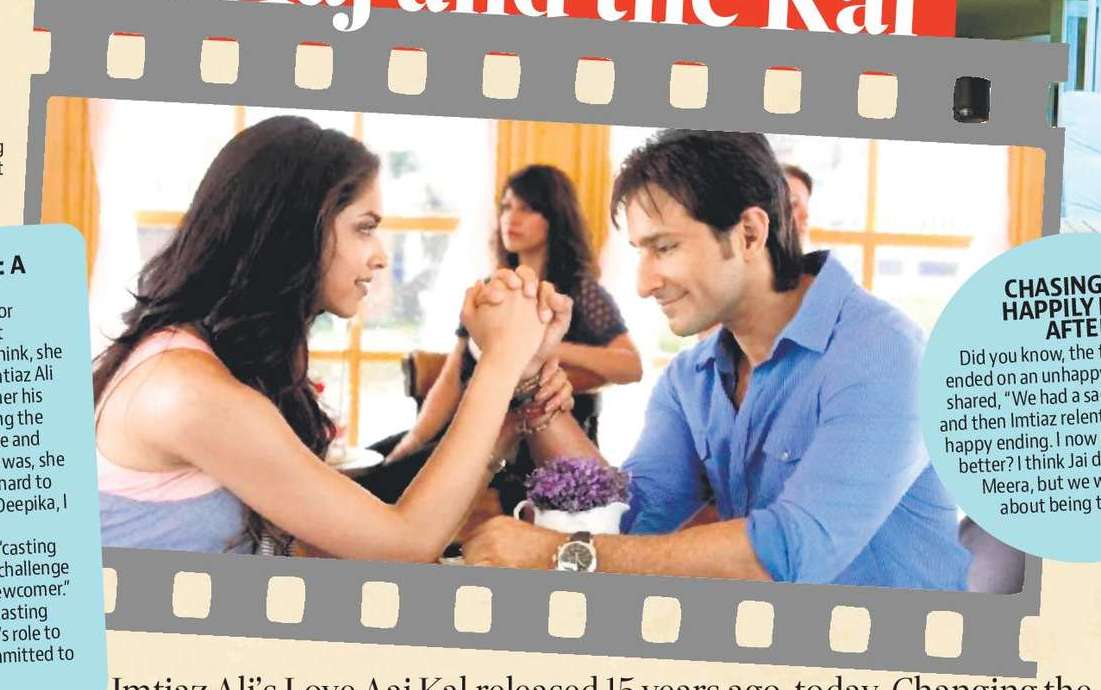
Imtiaz Ali’s Love Aaj Kal released 15 years ago, today. Changing the template of the rom-com genre, this cult classic introduced the concept of breakup parties! Starring Saif Ali Khan, Deepika Padukone, late Rishi Kapoor and Giselli Monteiro, here's taking a look at some interesting tea and trivia that went into the making of the film
HINDUSTAN TIMES (July 31, 2024)

UNLIKELY CASTING CHOICES
The casting of Brazilian model Giselli Monteiro as Harleen Kaur was considered an unlikely choice. Imtiaz had said, “Giselle came to me through dress designer Anaita Shroff. She was to play Jo, Saif’s Caucasian girlfriend in the second-half. She wasn’t right for Jo. But my wife (Preety Ali), who was there, suggested Giselle for Harleen.”

CHASING THE HAPPILY EVER AFTER
Did you know, the film originally ended on an unhappy note? Saif had shared, “We had a sad ending at first and then Imtiaz relented and gave us a happy ending. I now wonder, which is better? I think Jai deserved to lose Meera, but we were worried about being too clever.”

A SEQUEL (NOT) FOR THE AGES
When a sequel was announced, actor Saif Ali Khan wasn’t interested in doing it and had said, “I don’t see it as a continuation... Imtiaz should probably try and make one of these every 10 years, calling it Aaj Kal with different actors! I’m hoping it is a different story, though.” Incidentally, his daughter, actor Sara Ali Khan acted in the film’s spiritual sequel, Love Aaj Kal (2020).

KAREENA VS DEEPIKA: A RISK THAT PAID OFF
Saif wanted then-girlfriend actor Kareena Kapoor Khan to be cast opposite him. Saif had said, “I think, she was quite keen to work with Imtiaz Ali again and I think he promised her his next movie. Her boyfriend being the producer of Imtiaz’s next movie and being in the situation that she was, she was wondering and finding it hard to understand why we had cast Deepika, I think.”

Imtiaz later admitted that “casting Deepika was a risk”: “It was a challenge to myself as Deepika was a newcomer.” Imtiaz was so sure about his casting choice that he offered Meera’s role to Deepika even before she committed to making acting her career.

YASH CHOPRA GIVES IT A THUMBS UP
This love story had received the stamp of approval from late filmmaker Yash Chopra. In an interview, Imtiaz had shared, “I remember that Yash ji had called me after watching it. I had rushed away from the room I was in, and went to the balcony to hear very carefully what he was trying to say. He liked the film, that was a great moment for me.”

A PERSUASIVE RETURN
Actor Neetu Kapoor made a cameo appearance, returning to screen after 26 years. Imtiaz had revealed, “I fell on my knees and told her I am a huge fan. After a lot of persuasion, I finally convinced her to act in my film.” Neetu later said that she did the film “as a favour” to Rishi.

TRIVIA:
- The working title was Production No 1, because it was Saif Ali Khan’s first production. Later Aaj Kal, and Elastic were considered as titles.

- While shooting for the song Chor Bazari, Deepika Padukone met with an accident. In the scene where she is supposed to fall from a table and land in Saif’s arms, the actor ended up on the floor, but avoided serious injuries.

- The songs Aaj Din Chadheya and Aahun Aahun were initially not a part of the film. But composer Pritam convinced Imtiaz Ali to include them, saying that the film needed a romantic track.

- The film was remade in Telugu in 2011, titled Teen Maar and starred Pawan Kalyan, Trisha Krishnan and Kriti Kharbanda.

All my films have had some problems in execution-Imtiaz Ali

Shekhar on campaigning for Kangana: Yeh toh mera farz hai

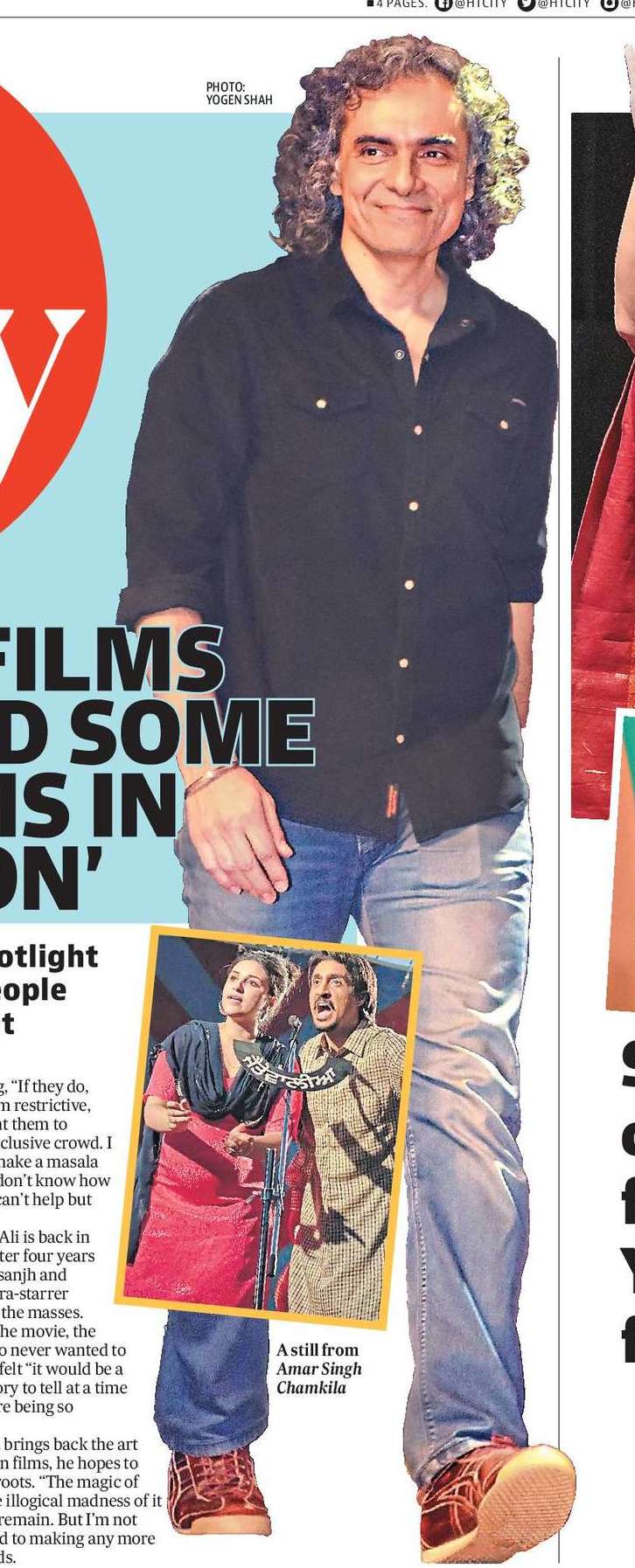
Imtiaz Ali, who is back in spotlight with his latest hit, hopes people see merit in his projects that didn’t work
Akash Bhatnagar (HINDUSTAN TIMES; May 9, 2024)

He may be riding high on the success of his latest outing, Amar Singh Chamkila, now, but filmmaker Imtiaz Ali has had his fair share of failures too, with Jab Harry Met Sejal (2017) and Love Aaj Kal (2020).

“When I made them, I just wanted to make a movie, but they didn’t work. All my films have had some problems in execution; [I feel] they could have been better. However, I hope people see some merit in these two films also, as there are some good things that probably did not come through [at once],” he reflects. 

But the audience has loved films such as Rockstar (2011) and Tamasha (2015), also dubbed as some of his intellectual projects. Will there be more such movies? “I don’t want my films to come across as intellectual,” says Ali, adding, “If they do, they might seem restrictive, and I don’t want them to belong to an exclusive crowd. I would love to make a masala film, but I just don’t know how to make it as I can’t help but be myself.”

Meanwhile, Ali is back in the spotlight after four years as the Diljit Dosanjh and Parineeti Chopra-starrer resonates with the masses. Talking about the movie, the filmmaker, who never wanted to make a biopic, felt “it would be a magnificent story to tell at a time when people are being so judgmental”.

As Chamkila brings back the art of live singing in films, he hopes to go back to the roots. “The magic of cinema and the illogical madness of it should always remain. But I’m not looking forward to making any more biopics,” he ends.

I don’t mind being loved or hated, but I don’t want to lie to anyone-Sara Ali Khan


Madhureeta Mukherjee (BOMBAY TIMES; August 23, 2023)

She was raised by liberal parents who encouraged her to blossom, thrive and be who she wanted to be. And here’s what we have today — a bindaas, spunky, confident and cool girl, who likes living her lifezara hatke. Someone who is proud about not “being manicured”. Take it, or leave it — that’s Sara Ali Khan for you, darshakon! Sitting in her lovely Juhu home, we talk about all that matters – success, failure, beliefs, criticism, love, and most of all, about her honest, true self. Read on…

With films ranging from Kedarnath, Simmba, Coolie No 1 to Atrangi Re, Gaslight, and your recent release Zara Hatke Zara Bachke, would you say that your career has been zara hatke, or did you tread more bachke?
I definitely think that my career has been hatke. Aankh Maare (Simmba) dropped on December 6, 2018, and Kedarnath released the next day, on December 7, and just those two pieces of work are so different. However, I think whenever I have played a girl from the heartland of India, it has connected with the audience, because I am that person in my soul – in the way I travel, eat, talk or my values. Whether it is the Bihari dialect in Atrangi Re or dressing up like a Punjabi girl in Zara Hatke Zara Bachke (ZHZB), these are things you have to work on, but desiness to me is an emotion. So, the desire to be versatile is always there, but beyond that, there has been no planning my career trajectory.

You have received a lot of love for ZHZB, which went on to become a success. But how do you deal with the harsh criticism that comes your way for some of your work? In fact, a lot of opinions and comments on various aspects of your life are put out there by people on social media. How deeply does it affect you?
I think it is important to understand what the criticism is. If I am being criticized for going to a temple, the length of my shorts or the colour of my dupatta – then I don’t care. It’s no one’s business, but my own! But, if I am being criticized about my work, and if they don’t like my work, then that’s a problem because I work for the audience. It is important to take feedback, learn and grow. If I had carried the burden of the failure of Love Aaj Kal onto the set of Atrangi Re, I wouldn’t have been able to deliver. Whatever I do, I do it with my heart and soul. It is difficult to detach when you love something so much. It broke my heart when the media and audience that gave me so much love for my first two films panned me in Love Aaj Kal. It shattered me entirely. But I decided that main haar nahin maan sakti, and I have to do better. I am not one of those people who will say that they don’t care. Of course, I do. I don’t let failure or criticism break me, but I don’t let it make me either. Now, when I meet people at the gym, they are much nicer to me than they were a few months ago (owing to the success of my film). The love I received for ZHZB has given me a lot of confidence, but I didn’t let it excite me much as I know it’s till next Friday. So, I don’t get too attached to the love, for I know that it might not last.

In the last few years, do you think you have come into your own?
Yes, I have. I am getting better at being able to surrender to the director’s vision. I think somewhere, I had become a little insecure after some of my films that released didn’t get the kind of response and love that I had hoped they would. Suddenly, I became unsure…ki bharosa bhi karu to kispe karu, kitna, kya karu? To fully let that feeling go and be able to honestly present yourself in every set is a different learning. Also, because I am loud, funny and bindaas, one thing I have learnt recently is that the idea is not to be the joker on set. The idea is not to exhaust yourself so much that action aur cut ke beech mein kuch rahe na because you have to leave the juice and meat for what really matters. The rest is all useless.

When you interact with your fans and the media – whether in person or via social media – there seems to be a certain ease and comfort. You are fun, chatty and even goofy. Does it come naturally to you, and is this your honest, real self that you put out there?
I guess I am so different from others that I come across as bindaas, ziddi, pagal…aur mujhe yeh sun ke bahut garv mehsoos hone laga ki I am not manicured, and I started liking that. I started enjoying the fact that people appreciate me for who I am. Since childhood, I was encouraged to be myself by my parents. But people often told me, ‘Talk softly, don’t laugh so loudly, your body language and posture should change now that you are going to be an actor.’ Then I actually got accepted for who I am, and I was like…why should I waste my energy trying to be someone else. I can be different people for my screen roles, and if I need to do justice to all these characters on screen, I need to be Sara when I am not any of these in real life, else I will go crazy. I admire people who can put up this front 24/7. It is exhausting, and I want to save that energy for action and cut. It is not that I say anything anywhere, I do have that awareness. But yes, off-camera, I want to be myself and be real.

Having done all-out commercial films to the hatke ones – is there any genre you specifically want to explore or do more of?
I want to be able to do everything. There is a certain connect that I feel to heartland India, and I would like to do another one in that zone. But I also want to do a royal period drama and a romantic film. I want to reach a point where people say that there is no genre that Sara can’t do. I set very high standards for myself; I always have. I believe that if you aim for the moon, you will land on the stars. Anand L Rai taught me that – give a bad shot, but never give a safe shot. Take a risk, take that leap.

What is Sara’s ideal man like? Do men get deterred by your honesty and frankness?
I don’t know if it is a deterrent, but it is who I am. I have learnt thus far in life that I don’t mind being loved, I don’t mind being hated, but I don’t want to lie – whether it is to my friends, audience, media, or the man in my life. You have to take me for who I am. I do have an opinion, a brain, a heart, and I am not going to silence any of them. Hopefully, I will find the right person who accepts that.

‘I don’t want to be known as a knock-knock queen, that’s not my name’
I am beginning to understand what the job is and what isn’t. People pleasing is a defence mechanism you will adopt when you don’t think you are good enough for the job. I went through that phase after Love Aaj Kal when I thought my jokes would be appreciated if not anything else. But I am realizing that the work will speak. I don’t want to be known as a knock-knock queen, that’s not my name. That is only funny if there is a decent amount of work to substantiate it. Confusing audiences into buying their love by giving intelligent interviews or jokes on reels instead of work is not the approach. The more films I do, the more I realize that.

I don’t feel pressure while working with a big director-Sara Ali Khan

SARA FEELS ‘PRIVILEGED’ TO WORK WITH BIG DIRECTORS
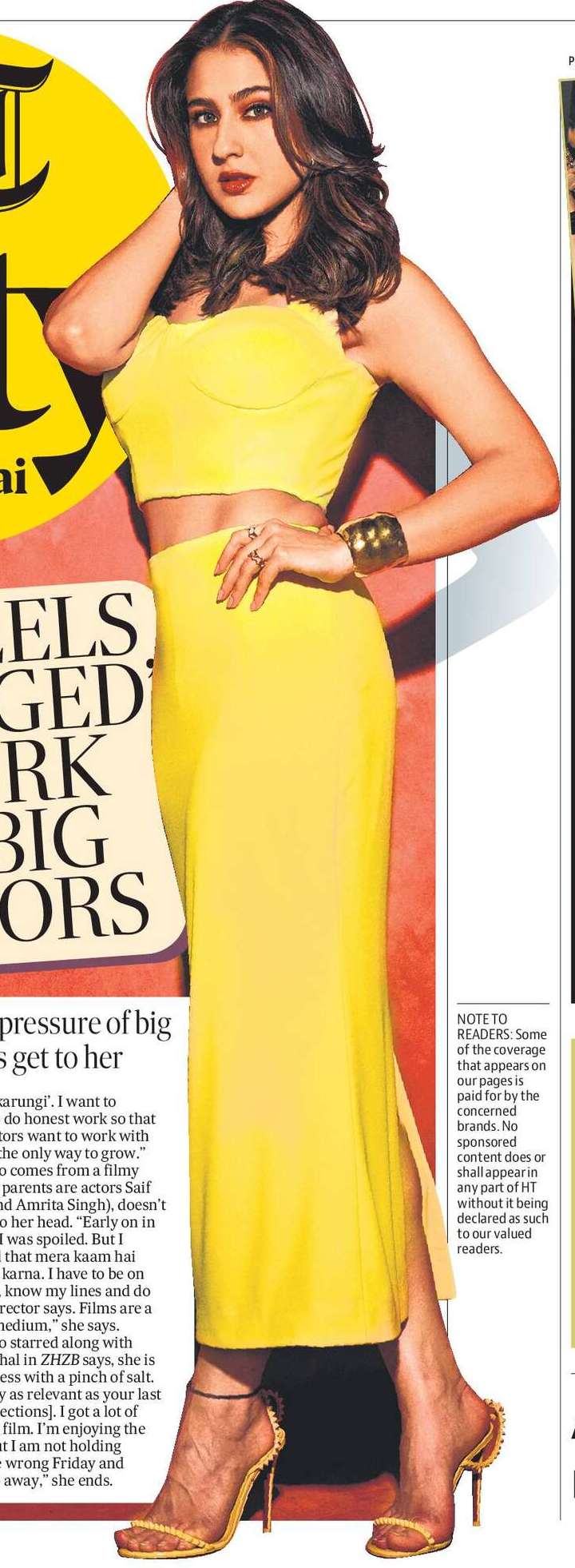
Sara Ali Khan doesn’t let the pressure of big names or her films’ successes get to her
Rishabh Suri (HINDUSTAN TIMES; July 31, 2023)

Since she broke on to the film scene five years ago, Sara Ali Khan has worked with a number of A-list directors like Abhishek Kapoor (Kedarnath; 2018), Rohit Shetty (Simmba; 2018), Imtiaz Ali (Love Aaj Kal; 2020) and Aanand L Rai (Atrangi Re; 2021). Riding high on her latest, Laxman Utekar’s Zara Hatke Zara Bachke (ZHZB), the actor, who is a “nervous person in general” believes that working with these big names is a privilege.

The 27-year-old shares, “I don’t feel pressure while working with a big director, but rather privileged. I want to work with filmmakers, who I can fully surrender myself to and say ‘Bhai aap jo bologe, as an actor, main vahi karungi’. I want to continue to do honest work so that more directors want to work with me. That’s the only way to grow.”

Sara, who comes from a filmy family (her parents are actors Saif Ali Khan and Amrita Singh), doesn’t let that go to her head. “Early on in my career, I was spoiled. But I understood that mera kaam hai apna kaam karna. I have to be on set on time, know my lines and do what the director says. Films are a director’s medium,” she says.

Sara, who starred along with Vicky Kaushal in ZHZB says, she is taking success with a pinch of salt. “You’re only as relevant as your last Friday [collections]. I got a lot of love for the film. I’m enjoying the moment but I am not holding onto it. One wrong Friday and it can all go away,” she ends.

Bhool Bhulaiyaa 2 is a blockbuster; Kartik Aaryan emerges as the Shehzada of Bollywood

THE SUCCESS STORY OF KARTIK AARYAN

With the success of his latest release and his popularity among the masses, Kartik Aaryan has become one of the most bankable actors in India
HINDUSTAN TIMES (June 23, 2022)

Kartik Aaryan is the young superstar who’s currently reigning at the box office and remains unstoppable, which makes his journey to superstardom meteoric. His recent release, Bhool Bhulaiyaa 2, went on to do what other big-ticket entertainers couldn’t. It became the first Bollywood blockbuster and biggest opener after the pandemic, giving the Hindi film industry much-needed respite.

Aaryan proved to be a saviour at the box office, as Bhool Bhulaiyaa 2 also elbowed out some of the biggest superstars’ films that released during the hassle-free pre-pandemic time. The success of the horror-comedy is testimony to Aaryan’s bankability as an actor and his unmatched popularity with the masses across the country. At a time when the Hindi film industry was desperately seeking to revive its pre-pandemic glory and with the outstanding success of films from the south film industries, Aaryan brought audiences back to the theatres with the blockbuster.

The record-breaking success of the film has cemented the actor’s position in the top league of Bollywood superstars. Commenting on Aaryan’s contribution in the success of Bhool Bhulaiyaa 2, critic and trade analyst Taran Adarsh says, “Bhool Bhulaiyaa 2 is a major success at the box office and one of the prime reasons for that is Kartik Aaryan. A combination [of several factors] led to the film’s success, including the music, the fact that horror and comedy have been integrated well in the film, the way the screenplay has been woven, and most importantly, Kartik’s presence and the way he’s performed in the film. While stepping into another actor’s shoes, in this case Akshay Kumar, who was an integral part of Bhool Bhulaiyaa (2007), the comparisons were obvious. But Kartik surprised everyone with his performance. That’s what worked in his favour.”

He adds, “The fact that he enjoys a tremendous following, not just among women, but also family audiences and the youth, helped the film get a fantastic opening. It’s unbelievable how BB2 is doing tremendous business at the box office even after a month.”

Going by the actor’s track record, it’s also evident how he has never disappointed as far as box-office numbers are concerned and has always been a bankable star, says trade expert Joginder Tuteja. He continues, “It’s not just a splash in the pan. It’s not like Kartik Aaryan came and suddenly delivered a hit and is a saviour. If you look at his films, you’ll notice how he has been extremely consistent at the box office. While Love Aaj Kal (2020) got one of the biggest openings of 2020, his film, Sonu Ki Titu Ke Sweety (2018) crossed Rs. 100 crore. Luka Chuppi and Pati Patni Aur Woh (both 2019) were also superhits on the big screen. So, out of his last five movies, he has delivered four big hits and that pretty much establishes that he’s a superstar. He is finding love among family audiences, youth as well as kids.”

Industry experts also point out how Aaryan is a self-made superstar. They reiterate that the actor entered the film industry with a bag full of Bollywood dreams, no connections, no godfather or any big banners to back him.

What makes his success story even more distinct is the fact that the hit films of his contemporaries were a combination of celebrated filmmakers, significant marketing campaigns, bigger banners and equally prominent co-stars and several other elements that gave impetus to the success of these films. Whereas Kartik’s hits have been with debutante directors. Even the very recent Bhool Bhulaiyaa 2 can be counted in that category as it was filmmaker Anees Bazmee’s first directorial venture after a sabbatical.

Adarsh adds, “Kartik Aaryan comes without baggage of a godfather or a father who’s a producer or a financier or someone who is connected to films. He is a self-made star and that’s what people like about this guy. He’s played his character in Bhool Bhulaiyaa 2 with complete conviction, and if you look at his career graph, he’s played different kinds of roles and delivered versatile performances over the years and most of his films have done very well at the box office. I think this is just the beginning and Kartik is going to taste bigger success in times to come.”

The actor has truly proved to be a dark horse and a talent to reckon with. Once an outsider, but today among the most sought-after names in the Hindi film industry, Aaryan has an exciting lineup of films ahead with Shehzada, Freddy, Captain India and Sajid Nadiadwala’s untitled next.

Tuteja goes on, “With the success of Bhool Bhulaiyaa 2, it is apparent that Kartik Aaryan has consolidated his position in the top league, and with Shehzada coming in now, I’m pretty positive that it’s going to be another big one for the actor! Kartik Aaryan is likely to further reaffirm his super stardom.”

THE SUCCESS STORY OF KARTIK AARYAN
Kartik Aaryan is all smiles amid kids during a special screening of Bhool Bhulaiyaa 2 for an NGO photos: htbs

I love my peers; there is boundless scope to learn from them-Sara Ali Khan

Sara Ali Khan: Scope to learn from peers is boundless

With Sara becoming every industry actress’s best buddy, the actor on shattering the age-old adage that contemporaries must be rivals
Mohar Basu (MID-DAY; January 5, 2022)

Despite the polarising reviews the film received, Sara Ali Khan has earned acclaim for her act as the feisty Rinku in Atrangi Re. Acknowledging that the uncanny storyline, which amused and puzzled viewers in equal measure, is what drew her to the film, she says, “I want to work on films which are as [unique] as Atrangi Re. None of my films should have anything in common. I want to live different lives,” she says, delighted to have found herself in viewers’ good-books after their lukewarm reaction to Love Aaj Kal.

“When things don’t work, you lose a bit of your confidence. After Kedarnath and Simmba, I was put on a pedestal that I wasn’t sure I deserved. After Love Aaj Kal, I was dragged down brutally. But, I love social media, regardless. I can’t change how people think. So I work on myself instead.”

Since the subject of social media is raised, we can’t help but ask her about her new-found friendship with Janhvi Kapoor. Ever since the duo attended a music concert last month, discussions on their camaraderie has become the talk of the town. “We are both ambitious, young girls who have lost 18 months of our lives to COVID. We bond over that. We are different people, but comfortable in our skin.” 

Kapoor is not the only one to make a frequent appearance on Khan’s social media. On one occasion, she can be seen shaking a leg with Ananya Panday; on another, she is spotted trekking with Radhika Madan. “I love my peers because they are so different from me. There is boundless scope to learn from them.”  

Apart from her endeavour to shatter the age-old adage that female actors can’t be friends, Khan admits she has many battles to wage against trolls. That they pick on her for being inauthentic each time she greets lensmen with a ‘namaste’, hasn’t gone down well with her. “I have an understanding of what to say, and where. I talk differently with my friends, contemporaries, the press and the paps. That doesn’t suggest that I am fake. I grew up with a single-mother, and learnt that you [must] be a soft person, but have a hard exterior to protect yourself.”

Khan (right) training with Kapoor

Khan (right) training with Kapoor

You cannot attach your self worth to how your films fare-Sara Ali Khan


Renuka Vyavahare (HINDUSTAN TIMES; December 18, 2021)

Sara Ali Khan, like her famous parents (Amrita Singh and Saif Ali Khan), is nonchalantly honest. Exuding wisdom beyond her years, she lets us in on a secret. She may seem all confident and vivacious, but deep down, that’s her concealing her nerves better. The actress owns failure with as much integrity as success. In a candid chat with Bombay Times, Sara opened up on her life and beyond — right from relationships and highs and lows in her career, to her incredible weight loss journey and her forthcoming film Atrangi Re. Excerpts:

Your film Atrangi Re is a love triangle. You play a girl who cannot make up her mind between two men. Did that indecisiveness, not just limited to romantic relationships, resonate with you at any level?
There’s a line in the trailer that has caught a lot of attention. ‘Agar ek baar, ek ladki ko dono (ladke) mil jayenge toh kya aafat aa jayegi!’ I was so excited to say this line because I thought it was path-breaking in a way. Why does it have to be this or that in life? Aanand ji (director Aanand L Rai) told me, it’s not a path-breaking line, and you won’t say it like that. Say it in the same way as any other line because only then will people relate to it. He didn’t want me to make it sound like I was giving a speech or a sermon. He explained how it was a genuine, innocent and simple thought.

When you truly believe in something, you don’t jatao it. If I want to have salad and pizza, why can’t I have both? Other than the indecisiveness, what I found most exciting about my character Rinku is her demeanour. She says these assertive, confident and strong things, but it’s all coming from a pure and innocent space. She seems unabashed, but she isn’t callous. If I were to compare, Rinku is not quite like me except for one thing, and this one similarity outweighs the differences. Like her, I may seem bubbly and display clarity of thought, but that’s on the exterior. In reality, I am extremely sensitive as a person. I just know how to conceal that side of me better with confidence. I grew up with a single mother (actress Amrita Singh) who understood early in life that if you have a soft shell, you will be crumpled easily. I idolize my mother and hope to be like her every day, so the strength to conceal the vulnerability comes from there.

As your film hints, do you believe one person can fall in love with two people at the same time?
Love is a very personal and subjective phenomenon. I do believe in one thing. To have any kind of love in your life, you need to love yourself first. It took me a while to realise that. The rest is different for different people.

Your weight-loss journey has often been spoken about. What’s impressive is that you were confident then and you are confident now. It wasn’t based on the weighing scale, was it?
Confidence for me is never about what I look like. That’s not real. You are who you are on the inside. That’s your identity. Baahar ka toh theek hai. Aap paanch pizza khaogay thoday motay lagogay, paanch ghanta bhagoge, patle lagogay. What you are on the inside is what matters the most. Also, it doesn’t matter to me what people say. You allow a troll to win when their comments affect you. You look in the mirror and say, mujhe farak nahi padta toh nahi padta. It’s unrealistic to believe that you can change how the world thinks. It would be great if we all woke up to being body positive, but that may not happen. The need for validation from other people is inevitable in our jobs, but you need to compartmentalize it. I mean no disrespect to anyone, but what they think of how I look does not matter to me. However, what you think of my acting does matter to me. That’s my job. I do films for the people and media. If they don’t like my work, then it’s a problem, and I need to work on it. That I will take seriously. But how I walk, look or what I wear is nobody’s business. That’s my life. I am proud of the fact that I have been able to segregate Sara, the actor, from Sara, the person.

Does this wisdom come from your parents, who are known for being independent in their thinking?
Absolutely! They both have taught me to have a sense of balance. After Kedarnath and Simmba, I could have thought I’d arrived and after Love Aaj Kal, I could have locked myself in a room. I didn’t do either of those things. You cannot attach your self-worth to how your films fare. My job matters a lot to me, but if you stop mattering to yourself, job kaise kar paogay? My mom stopped working as a leading lady the year before I was born. She bagged the Filmfare Award for Aaina (1993) and called it quits. My father gave 17 flops, and then became somebody who won numerous awards later on, including the National Award for Hum Tum. He went on to do films like Omkara. I learnt from them that if your heart is in the right place and you try hard and mean well, you are sorted.

Atrangi Re will be out on the same day as Kabir Khan’s '83. Both films are much awaited. Is it unnerving to go head-to-head with another promising film?
I do have butterflies in my stomach, but for other reasons. I haven’t had a release in a year. My last release was Coolie No 1. Honestly, it’s been two years since I have done a film that I can say I am really proud of. I started shooting for Atrangi Re two weeks after Love Aaj Kal was released, and that film was my first failure. With much love and compassion, Aanand ji told me that, ‘You cannot play on the back foot now. You are a confident girl, and I need that confidence to reflect in the performance. I want people to see that.’ He made me believe in myself at a time when I didn’t.

We live in a world where success is celebrated and failure is brushed under the carpet when it’s the latter that teaches you more, doesn’t it?
What doesn’t kill you makes you stronger. Love Aaj Kal’s failure taught me more than Kedarnath’s success. When Kedarnath released, I had no expectations. I didn’t know what would happen. I loved my job, but bhook nahi thi aur itna khaana mil gaya. In Love Aaj Kal, I wasn’t appreciated at all and rightfully so. But now I have that hunger.

What do you think went wrong with Love Aaj Kal? Your performance evoked a fair amount of criticism. In hindsight, do you wish you had approached the role differently?
I had a blast working with Imtiaz Ali sir on that film and films are ultimately a director’s medium. We make movies for the audience and media. If you guys didn’t like the movie, then it didn’t work. I should have been a bit more understated in my performance, but that wasn’t the brief given to me. It could have been different, but you learn. If a character didn’t connect with you, I have to accept the fact that maybe my pitch was unreal. Maybe I wasn’t emotionally convinced as an actor to pull that off. I am cognisant of my failure. I hope to learn from my mistakes and get better in the future. As far as criticism is concerned, it’s important to understand what didn’t work, but you cannot take it to heart and lose confidence.

Maybe I was too high-pitched and loud in Love Aaj Kal. Maybe it was unconvincing-Sara Ali Khan

Sara Ali Khan: Aanand sir had confidence in me when I did not

Admitting that Love Aaj Kal’s box-office fate left her shattered, Sara discusses learning lessons from its failure and blooming creatively on the Atrangi Re set
Mohar Basu (MID-DAY; December 9, 2021)

Sara Ali Khan doesn’t want to drink too many black coffees the morning we catch up with her for an interview. Having inherited her father Saif Ali Khan’s candid nature, she is worried she will tell us too much about Atrangi Re. She argues that the Aanand L Rai film has a complex plot that’s best revealed when it drops online. For now, all she is willing to say is that the Akshay Kumar and Dhanush-starrer is a film of a lifetime to her.

“I have the Thalaiva of the north and the Thalaiva of the south on screen with me. Aanand sir found vulnerability and innocence in me, which I hide beneath my confidence. He helped me bring those out on screen. So, in some ways, my character is like me. I am softer on the inside than I show. I have grown up with a single mother, and learnt from her that I need a hard exterior to protect what’s inside,” she says.

Rai’s stories usually have fierce women driving the narrative. Khan believes the beauty of his heroines lies in their love and compassion. “He loved me so much on that set. I started this film a week after Love Aaj Kal [2020] released. That film didn’t do well. Being with Aanand sir helped me rebuild myself. He had confidence in me when I did not. He made me perform when my self-esteem was at its lowest.”

We prod her about overcoming the failure of Imtiaz Ali’s Love Aaj Kal. The love story was slammed even by the filmmaker’s devout fans. “If something doesn’t work, I can’t defend it. I had to accept that it wasn’t good. We did what we thought was best; it didn’t translate on the screen. Maybe I was too high-pitched and loud. Maybe it was unconvincing. I tried to be receptive to [the audience’s feedback] to change that.”

She remembers Rai being her pillar of strength at the time. “During one of our early days, Aanand sir told me, ‘Tu hil gayi hogi Love Aaj Kal ke baad, but you have to play on the front foot.’ My mom [Amrita Singh] made sure that Kedarnath [2018] and Simmba’s [2018] success did not affect my behaviour on Love Aaj Kal’s set. So it’s only right that the failure of this shouldn’t affect Atrangi Re. It’s harder to forget a failure than the high of a success, but what doesn’t kill you makes you stronger.”

The one thing that looms large over Atrangi Re is that it’s set for a digital premiere despite theatres having reopened. Khan points out that the deal was cracked long ago, and adapting to different mediums is part of the job. “I became an actor for the big screen. But I also realise that with changing times, viewers will watch wherever they have to. Disney+ Hotstar has a massive viewership. Aanand sir made this decision. I won’t question his judgment. I fully support it.”

I call Akshay Kumar Thalaivar of the North, as he has so much energy, spontaneity, and spark-Sara Ali Khan

Sara Ali Khan gets candid about falling in love with her work again, the trend of direct-to-OTT releases and more
Rishabh Suri (HINDUSTAN TIMES; December 7, 2021)

It’s been a year since actor Sara Ali Khan, 26, returned to doing interviews, and she’s dressed as if she’s at home, at ease. And that’s exactly how the conversation goes — easy, free-flowing, with no reluctance on any subject, whether it’s about a previous film that didn’t do well or her upcoming film, Atrangi Re.

“My films are only released in December,” she jokes (her last film, Coolie No 1 was released in the same month in 2020). Excerpts:

You are back in the rustic, street smart girl zone after Kedarnath (2018), your debut. Was it deliberate, after urban-set films like Love Aaj Kal, and Coolie No 1 (both; 2020)?
I believe in the stories that I think deserve to be told. This (Atrangi Re) just so happened to come to me after seeing a commercial film. Also, the thing is, with the kind of films I have been privileged to do, I haven’t chosen them, they have chosen me. Rohit Shetty, Imtiaz Ali, Aanand L Rai (filmmakers)... How can you choose these people? They choose you. This film came to me at a time when I most needed it. The only good thing in my life in 2020 was Atrangi Re. Love Aaj Kal didn’t get love. Ten days after it flopped, I was on the floors with Aanand ji, doing this movie. On a personal level, Rinku (her character in the movie) and Aanand ji made me fall in love with myself and my work.

You shot this film amid many restrictions due to Coronavirus. How different was it?
It was simply beautiful to realise and remember what it was like to be on a set where everyone was doing their job because they wanted to, not because they had to. After the lockdown was lifted, the song Chaka Chak was the first thing I shot for.

Like with your last release, Atrangi Re is heading directly to an OTT platform. Did you have any apprehensions?
My initial reaction was to feel bad because I do films for the big screen and I believe in that experience. Then I also realised, for lack of a better word, what the aukaat of an actor is. It’s not my decision. I love Aanand ji. He made me love myself when I didn’t love myself. So I am not one to question his thought process. Jo bhi kiya hoga, bahut soch samajh ke kiya hoga. Ultimately, for me, it matters that you watch the film. If I reach more eyes, I win. As long as you can watch the film and have a smile, I am happy.

What was it like to work with Akshay Kumar and Dhanush?
It was insane! I call Akshay sir Thalaivar of the North, because he has so much energy, spontaneity, and spark. Dhanush sir is both an inspiration and an institution in the world of acting. He knows the camera like I know water. There was not a single day on set where, apart from being fun and creatively rewarding, there wasn’t constant learning. If it was a seven-to-seven shift, and I had to pack up after lunch, I wouldn’t go back. I would sit and watch all the takes of Dhanush sir on the monitor.

Fenil's Bollywood Talk # 660

BOLLYWOOD LETS VALENTINE’S DAY WEEK TO GO WASTE

Over the years, the Valentine’s Day has become as important as any other festive holiday. Interestingly, offices, banks and educational institutes are all open on February 14. Yet, the footfalls in theatres have seen an upswing on this day. Last year, February 14 fell on Friday luckily. Love Aaj Kal released on this day and it collected a huge Rs. 11.75 crore. In 2019, Gully Boy released on a Thursday to take advantage of this day and it was a good decision. The film opened very well, at Rs. 19.26 crore. In 2018, Pad Man released in the Valentine’s week while in 2017, it was Jolly LLB 2. Both films starred Akshay Kumar and were not exactly ideal Valentine’s Day films. Yet, the collections for Pad Man grew by around 20% while that of Jolly LLB 2 jumped by 25%. That’s the power of this day.

After the lockdown was imposed, very few films have been releasing in cinemas. There have been weeks where no Hindi film has released. And sadly, this week, too, would be one of those. However, till now, at least some film has released on festivals, though most of them were non-exciting. Suraj Pe Mangal Bhari released on Diwali and was the best of lot. Chrismtas saw the release of Shakeela, Ramprasad Ki Tehrvi came on New Year’s Day while Madam Chief Minister hit screens in Republic Day week. Hence, it was expected that some film would make it in the Valentine’s week.

Surprisingly, two films are scheduled to release next week and both seem ideal Valentine’s Day entertainers. One is the Hollywood film Tom & Jerry. However, it’s made by Warner Bros. It’s Indian office is releasing it a week before it’s international release, which is two weeks away from now, on February 26. To convince the Los Angeles team to prepone the film’s India release by 2 weeks would be too much.

However, the other release is a Hindi flick, a romcom that too, called Tuesdays And Fridays. It is produced by T-Series and Sanjay Leela Bhansali and stars Poonam Dhillon’s son Anmol Thakeria and Jhataleka Malhotra, the first runner-up in Femina Miss India 2014. This film looks forgettable but it at least is a love story. In fact, this film had some chance of earning something if it had released this week rather than the next.

With no other option, multiplexes will be playing past romantic hits from Bollywood like Bajirao Mastani, Dil To Pagal Hai, Gully Boy, Jab We Met, Yeh Jawaani Hai Deewani, etc and from Hollywood like A Star Is Born, La La Land, etc. Will it lead to even 5-10% occupancy remains to be seen.

I’m never shedding the lover boy image. It’s a privilege that doesn’t trouble me-Kartik Aaryan


Renuka Vyavahare (BOMBAY TIMES; December 16, 2020)

Gwalior boy Kartik Aaryan has carved a niche for himself in Bollywood in a relatively short span of time. The actor’s unkempt voluminous hair, boyish smile and ability to mouth monologues in romcoms that revolve around the battle of the sexes catapulted him to stardom. His upcoming thriller Dhamaka will see him breaking away from the ‘Kartik Aaryan brand of cinema’, or so we believe. In an exclusive chat with Bombay Times, the actor opens up on life, movies and how the year changed him as a person.

In our last interaction, you said you love to be a ‘massy hero’. With the OTT boom and the kind of movies that are being made today, are you slowly inching towards what is perhaps more experimental or unconventional? Has this year changed your outlook towards the choices you will make from now on as an actor?
Not at all. In fact, I think the OTTs are changing their approach from what it was a couple of years back. We’re seeing so many conventional big-ticket Bollywood films releasing on OTT now. I think it’s best for everyone. Our country’s DNA has commercial and massy ingrained in it. This is reflecting even in the original series that are being made for the web platforms. But it’s true that now we have a big safety net because of digital platforms and actors do not have to dismiss unconventional roles because of the risk factor. My primary criteria still remains the same though — I should get entertained by the script. I won’t choose roles just for the sake of being experimental or unconventional.

From acing the monologue act and romcoms, to entering the thriller space with Ram Madhvani’s Dhamaka. Are you happy to shed the lover boy image finally?
Dhamaka is going to be a pleasant surprise for everyone. Yes, it’s a thriller, but it’s so much more. It keeps you on the edge throughout and talks about so many relevant things that are going on in our society right now. It’s my most commercial film yet.

However, I’m never shedding the lover boy image. It’s a privilege that doesn’t trouble me at all. My favourite lover boy is still Shah Rukh Khan and so is India’s. Even after Dhamaka, I have horror-comedy, rom-com and family films coming up. I’ll keep doing a variety of films. I feel blessed to have a line-up covering so many genres.

Was Dhamaka a conscious decision to move away from the Kartik Aaryan brand of lighthearted cinema? What prompted you to do so?
It is a conscious decision to expand the Kartik Aaryan brand of cinema. Light-hearted is still the flagship. The more of my ‘light-hearted’ work people enjoy, the more they will look forward to my hard-hitting roles. Actually, KokiPoochega (his online talk show during lockdown) may have been a push in this direction. People were extremely kind and warm to me, and we spoke about serious issues.

After a spate of box office hits, your last outing Love Aaj Kal failed to make a mark. What do you think went wrong, and how did you handle its dismal performance?
I don’t think I had to ‘handle’ anything. When I was offered Love Aaj Kal, I was most excited about the process of working on an Imtiaz Ali love story. The process completely lived up to my imagination. I have learnt so much from being on Imtiaz sir’s set, and the energy was on another level. It has given me so much as an actor that I genuinely never bothered about the outcome. A great box office performance would have been nice, but a below average one doesn’t bother me at all. At least not yet. Plus, the fact that my performance was so appreciated, especially by my favourite filmmakers, is more than enough for me.

Do you think 2020 has forever changed the way we watch films or consume content? Has there been any change in how you watch films now?
I think it has only broadened our horizons. We are more accepting of different platforms than before, but that does not mean it will change cinema. People will still go to the theatres. Films are an event for us. How can that ever change? The fact that people have the capacity to now binge watch is an advantage to all makers, regardless of the format and platform.

What has been your biggest learning through this pandemic phase?
Looking ahead, I think we all will come out as better people now. I always valued relationships and people, but having got so much time to spend with family and on the phone with my friends, has refreshed me in a very positive manner. I feel great energy in life right now, which I believe everyone must be feeling. We have definitely made our bonds stronger.

Talk us through your forthcoming releases and what drew you to them?
Dhamaka talks about such an important issue that is going on around us every day that anyone will be hooked on to it from the very first minute. For Bhool Bhulaiyaa 2 and Dostana 2, I don’t think I need to say what drew me to them. They are two of my favourite films from recent years. To be able to do a sequel with such awesome scripts is a no-brainer.

It hurt that the audience could not see a more authentic version of Battle Of Saragarhi-Randeep Hooda


Randeep Hooda opens up on Battle Of Saragarhi, admits he didn’t watch Akshay Kumar’s film on the same subject
Himesh Mankad (MUMBAI MIRROR; March 23, 2020)

Randeep Hooda recently wrapped up Prabhudheva’s Radhe, featuring Salman Khan in the titular role. In his first negative role he plays a Mumbai-based gangster and has shot some dare devil action scenes with a Korean stunt team. “I’ve had this action image for a long time and I would always wonder why because I’ve never punched anyone, never used my fists. But I love action, if it’s not too over-the-top,” smiles the actor.

Randeep underwent extreme transformation, shedding 18 kilos for Sarabjit Singh’s biopic and then growing his hair and learning the Sikh martial arts to enact the role of Havildar Ishar Singh in Rajkumar Santoshi’s war drama, Battle Of Saragarhi. “It’s just an extra effort I put in for my character and there’s a sense of responsibility and respect when you are playing one who was for real. There’s also a fear that people will find out that I can’t act,” he guffaws.

Battle Of Saragarhi was shelved and it was Akshay Kumar who played the braveheart in Anurag Singh’s Kesari. Surely, it must have been upsetting? “It hurt that the audience could not see what would probably have been a more authentic version with more real emotions of the story. That apart, you learn to move on. Through the journey I learnt the principles of Sikhism and I’m a better person now,” he avers. Did he watch Kesari, you wonder, and he quips, “Nope, it didn’t excite me much.”

Randeep will soon be seen in Sai Kabir’s Mard and describes him as a “quirky director” who is trying to extend himself with this film. “Every film has a life of its own. Since I don’t go on holidays, my only holiday is to go into the world of films,” he exclaims.

His last release, Imtiaz Ali’s Love Aaj Kal, despite Kartik Aaryan and Sara Ali Khan, failed to connect with the audience. Ask him what went wrong and he laughs, “It didn’t do well? I’m not sure because had it done well, I’d have got a grand piano from Imtiaz, but I believe I’m not getting it now.” Prod him and he says he thought it was a novel story, underlining the difference between the sex-starved, gender-separated love of the ’90s with the sexually easy yet empathetic world of today. “It was well directed, I enjoyed it,” he avers.

Sajid Nadiadwala has confirmed that a sequel to his 2014 directorial, Kick, is being scripted. The first part had featured Randeep as a no-nonsense cop, Himanshu Tyagi, on the hunt for Salman’s Devil aka Devilal Singh. Has the maker returned to him with Part 2? “I have no idea they were doing the sequel!” he exclaims. “I really enjoyed Kick, Sajid’s debut directorial.”

Buzz is, Randeep will soon be seen in a quirky comedy produced by Sanjay Leela Bhansali. He interrupts, “That’s being produced by somebody else now. Yes, it’s a comedy and I play a cop. I am shooting for it right now at Karnal.”

Speculaton is also rife that the actor will soon tie the knot with model-actress, Lin Laishram. The actor neither confirms nor denies the rumour and signs off keeping the suspense around his personal life intact. “As a rule, I don’t discuss my personal life, I have enough to talk about professionally. But yes, I am in a very good space at the moment,” he winks.

With She, I am glad that I am doing something I am not associated with-Imtiaz Ali

Imtiaz Ali
Known for his romantic dramas, Imtiaz Ali discusses why he chose to explore the thriller genre for his maiden digital offering, She
Shaheen Parkar (MID-DAY; March 22, 2020)

Still of SheOne would believe that Imtiaz Ali and crime thrillers don't go together. After all, he is the mind behind some of Hindi cinema's famous love stories. But Ali says he was happy to give in to the allure of the uncharted path as he explored the thriller genre with She on Netflix, his maiden digital offering. "I did not plan it [the shift of genres]. I am glad that I am doing something I am not associated with. It's my first web series, so I might as well make a new beginning," he says.

Though he always writes and directs his projects, She sees Ali as a writer and show runner with the directing duties assumed by filmmaker-brother Arif Ali and Anaarkali Of Aarah director Avinash Das. "I realised I could not do everything, as making a web series is like making four feature films at the same time. So, I preferred to look after the creative side and hand over the directorial reins to them."

Starring Gully Boy (2019) actor Vijay Verma and Aaditi Pohankar, the film revolves around a female cop who has a self-awakening journey as she joins an undercover operation to expose the underbelly of Mumbai. The filmmaker was not tempted to rope in big names from Bollywood, instead focusing on the demands of the roles. "In the digital world, it is all about the actor [being the perfect fit for] the character. Most web show actors, especially in the US, became big names due to their performances in the shows."

Will Work Harder To Understand Audience: Ali On Love Aaj Kal's Failure
Ali's last Bollywood outing, Love Aaj Kal—a modern twist to his 2009 outing of the same name—was panned by critics and audience alike, with some cinegoers even demanding a refund on their tickets. Ali agrees that he has introspected since the film's failure. "I will have to work harder to understand who I am talking to and how I should be telling the story for them to enjoy," he says, before adding, "It's not the question of what I did was right or wrong. I did what I felt at that point of time. I hope to get an answer from the audience over time. Some films are appreciated much later. For instance, Sholay did well after weeks [of its release]. I am not saying my film was a Sholay, but nowadays, we only look at short-term gains at the box office and not at a film's longevity."

Still of Love Aaj Kal