Showing posts with label Life In A Metro. Show all posts
Showing posts with label Life In A Metro. Show all posts
Dharmendra, the star everybody loved, passes away; Garam Dharam leaves behind 'Yaadon Ki Baaraat'
8:56 AM

Avijit Ghosh (THE TIMES OF INDIA; November 25, 2025)
Dharmendra, whose irresistible combo of soft face and tough body made him the poster boy of endearing masculinity, and whose Venus-Adonis-like pairing with Hema Malini sold millions of film tickets and gossip magazines, passed away in Mumbai on Monday. Ailing for sometime, the actor was two weeks short of 90.
In the 1970s, a Hindi newsmagazine ran a readers’ contest posing the query, “Why I like Dharmendra?” The winning answer went, “If the question was, why I don’t like him, nobody would have won the prize.”
Everybody loved Dharmendra. The actor, who acted in more than 300 films over six and half decades, thrived even when a tsunami called Rajesh Khanna struck India in late 1960s and when Amitabh Bachchan’s Angry Young Man became the unofficial spokesperson of the nation’s angry young in early 1970s. Unfazed by fluctuating trends and fickle public taste, he remained a constant star on the Bollywood firmament.
Blockbusters like ‘Phool Aur Patthar,’ ‘Aankhen’, ‘Mera Gaon Mera Desh’, ‘Jugnu’, ‘Yaadon Ki Barat’, ‘Sholay’, ‘Dharam Veer,’ ‘Hukumat,’ made action films his province and created Hindi film’s enduring He-Man. But Dharmendra was more. He effortlessly romcom-ed as a botany professor masquerading as a car driver in the inter-generational favourite ‘Chupke Chupke’ and delivered his career-best act as the idealist engineer in ‘Satyakam’, both with director Hrishikesh Mukherjee who eternalised the ‘other’ Dharmendra.
Unpretentious and generous to a fault – the actor embodied the soul of rural Punjab. In one of his last films, ‘Rocky Aur Rani Kii Prem Kahaani (2023)’, Dharmendra reprised a classic ‘Hum Dono’ track, “Abhi na jao chhod kar, ke dil abhi bhara nahi.” (Please don’t go. I haven’t had enough of you).” His fans would be saying the same.
Whenever Dharmendra snarled, "Kuttey main tera khoon pee jaunga," or something like that, bad guys cowered, frontbenchers whistled and box-office queues became as long as a goods train. But that happened long after the actor struggled with a series of flops.
Producer-director O P Ralhan’s Phool Aur Patthar (1966) made him a star. In the film, he played Shaka, a thief with a conscience. In an iconic scene, a drunk and topless Dharmendra walks up to a scared widow (Meena Kumari) pretending to be asleep. He looks at her, spreads a quilt over her and walks away.
The scene not only established the character’s innate decency but also underlined his splendid physicality; two attributes that the audience, both male and female, would associate him with in their own ways. Here was an actor whose body men wanted to acquire, and women lie next to.
Born on December 8, 1935 in Nasrali village, near Khanna town in Punjab’s Ludhiana district, the school headmaster’s son developed a passion for moving pictures after watching Dilip Kumar's ‘Shaheed’ (1948) in Ludhiana’s Minerva cinema. That obsession persisted even after he was employed as a mechanic in an American drilling company. Mumbai beckoned. In 1958, he finished second in Filmfare-United Producers’ first talent contest. By then, he was married to Prakash Kaur and father of a child, now known as Sunny Deol.
Dharmendra confessed on Rajat Sharma’s ‘Aap Ki Adalat’ show that during his early years, a renowned producer told him, “I want a hero, not a hockey player.”
The actor lived in a rented single room over a garage in Versova developing a close friendship with fellow struggler Manoj Kumar. Film journalist Rajiv Vijayakar writes in the actor’s biography that Kumar stopped Dharmendra from leaving Mumbai and going to Delhi where he had landed up a job.
Dharmendra got his big break in Arjun Hingorani’s ‘Dil Bhi Tera Hum Bhi Tere’ (1960) with Kumkum as fellow heroine. More people noticed the kind-hearted doctor who falls in love with a murderer (Nutan) in Bimal Roy’s ‘Bandini’. Over the years, Hingorani and him would form a cosy director-actor team making hits starting with the letter, K -- 'Kab Kyun Kahan' and 'Kahani Kismat Ki' to name just two -- much like the Ekta Kapoor teleserials later.
His collaboration with Bengali directors widened his repertoire. Satyen Bose’s ‘Jeewan Mrityu’ and Dulal Guha’s ‘Pratigya’ were megahits. He wasn’t much of a dancer but the brio with which he expressed ardour while mouthing, “Main jat yamla pagla deewana” became the film’s highlight.
Unlike most stars of the time, Dharmendra was shorn of mannerism, barring a tendency to flare his nostrils when singing or screaming. Directors like Hrishikesh Mukherjee (‘Anupama’, ‘Satyakam’, ‘Chupke Chupke’) and Basu Chatterjee (‘Dillagi’, where he played a BHU-educated Sanskrit teacher), expanded his range, fashioned his bhadralok persona. ‘Satyakam’, a human tragedy, saw his best performance. But forget winning awards, he wasn’t even nominated for one, a fact that despaired him.
With ‘Dreamgirl” Hema Malini, Dharmendra formed a red hot romantic pair. Even in the ultra-violent ‘Sholay’, the scenes of romantic comedy between the two, are utterly charming. ‘Seeta Aur Geeta’, ‘Raja Jani’, ‘Jugnu’, ‘Pratigya’ and ‘Charas’ were some of the major winners they paired with. The real and the reel came together when they got married in 1980; among the finest examples of North-South fusion in Bollywood.
In the 1980s and the 1990s, the market for soft romances and gentle comedies receded. Consequently, Dharmendra focused more on fists and guns which ensured that his underclass fans remained steadfastly loyal. ‘Ghulami’, ‘Hukumat’, ‘Aag Hi Aag’, ‘Loha’, ‘Insaniyat Ke Dushman’, ‘Watan Ke Rakhwale’, ‘Tahalka’ were superhits of this era. The title of one film summed up his new stock-in-trade: ‘Paap Ko Jalaa Kar Raakh Kar Doonga.’
Much of the actor’s later career is a collage of forgettable films. Exceptions include Sriram Raghavan’s nuanced neo-noir, ‘Johnny Gaddaar’ (2007), Anurag Basu’s take on modern love, ‘Life In A Metro’ (2007), an aging NRI waiting for an elderly girlfriend (Nafisa Ali) and the rollicking action comedy, ‘Yamla Pagla Deewana (2011). Raghavan’s ‘Ikkis’, scheduled for release next month, will be among his last films.
In 2004, Dharmendra won the Bikaner Lok Sabha seat on a BJP ticket. Unlike Hema Malini, who seems to relish politics as a three-time MP from Mathura, the Punjab da puttar didn’t. Gossip mags called him ‘Garam Dharam’. But for many, he was a 'naram dil insaan' (soft-hearted guy) who helped out struggling artists and technicians, making guest appearances by the dozen. Even his real-life misdemeanours, which includes beating up film journalists once, didn’t change that image.
The Padma Bhushan recipient was a regular on Twitter (now X) till March this year building a healthy 770,000 followers. His posts revealed his love for farming and Urdu poetry. Not many know that Dharmendra also wrote poems.
During an interview to TOI, he once recited a few lines from one of his poems, ‘Main Kaun Hoon’: “Pyar, mohabbat duayein apki sejti hai jazbaat ko mere/ Isi liye aaj bhi jawan hu main/ Khata gar ho jaye baksh dena yaaron/ Galtiyon ka putla aakhir ek insaan hoon main. “(Your love, affection and prayers nurture my emotions/ That’s why I’m still young/ Please forgive me if I’ve erred ever/ After all, I am only human).”
I missed Irrfan Khan so much during Metro...In Dino shoot-Konkona Sen Sharma
8:28 AM
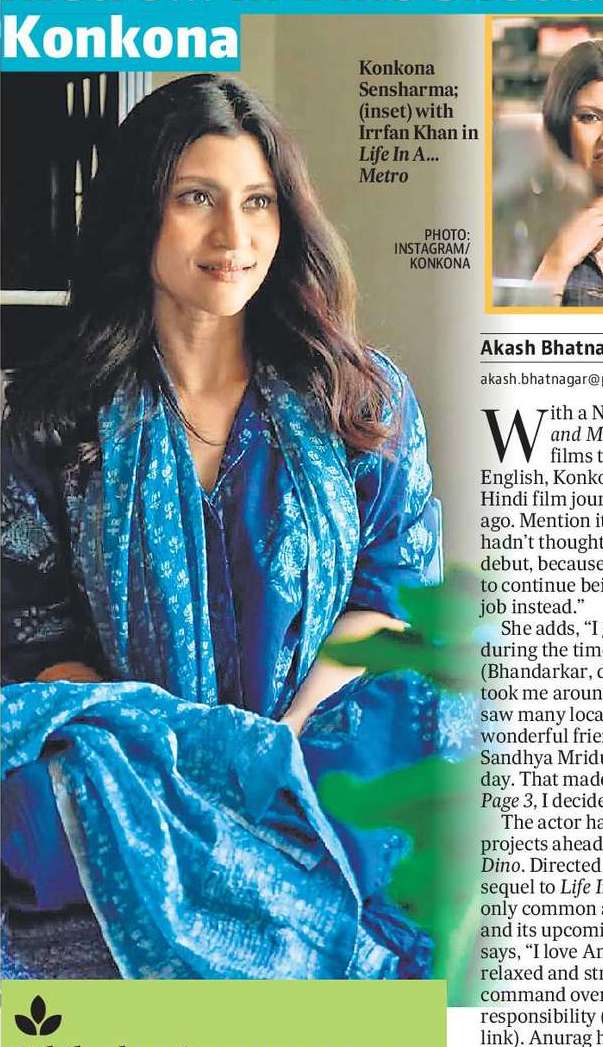
Akash Bhatnagar (HINDUSTAN TIMES; January 26, 2025)
With a National Award win for Mr and Mrs Iyer (2002), and a few films to her name in Bengali and English, Konkona Sen Sharma started her Hindi film journey with Page 3, 20 years ago. Mention it to her and she says, “I hadn’t thought of it as my Bollywood debut, because I was not sure if I wanted to continue being an actor or get a real job instead.”
She adds, “I got to know Mumbai during the time I shot for Page 3. Madhur (Bhandarkar, director) and his assistant took me around the city in local trains. I saw many locations and made some wonderful friends. (Actors) Tara Sharma, Sandhya Mridul and I are friends to this day. That made me stay in acting. After Page 3, I decided to move to Mumbai.”
The actor has some interesting projects ahead, including Metro...In Dino. Directed by Anurag Basu and a sequel to Life In A...Metro, Konkona is the only common actor in the 2007 release and its upcoming sequel. The 45-year-old says, “I love Anurag; he is a lovely person, relaxed and stress-free. He has excellent command over his craft. I don’t feel any responsibility (of being the only common link). Anurag has shoulders broad enough to handle that responsibility.”
Konkona was paired opposite late actor Irrfan Khan in the 2007 film. She reminisces, “This time, I missed Irrfan so much. In the first movie, I was the one who named his character Monty. While shooting some scenes, we kept remembering him. There were some scenes where I got emotional as well.”
I am one of the few artistes who are very particular even about kissing on screen-Shilpa Shetty
8:20 AM

All for experimenting and risk-taking on OTT, Shilpa Shetty Kundra draws the line at onscreen intimacy
Navya Kharbanda (HINDUSTAN TIMES; February 21, 2024)
Having ventured into the OTT space with Rohit Shetty’s Indian Police Force recently, actor Shilpa Shetty Kundra is all praise for the medium. She says, “When you are going theatrical, there’s a lot of pressure on whether the role or that kind of content will be accepted. OTT, on the other hand, allows artistes and filmmakers to take risks.”
While the web space brings with it more scope and liberty to experiment, the 48-year-old still has her reservations while picking scripts. “I want my kids to be able to watch my content. So, I always do family-oriented stuff. I am one of the few artistes who are very particular even about kissing on screen. I have never done it. I am clear about what I can and can’t do.”
A significant advantage of working in web projects is that one gets to operate without the pressure of the box-office. And Kundra experienced that firsthand when her last big-screen outing, Sukhee, found its audience on OTT after a dismal box-office run.
“[While doing web shows,] I feel like I can throw caution to the wind and do interesting stuff without being judged by the box-office collections,” says the actor, who feels one’s personal growth reflects in their professional graph too — which is what is happening with her right now.
“There was a time when I did glamorous films, and then I did serious cinema with Dhadkan (2000), Dus (2005), Life In A... Metro (2007),etc. Just when I was starting to understand the craft, I got married and took a sabbatical. Now, I feel like I am rediscovering myself. That’s why, people saw a new Shilpa in Sukhee,” she ends.
I am doubtful about sequels of much-loved films, says Konkona Sen Sharma on Wake Up Sid 2
3:44 PM

Vinay MR Mishra (BOMBAY TIMES; January 21, 2024)
Sequels have often proved to be a success formula in Bollywood. Recently, when Konkona Sensharma and Ranbir Kapoor came together for a commercial, netizens said that they were keen to see them on the big screen after their much-loved movie Wake Up Sid back in 2009. Reacting to it, Konkona says, “I am so touched. So many people still have so much love for the movie and the character.” The actress, however, isn’t certain about a second instalment of the movie, which many were hoping for.
“I am a little doubtful about sequels of much-loved films. You can never live up to that hype, so it is best left to the imagination. Also, it is a lot of pressure to live up to something people have already loved,” she says.
Konkona says that shooting with Ranbir recently, however briefly, was like “a little nostalgia trip”. She continues, “We shot for just two days, but it was lovely to reunite with Ranbir and others. We were remembering that we were all babies when we shot the movie around 15 years ago. At that time, Ranbir had just done Saawariya. We were all kids starting out, and it was lovely that after a long time, we could all be together. We’ve all come a long way and grown so much… we have our own families now. Ranbir has a child, I do, too.”
Interestingly, while the actress is mostly not excited about the idea of sequels of some films, she will next be seen in Metro...In Dino, a sequel to Anurag Basu’s Life In A… Metro (2007). Explaining why she decided to be a part of the project, she says, “It is like a spiritual sequel because it’s not the same character. But it is so nice to work with dada (Anurag Basu) again. He is a wonderful human being and a great director,” she signs off.
Sukhee got me the most praise in 30 years-Shilpa Shetty
11:05 AM
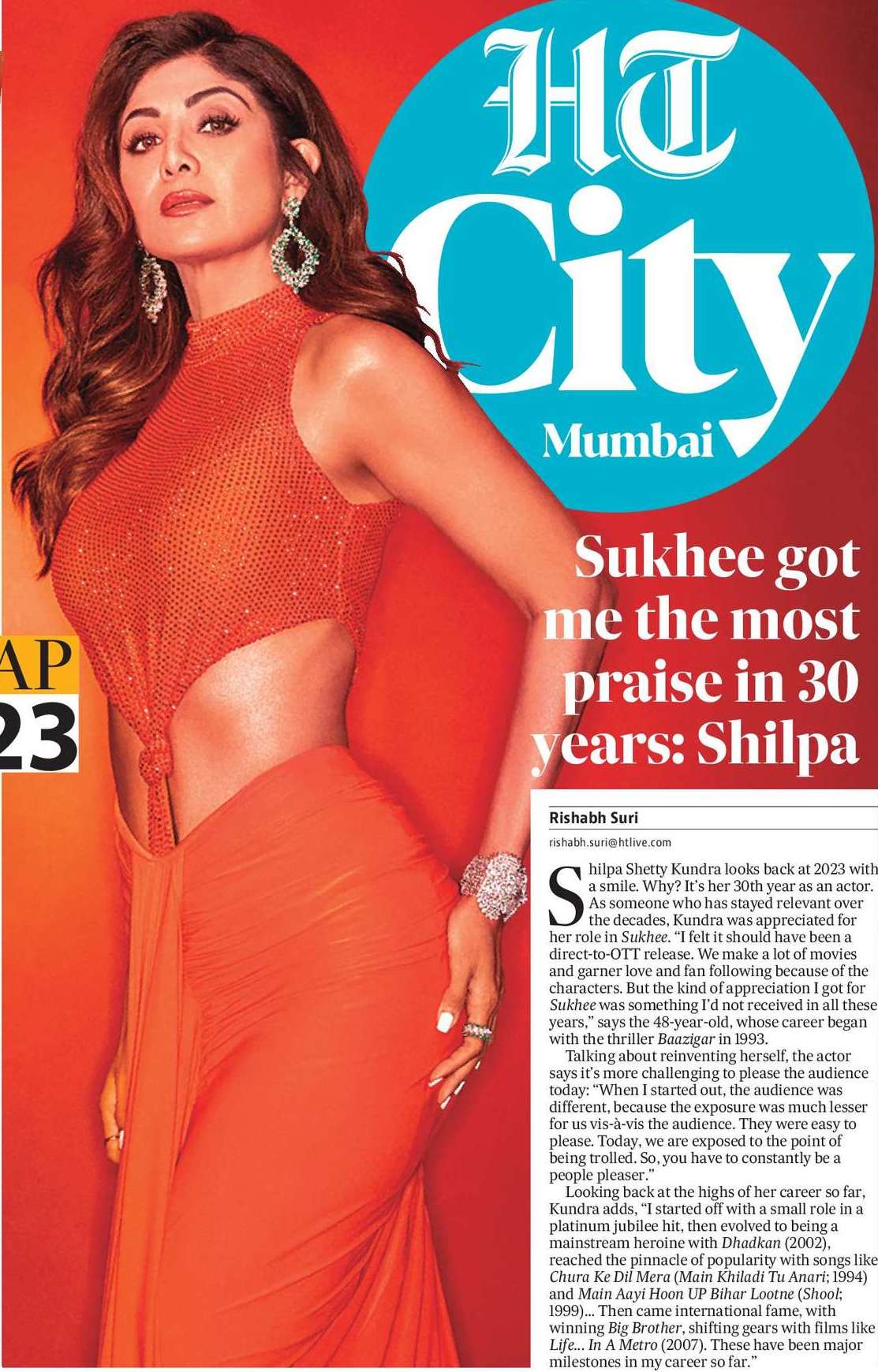
Rishabh Suri (HINDUSTAN TIMES; December 27, 2023)
Shilpa Shetty Kundra looks back at 2023 with a smile. Why? It’s her 30th year as an actor. As someone who has stayed relevant over the decades, Kundra was appreciated for her role in Sukhee. “I felt it should have been a direct-to-OTT release. We make a lot of movies and garner love and fan following because of the characters. But the kind of appreciation I got for Sukhee was something I’d not received in all these years,” says the 48-year-old, whose career began with the thriller Baazigar in 1993.
Talking about reinventing herself, the actor says it’s more challenging to please the audience today: “When I started out, the audience was different, because the exposure was much lesser for us vis-à-vis the audience. They were easy to please. Today, we are exposed to the point of being trolled. So, you have to constantly be a people pleaser.”
Looking back at the highs of her career so far, Kundra adds, “I started off with a small role in a platinum jubilee hit, then evolved to being a mainstream heroine with Dhadkan (2002), reached the pinnacle of popularity with songs like Chura Ke Dil Mera (Main Khiladi Tu Anari; 1994) and Main Aayi Hoon UP Bihar Lootne (Shool; 1999)... Then came international fame, with winning Big Brother, shifting gears with films like Life... In A Metro (2007). These have been major milestones in my career so far.”
Now, you know everything about the other person by looking at their social media profile-Mohit Raina
8:29 AM
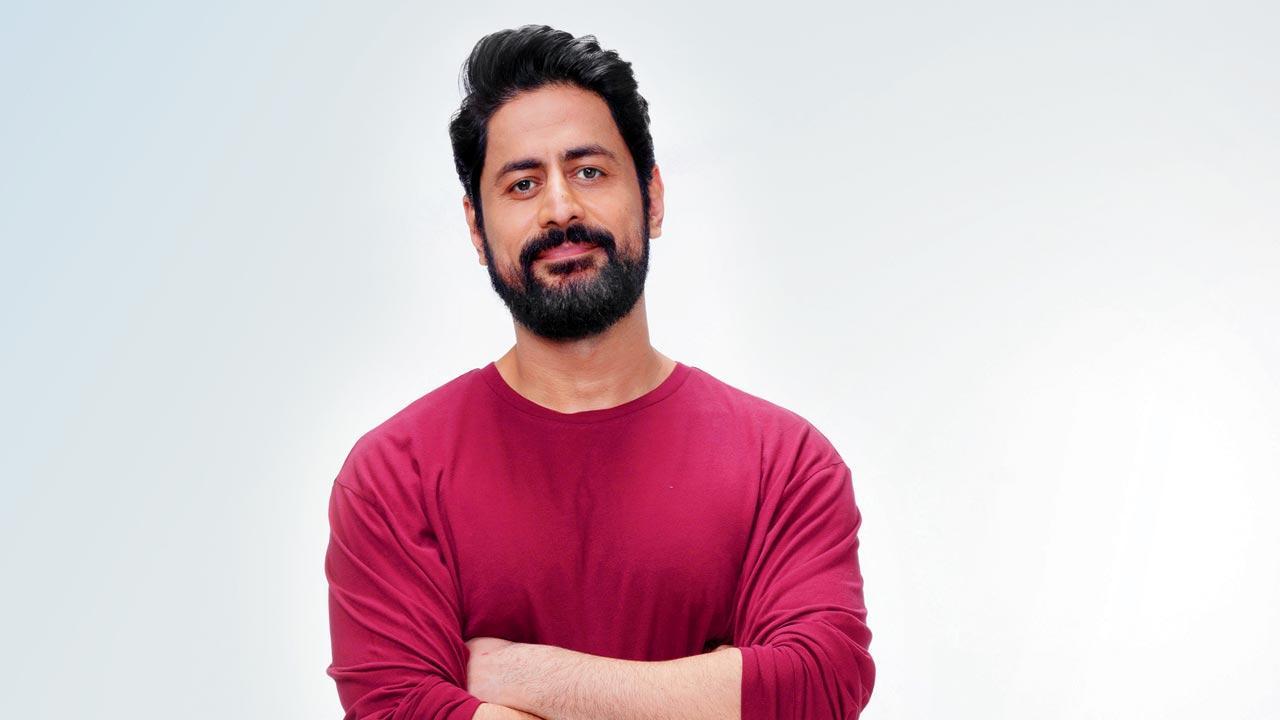
Mohit Raina, who is a fan of slice-of-life romantic stories, on finally adding one to his résumé with Ishq-E-Nadaan
Letty Mariam Abraham (MID-DAY; July 18, 2023)
Don’t go by the roles he does on screen. Off screen, Mohit Raina is a fan of romantic dramas, and counts Life in a Metro (2007) among the finest love stories made in Bollywood. So, when Ishq-E-Nadaan was offered to him, the actor jumped at the opportunity of adding a romantic film to his resume. In conversation with mid-day, Raina talks about how the JioCinema offering’s simple yet heartfelt story appealed to the romantic in him.
Edited excerpts from the interview.
Was it a conscious decision to do a romantic drama?
I wanted to do a romantic show for a long time. When I started working in television, I was never approached for romantic shows. In digital entertainment, I only did one series that had tinges of romance. I was waiting for something like Ishq-E-Nadaan. It’s a beautiful, light-hearted love story that talks about human relationships. Any actor would have grabbed this opportunity.
How did the script come to you?
When Avishek [Ghosh, director] narrated the script to me, in my head, I was on board already. Almost 15 minutes into it, I was thinking about how I would arrange my dates and was doing [mental] calculations because I loved the script.
Over time, has any love story—be it in movies or web series—resonated with you?
For me, Life In A Metro [2007] was one such movie. I liked the concept of [telling stories of] people in one city and how their stories connected despite being from different walks of life. After that, many people tried to emulate it, but it wasn’t accepted. I wanted to do something like that for a long time. Now, Anurag Basu is coming with a sequel to it.
At a time when love is all about right and left swipes, do you think people connect with old-school romance?
I don’t think it is possible today. Now, you know everything about the other person by looking at their social media profile. But back in the day, you’d wait for the person to go out, then see what flavour of ice-cream they are having. Obviously life is all about change. That was old-school charm, but I don’t think today’s generation understands that.
What is the most romantic thing you’ve ever done?
I got married last year. For my wife’s [Aditi Sharma] birthday, I collected all the photographs that showed our journey—how we met and started going out—and made a collage. I put it on the walls with decorations to surprise her. She was under the impression that we might only go out for dinner. So, this took her by surprise.
Tell us your love story?
We met through a common friend. There were no balloons or flowers, nothing lavish. My wife is definitely more romantic than me.
Why haven’t we seen you doing more work?
I prefer doing less but quality work, which makes my soul happy. I want to satisfy the hunger of the actor inside me. If I wanted, I could do a lot more work and earn more money, which is what everyone has been advising me to do, but I don’t see myself doing that. If I take on a role for the sake of it or do something that I don’t want to do, it will show. I won’t be able to do justice to it.
Do you feel you are typecast?
There is scope for more diversity. Sometimes, the scripts coming my way are [similar]. I would like to experiment more, which is not happening.
What’s next on your plate?
I have completed the second season of Mumbai Diaries 26/11. We shot it last year.
Ali Fazal, Fatima Sana Shaikh play a Delhi-based couple in Metro...In Dino; to shoot in February 2023
8:30 AM
Upala KBR (MID-DAY; December 11, 2022)
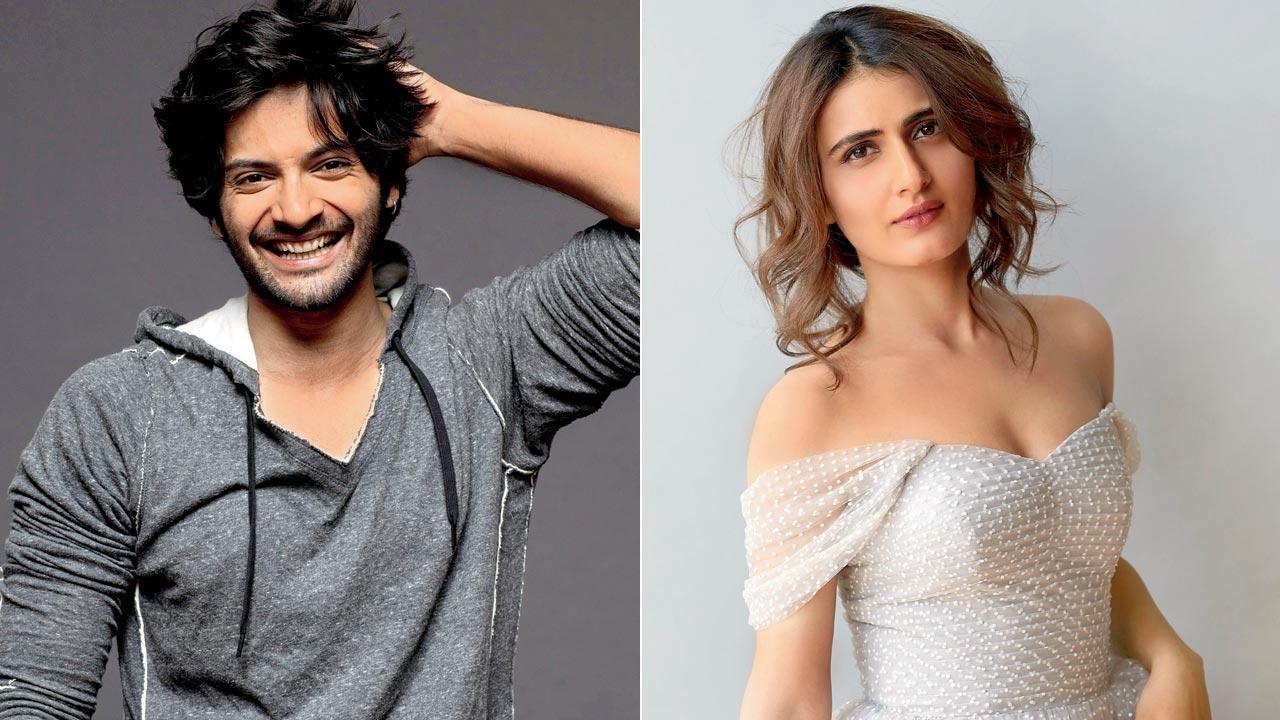
Earlier this week, filmmaker Anurag Basu announced 'Metro...In Dino', an anthology of four stories exploring modern-day love and relationships. The film—starring Aditya Roy Kapur, Sara Ali Khan, Konkona Sen Sharma, Anupam Kher, Neena Gupta, Pankaj Tripathi, Ali Fazal and Fatima Sana Shaikh—is a spiritual sequel to Basu’s much-loved Life In A Metro (2007).
While Kapur and Khan will begin shooting for their portion this month, it is now learnt that Fazal and Shaikh will face the camera for Basu in February 2023.
The two play a modern-day couple based in Delhi, and will film their segment in the capital. “It’s a happy slice-of-life story that Ali loved at the first narration. He has been keen to work with Anurag for a long time. The director roped in Fatima for the story, having collaborated with her on Ludo,” says a source from the creative team.
The filmmaker, on his part, had often expressed his desire to make a sequel to his 2007 drama. “It was during the first lockdown in 2020 that he finally got the idea for another anthology. The story will have four segments, each story going on to be linked with one another in the end. Anurag had done a remarkable job of interweaving four different stories in Ludo. Metro…In Dino will have a similar flavour, but will be treated in a different style.”
Anurag Basu to kick off next in January; says it is not a sequel to Life In A Metro
8:06 AM
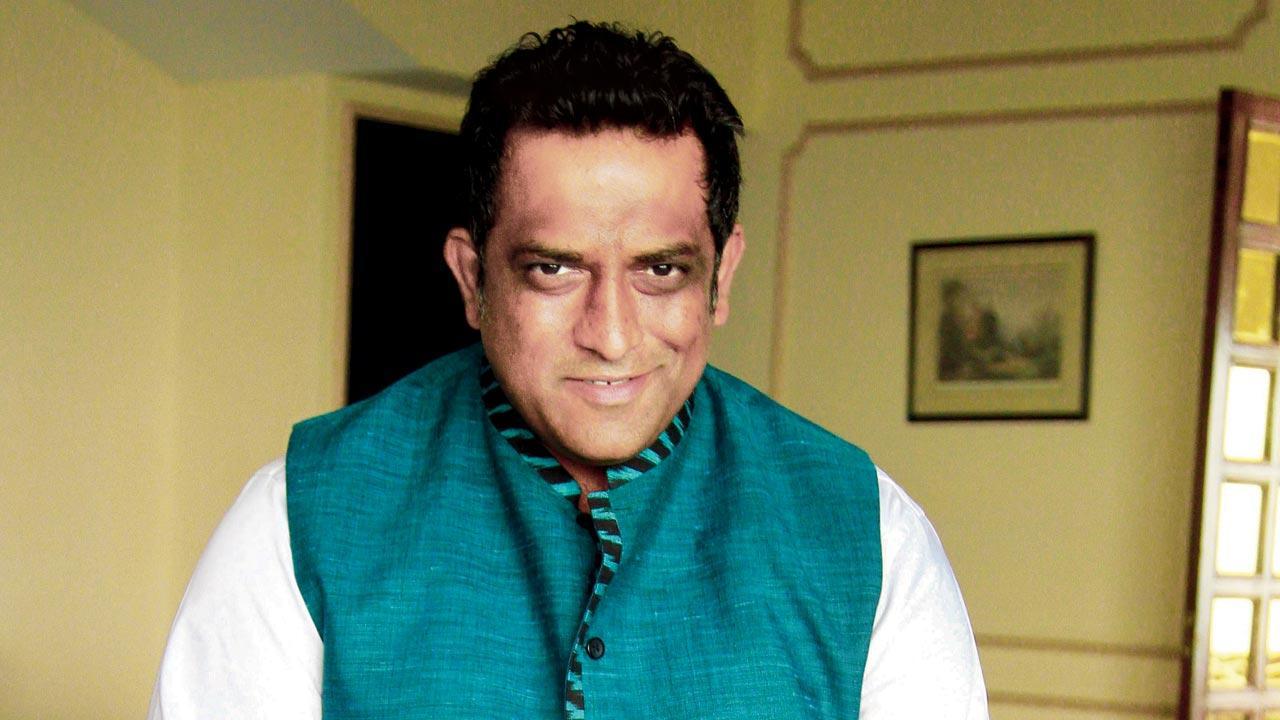
Priyanka Sharma (MID-DAY; December 2, 2022)
Tales of love never get old, and Anurag Basu is set to depict four unique ones in his next venture. His upcoming relationship drama remains untitled as of now, and will feature an ensemble cast.
Basu tells mid-day, “We haven’t decided the full cast of the project yet, and are yet to arrive on a title, but, we plan to start shooting in January.”
With the premise seeming all too familiar to Basu’s 2007 film, Life In A Metro, we ask him if this offering is a sequel to the drama. He responds in the negative.
While Basu refuses to confirm the news, sources suggest that Neena Gupta and Ali Fazal are on board this new venture, which will depict four stories. Meanwhile, Basu has Aashiqui 3 with Kartik Aaryan in the pipeline.
Life In A Metro wasn’t a film that was supposed to happen with me-Jaaved Jaaferi
8:09 AM
Preeti Atulkar (BOMBAY TIMES; July 30, 2021)
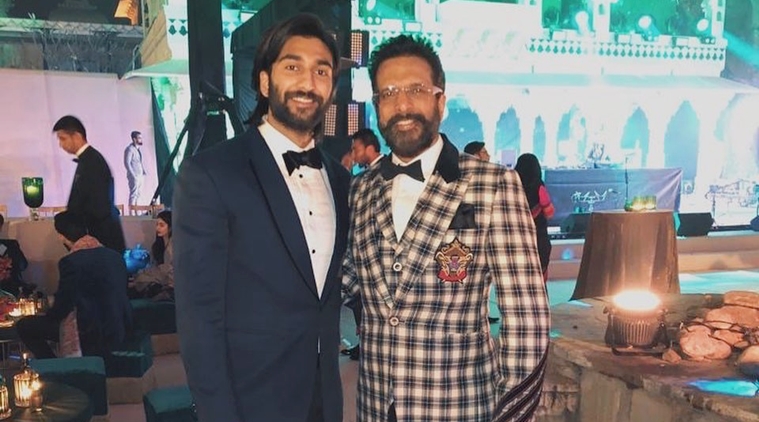
In a career spanning over 35 years, Jaaved Jaaferi has worn several hats with equal élan — model, actor, voice artiste, dancer, choreographer and politician, to name a few. However, he hasn’t ticked off his wish to wear the director’s hat yet. He says, “I have directed a few ad films in the past. I could have forayed into film direction, if I had somebody who would have taught me time management. With direction you get to head a creative process. I would like to do that, hopefully soon.” In a chat with us, Jaaved speaks about the projects he missed out on, his son Meezaan Jafri and more. Excerpts:
‘TREAT YOUR WORK AS WORSHIP’
Now that his son Meezaan has forayed into Bollywood, how does Jaaved guide him? He replies, “One thing that I learnt from my father (the late actor Jagdeep) is that you should treat your work as worship and not take it lightly. I’ve told Meezaan the same. I have explained to him not to keep material objectives because when you do that, you tend to take up any and every project to make it happen.”
Jaaved adds, “I also tell him to not go by the number of social media followers; they don’t make your film work. If that was the case, then every Salman Khan movie would have been a superhit and would’ve crossed Rs. 500 crores. So, I tell him that kaam pe focus karo, aapka kaam bolega.”
However, there is one role that the actor would like to see his son in. “I would like Meezaan to play Anil Kapoor’s role if Meri Jung is ever remade. That’s a strong role and he’s got the personality to pull it off.”
‘LIFE IN A METRO PROBABLY WASN’T SUPPOSED TO HAPPEN WITH ME’
Recalling the opportunities that he missed, the Dhamaal actor reveals, “After Boogie Woogie, I was approached for a talk show by the same channel. Things didn’t work out from my side and I missed the window. The channel eventually made Movers & Shakers. I regret not doing that.”
Another project that Jaaved had the opportunity to be a part of was Anurag Basu’s Life In A Metro, which didn’t materialise. He shares, “Irrfan had some other commitments and couldn’t take it up. So, the makers approached me. Things were almost finalised when Irrfan said he could do the film. I feel it wasn’t a film that was supposed to happen with me.”
But the actor doesn’t have regrets. “I can’t keep regretting or fretting over things that weren’t meant to be. I believe that what you have in hand is what you make the best of,” he says.
----------------
JAAVED ON HIS FATHER, THE LATE ACTOR JAGDEEP...
Fondly remembering his late father, the legendary Jagdeep, who passed away last year, Jaaved says, “He had immense love for the country, its people and culture. His dedication towards his craft was inspirational. He would always say that it is an actor’s job to provide wholesome entertainment to a person who is spending a part of his hard earned money to watch you perform. There were things that I wanted to tell my father and there were things that I wanted to do for him.”
Ranbir Kapoor & I never fought on Jagga Jasoos. We never crossed the film's budget-Anurag Basu
8:10 AM

From life to near-death, television to films, hits to flops to hits again, doing 'adda' with Bollywood's top survivor, director Anurag Basu
Mayank Shekhar (MID-DAY; December 26, 2020)
Offering him a chance to graduate from directing on television, to debuting in films, producer Mukesh Bhatt asked Anurag Basu in the early 2000s how much he would charge. Mukesh, well-known in Bollywood to be frugal with expenses, suggested, "Rs 7 lakh?"
Basu agreed so instantly to the number that, taken aback, and in that split sentence, Bhatt revised that Rs 7 lakh into a two-film deal! "In just two seconds, huh," Basu laughs. "But it was my stepping stone, I was just an outsider, getting to learn a lot; I would have done it for free," he says; no complaints still.
This would've been for his forgotten debut Saaya (2003, starring John Abraham, Tara Sharma). Having delivered a box-office dud, the sets for Basu's second film had also been mounted, when he had stopped showing up at the office of Vishesh Films (run by brothers Mukesh and Mahesh Bhatt). He told the producer, he'd "lost confidence" in the film they were about to shoot/start in a few days.
But there was a half-constructed set, paid for, while Vishesh Films were already reeling under a string of flops. "Ghuma phira ke", Basu narrated an idea around what Mukesh had suggested. Driving back home, he found actor Kashmera Shah sitting at the Barista coffee shop in Lokhandwala. He stopped to ask if she'd dance for a song, which Anu Malik composed in a couple of days.
They utilised that set for a track, Dil ko hazaar baar roka, and carried on with another film altogether. Which was? Murder (2004). It gave Basu tremendous box-office cred. The film went on to collect Rs 75 crore. And Basu received? Rs 3.5 lakh - second tranche of his two-movie deal - making him perhaps the best directorial ROI for a producer, in the history of Hindi films!
Male audiences across North India lined up to catch the skin-fest Murder - evidently inspired by Adrian Lyne's Unfaithful (2002) - mainly to ogle at Mallika Sherawat. It's Emraan Hashmi, the male lead, who became the single-screen sensation: "He became a rage!"
Every producer at the time, top ones included, had a DVD of a sleazy Hollywood film that they wanted Basu to convert into a Hindi movie! Murder itself belonged to a B-movie genre (that subsequently became a franchise).
How Basu elevated it still is with a certain level of soft lighting and warm aesthetics: "Aesthetics are in-built, you cannot change it. It's the way you see things. I used to also shoot television like that," he says.
In fact, you can notice even more of that - surely the film industry did - in Basu's Gangster (2006), a musical drama, loosely based on underworld don Abu Salem and his moll, '90s starlet Monica Bedi's escapades. Who became the star from that movie? Debutant Kangana Ranaut.
"Of the 20-25 girls we auditioned for the part, her face just stuck in my head - there was something unique about her," Basu recalls. Did he foresee her success? "In the beginning, she needed guidance for everything. But she is a really fast learner. I have seen her growth during the filming of Gangster itself."
What about her public persona, as the relentless online troll, if you may? Did he see this coming? "Not really. We usually don't meet, but whenever we do, this [public] persona is not the Kangana I [know] personally. So I think there are two Kanganas. Beech wali [the other one] I don't understand."
Basu, 46, Bengali boy from Bhilai, moved to Bombay to pursue a graduation degree in physics, and look around for work in the entertainment industry alongside. Lives of the young in the steel township he comes from are chiefly centred on cracking medical and engineering exams. He got exposed to story-telling and performance arts, because of the theatre group that his father ran as a hobby. And they'd travel with plays at amateur theatre competitions across India.
In the sense of Bollywood, Basu belongs to a productive class of the early '90s actors/filmmakers, from various parts of India, looking to build a career in showbiz, and who gradually took over Bollywood's reins later.
He started out as a 22-year-old assistant allowed to direct a scene in the popular television show Tara - putting his foot down among veteran actors, so they took him seriously, which was becoming an issue. He exited TV about a decade after, as the highest paid director: "I used to make as much from a month of TV, as I did from my first film."
There are also the common stories of doing producers' rounds, hanging around Prithvi in Juhu, approaching Shyam Benegal, Sriram Raghavan to assist. Also, accidentally, dancing behind Mithun Chakraborty, as the hero's friend, in a film called Dalaal (1993) - because the director was Bengali (Partho Ghosh), and they were looking for a bilingual Bengali assistant to help communicate at an outdoor location!
There is a scene in Vikramaditya Motwane's film AK vs AK (2020), where the self-referenced protagonist, director Anurag Kashyap, is casually referred to as Anurag Basu. This is partly true in the reverse as well, as it turns out, since Basu would get messages meant for Kashyap back when there were pagers for communication (or the lack of it).
In fact, they have a lot more in common, I discover, during this conversation, including Benegal, Raghavan, Prithvi, a play that both were meant to do for Makarand Deshpande. And, inevitably, stories around the adorable old miser Mukesh Bhatt!
Where similarities between Kashyap and Basu end is, of course, in their cinematic worldview. Even a gun-toting thriller with dames and dons, Ludo (2020), in Basu's hands, turns into a joyously musical carnival of atrangi/colourful/shiny characters! His films are more fantastical in their approach, yet experimental in their own right. While it may not seem so, he says, they are actually drawn from reality.
The semi-silent musical Barfi, he reveals, is based on a real-life girl Razia (played by Priyanka Chopra, and who she actually met later), and a boy with hearing impairment called Murtaza (that was Ranbir Kapoor).
Basu knew these two from a special school in Goregaon, which had a branch near his Andheri office. He had locked Barfi's script, the sleeper super-hit of 2012, at the same time as he'd finished writing Super 30, based on Bihari math wiz Anand Kumar, that later got made with Hrithik Roshan, directed by Vikas Bahl.
Likewise, the lead character (played by Ranbir) in the full-blast, theme-park adventure Jagga Jasoos (2017), of a young man who stammers, but not when he sings, is essentially Basu's long-time music collaborator, Pritam!
Katrina Kaif's character in the same movie, he says, is wholly modelled on his clumsy wife Tani: "Calamity Jane, that's her. She could be holding a cup, and be left with just the handle. Lots of stuff that happens [to Katrina] in the film has actually happened before me in real life with Tani."
Calamity is also how Jagga Jasoos got blasted as, by a wide section of the film industry, upon release - given how long it took to make it in the first place (roughly over four years). "Yeah, too long, actually," Basu admits. "We could have finished a year before. There is not a single thing I can pinpoint [for what went wrong]. Ranbir [the lead] was shooting and promoting four films [Besharam, Bombay Velvet, Roy, Ae Dil Hai Mushkil] during this time. I could have put my foot down and requested him not to. But then, Pritam also wanted time to make music. I didn't know where to balance. Even after all this time, we were rushing with post-production, five months before release!"
Then there was the story from Jagga Jasoos sets about veteran actor Govinda being hired, he'd even shot, and then was fired: "Govinda ji did come with us. With such delays already with the shoot, [there was confusion] if Govinda ji is coming on the set, or is he cancelling the flight, or is he taking the fight, or are we cancelling shoot? It was so unpredictable. I couldn't have taken that stress, yaar. We were shooting outdoor in South Africa, everything was lined up. I just had to [let go of him]."
Not that Basu isn't used to this level of stress - more so, a barrage of take-downs, post the release of a film. The biggest case study in his career might well be Kites (2010), a hugely ambitious trans-Atlantic release, headlined by Hrithik Roshan, with the Mexican tele-novella star Barbara Mori in the female lead.
Kites opened to theatres in India with desis wondering what language the film they had walked into was in - English, Spanish; or Hindi? The budgets clearly didn't match the public response to this immensely stylised romantic thriller.
Basu himself felt as lost during the making of Kites, he remembers, as the audiences did after its release: "Take a film like Gangster. I wanted to shoot in Korea. I asked my producer [Mukesh Bhatt] if I could. He'd be like, 'Here's Rs 3 crore - finish the film within it. Now I don't care if you go to Honolulu, or anywhere else.' So, I knew my budget; production was in my hands. That's what I was used to. With Kites, it wasn't like that. I was just going there and directing. And we would discuss how we are going to execute [the scenes]. I was not thinking of market, returns… It started out as a small, indie [film]. It was taking its shape, with four or five people making decisions. Also my vision and [producer] Rakesh ji's [Roshan] were separate. Eventually, yeh naa idhar ka raha, naa udhar ka [it belonged to neither an international nor a local audience]."
Which isn't to tone down Basu's own reputation, mostly suggested warmly by his colleagues, of him revelling in the chaos of filmmaking - deriving magic from the spontaneity of a moment, rather than over-planning. While this may cause major heartburn, if the money involved is massive, it has surprisingly served him well in the mainstream.
Actors who've worked with him often speak about showing up on the set, with little idea of what they're meant to do. The scene develops as they go along. This can be a scary process, yes. It hasn't stopped him from attracting some of the top Bollywood stars around. Case in point is Ludo (2020), with more bona fide movie-industry leads (Rajkummar Rao, Abhishek Bachchan, Aditya Roy Kapur, Pankaj Tripathi, et al) than you can fit into two-and-half hours, without each seeming like cameos.
"I was not like this when doing television. This process of mine started somewhere during the making of Gangster. Kangana was new. Shiney [Ahuja] used to come over-prepared. There used to be a struggle to get the performance right. Too many retakes. Also, when I started wearing the hat of writer, director and producer [with Life In A Metro], I didn't have to deliver a script to anyone." The key reason for playing it by ear, he believes, is that "actors don't usually get the full arc of a film." It's better if they live in the moment.
"Also, I don't commit to a scene till the last moment. In [Life In A] Metro, for example, there is a scene where Kay Kay [Menon] and Shilpa [Shetty] confess about cheating on each other. She talks about Shiney [Ahuja]. I was staging the scene, with Shilpa and an assistant, who's also an actor. And there's a dialogue that just slipped off the tongue; Kay Kay asks, 'Bachcha toh mera hai na?' [I'm the kid's dad, right?] That wasn't there in the script. It appeared in the heat of the moment on the set. I thrive on that actually."
Which is also similar to how Basu winged it with Life In A Metro (2007) in the first place. He had only written the script until interval point, when he met (then) UTV's head honcho Ronnie Screwvala for a narration. To adequately fill time, and keep Screwvala and others sufficiently entertained, he got composer-friend Pritam to tag along, and play music all through the narration. The script got sold, while he was halfway into fleshing it out!
Everybody calls Basu, Dada (for elder brother), in Bollywood. As Bengali adults are affectionately named - regardless of their age. Director Basu Chatterjee was Basu Da even to millennials; he died at 93. A well-known Bengali trait with Basu is actually his penchant for the adda (fun chat), as I can sense, while he generally eases into talking about his life, with a gentleness/lightness of touch that often eludes the successful/self-aware.
As a person/artiste, he finds himself connecting the most with the other great Bengali, Kishore Da - Kishore Kumar: "Every time I read about him, I realise, arre, he thinks like me - his madness, his world, it is fascinating." Basu has been sitting on the draft of a Kishore Kumar biopic for years, determined to make it. It hasn't worked out, yet. "It will be made by me, promise, very soon," he says.
Like Kishore Da, Basu is also a polymath of sorts. You can gauge that from his last movie, the mad, mad Ludo, that dropped on Netflix in November. He was the film's cinematographer, writer, director, producer, along with playing the role of the traditional sutradhar (narrator) on screen. This was one of the early movies to finish shoot while the pandemic was still on. Surely they would've taken adequate precautions shooting the final scenes. Although having sanitiser on set and shooting with a mask on isn't novel for Basu.
Shortly after the success of Murder, he was diagnosed with late-stage cancer. Doctors gave him a few weeks, max: "It just happened too quickly. One day I just saw my reflection, and I didn't know this is what I was looking like - the internal bleeding was happening, buckets of blood going out. I just wanted to breathe right, until I went on the ventilator for 17 days. It took a toll on my dad, actually. His health deteriorated after that. It was tough on my family."
There is a scene in Life In A Metro, where Nafisa Ali's character dies in an ambulance, in a traffic jam: "I thought this was going to happen to me, when I was being shifted from Lilavati [Hospital] to Tata [Memorial Centre]."
This was also the time Basu was in the midst of a film called Tumsa Nahin Dekha (2004, starring Hashmi, Dia Mirza). But the film, as he says, was all in his head. And he was struggling for life. Each day, he would relay instructions recorded into a dictaphone from his hospital bed, to keep the shoot going.
The treatment, of course, carried on for a couple of years: "I had become really thin; had my mask on. There were hospital bills to recover, with treatment in the ICU that had gone on for really long. There was a survival issue, with regard to money. I went to my old television colleagues at Zee and Sony, and they gave me shows to do. I had no film. So, it was back to square one. I did television for over a year."
He got on a film-set finally with Gangster: "I also had Life In A Metro to make. But decided that I may as well be with Vishesh Films at the point. [Producer] Mukesh ji used to carry a sanitiser in his bag, yell at me if I wasn't being careful. They were not greedy; they were careful about my health. They asked me to wait, and I didn't want to."
A close brush with death, one presumes, changes man forever. I ask Basu if he sees it that way - a before and after, as it were: "My rights and wrongs are the same. But I have become less cynical about things, I'm more positive."
On an observable plane, he concludes, "That is [also] when I decided to turn producer. [Life In A] Metro happened because of that. I thought, when I make movies, I should also make money. It is important to keep money for your family."

I have four subjects ready, but I am not sure which one to go with-Anurag Basu
8:39 AM

Anurag Basu on future project, Jagga Jasoos, Metro sequel and next film, which was hit by the pandemic
Roshmila Bhattacharya (MUMBAI MIRROR; June 12, 2020)
 While many have been feeling angry, restless and caged-in during the Coronavirus lockdown, Anurag Basu’s friends have been messaging him, saying, “You must be happy because you’re always in a state of perpetual lockdown.” The director admits with a laugh that periodically, he does go underground for five-six weeks, when he cooks for the kids and goes into his corner. “When the lockdown started, I imagined it wouldn’t last longer than two-three weeks and compiled a long to-do list, comprising writing and other stuff. I haven’t even got started on it,” he sighs.
Well, for many, who were hurtling along at a crazy pace with little time for family, the last few months have been an eye-opener and life-changing. What about him? “Hamare liye yeh naya nahin hai; my life changed back in 2004 (when he was diagnosed with acute promyelocytic leukemia, a type of blood cancer, and the doctors gave him around two months to live). Since my wife Tani was seven months pregnant at the time with our elder daughter, Ishana, I set myself small targets, starting with three months, so I could see my child. Then, a couple of weeks more… a month, two months, six months, a year... Taking baby steps. I went back to the set while my chemotherapy was still on, wearing a mask,” he flashbacks.
He cheated the Big C and, in the process, his priorities and lifestyle changed. “Now, Ishana and Ahana (younger daughter) are imbibing it without me telling them to. Those who knew me earlier will tell you this one is very different, new and improved Anurag,” he chuckles, adding that it started with small changes and the process continues. “Poora insaan toh nahin badal sakta, but my concept of right and wrong changed.”
While on the topic, one wonders if Ranbir Kapoor confided in him when he learnt that his father, Rishi, had cancer. “He did. I was among the first few to know,” admits the filmmaker. “We discussed what line of treatment he should take. I shared the number of my doctor with him and they spoke to him and told me what they had decided.”
There were no conversations during the treatment, but after the senior Kapoor returned from New York, just before Ranbir’s birthday on September 28, they had dinner together. “Neetu ji spoke about the treatment, Chintu ji, like always, was in his element, trying to dig into cake. Since he was not allowed to have sweets, Neetu ji tried to keep him away and this led to a fight between them. It was very cute,” he laughs. They met last on Ranbir’s birthday.
On April 30, we lost Rishi Kapoor. The day before, his good friend, Irrfan Khan, who was also battling cancer, breathed his last. Anurag was distraught. He admitted that, on Irrfan’s urging, he had scripted a sequel to his 2007 musical drama, Life In A… Metro. Irrfan, who was hilarious as the socially inept bachelor boy Monty in Part 1, was the first actor to be signed on. “I know I’ll make Metro again, I just wish I could have made it with Irrfan, too,” Anurag sighs.
For now, there’s Ludo, which is completely ready and was to open on April 24. The on-going Coronavirus pandemic has delayed the release. “I completed it in a year,” he exults. That’s quick, given Jagga Jasoos took so long. “Jagga went completely out of control. But I had made Gangster in six months. Ranbir was very busy at the time, with Ae Dil Hai Mushkil, Bombay Velvet and Tamasha, and I was just sitting at home. It was frustrating at that time, but I am not blaming anyone. Film hi aisi thi. I had entered a zone that took a lot of time,” he reasons, pointing out that it is easier to make films when you repeat yourself, but when you ask yourself what new to do, the answer takes a long time to present itself, particularly later in your career. What’s heartening is that, over time, more so during the lockdown, there have been lots of tweets, messages and positive reviews from those who caught up with it, finally. “It was not a flawless film. On the contrary, it had lots of flaws. But we are all proud of Jagga Jasoos.”
So, what next? Anurag shares that he has four subjects ready, but he’s not sure which one to go with. “That was one of the the things on my to-do list. I haven’t decided yet,” he admits. Is one of them the Kishore Kumar biopic? Anurag confirms the same, saying he has worked on the subject too long and too hard, to let it go and move on. “Too much energy and passion has been invested in it, which is why it keeps popping up,” he acknowledges, pointing out that the problem isn’t only about rights. “The family is keen to make the film, but there are lots of issues. I need support from someone to push it through. But whenever I make it, it will be with Ranbir.”
Meanwhile, is he happy with Ludo? “People who have watched it liked it. I remember Barfi! for all the fun we had while making it. Jab shooting mein mazaa aata hai, toh film theek hi ban jaati hai. We had a blast during Ludo, too, there was the same synergy and energy in the team,” he signs off on an ebullient note.

I told Dharam ji that it was Nafisa ji’s suggestion to kiss and vice versa. They both agreed and I got away-Anurag Basu
8:37 AM

Roshmila Bhattacharya (MUMBAI MIRROR; May 9, 2020)
 “Do you know Irrfan’s (Khan) character in Life In A…Metro was originally a Bengali by the name of Debu? In the film’s first photo shoot, he was wearing a dhoti and a topor. But while we were shooting his first scene, I could visualise Irrfan in the climax, entering the station on a horse. Since Bengali grooms don’t come to their wedding on a ghoda, I told him we’d have to take the shot again and this time he should introduce himself to Konkana’s (Sen Sharma) Shruti as Monty. Irrfan being Irrfan, just laughed and went along,” narrates the film’s writer-director Anurag Basu, whose musical drama, revolving around the lives of nine Mumbaikars, opened 13 years ago, on May 11.
 That wasn’t the only impromptu decision Anurag took. While driving from his home in Goregaon to Koperkhairane station in Navi Mumbai where the last scenes were shot, he was mulling over Shilpa Shetty and Shiney Ahuja’s track. In the original script, she was to leave the city with him. But plagued by second thoughts, he texted all his female colleagues, and even his wife Tani, asking for their opinion. “They all insisted that she should give her marriage with Kay Kay Menon a second chance for the sake of their daughter. When men write female characters, they tend to make them more feminist than they really are,” Anurag offers by way of explanation. The last-minute change, he admits, left Shilpa bemused, and she still hasn’t forgotten this twist in the tale.
 In the film, Shilpa and Kay Kay’s marriage had turned into a union of two indifferent strangers, with the latter involved in a clandestine affair with his sister-in-law’s roommate and his office colleague, Neha, played by Kangana Ranaut, whom Anurag describes as “ghar ki ladki”. He informs that his Gangster leads, Kangana and Shiney, were the first to come on board. Irrfan was a little miffed that despite their long TV association, Anurag had not cast him in Gangster. “I made up with a role in Metro which showcased his lighter side, which I was acquainted with from our TV shows. As Monty, Irrfan was a riot,” asserts the director, admitting that the idea of a Metro sequel came from the actor who passed away last week. “I had approached him to play Ranbir’s (Kapoor) accident-prone, adoptive father in Jagga Jasoos. He was busy with other films then, and since Jagga Jasoos’s dates were all over the place, we couldn’t collaborate on that project. But he told me, ‘Chal, Metro sequel banate hain.’”
 When Irrfan repeated this to him, during the Qareeb Qareeb Singlle promotions, Anurag sat down to take the story further. “Metro 2 mujhe Irrfan ke saath hi karni thi,” he sighs, heartbroken over the loss. Will it happen now, you wonder, and he says, “I don’t know… I really don’t know.”
He repeats the “I don’t know” phrase when you wonder how this anthology of stories connected through characters whose lives were entwined, came together. After a reflective pause, he points out that Murder and Gangster, which came in quick succession, were in the same space, with the Bhatt stamp, so, he wanted to try something very different. “Films like Metro were common in the West, but we had not experimented with the narrative here,” he points out.
 He used a unique narrative device, with a rock band popping up at crucial plot points to take the story forward through songs which otherwise did not fit into the screenplay. The Metro band was headed by the film’s composer and Anurag’s dear friend, Pritam, and included Suhail Kaul, Soham Chakraborty and Bangladeshi singer James. Was it easy getting them to face a movie camera? “Pritam wanted to lose some weight. I told him to grow a beard instead, to look like a rock star. He used to be clean shaven before Metro, but hasn’t lost his beard since. I wouldn’t even let him shave off his beard or cut his hair to get married because we were still shooting the film,” laughs Anurag.
He goes on to confide that Shiney’s character, Akash, a struggling theatre artiste, whom Shilpa’s Shikha is drawn to, grew out of his own experiences on stage. “The play he performs was one of mine, I called it Collage when we brought it to Mumbai. Akash was very close to me,” Anurag acknowledges emotionally.
His biggest fanboy moment was directing his idol Dharmendra. “I remember when we were shooting at Sion station, it was as if all of Dharavi had descended there that day. I was amazed by Dharam ji’s fan following,” he says, the awe still evident in his voice. And how did he persuade the senior actor to kiss Nafisa Ali? “I told Dharam ji that it was Nafisa ji’s suggestion and vice versa. They both agreed and I got away,” he signs off with a laugh.
Irrfan Khan is a poem. A poem he himself read out loud-Raja Sen
8:14 AM

Film critic Raja Sen pays tribute to the actor who strove for the precise pitch and could make every gesture appear special
Raja Sen (MUMBAI MIRROR; May 3, 2020)
Cocaine. It was the first thing I spoke to Irrfan Khan about. It was 2006, on the sets of Life In A Metro. 20-something and childishly eager, I asked whether he’d done cocaine in order to play an addicted stockbroker in his last, Yun Hota Toh Kya Hota? “Yeah,” he nodded, “I had to.” The recorder was on. Irrfan saw my face and laughed. “See, as an actor you have to understand what it does. To your behaviour, movements. It was new to me toh… examine karna pada.” He didn’t enjoy it (“kaafi hectic hai”) and I wondered why he’d do that for a middling film. “Because it is new! Ek nayi cheez… Why else do we act, yaar? Plus, the film is by Naseeruddin Shah. Who knows what he will notice? What he will expect?” I remember the way he tapped his nose. “Isiliye… homework.”
The way he tapped his nose. Those words make you picture him, visualise how he must have done it, that ephemeral Irrfan-ness rendering the moment impossible to forget or mimic. Where do we begin to talk about an actor who made every gesture special? Perhaps one hails the movements themselves: the way Irrfan sculpted the silent beats, the way he reacted to actors around him when they spoke, the way he let his eyes do the heaviest lifting. Good actors deliver loaded dialogue in ways that make the words sing — Irrfan made us read between the lines.
In The Lunchbox, he unwraps food from a brown paper bag and picks up a novel as he eats. The care with which he smoothens the dog-eared page and straightens his spectacles before he starts shows how ritualistically the widower has done this for years. In Slumdog Millionaire, he supervises the electrocution of the young hero, but finds an instant to look away, discreetly and distastefully. In The Darjeeling Limited, as a villager whose young son’s body is brought to him, his first alarmed act is to lift the entire body, hoisting the boy’s chest to his ear like an errant pocketwatch, to see if he still beats. In Paan Singh Tomar, he collapses after breasting the tape in an early race, taking a telltale pause before he falls, as if looking to see if it’s okay to let go, okay for the runner to finally fall.
Irrfan is a poem. A poem he himself read out loud.
He strived for the precise pitch, the sur, the mot juste. There was always authenticity to be plumbed and sought, and he hungered both to learn and unlearn. He cultivated screen presence to deliver blockbuster punchlines, then discarded it to play an unassuming Bengali man. His was not a linear life, looping from early art cinema to popular television, from independent English films to Hindi masala to global art house success, and then, finally and delightfully, to a confluence of both, commercial and radical cinema hand in hand. The actor of his generation? That feels too prosaic for a man whose performances crept up on us, touching us in ways films or viewers could scarcely predict.
That Irrfan face. Those electric eyes, that slack jaw, the mouth ever ajar, especially in the earlier films, as if unsaid sentences live on the tip of his tongue. His words, deep and lyrical lines delivered with a languor that suggested his mind lay in a hammock. In the real world, he had the swagger of a cowboy, shoulders preceding footsteps, but on screen it was about those he played — the complicated, tentative, un-spotless men — and he gave up his gait for theirs.
In 2016, sitting at his new apartment and discussing the TV series Fargo, I asked him about winning an Oscar — a hypothesis that given his trajectory I considered an eventuality. “That is an award that can change everything,” he had said, briefly chewing on the idea. “It can open up every choice for an actor.” Ah, Irrfan… so many marks left unmade.
Talking to him was always a rush. The self-awareness, the philosophical digressions, the boundless curiosity — how he deconstructed a character, how keenly he engaged with criticism. Fingers perpetually busied with rolling paper, he spoke unhurriedly, with many an ellipsis, plucking the right phrase out of thin air. The mot juste. Even without cameras, there was economy and precision.
Think of Piku. Where he, as the owner of a transport firm, is stung as he sits in the driver’s seat with hired help in the front, while the clients sit behind. He looks pointedly at Deepika Padukone in the rearview mirror. It is a slippery moment; what, after all, is wrong with the boy sitting up front? Irrfan doesn’t glare, instead compels her by holding her gaze. Fury would make his character appear classist, but this quiet, unyielding indignation makes it evident Irrfan is feeling disrespected. He doesn’t start the car till he gets his way. Here, his way is to persuade the audience and win the benefit of their doubt.
That is a masterclass — and that doesn’t just mean something for actors to learn from. Great performers offer up mirrors to lives like ours so we can steal from their characters, from perspectives to mannerisms, from reactions to epiphanies. Irrfan Khan, conqueror of the unknown, gave us all so much to observe, so much to understand. His performances, his fluidity, his tenderness, his existential silences. Thank you for the movies, Irrfan. Thank you for waging a war against the obvious. We’ll watch you forever. We’ll learn, forever. Thank you for the… homework.
Irrfan Khan’s colleagues share memories of the man and the actor - Part 1
8:33 AM

Anurag Basu:
 Irrfan and I go back to our TV days when we did a lot of work together. I’ve seen his journey from TV to films, and the long battle he fought in the last two years. There were so many ups and downs, but in the last few months, we were hopeful he would come out of this. Which is why today it’s so sad and shocking that he’s not there amongst us. The first thought that comes to my mind is that we would not be a part of his last journey. He deserved it. But Irrfan would have preferred to leave with his family. The kind of person he was, he wouldn’t like a crowd and the media around. He loved his own space.
He had the clarity to say “yes” or “no” to a project. I know he got a lot of offers from Hollywood which he turned down. Jigar chahiye, to refuse international offers. He created his space and he owned it. It will always belong to him.
He loved flying kites. During Life In A… Metro, we flew kites on a few occasions and would get so engrossed in ensuing fights that shoot would be on hold for a while. Konkona (Sensharma) was waiting to shoot, which we managed to complete before losing sunlight.
Irrfan’s first house was a one-bedroom apartment with a balcony in Malad’s Evershine Nagar. My house has a similar view, so, it will always remain etched in my memory. Then he bought his bungalow in Madh as he wanted to be out in the open, free of the city. He was a gypsy at heart. He lived 100 years in 53 years. The last time he came to my office was about a month before the diagnosis. My office has a terrace and he wanted a space like that for his office, too. We were talking about sequel to Metro. I waited for him and started work on Ludo meanwhile. The Metro sequel was to be my next film and from the previous film, Irrfan was the only actor to be finalised for it.
— As told to Hiren Kotwani
---------------------------

Homi Adajania:
 What can I say, right? We all knew it was coming but it hurts really badly for some reason. But I guess time will sort that out. It always does.
If we could go back in time and change anything, he told me that he wouldn’t.
He said he wouldn’t change anything that has given him the realisation of what life actually means. A realization, he said, he wouldn’t have got a glimpse of in 40 lifetimes. He said that he had realised how we are shackled by the labels people put on us, labels we think define us. How he had earlier believed that he was ‘Irrfan Khan - The Star’, “the famous crossover actor known around the world”. And now he had come to intimately know “a human being who had the name Irrfan.”
I don’t know how this s**t works but I know he’s in a happier place and it’s happier because he is there. I hope they have enough popcorn in that place because one of our finest actors has arrived there to entertain them the way he always mesmerised us. It was a privilege that I could call him my friend.
— As told to Roshmila Bhattacharya
---------------------------
Dinesh Vijan:
 After my dad’s demise, I thought I’d be able to accept death when it came knocking again, but when I heard about Irrfan at around 11 am, I went numb. It’s still hard to believe that he is gone.
All of us are fighting personal battles, but few have his resilience and strength. To come back and shoot a movie (Angrezi Medium), the last bit on morphine shots, needs exceptional spirit and a passion for the craft. And through it all, Irrfan was peaceful, almost Zen-like. He believed that the mind is our biggest enemy, controlling the body, making us collect things that we eventually leave behind. He had moved beyond the rat race, which is why, looking at him and speaking to him, you learnt not to magnify your problems or blame the world for who we were becoming.
More than an actor, we have lost a beautiful human being. A man who called himself just Irrfan and has left an impact on everyone he ever knew. I have to make a special mention here of his wife, Sutapa Sikdar, who stood shoulder to shoulder with him.
— As told to Roshmila Bhattacharya
---------------------------

Ali Abbas Zafar:
 I worked with him on Gunday and remember him as a lively guy with great stories and a love for food. I was fairly young and he’d tell Ranveer (Singh), Arjun (Kapoor) and me, “On camera, more is less. One doesn’t need to over-express to be a great actor, you just need to feel the emotion and deliver.” His words have stayed with me.
On the set, we would joke about his big, expressive eyes. Once, I said, “Sir, aapki aakhen itni badi hain, camera mein aane ke liye wide lens use karna padega.” He laughed and retorted, “Chashma pehen loon kya?”
—As told to Himesh Mankad
---------------------------

Nikkhil Advani:
 Every Irrfan scene is a memory, every scene special. Before we started the shoot, he kept asking, “Tum ne Kal Ho Naa Ho banayi hai, D-Day jaisi picture kaise bana paoge?” I got Sudhir Mishra and Anurag Kashyap to talk to him as he wasn’t sure if I’d be able to keep things as raw as they were on paper. Another question was, “You won’t put songs in this film, na?” He was phenomenal. There is a sequence, when in his last moments, he calls up his son. He delivered his interpretation of the scene and Rishi Kapoor (co-star) who was sitting right there, hugged him, saying, “I can’t believe what you have done!” One day, he pointed out to me that I okayed everyone’s take except his. I told him I didn’t think I deserve to weigh his performance.
—As told to Himesh Mankad
---------------------------

Nimrat Kaur:
 I got to spend time with him during the premiere of The Lunchbox at the Cannes Film Festival. We had barely met during the shoot. I remember him as one of the finest and the most grounded people I have ever met in the industry. His observations on people and life were incredible thanks to his razor-sharp wit and unmatched humour. He said the funniest things with the straightest face. At the end of the day of our premiere, there was an avalanche of praise and applause coming our way. I was overwhelmed. When we were hanging out after it had settled, I told him that I didn’t know how to handle it as The Lunchbox was my first film. He laughed and said, “Nimrat, just soak up all the good times and everything that is worth celebrating because those times are few and far between. We get them as a break from the struggles, trials and tribulations that life puts us through.” I have held that close to my heart.
—As told to Akash Bhatnagar
---------------------------

Sudhir Mishra:
 Irrfan was an amazing, complicated, not often easy yet a generous and spiritual person, always in search of beauty and the meaning of life.
We were neighbours and soon became friends, going on to work together in Yeh Saali Zindagi. I remember a scene from the film, where he sees a woman he was in love with… and walks away, dropping his phone. Suddenly, his caller tune goes off, infusing the moment with self-deprecating humour which hadn’t been scripted.
I was the creative director on one of his last projects, a political satire called Gorment, being made by the AIB guys. He was completely in character and almost rewrote a scene. He was not one for rehearsals and would just keep reading to understand the director’s vision.
I met him last just before he started shooting for Angrezi Medium. There was so much more work he could have done.
— As told to Roshmila Bhattacharya
---------------------------

Kabir Khan:
 New York (the director’s 2009 thriller) was an interesting experience as we were stationed in the US for 100 days. Irrfan enjoyed chatting with people. A couple of days into the shoot, he told me, “Yaar Kabir, tumne mahaul bahot achcha bana rakha hai.” The remark showed how nice a person he was. There was a lot to learn from him; he brought shades to a character that even I couldn’t visualise as a director. I did just one film with him but he was on the top of my mind for a lot of characters in subsequent films. This was also one of Nawaz’s (Nawazuddin Siddiqui) first mainstream films. Irrfan was not on the set when we shot with him, but when he arrived in the afternoon, he asked to see the scene as everyone on the set was talking about it. Tears flowed down his cheeks as he watched it. That’s the level of empathy he had for people and characters. I bumped into him in London a year-and-a-half ago. He was eating breakfast and looked good.
— As told to Himesh Mankad
I want people to know that I am doing better-Nafisa Ali
7:35 AM

Eight months after her diagnosis, Nafisa Ali has beaten the big C and is looking forward to facing the camera again
Roshmila Bhattacharya (MUMBAI MIRROR; July 4, 2019)
Naifisa Ali Sodhi’s Instagram post on Monday, seeking an “elegant role to portray in Indian cinema… a perfect script for a senior actress” has touched many hearts. She is quick to say that there is no “need to earn money” but if there is a small role which is exciting and motivating, she’d be happy to do it. “I want people to know that I’m doing better and not going downhill,” says the 62-year-old actress, alluding to her cancer diagnosis which came through in September last year. Her latest PET scan has declared her “cancer free” and she describes it as a “miracle”. “I still have to go for check-ups every three months and it will be five years before it can be said that the cancer is in remission, but it was still a good reason to reach for the champagne,” she exults.
In her first CA 125-test, which measures the cancer antigen 125 in the blood, the reading was an alarming 6,500 as against the normal under-30. “Today, it is down to eight after three rounds of chemotherapy that was carried out in two cycles and a big surgery,” Nafisa says, insisting that every woman undergo this test which can detect any kind of cancer.
She had been suffering constant and intense abdominal pain for months despite an all-clear CT Scan and Ultra Sound. Her tears prompted her radiologist friend, Dr R K Mathur, to persevere and some fatty tissues were detected in her colon and abdomen which were pushing her organs together. It wasn’t appendicitis as she’d imagined, laparoscopy, biopsy and other tests revealed cancer cells and acetes in the liquid bloating her stomach were responsible for those frequent, embarrassing burps. Flashbacking to the moment when she was told it was cancer, Nafisa says, “I told myself, chalo at least now I know I’m not a hypochondriac.”
A diagnosis by surgical oncologist Dr Harit Chaturvedi and British specialist Dr Peter Harper revealed it was Stage 3 of primary peritoneal cancer which had spread. Fortunately, her kidneys, pancreas and liver are safe, but all the other organs have been removed, leaving a scar from near the ribcage all the way down south. “I could only wear a kaftan for weeks before moving to yoga pants. It took a while to walk with help to the park in Defence Colony (Delhi). I had to keep telling myself, ‘I’ve got to do this’ and take each day at a time. Today, when I see people with fear writ large on their faces in the hospital, I hold their hand and tell them to believe in themselves and not give up. The spirit must be strong,” she asserts with a sunny smile which has been flashing bright all through her battle. “I’m a simple soul, I thrive on small joys, it pains me to see people troubled. I realised that through my smile I can reach people faster and if I can change some lives, there is nothing better.”
When prodded on her other Insta post, which addressed Zaira Wasim’s decision to quit acting, saying, “work is something which is your choice, it is your freedom, your independent right. There are many pressures young people are surrounded by... but if you have a choice, make sure you think and make the right choice”. Nafisa had added that when she looks back, she wishes she listened to herself and not her father. She says Zaira’s post transported her back to when she was 20 and flooded with offers after her National Award-winning debut film, Junoon. “This girl’s journey seems similar and I wanted to impress upon her that this is her journey and so the decision must be hers and no one else’s,” she reasons.
She returned to the screen with films like Life… In A Metro for which old friend Dharmendra recommended her strongly to Anurag Basu. “Post its release, a young lady lawyer at the airport told me that her siblings and she had initially opposed their mother’s wish to live her life the way she wanted to but after seeing the film, they had arranged her second marriage with her childhood friend. And I knew my reason for doing the film had been achieved,” she beams.
Nafisa also featured in a Malayalam crime thriller, Big B, with Mammootty in 2007, after director Amal Neerad overrode her reluctance saying he’d written the role with her in mind. “It got me awards and acclaim and last year, Saheb Biwi Aur Gangster 3 was a great holiday,” she laughs, looking spiffy in the new haircut that daughter Armana’s children Aamair and Aariana have given her. All that hair cascading to her waist is gone after chemotherapy, as have her eyebrows and eye-lashes, but she is unfazed.
She’d earlier told Mirror (Nov 21, 2018) that she had to get well by June to welcome her third grandchild. “Ayaan was born early because Pia’s BP shot up in the eighth month. I was in Australia then with my mother and brother and saw him only after a week, but it was amazing holding him in my arms. My family has surrounded me with so much positivity, my son Ajit left Mumbai for six months to be by my side. When there’s so much of love, you must fight back,” she signs off with another sunny smile.
Now I’m ready to read scripts-Shilpa Shetty
8:03 AM

Chaya Unnikrishnan (DNA; October 4, 2018)
Shilpa Shetty Kundra may be missing from the silver screen, but the actress has constantly been reinventing herself — she was among the first ones to make the transition from films to television when she judged a dance show. Later, she participated and won Celebrity Big Brother. She has her YouTube channel through which she promotes healthy recipes, yoga and fitness.
Recently, the leggy actress ventured into radio and lent her voice for the part of Draupadi in Mahabharata. Now, she is hosting a dating show, Hear Me, Love Me. Here, Shilpa talks about embracing different mediums, and what will bring her back to the big screen.
Films, TV, radio and now the digital platform. You are straddling all the mediums...
(Laughs) Yes, I think digital is one of the most sought-after mediums. It is convenient to access, and you can watch it at your time. It’s the way forward — I have been watching a lot of web series. When I was approached to host Hear Me, Love Me, the concept appealed to me. I watched the original Israeli series and found it hugely entertaining. Also, the show caters to the millennials. So, I’m addressing a different set of audience.
What is the show about?
It is a dating show — normally, it is always left to the boy to choose, but here the ball is in the girl’s court. And, as a host, I will be helping the woman find love. When you watch the show, you’ll see whatever I say is from my experience. I would be advising the girl as I would to my younger sister. Some of the girls who came on the show shocked me. They were clear about what they wanted from the guy. When I was dating many years ago, I had no such clarity. Here, the girls would come with a prototype, but on the show, they would go for somebody opposite of that! The show’s USP is that the woman doesn’t get to see the three guys, with whom she goes on a date. But they will see his world, the family and in the process, fall in love with what they are doing. By the end of it, she has to pick the guy on the basis of his personality after which, his face is revealed.
In real life, have you played Cupid to anyone?
(Laughs) Unfortunately, no. I am not good at that.
How is it shooting for a web show?
The shoot for this was tedious. For a TV show, normally, we can shoot it at our own time, but here we had to film in 12 hours and there had to be a correlation between the studio and the three guys who were at different locations like Pune, Madh Island and Worli. Cameras were strapped to their chests and each of them had to get a stipulated time with the girl. We couldn’t lose light and a certain portion had to be shot at a particular time. I used to shoot for Super Dancer, get to a hotel, stay overnight and start shooting for Hear Me, Love Me in the morning.
Will you be judging the next season of Super Dancer?
Yes, we will be shooting from November end or December.
Tell us about your radio show Mahabharata.
In my career span, I have never played a mythological character, so it was beautiful to essay Draupadi in Mahabharata. Normally, we get a script and breathe life into the character, but here, Draupadi is a larger-than-life character, something we have read and heard about since childhood. She was a strong, smart character. She was the chosen one by Krishna because he knew he had to bring his yug to an end, and he needed somebody who could be selfless and become his aid. Draupadi knew what was happening to her was unjust and blamed Krishna for it as she felt he could have avoided it. That’s when he tells her that in the course of history, every action creates a reaction and that she is born for a higher cause. And, she was the one who literally spearheaded the war.
There is talk of Anurag Basu making a sequel to Metro. Will be you be a part of it?
Anurag is a dear friend of mine. Whatever he makes, it will be epic. It was great being a part of that anthology (Life In A...Metro), but I don’t know if I will really feature in the next one. He hasn’t spoken to me.
Do you have plans of making a comeback to films?
I’m already in the midst of doing really interesting stuff, and I’ll play it by the ear. But, yes, now I’m ready to read scripts. Also, a good director is a prerequisite for me to do a film. I need a director who will paint a character that I haven’t portrayed before, only that will interest me in making a comeback.
Busybee Rajkummar Rao takes us through his nine upcoming projects
8:03 AM
Natasha Coutinho (MUMBAI MIRROR; September 20, 2018)
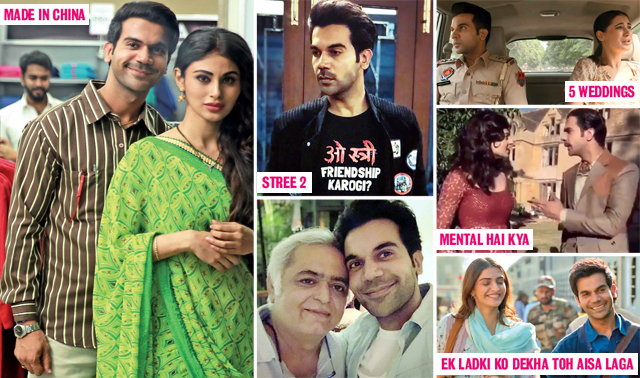
STREE 2
Everyone wants us to spin a sequel of Stree and discussions on the new film are currently on. I am really looking forward to Part 2 of the horror-comedy because the kind of response we have been getting to the film since its release on August 31 is simply overwhelming. People are watching it twice, even thrice and I can’t wait to get back to it .
EK LADKI KO DEKHA TOH AISA LAGA
I feel like I’m a part of Anil (Kapoor, co-star) sir’s family. He showers me with so much love. And Sonam (Kapoor, co-star) is a dear friend. Being on the sets of this film has been wonderful, I couldn’t have asked for a better team. We have just one day of shoot left. And as the tagline goes, it’s a “syaape wali love story”.
SWAGAT HAIN
This film marks yet another reunion with Hansal Mehta sir, who is currently working on the script. It is slated to go on the floors sometime next year. While we are attempting something new with Turram Khan, this one is in a space that we already connect with.
TURRAM KHAN
Turram Khan is a small-town fun film. I think Hansal sir (director and frequent collaborator) is hilarious and I’m glad that he’s finally making a comedy. We share a great rapport; he’s practically family. Nushrat Bharucha (co-star) and I are reuniting eight years after LSD-Love Sex Aur Dhokha. I’ve seen her other work, she’s a fantastic actor. Luv (Ranjan, producer) is known for his great writing and his happy-happy films so it’s a fantastic team coming together.
MENTAL HAI KYA
Shooting for the film is on its final leg presently. It is such a quirky script, I had a lot of fun shooting for it with Kangana (Ranaut, co-star) and the team. The film is scheduled to release next year.
IMLI
Another collaboration with Kangana, this one will roll early next year. Getting to work with (director) Anurag Basu is like a dream come true as I’m a huge fan of his work. The story of Imli is heart-touching and my co-star is a wonderful actor, one of the best in the country today. Working with good actors makes my job easier so I’m always eager to team up with talent like Kangana.
5 WEDDINGS
5 Weddings is a small film that I did a couple of years ago. I have immense respect for our director, Namrata Gujral. She is a wonderful lady.
MADE IN CHINA
The treatment of this film is simple yet different. I’m playing a Gujarati businessman. It’s the story of dreams, aspirations and family ties packaged as a quirky comedy. We are shooting in Ahmedabad and it’s been a lot of fun. Mouni (Roy, co-star) is a dedicated actor. We have shot a couple of scenes together and she takes her work extremely seriously.
LIFE IN A METRO 2
I can’t comment on this now. We’ll talk about it at the right time.
Subscribe to:
Posts (Atom)