Showing posts with label Kumar Gaurav. Show all posts
Showing posts with label Kumar Gaurav. Show all posts
People say Amit Kumar was born with a silver spoon, but I have also seen the hard life-Amit Kumar
8:30 AM

Debarati S Sen (MID-DAY; October 26, 2023)
Amit Kumar has been the voice of almost all big stars in Bollywood including Dilip Kumar, Sanjay Dutt, Govinda, Anil Kapoor, Rishi Kapoor, Shah Rukh Khan and Salman Khan. In a candid conversation with us at his Juhu home, he admits he is nothing like his genius father Kishore Kumar, talks about the maestro, the ups and downs in his musical career and being in a phase where he is enjoying live performances. Excerpts:
Your father was a genius but also known and loved for his quirkiness. How much of him do you see in yourself?
Oh! We can’t be compared at all!
But would you say that you are temperamental, a trait your father was known to have?
You could say that. My father was temperamental, and I used to be like that, too. I guess all artistes have that to some extent. But my father was also a very down-to-earth person and a very simple man at heart. Earlier, I had a restless mind like him, but over the years, I have calmed down a lot. I regularly meditate now.
Over the years, you sang for almost all the big heroes in Bollywood, but then there was a lull. What do you think was the reason behind that?
My first recording was in 1973, but the song came out five years later. Then sang a duet with Asha Bhosle, and one for Madan Mohan and Salil Choudhary, but none of them released on time. Bade Achhe Lagte Hai (Balika Badhu, 1976) became a popular song even though the film didn’t do so well, and it is my bread-and-butter song even today. My songs in the 1979 film Baton Baton Mein were all hits. With Bappi Lahiri, I did Govinda’s first film, and the song I Am A Street Dancer was a super hit. After that, I sang for films like Afsana Pyar Ka, Kabhi Haan Kabhi Naa and Baaghi. I sang many songs for Anil Kapoor in Tezaab, Judaai, Rakhwala, Khel, Jamai Raja, Kala Baazar, Kishen Kanhaiya and others. I became his voice with hits. There were also many other good songs, but those films didn’t run at the box office, so they weren’t heard by most, just my luck!
Now, you are not actively into playback singing, are you enjoying doing live shows?
I do stage shows frequently. I have performed in Amsterdam and the US recently. In November, again, I will be out of the country. I am also constantly creating and composing music for the digital platform. The fact that people still want to listen to me on stage and buy tickets for my shows is overwhelming. I am 71 and still going strong and loving it. I have been performing on stage for the last 50 years! Whether good or bad, I have played my innings, and now I am relaxed and enjoying this stage of my life.
How do you view your journey in the music industry?
I have never spoken about this, but when I was in the Calcutta Youth Choir, I travelled all over India. We would travel in a third-class compartment in trains, carrying heavy bags. It was tough, but fun. People say Amit Kumar was born with a silver spoon, but I have also seen the hard life. My father used to say you must see all this to grow. When he introduced me at Shanmukhananda Hall (Mumbai) with the show ‘Daddy Kishore and sunny Amit’, it went on for three years, and every single weekend was houseful. It was because of my father, of course, but that made a difference in my life and gave me immense confidence.
Wasn’t your singing style compared to your father? Did you consciously try not to sing like him?
R D Burman had told me in the early days, ‘Don’t try to sing like your father. Don’t clone him. Sing what you are. Just do your own style.’ He egged me on. The composers I worked with helped and I developed my own style.
A lot has been written about your father. What is that one thing that most of his fans don’t know about him?
My father used to do stage shows for the army, but he never publicized that kabhi bhi apna dhol nahi pita. Sab bolte the ki Kishore Kumar kanjoos hai, but no one knew how much he did for others. He did the maximum free shows for the jawans of our country. Not many people know this. I have been doing shows to support cancer patients for the last six to seven years and consider myself extremely fortunate to be able to give back to society. And I too have been doing shows to support cancer patients for the last six to seven years and consider myself extremely lucky to be able to give back to society like this. I am blessed with everything and to be able to do such charity shows, it feels great. This year it is special because my 18-year-old daughter Muktika debuted on stage with me. She isn’t a professional singer, but I feel she has it in her.
Love Story (1981) was your first major hit?
Yes my stardom in playback singing was with Love Story and I became the voice of Kumar Gaurav. We went on to do many films together for five years after which Kumar Gaurav’s films began flopping and slowly, I was out too. Over the years my career has been like the waves in the ocean, full of ups and downs. I did so many songs for Anil Kapoor and became his voice with all the super hit songs! The fact that you journalists are still coming to me for interviews shows I must have done something right.
Your first stage performance was with your father? You weren’t based in Mumbai in those days. How did that happen - coming from Kolkata where you stayed with your mom, and working here?
I landed in Bombay when I was 19. My father introduced me for the first time on stage 50 years ago in 1973, at Shanmukhananda Hall. Then we went on to Europe, America, all over the world for shows. People talk of my father, but no one speaks about my mother, Ruma Guha Thakurta. She was instrumental in my life, encouraged me a lot. I used to sing in her group, Calcutta Youth Choir that she set up along with Salil Chowdhury and Satyajit Ray. I grew up in Uttam Babu’s (film star Uttam Kumar) neighbourhood. My first stage program was during Durga Puja, and Uttam Kumar had called my mother saying, ‘Ruma your son is a good singer, will he sing on stage?’. My mother refused saying he has studies. But he coaxed me to sing anyway. I rehearsed four songs but sang 10 and got Rs 800 for that show and we friends went over to Park Street the same night and spent all the money eating there.
My ma wanted me to have a stable career like a doctor as she knew music was not a steady profession. She complained to my father, ‘Your son is singing here and there, not studying. Gali gali mein gaana ga raha hai awaara jaisa. Fail ho gaya hai (at the famous institution Patha Bhavan). But my Baba hearing all this said, ‘Very good, very good! Time for him to come to me in Bombay’. That was typical of my father (laughs) He then came to Kolkata and saw me perform live at Rabindra Sadan. He said never keep a seat for me because the audience will get distracted and won’t hear you. So, he watched me from backstage. That’s when he was convinced. I learnt classical music for a bit but bouncer gaya. I learnt tabla and then it all began. Music directors like R D Burman, who was like family, Kalyanji Anandji, Laxmikant Pyarelal, Rajesh Roshan, they stood by me. They knew how to extract the best from me and I learnt a lot through experience.
VHS was to the ’80s what OTT is to the 2020s-Avijit Ghosh
9:51 AM

Shabana Azmi and Naseeruddin Shah in Shyam Benegal’s Mandi. Pic Courtesy/Shyam Banegal
Author Avijit Ghosh's book on Hindi cinema looks back at a decade largely remembered for mindless entertainment but one that taught the industry resilience
Jane Borges (MID-DAY; March 26, 2023)
Right at the outset, Delhi-based novelist-author Avijit Ghosh tells us of his interest in “lost causes”. He illustrates this with the titles of his previous books, Cinema Bhojpuri (2010) and 40 Retakes: Bollywood Classics You May Have Missed (2013). Both reflect on movies and experiences that were cast away but deserved a prominent place in Hindi cinema history. His latest book, When Ardh Satya Met Himmatwala: The Many Lives of 1980s’ Bombay Cinema (Speaking Tiger Books), is no different. “During discussions on films with friends and colleagues, I’d often hear that the 1980s was a useless period, a black mark of sorts.”
As a student of Jawaharlal Nehru University, Ghosh had had first-hand experience of the decade. “I had seen so many [of these] movies in cinema halls... So I knew that this view was lopsided. I felt that we needed a more serious examination of the decade.”
The 1980s, according to him, saw entertainment arrive in the drawing room like never before. “Till then, cinema was the pastime preferred by the middle class... it was an occasion when the entire family dressed up and went to the movies. Now, cinema came home, rather illegally, courtesy the video home system [VHS] and the video piracy [network]. This, and later serials on cable TV, bruised and battered the film industry, and it caused major ripple effects.”
Simultaneously, as a consequence of Kapil Dev and team’s World Cup victory in 1983, there was a sharp increase in ODI cricket matches being shown on television. This too, he says, hurt the film industry’s ability to lure day-time audiences into theatres. “The political turmoil in Assam, Punjab and Kashmir further stumped the film market.”
While all of this was happening, there was strangely a serious leap in production: “More films were being declared as flops, and yet, more films were being made. At the heart of this contradiction is the 1980s story—how old money was gradually being replaced with new money, part of which was bad too,” says Ghosh.
The death of single screens, which hastened during the recent pandemic, began sometime during this period, as the footfall to cinema halls dropped significantly. “In Bombay, theatres such as Rex, Majestic, Broadway and Neptune had already been razed and recast as shopping centres. By 1986, two prominent cinema halls in Ahmedabad, Ajanta and Ellora, had also shut down. A similar trend was seen in Jabalpur.”
It is against this socio-political and economic backdrop that Hindi cinema was trying to find a voice. “It was a defining decade, because it changed how cinema was being consumed. VHS was to the ’80s what OTT is to the 2020s. This led to the personalization of entertainment. And because the middle class had largely abandoned the theatres, the filmmakers were making tweaks to the script to suit the taste of the core audience, which was non-gentry in nature [youth and the underclass].” The content, he says, was marked by the “sublime and ridiculous coming together”.
This was the time when the genius of Kundan Shah, Govind Nihalani, among others who rode the new parallel cinema wave, sat alongside films that boasted pelvic thrusting actors spewing double entendre dialogues, says Ghosh, who did interviews, dipped into records available with the National Film Archives of India, and scoured through English newspapers, trade magazines and Madhuri, Dharamyug and Sarika, to build his argument. “I also looked at Parliament replies by ministers to understand the sentiment of the time.”
Another significant event that marked the decade was the 1986 film industry strike. “The strike was against excessive taxation and lasted 31 days. No film was shot or screened during this time. It was a total shutdown,” he shares.
On the 12th day, which was October 21, a cavalcade of about 150 cars and trucks gathered in the Shivaji Park area. Many even walked. Some of the participants in this march included V Shantaram, Sunil Dutt, Dev Anand, Rajesh Khanna, Rohini Hattangadi, Raj Babbar, Tina Munim, Anil Kapoor, Govinda, Khushboo, Farah, Meenakshi Seshadri, Javed Akhtar, Shabana Azmi, Sanjay Khan, Akbar Khan, Yash Chopra, Mithun Chakraborty, Shashi Kapoor, and many more. Khanna was the press convener of the action committee. “Who would have thought that the chaotic film industry, which was divided into camps, would collectively raise the banner of protest against the state government.”
“The outcome was modestly successful... it gave the industry a handle of hope when video piracy was eating into revenues. The movement also lifted the industry’s spirit and made many aware of being part of a larger community.”
The man who owned the decade, Ghosh feels, was Mithun Chakraborty. “He is significant because the 1980s was also the decade of star sons [Kumar Gaurav, Sanjay Dutt and Sunny Deol]. Mithun represented the exact opposite of that; he was a self-made star.”
That he could slip into any character or genre, be it action or a family drama like Ghar Ek Mandir, or the romantic superhit Pyar Jhukta Nahin, made him most sought after. “This decade was also typified by a certain kind of sound—disco. Mithun was the face of disco,” he adds. “Here was a star who the non-gentry cinema-goers could root for. He was an idea whose time had come.” Govinda, he says, took this forward. “But he arrived only in 1986, and came into his own [as a comedy actor] in the 1990s.”

Avijit Ghosh Pic/Nishad Alam

Hema Malini played a dacoit in Sitapur ki Geeta. Sridevi and Zeenat Aman also starred in such films where the male actors played second fiddle. Pic Courtesy/Manmohan Kapoor

Director B Subhash and Mithun Chakraborty made a hit team after the success of Disco Dancer. Pic Courtesy/B Subhash
No one gets upset when a classical musician’s children become musicians-Tejaswini Ganti
8:39 AM

Nepotism in Bollywood has recently become a cultural flashpoint after the suicide of actor Sushant Singh Rajput. Tejaswini Ganti, anthropology professor at New York University who has studied the industry’s workings in her book ‘Producing Bollywood’, gives Amulya Gopalakrishnan her perspective
Amulya Gopalakrishnan (THE TIMES OF INDIA; June 21, 2020)
Why is Bollywood seen as hostile to outsiders?
The personalised and hereditary nature of the Hindi film industry obviously creates barriers for those who have no family or social connections. The absence of any defined method to gain access makes the process of trying to “get a break” that much more haphazard. When outsiders do manage to succeed, their stories, which are anomalies, are touted as the norm.
But I’m struck by how the epithet “nepotism” is lobbed most vehemently at Bollywood when pretty much every field in India could be described that way. The family firm continues to thrive in India. Filmmaking has also been structured as a family business in India — relying on personal networks is a way of hedging risk in an uncertain environment. This also seems to mirror folk and classical performance traditions like music and dance, which historically have been hereditary vocations. However, no one gets upset when a classical musician’s children become musicians.
Has inherited advantage always been the norm in the film industry?
For much of its history, filmmaking was not a hereditary occupation in India. With the exception of the Kapoors, the pioneers of the Hindi film industry did not establish filmmaking lineages or dynasties. It began to seem like a hereditary vocation in the early 1980s with the phenomenon of “star sons” — Sanjay Dutt, Kumar Gaurav, Sunny Deol — making their debuts in films produced by their fathers.
This trend intensified from the mid-1990s, and by 2008 a little over 60% of the actors who appeared in leading roles hailed from film families. Of the top ten male stars in the industry, eight were either second or third-generation members of the film industry. When I started doing this research in 1996, nearly everyone I met had entered the industry through a family or friendship. Even then, it seemed as if the Hindi film industry was literally reproducing itself in all spheres: production, distribution, and exhibition.
Why would that happen, at a time when liberalisation should have widened opportunities?
It is not so surprising that kinship networks intensified in the Hindi film industry from the mid-1990s, after liberalisation. The family becomes even more economically essential under capitalist expansion. Many businesses become hereditary when there is something to inherit, and economic security comes from consolidating one’s investment within the family. A consequence of the greater economic potential and cultural legitimacy of Hindi cinema since the mid-1990s was its increasing attractiveness as a career for filmmakers’ own children.
Why has this situation caused so much more heartburn in the last few years?
I think that the increased number of people from middle to upper-middle class backgrounds trying to enter the industry has played a role. Given that there is no longer a stigma attached to working in the film industry, people who are also college-educated or trained in film institutes and have been socialised into a notion of “merit”, become frustrated with the lack of access.
Also, all the discussion about the “corporatisation” of Bollywood suggests transparent practices of hiring and advancement. And yet, this intensely personalised nature of work and reliance on family and friends seems to be the opposite of that. With the explosion of TV channels and social media, people have more venues to vent their criticism.
What difference does social background make to an actor’s work experience?
Women without family or social connections have more chances at a film career than men, through routes such as beauty pageants, modelling, or being “discovered” by star-makers. Ironically, the patriarchal nature of the film industry enables unconnected women to gain entry because the success or failure of a film is not perceived to be dependent upon the lead actress.
Industry offspring have access to social networks and specialised knowledge of the workings of the film industry. This form of training by immersion and instant name-recognition is interpreted by producers and distributors as a type of guarantee in a very uncertain business. Because they are already celebrities before even starting their careers, they can be interpreted as “brands”.
Other factors that can give people an advantage is being from Mumbai, living in the western suburbs, and being fluent in English. Knowing Hindi is actually much less important, ironically.
Has the background of those who work in the film industry diversified in recent years?
It really depends on which metric one is using and which part of the industry one is describing. The Hindi film industry has high levels of regional, ethnic, religious and linguistic diversity. Compared to the rest of Indian society, there is a high rate of intermarriage across these lines. However, when one looks at actors, directors, producers, writers, and other creative or financial decision-makers, they are still largely upper-caste/savarna.
Why is Ram Gopal Varma bringing up the past again?-Namrata Dutt
8:24 AM

As Ramu announces a warts-and-all biopic on Sanjay, sister Namrata Dutt on why the family should not have to relive their disturbing episodes, time and again
Upala KBR (MID-DAY; July 21, 2018)
Hours after it was reported that Ram Gopal Varma has set into motion a biopic on Sanjay Dutt — one that critically appraises the actor and his run-ins with the law — sister Namrata Dutt says she doesn’t understand the need to put the spotlight on episodes that Sanjay has put behind him.
 Namrata tells mid- day, “Doesn’t Varma need Sanjay’s approval to make it? If Sanjay gives a go-ahead, we are nobody to say no to him.”
Despite it being a runaway hit, Rajkumar Hirani’s Sanju has been accused of glossing over the actor’s laid on his strained relationship with father Sunil Dutt. In sharp contrast, Varma’s biopic, tentatively titled Sanju: The Real Story, will focus on Sanjay’s arrest for possessing an AK-56 rifle in connection with the 1993 Mumbai bomb blasts.
Stating that it was “painful to watch” the Hirani-directed venture as it brought back the dark days that the family had been through, she says that another cinematic outing would only affect them further. “We have been through every phase of what Sanjay has gone through. When he became a drug addict, we at least knew that we could help him out of it by sending him to rehab. But we had no control over the other incident [going to jail]. It was painful as we helplessly watched him suffer,” she recollects, adding that Sanjay has strived to emerge stronger from his past incidents. “It was an unfortunate episode in Sanjay’s life. He has moved past it. Why is Varma bringing up the past again?”
Though Varma and Sanjay have collaborated on two films, Namrata states that she doesn’t trust the director’s gritty style of filmmaking. “His movies are dark. Why do you want to go on and on about Sanjay’s life? Why is he putting us through so much pain again?”
Rumours suggest that husband Kumar Gaurav hasn’t watched Sanju yet as he’s hurt that despite being thick friends for decades, his character didn’t find a place in the movie. “Bunty is not upset. He wasn’t well during the screening. He will watch it soon.”
She adds that she would have liked if Sanjay’s former wife Richa and daughter Trishala were depicted in the biopic. “I missed watching their characters. But I haven’t mentioned it to Sanjay.”

Apparently I was crap, they removed me from Jo Jeeta Wahi Sikandar-Akshay Kumar
3:49 AM

mid-day's exclusive in-depth conversation series, Sit With Hitlist, started off with Aamir Khan. Akshay Kumar is a fine follow-up. Both being kings of box-office. Besides that they've being reigning over Bollywood since the '90s
Mayank Shekhar (MID-DAY; November 24, 2017)
Now since this is part of a conversation series, I was trying to look at stuff that links you and Aamir. But, of course, you haven't done a film together. An interesting bit of trivia that I suspect audiences may not be aware of is that you, in fact, had auditioned for Aamir's cult classic Jo Jeeta Wohi Sikandar [1993], and it didn't eventually work out, is that true?
So, I went there. Apna screen test diya maine, for Deepak Tijori's role [Tijori played the young anti-hero in the school-campus rom-com]. And they didn't like it. And, apparently, I was crap, so they removed me. So, there you go!
Were you auditioning a lot [and perhaps getting rejected] in those years?
Yeah, I had auditioned with B R Chopra, Ravi Chopra, Raj Sippy, Pramod Chakravorty. I didn't have money to get my own portfolio shot, so I assisted photographer Jay Seth, on the condition that one day, he'd shoot and make my portfolio for me. I worked for him without any pay. Then there was the producer Salim Aftab, who'd made lots of films, including Loha, that I gave an audition for.
So usually, in Mumbai, over 20,000 people come over every year with the expressed intention of working in films. And over the years...
Per year, no? In Bombay Central station itself, kariban 5,000 log roz utarte hai [get off everyday]. From the North, and the South, but mostly from the North. Of these, around 3,500 return, because nothing works out for them. That is the actual figure. And this is from one station.
So they step out of Bombay Central, and a lot of them head straight towards Lokhandwala, and adjoining areas...
Yes, Lokhandawa is the hub.
Most of them hang around in CCD [Café Coffee Day], Barista…. Was the scene very similar, when you were starting out? Was there like a CCD equivalent, where people would dress up, chill, discuss scripts...
Back then, there was nothing known as script. As for places, there was one called Bonbon. Have you heard of it? It's a shoe shop in Seven Bungalows [Andheri]. That's where everyone would gather. Aur, ikatthe bhi kaun hote thhe [and the ones who would gather would be] strugglers, with fight masters. So, they would sit there, talk about stuff. The fight masters would then take us to meet some producers, directors. Because every film had fights. I think, after every eight to ten scenes, there would be a fight. If you see films from those days, you'll realise how they used to be full of fights, and fights, and fights. Yaha tak ki, I've heard so many directors say, ki jab film ke screenplay mein dhalaan aaye [when the story peters down], toh fight dal do [put in a fight sequence], toh upar aa jayegi [the tempo will pick up]!
So you're saying these action directors were the casting agents, in their own ways, back then? That you look good, can fight well, let me take you to a producer/director?
Yes. For the entire day, Bon Bon would be our hub to meet up, because the fight masters were there.

Why outside a shoe store though?
Because uske baju mein [right next to it], kabab ki dukaan thi [there was a kabab shop]. All Punjabi fight masters used to go there, wahan kabab shabab khate the. But because the name of that kabab shop was not easy to pronounce, we used to refer to the place as Bonbon [for the shoe store next to it].
Because uske baju mein [right next to it], kabab ki dukaan thi [there was a kabab shop]. All Punjabi fight masters used to go there, wahan kabab shabab khate the. But because the name of that kabab shop was not easy to pronounce, we used to refer to the place as Bonbon [for the shoe store next to it].
Another really fascinating thing I came across, and I'm not sure how many people know this, has to do with your name. A lot of conversations have happened around why you decided to take up Akshay Kumar [his real name is Rajeev Bhatia]. There was a [little known] Mahesh Bhatt film called Aaj, that you worked in, where you were supposed to be a stunt-person...
Martial arts teacher.
And when you actually saw the film, your role had been snipped to about seven seconds. Is that correct?
No, it was always that long. I had shot for seven seconds!
And then, you realised that the hero of that film is called Akshay. So you started to call yourself Akshay as well. Is that really the story?
Yes. That is a true story. Kumar Gaurav was the hero in that film. He was called Akshay. And, I don't know why, it's not that I thought my name was bad. Rajeev is a very good name. Pata nahi, dimag mein koi chah aa jati hai [something just interests you in your head]. And I just wanted to go, and change my name, and I went to the court in Bandra East and did it. I have a full certificate as proof [of my name-change].

And on one fine day, you decided to have a visiting card with that name.
Yes, a yellow and white coloured card.
Do you have the card with you?
I'm sure it's lying around somewhere. It was yellow and white in colour, I still remember that. I put my [new] name on it, my address, baaki toh kuch ttha hi nahi [there was nothing else to put anyway]. I just wrote, black belt, under it. That's it.
And your life changed on that day!
Actually there's a long story behind this. You want me to say it?
Absolutely.
So, I woke up one morning to start my workout. At six in the evening that day, I was meant to go to Bangalore for a modelling assignment that I'd got. At 5.10 am, I got a call from the airport. The [modelling] agency guy asked me where I was. I said I was home. And then he blasted me, over how unprofessional I was. He said, "You will never succeed in life, I can guarantee you." I asked, "What happened?" And then I realised, the flight I had thought was for 6 pm, was actually for 6 am. I was actually in tears telling him, "Yaar, mein bhag ke, motorcycle pe abhi aata hoon [I can just rush in now]." Unfortunately, they didn't agree. Obviously, they were also right. They had to catch a flight as well. Ussi din, mera card bhi aa gaya chap ke [That's the day my visiting cards arrived from the printing press]. I was very low. My father had gone to work. I was talking to my mother, who said, as every mother says in their own language, "Puttar koi baat bahi. Jo honda hai, Rab theek karta hai [Whatever happens, happens for the good]." That line, I've heard so many times from my mother. So, I went to Natraj studio that day, where I met [filmmaker] Pramod Chakravorty's company's make-up man. He asked me, "Hero banna hai?" I said, "Haan yaar, banna hai [Yes, I want to be a hero]. He said, "Photo hai [You have pictures]?" At that time, we used to travel with such big photographs, in a huge album. Because directors, and producers, would not want to see a small picture. I don't know what they wanted to see - pores in your skin, or what. But they wanted to see everything closely. So, he took that album inside the office, Pramod Chakravorty saw it. I was called in. Much to my surprise, he gave me my first cheque, signed me up for three films, immediately. Right away. He gave me a cheque of Rs 5000, for the first film, Rs 50,000, for second film, and the third cheque had Rs 1.5 lakh on it. The exact time he gave me those cheques was 6 o'clock in the evening. It would have been a disaster, if I would have gone to Bangalore. Today, I would be a retired model somewhere. So yes, whatever happens is for the good.

So you didn't go to Bon Bon the next day?
I did.
To tell everyone, boss, I got my break?
You know how it is. Humare dimag mein yeh bhi ek rehta hai na, ki jab tak film shuru nahi hoti, tab tak kya pata [You're never sure until the film actually rolls]. So many slips happen so often. You just never know. When Dada [Chakravorty] started taking care of me, I became his family.
So that make-up man is still your make-up person?
Yes, he's still there. Since I entered the industry, my driver, spot-boy, everybody has been the same.
I'm assuming the film you got that day was Deedar, which was also supposed to be Karisma Kapoor's debut?
Actually, Nagma had given the screen test first. Then Karisma did, and Karisma got selected.
This would have been your first film on screen, but it wasn't. And it was a romantic film?
Yes.
So you would have started out as a romantic hero, rather than the 'action star' that you eventually became.
But it [Deedar] had lots of fights too!

The persona that stuck with you was that of 'Khiladi', which is from your third or fourth movie onwards. Your name itself became Khiladi. Correct me if I'm wrong, one of the tests for old-world stardom in Indian movies, is when the actor acquires a sobriquet: for instance, Amitabh Bachchan is Shahenshah, Shah Rukh is Badshah, or King Khan… After Khiladi, in particular, was there a moment when you finally realised or told yourself, "Boss, I'm finally a star"?
I have this habit of listening to lots of people's stories, and learning from their experiences. Like, I love hearing about what happened with Rajendra Kumar, or Sunil Dutt saab, or Rajesh Khanna, or some producer, and I've learnt from their experiences. And the fact remains, there's nothing called a star. Kyunki aaj hai, kal nahi [It's there today, gone tomorrow]. Yeh mein bahut jaldi seekh gaya [I learnt this quite early on]. So I never took the idea of stardom very seriously. Sure, they call me Khiladi viladi, and they still do. For the last 15 years in the industry, I haven't made a 'Khiladi' film, yet if I step out, people say, "Aye Khiladi!" Even if I do 50 more films, woh naam hatega hi nahi [that name won't disappear]. But, I have never taken the word 'star' seriously, because I'm very scared that this is all going to go away. Without taking names, I have even heard stories of people going mental, when this star [syndrome] has been taken seriously, and things have started falling apart. Because this is a very deadly industry. Kabhi bhi gira sakti hai [You can fall any minute]. Kuch bhi ho sakta hai [Anything can happen].
Any other stories you might want to tell in this regard, even if without taking names?
Actually, I've learnt a lot from Danny Denzongpa. He's the one guy I would always like my life to be like. He has never taken his stardom seriously. He has his own very straight and simple life. He has his small beer company, where he gets his money from.
Dansberg, yes. You don't drink, but it's a superb beer though!
Yeah, I don't drink, but I know what you mean. Similarly I would also like to have a small company, so money keeps coming in. Then for three months in the summers, he [Danny] doesn't work. In the winters, if there's work, he'll go there. For two months, he goes alone, taking his flute, and he's singing, swimming in lakes! He really spends a life, and he has a great family life too - a man without any stress. I look at him, and say I want to have a life like him. So I follow him, and try to ape him. I'm sure you didn't expect Danny Denzongpa's name.
As your idol?
Well, only for the way he leads his life.
Sure, not as a professional, because very few people have been as competitive as you. I mean you take your holidays, but you make sure that you do four films a year.
Well, I don't make sure. It is not science. I fail to understand why people think of four films as a big deal. It's 38 days, into 4, that's 152 days in a year, give it 10 days each for the film's promotional activities, the rest of the days are yours, ghumo firo! (chill).
The other thing about highs and lows, very few have seen that as much as you - strings of hits followed by string of flops - and you've done so many films that you've probably lost count yourself...
No, I count them. It's 131.
Does that include Aaj?
Yes.
Because, Aaj doesn't feature much online...
I actually have another film, even before Aaj, called Harjaee.
What did you do in that movie?
I'm throwing flowers at Randhir Kapoor, he's getting married! (Audience laughs)
So when you've done that many movies, clearly by now, you have a sense of chalegi ya nahin [will it work or not]?
No.
Not at all?
Kisika baap nahi bata sakta! I challenge anybody who can say, yeh chalegi [this will work].
So are you still stunned by arrey, yeh, chal gayi [wow, that worked]? Or the other way round?
I can only say that this film will make a name for itself. But I can't predict what kind of business it'll do. For example, with Toilet [Ek Prem Katha], I knew people are going to say that we've made a good film. But that it would make Rs 130 to 132 crore was shocking for me.
And 2017 has been your year again: two back-to-back massive hits.
Things have been very good. It's been like this from the beginning of my career. Flop chal raha hai toh chal hi raha hai. 14 flops ek saath marta hoon! [If films are flopping, then I hit 14 flops in a row!]. And if it's hits, toh 12 hits mari hai ek saath [then I've scored 12 hits in a row!] Right now, the number is six [hits in succession]. Between 2010 and '12, I had delivered six flops together.
So you're saying it's purely luck of the draw then. By now I'm certain you've the inherent instinct to figure the business out; I mean that's how you budget movies, isn't it?
Okay, chalo mein aapki baat maan leta hoon [Let me agree with you then]. Golmaal [Again] released. I bet Rs 2 lakh that the film will hit Rs 200-crore mark. And that number worked.

Who was the bet with? Ajay (Devgn)?
No, I'm not going to tell you; someone else.
That's another interesting relationship you have with Ajay Devgn. You were apparently chosen to star in his first [Phool Aur Kaante, 1991]. Is that true?
Yes, I was in Phool Aur Kaante. I sat in on the [music] sessions, with Nadeem-Shravan at Sunny Super Sound [recording studio]. Those days, there used to be 30-40 violin guys in every song, a separate orchestra. Ab toh, we finish off everything in an instant. So at night, I was readying my ice box. You had to do it on your own in those days - paani dalna, barf dalna [placing water, ice]. So I was getting ready for the first day's shoot. And then I get a call, ki bhaiya aap mat aana. Koi aur aa raha hai [You don't need to come for the shoot, someone else is].
Nepotism?
No. But around the same time, a few days later, I met Abbas-Mustan at Juhu Centaur. And got Khiladi [1992].
Now another thing you'd maintained throughout in your career, is that you will never turn into a producer, that you only want to remain an actor. But you first produced Waqt [2005], the earnings of which, if I'm not mistaken, you donated to a cancer hospital in Canada. It seemed like a one-off call. But now you're one of those most active producers. What led to that change?
See, it became very difficult for me after a point. Now a producer comes in and says, "Bhaiya, mein produce karna chahta hoon, aap kitna paise lete hain [How much do you charge]? I don't know what to charge. Because, actually, nobody can come to know what to charge. The best way then would be that I make my own film. And I don't charge anything. When the film releases, I take whatever the earnings are, the whole thing.
You take the whole thing?
Yes, because I'm producing it. Unless, agar aap paise laga rahe ho [you're putting in money], I have to pay you. I make most of my films at a budget of Rs 20-30 crore, say. That return is guaranteed. Beyond that, if the earnings are Rs 40, 50, or 60 crore, good. And if it totally doesn't work, and makes Rs 10 crore, even then I have not caused a loss to anyone. It's a very simple. Obviously a newcomer can't do this. You have to be in this industry for quite a while. But, this is my calculation behind producing films - the fact that I cannot quote a price on myself, to any producer. Because I don't know how much the film will make. And I don't know what is going to happen - sometimes satellite rates go up, digital rights numbers go down, music works, or Bhushan ji [T-Series' Bhushan Kumar] says ki nahi chali [didn't work]. Nobody knows what is happening. There is no certainty to anything. So, why not take the blame on myself? And if I earn, I earn. If not, I lose. And obviously, there's no chance of losing, because that much [of investment], you can always earn [recover].
Are you good with money, otherwise?
I'm very good with money. My father was an accountant. I can calculate money very fast.
Does money interest you a lot?
No. To a certain extent, yes. Earlier I used to work in films for money. But, now I don't - I want to make films, which make a difference to society. That's why you'll see my choices of films have changed. Yes, when I entered the industry, it was a pure and simple thing - paisa kamao, ghar jaao [earn and leave] - I just wanted Rs 10 crore in my bank. Ab, woh calculation bandh ho gaya. That money wire in my head has been cut off. Now my calculation is, what next.
That's such a huge change from how you used to be-from your subjects in films, to your approach to movies itself.
But then that wire got cut!
When that wire was there, what did you love about money most? Was there ever a moment when you bought something and that felt like worth earning for?
I had not seen much money since childhood. So there was certainly an attraction towards it. But when I bought my house, that felt good. It was later that I realised that it was the same place where I'd done a photo shoot, and the chowkidaar had thrown me out! It's just a coincidence that I bought that house. Not exactly a scene from Anitabh Bachchan's Deewar [1975]! I still have a photograph of me lying on the ledge, and it's the same place where I live now. I have memories of coming to that beach with my parents. We would spend family time together.
It seemed to me that [your wife] Twinkle [Khanna] also had a role to play in the change in your film choices. She happened to be in the room while I was having this conversation with you recently. She agreed and said, in jest, that she keeps whispering in your ears while you sleep: "Do good films. Win awards." You said that you whisper back into her ears, "Mela, Mela..."
I also tell her about Kuch Kuch Hota Hai [1998]. Even that was offered to her. She read the script, and she didn't understand it. Eventually, Rani [Mukerji] did that role. She still tells Rani, "Teri zindagi maine banayi [I made your life]." She'd actually thrown the script, and called it sh*t!
As a couple, you share fabulous chemistry in public. But you guys seem very different from each other otherwise. She is a popular writer, very vocal about her opinions. You are extremely diplomatic. Are you much of a reader?
I don't read anything, except my agreements. I am a movie person. I watch every film, and almost every day. Anything on TV catches my attention. Just the other day, I was watching a Malayalam film, with no subtitles. I wasn't understanding anything. But mentally, I was weaving my own story of what's playing, based on the visuals. A lot of the times we make movies, by looking at movies.

Do you usually also look for material to remake?
I don't remake films, I remake scenes. Earlier in Hindi films, we would copy a lot. Things became really strict over time. Earlier, copyright meant right to copy. But thankfully, now we've a lot of original scripts to choose from. With studios coming in, things have fallen in place. People are working towards original screenplays. When you watch new movies, you can feel this change in cinema - Vicky Donor [2012], Shubh Mangal Savdhan [2017]… Earlier, who would think of making a film on sperm donation?
That's also the mode you've picked: mainstream, entertaining movies, slightly high-pitched, with a strong message [Jolly LLB 2, Toilet - Ek Prem Katha].
You have to do that.
While you're extremely diplomatic on political affairs, I was watching an interview of yours, where you've said that you wouldn't mind being a sports or health minister. Really?
I know these two areas very well. I don't want to do politics, for the sake of politics. I know what a sportsman thinks. I know I can do something about it. Even if I am given a stadium, I know I can change things. All my life I have been into sport. I might not be that educated, but sports has provided me education all along.
So far as movies are concerned, the one thing that you can certainly take credit for is bringing about change in the lives of stuntmen. Awara Pagal Deewana [2002] was the first movie to introduce stunts, using cables. Back in the day stuntmen used to die, lose limbs during jumps. There was hardly any safety net from an insurance point of view either.
I am happy to say that every fighter now has insurance. Hindi films' stuntmen are the only insured people. This practise has yet to reach Tamil and Telugu industries. Those men also need to be insured. I remember, once I was wearing my knee pads on the sets, that I had got from Bangkok. The stunt-master came up to me and said, "Kya kar raha hai, beta. Chand pe jaa raha hai. Mera bhi ghutna toota hai, theek hai. [What're you doing, son? Are you going to the moon? Even I've broken my knee, it's okay!]." There was such lack of knowledge.
Have you seen a major mishap happen in front of your eyes?
I have seen someone die. I can never forget that. He was a young boy, doing a car stunt. He waved out at all of us. And then the crash happened. We all went running. But by the time we got him out, he had snapped his neck. People don't understand that there is a lot of physics behind stunts. You've to understand it better. Suppose, if someone has to jump from a highrise or even from a chopper, what you think is the middle point, where you have to land, is actually not the mid-point. You have to take into consideration the airspeed which will shift you from it. I remember someone had to jump from a height, and land on boxes, and he fell out of it. People blamed me for it, said he was trying to copy me. People need to understand that every stunt - be it jumps, or those involving fire, skidding on a motorcycle - can be calculated. Stuntmen don't take proper care. They've started to of late. Earlier, we used to lose our men, left, right, centre.

Another area that you've actively worked on is self-defense for women. I was quite stunned to learn that this year, you had 21,000 girls graduate from your school.
Well, there was a recent case as well. A guy tried to molest one of the girls trained from my school. Forget resisting the molestation, she was so powerful that she beat him black and blue. He is in jail now. It's not about learning martial arts. Women have to understand that they should be able to combat blows. What happens when someone holds a girl's hands, she freezes. She can't believe that someone has caught her like this [inappropriately]. She doesn't scream, move or shriek. That is when a man takes advantage of her. I am trying to teach them how to be more confident in real life, besides being able to get out of an unfortunate situation. I teach them that they have to scream. I never have them come to the school in track pants. If people go to work in saree, they should come to learn in a saree. When someone attacks, you won't say, "Ruko track pant pehen ke aane do [Wait, let me wear my track pants]." They practice in heels, shoes everything. We have all kinds of students -from CEOs, to maids -training, free of cost. They come, enjoy the classes, and win medals. My farewell gift to them is a keychain with a whistle on it. When a girl whistles, the guy withdraws, and gets shocked. It scares him. It's an Israeli tactic.
Final question, and coming back to films, and actually how we began this conversation, with the Aamir Khan connection. Your next huge film is Shankar's 2.0. Because Rajinikanth wasn't well at a point, he had called Aamir up to check if he might want to do his role in 2.0. And Aamir said this was the most kick-ass script he'd read in the longest time, and that it would to be the biggest hit of the year. Except, he couldn't imagine himself playing that part, he could only see Rajini, when he closed his eyes. That great?
Yes, it is something very different. As I always say, Shankar is not a director, he's a scientist. He discovers things. Once you watch the movie, you will wonder for a while, "Yeh hua kya?" The topic is great. And it's a superhero film, where you get emotional as well. I don't know how Shankar does it. I have no idea how he wrote it.
And this is one of those films that can actually go across India, Rajini, you - South, North?
Yes. It has the capacity to travel even outside India, in a big way.
(Excerpts of the conversation transcribed by Sonia Lulla, Mohar Basu and Sonil Dedhia)
On Vishesh Films' 30th anniversary, Mahesh Bhatt revisits seven intensely personal dramas
8:19 AM

As Vishesh Films completes three decades on April 2, its lodestar, Mahesh Bhatt, talks about its latest offering and six intensely personal dramas that are cherished memories today
Roshmila Bhattacharya (MUMBAI MIRROR; April 1, 2017)

BEGUM JAAN (2017)
This Partition drama is a new spring for Vishesh Films. After a few flops, a gloom had descended over the establishment which had the infrastructure and access to money, but the core from where my films had come had withered. That’s when I accidentally stumbled on this Bengali film, Rajkahini, whose director, Srijit Mukherji, was suggested to me by my writer Suhrita Sengupta.
I’d liked his work and when invited to see the film at a preview theatre, I dragged my reluctant brother, Mukesh Bhatt, along. I was devastated by it. The film shook me, my body and soul. I came out of the screening, hugged Srijit tightly and said, “As long as there are storytellers and filmmakers like you, the moral compass of the nation is intact.” In that embrace was born the narrative of Begum Jaan.
When Mukesh saw how overwhelmed I was by the film, he decided to remake it in Hindi. With all his caution and worldly wiseness, Mukesh Bhatt has taken many risks based on my gut instincts. He’s as much a gambler as me, without whom we would not have come this far.

ZAKHM (1998)
So many painful memories because this film was semiautobiographical, based on my proud origin of having a Hindu father, a Muslim mother and a Christian schooling. It was my last directorial and because it dealt with communal politics and the carnage post ’92-’93, my mother was concerned believing that by taking up for secular values, I’d upset the ultra right-wing forces. She died after the first schedule and I had to unmask her Muslim identity which she had hidden behind a sari, tika and mangalsutra when she was alive and had to tell the family that her last wish was to be buried.
She went into the grave as Shirin Mohammad Ali as she didn’t have her husband’s name attached to her. It was graceful of the man in charge of the burial ground in Byculla to let me perform the last rites after learning that I was a Hindu by the name of Mahesh Bhatt. When I stepped into the grave and turned her face towards Kaba, it was the most intimate time I spent with my mother who was no more. That became the defining image planted in the climax which touched the nation’s consciousness.

SADAK (1991)
I remember an enchanting night in Mysore’s Brindavan Gardens where we were shooting Nadeem-Shravan’s romantic track, “Tumhe Apna Banaane Ki Kasam” with a young Pooja Bhatt and the new star Sanjay Dutt. In between shots, I would be listening to a commentary on the Gulf War. Sanjay wondered why I was interested in something happening in Iraq. We had to finish the shoot before dawn becauses it was an expensive location but even though we stretched ourselves, one shot remained. I resigned myself to completing it elsewhere but Sanjay protested, saying, “We have to shoot it here.”
I told him it was impossible to carry the equipment to a distant location before daybreak. “I’ll do it,” he said, and lugging one of the huge archlights, turned to the lightboys and commanded, “Follow me.” They did and we got the shot before the sun came up.

DADDY (1989)
Not for nothing was I labelled the “autobiographical” filmmaker. I went through the attics of my life and shamelessly pulled out stuff others shudder to reveal to the world, including my battle with the bottle, to launch my 16-year-old daughter Pooja Bhatt as an actress in Daddy. It’s a film about an alcoholic struggling to reform for his daughter, part fiction-part real.
My wife Soni Razdan is away in Hong Kong with our newborn child and Pooja was staying with me in Juhu during the shoot. Every night she would rehearse her lines for the next day, perform them for me, then go to bed. One night, after she and the rest of the world had fallen asleep, I had a sudden craving to go to a bar and have a drink.
‘Who would know’, I asked myself. My wife was away and my daughter, asleep. A voice replied from deep within, “You can con the world, you can con your child, but how can you con yourself Mahesh Bhatt? You would know.”
I didn’t have that drink and it was a turning point for me in my struggle with alcoholism. The next morning, I rewrote the climax with Anupam Kher who played the alcoholic, being offered a drink by the baddie before going on stage and tossing the whiskey and the temptation away. What happened in life was transported to the movies. Celluoid has been my intimate diary and I’ve let the world into that space because there’s nothing to hide.

NAAM (1986)
After the critically acclaimed Saaransh and Arth, this was my first money-spinner. It enjoyed a golden jubilee run and brought back Sanjay Dutt after a string of disasters. It also put the spotlight back on Salim Khan after a split with his scriptwriter partner Javed Akhtar.
I have to thank Kumar Gaurav for making Naam possible for us. When I narrated the idea to his producer-father, Rajendra Kumar admitted it was good but then apprehensively turned to his son and pointed out that Sanjay Dutt’s role in this two-hero film was more powerful. “Why not do a film with you at the heart of it?” he suggested.
Without blinking an eye Kumar Gaurav replied, “If we’re going to make this movie, it has to be on this story.” Seeing his conviction his father agreed but ironically, Rajendra Kumar’s fears are confirmed because despite Kumar Gaurav’s brilliant performance, Naam is Sanjay’s show.

ARTH (1982)
The film was done and was the talk of the town. But there were no takers. The end —Shabana Azmi’s character Pooja choosing not to return to her philandering husband or jump into the arms of her lover who promises her the moon but opting to live alone as a single mother to her maid’s daughter—was too bold and unconventional for our Hindi film industry.
There was another problem. My narrative stood on the shoulders of two brilliant actresses, Shabana and Smita Patil, but the latter had moved out of the art house circuit into Bollywood’s A-list. She was convinced I’d been grossly unfair to her character, Kavita, pruning some of her best scenes to make her look like a lesser actress to build up Shabana. An uncomfortable silence stretched between us which I didn’t know how to bridge.
One day, I ran into her at Parkview Hotel. I’d gone to drop off playwright Vijay Tendulkar whom she’d come to meet. The staircase was too narrow to avoid a collision. She tried to walk away but I wouldn’t let her. “Smita, you can’t do this to me. You can accuse me of being a less talented director who could not do justice to your part, but to accuse me of being partial is unfair and you know it,” I entreated, looking into her eyes.
“How can you do this to me? Now I can’t even be angry with you. You’ve taken away all my anger,” she wailed. She went on to watch the film and liked it. And our almost-sour relationship had a happy ending.
SAARANSH (1984)
On the first day of the new year, when my colleagues, after a night of indulgence were still recovering from the hangover, I was at Mehboob Studio with my actors and technicians, and the entire Barjatya family, gearing up to take the first shot of my new film. I shouted, “Action” and in the foreground a telephone began to ring. A grainy image of Anupam Kher as BV Pradhan, a retired school teacher of 70, walked into the frame to pick up the receiver. A disembodied voice — mine — informed him that his only son was dead after being mugged while returning from an Independence Day celebration in New York. The shot was okayed in one take but instead of the usual claps and smiles I could see that my producers were uncomfortable.
Rajkumar Barjatya, speaking for his family, asked me respectfully if it was the right shot for the mahurat given that we were announcing an end. I pointed out that the essence of Saaransh was coming to terms with the finality of death and debunking the popular notion of immortality. With my words their concerns melted away as the true meaning of Saaransh asserted itself with the first shot.

Sanjay Dutt turns 57 with three cakes
7:53 AM

The actor who had brought in his birthday in prison for the last three years, made it an occasion to remember this year with his wife, children, sisters and the media
Natasha Coutinho (MUMBAI MIRROR; July 30, 2016)
Sanjay Dutt who turned 57 on Friday celebrated his first birthday as a 'free' man with wife Manyata, sisters, Namrata and Priya, and their husbands, Kumar Gaurav and Owen Roncon, cutting the first cake at midnight.
A source close to the actor adds, "Sanjay's kids, Shahraan and Iqra, who go to bed by 9 pm, missed out on the midnight celebrations. So the doting dad made it a point to wake up early the next morning despite the late night before they left for school and cut another cake with them. The kids gifted the birthday boy a card while Manyata gifted him a hot pair of wheels, an Audi Q7. The family then proceeded to lunch with Manyata and all of Sanjay's favourite dishes were laid out. The day ended with a family dinner at the couple's favourite restaurant in Bandra."
However, before calling it a day, Sanjay cut a third cake with the media at 6 pm, telling them how great it felt to celebrate as a free man. "I spent the last three birthdays in jail. Today, I'm glad I can celebrate it with my kids," he exulted.
The actor also took the opportunity to address rumours of a rift with Salman Khan, making it a point to underline the fact that the actor had called to wish him. "He is my younger brother, there is no fight between us and can never be. I had called him too when he got a clean chit in the court cases. I'm happy for him, I don't want anyone to go through what I did," he said emotionally.
However it's not all play and no work for the Dutt who has his hands full. "Marco Bhau, with Vidhu Vinod Chopra, will begin in November. I'm doing a film with Mahesh Manjrekar too which is a remake of the Marathi film De Dhakka. And the next Munnabhai film is expected to roll by 2018," he informed, adding that he has resumed his workouts and is also practising martial arts. "I have also given up alcohol and follow a strict diet to keep fit," he concluded.

Sanjay Dutt makes pal Paresh Ghelani sit on his lap in the car
7:38 AM

Shaheen Parkar (MID-DAY; March 7, 2016)
Sanjay Dutt is up and about. A little over a week post his release from jail, the actor has been hitting the social circuit with his buddies in tow.
In the wee hours of Sunday, he was spotted partying with his old pal, US-based entrepreneur Paresh Ghelani, whom Dutt fondly refers to as Parya. Ghelani has specially flown down from Los Angeles to spend time with the actor; the two go back a long way. The bond that Dutt shares with his pal can be ascertained from their snapshots. He made Parya sit on his lap in the car — not that there was no space for him in the vehicle; it was perhaps their idea of having fun and making up for lost time.
Dutt along with his other buddy, businessman Raja Dhody had a night out at his brother-in-law Kumar Gaurav’s new residence, Seven On The Hill, also in Pali Hill, Bandra. Gaurav has moved from Imperial Heights (where the Dutts stay) to a new highrise where his father Rajendra Kumar’s Dimple preview theatre stood. Dutt’s wife Manyata, sister Priya Dutt and her hubby Owen Roncon were also present at the bash.

Says an onlooker, “Sanjay was seen exiting Kumar Gaurav’s place at 2.30 am. Since it is a new place, it was a sort of a housewarming party. While getting into the car, he insisted that Parya sit on his lap in the car. The presence of the paparazzi was no deterrent. The actor looked relaxed and cheerful.”
On Friday night, Dutt along with Manyata made his first public appearance at hotelier Kishore Bajaj’s daughter, Kresha’s wedding reception in Worli which had several Bollywood folk in attendance.

After some point, I felt I looked like Al Pacino-Shah Rukh Khan
12:21 PM

MUMBAI MIRROR (March 2, 2016)
 Shah Rukh Khan has revealed
that before he joined the filmdom, he felt he looked like Bollywood
actor Kumar Gaurav but at a later stage, thought his looks matched that
of Hollywood veteran Al Pacino's. “Initially I used to feel I look
like Kumar Gaurav. He was the first star I wanted to meet. I was happy
that I looked like someone good like him. Then after some
point, I felt I looked like Al Pacino,“ Khan joked. “Now at the
age of 50, I feel I look like my father. I am hopeful a time will come
when I would feel I look like myself,“ he laughed. Meanwhile,
Salman shared on social media that now he's “Being a fan of SRK“. The
two kissed (Arpita Khan Sharma) and made up last year and it's been a
happy bromance ever since.
Images: Check out the star-studded New Year's bash of Sanjay Dutt
8:03 AM

MUMBAI MIRROR (January 2, 2015)

 Sanjay and Manyata Dutt
brought in the New Year with a low-key get-together of family and old
friends at their Bandra apartment. However, word soon spread and by the
time the guests started arriving, photographers were swarming the venue
looking for 'exclusives'.
They got their Kodak moments when Sanjay's brother-in-law Kumar Gaurav's Range Rover rolled in. Keeping him company was wife Namrata, their newly-wed daughter Saachi and brand new son-in-law Bilal Amrohi. Saachi and Namrata took turns to carry their puppy love, who too had tagged along.
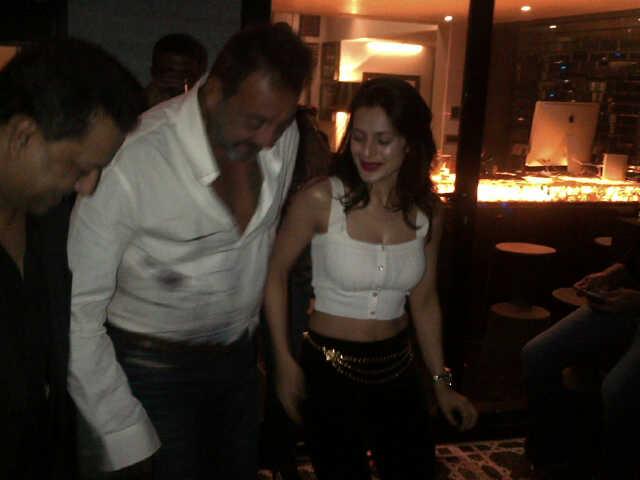
Manisha Koirala, who is returning to the public eye after recovering from cancer, too had the lensmen going click, click, click. Ameesha Patel's sole mate was a spiked number from Christian Louboutin and she gave the occasion a nod with a glittery crown perched perkily on her head.
"More than the New Year, it was a celebration of Sanju's return. There was mostly family members around, I was one of the few outsiders," said the actress who owes her friendship with the Dutts to a "disastrous" movie which she refuses to name.
Ameesha, like everyone else, was wowed by Sanjay's newly-trim body. "He has used his prison time really well. He can give any of the young boys a run for their money with those abs. He has come out a spiritual person, which is really inspiring," she asserted.
Her words were echoed by Gulshan Grover, who was twirling moustaches with his buddy, whom he was meeting after two years. "Sanju is so positive.... And his body is amazing, like a rock!" said an awed Gulshan who himself is fighting fit at 59 and goes to the gym seven days a week.
Interestingly, Gulshan was an assistant professor at Roshan Taneja's acting school where Sanjay enrolled to groom himself for his debut film Rocky, which released in 1981. "Sunil Dutt saab, who was the film's producer-director, spotted me there and offered me the role of Sanju's buddy. We made our debut not just in the same film but also in the same shot. I remember we were on the lawn of the Oberoi Hotel in Sringar and Sanju was singing, Aao mere yaaron aao," he recalls.
"His sisters, Namrata and Priya, are my rakhi sisters. Looking into his warm eyes I was completely overwhelmed. I am glad Manyata had invited me into their home."


------------------
AMEESHA PATEL AT SANJAY DUTT'S BASH:





Kumar Gaurav's daughter Saachi marries Kamal Amrohi's grandson Bilal
7:49 AM

Vickey Lalwani (MUMBAI MIRROR; November 24, 2014)
 In March, Kamal Amrohi's
grandson Bilal confessed his love for Kumar Gaurav and Namrata Dutt's
daughter Saachi and announced that he would marry her one day. Well, the couple who have been dating for the last
four-and-a-half years, have tied the knot.
Namrata confirmed the news saying, “Yes, Saachi has married Bilal. We wanted to keep it quiet, but now that you ask.... We had the option of calling everybody or just the immediate family. We chose the latter.“
The reason the wedding, which happened in Mumbai few days ago, was a hush-hush affair because Namrata's brother and Bunty's best buddy, Sanjay Dutt is in jail. Bilal's father Tajdar, who not so long ago was raving about Saachi saying she is “prettier than most heroines and could have become a top star if she wished,“ was more reticent this time saying, “I'm happy with whatever has happened but I don't wish to elaborate. It's a personal matter.“
Saachi got a diploma in fashion designing from SNDT University in 2006. After a six-month internship with designer Anna Singh, she started her own business and is doing well today. Bilal, who made his debut in Atul Agnihotri's O Teri, has bought a flat in Bandra in the same building as Kangana Ranaut. And buzz is, that's where the couple have started their new life together. “Namrata is very happy that they will be living in Mumbai, close to her,“ says a source close to the family.
Naam: The film Kumar Gaurav made for buddy Sanjay Dutt
7:40 AM

Roshmilla Bhattacharya (MUMBAI MIRROR; October 28, 2014)
Sanjay Dutt's career got off to a Rocky start in '81. Following a battle with drugs and a series of flops, it had hit a dead end five years later. In these testing times, his buddy who became his brother-in-law, Kumar Gaurav, not only stood by him but was determined to make a film that would bring him back into the race. This film was Naam.
The idea of two half-brothers came from Mahesh Bhatt, who during his growing up years was haunted by the ghost of his own illegitimacy. He sketched out the story of Ravi and Vicky to the two young actors and instantly, impulsively, Kumar Gaurav decided to turn it into a film under his banner.
His father, Rajendra Kumar, wasn't convinced, having spotted the dangers inherent in the script. "Even though it was a two-hero project, Rajendra Kumar knew that the audience's sympathies would eventually swing from Kumar Gaurav's character Ravi to Sanju's bad boy Vicky," reasons Bhatt who went on to direct the film.
Naturally, no father would want his son to get over-shadowed in a film he was producing but Kumar Gauarv stood his ground and insisted he wanted to make this film and none other.
Eventually his dad gave in.
Bhatt then took his idea to Salim Khan. After the split of the Salim-Javed jodi, Javed Akhtar was the one getting the plum offers and it was being said that Salim had been just the business component in the partnership that had given Bollywood blockbusters like Sholay, Zanjeer, Trishul and Seeta Aur Geeta. Naam brought Salim Khan back into the spotlight as a scriptwriter and he gave it all he had. "He added box-office sparkle to my offbeat story of two half brothers and turned it into a blockbuster. Naam was my first golden jubilee," reminisces Bhatt.
Sanjay Dutt, he remembers, was like a bhakt who surrendered himself completely to the film with single-minded dedication and boundless energy. "I never saw that kind of focus in Sanju again. With his stunning performance, he broke people's heart. We became a lifelong friend and years later, on the eve of his departure to the Yerwada Jail, I remember sitting with him and feeling as helpless as Kumar Gaurav's character in Naam because there was so little that I could do for him," he sighs.
There's a word of praise for Amrita Singh too who played Sanjay's wife and the mother of his unborn child for whom he finally decides to give up his life of crime and return home. It was like waking up to a new day after a long dark night and was beautifully expressed in the song, Chhiti aaye hai.
"Laxmikant-Pyarelal scored some beautiful songs for the film, but this is the one people still want to talk about whenever I travel to the Middle-East," says Bhatt, recalling how when Rajendra Kumar first heard Anand Bakshi's lyrics he innocently asked about the mukhdas and the anatras, convinced that a song that strayed from the traditional format would not work. Bhatt was far more accepting and Bakshi told their producer, "That's why you have put a younger director in charge. He understands my language, you don't," Once again, Rajendra Kumar gracefully gave in.
Pankaj Udhas, a popular ghazal singer in the '80s, not only recorded it but it was also picturised on him. "Pankaj would shoot for us during the day and sing at concerts at night. He struck a chord with the Indian and Pakistani diaspora," points out Bhatt, adding that Salim saab had stressed on the bonds of brotherhood between the two countries through the friendship of Sanjay and Aakash Khurana, his Pakistani neighbour who stands by him when he is imprisoned in Dubai.
As he signs off Bhatt adds Naam's misguided search for identity would not have had the emotional impact it did without its mother figure. He says, "Nutan wasn't keeping well at the time but she instantly agree to do the role and would come on the sets an hour-and-a-half early to get into the skin of the character. As always she was outstanding!"
Subscribe to:
Posts (Atom)