Showing posts with label Kishore Kumar. Show all posts
Showing posts with label Kishore Kumar. Show all posts
You can’t recreate Kishore Kumar, only celebrate him, say Amit Kumar and Sumeet Kumar
2:41 PM

Debarati S Sen (BOMBAY TIMES; August 4, 2026)
As music lovers celebrate Kishore Kumar’s 97th birth anniversary today, his sons Amit Kumar and Sumeet Kumar reflect on the singer’s enduring legacy after recently paying tribute to him through a special charity concert for cancer patients. In a conversation with Bombay Times, the two speak about the timeless appeal of Kishore Kumar’s songs, and why staying true to his individuality matters more than trying to imitate him. Excerpts...
Your father continues to inspire generations of singers and music lovers’ decades after his passing. What do you think is the secret behind Kishore Kumar's timeless appeal, especially among today's younger audiences?
Amit Kumar: I believe the timeless appeal of my father, Kishore Kumar, lies in the honesty and emotional depth with which he approached his music. He never restricted himself to a particular style or generation. Whether it was romance, joy, heartbreak, or humour, he sang every emotion with remarkable authenticity. His voice had a unique ability to connect directly with the listener's heart. I think today's younger generation continues to relate to his songs because emotions are universal and timeless. His music remains as fresh and relevant today as it was decades ago.
You've spent your life both as Kishore Kumar's son and as an accomplished singer in your own right. When you perform his songs at tribute concerts like this, do you approach them as a son reliving memories or as an artist interpreting a musical classic?
Amit Kumar: It is always a deeply emotional experience for me. I approach his songs both as a son carrying precious memories of my father and as a singer who has immense respect for the artist he was. Every time I sing his songs, I feel a sense of nostalgia, but at the same time, I understand the responsibility of presenting them with sincerity and respect. I do not try to imitate him; instead, I try to preserve the spirit and emotion of his music while allowing my own voice and interpretation to come through. For me, performing his songs is a beautiful way of keeping his memory and musical legacy alive.
Audiences often remember Kishore Kumar for his playful personality and effortless singing. What is one lesser-known quality about him that you wish more people knew?
Amit Kumar: Beyond his extraordinary talent and his well-known sense of humour, my father was a deeply sensitive and emotional person. He had a very strong sense of individuality and was someone who valued simplicity and authenticity. He was also extremely passionate about creativity and believed in doing things in his own unique way. People often remember his laughter and playful nature, but there was a very thoughtful and sensitive side to him as well. I feel that this depth of emotion is one of the reasons why his voice continues to touch people's hearts even today.
If Kishore Kumar were watching today's music industry with streaming platforms, AI-generated music, and changing listening habits how do you think he would have responded to this new era?
Sumeet Kumar: My father was always a very curious and creative person who embraced new ideas in his own unique way. I believe he would have been fascinated by the technological advancements taking place in music today. At the same time, he would have strongly believed that technology can support creativity, but it can never replace genuine emotion and human expression. He would probably have explored these new platforms with his characteristic originality and sense of humour, while continuing to believe that music must come from the heart and connect with the soul of the listener.
As someone carrying forward your father's musical legacy, how do you balance preserving his iconic style while creating your own identity as a performer?
Sumeet Kumar: Carrying forward my father's legacy is both an honour and a great responsibility. I believe that preserving his legacy does not mean simply imitating him; it means respecting the values, emotions, and musical spirit that made his work timeless. I try to present his songs with the same sincerity and love while bringing my own personality and interpretation to every performance. My father has been my greatest inspiration, but I also believe that every artist must find their own voice. My endeavour is to celebrate his timeless music while continuing to grow and establish my own identity as a performer.
Sulakshana Pandit was too sensitive and honest for the business-Shweta Pandit
8:44 AM

Shweta Pandit remembers her aunt, singer-actor Sulakshana Pandit, as ‘a woman ahead of her time who never got her due’
Vishakha Pandit (HINDUSTAN TIMES; November 10, 2025)
Veteran playback singer and actor Sulakshana Pandit died on Thursday at 71 following a heart attack, closing a luminous chapter in one of India’s most musically gifted families.
Sulakshana’s velvety voice defined the tender, romantic tone of 1970s Hindi cinema. She also charmed audiences on screen, becoming, as her niece actor-singer Shweta Pandit notes, “the only other female artiste after Nargis (Dutt) ji and Suraiya ji to be both a professional playback singer and a leading actor”.
Remembering her aunt, Shweta says Sulakshana “never received the recognition she truly deserved”. “She was immensely talented but she was too sensitive and honest for the business,” she adds.
Born in Madhya Pradesh, Sulakshana grew up in a home where music wasn’t just a passion, it was the family language. Her father, Pratap Narain Pandit, served as the state’s chief musician and was a respected Hindustani classical vocalist. Her brothers Jatin and Lalit would later form the celebrated composer duo Jatin–Lalit, while Mandheer Pandit (Shweta’s father) mastered the tabla, and her sister Vijayta Pandit followed her into singing and films.
“After our family moved to Mumbai in the late 1950s, her voice quickly found its stage. She recorded her first song at nine and performed with legends like Kishore Kumar,” Shweta recalls.
By the mid-1980s, Sulakshana quietly withdrew from the spotlight. “She got tired of how things worked,” Shweta says. “At that time, artistes didn’t have the management support they do now. She needed that guidance but never had it.”
In later years, Sulakshana battled health issues after a fall left her bedridden: “She was actually struggling with depression, something rarely spoken about then.”
To her niece, she will always remain the first superstar of their family’s cinematic journey. “She carried the Pandit family’s name into films and was my guru,” Shweta says, adding, “Once, Shammi Kapoor ji heard my name and smiled, saying, ‘The Kapoor family is the first family of cinema, and the Pandit family is the first family of music’. That was the biggest compliment.”
Bollywood hits the rewind button, turning the lens on its legends
9:40 AM

Artistes’ popularity, lower costs make the genre promising bet for producers
Rajesh N Naidu (THE ECONOMIC TIMES; October 6, 2025)
Mumbai: Producers are turning to biopics on celebrated film personalities, drawn by their emotional depth, lower marketing costs, safer returns and audiences' growing fondness for real, inspiring stories from the world of cinema, writers and trade insiders told ET.
Over the next two years, Bollywood producers are set to release a wave of biopics on film legends such as Dadasaheb Phalke, Meena Kumari, Kishore Kumar, Parveen Babi, Madhubala and Ilaiyaraaja, as the industry increasingly turns the camera inward amid a broader boom in biographical films across politics, history, science, sports and mythology.
"These biopics have an advantage. Largely, audiences are inquisitive about the personal lives of their favourite film artists," said Girish Johar, producer and film business expert. "But for those who are not admirers or fans of these artists, the merit of these biopics will be tested only on how their stories are told," he added.
A key concern among directors and writers about biopics on film artists is the authenticity of their portrayal, a nuance that many past films failed to capture.
"I am keen on watching a biopic about the actress Meena Kumari given her body of work, personality and the enigma around her. But a key question remains: Will the film on Meena Kumari deal with the critical aspects of her life or just one prominent aspect of her life?," said veteran writer-director Nilaskhi Sengupta. "Ultimately, it is the authentic portrayal of such artists which will decide how well they will be received," she added.
In recent years, creative works based on the film industry and artists have received high critical acclaim. In India, the web series Jubilee, which showed the 1940s era of the Hindi film industry received favourable response from the audience.
Lastly, costs also play a role in this trend. "Indian audiences have an immediate connection with biopics on film artists. For producers, who are under-confident in backing original stories due to polarized responses to films, a biopic on a film artist reduces at least the marketing and promotion costs," said Ameya Naik, founder of Fantasy Films, an event management company.
Whenever I sing, I imagine an 18 or 20 year old singing-Shaan
4:21 PM

Priyanka Sharma (MID-DAY; September 15, 2025)
How does one keep the passion for their art alive over a 26-year singing career? With riyaaz, dedication, and the knowledge that the craft is almost like a lover you can’t stay away from, chuckles Shaan. In a free-wheeling chat with mid-day, the singer — who voiced Bam Bam Bhole in Sikandar and is looking forward to his upcoming song from Farhan Akhtar’s 120 Bahadur — opens up about holding on to the magic of one’s voice despite ageing, and his secret to sounding young, year on year. Excerpts from the interview.
Is it tough to keep a 26-year relationship with music alive?
Love happens first, and then it turns into a profession. What comes first will stay till the end. Obviously, there will be a point when the voice may not be how it should be. But in terms of appreciating and having an ear for music, that will always stay. For me and any singer, it can be frustrating [to be at a point] when we’re alive and not able to sing. It’s like being estranged from your lover. We have a crazy, ek tarfa pyaar with our voice.
With love comes commitment that an artiste has to their craft. After all these years, is it difficult to be disciplined and adhere to your riyaaz?
Honestly, my riyaaz has increased because after a certain point, the voice gets delicate. I started doing more riyaaz after my 40s. Until I met my guruji, my riyaaz was erratic. Sitting down, practising a bandish or doing a sargam — all that started only after 30. But by the time I got to 40, I could see a slight [change in my voice]. I could also see a lot of my seniors sounding older. I wouldn’t want that to happen with my voice. So, the only way I could postpone it was by doing riyaaz.
What do you feel is the key to your voice sounding young?
I feel young. Whenever I sing, I imagine an 18- or 20-year-old singing. Also, I often get youthful songs. If I were told that I would be singing for a mature, aged person, I would modulate my voice that way. But mostly, our romantic heroes are young. Even if they’re in their 50s or 60s, it’s important to sound young for them (laughs).
As a ’90s kid, I grew up listening to you, Sonu Nigam and many other voices, each of which was distinct. Today, it gets difficult to differentiate one singer from another, except Arijit Singh. Is it the demand today that voices sound similar?
It’s the Arijit effect; everyone wants to sound like him. Arijit is an intelligent singer. So, sometimes he surprises you with a different tonality. His voice is so popular with the [decision makers] in the industry that they think, ‘If we can’t get Arijit, at least let us get someone who sounds like him’. A singer doesn’t have much choice.
Also, aspiring singers, who have been listening to Arijit and Atif [Aslam] for 10-15 years, will think that if they sound like them, they will probably get a job. I had a similar situation when I started out. They would ask me, ‘Are you Kishore Kumar or Mohammed Rafi?’ They were two strong schools of singing. Udit ji [Narayan] had a touch of Rafi saab’s style of singing, and [Kumar] Sanu da was from the Kishore Kumar school.
So, what did you do?
I came from Hindi pop and there was no precedent to it. There was no one who was doing pop for me to copy. So, I was an original voice.
Nose no limits; How Himesh Reshammiya became a Lord and a meme
3:19 PM

Mohua Das (THE TIMES OF INDIA; September 7, 2025)
These days, Himesh Reshammiya enters the stage like Batman might. He doesn’t walk on so much as emerge through smoke and trap door in black flared cape and sunglasses. The cap is firmly welded to his head and has become the leitmotif of his Cap Mania Tour, with a giant red replica looming over the stage.
“The cap happened because I lost my hair. It was the best look possible then but created an emotional connect,” he says. The admission is oddly disarming. His camouflage attempt spawned parodies but made him instantly recognizable. The transplanted hair that followed has been mercurial too — silky curtains, poker-straight spikes, side-swept bangs, retro shag. And while the hair styles may change, the nasal twang remains non-negotiable. Only some artists can turn what they were once mocked for into a punchline. Himesh, now 52, does that with ease. On stage, he asks fans: “Naak se gaaun kya?” (Should I sing from my nose?) and the stadium roars back, “Yes!”
That twang has carried him further than even he’d imagined. Along with Beyonce, Lady Gaga, Coldplay and Ed Sheeran, he’s made it to Bloomberg’s Pop Power List. Debuting at No 22, he is the first Indian to do so. The feat, he says, isn’t a fluke. “My strength has always been as a composer who knew how to spot the X-factor. My voice needed Himesh the composer to deliver those 50 back-to-back hits.”
It sounds faintly absurd phrased that way, except for one thing. The ranking is based on seven data-driven metrics including live revenues, ticket sales, digital song streams and social media following. “The numbers have spoken, so I've nothing to add,” he deadpans.
He’s had his share of critics. About ‘Jhalak Dikhla Jaa’, which released 20 years ago, he recalls, “People loved the song and I got awards, yet they asked, ‘Arre naak se kyun gaa raha hai?’ (Why are you singing nasally?)”
Fast-forward to 2025, and fans dressed in HR-emblazoned caps and jackets watch Reshammiya sing ‘tera tera… surroooor’, the song that launched a thousand memes and is now chanted by Gen Z in sold-out stadiums with the kind of fervour you usually witness for boybands and cricket finals.
The Delhi and Mumbai concerts saw 50,000 turn up. When Mumbai sold out, fans flew to Delhi where the concert was over two nights because one wasn’t enough. Though the show was meant to close at 10 pm, Himesh informed the crowd, “Aaj main mood mein aa gaya hoon,” and carried on for another hour. Nobody complained.
This is the same man who once baffled linguists by releasing an album titled ‘Aap Kaa Surroor’ with the respectful ‘Aap’ not even used once. Instead, it was Tera on a loop — Naam Hai Tera, Tera Fitoor, Tera Mera Milna, Tera Aana, Tera Deewana — like a Freudian fixation running through his discography like a watermark. Now, after two decades, five movies, a hair transplant, a vocal-cord surgery that gifted him a second bass octave, and a six-pack, he has been rebranded by fans as ‘Lord Himesh’.
His unlikely comeback began with Surroorgasm. Not a medical condition but a meme page that mutated into a stan account with nearly 1.5 lakh followers on Instagram.
Soon came spin-offs like Himesh Doing Things. Exhibit A: Himesh as a gym bro downing protein. Exhibit B: Himesh slow-walking through a desert in a black trench coat embodying global warming. Exhibit C: Himesh licking his lips diagonally for the first time. “I love it,” he says about his meme-ification. His listeners, he insists, were always there at parties, weddings and clubs. “Even when the films didn’t work.”
Every singer, he argues, has a USP. The nasal twang is his. “It’s not a gimmick,” he insists, but a lineage. “Even Kishore da (Kumar) loved K L Saigal saab, who was nasal. Our roots have always been nasal.”
But the “real Himesh” he explains, is about smuggling complex ragas to unsuspecting masses, the way a parent sneaks veggies into a child’s sandwich. “Sometimes it’s a pure raga, sometimes a mishra raga. Sanam Mere Humraaz, for instance, was raga Bhairav in disguise,” he holds forth. His trick, he says, is simplifying India’s musical DNA until everyone can hum it on the bus.
Something he learnt from his father, composer Vipin Reshammiya, one of the first to plug electronica into Bollywood. “Composing was in my blood. But he taught me how to compose for the common man with high-standard notes.” Armed with that formula, Reshammiya built himself an arsenal of 350 songs — tragic ballads, shaadi bangers, heartbreak anthems — you name it.
He has his own homegrown focus group of family, neighbours, school friends. He plays them a tune, watches their reactions, and sorts the track into cool urban, desi, or universal. If they love it, it stays. If they don’t, it gets tweaked until they do. He now has a library of more than 2,000 songs. “Even today, I compose one a day.”
The point, he adds, was never to stay a ‘panchwa gayak’ (fifth backup singer).” Playback felt too small a box. “Michael Jackson never sang for Tom Cruise, did he?” His ambition was to be “a complete package. Voice, composition, visual character.” His signature chant: “Jai Mata di, let’s rock!” is part of the package, and it works equally well in stadiums, on Instagram, and at Vaishno Devi, where he’s performed half a dozen jagrans in recent years.
But his way back into the public imagination was ‘Badass Ravi Kumar’, a retro ’80s-type action film released in February where he leans into his memes, sprinting across Florence’s Duomo roof, slicing villains in half, and gnawing on an unlit cigarette because the line goes: ‘Woh cigarette peeta nahi hai par cigarette ke bina jeeta nahi hai (He doesn’t smoke but can’t live without his cigarette).’ “The film’s tagline was ‘logic is optional’,” he deadpans.
And it lived up to it. It’s the sort of absurd that saw fans on Reddit and elsewhere induct ‘Badass Ravi Kumar’ into the “so-bad-it’s-good” hall of fame. The Rs 20-crore film made over Rs 25 crore in its first run and unleashed the sort of delirium in theatres that big stars now crave as multiplex footfalls thin. Apparently, OTT platforms are now fighting over rights. “I just needed one film to give me that ‘hit actor’ tag that connected with the youth,” he says, fully aware that Gen Z discovered Ravi Kumar first and only later dug into Reshammiya’s catalogue of nasal bangers.
In a curious prequel to his pop stardom, while most 17-year-olds were solving algebra, “I produced my first Hindi show, ‘Andaz’ in the ’80s,” he recalls, starring heavyweights like Kulbhushan Kharbanda, Poonam Dhillon, Prem Chopra and others.
Ask Reshammiya about hobbies, and he valiantly says, “Cricket and board games.” His wife, sitting nearby, cuts in. “He’s giving you fakeology! Basically, he eats, sleeps, drinks, travels, dreams only films. He has no hobbies!”
Reshammiya laughs but doesn’t protest too hard. “We’re lucky that our hobby is our profession.” If Sonia keeps him grounded, she’s also the reason his cap matches his cape. “She’s my stylist and says heads should turn when I enter a room. My curated look and fitness are part of the job.”
So, what other summits does he want to scale? “I’m a very bad dancer,” he admits, “but I’m going to learn so that in ten years I can perform with a six-pack.” Before you raise an eyebrow, he talks about his next project: “An English-language global pop blockbuster.” He says he’s already written and sung 15 tracks, due this December.
And will it be nasal? He doesn’t flinch. “See, my basic texture will always be there. But the grammar, production, composition… those will be genuinely international.”
The nose, it turns out, knows no borders.
We lack good comedy writers; hum bhi improvise kar sakte hai par kuch likha toh ho-Johny Lever
9:14 AM

Onkar Kulkarni (BOMBAY TIMES; July 22, 2025)
Veteran comedian Johny Lever, who has entertained audiences for over four decades, has consciously cut down on work in recent years. The reason, he says, is simple - the lack of strong, inspiring roles. He adds, “When someone approaches me with a project, I try to see how I can take it a notch higher with my inputs. If the role is not interesting, why would I ruin my name by taking up mediocre work?”
‘Comedy pe zyada kaam nahi ho raha hai’
Last seen in Housefull 5, Lever observes that comedy is no longer being explored as actively in films. “Comedy ko kum kar diya hai, uss pe zyada kaam nahi ho raha hai. Comedy has become tough now. People are watching so much comedy in form of reels, toh aur zyada innovative comedy laaye kahan se? Also, we lack good comedy writers. Usually, we improvise and enhance a scene. Legends like Mehmood saab and Kishore Kumar saab would add their own inputs to the script. Hum bhi kar sakte hai par kuch likha toh ho. Kuch dhaancha ho toh uske upar kuch sajayenge na. Dhaancha hi nahi hai toh kya karenge? For now, there’s only action in abundance in movies.”
‘We used to observe people & imbibe their body language’
Lever also feels there are very few actors today who are keen on doing comedy or who can pull it off well. He says, “The thing is, today everybody is trained in a film school. But the theoretical knowledge doesn’t work on set. When you are on a set, you have to follow the cues of the team members. We used to observe people and imbibe their body language for our characters. Character ko andar se jeete the. Pagalon ki tarah kaam karte the.”
‘Comedy mera shauk tha aur phir mera profession ban gaya’
One of the reasons he supported daughter Jamie Lever’s decision to step into comedy is that he didn’t receive that kind of support from his own father. “Whenever I used to go on stage, my dad used to come to hit me. Once, I was performing at the Shanmukhananda Hall in Mumbai, and he came with a rubber pipe and began chasing me. The audience thought it was part of the act and started laughing and clapping,” he says.
On a nostalgic note, he says, “One day, I shot an ad and was paid Rs 25,000. It was equivalent to dad’s provident fund, which he received after 25 years of service. That is when he realized, ‘Mera beta kuch kar raha hai.’ He would be surprised to see people clap and laugh while watching me perform. It opened his eyes. Comedy mera shauk tha aur phir woh mera profession ban gaya.”
‘Comedy is in Jamie’s blood’
Lever, known for his roles in Baazigar, Koi… Mil Gaya, Awara Paagal Deewana and Golmaal Again, beams with pride when speaking about his daughter Jamie, who has carved a niche in the comedy space. “See, that’s in her blood. Initially, she didn’t plan to pursue comedy as a career. She was studying in London. One day she visited a café with her friends where a live stand-up performance was on and she suddenly told her friends, ‘Yeh barabar nahi kar raha. He is missing all the punches.’ She pointed out where the comedian could have added the punches. Then she called her mom up and said she aspires to do stand-up. Pehle mujhe gussa aa gaya, because I’ve been through struggles, and I was worried that my daughter would also have to go through that,” he says.
Anurag Basu on Kishore Kumar biopic: "Keeping my fingers crossed that it happens this time"
8:50 AM
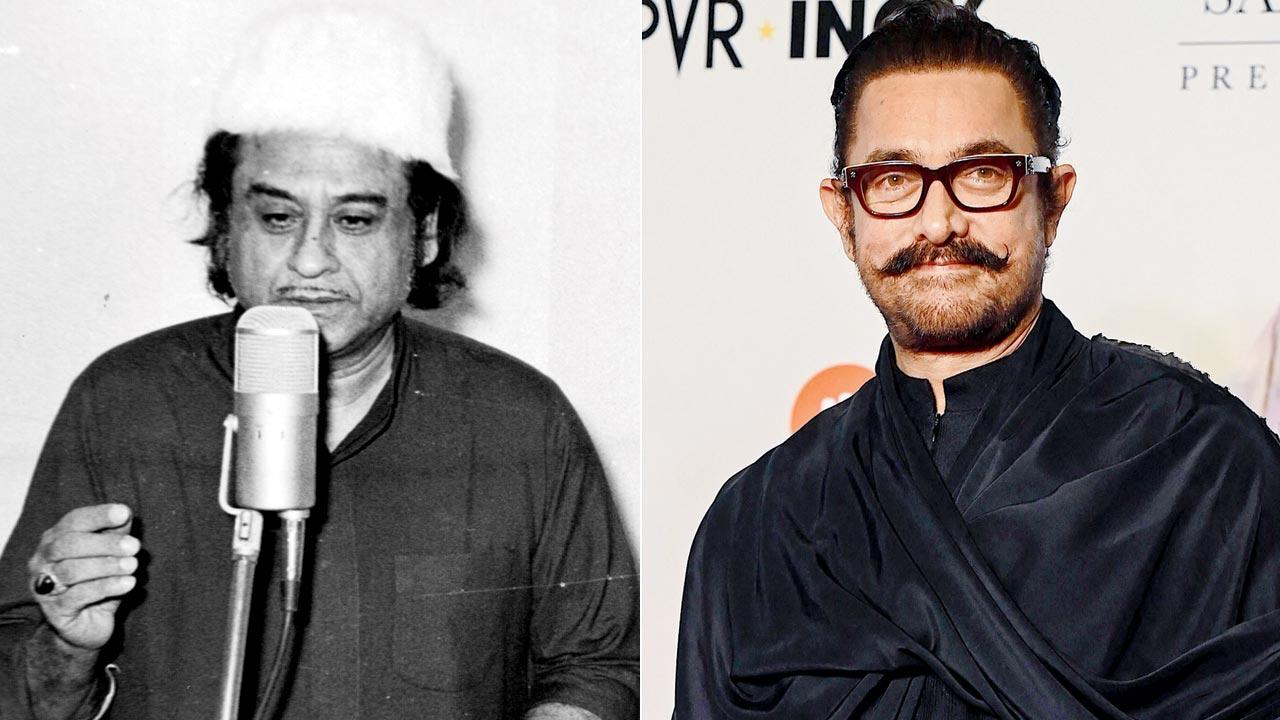
Amid rumours that Aamir Khan will headline the Kishore Kumar biopic, filmmaker Anurag Basu says he hopes to roll his decade-in-the-making film soon without jinxing it
Priyanka Sharma (MID-DAY; July 8, 2025)
A biopic of Kishore Kumar has long fascinated filmmaker Anurag Basu, and for good reason. The late singer and actor greatly influenced Hindi cinema’s music landscape. While Ranbir Kapoor was initially attached to lead the biopic, recent rumours suggested that Aamir Khan would step into the shoes of the maverick artiste. So, as we caught up with the filmmaker, we asked if he was indeed set to direct Khan on his passion project.
“No comment,” he chuckled, before adding, “Until everything is finalized and the contract is signed, I don’t think I should speak on it.”
Basu’s long-cherished project has gone through an eventful journey, with the makers earlier struggling to get the approval of Kumar’s kin for the story.
“This project went through a lot of ups and downs. So, I’m keeping my fingers crossed that it happens this time and I go on set with the story, which I’ve been trying to tell for the last decade. So, I won’t jinx it by speaking about it.”
Rumours have also surfaced about his reunion with Kapoor, who led his past offerings Jagga Jasoos (2017) and Barfi (2012). The director is hopeful of a third outing, as he said, “I hope it happens soon. Woh aadat bohot kharab kar deta hai [he spoils you a lot]. We keep talking about working together again.”
When not talking films, the duo talks about Kapoor’s lifestyle brand. “He has gifted me a pair of shoes again. Pehli baar galat size bheje thhe,” Basu laughed.
Music logon ko theatre tak kheench ke laata hai-Kumar Sanu
2:50 PM

Debarati S Sen (BOMBAY TIMES; January 25, 2025)
In his career spanning almost four decades, Kumar Sanu has sung around 22,000 songs in 26 languages. And recently, he also recorded an English number, 9 to 5, with his daughter Shannon K. In a conversation with us, the Aashiqui singer spoke about his initial struggles, the challenges he overcame in the music world, and the joy in collaborating with his daughter.
For someone who has been singing for around 40 years, you initially did not aspire to be a singer. How do you reflect on your journey?
I didn’t dream of becoming a singer. I was a tabla player and a good painter. However, circumstances changed my decision. I was around 16 years old when I started doing stage shows in Kolkata. My desire to become a singer grew, and I began singing in hotels there. When I came to Mumbai, I sang in hotels and saved money to make a demo cassette that I’d play for music directors. Jagjit Singh ji discovered me and introduced me to Kalyanji-Anandji. I would do covers of Kishore Kumar’s songs. Later, for Jaadugar, they made Amitabh Bachchan listen to my songs, and he agreed to have me as the playback singer. That’s how it all began. I struggled for around 18 years in Mumbai before I became a name.
At the beginning of your career, you were called Kishore Kumar’s clone. How did you deal with that?
After Aashiqui became a hit, things changed. Mere upar ilzaam tha ki main Kishore da ka nakalchi tha, but Aashiqui gave me the opportunity to get rid of that. Uss picture ke gaano ko log tees saalon ke baad bhi bhule nahin. After Aashiqui, I kept getting offers. It went from, ‘theek hai, gawa le isse’, to ‘Sir, please mera gaana gaa dijiye’. I’ve seen it all.
The number of songs that Bollywood films feature today has reduced considerably. Do you think that earlier film songs were a big draw for the audiences?
Films flop miserably despite makers spending crores on them. They should understand that they have to pay close attention to the story and the music and give a free hand to the music director. I believe that music logon ko theatre tak kheench ke laata hai.
You once said, ‘Main Bollywood politics jhel raha hoon’. What did you mean by that?
Yeh politics hamaare legendary singers ne bhi jheli hai, hum bhi jhel rahe hain, aur future singers bhi jhelenge. It’s not new, but the industry wasn’t as cruel earlier. People were kind-hearted. But I believe you can’t stop talent. With the help of politics, you may get fame temporarily, but only real talent will last for years. I also feel songs have changed. Earlier, there were more melodies, great lyrics and Urdu shayari, but abhi halkapan hai. It may change again in the future.
I admire my dad’s positive attitude, says Shannon
Recently, Kumar Sanu and his daughter Shannon, an independent singer who began her Bollywood career with Happy Hardy and Heer recorded an English song.
Ask him about the experience, and he says, “Initially, I didn’t want to sing the song because there was a portion in English. Shannon ki accent ke wajah se main darr raha tha (laughs). My younger daughter Annabelle is a songwriter and she insisted that I sing this song. Now, I am glad I did it.”
Talking about collaborating with her dad, Shannon shares, “He was very concerned about the diction. He wanted to make sure that he justified the language and would keep asking me how to pronounce certain words. It was fun for me, I’m not sure about him!”
The young singer says that her father is her inspiration in every way. “I admire his positive attitude towards life. It is so easy to fall prey to negativity around, but dad’s positive spirit, way of looking at life, and attitude are things that I really admire and hope to emulate,” she says.
If you make a hundred songs, at least one will be a hit. That can be profitable for you-Sanjay Tandon
8:59 AM
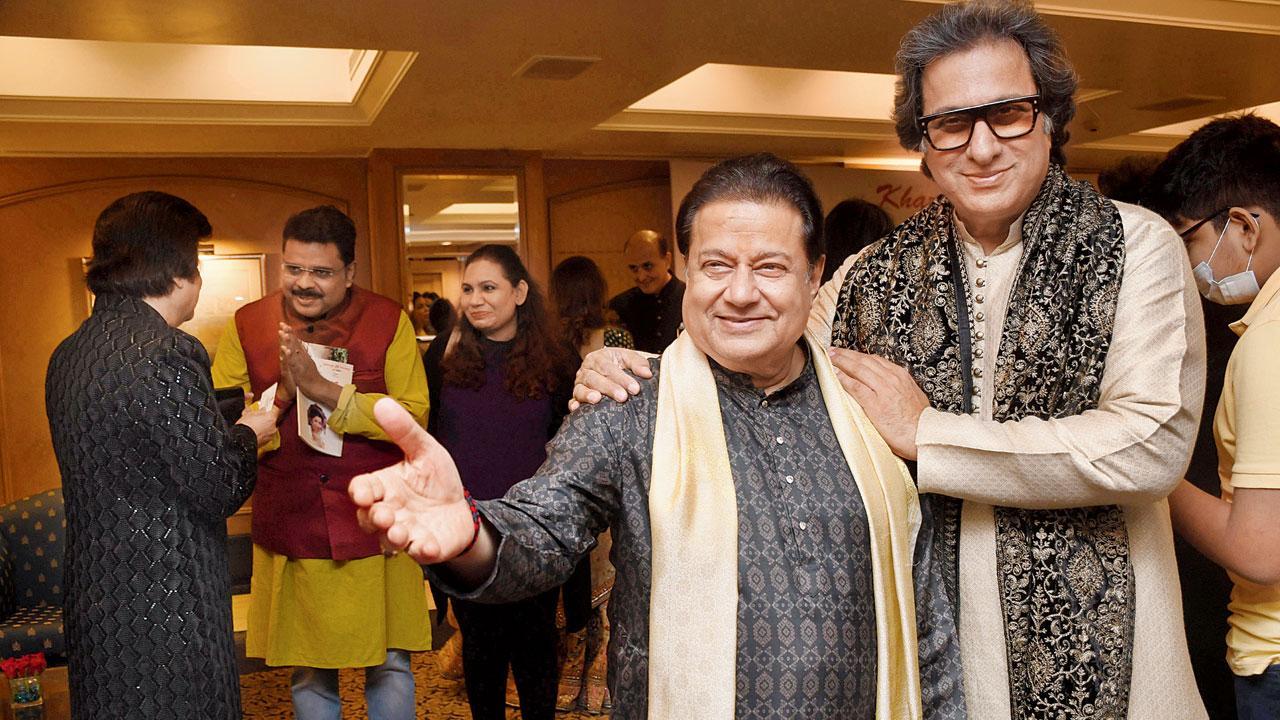
Jalota and Aziz
As they unravel the process of acquiring royalties, ISAMRA bosses Jalota, Aziz, and Tandon on why artistes should make “as much music as possible” to safeguard their futures
Parth Srivastava (MID-DAY; July 15, 2024)
Established in 2013, the Indian Singers and Musicians Rights Association (ISAMRA) has been spearheading the fight for monetary benefits for musicians in the film industry. Navigating the workings of music labels and associations to ensure that artistes earn their due royalties, the board of directors tells mid-day that they have worked towards tweaking laws that do not favour those who do the leg work.
The organization's CEO, Sanjay Tandon, says that in this day and age, “being aware of your rights” is imperative. “As a collecting body, we collect royalties on behalf of artistes, and subsequently pay them. Only in the recent past have musicians raised questions on these aspects, and our organization is working as the middleman to facilitate this exchange [of money],” he says.
A discussion on royalty becomes important in a world that’s increasingly dependent on artificial intelligence. With voice samples of artistes being fed to software that subsequently generates a new song in the desired voice, we ask Tandon if the rights of musicians are indeed protected.
“As of now, if people are using AI to create content for social media, we aren’t taking any steps. However, if they [are deriving monetary benefits by] uploading it on YouTube or other similar platforms, we are imposing copyright strikes.”
Chairman Anup Jalota, who has leveraged his stature to push for reforms in royalty distribution, has been instrumental in shaping policies that favour fair compensation. “Singers and musicians have always been under the hand of [music] publishers. We ensure that if a member’s song is played, either digitally or on the radio, they are compensated. However, if the song is never played, we cannot pay them,” says Jalota.
In a bid to put money into the hands of musicians, Tandon thus encourages singers to “sing as many songs as possible”. “Make as many compositions as you can. If you make a hundred songs, at least one will be a hit. And that can be profitable for you.”
At a time when reworking old ditties has become the norm in the industry, Jalota says “the original artiste always gets a share of the royalties”. “Even after the artiste’s demise, their children continue to benefit. For example, the royalties of Kishore Kumar are received by his son, Amit Kumar.”
Ghazal maestro Talat Aziz, who has also been associated with ISAMRA, says artistes must “understand the concept of distribution in music”. His efforts have been pivotal in addressing issues faced by musicians, particularly those working to further the classical music scene. “Those who understand the process can be empowered enough to demand fair compensation. This will help establish standardised practices for royalty distribution.”
Music and laws
- While the use of AI for entertainment purposes is not being objected to, ISAMRA is imposing a copyright strike if the voices of their singers are being generated for commercial purposes using AI tools.
- Only when a song becomes a hit, and is subsequently played on multiple occasions does it yield monetary benefits. The board suggests that artistes create as much work as they can to create a financial basket.
- ISAMRA says after the demise of an artiste, his or her children can continue to earn monetary benefits from royalties.
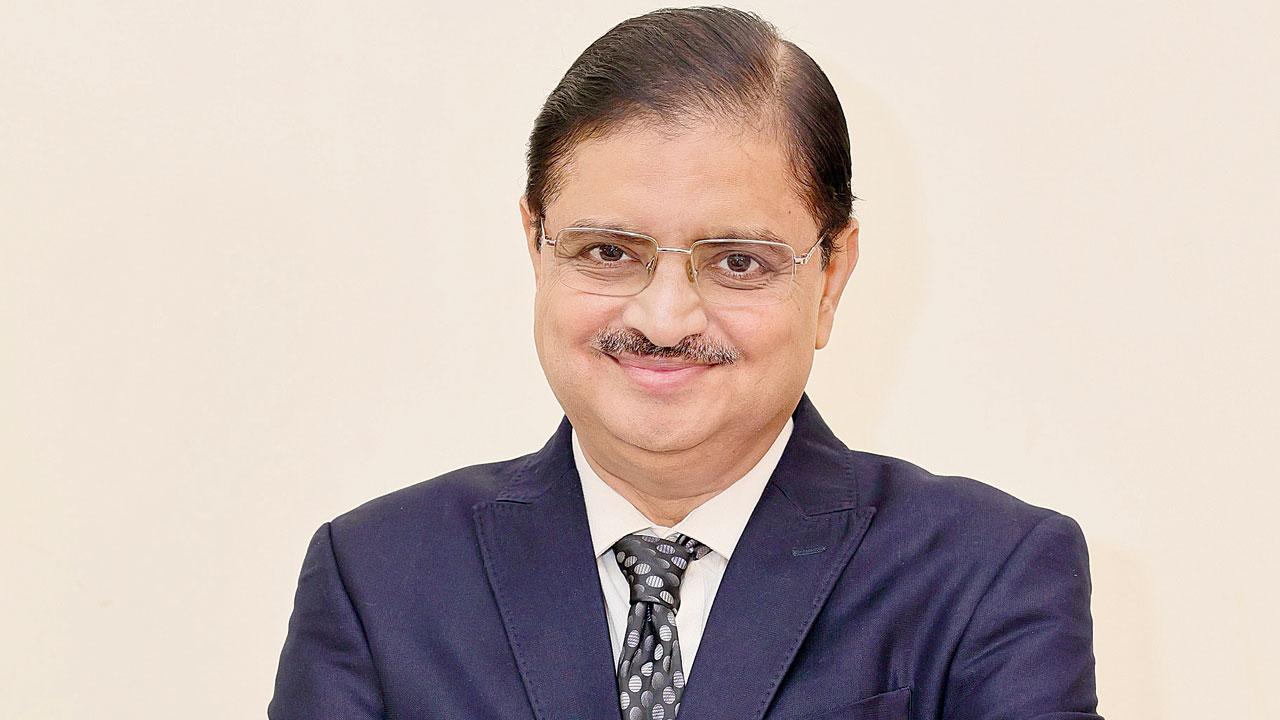
Sanjay Tandon
Radio is far from dying-Shaan
10:21 AM
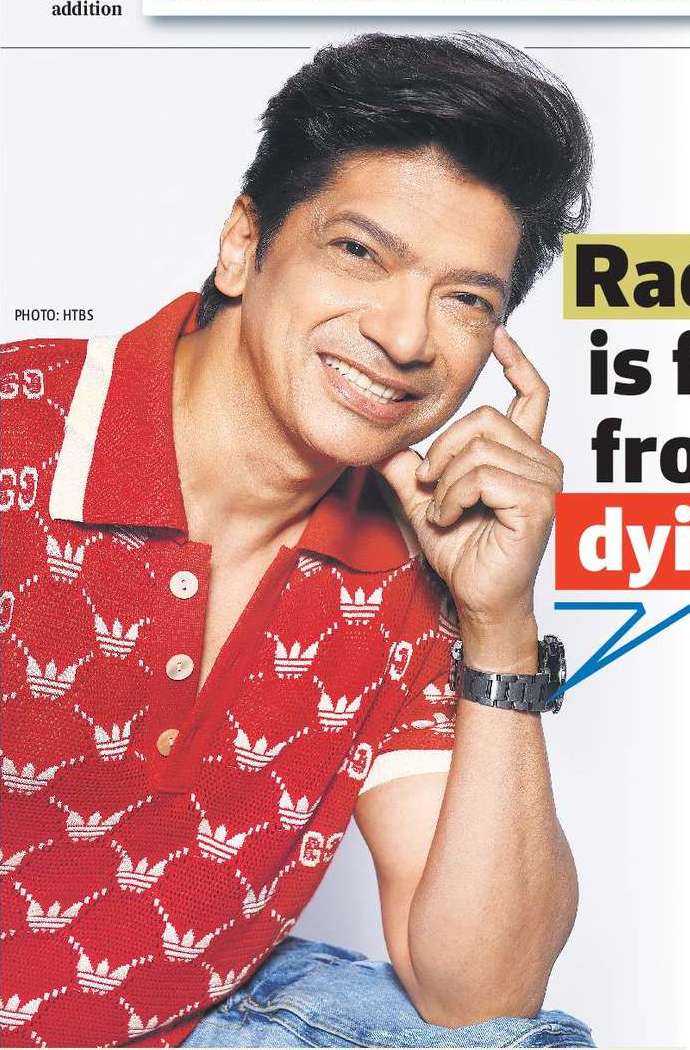
Akash Bhatnagar (HINDUSTAN TIMES; March 10, 2024)
In his illustrious career of over two decades, Shaan has time and again proven his mettle across fields — be it singing, composing, writing or hosting. Adding another feather to his cap, he is now turning RJ with Fever FM’s Crazy For Kishore.
“It’s a blessing that people approach me to try new things and I get these opportunities. If I had just stuck to playback, I would probably have retired or quit,” he tells us.
By trying his hand at a medium that is often misunderstood as outdated, the 51-year-old is proving this label is far from true: “On the contrary, the consumption of audio has gone up in a big way. People today want to use all their senses and multitask. The wonderful thing that radio brings is a sense of surprise, and no other medium can give you that. So, radio is far from dying.”
The singer is glad that through his show, he is getting the chance to honour the legendary Kishore Kumar. When asked how “crazy” he truly was for the late singer growing up, he responds, “Were? I still am and will always be. My connection with him is getting stronger with this show, as I got to know many stories about him that I didn’t before.”
When prodded to dish out one such Kishore da anecdote, Shaan reveals, “When he was very young and Ashok Kumar (late director) sahab was shooting with Madhubala ji (late actor), he hid on the set with a mask on to scare her. She came out screaming from there, and this was their first encounter. Later, they became man and wife.”
Nostalgia is okay to learn from, but it is not a place to live in-Gulzar
8:07 AM

Debarati S Sen (BOMBAY TIMES; January 24, 2024)
The garden at Mumbai’s iconic David Sassoon Library was filled to capacity when acclaimed writer, lyricist, filmmaker and novelist Gulzar inaugurated the literature vertical of the Kala Ghoda Arts Festival 2024 with a session called ‘Yours Truly, with Gulzar’. The conversation led by literary historian Rakhshanda Jalil revolved around Gulzar’s early days in Mumbai, his connect with the city and Marathi literature. Excerpts:
‘I did not come to Mumbai to become an actor or join the film industry’
When asked about how he first landed in the city, Gulzar said, “Bahut purani baat hai, bahut saal hue. Sann kaun yaad rakhta hai, ab toh sann yaad rakhne se umr yaad aane lagti hai. Bahut saal hue Bambai mein aaye. Before I came here, jo baat mashhur saare Hindustan mein thi, usmein yeh tha ki, when a boy would run away from home, people would assume he had gone to Mumbai to become an actor. However, I did not come to here to become an actor or join the film industry. My elder brother was a businessman here, and since Delhi was filled with refugees everywhere and it was tough to live there, I was packed off to Bambai in the Frontier Mail with strict instructions ke, ‘Gaadi se mat utarna kahin. Tum apni ghazal kehte rahoge aur gaadi chali jayegi’. Unn dino double-decker buses sirf Bambai mein the and dumanzila bus bahut badi baat thi. Bori Bunder, Chowpatty mashhoor thi,” he said as he spoke about the city. “Meri baatein bahut mamuli, mamuli si hain, koi gyaan ki baatein nahi hain,” he said.
‘I wanted to see my books in different sizes and fonts’
Gulzar was fond of the Bengali language and is well versed in it. This helped him when he began his career in the film industry. Talking about his entry into films, he shared, “Main filmon mein bahut der ke baad aaya. I used to work in a motor garage where I met Bimal da’s (filmmaker Bimal Roy) assistant Debu, who later began to live with me. In those days, I used to meet Salil da (Salil Choudhury) and Shailendra. I had joined the Bombay Youth Choir created by Kishore da’s (Kishore Kumar) first wife, Ruma Guha Thakurta. But mujhe filmon mein jaana nahi tha because literature was my passion. Books were my passion and I wanted to see my books in different sizes and fonts. I told Debu mujhe nahi jaana filmon mein. Shailendra was a little senior to me and he scolded me and said, ‘Tum kya samajhte ho? Saare unpadh hain industry mein? Bimal da ke paas kahan kahan se log aayein hain naukari dhoonte hue. Aur tumhe aisa mauka mil raha hai!’ So, I went and met Bimal da, who was a legend in cinema. He told Debu in Bangla, ‘Ei bhodrolok ki kore jaanbe Boishnob kobita ta ki’ (How will this gentleman know what Vaishnav kavita is, referring to a situation for a song in his film Bandini). Debu immediately told him, ‘Dada, he knows Bangla very well and understands everything’. And Bimal Da blushed. His beautiful face would become bright red when he blushed. Behrhal unhone mujhe bola Sachin Da se milo. Sachin Da ne mujhe tune batayi and uss pe maine likha, ‘Mora gora ang laile, mujhe Shyam rang dei de’."
‘Maharashtrian toh zaroor keh lete hain log mujhe, which I deserve after staying here for so long’
Gulzar spoke about how he slowly met and got to know the literary greats of Maharashtra. “Gradually, I got to know the Maharashtrian writers here, including some senior writers. In those days, I didn’t understand Marathi well, today I do. But itna mujhe maloom hai ki jo bhi mila, kisi ne mujhe gaali nahi di (in Marathi).”
He interacted with several Maharashtrian writers and poets, like P L Deshpande and Arun Shevate, and also translated their works, including Kusumagraj’s book. “So that’s my relationship with Marathi literature. Ab itne barson mein, deel-daul se kahin jawani me agar patle hote, toh koi mujhe Maratha kehta, lekin Maharashtrian toh zaroor keh lete hain log mujhe, which I deserve after staying here for so long.”
‘Why are only classics being taught in schools?’
Gulzar believes contemporary literature should be included in the syllabus. “Students should know about the poems and literature that is relevant. Har daur ki apni shayari hai, aaj ke students jo textbook mein nazmein padh rahein hain, that is not relevant to this time, because only classic literature is being taught. Why isn’t contemporary literature in the syllabus? Why are only classics being taught in schools? Aaj ka literature hona zaroori hai. That is important. Nostalgia is okay to learn from, but it is not a place to live in.”
55 Years of Padosan: I used to laugh uncontrollably so much that the unit would turn off all the lights-Saira Banu
2:25 PM

Saira Banu took to social media to share some fond memories of the shoot of her film Padosan (1968), which clocked in 55 years on November 29. The film featured her with Sunil Dutt, Mehmood and Kishore Kumar. She wrote, “We are talking about one of the most favourite films of my career, mine, and the public in general. It is Padosan, a film for all occasions and ages. I am glad that I did this because I had refused any work soon after my marriage. It was understood that I would not be carrying on with a professional career.”
She continued, “It was then that Mehmood Bhai as he had earlier approached me for this film came running to Sahib, hugged him close, and kept saying in a rhetorical tone, ‘Yousuf Bhai you have to let Saira do this film for me. I will not let go of you until you say yes please, please.’ Sahab was tickled to the bone and kept repeating laughingly, ‘Mehmood, it is entirely up to Saira, You have to convince her. You have my absolute permission’.”
The veteran actress added, “The cast was so perfectly chosen that even I was initially surprised to see Dutt Saab as a simpleton ‘Gaonwalla’, I mean who could have imagined it? Dutt Saab would humorously say, ‘Saira ji, yeh kyaa hain, yeh hum kyaa kar rahein hain? Hamein toh Anthony and Cleopatra mein kaam karna chahiye, something romantic and glamorous’ (sic).”
‘IT WAS DIFFICULT FOR ME TO STOP LAUGHING ON THE SETS OF PADOSAN’
Directed by Jyoti Swaroop, the musical comedy was a remake of the Bengali film Pasher Bari. Saira Banu concluded her note by saying, “Until Padosan, I hadn’t worked with Dutt Saab, who turned out to be lively and funny. On the contrary, Kishore ji was a very subdued gentlemanly star who would get up from his seat respectfully as soon as any lady walked in. The shooting was a killer. I used to laugh uncontrollably so much that the unit would turn off all the lights and say ‘Ruk jao, abhi madam hass rahin hain’. It was that difficult for me to stop (sic).”
------------------------------------------
ETIMES (November 30, 2023)
Saira Banu reminisces the magic behind 'Padosan' - where Mehmood Bhai's dedication, Sunil Dutt's rib-tickling humor, and Kishore ji's spontaneous creativity turned every scene into a timeless laughter symphony. From the quirky head-shaving ceremony to the stroll in 'Brindavan Gardens,' the film's behind-the-scenes tales are as delightful as its iconic melodies.
In her continued post she wrote, "Continuing with the PADOSAN series, I want to talk about Mehmood Bhai's dedication to his roles. At the "Vrindavan Gardens" Palace, Mehmood Bhai joined our unit to start shooting scenes with me. Soon after his arrival, he sat in the palace verandah with his barber and then we witnessed the funny ceremony of him shaving off his head, giving off his beautiful hair to portray the bald dance teacher Master Pillai with romantic intentions towards 'Bindu'. As the barber shaved, "Tup Tup", tears rolled down his cheeks. We were both sad and amazed, momentarily forgetting our laughter.
The funniest scenes were where Master Pillai alias Mehmood was constantly trying to win over the affection of Bindu. In one scene I am trying to make Bhola jealous when he is standing in the window opposite. In this, I had to hold hands with Mehmood Bhai and rest my head on his big shoulders! It was a scream for both of us because all our lives he had been like a lofty big brother and now doing this scene to enrage Bhola, Sunil Dutt was rib-ticklingly funny. Another favourite scene is where I am strolling in “Brindavan Gardens” with Master Pillai amidst the beautiful greenery and fountains all around, Dutt Saab, Kishore ji and other comedians are walking right behind us eavesdropping trying to hear what we two are talking about (hidden with mobile branches of leaves and trees).
We had an able director Jyoti Swaroop who tried to control us in our fun and frolics while shooting but the major contribution to the making of scenes was inspired on the spot by Kishoreji, Mehmood, and Dutt Saab. For instance, the song “Meri Pyaari Bindu” was choreographed from start to finish by Kishore ji.
"PADOSAN" gifted the world of cinema with timeless melodies and the music of the film was directed by none other than R.D Burman Saab, among them was "Bhai Battur," a melody delivered by the Nightingale of the Indian Music Industry, Lata ji. In one of her interviews, Lata ji expressed that singing "Bhai Bhattur" was a remarkable experience for her, given the song's unique and distinct nature compared to other tunes of the 60s. Similarly, I found shooting for this particular song to be an extraordinary experience".
People say Amit Kumar was born with a silver spoon, but I have also seen the hard life-Amit Kumar
8:30 AM

Debarati S Sen (MID-DAY; October 26, 2023)
Amit Kumar has been the voice of almost all big stars in Bollywood including Dilip Kumar, Sanjay Dutt, Govinda, Anil Kapoor, Rishi Kapoor, Shah Rukh Khan and Salman Khan. In a candid conversation with us at his Juhu home, he admits he is nothing like his genius father Kishore Kumar, talks about the maestro, the ups and downs in his musical career and being in a phase where he is enjoying live performances. Excerpts:
Your father was a genius but also known and loved for his quirkiness. How much of him do you see in yourself?
Oh! We can’t be compared at all!
But would you say that you are temperamental, a trait your father was known to have?
You could say that. My father was temperamental, and I used to be like that, too. I guess all artistes have that to some extent. But my father was also a very down-to-earth person and a very simple man at heart. Earlier, I had a restless mind like him, but over the years, I have calmed down a lot. I regularly meditate now.
Over the years, you sang for almost all the big heroes in Bollywood, but then there was a lull. What do you think was the reason behind that?
My first recording was in 1973, but the song came out five years later. Then sang a duet with Asha Bhosle, and one for Madan Mohan and Salil Choudhary, but none of them released on time. Bade Achhe Lagte Hai (Balika Badhu, 1976) became a popular song even though the film didn’t do so well, and it is my bread-and-butter song even today. My songs in the 1979 film Baton Baton Mein were all hits. With Bappi Lahiri, I did Govinda’s first film, and the song I Am A Street Dancer was a super hit. After that, I sang for films like Afsana Pyar Ka, Kabhi Haan Kabhi Naa and Baaghi. I sang many songs for Anil Kapoor in Tezaab, Judaai, Rakhwala, Khel, Jamai Raja, Kala Baazar, Kishen Kanhaiya and others. I became his voice with hits. There were also many other good songs, but those films didn’t run at the box office, so they weren’t heard by most, just my luck!
Now, you are not actively into playback singing, are you enjoying doing live shows?
I do stage shows frequently. I have performed in Amsterdam and the US recently. In November, again, I will be out of the country. I am also constantly creating and composing music for the digital platform. The fact that people still want to listen to me on stage and buy tickets for my shows is overwhelming. I am 71 and still going strong and loving it. I have been performing on stage for the last 50 years! Whether good or bad, I have played my innings, and now I am relaxed and enjoying this stage of my life.
How do you view your journey in the music industry?
I have never spoken about this, but when I was in the Calcutta Youth Choir, I travelled all over India. We would travel in a third-class compartment in trains, carrying heavy bags. It was tough, but fun. People say Amit Kumar was born with a silver spoon, but I have also seen the hard life. My father used to say you must see all this to grow. When he introduced me at Shanmukhananda Hall (Mumbai) with the show ‘Daddy Kishore and sunny Amit’, it went on for three years, and every single weekend was houseful. It was because of my father, of course, but that made a difference in my life and gave me immense confidence.
Wasn’t your singing style compared to your father? Did you consciously try not to sing like him?
R D Burman had told me in the early days, ‘Don’t try to sing like your father. Don’t clone him. Sing what you are. Just do your own style.’ He egged me on. The composers I worked with helped and I developed my own style.
A lot has been written about your father. What is that one thing that most of his fans don’t know about him?
My father used to do stage shows for the army, but he never publicized that kabhi bhi apna dhol nahi pita. Sab bolte the ki Kishore Kumar kanjoos hai, but no one knew how much he did for others. He did the maximum free shows for the jawans of our country. Not many people know this. I have been doing shows to support cancer patients for the last six to seven years and consider myself extremely fortunate to be able to give back to society. And I too have been doing shows to support cancer patients for the last six to seven years and consider myself extremely lucky to be able to give back to society like this. I am blessed with everything and to be able to do such charity shows, it feels great. This year it is special because my 18-year-old daughter Muktika debuted on stage with me. She isn’t a professional singer, but I feel she has it in her.
Love Story (1981) was your first major hit?
Yes my stardom in playback singing was with Love Story and I became the voice of Kumar Gaurav. We went on to do many films together for five years after which Kumar Gaurav’s films began flopping and slowly, I was out too. Over the years my career has been like the waves in the ocean, full of ups and downs. I did so many songs for Anil Kapoor and became his voice with all the super hit songs! The fact that you journalists are still coming to me for interviews shows I must have done something right.
Your first stage performance was with your father? You weren’t based in Mumbai in those days. How did that happen - coming from Kolkata where you stayed with your mom, and working here?
I landed in Bombay when I was 19. My father introduced me for the first time on stage 50 years ago in 1973, at Shanmukhananda Hall. Then we went on to Europe, America, all over the world for shows. People talk of my father, but no one speaks about my mother, Ruma Guha Thakurta. She was instrumental in my life, encouraged me a lot. I used to sing in her group, Calcutta Youth Choir that she set up along with Salil Chowdhury and Satyajit Ray. I grew up in Uttam Babu’s (film star Uttam Kumar) neighbourhood. My first stage program was during Durga Puja, and Uttam Kumar had called my mother saying, ‘Ruma your son is a good singer, will he sing on stage?’. My mother refused saying he has studies. But he coaxed me to sing anyway. I rehearsed four songs but sang 10 and got Rs 800 for that show and we friends went over to Park Street the same night and spent all the money eating there.
My ma wanted me to have a stable career like a doctor as she knew music was not a steady profession. She complained to my father, ‘Your son is singing here and there, not studying. Gali gali mein gaana ga raha hai awaara jaisa. Fail ho gaya hai (at the famous institution Patha Bhavan). But my Baba hearing all this said, ‘Very good, very good! Time for him to come to me in Bombay’. That was typical of my father (laughs) He then came to Kolkata and saw me perform live at Rabindra Sadan. He said never keep a seat for me because the audience will get distracted and won’t hear you. So, he watched me from backstage. That’s when he was convinced. I learnt classical music for a bit but bouncer gaya. I learnt tabla and then it all began. Music directors like R D Burman, who was like family, Kalyanji Anandji, Laxmikant Pyarelal, Rajesh Roshan, they stood by me. They knew how to extract the best from me and I learnt a lot through experience.
Kishore Kumar’s granddaughter Muktika Ganguly to mark stage debut with son Amit Kumar
8:28 AM
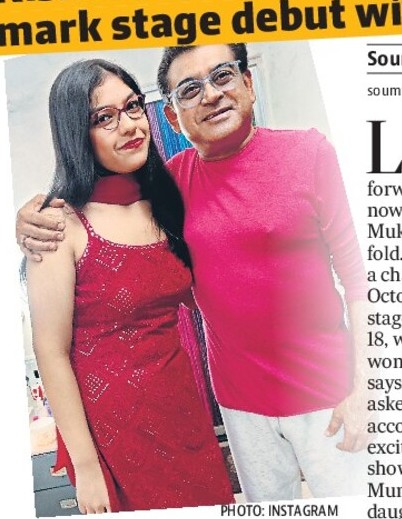
Soumya Vajpayee (HINDUSTAN TIMES; October 4, 2023)
Late singer Kishore Kumar’s son, singer Amit Kumar, took his legacy forward decades ago. And now, his granddaughter, Muktika Ganguly, joins the fold. She is set for her first gig, a charity show in Mumbai on October 7. Set to share the stage with her dad, Muktika, 18, will raise funds to support women cancer survivors.
Amit says, “When the organisers asked me if she could accompany me on stage, I got excited. I performed my first show with my daddy in 1971 in Mumbai and now, my daughter will accompany me. It’s like life coming full circle.”
He adds, “I never told her, ‘You have to do music and take the family’s musical tradition forward’. It’s not easy to carry the legacy forward. I have done it for years and I know how difficult it is to do that.”
Amit feels if Muktika has to make a career in Bollywood, “she will have to be diplomatic and will have to learn classical music”.
Ranveer Singh strong contender for Kishore Kumar biopic, since Ranbir Kapoor decided to take a break after Animal?
8:57 AM
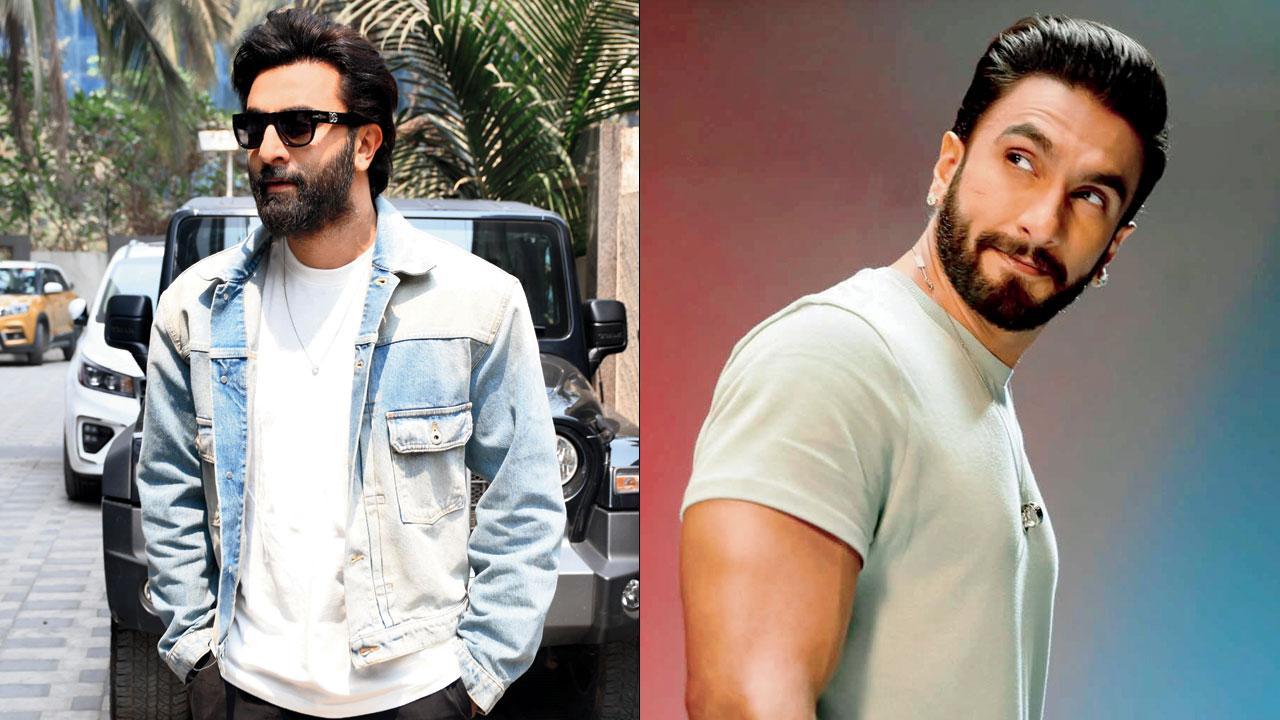
Sources say Ranveer contender for the Kishore Kumar biopic, since original choice Ranbir plans to take a break after Animal
Mohar Basu (MID-DAY; May 27, 2023)
Over the past 11 years, Ranbir Kapoor and filmmaker Anurag Basu have been developing the script of the Kishore Kumar biopic — a fact that was reiterated by the actor at an event in February. But in the latest development, one hears that Ranveer Singh has emerged as a strong contender to lead the film on the late legendary singer. So, what has brought on the surprising turn of events? Sources are attributing it to Kapoor’s desire to take a short break after the August release of Animal.
Recently, the actor revealed that he would take some time-off after Sandeep Reddy Vanga’s directorial venture to understand where the film industry stands after the pandemic, and weigh in on his next move. This has left many wondering whether he will continue to be a part of Basu’s passion project.
A source says, “With the makers now discussing the possibility of a casting change, Ranveer has emerged as an obvious choice. His ability to immerse himself in a wide range of characters makes him a perfect fit to bring the maestro’s maverick personality to the screen. But Anurag is still hopeful about casting his frequent collaborator Ranbir. The top brass at T-Series, which is bankrolling the film, will take a call after August as they want to take the movie on floors by the year-end.”
When Kishore Kumar's biopic gave Soumik Sen the idea for Jubilee
8:23 AM

Jubilee co-creator reveals how scripting of Kishore Kumar biopic led him to explore ’50s film industry that forms the series' crux
Hiren Kotwani (MID-DAY; April 7, 2023)
Their love for cinema has seen many filmmakers tell stories set in the Indian film industry. Vikramaditya Motwane and co-creator Soumik Sen take a stab at it with Jubilee, Amazon Prime Video’s marquee series that stars Prosenjit Chatterjee, Aditi Rao Hydari, Aparshakti Khurana and Wamiqa Gabbi. Sen surprises us when he says that the period drama has its roots in the Kishore Kumar biopic that he was scripting for Anurag Basu, and was to star Ranbir Kapoor.
“While working on the Kishore Kumar biopic, my research extended to R D Burman, the music of those times and the era before that. In the process, I went through old magazines that gave insight into the functioning of the film industry,” recounts Sen.
It led him, along with Motwane and Atul Sabharwal, to create a fictional tale set in the Hindi film industry of the ’50s and ’60s. Jubilee studies love, power and burning ambitions set against the backdrop of the studio system.
Reminiscing the time actors like Ashok Kumar and Dilip Kumar opted out of studios, Sen shares, “Actors went their independent way when [their star power] became the reason for commerce.”
He adds that the studio system eventually gave way to the star system. “Whenever a new actor is given a break, he likes to associate with a certain production house — like Rajesh Khanna did with Shakti Samanta Productions, or Amitabh Bachchan did with Prakash Mehra.”
While Sen is awaiting the audience’s reaction to the series, we prod him about the fate of the Kumar biopic. “Kishore da’s family would be in the best position to share any details about it,” he says.
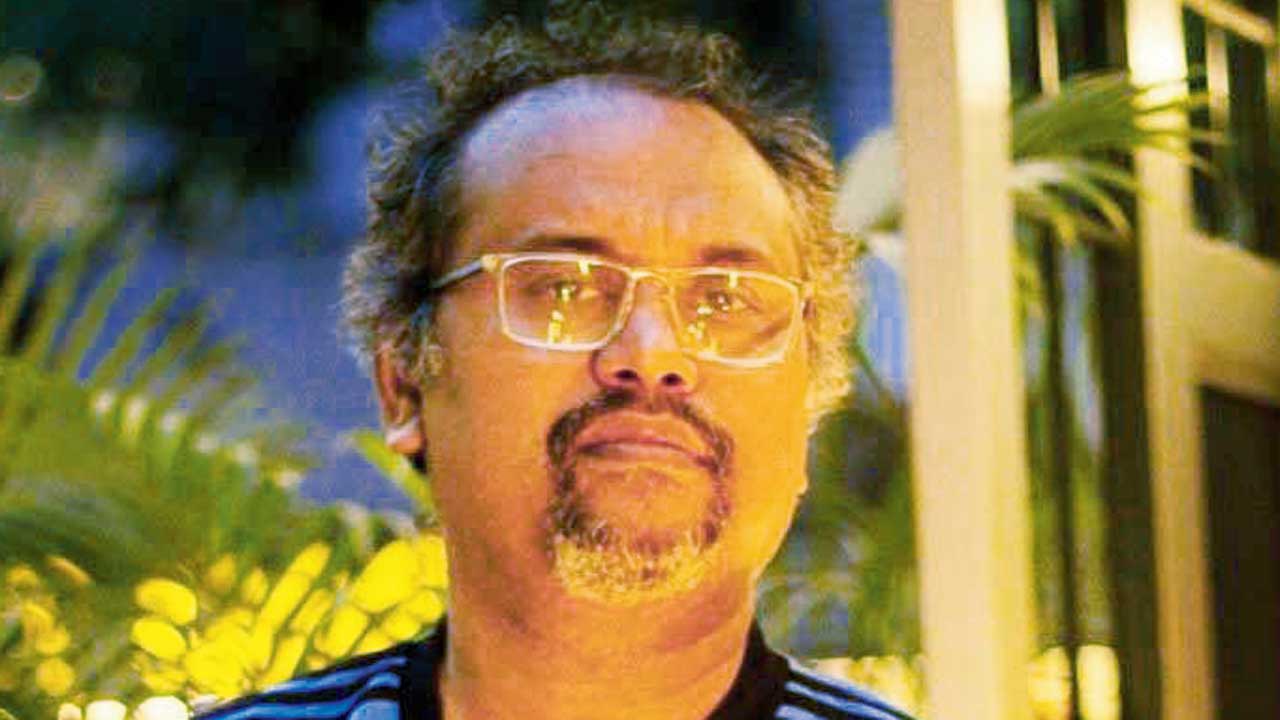
Sourav Ganguly is a living legend and a biopic on him will be very special-Ranbir Kapoor
8:27 AM

Ranbir Kapoor and Sourav Ganguly deny finalizing the casting for the former BCCI president’s biopic while keeping speculations alive
Ruman Ganguly (BOMBAY TIMES; February 28, 2023)
Ranbir Kapoor, who was in Kolkata on Sunday, won over his fans when he played a spot of cricket with Sourav Ganguly at the Eden Gardens. The friendly match was significant as it came at a time when speculations about the actor playing Sourav in the latter’s upcoming biopic have hit a crescendo. Though both refuted the ‘rumour’, there was enough action on and off the field on Sunday to keep the speculations alive.
RANBIR ON DADA’S BIOPIC
“I think Dada is a living legend, not just in India but also around the world. And a biopic on him will be very special. Unfortunately, mujhe yeh film offer nahi huyi hai. I think the makers are still writing the script.”
...ON PLAYING CRICKET WITH SOURAV AT EDEN GARDENS
“It’s a dream come true. Dada bowled 10 balls to me, and it’s just like every kid’s dream to play with him at Eden. I’m going to cherish this moment.”
‘I’M A BIG FAN OF MISHTI DOI’
Ranbir evidently had a finger on the pulse of the City of Joy when he said that he enjoyed aloo posto, puri and shorshe maachch for lunch. He added, “I’m a big mishti doi lover. Toh main char balti mishti doi kha ke aaya hoon.”
He was also happy discussing football leagues and World Cup matches during his interactions. At Eden Gardens, even as Sourav heaped praise on Ranbir as an actor, the star called Sourav a “national treasure”.
‘A BIOPIC TAKES A LOT OF EFFORT’
The actor said, “Har biopic ke liye bahut mehnat lagti hai. When I did Sanju, it was not just about how he walks and looks, but more about what he is as a person, his soul. I think that is more exciting as an actor. To me, understanding a human being deeply before portraying him is very important. Main gyarah saal se Kishore Kumar ke biopic pe kaam kar raha hoon. We’ve been writing that with Anurag Basu and I’m hoping that it’s going to be my next biopic.”
-------------------------------------------
HINDUSTAN TIMES (February 28, 2023)
Speculation around Ranbir Kapoor being finalised for the biopic of former India cricket captain Sourav Ganguly doesn’t seem to die down anytime soon. A bunch of photos showing Kapoor and Ganguly playing cricket at Kolkata’s Eden Gardens surfaced online on Sunday, fuelling the speculation. While the photos sparked excitement among fans, the actor has set the record straight once and for all.
During an event in Kolkata for the promotion of his next movie, the 40-year-old said, “I think dada (Sourav Ganguly) is a living legend, not just in India but around the world. A biopic on him will be very special. Unfortunately, mujhe yeh film offer nahin hui hai. I think the makers (filmmaker Luv Ranjan and team) are still writing the script.”
However, there’s one biopic that Kapoor seems to be super excited about — that of legendary singer-actor Kishore Kumar (born Abhas Kumar Ganguly).
“I have been working on a biopic on Kishore Kumar for the last 11 years. We have been writing that with (filmmaker) Anurag Basu and I’m hoping that it’s going to be my next biopic,” said the actor, who played actor Sanjay Dutt in the latter’s 2018 biopic Sanju. “But maine abhi tak dada ke upar jo biopic ban rahi hai, uske baare mein kuchh suna nahin hai. So, I don’t know,” added Kapoor.
‘Kishore would sing to anybody’s tune but not the government’s’: A new book traces the life and times of Kishore Kumar
8:48 AM
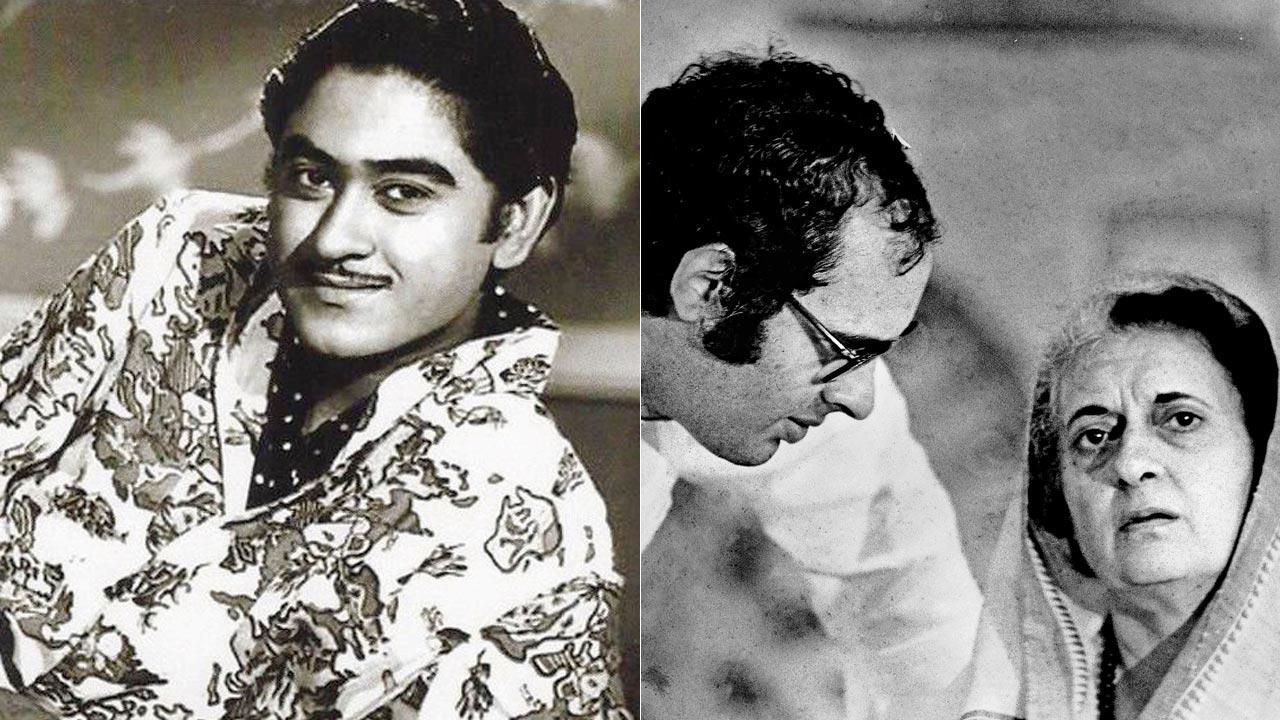
Pic/Wikimedia Commons; (right) Sanjay Gandhi with his mother, Indira Gandhi during the Assam session of the All India Congress Committee, November 19, 1976. Pic/Getty Images
He snubbed Sanjay Gandhi, and cared less about repercussions. A just-released biography looks back at the life and times of veteran singer-actor Kishore Kumar, whose impertinence was as legendary as his music
MID-DAY (October 16, 2022)
It was around January 1976. Geeton Bhari Shaam was Sanjay’s brainchild, and it was decided to rope in film celebrities to do films for television eulogising the Twenty Point Programme. The session was to be the antidote for a nation engulfed in despondency. And who better to lift them from the despair than Kishore, by now the authority on live shows?
He wanted Kishore to sing jingles in praise of the government and its schemes. “Wanted” would be a wrong choice of word for Sanjay of those days. It was more of a demand than an appeal. Kishore was basking in the glory of a Filmfare Award, his first in six years, when the trunk call came from Delhi. Not known to pick up phone calls directly, Kishore had made an exception that day.
“You have to come to Delhi. Sanjay Gandhi ka programme hai.”
“Who are you?” Now it was Kishore’s turn to “demand”.
“Burney.” It was a voice that reeked of unmerited power.
An infuriated Kishore was unusually cool and, for a change, politically correct.
“Please talk to my secretary or else take prior appointment.”
In his interview with Pritish Nandy, Kishore would set the record straight some nine years later. “Who knows why they come? But no one can make me do what I don’t want to do. I don’t sing at anyone’s will or command.”
The conversation would end there, but the confrontation had just begun. In those days, the Gandhi scion would not take no for an answer. Shukla needed to act in a hurry to save his job and honour.
Sayed Muzaffar Hussain Burney, the then Secretary in the Ministry of I&B, reported the conversation to his boss and was swiftly directed to arrange a meeting with some government officials and industry representatives in Bombay. The said meeting took place on 29 April 1976 and was attended by G P Sippy, the then head of the All-India Film Producer’s Council, director Shriram Bohra, B R Chopra, Subodh Mukerji and Nasir Hussain, among others.
Sippy tried to convince Kishore for the show but was snubbed. Sippy then explained to the officials that convincing Kishore was not their cup of tea and that ministry officials should contact him directly.
Next, it was the turn of Joint Secretary C B Jain to engage with Kishore. He spoke to the singer directly on phone and explained the government’s stance on the matter. Jain even suggested visiting Kishore to discuss the matter but was told that Kishore was not to see anyone as per medical advice. Kishore, during these years, was indeed suffering from hypertension, eosinophilia and other issues for which some live shows had to be curtailed midway.
By this time, Kishore was also mentally prepared to make a debut on the streets. With a harmonium hanging from his shoulders, he would sing to anybody’s tune but not the government’s:
I did what I thought best. Singing at private functions is definitely not an anathema. With genuine love and respect, I am only too eager to bend. However, if someone decides to rest his foot in my head, he will not have the good fortune to witness the best of my courtesies.
The film industry had attuned themselves to the eccentricities of Kishore, but for the mandarins at Delhi, this “impertinence” was not to be taken lightly. Note sheets were initiated, and the job was entrusted to Jain.
Jain’s note started with the meeting at Burney’s office, where Kishore Kumar’s name was mentioned as being one of those who was “non-cooperating”.
Therefore, the government needed to immediately ban the playing of Kishore Kumar records on AIR and Doordarshan for three months. Contact had to be made with the gramophone recording companies to request them to “freeze all records of Kishore Kumar’s songs” and to see that “no record of his should be sold”.
Jain had not finished yet. A list of under-production films with Kishore Kumar as the playback singer was also to be produced so that steps could be taken not to release any raw stock to “these productions”. It was also to be examined whether “such films could be refused censor certificate(s)”.
Still not satisfied, Jain took the matter to ridiculous proportions by exploring options regarding the broadcasting of songs by the BBC and if anything, “can be done to stop this”.
Based on Jain’s note, Burney would initiate his on 30 April, which Shukla would approve on 11 May 1976. The note read thus:
All the songs of Sri Kishore Kumar should be banned from AIR and DD and that all films in which he was the playback singer should be listed out so that suitable action can be taken against these films. Besides, the representative of HMV and Gramophone recording Companies should be sent for and, in consultation with the Ministry of Education, the sale of Sri Kishore Kumar’s records and discs should be frozen.
Strangely, the orders were issued even before Shukla had vetted the proposal. Exactly a week before that, on 4 May 1976, orders were issued by the Director General of AIR that songs by Kishore Kumar should not be broadcast and that film excerpts or films featuring him as a playback singer should not be shown on TV. All records of his songs should be kept in the “personal custody” of the head of the various AIR and TV centres. Three days later, on 7 May, another order followed, this time related to advertising spots featuring Kishore Kumar’s voice. They could be used but only without any mention of his name.
The ban had well and truly begun. For Doordarshan, which had just been separated from AIR a month previously, the start could not have been more inauspicious.
Reproduced with permission from Kishore Kumar: The Ultimate Biography by Anirudha Bhattacharjee and Parthiv Dhar, published by HarperCollins India
My father hasn’t been with us for over 35 years, but he is on top and is still remembered-Amit Kumar
9:04 AM

The singer is glad that his dad, late singer Kishore Kumar’s legacy and music still lives on
Soumya Vajpayee (HINDUSTAN TIMES; October 8, 2022)
Singer Amit Kumar is known for taking the rich legacy of his father, late singer-actor Kishore Kumar forward. And, he’s glad that his dad’s music and legacy lives on. “His voice is remembered because he was one of a kind. He was not only a singer, but also an actor and a performer. He was a brilliant singer. Even today, most of the songs played on All India Radio are his renditions. My father hasn’t been with us for over 35 years, but he is on top and is still remembered. It shows his diversity and versatility,” says the 70-year-old, who will be performing at Amit Kumar Live In Concert to raise funds to help women who are battling cancer.
Ask what’s the greatest role his father’s music played in his life or what’s been his greatest learning, and Amit tells us, “Like for so many artistes, he was my inspiration too and I was blessed (to be his son). I have learned everything from him. He showed me how to sing in front of a microphone.”
While Kishore Kumar is known for his iconic songs that continue to top most playlists, Amit feels with the changing times, even those songs might fade away. “If we look back, there were legendary singers like K L Saigal and others, but many people don’t remember them. People are forgotten, that’s life. My father may be remembered for another 50 years, but there will come a time, say after 100 years, when he will be forgotten. He will become history, this is what I believe,” the singer ends.
What: Amit Kumar Live In Concert
When: Today (October 8)
Where: Rangsharda Auditorium, Bandra (W)
Timing: 7 pm onwards
I love old songs, but I don’t like how they are recreated-Mohit Chauhan
8:16 AM

Dharitri Ganguly (BOMBAY TIMES; April 30, 2022)
Mohit Chauhan is busy working on a new album these days, one that he hopes to release by the end of this year. The Matargashti singer spoke to us recently about current music trends, his aversion to singing remakes, and more. Excerpts:
‘OLD SONGS ARE BEING RECREATED WITH ELEMENTS THAT DON’T GO WITH THEIR ESSENCE’
Mohit is clear about not singing recreated versions ofold hits. In fact, he even turned down an offer to sing one. Voicing his opinion on the same, he says, “It’s not like I don’t like singing old Hindi songs. I have sung Kishore Kumar ji’s songs on my online channel, but I don’t like the way old songs are recreated. Music directors are deconstructing the songs and remaking them with rap and other elements that probably don’t even go with the song’s essence. As a result, the purity of the original song gets lost, and I don’t support that. These songs need to be treated aesthetically and with a lot of love. ”
‘INDIE MUSIC LACKS DISTINCTIVE STYLE AND FEARLESSNESS TODAY’
Mohit shot to fame with independent music. Be it Dooba Dooba or Boondein, the former Silk Route vocalist’s songs are among the most heard compositions on the indie music scene. Talking about the indie music scenario today, Mohit says that nowadays it gets difficult to differentiate between non-film music and film music.
“Probably the music labels feel that these are the songs that will do well, but the fearlessness to play with different genres is missing on the indie scene today. When we used to create music as a band, there were so many independent musicians and bands that had a distinct style. I think music companies and labels need to identify, pick and push musicians who have the potential to think out of the box and create a unique identity,” he says, adding, “One needs to have a free mind and the ability to delve deep inside to create something beautiful, original and close to their heart.”
‘SOCIAL MEDIA CAN’T ASSESS GOOD MUSIC’
Mohit says, “Social media cannot be the measure of a song’s popularity. Jo sangeet-premi hote hai, woh waise bhi gaana sunenge, bhale hi woh gaana social media me popular ho ya nahi. Social media is like instant noodles —it provides instant drama and entertainment, but isn’t a platform to assess good music.”
Subscribe to:
Posts (Atom)