Showing posts with label Kenya. Show all posts
Showing posts with label Kenya. Show all posts
I don’t make films for bigoted racists or colonialists-Gurinder Chadha
9:40 AM

Director Gurider Chadha and producer Anushka Shah
As Gurinder Chadha’s Christmas Karma gets ready to arrive in India, the British filmmaker reflects on her growing up in Southall, carrying her Indian heritage everywhere and the sisterhood she feels with her peers Mira Nair and Deepa Mehta
Priyanka Sharma (MID-DAY; December 7, 2025)
It’s been two weeks since Gurinder Chadha released her upcoming feature, Christmas Karma, in the UK, the country where she lives. It’s a week before she releases the film in India, the country she carries with her everywhere. Like her film, Chadha has always found her belonging there and here.
So, as we sit with her, in a Mumbai suburb club, to talk about the film, we can’t help but ask her, “What’s home for you?” “Southhall is my home,” Chadha replies promptly, while browsing through her phone gallery to show us the street she grew up in.
“And I always end up going back to those streets. I was there last week and I did a little activity with local school children to open their Christmas festival. I saw one particular area where the first Indian shop in Southall opened, where my parents used to go. Next to it was a playground where I played as a little girl,” the filmmaker shares with a child-like excitement.
Her love for her British roots and Indian origin is reflected throughout her filmography. Christmas Karma is no different, in that context. But something else is different this time, Chadha says. “When I adapted Jane Austen’s Pride And Prejudice (as Bride & Prejudice), no one asked why Gurinder Chadha should do this. But because the country’s moved a bit to the right, there are people who feel emboldened, and they are asking, ‘Why should Gurinder Chadha do Charles Dickens? How dare she make a film on Christmas? It’s our holiday’.”
In such times, a film like Christmas Karma that puts an Indian immigrant in the UK at the centre of the story is only timely. Chadha says, “There’s a fight going on for who decides what British cinema is and whose voice is considered to be British or not. It’s really important that those questions are being asked at a time when racism is on the increase. I make films for those fighting the good fight, ones who talk about inclusivity. I don’t make films for bigoted racists or colonialists.”
But it’s not to say that the director doesn’t feel isolated at times. “Sitting here, we’re all Indian women, right? I’m not anything unusual to you. In England, I’m a complete anomaly. Where are the Indian women? Where are the actual directors?”
That’s a question that does need to be asked. Throughout her career, Chadha has been a force to reckon with when it comes to telling stories of the Indian diaspora, including successes like Bend It Like Beckham (2002), Bride & Prejudice (2004). But there haven’t been voices after her that have been able to make themselves heard and seen. The first thing to understand, Chadha says, is the struggle that theatres in the UK have been facing since the COVID-19 pandemic.
“In England, people are saying, ‘It’s a miracle that you’ve got a film made, because there’s so little getting made right now.’ Post-pandemic, it’s been a tough time for all film industries, everywhere. So, that is also something to be kept in mind,” she says. But that just scratches the surface. The bigger obstacle for any South-Asian filmmaker in the west is still rooted in his/her identity.
“When you try and make a film with a person of colour as the lead, it’s very hard because people don’t see it as necessarily as mainstream and commercial as we think it is. And this is when I have proved the opposite with my films. I have examples. I have numbers to support it. I tell them, ‘I don’t understand. Why are you hesitant? Look at the successes.’ I am shocked by the lack of films from the diaspora. I also didn’t make a sequel to Bend It Like Beckham because I felt that that was a film that I couldn’t really emulate,” she says.
But her single-minded pursuit to tell stories of Indian immigrants stems from a personal emotion, which she is not sure motivates the generations of filmmakers that came after. Even Christmas Karma, the adaptation of Charles Dickens’ A Christmas Carol, is born out of the endeavour, Chadha says, of showing that the struggles of her ancestors, who had to leave their land behind, weren’t in vain.
“Christmas Karma comes from the same wheelhouse as Bend It Like Beckham. It’s a human empowerment movie. It’s about having the muscle memory of knowing that your parents and your grandparents went through some kind of migratory movement. In my case, it was a partition that my grandparents went through. Then my parents were born in East Africa. I was born in Kenya, but I grew up in England. And you carry all that with you. So, the successes of my generation are really about wanting to show that our parents’ lives were worth it. And their struggles were worth it,” she smiles.
And in her endeavour, she always ends up finding allies. Even though the director initially struggled to find investors for Christmas Karma, she eventually found a partner in producer Anushka Shah, whose Civic Studios has backed the project. And if her films have been unifiers for Indians around the world, in her life, she has forged a sisterhood with Indian women, who walk the same path as hers.
One such bond is what she shares with filmmakers Mira Nair and Deepa Mehta. The trio has a WhatsApp group as well, which goes by the name “Behenji Brigade”.
“Mira gave this name. I congratulated her on Zohran’s (Mamdani, Nair’s son) win. I messaged her, ‘Bohot Mubarak, Mira. What wonderful news to wake up to. It is great that my son has such a role model to look up to. Kya baat hai.’ Then Deepa wrote, ‘Bilkul, Mira. Many, many congratulations. Waah Bhai Waah.’ Mira said, ’It’s the dawn of a new day. We’re bursting with joy,’” Chadha shares.
And if there’s another friendship that the filmmaker is proud of, it’s with Bollywood star Priyanka Chopra, who even sang a Hindi cover of George Michael’s Last Christmas for Chadha’s film.
“She is just amazing. She is always sending me messages, where she would say, ‘Keep breaking new ground.’ She doesn’t have to do that. She sang the song to support me. Priyanka is also a woman who left the safety of Hindi cinema and went abroad, and had to knock on doors to get recognition. She did it the hard way. Maybe some people in India don’t see that struggle but I have seen it. I know what it is like for her because I know what it has been like for me.”
Priyanka Chopra, Mahesh Babu begin shoot of S S Rajamouli's next in Kenya
4:03 PM
Rohit Bhatnagar (HINDUSTAN TIMES; September 6, 2025)
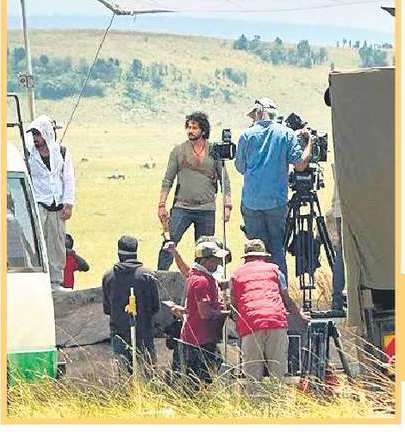
Filmmaker S S Rajamouli’s next project — tentatively titled SSMB29 — has been making waves since it was first announced.
As anticipation grows, we have got our hands on the first pictures from the sets of the film, which features Priyanka Chopra Jonas and Mahesh Babu.
Mahesh was recently seen in Kenya, seemingly shooting a pivotal scene.
A close source to the production reveals, “Rajamouli has begun the shooting in Nairobi, Kenya with Mahesh Babu and Priyanka. The actors are currently shooting at hidden locations across the city, under strict surveillance. The crew isn’t allowed to bring their phones to the sets.”
The filmmaker is leaving no stone unturned to keep the details of the film under wraps, the insider says. “Even the actors’ vanities are parked around a kilometre away from the actual shoot location. Their entourages aren’t allowed outside the vanities. The atmosphere on set is very tightly guarded and quiet,” the source adds.
While our source tried to capture clearer photographs from the shooting floor, they were unsuccessful.
Announced earlier this year, the film went on floors in April, with parts of the film being shot in Odisha and Hyderabad. It also marks Priyanka’s return to Indian cinema after 2019’s The Sky Is Pink.
With a reported budget of Rs. 1,200 crore, the makers seem to be eyeing a 120-country release. As of now, a premiere date has not been set.
S S Rajamouli has a plan B ready after SSMB29 Kenya shooting called off due to unrest
9:15 AM
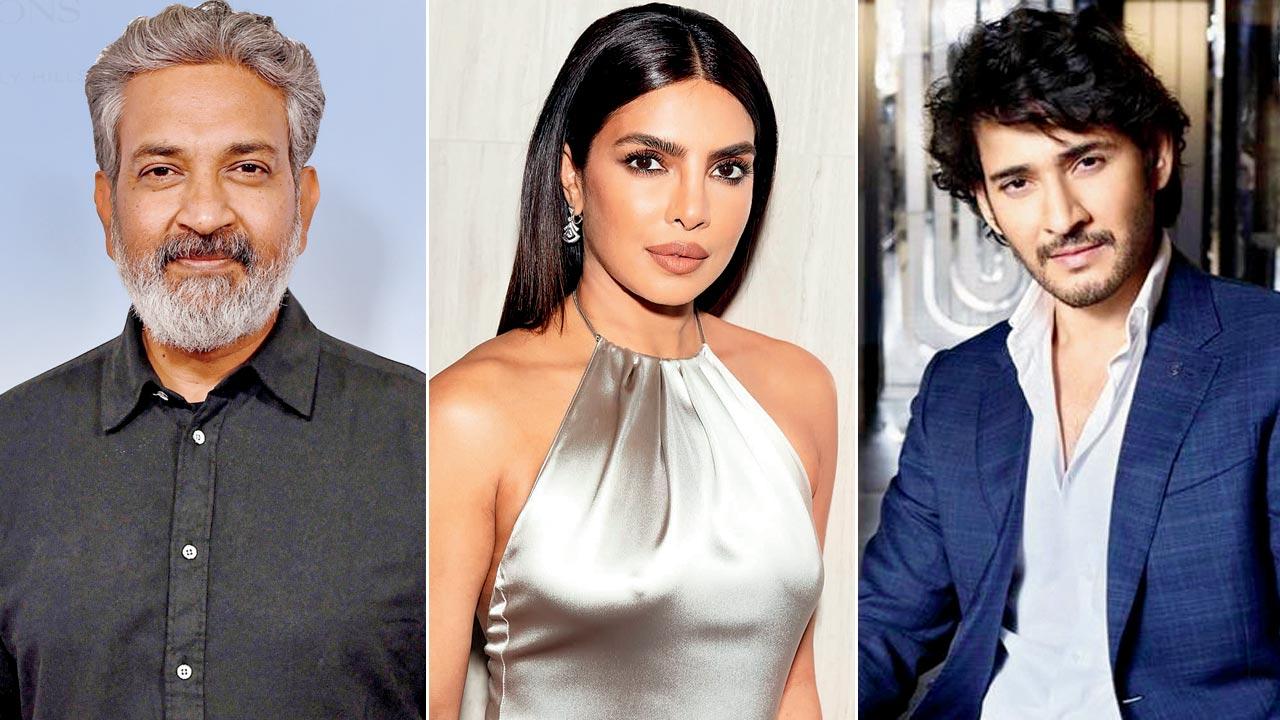
After SSMB29’s Kenya shoot was recently called off due to unrest in the country, sources suggest that S S Rajamouli to film in South Africa and Tanzania
Mohar Basu (MID-DAY; July 14, 2025)
In June, mid-day reported that filmmaker S S Rajamouli would take his Mahesh Babu-led action adventure, the working title of which is SSMB29, to Kenya for a month-long schedule (Kenya calling, June 24). But in the latest development, the plan has hit a roadblock amid the ongoing protests in Kenya.
“Our team had done the recce, locations were finalized, but just weeks before the mid-July shoot, unrest began brewing in the region. We couldn’t risk the crew’s safety,” reveals a source associated with the film that also stars Priyanka Chopra and Prithviraj Sukumaran.
So, where will Babu’s character — a globe-trotting explorer on a quest for some rare artefacts, à la Indiana Jones — head to, with Kenya off the table? We’ve heard that Rajamouli and his team, keen to not waste time, are now planning to head to South Africa and Tanzania, locations that promise similar visual appeal.
A unit member says, “Rajamouli sir was clear that he wanted terrains that have rarely been seen on Indian screens. Tanzania’s highlands and parts of South Africa ticked those boxes.”
The production team is currently in the process of securing permits. If things work out, the cast and crew will head to South Africa by the third week of July. “We’re hoping to lock everything in the next 10 days,” adds the insider.
S S Rajamouli heads to Kenya for Mahesh Babu-Priyanka Chopra-Prithviraj-starrer
9:28 AM

S S Rajamouli to shoot SSMB29’s next leg in Kenya; actioner becomes the second major Indian film after Jagga Jasoos to be shot there
Mohar Basu (MID-DAY; June 23, 2025)
S S Rajamouli’s action adventure, the working title of which is SSMB29, has taken him from Odisha to Hyderabad since it rolled last year. Now, the filmmaker and leading man Mahesh Babu have zeroed in on the next destination. Sources reveal that the director will begin an elaborate three-week schedule in Kenya in July.
It has been learnt that the Kenya leg will feature some intense action sequences. A unit insider reveals, “Rajamouli sir chose the country because it has everything the film needs — savannahs, highlands, and dense forests.” The portions will be filmed across multiple locations, including the Tsavo National Park, the Aberdare National Park, and on the outskirts of Nairobi.
Also starring Prithviraj Sukumaran and Priyanka Chopra, SSMB29 tells the story of a globe-trotting explorer on the quest for some artefacts. The production team has roped in stunt coordinators of the region to execute the action set-pieces.
The source adds, “Some sequences involve wildlife interaction, and combat in the jungle. Rajamouli sir has envisioned chase sequences in wildlife corridors, and ancient ruins.”
Interestingly, SSMB29 becomes only the second major Indian film after Ranbir Kapoor’s Jagga Jasoos (2017) to be shot extensively in Kenya.
90% of my 2 ½ year old son's classmates have breathing issues. It’s scary-Dia Mirza
9:44 AM

Dia Mirza Rekhi on her recent experience at the United Nations Environment Assembly in Nairobi and why it’s imperative to ‘care for the environment’
Navya Kharbanda (HINDUSTAN TIMES; March 11, 2024)
Last month, actor Dia Mirza Rekhi attended the sixth session of the United Nations Environment Assembly (UNEA-6) in Nairobi. With an initiative to realise the dream of 500 million trees by 2032, Rekhi, who is also the Goodwill Ambassador for the United Nations Environment Programme (UNEP), says, “The UNEA gave me a chance to meet some of the most inspiring people. Most of them were people who really care for the environment. The most exciting thing for me was the World Restoration Flagship, which were the awards given to countries who were taking initiative to improve the health of the environment.”
The Dhak Dhak (2023) actor adds, “Another interesting opportunity was engaging with young changemakers. I have known some of them for almost eight years. It’s all about engaging with passionate people who really care about bringing a change. It is the first global platform where I saw so many women in leadership places.”
The 42-year-old feels “we need to start planting trees, avoid pollution and take steps on the ground level”. She adds, “If we don’t start acting now, it will be too late. My two-and-a-half-year-old son (Avyaan Azaad Rekhi) goes to school and 90% of his classmates have breathing issues. It’s scary.”
It is our ignorance that makes us believe that by afforestation, we can get away with destroying biodiversity-Dia Mirza
9:42 PM
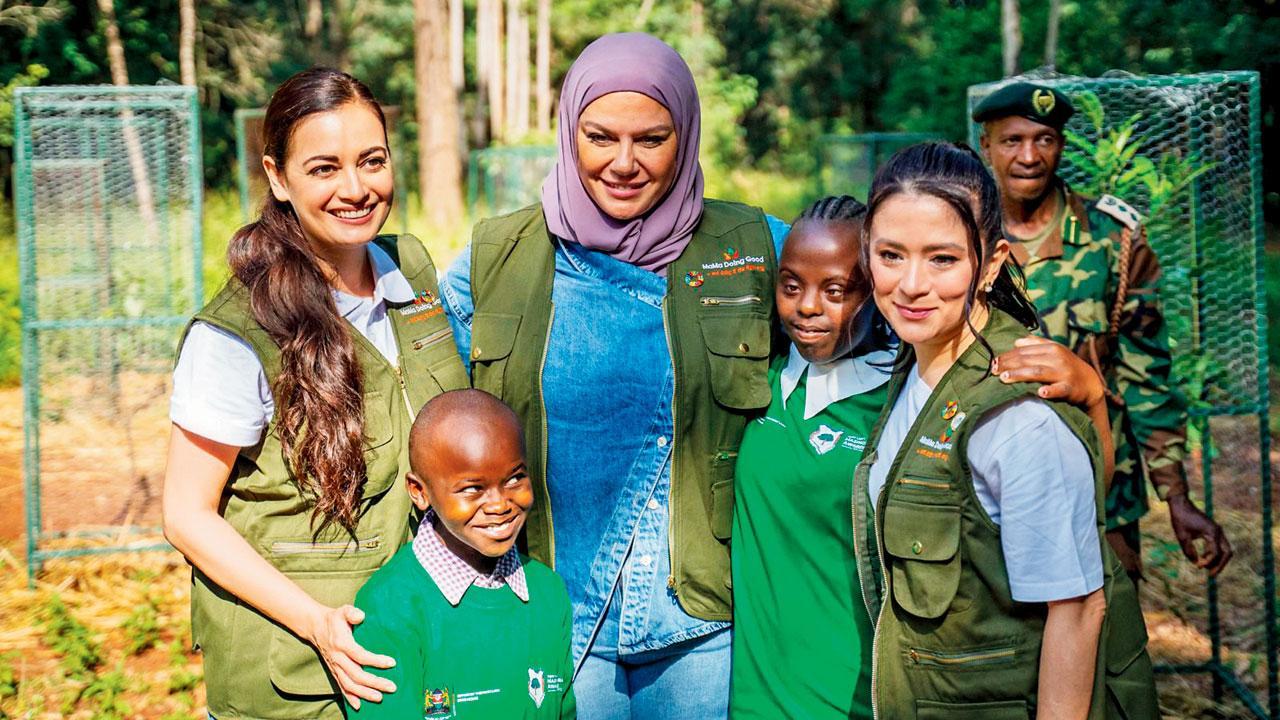
Dia, who recently attended UN Environment Assembly in Kenya, on how Mumbai needs to actively increase green cover to lower AQI
Mohar Basu (MID-DAY; March 5, 2024)
Last week, Dia Mirza, India’s Goodwill Ambassador for United Nations Environment Programme (UNEP) and the UN Secretary General’s Advocate for Sustainable Development Goals, attended the UN Environment Assembly (UNEA) in Kenya. The actor-producer was joined by Kenya’s First Lady Mama Rachel Ruto, and Inger Andersen, executive director of the UNEP, at an afforestation event at Karura Forest in Nairobi.
Mirza says that at the assembly, India sponsored a resolution on sustainable lifestyle. “Member states recognised the potential of behavioural changes in contributing to the [goal] of sustainable development. At UNEA, governments also passed a resolution on promoting regional cooperation on air pollution to improve air quality globally.”
Poor air quality has been a major discussion in India over the past few months. In Mumbai, the air quality index (AQI) reached as high as 400 in January. Emphasizing the need to increase our green cover, she says, “It is our avarice and ignorance that [makes us believe] that by afforestation, we can get away with axing old trees and destroying biodiversity. This is far from the truth. Urban spaces need more green cover. It is critical to protect existing biodiversity. New plantations cannot deliver what old forests can.”
Another oft-discussed question is: are we doing enough to save the planet in the post-COVID world? The actor believes that awareness has grown about the crises of climate change, biodiversity loss, and pollution.
“COVID brought a mindset change, especially in individuals to redirect their over-consumptive lifestyles towards making conscious choices. More people are connecting with nature. Wish I could say the same about big companies and governments.”
I have the spirit of tigress, the soul of an elephant and the loyalty of a dog-Rupali Ganguly
8:36 AM

The actress talks about a unique gift that she received
Hasti Doshi (BOMBAY TIMES; April 10, 2023)
Rupali Ganguly was pleasantly surprised recently when she got to know that somebody had adopted an elephant on her behalf. A fan from Canada adopted an elephant called Mayan, which is in Kenya with the Sheldrick Wildlife Trust. Incidentally, Rupali wasn’t even aware of this; it was brought to her notice by one of her friends.
Rupali shares, “One of my writer friends saw it on Instagram and told me about it. That’s when I got to know that this girl had adopted the elephant last year on my birthday and she has done it this year, too. I was overwhelmed. I missed seeing her message on social media last year, but I am glad I got to know about this beautiful gesture. I always say that I have the spirit of tigress, the soul of an elephant and the loyalty of a dog.”
Talking about her wish to meet elephant Mayan, the Anupamaa actress says, “I am very fond of elephants and I hope that I am able to visit Kenya someday and meet elephant Mayan. I would love to do that. I haven’t yet spoken to Sandhya Bodapati, who has done this for me. My team has connected with her and I’ll speak to her soon.”
HOW CAN YOU ADOPT AN ELEPHANT?
Visit the website of a wildlife trust, which allows the adoption process from anywhere around the world. Select whichever one you wish to adopt for a year and make the payment online. The funds received go towards food and blankets for the elephants, arrangements for their sleeping areas, etc.
If they want, the Indian film awards can build on credibility as well. I guess the money involved is too huge-Nawazuddin Siddiqui
8:08 AM
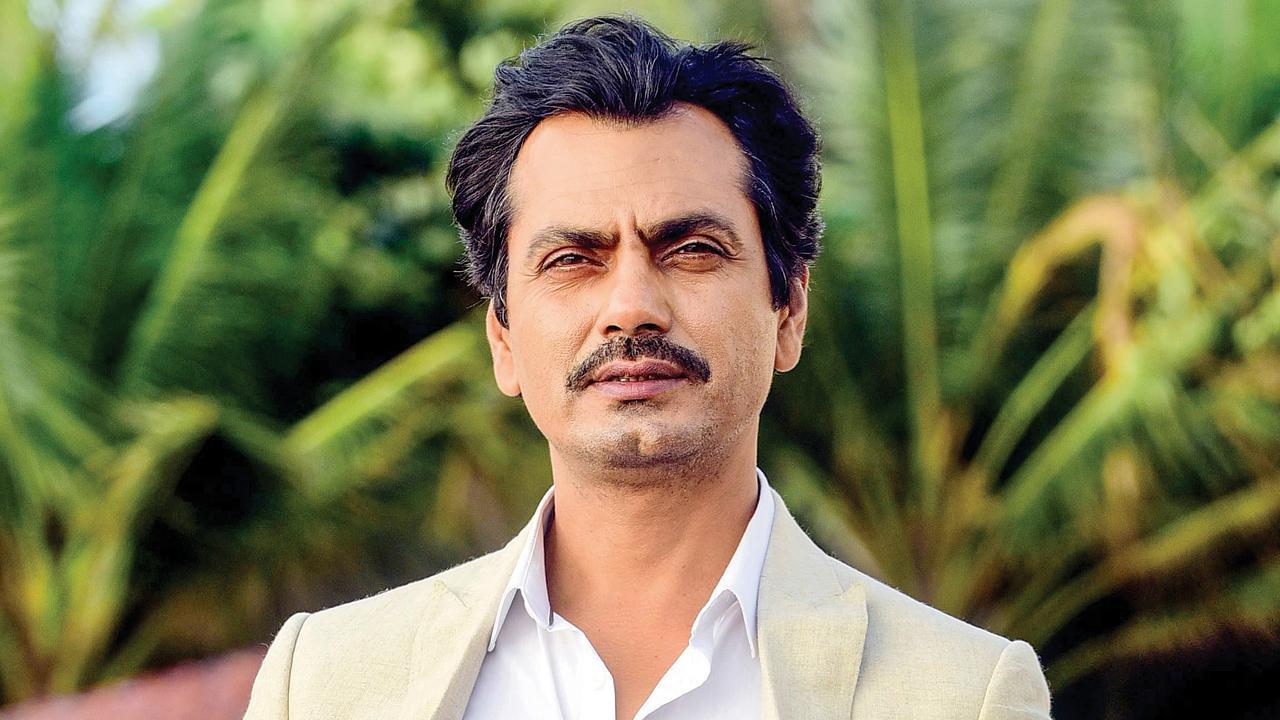
Ahead of International Emmy, Best Actor nominee Nawazuddin for Serious Men lauds global awards for honouring merit; says Indian award galas must take a cue
Mayank Shekhar (MID-DAY; November 22, 2021)
New York can be an intimidating/overwhelming city for most people. Evidently not for the perennially unfazed, actor Nawazuddin Siddiqui. As we watch him, like in his films, merging into the Manhattan crowd — an Everyman, as it were, only on occasion disturbed by desi selfie-seekers; he generously obliges, while you can tell, he’d rather not!
Sometimes reticent to a fault (as with interviews as well), no point asking if the atheist Nawaz is going to do a special namaz (prayer), leading up to the International Emmy — the Olympics of world television — where he is nominated for Best Actor (film/series) for Sudhir Mishra’s Serious Men, a Netflix production. This automatically puts his performance among the year’s best in movies and series, across streaming services and network TV worldwide.
“Nomination is a good enough measure for your choice of film, since the world is recognizing it,” Nawaz says. Even Emmy is not new for him, though: “I actually held that trophy [on the stage], when McMafia won [the Best Drama Series in 2019].”
He adds, “This silsila [or procession, in a red-carpet sense] really began with Cannes in 2012. That was the first time in my life, I found myself surrounded by people from across the world, who only spoke of art and creativity. That’s when I decided to do at least one film every year, just so I can participate in such a mahaul [environment]. I was just fascinated by this world. The other world started making less [sense] to me.”
With the other world, maybe the reference is to similar film awards in Mumbai, that aren’t so similar, actually! “Well, the point is that Emmy, Oscars, or Cannes have built their credibility over decades — by being only interested in rewarding pure artistic merit. We’ve also had film awards for as long. But one hears, lately in the news, that they’re actually sold out. What happens as a result is that [the performers themselves] start taking these [award shows] for granted. Although if they want, the Indian film awards can build on credibility as well. I guess the money involved is too huge. Which is all fine, but creativity should be nurtured and protected too. It’s not necessary to turn everything into a dhanda!”
Outside of international festival cred — as an actor, for instance, Nawaz has probably had the most number of Indian films at Cannes, including the pathbreaking Gangs Of Wasseypur (2012), and The Lunchbox (2013) — it is globally accessible content on OTT platforms that’s genuinely helped him jump Mumbai cinema, and its ruthless star-system, altogether.
If you consider Sacred Games — Netflix India’s flagship show, two-third of the audiences of which came from outside India. Nawaz recalls, “The last time I was in New York, I could sense people looking in my direction, while I’d enter the hotel. Likewise, a man in Kenya gave away his house for free, once he learnt that we were going to shoot the second season of Sacred Games there. It felt good when Paulo Coelho, the writer of The Alchemist, called and messaged me after watching Sacred Games.”
It’s mildly surprising therefore, we point out a recent press interview, where Nawaz wholly slams Indian content creation for OTT platforms, that he felt had turned into a sham of sorts, with stuff being made for the heck of it.
“My opinion wasn’t directed at OTT platforms as such. They’ve actually showcased Indian talents internationally. If there was no Netflix, I wouldn’t be sitting here. I was simply talking about a few production houses [doing this]. There has to be something khaas, apni pehchaan banane ke liye (special in the content, for it to stand out).”
He did say though that he won’t be part of OTT content anymore? “That I won’t do any series, yes. Can’t anyway, because I’m busy with films for the year ahead.”
Also, Nawaz adds, as far he’s concerned, there really is no difference between series and films: “[Being in] the moment is important for me [an actor]. And that honesty of the character doesn’t change — whether you’re in film, or series.”
Whether he’s Gaitonde in Sacred Games, or Sheikh in The Lunchbox. Or indeed Ayyan Mani, in the Emmy, nominated performance from Serious Men: “What’s common to all these three Mumbaikar characters, from different sub-cultures within the same city, is that they loved Mumbai most dearly.”
Soon as the International Emmy Awards show finishes in New York City, November 22 night, Nawaz heads back to Mumbai as well, to wrap up shoot of his film Tiku Weds Sheru, co-starring Kangana Ranaut. From the sets of which Kangana had recently posted a picture of both actors laughing out loud, captioned, “Good jokes only, please. Nawaz knows how to crack one.”
What was the joke, we’re curious. Nawaz decides to enact it. “Why don’t you become me, and ask me for water. I’m the spot-boy.” We do. Nawaz pretends to pick up two glasses, drinking from one, while offering the second one simultaneously.
“There is a spot boy, who was with me for two years, who’d always do this. And then he’d stare at me relentlessly all day. I’d ask him what’re you looking at. He’d say nothing. And continue to stare, always wondering in his head, looking at me, ‘What’s so great about this guy, man? What’s the khaas baat about him — na aaga, na peechha, na shakl, na surat (no body, no looks, no beauty) — how has he become a star? What’s he got that I ain’t got’,” Nawaz laughs.
Well. Maybe the assistant should’ve observed him more as the chameleon-like actor constantly killing it on screen, instead of staring at an inherently shy Everyman in real life.
When it comes to wildlife photography, you need to have luck and patience-Waheeda Rehman
7:21 AM

Veteran actor Waheeda on pursuing her hobby as she hosts wildlife photography exhibition
Sonil Dedhia (MID-DAY; December 16, 2019)
It’s never too late to discover a new passion. Waheeda Rehman will vouch for it — after decades of romancing the camera, she is equally happy behind it. The yesteryear actor has turned a wildlife photographer as she recently held an exhibition of her pictures from her safaris to Kenya, Tanzania, and wildlife reserves across India.
“I always loved taking pictures. When I was young, I would carry a small camera with me on the sets. I recently met Himanshu Seth [curator of the show] who asked me to pursue my hobby and came up with the idea of having an exhibition. I wasn’t too keen to display my pictures as I didn’t think they were great, but my friends and family persuaded me,” she smiles, adding that what started out as a mere hobby has now become “an addiction”. “When it comes to wildlife photography, you need to have luck and patience.”
She may be 81, but it is evident that Rehman is unstoppable as she discusses her bucket list. “I want to learn scuba diving,” she shares, before revealing that she is working towards it. “Prahlad Kakkar’s son runs a professional training company. I will discuss my health condition, and will try my hand at it.”
Check out the fun and excitement on the sets of Sacred Games in Mumbai
8:24 AM

Travelling across multiple Mumbai sets of the sequel to world’s most watched Indian web- series, Sacred Games
Mayank Shekhar (MID-DAY; August 11, 2019)
"I can give you the script [to read]," says director Anurag Kashyap, lounging after the day's gruelling shoot. He's of course not referring to the script of Sacred Games (SG) season two, the tightly guarded sets of which we are at, in Mumbai Film City's Reliance studio.
"We're bound by such contracts that there'll come a time when I may have to look into it, even before saying hi," says Kashyap, revealing precious little about a dark 'warehouse sequence' he's just shot. But the script he's willing to privately share is still SG, although a different version that was offered to him to direct in 2013, by the American Scott Reid Productions.
Kashyap had flatly said no to it then, primarily because that script, sticking completely to Vikram Chandra's novel of the same name (unlike the Netflix version), was to be shot entirely in English. And he could never do that. The authenticity would've been completely lost.
The fact that the 'universal is specific first' is a model that Netflix has followed to global success with subtitled super-hits like Narcos (Spanish), Fauda (Hebrew), and so many others. There is in fact an English-dub of SG available on the web-platform as well. Those who have seen it say it completely destroys the experience. Deeply rooted in the Mumbai milieu, characters in SG speak the city's language that, as writer Salman Rushdie once described it, is HUGME—Hindi, Urdu, Gujarati, Marathi, English.
Add to that Punjabi, since the lead, Cop Sartaj Singh, is Sikh, played by Bollywood star Saif Ali Khan, in blue turban, who we met earlier in the day in Malad—shooting an 'interior sequence' of an ashram, that he says "explores the 'sacred' part of Sacred Games, which wasn't so much there in the first season; but it comes in now."
Khan appears a much leaner Sartaj Singh (SS, on the set), from before. "The worn-out look, for someone less sedentary, mostly running around, is closer to how the character is described in the book. Also, with a clock ticking and all that, we're getting into more of an 'action series'," he says.
Khan's portions in the second season are being directed by Neeraj Ghaywan (Masaan), who took over from Vikramaditya Motwane from the first part, since Motwane was finding it hard to balance directorial duties with the job of the showrunner—who looks at the "macro-picture"; supervising for months, before and after production, with writers (led by Varun Grover), and editor (Aarti Bajaj); putting together 15-hour shoots, between multiple locations, time-lines, over 200 days, into seamless, eight episodes of a series. Phew!
Motwane doesn't normally visit the sets, he says. He doesn't need to since he implicitly trusts the two directors, Kashyap and Ghaywan, respectively filming parallel stories of Don Ganesh Gaitonde (Nawazuddin Siddiqui), and Sartaj, alongside. Both tracks, not just visually, even pace and performance-wise, play out, if you carefully observe SG season one, like two totally separate films.
Motwane agrees. And this isn't simply because the directors are different. So is the setting. "Gaitonde's world [a series of flashbacks], is a personality-led fable. Sartaj's is a more private space, of tension, and [building] mystery," he explains. From a technical/visual point of view, this is achieved through the use of different kinds of lenses—"anamorphic, with more saturation for Sartaj's [world]; and spherical, with less saturation, for Gaitonde's." While there is no "show-bible" as such, the template is more or less set.
Lay viewers are hardly going to notice these technicalities. What they will/have is, according to Khan, the reason he was instantly drawn to SG as the first Indian Netflix series going out to the world: "Besides an international sensibility in filmmaking, it [the subject] is very Indian. And by that I mean it's got mafia and cops, whose equations are unique. Then you've got religion, politics, God-men, and Bollywood, all thrown into the mix of what's a very psychological mind-game."
True. Can't wait! New season drops on August 15. Two-thirds of SG season one audience, Netflix reveals, has come in from outside India, making it truly a global show. Khan has been around as a Hindi film-star for over two and half decades, with 60-plus movies, and a strong audience-base among South Asians and other Bollywood fans abroad. One wonders if the demography eyeing/approaching him at international airports has broadened/changed a bit since SG. He gently shrugs, making little of that remark, "No... I don't know...Maybe they expect a Sardar with a beard!"
Couple of days after SG dropped, Siddiqui, on the other hand, felt a bunch of locals weirdly staring at him on the streets of Rome while he was there for a film with actor Tanishtha Chatterjee: "Saamne gora dekh raha hai. Matlab, Sacred Games dekha hai," he whispered. The filmmakers shooting the second season seem to have equally benefitted from the prequel's success.
Kashyap recalls, "We've shot the sequel all over—Croatia, South Africa, Kenya… We shot on the same boat from Free Willy. There was an incredible riverside bungalow in Kenya. The moment the owner got to know Gaitonde was going to be there, he just let us do whatever we wanted."
Which brings us to, well: Where is Ganesh Gaitonde? In his village, as we speak. Or a village, aptly created as a set, in Goregaon! Stepping into the refreshment-tent outside the makeshift mud-hut, after a late-night shift, you can tell, Siddiqui has clearly shed Gaitonde behind, to reveal his usual, painfully shy self. Chameleon-like transformations have pretty much defined Siddiqui's career.
But the longest he's ever been with a character is obviously the Marathi gangster's: "It's become too internalised, I can't switch on-off like a computer." And he's evidently developed some empathy for him as well: "For one, he [Gaitonde] loves Mumbai. Two, he's very trusting. And, he doesn't ever discriminate over religion."
For character-study, interestingly enough, Siddiqui points to his own brother as personal inspiration: "I have several [brothers], but only [a younger] one remained uneducated and stayed back in the village. People talk shit about him. I used to as well. It's only when I began to look deeper, I realised, he's essentially over-sensitive and over-reacts. If there's a galat baat (a wrong utterance), people might calm down. He can't. He became bad, because of the bad happening around him."
Extending that example, Siddiqui adds, "Take Dawood [Ibrahim]. People say he has a sharp mind. But it's twisted. If he'd applied his acumen in the right direction, he could've been a great businessman." Hmmm… Got it, Gaitonde.

I’ve never started any conversation saying that I’m Vinod Mehra’s son-Rohan Mehra
7:58 AM

Rachana Dubey (BOMBAY TIMES; October 24, 2018)
Late actor Vinod Mehra’s son Rohan Mehra, is gearing up to flag off his acting career with Baazaar. He might be a star kid, but he grew up in another country, far from the glitzy bylanes of Bollywood and the conversations of film industry insiders. The young actor, who had to work hard to land his first role, speaks to BT about his father, finding his way back to Bollywood and realising his true dream of being an actor. Excerpts…
 Are you excited about the kind of reactions your debut film, Baazaar might receive?
I wish the film would open tomorrow and not on Friday, because I am really impatient. I want everyone to see it right away and I am so blessed to be in this situation. Not everyone gets a chance to experience this. I’ve waited a long time for it. Yes, waiting in the wings made me anxious and I doubted what I was doing. In retrospect, maybe this is how it was meant to be. In the process of waiting for the film, I grew up, matured and I developed a sense of what life has to offer.
You grew up in Kenya, far away from the film industry in Mumbai. Did those experiences have any impact on your dreams and aspirations?
I grew up in Mombasa, Kenya. It’s a small town, far away from arts of any kind, where everyone aims to follow typical careers like banking, medicine or engineering. I wanted to be an investment banker. Funnily enough, my first film revolves around the stock market. At 18, I moved to England to study mathematics and economics and I did well. But, my heart wasn’t in it. I wasn’t as passionate about numbers as I was about music, movies and stories. I decided to make a career out of that. I came to Mumbai, after completing my education, to work in the film industry. I was ready to work in any capacity – assistant director, photography, music, acting – I just wanted to be a part of the storytelling process. I tried a bit of everything, believing that it will help sharpen my skills.
You weren’t the first choice to play Rizwan in Baazaar. How did you land the part when the makers weren’t keen on casting a newcomer?
I was auditioning for films and had put up a couple of photos from a shoot on my social media page. Gauravv K Chawla (director of Baazaar) saw those and called me for an audition. That film didn’t take off, but the company was keen to do something with me. Maybe, I had created an impression. I remember reading about Baazaar, which was Nikkhil Advani’s (producer) homage to Trishul (1978). It fascinated me. I approached Nikkhil to cast me in it, but he didn’t want to even talk about it. After a lot of persuasion, he gave me a scene to enact, just for fun. I kept working on the scene with his inputs for months and kept reading that the role had been offered to several actors. Eventually, he decided to cast me because he was convinced with my audition videos.
Baazaar does not seem like the traditional first film for a star kid. Did you consciously opt for an unconventional debut?
I don’t think I would have wanted it any another way. Maybe, the unconventional nature of my debut will make it stand out a little bit. It’s given me a chance to step out of the song-and-dance routine. In Baazaar, I have worked with some really big names, right at the beginning of my career, and that has been scary and nerve-racking. But, it’s all turned out to be fine eventually and the entire team made me feel comfortable.
Your father Vinod Mehra passed away before you were born. Do you think your journey would have been different had he been around?
I don’t know how to answer that. Honestly, while growing up I didn’t ever get a chance to know him. From everything I hear, I realise that he was a really lovable guy. My mother was still pregnant with me when dad passed away and she moved away from Mumbai, when I was a toddler. I’ve grown up watching my mother closely. Had I lost her, I would have really felt the pangs of separation and missed her immensely, because she’s part of all my memories and we have shared a life together. It’s difficult to imagine how my father would have reacted to watching me on the big screen, but trust me, I did think about that a lot. Especially, the day we were launching the trailer.
Which of your father’s films are your favourites?
Anurodh (1977), Ghar (1978) and Bemisaal (1982). I rooted for him in Bemisaal, even though his character had grey shades. Ghar was such an unconventional love story and far ahead of its time. Anurodh is a film you can always empathise with. My father had a pleasant screen presence and that’s something I have tried to imbibe, too.
You are the son of a Bollywood star, but your story and upbringing don’t really fit into definition of a star kid.
Every clique or circle has the insiders and the outsiders. I am on the fence looking inside. I am an accidental star kid, because I grew up away from Bollywood, in a neighbourhood where there were no stars or their families. No one treated me like a star kid. So, I’ve never started a conversation in my life talking about the fact that I am Vinod Mehra’s son. People within the industry weren’t affected by that either. Even when people found out whose son I was, they continued to do their job, unaffected, which is great and that made everything seem normal to me. People did tell me that they’re huge fans of my father’s work, but gladly it didn’t change their attitude towards me.
There have been rumours, romantically linking you with Tara Sutaria who makes a debut in Student Of The Year 2…
That’s an occupational hazard. You will always be watched and people will try to gather stuff about you all the time. But right now, I don’t know if I have time to fall in love with anyone except for my work.

I would be lying if I said that I didn’t feel impatient with Baazaar's release getting delayed-Rohan Mehra
8:02 AM
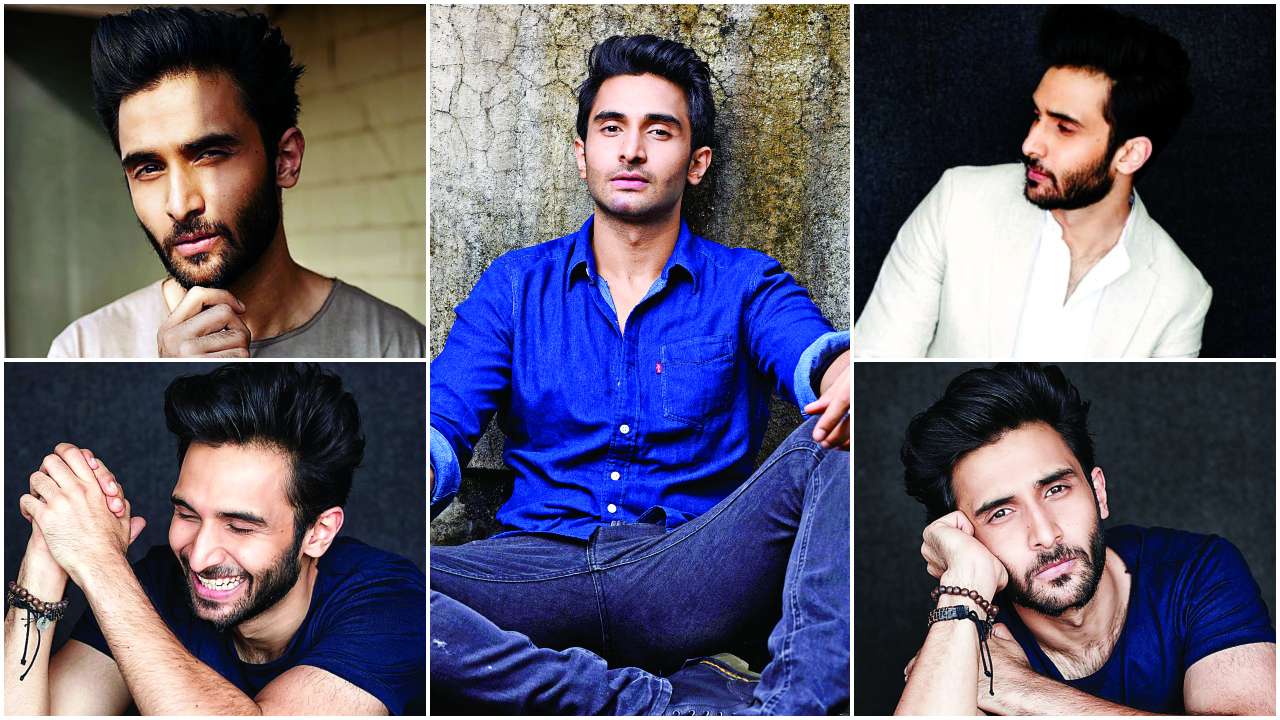
Meena Iyer (DNA; October 17, 2018)
Newbie Rohan Mehra, son of the gentleman actor of the ’80s, Vinod Mehra, has not met his dad. Unfortunately for the 27-year-old, his father passed away when his mother, Kiran, was four months pregnant with him. And since he can only unravel the mystery of who his papa was through conversations with people who had met him, Rohan, who has many traits (but naturally) of his late father, hangs on to my every word. After all, I knew Vinod well.
Through my conversation with the debutant, who will foray into Hindi cinema with the stock market thriller Baazaar, which releases on October 26, I discover a few similarities between him and his dad. More importantly, I find that Rohan is eager to make Bollywood his mainstay. Over to him:
Let’s talk about Baazaar.
Yes, let’s first tackle the elephant in the room (smiles). Baazaar, produced by Nikkhil Advani, Monisha Advani and Madhu Bhojwani, is my debut film. Nikhil sir is my Godfather. This is the first time I’m facing the camera. And I must say, it was overwhelming. I’m excited and impatient for it to release. It’s an interesting movie for the time and place. Even though it is set against the backdrop of the stock market, and some viewers might think it’s niche, I personally think the story will resonate with everyone. It’s about relationships. It’s what every good story should be in my opinion like how people interact with each other, how far are you willing to go to get what you want, are you willing to make enemies and who your heroes are, etc. When you put great elements against the backdrop of the stock market, you get a story that the audience can relate to. It seems niche but they will be like ‘Wow, I know exactly what that feels like.’
You were the rookie on the set. So were you the pampered one?
Quite the opposite really (laughs). I was not pampered. They were like, Rohan will be there as long as you want, he is new, he will do anything and everything. If you want him to shoot overtime, it doesn’t matter. I’m glad they did that, and I shot upto 15 hours a day. In a way, they were testing me. Everyone knew that I was coming with an abundance of energy and they wanted to see how long I could sustain. I would go on the set thinking I’ve got a big scene and I’m going to give it my best, get into character and be amazing. When I first arrived on set, I would be all charged up. An hour later, I would be a little tired; two hours later, when they still hadn’t taken my angle, I would be slightly restless. However, even if I had to wait for five hours, I would make it a point to sustain my energy. After all, it is my film and I was not going to let anything come in the way. So, I was not pampered. I was pushed as hard as I could be because it was a challenging movie to make.
So, Baazaar was a solid training ground?
It’s a big-budget film where you have the luxury of a nice brand. At the same time, it has prepared me for the conditions and times. We shot in real locations, nothing much on the studio or the set. So, it’s the best of both the worlds.
The film’s release got pushed. Did that make you impatient? Were there times you had to keep yourself motivated?
I would be lying if I said that I didn’t feel impatient and a little worried. But I had to keep in mind that such things are a part and parcel of this profession. Moreover, I got into this at the right time and right age. As clichéd as it may sound, I feel good things come to people who wait. Five years ago, I would have been like, ‘Why isn’t this happening, why am I not getting the work that I want to do?’ Through that process, I learnt that if you wait, you’ll get something good. You get wisdom from that process.
How was it interacting with an actor like Saif Ali Khan?
I had this perception of him as a star whose films I have grown up watching. But I remember the moment I walked on the set and did my first scene with him, all that went away. The way he said, ‘Hi Rohan.. how are you?’ helped dispel all my apprehensions. It was like two co-actors working together to give the best we could. It became such a friendly contemporary relationship, rather than ‘Oh, my God! It’s Saif Ali Khan in front of me’. With due respect to him, he never made me feel that ‘You’re a newcomer and I’m this big star’. I’m thankful to him that he made my first experience on a film so lovely.
Have you been meeting other filmmakers?
Even as I wait for Baazaar’s release, I have been meeting other filmmakers simultaneously. I’m blessed that I have someone like Nikkhil to guide me. He has seen the world and has had his share of ups and downs. I’m fortunate to have him because he, Monisha and Madhu Bhojwani really look out for me.
Since you said that you didn’t know your dad, what you’re getting to know about him is through stories from others, including your family.
I guess, as you can see, it’s one of those really strange stories wherein, how many people in the world can say my father passed away when my mother was four months pregnant with me. After I was born, I went to Kenya where my mom’s grandparents lived. Two things happened. Firstly, I had a lovely childhood. Secondly, I moved to a place where no one knew my father on a personal level. They were aware of Vinod Mehra, the Bollywood actor, but no one could sit across the table and tell me what he was like as a human being. So, I grew up not knowing him. To be honest, there was a slight intrigue factor. When you’re raised in an environment where everything is given to you, you don’t seek out that knowledge. But when I moved to Mumbai six years ago, the world completely opened up. It was like knowing your dad 21 years later. People said, ‘Oh Rohan, you do this as well! Your father did things exactly like that.’ When I started learning about him, my interest increased. I wanted to know more about him. I could relate to him, I feel we’re almost the same person.. he’s not there, but I feel so close to him. Suddenly, the jigsaw puzzle makes sense. I meet my bua (my dad’s sister) and she says, ‘Oh my God! You’re exactly like him.’ Discovering him through other people’s experiences and interactions with him has been an incredible journey.
Like everyone else in the industry, your private life became news before your professional life had started.
Yes, it did (laughs). It’s an occupational hazard. You sign up for it. It’s no secret that I feel emotional about my family, friends. If you dig deep into my social media posts, you’ll notice that I’m very open about everyone. Whoever my friends are, I express what I feel about them.
Have you faced heartbreak?
I get the person you’re speaking about (Tara Sutaria). We’ve been great friends, she is a lovely girl. She is doing a big film and I wish the absolute best for her.
The last time I met Mamta Kulkarni, she told me she wanted to get filthy rich-Jayesh Sheth
8:01 AM

Roshmilla Bhattacharya (MUMBAI MIRROR; November 14, 2014)
Back in '89, a pretty girl walked into ace photographer Jayesh Sheth's studio and surrendered herself completely to him. There were no tantrums or traces of green-eyed envy.
Mamta Kulkarni happily assisted Jayesh when he was shooting other actresses and told him that one day she too will shine on the marquee.
But the Bolywood offers she so hoped for didn't come along. What did, was an assignment from Stardust magazine for Jayesh. A topless shoot that none of the A-list actresses agreed to. "I suggested Mamta's name, pointing out her innocent face and sexy body," he reminisces.
The magazine agreed, so did Mamta, assuring him that she was comfortable with shedding her clothes for the lens.
That shoot made her an overnight sensation, bringing her films opposite the top heroes of the time, from Akshay Kumar and Aamir Khan to Govinda. "It was a shortcut to success. Mamta was soon competing with another promising contender, Divya Bharti," says Jayesh.
Those were the happy years. Then Mamta briefly disappeared, returned with Rajkumar Santoshi's Ghatak, got embroiled in a controversy with Tinu Verma and vanished again for two years.
"Then one fine day she was back in my studio, wanting to do a photo shoot. I could see she was not in good shape, physically, and it was her do-or-die attempt. While at my studio she got a call from Dubai. After putting the phone down, she told me she planned to go abroad and get filthy rich. That was the last conversation we had, back in 1996," admits Jayesh. What followed were rumours: She's gone insane... she has settled in Dubai... she has married a don called Vicky.... she is now a sanyasin.
These speculations sparked off his curiosity about the missing Miss and he started penning a screenplay of a struggling actress who makes it big and then disappears from the screen. "That's the subject of my second film and the protagonist has definitely been inspired by Mamta Kulkarni. I was just putting the finishing touches to the script when I heard that she has been traced to Kenya," says Jayesh. "I was shocked but not really surprised. But now, given this fresh twist in her story, I'l have to make some changes in the climax of my film."
Mamta Kulkarni caught in drug raid in Kenya; husband arrested
7:59 AM

Hiren Kotwani (BOMBAY TIMES; November 14, 2014)
 Mamta Kulkarni, popular sex
siren of the 90s, and her husband Vicky Goswami
were reportedly detained in Kenya for alleged involvement in drug
trafficking. Apparently, the couple was nabbed in a joint operation
between DEA (Drug Enforcement Agency) and Mombasa Police, and are being
questioned. One might remember, Vicky was arrested in 1997 for
alleged drug trafficking in Dubai and sentenced to 25 years in prison,
which was later reduced to 15 years.
The actress, now in her early 40s, has acted in films like Aashiq Awara,
Karan Arjun, Baazi and Sabse Bada Khiladi.
Mamta Kulkarni, popular sex
siren of the 90s, and her husband Vicky Goswami
were reportedly detained in Kenya for alleged involvement in drug
trafficking. Apparently, the couple was nabbed in a joint operation
between DEA (Drug Enforcement Agency) and Mombasa Police, and are being
questioned. One might remember, Vicky was arrested in 1997 for
alleged drug trafficking in Dubai and sentenced to 25 years in prison,
which was later reduced to 15 years.
The actress, now in her early 40s, has acted in films like Aashiq Awara,
Karan Arjun, Baazi and Sabse Bada Khiladi.
--------------------------------------------

On Thursday, social media was abuzz with news of Mamta Kulkarni's arrest. Reportedly, the yesteryear actress was taken into custody by the Kenyan police, along with husband Vijay 'Vicky' Goswami, on charges of drug trafficking.
However, Mirror has learnt that while her husband has indeed been arrested after a major drug bust undertaken by the US Drug Enforcement Administration and the National Police Service of Kenya, Mamta was not detained.
According to a leading Kenyan daily, the suspects were picked up in Nyali, Mombasa, at the residence of Baktash and Ibrahim Abdalla. The two Kenyan nationals were arrested, along with Goswami and another Indian national, Kulam Hussein.
The head of the unit investigating the case, Hamisi Massa, told the local press that the "suspects are liable to charges of conspiracy to traffic narcotic drugs in the US and Kenya and if found guilty, will attract severe penalties."
Cliff Ombeta, the lawyer representing the accused, including Goswami, admitted that Mamta was present in the house during the raid, but said that she was not arrested or detained.
Speaking from Mombosa, he told Mirror, "The lady was present in the house in Nyali when the police raided it. But no drugs were found there. The police arrested the Abdalla brothers, Vijay Goswami and Kulam Hussein based on an earlier raid in Nairobi. They will be in police custody for 14 days."
He added, "The US agencies want to extradite them so the trial can take place in a New York court. We will strongly oppose that."
Mirror tried to reach the Kenyan Director of Public Prosecutions to verify the lawyer's claim, but they chose not to comment.
Mamta Kulkarni, who disappeared from the limelight in early 2000s, was traced to Dubai where she married Goswami, an international drug lord.
In 1997, Goswami was arrested for drug trafficking and sentenced to 25 years in prison, as per Dubai laws. Owing to good conduct, he was released after 15 years. He then shifted to Nairobi with Mamta, who started a real-estate and hotel business there.
When asked if Mamta can be jailed, considering that she is Goswami's wife, Ombeta asserted, "She has nothing to do with the offence. Therefore, she wasn't taken to the police station. She is in her house and absolutely free."
Kim Sharma turns grooming expert for brides & grooms
7:43 AM

DNA (September 19, 2014)
Kim Sharma may be best known for her role in Mohabbatein but following a brief career in Bollywood the former model has changed roles. Kim disappeared from the social scene post her marriage to Kenyan businessman Ali Punjani in 2010 and while shuttling between her homes in Kenya, Dubai and here, she has launched her own bridal grooming service - Liason. Talking about the venture, Kim says, “It wasn’t really a definite thought process. I saw a couple of brides looking quite stressed out on their wedding day and realised they’re spending lots of money but not in the right way. I soon started getting requests to help in grooming and began enjoying it.” Most of her clients are women who want that special touch on their big day, but she has also had grooms coming to her who want to improve their image. “Most girls say that they want to look beautiful during their wedding. But it’s not just about those three days. It’s about continuing to look beautiful and fit even as a wife,” explains Kim who personally meets each person, understands their needs and then takes a call as to who are the best experts in the field to help them. “Generally I prefer it if a bride or groom comes to me four to five months prior to their big day. We address problems across the board— be it medical, aesthetic, psychological, emotional or even style-related. Whether it is weight loss, a skin concern or lack of self confidence — the transformation has been beautiful and rewarding,” she adds. Though she has already started her service in India, Kim plans to introduce the company on September 29 at the Helping Hands charity exhibit which is supported by Avantika and Imran Khan. “Our base for the India branch is in Mumbai, but I hope to help brides across the country. I feel all the exposure I got being in the glamour industry and having worked with and having access to the best in the field has helped me greatly. Having the same grooming service in Kenya and Dubai, I plan to divide my time equally between each city.”
Subscribe to:
Posts (Atom)