Showing posts with label Kalki 2898 AD. Show all posts
Showing posts with label Kalki 2898 AD. Show all posts
Nag Ashwin on winning National Award: "Kalki 2898 AD deserved recognition for it's production design"
4:48 PM

Vishakha Pandit (HINDUSTAN TIMES; September 24, 2026)
After Kalki 2898 AD (2024) won two National Awards, including Best Popular Film Providing Wholesome Entertainment and Best Production Design, director Nag Ashwin calls the wins “special”. The recognition marks his second National Award after he was previously honoured for Mahanati. Speaking about the honour, Ashwin says awards were not on his mind while making the film, but he always believed its production design deserved praise.
“Usually during making films, I don’t think of what awards it will get but for Kalki, I always felt that it should get in production design. We were doing some extremely impossible things and I’m very happy that it got that recognition,” says the filmmaker.
Reflecting on the win, Ashwin says the team shared the joy despite being in different places. “We were all in different places but overall I think we all felt an immense gratitude and joy for the recognition,” he says.
The film featured an ensemble cast of Amitabh Bachchan, Prabhas, Deepika Padukone and Kamal Haasan, among others. Ashwin credits the film’s “great actors” for pushing him to be sharper and ensuring that the story and scenes were “up to the mark”.
“Rather than overpower the story, I feel it helped me be sharper on my feet and make sure that the story or the scenes really were up to the mark, to justify the great actors who were playing these roles,” he says.
Recalling the film’s most challenging sequences, Ashwin points to the climax featuring Ashwatthama (Amitabh) battling Bhairava (Prabhas) in Bujji, the three-wheeled AI car, as well as the Mahabharata portions. “It was really a complicated sequence because the action had proper story beats and had to keep improving. And also the Mahabharata sequences,” shares the 40-year-old.
Ashwin also feels the response to films across scales is encouraging. “It’s very exciting as stories now, whether they are small and intimate or larger than life, have somehow seemed to have found their own stable audience and I’m really hoping that this trend continues,” he says.
He adds that Kalki’s success has also inspired filmmakers to explore the genre, although that means he will have to reassess some of the ideas he originally developed years ago. “Kalki has inspired many more to follow this genre... what was original seven years ago while writing it, I’ll have to assess and reimagine sometimes,” he says.
With the film’s box-office success followed by National Award recognition, Ashwin says the focus for its sequel, Kalki 2898 AD – Part 2, will remain on the story rather than expectations. “After the box office success and now the award recognition, what we will strive to do is to still be honest to the story. And make a film that can stand the test of time,” he says.
For Ashwin, that honesty begins with the reason a filmmaker chooses to tell a story in the first place. “I feel the stories that directors want to tell... from inside... not because they need to make their next film or are trying to write something according to the trend. The want to make something should be blind and relentless. I feel only those work, at any point of time,” he concludes.
-----------------------------------------
Vinay MR Mishra (BOMBAY TIMES; September 24, 2026)
For Nag Ashwin, the National Award recognition for Kalki 2898 AD is more than just an accolade — it is a validation of the immense effort that went into creating the ambitious sci-fi spectacle. The filmmaker says the honour feels like a “pat on the back”, particularly because of the scale of the film and the number of people involved in bringing his vision to life.
“I felt very grateful because it has taken a long time and a lot of people to achieve this, and the recognition felt like a pat on the back,” he says. Ashwin admits that awards are rarely on his mind while making a film.
“Normally, I don't think of awards while making a film, but with Kalki, I felt that the VFX and production design really were doing some impossible things, and I hoped it would be recognized,” he says, adding, “Now, winning the National Award for Production Design is very satisfying. For me as a filmmaker, I think it really gives you a little boost of energy to keep going.”
With anticipation around the second instalment at an all-time high, the director reveals that the team is preparing to move into the regular shooting schedule soon. “We should be getting into regular shoot from next month and hopefully finish the shoot of the film by the middle of next year,” he says.
Does the massive anticipation surrounding Kalki 2 add pressure?
“No, I don't think it adds any pressure, but I think it's very encouraging and energizing to know the number of people that are waiting eagerly for Part 2,” he concludes.
Jackky Bhagnani reveals why Shahid Kapoor’s Ashwatthama project was shelved
11:19 PM

Priyanka Sharma (MID-DAY; August 17, 2026)
Even as reports suggest that Shahid Kapoor will kick off a comedy later this year, the actor is keen to collaborate with long-time friend and producer Jackky Bhagnani for a big-screen outing. Bhagnani revealed to mid-day that the two friends want to unite forces professionally.
“Shahid and I want to do something together. We feel that while we have been friends for 20 years, we can come together strongly as a professional team. But until we find that correct opportunity, we won’t. We are actively looking for something to collaborate on,” said the actor-turned-producer.
In early 2024, this plan had almost come to fruition. Bhagnani’s Pooja Entertainment and Prime Video had announced their ambitious film, Ashwatthama - The Saga Continues, as part of the streamer’s slate. However, it was soon heard that the project was shelved.
When we mentioned this to Bhagnani, he shared, “There were multiple reasons why we decided against it. [One being that] Kalki 2898 AD [2024] came after that. When you make a big-scale film, the audience doesn’t judge you on the basis of the amount of money you have spent on it, but on how unique your content is. If it’s not unique, that money goes down the drain.”
Rumours also suggested that Jackky Bhagnani’s banner was producing ‘Suryaputra Mahavir Karna’ with South star Vikram. “We aren’t doing it right now. We have pushed it,” he revealed.
Its going to be a tough road ahead for films from the South
3:13 PM

Box Office India Trade Network
The past few years has seen films from the South score and even break records which was a rarity earlier but it has been presented as some sort of dominating wave which has left Hindi cinema behind which is very far from the truth. Whatever the struggles of Hindi films, it will remain the biggest film industry in the country simply because of the POTENTIAL audience it has in sheer numbers. Its a different matter that this potential audience has not been reached generally over the last few decades or so.
This so called pan India thing is just not there, no matter how much the media shouts as the majority of these so called pan India films bite the dust. But the ones which get though are talked about. It is going to be even tougher now for this South content as generally its built on sequels. The first film gets appreciation and then the second one gets the numbers but this game is just not valid for South films but all films.
The sequel thing will run its course as it cannot go on forever due to over supply be it from Hindi cinema or South. Hollywood has already seen this happen. There was this South wave in the 80's but it was slightly different as it was banners and directors from the South making films in Hindi with Hindi film stars and it lasted 3-4 years before normal service was resumed. Also that was actually a wave while the present is more media made.
The problem the South films will face are expectations because of this media made wave and their huge budgets and how they open when they are not sequels. The wider audience responds when its a sequel to an appreciated film but outside that, its just a few areas where there is a ready audience.
Below are the opening day collections of South films in Hindi when not sequels and they pretty much say it all with just a handful which can be called good opening and mainly Prabhas starrers who has a following in certain Hindi belts. There are not many films to get even 5 crore nett till date and it will be similar films going forward which history shows is always dwindling returns. The road is only going to be tougher from here.
1. Saaho - 25,82,00,000
2. Kalki 2898 AD - 20,86,00,000
3. RRR - 19,38,00,000
4. Salaar - 15,73,00,000
5. Devara - 7,13,00,000
6. Game Changer - 6,83,00,000
7. The RajaSaab - 5,03,00,000
8. Baahubali: The Beginning - 4,92,00,000
9. Coolie - 4,14,00,000
10. Radhe Shyam - 4,09,00,000
Dhurandhar The Revenge first film to cross 10 million mark in Canada
2:21 PM

Box Office India Trade Network
DHURANDHAR THE REVENGE smashed all records in Canada as it has collected almost $10.8 million till date which is a record by a distance and the first $10 million Indian film in the country. The film beat the record of DHURANDHAR by over $3 million and ANIMAL, by $3.7 million which are second and third best.
The market has grown by leaps and bound post the pandemic and is the fastest growing market for Hindi films in Overseas. There was a time 8-10 years back when $2 million was a big mark in Canada and here you have a film crossing $10 million. The share of Canada from the US/Canada market is 31% for DHURANDHAR THE REVENGE. This is roughly the average today though if the film has less of a gentry audience, then Canada can go up as USA has a bigger market for gentry films.
DHURANDHAR THE REVENGE has not beaten the BAAHUBALI 2: THE CONCLUSION record in USA alone as that was $19.9 million and DHURANDHAR THE REVENGE will be $17.5 million. But BAAHUBALI 2: THE CONCLUSION was only $275k in Canada while DHURANDHAR's sequel will be $7.9 million (USD) giving it $25.4 million total as compared to $20.175 million of BAAHUBALI 2.
Below are the all time top grossers in Canada. All figures are in CAD $.
1. Dhurandhar The Revenge - $10,800,000
2. Dhurandhar - $7,700,000
3. Animal - $7,103,000
4. Pathaan - $6,054,000
5. Jawan - $5,278,000
6. Pushpa 2 - The Rule - $4,218,000
7. Stree 2 - $4,213,000
8. Jatt & Juliet 3 - $3,860,000
9. Kalki 2898 AD - $3,623,000
10. Rocky Aur Rani Kii Prem Kahaani - $3,281,000
Kareena Kapoor, Ananya Panday back Deepika Padukone’s eight-hour shift demand
10:33 AM

HINDUSTAN TIMES (March 8, 2026)
Actor Deepika Padukone sparked debate last year over eight-hour work shifts after reportedly exiting films like Spirit and the sequel to Kalki 2898 AD (2024). Now, actors Kareena Kapoor Khan and Ananya Panday have defended her stance, saying such conversations with producers are necessary.
Speaking to The Hollywood Reporter India, Kareena said clear communication and planning are key, especially for working mothers. Recalling her time shooting The Buckingham Murders (2024), she shared that she informed producers in advance about returning to her children while her husband, Saif Ali Khan, looked after them. She further spoke about Deepika’s eight-hour shift demand and added that if actors are married, they need a partner who understands, as they cannot both work and leave the children alone.
“I feel like if you are married and have children… You should be able to say this is what I want. I can work this number of hours. I think it’s completely fine to say that way before a film starts,” Kareena said.
Ananya, on the other hand, said, “I have worked with Deepika (in the 2022 film Gehraiyaan), and before she became a mother, there was no such thing like that. She was working, coming to workshops, no complaints and no asking for anything. Now she’s a mother… she needs to be present with her child in the first two years. I think it’s okay to have a conversation with your producer to find a balance.”
Keerthy Suresh calls Deepika Padukone’s eight-hour shift ideal
10:02 AM

During a press meet, Keerthy highlighted that sleep is just as important as food or exercise
HINDUSTAN TIMES (November 28, 2025)
Ever since actor Deepika Padukone’s exit from director Sandeep Reddy Vanga’s Spirit and director Nag Ashwin’s Kalki 2898 AD sequel, there has been a lot of conversation around work shifts. Now, while promoting her upcoming film Revolver Rita in Hyderabad, actor Keerthy Suresh explained why work shifts in the film industry are ideal for actors and technicians. Here’s what she said.
Keerthy told the press that she has worked various shifts throughout her career, sometimes even from 9 am to 2 am the next day. While shooting for Mahanati, she also worked on five other films, she revealed. But, she emphasized that for health reasons, it would be ideal to have an 8-hour shift.
Explaining what a day looks like for most actors, she said, “For a 9 o’clock shift, if I have to be there by 7:30 am, I have to start from home at 6:30 am and wake up by 5:30 am. And when you pack up by 6-6:30 pm, you leave by 7 pm to go back and change. By the time you reach back home, it’s 8:15 pm. We change and go to work out by 8:30 pm, and by the time you’re done, it’s 10 pm. You shower, have dinner, and it’s already 11p m. Now, I have to wake up at 5:30 am after sleeping at 11:30 pm.”
She added how in Malayalam and Hindi, actors and technicians work longer hours with less time to sleep. “We say 8 hours of sleep is good, but we hardly get to sleep for 6 hours. And this is in an ideal 9-6 shift. Imagine us shooting for more hours, imagine the technicians reaching sets before and packing up after us,” she explained, adding, “In Tamil and Telugu, we usually have a standard of 9-6. But in Malayalam and Hindi, they work for 12 hours. In Malayalam, they work without breaks in continuous schedules, and it’s difficult. They sleep 3-4 hours, and lightmen in Kerala sleep 2-3 hours.”
The South is eating OTT’s lunch; Bollywood isn’t the main course anymore
9:49 AM

Once built around a Bollywood-first script, India’s streaming economy now finds its biggest growth engines and creative bets firmly rooted in the southern states
Javed Farooqui (THE ECONOMIC TIMES; November 26, 2025)
Over the last decade the gravitational pull of India’s entertainment economy has shi fted unmistakably southward. What began as sporadic national curiosity, gradually swelled into a full-blown cultural crossover. When Naatu Naatu from the Ram Charan-NTR Jr starrer RRR lit up the Oscar stage, it signalled that southern cinema was no longer rising quietly; it was asserting itself at the centre of India’s mainstream imagination.
That momentum has now spilled decisively into the OTT universe. For years, India’s streaming landscape ran on a Bollywood-first operating system. Budgets, narratives, and viewer targeting were all sculpted around the Hindi-speaking market.
But the lockdown years changed viewing behaviour dramatically. Housebound and hungry for fresh stories, audiences began exploring Tamil, Telugu, Malayalam and Kannada films in unprecedented numbers. The runaway popularity of Pushpa: The Rise - Part 01, Kantara and RRR ensured that southern storytelling was no longer incidental, it was central.
Among the southern-language industries, Malayalam cinema has emerged as the most intriguing outlier. Despite being the smallest in scale, it has consistently punched above its weight. Films like Manjummel Boys and Aadujeevitham - The Goat Life have travelled across states, while titles such as 2018 and Premam have shown modest overseas draws. Its combination of creative discipline and financial prudence has strengthened the entire value chain, making Malayalam cinema an appealing proposition not just for theatres but also broadcasters and streaming platforms chasing quality content with dependable economics.
Battle for Eyeballs
Today, the fiercest battle for subscribers, originals and film rights is unfolding in southern India. Tamil Nadu, Telangana, Andhra Pradesh, Kerala and Karnataka have become high-growth markets. Every major platform is investing aggressively, drawn by more than 250 million people, deep digital penetration, mature entertainment habits and a willingness to pay.
L V Krishnan, chief executive officer of TAM Media Research, notes that southern audiences have historically shown about 50% higher content consumption. “With growing digital penetration and diverse storylines, content consumption is being further boosted by streaming platforms. Easy and cost-effective AI-driven dubbing has broadened the appeal of southern content to a global audience.”
India’s streaming ecosystem has exploded to 57 OTT platforms, spanning national giants and regional players like Aha, Sun NXT and ETV Win. Ormax Media estimates the country’s OTT audience will touch 600 million by year-end, powered by rising connected-TV usage expected to hit 129 million. With 562 million smartphones and nearly 50 million connected-TV screens, digital entertainment is now the default mode of consumption.
Content Counts
Content supply has kept pace —India churns out close to 200,000 hours of original programming a year—from over 1,600 films to more than 2,600 hours of premium OTT series, says a FICCI-EY report. Paid streaming is also expanding, with subscription video users projected to rise from 47 million in 2024 to about 65 million by 2027.
Although platforms do not reveal regional subscriber splits, executives say the South contributes disproportionately to paid users and viewing hours. The region’s 143 million OTT users nearly match North India’s 151 million despite its smaller population base, according to Ormax. Half the southern population already consumes OTT content, the highest penetration in India.
The investment momentum reflects this energy. Platforms are building larger content teams in Chennai and Hyderabad, experimenting with new pricing models and aggressively commissioning original series that reflect local culture rather than merely ticking regional boxes. The era of token presence is over; depth is the new strategy.
For Netflix, Prime Video and ZEE5, southern growth is fuelled by blockbuster films and originals. For JioHotstar and Sony LIV, sports strengthen their entertainment pipeline. Local giants such as JioHotstar and ZEE5 also benefit from steady daily TV content that reinforces platform stickiness.
“Streaming created a watershed moment for South cinema. During the pandemic, high quality subtitles and dubbing removed language barriers and audiences discovered stories they never had access to,” said Monika Shergill, VP content, Netflix India.
On a New Platform
In 2022, South content viewership grew 50% year-on-year, with South titles appearing in Netflix’s global non-English Top 10 list in about 17 countries the following year. This number has now risen to 26. Last year, Vijay Sethupathi’s Maharaja became Netflix’s most-watched Indian film globally.
“South storytelling is not just becoming bigger in India, it is becoming mainstream. A large part of our slate today consists of South movies, and we acquire the Hindi dubbing rights along with multiple subtitle and dubbing language rights. This allows these powerful films to travel across different audiences,” Shergill said.
Early OTT investment focused heavily on acquiring South Indian films. Titles such as Pushpa, Kantara, Kalki 2898 AD and KGF fetched some of the highest digital acquisition fees. Films still trigger subscriber spikes, but platforms are now investing more in long-form originals to build retention.
Netflix recently announced six new Tamil and Telugu originals, underscoring long-term commitment.
“We currently have about 26 shows in development, negotiation or production for the South. This is the largest pipeline of South Indian content we have ever had,” said Nikhil Madhok, director and head of originals, Prime Video India, adding that 60% of users watch content in multiple languages.
Sony LIV is developing 13 regional originals, 11 of them from the South. Sony LIV’s business head Danish Khan said the South’s strong legacy in films and television raises creative expectations. “Tamil and Telugu are large markets both within India and internationally. Malayalam has become a supplier of strong stories across India.”
Khan noted that consumption patterns in South India mirror national trends—sports, films and originals drive engagement. Sony LIV acquires only select Malayalam films for cost efficiency. The subscriber split is around 80:20 male to female and viewership is 70:30 in favour of men. “OTT penetration in South India is already high and content consumption per user is higher than the national average,” he said.
“We anticipate a substantial rise in the volume of OTT content originating from the South in the coming years.”
JioHotstar plans to triple its South slate to 1,500 hours of original and acquired programming over the next year. JioStar head of entertainment, South cluster, Krishnan Kutty said one-third of the platform’s viewers are from the South and account for a disproportionately high share of watch time.
“The Tamil and Telugu markets are the largest in terms of heft and creative ecosystem. Kerala punches far above its weight because it has a strong pool of storytellers. Some of our most successful movies and specials have come from Kerala. In Karnataka, we are at an early stage, but we are very excited about that market too,” Kutty said.
ZEE5 chief business officer Siju Prabhakaran said, “South contributes up to 45% of our total OTT watch time. Language packs contribute roughly 60-70% of our new subscribers. Each market has a business head who understands local culture and stories. For us, content is the hero.” ZEE5’s language packs are priced at Rs. 99 per month and Rs. 699 annually.
Plot in Story-telling
Executives say South Indian audiences are shaping a distinct OTT playbook. The region’s entrenched TV habits and strong cinema culture push platforms to create habit-forming content. Films remain the biggest subscription catalyst, with Prabhakaran estimating 50- 60% of new subscribers still coming from movies. Prime Video also notes the South’s affinity for films.
To build retention, platforms are adopting TV style storytelling. JioHotstar’s 80–100 episode series are “breaking conventional norms of digital content” as viewers return weekly. ZEE5’s OTT-first reality shows are among its biggest non-fiction subscription drivers.
The South is no longer a regional appendage to the national entertainment market. It has become the creative engine powering India’s soft-power ambitions. As language barriers fall and audiences embrace Indian stories, creators from Tamil Nadu, Telangana, Andhra Pradesh, Kerala and Karnataka are leading the charge. Streaming has not only expanded southern cinema’s audience; it has reshaped India’s entertainment economy and its cultural centre of gravity.
THE GREAT EXPANSION
- JioHotstar plans to triple its South slate to 1,500 hours over next year.
- Prime Video has 26 South-origin shows in the pipeline.
- SonyLIV has 13 regional originals, 11 of them from the South.
- ZEE5 says the South accounts for 45% of its OTT watch time, driven by aggressively priced language packs.
- Netflix has announced six new Tamil and Telugu originals; says views of South content grew 50% YoY in 2022.
Kantara: A Legend Chapter – 1 is sixth highest South dubbed film in Week 2
3:22 PM

Box Office India Trade Network
KANTARA: A LEGEND – CHAPTER 1 had the sixth highest collection ever in the second week for a dubbed or bilingual film from the South. The list basically incorporates most of the biggest films from down the South because if a South film is collecting well in week two in Hindi, its almost certain the film is a grosser. Hindi is basically the ultimate frontier and the toughest hurdle for the South films.
The film is dominated by sequels and that is why films like RRR and KALKI 2898 AD deserve a special mention as they have done without the craze of a previous films. However, RRR was an exception; it had the advantage since it came from the makers of BAAHUBALI. It was a rare instance in Hindi cinema that the maker carried the film as its normally all about the stars as far as the bigger numbers go.
The list is dominated by Prabhas films who has four films in the list and even a film like SAAHO manages to get into the top ten. This guy is probably the only star till date who has made that breakout into Hindi cinema. The other one who was close was Rajinikanth and it remains to be seen what happens with the hero of PUSHPA, Allu Arjun.
This breakout of Prabhas makes a regional actor the biggest star in the country which is shocking and this was not even thinkable earlier and a its a lot down that the stars of Hindi cinema either doing bad films and others seeing lack of support in core Hindi circuits. It remains to be seen how long this remains as Prabhas will have a lot of Telugu content to satisfy his local crowd and this will not always penetrate into Hindi. If the film is too Telugu, it could even struggle for initials. Obviously, SPIRIT is there and when the biggest star and biggest director (arguable but as far as Hindi content goes, Sandeep Reddy Vanga stands alone at present) get together, then fireworks will be expected.
The top ten second weeks for dubbed/bilingual films are as follows.
1. Pushpa 2 - The Rule - 1,78,31,00,000
2. Baahubali 2: The Conclusion - 1,42,52,00,000
3. KGF - Chapter 2 - 79,57,00,000
4. RRR - 75,34,00,000
5. Kalki 2898 AD - 70,71,00,000
6. Kantara: A Legend Chapter – 1 - 50,75,00,000 apprx
7. 2.0 - 36,81,00,000
8. Baahubali: The Beginning - 25,26,00,000
9. Saaho - 24,04,00,000
10. Pushpa: The Rise - Part 01 - 20,02,00,000
Male superstars have worked eight hours for years, it’s never made headlines-Deepika Padukone
10:36 AM

HINDUSTAN TIMES (October 11, 2025)
Deepika Padukone has finally addressed the controversy surrounding her demand for an eight-hour workday, which reportedly led to her exit from director Sandeep Reddy Vanga’s Spirit and director Nag Ashwin’s Kalki 2.
Speaking to CNBC-TV18, the actor highlighted that while “male superstars” have worked similar hours for years, it “never made headlines”. “By virtue of being a woman, if that’s coming across as being pushy or whatever, then so be it. But it’s no secret that a lot of superstars, male superstars, in the Indian film industry, have been working for eight hours for years, and it’s never made headlines,” she said.
The 39-year-old added that many male actors even refrain from working on weekends: “I don’t want to take names now and make this into a whole thing. They do not even work on weekends.”
Deepika also commented on the broader state of the film industry, describing it as “a very disorganized industry”, and emphasizing that “it’s time we brought in some system into this culture”.
When asked about navigating change in her own way, she responded, “I am someone who has always fought my battles silently, and for some strange reason, sometimes they become public, which is not the way I’ve been brought up. To fight my battles silently and in a dignified way is the way I know.”
Alia Bhatt busy with Chamunda; Nag Ashwin resumes talks with Sai Pallavi?
10:32 AM

Mohar Basu (MID-DAY; October 3, 2025)
Last November, mid-day had reported that Alia Bhatt was in talks to headline filmmaker Nag Ashwin’s yet-untitled woman-led film (Alia Bhatt to front Nag Ashwin’s next, Nov 10, 2024). But 11 months is a long time for things to change. Ashwin, whose ‘Kalki 2’ is now undergoing a round of casting following Deepika Padukone’s exit, is reportedly considering focusing on his woman-centric film in the interim.
However, that clashes with Bhatt, who is said to have given bulk dates to Maddock Films’ ‘Chamunda’ from March 2026. In the latest development, industry chatter suggests that the filmmaker has resumed talks with Sai Pallavi, who has long been his choice to lead the action drama.
A source close to the production revealed, “Nag didn’t let go of the idea of the woman-led film. It was simmering on the backburner through most of 2025. With the developments in Kalki 2, bringing the other project forward is a possibility.”
Pallavi, however, can allot her dates only after the two-part Ramayana is complete.
The source adds, “She is expected to wrap up the second instalment of ‘Ramayana’ by mid-2026. If the dates align, she could step into Nag’s film before he moves to ‘Kalki 2’.”
Insiders, however, insist that schedules and casting could shift, given the dynamic nature of the projects in question.
Shah Rukh Khan's King also a reason for Deepika Padukone's exit from Kalki 2898 AD sequel
9:33 AM

Upala KBR (MID-DAY; September 23, 2025)
Days after the makers of Kalki 2898 AD (2024) announced that Deepika Padukone would not be a part of the sequel as they could not find a “partnership”, the actor seemingly hit back with an Instagram post. Over the weekend, she shared a picture from the set of Shah Rukh Khan’s King and noted that “the experience of making a movie, and the people you make it with, matter far more than its success.” This has reignited the chatter around what led to the falling-out between Padukone and Vyjayanthi Movies, which is backing Kalki 2.
While the actor’s fee hike and stipulated working hours were said to be part of the reason (All the dope behind dropping DP, September 20), one now hears that Kalki 2’s delays and eventual scheduling conflicts with King also led to them parting ways.
It turns out the sequel to Nag Ashwin’s sci-fi action film was earlier supposed to go on floors in May 2025.
A source breaks it down, “Kalki 2 did not roll in May, as initially planned, since Prabhas was shooting for Fauji. The constant delays required Deepika to reshuffle her projects. Finally, when the latest set of dates was asked for Kalki 2, it was clashing with King. Deepika has done five films with Shah Rukh and shares a deep friendship with the superstar. There was no way she would not feature in his film.” An insider points to the tone of the makers’ statement, saying, “It just shows their attempt to deride her when they know that they couldn’t adhere to the discussed timeline.”
But every story has two sides. The buzz is that the talks around Kalki 2 had started spiralling downwards in the past three months after the shoot didn’t kick off in the summer.
Another source says, “Each star’s fee for the sequel was agreed right when the first film was signed. The producers felt that Deepika’s new ask for a fee hike was unjustified. She wanted a 30 per cent hike plus back-end profits, five hours of shoot per day, conveyance and luxury hotel accommodation for her 26-person entourage. Why didn’t she make her conditions clear when she signed the first part? Also, the turning point came with the way her management handled the negotiations. Recently, Nag Ashwin apparently told the producers that Deepika wasn’t taking part in any discussion about the film. The producers felt they could save about Rs 40 crore if they dropped her. So, they made the announcement. As for her dates, they were supposed to be a mutual arrangement. So, the narrative of a scheduling clash has no grounds to it.”
Hiked fee, eight-hour workdays, entourage cost caused Deepika Padukone's exit from Kalki 2898 AD sequel
9:38 AM

Mohar Basu, Priyanka Sharma (MID-DAY; September 19, 2025)
Deepika Padukone’s character Sum-80 was central to the story of Kalki 2898 AD (2024). Can one imagine the sequel without the actor? The makers can, and are doing so. On Thursday, they announced that Padukone will not return for the sequel of the sci-fi action film that was headlined by Prabhas and her. Vyjayanthi Movies, the studio behind Nag Ashwin’s ambitious directorial venture, kept its statement brief but pointed.
An excerpt from it read, “Despite the long journey of making the first film, we were unable to find a partnership. A film like Kalki 2898 AD deserves that commitment and much more”.
Understandably, the development has created ripples across the industry. This comes four months after Padukone was dropped from Sandeep Reddy Vanga’s Spirit, reportedly over the actor’s request for stipulated working hours — an ask that many sections felt was justified for the new mother. On Kalki 2, multiple factors apparently led to the split, one being the request for eight-hour workdays.
A source tells mid-day, “It wasn’t unreasonable from Deepika’s perspective because she has a young child and wants a work-life balance. But on a film like Kalki, an eight-hour workday translates to about six hours of camera time. Kalki is heavy on action and VFX, and that sort of schedule is hard to accommodate.”
An insider close to the production reveals that the decision makers at the banner, planning to roll Kalki 2 by the year-end, knew that any uncertainty around schedules would burden the expensive film. The insider says, “Kalki 2 is a multi-hundred crore film with an ensemble cast, and enormous technical and logistical challenges. Any uncertainty around a lead actor’s time can derail the entire chain.”
Another point of contention was money, according to multiple sources. It is heard that Padukone’s team proposed a fee hike from her compensation for the first film. “The studio felt the combination of higher fee and limited hours made the project unworkable.” Reports suggest that the studio also had reservations regarding the actor’s entourage costs.
Negotiations not materializing is common in the movie business. What stood out starkly in this case is Vyjayanthi Movies’ step to publicly announce the parting of ways on social media. Apparently, the decision was rooted in caution.
A source shares, “The production house was clear that they didn’t want a repeat of the media showdown that happened during Spirit. Kalki is a prestigious film for them, and they didn’t want multiple narratives to surround it.”
mid-day contacted Padukone’s team, Vyjayanthi Movies, and Ashwin, who didn’t respond till press time.
Southern films struggle in Hindi; poor marketing, weak stories to blame
9:34 AM
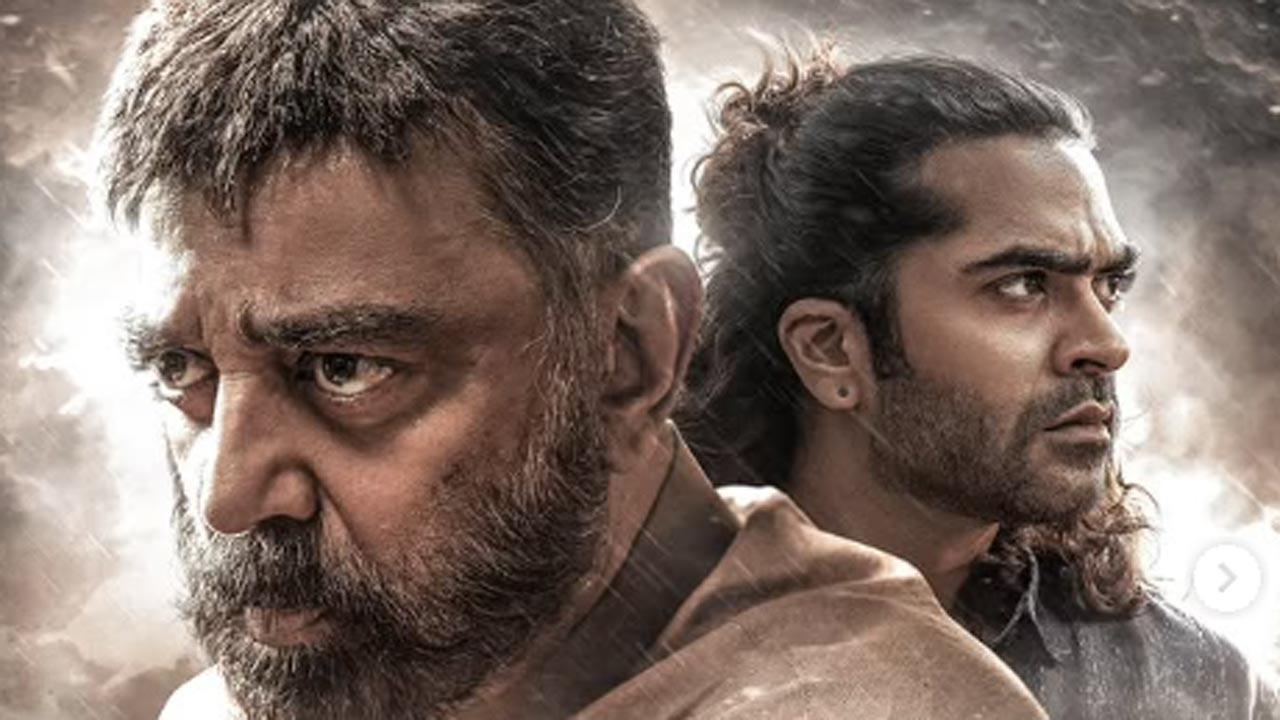
Dubbed regional films struggle to find success in the Hindi belt over the past six months, despite attempts to broaden their appeal
Rajesh N Naidu (THE ECONOMIC TIMES; June 9, 2025)
An increasing number of southern language films dubbed in Hindi have failed to attract a favourable response in the past six months, thanks to limited or no marketing, lack of stories containing universal values and stylish larger-than-life characters, a small four-week window in theatres, and ineffective branding through the deliberate casting of prominent actors from across India.
The recent washout performance of the Hindi-dubbed version of the Tamil film Thug Life points is the latest example.
According to box office research firm Sacnilk, Thug Life collected 1.2 crore in Hindi over the past three days, while the Tamil version earned 26.08 crore in the same period. Apart from Thug Life, dubbed Hindi films such as Retro, HIT: The Third Case and Kanguva have not worked.
Producers believe that the increasing tendency among southern filmmakers to promote films as pan-India offerings is a key reason for their failure.
"A pan-India film is a myth. Deliberately casting actors from different states does not make a southern film pan-India. The Hindi belt audience just wants a good, entertaining film. A good film dubbed in as many languages as you want will work," said Naveen Chandra, founder and CEO of 91 Film Studios, a studio that produces, finances, and distributes regional films.
He cites 'Pushpa 2' and 'Kalki 2898 AD' as examples of films that found a strong audience in the Hindi belt. "In Pushpa 2 – The Rule, the story has not progressed at all. The cop has not caught the criminal. There is a continuous chase. Yet, the film has worked. This is because almost every scene in the film is entertaining. And the Hindi belt audience has loved it," said Chandra.
Pushpa 2 – The Rule was released in December last year. It collected Rs 812 crore in the dubbed Hindi version alone-much higher than the film's collection in its original Telugu, which was Rs 341.4 crore.
Another reason Hindi-dubbed versions are failing at the box office is their storytelling. "The Hindi belt audience is not interested in stars. They are interested in stories that contain universal values, stylish larger-than-life characters, and a high dose of escapism. Of late, however, southern films have been more realistic, with little escapism. Hence, they are not travelling beyond their home states," said Shaaminder Malik, a film distributor and trade analyst.
According to a report by media and entertainment research firm Ormax Media, in 2024, dubbed Hindi films contributed 31% to the total Hindi box office, highlighting the dominance of southern films. But this contribution is likely to drop in 2025.
Limited marketing and promotion, along with a four-week theatrical window, have also contributed to the failure of Hindi-dubbed films. "Of late, a dubbed Hindi film is either not marketed or not well enough. Audiences in the Hindi belt are not aware of these films. Importantly, most southern films stay in theatres for only four weeks before being released to streamers. So, the potential of these films is not fully exploited by Hindi belt audiences," said Suniel Wadhwa, a veteran film distributor.
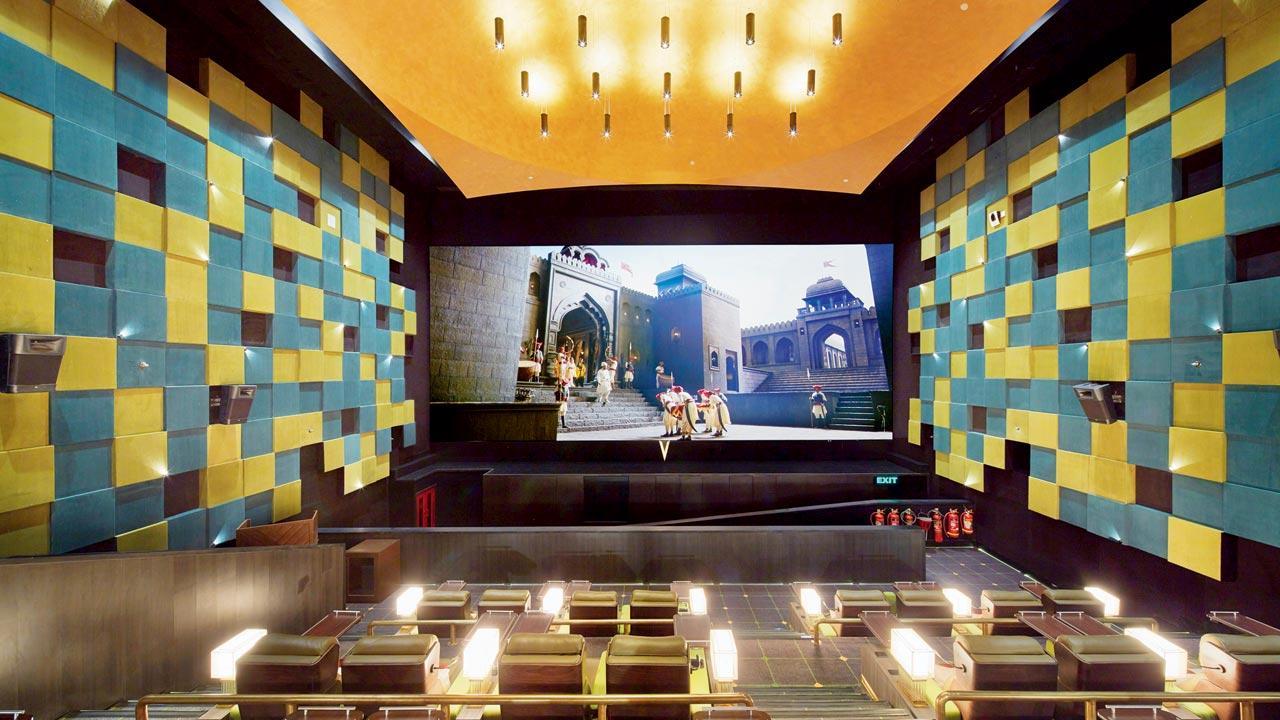
PVR Inox Q4 Results: Loss narrows to Rs 125 crore, revenue falls 0.5% YoY
11:16 AM
THE ECONOMIC TIMES (May 13, 2025)
Multiplex chain PVR Inox on Monday reported consolidated net loss of Rs 125 crore for Q4FY25 versus Rs 130 crore in the year-ago period. The loss is attributable to the owners of the company.
The revenue from operations in the March-ended quarter stood at Rs 1,250 crore, which was marginally down at 0.5% versus Rs 1,256 crore in the corresponding quarter of the last financial year.
On a sequential basis, the company reported a loss against profit after tax (PAT) of Rs 36 crore in Q3FY25. The top line, though, witnessed a 27% fall versus Rs 1,717 crore in the October-December quarter of FY25.
The earnings were announced during market hours, and PVR shares remained unfazed amid an upbeat mood in the market, trading at Rs 958 on the NSE, up by Rs 36.55 or 4% over the Friday closing price. The headline Nifty50 index was trading over 3% higher around 1:30 pm.
The company's Earnings Before Interest, Taxes, Depreciation and Amortisation (EBITDA) stood at Rs 344 crore, up from Rs 327 crore reported in the year-ago period.
In the quarter under review, patrons that visited the company's cinemas stood at 30.5 million with an average ticket price of Rs 258. The F&B spend per head (SPH) stood at Rs 125. As of date, PVR Inox operates 352 cinemas with 1,743 screens across 111 cities.
The box office in FY’25 was impacted by an uneven release calendar, marked by inconsistent content availability across quarters, the company filing said. Both Bollywood and Hollywood underperformed, contributing to a 9% decline in the company's overall gross box office revenue.
Hindi box office collections dropped 26%, primarily due to a 14% reduction in film releases, the absence of major superstar-led titles, and multiple postponements. Hollywood revenues fell by 28%, reflecting the lingering effects of the previous year’s strike and a lackluster tentpole slate. In contrast,
Hindi-dubbed films saw a remarkable 153% surge, driven by nationwide hits like Pushpa 2 – The Rule and Kalki 2898 AD, underscoring a growing audience appetite for large-scale pan-India narratives.
Chhaava emerged as the highest-grossing film in the 4th quarter, earning approximately Rs 700 crore at the box office.
Commenting on the results and performance, Managing Director Ajay Bijli said, "FY’25 was a year of transformation — defined by our renewed focus on innovation and agility. We evolved from being reactive to becoming resilient and emerging as a more agile, future-ready organization, laying the groundwork for long-term sustainability and relevance in a rapidly changing entertainment landscape”.
------------------------------------
Mumbai: PVR Inox, India’s largest multiplex operator, said its net loss narrowed to Rs. 125 crore in the March quarter compared with Rs. 129 crore a year ago. Multiplexes in India have been seeing declining footfalls amid lackluster box office performances.
For the full year FY25, PVR Inox’s net loss surged to Rs. 281 crore, up 751% from Rs. 33 crore in FY24. Earnings before interest, taxes, depreciation, and amortisation (Ebitda) for the quarter rose by 5.2% to Rs. 344 crore from Rs. 327 crore. For the full year, however, it declined by 12.8% to ₹1,715 crore from Rs. 1,966 crore in the previous year.
Quarterly revenue from operations stood at Rs. 1,249 crore, down by just 0.6% from Rs. 1,256 crore a year ago. Full-year revenue dropped by 5.4% to Rs. 5,779 crore from Rs. 6,107 crore a year ago. Expenses for the quarter were nearly flat at Rs. 1,478 crore, compared with Rs. 1,480 crore in the previous year, while annual expenses rose by 0.3% to Rs. 6,327 crore from Rs. 6,307 crore.
The company’s cinema count declined by 2.8% to 349 for the year ended March, even as screen count increased by 0.3% to 1,723. Total admits dropped by 9.5% to 136.9 million and occupancy declined by 261 basis points to 23%. The average ticket price (ATP) remained flat at Rs. 259, while food and beverages (F&B) spend per head rose by 1.5% to Rs. 134.
Indian films big on style, find bigger global connect
10:04 AM

Overseas mop-up rises 30% between 2022 & 2024; ‘universal’ content, availability on streaming platforms enhance appeal
Rajesh N Naidu (THE ECONOMIC TIMES; March 31, 2025)
Mumbai: Indian films are showing higher growth in collections abroad than at home, with overseas box-office mop-up surging nearly 30% to $323 million ('2,760.6 crore) between 2022 and 2024, even as domestic growth crawled at 7.2%, according to the FICCI-EY Media and Entertainment 2025 report.
Between 2022 and 2024, domestic box-office revenue for Indian films increased a modest 7.2% to Rs. 11,800 crore, it said.
"Recently, Indian films have been telling stories which have universal emotions and global appeal. These films score well on the parameter of visual presentation of stories. Consequently, Indian films have been crossing language and geographical barriers," said Adi Tiwary, creative director and partner, Stuart Entertainment, an Australia-based boutique distributor and producer specialising in global content licensing, production and strategic partnerships.
Indian films such as 'Pushpa 2 – The Rule' (2024), 'Kalki 2898 AD' (2024), 'Pathaan' (2023), 'Jawan' (2023), 'Animal' (2023), 'Leo' (2023), 'Jailer' (2023), 'KGF - Chapter 2' (2022) and 'RRR' (2022) collected Rs. 200-500 crore each in overseas markets.
Experts said these films connected with people around the world because they use some of the same styles and techniques seen in popular Hollywood movies, and they discuss ideas and feelings that people of different ages can relate to.
For instance, 'Kalki 2898 AD' is fast-paced and uses several languages. Its style is similar to Marvel superhero movies and action films like 'Mad Max: Fury Road'. On the other hand, 'RRR' appealed to many international viewers by telling a story that felt deeply Indian and rooted in its culture.
The mix of global style and Indian storytelling has played a big role in the success of these movies overseas. It's also helped attract more non-Indian audiences to Indian films, according to industry executives and experts.
Rajat Agrawal, COO, Ultra Media & Entertainment Group, said, "Indian films have been gaining popularity even among non-Indians in overseas markets. Given the universal themes of love, family and friendship in Indian films, they have resonated with non-Indian audiences."
Producer and film business expert Girish Johar concurred, saying, "Apart from stories, Indian films are finding patronage even among non-Indian audiences because of the improved scale and quality of filmmaking."
Another factor aiding the acceptance of Indian films in overseas markets is their easy availability on global streaming platforms.
Ameya Naik, producer and founder of Fantasy Films, said, "Global streamers have played a key role in familiarizing Indian content to overseas audiences. Better subtitles and superior dubbing of Indian films on these global streamers have removed language barriers and provided overseas audiences anytime access to Indian films."
In addition to global streamers, growing online distribution, social media discussions, targeted marketing and prestigious awards at international film festivals have piqued overseas audiences' interest in Indian films. In addition, following the Covid-19 pandemic, Indian films rose to prominence as a result of the lull in Hollywood productions caused by the writers' strike.
In the overseas markets, the success of Indian films relies more on the Indian diaspora settled abroad. But there is demand for Indian films from audiences in non-traditional markets such as the Gulf (the UAE, Saudi Arabia and Qatar), North America (the US and Canada), the UK and Europe (Germany, France and the Netherlands) and Southeast Asia (Malaysia, Singapore and Indonesia). Despite such a wide overseas market, industry experts believe revenue from the Chinese markets will make a material difference to Indian films' collection given its size.
A testimony to this is the success of the Tamil film 'Maharaja' in China. Of its total worldwide collection of over Rs. 200 crore, it collected Rs. 91.6 crore from China alone, showing the potential of that market.
Amitabh Bachchan to start shooting for Kalki 2 in May
9:54 AM

With the 16th edition of Kaun Banega Crorepati behind him, Amitabh Bachchan is set to return to the film set for Kalki 2 in May for a month-long shooting leg
Upala KBR (MID-DAY; March 15, 2025)
After bidding an emotional adieu to the 16th season of the game show Kaun Banega Crorepati, megastar Amitabh Bachchan has his attention trained on his next, Kalki 2, co-starring Prabhas, Kamal Haasan, and Deepika Padukone. The sequel to the 2024 film Kalki 2898 AD, Nag Ashwin’s dystopian science fiction will offer more screen time to Bachchan, we hear.
A source says, “He begins shooting in May, and his screen time has been increased. Filming is expected to continue till June 15, and following that, Amitabh is expected to kick off the next season of KBC in July. The next edition of the quiz show airs in August.” Bachchan, we’re told, will begin prepping for his role of Ashwatthama from the end of this month.
“The sequel will take forward his and Bhairava/Karna’s [Prabhas] story, and their role in rescuing Sumathi’s [Padukone] unborn child. It will be grander than the last one as Prabhas and Bachchan also confront the evil Supreme Commander, Yaskin [Haasan]. So, three titans will clash.”
For those familiar with the tale of the original film, the source shares that the upcoming sequel will also introduce a fourth world, Flux Lands, and a tribe called the Nomens.
“While a 30-day filming leg concluded last year, a lot of action portions still need to be shot. As Bachchan plays an immortal being from the Indian mythological epic Mahabharata, he will also be seen doing more action with weapons. They will shoot on the outskirts of Hyderabad, where a massive set has been constructed. The first film was shot in Shankarpally.”
Top ten footfalls post pandemic; Pushpa 2 - The Rule rules
3:49 PM

Box Office India Trade Network
PUSHPA 2 - THE RULE in Hindi will finish its run with roughly 4 crore footfalls which has only been seen twice this century with GADAR 2 and BAAHUBALI 2: THE CONLCUSION and these two went over 5 crore. No other film has crossed the 4 crore mark with DANGAL being the best at 3.7 crore while before GADAR, it was RAJA HINDUSTANI in 1996 to hit 4 crore.
There are many films to hit 4, 5 and even 6 crore in the older days when cinema had less competition from other entertainment and also was the only option to watch films though population was also only half of what it is now which more than compensates. Basically the films held wide appeal in those days. PUSHPA 2 - THE RULE joins an elite group of around 15-20 films in history to get 4 crore footfalls.
This is a huge target that PUSHPA 2 - THE RULE has set as post pandemic, 4 crore seemed like an impossible target due to the dwindling audience coming to the theatres. There are four South films dubbed into Hindi in the list and are probably more to come in the next few years especially if sequels of liked films are released. A realistic target for most of the big Hindi films will be 3 crore as GADAR 2 also looks a one off as that sort of single screen business can be written off for most films.
The box office number of GADAR 2 could have been higher with better multiplex pricing and footfalls could have been a little higher as well if it was not released in a crowded period. But as mentioned before, this is probably a one off and its 3 crore which is the biggest original Hindi films but that is also more than good enough as its around 600 crore nett business this year for the film released as a blockbuster film.
The top ten footfalls post pandemic are as follows. The original Hindi films are in bold.
1. Pushpa 2 - The Rule - 4 crore
2. Gadar 2 - 3.4 crore
3. Stree 2 - 3.2 crore
4. Jawan - 3.1 crore
5. Pathaan - 2.8 crore
6. Animal - 2.7 crore
7. KGF - Chapter 2 - 2.55 crore
8. RRR - 1.70 crore
9. The Kashmir Files - 1.55 crore
10. Kalki 2898 AD - 1.50 crore
Dubbing rights bring in big bucks for South films
9:20 AM

Streaming & satellite rights of dubbed versions accounted for a quarter of their revenues in 2024, up from 10% 7 yrs ago
Rajesh N Naidu (THE ECONOMIC TIMES; January 2, 2025)
Mumbai: South Indian films generated as much as a quarter of their revenue by selling streaming and satellite rights of their dubbed versions in 2024, compared with less than 10% seven years ago, according to distributors and industry analysts.
Streaming giant Netflix paid Rs. 175 crore for the Hindi dubbed version of the recently released multilingual blockbuster Kalki 2898 AD, trade analysts said. The film's dubbed rights in southern languages were sold to Amazon Prime for Rs. 200 crore, they said. India's largest blockbuster film, Pushpa 2 – The Rule, recently sold the streaming rights of all languages for Rs. 275 crore, according to box office research firm Sacnilk.
"Among the various languages a pan-India southern hit is dubbed, it is the Hindi dubbed version which fetches the highest revenue to a producer given its reach," said Ramesh Bala, an entertainment sector analyst based in Chennai. A southern film can sell streaming and satellite rights separately for each dubbed language. For instance, the satellite and digital rights of a film originally made in Telugu and dubbed in Hindi, Tamil, Kannada and Malayalam can be sold separately to television channels and streaming platforms.
G Dhananjeyan, cofounder of Tamil Nadu-based production house Creative Entertainers & Distributors, said the 2017 movie, Baahubali 2: The Conclusion, opened the eyes of southern producers to an additional source of revenue: theatre release of a dubbed version in Hindi.
Over the past seven years, southern films such as KGF - Chapter 2 (2022), Kantara (2022), RRR (2022) and Kalki 2898 AD (2024), which have succeeded on a pan-India level, have consciously followed this strategy. The dubbed Hindi version of Baahubali 2: The Conclusion recorded lifetime box-office collections of Rs. 510.90 crore. The satellite rights of the Hindi dubbed version were sold to Sony TV Network for Rs. 51 crore, while its digital rights were sold to Netflix for Rs. 25.5 crore.
A large part of the success of these southern films can be traced back to the early acceptance of dubbed southern films on television.
Ameya Naik, a producer and founder of event management company Fantasy Films, said: "Pan-India channels such as Zee TV laid the foundation for a pan-India southern hit. The channel bought dubbed southern films as there was a potential audience for them. Then, the emergence of YouTube channels such as Goldmines Telefilms fuelled the interest of North Indian audiences in dubbed southern films."
This increasing acceptance in the North also led to a new trend: southern films featuring Bollywood stars. Examples include Ajay Devgn (RRR), Sanjay Dutt and Raveena Tandon (KGF - Chapter 2) and Amitabh Bachchan (Kalki 2898 AD).
Bigger movies like Kalki 2898 AD is attracting audience, but I like smaller movies like Laapataa Ladies-Sharmila Tagore
10:31 PM
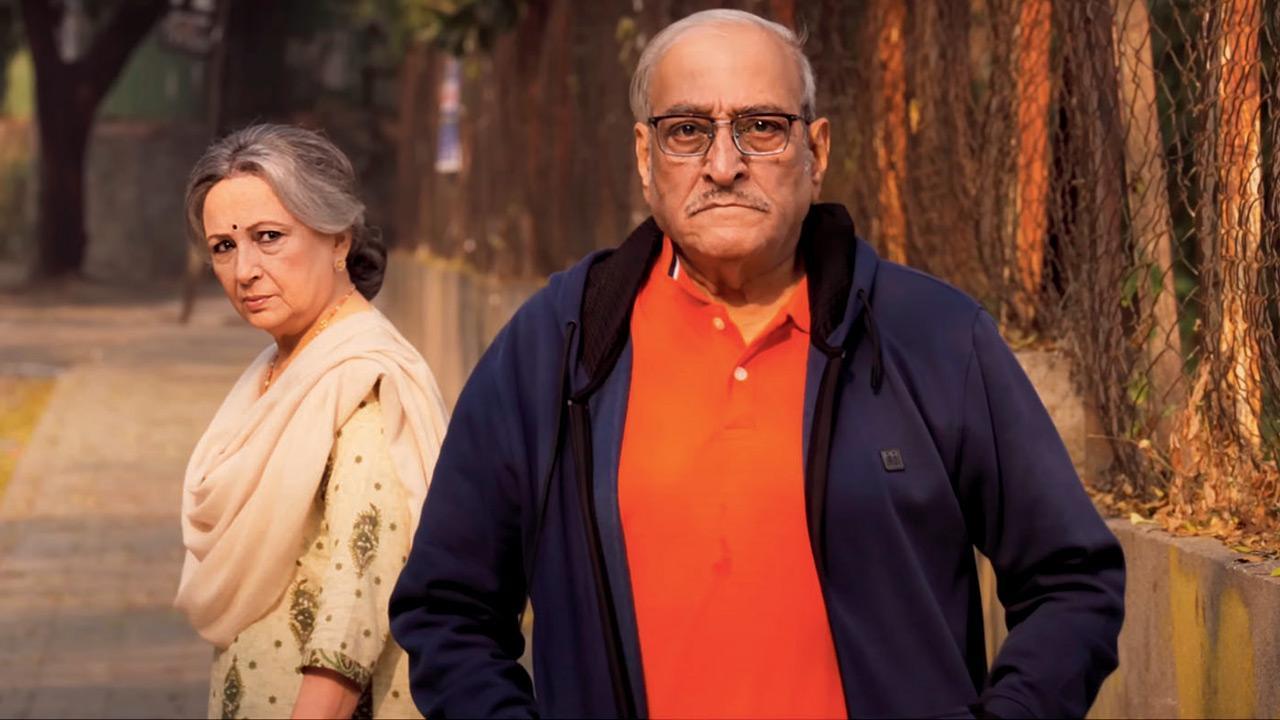
Noting that violent actioners are dominating the box office today, veteran actors Sharmila Tagore and Mohan Agashe say their feel-good film Outhouse serves as a ‘detox’
Upala KBR (MID-DAY; December 21, 2024)
Gulmohar (2023) reminded us how much we had missed seeing Sharmila Tagore on screen. Over a year later, the veteran actor has faced the camera again for Outhouse, teaming up with her Mississippi Masala (1991) co-star Dr Mohan Agashe. In Sunil Sukthankar’s directorial venture, Tagore plays a successful illustrator, who develops an unlikely friendship with an elderly neighbour while babysitting her grandson over a weekend. It was the director’s sensitive gaze towards the plight of senior citizens that drew her to Outhouse.
“The film brings forth the different needs of old age, and how the intergenerational gaps can be filled by communicating, with some humour and understanding,” starts Tagore.
The film, which hit the screens yesterday, marks Agashe’s last collaboration with writer Sumitra Bhave, who passed away in 2021. Having worked together in notable Marathi films, including Kaasav (2017) and Dithee (2019), the senior actor wanted Bhave to explore how the lives of elderly people are impacted by the breakdown of traditional family dynamics and a change in the caregiving system. But Agashe had a caveat—it should not be a tear-jerker.
Remembering Bhave, he says, “After I read the script, Sumitra asked me, ‘Do you think Sharmila would act in this?’ I told Sumitra that I would ask her. Fortunately, Sharmila liked the script.”
At a time of big-scale entertainers, the slice-of-life film comes as a fresh breath of air. Tagore believes it is a much-needed departure from the actioners that are currently dominating the box office.
“A lot of violent films have done well. I don’t mind violent films. If it has a theme or there is a reason for that violence, I’m open to seeing it. I can’t stomach films that are violent for the sake of violence. At the moment, films are going through a rough time. The actors are charging so much money. From what I hear, bigger films like Kalki 2898 AD and Brahmāstra: Part One—Shiva [2022] attract the audience. But personally, I like smaller movies like Laapataa Ladies,” she smiles.
Agashe echoes her sentiment, adding that “the world of movies is becoming a bit toxic”. “There is a lot of violence and sex in today’s films. When it hits a certain threshold of toxicity, it needs a good detox. I preferred this film because there is no sex, violence, killings or religious propaganda. It’s about the pure friendship between a child and a puppy, and the lives of two elderly singles.”
AI use comes of age in Hindi film production
8:04 AM

From storyboarding to de-aging, new-age tools likely to save up to 30% of costs
Rajesh N Naidu (THE ECONOMIC TIMES; November 26, 2024)
Mumbai: Generative Artificial Intelligence (AI) is making its presence felt in the Hindi film industry as increasing use of such technology tools would help makers not only save time but also costs - both in the pre- and post-production stages of film-making.
ET spoke to producers, directors, writers, editors, and companies that provide AI tools to gauge the penetration of AI in the industry, advantages it offers to makers and how much time and cost makers save after using such tools.
Over the next two to three years, these stakeholders estimate that 40-50% makers in the industry are likely to use AI tools in various stages of a film's production from 15-20% at present. In the same period, these stakeholders estimate that AI will help save 40% of time required for post-production of a film from 20-25% at present. In terms of costs, in the same period, they estimate that producers may be able to save 25-30% of the cost involved in the making of a film from 15-20% at present.
In the past one and a half years, makers have been increasingly using generative AI tools in the various stages of a film's production.
In the pre-production stage of a film, AI plays a critical role in improving and providing relevant information about storyboarding, graphic look, scripting, poster (stills), casting, set design, costume and reece among others.
Debashis Das, an editor and veteran post production expert, said, "Today, all big production houses in the Hindi film industry are using AI tools in the pre-production stage."
One of the early stages of film-making where AI's role begins is pitching concepts and ideas.
Siddharth Roy Kapur, founder, Roy Kapur Films, said, "Currently, I can see AI tools being used by production houses, directors and writers in pitching concepts and ideas. This enables a clearer visual representation of the written word."
RECREATING SCENES
Storyboarding (visual representation of scenes) is another key area where AI tools are used considerably.
Gokul A, founder, D.cult Studio, a company which provides AI tools and has provided AI tools to 60 films in the Malayalam language, said, “One of the time-consuming processes in the pre-production is storyboarding. For the film ‘Jodhaa Akbar’ (2008), the makers took one year for pre-production. Storyboarding took a long time. A storyboard artist will take seven to ten days for drawings. Today, with the help of AI tools, drawings of a storyboard would take eight to ten hours.”
He pointed out that AI tools provide much better output as these tools generate images with colour and lighting instead of just sketches in a storyboarding.
Besides, AI tools provide relatively right promptings about the type of camera to use, lenses, and shots. To a great extent, these tools convert 2D image to 3D. Gokul A of D.cult Studio said, “AI tools are of great help in providing a clear idea about set design. This is a key reason why it is much easier to make a period film with AI-enabled tools today.”
According to industry observers, these tasks take a long time in a shooting schedule where time is money. A senior executive of a production who wished to be unnamed said, “With the help of a proper storyboard and a team to implement AI tools, a producer can save five to eight days of shooting days. This is a good saving considering the per day cost of a shooting schedule.”
It is estimated that production cost of a day’s schedule of a Hindi film is in the range of Rs. 15-50 lakh. Girish Johar, producer and film business expert, said, “If a producer saves time, then the producer saves money. If a producer saves five to ten days of a shooting schedule because of efficient AI tools, then it is a reasonably good saving.”
In the post-production stage of film-making, AI tools are being used for dubbing, subtitling, visual effects (VFX), animation, editing, cleaning and other laborious tasks.
Mautik Tolia, managing director, Bodhitree Multimedia, a content production company, said, “This is the first phase of Generative AI, which enhances or replaces services. This is most noticeably seen in subtitling and dubbing among others.”
Recently, AI tools were used to dub the Tamil film ‘Kanguva’ in eight languages. Upgradation and improvement in language templates have made dubbing through AI tools relatively accurate. This has saved time for film-makers.
Bhavika Karwarkar, founder, Mumbai Posst House, a post production studio based in Mumbai, said, “Earlier we required three people for dubbing. Today, with the help of AI, we require one person to monitor dubbing. AI tools have a wide range of language templates which help save time in dubbing.”
She added that a lot of tasks related to the backend work done in the post-production stage of a film are being swiftly done through AI tools.
She said, “These tasks in the post-production stage of films form 15-20% of the cost of production of a film. So, one can estimate how much a producer c an save.” She estimated that in the next two to three years, 40-45% of film-makers in the Hindi film industry will use AI tools from 15-20% at present.
EDITORS’ FAVOURITE
In addition to dubbing and subtitling, AI tools help save time in editing. The time taken to create a line-up of scenes for editing has been reduced drastically, pointed out veteran editors.
Vaibhav Desai, a veteran editor and owner, Videshi, an editing studio in Mumbai, said, “Once I feed my inputs to a machine using an AI tool in the night, I have a complete lineup of my scenes the next morning. Earlier this whole exercise would take two to three days.”
In the next two to three years, filmmakers will save at least 40% of their time on post-production work as more people use AI tools and more AI tools become available, he added. At present, in the Hindi film industry, AI tools help in saving 20-25% of the time on t asks related to post-production.
A clear and big advantage AI tools have provided Hindi film-makers in recent years is in animation and VFX domains. The spate of spectacle films across languages reflect this trend.
Bhavika Karwarkar of Mumbai Posst House, said, “AI is mainly used for 2D animation and VFX among other things. This is a great advantage especially if a film has heavy VFX. With AI tools, a director and cinematographer can easily explain lighting, camera angles, and colour of a film to the crew.”
Given these advantages, the Hindi film industry has been experimenting a lot with AI tools in recent years. The much popular deaging technique is being used prominently in Hindi films. A case in point is the younger version of actor Amitabh Bachchan’s character in the film ‘Kalki 2898 AD’. Even film director duo Raj & DK used AI tools to create character sketches of their recent web series ‘Citadel: Honey Bunny’. Down south, the makers of the Tamil film ‘The Greatest Of All Time’ used AI tools to use late actor-politician Vijayakanth’s AI version in the film. In the West, AI-enabled film-making has become an accepted norm.
ON-TAP INTELLIGENCE
Suniel Wadhwa, co-founder & director, Karmic Films, said, “In the West, AI is used in every stage of a film’s making. These include scriptwriting, audience analysis, real-time virtual production and advanced post-production.”
Concurring with him, film editor Debashis Das said, “70-80% of studios in the West use AI tools. If a person from a department of film-making turns up late on a set, then the whole shooting schedule goes for a toss.”
The recently released film ‘Here’ of actor Tom Hanks, which shows a young version of Tom Hanks for the large part of the film, is an example of how well AI tools have become integral to film-making in the west. Even director Martin Scorsese’s film ‘The Irishman’ used the de-aging technique seamlessly.
Globally, according to Business Research Company, a global market intelligence firm, generative AI in movies market is estimated to grow at a compounded annual growth rate of 24.1% in the next four years to reach to $0.77 billion (Rs. 6,545 crore) by 2028 from $0.32 billion (Rs. 2,720 crore) in 2024. This shows how AI tools are being rapidly adopted. Although AI tools are being used extensively, the underlying rationale behind their usage is to provide enough time to directors to focus on creative aspects of film-making.
Subscribe to:
Posts (Atom)