Showing posts with label Jism. Show all posts
Showing posts with label Jism. Show all posts
Filmmakers of yesteryear had a gambler’s spirit. Now, executives decide when to greenlight films-Mahesh Bhatt
8:21 AM
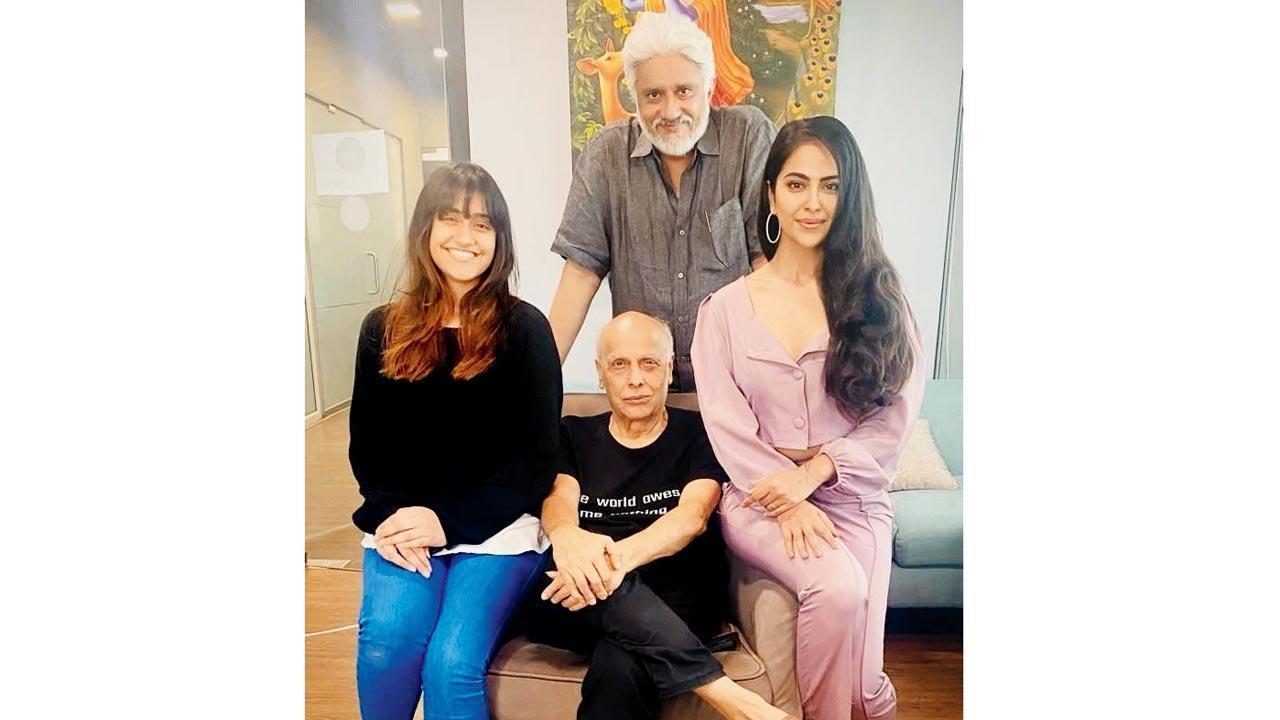
Having presented Avika Gor of Balika Vadhu fame in a different light in Bloody Ishq, producer Mahesh Bhatt on why he doesn’t rely on star power to deliver a success
Mohar Basu (MID-DAY; July 30, 2024)
Considering the fact that web releases are consumed by cinewatchers at a time that’s most convenient to them, the OTT boom has eased the stress related to a ‘Friday box-office performance’. But the day of his film’s release is still a euphoric one for Mahesh Bhatt, who has spent decades keeping tabs on the opening numbers of his movies. Bhatt’s Disney+ Hotstar production Bloody Ishq, which aired on the platform on Friday, opened to mixed reviews. What makes the offering particularly special, however, is that it marks a prominent commercial release for actor Avika Gor, who acquired immense fame as a child actor for her role in the teleshow, Balika Vadhu.
The casting, though unusual, is not a surprising move, given the fact that Bhatt has consistently invested in actors instead of ‘stars’. “[Late producer] Rajkumar Barjatya told me something vital during [the filming of] Saaransh [1984]. I was in search of a producer for the film. Sanjeev Kumar was a dear friend. People had assumed that Sanjeev would lead the film while Anupam [Kher] would be the second lead. But Anupam insisted that he lead it. He [spoke with] passion, and I agreed. When Sanjeev saw the film, he admitted that he wouldn’t have been able to do what Anupam did. Mr Barjatya told me, ‘You pick the actor you believe in, kyunki, ultimately, chalti toh picture hi hai’. Today, Anupam has done 500 movies, and Saaransh was a defining one for him. Since the release of Raaz, we have predominantly worked with new people. When the hoopla passes, the movie stays with you,” says Bhatt, lamenting that today, producers choose to invest in stars to make a project “safe”.
Calling the new breed of movie-makers “risk averse”, he says, “Moneybags know that star power makes a project safe. But, I don’t want to rely on the star to do well. I want our story to hold people’s attention.”
Easily among the names who’ve contributed to creating the identity of horror films in Indian cinema, Bhatt believes the decision to determine if the genre has evolved significantly over the years rests with the audience.
“We achieved a breakthrough with Raaz. Horror, until then, was seen with disdain. By stitching good music and keeping human relationships at the narrative’s core, we made a spectacular film. And while we made several franchises in the genre, I don’t think [today’s filmmakers] have been able to break new ground as storytellers. Filmmakers of yesteryear had a gambler’s spirit. Now, executives decide when to greenlight films. Storytelling today is not as path-breaking as it was a decade ago.”
He points to his daughter Pooja Bhatt’s film, Jism (2003), to further his case. “No one thought that a leading lady would promote the idea that ‘the body knows no love, just lust’. To make edgy, neurotic films, you need a free pass.”
Even though production houses have become commercially aware in the aftermath of the setbacks they faced during the pandemic, several artistes have faced challenges due to the industry’s changing norms. “It is difficult to make content these days. Even in Hollywood, people who have been in the industry for years are seeking alternate jobs. The industry is in shambles. The traditional way of movie-making is getting outdated.”
Everyone wanted me to write songs like Jaadu Hai Nasha Hai-Neelesh Misra
8:36 AM

Lyricist Neelesh Misra on working on the songs of Jism and why they live on
Soumya Vajpayee (HINDUSTAN TIMES; January 17, 2023)
He forayed into Bollywood as a lyricist in 2003 with Jism. And as the film turns 20 today, Neelesh Misra takes us through the experience of working on the Bipasha Basu and John Abraham-starrer. “Jaadu Hai Nasha Hai was my first song as a lyric writer and it became such a benchmark that everyone wanted me to write songs on similar lines. Since it released at a time when we had just entered the new millennium, it started a new trend of songwriting. Though it was edgy and sensuous, it was beautifully romantic. There was nothing vulgar or obscene about it,” says Misra, as he goes on to explain how it wasn’t easy for him to start out as a lyricist, given the way songs were made back then.
He adds, “It was during my first music sitting in Mumbai when I found out that the tune of a song was created first and the lyricist had to fit the words into it. When I sat down to write Jaadu Hai Nasha Hai, I just couldn’t do it. This was the first time in my life when I failed at something on day one. I felt awful as I couldn’t meet the expectations that Bhatt sahab (filmmaker Mahesh Bhatt; story and screenplay writer of Jism) and Pooja (Bhatt; producer) had on me.”
Interestingly, the song worked out in an unexpected manner and he credits composer M M Kreem for making him feel comfortable: “I was in a cab and suddenly some words crossed my mind. I wrote Jaadu Hai Nasha Hai on the rear side of a food bill and when I shared the lines with Bhatt sahab, he was ecstatic.”
Misra also penned the song Chalo Tumko Lekar Chalein. “I wrote the lyrics of the song in a classic ghazal metre. I feel the way Mr Kreem captured the silence in the song was beautiful,” says the lyricist.
Since Jaadu Hai Nasha Hai had sensuous visuals, it was received well at Misra’s home: “I was very excited about the promo of the song, as it was my first Bollywood track. I come from a middle-class family and I still remember my father said, ‘I will listen to the songs you write, but won’t see them’,” he quips.

Had I been an inch shorter, I might never have made it as an international model-John Abraham
7:49 AM

As told to Roshmila Bhattacharya (MUMBAI MIRROR; July 2, 2018)
I grew up in the City of Dreams, schooled at Bombay Scottish and after graduating in Economics from Jai Hind College, did my masters in management studies from the Mumbai Education Trust (MET). I then got started with the four Ps. For those who are wondering about the Ps, let me explain... To understand what a product or service can offer the consumer and plan for a successful product offering, we have what is known in marketing terms as the four Ps — Price, Product, Promotion, Place.
I wanted to be a strategic planner and an implementation buyer so I interned with an ad agency, Euro RSCG, working under V Ramani. After that, I joined Enterprise Nexus Communications Pvt Ltd as a media planner. My boss Hiren Pandit gave me the opportunity to become what I am today.
Media planners analyse data and thinking creatively come up with innovative strategies to help the client reach specific markets and target audience. Depending on the package, the idea is to come up with the most effective media plan. This can take a couple of months and involves hours of backbreaking research, sometimes ending in heartbreaks. If one number changes, you have to go back to the table.
My first account was The Times Of India group. It was exhausting but at the same time exciting to work with one of India’s biggest publishing houses with credentials to match. Meanwhile, when a model didn’t show up for a shoot, I was pushed into taking his place. I ended up showcasing a pair of jeans and became a part-time model.
In 1999, I took part in Maureen Wadia’s Gladrags Manhunt Contest while planning a move to a bigger agency. To my surprise, I was shortlisted for the international Manhunt contest in Manila, Phillipines. I was the first runner-up and magically, the world opened up for me. But when I look back, I realise that had I been an inch shorter, I might never have made it as an international model. At 6 feet 1 inch, I just made the grade and was signed by Carrie Models. I worked in Singapore, Hong Kong, London and New York. Then, I returned home, continuing to make merry.
My first ad campaign was for a soap brand. I was the Cinthol Man. Sabal Shekawat gave me my first break and I recall running through the jungles of Mauritius, 20 top models, including Madhu Sapre and Diandra Soares, chasing after me. It was a memorable shoot!
Along with modelling assignments, I also started featuring in music videos, going on to collaborate with popular singers like Hans Raj Hans and Pankaj Udhas. I’ve never forgotten Pankaj’s “Chupke Chupke” whose music video Anubhav Sinha had directed. It was a sweet, innocent song which went on to become all the rage then and is still remembered today. Then, Bollywood beckoned...
I got two film offers from two Bhatts. Vikram Bhatt offered me the role of a baddie in Aetbaar while Mahesh Bhatt approached me to play the antagonist in Jism, an erotic-thriller his daughter Pooja was producing for which he wanted a new face and not a star. The agency didn’t want to lose me but my closest friends insisted I give films a go. My family has always supported me in everything I’ve done and encouraged by their confidence I took the plunge into showbiz.
It was a challenge because as a model you are just a face and a body, endorsing a brand, but as an actor you play a character who can be your polar opposite. It needs a mind and takes you places.
In 2003, I appeared on screen in my first feature film, Jism, as an alcoholic lawyer who gets caught up in an extramarital affair which destroys him. Fifteen years later, I am not just acting in but also making my own movies, from Vicky Donor and Madras Cafe to Rocky Handsome, Force 2 and the recently released Parmanu. The era of the supermodel which had yielded the likes of Milind Soman, Arjun Rampal and Dino Morea ended with me. And I ended up in the movies but the media planner in me still touches different aspects of my life. I plan my life and investments and position my films in a way that they reach the audience in the best possible way, calling into play all that I have learnt about GRPs, TRPs and OTS. I even strategise on my football team’s (he has 90 per cent stakes in NorthEast United Football Club which plays in Indian Football League) jersey, brand positioning and ticket sales. Once you enter the market, you are there to stay. But that’s not enough for me, I want to ensure I am always at the top of my game.

A still from Pankaj Udhas’s ‘Chupke Chupke’; John in his early days (top)
Alia Bhatt isn’t just a pretty face; she’s someone who’s very sorted-Pooja Bhatt
7:54 AM

Pooja Bhatt on the role that film festivals play, the struggles she faces as a filmmaker, and how her father might still have a movie left in him
Shakti Shetty (MID-DAY; September 29, 2014)
She was the first from the Bhatt clan to leave the so-called Bhatt camp to set up her own production house. But then, fiery independence comes easily to Pooja Bhatt, who’s known for supporting films that she believes in. On Sunday, Bhatt was part of a panel discussion on cinema at the fifth edition of the Jagran Film Festival (JFF). Giving her company on the panel were Manoj Srivastava, strategic consultant, JFF, and Ajay Brahmatmaj from Dainik Jagran. Needless to say, hitlist’s tête-à-tête with the feisty lady on the closing day of the week- long festival made for an interesting chat…
There are not many women filmmakers in our industry. Do you feel stereotyped because of your gender?
Bollywood has been a man-dominated world, so I know this happens at times. But thankfully, I don’t crave for respect from the industry. I’m just happy doing what I’m doing. But to address your question, it’s true that a female director tends to make films that concentrate on female-related concerns and as a result, they get branded. I think this is pretty much true for other professions too. I, for one, look at myself as an actor who turned into a producer before directing films and then I became a production designer too. How are you going to slot me in terms of my gender?
Would you call yourself an independent filmmaker?
As far as the funding for a film goes, I don’t take any help from the so-called Bhatt camp. I raise money on my own. But when it comes to seeking advice on something, I turn to both my uncle (Mukesh Bhatt) as well as my dad (Mahesh Bhatt). Having said that, getting funds is never easy. You have to keep telling people all that your film will boast of, the budget that you have in mind and of course, the profit you’re looking at making. At times, you have to credit yourself a bit more and forget all the bad reviews your movies got (laughs). Or else, you’ll never make a film again.
As a filmmaker, how do you go about differentiating between mainstream and non-mainstream films?
Not very long ago, there was a clear demarcation between arthouse cinema and commercial cinema. But over the last few years, we’ve seen the two streams merge into one. Lines between the two are blurring at a rapid pace. A film today can have the best of both worlds as well as the worst of both worlds.
In such a scenario, what role does a film festival play?
A film festival can do a lot of things; it can change the way cinema is perceived. But then again, a film festival can’t afford to be elitist; it’s something we’ve seen take place with literary fests. A film festival has to embrace the common people and make him/her part of the process. A common person should be able to walk in and watch something he/she wouldn’t otherwise. In this way, smaller films can get the space that they deserve and the appreciation they are eventually going to earn.
And what about these small films not getting a commercial release?
Today, releasing a film is an art form in itself. The most common argument put forward is this: we only offer what the public wants. What this means is that the market is wide open for what the consumer demands. It may be sad, but that’s how commerce works. A lot of money is invested in making a film, let alone the money spent on advertising and publicity. If the cinema owners are taking a risk, expecting returns is quite natural. And because of these harsh realities, it’s important that we make a start with a regular film festival — if not a separate event. Here we can have a discourse and a filmmaker can tell aspiring film students that it’s not enough to just have a dream or a script. Things can get messy here.
Bollywood is getting increasingly bold nowadays…
We tend to believe that boldness is all about skin show; it’s not. Boldness has a lot to do with our thoughts. Jism released around a decade ago and it opened a Pandora’s box for us. We had a female protagonist (Bipasha Basu) tell us that the human body understands lust, not love. And if you remember, there weren’t many scenes showing skin in that film. After this film, we’ve seen a spate of bold films where the female character isn’t afraid of speaking her mind. She doesn’t have to prance around in a bikini to put forth her point of view.
Do you think your father is going to direct another film?
His book, A Taste of Life, which talks about the last days of UG Krishnamurti, is too relevant to not be transformed into a film. You can put all his films on one side and then put this book on another — it’s that good. I keep telling him that there’s one more film left in him and it has to be this book. But he keeps saying that he can’t go through the grind again.
Does Alia (Bhatt) approach you for your guidance?
She doesn’t need anyone’s guidance. We should go to her for guidance (laughs). She isn’t just a pretty face; she’s someone who’s very sorted and has a sensitive side to her. And she was clear about one thing: she wanted to be a star and she is one today.
I have sung my best item songs when I have been the saddest in my life-Shreya Ghoshal
9:41 PM

Priya Gupta (BOMBAY TIMES; December 25, 2013)
Shreya Ghoshal, 29, is most attached to her father. She is emotional and expressive, but is her own emotional anchor. She is simple and sorted and will not hesitate or regret saying no to a song with bad lyrics. She has sung a whole range of songs this year from the romantic Sun Raha Hai from Aashiqui 2 to Nagada Sangh Dhol from Ram-Leela to the most recent Drama Queen from Hasee Toh Phasee. In an hour-long conversation over a Rajasthani lunch in her house, she talks to Bombay Times about her relentless father, the musical Bhatts and why she would not date a musician. Excerpts:
How did you get your first break in Devdas? I was born in Murshidabad at my nani’s house, but lived the first 13 years of my life in Rajasthan, where my father worked as an engineer with the Nuclear Power Corporation. Every family had a scientist or engineer and our township was a little cut off, where our source of entertainment was what we ourselves created. It was a little paradise with lots of greenery and the Chambal river passing through it. My parents being Bengali, we always had music in our house. My nani was a trained classical singer, who taught my mum, who, in turn, was my first teacher. Later I would travel almost 70 kms to the nearest town Kota to learn music from my guru Mahesh Sharmaji, who was also the principal of the music college there. Even now, I dream of my old home, which had a big garden, lots of time to play with a regimented time for riyaz. When I was eight, I participated in a local competition with the Sangam Kala group (that also gave Sonuji and Sunidhi). I won and from there participated at the state and finally national level. That was the first time I had gone out of my own circle and sung in front of Rajan Sajan Mishraji and Anandji bhai. It gave my dad a lot of confidence and, despite the fact that all my friends were pursuing studies to become engineers and doctors, my dad unconventionally supported my talent and made me participate in Sa Re Ga Ma Pa. It went like a dream and I got a lot of applause. It paved my path ahead and I did Sa Re Ga Ma Pa till I won the mega final at the age of 14. I met Kalyanji bhai and with his encouragement, papa took a transfer to Mumbai in 1997. I regularly went to Kalyanji bhai’s place and learnt music there. I started singing cover versions of Marathi and Bengali songs that became quite popular. Sanjay Leela Bhansali’s mother saw me singing on Sa Re Ga Ma Pa and asked Sanjay to hear my voice. He was shooting Hum Dil De Chuke Sanam at that time. He remembered my voice and when he was making Devdas, he called me to sing Dola Re. He has given a chance to so many musicians including Ismail Darbarji. I adore Sanjayji. He is amongst the few who have always had bharosa in music. His music in Ram-Leela is commercial, but is so beautiful.
Post Devdas, did your career take off? In your formative years, there are few people who have trust in your work. Vishesh Films was my support system in my struggling days. Whenever I meet Bhatt sahab, I feel like sitting down and spending more time with him. He loves Urdu poetry and ghazals, which he makes me sing whenever he meets me. It’s beautiful to have successful filmmakers who, at the same time, inherently have a musicality in them. Despite Devdas, due to the existing panel of singers and composers, I did not get to sing for a year till MM Kreem gave me Jism. That also broke the ice as I had got stereotyped as a classical singer.
Let’s talk about your dad? My dad is the reason why music played in our house and our house was the hub for all cultural activities as he appreciated all forms of art. I owe everything I am to my dad. He never gave up and never got scared despite all the advice he was given. He is a brilliant person, but left his ambition to be with me to help me pursue my career. He is extremely logical when it comes to solving day-to-day problems and is always right and honest along with being efficient at the same time. He is 60 and yet he learns everyday by reading and from others and passes it on to me. He wants me to be proactive about my own business and life as he feels I leave everything on him. He does not like the fact that I get disturbed with paper work. In reality, it’s not that I don’t understand it, but I like to take my mind off that and be just a singer. I know that my dad likes taking care of it and I let him. I like his involvement in my life and I don’t want to take it away. I like him being the boss. With his vision and wisdom, I have never had any trouble in my life. He never judges any person. I have had silly stuff happening in my life and he would get angry inside, but remain silent about it. Next day he would come to me and just give me such beautiful advice. A child can easily become a rebel, but the way he preaches is what touches me the most. Every parent can learn from him.
Do you have friends in the industry? I am very good friends with Shantanu Moitra. If I am low, he is just a call away. I hang out at least once every week with him, his wife and son. He is a musician, but I feel envious in the way he is so detached and can do things that he wants. I am detached from success, but saying ‘no’ to a song is a difficult thing for me, but I am extremely ethical. A bad composition cannot be called unethical, but bad lyrics can be said no to. I have said no to singing many super hit songs which had bad lyrics and have never regretted that.
Do you see a change in the music of Bollywood? It is changing all the time. The good thing is that there is a constant need for innovation, which is important in the evolution of music and sound. But that is also bad as it has become a factory and there is a pressure of churning out commercially successful products which also kills innovation.
Do you see yourself getting married? Yes, I have always wanted to get married since I was 20. I am a very romantic person and have fallen in love plenty of times. I adore people and get smitten by some people and have made my mistakes. I like men who have their own voice, are opinionated but are not rude. I don’t like very serious people as I believe that there must be a fun element to life. I get bored very easily and have a very short attention span and I am restless. Thankfully, as artistes, we travel a lot to perform in different places and that is a relief in life. I have experienced everything. I have been obsessed, passionately in love, hurt, been deceived and have deceived. I don’t like to be taken too much for granted. Everything should be in balance. I may have also taken my relationships for granted and suffered. It has helped my music. Probably, I have sung my best item songs when I have been the saddest in my life. I have never dated a singer or a music director. People that I have dated have been from the world of technology or entrepreneurs. I want to experience the other world through the other person.
What are you like? It’s very difficult for me to appreciate my own songs as I criticise them a lot. Every time I am on TV today, I rush to my room and don’t watch it. Devdas was a big turning point in my life and when the premiere happened at Sterling and Silsila Yeh Chahat Ka where Aishwarya was introduced came on, I was not looking at the screen but was only looking at my parents thinking what they must be thinking. I cherish that first excitement in my life. I cannot go back in time, but I can recreate that time by doing something more special. I am simple and sorted and know what I need in life. To me, it’s important to be with my family, come back home on time and stay connected to my middle- classness. I know that people who have done anything in their lives and who have lived for decades, not the short lived people, are actually very simple people. And that is the mantra. Be sure that you are here because of certain people. It’s easy to disintegrate and get swayed by the audience in a concert. I know that I must have done good deeds in my past life that I have got this. Barring the small mistakes, I have made, I feel even more sure about my principles and ethics. Fortunately for me, my dad was always there to not allow me to make mistakes. There is a very big forgiving side in me that keeps me very light in my heart and happy. It’s easy to burn out in the industry as there is a lot changing all the time. What stays with you is your foundation. To me, music is oxygen and I know that someday even if I can’t sing, I can always continue listening to it.

Subscribe to:
Posts (Atom)