Showing posts with label Indira Gandhi. Show all posts
Showing posts with label Indira Gandhi. Show all posts
Remembering Tamas: A lesson in history for the ‘reasonable and strong-minded’
10:16 AM

Arushi Jain (BOMBAY TIMES; August 14, 2026)
As India observes Partition Horrors Remembrance Day, Govind Nihalani’s Tamas remains a searing depiction of Partition. First telecast on Doordarshan in 1988, the six-part adaptation of Bhisham Sahni’s novel tells the story of the violence and upheaval that accompanied the splitting of a nation into two. Nearly four decades later, its questions around history, memory and intolerance remain relevant. While Nihalani has maintained that a work like Tamas is not easy to make today, late actor Om Puri believed it would remain relevant for generations.
‘Those who forget their history are condemned to repeat it’
Adapted from Bhisham Sahni’s 1973 novel of the same name, which won the Sahitya Akademi Award in 1975, Tamas brought together a formidable cast of Om Puri, Amrish Puri, A K Hangal, Pankaj Kapur, Dina Pathak and Surekha Sikri. Sahni himself was closely involved with the series, though certain details were altered to create a more compelling screenplay.
Every episode started with a reminder: “Those who forget their history are condemned to repeat it.” The series unfolded in a fictional Punjab town, beginning with a pig carcass left on the doorsteps of a mosque, an act that sparks riots. From there, it traced how rumours snowballed into violence, how neighbours turned into enemies, and how women took their own lives to escape dishonour.
Years later, at a 2011 event, Om Puri explained why Tamas remained relevant: “A film like this should be shown to every community. This is a work of art which should be shown to every child, and it will be relevant for generations to come.”
Govind Nihalani had a story, but no money to make it
Making Tamas was not easy. Born in Karachi, Nihalani had long been intrigued by the Partition, but the courage to take it on as the subject of a film came only after he stumbled upon Bhisham Sahni’s novel. “I first saw the book at a store in Mandi House. I didn’t know the writer or what it was about, I just read the title and liked it. I still remember the first sentence – it read – ‘Aale mein rakhe diye ne ek jhapki lee’. And as I finished the first paragraph, I said to myself, ‘This is it. I am going to work on it.’ But I had no money to make the film,” he recalled in a 2017 interview with Delhi Times.
The same year, he met then Prime Minister Indira Gandhi during the International Film Festival of India (IFFI) in Delhi. During their two-minute conversation, Nihalani asked if the government would support a film on Partition. She told him, “It will all depend on the political condition of the country when you make the film.”
Nihalani soon realized that turning Tamas into a film would be a herculean task, particularly when it came to finding the money. He eventually found Lalit Bijlani of Blaze Films, who had produced Shyam Benegal’s Ankur (1974), willing to back the project. Nihalani had warned Bijlani that the film could be controversial, but he went ahead nevertheless.
His apprehensions proved right when Tamas ran into controversy after its 1988 Doordarshan telecast, with Nihalani facing threats and court cases. Yet, the film has endured as one of the finest works on Partition.
‘Making Tamas was an act of faith’
“When Partition happened, I was a little kid, but my first memory of fear, panic and blood comes from that period. My family migrated from Karachi and we settled down in Rajasthan. I was very emotional while making this film,” Nihalani had said in a 2013 interview.
That personal connection also shaped the making of Tamas. “Making Tamas was an act of faith,” Nihalani had remarked. He said he was fortunate to find some of the finest artistes for the project, “I was just lucky.”
'Some roles change your life’
For the actors, too, the series was transformative. Ila Arun, speaking at a 2011 event marking its DVD release, had said, “I didn’t know the pain of Partition until I played Lalaji’s wife. I understood what the Partition took away from people. After working on Tamas, I learnt a lot about humanity and Hindu-Muslim friendship.”
Deepa Sahi had also echoed the sentiment: “Some roles change your life and Tamas is one of those. I can write a book on my experiences from the Tamas shoot.”
Amrish Puri, though wary of overexposure on television, agreed to play an elderly Sikh community leader at Nihalani’s insistence. “It really was an agonizing role in Tamas. I was very selective about television appearances and accepted this for the sake of personal associations. When Govind wished to cast me, I didn’t allow stardom to affect my decision,” he recalled in his autobiography.
Tamas takes us to a historical past – unpleasant at times, but revealing and instructive
The Supreme Court in its 1988 judgment
Om Puri, who played the tanner Nathu, believed the show carried a larger lesson. “It is a reminder of the price we pay if we divide on the basis of communities,” he had said at the 2011 event. To look the part, he shed further kilos despite already being lean.
Tamas went on to win three National Awards – for Nihalani (Nargis Dutt Award for Best Feature Film on National Integration), Surekha Sikri (Best Supporting Actress), and music director Vanraj Bhatia (Best Music Direction). The series is currently streaming on YouTube.
‘Tamas is not entertainment. It is history’
The telecast was followed by legal battles. On January 21, 1988, a writ petition led to a Bombay High Court stay on further telecast of the serial. But two days later, on January 23, a division bench of the Bombay High Court, comprising Justices Bakhtawar Lentin and Sujata Manohar, overturned it after watching all six episodes in one day. The court famously declared: “Tamas is not entertainment. It is history. And you cannot wish away history simply by brushing it under the carpet.”
The controversy didn’t end there. There were protests, demonstrations, and Nihalani received threatening calls and needed police protection. The case reached the Supreme Court, where Soli Sorabjee, India’s former Attorney General, argued on Nihalani’s behalf that free speech could not be judged by the standards of a fanatic. On February 1, 1988, the Supreme Court upheld the High Court’s decision, ruling that Tamas must be seen through the eyes of “reasonable, strong-minded” citizens.
The court added that the HC judges who had seen the film had come to the conclusion that “the average person will learn from the mistakes of the past and realise the machinations of the fundamentalists and will not perhaps commit those mistakes again.”
An India Today report from the time had quoted Nihalani as saying, “We are becoming polarized as a society and strong consciousness is needed among people so that the saner elements in each community see this pattern.”
Ironically, the controversy also boosted sales of Bhisham Sahni’s novel. By the time the final episode aired on February 13, 1988, Tamas became both a cultural flashpoint and an important case on free speech.

Amrish Puri featured as elderly Sikh community leader Teja Singh
Not easy for any child to live in two homes. But I never let Indira feel torn-Madhu Sapre
8:47 AM

Madhu Sapre was a national-level athlete who entered the Miss India 1992 contest for a lark, but went on to win the crown and the crowd with her forthrightness. When asked which historical event she would like to change, Sapre said she would want to “bring back” assassinated former PM Indira Gandhi. Two decades later, she named her baby girl Indira. The successful supermodel, who moved to Italy after marriage, spoke to Neha Bhayana about her journey from walking international runways to being a stay-at-home mom and navigating co-parenting after divorce
Neha Bhayana (THE TIMES OF INDIA; July 5, 2026)
Modelling or motherhood — which role is tougher according to you?
Both have their own challenges. But motherhood is definitely tougher. It is such a huge responsibility to care for a little life that is so dependent upon you. And, you have to set an example for your kids to follow. Children learn from your actions, not words. You are constantly wondering: Did I do the right thing? Am I doing enough?
Your daughter is 14 now. How are you coping with teen tantrums?
I haven’t faced any major issues so far, and I hope it continues like this. Indira isn’t perfect; none of us are. She is doing well in school and is pursuing artistic gymnastics. She isn’t the kind of girl who throws tantrums. Of course, there might be some behaviour that I need to correct. So, sometimes I scold her; sometimes I gently explain to her with patience. Then, in some not-so-serious issues, if she is really adamant, I tell her about the repercussions and let it go. She needs to learn from her own mistakes. I have told her: now is the time to make mistakes and learn from them rather than later in life.
Each year, as she grows, I have given her a little more space, a little more independence, and some decision-making to do. Kids are ours till they are 10. Their identity is mixed up with their mother’s. After that, you need to let go slowly. I want her to grow up to be an independent, responsible woman. Sometimes, she can be untidy or reluctant to help with housework. But then I think of her overall behaviour. She is a good kid, quite mature for her age, grounded and affectionate. She is also very strong-minded. She knows what she wants, and I respect that to a great extent. At times, she can be stubborn, short-tempered, and reluctant to share what’s on her mind. But each of us has our own personality.
We need to understand and accept that and work with it. We do argue sometimes and make up quickly, too. I apologize if I am wrong.
You moved to a quiet beach town in Italy after marriage. Was it difficult going from your fast-paced life in Mumbai to a slower one in Italy?
Actually, my life became even faster-paced after I moved. We stayed in Budapest for the first five years as my ex-husband (Gian Maria Emendatori) was setting up his family business there. His family home was in Italy, so we would keep going back and forth. I was still modelling and shooting for the film ‘Boom’ then, so I would travel a lot. He, too, had to travel a lot for work. Plus, we would go to exotic locations for holidays. Basically, we were living out of a suitcase. We didn’t have time to breathe. I worked till 2010, when I did one of my last shows with Naomi Campbell and others in Mumbai. Then I took a break because I wanted to get pregnant. We had been trying for years but had not been successful. Perhaps our life was too hectic, and my body needed rest. Fortunately, I conceived soon after, and Indira was born in May 2012.
You became a stay-at-home mom after Indira’s birth. Did you miss the limelight?
Not really. I thought I would get back to work soon after her birth, but life had other plans. My father passed away before Indira’s first birthday. That was a huge setback for me. I had also put on a lot of weight. I was getting offers, but I did not take up anything as I did not feel good, physically and emotionally. Some years went by, and Gian Maria and I also started facing issues in our marriage, which led to a divorce. Even as I was coming to terms with my new living situation, my brother passed away… around five years ago. This was a very painful period in my life. Life kept throwing me on the floor, and I kept getting up on my own, without support. Despite all the chaos, I tried to give a stable home to Indira. I got work offers, but I could not take them up as it wasn’t always possible to fly to India. I only did a shoot for Vogue and an ad campaign for Masaba Gupta two years ago, as the timing worked. I could leave Indira with her dad at that time. I did sacrifice many opportunities, but I have no regrets. When we bring a child into this world, it is our duty not to neglect her.
I am a hands-on mom. I had a nanny to help out till she was six, but I have raised her myself. I cook all of Indira’s meals. And, I accompany her to classes and tournaments, just like my daddy did for me. Parenting is a big responsibility. You are constantly on your toes.
There is a lot of pressure on moms to ‘bounce back’ soon after delivery. But, in reality, most women can never get their pre-pregnancy body back. Was it difficult to accept the new you, especially as you have always been known for your fit body?
Life changes, and our bodies change as we move from our 20s to 30s and 40s. I have gone with the flow. I have tried not to get affected by the pressure and judgment. I remember in the final stages of my pregnancy, I was in Mumbai and had stepped out for a movie premiere with friends. The paps took a picture from the worst possible angle. I looked like a whale. A newspaper published it alongside my old picture. I just wanted to drown when I saw it, but I pulled myself together. I didn’t let it overwhelm me. I accepted myself and the changes in my body. My health had also suffered because of the hardships I faced. But when I felt better, I started looking after myself (I have not had any cosmetic surgery) for the sake of my health and also so that I could continue to look after my child as she grows. I lost weight and started looking like Madhu Sapre again — not the old Madhu, but a new Madhu, older and wiser.
I am happy with the way I am now. But sometimes people who meet me say, “Oh, we remember how you were”. They add, “You are still beautiful.” I laugh it off. What can one say to such comments? How can you expect me to look like I did 25 years ago? We are humans; we are like perishable goods. Of course, if you are in the fashion business, it is your responsibility to be in shape. But how long you take to deal with pregnancy weight depends on you.
You were a junior national champion in track-and-field athletics. Do you guide Indira based on your own experience?
Yes, I have instilled in her the importance of physical activity from the time she was little, just like my dad did for me. I used to make her run in parks. I taught her to swim, cycle, and do cartwheels. I emphasize on the importance of healthy competition. When she is preparing for gymnastics competitions, I don’t put any pressure on her. I don’t tell her to aim to win or be number one. I just tell her to give her best.
Most Indian parents prioritize academics over sports. Do marks matter to you, or are you happy to let Indira focus on sports?
Both are equally important. After the divorce, it’s only me, her, and our pets in the house. She is my priority. I have built our life around her necessities. I have always followed a strict daily routine where studying, sports, and leisure have their own importance, place, and order. One does not overshadow the other. We prepare her bag and clothes the night before school. She studies hard and does well at school, but if she didn’t, I would have had to accept that and see where else she had potential. I am not a nagging mom.
Does she also aspire to walk the ramp like her mamma? Is she aware of your successful modelling career?
She knows a bit, but I haven’t spoken much about my modelling career or the success I saw. We haven’t yet spoken about whether she would like to be a model or an actress. We will see. I am bringing her up with a lot of simplicity. I don’t want her to ever feel she is not good enough if she isn’t number one or a celebrity. I also believe in destiny.
Are you raising Indira single-handedly now, or does your ex share responsibility? Have you faced any parenting challenges after the split?
After our divorce, Indira has been living with me and her dad has visiting rights. He travels a lot, but he does help me out when he is in town. It has not been easy after the split, but my ex and I have worked on our relationship to make it cordial for Indira’s sake, as she is our priority. I wanted her to be loved by both of us and did not want her to have to choose one parent. It took time, but we are in a good space now. He has remarried, and Indira has three other younger half-siblings. She adores his new wife and the kids, and they love her too. They live very close to us. So, we are a big extended family and meet occasionally. It is not easy for any child to live in two homes. But I have never let Indira feel torn between them. She was and is always free to be with her dad and his new family as and when she wants or if her daddy wants to see her.
My ex and I are opposites. We do not agree on many things, but he listens to me when it comes to parenting matters. Sometimes, I let him decide certain things for her, even though I disagree. Or we discuss the issues we don’t agree on and reach an understanding to make the final decision. It is not easy, but with effort, we have been managing so far.
You come for annual visits to India. Does your daughter Indira feel connected to her Indian roots? Does she speak Marathi, your mother tongue?
Indira was born in Mumbai, and she does feel very connected to India. I wanted to teach her Marathi when she was little, just like I taught her English. But she refused to learn it, so I let it be. Now she asks me if I will teach her Marathi.
What values did your parents teach you that you now wish to teach your daughter?
Simplicity, honesty, kindness, respect for others, and humility.
New-age gentle parenting or old-school strict discipline — which is the more effective and wiser approach according to you?
I try not to get caught up in any definitions or trends on how to bring up kids, as every kid is different. I am a strict mom, but at the same time not a dictator. I am soft when required. I prefer to gently guide rather than instruct. Indira knows she cannot disrespect me, and the same goes for me. Like a plant needs good soil, sunlight, and water to grow, we need to give our kids a nurturing, protective environment to thrive and a lot of personal attention, time, and care. I have given her this and will continue to do so. Kids need clarity, not confusion, and unconditional love too.
From supermodel to supermom, how do you look back at your journey?
I am so grateful for everything. Winning pageants, being a model, and seeing success were great, but I personally felt more complete after I became a mom. It was a dream come true.
I would sit on my dad’s lap and announce that I wanted to be an ‘omelette’-Lara Dutta
9:01 AM

Natasha Coutinho (HINDUSTAN TIMES; October 8, 2025)
Lara Dutta Bhupathi lost her father, Wing Commander L. K. Dutta (Retired), earlier this year in June. On Air Force Day today, the actor shares memories of her late father and the environment she grew up in.
The 47-year-old says, “My father was commissioned very young as a flying officer straight out of NDA. He won two Vayu Sena medals for gallantry; one during the 1965 Indo-Pak war and the other during the 1971 war,” adding, “When dad retired, he was flying for Indira Gandhi, then Prime Minister, and was stationed at Hindon (Uttar Pradesh), where I was born. We grew up knowing that the men in our lives were married to the motherland first, and then to their families; and that the officers’ wives’ were women of resilience.”
Lara says her father left behind a void that can never be filled. She recalls, “Growing up, I would sit on my dad’s lap and announce to the world that I wanted to be an ‘omelette’ because I could not pronounce pilot.”
She adds that growing up in a military family has taught her adaptability. “Every few years you are at a new Air Force station. As a child, there’s no better education you can have than experiencing different cultures and languages. I’ll always remain an air force brat,” she signs off.
Emergency will be a tight slap on all those who think I’ve projected Indira Gandhi in a negative way-Kangana Ranaut
8:13 AM
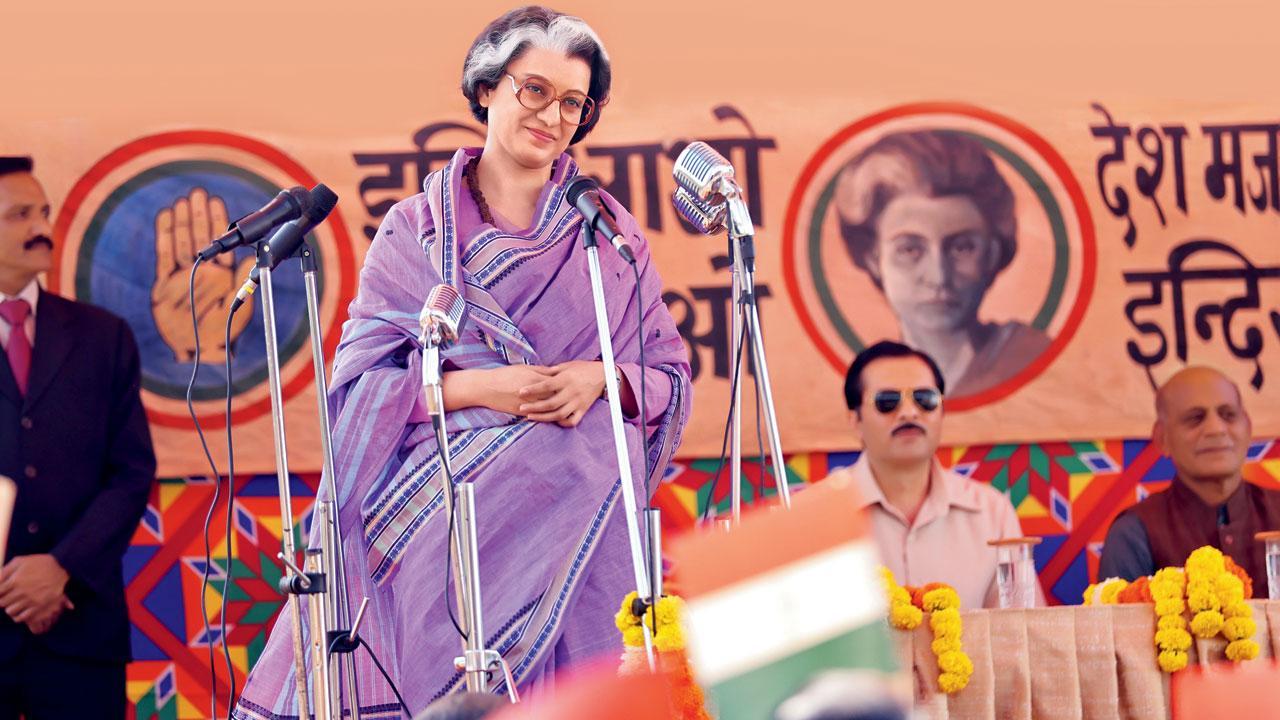
Amid speculation that Kangana has projected Gandhi in a negative light in Emergency, actor discusses portraying her as a mother and someone who loved her country
Upala KBR (MID-DAY; August 30, 2024)
Emergency could well be among Kangana Ranaut’s definitive films. It not only sees her wield the directorial baton after she co-directed Manikarnika: The Queen of Jhansi (2019), but also holds the potential to be her most memorable role. What made her tell the story of late Prime Minister of India, Indira Gandhi? Was it the allure of essaying one of the most formidable figures in Indian politics? Or the desire to decode the darkest chapter of Gandhi’s political career?
The actor-director says, “I didn’t begin with the intention of making a movie on it. Since I am a socially and politically-aware person, I started reading about the Emergency. Apart from Coomi Kapoor’s book [The Emergency: A Personal History], I read Mrs Gandhi’s autobiography. Her guru Jiddu Krishnamurti had told her to stop the Emergency and she told him, ‘I feel I’m riding a beast, which I loved riding initially, but now I can’t get off it.’ This gave me an insight into somebody who had a conscience. Mrs Gandhi’s life was such a beautiful Shakespearean tragedy. There is a throne, a person destined to be the queen, her opponents, and her internal battle with her conscience.”
Ranaut’s position as a Bharatiya Janta Party member has also coloured people’s perception of the biopic. Many feel that she may have projected Gandhi in a negative light. Broach this subject, and she says, “What is it like to love your country and be loved back? That thought took over my existence. It reached a point where I was sure that I’d make the film, even if I have to sell my house to do it. I’ve been judged so much that I’m fed up. This film will be a tight slap on all those faces, who think I’ve projected her in a negative way! They didn’t even give my film a chance. It’s a week away, at least watch it [before forming your judgment].”
With the biopic, Ranaut believes she has shown Gandhi’s different facets—as a woman, a mother, and a politician. “Mrs Gandhi loved her son [Sanjay Gandhi] so deeply and then lost him! As the character, it was one of the most difficult things for me to come to terms with. Her life had so much pain, trauma and drama. I was keen to make this film because people don’t know those aspects of her.”
Directing the film, she admits, was an intense job. “My revenue took a hit. As an actor, I can do three films in a year, but as a writer-director, I can only do one film in three years. Then you’re selling your own things to pay for the film. So, I will take some time before I direct again. Selling the movie was a challenge. The protagonist is in her 60s, and everybody in the movie is wearing khadi kurta pyjamas, but luckily Zee Studios stepped in.”
We took pictures of saree that Indira Gandhi wore when she was killed and replicated it-Sheetal Sharma
8:33 AM
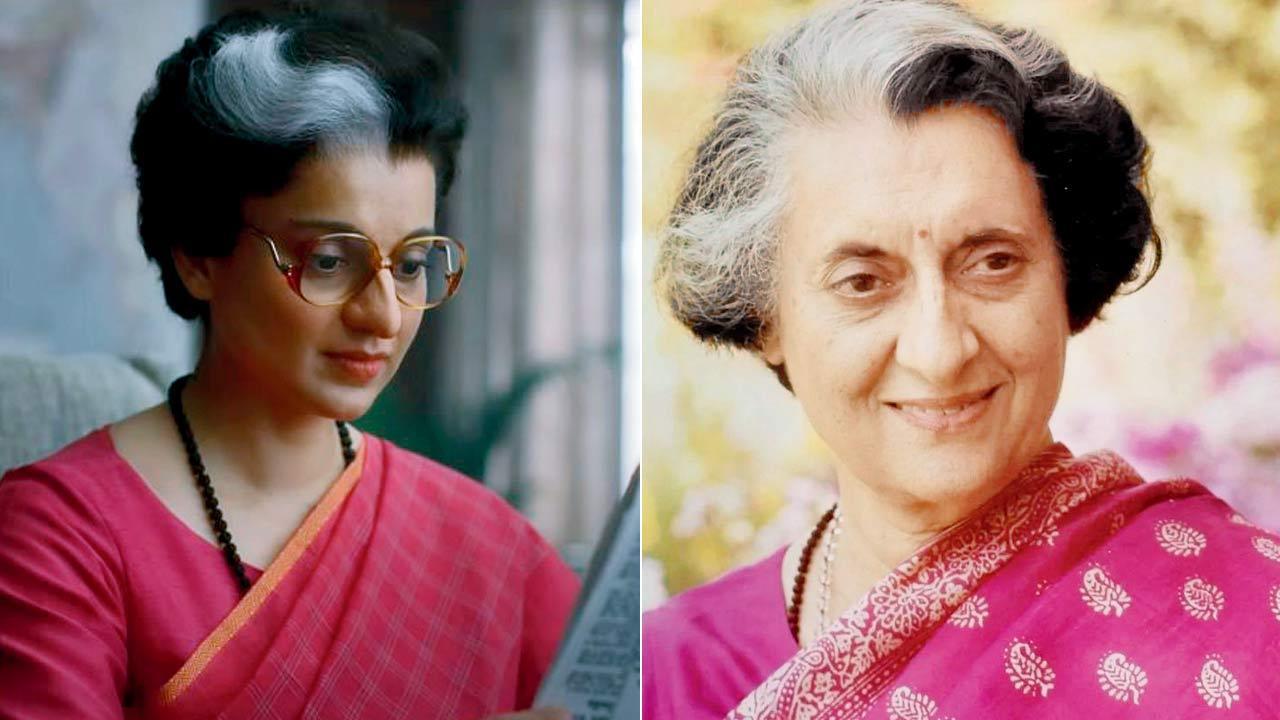
Emergency costume designer decodes how Kangana and he made weavers replicate late PM Indira Gandhi’s sarees, in their bid to ensure authenticity
Upala KBR (MID-DAY; August 24, 2024)
Nailing the look is among the many critical steps when making a biopic. It becomes all the more important when you’re telling the story of the former Prime Minister of India, Indira Gandhi. Sheetal Sharma, who serves as Emergency’s costume designer, says staying true to the subject was actor-director Kangana Ranaut’s top priority.
“Kangana [found] references from archival videos of Mrs Gandhi’s speeches, newspaper articles, and albums from the Parliament,” he starts.
The film, also starring Anupam Kher as Jayaprakash Narayan and Shreyas Talpade as Atal Bihari Vajpayee, spans from the ’60s to the ’80s, with an emphasis on how Gandhi declared the Emergency in 1975. Ranaut’s brief was simple—the audience should be convinced that she is a spitting image of the late PM.
Sharma says, “In The Crown, [Elizabeth Debicki] looked and behaved almost like Lady Diana. Kangana too wanted to look like Indira Gandhi down to the minutest details—her clothes, prints, fabric, and glasses. We replicated what she wore during the Shimla Agreement signing, or when taking the oath as the PM. We also [incorporated] the way she draped her shawl, wore French chiffon sarees and khadi blouses, and her famous hairstyle.”
For certain looks, the stylist hired weavers to weave the sarees from scratch, as per the fabrics and prints of the original.
“The saree that she wore when she was killed is in Indira Gandhi Memorial Museum, Delhi. We took pictures and replicated it. She wore a stunning white silk saree at Sanjay Gandhi’s wedding. Kangana made sure the other characters also looked exactly like the real [politicians].”
Shabana Azmi condemns Kangana Ranaut slapping incident
8:25 AM
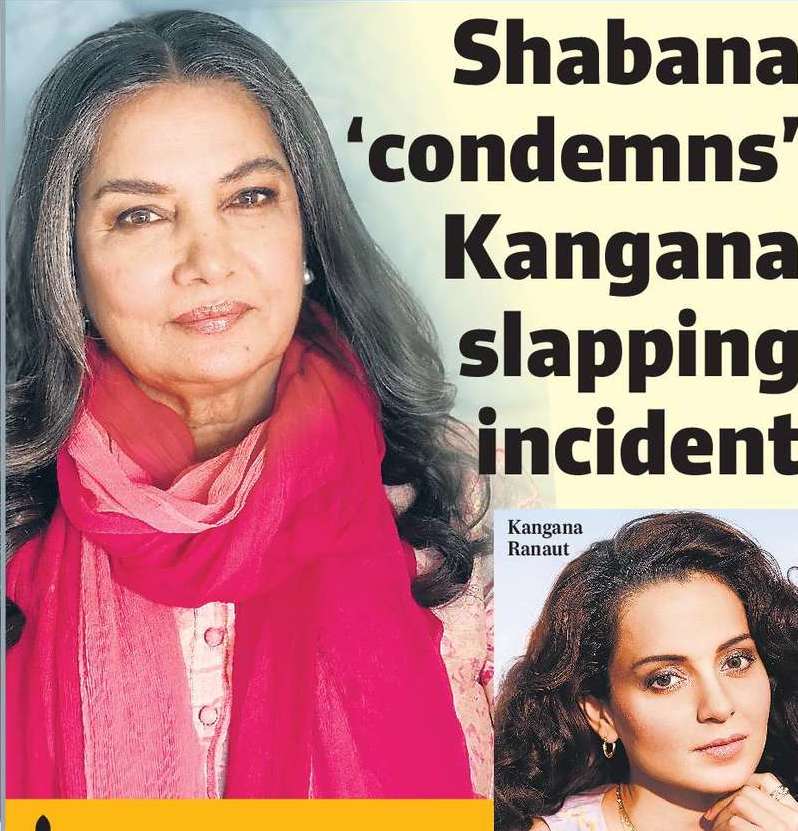
Yashika Mathur (HINDUSTAN TIMES; June 10, 2024)
Actor Shabana Azmi has come out in support and condemned the attack on newly elected Member of Parliament, actor Kangana Ranaut. On June 6, while travelling to Delhi from Mandi, Himachal Pradesh, for her swearing-in ceremony, Ranaut was slapped by a lady CISF personnel at the Chandigarh airport, Punjab, for her comments on the farmers’ protests.
“I condemn the slapping incident completely,” says Azmi, adding, “Kangana is a duly elected MP, here to serve the country. You can disagree with her views, but resorting to violence isn’t acceptable in any circumstances. The true essence of a democracy is that there is room for dissent without taking the law into your hands.”
Referencing Indira Gandhi’s assassination, where the former late Prime Minister’s armed bodyguard fatally shot her on October 31, 1984, the 73-year-old elaborates, “We trust our security personnel with our safety. If that confidence is breached there will be a descension into chaos. Remember what happened with Indira Gandhi? No amount of provocation can justify the actions of the CISF personnel, particularly when she is in uniform.” Incidentally, Ranaut will play the role of Gandhi in her next film, Emergency.
After actors Raveena Tandon, Anupam Kher and singer Mika Singh voiced their support for Ranaut, actors Alia Bhatt, Hrithik Roshan, Soni Razdan, Sonakshi Sinha and filmmaker Zoya Akhtar have liked a June 8 Instagram post condemning the incident. Meanwhile, an old post where Ranaut voiced her support for actor Will Smith slapping actor Chris Rock, at the 2022 Oscars, resurfaced and has the internet buzzing.
Why Doordarshan didn't have a recording of its launch broadcast
8:35 AM
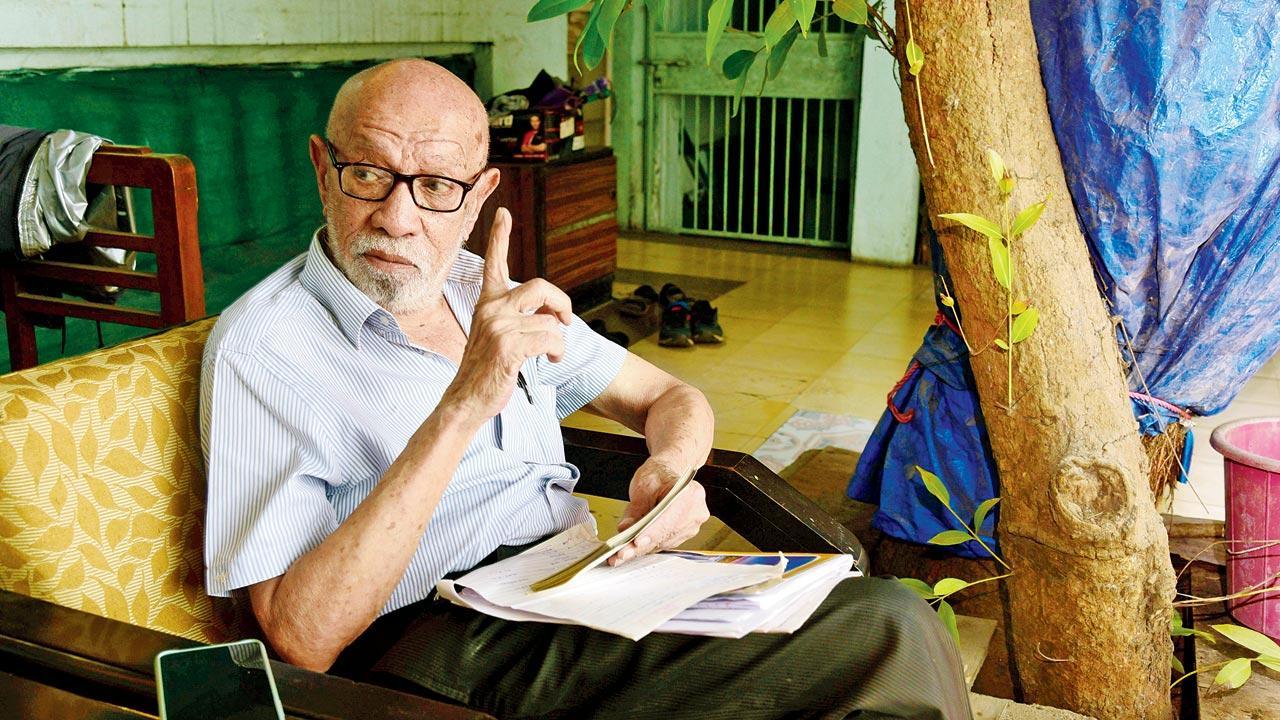
Now 88, Mumbai Doordarshan’s first staffer regales mid-day with the many successes and little bloopers that made up the initial years of the public service broadcaster
Heena Khandelwal (MID-DAY; October 9, 2022)
It was the year 1980. Yakub Sayed, then assistant director at Mumbai Doordarshan, now called DD Sahyadri, received a phone call. It was to inform him that actress Nargis Dutt, who was in New York for medical treatment after being diagnosed with pancreatic cancer, had passed away. He informed his director, and a call was made to the I&B Ministry, which then connected with the Prime Minister’s office.
“We were informed that PM Indira Gandhi is on her way to Bombay and somebody should go to the airport to let her know the news. I was given this task. I went along with my cameraman. Just as she [PM Gandhi] began descending the airstair, I asked the cameraman to start shooting. When I informed Mrs Gandhi, she said that she was deeply saddened at the news. But it was a small reaction. To get more, I decided to pay a visit to Dev Anand’s office, which was in the vicinity. After I had broken the news to him, he offered us a long byte. To make it a whole package, I decided to pay a visit to Sunil Dutt’s home, hoping to get a reaction from the househelps and drivers. But once I reached there, I saw Sanjay Dutt having tea with his friends, laughing. I asked the cameraman to stay put and decided to ask him about his mother and he said, she is doing better,” Sayed tells mid-day between laughs.
By the time he had reached DD’s Worli office, everyone had heard what had happened. “I behaved like I didn’t know. They told me I must pay Mrs Gandhi a visit and confess the blunder because she had already offered her condolences at a meeting that day. I refused, saying, I would rather resign than tell her that… she was known to have a temper. Someone else was given the task and I am sure a few people lost their jobs that day.”
A year later, when a call came saying Nargis Dutt had passed away, Sayed took a taxi and went to Breach Candy Hospital where she was admitted. It was only after he saw a crowd of mourners that he was convinced that the news was in fact, true. “But, it was a Sunday. So, everyone was on chhutti. I went to her brother Anwar Hussain asking if he had the reel of her last film, Raat Aur Din. He had the negatives. I got them developed, and that’s what we aired that evening,” recalls Sayed, now 88. “The viewers, I heard, loved that telecast.”
Mumbai Doordarshan completed 50 years last Sunday. Sayed, who was present at the ceremony held at its Worli studio, served the public service broadcaster from 1972 to his retirement in 1992, when he left as director of Doordarshan Kolkata, or DD Bangla.
We met him on a weekday afternoon in Bhiwandi where he put up for the day in an ancestral home that belongs to his daughter and son-in-law. “I moved here from Kurla because my daughter thinks I am too old to live by myself,” he says.
Over the next hour, Sayed takes us on a journey through the initial years of Mumbai Doordarshan, sharing anecdotes that shaped his life. This, however, wasn’t his first job. After a Master’s in Arts degree from Pune University, Sayed bagged a job at All India Radio. “It was after working there for a decade that I was told I have been selected for television and would have to undergo a six-month training at FTII [Film and Television Institute of India],” he says, of the broadcaster when it had just about 100 employees.
“Since Bombay was catering to the Marathi-speaking population, about 80 per cent of our content was in Marathi. The most popular among this were the Marathi plays. On Saturday, we would show a 2.5 hour-long play which enjoyed better viewership than films; Maharashtrians love their theatre.”
Sayed directed and produced 180 plays himself, including the popular Dinucha Sasubai and Radhabai, Shyamchi Aai, Sharda, Naukri and Piano. “In fact, during the broadcast of Piano—a love story where a female piano player plans to elope with her lover after a performance but cannot—I got a call from Raj Kapoor asking about the actress. He asked me to send her to his office and she was offered the role of heroine in his film; she however, refused saying she was to get married. The film was Prem Rog; the role eventually went to Padmini Kolhapure.”
Another play that Sayed worked on, Beimaan, the story of two friends, was also turned into a film. “Hrishikesh Mukherjee made it into Namak Haraam in 1973 starring Rajesh Khanna and Amitabh Bachchan.”
Besides theatre, Sayed says shows that enjoyed large audience include a children’s shows called Khilbil; a light entertainment programme Garba that focussed on small skits; Aamchi Maati Aamchi Manasa which tackled challenges faced by farmers; a show revolving around home called Sundar Maze Ghar; a comedy called Has Parihas and a chat show featuring the legendary Tabassum, Phool Khile Hain Gulshan Gulshan.
“Tabassum’s Phool Khile Gulshan Gulshan [which aired until 1993] was then what Koffee With Karan is today. She interviewed top actors and musicians show from Prem Nath to Amitabh Bachchan, RD Burman, Shatrughan Sinha and Ashok Kumar, some even multiple times… only Raj Kapoor and Dilip Kumar refused saying they aren’t comfortable being interviewed by someone who was younger to them,” Sayed recalls.
For one of the shows, he turned actor, bringing him public fame. “In one of the meetings, we discussed the need for a comedy programme. The arrow pointed at me. I thought everybody who picks up newspapers does read a joke, why not enact them on television? The show was called Has Parihas. It began in 1973 and became very famous… Mahmood, Jeetendra, Daboo [Randhir Kapoor], everybody came on the show. Lata [Mangeshkar] would also request for jokes… It gave me a lot of fame,” he says, adding, “You know who was my biggest fan? Morarji Desai. He once asked me to meet him, saying he always calls for my tapes and watches them. He even asked why the show was shut down.” After airing for three years, the show stopped after his co-actor on the show Baban Prabhu passed away.
Interestingly, television was still in a nascent stage and those who had TV set at home struggled with its operation. “Once I got a call from a minister, asking me to come over to his residence. Because he was an important man, I dropped everything and went across. He told me his TV was not working. I was no engineer. I asked his staffer to go to the roof and continue to gently move the antenna till I asked him to stop. When it was adjusted enough to sit parallel to the TV, the set came on.” In return as a goodwill gesture, the politico agreed to come on Kilbil as guest.
But Sayed’s favourite story is from the inaugural day of Mumbai Doordarshan—October 2, 1972. “At around 6 pm, we realised that the hustle-bustle that should have marked the arrival of the chief minister was missing. On calling his secretary, we were told that his diary had a wrong date entry. The event that should have started at 6.30 pm was delayed; this irked Bismillah Khan [shehnai maestro], who had to miss his evening namaz. Then a cup broke in the green room and hurt Asha Parekh’s foot and she started to bleed. I went downstairs to find a doctor. To top it all, we ran the programme live but forgot to record it. DD Mumbai does not have a recording of its debut broadcast.”
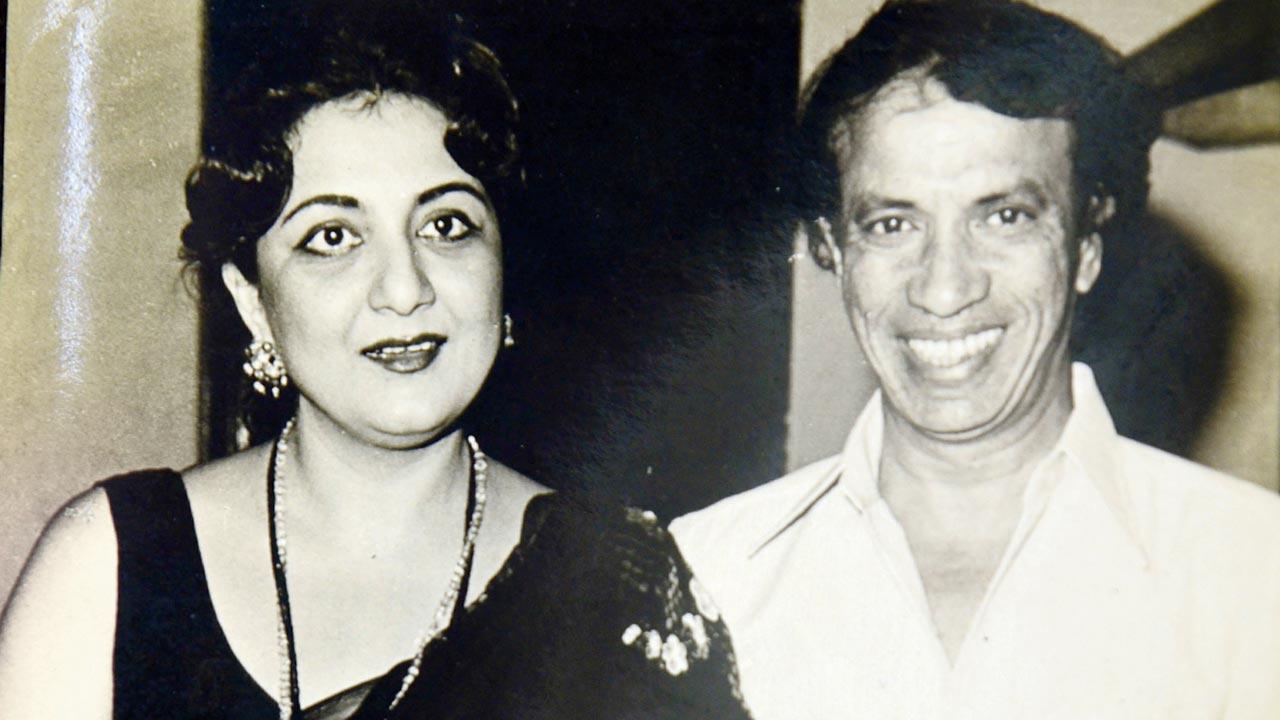
Yakub Sayed with actress and television host Tabassum whose chat show Phool Khile Gulshan Gulshan was very popular and saw the presence of every prominent actor and musician
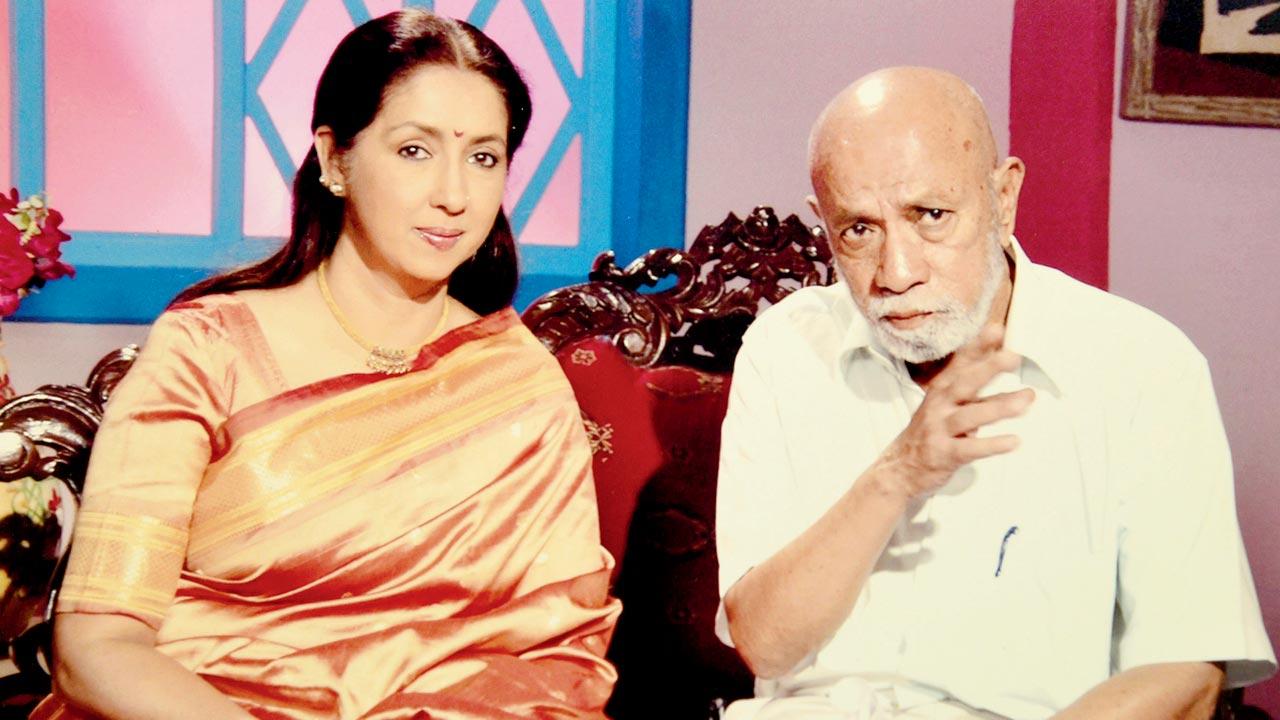
Yakub Sayed with popular Marathi actress Neena Kulkarni, who began her career in the 1970s with theatre
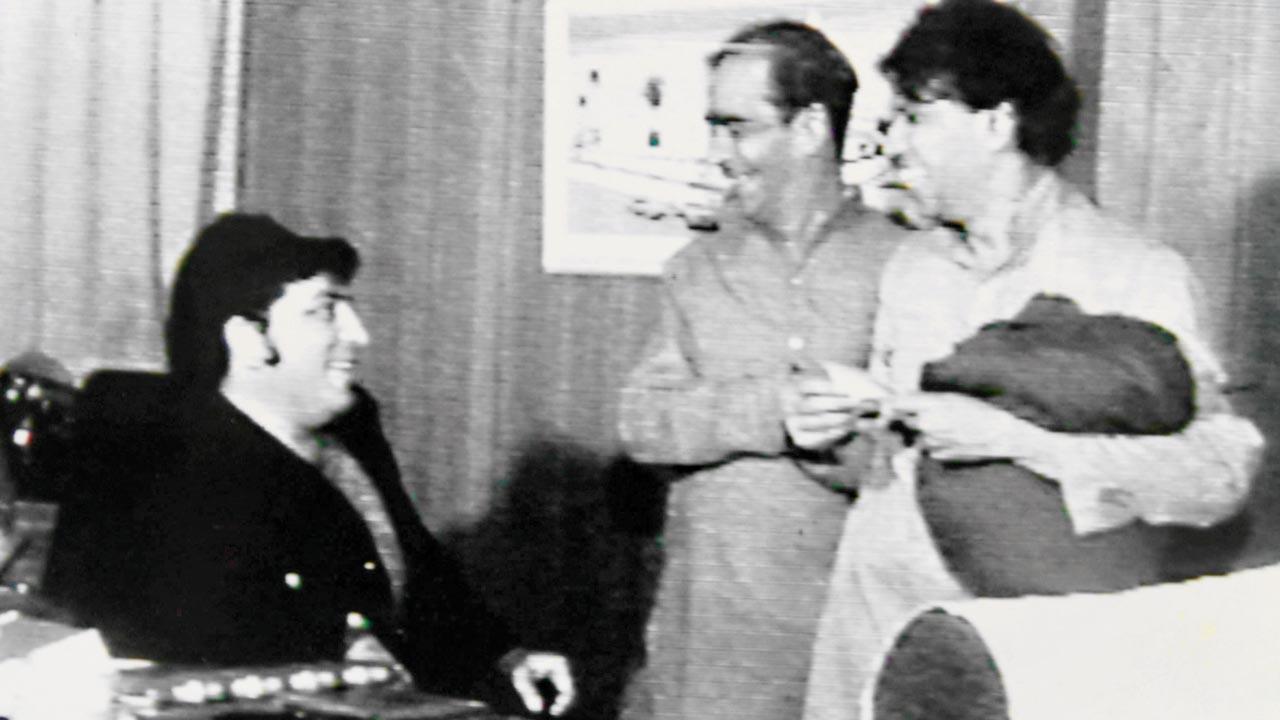 l
lYakub Sayed and his co-actor on the show Has Parihas, Baban Prabhu with Amjad Khan
Oscar-winning make-up artist David Malinowski said I resemble Mrs Indira Gandhi a lot-Kangana Ranaut
9:43 AM
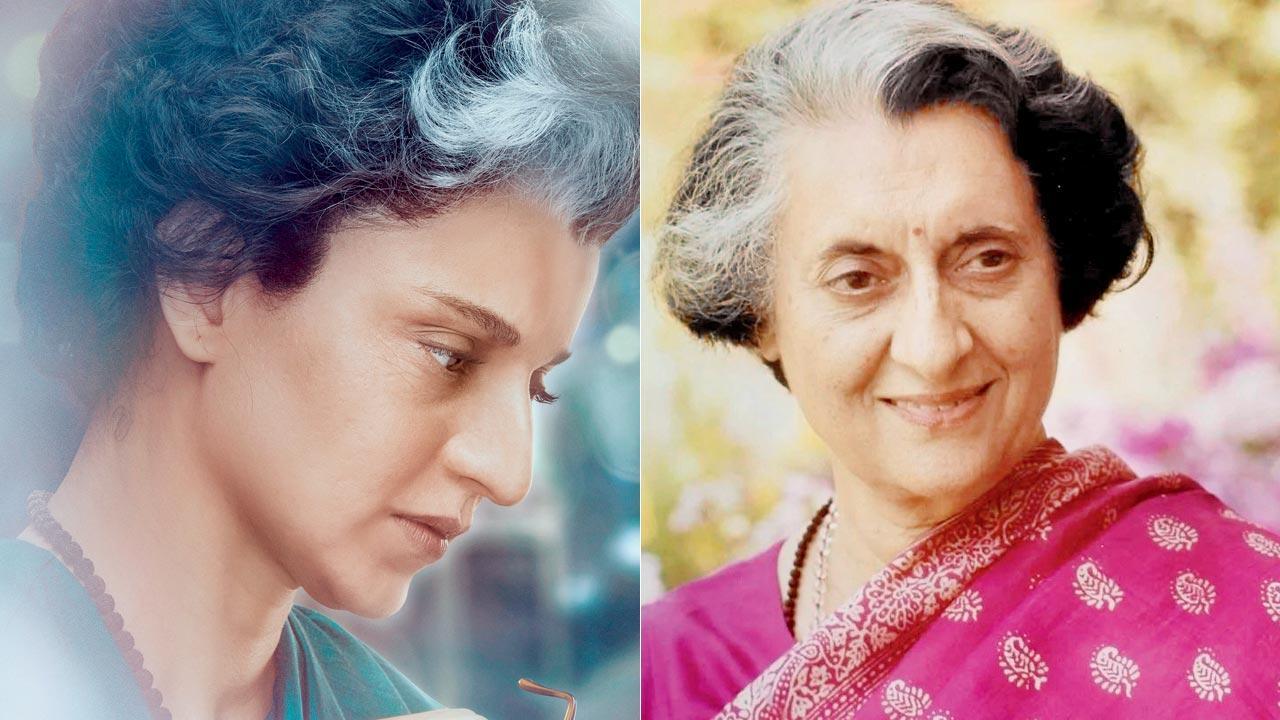
Working with Oscar-winning make-up artist Malinowski for 'Emergency', Kangana discusses how it takes four hours to transform her into former PM Indira Gandhi
Mohar Basu (MID-DAY; July 15, 2022)
With 'Emergency', Kangana Ranaut has the double duty of being an actor as well as a director. Nailing the look is the first leg of a long journey ahead, as she tells the story of former Prime Minister Indira Gandhi who had a state of emergency declared across the country in June 1975. As soon as the film’s first look dropped online yesterday, netizens appreciated Ranaut’s on-screen transformation into India’s Iron Lady. The actor gives the credit to Oscar-winning make-up artist David Malinowski.
She begins, “David and his team are astute professionals. An entire team flew down from London. We had a series of meetings to ascertain the final look, and did a bunch of look tests. David took the calls on how to go about it. In fact, he pointed out that I physically resemble Mrs Gandhi a lot, including the skin texture and jawline. I told him that in India, people believe I am the perfect person to play Mrs Gandhi.”
Malinowski has a way with historical dramas. He walked away with the Academy Award for Best Make-up and Hairstyling, when he transformed Gary Oldman into Winston Churchill for the war drama, Darkest Hour (2017). Recreating Gandhi’s look takes the team four hours every day, reveals Ranaut.
“David believes that the time to perfect the [avatar] will come down, as we set the look in the days to come,” she adds.
With Emergency marking her third film that sees her play a historical character after Manikarnika: The Queen Of Jhansi (2019) and Thalaivii (2021), the actor admits that the prep reminds her of how she soaked herself in the part of Jayalalithaa for the A L Vijay-directed bilingual.
This biopic, however, will be more demanding than her previous offerings as she is also the captain of the ship here. While Manikarnika saw her take the directorial baton midway through the project, the actor considers Emergency her baby. “The response to the look has been marvellous. Now, the shooting has commenced. I am ecstatic that something I have always wanted to do — a solo directorial project — is happening,” she smiles.
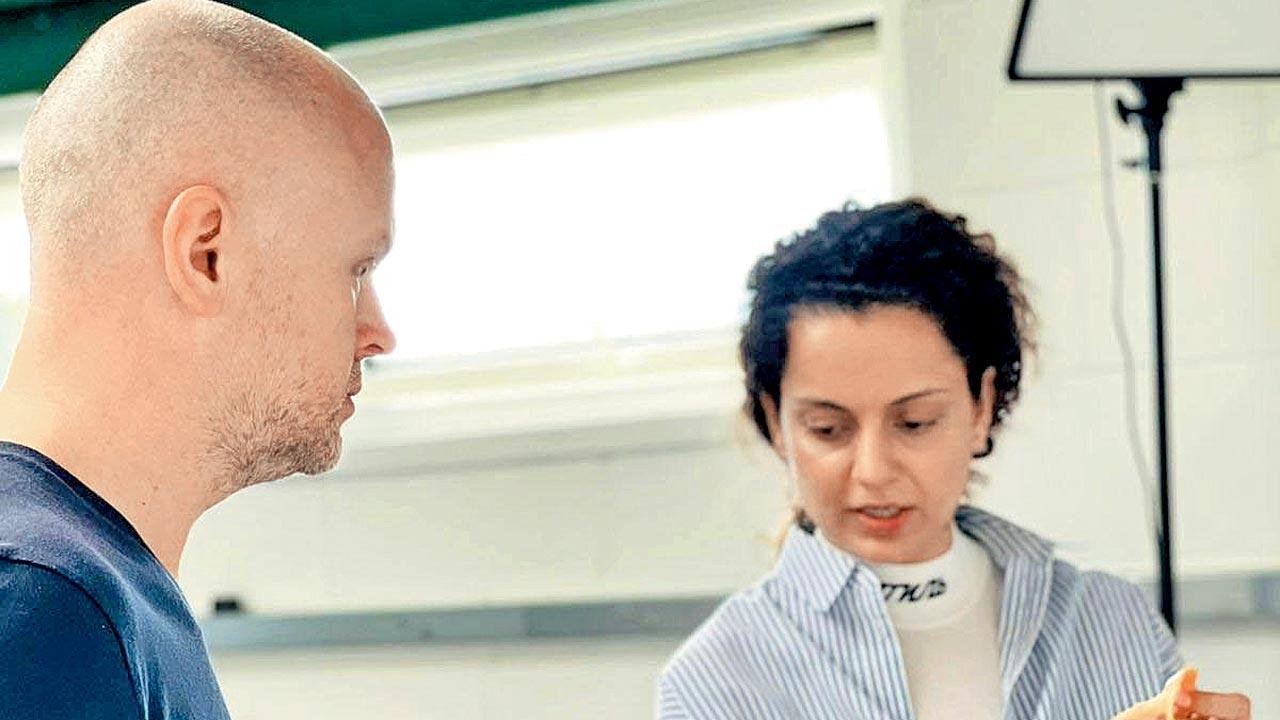
The actor with David Malinowski
Rocket Boys showed Bhabha and Sarabhai’s equation with PM Nehru; second season set in Indira Gandhi’s reign
8:04 AM
Upala KBR (MID-DAY; February 21, 2022)
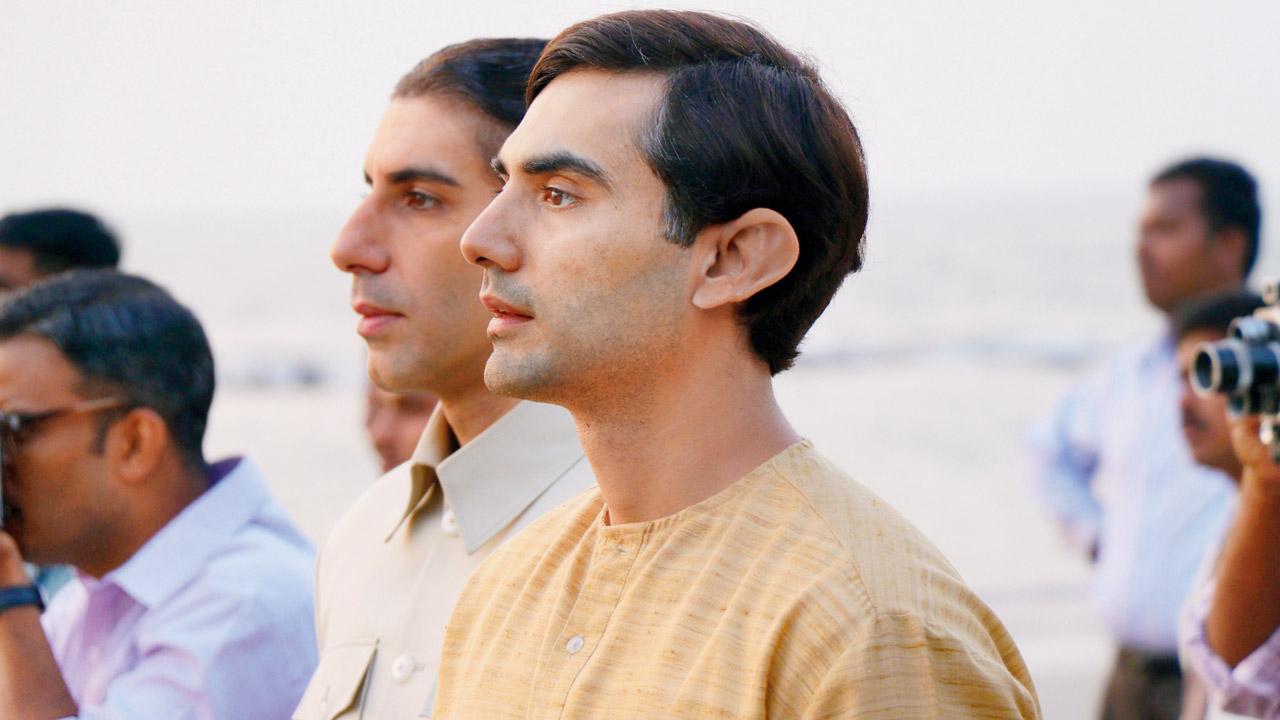
Director Abhay Pannu ended the first season of Rocket Boys on an interesting note, with Homi Bhabha — essayed by Jim Sarbh — standing on the cusp of an era-defining invention. While the series depicted how Bhabha and Vikram Sarabhai boosted the nation’s standing in scientific communities under the aegis of then Prime Minister Jawaharlal Nehru, it is learnt that the second edition will see former Prime Minister Indira Gandhi play a bigger role as she takes charge.
Kavish Sinha, who handled the casting of the Sony LIV offering, had roped in Charu Shankar to play India’s Iron Lady in the opening season. “There are a lot of dignitaries who come into [play] in the second season, including cabinet ministers and prime ministers. A major part [is dedicated to] Indira Gandhi in the upcoming season. Abhay was ready with a complete docket for the entire show, including the character arcs,” says the casting director.
He adds that both instalments were shot simultaneously. “We needed actors who would be invested for a long period as the two seasons were being shot together. The 16 episodes weren’t shot episodically, but as per the script and location.” He adds that the show is now in post-production.
It also takes an actor like Akshay Kumar who believes that we cannot stop functioning, ever-Lara Dutta
8:14 AM

Rachana Dubey (BOMBAY TIMES; August 18, 2021)
Lara Dutta Bhupathi turned out to be the surprise element in the trailer of Ranjit Tiwari’s spy-thriller BellBottom, set in the 1980s. The actress plays former Prime Minister Indira Gandhi. In the last few years, Lara has directed her attention towards characters, largely in the content created for the OTT platform. In a chat with BT, the actress spoke about the transition she sees in storytelling, being offered worthwhile characters and more. Excerpts:
A common reaction to the trailer of BellBottom is that you went unnoticed in it, in the first instance. No one expected you to play Mrs Indira Gandhi, our former Prime Minister.
Well, the reactions have been overwhelming, and a common feedback is that people could not easily place me in the trailer. Honestly, even I was overwhelmed when I saw myself in the mirror for the first time in the get-up, with prosthetics and the wig in place. I could not find Lara anywhere in the mirror. As an actor, it means something to me to be able to convincingly pull that off. It’s an honour to play Mrs Indira Gandhi.
Tell us about what went into the process — physically and mentally — to play her part?
When Akshay (Kumar, her co-star in the film) called me and told me they were casting for BellBottom and they wanted me to play Mrs Gandhi, I took it as a joke. Of course, I realised he is serious. I was concerned as we had nothing in common, not one feature that made me look like her. There was no resemblance whatsoever. But he was convinced because the producers and he wanted an actress who had a certain poise and presence. When you get such a part, as an artiste, you don’t pass it on. I had to be immensely responsible while portraying Mrs Gandhi on screen, it had to be done appropriately. A lot of prep went into it. Right from watching a lot of her videos pulled out from archives, footage of her speeches, which helped me study her mannerisms, and also what she stresses on when she speaks. My father (L K Dutta, Retd Wing Commander) has served as her personal pilot. I had heard stories about her from him, about how she would be around different sets of people and how she was as a person. I was a child then, and I used to be fascinated by her.
But all that my father had told me back then, has helped me to play the character now. An essential aspect of playing the role was to understand her as a person; go beyond adapting her mannerisms and style of wearing clothes. There was a certain environment that she was inhabiting at that time. The 1980s had a certain kind of political and social environment. One had to imagine how Mrs Gandhi would have acted and reacted in those situations. BellBottom is set around a set of highly dramatic events, but she was not thrown into the dramatics at all. She shared a rapport with R N Kao, the founding father of R&AW. She would turn to him in a crisis. It’s depicted very well in the film. I am excited for people to see what we have created as a film.
At a time when good parts are being written for women, we don’t see you doing too many movies. Are you consciously doing less to balance between work, family and your other areas of interest?
Unless something is challenging, I don’t want to slip my foot into it. I have more or less tried everything from the songs and dances to the comedies and serious films. I have also produced a film in the past. So, something should really push me out of my comfort zone for me to do it. This film did that. I am not just an actor — I am a mother to a nine-year-old child, I have a business running, I have a whole lot of other things taking away my time. If I have to make room for an acting assignment, it will have to be worth the ride. The good part is that the writers are now, more consciously, writing a lot of good roles for women my age. There’s a lot for us to do. They are real characters, with nothing atypical about them. It’s a departure from the suffering woman or the perfect mother. I love the fact that writers are doing such a great job with characters. When there is a chance to imbibe a beautiful character like Indira Gandhi’s, you step forth and embrace it.
So, what sort of boxes should a project tick for you?
The number one role I have on hand is that of a mother. Everything I do today is kind of designed around Saira. I’m very clear that as an actor I have certain limitations. I have a system in place that allows me to use my abilities well and balance my role at home at the same time. So, for me, it all boils down to what the role is, what I am stepping into and why I am being chosen to play the role. I want to know what value one thinks I can bring to a project, if something was envisioned with me and why. Of course, it also matters who I work with. Once that is in place, things move smoothly.
When the producers decided to shoot BellBottom , most parts of the world were in lockdown. The decision to travel abroad must have been tough given the scenario in 2020.
It was a tough time and uncertainty was looming large. There was no vaccine, there were all kinds of truths and myths floating around and everyone was stressed. I have to give credit to Vashu Bhagnani and his children, Jackky and Honey, for ensuring that everyone was safe. I think it’s important for the show to go on. The world had already changed a great deal by the time we started shooting. The morale was low when Vashu ji stepped forward and decided to take the film on floors and reboot work in the industry. It also takes an actor like Akshay Kumar who believes that we cannot stop functioning, ever, and that we have to find a way to survive this. We went ahead and all of us did mandatory quarantine before the shoot. The normal sightseeing and shopping routines didn’t happen on this outdoor schedule, but no one complained. We stayed within a bubble, with our families around. It just boosted everyone’s morale. We as a team bonded better. This shoot became special on more than one level.
Thanks to my father, I had this ready-made vault of knowledge on Indira Gandhi-Lara Dutta
8:13 AM
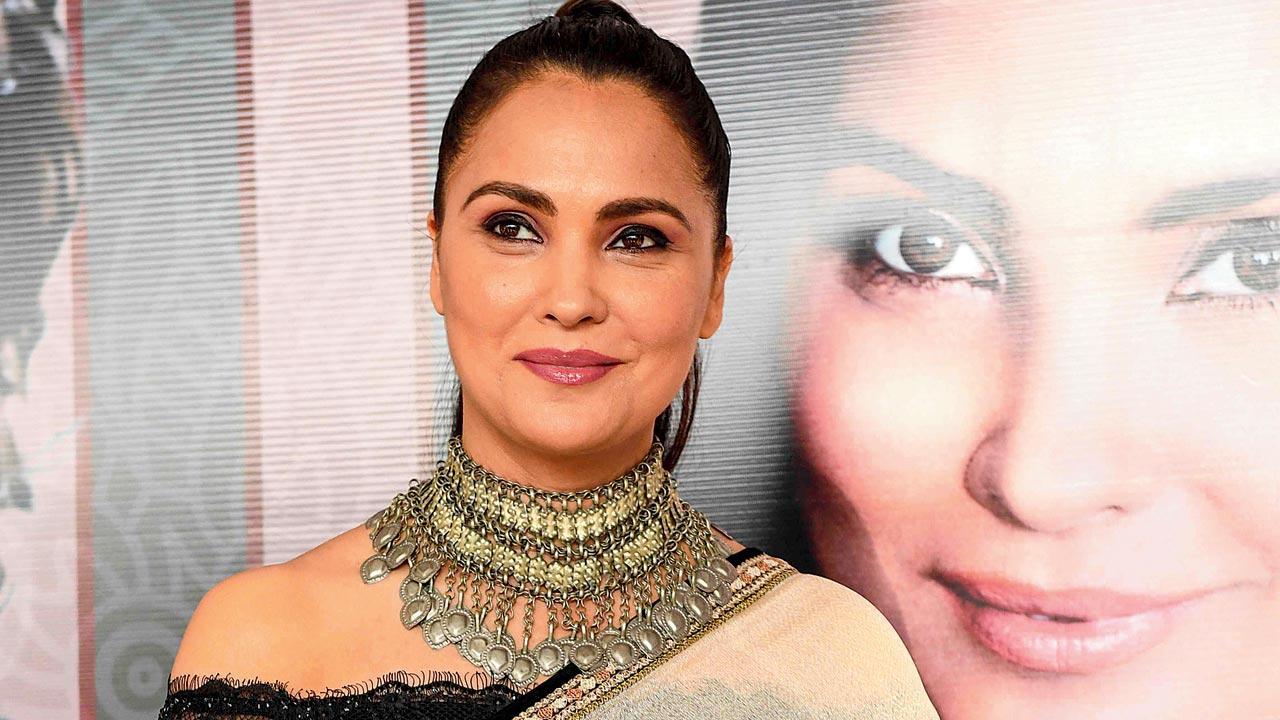
With her father having served as Indira Gandhi’s pilot, Lara Dutta discusses relying on his experiences and intense prep to play late PM in 'Bellbottom'
Mohar Basu (MID-DAY; August 16, 2021)
Most viewers did a double-take when the trailer of Bell Bottom was launched. Reason — Lara Dutta was almost unrecognisable as she slipped into the role of late Prime Minister Indira Gandhi for the Akshay Kumar-starrer. “For any actor, playing Mrs Gandhi is a huge honour,” begins Dutta.
When the offer came her way, she was initially unsure of taking up the part. “When Akshay called, I asked him if he was sure [about casting me in the role]. Once I said yes, the magnitude of the responsibility dawned on me. Vikram Gaikwad did a great job on the prosthetics, creating wrinkles and pigmentation because I played her in her 60s. Once the look came together, I was more convinced I could pull it off.”
It was then time for Dutta to imbibe the traits of India’s Iron Lady. With director Ranjit M Tewari, she watched archival footage of Gandhi, studying her body language and interactions. She also fell back on father L K Dutta’s experiences with the former prime minister. “He was Mrs Gandhi’s pilot, and has flown her on innumerable occasions, including election rallies. We grew up hearing first-hand stories of his interactions with her. I had this ready-made vault of knowledge on her."
“She believed in straight talk. This film is centred on a dramatic incident. We have taken some cinematic liberty, but retained the authenticity of how she would have reacted to the incident. As an actor, I feel content with what I have done. My father felt it was a job well done.”
While most have praised her transformation, some detractors have nitpicked on her look, including Sapna Bhavnani who called it a bad wig. Dutta is unfazed as she says, “You can’t please everyone. There will be people who will find flaws, and everyone is entitled to their opinion.”
The actor will soon be seen in Lionsgate’s new series that is an adaptation of American show Casual. Describing the current phase as “the best time” of her career, she says, “As a woman in her early 40s, it’s liberating that the roles are not restricted to playing someone’s wife or the hero’s mother. There are more female writers who are writing better parts for women.”
With Bellbottom, we’ve taken a step ahead of returning to the big screen-Akshay Kumar
8:41 AM

Kavita Awaasthi (HINDUSTAN TIMES; August 13, 2021)
From taking a 200-member crew to the United Kingdom to shoot a film from start to finish amid the Coronavirus pandemic last year, to wrapping up five films since then, Akshay Kumar has been leading by example. In a chat with us, the actor divulges what led to the decision of releasing Bellbottom in theatres at a time when they aren’t operating in full capacity, and how he drew inspiration from frontline workers. Excerpts:
Being one of first actors to start shooting after the lockdown, last August, how do you look at the experience, uncertainty and risk of shooting in the UK?
I still remember that flight, being on the tarmac with a crew of 200 plus members. Everyone was quiet while we were about to take off, as there was so much uncertainty and apprehension, the underlying fear that anytime, we’d get a call about a change in rules and regulations, and we won’t be able to fly. But, as soon as we were airborne, the entire crew screamed in jubilation, almost deafening. That was such a special, liberating moment... maybe my most memorable flight till date!
We’ve been living with Covid-19 for 15 months now. Going forward, what changes do you see in the business of filmmaking, theatres and the mood of the fraternity?
I can’t comment about others, but I am going about doing business as usual. I’ve already completed five films during the pandemic. And, I’m onto the next one, Cinderella, with the same team as BellBottom, directed by Ranjit Tewari. But then, this has always been the way I’ve worked — doing an average of four films a year. Yes, the avenues to showcase our films may change a little. I know even before shoot begins, that some films are being planned for an OTT release only. Also, another term I have recently learnt is hybrid release — when a film releases in theatres and on an OTT platform, simultaneously. One way or another, the show must and will go on.
First Dhoom 4, now a Neeraj Chopra biopic — speculations around you don’t seem to die down, not to forget the memes. How do you handle these?
Some of the memes are really funny. The recent one, which was a still from my film Saugandh (1991), of me with a stick, read ‘Akshay Kumar preparing for Neeraj Chopra biopic’. Jokes aside, it actually feels good. The worst thing for an actor is to be missing from public memory. I guess this whole experiment of juggling different genres seems to be working.
Airlift (2016), Gold (2018), Kesari (2019) — your films are patriotic, minus the jingoism. Is that by choice or chance?
I pick subjects which I find entertaining. If they help convey a message to the audience, it’s the icing on the cake. As far as jingoism is concerned, it’s a conscious choice. If you overdo something, audiences can see through it. I prefer to keep it to a degree which is believable. The idea is to make audiences aware of stories of India’s unsung heroes, honour them and instil a sense of pride for their achievements. If we manage to do that much, mission accomplished!
In BellBottom, you play a spy who turns saviour. What attracted you about this film?
We have so many interesting, untapped stories in our country. For instance, when I did Airlift, I didn’t know something like this had happened, and to this day, it’s the biggest civilian evacuation in aviation history. Many people weren’t aware of this fascinating story. Same was the case with Gold, Kesari, Mission Mangal (2019), etc. I love real-life stories, and when I hear of an extraordinary incident, I get all the more fascinated. I feel more people should know about it, and there begins the process of filmmaking. BellBottom is no different, it’s a story based on events of India’s first covert operation.
Lara Dutta Bhupathi’s transformation as Indira Gandhi is being lauded. Director Ranjit Tewari said you recommended her for the role?
When Ranjit narrated the story to me, we knew it would be tricky to cast for the character of Indira Gandhi, but we had to get it right. Mrs Gandhi had a certain body language and gravitas, which I felt Lara could bring to the character, and look what an amazing job she has done. Congratulations to the makeup artist, Vikram Gaikwad, and his team for pulling off the look.
BellBottom is releasing at a time when theatres haven’t opened in full capacity. Does it perturb you?
It did earlier, but with time, I’ve learnt that the lesser time you spend mulling over things which aren’t in your control, the happier you’ll be. We had two choices — sulk and postpone again, or go ahead and let the film decide its fate. Taking control of what’s in our hands, we chose the latter.
Any update on the release of Sooryavanshi?
I’ll have to redirect this question to two people, God and Rohit Shetty (laughs). In case you have an update, let me also know! On a serious note, with BellBottom, we’ve taken a step ahead of returning to the big screen. Hopefully, the results will give others confidence to follow suit.
You have six films lined up for release. Is this a business decision or a chance for thousands in the industry to earn their livelihood?
Last year, most of us had the privilege to stay safe and work from home. But doctors, policemen and essential service providers didn’t have that choice. They continued doing their jobs, despite the looming fear. I took inspiration from them. The only job I know is to act, so I decided to get back to work. I have been fortunate to have cooperative producers and directors who agreed to resume shooting amid the pandemic. And, I’m glad if one decision, in turn, helped people who are associated with me to get back to their normal livelihood as well.
With projects that spell versatility, such as BellBottom, Atrangi Re, Sooryavanshi, Bachchan Pandey and RakshaBandhan, to name a few, you seem to be living every actor’s dream.
I have been very fortunate that such diverse roles have come my way. Earlier in my career, I’d gotten too comfortable as an action hero. It was sheer luck that Priyan (director Priyadarshan) sir offered and convinced me to do Hera Pheri, which helped me step out of my comfort zone. The reward of that one risk of trying to do something totally new, taught me to keep an open mind and play different roles, be it a transgender character, a homosexual or Pad Man. In a way, I’m still reaping the benefits of Hera Pheri.
One reaction since the first look trial was that of shock, says Vikram Gaikwad on Lara Dutta's look in Bellbottom
8:41 AM

Rachana Dubey (BOMBAY TIMES; August 12, 2021)
When the trailer of Akshay Kumar’s BellBottom was launched in Delhi, Lara Dutta Bhupathi turned out to be the surprise package in it. The actress plays former prime minister late Indira Gandhi in the spy -drama set in the 80s. The movie revolves around the hijack of an aircraft and a covert mission to rescue passengers. Lara’s make-up, loaded with prosthetic elements, did the trick for her. Talking about it, National Award-winning makeup artist Vikram Gaikwad, says, “It’s a humongous responsibility to design the look of characters for a film set in a specific period. And it’s an even bigger responsibility when you are recreating the personality of a powerful figure like Indira Gandhi.”
Elaborating on the process of putting together Lara’s look, Vikram says, “BellBottom is a period film, which means all the characters in the movie belong to a certain era and have to look a certain way. For Lara’s look, we researched pictures and videos of Indira ji. She has three prominent features —eyebrows, nose, and a face cut, along with a particular hairstyle. We changed the shape and style of Lara’s eyebrows to make them look more dominant. We got prosthetics done on the nose and the wig was worked out in fine detail. Also, the wrinkles were created with a lot of shading work. It took the team around two to three trials before the shooting started. Each make-up session took about 3 hours. Make-up like this cannot happen without the dedication and cooperation of the artiste.”
Talking about the reactions to Lara’s look, Vikram says, “There is one reaction that has been consistent from the beginning — shock! During the first trial when Lara saw herself in the get-up, she was unable to find her old self. She was convinced about the look and that was very important for me. Everyone associated with the film was surprised. Even people close to Lara could not identify her.”
---------------------
Rishabh Suri (HINDUSTAN TIMES; August 12, 2021)
People are going absolutely gaga over how actor Lara Dutta Bhupathi has transformed into late politician Indira Gandhi for the upcoming thriller BellBottom. And major credit for it goes to makeup expert Vikram Gaikwad. Calling it a “humongous responsibility”, the three-time National Film Award-winning makeup artiste says, “The result you see is the outcome of a very thorough process. I read the script, then the casting and direction team informed us that Lara is going to perform as Indira Gandhi.”
Thus began the challenge, as Gaikwad felt that there’s no likeness between their faces. “However, Lara is a brilliant actor, so I had to do my best to deliver the look,” he explains, adding, “We’ve changed the style and shape of Lara’s eyebrows and done prosthetics on her nose.”
Two-three trials were done before the shooting began, and each makeup session took three hours. And the end result “shocked everyone” to say the least, according to Gaikwad. “There’s one reaction that kept coming since the beginning, and that was of shock. The most important thing is that Lara, Akshay (Kumar), Ranjit (Tiwari; director) and Jackky (Bhagnani; producer) trusted me and my team,” he adds.
While people were stunned with Dutta’s look, hair stylist Sapna Bhavnani tweeted her disappointment: “Such a bad wig though, can see the lining. But of course, you wouldn’t as you’re not a hair person...” Point this out and Gaikwad says it is not “worth commenting”.
When I saw myself in the mirror, I was blown away, I couldn’t recognize myself-Lara Dutta
8:26 AM

Titas Chowdhury (HINDUSTAN TIMES; August 8, 2021)
Lara Dutta Bhupathi’s resemblance to former Prime Minister Indira Gandhi, in the trailer of Bellbottom, has been creating ripples on social media. The actor says she too was shocked to see her transformation. “Once we did the look test and I saw myself in the mirror, I was blown away, I couldn’t recognize myself. I had to look hard to find any semblance of Lara in the mirror looking back at me. My jawline looked so different!” she shares.
To play the iconic leader, Bhupathi had two options – either play a character loosely based on Gandhi or go full out and resemble her as closely as possible. What also made the transformation process challenging for the role was ageing her skin. “Vikram Gaikwad and his team who did the prosthetics went through a long process. I was playing a character who was two decades older than me for the time frame we’re portraying her in,” she says.
Her father, retired Wing Comander L K Dutta, who was Gandhi’s personal pilot, gave her valuable inputs. “When I was offered this film, I knew my dad would be a source of information for me to be able to build on Mrs Gandhi’s psyche and body language. The biggest compliment is hearing from him that I’m convincing enough and he’s proud of me,” Bhupathi ends.

Diljit Dosanjh set to revisit the 1984 riots with Ali Abbas Zafar's next production?
8:29 AM

Himesh Mankad (MUMBAI MIRROR; July 14, 2020)

Ali had also completed the script for another production, set against the backdrop of 1984 riots, triggered by the assassination of the late Prime Minister Indira Gandhi on October 31, 1984, by two of her Sikh bodyguards.
“Ali has always been attracted to Indian history; both Gunday and Bharat grew from the past. He has wanted to make a film around the ’84 riots for a while and has finally found a subject that has him charged up. Besides producing the period-drama, he is creatively involved with the script,” informed a source, adding that the 38-year-old filmmaker is in talks with Diljit Dosanjh to play the lead. “Ali and the team believe he is best suited to play the role and will bring in local flavour too. Diljit has agreed verbally, with a final narration scheduled in a few months. The idea is to roll as soon as normalcy returns.”
Incidentally, Diljit has acted in a Punjabi film, Punjab 1984, based on ’84 riots, directed by Anurag Singh. It bagged the Best Feature Film in Punjabi at the 62nd National Film Awards. “Diljit is excited to revisit that tumultuous time in Bollywood,” adds the source. The yet-untitled film will mark the directorial debut of one of Ali’s assistants.
With many films opting for a digital release, rumours suggest that Khaali Peeli might go the OTT way, too. The source insists that Ali and his studio partner, Zee Studios, are keen on a theatrical release and willing to hold on to the film for a few months. “It’s an out-and-out commercial entertainer, meant to be viewed on the big screen. The team is wrapping up post-production, after which they will study the situation before taking a call. If cinema halls open and register occupancy, Khaali Peeli will be among the first films to arrive,” the source signed off.
Ananth Mahadevan's soon-to-be published book to narrate stories behind milestone TV shows
8:36 AM

Filmmaker Ananth Mahadevan’s soon-to-be-published book, Once Upon A Prime, takes us through milestone shows of Indian TV
MUMBAI MIRROR (April 29, 2020)

How Kishore came to sing for Yeh Jo Hai Zindagi
 The title refrain of Yeh Jo Hai Zindagi is still high on the television memory charts. When pop star Ajit Singh composed it, S S Oberoi blew a bugle, “lets get Kishore Kumar to sing it!” Kumar, the maverick actor-singer-composer, had not stepped out of the movie circuit before. In his legendary style, without batting an eyelid, he rattled off a figure of 18,000 rupees, the fees he charged for a film song. Oberoi didn’t blink either. He could see the song playing on television every week. Over 52 episodes it would amortize to less than 4,000 rupees a week. And so, Kishore Kumar sang for television.
When Colonel Kapoor ran behind ‘Fauji’ Shah Rukh Khan with a stone
He (Director Colonel Raj Kumar Kapoor) first ran into the 23-year-old lad named Shah Rukh Khan at Gulmohar Park in New Delhi. Kapoor’s brother-in-law auditioned him along with a bunch of others, and let them loose on the training ground. The Colonel put them through a grind unfamiliar to them. Not surprisingly three of them dropped out with a curt “we haven’t come here to join the army”. Only Khan kept up with Kapoor.
It ended in a sparring match with both donning boxing gloves. “I goaded him to hit me and he finally did. I could sense his aggressive nature. It was a presence that the camera loved. My Abhimanyu Rai was born, though honestly, I hadn’t penciled him in for the part. He was a bit of a bum though, turning up late for shoots. Once I ran behind him with a stone and that put an end to his punctuality ills.”
The other ‘bums’ weren’t a piece of cake either. The Colonel had recruited a barber on the set to clip their Samson locks. Yet the cadets continued to sport long hair. “I later discovered that they were bribing the barber,” he says. Corruption had seeped into the ‘army’, courtesy the civilians.

Govind Nihalani asked Indira Gandhi for government support for Tamas
Tamas lay untouched in Nihalani’s (director Govind Nihalani) room for more than a week. He preferred to read it when he had sufficient time out from filming. When he did get down to reading it, every sentence struck him not as words, but images. Something told him ‘this is it’. He decided that he wanted to do it, but didn’t have a clue how to go about it.
It was around that time that Nihalani’s searing human drama, his first film, Aakrosh (The Cry of the Wounded) was selected in the Indian Panorama section of the International Film Festival of India, held that year in Delhi. The directors of the films screened were invited for a tête-à-tête with then Prime Minister Indira Gandhi. An evening with Gandhi, however, turned into a rationed two minutes with each person.
Nihalani who was deeply under the influence of the book came straight to the point. “Madam, if a serious film were to be made on the Partition, would the government extend support?” “What do you mean by government support?” she enquired.” “The National Film Development Corporation, for instance. Regular producers do not fund this kind of film.” Gandhi instantly asked him when he wanted to make it. “It is a sensitive film. It will all depend on the political situation at that time.”
Nihalani realised that her sharp mind had taken cognizance of the Hindu-Muslim elements in the story. The communalism in the film and the country would not be without repercussions. “I realised I was sitting on a potent subject. I was certain as hell that I wanted to make the film.”
Why the Big B was apprehensive about KBC
Amitabh Bachchan’s participation in (Kaun Banega Crorepati) evoked the expected skepticism. I was privy to groups turning into all-knowing prophets of doom: “What works in formula films will not work on TV”, “Imagine diminishing his status to that of a television host”, “Did he need this at this stage of his career?”… Strangely, Bachchan himself echoed some of the sentiments “Yes, I was most apprehensive about the idea of going on to the ‘small screen’, as were most of my family members. I felt that the uncertainty of my ability to pull off something like this, was weighing more than the actual danger of reducing my size from 70mm to 21 inches. But as is with most pioneering efforts, since there were no yardsticks or examples to use for reference, I merely took the decision, and the plunge. I have never thought of myself as being in possession of any stature or for that matter being some kind of a star. I looked upon this as another job to be done and that is how I approached Kaun Banega Crorepati.”

Boman Irani joins the cast of '83; to play Farokh Engineer
7:50 AM

Actor, who plays former cricketer-commentator in Kabir Khan’s sports drama featuring Ranveer Singh, on spending time with him
Himesh Mankad (MUMBAI MIRROR; August 27, 2019)
 Mirror was the first to report (May 17) that Kabir Khan’s Kapil Dev biopic, ’83, featuring Ranveer Singh as the protagonist and his actress-wife Deepika Padukone as the former skipper’s better half, Romi, will go on the floors on June 5 in London. Now, we have learnt that Boman Irani has joined the ensemble cast of the film, which includes Pankaj Tripathi, Tahir Raj Bhasin, Saqib Saleem, Ammy Virk, Chirag Patil, Jiiva and Harrdy Sandhu.
The actor, who plays legendary former opening batsman and wicket-keeper, Farokh Engineer, in the film, informs from London, “He was the only Indian commentator during the 1983 World Cup. His story, along with co-commentator Brian Johnston’s, runs parallel to the main narrative.” During the historic World Cup final between India and West Indies, Johnston had jokingly asked Engineer if the then Prime Minister, Indira Gandhi, would declare a public holiday if India wins, to which his Indian counterpart had quipped, “She is an avid listener of the show, and would declare a public holiday just hearing this.” Turned out, Engineer’s prediction came true.
Boman joined the team at the Lord’s cricket ground on Sunday. “I will be shooting for a couple of days here, and then join the team in Mumbai. It’s a great honour to play this legendary character,” the actor beams. Ask him if he has met Engineer as a part of his prep, and he reveals, “I went to Manchester during the World Cup this year and stayed with him for a few days. We even watched the India versus Pakistan match together. It was so surreal; like meeting your boyhood hero. I stayed at his house and we had some good laughs while trying to understand the man for the role.”
The actor also opened up about what drew him to the film, produced by Sajid Nadiadwala, Reliance Entertainment and Madhu Mantena, in which he represents India from the commentator’s box. “Kabir called me a few months ago and offered me this role. Instinctively, I replied, ‘If you give this role to someone else, we’ll not be friends anymore.’ I’m here now, shooting,” Boman shares.
Putting on make-up and prosthetics to transform into Farokh Engineer for the big screen was memorable as well. “While I was getting into make-up, I called Engineer to thank him for the honour of portraying him. The ’83 World Cup is a big part of our lives, not just as cricket lovers, but as Indians,” the actor signs off.
Actors don't have a shelf life, stars do-Vidya Balan
8:21 AM

Vidya Balan busting the myths around girl bonding in Bollywood, the shelf life of actresses and why her career isn't a chore for her
Mohar Basu (MID-DAY; August 18, 2019)
We meet Vidya Balan on the last day of Mission Mangal promotions. Dressed in finery after swiftly wrapping up last-minute work, she settles in her sea-facing room at a suburban five-star. "During Kahaani (2012), I made a personal record of 58 interviews in a day. This feels a lot a lighter," she starts off. Feet up, sinking inside a quilt, a visibly exhausted Balan retains her affable smile as we chat about the shifting definition of a female actor, the reason behind her long gaps, the myth of female catfights and the long wait up to her passion project—the Indira Gandhi biopic.
Edited excerpts from the interview.
It's been a year and half since Tumhari Sulu (2017). Why did you take such a long gap?
I did three films back to back [Kahaani 2, Begum Jaan, Tumhari Sulu] and after that I didn't want to jump into another one immediately. I loved Mission Mangal which is why I took it up. I need time to rejuvenate after gruelling work and family time is sacrosanct; I prefer to take things at my own pace. There have been instances in the past when I have gone on set and said, "Pack up kab hai?" That's a red flag for me. My work cannot become a chore. I am not here to churn films, neither am I in any tearing hurry to get anywhere. I am here for a lifetime.
But the common assumption is that actors have a shelf life.
Actors don't have a shelf life, stars do. Being in the public eye and living under constant scrutiny can get daunting and draining after a while. By design, that is changing because the fabric of movies and audience is changing. Hence the concentration is on becoming a better actor [with each film], not a star. My 'care-a-damn' attitude works and it is the only way I know [how to survive], which is why I am here [in Bollywood] for as long as I want to.
In a cast full of women, all stars in their own right, how regular were the catfights?
(Laughs) That's a cliché. People believe when female actors work together, tensions and insecurities run high. However, in my experience, that is hogwash. I did Begum Jaan with an ensemble female cast [and there were no catfights]. It's even more creditable here because each of us—Taapsee (Pannu), Nithya (Menen), Sonakshi (Sinha), Kirti (Kulhari)—are stars in our own right. We were secure and it was a joyous experience to work together. High time we made a girls' road trip film in India. The cliché [about catfights] was probably true in the past, but women stand together today.
Being the primary lead in the film, doesn't it bother you that Akshay Kumar's face is more prominent on the poster?
[The emotion is] far from it. If Mission Mangal does well, we will all gain from it. Having his face [on the poster], guarantees more footfall in the theatres; and I have no qualms using his stardom. In the films I headline, I am prominent on the poster. We all have prominent roles, but when there is a star like Akshay Kumar, it makes sense. I know the film I signed up for and I am okay with whatever they do to market it. My experience helps me see things in perspective.
Last November, filmmaker Radha Bharadwaj reached out to mid-day about a legal suit she filed on you for passing her film idea (similar to Mission Mangal) to R Balki.
And we won the case. Although I never met Radha, her script came to me through my agent, Bling [Entertainment]. I was offered four films on the same subject. One script that Atul Kasbekar wanted to produce was still at the ideation stage; and there was nothing for me to do in it. Ronnie Screwvala had a similar script with two character options—a 22-year-old and a 55-year-old—I declined it because I fit neither. Each of the scripts gave me the feeling of something missing. Mission Mangal scripted beautiful personal lives for each scientist, the science was simplified, the mission was detailed and I loved it. I was on board as soon as I finished reading. Having spent 15 years in the business, I respect everyone who comes to me and I pride myself for my integrity. Not once have I shared another person's idea with another filmmaker. I am happy truth prevailed.
Did you feel targeted because you are a star?
We are definitely scrutinised more. I felt it was unfair to me, considering I never announce my own films. It always comes from a director or producer. I was taken aback when it happened and that too on the first day of our shoot. Last one month, the pressure increased because Radha wanted clarity before our film's release. I can empathise with that, especially for someone who has worked on a script for long. The information is on public domain and there is no limit on how many films can be made on the same subject, like the Bhagat Singh biopics that all happened at the same time.
What is next in the pipeline?
I start prep for the Shakuntala Devi biopic soon. The Indira Gandhi biopic [based on author-journalist Sagarika Ghose's book Indira: India's Most Powerful Prime Minister] will take more time to be structurally drafted and Ritesh Batra is working hard on it. The web series is a mammoth amount of work. It is a passion project.
Are you involved in the writing process of the series?
I don't have the talent, bandwidth or discipline for it [writing]. I respond better to what is being written. May be by year-end, once the material is ready, we could start discussions. It may also take another two years, but it's worth the wait. Sometimes, I worry that it's taking too long, but then, I don't have to go anywhere. Good things require patient brewing.
Any plans to venture into production someday?
No. Ronnie offered me the producer credit [for Natkhat] because there is no money in short films. Siddharth [Roy Kapur, husband] is a producer. Honestly, I am living my only dream of being an actor. Producers have plenty to handle, and I am clear, I want to be on the other side, being handled (laughs).

There were days when I’d go to sleep in tears-Vidya Balan
8:15 AM

Vidya Balan on her early struggles as an actress and how it helped forge a bond with her screen alter ego in her next, based on the Mars Orbiter mission
Roshmila Bhattacharya (MUMBAI MIRROR; August 12, 2019)
Today, who doesn’t know Vidya Balan. She is the lovelorn Lolita of Parineeta, the desi siren of Ishqiya, The Dirty Picture’s unabashed Silk, the surprise twist of Kahaani and housewife-next-door of Tumhari Sulu with a call-in-the-night radio show. And these are just some of her screen turns which have made the National Award-winning actress a household name. But there was a time when her aspirations made her cry.
“Coming from a non-filmi family I had no idea how to go about becoming an actress, yet I wanted to be one. It worried my family, though they have always supported me. It must have come as a relief to them when my first TV show, La Bella, shut down after a few months. They must have thought, ‘Chalo, abhi to bhoot utar jayega,’” she reminisces.
But Vidya continued to chase after her celluloid pipedream, despite friends telling her she needed to her studies or at least a back-up plan in plac She did enroll for her Masters to keep herself occupied after some of the offers she had been banking on fizzled out. “It was three years of constant rejections from down South and there were days when I would go to sleep in tears. But next morning, I and smiling, hop something good would happen, and Parineeta did,” she smiles. Perhaps it was her real-life struggle, along with the fact that in the last decade she has spearheaded many films which can get frustrating when things are not going right, that helped Vidya forge an instant connection with Tara Shinde, her character in the upcoming Mission Mangal. The Independence Day-release is inspired by India’s Mars Orbiter Mission which had once seemed like an impossible dream too. “But even when the challenges seem insurmountable, Tara refuses to give up,” says Vidya, pointing to the similarities between herself and her screen alter ego.
You wonder if as a child she had wanted to be an astronaut and reach for the stars, and she laughs, “The closest I have come to that is being on the sets of this film. In fact, I was nervous about spouting all the technical jargon because these concepts were so alien to me. I spent hours reading and watching the videos Jagan (Shakti, director) had given me for my prep.”
Her journey with co-star Akshay Kumar goes back to 2007, Heyy Babyy and Bhool Bhulaiyaa. How much has he changed in the years since, you wonder, and Vidya admits she was thinking the same thing before they started shooting. “But I quickly discovered that the madness is intact, while interestingly, Akshay has reinvented himself as an actor, exploring different genres, moving from action and comedy to socially relevant subjects which he feels strongly about. Which is perhaps why these films are working for him,” Vidya reasons. And for her, how different was it moving from a woman centric film to a women centric one? Vidya is quick to correct you, pointing out that both genders contributed equally to the Mars mission, though the five women, played by her, Taapsee Pannu, Sonakshi Sinha, Nithya Menen and Kirti Kulhari, have a significant role to play in this narrative. “Personally, I like all the girls and the work they are doing. All of us in our own ways are trying to push the envelope and do something interesting,” she avers.
Next up for her is the Shakuntala Devi biopic which kicks soon. Vidya admits that since it was reported that she is doing the film, several people, including her Kahaani director, Sujoy Ghosh, have told her that they had met the mathematician, and all of them have an interesting story to tell about the ‘human computer’. “For me, Shakuntala Devi was just a photograph in the newspapers—her head slightly tilted, a smile playing on her lips and a bindi dotting her forehead. Since I am a South Indian, academics come easily to me, still when I heard the narration, I was left gobsmacked!” she exclaims. Prod her on what impressed her the most, and she says, “She wasn’t only about numbers, she had a wicked sense of humour too.”
There was a time when Vidya was offered as many as eight biopics, but apart from the one on M S Subbulakshmi, which has hit a roadblock, she steered clear of the rest. “It’s not enough to just make a film on an imposing personality. The person should have a story to tell too,” she explains, sighing over the fact that she’d been approached for a Meena Kumari biopic soon after The Dirty Picture, and since their trajectories were similar, she’d turned it down. “Since then no one else has come forward, but I’d still love to play my favourite actress on screen.”
For now, she is working towards resurrecting our former Prime Minister Indira Gandhi on screen, after having bought the rights to Sagarika Ghose’s book, Indira—India’s Most Powerful Prime Minister. “The project is not likely to take off soon, it needs a lot of work. The material is vast, Ronnie Screwvala is helping me figure out what we want to tell,” Vidya informs.
The high for now is that after several misses in the early stages of her career, she has just featured in her first Tamil film, the remake of Shoojit Sircar’s Pink. “I worshipped Sridevi as an actress and for the love I have for her and my affection for Boney Kapoor (who produced the film), I agreed to a special appearance,” she points out, as she gets ready to blast off into space with another mission impossible.
BT Exclusive: Nawazuddin Siddiqui to back a biopic on legendary folk artiste Teejan Bai
8:32 AM

BT captures an interaction between the actor, his wife Aaliya — the brain behind the film — and Teejan Bai, who recalls her journey and the storms she had to brave
Renuka Vyavahare (BOMBAY TIMES; February 11, 2019)
It’s raining biopics in Bollywood and there’s one more in the making. BT has exclusively learnt that Nawazuddin and wife Aaliya Siddiqui are set to make a film on Chhattisgarh’s legendary folk artiste, Padma Vibhushan awardee Teejan Bai. The veteran artiste is the greatest exponent of Pandvani (Pandavon ki katha in Chhattisgarhi language), a traditional performing art form involving narration of tales from the Mahabharata.
Nawaz has been a huge admirer of Teejan Bai’s work since his early days as a theatre actor and has seen her perform live.
However, the thought of making a film on her was Aaliya’s, who will soon make a foray into cinema as a producer with a film helmed by Sai Kabir. The Teejan bai biopic will be her second outing as a producer. While the film is still being scripted, BT was the first to catch up with Nawaz, Aaliya and Teejan Bai in Mumbai. It was also the first time that the three were coming together for a discussion. Excerpts from a tête-à-tête with the trio...
As we entered the room of a suburban five-star hotel in Mumbai, Teejan Bai welcomed us with a warm namaste and expressed gratitude to Aaliya and Nawaz for dedicating a film to her. Though she isn’t too acquainted with the current crop of actors, she acknowledged Nawaz’s work and told us that she is aware of him as an actor. She even recalled her meeting with director Imtiaz Ali (during Tamasha, 2015) and said, “Itney bade director hamare ghar aaye, hamare saath khaana khaaya. Woh Tamasha bana rahey the tab. He spent almost four hours in my village. I showed him around.”
Explaining why she chose to make a film on Teejan, Aaliya explained, “I’ve always wanted to make a film on amma (Teejan Bai). Even at this age, she performs on stage for hours and doesn’t forget a single word. She fought the norms created by the society, at a time when women barely had the right to speak up and that’s admirable. I would love to see Amitabh Bachchan sir playing the role of her nana, as in reality, her grandfather played an integral part in her life and career. Interestingly, we discovered that Amitabh ji’s legendary father Harivanshrai Bachchan was also an admirer of Teejan ji. Amitji had also invited amma to his home on his birthday.”
Teejan was accompanied by her assistant, who helped us communicate with her better. He innocently pointed out that she barely remembers her age. While she says she is 63, she could be well in her 70s, but can still perform on stage for over an hour at a stretch. She cut in, “Government ne naukri diya tha. Main anpad gawar insaan kya jaanu. Naukri ke time age poocha toh aise hi bata diya. Mujhe baad mein pata chala ke mera age toh zyaada hai.”
In times of women empowerment and fight for gender parity, as Teejan recollects her life’s journey, and her success against all odds, you wonder why it took so long for Bollywood to notice her. She regrets her lack of education and despite enjoying global recognition and receiving various national and international awards, it is heartwarming to see her simplicity and honesty.
NAWAZUDDIN’S FANBOY MOMENT!
A self-confessed Teejan fan, Nawaz recalled, “Like hundreds of people, I have also been a fan of Teejan Bai. Her shows were always houseful. People used to stand on their seats and clap. They would queue up to catch a glimpse of her. I must have been 20 years old. I got goosebumps when I watched her perform live in Delhi for the first time, in the early 90s. Woh ek mahol create karti thi. Traditional folk artistes like her have a way of telling a story with their gestures, voice, and body language. It’s dramatic, OTT and magnificently enthralling. Legends like her have kept our country’s culture and art alive.You need to conserve what is yours. It hurts to see that today’s generation might not even know about her. ”
As far as his involvement in the film is concerned, he added, “Aaliya is my wife and I will support her as much as I can. I will be involved in this film as far as the creative part is concerned. Teejan Bai is a legend and we hope we can make this film relevant, not just for the film festivals, but also the audience in general.”
Happy to know that a film is being made on her, Teejan Bai said, “Maine apni zindagi mein kaafi utaar chadhav dekhi hain. Mujhe khushi hai ke mere jeevan par ek picture ban rahi hai. It reminds me of all the problems and hurdles that I have overcome in all these years.”

TEEJAN BAI’S LIFE STORY
Attributing her art to God, Teejan revealed that Pandvani was her calling and it came naturally to her. But that was a problem, as women weren’t supposed to perform on stage at that time. It was condemned. Since she didn’t pay heed to her parents’ disapproval, she was asked to leave the house. She explained, “I hail from Ganiyari (Chhattisgarh) and I’ve been performing since the age of 13. I am no poet. I used to hear my nana (grandfather) sing at night and I learnt it from him. Words and pictures came naturally to my mind. Pandvani yeh kaam ladkon ka hai, ladkiyon ka nahi, aisa mujhe bola gaya. Mujhe mana karte the sab log. Maa kehti thi ke sab gaon wale taana maarte hai. Main ladki hokar ladkon ka kaam kar rahi thi. I never understood why I can’t do it. Why shouldn’t a woman perform on stage? I was told that if I continued doing it, no one would marry my siblings and that we would be ostracised by our village and society. Uss zamaney mein Hindu dharam mein aisa samajhte the ki jinka gharaana accha nahi hai, wohi aurtein stage pe perform karti hai. I was told to focus on household chores. I felt, Bhagwaan ki katha bataane mein kyun katrana’, so I continued singing. Maine maa ka nahi suna isliye mujhe ghar se nikaal diya. I was very young then. I’ve looked after myself from a very young age. Mujhe chulha jalaana bhi nahi aata tha. I became a nomad. I travelled wherever the work took me. My parents loved me, but they were adamant that I give up Pandvani, which I didn’t do. I got married thrice. Even my in-laws would say, ‘Humein gaana gaanewali nahi, khaana bananewali bahu chahiye’.”
AWARDS, GLORIES AND A MEETING WITH INDIRA GANDHI
Speaking of awards and degrees conferred upon her, including the recent Padma Vibhushan, Teejan naively admitted, “I didn’t have the knowledge of these awards (Padma Awards) until people told me what they meant. When Bilaspur University awarded me with a D.Litt (doctorate) honour, much to their amusement, I told them that I can’t have two D.Litts as I was already offered one by Raipur University. I told them give it to someone else. They laughed and told me, ‘Aisey Dr ki upaadi aapko dus bhi mil sakti hai’. That’s when I thought, ‘Oh, I just got two. I want more (laughs!)’. I have four such D. Litt degrees today — from Raipur, Bilaspur, Raigarh and Jabalpur universities. I have even performed in front of Indira ji (former Prime Minister Indira Gandhi), and unko bhi mera performance pasand aaya tha. She thought that my courage was admirable. She even joked with me saying, ‘Chhattisgarh mein Mahabharat karvati ho kya?’ To which I replied, ‘Karvati nahi, sunaati hoon’. Impressed by my repartee, she couldn’t believe that I wasn’t educated.”
IMTIAZ ALI’S TEEJAN BAI CONNECT!
Like Nawaz, another huge fan of Teejan Bai from the industry is filmmaker Imtiaz Ali. Interestingly, his Ranbir Kapoor and Deepika Padukone-starrer Tamasha was strongly influenced by her craft.
Describing her as the ‘rock star of Indian tamasha (grand show)’, Imtiaz told BT, “Before starting Tamasha, Ranbir and I decided to visit the rockstar of Indian Tamasha, Teejan Bai. We went to her home in Ganiyari village (Raipur) where she still rehearses and figures her lines. She even performed for us. I wanted Ranbir to see how stories are told with drama, the real Indian way.”

Subscribe to:
Posts (Atom)