Showing posts with label Harivanshrai Bachchan. Show all posts
Showing posts with label Harivanshrai Bachchan. Show all posts
BT Exclusive: Nawazuddin Siddiqui to back a biopic on legendary folk artiste Teejan Bai
8:32 AM

BT captures an interaction between the actor, his wife Aaliya — the brain behind the film — and Teejan Bai, who recalls her journey and the storms she had to brave
Renuka Vyavahare (BOMBAY TIMES; February 11, 2019)
It’s raining biopics in Bollywood and there’s one more in the making. BT has exclusively learnt that Nawazuddin and wife Aaliya Siddiqui are set to make a film on Chhattisgarh’s legendary folk artiste, Padma Vibhushan awardee Teejan Bai. The veteran artiste is the greatest exponent of Pandvani (Pandavon ki katha in Chhattisgarhi language), a traditional performing art form involving narration of tales from the Mahabharata.
Nawaz has been a huge admirer of Teejan Bai’s work since his early days as a theatre actor and has seen her perform live.
However, the thought of making a film on her was Aaliya’s, who will soon make a foray into cinema as a producer with a film helmed by Sai Kabir. The Teejan bai biopic will be her second outing as a producer. While the film is still being scripted, BT was the first to catch up with Nawaz, Aaliya and Teejan Bai in Mumbai. It was also the first time that the three were coming together for a discussion. Excerpts from a tête-à-tête with the trio...
As we entered the room of a suburban five-star hotel in Mumbai, Teejan Bai welcomed us with a warm namaste and expressed gratitude to Aaliya and Nawaz for dedicating a film to her. Though she isn’t too acquainted with the current crop of actors, she acknowledged Nawaz’s work and told us that she is aware of him as an actor. She even recalled her meeting with director Imtiaz Ali (during Tamasha, 2015) and said, “Itney bade director hamare ghar aaye, hamare saath khaana khaaya. Woh Tamasha bana rahey the tab. He spent almost four hours in my village. I showed him around.”
Explaining why she chose to make a film on Teejan, Aaliya explained, “I’ve always wanted to make a film on amma (Teejan Bai). Even at this age, she performs on stage for hours and doesn’t forget a single word. She fought the norms created by the society, at a time when women barely had the right to speak up and that’s admirable. I would love to see Amitabh Bachchan sir playing the role of her nana, as in reality, her grandfather played an integral part in her life and career. Interestingly, we discovered that Amitabh ji’s legendary father Harivanshrai Bachchan was also an admirer of Teejan ji. Amitji had also invited amma to his home on his birthday.”
Teejan was accompanied by her assistant, who helped us communicate with her better. He innocently pointed out that she barely remembers her age. While she says she is 63, she could be well in her 70s, but can still perform on stage for over an hour at a stretch. She cut in, “Government ne naukri diya tha. Main anpad gawar insaan kya jaanu. Naukri ke time age poocha toh aise hi bata diya. Mujhe baad mein pata chala ke mera age toh zyaada hai.”
In times of women empowerment and fight for gender parity, as Teejan recollects her life’s journey, and her success against all odds, you wonder why it took so long for Bollywood to notice her. She regrets her lack of education and despite enjoying global recognition and receiving various national and international awards, it is heartwarming to see her simplicity and honesty.
NAWAZUDDIN’S FANBOY MOMENT!
A self-confessed Teejan fan, Nawaz recalled, “Like hundreds of people, I have also been a fan of Teejan Bai. Her shows were always houseful. People used to stand on their seats and clap. They would queue up to catch a glimpse of her. I must have been 20 years old. I got goosebumps when I watched her perform live in Delhi for the first time, in the early 90s. Woh ek mahol create karti thi. Traditional folk artistes like her have a way of telling a story with their gestures, voice, and body language. It’s dramatic, OTT and magnificently enthralling. Legends like her have kept our country’s culture and art alive.You need to conserve what is yours. It hurts to see that today’s generation might not even know about her. ”
As far as his involvement in the film is concerned, he added, “Aaliya is my wife and I will support her as much as I can. I will be involved in this film as far as the creative part is concerned. Teejan Bai is a legend and we hope we can make this film relevant, not just for the film festivals, but also the audience in general.”
Happy to know that a film is being made on her, Teejan Bai said, “Maine apni zindagi mein kaafi utaar chadhav dekhi hain. Mujhe khushi hai ke mere jeevan par ek picture ban rahi hai. It reminds me of all the problems and hurdles that I have overcome in all these years.”

TEEJAN BAI’S LIFE STORY
Attributing her art to God, Teejan revealed that Pandvani was her calling and it came naturally to her. But that was a problem, as women weren’t supposed to perform on stage at that time. It was condemned. Since she didn’t pay heed to her parents’ disapproval, she was asked to leave the house. She explained, “I hail from Ganiyari (Chhattisgarh) and I’ve been performing since the age of 13. I am no poet. I used to hear my nana (grandfather) sing at night and I learnt it from him. Words and pictures came naturally to my mind. Pandvani yeh kaam ladkon ka hai, ladkiyon ka nahi, aisa mujhe bola gaya. Mujhe mana karte the sab log. Maa kehti thi ke sab gaon wale taana maarte hai. Main ladki hokar ladkon ka kaam kar rahi thi. I never understood why I can’t do it. Why shouldn’t a woman perform on stage? I was told that if I continued doing it, no one would marry my siblings and that we would be ostracised by our village and society. Uss zamaney mein Hindu dharam mein aisa samajhte the ki jinka gharaana accha nahi hai, wohi aurtein stage pe perform karti hai. I was told to focus on household chores. I felt, Bhagwaan ki katha bataane mein kyun katrana’, so I continued singing. Maine maa ka nahi suna isliye mujhe ghar se nikaal diya. I was very young then. I’ve looked after myself from a very young age. Mujhe chulha jalaana bhi nahi aata tha. I became a nomad. I travelled wherever the work took me. My parents loved me, but they were adamant that I give up Pandvani, which I didn’t do. I got married thrice. Even my in-laws would say, ‘Humein gaana gaanewali nahi, khaana bananewali bahu chahiye’.”
AWARDS, GLORIES AND A MEETING WITH INDIRA GANDHI
Speaking of awards and degrees conferred upon her, including the recent Padma Vibhushan, Teejan naively admitted, “I didn’t have the knowledge of these awards (Padma Awards) until people told me what they meant. When Bilaspur University awarded me with a D.Litt (doctorate) honour, much to their amusement, I told them that I can’t have two D.Litts as I was already offered one by Raipur University. I told them give it to someone else. They laughed and told me, ‘Aisey Dr ki upaadi aapko dus bhi mil sakti hai’. That’s when I thought, ‘Oh, I just got two. I want more (laughs!)’. I have four such D. Litt degrees today — from Raipur, Bilaspur, Raigarh and Jabalpur universities. I have even performed in front of Indira ji (former Prime Minister Indira Gandhi), and unko bhi mera performance pasand aaya tha. She thought that my courage was admirable. She even joked with me saying, ‘Chhattisgarh mein Mahabharat karvati ho kya?’ To which I replied, ‘Karvati nahi, sunaati hoon’. Impressed by my repartee, she couldn’t believe that I wasn’t educated.”
IMTIAZ ALI’S TEEJAN BAI CONNECT!
Like Nawaz, another huge fan of Teejan Bai from the industry is filmmaker Imtiaz Ali. Interestingly, his Ranbir Kapoor and Deepika Padukone-starrer Tamasha was strongly influenced by her craft.
Describing her as the ‘rock star of Indian tamasha (grand show)’, Imtiaz told BT, “Before starting Tamasha, Ranbir and I decided to visit the rockstar of Indian Tamasha, Teejan Bai. We went to her home in Ganiyari village (Raipur) where she still rehearses and figures her lines. She even performed for us. I wanted Ranbir to see how stories are told with drama, the real Indian way.”

After joining the film industry, I realised that paisa badi mushkil se milta hai-Amitabh Bachchan
8:49 AM

Amitabh Bachchan, who was honoured with Sayaji Ratna Award recently, shared some interesting anecdotes from his life
Soumitra Das (BOMBAY TIMES; November 25, 2018)
It was a whirlwind trip alright, but it takes a megastar only a few seconds to conquer his audience. And things were no different when Amitabh Bachchan visited Vadodara on Tuesday afternoon, after a long gap of 32 years. The veteran actor was honoured with Sayaji Ratna Award, which was presented to him by the BMA (Baroda Management Association).
There, he recited a few lines from the famous poem Agneepath, which was penned by his father, poet Harivanshrai Bachchan, much to the delight of the gathering. “I don’t have words to express my gratitude for receiving this award,” he said, adding, “I feel really overwhelmed and on this day, I am reminded of all those people who have inspired me and played a big role in my life, especially my parents.” Excerpts from the speech...
LEARNT A LOT FROM BABUJI
Just spending time with babuji, reading his poems and watching him at work taught me some invaluable lessons. No matter what you do in life, you can’t really move ahead without the blessings of your parents. Today, when I read about stories of aged parents being abandoned by their children or being neglected and sent to old age homes, I feel really pained. I would urge this generation to take utmost care of their parents because whatever we achieve in life is because of their blessings.
EARNING MONEY IS NO EASY TASK
I distinctly remember how babuji would travel to neighbouring cities and take part in kavi sammelans. There were times when he would return at 3 am, and I would open the door.
I would ask him, “Babuji, aap kya karte hai, itni der tak kaam karte hai? Ye sahi nahi hai!” He would smile and say, “Beta, paisa badi mushkil se milta hai!” Later, I joined the film industry and in those days, we would work on three films at a time. So, the first shift would be from 7 am to 2 pm, followed by 2 pm to 10 pm and 10 pm to 6 am shifts! So, occasionally, I would go home around 5 am and my father would open the door.
This time, it was his turn to ask, “Beta, kya karte ho? Kitna jyaada kaam karte ho?” And I had to admit, “Babuji, paisa badi mushkil se milta hai!”
DNA Exclusive: 'Thugs' Aamir Khan and Amitabh Bachchan reveal their Diwali celebration plans
8:19 AM
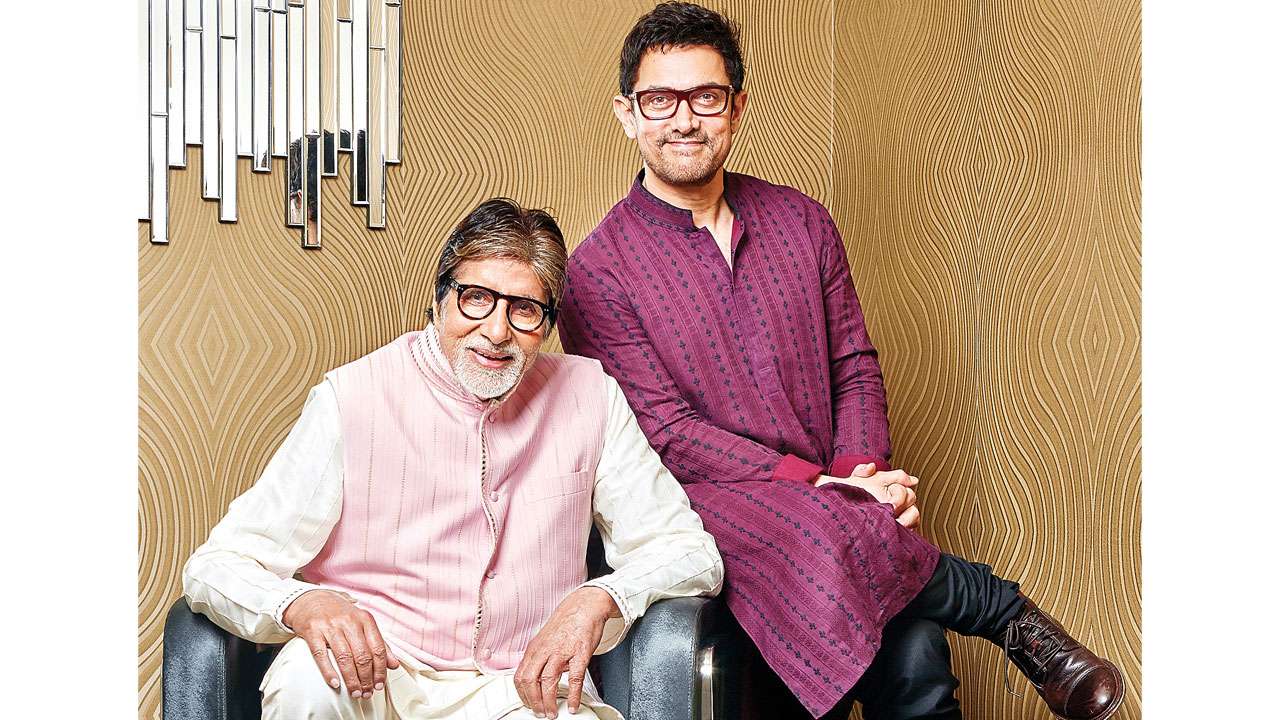
Meena Iyer (DNA; November 7, 2018)
The icon of Indian cinema, Amitabh Bachchan and Bollywood superstar Aamir Khan, who are coming together for the first time ever in Thugs Of Hindostan (TOH), gave DNA After Hrs readers a special surprise by coming together to wish them a Happy Diwali.
This year, the festival of lights is synonymous with the action-adventure TOH. The film, which promises to break opening-day records, releases worldwide tomorrow! After Hrs caught up with these two thugs, who spoke to us exclusively on what they love about this auspicious fest that is celebrated with great fervour globally.
BIG B: MY FATHER WOULD READ A PORTION OF THE RAMAYAN TO US EVERY DIWALI
Diwali has two meanings for me because I am 76-years-old. I will have to describe those moments when I was younger and what is happening now, so there are different outlooks, interpretations and celebrations. When we were younger, almost a month before the actual event, we would go to the storeroom in the house and pick out all the mitti (clay) diyas. We would wash them a night prior and next morning put them out in the sun to dry.
Then, we would make cotton battis that would go inside the diya and then add oil. The evening or night before, we would start placing them on the steps, at the gate and in the lawn. We would keep a diya in every room of the house and then do the same on the day of puja. Nowadays, you have electricity. We never did it with electricity because that was the true form of Diwali.
My father would read a portion of the Ramayan, which is synonymous with the festival. It talks about Ramji’s return from Vanwas and the celebrations. After the puja was over, we would light the diyas and then burst firecrackers. Lots of fresh sweets were made in the house, all the children wore new clothes and guests would come over to wish. I used to be with my friends till late in the night. Next morning, we would pick all the diyas, clean them and put them away for next Diwali.
Now, it’s different. You start off by preparing how to light up the house using electricity, which is not the same thing as a diya. Now, we do some rehearsals to check how is it looking, if everything is in sync, whether all the bulbs light up and ensure that there are no fused bulbs. We discuss how to decorate the trees, what kind of lamps to put up and invite friends over to the house and serve them delicacies.
Also, playing cards is a symbolic gesture as you invite Goddess Laxmi into the house. The prettier your home looks and is lit up, it is said the more the Goddess will be generous with you. Later, we start playing cards. I know that many people in the other parts of the country take it seriously and start playing cards weeks before, but in our house, we do so only on the day of Diwali. It is considered as good shagun.
AAMIR: THIS DIWALI IS EVEN MORE SPECIAL AS IT’S KIRAN’S BIRTHDAY
What I like most about this festival is the gambling (laughs)! I’m a reckless gambler. I love it, but do it only once during this time of the year. I like poker and I’m looking forward to playing it. It’s a great game. What I also enjoy about Deepawali is being with my family. This year, it’s even more special as it’s my wife, Kiran’s, birthday. I hope this Diwali will be special, joyous and safe for everyone.
Amitabh Bachchan to lend his voice to Harivanshrai Bachchan's famed poems again
8:01 AM

After Madhushala, megastar Amitabh Bachchan to lend his voice to Harivansh Rai Bachchan's famed poems again
Sonil Dedhia (MID-DAY; May 11, 2018)

"I am planning to come out with a compilation of my father's poems. I want to sing them exactly the way he would narrate them to us. It's a tedious process, but I have already started recording for it. I will present it in a month's time," said Amitabh Bachchan.
It may be recalled that the megastar had attempted a similar venture in 2012 with his father's famed work, Madhushala. That Bachchan is musically inclined has been evident in his previous works. "After I sang in Mr Natwarlal, a lot of directors started requesting me to sing in their films. I would often jam along with my dear friend Aadesh Shrivastava who is no more. We would casually compose a tune and then, he would record it in my voice. Say Shaava Shaava from Kabhi Khushi Kabhie Gham [2001] was composed in a similar way."
Prateeksha, Janak, Ammu, Jalsa, Mansa: How the Bachchans are an island unto themselves...
8:00 AM

Bringing you interesting asides on the multiple addresses of Indian cinema’s most famous family, who owns five bungalows in Mumbai’s JVPD Scheme
DNA (November 6, 2017)
Hollywood cinema icon Marlon Brando owned an island called Tetiaroa in Tahiti. And our own Indian cinema icon Amitabh Bachchan has made a little island for himself and his family at Mumbai’s Juhu and Vile Parle Development (JVPD) Scheme, a place that is one of the prime real estate areas in the maximum city.
The proximity of four of those five bungalows, three of which — Ammu, Jalsa, and Mansa — are just separated by compound walls, and Janak that is one lane away, definitely makes it seem like the Bachchan family has earmarked an island for themselves. Of course, Prateeksha that is a few furlongs away completes the quintuple count of residences.
Meet Prateeksha
Amitabh Bachchan’s first famous address in Mumbai. The place continues to remain a landmark on Juhu’s busy 10th Road. It was ‘attached’ when the Hindi cinema legend got into a financial mess post the launch of his production company ABCL in the mid-’90s. However, he managed to avert the auction bid when he paid back all the monies he owed with interest to his borrowing bank.
Our source says, “Though he lives in Jalsa currently, Prateeksha has a special place in the Big B’s heart. Even today, he drops in here every morning after his walk. He has a special room here — in memory of his parents, Dr Harivansh Rai Bachchan and Teji Bachchan. It is almost like a place of prayer and one or the other family member comes here to spend a few hours each day.’’
Inconspicuous Ammu
Bang next to Jalsa, Ammu is the most inconspicuous of the Bachchan abodes. Sheltered by trees, the compound wall is low. Since the ground floor is leased out to a global bank, hardly anyone looks at the rest of the edifice. However, it is said that above the bank is where Abhishek, Aishwarya, and Aaradhya spend time.
Jalsa: The current residence
Yes, this is the place outside which huge crowds throng each Sunday. At 5 pm, the living legend steps out to wave and do a namaste to the countless fans who assemble here from across the world.
The place is diagonally opposite the J W Marriott Hotel and it is said that at 5 am, Bachchan often crosses the street to use the hotel’s gymnasium.
Jalsa was originally called Mansa. However, a vaastu expert, apparently, asked the B family to change it to Jalsa.
This is the place Amitabh Bachchan got in the early ’80s; around the time he did Satte Pe Satta (1982) from the producer of the film N C Sippy. The cost of the bungalow was reportedly adjusted against his fees for the film.
Jalsa was home to Ajitabh Bachchan for a while
Jalsa was also residence to Ajitabh Bachchan, his wife Ramola, and their three daughters for a short while. At this time, Amitabh and family were still living in Prateeksha. However, after a while, Ajitabh left because he found the place “unsuitable.’’ In fact, Amitabh is said to have sold off this place for a certain price. But when Jaya, who was very attached to Jalsa, asked her husband to get the place back, AB Sr apparently paid the builder double the price and got it back for his missus.
The brand new Mansa
Exactly behind Jalsa is Mansa. This is the latest acquisition of the Bachchans. The place originally belonged to a film financier. And when Mr B evinced an interest in the plot, the financier was ready to sell it to the legend. The deal was brokered by a yesteryear filmmaker’s son (who also resides in Juhu).
The lawns of Mansa are where the Bachchans host the guests for their Diwali and Holi parties. On other days, this is Aaradhya’s playground.
Janak, where the junta goes to meet the Bachchans
Janak is the official Bachchan office. This place is separated from the Bachchan official residences by JVPD’s Road No. 11. It is said that when the Big B wants to get to work, he just walks across from Jalsa to Janak via Mansa. Yup, that entire stretch provides him complete privacy. Janak is where the Bachchan staff sits. This is also the place where the media interactions with the family happen.
Two of the upper floors at Janak are private spaces earmarked for the Piku actor. He likes listening to music here. He also has his favourite musical instrument, the piano, occupying a place of pride at Janak. If you are lucky, you can hear the strains of the piano being played very proficiently by the legend. Of course, if you compliment him, he will shrug it off, saying, “Oh, you flatter me! I’m just about learning to play.”
Kumar Vishvas apologises to Amitabh Bachchan for reciting lines of Harivanshrai Bachchan's poem
7:23 AM

MUMBAI MIRROR (July 14, 2017)
 When a clip of Aam Aadmi Party leader and performance poet Kumar Vishvas
reciting lines from the late Harivanshrai Bachchan’s poem “Need ka
Nirmaan Phir Phir”, on his show, Tarpan, reached Amitabh online
recently, little did the politician know that the actor would
immediately shoot back with, “This is a copyright infringement…! Legal
will take care of this.”
A day later, smarting from the unexpected response, Vishvas sent a tweet to the Big B, saying, “I received appreciation from all the poets’ families but a notice from you, sir. Deleting the tribute video to Babuji. Sending earned Rs 32 as demanded. Pranam.”
Vishvas also released a statement later, stating that he had received the notice asking for the video to be taken down and for him to account for the revenue generated through it.
Jaya definitely has more knowledge of cinema than I have-Amitabh Bachchan
2:12 PM

The legend. The megastar. The actor. Amitabh Bachchan discusses family, future, films and women empowerment
Meena Iyer (TIMES LIFE; January 8, 2017)
You wrote a letter to your granddaughters Navya Naveli Nanda and Aaradhya Bachchan asking them to lead life on their terms, irrespective of their famous surnames. Did you have any real conversations with your granddaughters after that?
Aaradhya is very young. Yes, the day the letter appeared in the media and on social media platforms, Navya who studies in New York, called me in the middle of the night and said, “Nana, I read your letter. I want to tell you that I am very proud to be your granddaughter. I will exactly follow every word.“ That felt very nice. Today's children have so many other distractions and activities, avenues to go to. But for someone like Navya, who spent most of her study-time overseas and is exposed to so much in the outside world... to be able to react to my letter in this way was wonderful.
Is it true that your daughter Shweta was the first to see Pink?
Yes. And she felt proud of the fact that I had been involved in a film like this. She has a lot of friends and all of them went to the movie together. She said that when people learnt she was watching it with them, many of them walked up to her and congratulated her. She told me she was so proud, she almost felt as if she had acted in the film. It was very gratifying. While on Shweta, I must tell you that all of us in the house go to Shweta to get real reactions for our movies. She is the one who gives us feedback on our songs and movies. And 99.9 per cent of the time she is bang on! We have a private thing amongst ourselves saying that when Shweta endorses a film or a song, we are in safe hands.
How about Jaya? Isn't she quite discerning in her taste?
Jaya is very conservative with her compliments. Unless she really likes something, we do not hear from her. Jaya has studied at the FTII (Film & Television Institute of India.) So, she normally looks at cinema as a complete package script, sound, editing, screenplay, the whole thing. When she says some thing complimentary, it is genuine. I normally watch a film only for the performances. I am not so critical of the other aspects of cinema. If it is a film of mine, I am normally looking at my own performance and finding faults! Jaya definitely has more knowledge of cinema than I have and she usually looks at a movie as a whole.

Did more compliments pour in from women for Pink?
Women felt the tag line, 'No means No', was very powerful and it got accepted universally. It almost be came revolutionary in a sense. Even quarters that generally do not react to films, reacted to this one. The praise and the accolades are more for the acceptance of the concept. That is important. For me, I work for the girl child in the United Nations as the ambassador and I also work for the Government's campaign on Beti Bachao, Beti Padhao. So, the movie was very relevant to what I do. Legally, the film was well researched. Shoojit (Sircar) and his team went through a lot of real life cases, so we got the language correct. When the first trailer came out, people were somewhat taken aback with the strong language we used in court. But when we checked, we were told this is the kind of language used in courts to interrogate women in sexual assault cases.
Would you authorize someone to make a biopic on you?
Who would be interested in making a biopic on me? There is nothing in my life that merits a biopic. I would rather work on something that my father, Dr Harivanshrai Bachchan, has written. Those who are fond of literature say that my father's prose is better than his poetry. And some of the chapters are incredibly amazing.
Perhaps one can make a biopic on your father?
Not a movie. There is far too much to be consumed. To be able to put it into a film would be difficult. But I am working on something. Perhaps we can do a serial on his life. It's just a thought now. Nothing is firmed up.
You seem to have a certain avariciousness for work...
What else do I do sitting at home? I need work. I need a job. A lot of people seem to think that I do not need a job, but I do need one. There is no greed. However, I think if you are satisfied, you are being arrogant. I don't think any creative artiste should ever be satisfied. If he/she does that, then that is the end of life. Every day is a huge learning ground. When I see the younger stars, I am amazed at their work and confidence. I get to learn so much by being in their company. And therefore, I need to keep working. The kind of roles I now get are limited to my age. Having said that I still need to find work. I'm still thankful to the people of the country who go and watch my films. They are keeping me alive in a sense. Not many films are written with such characters. I am grateful to filmmakers who are still doing it and I am happy that there are people who still watch our films. Movies can be about pure entertainment too. However, if something creditable and worthwhile can be said through our movies, it makes me feel good.
What's in the pipeline?
I have Sarkar 3 and Thugs Of Hindostan. Next year, I have another season of Kaun Banega Crorepati. But you see, time is the factor. It is very difficult to explain to someone that they should understand time. A lot of filmmakers who approach me for their movies say, “Sir we will wait for you for two or three years.“ However, time is not on my side. I am 75. The younger generation has more time, so that is something they can talk to them about. However, you cannot talk to me about something three years from now. That is not right. With age, you never know. There can be deficiencies in you, I may not be able to work. There are so many ifs. When I look at my date calendar, I tell filmmakers, “Tell me what we can do in the next few months“. I have my diary sorted out for the next six months. That is okay, God willing, but usse zyada nahin. I always say let us overcome this six-month period and then we will speak. Do not look at me as you would look at a Ranbir Kapoor or Ranveer Singh. They have time on their side.

Amitabh Bachchan's Juhu office Janak under siege as he celebrates his 74th birthday
8:15 AM

Shaheen Parkar (MID-DAY; October 12, 2016)
Birthday boy Amitabh Bachchan stepped out of his home in an off-white and yellow chikan kurta for his big day. Asked if it was new, he exclaimed with child-like glee, “Yes.” From chikan couturiers Abu-Sandeep’s collection? He flashed a smile.
On his 74th birthday yesterday, his Juhu office Janak was a busy place as fans assembled there and the star’s popular chartbusters played in the background. At about 11am, the music stopped. “Aa gaye, aa gaye [He has arrived],” someone declared aloud. Big B made an entry to the tune of Main Hoon Don. The ‘Happy Birthday’ song rent the air. He was accompanied by a posse of security officers as well as cops.
Greeting the crowd in his trademark baritone, Big B quoted a line from his father Harivanshrai Bachchan’s poem, “Nav varsh, harsh nav, jeevan utkarsh nava.” Like every year, Big B celebrated his birthday with the media, fans and EF (he refers to his multitude of fans on social media as Extended Family) thronging his houses, Jalsa and Pratiksha, as well as Janak, all in each other’s vicinity at Juhu Scheme.
Every birthday, Big B makes an early morning visit to Pratiksha where his parents lived. He spends some time there and then heads to Janak to meet the media and fans.
Biscuits, wafers, samosas and tea were served to those who had gathered. There was no cake, though some members of the EF brought in a three-tier pink cake (his last outing was Pink), but Big B left it untouched. Looking around, one also saw pink balloons merrily swaying to the breeze. “I stopped cutting cake many years ago,” he says, and adds, “I do not understand the concept and the rationale behind it. First, as soon as the cake is placed on the table, candles are placed, and then they have to be lit and blown. Then you need a large knife to cut it. The slices are to be fed to each other. And what is this fascination for smearing cake on everyone’s faces? I do not get the point.”
Scores of fans waited patiently to wish him with bouquets and cards, some with EF plastered on their face to display their connect with him in the virtual world, others with placards with messages for their matinee idol. His look-alikes were there too. Among the scores of gifts was a jukebox from Netherlands.
Then he got ready to field questions in an open session. Would he be the President of India? He said Shatru babu (Shatrughan Sinha) keeps joking about it. He talked about his upcoming films Sarkar 3, for which he will begin shooting soon, and Thugs Of Hindostan with Aamir Khan, which rolls in February.
Asked about the current Indo-Pak scene and the ban on Pakistani artistes, Big B was not too keen to get into sensitive territory. He said, “It is not the right time to speak about it. Who says what and when, and the country is incensed. It is time to show solidarity to the jawans who are sacrificing their lives.” But, didn’t he recently tweet, “Don’t mess with the Indian army”? It’s a dialogue from his 1998 film Major Saab, he reasoned.
While the celebrations were underway, granddaughter Aaradhya was fast asleep, so he had not caught up with her. The celebrations continued upstairs in Janak where several of his EF folk requested for selfies and autographs while presenting gifts. Some of his fans relentlessly clicked his pictures as well as the interiors of Janak. Anything connected with the legend has to be captured for posterity and Bachchan wasn’t stopping anyone.
At 74, Big B’s energy is indefatigable. “After all, all this has kept me going all these years,” he said.

SHOCKING: When Sholay was called 'anti-national' by a prominent film critic
2:39 PM

Film historian SMM Ausaja’s coffee-table book, The Bachchans, features candid pictures and unheard-of stories about three generations of the family
Kusumita Das (MID-DAY; September 11, 2016)
The first thing you notice as you step inside film historian SMM Ausaja’s home, is a wall covered from one end to another, with framed pictures of Hindi film posters dating back to the early 70s. Then you spot stacks of lobby card placards, original first prints of some of Amitabh and Jaya Bachchan’s least known works from the same period. This is clearly a collector’s den. “Welcome to my obsession,” Ausaja says, greeting us with a smile. For over 30 years, he has been collecting film memorabilia, a treasure trove he excavated through to put together his upcoming book, The Bachchans, which is slated to release at the end of this year. “It’s not a biography,” the author clarifies right away.
 “It’s a coffee-table book which is a career chronicle, the first of
its kind, that covers the five most famous of the Bachchan family — Dr
Harivansh Rai, Amitabh, Jaya and Abhishek and Aishwarya. It’s a
collection of stories told both in pictures and words that revolve
around their work, filmi and non-filmi. There are first-print
posters, photographs, LP/EP covers, song booklets and several nuggets
that you have never seen or heard of before,” Ausaja says.
The Bachchans never got directly involved in the making of the book, although Ausaja did share the idea with Amitabh. “He is aware and they have no issues, obviously, because I am not peeping into anyone’s bedroom. This is strictly about their work, hardly ground for conspiracy,” Ausaja says. He has known Amitabh since the time he was working on his last book, Bollywood in Posters. “He is a man of very few words. And if he says something, you better listen, even though he poses it as a suggestion,” recalling his meeting with the man in Pratiksha when the actor had asked to see the dummy. Turned out, he was impressed enough to pen the foreword and has told Ausaja that he is looking forward to the new one.
Given Big B’s volume of work, he, quite effortlessly, ends up occupying a large chunk of the book. But the question remains — what can one say about the Bachchans, especially Amitabh, and still manage to break new ground? “I am the only author that didn’t need him to write this book. This book does not chronicle his perspective through an interview. It stems from my own research over decades as a film historian,” Ausaja says as he delicately rolls out a very brittle, but stunning first-print poster of Hrishikesh Mukherjee’s Namak Haraam. As we take in the hand-painted artwork, the film historian rattles off release dates and trivia as he continues to tell us about the book. “It was not Mr Bachchan who told me that his first film, Saat Hindustani, did not even find a release in Mumbai, even though it is counted as his debut. His first film that released here was Anand.” And to get to this fact, he poured through reams of trade magazines that released between 1969-70.
 The book takes off from Harivanshrai Bachchan’s life and talks about his close proximity with Pandit Jawaharlal Nehru and how the latter pushed for the poet to be recognised. Among the many nuggets Ausaja has shared, is one about how Harivanshrai’s debut as a lyricist was not in Amitabh’s Alaap (1977), as is commonly believed. It happened in a film titled Badnam Basti (1971), where he even recorded a song in his own voice. “The song was called Mele Mein Koi Gujariya. I have a picture from that recording that I have included in the book,” Ausaja says, adding, “The only way to understand Amitabh’s life is to understand his father’s.”
For every film included in the book, Ausaja has inserted review excerpts. “I have collected them from the monthly trade magazines of that era. What did the critics say when Sholay or Zanjeer released? None of that is available on the internet. Baburao Patel called Sholay ‘disgraceful and anti-national’!”

Ausaja’s collection of posters and memorabilia may be accidental stumbles, but there is a method to the madness. “There are multiple ways of acquiring memorabilia. An obvious way is to approach producers but most of them don’t have anything. And if they do, they won’t easily part with it. So, then, you barter. Exchange one rare poster for another. In my case, producers have come to me asking for posters of their own films,” he says, adding that he has gifted posters of films like Natwarlal and Yarana to its maker Rakesh Kumar, who didn’t have them. He also approaches distributors, most of whose offices are shut now. “They could have a treasure in their godowns, but most of them have found their way to chor bazaar through raddiwalas. But even there, chances of finding an original first print is negligible.” The cream of his collection is courtesy Feroze Rangoonwalla. “He was the most admired collector of his time; he passed away recently. In the last 12 years, I met him almost every month, and a large chunk of my salary would go to him, but it was totally worth it.”
It has taken Ausaja eight years to put together this book, that’s a commissioned project by Om Books International. “This book is the fruit of my painless research and I want to it to be reference material for the Bachchans for the future generation,” he says.

Every two seconds I am looking at my phones. We are all married to our phones-Amitabh Bachchan
8:59 AM

We catch Amitabh Bachchan in a unique mood. In a long, candid chat, he veers from being misty and nostalgic about his father and the other people who shaped his life, to being upbeat and excited about how he still manages to get challenging roles
 Shubha Shetty Saha (MID-DAY; May 31, 2015)
He walks in exactly at the scheduled time for the interview. Yet again showing that his penchant for punctuality hasn’t taken a beating even after 46 years in this industry, which is full of people who have scant respect for other people’s time.
He is dressed in a kurta pajama with a shawl across his shoulders, reminiscent of his dad — the celebrated poet late Harivanshrai Bachchan. Talking about his father, Bachchan says he truly wishes he had the willpower that his dad did.
He goes on to narrate two amazing anecdotes from his father’s life to reiterate his point. “My father’s dedication to whatever he thought of and making sure that it was achieved purely by his willpower was phenomenal. I must tell you about these incidents. Pandit Nehru once asked my father to translate a biography written on him by Micheael Brecher from English to Hindi. He wanted to publish it by his birthday, (November 14) which was just about three months later.
My father had so much to do in such little time, so he would sit in his study for hours together. He would hang a painting outside the door, so that we know that we should not be disturbing him. But one day we got worried because he hadn’t come out of the study for about 20 hours. When I went in to check on him, I saw that he had kept his left hand in a bowl of water. When I asked him about it, he said, “My left hand is paining. Actually my right hand was paining because I have been writing non-stop, so I willed the pain to go from right to left, and now the left hand is paining so I have kept it in a bowl of water to get some relief’,” he says.
Rock solid
"Another time, when we were staying in New Delhi, he would go for his morning walk around 4 am. He would find some figurines on rocks in the area and he would bring them home and paint them. One day, he came back from his walk and woke me up. He was standing next to a huge boulder just outside the house. He wanted it brought in as he wanted to paint the garud (eagle) on it. The boulder was so huge that I had to get some four or five people to take it inside. I asked my father how he managed to bring it till outside the house. So he told me that he had seen it some time back and so, for three months, every morning he would push it about three inches towards the house, till he managed to get it outside the house. That’s the kind of willpower I am talking about. He was just amazing,” he says with a sigh that seemed mixed with a tinge of regret at having lost him.
Band of friends
Ask him if older also means lesser friends and lesser people you love and admire, he nods. He says, “I always believe that once you are someone’s friend, you are a friend for life. Once you share a part of your life with someone, you cannot disown them. I will always have that respect for a friend, irrespective of whether the other person respects or not. Yes, as you grow older, there are fewer friends around you. My samdhi, Shweta’s father-in-law (Rajan Nanda), once told me something very pertinent when a friend of mine passed away. He told me over the phone, “Now is the time when you don’t make friends, you lose them.” It is very sad, but it is the fact of life. As you grow older, so many people are gone from your life. Khwaja Ahmad Abbas, the gentleman who gave me a break in my career, is gone, people who shaped my career like Manmohan Desai, Prakash Mehra, Shakti Samanta... they are gone. SD Burman, RD Burman, so many people. When you are with them, you are full of vigour and joy and never imagine that there will be a time when they are not going to be around, even if you want to, you won’t be able to see them again.”
Cashing in on that emotional mood he’s in, we ask him whether he is still romantic at heart, he laughs. “I hope so. Yes, filmmaking itself is a romantic thing. Love necessarily doesn’t have to be a male-female equation. I am in love with my granddaughter. I could be in love with my phones. Every two seconds I am looking at them. We are all married to our phones. Romance has different connotations...’ But what about male female romance? Does he have infatuations?
“It is not the age for that now.” Tell him romance is ageless and he agrees, “Yes, I am envious and sad that I am not young enough to play the leading roles with girls like Deepika (Padukone), Kangana (Ranaut), Vidya (Balan), Alia (Bhatt), etc.’

His role as Deepika’s eccentric father in 'Piku' was well appreciated. Congratulate him about it and he chooses to be modest. “I think on moments like these you should give credit to the person who thinks and writes such characters. I would give all credit to Shoojit (Sircar, the director of the film) and Juhi (Chaturvedi, the writer).
Tell him his role role of an eccentric character needed a lot of restraint as there was a danger of it going overboard and he nods in agreement. “That’s a very good observation because most of the times when we do caricatures, we tend to go overboard. What worked for us was that we were all made to be immersed in this world, a typical, conventional Bengali home in CR Park, Delhi. There is no story as such. It is just how people converse. Most of the Bengali community in Delhi stays in CR Park, if you notice that happens everywhere. Every community builds its own area if they are out of their home state. So there was this setting of the house, which was so typical. The whole ambience of the house, the photograph of the maa… we didn’t feel like we were playing those characters, we were those people. I actually wanted more Bengali in the film, but some of the portions, there were some lovely scenes like where there is a banter between Moushumi (Chatterjee) and me had to be sadly edited out. The producers felt that they didn’t want anything to go over the head for Hindi speaking audiences.”
Set up
Shoojit’s film set-up reminds him of a Hrishikesh Mukherjee movie. “I doubt that I have felt anything like this after Hrishida. And that’s wonderful for Shoojit because Hrishida had that capability of walking the middle path, not too left and not too right. I would also like to give credit to the audience for having noticed the undercurrents and also having gotten attached to it.”
He says it’s time we recognise the intelligence of the audience, “We should be kicking ourselves now. We have a wonderful audience which is so ready to patronise different kind of stories. But we are still stuck on thinking that only those typical extravaganzas do well.”
Bachchan says he’s familiar with the Bengali culture that worked in his favour. “I have lived and worked for seven years in Kolkata and since Jaya and my in-laws are Bengalis, you pick up on little things.

This success, which he says came as an absolute surprise to the team, must have been a relief after the debacle and disappointment of his last film, 'Shamitabh'.
“I don’t know what went wrong with 'Shamitabh'. Balki (director of the film) and I did have a chat about it wondering what went wrong. I had loved the concept which was unique and different. But I am happy I did the role, in fact, I am just grateful that I still get to do such challenging roles. It is funny that when you are younger and playing lead roles, you don’t get the opportunity to play such diverse roles. As a leading man, you are just romancing a girl, doing action and that’s about it,” he says with a broad smile. “This is just a wonderful time. Not only do I get the satisfaction of doing things that I have not done before but also being on the same frame with the actor of younger generation. They are all fabulous. I really feel that by far the actors of Indian cinema are the most fascinating talent. Every actor is an evolved actor and when we entered films, we were so lost. I am not evolved even after 46 years and still learning. But these youngsters know bang on from the first film. They find it very odd that I don’t have a manager or a stylist and they say, why do you do things yourself? Who reads the scripts for you? And now I realise we carried all the responsibilities all this while and they have diluted their pressures so easily by delegating work. There is a method in what they do, whereas we just went on with whatever came our way. Look at Kangana, she is incredible in 'Tanu Weds Manu Returns'. I would struggle to do something like that. Look at the other actors around her in the film, everyone is absolutely marvellous.”
Bachchan’s next film, Bejoy Nambiar’s 'Wazir', is produced by Vidhu Vinod Chopra and Rajkumar Hirani. “I don’t have the permission to talk about it, but I can say this much that I am on a wheelchair throughout the film and Farhan Akhtar plays a cop. There are some relationship issues which are common to both parties. Technically Bejoy is very sound. The dramatic thriller will release in October.”
Ask him if he’s proud of his baritone and the way he modulates his voice, and he says with a hint of a blush, “What baritone? A lot of guys have voice like mine.”
Has it ever worked against him? “I like it if my a voice can be put to good use. There have been instances when I tried to go away from the voice, like in 'Agneepath', but it worked against the film. I had to redub the voice, because the audience started attacking the theatre owners thinking something is wrong with their sound system. I try and use my voice for social causes, I am more than happy to do that,” he says just before bidding us adieu in that very sexy voice.
Subscribe to:
Posts (Atom)