Showing posts with label Gulzar. Show all posts
Showing posts with label Gulzar. Show all posts
I would rather see Maachis re-released than have a sequel-Chandrachur Singh
3:48 PM

Tanvi Trivedi (MUMBAI MIRROR; November 7, 2026)
Chandrachur Singh, who made a lasting impression with Gulzar’s Maachis, recently marked 30 years of the film, which released before his debut project Tere Mere Sapne. The actor, who was shooting for both films simultaneously, recalls how he landed the role in the 1996 film. “I went to meet Gulzar saab in his office because he was looking for the lead character. I had not shaved my beard, and it was an unkempt sort of look. But that was the kind of character he was looking for,” says Chandrachur.
“I was recommended for the role by common acquaintances. Gulzar saab subsequently watched my audition tapes for Tere Mere Sapne, after speaking with Jaya ji (Bachchan), and decided to cast me. I have always believed that if things are meant to happen right, they do happen and fall into place at the right time.”
The actor says working with a filmmaker of Gulzar’s stature early in his career was a valuable learning experience. Maachis, shot across Himachal Pradesh, Kota and Mumbai, went on to earn critical acclaim and commercial success.
“We never assumed that it would become such a hit. We knew it would be critically appreciated, but commercially doing so well was something none of us had imagined,” he says, adding, “The film’s success grew through word of mouth in those days.”
Recalling the challenges of filming against the backdrop of political turmoil in Punjab, he says, “At that time, though the film was centred around the political turmoil in Punjab, we could not shoot it in Punjab, nor did we shoot in Kashmir due to security issues. We shot in Manali, Kota and then in Mumbai.”
Asked about a possible sequel to Maachis, Chandrachur says, “I would rather see Maachis re-released. I always believed that the original had said everything it needed and so there was nothing much left to carry it forward.”
Chandrachur is now focussing on both OTT and movies. He says, “There are good films and there is good work. OTT platforms have opened up opportunities for talented performers.”
Gaana Rekha ko hota hai aur gaa main raha hoon-Vishal Bhardwaj
11:03 AM

Niharika Lal (BOMBAY TIMES; October 16, 2026)
For Vishal Bhardwaj, music is as much about the stories behind a song as it is about the act of singing it. At a recent intimate baithak of music and conversations in Delhi, he opened up about a chapter of nostalgia. From recalling his collaborations with Gulzar to discussing the influence of poet Bashir Badr, the filmmaker, composer and lyricist offered insights into the ideas, words and emotions that shape his music. Seated across from him in the front row, Rekha Bhardwaj listened to his songs from the audience. Excerpts:
‘JAB AUDIENCE KO ACCHA LAG RAHA HAI TOH PATA CHALTA HAI’
Vishal Bhardwaj is an alumnus of Hindu College. He shared that back then, the tradition of mehfil was very much alive, where the great artistes of that era would sit together and perform. Over time, the distance between the performer and the listener kept growing, and we forgot that tradition. Talking about the concept of a baithak, he said, “Jab audience ko achha lag raha hai toh pata chalta hai, jab achha nahi lagta hai toh pata chal jata hai, toh ye bahut khoobsurat hai.”
‘PATA NAHI AAKHIRI BAAR MOHABBAT HOTI HAI YA NAHI. PEHLI BAAR TOH ZAROOR HOTI HAI’
Bhardwaj would often stop singing to explain the nuances of the lyrics and the origins of a song. Before singing Pehli Baar Mohabbat from Kaminey (2009), he said, “Gulzar sahab ne separation sunn ke ye line di thi – pehli baar mohabbat ki hai, aakhiri baar mohabbat ki hai. Bahut hi khoobsurat line hai. Waise pata nahi aakhiri baar mohabbat hoti hai ya nahi. Pehli baar toh zaroor hoti hai.”
He recalled that after recording the song Raat Ke Dhai Baje, he felt its soul was demanding something else. He then recorded another version of the song.
‘BASHIR BADR KEHTE THAY KI GHAZAL CONTEMPORARY HOTI CHALI JAATI HAI’
Two poets who have left a deep impression on the country, Bashir Badr and Gulzar, kept coming up in Bhardwaj’s anecdotes. Both are immensely close to him.
“Bashir Badr sahab mere ustad rahe hain aur woh kehte thay ki ghazal jo hoti hai woh contemporary hoti chali jaati hai, aur uska maza bhi tabhi hota hai jab rozmarra ki jo bhasha hai woh usmein use ho. Uska connection tab banta hai. Koshish ye hai ki rozmarra ki baatein ismein ho.”
He then sang songs that had references to live location, Gmail and Google Maps. As always, he left the gathering in awe when he sang, “Pyaar mein itni bhi khamoshi theek nahi, gussa ho toh emoji mein bolo na.”
‘MUJHE TOH LAG RAHA THA MAINE AAP LOGON KO PHANSA KE RAKHA HAI!’
Bhardwaj had composed a song based on a sher by the poet Farhat Ehsas for the audience. He spoke about discovering the poet in Lucknow, and recalled a sher his friend had recited and said, “Hum log ke umr mein pahunchne ke baad bahut doctors ko consult karte hain. Toh woh tha – ‘Ilaaj apna karate fir rahe ho jaane kis-kis se. Mohabbat karke dekho na, mohabbat kyun nahi karte?’”
When he ended the evening on a high note with Chappa Chappa Charkha Chale, requests written on chits began arriving one after another. As the requests kept coming, Bhardwaj said, “Mujhe toh lag raha tha maine aap logon ko phansa ke rakha hai!”
‘Mujhe aisa mauka kabhi kabhi milta hai jab main gaa raha hoon aur Rekha sunein’: Vishal Bhardwaj
Three years ago, Vishal and Rekha performed live together. Back then, they spoke of how sharing the stage had been a dream for years. Since then, the two have performed together a couple of times. However, at Ibtida-Ek Mehfil, the spotlight was on Vishal, the singer, as Rekha sat in the audience listening to him. The stories he narrated drew from his many worlds, while an attentive audience listened, hanging on to his every word.
He began the evening with the ghazal Jaana tumko jaana ho toh mat aana from Khufiya (2023) and said, “Rekha sang this ghazal. I’m very happy that Rekha is late. She is going to be sitting in the audience today. Mujhe bhi aisa mauka kabhi kabhi milta hai jab main gaa raha hoon aur woh sunein. Usually, ulta hi hota hai. Obviously, hona bhi chahiye. Rekha bahut hi zyada achhi singer hai. Main uske aas-paas bhi nahi hoon. Par ab Rekha nahi hai toh aur bhi mauka banta hai sunane ka.”
Sharing a joke, he said, “Gaana Rekha ko hota hai aur gaa main raha hoon.” Later in the evening, when he invited Rekha on stage, she told the audience that Vishal had been doing more riyaaz than her these days. Vishal added, “Rekha meri guru hai.”
‘This evening reminds me of Gulzar sahab’s Dil Dhoondta Hai’
Bhardwaj said the evening reminded him of the old times Gulzar wrote about in the song Dil Dhoondta Hai. He said,
“Ghalib ka unhone ek sher leke usko aisa khola ki ‘Dil Dhoondta Hai phir wohi fursat ke raat din’. Ki woh jo waqt hai na, ki kuch nahi hai karne ke liye, aap apni jagah ke tasavvur mein bas baithe hue hain. Woh dil dhoondta hai. Zindagi mein jab hamare ambitions, humari greed humein itna uljha dete hain, hum wohi lamhein yaad karne ke liye gaane sunte hain. Wohi lamhe yaad karne ke liye hum aisi mehfilon mein saath mein milte hain.”
-------------------------------------------
“Ye experience mere liye itna zyada maayne rakhta hai ki main iss mental state mein kabhi-kabhi jaata hoon – jaise ki apne drawing room mein baithe hain.”
Korean actors in Lust Stories 3 are actually from Korea. One of them is in Bombay right now-Vikramaditya Motwane
4:49 PM

Mayank Shekhar (MID-DAY; September 23, 2026)
As with Shakun Batra, director Kiran Rao made her first short film, in her early 20s, at film school (Jamia, in Delhi) that, she recalls, was about a 31-year-old’s birthday gone south, because of a husband, who doesn’t care. Her short film debut in Netflix’s Lust Stories 3 — as with most shorts — would be hard to describe, without a spoiler, though.
Suffice it to state that it’s a play on Shakespeare’s Comedy of Errors, but rather serious. Shakun’s, on the other hand, with Ali Fazal, Radhikka Madan, felt to me as a running narrative on the addictive nature of ‘break-up sex’. Shakun disagrees, but adds, that could make for a fine elevator pitch!
Three of the four directors on the threequel of the Emmy-nominated Netflix franchise, competently produced by Ashi Dua, are men — while the anthology, looking at relationships through the prism of sex alone, for the most part, seems entirely from the women’s PoV.
Take Vikramaditya Motwane’s opening comedy (starring Radhika Apte, Konkona Sen Sharma) on couple-swap. The best bit that actor Vijay Varma gets in it is that his character experiences trauma from whisky + ghazal, because they remind him of his alcoholic dad. Hilarious!
The filmmakers, on the other roster, direct features, otherwise. Vishal Bhardwaj, who’s filmed several shorts in the past, says he finds the medium hugely liberating: “The commitment involved isn’t as long. And you have the opportunity to say something crisply, with design and craft.”
Which is precisely what Vishal does, transporting his plot to 1980s Hyderabad — about an anonymous, Urdu writer of smut (Aditi Rao Hydari), whose fantasies, chiefly imagining her husband (Siddharth) soar over her everyday married life.
What did you think of the said short films? My favourite was Vishal’s, while enough people have told me they loved Vikramaditya’s or Kiran’s more. An online survey on my social media handle rates Shakun’s, by far, the best. The comparisons are immaterial. What matters is, if the anthology works as a whole. It sure does.
Lust legacy
In ‘Lust Stories’ (2018), filmmakers Anurag Kashyap, Zoya Akhtar, Dibakar Banerjee, and Karan Johar came together to tell four distinct stories exploring desire and relationships. In ‘Lust Stories 2’ (2023), R Balki, Konkona Sen Sharma, Sujoy Ghosh, and Amit Ravindernath Sharma gave their takes on desire
Quick bytes with the directors...
Personally, how do you make a distinction between love and lust?
Kiran Rao: When you see someone, you’re attracted to, is that lust? The curiosity about a person you want to be with, or know more about, does that start from love, or something chemical? Lust can be the starting point. Could it be the ending point too?
Absolutely. Also, what makes a person sensually attractive, often, is the conversation, their humour. You [could] find a person sexy, because of their smile; not necessarily for how they look with their shirt off. It’s hard to distinguish. But I do think love comes after knowing a person, including their flaws.
Everyone must watch (Belgian psychotherapist) Esther Perel, when she talks about how to keep the spark in a marriage alive. One of the things missing, once you’ve been married for long, is you know the person too well.
Mystery’s gone. There’s no chase. Why is it that people are interested in extramarital affairs? Because there’s something unknown. There’s potential of knowing someone. Therefore, to keep lust alive in a marriage is always work.
Your film gets funnier, once you introduce Korean drama into the story, with the imaginary characters Jin and Min — did you dive deep into the popular TV genre to understand it better?
Vikramaditya Motwane: I didn’t do a deep-dive. My research was, I asked my ADs (assistant directors), do you follow K-dramas? Yes. So as long as they are K-drama fans, I’m gonna trust them to surprise me, and let me be.
Netflix did get me in touch with people in Korea. We had a couple of conversations, where I said this is what we are trying to do, and if it’s kosher. They kinda told me, where it would land in the Korean landscape, and what my title [sequence] should be. The actors are [actually] from Korea. One of them is in Bombay right now. The other is a professional actor living in Delhi!
Of all the lust stories, why are you looking at marriage, when you’ve never been married yourself, or is that the reason?
Shakun Batra: I was [actually] going through a relationship, when we weren’t able to communicate, and sex was filling up the gap. I started reading about how bodies tend to communicate. They’re very primitive. The body needs closure too.
Without giving away spoilers, these two people [in the film, Ali, Radhikka] haven’t addressed some of the grief part of their marriage. The sex then is still trying to keep them together, right? It happens with most relationships. Your heart and mind may say this relationship’s over. But bodies still, sometimes, tend to continue. And why’s that? For me, that is very exciting.
[Let alone Lust Stories] you’ve done Zubaan Pe Laga… Namak Ishq Ka (from Omkara) — the world’s lustiest song, ever; was that the intention?
Vishal Bhardwaj: Gulzar Saab is a master. Even Beedi Jalai Le, if you read minutely, is about adultery. When he says, Itni Sardi Hai Kisi Ka Lihaaf Lele, Ja Padosi Ke Chulhe Se Aag Lele — he means the neighbour’s wife. That was the theme for Omkara, so lusty; and that’s how involved he gets in the script. Namak Ishq Ka was originally written as the antara of Beedi Jalai Le.
I drifted from that metre, while composing the tune. But I usually have 50-60 chhilke (shells), or rejected lines of Gulzar Saab, lying around, which I saw in my notebook, when making the new song. I picked up this line, where he writes, Zubaan Pe Lage Namak Ishq Ka Toh Duniya Savaadi Lage… which became Balam Se Maanga Maanga Re, Namak Ishq Ka… and then the final version.
Then bus conductors listened to our poems. City of Mumbai has changed, but so have I-Gulzar
3:09 PM

At 91, Gulzar has outlived at least two versions of the city, the one that destiny “deposited” him into in 1950, and the one he continues to observe and absorb. ‘Aamchi Mumbai’, his new collection of 36 poems and 25 stories, is not an attempt to explain Mumbai in 2026 but to preserve the city that lives inside him, populated by migrants and mill workers, eccentrics and survivors. Speaking to Mohua Das, he reflects on why poetry is his way of making sense of the world
Mohua Das (THE TIMES OF INDIA; June 21, 2026)
You have lived through mills becoming malls and Bombay becoming Mumbai. What do you miss most?
I remember the Bombay of mills, with smoke constantly rising from the chimneys. It was an industrial city, known for textiles across the country. I remember buses where no passenger was allowed to stand. It was a city of progressive labour unions, labour laws and workers’ movements. I have seen workers’ rallies and remember (Shripad) Dange Sahab, the great union leader, carrying the banner and leading those marches. Mazdoor gareeb zaroor the, par us gareebi mein bhi ek izzat thi. Usme sharmindagi nahin thi. (The workers may have been poor, but there was dignity in that poverty. There was no shame in it.) We used to attend Progressive Writers’ Association meetings at Charni Road with people like Sardar Jafri, Rajindra Singh Bedi, Krishan Chander and Sahir Sahab. We were younger writers, so after those meetings ended, we would continue our discussions on the upper deck of a tram all the way to Dadar. Conductors and passengers would listen to poems and stories and even participate. All that is not there now.
And yet, in poems such as ‘These Were All Villages, Once!’, ‘Sealink’, ‘Haji Ali’ and ‘Skyline’, there is nostalgia but not necessarily resistance to change…
What Mumbai has retained is its progressive outlook. Earlier, if somebody wanted to dream bigger or look beyond the country, the route somehow passed through Bombay. Even today, Mumbai looks outward and pushes people from the national towards the international. The skyline has changed completely. I remember how Mira-Bhayandar, Borivali and Bhandup, once jungles, have become mini Mumbais. There are tall buildings where once there were palm trees and open views. But some things have become more beautiful. Haji Ali earlier felt trapped within the city. Today, when you pass it from the flyover, especially during high tide, it looks like a gem to me. The city has grown, but some of that change is beautiful.
You view the city from street level, sometimes even below street level… the beggar at a traffic signal, life on the footpath, chawls, scavengers. How have you kept that line of sight open?
I would say not only eyes, keep your antennas open, and the city will nourish you and keep you informed. If I spend the whole day at home and then go out in the evening to look for life, then I am finished as a writer. Life is not displayed in a showroom. It is touching you every moment. That is true not only for writers but for painters, musicians, actors and performers.
We find very little of the glitzy or corporate side of Mumbai in the collection. Was that a deliberate choice?
I think it is one’s temperament… what you notice and what attracts you. There is a story in the book about a boy who draws his own chalk outline every night like the police do around dead bodies and lies down inside it only to roll out of it every morning and say, ‘See, I survived again today’. His sense of humour fascinates me. You must see the zinda (living) part of the city. People ask me why the footpath appears so often in my poems and stories. My association with it is direct, not imagined. But it is neither something to boast about nor turn into a tragedy. The struggle is not that you slept on a footpath. The struggle is how you lived through it. Suppose a man has lost a leg. Do you think he never smiles or is never happy? He may limp and clean taxis or rickshaws for a living, but he still laughs and lives. Don’t count him out.
Poetry has been at the heart of your writings, whether in ghazals, nazms, film lyrics, experiments with tanka or presenting poets across borders. What do you value most in poetic expression?
I look for a live moment in a poem. I’m not giving a lesson. I am working on a show about the environment. But environment is not about saying, look how dirty things have become. How do you make people aware of trees? Of leaves? My next book, called ‘Spinning the Moments’, has a poem called ‘Ek akela patta’ where a tree is half submerged in flood water, but that one lone leaf still attached to the tree whispers to it, ‘Darna mat, main hoon na’. My heart goes out to that moment. That’s what makes a poem.
Most of your books, including ‘Aamchi Mumbai’ are bilingual, but so much of your writing is in the wordplay and nuances. After years of translating and being translated, what is essential even when carried into another language?
A young man from Kerala once wrote to me asking if he could publish a Malayalam version of my book ‘Suspected Poems’ that his father had translated while he was in jail during a communist movement. I liked the gesture and told him to go ahead. Later, he came to meet me with the book. That act of sharing is wonderful.
You describe Mumbai as a lifelong partner who has ‘admonished’, ‘beaten’ and ‘scared’ you, but ‘never dropped you from its lap’. What do you understand about the city — and about yourself — today that you didn’t when you first arrived at Bombay Central as a teenager?
Bombay is like the eldest brother in a family who takes care of the younger ones. When I write, ‘Yeh shehar woh nahin jahan main 60 saal pehle aaya tha’ (This is not the city where I arrived 60 years ago), the city replies to me: ‘Yeh sab theek hai, par tum bhi woh nahin jo 60 saal pehle aaye the.’ (All that may be true, but you are not the same person who arrived here 60 years ago either.) It is because of us that the city changes, and it is because of the city that we change. The migrating population that comes every day and goes back leaves its impressions. The city learns from them and makes space for them.
Meghna Gulzar wrote a nasty message to me after Raazi shoot-Harinder Sikka
4:27 PM

Natasha Coutinho (HINDUSTAN TIMES; April 1, 2026)
Author Harinder Singh Sikka, whose espionage book Calling Sehmat was adapted into the 2018 film Raazi, insisted in a post on X on Saturday that choosing Meghna Gulzar to direct the film was his “gravest misjudgement”.
Speaking to us, Sikka says he has been raising the issue for a while and is bringing it up again in light of the buzz around the spy franchise Dhurandhar. “I wasn’t willing to sell the rights of the book but agreed because of a promise to (poet-filmmaker and Meghna’s father) Gulzar,” he shares, adding, “My problem is that she removed the tricolour from the movie, while the Pakistani flag was flaunted. Even the Pakistani army was shown in a soft light. While in the book the protagonist was welcomed with (the Indian national anthem) Jana Gana Mana when she returned to India, all that was missing in the film. The climax was made to show that Sehmat made a mistake by fighting for India, which harmed the cause of Kashmiris.”
Recalling his first meeting with Meghna, he says, “I told her that I was appointing her on her father’s request, even though she didn’t have a good reputation in the industry. After the film’s completion, she wrote a nasty message saying, ‘I don’t want to speak to you anymore’. The director’s cut was shown to the armed forces but not to me.” He adds that he appreciates films like Dhurandhar for showing Pakistan in its “true light”.
We reached out to both Gulzar and Meghna for a comment, but received no response till the time of going to press.
Harinder says that the changes done from the book for Raazi “undid” his hard work. “Meghna changed the story and then got her father to write the song Ae Watan Mere Watan. There is not a word about Bharat in it. It was cleverly worded and presented. It took me eight years to write the book, and with one film, the hard work was undone,” he says, adding that while the film was a commercial success, he knew that it won’t win any National Film Award: “It isn’t worthy of that. The film did India dirty.”
The author adds that he also didn’t agree to the film’s title change from Sehmat to Raazi. “Meghna didn’t want to acknowledge Sehmat for who she was. I was taken for a ride,” he says, claiming that Gulzar also got him excluded from speaking at an event: “I have a letter by the Jaipur Literature Festival team, that says Mr Gulzar pushed them to not let me speak at their event. When I questioned him, he said it was a typo.”
Sikka expresses disappointment as he feels that films like Raazi are made to show that “the tricolour need not be celebrated”. “Even though that is what our martyrs come home wrapped in,” he ends.
I kept wondering at night whether I should impersonate Gulzar and how it would be received-Sunil Grover
9:34 AM

Neha Maheshwri (BOMBAY TIMES; March 11, 2026)
If anyone can slip into the skin of Aamir Khan, Shah Rukh Khan, Salman Khan, or even Gulzar saab with uncanny ease, it is Sunil Grover. His razor-sharp impersonations routinely set the internet buzzing, and his take on Aamir Khan drew praise from the actor himself. In this conversation, Sunil reflects on craft, pressure, admiration and the slow burn of stardom.
‘It’s a gift I try to preserve’
Asked about his ability to capture voices and mannerisms, Sunil admits he does not fully understand how it happens. He says, “It just happens. Hum toh karte rehte hain aur kayi baar cheezein click kar jaati hain. It’s instinctive. I see it as a gift, and I try to preserve and nurture it. Even I surprise myself sometimes and think, ‘Did I really do that?’ Sometimes it doesn’t land, but that’s part of the journey. Jab nahi hota, tab samajh lena chahiye ki abhi taiyaari chal rahi hai.”
Despite bringing so many characters to life, he acknowledges that the nervousness never disappears. He says, “It’s not just butterflies in the stomach; sometimes it feels like huge birds are flying inside! Pressure should only be to the extent that it helps you give your best. If you take too much pressure, you won’t perform well. Our job is to enjoy what we do. The only real pressure is when there is no work.”
‘Presenting Gulzar saab in a comic light had to be done carefully’
Sunil remembers hesitating before performing one of his most talked-about acts. He says, “There was an impersonation of Gulzar saab. I kept wondering at night whether I should attempt it and how it would be received. He is such a respected and celebrated poet and writer. Presenting him in a comic light had to be done carefully, especially since we were blending humour with reverence.”
‘Stardom doesn’t make any difference to me’
His recent impersonation of Aamir became a talking point when the actor himself called it fantastic and said he laughed the loudest while watching it. Sunil describes that appreciation as deeply affirming. He shares, “When appreciation comes from someone like Aamir Khan, whom I admire, it feels deeply rewarding. I respect his passion for his craft and the love he has for his work.”
For Sunil, however, it is never about fame. He says, “Stardom bohot achhi cheez hai aur popularity mil jaati hai, par main unki skills ka fan hoon. Mujhe artiste ki art intimidate karti hai, their approach to art, their talent and what they do with it. That amazes me more than a person’s popularity. Stardom doesn’t make any difference to me.”
‘I started mimicking everyone around me in Class Six’
His journey began early. Sunil recalls, “I was in class six when I first impersonated veteran actor Rajendra Nath. He remains my favourite. Watching him brought me immense joy. Of course, I was copying teachers and relatives. That’s how it all began.”
Did that lay the foundation for his comedy? He reflects, “Kayi baar aap woh karne lagte ho jisme log aapko pasand karte hain. I didn’t know people would enjoy my impersonations. There was a phase of Gutthi and Mashoor Gulati. Abhi impersonation ka phase chal raha hai, toh dekhte hain kab tak uska maza le sakte hain. Kabhi kabhi darr bhi hota hai ki audience ko achha lagega ki nahi.”
‘For me, impersonation is a tribute’
In an era where celebrities are protective of their personality rights, Sunil takes a light-hearted view. “Jis kaam ko main kar raha hoon, main chahta hoon koi rokk na lagaye,” he jokes, adding, “A colleague once suggested that I secure my personality rights. I told him, ‘Main khud doosron ki copy kar raha hoon, tu mujhe kya bol raha hai personality rights ka. Main kisi ko kaise rokunga?’”
For him, impersonation is rooted in admiration. “Unless I genuinely like someone, I cannot impersonate them. There has to be something distinct about them that fascinates me. I must enjoy the process of becoming them. I don’t see it as mere mimicry. It’s a celebration of people,” he emphasizes.
‘Sometimes I wonder whether I deserve this love’
The internet often calls him ‘exceptional’, compares him to a chameleon and describes him as someone who redefined the word behroopiya. Ask him about his stardom and he laughs, “Yeh itna dheere dheere hua hai ki mujhe pata hi nahi chala. When it comes to popularity and its ups and downs, I relate to Sahir Ludhianvi’s line, ‘Main pal do pal ka shaayar hoon’. It sums it up. Although it reflects reality, woh reality sunn kar aap kaam nahi kar sakte.”
He adds, “I feel fortunate and grateful for all this love. Sometimes I wonder whether I deserve it. The joy lies in seeing something you once enjoyed privately beginning to resonate with others. When people connect with it, that makes me truly happy. I’m simply grateful and hope to continue doing what I love.”
I hope Vishal Bhardwaj continues making films for children like The Blue Umbrella-Gulzar
10:22 AM

The lyricist-poet talks about why his connection with young audiences endures and how their world still moves him to create with heartfelt passion
Natasha Coutinho (HINDUSTAN TIMES; January 12, 2026)
Veteran lyricist-poet Gulzar, who at 91 remains discerning about the projects he chooses, is set to return to writing lyrics for a children’s film titled Masab Tank. Speaking at his Bandra bungalow, Gulzar reflects on why writing for children continues to matter deeply to him. “It’s not just a desire or an ambition, it is an obligation. Unfortunately, it is treated in a very left-handed way by writers.”
Explaining what drew him to Masab Tank, Gulzar shares, “Masab Tank is an area in Hyderabad where children’s playgrounds have been taken away and replaced by buildings. This project really touched my heart,” he says.
Having penned some of the most memorable children’s songs in Indian cinema — from Lakdi Ki Kaathi (Masoom, 1983) to Jungle Jungle Pata Chala Hai from the iconic 1990s television series The Jungle Book — Gulzar says his engagement with children’s writing is far from over. “Writing for children will continue till I grow up enough to be a child again,” he smiles.
He hopes his protégé, filmmaker-composer Vishal Bhardwaj, will carry the baton forward. “I hope Vishal continues making films for children like The Blue Umbrella (2007). He has that rare sensitivity required to create songs that truly connect with children,” Gulzar says.
The concern for children, Gulzar adds, runs through his family as well. His son-in-law, businessman Govind Sandhu has written a book inspired by the plight of children affected by war in Gaza and Ukraine, while his daughter, filmmaker Meghna Gulzar, has authored a book focusing on differently-abled children.
Gulzar also speaks passionately about his long association with Arushi, an institute for specially-abled children. “I came across the institute while making my film Koshish (1972). Every year, these children come to the city to participate in a marathon, and I have been walking alongside them for almost two decades,” he says.
As for future collaborations, when asked whether audiences will see him working with Meghna on her upcoming film Daayra, starring Kareena Kapoor Khan and Prithviraj Sukumaran, Gulzar reveals that it may have to wait. “She said that her script doesn’t allow for any songs. So that collaboration will have to wait,” he ends.
The warmth Gulzar saab gave me stayed in my heart-Divya Dutta
10:12 AM

Onkar Kulkarni (MUMBAI MIRROR; December 12, 2025)
Divya Dutta recently shared a stage with Gulzar at an event—an experience that reminded her just how fortunate she feels to have known him personally for so many years.
Reflecting on their bond, she says, “I have been very fortunate to have known Gulzar saab personally. I remember telling people who knew him that I just wanted to meet him once. But I’m glad the opportunity came knocking at my door when I was asked to have a conversation with him in Indore at an event. When we met, he said, main umeed karta hoon ki tum mere baare mein thoda jaanti ho. I told him I have seen all his films, listened to all his songs, read his books and absolutely adore him. Something clicked between us, and the warmth and affection he gave me stayed in my heart.”
Sharing one of her favourite memories, she adds, “I remember once I was climbing up an escalator and he was ahead of me. I was about to lose my balance and he held my hand saying, ‘Aaja beti, aaja.’ That moment cemented my relationship with Gulzar saab. Since then, I have been fortunate to speak with him on many platforms, to meet him personally at his home, to talk to him and really get to know him. His sense of humour is amazing, especially the way he jokes about things with such ease.”
You keep hearing shlokas and then one day you realise the meaning behind them-Gulzar
9:46 AM

Harshada Rege (BOMBAY TIMES; September 24, 2025)
At an event held recently to celebrate poet, lyricist, author, screenwriter and director Gulzar’s work in the literary world, including the Jnanpith Award, poet, lyricist and screenwriter Prasoon Joshi said that it is cinema’s good fortune to have Gulzar as part of its world. Prasoon, the moderator of this evening, also pointed out, “Filmonse judi baatein itni zyaada ho jaati hai ki hum yeh bhul jaate hai ki Gulzar saab ke dimensions kya-kya hai.”
During the conversation, Gulzar reflected on the skill of translating literary works, choosing to leave space for interpretation in his creations and welcoming change in both his life and creative space. Excerpts:
Gulzar on how Rabindranath Tagore's works influenced him
Gulzar, who has translated Rabindranath Tagore's works into Hindi, spoke briefly about how he was influenced by his writing. He shared, “Main school mein padhta tha, woh partition ka time tha aur tab bahut se libraries hoti thi. Aap chavanni deke hafte mein jitni bhi chaahein kitabein padh sakte the. Uss waqt main jasoosi wali kitbabein leke aata tha, aur raat mein padh leta tha. The shopkeeper got fed up and said, ‘How many books will you take for this amount?’ He pulled out a book and handed me what was the Urdu translation of Tagore’s work. See, you can be influenced even without understanding something. Shayari ka feel pehle aata hai aur uske baad usse samjhne ki koshish hoti hai. I think all education begins in a similar manner. You keep hearing shlokas and then one day you realise the meaning behind them.”
‘Mumbai mein chaar-paanch zabaanein har shaks ke kaan se takraati hai’
Upon being asked how he navigates a translation when he is unable to find a word that matches the original, Gulzar said, “I use the original word, phir main usse apni zubaan mein samjhata hoon. We have so many and such beautiful languages that you can’t avoid being touched by them. Aur Mumbai jaise shehar mein din mein chaar-paanch zabaanein har shaks ke kaan se takraati hai.”
‘Jo mehsoos karta hoon waise hi likta hoon’
Besides writing poems and lyrics, Gulzar has also penned screenplays and dialogues. Talking about the various forms and how he compartmentalizes them, he shared, “Whatever I have felt spontaneously, I try to say it in that form, jo mehsoos karta hoon waise hi likta hoon. For example, someone looks at a sunset and says it looks like a painting, and someone else looks at a painting of a sunset and says it looks like a real sunset. Mujhe yeh mehsoos hua tha ke mein roz jab shafaq ko dekhta hoon, toh jee chahta hai main isko haaton pe malke aaon, aur tere rukhsaaron ke upar mal doon. So, for me, it is nazm and it will stay that way. Aur maine isme kartab dikhani ki koshish nahi ki, ki I’ll also write a story or a screenplay, kyunki main literature ke saath kabbadi nahi khelta.”
Gulzar saab deepens the mystery of life for us: Prasoon Joshi
Prasoon also pointed out that Gulzar — the only creator to be honoured with both the Jnanpith Award and Dadasaheb Phalke Award — finds poetry in life’s smallest details. “There’s no hierarchy for him, ki yeh bahut ahem cheez hai, ispe kavita honi chahiye aur yeh chhoti si cheez hai,” Prasoon said. Talking about often leaving his works open-ended, Gulzar said, “You cannot give a conclusion of any feeling for life. Because what you have felt, someone might feel it differently, and their interpretation may differ.”
Prasoon added, “We see Gulzar saab not trying to solve life for us, but deepening the mystery of life, and sometimes he leaves you to navigate.”
‘Accept the growth of your language’
Many people have a grouse about how the purity of languages is being adulterated. When asked if that worries him, Gulzar responded, “Chinta nahi lagti, mein samjhne ki koshish kar raha hoon. Ya toh aap apni zameen choti kar le, and say that I will only talk this way. Ya aap apni zameen thodi phaila le kyuki doosre logon ke paas ek doosri zameen hai jiske saath aap talooq rakhna chaahte hain. There’s no compulsion to be bound to a language. You have to be aware of the change that your language is going through. When I wrote Naam Gum Jaayegaa (Kinara), people said it was wrong and that it should be naam gum ho jaayegaa. But I told them that when talaash karne ko talaasha bana diya, toh yeh kyun nahi? It’s the growth of your own language, accept it.”
I was pushed into directing Fiza after plans with Ram Gopal Varma fell through-Khalid Mohamed
9:31 AM
S Farah Rizvi (HINDUSTAN TIMES; September 8, 2025)
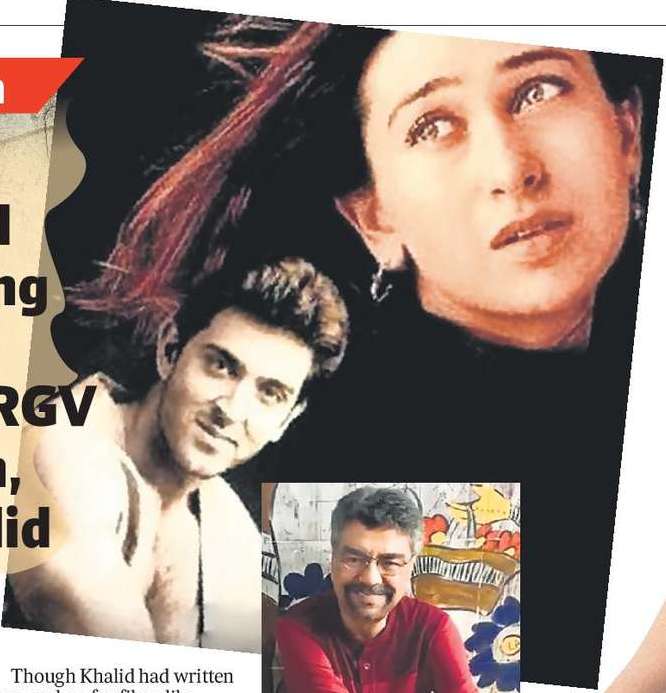
Fiza, released in 2000, celebrates its 25th anniversary today. On this milestone, the film’s writer-director, Khalid Mohamed, shares, “These 25 years seem like yesterday. Looking back, there’s a sense of self-fulfilment and pride.” He calls actors Karisma Kapoor a “dream to work with” and Hrithik Roshan the “most immersive” actor.
Khalid says he wasn’t meant to helm the film originally but was “pushed into directing” after filmmaker Ram Gopal Varma, the first choice, didn’t work out. It was cinematographer Santosh Sivan who stepped in with a suggestion: “Why don’t you direct it yourself?” Later, Karisma also joined Santosh in encouraging Khalid.
Though Khalid had written screenplays for films like Mammo (1994), Sardari Begum (1996), and Zubeidaa (2001), directing had its own challenges: “Of course, there were some tough days, like when we didn’t have enough resources to show a large room.”
Funding was also major concern until a new producer came on board. “The film had been started with loans derived from friends by co-producer Pradeep Guha and myself,” Khalid explains.
Sharing how the music became a huge asset to the film, he muses, “I lucked out.” Anu Malik “was in his element”, and A R Rahman composed Piya Haji Ali for free. Gulzar’s lyrics for Aaja Mahiya also “worked wonders for the song,” Khalid adds.
Shabana Raza Bajpayee: My goal was to get more scenes
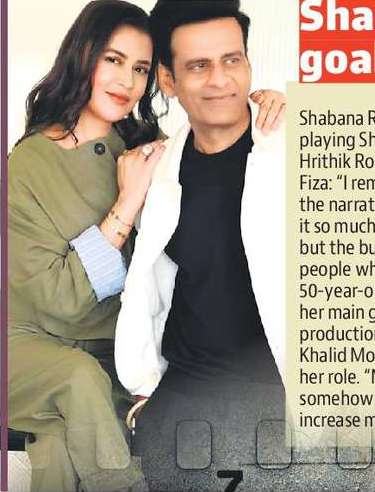
Shabana Raza Bajpayee recalls playing Shehnaz Sulaiman, Hrithik Roshan’s love interest in Fiza: “I remember when I got the narration of the story. I liked it so much, not just its canvas but the bunch of talented people who were involved .”
The 50-year-old actor reveals that her main goal during production was to get director Khalid Mohamed to broaden her role. “My only aim was to somehow persuade Khalid to increase my scenes, as I loved the story so much and, like any other aspiring actor, I wanted to be there in more frames,” Shabana explains, adding, “No one could deter him even a bit from the original plot.”
She also reflects on working with her husband, actor Manoj Bajpayee, who played Murad Khan. “Manoj had a small but memorable role,” she says, adding, “Every character was an anchor to the story in their own way; that’s what makes the film more special.”
Restored Do Bigha Zamin to premiere at Venice
8:59 AM

The restored version of Bimal Roy’s film will have its world premiere at the Venice Film Festival in the Venice Classics section. Meanwhile, Bandini, Devdas and Madhumati are also being restored
Niharika Lal (BOMBAY TIMES; July 13, 2025)
Do Bigha Zamin (1953) marked a turning point in Indian cinema. While most films of that era were shot within the confines of a studio, director Bimal Roy broke the mould and took the camera to the streets, paving the way for realism in Indian filmmaking. Now the film, restored by the Film Heritage Foundation (FHF), the Criterion Collection and Janus Films, will be screened at the Venice Film Festival’s Classics section.
Gulzar, who worked with Roy, spoke to us about the film’s legacy. “It’s amazing that Do Bigha Zamin is restored and will be shown in Venice. The most important element is that all of his films were based on literature. Not many people know that Do Bigha Zamin is based on a poem by Rabindranath Tagore, with the same title.”
How was the film restored
Do Bigha Zamin was restored in 4K by the Criterion Collection and Janus Films, in collaboration with Film Heritage Foundation, at L’Immagine Ritrovata and Resillion, and in association with the Bimal Roy family.
The restoration process took over three years. It began in 2022, when the Criterion Collection/Janus Films and Film Heritage Foundation initiated the project. The FHF accessed the original camera negative and sound negative, which had been deposited by the Bimal Roy family at the NFDC–National Film Archive of India (NFAI) for preservation.
However, the sound negative presented several issues, including poor audio quality, interrupted dialogues, and missing sections. The original camera negative was also incomplete. A combined dupe negative - on Dupont/Kodak stock from 1954–55 was found at the British Film Institute (BFI) which was also used for the restoration
The restoration drew from the best surviving elements the 35 mm picture and sound negatives preserved at NFAI and the 35 mm combined dupe negative from the BFI.
Bimal da was the coolest director I have ever seen: Gulzar
I started working with Bimal da, who we used to call Dada, from the film “Kabuliwala” when I was his chief assistant. I have very fond memories of that time. People would say that Bimal-da was like a married print. In those days, the picture and sound negatives were separate and when they were brought together optically to make the release print, it would be called a married print.
Bimal da would shoot two shifts in a day – 7 am to 2 pm and 2 pm to 10 pm and would then sit in the editing room working till late night at Mohan Studios. People would say that he is married to films.
Bimal da was the coolest director I have ever seen. I learnt not only filmmaking from him, but the art of patience and stamina.
I am sharing a poetic portrait that I wrote on Bimal-da.
"The softly flowing river face shrouded in the evening mists
Eyes burning in the mistiness of a tawny visage
The spiral of smoke from the endlessly burning cigarette
The faraway voice heavy with sleep.
Shadowed below unknown thoughts that flew above
A face that seemed etched out of molten wax
The sound of every new dream transforms him
Making it seem he would neither sleep, nor wake, nor speak
A silent flowing river shrouded in evening mists."
(From the book “Caged . . .Memories Have Names”)
'Do Bigha Zamin changed the face of Indian cinema: Shivendra Singh Dungarpur, director of Film Heritage Foundation
Do Bigha Zamin changed the face of Indian cinema that brought filmmakers out of the studio to begin shooting on the streets. I am so happy that we were able to collaborate with The Criterion Collection/Janus Films to restore not only Do Bigha Zamin, but other classics of Bimal Roy like Devdas, Madhumati and Bandini, which are in the process of being restored.”
Do Bigha Zamin, is an unspoken autobiography of Bimal Roy: Rinki Roy Bhattacharya, Aparajita Roy Sinha, Joy Bimal Roy
After watching Vittorio De Sica’s film Bicycle Thieves, our father hoped Indian films would follow its deeply moving humanist vision. Do Bigha Zamin, is an unspoken autobiography of Bimal Roy who was cast off from his home in East Bengal in a similar episode like the hero, peasant, Sambhu Mahato. He never recovered from this cruel separation from his beloved birthplace.
Satyajit Ray on “Do Bigha Zamin”
“With his very first film Udayer Pathe (Humrahi in Hindi), Bimal Roy was able to sweep aside the cobwebs of the old tradition and introduce a realism and subtlety that was wholly suited to the cinema. He was undoubtedly a pioneer. He reached his peak with a film that still reverberates in the minds of those who saw it when it was first made. I refer to Do Bigha Zamin, which remains one of the landmarks of Indian cinema.”
Raj Kapoor on “Do Bigha Zamin”
Perhaps the best compliment came from Raj Kapoor, who upon watching the film, reportedly said, “I wish I had made this film.”
Shreya Ghoshal sets BKC ablaze with melody: "Mumbai tumhari aur meri love story hai"
8:41 AM

Debarati S Sen (BOMBAY TIMES; May 26, 2025)
Saturday evening turned into a surreal musical celebration as Shreya Ghoshal took centrestage at BKC, delivering an unforgettable performance that was nothing short of electric. Thousands gathered to watch the melody queen live in action, and she did not disappoint, holding the audience in rapturous delight from the first note to the final bow.
As the evening set in and the crowd erupted in deafening cheers, Shreya made a powerful entrance singing “Sunn Raha Hai”, setting the tone for a night of nostalgia, emotion, and celebration. “Are you ready to sing with me, Mumbai? Are you ready to party?” she asked, and the crowd responded with euphoric chants of “Shreya, Shreya!”
“Mujhe iss din ka intezar saalon se tha!”
Brimming with emotion, Shreya expressed how special the Mumbai concert was for her. “Finally the day has come, and I am performing in Mumbai (The same show was to be held earlier on May 10 at the same venue). I am so excited! Trust me Mumbai, mujhe iss din ka intezar saalon se tha!” she said, visibly overwhelmed.
“Bahut gaana hai, it's going to be an incredible night. Sab saath mein gaane wale hain. Hope you are prepared with some moves!” She then set the stage ablaze with chart-toppers like “Tum Kya Mile”, “Jadu Hai Nasha Hai”, and many more, turning the ground into one massive karaoke session with the audience singing in unison.
“Mumbai tumhari aur meri love story hai”
Declaring her eternal bond with the city, Shreya said, “I have a perfect song, because Mumbai tumhari aur meri love story hai. Aisi love story honi hai because Mumbai mera ghar hai, meri Bhoomi hai, mera sab kuch hai.” That heartfelt proclamation was followed by songs that touched the soul, “O Rangrez,” “Piyu Bole,” “O Saathi Re,” and “Deewani Mastani”.
As she sang, Shreya also took time to connect with fans holding up placards. “You’ve travelled 12,000 kilometres to be here!?” she read aloud in amazement. One fan had brought her a painted portrait to which she asked, “Main yeh rakh loon?” A girl from Kota caught her eye, prompting a warm, “You are from Kota! Hello, girl from my place!”
“Singing a Gulzar Saab song is an award in itself”
Shreya paid rich tributes to the lyricists and composers who’ve shaped her musical journey. “Gulzar saab ka koi gaana agar ga liya toh wohi award hai apne aap mein.” Reflecting on her blessed journey, she added, “Mujhe saare composers ne apne best gaane diye hain. Main bahut shukr guzar hoon unn sab ka. Aaj bhi woh sab gaane dil ko chhoote hain… because acche music ki life bahut lambi hoti hai.” She then delivered those very timeless tunes that audiences continue to cherish, proving that good music indeed has no expiration date.
“Aaj sabse surili audience hai. Kasam se”
As the audience harmonized note-for-note, Shreya playfully joked, “Everywhere I perform, I say, ‘I have the best singing audience today.’ I have said this in so many places that iss sentence ka koi trust value nahi raha. Iske toh memes bhi ban chuka hai. But today I really have to say, ‘Aaj sabse surili audience hai. Sacchi main, kasam se.’” Popular Bollywood singers were spotted cheering from the audience including Benny Dayal, Amit Trivedi, Aditi Singh Sharma, and Shalmali Kholgade.
“The reason I became a singer is because of Lata Ji’s voice”
In one of the evening’s most poignant moments, Shreya paid tribute to her greatest inspiration, Lata Mangeshkar. “The reason I became a singer is because of her voice. Her songs inspired me to choose music beyond just a simple passion or a career.” She followed this with soul-stirring renditions of “Lag Jaa Gale” and “Abhi Na Jao Chhod Kar”.
“This is the first time I am singing this verse on stage”
In a surprise, Shreya sang a verse she had never sung live before. “There are so many songs I want to sing but never have the time. But aaj main tayyari karke aayi hoon. This is the first time I am singing this verse from ‘Main Agar Kahoon’ on stage.”
The magical moment left the audience spellbound. She also performed duets with singers Kinjal Chatterjee and Chaitanya Devadhe, fondly calling him “Chaitu.” They sang some favorites like “Manwa Laage,” “Tere Naina,” “Teri Ore,” “Dagabaaz Re,” and “Saans.”
“Thank you for being with me despite the rain”
Despite a mid-concert drizzle, the crowd stayed rooted to their spots. Organizers swiftly distributed free raincoats to all. Shreya smiled and thanked them saying, “Thank you for being with me despite the rain today.” Towards the end, she warmly introduced every member of her band and background vocalists, showing her appreciation for the people who make the magic happen behind the scenes.
After nearly 40 songs and three hours of pure musical bliss, Shreya closed the night with a powerful tribute to India’s armed forces with “Vande Mataram”.
I couldn’t complete my graduation. But I worked three times harder-Gulzar
9:19 AM

Dipti Singh (MID-DAY; February 19, 2025)
If you are a student feeling stressed, finding ways to deal with the pressure is essential for your well-being, especially during exam season. With some board exams underway and others set to begin, we speak to renowned personalities who have faced failure and struggles in their lives—experiences that either shaped them into who they are today or became challenges they overcame to excel in their fields.
In conversation with mid-day, veteran Indian Urdu poet, lyricist, author, screenwriter, and film director Gulzar, along with Dr Narendra Jadhav, a noted economist, public policy expert, and former member of the Rajya Sabha and Planning Commission—both of whom are mentioned in Arun Shevate's book Napas Mulanchi Goshta—share their perspectives and advice for students on overcoming academic and personal setbacks. They also reflect on their own life experiences, the challenges they faced, and the resilience that led to their success.
‘Worked thrice as hard’
Speaking with mid-day, Gulzar said, “I couldn't complete my intermediate education due to various factors, including the partition. Later, I had to leave St Stephen's College in Delhi and move to Mumbai in search of a job because of family circumstances and financial difficulties. My education came to a halt, and I couldn’t complete my graduation. But I worked three times harder to achieve what I have today. My parents played a crucial role as a support system, helping me overcome those struggles and carve out the life I have now."
He then spoke about how the pressures on students have evolved over time. “Times have changed, and with them, the expectations placed on students. Today, parents’ high aspirations and expectations often add to their children's stress and anxiety. Back in the day, families offered a built-in support system, helping to ease such burdens and pressure. But in today’s world, things are different. Parents need to be a source of reassurance for their children, giving them the freedom and emotional space to develop. It's crucial to help them realize that an academic setback does not define their future.”
A message for students
To students, Gulzar shared a heartfelt message. “Failures are lessons, not the conclusion of a chapter in your life. Life goes on, and you must take the lessons with you while leaving failure behind. Students need to understand—failing an exam is not failing at life. Exams are merely a way to test what you’ve learned; they are challenges that encourage you to keep growing. If you score low, it doesn’t mean you are less talented or a less capable person.”
Encouraging students to adopt a growth mindset, he added, “Success is like climbing a mountain… you can’t take a straight path; you have to move in a spiral to reach the peak. Keep moving forward, keep learning, and don’t be disheartened until you achieve what you set out to do.”
“Aadmi bulbula hai paani ka… Aur paani ki bahti satah par tootta bhi hai, doobta bhi hai… Phir ubharta hai, phir se bahta hai… Na samundar nigla saka isko, na tawarikh tod paayi hai… Waqt ki mauj par sada bahta aadmi bulbula hai paani ka. (Man is a bubble of water… Breaking and sinking on the flowing surface… Yet rising again, drifting once more… Neither the ocean could swallow him, nor history could break him… Ever flowing with the waves of time, man is but a bubble of water),” Gulzar added, reciting one of his verses.
Meanwhile, Dr Jadhav shared that although he had never failed any annual or board exam, he did experience failure in a school test. “I failed a math exam in Std VII because I had typhoid and couldn’t attend school for several days. Unfortunately, during that time, a crucial chapter on compound interest was taught. As a result, I scored only 30 out of 100. It came as a shock to my classmates, my teachers and me. But instead of feeling defeated, I took it as a challenge, or perhaps even a kind of revenge. In the next exam, I doubled my score. I believe that for any exam, big or small, students should always set ambitious goals.”
Aspire for more
He further emphasized the importance of aiming high. “Having no aim or setting low goals is a bigger crime than failure itself. Too often, students are content with just passing, thinking that 35 per cent is all they are capable of. But one should always aspire for more.”
Sharing words of encouragement, Jadhav drew from his motivational speeches. “Pratyek vyaktimadhye ek rajhans dadlela asto (Within every person lies a swan, a symbol of excellence)—whether in academics, arts, sports, or any other field. One must recognise their strengths and talents. No one is born without potential; they just need to explore and discover what they are truly good at,” he said.
‘Scores don’t define us’
“Scoring high in school or college doesn’t necessarily define success. I believe everyone has faced failure at some point, big or small, but what matters is how they overcome it. There is no need to feel disheartened by low marks or failure in an exam.
I grew up in the slums of Wadala and studied in a municipal school until Std IV. At one point, I thought I would become a goon, and later, I even considered being a peon. But life had different plans, and through sheer hard work and determination, I was able to shape my future,” he said.
Jadhav also shared an inspiring example. “Take Sachin Tendulkar for instance… he wasn’t particularly good at academics, yet today, he is a legend in the world of cricket. Success is not defined by exam scores alone; it’s about recognizing your true calling and working relentlessly toward it,” he signed off.
mid-day also caught up with award-winning actor, director, producer, and writer Subodh Bhave. Only a few people are aware that he failed in three subjects—Physics, Chemistry, and Mathematics—when he appeared for his HSC exam. However, instead of letting failure define him, he used it as motivation to pursue his passion for acting. Bhave believes that academics alone don’t determine success in life.
Don’t let pressure ruin you
“As board exams approach each year, students often experience fear and stress. My advice is simple—don’t let exam pressure ruin your life. You are the future of this country, and your potential is far greater than any exam result. Exams come and go, and even if you don’t succeed at first, life always gives you another chance. The pressure around exams is often created by society, but students must believe in themselves. You have immense power within—discover it, use it, and trust yourself. Have faith in your abilities and in God.”
- Inputs from Archana Dahiwal
I was asked to replace the word chaddi from Jungle Jungle Baat Chali Hai-Gulzar
11:26 PM

Natasha Coutinho (BOMBAY TIMES; November 14, 2024)
Celebrated Indian poet, lyricist, author, screenwriter and film director Gulzar has penned iconic children’s songs like Lakdi Ki Kaathi from Masoom (1983), Jungle Jungle Baat Chali Hai from The Jungle Book (1989) and Panga from Makdee (2002), the latter two composed by Vishal Bhardwaj. Not many know that even the popular prayer Humko Mann Ki Shakti Dena from Guddi (1971) was written by him. On the occasion of Children’s Day, in a chat at his Bandra bungalow, Gulzar spoke to us about some of his favourite works for children.
‘Many are not aware that the lyrics of Humko Mann Ki Shakti Dena were written by me’
Gulzar explains that the idea behind the song was to portray what a young schoolgirl prays for and how she expresses her thoughts. He says, “Humko Mann Ki Shakti Dena went on to become the morning prayer at many schools. Many people don’t know the lyrics were written by me. I was recently working with Shaad Ali (director) at the recording studio, and he mentioned that they used to sing Humko Mann Ki Shakti Dena in school. He was taken by surprise when Shankar Mahadevan mentioned that the lyrics were written by me. If you speak from your heart, it reaches children. Back then, the great Indian poet Kedarnath Singh had told me, ‘Your work has gone beyond your name, which is a great thing.’”
‘Writing for children isn’t about getting the grammar right’
Talking about how he develops the idea that connects with children, he cites the example of Lakdi Ki Kathi (Masoom), a song that has resonated with children across generations. “The idea came from the thought that if you make a child sit on a walking stick and call it a horse, they know it isn’t real, but they still enjoy the experience because of their imagination. It’s also important to use places that they are familiar with, for example, they have heard their parents speaking about visiting the sabzi mandi (vegetable market) or Mehrauli and so on. So, the song must have a familiar environment. Writing for children isn’t about getting the grammar right, it’s about throwing grammar out of the window and connecting with the child’s thought process. Children enjoy tongue twisters, what we give them in textbooks is boring.”
‘I was asked to replace the word chaddi from the song Jungle Jungle Baat Chali Hai’
Recalling a controversy over the lyrics of another popular song, he shares, “NFDC had some objection to the lines, Jungle Jungle baat chali hai, pata chala hai, arre chaddi pehen ke phool khila hai (The Jungle Book, 1989).
“I was told, ‘Gulzar saab ab aap poetry mein chaddi bhi le aayenge.’ There was a silly suggestion to replace the word chaddi with lungi. I asked them if Mowgli in The Jungle Book had put on anything else throughout the film? Ab chaddi ko kuch aur bolenge? Vishal Bhardwaj (music composer for The Jungle Book) has a knack for understanding children, he made films like Makdee and The Blue Umbrella, but didn’t find encouragement from the trade. Vishal himself is a little child for me.”
‘I have been working with physically challenged children since 1972’
Gulzar shares, “Since the time I made Koshish in 1972, I have been working with physically challenged children. Every year these children come down from Bhopal and I walk with them at the Mumbai Marathon. These children feel so happy when they appear on television and that gives me immense joy, too. I wish to continue working with children till I’m alive.”
'Inspired to write poems during Covid'
He says, "I wrote a poem on a crow during COVID-19, when death was surrounding us, ambulances were constantly passing by, people were wearing masks but this crow near my house, was busy building it’s nest. Hearing the little crows caw was so inspiring. I ended up writing 14 children’s poems that were published by my friend Sushil Shukla with illustrations by Allen Shaw."
Photo: Prathamesh Bandekar
Galtiyaan bahut kari par regret nahi karta-Yo Yo Honey Singh
10:05 AM

Riya Sharma (BOMBAY TIMES; September 11, 2024)
He is a proud ‘west Delhi boy’, who in his own way popularized hip-hop as a genre to a generation. Sporting a salt & pepper look that his parents don’t approve of, Yo Yo Honey Singh now plans to re-establish himself.
“Jab main kamyab hua, maine nashe kiye, maine woh likha. Maine aiyashi kari toh visuals mein dikhayi. Mera dil toota toh woh gaaya… par maine apne logon se kuch nahi chhupaya. I don’t regret anything and I am in a good mood after a long time,” he says.
‘Galtiyaan bahut kari par regret nahi karta’
Does he regret anything? “Nahi yaar, galtiyaan bahut kari par regret nahi karta, kyunki galti ka realisation ho gaya ki yeh galtiyaan kari aur nahi karni chahiye thi. So I am blessed. Kuch log saari zindagi galti regret karne ke baad bhi usko apne system se correct nahi kar paate aur phir se wahi galti karte hain... uss loop mein fasey rehte hain. Galtiyaan hui par regret nahi hai kisi cheez ko leke,” says Honey.
Meri sabse badi ladayi khud se hai: Honey Singh
Honey Singh, who had to take a break in 2014 for 18 months due to his mental health battles and substance abuse, points out that he never hid anything from his fans. “I am still on medication. I want to be associated with an organization through which I can support people dealing with issues related to mental health. Mujhe kabhi rehab nahi leke jaya gaya. Maine apni marzi se hashish aur daaru chodhi in 2014. Ab 2021 se badhiya chal raha hai,” he says.
Through his new work, Honey, who has hits like Desi Kalakar, Blue Eyes, Brown Rang to his name, plans to re-establish himself. “I’m in a good mood after a very long time. Peechle teen saal se main bimari se recover kar chuka hoon, kaafi badhiya chal raha hai. Mera confidence itna achcha nahi tha, dheere dheere develop ho raha hai. Honey 3.0 (2023) mein main dara hua tha, tab maine khud produce nahi ki woh album,” he says.
“Woh fear isliye tha kyunki 6-7 saal kaam nahi kiya toh craft nikal gaya,” admits Honey, adding, “Meri sabse badi ladayi khud ke saath hai kyunki maine Angreji Beat banaya, Party All Night banaya, Lungi Dance, Blue Eyes, Sunny Sunny, Chaar Botal Vodka, Aata Majhi Satakli, Yaar Naa Miley banaya toh yeh sab milestones thay. Kuch bhi kisi chiz se match nahi karti thi toh mere liye sabse bada challenge tha ki mera kaam pehle ke kaam se match na kare. People shouldn’t say that Honey Singh came back after so many years and he is doing the same thing. Aur mere saath ulta hua. Log uss waqt aware thay ki yeh aadmi har baar kuch alag karega (when he was working), people knew that this guy is insane and he is dropping something new every time. But mera music jab nahi aaya toh woh bhul gaye ki Honey Singh toh shuru se alag karta tha.”
‘I am not objectifying women'
While Honey’s songs were always a hit, his lyrics have often been termed as objectionable and misogynistic. Ask him about his opinion on this and he says, “I don’t give a s*** but I think I should answer this. Gulzar sahab likh rahe hain. ‘Beedi jalaile jigar se piya, jigar mein badi aag hai’, jigar kahan hota hai aurat ka? This is misogynistic for me. ‘Zuban pe laga namak ishq ka’, why is he talking about the tongue of a woman...main yeh sab sunke bada hua hoon. Sirf main hi kyun galat hoon? Main pehle bolta nahi tha, aaj bol raha hoon yeh baatein. Main pehle jawab nahi deta tha toh log kehte thay easy target hai, issi ke baare mein bolo. Iski na koi PR hai nahi jo iski image clean karegi, yeh leta rahega.”
Does he think his lyrics objectify women? “I am not objectifying women, aise thodi na hota hai. Pehle kaise kaise gaaane hote thay, woh ganon ki tarah liye jaate thay. Main Choli Ke Peeche Kya Hai jaise controversial ganon ki toh baat hi nahi karta... par Honey Singh ko hi kyun gaali di jaati hai aur unko aap legend bolte ho? Main bhi bolta hoon. Hum dual personalities leke chal rahe hain aaj ke daur mein. Modernize bhi ho rahe hain par backward bhi soch rahe hain,” he says.
'Main world mein kahin ghoomta hoon toh mujhe koi na koi West Delhi se mil jaata hai'
‘Proud to be from Karampura’ Honey, who is from Karampura in West Delhi, says, “Karampura hai ek refugee area. Mere bhi great grandfather Lahore se aaye thay. Woh lower middle class area tha lekin uske saath hai Punjabi Bagh – jahan bachhon ke paas gaadiyan thi, paisa tha. Toh woh (mera) inspiration tha. Hamare pita ji ne hum dono bhai behen ko kisi tarah karke Punjabi Bagh ke badhiya school mein dala. Mere liye initially ek inferiority complex tha ki kisi ko pata na chale ki main Karampura rehta hoon. Today I am proud that I am from Karampura. Main world mein kahin ghoomta hoon toh mujhe koi na koi West Delhi se mil jaata hai. They say, ‘Paaji, West Delhi for life.’”
The core of my existence remains my daughter, Meghna-Gulzar
9:36 AM

Natasha Coutinho (BOMBAY TIMES; June 13, 2024)
Gulzar’s home in Mumbai is called Boskyana, and it’s named after his daughter Meghna, whom he lovingly calls Bosky. “The core of my existence remains my daughter,” says the celebrated poet, lyricist, screenwriter and director, who was feted with the Jnanpith award earlier this year.
“I had already imagined becoming a father to a girl child much before she arrived. Once she was born, she became the apple of both our eyes – her mother Rakhee and me. Rakhee was a working mother, and I would take on the role of both a father and mother when she was away on shoots. I believe there is a strong maternal side within me. I remember how she was upset with her caretaker on one occasion because she wanted two plaits. This is why I learnt to braid her hair,” remembers Gulzar, sitting in his cosy library, sipping on green tea.
When it was time to put Meghna in school, she was taken to a kindergarten that she loved so much that she didn’t want to leave it, though other schools were available in the Bandra-Khar area.
Gulzar shares, “We decided to admit her there. Later, I found that it was run by actor Pran’s daughter. I also loved taking her along to buy books – be it from the stores or on the pavement. Once, when she was still a child, she confidently asked the shopkeeper if he had Hans Christian Andersen’s book of fairy tales. The man was surprised that a child was familiar with the author’s name!”
Talking about how Meghna grew up to become a confident young woman, who made her own decisions, he says, “She and her friends decided to join St Xavier’s College and her mother was worried how she would travel. But she learnt to take the train instead of going by car. I wish she had taken to sports, but her interest lay in dramatics. She also met her then-boyfriend and now husband Govind during that time. Like the daughters from film families, she started getting movie offers, though she wanted to complete her studies. I found out about her interest in filmmaking after she started assisting Saeed Mirza,” he recalls.
When it came to going abroad, Meghna had already decided on an institution and did not allow either parent to recommend her anywhere. “Both she and Govind moved to America. Both Govind’s parents and we knew they would marry someday and did not pressurize them,” Gulzar says.
He will turn 90 this year, but the ability to see the humorous side of life hasn’t left Gulzar. “There is the famous story of the cat and the tiger. The cat teaches the tiger all sorts of survival skills, but finally, the tiger pounces on the cat. Seeing the danger, the cat climbs a tree and escapes – and the tiger realizes that he’s not been taught this skill. Meghna learnt all the other skills I have on her own, but even today, when it comes songwriting for her films, she comes to me. She does not let me read her scripts before they are ready, but I’m proud of her journey from Filhaal to Sam Bahadur. The best gift she has given me is my grandson, Samay Gulzar Sandhu,” he tells us.
I am a headstrong director, and as a lyricist, my father always offers me that space: Meghna
“Though both my parents are famous people, I’ve had a very normal upbringing. It was nothing like today’s celebrity kids. They were always very present, and I never felt that either of them was not there for me. It isn’t easy for a father to raise a daughter, but he would tie my sash and do my pigtails just the way I wanted them. He would hold me from the back when I went cycling down the slope… these are precious memories. My parents raised me in a way that I could make my own choices and live with them. It was equal parenting and positive reinforcement – that’s how I would describe it,” says Meghna.
She adds, “Though my father writes my film’s songs, he keeps egging me on to write my own songs. I think in English, so when one of my films needs lyrics in English, I do my own writing as well. I am a headstrong director, and as a lyricist, he always offers me that space and courtesy. I hope my son, Samay, imbibes the same values, though he is developing his own personality. Samay and he share a unique bond that’s independent of me or my husband.”
Jai Ho controversy: Mere se zyada koi haqeeqat nahi janta, says Sukhwinder Singh
8:50 AM

Debarati S Sen (BOMBAY TIMES; April 23, 2024)
Jai Ho from Slumdog Millionaire won the Oscar in 2009, in the Best Original Song category. Composed by AR Rahman, penned by Gulzar and Tanvi, the song was sung by AR Rahman, Sukhwinder Singh, Mahalakshmi Iyer and Vijay Prakash. Recently, filmmaker Ram Gopal Verma claimed that the song was composed by Sukhwinder Singh. The singer clearly denied it and told us the story behind how the song came into being.
“Mujhe bhi Ram Gopal Verma ji ka video aaya hai. Woh jo keh rahein hain uske baare mein mujhe bilkul bhi kuch nahi pata," he says.
Elaborating on the how Jai Ho was recorded, Sukhwinder says, “A R Rahman presented the first draft of Jai Ho to Subhash Ghai. Mujhe laga ki iss gaane mein kuch baat hai. However, Subhash Ghai ji ne kaha ki the character in his film is a tapori and the song is too decent for that, so it won’t work. He wanted a tapori type of song, so he told Rahman saab to compose another song and he agreed to do it after a while.”
Sukhwinder adds, “When they took the decision to compose another song, Subhash Ghai ji and Rahman saab apni, apni gadi mein baithe, aur chale gaye. Only a few people were left in the studio, Gulzar saab, few of the musicians, recordists and me. Sabke chehere pe zara si udasi aayi thi ki yeh kya ho gaya. Mujhe laga ki iss Jai Ho gaane ka kya hoga. So quickly I took a decision and told everyone, ‘Come on, let’s sing this song’. But Gulzar saab said, ‘Ki gaana toh ab dusra banana hai’. Tab maine kaha ki woh ‘zari wale neele aasman ke tale’ is something special. Jitna bhi experience kiya hai music ko, I can say that I’ve never heard a line like this. Itna khubsoorat likha hai, isse kam se kam gaa toh de ek baar. So, then Gulzar saab told me, ‘Ki if you really want to sing this song, go ahead’.”
Sukhwinder further explained how he started dancing while recording the song, which eventually was selected by Danny Boyle for his Oscar-winning movie, Slumdog Millionaire. “I had the music already, and so I told my recordist to put up three microphones and he was surprised. Then I sang Jai Ho in the three different mics. I was literally dancing from one mic to the other when I was singing the song and quickly the recording was done. Gulzar saab ne mujhe mathe pe choom liya. Maine pucha, koi khaas baat? He said, ‘Ise kehtein hain music se mohabbat karna. Tumhe ishq hai music se!’ Uske baad sabha samapt ho gayi, I gave a CD of that recording to Gulzar saab and I sent one to Rahman saab,” he shared.
Around a week later Sukhwinder got a call from Rahman. “He told me, ‘Hello Hollywood singer’. I asked, “Hollywood?”. Rahman said, ‘The song you sang, Jai Ho, has been selected by a Hollywood director’. This was the song that was almost rejected. Bas iske aage peeche mujhe kuch pata nahi. Maine Jai Ho gaya hai, compose nahi kiya. Mere se zyada toh koi haqeeqat nahi janta na,” says Sukhwinder.
Ram Gopal Varma ji ko shayad kuchh galat pata chala hoga-Sukhwinder Singh
9:21 AM

Sukhwinder Singh denies Ram Gopal Varma’s claims that Rahman didn’t compose the track
Rishabh Suri (HINDUSTAN TIMES; April 22, 2024)
The question of who composed the Oscar-winning track Jai Ho (Slumdog Millionaire, 2008) unexpectedly sparked a debate, considering that music maestro A R Rahman has always been credited for it. However, recent claims by filmmaker Ram Gopal Varma in an interview with Film Companion left the internet in confusion. Varma stated that singer Sukhwinder Singh, who sang Jai Ho, actually ghost-composed it, and Rahman merely received credit.
But when contacted, Singh vehemently denies this assertion. He clarifies, “A R Rahman has composed the song; I only sang it. Ram Gopal Varma ji ko shayad kuchh galat pata chala hoga.”
Singh further explains the origins of the song, stating that it was composed by Rahman in his (Singh’s) studio in Mumbai after being impressed by the lyrics penned by Gulzar. Originally intended for Subhash Ghai’s film Yuvvraaj (2008), Jai Ho faced rejection from Ghai himself, who felt it didn’t suit the character’s evolution in the story. Despite suggestions for modifications, Ghai insisted on a completely different song.
“I was sad. I requested Gulzar sahab to stay back for 10-15 minutes. Phir maine naachte kudte gaa diya; I sent it to Rahman sahab, who in turn made Danny Boyle, director of Slumdog Millionaire, listen to it, which ultimately became the version we hear today,” Singh tells us.
We tried reaching out to Varma, but he was unavailable for comment.
Gulzar's voice, his diction and tonation, I just couldn’t help but get lost in it-Saiyami Kher
8:12 AM

Akash Bhatnagar (HINDUSTAN TIMES; March 21, 2024)
Even after coming from a different generation, Saiyami Kher shares a special bond with Gulzar. On World Poetry Day today, the actor recounts how the veteran poet-lyricist’s words have impacted her.
She says, “Gulzar sahab’s poetry transcends time and language barriers. They touch the soul with their beauty and depth. His words have inspired me in countless ways. The essence of his poetry, the intricacy of his storytelling and the sheer emotion woven into every verse have touched my life and made me a better person.”
The 89-year-old wrote Kher’s debut film Mirzya (2016). The 31-year-old recalls meeting him for the first time while attending a friend’s play that was written by Gulzar: “When I went to meet him, I thought he wouldn’t know me. So, I stood awkwardly in a corner and just smiled at him. Before my friend could introduce me, he said, ‘Arey, yeh to meri Suchi (her character in Mirzya) hai’.”
Kher reveals that she touched his feet and was too overwhelmed to say anything. Recalling her second meeting with him the next day, Kher says, “He is someone I want to hold on to closely. He had so much to teach me in just the first time we met.”
Kher still remembers her greatest learning from the veteran. She recalls, “He told me a story about how he used to throw stones at a mango tree growing up while there was an older man in the balcony seeing that. Through his poem, he recited his journey from being that kid to reaching that balcony and how time goes by so quickly.”
Kher and Gulzar’s discussions aren’t just limited to such deep issues: “The most beautiful thing about our equation is that we talk about the most random things. He is a big fan of Roger Federer (former tennis star), M S Dhoni (cricketer) and cricket. We end up talking a lot about sports.”
She says that her most memorable interaction with Gulzar was also the scariest. “He had written the poetry for our film 8 A.M. Metro (2023) and I had to learn to recite it from him. When he was speaking in front of me, I was trying to understand the metre of the poetry. But his voice, his diction and tonation, I just couldn’t help but get lost in it,” she ends.
In 90% of our commercial cinema, the depiction of fully developed female characters is lacking-Leena Yadav
9:03 AM

Niharika Lal (BOMBAY TIMES; March 10, 2024)
Leena Yadav, who directed the 2015 drama Parched – the film revolves around three women living in seclusion in their village, who decide to take charge of their lives – tells us that depiction of female desire on screen has increased, which is a step forward because it sparks conversation.
She says, “Female desire is shown from a lot of perspectives, and many of them are not to my liking, but it's fine as long as it's there (on screen) and there is a conversation about it. I think we still have a long way to go. We need to normalize depiction of the female desire. It is still the case that one film on such a subject will come out, there will be some conversation around it, and then no other project on similar lines will follow. In a love story or any portrayal of a relationship, a depiction of a woman’s needs should be normalized. It should be the most normal thing to explore, like we have been exploring the male desire for years and years.”
She adds, “Actors should not have a problem with portraying female desires on screen, but they do, which is fine. After one gets past that, there is society. The societal framework is important to navigate. I remember some sex scenes from Parched were leaked online. That is how suppressed and starved we are for sexuality as a society. At that time, there was another (short) film that Anurag Kashyap had done with Radhika Apte; those scenes were also leaked. I think there needs to be a change at the societal level. Just putting some content out is not enough. We have to create enough awareness and normalize it in society to really progress further."
Addressing the same depravity in society, when Radhika Apte’s scenes had leaked from the Anurag Kashyap short, the director had said, “You try to take a step forward as a filmmaker, they take you five steps back."
‘Depiction of female desire should be normalized; we’ve been exploring male desire for years’
'There are even a few films that pose as feminist films but actually are a male fantasy of feminism'
Leena Yadav says, “To be honest, the depiction of sexuality on screen is a distant goal right now. I am appalled at the content now, where one sees such underdeveloped female characters, at times. If the conversation has progressed to discussing sexuality, let’s at least see female characters being portrayed properly. But we still come across sloppy writing of female characters. Within the setup of any blockbuster, there’s nothing preventing filmmakers from better defining the female characters – it wouldn’t make the film less commercial. But, in 90% of our commercial cinema, the depiction of fully developed female characters is lacking. Therefore, a decent portrayal of female sexuality remains a distant destination."
She adds, "We have to create enough awareness about the female desires and normalize it in society to progress further.”
Kausar Munir, lyricist who has written songs like Doobe Doobe for Gehraiyaan and Main Pareshaan for Ishaqzaade says, "When one thinks of songs portraying female desires in films, the first song that comes to mind is 'Na jao saiyaan' from Sahib Bibi Aur Ghulam which had pathos, longing, and oppression, capturing the beauty of the scene. But that song was more about a woman who is wronged and oppressed. Many of Gulzar Saheb's songs, such as 'Aaj kal paon zameen par nahi parte mere,' when looked at from a woman's perspective, are songs about female desire. In fact, 'mera kuch samaan' is tinged with longing, desire, and loss. Gulzar saheb comes out as a champion of (writing) female desires in songs. Even a song like Kajra Re, which is kind of a club song with the line 'aankhein bhi kamaal karti hain, personal se sawaal karti hain', is the ultimate flirtatious line, layered with context where she is asking -'what's next? where do you want to take it now?' Many of Kaifi Azmi's songs have also expressed female desire. One of the best songs on female desires is Jaan Nisar Akhtar's 'Ae-dil-e-nadaan,' with the second line 'Aarzoo Kya Hai, Zustajoo Kya Hai,' beautifully depicts desire."
She adds, "When people, and by people I mean mostly men, think of an item song, it's often very different from what female desire actually encompasses—it's much more varied."
Talking about her songs, she says,"'Gehraiyaan' is particularly fascinating; it goes into forbidden desires. But it is for both men and women. I was asked to capture the film's essence in the song. I coined the word 'besafar' for the song, which many people thought was an actual word. Similarly, I created the word 'Ishaqzaade,' which, in fact, is not a real word. Reflecting on it now, 'Main Pareshaan Pareshan Pareshan' from Ishaqzaade is also about female desire. What else would she be pareshaan about?"
Subscribe to:
Posts (Atom)