Showing posts with label Disco Dancer. Show all posts
Showing posts with label Disco Dancer. Show all posts
I have fallen so much in love with Mumbai that I often find myself thinking about living her permanently-Aoora
8:16 AM

K-pop idol Aoora’s recent Korean version of Jimmy Jimmy aaja aaja is a hit among K-pop fans not just in India but across the globe. The Korean star, and now an Indian sensation, tells all in this chat
Devanshi Doshi (MID-DAY; June 6, 2023)
After a Russian and even a Tibetan version of Bappi Lahiri’s cult hit Jimmy Jimmy aaja aaja, K-pop idol Aoora is the latest to give a Korean twist to the Disco Dancer track. The 36-year-old’s plans to bring India and Korea together via music reflect not only in his new release but also in his lifestyle and social media engagements. The remake, Jimmy Jimmy K-pop version, which was released on May 25, has already crossed a million views. Aoora has plans to continue making such songs, and would like to collaborate with his favourite Indian singer, King. Excerpts from the email interview:
How did you first discover, and later, decide to remake this track? What made it ideal for K-pop music?
I have been listening to a lot of Indian music lately. About two months back, I heard this song Jimmy Jimmy aaja aaja [sung by Parvati Khan and composed by Bappi Lahiri]. I was attracted to its energy and the disco beats. I felt that adding K-pop beats to the song while keeping the original disco element intact would be cool. I am happy that people like this version.
How have the fans (Korean and Indian) reacted to the song?
The response has been amazing. From the comments I’ve received, people are definitely enjoying it. In my recent concerts, I was surprised to see the audience dancing to the hook step of this song. It is humbling.
You are a regular visitor to India. At what point did you decide to bring Korea and India together via music?
The energy in K-pop and Indian songs is similar. I have wanted to do something like this for ages. I have discovered that when you bring the art forms together, the results can be surprising [in a good way].
Indian K-pop fans adore you. What made you connect with people from a very different culture?
Music is a universal language. K-pop fans connect with me because they understand that my only purpose is to create music that can spread happiness.
What was a big cultural shock for you when you first came to India?
In Korea, more people prefer to live alone. At first, I was pretty shocked [to see families still living together in India]. But now, I feel like I want to live here, too. Everyone is so loving and kind; relationships are strong.
Your Instagram account is full of Bollywood stuff; do you follow it regularly?
Oh, yes. I follow and listen to many Indian songs; not just Bollywood but also Tamil, Telugu and Punjabi music. My current favourite songs are Naatu Naatu, Badtameez Dil and Cham Cham.
What desi lingo have you picked up from your visits to India?
Jhakkas! Fadu hai, fadu! Ab chalein?
-----------------------------------
The K-pop artiste, who has recreated the Bollywood track Jimmy Jimmy, talks about his love for Indian music
Debarati S Sen (BOMBAY TIMES; June 10, 2023)
While there are many fans of K-pop music in India, K-pop artiste Park Min-jun aka Aoora, a wellknown K-pop artiste, by his own admission, is an admirer of Bollywood music. After his debut show in Mumbai in February 2023, the singer, rapper and music producer says that he “felt an instant connection with the people of Mumbai”, and was captivated by Indian music so much that he recreated two of Bappi Lahiri’s songs, one of which is Jimmy Jimmy (Disco Dancer, 1982). He is currently in Mumbai for some work commitments and plans to explore the city before heading home at the end of this month.
ON RECREATING JIMMY JIMMY FROM DISCO DANCER
Aoora says, “When I first heard the song, Jimmy Jimmy, I was captivated by its modern and globally appealing beats. I saw an opportunity to infuse it with a K-pop twist, which I knew would be exciting and enjoyable. The idea of blending the essence of Bappi Lahiri’s song with the vibrant and dynamic elements of K-pop felt like a perfect fit.”
-----------------------------------
"One of the major factors that has drawn me to this country is Indian music. I am captivated by the energy and vibrancy it exudes. The lively beats, rhythmic patterns and melodic arrangements of Indian singers never fail to energize me"
-----------------------------------
"I love everything about Mumbai! I have fallen so much in love with the city that I often find myself thinking about living her permanently. It is a place that resonates with me on a deep level"
-----------------------------------
"I admire the grandeur of Bollywood songs. The production value, vocals and choreography create a captivating experience. I also find a striking similarity in the energy of K-pop and Bollywood music"
I felt adding K-pop beats to Jimmy Jimmy would be fun-Aoora
8:23 AM

K-pop singer Aoora talks about his love for Bollywood music and working on Bappi Lahiri’s cult classic
Aakanksha Bajpai (HINDUSTAN TIMES; June 7, 2023)
The Indian love affair with K-pop musicians is no news. But it’s not one-sided anymore. Over the years, we have seen international stars falling in love with Indian culture. Treading the same path is K-pop singer, rapper and music producer Park Min-jun aka Aoora, who was in India recently. He has come up with a K-pop version of late musician Bappi Lahiri’s cult classic Jimmy Jimmy (Disco Dancer; 1982).
Aoora shares, “A year ago, I heard the Bollywood song Cham Cham (Baaghi; 2016) and it drove me to exploring Hindi film music. I feel the energy and grandeur of Bollywood vibe with my personality. This is one major reason why I love Indian music. I was very drawn to the energetic beats and grand visuals of Bollywood songs. I heard Jimmy Jimmy about two months ago and found it very upbeat. I felt adding K-pop beats to it would be fun.”
However, it’s not the first time that Aoora has sung a Hindi song. He has been doing mashups of them for some time now on social media. While revisiting the song, he made sure he kept the ’80s flavour of Jimmy Jimmy alive. He explains, “I wanted to retain the original essence of this beautiful Bollywood song and wanted to create one that had K-pop feel as well as the 80’s essence. I am glad we could achieve that.”
The K-pop artiste adores Indian musician King and wishes to work with him. “I love his song Maan Meri Jaan and if I get the chance, I would love to collaborate with him,” he says.
Aoora is also looking forward to some Indo-Korean projects. He says, “Apart from bringing both the cultures together through music, I also plan to do something in the fashion space, which is my second passion after music.”
Mithun Chakraborty's Disco Dancer ready for a sequel
8:08 AM
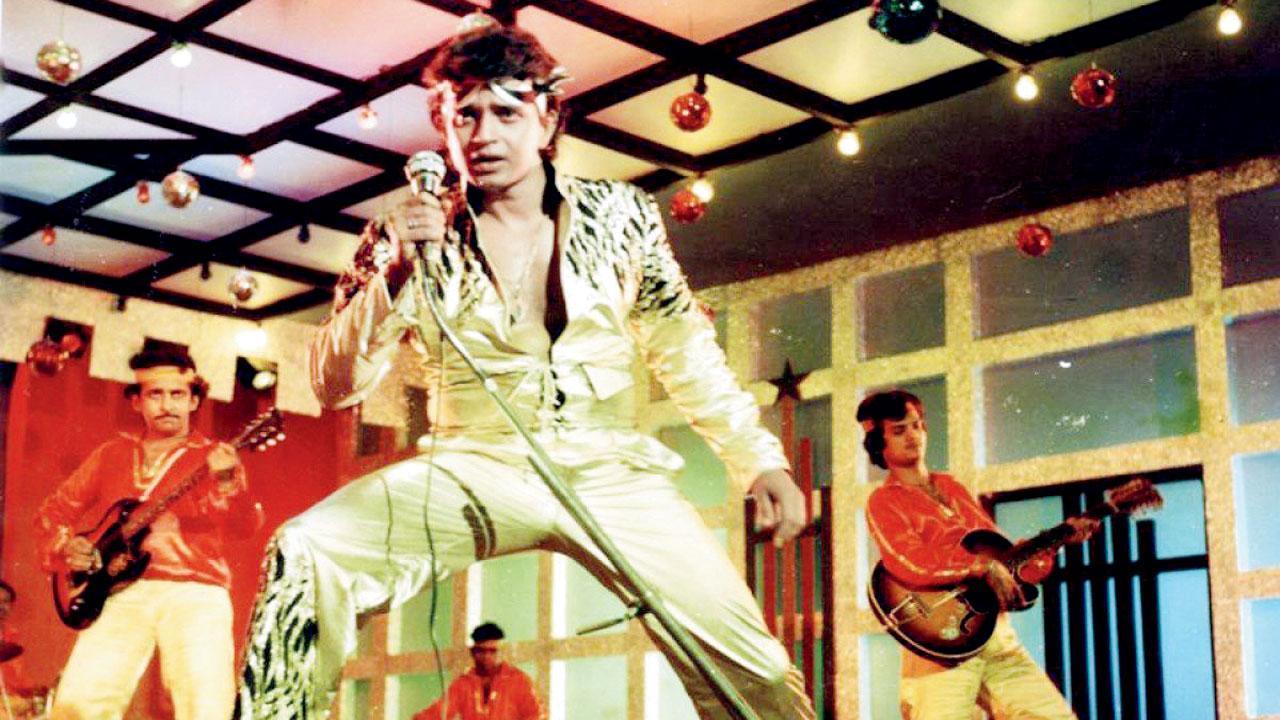
Disco Dancer director ready to roll sequel to Mithun’s 1982 smashing hit; senior actor likely to reprise his role of dancing star Jimmy
Upala KBR (MID-DAY; April 4, 2023)
Forty-one years is a long time between a film and its sequel. But considering the immense popularity that Mithun Chakraborty’s Disco Dancer (1982) enjoys, the veteran actor’s fans will only be too happy to get a follow-up movie. mid-day has learnt that B Subhash, who produced and directed the 1982 musical drama, is backing the sequel, the working title of which is Disco Dancer 2. Nitin Kumar Gupta, who directed Sayonee (2020) and Love In Ukraine, will helm the offering.
Disco Dancer, also starring Kim, revolved around Chakraborty’s street singer Jimmy who becomes a disco star. On its release, it became a smashing hit, thanks to the leading man’s smooth dance moves and Bappi Lahiri’s chartbusters, including Jimmy Jimmy Aaja Aaja, I Am A Disco Dancer, and Yaad Aa Raha Hai. The movie is also credited for ushering in disco music in Hindi cinema.
A trade source reveals, “The upcoming action-musical will pick up where the first movie left off, following the story of Jimmy and his son. It will be shot in various international locations, including Russia.”
The world of Disco Dancer is incomplete without Chakraborty. We hear that the makers are keen to rope in the senior actor for the second edition. “While Mithun has not been approached yet, he will most likely be seen in the pivotal role of Jimmy. Music plays a key role, and the makers have initiated talks with some international music directors,” says the source.
Subhash and Gupta are apparently in talks with K V Vijayendra Prasad — the writer of RRR [2022], Baahubali, and Bajrangi Bhaijaan [2015] — to serve as the writer-presenter.
Despite multiple attempts, Gupta remained unavailable for comment. Subhash, however, confirmed the news, stating, “I have given the sequel’s rights to Nitin, who is directing it. I will be a joint producer.”
When probed whether Chakraborty will be a part of the sequel, he stated, “The casting is underway. It’s too early to talk about it.”
It was my dream to bring Disco Dancer alive and relive the ’80s-Salim Merchant
8:19 AM
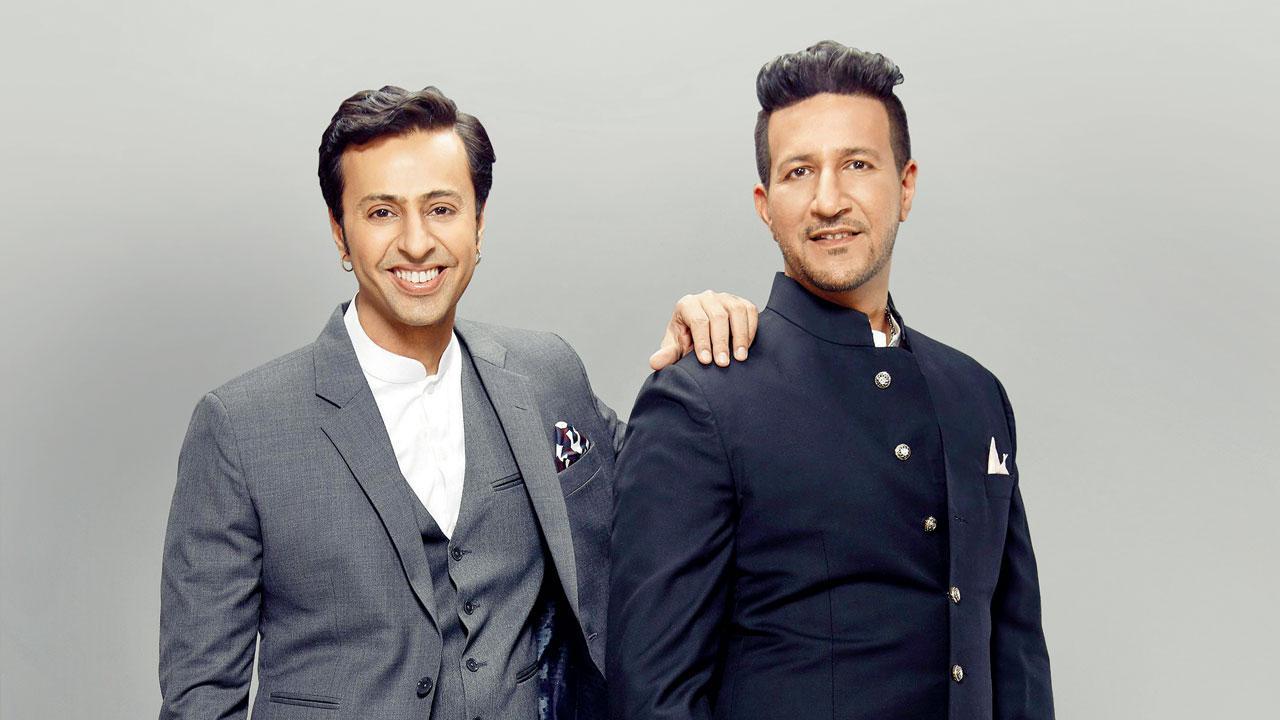
Set to present the musical adaptation of Disco Dancer in the city, Salim Merchant of Salim-Sulaiman, on how his appetite for stage shows served him
Sonia Lulla (MID-DAY; March 27, 2023)
Come April 14, Mumbai will witness Salim and Sulaiman Merchant’s acclaimed show, Disco Dancer — The Musical, which first premiered in London. The composer duo that previously successfully presented the musical, Umrao Jaan, was on the hunt for a project that was “different”.
“I am a huge disco fan,” says Salim, adding, “I had met Bappi da [Lahiri], and he was keen to work on a musical. However, he had limitations due to his health, and had also been living in Los Angeles, for the most part. After Umrao Jaan, which had travelled to the UK, Mumbai and then Delhi, we began to think about what we should do next. When I thought about Bappi da’s work, I realized that the film, Disco Dancer was such a prominent one. Few know that this was the first movie that crossed the Rs 100 crore mark. This was a big achievement, especially at a time when ticket prices were (very cheap).”
Also, think about the songs like I am a disco dancer, Yaad Aa Raha Hai, Jimmy Jimmy, Goron Ki Na Kalon Ki and Ae Oh Ah. Which film had so many successful songs in the same soundtrack?” Salim was certain his idea had promise when he ascertained that the story of a boy who goes from rags to riches would interest watchers.
“It was my dream to have Bappi da present at the musical, but, unfortunately, that will no longer be possible. It has been heartbreaking to lose him. It was my dream to bring this alive, and relive the ’80s.”
Barring the fact that the English show has been adapted in Hindi, he says all other elements, including the sets, and costumes, have been retained. “Since the stage is larger, we’ve been able to make this larger-than-life. But, we’ve not changed a single note of the original compositions. We do have two new compositions though — One is a love song called Paas Aaye, it’s a ballad between the main characters. And the other is a track for the sections that showcase Jimmy’s rise [to the top].”
Having grown up with an appetite for musicals, Salim says he began to learn the nuances of theatrical productions from his childhood. “I’ve watched Phantom Of The Opera, My Fair Lady, and Chicago live on stage. In school, I’d be part of musicals because I was a fan of theatre. I would compose plays and rearrange existing songs. When I’d head on trips, I’d dedicate a day to watch as many musicals as I could on Broadway, even though I didn’t know I’d eventually become a producer,” says Salim, who joins hands with Suniel Shetty for this production venture.
Worldwide gross: The Chinese and Russian factor
8:42 AM

Box Office India Trade Network
PATHAAN emerged the highest grossing Hindi film in original format last week but there was a little debate within the industry as DANGAL had grossed more if you include the Far East and BAJRANGI BHAIJAAN is also ahead that way. But these numbers are all formats and basically when you do this, it just changes the history of Hindi cinema the way everyone knows it.
The overseas markets had this Russian factor for around forty years and the last decade saw the Chinese factor and both are very similar in almost everything. The difference being that Russia had far more Hindi films released though business could be extreme from crazy levels to practically nothing. Both markets generally have Hindi films on an outright basis as makers see it as extra money and give the film and then the distributor be it Russian or Chinese releases the film on his account. The cost gets higher if the film breaks out but so do the profits.
In Russia, the films was dubbed or subtitled and even cut to suit the needs of the market and it was a different case for different areas. If the film was dubbed, the songs were still left in original Hindi language and this was for all films though a song here there would be cut. It has been the same case in China though here reports are that songs are edited/cut especially if they don't take story forward.
The Russian story was a few prints released which meant very limited revenue but a film could break out into hundreds of prints with huge grosses (though not as high as these $50m, $75m, $100m numbers that go around). Its the same with China, there may be less releases but its about a break out. A difference with Russia is that in Russia, most major Hindi films managed a release
China, meanwhile, is still picky and distributors only pick films which they feel have a chance. PATHAAN will not be one them as it shows the INDIAN as a HERO and the Chinese will not take to that. The Russians were kinder that way as SEETA AUR GEETA, JUGNU, BAROOD and DISCO DANCER were huge but many historic blockbuster films like MOTHER INDIA, MUGHAL-E-AZAM, GANGA JUMNA, MERA GAON MERA DESH, MUQADDAR KA SIKANDAR and KRANTI were debacles there. Even the biggest of them all, SHOLAY, had only decent footfalls in Russia.
Simply put, PATHAAN has moved the benchmarks in Overseas to a different level but if you go by the Far East story then it has not as other films have already grossed more with their various formats. Just like HUM AAPKE HAIN KOUN and DILWALE DULHANIA LE JAYENGE opened up the overseas market in the 90's but if you go by the Russian factor then then many movies had already done higher business decades back.
The films that were released in Russia and then lately Far East are not the same films which were released in India that is why PATHAAN is the biggest Hindi worldwide grosser in its original format. Then taking all formats it can be said that DANGAL is bigger than PATHAAN worldwide, SECRET SUPERSTAR is bigger than SANJU, DISCO DANCER is bigger than KABHI KHUSHI KABHIE GHAM and MAMTA is bigger than MUGHAL-E-AZAM.
The original format of the film is most important and you cant mix up with other versions and then compare. Its like having a bag of Apples on one side and a bag of Apples and Oranges on the other but saying its the same thing. There will be people out there who do but then there are a lot of people who are a bit empty upstairs also.
When BAAHUBALI 2: THE CONCLUSION released and it was put above DANGAL on the site it was asked why it went above DANGAL as Hollywood does not do this but that is because there eventually for the top films, its a level playing field as most will will go to all the major markets. On a lighter note they also know that a edited/subtitled /dubbed LOLITA (1997) is not going to topple their greats be it GONE WITH THE WIND, TITANIC, AVATAR or ET. This is not to say the historic Hindi grossers in Russia and China are LOLITA's (This film is one of the biggest box office disasters in Hollywood if not the biggest).
Now, ENGLISH VINGLISH will release in China and it will do some business as otherwise the local distributor would not have taken it. But if it somehow, it goes on to do $100 million or more, it will NOT become bigger than PATHAAN as in original format you just cant compare the films.
Why ‘Jimmy Jimmy’ evokes such a joyful universality
9:26 AM

Avijit Ghosh (THE TIMES OF INDIA; November 6, 2022)
Like vagabonds, songs are restless. They wander without any fixed address and travel to the unlikeliest of places. Sometimes they are also repurposed in innovative ways. ‘Jaan pehchan ho’ (film: Gumnam, 1965) plays in the background of a chic Eastern restaurant inhabited by magicians and dragons, as part of a Heineken ad released a decade ago. And it is serendipitous listening to the faint sounds of ‘Mera joota hai japani’ (film: ‘Shree 420’, 1955) in a taxi in the whipsmart Hollywood flick, ‘Deadpool’ (2016).
Songs have the ability to talk across generations and cultures. But even the most devoted of Indian film lovers wouldn’t have fathomed the way ‘Jimmy Jimmy’ from producer-director B Subhash’s musical hit, ‘Disco Dancer’ (1982), was recently recast in China. To those who missed the news, snatches of the song were put out on the social media network Douyin, the Chinese name for TikTok. In Mandarin “Jie mi, jie mi” translates into “Give me rice, give me rice”.
In the satirical, soft-protest video, two women and a young girl, in Indian dresses, lip sync to the jivy number holding empty bowls to illustrate how they are deprived of basic food items due to a Coronavirus lockdown. The fact that the artists opted for ‘Jimmy Jimmy’ underlines the song’s recall value in China and why it was used to make a political point.
Written by Anjaan and composed by Bappi Lahiri, the easily-accessible footstomper has gathered 92 million views, 450,000 likes and over 20,000 comments on YouTube. Many comments are from Azerbaijan, Kazakhstan, Estonia, Georgia and others countries which were once part of the erstwhile Soviet Union and with whom India has shared an abiding link through songs, most notably ‘Awara hoon’ (film: Awara, 1951). As Arsen posted from Armenia this year, “If your (sic) a 80’s kid from the USSR, then you know this movie and song. It’s tattooed in your brain.”
The remark reflects how the song is part of the larger popularity of ‘Disco Dancer’, whose super success abroad lent iconic status to Mithun Chakraborty in these countries. Interestingly, the film’s title track was the bigger hit in India. In the 1982 annual radio countdown show of ‘Binaca Geetmala’, ‘I am a disco dancer’ (singer: Vijay Benedict), received a far higher rank (no 8) than ‘Jimmy’ (no 20).
There’s no place that ‘Jimmy Jimmy’ hasn’t been to. Posts from Malaysia, Serbia, Cameroon, Afghanistan, Syria, Romania, Mongolia, Israel, Argentina and other countries demonstrate the track’s enduring and diverse fan base. They show how songs can make you friends.
They also underline how ever-improving technology — audio cassettes, video tapes (generally pirated) in the 1980s, VCD and DVD (often pirated), the internet (pirated audio) and now video sharing social media platforms like YouTube — has enabled and magnified global engagement with music. In 2007, even British pop singer of Lankan origin, M. I. A, brought out her own version of the track. “‘Jimmy Jimmy’ is not just a song of India, but a song of the world,” an elated Subhash, told me over phone.
Crooned by Trinidad-born Parvati Khan, ‘Jimmy Jimmy’ evokes a joyful universality. But its tune can be traced to ‘T’es OK, T’es Bath’ (1980) of French pop duo Ottawan, as pointed out by itwofs. com, the website which diligently tracks Hindi film songs that have been inspired or lifted from foreign tunes. Few remember the original though.
In the age of video sharing sites, ‘Jimmy Jimmy’ isn’t just a song we hear. We watch it too. The number was choreographed by dance director Kamal and performed on celluloid by Kim, who shook and shimmied with vigour and enthusiasm amidst blinking lights. Those dance moves have been imitated in talent contests globally. Kamal and Kim are two under-appreciated contributors to the song’s popularity. Hindi film songs have always been part of India’s seductive soft power. They have seldom occupied world music charts but thousands have overcome language barriers and made home worldwide.
‘Jimmy Jimmy’ continues to globally teleport people to a place called nostalgia allowing them to reconnect to a time and a place they can no longer return to physically. Bisola Ayetigbo posted from Nigeria, “Omg! This song was my entire childhood… I can’t wait to send this to my sisters! We sang this song in the way we could all through our childhood even though we don’t understand any. . . the actors! They made my childhood so beautiful!”
Songs like ‘Jimmy Jimmy’ are our under-appreciated cultural ambassadors. In 2016, when a colleague visited a karaoke bar in Vladikavkaz, a city located in deep, south-east Russia, he was forced to sing ‘Jimmy Jimmy’. He hardly knew the words. But it didn’t matter. Drinks were on the house thereafter.
I was hesitant about screening Disco Dancer in Russia but Smita Patil convinced me-B Subhash
8:28 AM

Sonam Joshi (THE TIMES OF INDIA; March 29, 2022)
The year was 1983. Film director Babbar Subhash’s ‘Disco Dancer’ had just been invited for the Moscow film festival by a Mumbai-based agency Sovex Fort. “I was hesitant because it was a modern film with modern music and mostly dark films such as ‘Do Bigha Zamin’ have been successful in Russia but Smita Patil convinced me otherwise,” Subhash recalls.
By the time the movie screening ended, over 3,000 people in the auditorium were clapping and dancing along to the title track. “It was one of the best days of my life,” he says. ‘Disco Dancer’ went on to sell 120 million tickets in the Soviet Union, and even WhatsApp’s Ukrainian cofounder Jan Koum recalls watching the film as many as 20 times as a kid in Kyiv.
With Hollywood movies banned in the USSR during the Cold War, the Soviet government began promoting Indian movies from the 1950s onwards. The first big hit was Raj Kapoor’s ‘Awara’ selling 64 million tickets followed by ‘Shree 420’. Then came movies such as ‘Dhool Ka Phool’, ‘Love In Simla’, ‘Bobby’, ‘Barood’, ‘Seeta Aur Geeta’, ‘Muqaddar Ka Sikandar’.
Dr Sudha Rajagopalan, senior lecturer in East European Studies at the University of Amsterdam, estimates that 210 Indian films were screened in Soviet theatres between 1954 and 1991, around 190 of which were mainstream Hindi films from Bombay. “Indian popular films often surpassed both domestic and other foreign cinema in viewer turnout,” she writes in her book.
Elena Doroshenko, a Moscow-based journalist and linguist who has watched the old hits as well as the relatively newer ‘Kal Ho Naa Ho’ and ‘Paheli’, says they struck an emotional chord with Russians. “The films spoke the same emotional language — even though we were different, we understood the emotions and passions,” she says.
The success of Hindi films in the USSR also led to joint productions such as ‘Alibaba Aur 40 Chor’ and ‘Sohni Mahiwal’. However, this changed after the fall of the Soviet Union in 1991. “There was a flood of various films from the West and we wanted to imitate that lifestyle,” Doroshenko says. “Indian films were still on TV — it’s not that they were forgotten but they stopped being a sensation.”
Dancer Svetlana Tulasi, who was born to an Indian dad and Russian mom and raised in Moscow, recalls watching Bollywood movies on cassette tapes, then cable TV, then DVDs and eventually on the internet. She shot to fame a few years ago with her viral Bollywood-Kathak fusion dances at Russia's Got Talent and Ukraine's Got Talent.
On YouTube, there are Russian fan channels devoted to Mithun Chakraborty, and dance performances set to the song ‘Jimmy Jimmy’. There are even a couple of restaurants by that name in Vladivostok and the Georgian capital of Tbilisi.
The Georgian ‘Jimmy Jimmy’ was inaugurated in 2019 by none other than Raj Kapoor’s son Rajeev Kapoor. “When we visited Georgia for the first time, we were surprised to see that taxi drivers were playing ‘Jimmy Jimmy’ and ‘Mera Joota hai Japani’,” says owner Shubham Joshi whose customer base includes both locals as well as Indian students.
Bappi Da, I will miss you forever-Mithun Chakraborty
7:32 AM

Priyanka Dasgupta (THE TIMES OF INDIA; February 18, 2022)
Kolkata: “Bappida I will miss u forever, mithun” — this was the message that Mithun Chakraborty sent out a little over 24 hours after Bappi Lahiri’s death. The actor had been busy with his hotel work on the outskirts of Bengaluru and Mysore the day Bappi breathed his last in Mumbai.
While celebrities rushed to pay tributes on social media, Mithun was conspicuous by his absence. A day later, when he reached Mumbai, arrangements had already begun for Bappi’s final journey.
TOI obtained his message via the actor’s son. Mithun and Bappi shared a bond since the days of Ravikant Nagaich’s ‘Surakksha’ (1979) and ‘Wardat’ (1979) and K Murli Manohar Rao’s ‘Dilwaala’ (1984). And then came the avalanche of their hits in Babbar Subhash’ ‘Disco Dancer’ (1982). All its songs — from Vijay Benedict’s ‘I am a Disco Dancer,’ Parvati Khan’s ‘Jimmy Jimmy Jimmy, aaja’ to Usha Uthup’s ‘Koi yahan nache nache’ — hit the national airwaves like a storm. The bond strengthened over 32 years with Prakash Mehra’s ‘Dalaal’ (1993), where Mithun lip-synched to Bappi’s ‘Gutur gutur’, till ‘Golmaal 3’ (2010), which had Pritam getting Bappi to sing ‘Disco Dancer’ picturised on Mithun and Ratna Pathak Shah.
In 2011, Bappi had done the music for a film with Mithun’s son, Mimoh aka Mahaakshay. The film was shelved midway, but the two families had come together for the music setting where Bappi’s compositions would be dug up from the past.
I never saw Bappi Lahiri lose his temper even once-B Subhash
7:30 AM

B Subhash, Parvati Khan and Bappi Lahiri
Titas Chowdhury (HINDUSTAN TIMES; February 18, 2022)
Director B Subhash’s association with late music icon Bappi Lahiri dates back to 1982, when the duo scored their first hit together with Disco Dancer. Lahiri was someone the director could rely on because he had a solution for everyone and everything.
Recounting an episode from the ’80s, Subhash says, “We were at Mehboob Studio (Mumbai), and Bappi da had five other recordings that day. A producer came and requested him to finish a song because his film was going on floors the next day onwards. Bappi da smiled and obliged. The recording of a single song needs three to four hours. That day, Bappi da recorded for 24 hours at a stretch.”
Quiz him about how he would want to remember the singer-composer and Subhash shares, “He was a lovely person. In the past 40 years, I had never once seen him lose his temper. He was down-to-earth, sweet and kind.”
The duo collaborated again just a few years back when Lahiri composed the music for Subhash’s daughter’s yet-to-be released directorial, Jhoom. However, he rues not being able to meet him in the past two years: “Artistes don’t like to go all out about their sickness because it affects their profession. So, I didn’t visit him because I presumed that he wouldn’t like people coming to meet him due to his ill-health.”
On a parting note, the director says, “Bappi da did a lot for others, and that will stay back and become a part of his rich legacy.”
Till date, whenever my actor friends like Jackie Shroff call me, they never say ‘Hello’, but sing, ‘Yaad Aa Raha Hai’-B Subhash
8:26 AM
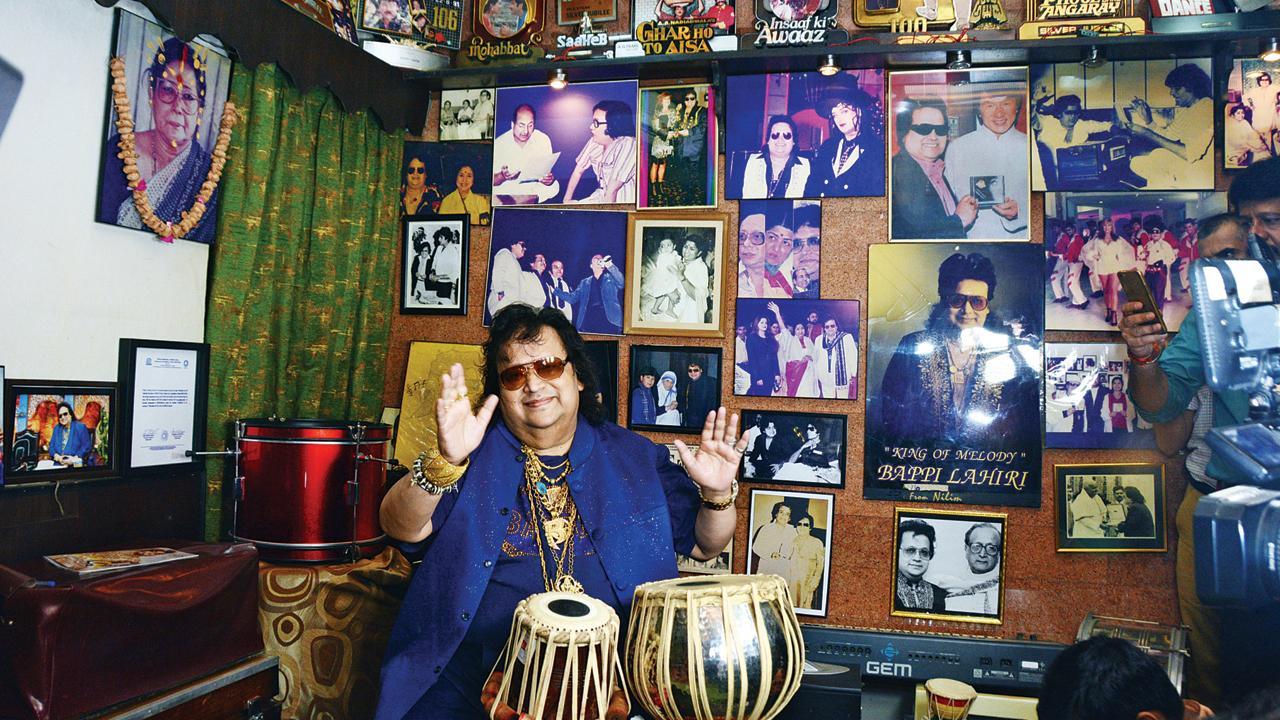
His songs shone brighter than gold, his voice boomed louder than his beats. India’s Disco King lives on in our hearts
B Subhash (MID-DAY; February 17, 2022)
My association with Bappi da began in 1978, when we collaborated on my directorial venture Taqdeer Ka Badshah, starring Mithun Chakraborty. It was on the set of this film that I decided to make Disco Dancer (1982).
It all began when, one day, I asked my assistant to call Mithun for his shot, but was told that he’s upset. When I went to meet Mithun, he said that he is earnest with his work, but things don’t seem to be working out. That’s when I told him that I’ll make Disco Dancer, which will make him a superstar.
Back then, Bappi da was working on popularizing the disco genre in India. Disco Dancer paved the way for Bappi da, Mithun and myself to become a [successful] trio of sorts. We three went on to collaborate on several films like Kasam Paida Karne Wale Ki (1984), Dance Dance (1987), and Pyar Ke Naam Qurbaan (1990). While every song of Disco Dancer became a hit, Jimmy Jimmy was in another league altogether, becoming immensely popular in China, Dubai, Israel, Ethiopia and even Russia.
When I first heard the song post recording, I told Bappi da that [it wasn’t quite doing justice to] the situation it comes in, in the film. He came up with the idea of using a double voice. Here, the artiste sings it twice separately, after which both [renditions] are blended. The result blew us away.
Apart from being a versatile composer and knowing how to play many musical instruments, Bappi da was also a great sound engineer. He knew exactly which technique to use [to enhance a song]. With Disco Dancer, we also introduced new singers like Vijay Benedict, Nandu Bhende and Parvati Khan.
Did you know that the song, Yaad Aa Raha Hai Tera Pyaar was to be actually sung by Kishore Kumar? On the day Kishore da was to record the song at a new studio in Cuffe Parade, the lift wasn’t working. Kishore da said he wouldn’t be able to climb the stairs due to health issues, and that we could do a scratch recording [with someone else]. So Bappi da recorded the scratch. When I heard Bappi da’s rendition, I felt it brought out the emotions of the song effectively. I wanted to retain it, and told Kishore da that I’d like to go ahead with [the musician’s] version if he agreed.
When Kishore da heard the version, he told Bappi da that he had sung it very well, and that his rendition should be retained. Till date, whenever my actor friends like Jackie Shroff call me, they never say ‘Hello’, but sing, ‘Yaad Aa Raha Hai..’. Such is the magic of Bappi da.
During the making of Disco Dancer, I would shoot the film during the day. Bappi da would use the time to compose the music. At the end of the day, we’d have our music sittings at 10 pm. When I first heard his composition of Ae Oh Aa Zara Mudke, I told him the song wasn’t sounding right, [given the context]. In an hour-and-a-half, he gave me a [reworked version] that was punchy.
At 11:30 pm, we decided the song had to be written too, so Kishore da could record it the following morning. So, I picked up lyricist Anjaan saab and brought him to Bappi da’s place. In another couple of hours, the song was ready. [The next morning] when I narrated to Kishore da how the song was created, he was all praise for Bappi da’s dedication.
Bappi da was a foodie. While working, he indulged only in biscuits. While travelling to international destinations, he would shop for two things — a musical instrument or cookies.
As told to Hiren Kotwani

(Clockwise) B Subhash and wife Tillottama with Smita Patil, Amrish Puri, Mithun Chakraborty, Mandakini, Bappi Lahiri, Shakti Kapoor and Dalip Tahil during the making of Dance Dance
Bappi Lahiri passes away in Mumbai at the age of 69
8:14 AM

Avijit Ghosh (THE TIMES OF INDIA; February 17, 2022)
Music director Bappi Lahiri, who harnessed and harvested the “disco sound” to produce chartbusters in films like Disco Dancer and Namak Halaal but was equally adept in composing gentler semi-classical and folksy tunes best exemplified in the less remembered songs of Aangan Ki Kali, Apne Paraye and Aetbaar, passed away in a Mumbai hospital late Tuesday night. He was 69.
The composer-singer had been under treatment for several weeks. “He was suffering from OSA (obstructive sleep apnea) and recurrent chest infection...He succumbed to his illness at about 11:45pm,” Dr Deepak Namjoshi of Mumbai's CritiCare Asia Hospitals said in a statement.
In the 1980s, a disco track became mandatory in Hindi films after the tsunami-like success of Qurbani’s ‘Aap Jai sa Koi’ (singer: Nazia Hasan, composer: Biddu). Songs became something that you both danced and listened to. For the young and the restless, beat acquired more prominence. And the electronic synthesizer became the busiest instrument. No Bollywood composer understood, captured and expressed the new musical ecosystem like Bappi.
His dalliance with disco started with ‘Hari Om Hari’ (Pyara Dushman, inspired by Neil Sedaka/Eruption’s ‘One Way Ticket’) and ‘Rambha Ho Ho Ho’ (Armaan). Director B Subhash’s Disco Dancer became his high noon. From the title track to ‘Jimmy Jimmy’, every track in Disco Dancer was dancey and delicious. If ‘Awara Hoon’ was Hindi cinema’s major cultural export in the 1950s, ‘Jimmy Jimmy’ remains a musical ambassador even in Vladimir Putin’s Russia today. Just go to YouTube for confirmation.
----------------------------
Bappi Lahiri’s breathless foottappers and Indeevar’s nursery-rhyme lyrics (‘Char baar marenge ek baar ginenge’, Mawaali) in Southern productions defined popular film music in the 80’s. They were integral to mind-numbing entertainers whose plots could match Donald Trump’s statements for incredulousness. Jeetendra’s Himmatwala, Mawaali, Maq sad and Tohfa were all propelled by these tunes. “He was a king in Madras,” director B Subhash told this reporter some years ago.
In the 1980s, Bappi da, as many called him fondly, provided the score for an eyepopping 230 films. In 1985, he gave music to 33 movies: 30 Hindi, 2 Bengali, 1 Tamil; which means a film released every 12 days! The composer lorded over the charts even when some of the songs were copies of foreign hits and desi classics. There was an alternative side to him as well.
In Basu Chatterjee’s Apne Paraye, he surprised critics with his folksy tunes. ‘Shyam rang rangaa re’, where he employed the Bengal percussion instrument khol, has the meditative feel of a Chaitanya kirtan. ‘Gao mere mann’ carries the smell of ponds, banana leaves and 19th century Bengal.
Not many would associate him with songs such as ‘Saiyan bina ghar soona’ (Aangan Ki Kali), ‘Chaar din ki zindagi hai’ (Ek Baar Kaho) or ‘Kisi nazar ko tera’ (Aetbaar). Many of them were sung by Yesudas and Bhupendra.
Born in north Bengal’s Jalpaiguri town to musician parents, Alokesh (his original name) trained under guru Samta Prasad and was hailed as a tabla prodigy at just six. Nanha Shikari (1973) was his debut Hindi film. But the composer made a distinct impression with Chalte Chalte (1976), among his finest scores.
Amit Khanna, who wrote the lyrics, recounts how Bappi got the film. “The film director Bhisham Kohli, also Dev Anand’s nephew, was looking for a music director. He was unable to get R D Burman and Laxmikant Pyarelal. Bappi had earlier come to Navketan looking for work. And I was impressed by some of the tunes I heard. I told Bhisham, why don’t you try him? During the music session, Bappi played the ‘Chalte Chalte’ tune. I wrote the opening lines. And this led to the song,” recalled Khanna.
Slowly, he worked his way up with hummable melodies in low budget action films such as Zakhmee, Ravikant Nagaich’s Surakksha and Wardat and the Ramsay brothers’ horror yarns (Saboot). Disco Dancer elevated his career. But when Prakash Mehra, then Bollywood’s biggest director along with Manmohan Desai, signed him for ‘Namak Halaal’, Bappi entered the super league. The music in Namak Halaal and Sharaabi (both Big B films) were worth the weight of the gold chains he fondly wore.
Namak Halaal’s ‘Pagh ghungroo baandh’ was nearly 12 minutes long but the tune was riveting. ‘Raat baaki’, which he sang with Asha, is a standout. Sharaabi earned him his lone Filmfare award in 1985. He tasted success in the 1990s too: K C Bokadia’s Aaj Ka Arjun and David Dhawan’s Aankhen, to name just two. ‘Gori hai kalaiyan’ (Aaj Ka Arjun) topped the Binaca Geetmala in 1990.
In recent years, Bappi sang in Baaghi 3 and Shubh Mangal Zyada Saavdhan. Last April, he had contracted Coronavirus but recovered well.
Now, the amiable and ever-smiling composer is no more. But the best of his 80s tracks remain groovy as ever. And even today, there’s no better farewell song than ‘Chalte Chalte’.
Musical play based on Mithun Chakraborty’s iconic dance film Disco Dancer to take off soon
8:00 AM

ETimes | BOMBAY TIMES (May 20, 2021)

Music director-turned-producer Salim Merchant added, “Due to the lockdown, rehearsals are on hold, but once everything opens up and we get the permission to restart work we will get going.”
The Mithun Chakraborty-starrer was a rage when it released, heralding the disco era in Bollywood. When asked who does he see playing Mithun’s part in the musical, B Subhash says, “Films and plays are two different mediums and I really don’t know who will be to able play that character.” Salim, too, was tight-lipped when asked about the actor who will be taking the centre stage in the musical. Interestingly, last year, Tiger Shroff stepped into Mithun Chakraborty’s shoes when he had danced to the remixed version of the iconic song, which was titled I am a Disco Dancer 2.0. The music of the video was produced by Salim-Sulaiman themselves, and Benny Dayal sung the track.
The film, a story about a street dancer’s transition to a disco dancer, was also known for Bappi Lahiri’s compositions like I Am A Disco Dancer and Jimmy Jimmy. Speaking about the songs that he would want to see reprised on stage, the director said, “I have no idea which songs from the film will be used, though I would want them to keep Jimmy Jimmy and I am a Disco Dancer in the musical as they are integral to the story.”
Unique collection of foreign posters tells the global story of Indian cinema
8:19 AM

Curator Jahan Bakshi, who scours the globe for local reincarnations of movie posters, has found gems like Awara in German and Raju Ban Gaya Gentleman in manga style
Mohua Das (THE TIMES OF INDIA; February 4, 2021)

When Jahan Bakshi, a movie art curator in Mumbai, stumbled upon old Czech and British quad posters for Satyajit Ray films with neo-futurist fonts and colourful surrealism, he knew he was onto something special. His curiosity led him down a rabbit hole — of familiar yet outlandish — doppelgangers of Indian movie visuals from across the globe that revealed a fascinating yet undocumented history of how different countries reimagined Indian films.
“Looking for foreign posters of Indian films started as research for an article but soon became an obsession. It was a revelation to see what Indian films look like when seen through a foreign prism,” says Bakshi who has unearthed around 150-odd foreign origin Indian posters and acquired around 50 physical copies from places spanning Russia, Latvia, Bulgaria and East Europe to France, Germany, the UK, US, Japan, China, Thailand and Egypt. “They’re unique both aesthetically and conceptually... like watching an act of translation via a poster image. It was also eyeopening to see just how much Indian cinema had travelled globally in the past.”

Recast, often dramatically, to resonate in the local market, these foreign posters blend local language, sexual allure, religion, violence and intellectualism. If some are reminiscent of the myths and legends of that land — for instance, the Russian poster for 1990 action thriller Khoon Bhari Maang borders on a folktale with the magnified head of an alligator occupying centrestage against an intense pink background and the Hungarian reincarnation of Benegal’s Nishant has little dragons wrapped around Azmi’s face — many are visual time capsules indicative of the prevailing politics and censorship in the country.

More recently, Chinese posters for Andhadhun — a massive success collecting over $35 million at the box office in China — took on a darker shade with black and white overtones and a braille piano in the foreground as opposed to the popping colours and quirky vibe of the Indian version.
“Interesting patterns emerge from posters of other countries, too. The US posters tend to be text heavy with emphasis on captions and pull-quotes. Posters from Europe and Central Asia are surprisingly flamboyant, eccentric and at times exoticize Indian-ness. Japanese posters are bizarrely unpredictable varying from subtle to whimsical, gonzo to pulpy,” observes Bakshi who scours popular poster sites like New York’s Posteritati Gallery to obscure ones in Germany, Czech Republic and Japan in his rescue mission though the pandemic did delay some of his packages.
But he is fortunate to have found an ally — the Academy of Motion Picture Arts and Sciences. The 30-year-old who had started ‘Posterphilia’ — a hobby project of posting his favourite movie posters on social media two years ago — drew the attention of Anne Coco, the head of graphic arts collections at the Oscars library, last September. “She approached me, asking if I could help build their collection of Indian film posters which was quite scant,” recounts Bakshi, who over the past few months of sourcing Indian film posters for the Academy, pitched the idea of “also” exploring their foreign counterparts.
“Since then I’ve helped them acquire a bunch of Ray, Raj Kapoor and V Shantaram posters of foreign origin and hope we can build it up further,” he says with his fingers crossed. “Old movie posters are cultural artefacts and I want to reclaim this aspect of Indian film history,” he signs off.
When Disco Dancer writer, Rahi Masoom Reza, suggested that the film be titled Qawwal
9:02 AM

Roshmila Bhattacharya (MUMBAI MIRROR; December 11, 2020)

“Even Anjaan ji complained that he had no idea how someone would become a Disco Dancer and suggested I take another lyricist,” the filmmaker reminisces, sharing that he subsequently visited a book shop in Mumbai’s Fort area and returned home with pamphlets of songs from albums from across the world. “One of them spoke about how a young man’s mother would often say that he could sing before he spoke and dance before he could walk. I took the words to Anjaan ji who came up with the lines, ‘Doston Meri Yeh Zindagi Geeton Ki Amaanat Hai, Main Isiliye Paida Hua Hoon, Yeh Log Kehte Hain Main Tab Bhi Gaata Tha, Jab Bol Pata Nahin Tha, Yeh Paaon Mere To Tab Bhi Thirakte The, Jab Chalna Aata Nahin Tha.’ After that there was no looking back and he penned one chartbuster after another,” he narrates.
Subhash ji adds that they broke away from the convention of the audience sitting soberly in seats watching a performance on stage, by getting Mithun to get them on their feet, urging, “Will You Sing With Me? Say D…D, Say I…I, Say… S…S... C….C… O…O. Disco, Disco, Disco Wow!” After the film’s release 38 years ago, on December 10, 1982, not just on the screen, but even in the theatres, Disco fans were grooving in the aisles.
The song ended with a two-minute piece of music and Subhash ji insisted that Mithun continue dancing to the beat while he captured the act in one shot. “At the end of it, he collapsed, exhausted, only for me to tell him that I wanted a retake. He looked at me quietly, then, got to his feet saying, ‘Okay Guru, let’s do it.’ That song is unforgettable!” the filmmaker exults.
However, it was not enough to just get a hit score from music director Bappi Lahiri. Subhash ji was determined that the sets would also match those he had seen in foreign videos. But when he suggested to his art director that he wanted a production design similar to what he had seen in the 1979 English synth-pop hit “Video Killed the Radio Star”, he was told that it would cost him plenty. The molded cane shop they visited at Opera House gave them an estimate of Rs 6 lakh which was way above what he could afford. “But on the way back, I spotted a small cycle shop with metal rings hanging outside. They were selling each for Rs 16 and I bought 100 at a discounted price of Rs 14, pasted paper on them and flashed light from behind, making for a colourful set decor that cost me no more than Rs 10,000. The film was all about such innovations since we were working on a shoe-string budget,” he recounts.
Subhash ji’s biggest worry was the climax. Back then, every time a song came on, people would exit the auditorium to smoke a cigarette or take a loo break. He had three songs—“Jimmy Jimmy Jimmy Aaja”, “Goron Ki Na Kalon Ki” and “Yaad Aa Raha Hai”—and knew that if he couldn’t keep them in their seats, the film would end early. To his delight, they didn’t walk out, they stayed and danced with Mithun.
Disco Dancer was a sensation not just in India but across the world, even in countries like Kazakhstan, China and Soviet Russia, with an overseas audience. Subhash ji recalls how he faced skepticism before the Indian release because Biddu’s Star, with bigger stars Kumar Gaurav and Rati Agnihotri, which had opened earlier, had bombed. “Industry colleagues also argued that Disco Dancer should not be allowed to release in Russia as it did not depict Indian culture. I was anxious and went for the first 3 pm show at Mir Theatre with a lot of trepidation. I was overwhelmed when, at the end, Russians were dancing to ‘Jimmy Jimmy’ and besieging me for autographs,” he flashbacks, adding with a laugh, “I set out to bring disco to India with my first production and ended up creating the world’s eighth wonder.”
At every concert I have to sing Ooh La La at least three times on popular demand-Bappi Lahiri
8:08 AM

Roshmila Bhattacharya (MUMBAI MIRROR; November 28, 2020)

Bappida recalls walking into Sunny Super Sound for a 4 pm shift and bumping into Raj N Sippy, his Thanedaar director, who, on his way out, told him that they needed one last song in his trademark Disco style to be picturised on Sanjay Dutt and Madhuri Dixit. Thanedaar was the fourth highest grosser of 1990, but it is “Tamma Tamma Loge” with its quirky dance moves, inspired by Michael Jackson’s “Bad”, that we remember the film by, three decades later. “In 2017, on the request of Bhushan Kumar (T-Series head honcho), I re-dubbed the song in a LA studio for Varun Dhawan and Alia Bhatt’s Badrinath Ki Dulhania,” he reminds.
Bappida has a treasure trove of hits, but the one film whose songs play across the globe and are instantly associated with Mithun Chakraborty, and him, is Disco Dancer. Bring up the subject and he pinpoints his golden song, “Yaad Aa Raha Hai Tera Pyaar” which was to be re-dubbed by Kishore Kumar on his return from London. “But when Kishore mama heard the track I had recorded, he called Subhash ji (producer-director B Subhash) and urged him to retain my version saying he could not better it,” Bappi da recounts proudly.

A year later, for Anil Ganguly’s Saaheb, he composed and crooned, “Yaar Bina Chain Kahan Re” for a very young Anil Kapoor. “Anil danced so well, and the following year, when I won the Filmfare Award for Shaarabi, both of us took to the stage to sing ‘Yaar Bina Chain Kahan Re’ together. What a night that was!” he reminisces.

Bappida was in the US when Vishal called to say “Ooh La La” was the No 1 song in India. “Soon, it was playing all over the world. Now, at every concert I have to sing it at least three times on popular demand,” he shares, boasting that after half a century, he’s still making music, without even a gap of a year.
This year, there was “Arey Pyaar Kar Le” with Ayushmann Khurrana for Shubh Mangal Zyada Saavdhan , “Bhankas” for Tiger Shroff’s Baaghi 3 and “Tim Tim Tim” for Kaamyaab . “But because of a rogue virus, I could not enjoy their success. I recorded a song with Akon before we were shut in, composed a few film songs in my home studio during the lockdown, and am waiting for her final approval to collaborate with Lady Gaga,” he rattles off, confident that life will get back on track soon and he will keep glittering bright in our galaxy.
The hardest part about a musical is the casting-Salim and Sulaiman Merchant
8:01 AM

Set to follow their Broadway adaptation of Umrao Jaan with Disco Dancer, composer duo Salim-Sulaiman on transitioning from musicians to storytellers
Sonia Lulla (MID-DAY; March 9, 2020)
Seated at a spacious studio, Salim and Sulaiman Merchant are weaving for us a tale that is set to open for theatre-going audiences on March 27, through 29. The months that they have spent breathing life into the Broadway adaptation of Disco Dancer hasn't diminished their fever. It is palpable in the twinkle in their eyes as they discuss "adding a dramatic ma-beta angle", employing lavish LED sets to depict "Bombay of the '80s", and "lowering of two telephone booths for a scene."
As they discuss Saregama Carvaan's adaptation of Mithun Chakraborty's 1982 musical for the stage, which follows the composer duo's successful Umrao Jaan, it is evident that they've emerged from being musicians to story-tellers. "The hardest part about a musical is the casting," says Salim, adding, "In India, finding someone who can sing, dance, and act, is a big challenge. While people may excel in one or two [skills], it's tough to find those who are good at all three. And we need to find at least five of them." The journey to merely zeroing in on the lead actors took them seven months, reveals Sulaiman. "Our country is not geared [to creating] a sampoorna kalakar, or true performer. Our aim was to find a good singer. That's the toughest part, since all the singing is done live. We identified singers who are good-looking, and then sent them to acting class." The unit roped in to feature in the production is currently on a fitness programme designed to build endurance, and hence, enable them to sing appropriately, without struggling for breath in the midst of dancing stints.
Employing larger than life screens and abundant technology meets a two-fold purpose. Firstly, it enables them to transport viewers back to the '80s with visuals from the era. "Also, since the story demands that we create backdrops, like the inside of a police station, or [scenes from] Goa, we needed to avoid moving sets since we want this show to travel to Delhi, US and the UK."
A great story, and a promising soundtrack are the essential factors to consider when choosing a film for a theatrical adaptation. But as cinema does with reality, the duo also takes creative liberty when adapting a project for their platform. While they "introduced a conflict" in Umrao Jaan via the addition of a character, they've added comic relief to Disco Dancer by featuring a Goan friend of the protagonist, Jimmy. "We created a character called Anthony, who is Jimmy's childhood friend. The comic relief is important for people to enjoy it."
The duo has gone to great lengths to ensure Bappi Lahiri's compositions are retained "exactly the way they were" in the original film, even taking off to New York and Prague to record with instruments popular in the '80s, but no longer available in India. "Apart from his tracks, we have three original compositions. There's a beautiful love song to give [viewers] a break from all the disco [tracks]. The other a track made for a film. It's called Yaaron main toh star ban gaya, and depicts Jimmy's growth from a nobody to a superstar. It has Latin and Brazilian beats. The third is an instrumental number which comes at a crucial point. It's [along the lines of] an opera, but we're contemplating adding a song there as well."
Whether it was when creating four original songs for Umrao Jaan, or the three that they did for this offering, the duo is mindful of the music style of the original composer "so that a listener can't differentiate a fresh composition from the [original soundtrack]". "With Umrao Jaan, we tried to create songs befitting Khayyam saab's compositions. In Disco Dancer, we've retained every cheesy element that Bappi da used, and became popular."
Excited distributors from all over India wanted to buy Disco Dancer instantly-B Subhash
2:36 PM

Roshmila Bhattacharya (MUMBAI MIRROR; November 29, 2019)
 On Thursday, November 27, Bappi Lahiri turned 67. If one were to ask me to pick a song from his kitty that would best embody India’s ‘Golden Man’, I’d single out the title track of B Subhash’s Disco Dancer. The film opened on December 10, 1982 and remains unforgettable for its psychedelic lights and flashing shimmering cat suits, disco beats and pelvic thrusts which instantly takes one back to the swinging ’80s.
The film was born during a visit to Bappi da’s Juhu apartment for a music sitting. “I was toying with a couple of ideas, wondering which one to direct, when Bappi ji’s wife (Chitrani) came into the sitting room with a puja thali. The window was open and as I looked out, like a bolt from the blue, a thought flashed through my mind: Why don’t I make a film called Disco Dancer?” recounts B Subhash ji, who, at the time, was shooting for Taqdeer Ka Badshah.
His hero, Mithun Chakraborty, was going through a professional low and one day, to cheer him up, the filmmaker told him he would make a film called Disco Dancer with him which would make him an evergreen star. Almost immediately, Mithun’s spirits lifted and when B Subhash ji’s publicist, Jagdish Aurangabadkar, turned up on the set, he nudged him into announcing the project.
 “I told Jagdish to inform a leading film weekly of the time that I would be not just directing Disco Dancer, based on my own story, but producing it as well, with Mithun in the title role, Bappi Lahiri as the music director and Anjaan as the lyricist. On Friday, when the paper carried the news on the front page, excited distributors from all over India wanted to buy the film instantly. And so the musical journey which brought the disco wave to India, started,” narrates B Subhash ji.
He recalls how, when they were recording the title song, which continues to be his caller tune, began with Mithun urging the audience to sing with him, the musicians around them came up with appropriate words for the letters D…I… S…C..O. “D for ‘dance’, I for ‘item’, S for ‘singer’, C for ‘chorus’ and O for ‘orchestra’,” he beams, all praise for his composer, who was at his creative best yet always open to suggestions.
“One day, at a sitting, I admitted I didn’t like one of the songs. But by the time we broke up, it was almost midnight and we had a recording with Kishore da (Kumar) early next morning and given how busy he was, we couldn’t afford to cancel. I didn’t think we could come up with an alternative at such short notice, but Bappi ji and Anjaan worked through the night and the next day, were ready with ‘Ae Oh Aah Zara Mudke’,” he marvels.
The high-tempo, synthesised, electronic “Yaad Aa Raha Hai”, which has been described as a disco anthem for all ages, was to be sung by Kishore Kumar, who even drove to the recording studio in Cuffe Parade, only to discover that the elevator was out of order. Since he was suffering from a heart ailment, he left, telling Bappi da to record the song, he’d dub it over the next day.
“I was listening to the song on a cassette when driving home. Bappi ji had sung it so emotionally that I felt we should retain his version and told him to convey this to Kishore da. He was unsure, but called back to say that his Kishore mama wanted to hear his rendition before taking a decision. Once he did, he agreed that Bappi ji’s voice should not be dubbed,” B Subhash ji flashbacks.
They introduced Parvati Khan to Hindi playback with “Jimmy Jimmy Jimmy... Aaja”. She was married to the film’s cinematographer, Nadeem Khan, and had just returned from London, upset because a song with Biddu had fallen through. “Dr Rahi Masoon Reza, her father-in-law who had written the film with Deepak Balraj Vij, requested me to give her a song. We decided on “Jimmy Jimmy”, one of the three songs in the climax, with “Goron Ki Na Kalon Ki” and “Yaad Aa Raha Hai”. “It was a stroke of genius on Bappi ji’s part to move from mono track to double voice. This enhanced the vocals and made the song unforgettable,” says B Subhash ji, agreeing that Bappi da always had the Midas touch.
Bappi Lahiri makes music with Lady Gaga and Akon now
8:31 AM

Jamie Jones and The Martinez Brothers have also remixed ‘Jimmy Jimmy’ as a tribute to India’s Golden Man in his 50th year
Roshmila Bhattacharya (MUMBAI MIRROR; October 22, 2019)
 Bappi Lahiri struck gold this year, completing 50 years as a composer, during the course of which he has given the music for over 600 films and scored 9000 songs. And incredibly, at the age of 66, he’s still going strong.
Speaking to Mirror from Los Angeles, he nonchalantly informs that he had just recorded two songs with Lady Gaga. Lady Gaga? Did we hear right? “Yes, two duets, with her singing in English and me in Hindi in my inimitable style. We are now waiting for the release to be greenlit, hopefully by the year-end. I also collaborated with Akon two months ago. That song should also be out soon.” Phew! The Indian Jackson has a way of suddenly pulling a rabbit or two out of his hat. Prod him for details and he is evasive: “Abhi itna hi.”
But wait, Bappi Lahiri isn’t done yet. Tech house wizard Jamie Jones and DJ duo The Martinez Brothers have joined hands for the first time for a two-tracker, Bappi, which has set dance floors on fire all summer. The title track, “Bappi”, opens with a trademark bassline, trips through strings and sirens, with distinctive Indian vocals woven in. “Bappi (Warehouse Mix)” on the other side, magnifes the groove. “It features a remix of my superhit song from Disco Dancer, “Jimmy Jimmy Jimmy”. The British-Sri Lankan rapper M.I.A. used the same song in her 2007 album Kala and, a year later, it was also there in the climax scene of Adam Sandler-film, You Don’t Mess With The Zohan,” he reminds you.
Popular in countries like China, Korea, Mongolia, Uzbekistan, Azerbaijan and Tajikistan, “Jimmy” has also popped up in cover versions by Russians and Tibetan artistes. In 2010, it landed an Uzbek local, Baimurat Allaberiyev, a role in a Russian film after he posted a video of himself singing “Jimmy” online.
 Quiz him about the original, from B Subhash’s 1982 musical, featuring Mithun Chakraborty in the title role of a disco dancer Anil aka Jimmy, and Bappi says, “The song took a long time to record because I introduced disco beats in Indian antara, to come up with an innovative sound. I also experimented with a new singer, Parvati Khan. But see, almost four decades later, people around the world are still playing it as a rare tribute to an Indian composer. I’m overwhelmed and feel proud to be accorded this honour,” he signs off exultantly.
I want to work for as long as I can-Kalpana Iyer
8:19 AM

Two decades after leaving to work in Dubai, “Rambha Ho” girl Kalpana Iyer appealed for decent, substantial roles on the social media
Roshmila Bhattacharya (MUMBAI MIRROR; August 5, 2019)
 Back in the eighties she turned “Hari Om Hari” into a disco beat, then, lip-synced to Usha Uthup’s distinctive, husky voice in the Bappi Lahiri-composed “Rambha Ho Ho” for Armaan to book a place in our collective memory as one of Bollywood’s hottest sirens. A former Miss India who went on to represent the country in the Miss World pageant and made it to the semi-finals, Kalpana Iyer featured in many more special appearance chartbusters, from Disco Dancer’s “Koi Yahan Nache Nache” to Raja Hindustani’s “Pardesi Pardesi”. Towards the end of 1999, she moved to Dubai.
For almost two decades, Kalpana disappeared from the public eye, surprising everyone on Saturday when she resurfaced on Instagram with a post, asking for work. It was not a desperate plea, rather it was a respectful appeal to friends to come through for her. “I have worked for almost my entire life and most of you know me so a CV, I believe, is not really needed for I feel that it would be self-glorification on my part,” she pointed out, proceeding to state in simple terms that she was looking for a job as she wishes to continue working for as long as she can. “I am eager and willing and sincere so please consider this as an appeal to lead my life with dignity,” she reiterated.
When Mirror reached out to her in Dubai, the veteran actress was her usual upbeat, feisty self, pointing out that she had voluntarily left India and Bollywood at the turn of the century even though the offers were still coming in , mostly for TV. “It is not as if I only wanted to do films. But after shows like Banegi Apni Baat, Junoon and Dillagi, the work that was coming my way was not exciting in terms of screen time and substance. Mazaa nahin aa raha tha,” rues Kalpana, who started her career with Rajshri Films’ Manokaamnaa in 1980, a love triangle featuring Shail Chaturvedi, Urmila Bhatt and her as the glamorous London-based fiancée of the hero. Incidentally, her last film before the hiatus was also a Rajshri production—Sooraj Barjatya’s star-studded family drama, Hum Saath Saath Hain, which she describes as a “sweet, decent role” and even though it wasn’t too long, she admits she had a lot of fun on the sets with co-stars Kunika and Jayshree T.
Soon after, a dear friend who was in the hospitality business, invited her to work in his restaurant as a manager and Kalpana migrated to Dubai “I hadn’t expected to stay away for so long. But I liked it there, and though I had a strict boss, I enjoyed the work. Since my family was with me, 19 years passed by in a flash. Around four years ago, the friend closed down his business, but I managed to land a job at another restaurant. Unfortunately, I lost that one too in June. Now, even though I am done with all my responsibilities and have no majboori, I don’t want to take it easy yet. I want to work for as long as I can, I want to stay young at heart,” asserts the sixty-plus lady.
She acknowledges that she’s been away for almost 20 years and since she was not desperate enough to issue any denials and clarifications, many of her former producers were led to believe that she was no longer open to acting and would never return to Mumbai. “There is no reason for me to quit showbiz. I am who I am today thanks to Bollywood and Mumbai. My doors have always been open, so has my heart, but kaam toh hona chahiye, na?” she reasons.
Urged by friends who have been telling her for a while now that it’s time to return home, Kalpana put out the Instagram post and is encouraged by the overwhelming response it has received. “Since I don’t live in Mumbai, this was the best way to catch the public eye,” she says.
In 2017, National Award-winning actress Neena Gupta, then 62, had shared a beautiful picture of hers on the social media with the caption, “I live in Mumbai and working as a good actor looking for good parts to play.” She was rewarded with a strong role in Badhaai Ho as a woman on the wrong side of 40s with two sons in their 20s, who suddenly discovers that she is pregnant again. It bagged her the Filmfare Critics Award for Best Actress. “I want roles like that, roles that are decent in terms of footage and have substance. The budget is not important, nor the platform. Apart from films, there’s a lot happening in television and on the digital media too, I am open to any kind of work. Things are far more professional today, a system is in place, the younger lot is enthusiastic. These are good times for actresses, for women, even those who are over 60. It’s a truly good space to be in so I thought, why not give it a try. Working is my passion, I feel alive and happy when I am busy. After all these years, it’s hard to sit at home with my feet up,” she asserts.
In April 2018, Kalpana had been invited to the launch of Filmfare Middle-East. The editor, Manju Ramanan, had promised that they had a surprise in store for the actress. She did turn up but had hurt her knee badly and was on her way out early when she was persuaded to return to her seat. “Usha (Uthup) invited me to the stage and greeted me with so much grace and warmth, showered me with so much love,” she flashbacks to that evening. You remind her that she had gone “Bang Bang” too with Usha didi and she laughs, “I’ve sung and danced at stage shows before too but that act was not planned. It just happened.”
Any calls from Bappi Lahiri after that impromptu performance? “No, but he knows if he has something for me, I am waiting,” she avers. So, in this age of remixes and remakes can we hope to see her grooving to “Rambha Ho” again? “These days the girls are so slim and trim. If the audience is okay with a plumper Kalpana doing a 'Rambha Ho' I’m game,” she quips.
Quiz her on career highpoints, and she says every single film was an enjoyable experience. “I knew no one, I had no godfather, yet the film industry was good to me, and I am not being diplomatic here. I truly have no complaints,” she asserts.
Kalpana has always been around for her family. But doesn’t she wish she had got married and had a family of her own? “I live with my younger sister. Her son is my son too. My other sister has two kids and they are my own. I have no regrets. It’s been a beautiful life,” she concludes on a high.

Kalpana Iyer in Pyaara Dushman’s ‘Hari Om Hari’; In Raja Hindustani’s ‘Pardesi’
From ‘Disco Dancer’ to ‘Sharaabi’, Bappi-Anjaan made musical hits
8:06 AM
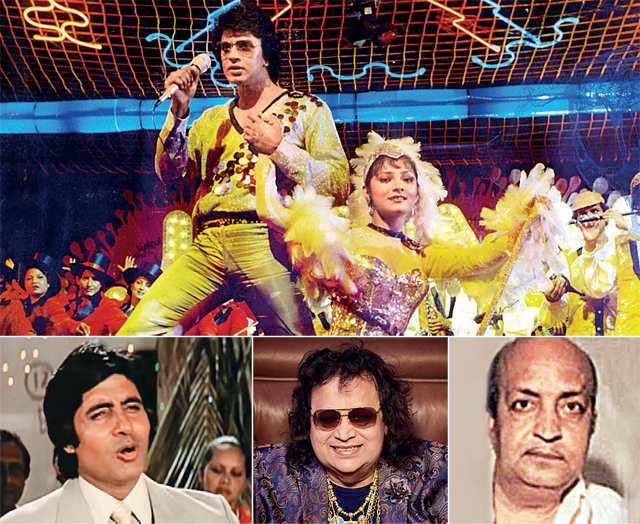
Top:
Mithun Chakraborty in Disco Dancer; (Above from left) Amitabh Bachchan
in Sharaabi; Bappi Lahiri; Anjaan collaborated on several hits
Roshmila Bhattacharya (MUMBAI MIRROR; November 2, 2018)
The name Lalji Pandey will not ring a bell even if you are a Bollywood aficionado but mention Anjaan and he’s not anjaan anymore. One of the most versatile and prolific lyricists, his words spun heart-felt melodies and foot-tapping chartbusters in equal numbers over five decades.
Among his frequent collaborators was India’s ‘Golden Man’, the irrepressible Bappi Lahiri who teamed up with Indeevar for the South potboilers, usually featuring Jeetendra and Sridevi, and scored equally big with Anjaan with Big B bonanzas like Namak Halaal and Sharaabi to name just two. “Indeevar and Anjaan ji were to me what Hasrat Jaipuri and Shailendra were to Shankar-Jaikishan. Anjaan ji and I gave innumerable kamaal ke superhits, including all the Disco Dancer songs, except for one Farukh Kaiser’s 'Koi Yahan Naache'. Hamara choli-daman ka saath tha and it was a proud moment for me to see the Tri Services band marching down Moscow’s Red Square to the beat of 'Jimmy Jimmy Jimmy Aaja Aaja, our song,” Bappida beams. This Disco Dancer track was also used in the Adam Sandler film, You Don’t Mess With The Zohan.
Bappi da goes on to inform that more recently, Dev Patel’s Oscar-nominated Lion also incorporated one of their songs from Kasam Paida Karne Wale Ki, “Come Closer”. Also, a special Hindi promotional clip of Guardians Of The Galaxy Vol. 2 had featured another popular song from the film, “Jhoom Jhoom Jhoom Baba”. The film’s leading man Chris Pratt reacted to it, exulting, “Whoa.. wow… I wonder if it’s too late to put that music in... instead of the music we’ve played... whoa... people are going to flip out!”
Prod the singer composer on the man himself and a picture emerges of Anjaan as a largehearted person with absolutely no ego, sincere and hard-working, who had a way with words. He flashbacks to Prakash Mehra’s 1984 film Sharaabi which bagged him the Filmfare Award for Best Music Director, and in particular “Manzilein Apni Jagah Hain Raaste Apni Jagah” for which Kishore Kumar, who had given playback for the song, took home a Black Lady as well. “Prakash ji gave Anjaan ji a mukhda he had scribbled telling him he could rewrite it if he wanted. Anjaan ji told him, ‘You have written such a beautiful mukhda, let me write the antaras for you now.’ He didn’t change a word of what Prakash ji had written which just goes to show his generosity of spirit,” Bappi da asserts.
He is also all praise for every antara of “Mujhe Naulakha Mangaa De”, saluting the wordsmith with, “Kya baat!” He then goes on to reveal that Amitabh Bachchan had requested Prakash ji to incorporate “De De Pyaar De” in the Sharaabi score. “Anjaan ji had written the song and I had recorded it in London with Runa Laila for the album Super Runa. In the film, they used two versions, one with Kishore mama and the other with Asha ji. Both superhit!” he avers. He adds that their song, “Gori Hain Kalaiyan” for Aaj Ka Arjun, was the No 1 song of 1991 on the countdown show Binaca Geet Mala.
Memories are mixed with melodies as Bappi da goes on to recall how Anjaan ji, when he was visiting him, had requested his singermother Bansari Lahiri for a Rabindra Sangeet. “My mummy sang 'Tomar Holo Shuru, Amar Holo Shara' and he reworked the lyrics to come up with “Chukar Mere Man Ko, Kiya Tune Kya Ishara” for Rajesh Roshan in Yaarana. Bahut pakad thi, he had a tremendous grasp over language. His son, Sameer, is a fabulous lyricist as well, with whom I have done a lot of good work, but aaj bhi main Anjaan ji ko bahut miss karta hoon. When he passed away, my heart broke and for a while I wondered how I would make music without life. Life goes on, but the musical memories remain,” he sighs, crooning “Yaad Aa Raha Hai Tera Pyaar, Kahan Hum, Kahan Tum, Hue Tum Kahan Gum…”
Subscribe to:
Posts (Atom)