Showing posts with label Dhadkan. Show all posts
Showing posts with label Dhadkan. Show all posts
Shilpa Shetty, Suniel Shetty on Dhadkan turning 25: "I knew people would relate to the film"
5:13 PM

Onkar Kulkarni (BOMBAY TIMES; August 14, 2025)
Twenty-five years ago, Dhadkan, starring Suniel Shetty, Akshay Kumar and Shilpa Shetty Kundra, and directed by Dharmesh Darshan, became a hit, with its songs achieving immense popularity. While Dev (Suniel) and Anjali’s (Shilpa) love story in the film remained incomplete, 25 years later, the two actors reflect on the emotional rollercoaster behind the film’s scenes and share why Dhadkan strikes a chord with audiences even today.
Dhadkan is keeping me alive through the third decade of my career: Suniel Shetty
Action works only when there is emotion. I have always backed my action with emotion, because then it works like magic at the box office. I was following the vision of director Dharmesh Darshan, and that made it far easier for me. We are well aware how Dev’s character came alive on screen. Dhadkan means the world to me because it’s keeping me alive through the third decade of my career. After the film, my life changed as an actor. Also, my approach changed, as I looked at every role with as much intensity and understood that acting is all about getting into the skin and putting your heart and soul into the character. I was never known to be a brilliant actor, but it was because of Dhadkan that people started believing that Suniel Shetty can act! The credit goes to our director, Dharmesh Darshan.
Dulhe ka sehra was the most difficult song of my career: Shilpa Shetty
It wasn’t a scene that we shot first. We shot the most difficult song of my career, Dulhe Ka Sehra. I was sporting a blue lehenga. We were shooting in Film City, and my sister, who had just learned to put mehendi, did the full mehendi design on my hands with a sketch pen. She touched it up every two days because the shoot of the song went on for a good eight days. I remember for the bidaai scene, Dharmesh wanted me to cry in a particular way and look at Kiran ji (Kiran Kumar, who played her father). We did some 20 takes for that shot. Dulhe Ka Sehra went on to become a huge hit. I knew it was a film that many people would relate to.
Shilpa on the most challenging scene in the film
I remember the scene when Suniel comes back, and we meet in his hotel room after the song Aksar Iss Duniya Mein. I tell him, ‘Iss janam mein toh kya, mein agle saat janam tak Ram ki ho chuki hoon.” And then, he says the iconic line, ‘Main tumhe bhool jau, yeh ho nahi sakta, aur tum mujhe bhool jao yeh main hone nahi doonga.’ I feel it could have been very cheesy if we hadn’t said it with conviction. It was a very complex scene.
If Dhadkan was to be remade...
Shilpa: I’m not pro remakes because I think it kills the whole essence and the soul of a film. But, if it had to be remade, maybe Alia Bhatt as Anjali could fit well with Ranbir Kapoor as Ram and Ranveer Singh as Dev
Suniel: Only Dharmesh Darshan can do a good job with its remake, and Ahan (Shetty) can play my role, Dev
Suniel on Arbaaz Khan and Sanjay Dutt being considered for his role in Dhadkan
I know that I was the first choice for the film. Initially, I had to turn it down because things got delayed and my dates were clashing. Eventually, I did it purely because Dharmesh wanted me to.
I am one of the few artistes who are very particular even about kissing on screen-Shilpa Shetty
8:20 AM

All for experimenting and risk-taking on OTT, Shilpa Shetty Kundra draws the line at onscreen intimacy
Navya Kharbanda (HINDUSTAN TIMES; February 21, 2024)
Having ventured into the OTT space with Rohit Shetty’s Indian Police Force recently, actor Shilpa Shetty Kundra is all praise for the medium. She says, “When you are going theatrical, there’s a lot of pressure on whether the role or that kind of content will be accepted. OTT, on the other hand, allows artistes and filmmakers to take risks.”
While the web space brings with it more scope and liberty to experiment, the 48-year-old still has her reservations while picking scripts. “I want my kids to be able to watch my content. So, I always do family-oriented stuff. I am one of the few artistes who are very particular even about kissing on screen. I have never done it. I am clear about what I can and can’t do.”
A significant advantage of working in web projects is that one gets to operate without the pressure of the box-office. And Kundra experienced that firsthand when her last big-screen outing, Sukhee, found its audience on OTT after a dismal box-office run.
“[While doing web shows,] I feel like I can throw caution to the wind and do interesting stuff without being judged by the box-office collections,” says the actor, who feels one’s personal growth reflects in their professional graph too — which is what is happening with her right now.
“There was a time when I did glamorous films, and then I did serious cinema with Dhadkan (2000), Dus (2005), Life In A... Metro (2007),etc. Just when I was starting to understand the craft, I got married and took a sabbatical. Now, I feel like I am rediscovering myself. That’s why, people saw a new Shilpa in Sukhee,” she ends.
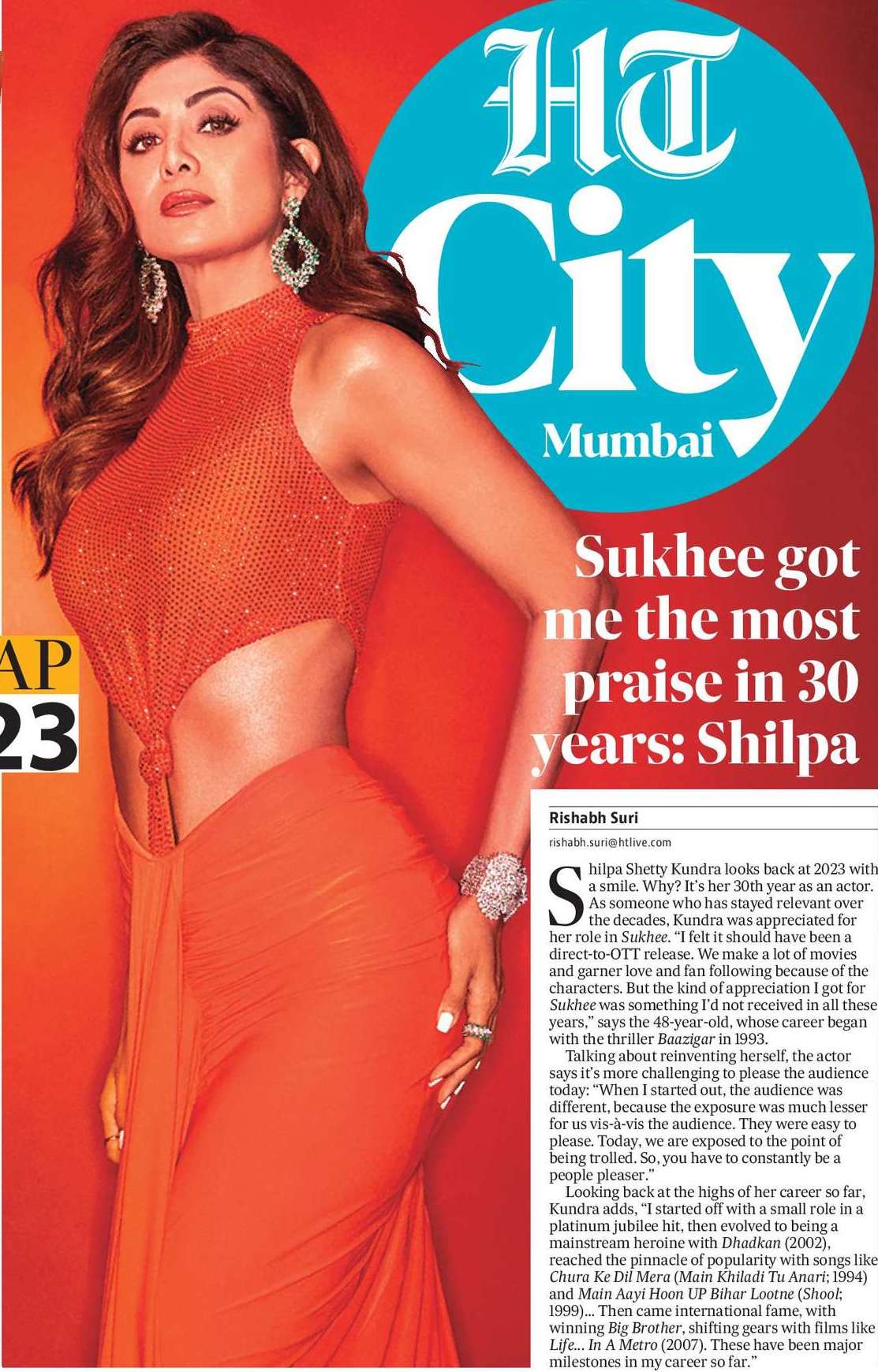
Sukhee got me the most praise in 30 years-Shilpa Shetty
11:05 AM
Rishabh Suri (HINDUSTAN TIMES; December 27, 2023)
Shilpa Shetty Kundra looks back at 2023 with a smile. Why? It’s her 30th year as an actor. As someone who has stayed relevant over the decades, Kundra was appreciated for her role in Sukhee. “I felt it should have been a direct-to-OTT release. We make a lot of movies and garner love and fan following because of the characters. But the kind of appreciation I got for Sukhee was something I’d not received in all these years,” says the 48-year-old, whose career began with the thriller Baazigar in 1993.
Talking about reinventing herself, the actor says it’s more challenging to please the audience today: “When I started out, the audience was different, because the exposure was much lesser for us vis-à-vis the audience. They were easy to please. Today, we are exposed to the point of being trolled. So, you have to constantly be a people pleaser.”
Looking back at the highs of her career so far, Kundra adds, “I started off with a small role in a platinum jubilee hit, then evolved to being a mainstream heroine with Dhadkan (2002), reached the pinnacle of popularity with songs like Chura Ke Dil Mera (Main Khiladi Tu Anari; 1994) and Main Aayi Hoon UP Bihar Lootne (Shool; 1999)... Then came international fame, with winning Big Brother, shifting gears with films like Life... In A Metro (2007). These have been major milestones in my career so far.”
Covid claims Bollywood composer Shravan Rathod
7:57 AM

THE TIMES OF INDIA (April 23, 2021)
From Husnlal-Bhagatram to Shankar-Jaikishan, from Kalyanji-Anandji to Laxmikant Pyarelal, Hindi film industry has a rich tradition of musical partnerships. Nadeem-Shravan forged an illustrious link to this abiding chain composing a staggering bunch of chartbusters in the 1990s. On Thursday evening, the alliance was snapped forever as the Coronavirus claimed the life of Shravan Rathod at a Mumbai hospital. He was 66.
Speaking to Bombay Times, Nadeem Saifee said, “My Shanu is no more. We have seen an entire life together. We saw our highs, we saw our lows. We’ve grown up with each other in many ways. We never lost touch and no physical distance could ever separate the two of us. I am in deep pain as I say this but my friend and my companion, my partner of so many years is no more. It has left such a vacuum.”
The pair started off with ‘Dangal’ (1977), the first Bhojpuri film made in colour. ‘Kashi Hile Patna Hile’, a reworked version of the popular folk track, ‘Aarah hile Chhapra hile’, became a sensation. The two graduated to Hindi cinema in the 1980s.
Tuneful melodies for films such as ‘Maine Jeena Seekh Liya Hai’ (1982) got them work but major success eluded them.
The duo hit the jackpot with Mahesh Bhatt-directed ‘Aashiqui’ (1990). Every song in this intense romantic drama, from ‘Dheere dheere se meri zindagi mein ana’ to ‘Bas ik sanam chahiye’—rose to the charts. The film also vaulted Kumar Sanu, who sang a majority of the tracks, to the top. Nadeem-Shravan became a hot property.
The 1990s belonged to them. ‘Saajan’, ‘Deewana’, ‘Dil Hai ke Manta Nahi’, ‘Phool aur Kaante’, ‘Hum Hain Rahi Pyar Ke’, ‘Raja Hindustani’ and ‘Pardes’—they lorded over the decade blending old school melody with modern instrumentation. Songs such as ‘Mera dil bhi kitna pagal hai’ (Saajan) to ‘Pardesi pardesi jaana nahi’ (Raja Hindustani) to ‘Do dil mil rahe hain’ (Pardes) were as popular among the college crowd as the truck drivers on the highway. The pair won the Filmfare award three years in a row, 1991-93, for ‘Aashiqui’, ‘Saajan’ and ‘Deewana’ and again in 1997 for ‘Raja Hindustani’.
It seemed that the two would rule over Bollywood for another decade or two. But things were never the same after Nadeem’s name cropped up in the killing of a music baron and he fled to London. The duo still kept providing scores together in films such as ‘Kasoor’ and ‘Dhadkan’. The two split once, then reunited. This time, sadly, the separation is final.
I was just 17; had never even hugged a boy before this, says Shilpa Shetty about her first day at shoot on Baazigar sets
8:23 AM

As told to Ankita Chaurasia (MUMBAI MIRROR; August 20, 2020)
The first film I shot for was Gaata Rahe Mera Dil. Ronit Roy, who was a big name at the time after Jaan Tere Naam, and his brother Rohit, were my co-stars and I had shot for my introduction scene with the latter. The makers had announced my debut with a huge close-up picture in a trade paper. But the film never saw the light of the day. However, my picture got noticed and landed me Baazigar opposite Shah Rukh Khan, who I had been a fan of since his Fauji days.
The first time I faced the camera was for the song, “Aye Mere Humsafar”. Other unit members had all carried duvet covers and bedsheets from their hotel rooms to the location. It was eight degrees in Igatpuri and I was shivering in a flimsy salwar kameez because I had no idea it was going to get so cold.
I was just 17 then, straight out of college, and though a lot of boys liked me, I hadn’t even hugged one before. I was really innocent, but luckily, the song required me to look nervous, so it worked.
I didn’t even know how to lip-sync and was standing with my back to the camera for my first scene. Rekha Chinni Prakash, the choreographer, kept screaming “Cut” and telling me my hair was obstructing the shot. Thank God for Shah Rukh, who took me aside and told me that the camera is my audience so even though I was giving beautiful expressions, no one could see. That bit of advice has stayed with me.
Honestly, I didn’t think I would last this long. Looking back, I think I got the hang of acting only after Dhadkan. Working with (director) Dharmesh Darshan and then, Revathi in Phir Milenge made me fall in love with cinema and the art of acting. Before that, I was just having fun. And had started commanding a high price from my second film itself. After the Main Khiladi Tu Anari chartbuster, “Churake Dil Mera”, I hit the jackpot. I didn’t come from a filmy background, so it was all about buying a car and a bigger house. Thankfully, the audience was much more forgiving back then. When I see my hair and makeup in old movies, I want to hide under the chair.

I don’t want to compete with Akshays & Ajays because you know you don’t stand a chance-Suniel Shetty
8:40 AM

Now a familiar face in South Indian films, the actor talks about riding the choppy waves of public adulation
Kunal Guha (MUMBAI MIRROR; March 15, 2020)
At 58, Suniel Shetty is still built like a tank. He brushes his hands over his salt-and-pepper beard as he settles down for this interaction at his Aaram Nagar office. The actor may have slipped off the Hindi film radar, but he has been making waves down South. In recent months, he’s shared the screen with Rajinikanth (Darbar), Kichcha Sudeep (Pailwaan) and will soon be seen in Mohanlal’s epic period war film Marakkar - The Lion Of Arabian Sea. “The passion to create and love for life” is what keeps him going, he says. “There’s a generation that has forgotten me and a younger generation that respects me for my fitness, rather than for my films,” he says. “They think you’re yesteryear’s [star]… but they don’t know why you’re not working.”
Shetty shares that he was comfortable with his extended sabbatical; he never thought he’d end up working in South Indian films, despite having done cameos in the past [Kalimannu (2013) and Kakkakuyil (2001)]. “I didn’t want to do a negative role and any actor from Bollywood who goes there is offered just that. They believe that you’re a national-level hero, so if any of their heroes can beat you up, it’s the best thing ever.” His recent film choices, he says, were driven by passion and uncertainty. “When you’re back from a long sabbatical, the best work doesn’t come your way and I wasn’t even sure if I can act,” says the actor credited for 128 films.
The response that Darbar and Pailwaan received, however, encouraged him to consider more projects. In the forthcoming Mosagallu, he dons the avatar of a powerful cop, while he plays a 16th century warrior in Marakkar - The Lion Of Arabian Sea. Unsurprisingly, Shetty’s invincible action hero image from the 1990s still has traction. He credits veteran actor Danny Denzongpa for helping him carve this image in his debut Balwaan (1992). “When we were brainstorming on how to make my character seem powerful, Danny Sa’ab suggested that I carry him on my shoulders and then drop him. The last person who had lifted him up in a movie was Amitabh Bachchan in Khuda Gawah. This tip worked like a charm.”
But at 58 it’s getting tougher to keep up with that image. Of an action sequence shot for Darbar, where he was expected to “fall and throw five kicks and six punches”, he says, “I asked a 19-year-old assistant if he felt I’ll pull it off, and he said ‘Very easily, sir’. Then, I asked him how old his father is, and he said 54. I told him, ‘I am 58, so if your dad can do it, I’ll do it’.”
Shetty made several attempts to shake the image of a brooding, death-defying action star, but it was never “accepted”. “I tried comic and socially-relevant films too, but they didn’t work,” he says. “My producers would only say, ‘Do action scenes aur ek baarish mein gaana daal dena, body dikhake’.” In fact, the feedback he received from his family for his non-action films was just as telling. “I would ask my parents and kids, ‘How’s the film?’ and they’d say ‘Brilliant’ and then later, ask for a Saridon. So, you know where you stand.”
Post Hera Pheri (2000), a milestone in Shetty’s chequered career, many were convinced that he also had the chops for comedy. “And that was validation for an actor who was dismissed by critics as ‘absolutely wooden’,” he says. But there was always a back-up plan. Shetty ran a restaurant and boutique business before films and if acting didn’t work out, he would have to swallow his pride and listen to friends say, “Actor banne gaya tha, wapas aa gaya”. But since he had signed about 14 films even before his debut, there was no looking back.
Later, Shetty decided that rather than struggling to dazzle his audience with his performance, he would startle them with death-defying stunts. “I took on action stunts which were so dangerous, people would say ‘Alag hain’,” says the actor, who remembers that some of them actually lead to serious injuries. “While shooting for Mohra [the 1994 hit], when I lost a ligament, I was told to go for surgery but I couldn’t as 17 films were pending. Kitchen usi pe chal raha tha,” he says. “I would shoot for Mohra during the day and then strap my ankle and go shoot for Gopi Kishan at night. I’d only get two hours to rest — while commuting between Mukesh Mills and Filmistaan.”
Only time will tell if his son, who makes his debut this year with Milan Luthria’s remake of RX100, is cut from the same cloth. While Shetty believes Ahan will be able to handle success, he worries about how he will deal with failure. “There will always be brickbats, and nowadays, any faceless person can take pot-shots at an actor. But I’m sure Ahan will fight back,” he says.
Reflecting on his own experience, Shetty shares that when he started out, he was “barely ready to take on the world”. “We felt personality hain, we’ll wing it. But dialogue bhi bolna hain, naachna bhi hain and both haath aur pao ke saath nachna hain,” he says with a laugh. The actor got a lot of flak for his puppet-like moves and peculiar voice. “Every newbie thinks that you’re the next Bachchan. But then you watch your film and think ‘Sh*t, I really need to learn the craft’,” he says. Incidentally, this was what he told his daughter Athiya after her debut Hero opened to a lukewarm response. “Then, she really worked on her performance and the result can be seen in Motichoor Chaknachoor,” he says of her third film with Nawazuddin Siddiqui.
The actor, who counts Border (1997) as his most gratifying film and credits Dhadkan (2000) for helping him sharpen his craft, learnt lessons of his own along the way, too. “Dharmesh [director Darshan] told me ‘Just really believe you’re the character’. That’s when I realised that the most important thing for an actor to do is to invest 10 per cent mind and 90 per cent heart,” says Shetty, who does not grudge his peers their succes. “I don’t want to compete with the Akshays and the Ajays because you know you don’t stand a chance,” he says. In fact, he appreciates their strengths. “Jackie Dada’s [Shroff] personality is so loving and affectionate that if you give him attitude, he’ll just ignore you; Amit ji’s [Bachchan] humility makes you feel, ‘Amitji aise hain, toh main kaun hoon’, while Salman Khan has mastered the art of commanding attention and respect without saying a word,” he says.
I want to bring our history books alive-Akshay Kumar
8:20 AM

Meena Iyer (DNA; August 6, 2018)
Akshay Kumar (50) is having the best time of his life at the movies. Forgotten is that phase when he was infamous for doing mindless action in Bollywood’s assembly-line films, most of which resembled the other. Today, Akshay is on top of his game.
Completely at ease in meaningful cinema — most of them propagating good causes and patriotism in equal measure — the erstwhile Khiladi is now considered a master of the game. His films pack a punch, his roles have gravitas and he’s having a ‘golden’ (no pun intended on his next film’s title) run.
Meeting the super-confident megastar and listening to him speak about all things Indian is always a pleasure. Over to AK:
You are building a brand for India through your cinema, what with your films having heavy doses of patriotic fervour and all. Is this deliberate?
Of course, it’s not deliberate. Brand India is much more important than Brand AK. I’m a small cog in a wheel and I don’t give myself that kind of importance to even think that I’m the one who is doing anything significant. If you are seeing a change in the kind of cinema I’m currently dabbling in, it’s because I have started to meet a lot of people, who have so many stories to share.
There are such amazing tales that often end up just remaining in our history books. I want to bring them alive, I want to revisit them through my movies. For example, my film Kesari, which is based on the Battle of Saragarhi, is an amazing story of courage. I remember reading about Saragarhi when I was in school. Back then, it was just another battle. But the wonderful part is that while making the film, I learnt so much more about it. And believe me, when people watch it, they will also be amazed at what that battalion of 21 Sardars/Sikh soldiers did. While Hollywood revisits a film like 300 (which revolves around 300 Spartans who fight the Persians) on a mammoth scale and makes people realise the real significance of such a war, not many people know about the 1897 Battle of Saragarhi in which 21 brave Sikhs were up against 14,000 Pashtun Orakzai tribesmen from Afghanistan. We have so many good and inspiring stories to tell our future generations. And, when I hear or revisit some of them that can lend themselves to fantastic scripts, I feel the urge to be a part of such cinema. It is not a conscious decision to try and do films with a patriotic bent. It is the other way around. Patriotic movies are being brought to me and I’m drawn to them because, as I pointed out earlier, these need to be taken to a larger audience.
It’s too much of a coincidence though, that every second script you pass these days has a ‘jingostic’ message in it!
I want to bring the history textbooks alive. Take Airlift, for example. Before the film was announced, did you know that 1,72,000 Indians were airlifted and brought back to their homeland from under the nose of Saddam Hussein after his Iraqi army invaded Kuwait? Back then, barely a couple of articles were published. But after the film released, thousands were written. It’s a known and proven fact that visuals will remain in your memory for a longer period of time than the written word. That’s the whole idea behind making a film like Airlift. I consider myself lucky to get such subjects.
Your Independence Day release Gold talks of India’s first gold medal in hockey. Did you know about this chapter in history or did you hear it from director Reema Kagti when she approached you?
Reema came over, introduced herself and mentioned the films she has made. Then Javed saab (Javed Akhtar) told me about the movie’s subject. I was surprised to hear ki aisa hua tha... achha, yeh bhi hua tha. There were so many things I learnt from Javed saab that day — how in 1936, we won our first gold as British India. However, on that occasion, the Union Jack was raised and we had to salute to it. There were so many problems after they left our country and we became an independent nation in 1947. Within a year, we had to prepare ourselves to bring a team not only to England but also to play against every other country. In the end, it was India against the British, it was the slaves versus the masters. I was shocked. If you asked someone how India won its first gold medal, probably just a handful of people would be able to tell you. Even I didn’t know about it. But after watching Gold, I’m sure many will share this story. This fact needed to be brought to light. Our country has so many sportspeople and can produce so many more too. I’m glad things are changing now. Recently, Hima Das won India’s first gold medal in a track event. I was super excited about her victory and I want to encourage others like her to come forward. We have won the gold in various sports, but never in athletics. We have to keep at it, not rest on our laurels.
In a lighter vein, you also fill the gaps between your patriotic movies with films like Housefull 4.
(Interrupts) I can’t leave those films either. I need those, too. And I will be doing such movies every once in a while. When I started my career, for about 15 years I suffered as the media only called me an ‘action hero’. I used to ask producers to give me a comic role or a romantic character or even a serious part. After a long time, filmmaker Priyadarshan gave me a chance with Hera Pheri (2000) and later Dharmesh Darshan gave me Dhadkan in the same year. When I tasted success during this phase, I swore that I will never let anyone tag me or stereotype me. So, I continue to dabble in genres.
Whatever you may say, these days your movies do have that pro-India twist.
The answer is in your question. I’m not talking about Brand Akshay Kumar. However, subconsciously, I do want to keep building on Brand India.
How do you continue to motivate yourself to go to work each morning?
The motivation comes from doing different kinds of roles. When I used to do only action, I hated going to work. I’d think wohi toh karna hai, fight karna hai, kick maarni hai, thoda dance karna hai. However, in the last decade, I have more motivation to go to the studios. Not only have I started to strike a balance in the type of films I choose but I also go to a set only for three months at a stretch. After that, I need a change because after doing one film for 90 days, I get bored. I want to enjoy doing every film I commit myself to. I am super-disciplined. I get to work as early as 8 or 9 am. And I am on set till 5 pm. I don’t waste any time on set. I work on one film at a time, wrap it up within a stipulated period and before boredom sets in, I’m finished with the project.
Besides shooting, what else gives you maximum joy?
Frankly what I enjoy most is picking up my children from school. I also love to stay fit, so I keep trying out a new fitness regime from time to time.
Do you also help your daughter to do her homework?
(Laughs uncontrollably) Never. That is my wife Tina’s department. She is the brain in our home, I am the brawn. And I have no qualms about admitting it. I definitely participate in a lot of sport with my children. My wife is slightly weak in that department (smiles).
You never seem to relax. Even your vacations are all about goals...
There’s no waste of time. We have only one life. When you sit on the couch, play a game on the computer or just sit doing nothing, soon your cholesterol levels will go up. It’s not that I don’t enjoy chilling out. On vacation, I do indulge myself in good food, desserts and even put on some weight. But after the first week, I feel the need to do something constructive.
Besides acting, you’re also producing films. Don’t you want to direct?
No, I don’t want to venture in that direction. I want to be happy (laughs).
I might get shot someday, as I say some honest things-Shilpa Shetty
7:55 AM

Recalling a quarter century in showbiz, the Baazigar heroine, now new-media star, opens up on films, food, fashion, fitness
Mayank Shekhar (MID-DAY; May 27, 2018)
To start right from the beginning, you literally stooped to conquer with your debut, Baazigar (1993), falling off a terrace, and rising as a star. Take us through that iconic scene. Hear there was no body-double, VFX, you actually hung there for three hours in a harness?
It was the whole shift, not just three hours! The only time they got me down was during lunch-break. We shot that sequence, the same way, over four days. And we shot it several times. Back then, we had no technology — just getting a hang of even the green [chroma] screen. They shot me falling with the harness on, and with the camera on top, and there was a building cut-out, which was moving. The harness marks are still there on my belly bone. They left deep cuts, as they were not sponged. I am just happy, I was okay. Being new, I didn't know any better.
You were 17, that's almost child labour!
Which is what I am saying. When you are young and don't know much, you are open to experimenting. I had no idea why I was in the movies. I was offered a role, and I did it. Because there was so much effort put into that sequence, I guess it stood out.
But Bazigaar was not your first film. There's one called Gaata Rahe Mera Dil, a love-triangle, with Rohit and Ronit Roy. Were they playing brothers in the movie?
No! And I want to kill you for bringing this up. It's my deep-dark secret. It was my first film. Fortunately, or unfortunately, it didn't happen.
Why unfortunately?
Because the financers ran out of money, and I don't think I would have become this big a star, given Baazigar was a platinum-jubilee hit. And nothing succeeds like success! Gaata Rahe Mera Dil was supposed to be directed by Dilip Naik, who was earlier an assistant to Yash ji [Yash Chopra]. He saw me at an agency, where I was giving a screen test.
You were already modelling then?
Yes, I had finished school, and someone had clicked my photographs. It was completely random. I had to no inkling of what I was doing in the industry, or how I got here. It was all chalked out by God. At that time, Jaan Tere Naam had released, Ronit Roy was really big, with his famous song, Yeh Akkha India Jaanta Hai. So I was like, "Woah! I am going to work with Ronit Roy." The script was centred on the girl, who falls in love with this guy, who dies. She loses hope, and someone who looks like him, comes into her life. The guy gets killed because of [his love for] music...
Sounds like Kaho Naa Pyaar Hai to me.
No, it wasn't. I'm not getting into details.
Why, someone else will steal that script?
No! So, anyway, someone at Venus [production company], which was auditioning for Baazigar, saw my pictures in a full-page ad, in a trade paper [announcing my debut]. Sridevi ji was supposed to play a double-role in Baazigar initially, because that is how the original film [A Kiss Before Dying] is [supposed to be].
Apparently when Abbas-Mustan told you Baazigar was a remake of A Kiss Before Dying, the first thing you said was you're not going to kiss in the movie!
Yes. I was really dumb [laughs]. I told them clearly that I won't kiss in the movie. I haven't kissed on-screen. That was always my condition.
But it was a rule with a lot of people then. Salman (Khan) still doesn't.
Yes. Shah Rukh Khan kisses?
Yes.
Earlier even he had this condition in his contracts. I got away with it. Imagine if I was in the industry now!
The other thing you had an issue with, you've mentioned, is with Hindi. Odd, since you grew up in Chembur, no?
I could speak Tulu well, having spent a lot of time with my grandmother in Mumbai. We would speak English at home. I spoke Hindi on the 'katta' at Poddar College, for half a year that I went to college. I am also a college dropout, if you remember. And the Hindi was all, "Aata hai, mereko, tereko…" My grammar was rubbish. In Bazigaar I would get my lines in my small make-up room in Film City. I would write those lines in English [Roman script] first. After, "Start sound, action," the camera would roll at a volume 10 time louder than usual, and I would forget all my lines. I remember Shah Rukh telling me, "Just perform for the audience. Forget that the camera is staring at you. Just do it as if no one [around] is watching." This was of great help.
So you went back to college after Baazigar?
My father had put just one condition — that I complete my education. He wanted me to join his business. We made pilfer-proof caps for medicine bottles. It was interesting, but not something I wanted to pursue. So after Bazigaar released, I'd go to college, and there would be a traffic jam. Even dad realised that it'd be difficult for me to keep up with the curriculum.
You do Bazigaar, then Main Khiladi Tu Anari (1994), which is just as huge. Seems like Vivek Oberoi's career to me: Company, then Saathiya, and then a bunch of films that few talk about. True?
[Laughs]. But, you know, strangely, a lot of songs from all the films that we don't remember are big hits, even today. That's the funny thing about my filmography. People don't remember the movies. But they do recall the terrible songs!
Why terrible, they were hits!
They were really terrible. Like I remember this song, Tak Taka Tak [Zameer], and then we had Barana De [Insaaf]. They were hilarious. But I was getting paid. I'd do my job, and get out. With due respect, I really think I am blessed.
You made a massive comeback with Dhadkan (2000), which is considered a landmark, in terms of commerce, yes, but you were also taken seriously as an actor.
Yes, before Dhadkan, I was doing only glamorous roles; and in the '90s, the film industry was predominantly male-dominated. It still is, but is gradually changing. At that time even the heroines didn't care. We were paid, and it was fewer days of work on a film. We did three shifts. It worked out well. Dhadkan took five years to make. By which time I had been totally written off. Akshay [Kumar] had had some major flops. Suniel [Shetty] also had had terrible flops. So, all three big flop-actors were in one movie. The film got shelved. Dharmesh [Darshan] started working on Mela, with bigger stars. His point was, "Itne saare flop actors ko kaun jayega theatre main dekhne!" I went begging to Dharmesh's mom, told her my life has come to a standstill — why doesn't her son want to make this film? I've never narrated this incident before. So, she later spoke to Dharmesh, and told him, "Kisi ki haai nahi leni chaihye. Movie ko complete kar de." Dharmesh finished Dhadkan. Mela flopped. Our film became a big hit, because of the songs, or my prayers. That's life.
The songs are still huge.
Yes, they still play at weddings.
But looking at your career in terms of pure performance, Phir Milenge (2004), stands out, right? Strong role, non-mainstream film, much loved.
For sure. I give a lot of credit to [director] Revathy. She made me believe that people love you for who you are, and the character you project. And not the make-up you wear. I was playing someone detected HIV positive, and I decided to use a bit of concealer and kajal. She said, you can't do this! When I shed my inhibitions, I felt like a new person. But there was a film called Rishtey [2002], where I had put it far more effort, which was, again, a huge flop. I played a Koli woman, worked on my dialect, spoke in Marathi, with a twang. There were long dialogues, and the very first scene that [director] Indra Kumar shot was the confrontation scene, the climax, between Karisma [Kapoor] and me. I was supposed to slap her, she pushes me. How am I going to do this? I got nominated for the part, but didn't win any awards. That was the most difficult role of my career.
Shouldn't the toughest part be playing yourself in [the reality show] Big Brother, being locked for three months, in the UK (2007)? You'd seen the show before? What made you do it?
I had watched the show, yes, but didn't know what I was getting myself into. My career was going through a lull. So was I, personally. When they offered me the money they did, and said I just had to play myself — firstly, I had no idea why they wanted me. After I came out of the house I realised there is a huge Indian diaspora they were catering to.
And you were the only foreigner in the house.
Yes, feeling like an alien. It was the first time I had been abroad alone, left to fend for myself. I was used to walking with an entourage. Here, I was a glorified maid — cooking, cleaning, since no one else [in the house] was interested. To top that, everyone would complain. It was a thankless job. They spoke about how I was eating with my hands, bitched me out. One had no idea how people were perceiving you from outside. Suddenly, in the second week, I saw helicopters circling the house, shutters were coming down. The scale on which they were shooting was really huge.
Looking back, what did it teach you?
Firstly, it makes you brain-dead. For three and half weeks, I always felt that I would get eliminated. I was praying to get out. After a fortnight, I realised something was happening. I was being treated badly. But I never put it down to racism. I just felt like the girls were very insecure.
But the racism row became huge, even discussed in the British parliament. What was it like living through that?
After I came out, they first took me to a psychiatrist. I was mentally scarred [laughs]. The one thing I remember vividly was that I had forgotten how to use a phone, or type messages. [As for public response] I had children and old ladies come up to me and cry. At some point they had faced racism. They could associate me with their experiences. A lady told me, "After Gandhi ji, if there is any Indian that people will know by name, it's Shilpa Shetty." That was a big compliment. But it was a scary and unnerving experience at the human level. So when I met Gordon Brown, he apologised; Tony Blair did the same. Every time I met someone, they would apologize, saying, "We aren't like this. It is terrible what you went through." They felt huge guilt. Today, if you ask me to be part of Big Brother, my answer would be no.
But what do you make of that kind of fame: it's overnight, and disappears overnight, too? Did that happen?
There was a lot I did there [in the UK] for almost a year and half. I got married after, so I didn't want to do anything. I was offered [BBC's] EastEnders. But anywhere you want to make a base, you have to make that country your own, and I wasn't willing to do that. I didn't do it for marriage, wouldn't for work.
Is that where you met your husband (Raj Kundra)? How did that happen?
A month after Big Brother, Raj was introduced to me through a common friend. Anybody who becomes famous there, can have a perfume [brand of their own]. And guess what, it even does well [laughs]. So Raj knew the owners of my perfume company. I had a firm doing the deal, but Raj offered me triple the money. He had a soft spot for me. And I was like, "He's such a cute guy!" So I did the deal, and that's how we met.
Another unique facet of your public life is that after a stint on films, TV, you're the first Indian celebrity to get on YouTube, starting out with fitness stuff. Would that be correct?
I'll tell you why there are no celebrities on YouTube. Because it doesn't make you any money [laughs]. People go there to become celebrities. I am a little cracked that way. But I've always been this person. I did a Yoga DVD 13 years ago! I used to be a state-level volleyball player even before I joined movies, and probably the only actress who would go to the gym. The hero would be shocked to find me there. Primarily, I wanted to bring about awareness towards health. It started out in a small way. I spent money from my pocket to shoot videos for YouTube, so people could get back to home-style cooking. I wanted to inculcate habits on how, when, and how much to eat. This whole influx of junk food joints makes me really sad. I've lost a couple of people who were really close, many in my circle are suffering from cancer, and immunity disorders. All this boils down to one thing: our lifestyle, and eating habits. I might get shot someday, as I say some honest things.
Why would you get shot?
Because these huge conglomerates are not happy. As celebrities we are at a blessed position. People take us seriously. So why not make use of that voice with something as important as health?
I know you talk strongly against aerated drinks. Ever asked your contemporary movie-stars to stop endorsing them?
It's not my place. But as celebrities we have great power. Aerated drinks are the worst things to have happened to this generation. My son has never tasted them. He is six, and has actually given up refined sugar. He calls it poison. They say sugar is more addictive, if not as addictive, as cocaine. If you don't encourage your children to smoke, drink, why would you let them have aerated drinks?
Popular diet regimens/fads keep changing every few months. What do you personally advocate?
To keep it simple. Go back to how people ate 70 years ago.
But people were dying damn young 70 years ago!
Maybe you're talking about open-heart surgeries, and advances in medicine. But look at the quality of life they led. And look at ours. Fine, we are living up to 70 years, but with diabetes, and many other illnesses. And I don't want to sound preachy. But if there is a change that has to happen, it is the current generation that we need to target. That's my idea behind getting on social media.
Many would aspire to have a body shape like yours, a lot of which is also determined by genetics, do you think?
You can literally reverse a bad deck of genes, with a good lifestyle. I put on 32 kilograms after my child was born. I just let myself go. I was having a baby really late, and this became my alibi. But I have changed my lifestyle, and with that I don't mean I am not eating. I have a tablespoon of ghee with my lunch. I don't eat after 8 pm. If Raj is late, he has dinner alone! If you are fit and happy, you can be a catalyst in making others happy.
I haven't seen your Yoga videos, but I did see you do Yoga with Baba Ramdev. Honestly, if I become the finest practitioner of Yoga in the world, is Baba Ramdev the best I can look like?
What if I tell you that he's someone who's suffered paralysis, and got out of it with Yoga? He's such a fit man. He was able to single-handedly encourage people to take it up. Only old people used to do Yoga before. The younger generation would hit the gym, or do other workouts: Pilates, etc. Yoga has suddenly got its importance back.
You think the West, especially coastal US, taking to Yoga made it hip back here as well?
That could be one of the reasons. In India, for sure, it was Babaji, though. I give him that credit. As for younger generation, I'd also take some of the credit, for making it look cool! On a serious note, because you brought it up, I don't know why we tend to ape the West so much. The power of Indian food is unbelievable. And while we're copying the West, it's funny that as an antithesis, the West is copying us — using coconut oil, clarified butter, which is ghee...
We touched on food, films, fitness. On fashion, I'm told, you don't wear animal prints anymore. Why? That was your thing!
It was my thing. But then you grow up, and move on. And it's not like I don't wear animal prints. Dolce & Gabbana used it for years, Gucci brought it back. Animal prints will never get out of style. But, I'm slowly turning into a yogini [laughs]. I just want to wear white kurtas, jeans. Just keep it simple. But then, I feel, no one will click my photos then, or they'll grill me on social media!
Final question: One thing I wanted to ask you about was the concept of the 'Bollywood mom', who'd always be with heroines at work, back in the day. True for several female stars, including you. What's it like being at work with your mom?
She was my reality check. Now you have several cameras shooting you, and a video-assist, where you can check the shots. My mom was my video-assist in those days. After the shot, I'd look at her behind the camera, for an okay.
Not the director?
If the director said OK, and she'd go [expresses poor take], I'd be like, "One more!" [laughs]. I'm sure it wasn't easy on her. We didn't have vans. We could be shooting on the road; she'd just take a chair, and sit there. She really made sacrifices; she was just 40 at the time.
Were you living her dream in some way?
I still am. This is the most beautiful life. It's been a rocky journey, a great roller-coaster ride. My manager is sitting on my head, going, "You need to do a film!" I don't have the time. So yeah, I will just take it as it comes.
(Transcribed by Sonil Dedhia, Sonia Lulla, Mohar Basu)

Shilpa Shetty in conversation at mid-day office. Pic/Sayyed Sameer Abedi
Ahan & Aarav should play me and Akshay Kumar in Dhadkan remake-Suniel Shetty
7:59 AM

Nayandeep Rakshit (DNA; June 23, 2017)
It never gets old. Remaking a South film or a foreign film. In recent years, we have seen a lot of that. Akshay Kumar and Sidharth Malhotra did a remake of the English film Brothers, Hrithik Roshan’s Bang Bang was a remake of Knight and Day, Varun Dhawan will be seen in the Judwaa remake and recently Huma Qureshi was seen in the Hindi remake of the horror film Oculus.
All actors have a wishlist. Some of them want to do a sequel to their hit films, while some of them like to see their old favourites remade with younger heroes. While Suniel Shetty’s daughter Athiya Shetty made her debut in Hero, a remake of the Jackie Shroff-Meenakshi Seshadri starrer, we asked him if he wanted to see his son Ahan debut in one of his old films.
Anna (as he is fondly called by his close friends) says he wants to see his 2000 hit, Dhadkan remade. “It should make for a great remake today,” Suniel says. About why he prefers Dharmesh Darshan’s directorial, Suniel explains, “It had the most outstanding music and was an extremely simple film. At the same time, a number of fans talk about Dhadkan till today, so it has an immense reach and recall.” The film had Suniel and Akshay Kumar fighting for Shilpa Shetty’s affection.
Suniel’s choice of actors to reprise the lead roles is also clear. “I want to see Ahan and Akshay Kumar’s son Aarav do it now. It would be fun and will make complete sense.” Let’s see whether Ahan and Aarav would really take the legacy forward!
I call myself a complete misfit-Dharmesh Darshan
7:54 AM

Dharmesh Darshan explains his unannounced sabbatical; why plans of Dhadkan 2 fell through.
Sanyukta Iyer (MUMBAI MIRROR; December 8, 2016)
On Dharmesh Darshan’s 42nd birthday on May 16, 2014, Ratan Jain, who’d produced his 2000 romance drama Dhadkan, featuring Akshay Kumar, Suniel Shetty, and Shilpa Shetty, asked him to announce a sequel. According to Dharmesh, he agreed to come on board as a “director making a comeback” out of sheer respect for his longtime association with his producer friend. Also, he figured he could give the second instalment a modern spin, mounting it on a much bigger budget than the original. However, two-and-a-half years since the film’s inception, Dharmesh has walked out of the project citing differences in negotiations. While he has seceded all association with the development of Dhadkan 2, the producers are now bringing on-board a newer, much younger director, Prem Soni whose last directorial was Preity Zinta’s debut production, Ishkq In Paris three years ago.
“Even though I had said ‘yes’ in principle, I wasn’t too sure after the negotiations that followed. There was a lot of back-and-forth and we worked on the terms of agreement for six months. I had absolutely no need to prove myself — over the years, Dhadkan has become a cult film as well as has made profits via satellite rights. I did not want to make a sequel just for the heck of it,” Dharmesh cleared the air to Mirror, further adding that he went on a sabbatical six years ago after 18 successful years in the film industry. “I was at the top of my game. My directorial debut, Lootere, released when I was 24 and was a super-hit. Four years later, Raja Hindustani made me a leading director at 28. My contemporaries, Aditya Chopra, Karan Johar, and Sooraj Barjatya decided to turn producers and my parents wanted me to follow suit but I didn’t want to chase money,” Dharmesh recalls, noting that he chose to make only seven films, including Mela and Haan Maine Bhi Pyaar Kiya, when he could have directed 70.
Aap Ki Khatir, the 2006 romantic comedy featuring Akshaye Khanna and Priyanka Chopra, would go on to become Dharmesh’s last directorial. On May 9, 2009, his mother, Sheila Darshan, daughter of Nanabhai Bhatt and the older sister of filmmakers Mahesh and Mukesh Bhatt, passed away at 69, making the director retreat into mourning. “My world changed overnight. Two-and-a-half years later, my father (Darshan Sabharwal) passed away on December 31, 2011. In 2007, I had two big-budget films lined up, one whose script I had already completed and was on the verge of taking to the floors. But I returned my signing amount and chose to go a sabbatical in 2010, and have been on a break for the past six years,” he explains, quick to add that there is much more to do besides making films, like teach, and travel and that he has no regrets since he has already broken all box office records of his time and made films like Raja Hindustani and Bewafaa that were “way ahead of their times”. And there’s another reason for his time-off from the film circuit. “In a time of money-hungry producers, everyone courts controversy and everything is about a person’s visibility and validity, I call myself a complete misfit. Fame, name and moolah came to me early on in life, and while they’re important to me as well, I’m not a businessman. Maybe I’m foolish or an artist with integrity,” he asserts.
While he continues to receive offers to remake films or direct sequels, he does not want to touch any of the classics because he believes it is “impossible to redo a soulful film.”
Today, he lives alone, without a partner or any children to cater to. “All artists live through the noise of a film set and the loneliness when in a crowd. While filmmakers manage to work through all kinds of emotions and situations, I cannot exhibit my grief and vulnerability on set. Neither do I crave for the attention anymore, nor do I mind the loneliness,” he says matter-of-factly.
Isn’t the lure of making a couple of crores a tad tempting or worthy of prompting a comeback soon? “Demonetization has proved that anything can happen to your wealth overnight. We’ll never know whether the filmmaker who chased it all was the right one or the one who gave it all up,” he signs off.
Dharmesh Darshan scouting for two new heroines for Dhadkan sequel
7:51 AM

Roshmilla Bhattacharya (MUMBAI MIRROR; April 8, 2014)
 Speaking
to Mirror from Shimla, Dharmesh Darshan admitted that he was travelling
around the country, quietly scouting for two new faces for the Dhadkan
sequel. “They will be the new Shilpa Shetty and Mahima Chaudhary,” he
asserted.
Speaking
to Mirror from Shimla, Dharmesh Darshan admitted that he was travelling
around the country, quietly scouting for two new faces for the Dhadkan
sequel. “They will be the new Shilpa Shetty and Mahima Chaudhary,” he
asserted.Dharmesh, who will be ending his sabbatical with this film, is looking for two terrific dancers with a pan-India look. “Juhi (Chawla) and Karisma (Kapoor) were from the North, Shilpa from down South and Sushmita Sen from the East, there’s never been any regional bias. In fact, I may travel abroad because girls in London and New York are more Indian than girls here. Once I find the duo, I’ll package them according to the requirements of the script,” says Dharmesh who gave Juhi, Karisma and Shilpa makeovers in Lootera, Raja Hindustani and Dhadkan.
Like Aashiqui 2, Dhadkan 2 will not feature the original cast of Akshay Kumar, Suniel Shetty, Shilpa and Mahima. “It’s a fresh concept and a younger film,” he said.
Dharmesh who’s locked the script, says he has “committed in principle”to direct the film for Ratan Jain, but nothing is on paper yet. “If I can make the film without any creative compromises, I’d love to see Dhadkan grow and evolve.”
Raj Kundra dominates outside the house, I inside-Shilpa Shetty
7:57 AM

Priya Gupta (BOMBAY TIMES; February 21, 2014)
Shilpa Shetty Kundra, 38, still considers herself as vulnerable as she always was, but today has learnt to guard her vulnerability. Her past rejections, be it in relationships or in films, have made her grow and become the personality she is today. She is practical and likes her middle-class values. She was pregnant when she decided to make Dishkiyaoon and feels that she has parallelly produced two babies, one her son Viaan and the other, the film. While her mother will continue to remain her emotional anchor, her husband Raj Kundra is her best friend, whom she turns to for things she can’t discuss with her mother. Over an hour-long conversation in her beautifully done-up home in Juhu, she talks to Bombay Times about her dominating mother, her self-made husband and the rejection that makes her stand taller today. Excerpts:
What made you choose Harman for Dishkiyaoon?
He’s not just a sweet guy, but also a good actor. How can you judge him after just doing two-and-a-half films? We got better after doing 20. I was lucky that I debuted in a superhit film like Baazigar. I am a Mangalorean who did not even know Hindi when I started. I was just 17 and wanted to be a model, that too was a keeda put into my head by a neighbour, who was a foreign photographer in Chembur where we lived. He shot me for free as he thought I was really tall. He arranged the makeup artist and the hairdresser for the shoot. The make up artist Jagdish Purohit is no more now, but he distributed my pictures as he thought I had the potential of becoming a model. I remember meeting Abbas bhai and Mustan bhai for Baazigar and they said, ‘This is a remake of a film called A Kiss Before Dying and the first thing I said to them was, ‘I won’t kiss.’ They said, ‘No, no you don’t have to kiss, but this is the role.’ I was initially very nervous in front of the camera, but learnt acting on the job. When I was seven, my father started the business of manufacturing pilferproof bottles for medical capsules. My mom used to work as a secretary to the main guy at Bharat Petroleum. My nana, who used to run an Udupi restaurant, lost all his money and so my mum had to fend for herself and her family. She was the first Bunt woman to have started working (Bunt is the small community of Mangalore in which women traditionally don’t work). My mum had pushed the boundary and I think I got my courage from there. She was so forward-looking, she never stopped me from doing what I wanted to, even though my dad was far more orthodox. I was the first Bunt girl to have become an actress. We were middle-class that grew up to becoming upper middle-class, where I had my own car and driver, but my parents scrounged with their luxuries to give us the best. My father did not want me to join the industry and wanted me to complete my education so that I could have taken over his business. Today, I have landed up doing business which I have believed in, be it a spa and salon, yoga or now movies. But there was a phase in my career, when I was written off and came back into the limelight with the UP Bihar song from Shool. And then Dhadkan happened. I keep asking myself what if Ratan Jainji and Dharmesh Darshan didn’t want to take me in Dhadkan. People would pose the same question to them, ‘Why Shilpa?’ But they stood their guns as they believed in me and the film was a superhit.
Talk about your relationship with your parents?
I try to be a good daughter as I believe in karma and feel that how you are with your parents is directly proportionate to what you receive in your life. I am a big oneness follower and our gurus have told us that if you want to achieve external happiness, you need to be happy internally. And your inner circle is your family. My mother is my guru. I admire her, not just because she is my mother, but because she has a great story to tell. We have the luxury to be able to choose the time we can spend with our child. But at that time, my parents were both struggling and working to create something for us. She’d work the whole day, put us to bed, get up the next morning with a smiling face, give us a bath and leave for work. Today, as a mother, I know how difficult it is to leave your kid as that is the most difficult thing. After an exhausting day, for her to come back home and see her children wanting to go to sleep must have been extremely painful. She was good at typing, so after being so tired she would type out the questions and answers for us for our exams. Shamita and I are culturally bound and spiritually inclined due to her upbringing. My father has also been wonderful. He was dominating outside, but inside the house it was my mother who dominated. These are strict rules which even Raj and I follow. While Raj handles finances, I handle the creative and while he dominates outside the house, inside it’s me.
Talk about your husband Raj Kundra?
I met Raj at a time in my life where I was riding this wave with the Big Brother success. He lived in London with his parents who had told him about me, ‘Yeh Shilpa Shetty aayee hai aur usne Indians ka naam ooncha kiya hai.’ He came to my hotel and the first thing was that he came and touched my mother’s feet even though he was a Londoner. And that sums up the person he is. He is very respectful and treats my parents like his. He is also an excellent son and I had thought, great husband, but he surpassed that with Viaan. I may do everything for Viaan, right from cleaning his potty to singing nursery rhymes, but the moment Raj will walk in, his focus shifts to him. Raj is a hands-on father and is happy to take him to the mandir alone or take a day off to be with him, if I am working. What I love most about Raj is that he is self-made and very hard-working and humble despite all that he has achieved at just 38. He is real and what you see is what you get and he has a great sense of humour. Because he is self-made, he says ‘even if I lose everything, I will make it back’ and doesn’t get attached to anything. I am happy I married a man I respected. Bluntly put, anyone who felt that it was a good catch for me, would change their mind if they met him. They would understand why I married him. He is a good man. While we are similar in many ways, he is impulsive and wants to do everything. Unlike me, Raj doesn’t believe in God, he believes in karma. I have a lot of faith in Siddhivinayak and every time something is weighing me down, I take the oath of walking barefoot 21 times, at the end of which my life changes.
What does Raj like the most about you?
I think we work well for each other. I don’t know whether he likes it or not, but I am not possessive in the conventional way. I have seen how women would keep tabs on their husbands when they go out for an all-boys night out or a party. If I don’t go with Raj to a party, it’s by choice. I don’t see the reason to tag along just because I am insecure or insist that your husband keep his phone on. When he goes out, I put my phone on silent, put it on charge and go to sleep as after 10 pm I want to sleep. So he likes this and also doesn’t like it.
Did your mother dominate your life?
I think my mum thinks she is more dominating, but I get my way around now. I am not dominating but when I don’t like something, I will tell her. I can’t be a hypocrite with people I am very close to. It may sound very harsh, but I will say it. For me, everything is black and white. There is no grey with me, which is probably why I didn’t quite make it in a sort of big way in the industry. I am willing to compromise to a point, but I can’t compromise my self-respect. Not coming from a film background, be it a teeny-weeny role or a big role, I have done it with a lot of dignity and fought my way through. But the only thing that kept me going is that I am the sort of person who doesn’t take no for an answer. If someone rejects me, I will be out to prove that person wrong in my own way.
Whose rejection hurt you the most in life?
I grew up with that rejection. It was important for it to happen. Twelve years ago, I was way too naïve. I was brought up in this over-protective kind of home where my mother travelled with me till the end of my career and I liked it that way. My mum and I were very close. I wouldn’t say yay or nay without asking her and that sometimes stunts your growth. I don’t think it was my mother’s fault as I was way too dependent on her and I must have got on the nerves of the man I was in love with, because it is important to be yourself and have control over your own emotional faculties and other aspects of your life. So a break-up, getting thrown out of a film, those were milestones in my life, in me becoming a better personality. At that time, it was very hurtful. But I want to thank those people as people who threw me out of a film came back to do a film with me. And that was my achievement. I still guard my vulnerability. I like my middle-class values. I like being innocent, but know now when I am being taken for a ride.

Subscribe to:
Posts (Atom)