Showing posts with label Chef. Show all posts
Showing posts with label Chef. Show all posts
I’d like to stay away from conversations that divide people-Saif Ali Khan
8:45 AM

Saif Ali Khan reacts to the controversy that his recent comment triggered after Tanhaji: The Unsung Warrior’s release, and talks about reinventing his onscreen image
Juhi Chakraborty and Titas Chowdhury (HINDUSTAN TIMES; February 16, 2020)
From playing a boy-next-door in his initial films to dissolving his identity to disappear into myriad roles in the last two decades, Saif Ali Khan has gone through a sort of metamorphosis.
Besides a cracker of a start he has had this year with two back-to-back successes — Tanhaji: The Unsung Warrior and Jawaani Jaaneman — he also landed in trouble with a statement he made that backfired. We get talking to the 49-year-old.
Your comment that ‘there was no concept of India until the British came’ drew a lot of flak. How would you like to clarify that?
There are a lot of questions that one gets asked, that you have to answer over a long conversation, about history and politics. But, I’ve also learnt that (with) a lot of these questions, the answers tend to divide people — either they agree or disagree — which isn’t really our job. My job is to unite people, and I do that with the kind of films I do. So, I think it’s wrong to get into a situation which might divide people. So, from now on, I’d like to stay away from such conversations, and focus more on the positive things of my profession that’s bringing the country together.
The past few years look like Saif version 2.0. Was it all planned?
I think it’s a combination of a few things — the kind of films being made, roles being offered and the audiences, which has made things more interesting. The brackets are changing. It has given an opportunity to play varied characters. I really enjoy acting and I’m enjoying the kind of roles I’m getting.
After quite a few intense roles, did you do Jawaani Jaaneman to step away from that zone?
It’s true. You want to mix it up a little bit as an actor. I’d like to try and do a little more comedy, generally. I enjoy it. Also, I’ve had my share of intense parts. People also enjoy a variety, and I’d like to deliver that.
You introduced urban romantic comedies in 2000s. Would you call yourself a trendsetter?
I remember talking to Adi (Aditya Chopra; filmmaker) about that. He introduced the genre in India. I was part of the wave. At that time, multiplexes were coming up, so we changed the kind of films we made. From Amitabh Bachchan’s angry young man films to the movies that were made when Khans came in, to witnessing films like Hum Tum (2004) and Salaam Namaste (2005)... I’ve been involved in these changes.
Do you find romcoms to be an easy genre to pull off?
They’re breezy! The crisis happens when something isn’t making you happy. They can be really funny also. So, as an actor, it’s both easy and difficult to pull them off. But, it doesn’t come naturally to everyone. I do enjoy romcoms; people enjoy watching them.
Would you say subtlety is an art?
It’s not easy to be easy. It needs control to look effortless. I suspect that our audiences like a bit of louder stuff before they call it acting. So, it’s difficult to be subtle. Chef (2017) didn’t do well; I believe it had a subtle performance by me. I worked so hard. But, may be audience believed that in this kind of a film, we aren’t really acting.
Saif Ali Khan would reject ill-fitting clothes, telling me to give it to my boyfriend instead-Sabina Halder
7:33 AM

As told to Ankita Chaurasia (MUMBAI MIRROR; December 16, 2019)
 Saif Ali Khan and I first collaborated for the promotions of his 2017 film Chef. He just told me to keep it comfortable. For me, Saif is the epitome of classic sophistication; it comes naturally to him. It’s not about clothes or accessories; it’s innate.
Over the past two years, I’ve observed that he has started to experiment more with colours and cuts, not just for outings but also when off-duty. He’s looking fresher and younger. The best part is that he’s not working to create an image. If he’s convinced about an outfit, he carries it effortlessly.
My first attempt to push him out of his comfort zone was when he made an appearance on Karan Johar’s chat show Koffee With Karan with his daughter Sara Ali Khan. Saif is a proper gentleman and doesn’t like meddling with the classics. I wanted an all-black look with white brogue shoes, but he insisted on socks. We argued; he wasn’t ready to ditch the socks. Next day, I turned up for the shoot without socks, leaving him no choice. He was adjudged the ‘Best Dressed Male Celebrity’ of the season. After that, he is more open to new ideas.
I think he now wants to go for a more boyish style, but not as an image-changing exercise. He has lost a lot of weight and looks fitter, even his hairstyle is fresh. So, Saif wants to do things that go with that vibe. He now loves ripped denims as opposed to the time when he went with bootcuts and straight-fits. In his next production, Jawaani Jaaneman, he plays a guy with swag, a stylish character you’d fall for. He even has a buzz haircut.
While he was promoting Laal Kaptaan, we started incorporating colours, pairing a basic look with yellow glares or red shoes. When he realised it was working, he called to say, “I like these colourful shoes. Let’s go and waste money on them.” I wasn’t sure I had heard him right till Saif rattled off the colours he wanted. “Red, blue, yellow espadrilles—I want to wear them all.”
Dressing up has been an integral part of his life, but he is governed by his mood. I can’t put a sweatshirt with a brand logo emblazoned across the chest on him. He is subtle that way. Saif is aware of brands but doesn’t have preferences. And he will just not wear bomber jackets or ill-fitting clothes or shoes. No matter how good they look, he will reject them outright, telling me to give it to my boyfriend instead.
We keep borrowing from his personal suit collection. He also prefers his own denims and shoes. As far watches go, I can’t even imagine sourcing the one-of-a-kind timepieces he has. He is a also a kurta-pyjama and Kolhapuri slippers guy. Then, he doesn’t care about what he is wearing. His style is not influenced by wife Kareena Kapoor’s, but whenever they step out, I’m awed at how good they look together.

1. CLASSIC CHIC: This look proved to be such a head-turner. It is a chic version of a classic blue denim and white tee combo. We teamed the basic look with red espadrilles and white glasses
2. SUITS HIM FINE: For the trailer launch of Tanhaji: The Unsung Hero, we decided to go with an olive suit to break the monotony. It looks fresh and different from his previous outings. Saif makes a suit look so good!
3. RETRO COOL: This was an extremely fresh and somewhat boyish look. We used understated basics—blue tee with blue ripped denims and white shoes. The yellow tinted glasses, from his collection of accessories, added a retro vibe

4. BLACK N’ WHITE: Saif wanted a sophisticated look for KJo’s show with Sara. We chose a black custom-made double-breasted suit with a black tee and white Oxford shoes without socks. He sported a ponytail at the time which went with the nonconformist vibe. The look was cool, but didn’t dilute the sophistication he is known for
5. TWIST OF ITALY: The classic Italian suit was custommade for the premiere of his show, the shoes were his own
I want to do slightly more commercial stuff-Saif Ali Khan speaks up on his 49th birthday
8:07 AM
Chaya Unnikrishnan (DNA; August 16, 2019)
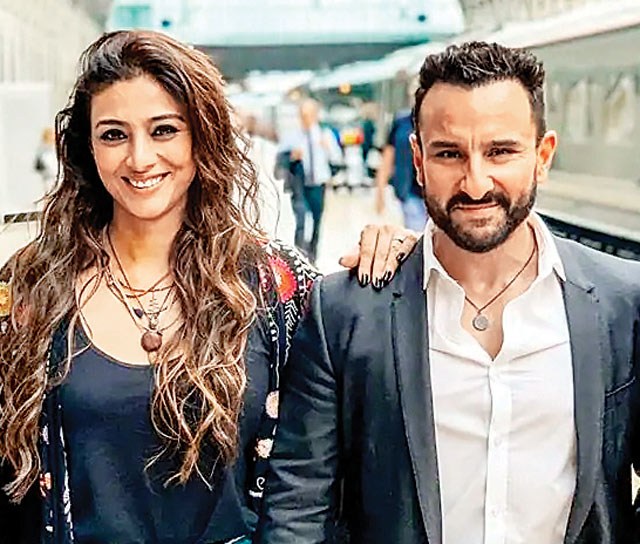
With his sleek hair cut and fitter-than-ever physique, the stylish and suave Saif Ali Khan is giving the younger heroes a complex. The Nawab of Pataudi turns 49 today, but forget looking his age, the Sacred Games star appears a decade younger! Even Tabu recently remarked that he is “looking so good with the haircut”. The AndhaDhun actress will share screen space with the Kaalakaandi actor in his next, Jawaani Jaaneman, which he is also producing. The two worked together in Hum Saath-Saath Hain (1999) and will reunite on screen after exactly two decades. “I don’t remember how it was working with her earlier because it was a long time ago. But, it was really good working with her now. She is a fabulous actress. Though we didn’t have much to do (together), there were a couple of really important scenes that she had. Speaking as a producer, it’s wonderful to see a really good actor bringing the scene alive,” says Saif, proudly adding that they wrapped up the movie in 43 days, “two days under schedule”.
The film was shot entirely in London and after completing it last week, the actor has extended his stay to celebrate his birthday there. “We are staying in an ancient country home in Windsor, England’s countryside. I thought it was haunted, but now I don’t think it is. It’s very nice and there are about six of us here with kids — we are cooking and eating. I will celebrate by having dinner with friends,” he shares.
Best work on the web
Incidentally, the second season of Sacred Games, which has Saif playing a cop, Sartaj Singh, was streamed a day before his birthday. The first season gained global recognition and the actor had won rave reviews for his performance. When asked what the series has meant to him, he said, “It’s meant that there’s more than one platform available to do amazing work. In fact, some of the best work I have ever done is on that platform. Entertainment is changing, and the way we’re making this content is also different. We are more mobile, our show is top class, and is comparable to any international one. That’s a great thing and I’m happy about it. It has also shown that there’s a market for intelligent directors and writers in India at the moment, which doesn’t have to be mainstream Bollywood or commercial. Since this is a web show, it should be different and tailored to suit the audience. So, a little more graphic, somehow not just in terms of sex and violence, but in terms of images. A little more artistic. It should be something beyond films and TV,” he elaborates.
A good phase
Apart from Sacred Games, the 49-year-old actor is gung-ho about his upcoming films, Jawaani Jaaneman and Bhoot Police. “The kind of ideas that were swapped on the sets of Jawaani Jaaneman and what I am expecting in Bhoot Police is something quite new and exciting. It’s a little different from how things were. I’m certainly feeling that it’s a very good time, actually, it is the best time because I am better than I was,” he says.
Saif is known to completely transform himself for every role that he plays, be it his hairstyle or the physicality. He believes that as an actor he should change for every role and come up with something different. “Examples have been around since forever. Aamir (Khan) has been doing it for the longest time. You know, you’re looking for something that can become a bit of an item, a piece of film. So, you’re finding a certain kind of Punjabi trendy look that can be from London, a tattoo or some haircut to make it effective. I think that’s something the audience also appreciates. And it’s something that as an actor, I quite enjoy finding that difference in each part,” he says.
Dealing with failures...
Saif has had a checkered career, which boasts of big hits and flops. How does he deal with it? “Things work and not work for various reasons. You need to get so many of these decisions right. Sometimes, it could just be the wrong kind of film. Like, there are so many different ideas today, and a lot of intelligent guys that I come across want to make slightly European cinema, which, you know, is not really mainstream. Some are trying to redefine mainstream Bollywood, I mean, they don’t want to make a certain kind of movie, but something more sensible. It’s a little tricky, sometimes you go wrong, because, you know, it’s not the kind of film that everyone wants to see. You spend all your energy making the wrong kind of movie. So, that is disappointing. But I think the job in itself is in a way satisfying. If your directors are happy and you’re proud of the film you made, that’s satisfying enough. But when it doesn’t run, that’s where you have to be strong, pick it all up and go again.”
... And moving on
With Sacred Games proving that he had made the right choice by moving to the digital platform, Saif now wants to keep the tempo going with his big-screen outings, too. Both his upcoming films, Jawaani Jaaneman and Bhoot Police are comedies, but of a different kind. While the former is a family comedy, the latter is a horror-comedy. Saif shares that he wants to be more conscious of what the audience expects to see. “I have tried to do it this year more than before. I want to do slightly more commercial stuff. In the past, I’ve done certain films like Chef which were a little different to what the audience would have wanted. So, I have become just a little bit more aware of what kind of films people want. For instance, Jaawani Jaaneman is quite intelligent and artistic in many places. But basically, it’s a lot of good fun. Both, director Nitin Kakkar and I, had it in our minds that we are trying to entertain people here — the emphasis has been on that,” he concludes.
I didn’t think I’d become a Bollywood singer-Armaan Malik
8:41 AM
Dhaval Roy (DNA; July 9, 2019)
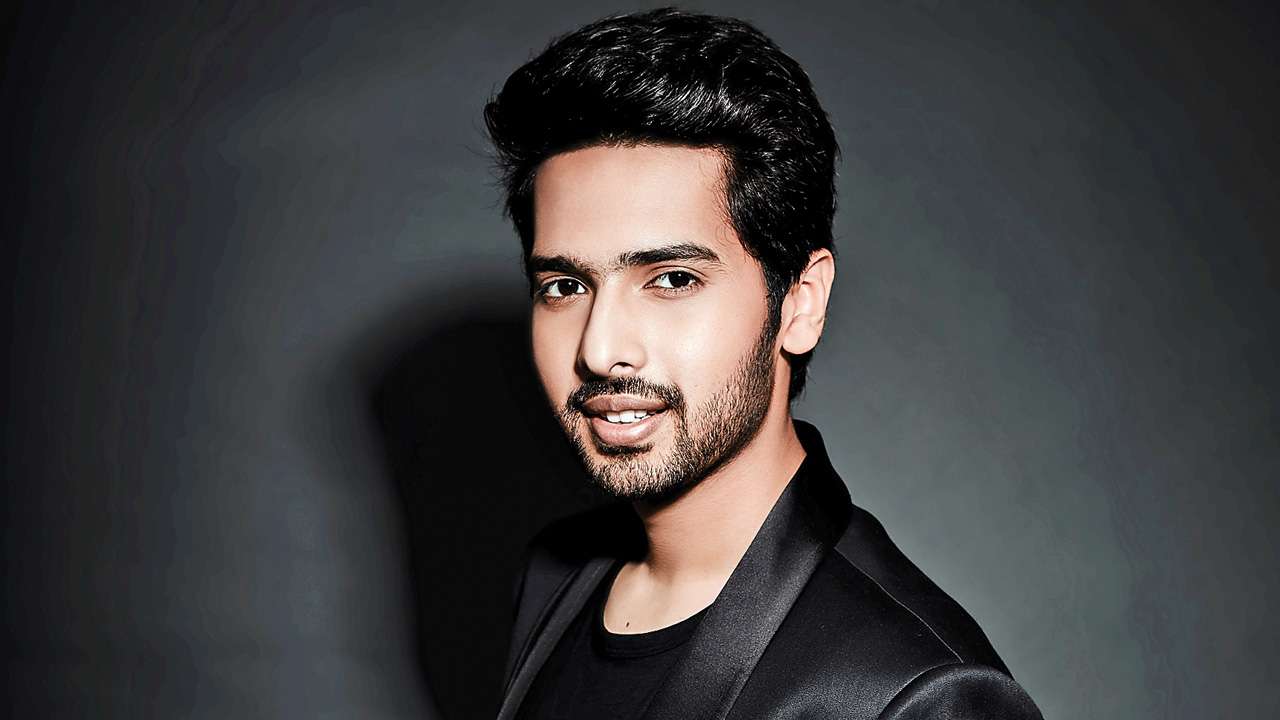
Life has come full circle for Armaan Malik in a number of ways this year. To begin with, he is teaming up with Sunidhi Chauhan to sing the Hindi version of Can You Feel the Love Tonight in the upcoming movie, The Lion King, and he recalls opening for her at a concert when he was about 12. “Now, I share vocal duties with her on this. It’s crazy,” he smiles. Then, 2019 started with him mentoring contestants on The Voice. “I started my journey as a participant on Zee TV’s Sa Re Ga Ma Pa Li’l Champs when I was nine; at 23, I was on the other side,” he points out. Incidentally, he is also going to Los Angeles, USA, in the next few days for the world premiere of The Lion King and meeting its director, Jon Favreau. “He also directed the movie Chef and I had a song Tere Mere in the Bollywood adaptation starring Saif Ali Khan. So, yes, it feels like the ‘circle of life’ is complete,” he says, alluding to another track by the same name in The Lion King. “It’s going to be such a huge trip for me,” he says excitedly.
INTERNATIONAL PROJECTS
Armaan has also sung Hakuna Matata in The Lion King. He says that his and the Kamli hitmaker’s westernised vocals were necessary to pull off the tracks in the musical. “I’ve been singing English songs since I was about 14. And these numbers needed someone with a similar background and who could really feel them. Also, The Lion King is such an iconic movie and we’re taking its legacy forward. What’s better than that?” he quips. This is the second international project that Armaan has sung for this year — he also crooned Ek Naye Jahan Mein (A Whole New World) in Aladdin earlier.
SONGS IN BOLLYWOOD, TOO
For Armaan, the year so far has also been great in terms of Bollywood songs as well — Pehla Pyaar in Kabir Singh and Intezari in Article 15 releasing recently. Armaan points out, “One is such a commercially-successful movie and the other, critically acclaimed. As a singer, it’s not just about the songs; projects on a whole are equally important. It makes my discography look better.” He is also gung-ho about singing for Vishal Mishra and Anurag Saikia respectively for the first time.
But singing for various composers isn’t different from lending his voice to his brother Amaal Mallik’s tunes. “Since I was 10, I had been singing with multiple composers before I worked with any of my family members. From that age, I’ve known what a composer demands out of a singer. So, even when it comes to Amaal, it’s not a comfort level kind of a thing. It’s just that he can shout at me if I go wrong (laughs); that is the only familiarity factor.” He further adds that it’s his duty to fulfil what’s expected from him, “I’m completely a composer’s singer,” he states.
WORKING WITH A R RAHMAN
Armaan has worked with the best in the industry, whether Shankar Ehsaan Loy (Bum Bum Bhole in Taare Zameen Par, 2007) or now A R Rahman in 99 Songs. “I kind of pinch myself to even think that I’ve been able to sing not only one but also the second song with Rahman sir,” he enthuses. He tells us that ever since he sang for 2.0 (Mechanical Sundariye), he hoped that ARR would repeat him. “He is the pride of our nation. Just being in the same room as him is such a big thing. And I’m glad that I’m singing for his passion project. I think all the top singers have sung some songs for this movie. I’m excited about that as well.”
MORE ENGLISH MUSIC
Armaan is currently working on a lot of original, non-film singles. “I’ve always wanted to take India to a global level, which is why I have been working on English music as well. For instance, I was the youngest Indian singer to perform at Wembley Stadium in the UK. I’ve been travelling to LA as well as London and will be going across half the globe for these projects,” he tells us. So, while he has Bollywood tracks in the pipeline, he promises to soon reveal what he’s working on. “It’s something that has been my lifelong dream. I didn’t think I’d become a Bollywood singer and it just happened to me. I always wanted to croon in English. So, life is veering me in the direction that I want,” he signs off.
I am willing to put myself out there and cause emotional damage to myself-Sobhita Dhulipala
7:50 AM
With a hit show behind her and another biggie in Bard Of Blood, girl-of-the-moment Sobhita Dhulipala on what makes her tick
Mohar Basu (MID-DAY; April 2, 2019)
“So am I famous now? I am at home, doing my laundry, and have no idea what’s happening outside,” quips Sobhita Dhulipala, the luminous lead of Amazon Prime’s much-loved series, Made In Heaven, and the Internet’s latest darling. As netizens binged on the relationship drama, Dhulipala’s character Tara Khanna — cut-throat yet with a strong conscience, gold-digger yet achingly guileless at times — became fodder for debate. The actor’s analysis of her muse is clear. “I saw Tara as unapologetic. Her flaws make her real. People have the tendency to categorise others into villains or heroes. But the truth is, we all think and do things that aren’t nice.”
Even as she is excited about the appreciation coming her way, the actor, 26, is already looking forward to Bard Of Blood, Netflix’s next original starring Emraan Hashmi. “Bilal [Siddiqi, author of The Bard Of Blood] is also part of the screenplay process. The writers were strict about actors not reading the book. The screenplay is an evolved version of the material. Moreover, the character dynamics have been altered.”
The espionage thriller is her second successive project with Hashmi after The Body. “The man is so different from his image of a serial kisser. For him, I am a bro,” she laughs.
With interesting projects in the pipeline, this might just be Dhulipala’s year. Point out that she went missing in action after a promising debut with Raman Raghav 2.0 (2016), and she says with an endearing naivety, “I don’t have the objectivity to understand screen gaps, or when people remember me and when they don’t. With me, it has always been about feeling assured as an actor. I had a nomination at the Cannes Film Festival with my first movie. I just want to do work that resonates with me.”
That she knows her craft is evident in the fact that the likes of Anurag Kashyap and Zoya Akhtar have placed their trust in her. She sparkled even in blink-and-miss role in Chef (2017) and a supporting part in Kaalakaandi (2018). Deconstructing the process to slip into roles, she reveals, “I prepare by being vulnerable, which is difficult, because the world will give you reasons to be cynical. But in order to get the true essence of the part, I am willing to put myself out there and cause emotional damage to myself. As an actor, if you can’t do that, it’s better to be an investment banker.”
As we wrap up the interview, Dhulipala admits that much like the audience, she too has her fingers crossed about the second season of Made In Heaven. “It’s still at the brainstorming stage. I can’t wait to strap on my heels, apply a lip colour and rock it again.”
The only time I’ll offer Sara a film is when I feel she is facing trouble in her career-Saif Ali Khan
8:31 AM

Renuka Vyavahare (BOMBAY TIMES; October 25, 2018)
It’s a known fact that Saif Ali Khan is an interesting conversationalist. Be it movies, history, politics, global issues, or current affairs — you can trust the actor to engage you in a stimulating chat. If and when he isn’t aware about certain things, which is rare, he has no qualms about asking those around to enlighten him. His eloquence, outspokenness and knack of being politically incorrect adds to his Nawabi charm. Ahead of the release of his next, Baazaar, he talks to BT about box-office success, his son Taimur being a social media sensation and why he admires Amitabh Bachchan and Anil Kapoor. Excerpts...
You have completed 25 years in cinema. Despite giving some wonderful performances in unconventional films, many of your recent movies didn’t translate into box-office success. Does that bother you?
It’s not uncommon. A lot of good films do not work. It’s interesting to know how the box office functions. There’s quality, there’s mass appeal and sometimes, there’s a lot of gap between the two. The Holy Grail is achieving both, but that’s rare. The trick is to strike a balance between the two. There are some films that have a stronger shot at the box office. Some of the films that I do, have more of an outside chance, but I was hoping that Kaalakaandi would be more mainstream. I thought that it was a really good movie and so was Chef.
Is it disheartening to see films with unique content not being received well by the audience?
Naturally, you are disappointed when these films don’t work and you wonder if you are doing something wrong. You question many things like yourself and whether you are doing the wrong kind of movies. I don’t want to take the pressure though (smiles). I leave it to the producers. If he feels that he should make a film in a certain way, he should. Baazaar is more commercial, Chef could have been more commercial, but the director gave it a European approach, which I was okay with at the time. It’s a risky area. Vikram Malhotra (producer), Raja Menon (director, Chef)... these guys have made Rs 100-crore films before. I think it’s a phase. You get certain things right, certain things wrong, but you’ve got to just keep working. Eventually, if you know what you are doing and if you are a good actor, hopefully something turns out that makes sense. I am spending my time trying to become a better actor, learning more about my craft. I am lucky that I am being offered interesting opportunities. More than making money, I am interested in quality roles.
Since Baazaar deals with the game of money and stock market, many are curious to know if it has similarities to The Wolf Of Wall Street...
Not at all. Baazaar is about what money means to different people. Money is called a whore sometimes, because it pretends to be something it isn’t. The Wolf Of Wall Street was more about American excess, corruption of society and the absurdity of American capitalism taken to an extreme. It’s also about drugs, parties and debauchery — it’s a completely different world. We can never get there in our movies because a Gujarati businessman (his character in Baazaar) comes from a very different methodology. It’s in a very Mahabharata space, which is an epic for us. That’s the way an Indian guy may operate mostly. He may believe he’s religious while taking you for a ride. Baazaar is not a sex-and-drugs kind of drama. It’s more about morality, money and legitimacy. Just look at our mythological epics to know what matters to an Indian. What is the class of your background and values? How far would you go to achieve want you want? People pretend to be pure and holier-than-thou, but they also justify violence. We’re talking about a philosophical explanation of fulfilling your dharm; the film falls into that space. The way the story unfolds is tense and pulls you in slowly. Also, you don’t have to understand investments to like this film. It’s about ambitious people and the repercussions of their actions.
Your policy of playing age-appropriate roles is a rare trait among most A-list Indian actors.
I grew up on international films and we used to make fun of how you cannot play a college boy at a certain age. Forty-year-olds going to college, I mean, that can look demented (laughs!). I want to be like Anil Kapoor and Mr (Amitabh) Bachchan. I want to be a fit 60-year-old like Anil. It’s amazing. I am not worried about competing with anybody. I want to be in my space. I feel there are so many dramatic stories to tell at this age. What a father goes through is as exciting as what the kids are going through. We should be a complex film industry that has stories for every age group. Like Hollywood, we should make our Twilights and campus romances, as well as have something more serious for the adults as life gets serious. The experience of reading Anna Karenina in school and then at 45 is completely different. Life changes and it’s nice to be able to express yourself from that point of view. I was telling this to Imtiaz Ali the other day, when we were talking about a love story. Too early to talk about it, but that’s also for a certain age and it’s cool. There’s always this wisdom that comes with age. Also luckily, the film industry is changing. Actors like Anil and Mr Bachchan, these guys are beacons for their respective age and I want to be one for my age, too. The stories will find you if you are fit and correct enough for the part.
Let’s talk about Taimur. What do you make of people stalking him on social media and he being a paparazzi’s delight?
Being photographed all the time while coming out of the house with him used to bother me, as I looked a bit slobby. Now, I dress up a bit, and I have got a nice pair of track pants (smiles), but it’s a bit of a pain. Taimur makes people happy, I understand that. He is always smiling, even at four in the morning, when I am half asleep. People have had interest in this kid ever since he was born and I can’t keep him away. I’d rather not have him photographed, but I can’t physically hide him and if I do that, the paps will be persistent. I want him to grow up as a normal kid, but he won’t. I don’t know whose fault that is and I am not pleased about it. The only option I have is to treat this as normal and make it as civilised as possible. There’s a nice relationship between the paparazzi and Indian stars. We have a clear understanding. We stop for a picture and respect the media and they respect us. They are not chasing his car or jumping on him while he is going to school and they shouldn’t. This becomes hectic when you run away from the paps and could lead to a scenario like Lady Diana’s where she was avoiding the paparazzi. If she’d given that photograph, they wouldn’t have chased the car. Also it’s the age of social media. If Tiger Pataudi and Sharmila had a kid today, even I’d have been photographed. Sara (his daughter) was such a cute kid! Taimur is from a different time. I had never been interested in anybody’s kids, so I don’t understand it (frenzy), but I respect it.
Initially, there was a lot of brouhaha about Taimur’s name…
I have now given him a soft nickname — Tim Tim, which takes the edge off Taimur. I think of India as a secular country, I don’t think of it as a Hindutva nation. I understand that there will be a right wing movement in the country because of independence and the creation of Pakistan and this idea of identity forming that is ours. I understand Hindutva. The scariest ideologies have a bit of truth to them. But my idea of India is that in my blood and his blood and on this earth, there have been so many people who have come and gone. Alexander the Great, Chandragupta Maurya, Babur, Humayun, Taimur and various other people. Whether they were good people, bad people, violent people, doesn’t really matter in my head. People have called Rama violent. We have had these conversations. To me, it’s a great name. Taimur means iron and I like it. He’s not named after a particular person, but even if he’s named after anybody, this is a part of us and history. We can’t pretend that we have been around only after 1948. That’s not what India is. India is the land of Kama Sutra, Yoga, Mohenjo-daro, Harappan civilisation, Mahabharata, including Taimur. It’s all a part of our history.
Will we see you playing Sara’s screen father in your next home production? There were speculations about it.
No. It was a nice idea, but acting is a very selfish business. You don’t want to act with your daughter, because you’d be worried about how she’s feeling all the time. The only time I’ll offer her a film is when I feel she is facing trouble in her career. If she didn’t have a Karan Johar film or Kedarnath, I’d offer her a father daughter story to help, but if she’s okay with Dharma and I am happy, Karan can be her father. Sara is already a good person; I want her to enjoy being an artiste and an actor.

I am not in the ‘character actor’ bracket, not yet-Saif Ali Khan
8:28 AM

Rachana Dubey (BOMBAY TIMES; July 22, 2018)
When you meet him, you’ll invariably feel that there’s a certain oldworld charm about the man, who’s fashionably inching towards his 50s. His choice of films proves that he’s moved on from the fear of the fickle Fridays. A traveller at heart, in his profession, too, Saif Ali Khan has explored a variety of characters and zones of filmmaking, which are anything from interesting to fairly daring. In a chat with BT, he talks about his cinematic journey in the last one year, the risky choices he has made and the ups and downs in his personal life. Excerpts…
This year is particularly special for your family. While Sara (daughter) will make her debut, Kareena’s first film after Taimur’s birth, Veere Di Wedding,worked wonderfully. Taimur is of course growing up really quick, and wowing us all with his adorable pictures...
I am quite happy for Bebo. She says that I push her to stay fit and do the work she likes, but I am happy to see her do whatever she wants to do. She has a creative job, which she really likes. It’s in the Kapoor DNA to be actors. I’ve seen this — she is happy being at work. She goes to shoot and comes back without making a fuss. There is no drama about ‘Oh! I am shooting tomorrow’. She balances everything well in life. It’s important for us to give Taimur a lot of time. Kids get affected if they are with their nannies all the time. It’s also a privilege for us to be able to be around him. Taimur is so happy when he’s with us. Balancing time between work and family is important. Our profession is so unstructured that sometimes, you really wish you had stipulated work hours. I mean, there are occasions when we work from 9 am to 9 pm, and sometimes in a shift that’s the exact reverse, and these kind of work hours can get really tiring. I wish we could start early and wrap up by sundown.
Your film Baazaar has been pushed to a release date later this year, and this is not the first time that this project has been postponed. What’s holding it back?
These days, finding a release date is not easy. The makers of Kaalakaandi went berserk finding the right date for release. Baazaar moved from April 27 to avoid a clash with Avengers: Infinity War, and then something else came up. So, it’s a cross between trying to crack the best deal with a studio and getting the best date. But that doesn’t bother me; I’ve done my job and I would like to see it release. The team has sent me ecstatic messages, but there’s no point in me saying how great the film is. I just hope it’s turned out fine. Like my interviews, even my acting needs good editing. My interviews, if edited well, can sound quite sensible. Edited badly, they can land me in trouble. It is the same case with my films (laughs!).
Would you say that lately, you’ve worked on some risky projects, which haven’t really paid off?
I’m worried that my films have not had good runs, but weirdly, though I have concerns, I don’t regret doing Chef or Kaalakaandi. I don’t think I could have been more committed to these projects. When I look back at Bullett Raja (2013), Phantom (2015) and Happy Ending (2015), I feel I shouldn’t have had the same haircut in such distinct films. Also, those films shouldn’t have happened around the same time. I should have been committed to one project and been with it throughout. I don’t think I was able to do justice to each character, individually. I regret those couple of years; a lot of money was at stake and when I look back, I feel it could have been handled better. Now, that wasn’t the case with Kaalakaandi or Chef. I don’t know what didn’t work for those films — was it the marketing or was it me? Sometimes, you just go wrong. I don’t want it to sound like a case of ‘sour grapes’, but maybe the marketing strategy could have been better. Probably, people found the trailer boring, though the films were made well. When Chef was offered to me, at that point, director Raja Krishna Menon had made a Rs 100-crore movie called Airlift, and so, he could make all the decisions. A lot of guys that I have worked with want to change cinema, which is great, but I don’t think our industry takes too kindly to change. There’s a pattern we like to work with. Rangoon, despite its casting coup, couldn’t run at the box office either. People didn’t like that movie, though I enjoyed playing my part and working with Vishal (Bhardwaj). I don’t know what really backfired. It’s okay to have things in life that you don’t quite understand. Failures are a part of your being. Darkness is also a must in your colour palate. When Rangoon had released, my mother (Sharmila Tagore) told me, ‘You’ve got great reviews. You can’t do anything beyond this.’
Would you give the same advice to Sara, when her first film is up for release?
I don’t know about that yet, but the good part is that she’s convinced about the scripts that she’s given a go ahead to. The lesson to be learnt with her experience is to always go with a sound producer and a good studio. Things can easily go wrong in the filmmaking business. I am happy she’s working with Karan (Johar) and Rohit (Shetty). Even if something doesn’t work, I feel her future is secure. I hope Kedarnath works out well, but I’m so happy that Sara already has good movies on her plate. The entire incident around Kedarnath was unfair on Gattu (director Abhishek Kapoor) and the movie, but sometimes, things go wrong and it’s not because of you. Today, I feel reassured that she has a mentor to keep an eye on her, which is better than not having one.
Talking about your children, Taimur is undoubtedly a social media sensation and he grabs more eyeballs on social media than most actors do. While Kareena has expressed her concerns about it, how do you react to so much focus on a one-and-a-half-year-old?
You can find a 100 things to feel victimised. He’s a privileged kid, which he will know with time. I will be happier if he could lead a normal life, but as celebrities, we don’t get to enjoy peace in our country. We can’t even walk to the gym because someone will click pictures of us and point to those shorts which we had worn two days ago. There are very few places in our country where we could go for a walk and just be ourselves without attracting any media attention. Pataudi is one of them. Taimur is already used to media attention, so I’m hoping that when he grows up, it won’t impact him much. He knows this is the family he belongs to and he must learn to behave well with the press that follows his folks. You know, it feels like there’s a different world for people who can walk out whenever they want, have pani puri and take a stroll down the street. I wish sometimes we could experience that without 10 people chasing us for a photo.
Apart from your films, you were in the news for being acquitted in the Black buck case, earlier this year. Did that come as a relief?
(Cuts in...) It’s not over yet. I am not comfortable talking about the case beyond saying that it’s still going on for some of us. Apart from anything else, having a court case against your name is very expensive. You want to avoid trouble. These cases go on for years and take up a lot of time, money and it affects people’s careers.
You are an actor who has always bagged good projects in spite of the fact that several of your films have not worked in the last couple of years. But did you ever fear being written off at any point?
No, I feel like a complete person today. I’m absorbed in my work. I never felt the need to compromise on my work because of some films that haven’t done well. Work wise, I’m one step up with the kind of projects I’m working on. Today, I want to be fit, I want to eat and drink in moderation and I want to monetise every asset I have. It’s not the time to be manipulative about my career. I would be happy if some of my films worked at the box office, because people still count on me to deliver. I am not in the ‘character actor’ bracket, not yet!

Women cinematographers of Bollywood talk about the challenges of working in a male-dominated profession
8:50 AM

Over the years, Bollywood has seen a rise in the number of female technicians, but cinematography is one area where women DoPs (Director of Photography) are still trying to make inroads. BT speaks to women cinematographers to find out the challenges of working in a male-dominated profession
Lasyapriya Sundaram (BOMBAY TIMES; April 30, 2018)


‘IT’S TOUGHER FOR WOMEN CINEMATOGRAPHERS TO GET THEIR BIG BREAK IN FILMS’
Priya Seth, who has shot big-budget films with A-list actors like Akshay Kumar and Saif Ali Khan in Airlift (2016) and Chef (2017) respectively, points out that it is director Raja Krishna Menon, who was instrumental in helping her fight the inherent sexism in the industry. She says, “For women cinematographers, the system doesn’t help in getting them their big break. It’s somebody who believes in them who gives them the opportunity. For somebody like me, it was Menon who gave me a fair opportunity. When I was going to shoot Airlift, the question that was posed was, ‘Will she be able to handle the pressure?’ These questions are never asked when a man is involved. There hasn’t been a systemic change in the industry per se. However, overall there has been a visible increase in the number of female cinematographers in the past 10 years in the industry. But in mainstream cinema, there aren’t that many. Also, what happens is that people want to work with those who they are comfortable with. It’s basically a boy’s club. That’s where the crux of the problem is.”

Director Raja Krishna Menon shares, “The general perception is that women are better with emotional subjects rather than action-driven content. But I don’t endorse this as it’s a question of perspective. I like to take advantage of the difference in perspective that one’s gender brings about and I don’t see it as a drawback. It’s a technical field and the camera used to weigh 50 odd kilos until recently. Perhaps, it’s the fault of gender stereotyping that many women in the past didn’t opt for cinematography. It’s also seen as a physically demanding job, as opposed to something like editing. Many producers and directors are men and possibly, they find it harder to work with women technicians because they haven’t done it. More women need to come out and shoot films like Airlift and prove them wrong. In fact, I am surprised how often I am asked why I chose to work with a female cinematographer on Airlift. I knew I was going to work with Priya and her gender was something that didn’t even cross my mind. Someone like her makes my job easier. In fact, I work with many female crew members on my set. Women are far better at organising than men.”
After training under cameraman Binod Pradhan, cinematographer Sunita Radia, who shot the Ajay Devgn and Ileana D’Cruz starrer Baadshaho (2017) and Hate Story 4 recently, reiterates, “Cinematography has been a male-dominated profession. Eighteen years ago when I started out, there weren’t too many women in the camera department. Earlier, it was believed that women couldn’t carry heavy equipment. One has to carry approximately 12-15 kilos as that’s how much a camera weighs.”

‘WE HAVE TO PROVE OUR WORTH TO GET THE JOB’
Film and Television Institute of India (FTII) graduate Neha Parti Matiyani, who kicked off her career as an independent cinematographer after having assisted cameraman Ravi K Chandran for five years, shares that unlike many others, she didn’t have to struggle a lot to get a break, as she had started her career working in films made by Karan Johar. The lady who shot the Varun Dhawan and Alia Bhatt-starrer Badrinath Ki Dulhania (2017) states that, while getting a break might be difficult, once that happens, nobody makes bones about whether the cinematographer is male or female. She elaborates, “People are opening up to working with female cinematographers. It is assumed that men are good at their job until they go completely wrong. When it comes to women, they have to prove their worth before everyone starts believing that they can do the job. As a cinematographer, you have a minimum of 35 people working under you. That’s not all; you have to practically run the set. Once you shoot a big film successfully, there is no stopping you. Then, gender ceases to be a point of contention. But I can’t deny the fact that if a man and woman had the same qualifications, then the man would get the job.”
‘THE AUDIENCE’S PERCEPTION IS THAT A DOP IS ALWAYS MALE’
Citing an example about the deep-rooted sexism that’s prevalent, Sunita adds, “A reviewer who had critiqued Baadshaho praised my cinematography in the film and referred to me as Sunit Radia, assuming that I was a man. The perception is such that the cinematographer is always male.” Priya adds, “Today, I have done big films and I know that I am talented; earlier, I was questioning my capabilities because I didn’t know any better. It took me 10 years longer than my male counterparts to reach where I am today. Nobody will accept it, but it’s a fact.” Cinematographer Fowzia Fathima who started out in the late 1990s with Mitr: My Friend, after having trained under P C Sreeram, states, “At that time, work would rather go to a lesser-equipped male DoP than a well-trained female. It’s because of the mindset. There was an innate confidence and belief when a man was behind the camera. However, today there are more women entering the field and there is a slight shift in perspective. Sometimes, the perception that cinematography is a man’s job’ is often used as a tool to deny women DoPs opportunities.”

‘YOUNGSTERS NEED TO HAVE STRONG WOMEN ROLE MODELS IN FILMMAKING’
Given that a number of young female cinematographers are trying to break stereotypes and make a mark, Fowzia along with other colleagues including Deepti Gupta (who was the DoP for Honeymoon Travels Pvt Ltd, 2007) and Savita Singh (who was the DoP for Phoonk, 2008) formed the Indian Women Cinematographers’ Collective’ (IWCC) last year on International Women’s Day. Fowzia says, “Women DoPs formed the collective to register their presence, for the younger generation to have a peer group and strong women role models in the field of cinematography to identify with. Essentially, it acts as a professional support group. We launched the collective last year and today, we have more than 100 members. A concerted effort to encourage women to be a part of every department of filmmaking is the need of the hour.”

From Farhan Akhtar to Priyanka Chopra, these actors are out pricing themselves?
8:33 AM

DNA (February 13, 2018)
When Farhan Akhtar told a reputed filmmaker that he would do his film, the latter rejoiced. But only for a short while. Next, the producer was conveyed that the actor’s asking price was reportedly Rs 11 crore. Naturally, the guy thought he had been socked hard on the jaw.
Of course, even before the second round of negotiations could take place, Farhan’s Lucknow Central released. The all-India nett gross box office earning of the film was approximately around Rs 12 crore. So, the maths just didn’t add up. Consequently, the project didn’t take off.
As of today, Farhan is taking his time, leafing through scripts more carefully before he green-lights his next acting assignment. But trade sources say he also needs to think hard about his fee. Yes, every now and then, producers find actors/stars making outrageous price demands that are hard to justify, especially when their previous film outings come unstuck at the ticket windows. But Farhan is not the only one whose ‘reported asking price’ is considered ridiculous.
A source says, “Sanjay Dutt and Saif Ali Khan are also asking for remunerations that are not justified.” One hears Sanjay’s reported price is Rs 11 crore (seems to be everyone’s favourite number). Incidentally, there are a few producers who are willing to pay Dutt this amount because he has been a huge star and they feel he comes with a legacy. However, the 57-year-old actor’s last outing, Bhoomi, collected Rs 9.50 crore at the Indian box office. So, once again, there is no match between the asking price and the return on account of having Dutt in a film. Priyanka Chopra is an internationally known name in showbiz today. However, when she allegedly asked for Rs 14 crore for a Bollywood film, the makers found it unreasonable, especially in the domestic market.
Incidentally, at this moment, Deepika Padukone remains the highest-paid Bollywood actress. Her last outing Padmaavat, in which she played the title role, justified her demand. Interestingly, her fee is a little less than what Priyanka is reportedly asking for.
Saif Ali Khan has also been asked to reconsider his fees. The actor, who has been having a poor run at the ticket windows, has been reportedly quoting Rs 7-8 crore as his market price. However, his last two outings haven’t fared as well as expected. Chef collected less than Rs 7 crore in the domestic market, while Kaalakaandi garnered around Rs 5 crore, locally. Guess, Saif will have to sell himself ‘sensibly’ for the moment.
We want to release more non-film music this year-Amaal Mallik and Armaan Malik
9:01 AM

Dhaval Roy (DNA; February 10, 2018)
There is a lot of banter at Amaal Mallik’s new pad in Versova as we sit down with the composer and his younger brother, singer Armaan Malik, for a tête-à-tête. While the younger one teasingly accuses his elder bro of getting too competitive as he’s singing more songs, the music director is quick to rattle off names like Vishal Dadlani, Sonu Nigam, Arijit Singh, and his own bhai who have lent their voices to his compositions.
Together, the duo has delivered hits like Naina (Khoobsurat), Buddhu Sa Mann (Kapoor & Sons), Sab Tera (Baaghi), and Hum Nahi Sudhrenge (Golmaal Again) among many others. The brothers, who have the lineage of music composers, grandfather Sardar Malik, father Daboo Malik and uncle Anu Malik, talk to After Hrs about making their own mark against all odds and sibling rivalry.
Which is the next song that we will hear from both of you?
Armaan: I have sung a track for Nikkhil Advani’s Baazaar, which has been picturised on Rohan Mehra. It’s a love song-cum-club number, which not many people associate with my voice. Tere Mere from Chef was the last composition we did together, so it was great singing for Amaal after so long.
Amaal: It will be a surprise for our fans because we have mostly done stuff like Bol Do Na Zara (Azhar) or Buddhu Sa Mann, which are more like car-drive and live-in-the-moment songs. This is the first time Armaan has rendered a tropical electronic dance number for me.
Do you have clashes while working together?
Armaan: Yes, we have a lot of fights (laughs). They are usually creative differences. When I’m singing for Amaal, it’s one of the toughest recordings for me. He sets the bar too high and if I don’t achieve what he wants, he goes berserk. But that’s great because he wants excellence and it prompts me to work harder.
Amaal: Armaan has a simple approach and understands what a composer wants. I tell him, ‘Give the song your own vibe but I will still come and fight with you and change it’ (laughs).
Have the fights ever turned ugly?
Armaan: I’ve walked off from the recording and said, ‘I’m not doing this anymore. I’m done with this...’
Amaal: Sometimes, I’ve shut the door and said, ‘You can’t leave.’
Armaan: And then he asks the driver not to get my car...
Amaal: But we fight to make a good song. He sees reason that the track has turned out much better. So, ladaai karna zaroori hai (smiles).
What has been your most gratifying song together?
Amaal: I was moved by the way he sang Tere Mere. There were notes that had to be rendered like an ustaad and some that needed a contemporary voice and he did both equally well. That has been my toughest composition till date.
Armaan: The track’s antara had to be sung in a single breath and he didn’t let me take a break even though we have the technology. He okayed it in one take and I slept really well that night (laughs) because usually after a recording with him, I need good, unhealthy food to comfort me. Our single Main Rahoon Ya Na Rahoon is the other composition that we are proud of.
Do you turn to each other when things get rough?
Armaan: All the time! And we do it over food, which is an integral part of our lives.
Amaal: No gaana without khana (laughs). Things in the industry get too competitive. In that pressure, you tend to lose yourself. So, it’s important to have someone to turn to and vent out. Thankfully, we have each other.
What about sibling rivalry?
Amaal: He’s a complete mama’s boy while I’ve always been closer to my father. So, the swords were always drawn.
Armaan: He was the bully as a kid. But I was sly. I would pretend to be this seedha saada guy and always get him into trouble by complaining about something he hadn’t even done. On a serious note, as musicians there’s no rivalry.
Did you face a lot of pressure because of your lineage?
Armaan: Everyone wanted to know what we were going to do. If I was on the stage, I represented my dad, uncle, dada, and Amaal.
Amaal: For people, we were never Dabboo Malik’s kids, we were always Anu Malik’s nephews. Our dad didn’t see the limelight and success that our uncle enjoyed. So, we had the fire in us to do well and take his name to the same position. People think we just got a chance three years ago but no one looks at our 10 years of struggle. I assisted Sandeep Chowta, Salim-Suleiman, Pritam, etc. while Armaan went the reality show way (Sa Re Ga Ma Pa Li’l Champs). We sang jingles and did voiceovers. Even when we got Jai Ho (2014), it wasn’t like we had arrived. On the contrary, the industry was harsher. People started writing me off when I was 23 and said I wasn’t the chip off the old block as a composer.
How do you see your career now?
Armaan: We have our own repertoire and style of songs. I think we have made a name because we have striven for it.
Amaal: Due to the comparison with our dad and uncle, the expectations were humongous. From that to people saying that my music has my signature has been a long journey. The fight has been worth the while.
Armaan, is there a song Amaal has composed with another singer that you wish you had sung?
Armaan: Mostly, he ends up releasing a song in my voice even if other singers have rendered it. But, I wish I had sung the non-film version of Chal Wahan Jaate Hain. It’s a beautiful track and when he was releasing it with Arijit (Singh), I asked him to take my version because it was close to my heart. I think the song was lost in the midst of a lot of other releases but we may do a version of it again.
What are you both working on now?
Armaan: We are collaborating on a single. We will shoot the video mostly by this month-end.
Amaal: We want to release more non-film music this year. We will also be touring together more.
I will shift Kaalakandi’s release if Padmavati hits theatres on January 12-Saif Ali Khan
8:20 AM

Sonil Dedhia (MID-DAY; December 7, 2017)
After its run-in with the Censor Board earlier this year that resulted in the film being postponed, Saif Ali Khan’s Kaalakaandi is ready for release. The makers have announced that the quirky comedy will hit the screens on Jnuary 12. However, Khan cautions that there may be a change of plans owing to Sanjay Leela Bhansali’s Padmavati. “If Padmavati comes in [on that day], we will think of shifting our release date. I hope we don’t have to do that. Kaalakaandi is a film I am proud of,” says Khan, who has explored uncharted territories with the Akshat Verma film.
While most makers avoid box office clashes like the proverbial plague, the actor believes that different films releasing on the same day only go on to show the diversity that cinema can offer. “It would have been nice to see Kaalakaandi releasing with Padmavati, as it shows that we have a film industry, which makes different kinds of movies. Recently, we saw Secret Superstar and Golmaal Again releasing on the same day and both films did well. Personally, I feel it’s a good time to have films releasing alongside one another. But filmmakers are wary about it and you need to take that into consideration.”
The box-office hasn’t been kind to Khan over the past few years — his last release, Chef, didn’t manage to rake in the moolah. Admitting that it “bothers” him when his films don’t fare well, the actor says his innate self-confidence keeps him going during such times. “It’s easy to think that people no longer want to see me in a film. But I don’t do that. I get my confidence back every time, irrespective of whether my film works or not. I’ll keep working and hopefully, things will fall into place.” Saif Khan.
Saif Ali Khan takes Gujarati lessons to add a real touch to his businessman act in Baazaar
7:52 AM

Sonil Dedhia (MID-DAY; November 8, 2017)
Saif Ali Khan is set to play a Gujarati businessman in his next film, Baazaar. Set against the backdrop of the stock trading market in Mumbai, the movie will see the actor speak in Gujarati. Khan tells mid-day that he had to hone his linguistic skills to do justice to the character. “I had a few dialogues in Gujarati in Sajid Khan’s Humshakals (2014), which came in handy while preparing for this film. I have tried to do justice to the scenes by adding Gujaratiness to them. It was challenging because I had to learn long lines, but I enjoyed that. My character in the movie is dark, strong and mean. So getting the nuances right was tough,” says the actor.
The first poster of Baazaar released recently. It features Khan in a salt and pepper look. He is excited about the project because of the character he is playing. “I am essaying a grey character after a long time. He is a ruthless businessman, who does some distasteful things. It got me worried when I read the script, but I realised that’s the beauty of the role. I like this kind of cinema. When you play such a character, you need to be hated by the audience. That’s how I expect the audience to react to my role,” says Khan.
The actor wants to experiment with different genres now. “I don’t think I could have done films like Baazaar and Chef 10 years ago. Whether a film works or not is not in my hands, but I think it’s the duty of an actor to do something entertaining, yet different, for the audience.”
Tu Hai Mera Sunday director Milind Dhaimade cries foul over exhibitors showing big debacle Chef over his film
8:40 AM

Mohar Basu (MID-DAY; October 14, 2017)
 Besides Saif Ali Khan’s Chef, last week witnessed the release of Tu Hai Mera Sunday. While Khan’s desi adaptation of the Jon Favreau film by the same name
failed to please mass audiences, the Shahana Goswami and Barun
Sobti-starrer, on the other hand, was appreciated for its interesting
storyline and deft direction. The positive reviews
notwithstanding, director Milind Dhaimade is struggling for his slice-of-life film to find appropriate show timings.
“We have unanimously received good reviews; people want to watch our film. But, it has been given poor show timings — as a result, my film is unable to reach the masses,” he tells mid-day.
Dhaimade is appalled to see exhibitors continuing to screen Chef, despite it running to empty theatres. “I met the distributors and exhibitors a few days ago, to discuss the situation. The exhibitors refused to give us better screen timings — this, when the other film hasn’t been faring too well. Their concern is that if they allot the evening shows to my film, the audience won’t turn up. I am sure they will, given the excellent word of mouth.”
For all its talk about content being king, the director believes that this episode proves how the industry is unabashedly biased towards stars. “It’s sad that films with good content aren’t pushed adequately. If we are not allotted proper screens, how do we draw the audience? And then people complain that good films are not made. Are we providing a conducive environment for such content to thrive?”

Fenil's Bollywood Talk # 486
11:43 AM

CHEF IS A DISASTER AND HOW!
In the last few years, there have been several high-profile disasters that shocked trade with its extremely poor collections. Noor, Mirzya, Rock On 2 and Fitoor are some of the recent examples. Bombay Velvet is the ultimate disaster. But nobody was prepared for the fate that awaited Chef. It was never expected to open big but the previews had begun three days before release and the response was positive. The industry was hopeful that the film might pick from Saturday as it always happens with such poorly opened but well received films. But shockingly, Chef earned just Rs. 85 lakhs on Day 1; it failed to even reach the Rs 1 crore mark. Still some were hopeful that if the film’s collections double from hereon, it would still be a ‘respectable’ flop as such! But alas, that never happened. The Day 2 collections were Rs. 1.15 crore and on Day 3, it collected just Rs. 1.35 crore. On Monday, the collections dropped to Rs. 50 lakhs. The first week collections would be around Rs. 5 crore. And before release, the trade thought that it will achieve the same figure in two days!
The trailers were very poor and just didn’t excite viewers. The theme and feel of the film was not appealing for mainstream audiences. Also there were so many distractions – Judwaa 2, Baahubali 2 on TV, Bigg Boss 11 etc. Moreover, the pre-Diwali has always been a dull period as people are busy in shopping, cleaning their homes etc. But more than these external factors, the makers need to understand that one can’t be making such films that are not just excited and is for niche audiences. And if you do, don’t spend a bomb making your film and then expect viewers to throng to cinemas. Movie-watching is an expensive experience now and people are not going to come out and splurge unless they are absolutely sure.
The upcoming Friday too is going to be a disaster. Ranchi Diaries is the big release, only because it looks fresh and has a good star cast, comprising of Jimmy Sheirgill, Anupam Kher and Satish Kaushik. But awareness is zilch and is all set to be a disaster. Sheitaan, Kaun Mera Kaun Tera and Ishq Ka Manjan will also be out and would be even bigger disasters. In Hollywood, the much-in-the-news Victoria & Abdul would try its luck at the box office. But the hype is very limited and the response is mixed. Hence, it would be another debacle at the box office.
All eyes are on the next weekend when the highly awaited films, Golmaal Again and Secret Superstar, will release!
(Crisp) Movie Review: CHEF by FENIL SETA
9:54 PM

Chef is a sweet and simple fare that never goes on a high but manages to leave a mark. The original film, also called Chef, was too great and the Hindi remake doesn’t reach to that level and is also different. The first ten minutes are very boring and also few developments happen too conveniently. But thankfully, the film gets better once the chef arrives in India and has some great adventures in Cochin, Amritsar, Delhi etc. The father-son bond is nicely shown and never goes overboard. Same goes for the equation between the chef and his ex-wife. The dialogues are simple and conversational and the fun moments are neatly incorporated. Saif Ali Khan is the best choice to play this role. One doesn’t realize from the trailers but Saif is very funny and raises loads of laughs in his trademark style. Child actor Svar Kamble gives a wonderful performance and that was really necessary as he has a crucial part. Padmapriya is absolutely gorgeous and is bound to impress viewers with her character and acting. Milind Soman as always looks killer. The food scenes are beautifully captured on camera and the ‘food bus’ is damn good – you wish such a bus existed in real life and that you could take a ride in it!. Chef is not the ideal remake but nevertheless, it deserves a watch!
My rating - *** out of 5!
Fenil's Bollywood Talk # 485
11:10 AM

WILL SAIF ALI KHAN FINALLY HAVE A HIT?
Saif Ali Khan is a versatile actor who has proved his worth in diverse roles. He’s one of the few actors who can effortlessly essay roles in romcoms, love stories, action flicks and even intense flicks in Omkara. Sadly, the box office performance of his films since 4 years has been bad. Bullett Raja failed despite being a masala action film. Humshakals was a torture rather than a funny film. Happy Ending was nothing new while Phantom was damn good but was a box office flop due to its high costs and niche appeal. Same goes for Rangoon – it was too niche and costs were skyhigh.
Now Saif Ali Khan is back with Chef, a remake of the popular Hollywood film of the same name. It also stars Southern actress Padmapriya, child actor Svar Kamble and Chandan Roy Sanyal. It is directed by Raja Krishna Menon, who made Airlift last year. The trailer is decent and it seems like a sweet family entertainer with a dash of food porn. Also interesting is the food bus used in the film – a revamped double decker that doubles up as the chef’s ‘chalta firta’ kitchen.
Sadly, the film looks quite niche. But unlike Phantom and Rangoon, its costs are very limited. Even then it would be difficult for the film to get audiences despite good word of mouth. The hype is very less for the film and also, the pre-Diwali period is very dull as majority of audiences stay away from cinemas. Hence, it remains to be seen if Chef can attract audiences simply through a good word of mouth.
WOULD YOU LIKE TO SEE CHEF AND WHY? DO LET ME KNOW!
You can never be friends with your kids while they are growing up-Saif Ali Khan
8:07 AM

Madhureeta Mukherjee (BOMBAY TIMES; October 5, 2017)
He has a voracious appetite
for movies, conversations, and food, of course. Yes, he admits that he
is a 'good proponent of the urban guy', but the actor in him is hungry
for more than just that. He admires heroic characters, but he is
fascinated by the dark side. On the eve of his next release, Chef,
directed by Raja Krishna Menon, Saif Ali Khan
talks to us about dinner table chats with his family, his views on our
modern-day society, parenting, relationships, films and fads. He serves
it up in small helpings, but leaves you with enough food for thought.
Chew on...
Chef talks about how 'The family that eats together, stays together'. Do you believe in it, too? Were 'family meals' a big part of your growing-up days?
It's more like the family that doesn't eat together, doesn't stay together. What makes Chef special is that it deals with urban issues, like not having enough time to spend with your children, prioritizing matters in your life and following your heart when it comes to your job and dreams. Then there is this unconventional relationship, which is common in India today. Couples are getting divorced, and it is getting increasingly tough to balance work and family life. It's a story that speaks to urban India. Yes, even my mom tried it at one point, it's a good rule. It's good to sit at the table, turn off the television and talk. There is always a discrepancy between the ideal family lunch and the reality. And of course, if you are forced to do it, then it's not the same. It's like communism then...when someone tells you that you have to do this (laughs!!) I guess parents understand that if you don't pay attention to all this, then families drift apart. In this digital age, people tend to have controlled conversations. However, I think relationships need open conversations, vigilance and constant communication. Food is the glue that can keep it all together.
Did you have open dinner table conversations with your parents?
Yes, sometimes, but my parents were definitely authority figures. We had more such figures in our family. My grandmom (daadi), who was the matriarch and the Begum of Bhopal, was an incredible woman who called the shots. My parents were liberal; my mom (Sharmila Tagore) would have a couple of glasses of wine and ask me, 'Have you started smoking yet?' I would confess and tell her, 'Yes, little bit'. Then, I would nearly get chucked out of the house and I'd wonder if I was being too honest (laughs!). I think you can never be friends with your kids while they are growing up. People try to be cool and be friends with their children, but it doesn't work. I think that you have to be a parent and an authority figure. You can be friendly with them, but not their friend, because they have their own set of friends. Later in life, you can hopefully reach that stage.
Talking about your movies, with Chef, you are in your comfort zone again, playing the urban, suave and sophisticated character that you pull off with ease. Personally, you are drawn to characters with negative shades (Omkara, Rangoon), though urban romances have worked best for you...
When I am playing urban roles, I have a lot of fun with improvisation, because it's at the same mental level that I am at. While playing characters that are different from my social strata, I have to manufacture everything, as I can't react spontaneously. I am a good proponent of the urban guy. I think Vishal Bhardwaj is fascinated by dark shades, he writes such characters very well. I think a little bit of the darker side suits me, it comes naturally to me. I would love to do it more, but sometimes, it gets difficult to constantly play against the audience's emotion. When you are playing heroic characters where your moral compass is correct, it is much easier. In Vishal's world, it's always far more exciting to be the negative guy than the hero. Given the choice between Omkara's title role and Langda Tyagi, there is no question about which one I would pick. Again, given the choice between Shahid's role in Rangoon and Rusi Billimoria, it's a clear choice for me. Having said that, sometimes, it is nice to see the audience rooting for you. The whole screenplay is written around everyone rooting for the heroic character. Now, I would like to play slightly more heroic parts in my movies.

When a few back-to-back films don't fare well at the box office, does it give you sleepless nights? Does it rattle your confidence?
You can think all sorts of things when your films don't work; you can even start doubting yourself, but the point is that people were not interested in watching the story. An actor can easily take the failure of a film personally, but I don't think the audience dislikes the actor personally. We aren't important enough for people to feel that way. Of course, when a film fails, there is a general atmosphere of gloom for a while. It is like a mini death and then you get over it. I have never been too shocked by a movie's result. It's like they say... that your doom never really surprises you, and you can see it coming (laughs!). It is a real pity that a film like Rangoon doesn't work. The intention is honourable - it is the marriage of commerce and art. So, when it doesn't work, it deters people from being experimental with intelligent cinema. Characters like Langda Tyagi (Omkara) and Rusi Billimoria (Rangoon) - I would do them again in a flash. So, does failure matter there? No, because you are still doing great stuff. If you are going to be regressive in order to be successful and then fail, you will get nailed, which I guess you then deserve.
If we look at the industry this year, the films that have been lapped up by the audience aren't big-starrer, big budget movies, barring a few. Do you think that the industry needs to focus on being more content-driven, than star-driven? Your thoughts?
The fact that you can make Rs 60-80 crore from a small film is great, but we haven't become a more intellectual society overnight. The star-driven blockbusters are also important. Yes, the volume of those smaller films will go up, as they are less scary to make. I am glad that we aren't just looking at the West. I think we need to look more inwards in terms of our own culture and stories, as that is the most international thing we can do with our movies. You can show Dangal to an American audience, rather than showing an urban, wannabe American romcom. In our country, we have always been schizophrenic in our growth in modern times. There are parts of our culture that's medieval and backward, and then there are parts which are extremely modern and forward thinking. I think it's the duty of those who are carrying the culture forward to carry more than their fair share of the load. Films are a reflection of what's going on in our society. That's how India is moving forward. There are also huge changes and modernity of thought, which shows in our movies. People keep saying that it is a really bad time and they talk about the economy, doom, left wing, right wing, et al. Sometime ago, the term intolerance had become a fad, and now it's gone. There are also good things happening in the city, but no one focuses on that.
Talking about fads, the hottest topic of debate in the industry over the past few months has been nepotism. Everyone has a view on it, you voiced yours, too. Do you think too much time has been spent ruminating on this?
We are symbols and we stand for something. I think there will always be some ongoing issues and debates; we like to discuss things and we even get heated up about it. I also like to argue and come up with different points of view. First of all, what happened at the awards show was a stupid joke. Later, people seemed to think that I was justifying it. I have never justified nepotism; I was simply trying to make a distinction between whether star kids getting launched is nepotism or something else. Probably, it is something that suits the producer. Anyway, all I have to say is that nepotism is awful. If you try and discuss it further, it sounds like you are justifying it.
Tell us about your memories of eating street food in Mumbai...
I remember eating bhelpuri after school (Cathedral) every day. This guy would sit with his thela at the corner of Carmichael Road, and I would eat teekha bhel for Re 1. I would tell him to not tell my mom or I would probably get beaten. While growing up, my whole experience of Indian cuisine was my mother trying to give me really safe, clean and boring food. So, I would run off to the servants' quarters and eat there, or while I was in Bhopal, I would eat mountains of rice, daal, fried bhindi, mirchi and pyaaz with the farmers. In my school in Bhopal, the boy next to me would eat aam ka achar and paratha, while my dabba had a pear and cheese sandwich. I would beg him to give me his food, and I think once I even stole his food and ate it. I would still love to wander around Mumbai and eat junk food, as that is a part of the city's lifestyle that I miss, but I don't do that anymore. In today's scenario, the media will land up there and it will become an event.
Are you excited about Sara's debut film, Kedarnath? Were you part of the selection process?
I am very excited about her debut, I think she is one of the most hard-working, humble and focussed people that I know. She wanted to be an actor ever since she did a television advertisement as a young girl. She has done some pretty serious theatre in New York, too. Sara is one of my most favourite people, I love her. I know everyone will say that about their children, but I admire the way she is. I wasn't involved in the selection of her first film. Having seen what I have signed recently, she probably thought that she'd rather ask somebody else. I don't think she is interested in my opinion (laughs!). On a serious note, Sara knows what she is doing, and we would hate to have one of those set-ups where papa is reading scripts for her, I can't even picture it. I've told her that the first thing she needs to know is which world she wants to be a part of and where does she see herself. To some extent, anyone can do some acting, but the trick is what you want to act in. If you get that right, it is amazing.
Chef talks about how 'The family that eats together, stays together'. Do you believe in it, too? Were 'family meals' a big part of your growing-up days?
It's more like the family that doesn't eat together, doesn't stay together. What makes Chef special is that it deals with urban issues, like not having enough time to spend with your children, prioritizing matters in your life and following your heart when it comes to your job and dreams. Then there is this unconventional relationship, which is common in India today. Couples are getting divorced, and it is getting increasingly tough to balance work and family life. It's a story that speaks to urban India. Yes, even my mom tried it at one point, it's a good rule. It's good to sit at the table, turn off the television and talk. There is always a discrepancy between the ideal family lunch and the reality. And of course, if you are forced to do it, then it's not the same. It's like communism then...when someone tells you that you have to do this (laughs!!) I guess parents understand that if you don't pay attention to all this, then families drift apart. In this digital age, people tend to have controlled conversations. However, I think relationships need open conversations, vigilance and constant communication. Food is the glue that can keep it all together.
Did you have open dinner table conversations with your parents?
Yes, sometimes, but my parents were definitely authority figures. We had more such figures in our family. My grandmom (daadi), who was the matriarch and the Begum of Bhopal, was an incredible woman who called the shots. My parents were liberal; my mom (Sharmila Tagore) would have a couple of glasses of wine and ask me, 'Have you started smoking yet?' I would confess and tell her, 'Yes, little bit'. Then, I would nearly get chucked out of the house and I'd wonder if I was being too honest (laughs!). I think you can never be friends with your kids while they are growing up. People try to be cool and be friends with their children, but it doesn't work. I think that you have to be a parent and an authority figure. You can be friendly with them, but not their friend, because they have their own set of friends. Later in life, you can hopefully reach that stage.
Talking about your movies, with Chef, you are in your comfort zone again, playing the urban, suave and sophisticated character that you pull off with ease. Personally, you are drawn to characters with negative shades (Omkara, Rangoon), though urban romances have worked best for you...
When I am playing urban roles, I have a lot of fun with improvisation, because it's at the same mental level that I am at. While playing characters that are different from my social strata, I have to manufacture everything, as I can't react spontaneously. I am a good proponent of the urban guy. I think Vishal Bhardwaj is fascinated by dark shades, he writes such characters very well. I think a little bit of the darker side suits me, it comes naturally to me. I would love to do it more, but sometimes, it gets difficult to constantly play against the audience's emotion. When you are playing heroic characters where your moral compass is correct, it is much easier. In Vishal's world, it's always far more exciting to be the negative guy than the hero. Given the choice between Omkara's title role and Langda Tyagi, there is no question about which one I would pick. Again, given the choice between Shahid's role in Rangoon and Rusi Billimoria, it's a clear choice for me. Having said that, sometimes, it is nice to see the audience rooting for you. The whole screenplay is written around everyone rooting for the heroic character. Now, I would like to play slightly more heroic parts in my movies.
When a few back-to-back films don't fare well at the box office, does it give you sleepless nights? Does it rattle your confidence?
You can think all sorts of things when your films don't work; you can even start doubting yourself, but the point is that people were not interested in watching the story. An actor can easily take the failure of a film personally, but I don't think the audience dislikes the actor personally. We aren't important enough for people to feel that way. Of course, when a film fails, there is a general atmosphere of gloom for a while. It is like a mini death and then you get over it. I have never been too shocked by a movie's result. It's like they say... that your doom never really surprises you, and you can see it coming (laughs!). It is a real pity that a film like Rangoon doesn't work. The intention is honourable - it is the marriage of commerce and art. So, when it doesn't work, it deters people from being experimental with intelligent cinema. Characters like Langda Tyagi (Omkara) and Rusi Billimoria (Rangoon) - I would do them again in a flash. So, does failure matter there? No, because you are still doing great stuff. If you are going to be regressive in order to be successful and then fail, you will get nailed, which I guess you then deserve.
If we look at the industry this year, the films that have been lapped up by the audience aren't big-starrer, big budget movies, barring a few. Do you think that the industry needs to focus on being more content-driven, than star-driven? Your thoughts?
The fact that you can make Rs 60-80 crore from a small film is great, but we haven't become a more intellectual society overnight. The star-driven blockbusters are also important. Yes, the volume of those smaller films will go up, as they are less scary to make. I am glad that we aren't just looking at the West. I think we need to look more inwards in terms of our own culture and stories, as that is the most international thing we can do with our movies. You can show Dangal to an American audience, rather than showing an urban, wannabe American romcom. In our country, we have always been schizophrenic in our growth in modern times. There are parts of our culture that's medieval and backward, and then there are parts which are extremely modern and forward thinking. I think it's the duty of those who are carrying the culture forward to carry more than their fair share of the load. Films are a reflection of what's going on in our society. That's how India is moving forward. There are also huge changes and modernity of thought, which shows in our movies. People keep saying that it is a really bad time and they talk about the economy, doom, left wing, right wing, et al. Sometime ago, the term intolerance had become a fad, and now it's gone. There are also good things happening in the city, but no one focuses on that.
Talking about fads, the hottest topic of debate in the industry over the past few months has been nepotism. Everyone has a view on it, you voiced yours, too. Do you think too much time has been spent ruminating on this?
We are symbols and we stand for something. I think there will always be some ongoing issues and debates; we like to discuss things and we even get heated up about it. I also like to argue and come up with different points of view. First of all, what happened at the awards show was a stupid joke. Later, people seemed to think that I was justifying it. I have never justified nepotism; I was simply trying to make a distinction between whether star kids getting launched is nepotism or something else. Probably, it is something that suits the producer. Anyway, all I have to say is that nepotism is awful. If you try and discuss it further, it sounds like you are justifying it.
Tell us about your memories of eating street food in Mumbai...
I remember eating bhelpuri after school (Cathedral) every day. This guy would sit with his thela at the corner of Carmichael Road, and I would eat teekha bhel for Re 1. I would tell him to not tell my mom or I would probably get beaten. While growing up, my whole experience of Indian cuisine was my mother trying to give me really safe, clean and boring food. So, I would run off to the servants' quarters and eat there, or while I was in Bhopal, I would eat mountains of rice, daal, fried bhindi, mirchi and pyaaz with the farmers. In my school in Bhopal, the boy next to me would eat aam ka achar and paratha, while my dabba had a pear and cheese sandwich. I would beg him to give me his food, and I think once I even stole his food and ate it. I would still love to wander around Mumbai and eat junk food, as that is a part of the city's lifestyle that I miss, but I don't do that anymore. In today's scenario, the media will land up there and it will become an event.
Are you excited about Sara's debut film, Kedarnath? Were you part of the selection process?
I am very excited about her debut, I think she is one of the most hard-working, humble and focussed people that I know. She wanted to be an actor ever since she did a television advertisement as a young girl. She has done some pretty serious theatre in New York, too. Sara is one of my most favourite people, I love her. I know everyone will say that about their children, but I admire the way she is. I wasn't involved in the selection of her first film. Having seen what I have signed recently, she probably thought that she'd rather ask somebody else. I don't think she is interested in my opinion (laughs!). On a serious note, Sara knows what she is doing, and we would hate to have one of those set-ups where papa is reading scripts for her, I can't even picture it. I've told her that the first thing she needs to know is which world she wants to be a part of and where does she see herself. To some extent, anyone can do some acting, but the trick is what you want to act in. If you get that right, it is amazing.

The success of Chef’s music has made us realise the power of cinema-Raghu Dixit
7:58 AM

Aastha Atray Banan (MID-DAY; September 24, 2017)
"Recently, we were at a music festival in Chandigarh, and there were five bands lined up before us. Everyone played either Punjabi music or Bollywood music on the dhol. The audience was lapping it up, and the band and I were just getting nervous,” says singer-songwriter Raghu Dixit, known for his folk leanings and his band The Raghu Dixit Project. “Then we came on, and the first four songs were thanda, but as soon as we played Shugal Laga Le from Chef, people started getting into it, and they even sang along to the Kannada songs after me. We made Punjabis sing in Kannada!”
It’s Dixit’s first time as music director for a Bollywood film — Saif Ali Khan-starrer Chef, adapted from the Hollywood film of the same name, and directed by Raja Krishna Menon. “I had a block as far as the Hindi film industry was concerned, but the success of Chef’s music has made us realise the power of cinema.”
Dixit says he didn’t think of pursuing a career in Bollywood. It was by chance that Menon heard his music. In the beginning, he was brought on for one song [Shugal...], and later decided to pitch for the entire film score. “Usually, it takes two years before your fans know the lyrics of an indie album. But a Bollywood release introduces your song instantly to the audience.”
Working for a mainstream film didn’t mean a change in how he made music. Dixit says he went about it organically — first asking for the script and then going with his gut feeling on how to make the music. “I am very bad at being told make a song sound a particular way. I am good at imagining the situation and thinking up tunes, and I am glad I got that freedom,” says the 42-year-old Bengaluru resident.
What he did imagine was a tapestry of music, using instruments and styles that range from all over India. The movie, which travels from Kerala to Delhi via Goa, has music that uses Kerala percussions, Samba and Punjabi beats.
For now, Dixit is busy working on his next indie release, which is a collaboration with the Berklee Indian Ensemble. He is also looking for a home in Mumbai. “Yes, I have finally decided to make the shift. As a band we had hit the ceiling, and often asked ourselves ‘what now?’. The answer to that is Bollywood.”
With Chef, it's the return of the Saif Ali Khan we have loved in the past-Raja Krishna Menon
8:10 AM

Avinash Lohana (MUMBAI MIRROR; September 4, 2017)
Raja Krishna Menon was
shooting the Akshay Kumar and Nimrat Kaur-star rer Airlift in Jodhpur
when producer Vikram Malhotra approached him with the gastronomical
comedy Chef. Raja was self-admittedly excited as he loves travelling,
food, and has a son, the mainstays of the official Hindi remake of the
Jon Favreau Hollywood film. But he'd only worked with original scripts
before amd wondered how he would make it different, admitting Chef was a
much harder film to shoot. “It's far more emotional than Airlift and
was a cathartic experience as I was trying to understand a father-son
relationship,“ he says.
Raja is a hands-on parent to son Yannick but he hardly knew his own father. “I have had no relationship with my father. He walked away from us when I was less than a year old and I've only met him a few times. My mother brought me up. I grew up in a home full of women - my mother, sister and aunt. When you grow up without something, you don't know if you are missing it or not,“ he says.
And just how similar is this film to the original? “Only that the protagonist is a chef and there is a food truck. Saif's (Ali Khan) character explores his life more closely as he returns to India to be with his son, then retraces his steps to the journey that made him a chef. It's the return of the Saif we have loved in the past,“ he exclaims. “He's playing a character he is true to and is definitely very relatable to professional India.“
Raja spent a month-and-a-half with Saif before the film rolled as the actor prepped for a few hours, four to five times in a week, to get the body language of a chef right. “It was important as his character works in a top restaurant and it was a basic requirement for him to look like a chef and understand the kitchen. My assistants and I shot a couple of real life chefs as they went about their daily business and watched them closely.“
Saif also underwent cooking lessons. “He makes the best aglio olio pasta, a simple recipe with only garlic, chilli and olive oil. We also got to indulge in local delicacies while shooting in Kerala and New York,“ says the director, revealing that the first time they were trying to make something in a suburban hotel's kitchen, they ended up putting the lobster in the pasta without cooking it properly.
The food truck that features in the film prominently took two-and-half-months of prep as it had to be a functional kitchen as well as conducive for shooting. “It used to get extremely hot and people would stop on the roads to look at it,“ Raja recalls.
He refutes rumours that Saif's better half Kareena Kapoor has a guest spot though she did visit the sets and hung out for a few days. In their quest for authenticity, they commissioned South actress Padmapriya to play the leading lady, a Malayalee Bharatanatyam dancer. The hardest part was casting the child actor to play Saif's son, which, after three months, finally drew to a close with 11-year-old Svar Kamble. “I wanted someone more intelligent than precocious, someone relatable and with a sense of responsibility. We screen-tested nearly 200 students, narrowing it down to 50, and did workshops with them. The first time I saw Svar's screen test, I knew he was the right boy. He is incredibly talented and really expressive for his age,“ Raja marvels, recounting how a nervous Svar tried hard to impress his onscreen father. “Saif broke the ice really fast and by the second meeting they had become friendly.“
Hopefully Kaalakaandi will come out with few cuts-Saif Ali Khan
2:52 PM

MID-DAY (September 1, 2017)
Saif Ali Khan-starrer 'Kaalakaandi' is currently in the Film Certification Appellate Tribunal (FCAT). The actor is hopeful the film will come out with a few cuts.
Reportedly, the Central Board of Certification (CBFC) ordered for as many as 73 cuts in writer-turned-director Akshat Verma's film, post which the makers went to FCAT.
"I wouldn't say that 'Kaalakaandi' is stuck. There were a lot of cuts [suggested by CBFC]. There is a government body of films called FCAT. Films that go there with a lot of cuts come out with no cuts or really less cuts," said Khan. "Hopefully Kaalakaandi will come out with few cuts because it's a lovely film and the process is still on. We think the trailer should come out after we know what the final cut is."
When asked how hopeful he was that films would no longer be censored since adman-lyricist Prasoon Joshi has replaced Pahlaj Nihalani as the Censor Board chief, he said, "I am always hopeful and also realistic. I don't know what will happen... let's see."
The actor was speaking yesterday at the trailer launch of his upcoming film, 'Chef', at a suburban multiplex. Raja Krishna Menon's film has the actor play the role of a father to a teenage son and how he rekindles his relationship with him through food. It is an official remake of Jon Favreau's 2014 Hollywood flick 'Chef'.
Khan said he tries to strike a balance between his personal and professional life in a way that he gets to spend time with son, Taimur.
"When I am working, I like to do a 7 am to 7 pm shift if I can. That's really good because I get to see him [Taimur] in the morning and when I get home, I get to spend a decent amount of time with him. If you shoot in the wrong shift, you don't get to see your children at all. In the earlier days, I remember senior actors telling me that they used to do so many shifts that they often didn't get to see the family for a long time. I think today, we all have become more conscious of it."
Khan added that he was happy with the way he and wife Kareena Kapoor manage their personal life. "I am lucky we have some help at home. My wife and I try to balance it as much as we can, so one of us is always around. It's all about the balance, which is the most important thing," he said.
The actor's son, Taimur, is already used to getting snapped by the paparazzi and the star stated it is only fair that the media does this as there is an audience for that.
When asked about star kids getting fame from an early age, he said, "The world is a free market. If there's a need for something, it is supplied. The press likes taking pictures and people are interested while having coffee to see the pictures, so it sells." When quizzed on how he feels about Taimur already being a star, the actor quipped, "I will take his autograph then."
Subscribe to:
Posts (Atom)