Showing posts with label Bombay. Show all posts
Showing posts with label Bombay. Show all posts
Tu Hi Re has become my Aadhar card-Hariharan
11:17 PM

Debarati S Sen (BOMBAY TIMES; April 10, 2026)
Few voices in Indian music carry the emotional depth and versatility of Hariharan. From timeless film melodies like Tu Hi Re (Bombay), Roja Jaaneman, Ay Hairathe and Bahon Ke Darmiyan to his work in ghazals, the singer has been an inspiration to many. As he celebrates 50 years of ghazal singing with his new album Jaan Meri, the legendary vocalist reflects on iconic songs, creative droughts, the revival of ghazals and the explosive growth of India’s concert culture. Excerpts from a conversation with him during his visit to the Bombay Times office.
You’ve lent your voice to many unforgettable Bollywood melodies. Which songs remain closest to your heart?
There are quite a few. Jhonka Hawa was a song that told a story, and I enjoyed the way it unfolded musically. Pachai Nirame in Tamil is another favourite. And there’s an A R Rahman song, Tum Ho Meri Nigahon Pe from Kabhi Na Kabhi, written by Javed Akhtar. I always feel it didn’t get the recognition it deserved. It has a beautiful symphonic quality.
Your song Tu Hi Re remains one of the most-loved romantic tracks in Indian cinema.
(Cuts in)… Tu Hi Re has become my Aadhaar card (laughs). Wherever I go, people immediately connect me with that song. It has travelled across generations and still holds that emotional power.
There was a phase between 2008 and 2012 when you were less visible in the music space. How do you look back at that period?
That wasn’t a great phase for me creatively. During that period, I released only one album, Waqt Par Bolna. I was touring a lot with Rahman then, and we would record songs with musicians wherever we travelled around the world. Another reason I didn’t record much was that I didn’t have my own studio. The moment I opened my studio in 2012, I suddenly had so many tunes in my head waiting to be recorded. I had already sung so much for films, and there was also Colonial Cousins, my band with Leslee Lewis. Sometimes the best thing is to remain silent and just let the phase pass. Creative droughts happen to every artiste.
You recently released the album, Jaan Meri, which celebrates your 50 years of ghazal singing. You have also been doing ghazal concerts recently. Do you think that the genre is seeing a revival?
Absolutely. There is a clear resurgence. Many youngsters are listening to ghazals and even singing them. The beauty of a ghazal is that it sits right in the middle of the road as a form. It is pure poetry, with a matla, sher and maqta. Each couplet can talk about a different subject. One verse might be romantic, while another might reflect on society. Because the poetry is so lyrical, it lends itself easily to composition.
You come from a musical family. How did that environment shape your journey?
I was born in Matunga into a family of classical musicians. My father was the principal of Shanmukhananda Sabha. My mother has taught more than 1,500 students Carnatic music. People often ask me why I don’t teach music, but teaching requires incredible patience. I don’t think I have that. We lived near Ruia College, and I went to Don Bosco School, Wadala, where I began singing rock music. I even had a school band and sang songs like It’s Been A Hard Day’s Night. For me, singing Western or Indian music was never a big transition, I was simply a singer who loved to sing in any language.
The live music scene in India has exploded in recent years. How do you view this concert boom?
It has grown tremendously. In my entire life, I have never done so many concerts as I do now — not just me, but everyone. It’s almost four times more than earlier. People want to go out and enjoy music. It’s a healthy thing. Music heals; it intoxicates you without side effects. All of us have rhythm — after all, we have a beating heart. When audiences come to concerts and immerse themselves in music, it’s a beautiful experience.
With such rapid growth in the concert circuit, do you think there’s a risk of saturation?
Maybe. Maybe after I retire from music (laughs).
From Roja to Satya, we have seen pan India phenomena earlier too-Rana Daggubati
8:01 AM
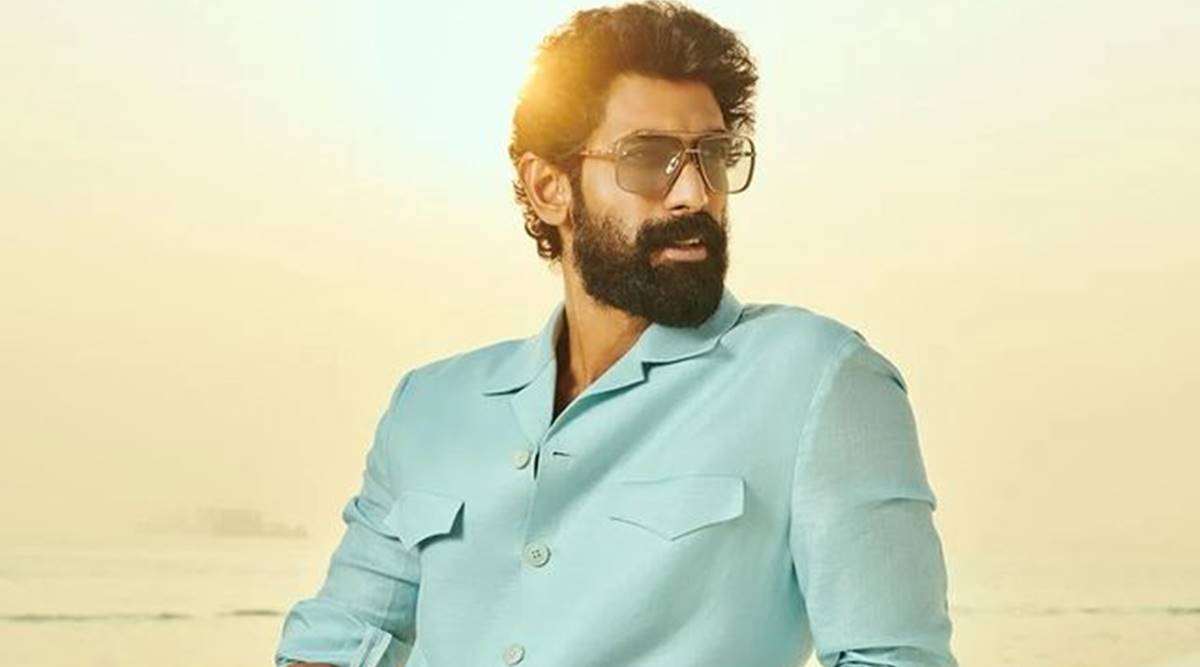
Niharika Lal (BOMBAY TIMES; December 2, 2022)
There was a time in his career, when people didn’t know which part of the country he was from or what language he worked in, says Rana Daggubati, adding, “And vice versa – people in the Telugu industry, or the Tamil industry, didn’t know what was happening in Mumbai.”
That’s what makes the shifting dynamics of Indian cinema all the more fascinating to the actor. At a session on film business at IFFI (International Film Festival of India), Rana shared, “It is the first year when we are addressing India as one film industry. What is happening in one industry is no longer alien to others.”
Rana said that OTT has definitely contributed to this shift. “Last week, I was at a party in south Bombay and they spoke to me about every Fahadh Faasil film they have seen in the last two years and this change is kind of incredible. The consumption of content is huge on OTT. You have so much choice on your phone and TV, which is high-quality, 4K, high definition. It gives you an opportunity to engage with those characters for a longer time. If you’re watching a show you’re hooked on those guys for 10 or 12 hours. It’s a different experience.”
‘PEOPLE ARE TAKING TIME OUT TO WATCH RRR & KGF ON THE BIG SCREEN BECAUSE THESE FILMS ARE LIKE EVENTS’
On the flipside, the audience is now more selective about which films to watch on the big screen, Rana said, adding, “When Black Panther: Wakanda Forever came out, everybody just got up, and left their offices, to watch it. People are still taking out time to watch KGF and RRR because those are events. If you sit in an auditorium with a giant screen, then you will only go for emotions or experiences that are extreme. Everything that is communal is more likely to be watched on big screens. Today you want cinema to be more authentic, and true to its genre. Whatever genre the filmmakers are making their stories in, they need to be extreme in narrative.”
Rana added, “What is extreme about Kantara? What it is showing you, you have seen it in photographs, you have experienced it. If you are from Karnataka, then you have heard of it or if you are from a different state then you have seen some other version of it, but to see all that together in a single frame. . . (pauses). Now, while I am talking about Kantara, my body is feeling the same effect it did when I first watched it. During the black and white films era, I remember my granddad used to keep talking about films that were devotional and he’d say that he felt God, and after this experience, I felt okay, maybe that’s what he meant...”
‘PUSHPA, KANTARA BROKE THE MYTH THAT PAN-INDIA RELEASES NEED BIG-BUDGET PUBLICITY’
Responding to a question on what’s next for cinema, Rana said, “We are just one year into it and we are all figuring out which films to make. I think all stories will find their place. But (it will take) three-four years of making, watching, and consuming them.”
Citing the example of Kantara, Rana said, “It didn’t matter what language the film was made in, everyone watched it in the language they preferred and ended up feeling the same. Earlier, we used to say that films should come out in all languages on the same date. But now we are seeing that if a film works in Kannada then 15 days later or a month later, it comes out in Telugu. And it still does the same job. You will see deferred releases and releases that can be localized. Earlier, this trend of pan-India films was (about spending) 10-15 crores in terms of publicity, otherwise, you would not even reach anywhere. But Pushpa and Kantara broke that whole myth. They spent what they had to spend in their region, and the whole country went to watch it. I think these systems (of pan-India mega-budget releases) will keep changing, and everybody will keep finding their type of affordable cinema.”
In response to the question of ‘why it took India so long for India’s cinema to become united’, Rana said, “When I was a kid, Mani Ratnam sir made Roja and Bombay. Those were Tamil films watched across the country. Everyone knows Roja’s music, no matter which part of the country you are from. Ram Gopal Varma made films like Satya, and again, it didn’t matter which language you spoke, you watched it. Time and again, there were films like these, which were telling us – ’Here you go, guys. We’ve done it.”
Addressing the narrative that in this flux, ‘Hindi cinema has somehow lost its way’, despite recent hits like JugJugg Jeeyo, Gangubai Kathiawadi and Brahmastra, Rana said, “Every time there is a certain change in the industry, the guy who is leading the pack is the first to get hit. I think somewhere Hindi cinema has been leading the pack. They are leading the entire industry in terms of creating music, creating value, and enterprise. And I think that they are closest to the change so they are taking a bit longer.”
‘STARDOM LIKE YESTERYEARS MAY NOT BE POSSIBLE TODAY, BUT GREATER THINGS ARE POSSIBLE’
About the changing definition of stardom, Rana said, “What is the star concept? The further away you are from a person, the more mystical they are. I don’t think you are going to have the same phenomenon as the yesteryear stars because there was just so little that you got to know about them. The only way to consume stars was through their films. Today, stars are always on social media, and you (the audience) also start treating them as entertainers. The star system will keep changing, and there will be characters that will last beyond stars.”
But are there still going to be stars? “The same thing may not be possible, but greater things are possible. Now you see platforms taking Indian culture, actors and films to a global stage. Becoming global stars is possible for Indian stars.”
Pan-Indian cinema is a trend now because people are open to watching such films-Mani Ratnam
8:21 AM

Prakash S (BOMBAY TIMES; April 28, 2022)
Pan-Indian film is a term that has come to be used often now in the Indian film industry, with Bãhubali and KGF franchises, and RRR attracting fans across the country. Though the Tamil film industry is churning out films that promise to cater to the sensibilities of pan-Indian audiences, there is a notion that Tamil cinema is not matching up to Telugu and Kannada cinema in this aspect.
Mani Ratnam, whose movies like Roja and Bombay have appealed to a pan-Indian audience, addressed this concern at an event recently, and said, “This is not something new. Since many films are coming out now and becoming a success in north India, too, we’re talking about it. Earlier, Chandralekha (S S Vasan’s 1948 film), which we made, became successful in north India. No one asked such questions then. Any growth is a positive element and no one can stop this. We’re watching Hollywood films being dubbed in Tamil; so, what’s wrong with watching a Kannada film? If you make good films, then it will become a success everywhere.”
So, if Chandralekha and Roja have done it before, pan-Indian cinema is not new. But why did it not become a trend then and why now? “Well, the first part of the question doesn’t matter anymore. Now, people are filmmakers are also adapting to it,” he answered.
The ace filmmaker further said, “The standard of Tamil cinema is very rich; there are a lot of brilliant filmmakers who are very good. Many young filmmakers are opening new doors for the industry.”
Touching on the role of technology in cinema, Mani Ratnam, whose multilingual period film Ponniyin Selvan – I is in its post-production stage, said, “Any tool which will help us make better films is welcome. Cinema is an expensive art form, and it’s very important to keep the budget under control so we can make better films. It’s wonderful to see a flux of techies entering with innovative ideas to make better cinema.”
I miss good lyrics-Kavita Krishnamurti
8:29 AM

Soumya Vajpayee (HINDUSTAN TIMES; January 24, 2022)
Singer Kavita Krishnamurti has recorded over 50,000 songs in 46 languages in her five-decade-long career. Reminiscing about the phase she enjoyed the most, the singer says, “I’ve had the privilege of working with many composers, singers and lyricists. Every moment has been a part of my learning process. The songs I recorded in the mid-90s for films such as 1942: A Love Story (1994), Khamoshi: The Musical (1996) and Bombay (1995) were extra special.”
But as we go on to talk about the Hindi film music of today, the veteran has mixed views. “Some of the songs are splendid, I like the innovative approach and fusion style. But, there are quite a few that are not my taste. I miss good lyrics,” says Krishnamurti.
Ask her how the pandemic has been for her, and the Dola Re Dola (Devdas; 2002) and Mera Piya Ghar Aaya (Yaraana; 1995) singer says, “I enjoyed working on some projects with my husband, Dr L Subramaniam, at home, including songs like Vasudhaiva Kutumbakam and Vande Mataram.”
She was recently honoured with the Mohammed Rafi Award and holds it close to her heart: “I was delighted to receive the award. Rafi saab was one of the most iconic playback singers. My experience of recording two lines with him for a film called Ladies Tailor (1981) is a memory I’ll always treasure.”
She will be celebrating her 64th birthday tomorrow (January 25), “It will be a quiet one at home, with family,” she says, quipping, “I am young as long as I can sing or enjoy music.”
Bombay is perhaps the only Indian city that exudes industry in every slum and gully-Remo Fernandes
9:44 AM
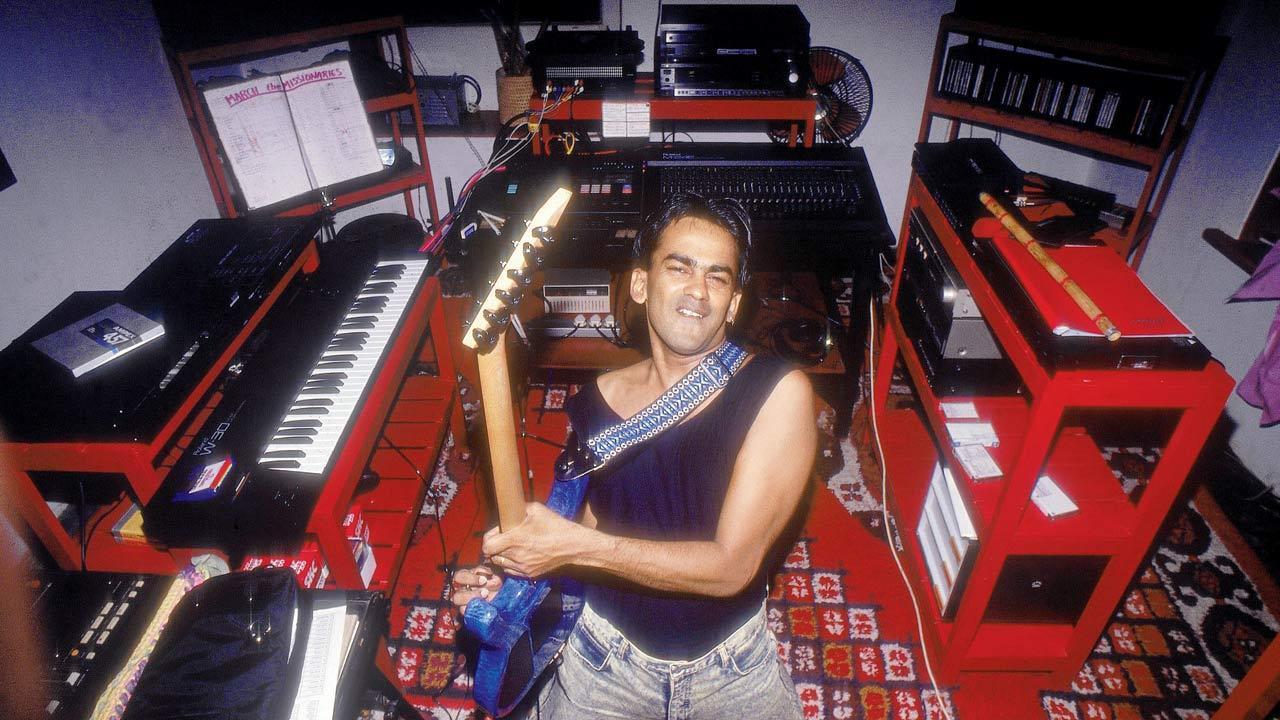
A file picture of Remo Fernandes dated 1990. Pics/Getty Images And Remo Fernandes, Harpercollins, India
Unabashedly honest, Remo Fernandes’ biography celebrates an illustrious indie music career free of Bollywood and a man who dared to write his own script
Fiona Fernandez (MID-DAY; December 5, 2021)
When we dial Remo Fernandes on his landline at his Siolim residence, we encounter disturbance in the audio. “It’s been pouring all day. Can you hear the pitter-patter?” Goa’s indie music veteran asks.
We can. But it’s the familiar voice at the other end that makes us swing back to the 1980s with a smile. On our black-and-white TV set, a Goan musician dressed in funky attire was making the audience groove to, “Graham Bell, Graham Bell/ You’re dead and it’s just as well/But if you saw the phones in India/You’d jump into the well.” It’s serendipitous then that a landline is the connector for this telephonic interview.
Ode to Graham Bell was part of a playlist where Indian pop musicians in the early days of the indie music movement performed for the Aid Bhopal concert to raise funds for survivors of the Union Carbide tragedy of December 1984. The grainy transmission, courtesy Doordarshan (DD), hardly mattered to school-goers like us. It was our first taste of a live gig where Indians sang in English. We realised that there could be a musician beyond Michael Jackson, Prince and Madonna, and he sounded good.
“We had some decent programming for music and films on DD back then,” Remo agrees. In fact, large sections in his just-released self-titled biography (HarperCollins India) act as a timeline for India’s independent music movement. Shows like Pop Time introduced Indians to desi pop and rock. By the early 1990s, satellite TV had arrived. Things were looking up. “The music video gave us two things—exposure to Western artistes, and wider accessibility to our own music. Before that, we’d be unsure if our music was distributed evenly across India. Music videos on Channel V and MTV did the trick. It was a golden era for Indi-pop. Then, Bollywood got wise and began to rope in the same artistes for films. Some of us sang those tunes, but kept our identity intact; others didn’t. It was far more lucrative,” he reasons.
Case in point was his jugalbandi with Juhi Chawla for a popular cola brand that took him to unknown corners of India. Remo admits that he was lucky to have worked with some of the best minds across art and commercial cinema, whether Shyam Benegal (Trikal) or A R Rahman (Humma, Humma; Bombay). “Here, all avenues of art appear to have been taken over by Bollywood. Some of our finest poets and dancers are working for them.”
Remo is proud he didn’t take the Bollywood route. He writes in the book how his father lost his cool just once about his choice of career, despite being supportive of the fact that he chose to ditch his architecture degree [Sir JJ School of Architecture], busk and back-pack across Europe and North Africa. Later, as fame and money came Remo’s way, he admitted to his wife with pride that his son had become rich and successful.
In fact, Remo’s childhood seems straight out of Kevin Arnold’s life in The Wonder Years—a secure, happy life surrounded by a loving family, friends and music in beautiful Panjim. “I feel lucky. Even if there was disagreement, we’d never break communication,” he says recalling how on his return from Bombay as a student, he told his parents that he had stopped attending Sunday mass. “You read about these episodes where families reunite only at someone’s funeral. That was never the case back then. And it wasn’t just about family. As Panjimites, we knew each other, and went all out to help.”
There are instances that reflect the simplicity of the time. “I call it the age of innocence,” he says, referring to when as a teen, he brought home marijuana to show his parents, who were curious. “There was ignorance about ‘drugs’. At our shows, some of them sponsored by Simla Cigarettes, after handing over complimentary packs, they would tell us that we were too young to smoke,” he laughs. “Now, we are suspicious of even the food we eat.”
He admits that music has always been riddled with danger. “The owners of venues always offer you a drink before the show. I cannot imagine any other profession where this happens. You are surrounded by vices. Back in the 1970s, everybody experimented with drugs. In Bombay, it was freely available around Colaba, and it was a cool thing to try. In Goa, many from my generation died due to drug overdose. It affected our youth,” he recalls. Years later, Remo would become the poster boy for Goa’s Anti-Drugs Campaign, composing hard-hitting tracks like, Pack That Smack.
As an architecture student in Bombay, Remo admits he tried it all—drugs, segwaying between multiple lovers, and slumming it in the big, bad city. He was the hipster musician, who got introduced to the Bhagavad Gita from where his discovery of Hinduism began. But Bombay wasn’t for him. Flood-prone Love Lane in Mazgaon and the mosquito-infested hostel in Bandra East, crowded buses and local trains were an irritant for the Goenkar.
But the next time he came to Mumbai, it was as a popular musician. “From my first visit student to later, where I moved around in chauffeur-driven cars and lived in five-star hotels, I saw things differently. Bombay is perhaps the only Indian city that exudes industry in every slum and gully. I noticed now that beneath a shanty’s roof, there were people earning money, they were industrious. This perspective cleared my mind.”
He paid a hat-tip to the city in the track, Bombay City: Bom Bom Bom Bom Bombay/They say you’re going to blow away/But I know you won’t, I know you’ll stay/Alive and kicking till Judgment Day.
He is glad the book is finally out since he took a six-year break in between writing. He admits that his literary agent Hemali Sodhi wasn’t aware of this detail when she received the first few chapters. “But the feedback I received was positive; I was relieved that the gap hadn’t affected my writing. But, self-editing was tough. How do you fit your life into a hundred thousand words?” He credits his editors for being accommodating.
Remo wrote the final pages in January 2021, bang in the middle of the lockdown. “I’m leading a peaceful semi-retired life with Zenia between Goa and Porto, doing the odd show, and making music in both studios,” he says. Yet, there is one production that Remo yearns to complete. It’s a precious score for the modern opera, Teresa & The Slum Bum, created after an inspired meeting with Mother Teresa in Kolkata. “That might happen in the future, but this felt like the right time to end my biography.”
Wise words from Remo
Find your own style. Imitation is a great school of learning; but after doing that, please find your voice. Make your own version of the song, even if it is a cover. If it is a rock song, change it to a bluesy one, or give it a Latino beat. Ensure you tweak the instrumentation; otherwise why would someone listen to your music?
I was anxious and swimming in tears-Aditi Rao Hydari
8:02 AM

Aditi Rao Hydari on using creativity and memories to cope with the lockdown
Ankita Chaurasia (MUMBAI MIRROR; July 1, 2020)
Just two days before the Coronavirus-induced lockdown, Aditi Rao Hydari’s mother, Vidya Rao, insisted she returns to their Hyderabad home from Chennai, where she was shooting for a Tamil film. And the actress is happy she complied.
However, despite being with family and friends, she admits there were several harrowing days during the three-month-long lockdown. “I was anxious and swimming in tears. I missed being on the sets and was feeling frustrated that I couldn’t help people the way I wanted to,” she shares.
Aditi is quick to add that being a self-confessed optimist, she can see the silver lining in any dark cloud. “Put a tub of muck in front of me and I will find something beautiful in it. So, I called my near and dear ones who were equally stressed, and helping them out helped me feel better,” she reveals triumphantly.
“Privileged” to be home, she used the time to revisit her childhood too. “In the last eight-nine years, I haven’t been able to give too much time to dance and music. I used to practice Kalari, but then, I stopped. The break gave me time to reconnect with my creative side,” relays the actress.
Aditi also helped her cousin set up his bachelor pad by painting his furniture. And since she loves cooking, she tried out some new recipes and now can dish up Bengali mustard mutton curry, yakhni pulao and mirchi ka salan.
“I was trying to get fluent in Telugu, my mother tongue. But since I am doing a Tamil film, I started getting confused and had to put that on the backburner,” she chuckles. Point out that learning Telugu when she is to make her debut in Malayalam films seems brave and she laughs again, “I play a speech-impaired dancer in the film, so the only language I had to learn was sign language.” Being a dancer, it was easy to convey with gestures, but she ensured her instructor was on the set to help her modify if she felt the need. Interestingly, it wasn’t dance that drew the actress to the film, but because it reaffirmed her belief in love.
“True love is innocent, pure, and complete. But when eight million others get involved, it complicates the way two people think. Eventually, there’s no right or wrong, what matters is intent,” Aditi points out, confiding that she is very idealistic about love. “With Leela from Kaatru Veliyidai, Mehrunisa from Padmaavat or Sujata from Sufiyum Sujathayum, I have learned to be fearless in love. To be able to look into someone’s eyes and tell them that you love them is the most frightening thing in the world, because you are at your most vulnerable at that time. But once it is done, you become the strongest person,” she philosophizes.
Quiz her if another film with Mani Ratnam is on the cards and she quips, “I became an actor because of him, so I am ready if he has anything for me. Bombay inspired me to become an actress. I wanted to climb into the screen and be Manisha Koirala. So, when I got to be a Mani Ratnam heroine, it was a dream come true.”
For now, however, Aditi has tested the waters of professional singing after her Tamil song with Dhanush, “Kaathodu Kaathanen” for the film Jail, got her loads of compliments. Despite not being a trained singer like her mother, she can croon a few soft, romantic tracks. “When the film’s composer G V Prakash insisted I sing, I agreed on the condition that he doesn’t autotune me, no matter how many takes it took to get it right. To my relief, it turned out well. Recording in a studio was much more relaxing than singing live with A R Rahman on stage. That was absolutely terrifying as he doesn’t believe in minus one (prior recording). Some day, I would want to give playback for myself too,” she concludes.
I don’t think I know how to date-Aditi Rao Hydari
7:50 AM

MUMBAI MIRROR (May 20, 2019)
Aditi Rao Hydari says that she had to get intimate with a stranger during an audition once. Making an appearance on a talk show, the actress revealed, “I don’t have any whacked-out stories from auditions, except Yeh Saali Zindagi, where I had to literally make out with someone I didn’t know.”
She was referring to Arunoday Singh, who was cast opposite her in the film, and was, by her own admission, polite. “But at that point, I didn’t know him, and he was a huge hulk of a guy and I was just like, ‘Uh...what’s going on here?’” she added.
Aditi also spoke about other aspects of her life, including how Mani Ratnam’s Bombay is what attracted her to the world of films. She was especially enamoured by the song “Kehna hi kya”.
The actress also opened up on her personal life, admitting that she had received her first love letter when she was just in the fifth standard. “It was really long. It was like, two pages. All I know is that it was from a senior. Very soon after that, I was packed off to boarding school,” she said with a laugh. Aditi remembers showing the letter to her mother. “I was nine at the time. It basically said that I was the most beautiful girl and blah blah. Now when I think about it, I’m like, ‘I was nine! How does that even work?’” she said.
Opening up on her “dating game”, Aditi, who tied the knot with actor Satyadeep Mishra when she was 21 and later separated, said: “If I got into a relationship like that at 21, my dating game would be zero, right? I don’t think I know how to date. After that, I joined the movies. What dating am I going to do?”
I’ll act till the day I die-Manisha Koirala
8:06 AM

Deepali Singh (DNA; June 11, 2018)
When we meet Manisha Koirala on a cloudy evening, the same morning the actress has posted a picture of herself trying her hand at swimming. As soon as we bring it up, she throws her head back and laughs. “I know what people will say. At this age she wants to learn swimming!” Wearing an off-white pantsuit that fits her petite frame and big glares which hide her twinkling eyes, the actress reveals that she has taken to her new hobby with a vengeance. “I used to float in water, but never really swam in the deep. I’ve always been petrified of that. But I felt proud of myself for finally being able to swim and trying out something new. Now, I’m super enthusiastic to come here every day at 6 am. I’m quite obsessive that way!” she laughs.
Post her recovery from cancer, the award-winning actress was last seen in Dear Maya last year. And now, she has three films lined up for release — Dibakar Banerjee’s Lust Stories, Rajkumar Hirani’s Sanju as well as the Hindi remake of the Telugu hit Prasthanam. Naturally, there is loads to talk about with her and Manisha, too, has been busy with media interactions since noon. Isn’t she exhausted? “Not at all. This is an important part of our profession. Especially today, it’s important to do them well and be there 100 per cent... I love it!” she insists with a smile. Over to her...
Swimming lessons, solo trips... you seem to be thoroughly enjoying this post-recovery phase?
I am embracing life with open arms! I’m doing things which I love. I feel I can do a few things, but I’m fully present because I’m enjoying them. I love nature, hiking, trekking, taking long walks... so I’m doing all that.
There was a lull in your career once you were diagnosed with cancer. Last year, you returned with Dear Maya and now, you have three films coming up...
Well, it’s great to be in your late 40s and be able to work. Honestly speaking, I had no idea in my 20s that I’ll continue loving my work. But it seems to me that I’ll act till the day I die (laughs). Have you heard of this Italian movie called Il Postino? I love Pablo Neruda’s poetry and this film is about his encounter with a postman, who used to bring his letters. The actor, Massimo Troisi, who played the latter, passed away after the film was shot. I know the value of an actor because cinema and acting is everything for me. If you love your work so much that this could be the last thing you would be doing before you say goodbye to the world, then it’s the best thing. I’ve rediscovered my love for acting. I’m so grateful that I’ve an opportunity to be able to perform different kind of genres. I’m scared of getting typecast. The industry has the tendency to stereotype actresses over 40 into mothers’ roles. I will do them, but differently with the sense of an actor.
You mentioned during Sanju’s trailer launch that the late Sunil Dutt told you that you reminded him of Nargis Dutt in your film Bombay. How did you prepare for the role of the late actress?
There was a trial of Bombay at Ajanta Theatre owned by Dutt saab. After seeing it, he called me and said, ‘Manisha, you reminded us of Nargis Dutt ji.’ That was a massive compliment for me! After so many years, I am playing her. But I was not very confident. I wasn’t sure if I would be able to do justice to the role. So, I was nervous but Raj ji (Rajkumar Hirani) and his team were thoroughly prepared. We did look tests, held discussions and he made me watch documentaries on her. Then I met Priya Dutt, who sent me a book written about her parents. I never got a chance to talk to Baba (Sanjay Dutt) about her, but all this work helped me perform.
Your association with Sanjay Dutt goes back many years. Now, you play his real mother in Sanju and his on-screen wife in Prasthaanam. Tell us a bit about working with him.
My association with Baba has been since my childhood. I became his fan when Rocky released! I think I was in sixth or seventh standard and I just loved him and Tina (Munim). We were not allowed to put up posters of film actors in our house, so I would stick his pictures and postcards behind the almirah door. When I got a chance to work with him, I told him I used to be his biggest fan. He said, ‘Why, aren’t you my fan now?’ (laughs) I told him, ‘Now, you are my colleague!’ Working with him is such a pleasure. He’s always the brat of the unit, so full of life and pulling pranks on everyone. I’m really excited to be working with him after all these years.
You will be seen next in Lust Stories. You have done your share of bold roles and some have even courted controversies. Is this a bold film, too?
I was enjoying solitude in Nepal when Dibakar (Banerjee) contacted me for this film, which was called Bombay Talkies 2 then. I saw the first part after that. I really liked that these four big directors have experimented with unconventional subjects because, in a bigger film, there is the handicap of trying to recover those big monies. I feel, for a performer too, it’s great to be able to work in a mainstream film as well as a movie set-up like this. I see it as a film that’s giving me scope to perform differently.
Since your story is about an extra-marital relationship, were there any bold scenes you had to shoot?
I’m fairly conservative, so there were none! In fact, Dibakar said people will know that he didn’t make a bolder film because of me (laughs). I feel some people can pull it off while others can’t. I’m someone who can’t pull off so much boldness; my boldness has its limitations.
You’re just bold in your views...
Absolutely, bang on! (Laughs)
You’re making your digital debut with this film...
Yes, and I have a few more interesting offers in that space. So, let’s see.
Sanju: How Manisha Koirala became Nargis Dutt in the Ranbir Kapoor starrer
7:52 AM

Nayandeep Rakshit (DNA; June 7, 2018)
Manisha Koirala, who plays Nargis Dutt in the Sanjay Dutt biopic, Sanju, went through many sessions to get her look just right for the part. And it seems the effort has paid off. We have got our hands on some behind-the-scenes images. Says a source, “The team tried a lot of different get-ups so that Manisha resembled Nargis ji. Director Rajkumar Hirani and producer Vidhu Vinod Chopra loved what they saw during the look tests.” Those who have seen the pictures have remarked about the uncanny resemblance between Manisha and the Mother India actress.
Commenting on the same, Manisha says, “We had many discussions. Hirani sir showed me a documentary on Nargis Dutt ji, while Priya Dutt gave me the book, Mr And Mrs Dutt: Memories Of Our Parents. We used to try various wigs and hairstyles. To match her charm and the spark in her eyes, I studied her a lot. Hirani sir’s entire team was involved in helping us actors get the right look and mannerisms.” At the launch of the film’s trailer, Manisha had reminisced how Sunil Dutt had once complimented her and compared her to the legendary actress. Manisha said, “He had called me after Bombay had released and told me that I reminded him of Nargis ji. That was special.”
Given a chance, I’d do all Mani Ratnam films-Aditi Rao Hydari
8:10 AM

Aditi Rao Hydari on her mentor-director and how he compares with Sanjay Leela Bhansali
Shravan Shah (MUMBAI MIRROR; March 26, 2018)
Sanjay Leela Bhansali’s period drama, Padmaavat, is still making the cash registers ring and with its lead trio, Deepika Padukone, Ranveer Singh and Shahid Kapoor, Aditi Rao Hydari, who played Alauddin Khilji’s wife Mehrunisa, is getting her share of raves.
“I knew the film was special but I didn’t know it would be this huge. The response is overwhelming!” says the 31-year-old actress, revealing that Bhansali had reassured her that even though her character would be kept under wraps before the release, Mehrunisa would weave her magic. “I had faith in Sanjay sir. I’d love to play a lead role, but a part like Mehrunisa is also nice. Everybody from Jennifer Lawrence to Natalie Portman is doing it in Hollywood, so what’s stopping us here?” she questions.
Aditi may not be from the film world but she has grown to love her job. “You could put her in front of the camera for 48 hours at a stretch today, and it’d still be a happy place,” she reasons.
The 2007 period drama, Sringaram, marked Aditi’s debut in Tamil cinema, post which she had to wait for a decade to make a new beginning down South with Mani Ratnam’s love story Kaatru Veliyidai. The director’s name brings a smile to her face, “I’m Mani sir’s biggest fan and could talk about him endlessly.”
She’s already moved to her second Mani Ratnam film, Chekka Chivantha Vaanam, and admits she feels blessed that one of her fave directors is working with her again. “Mani sir not only challenges you but also nurtures you. He’s a mentor in the true sense,” she gushes, adding that when she’s shooting with him, she’s eagerly absorbing everything like a sponge. “I don’t even go to the van to change. Mani sir runs a tight ship but his unit is like one big family and working with him for the second time feels like a homecoming. The work is challenging, but given a chance, I’d do every Mani Ratnam films. Working with him and Sanjay sir have been a life-changing experience,” she acknowledges.
Of the two filmmakers which one is the taskmaster, you wonder, and she says, “Both are but their passion for cinema is infectious. They live, eat and breathe films, the only difference being that if Mani sir is ‘micro economics’, Sanjay sir is ‘macro economics’. With Mani sir you are sprinting and he’s always ahead of you while Sanjay sir runs a marathon and you are always behind him. When working with them it’s rare for me to even check my phone. I’m like this kid in wonderland,” she beams.
Aditi’s new Tamil film, Chekka Chivantha Vaanam, also features Arvind Swami and Vijay Sethupathi and she asserts that the amazing actors only help her perform better. “I dreamt of being a part of this film since I read the script. But everybody loved Katru Veliyidai so much that the second film had to be equally convincing. With Mani sir every chord has to be real and true. You can’t fake it even for a millisecond. I promised him that if he thought I could do the role, I would do it, no matter how tough the job,” she says with conviction.
Reportedly there’s a third film with Ratnam in the pipeline and Aditi seems to have become his new muse? “I hope you are right. When I hear words like these, my heart fills with joy. I wanted to be an actress after I saw Manisha Koirala’s song 'Kehna Hi Kya' in Bombay. I was a kid then, didn’t know much about cinema or how great Mani sir was, but I still wanted to jump into the frame. That I’m actually living that dream today makes me want to work harder so I can do more films with Mani sir,” she says.
I have no regrets over bad decisions I've taken-Manisha Koirala
7:55 AM

Deebashree Mohanty (BOMBAY TIMES; July 9, 2017)
How does it feel to be back in front of the camera, a place you ruled for years before you were forced to take a break?
I would like to believe that I ruled the camera before I was forced to take a break (laughs). That apart, I love being back! There is nothing more satiating than to be able to do what you love doing. I have other interests as well, but the camera gets the best out of me. But let me tell you, I wasn't born to be a natural in front of the camera. It was all thanks to my mentors that I did what I did.
Please elaborate...
My mother was very keen that I get the part in '1942: A Love Story', but on my first take, Vidhu Vinod Chopra said I was a shitty actress and I couldn't do justice to the role. I was hurt, dejected, but I took it up as a challenge. I rehearsed till late at night and the second take was way better. On another day, I remember director Shekhar Kapur beating it down my head: “Manisha, flirt with the camera!“ Unfortunately, I didn't understand what he meant then. Now, I have come a long way.
So, you are not signing a lot of scripts these days?
I am being very choosy. There are some scripts that are not demanding enough for me to take up, others are a bit too challenging for me physically. In any case, I have decided to dedicate a lot of time to nature movies will happen here and there.
'1942: A Love Story', 'Bombay', 'Dil Se' you have been a part of movies around socio-political issues. Was that a conscious decision or did it just happen?
You will be surprised that I had also briefly contemplated turning down 'Bombay' because I feared playing a mother and being typecast. Cinematographer Ashok Mehta told me, 'pagal ho kya? Do you even know whom you are saying no to?' It's all thanks to such people and my mentors that I could play those parts. I wish I were offered such roles now like those I was offered 20 years ago.
Let's talk about your battle (with cancer)...
There's nothing left to talk about. I don't want to glorify my sickness and use it as a stepping stone for anything. It's a thing of the past and I don't want to dwell on it. It's painful to even think about those times... let's leave it at that.
You are writing a book documenting your struggle and life thereon...
I am still contemplating. I have learnt a lot from my sickness and I want to share some of those feelings with people who are bat tling similar problems. I want to tell them that nothing is unbeatable!
Could you share some of these learnings that you are talking about?
I spent a lot of lonely days, restricted to my hospital bed in NYC. There was a lot of time to dig deep, introspect. I realised that I was arrogant and ignorant about a lot of things in life. I was very complacent and had taken life for granted. Earlier, I would think of dieting only to lose weight and look pretty. Now, I realise the importance of overall nutrition; how a balanced diet is of utmost importance. I have also learnt that life should be enjoyed to the fullest. Take as many breaks as possible to rejuvenate in the right manner.
You used to call yourself a rebel...
I was one because I didn't wish to follow any trend blindly. Being a rebel gave me a sense of freedom, and I don't want to lose that ever. With age, I have become matured enough to understand that there is no point in wasting time just rebelling.
Do you regret having been complacent about life?
I don't regret anything neither my mistakes, nor my decisions. Yes, some things haven't worked my way, but I have moved on from everything. My stint with cancer has taught me to forgive, for get and quickly move on.
What are your plans for the moment?
The hills beckon. I plan to take a break for a about 3 to 4 months. Then, I will concentrate on a few scripts before leaving for Nepal to spend time with family.
You've often said your family is your first love...
My parents and my brother have stood by me in the worst of times. They have made me realise that there is no bond like the family bond. I am a very family-oriented person; that's why I want a daughter of my own. I plan to adopt one from Nepal by the end of this year. It will be five years since I became cancer-free. That would relax me a little. My doctors say in my type of cancer, it takes six to seven years to be out of the woods. But I don't have the patience to wait any longer.
Humma Humma in Ok Jaanu is a pale, insipid version of the original-Remo Fernandes
2:16 PM

Remo, the original voice behind 1995 iconic Rahman track, slams recreated version in OK Jaanu
Mohar Basu & Sonil Dedhia (MID-DAY; December 17, 2016)
Putting a new spin on an iconic song can be a risk. As far as the recreated version of AR Rahman's chartbuster Hamma Hamma in Aditya Kapur and Shraddha Kapoor-starrer 'OK Jaanu' goes, the risk doesn't seem to have paid off. The track rendered by Tanishk Bagchi and Badshah didn't open to the most positive remarks on social media, with many slamming the rap bit and calling it pointless and sleazy. One tweet read, "Badshah puts the no in nostalgia".
Remo Fernandes, who sang the original song in Mani Ratnam's Bombay (1995), hasn't taken to it kindly either. Speaking to hitlist from Portugal, he says, "There is nothing wrong in doing new versions of existing songs, as long as one brings something new to the table. It can be something plus, or at least something different. This version of Humma Humma, I am afraid, brings neither. It is but a pale, insipid version of the original. Vocally, instrumentally and arrangements-wise, it seems to be a hurried, uninspired job."
Aware of the brickbats thrown his way, Tanishk says the intention was to pay tribute to Rahman and "not spoil the track". "We are getting mixed reactions and a lot of people have also accepted it. When I was first approached for the song, I was excited because, as a kid, I would always dance to it. But, I had questioned the makers why we were remixing a beautiful track. Rahman sir has always been an inspiration, so for me, it was a chance to work with him (Rahman is the film composer). He suggested that Badshah and I work on the song since he knew we would bring a new flavour to it," clarifies Tanishk.
He calls the track an unplugged version. "Badshah and I started working together, so it is common sense that his presence would bring a rap element to the song. If you listen to it, the rap isn't the trademark Badshah style. He has done it in quite a unique manner," adds Tanishk.
Censor Board to ask producer bodies to do away with the 'Bombay' in film titles, dialogues, lyrics?
7:54 AM
Bharati Dubey (MID-DAY; February 10, 2015)
 The Censor Board’s recent decision to beep out ‘Bombay’ from singer
Mihir Joshi’s new track, Sorry, was just the tip of the iceberg. Now,
the board is said to have decided to impose an umbrella ban on the
city’s old name, advising producer associations against accepting its
registration for film titles, or usage in dialogues and lyrics.
The Censor Board’s recent decision to beep out ‘Bombay’ from singer
Mihir Joshi’s new track, Sorry, was just the tip of the iceberg. Now,
the board is said to have decided to impose an umbrella ban on the
city’s old name, advising producer associations against accepting its
registration for film titles, or usage in dialogues and lyrics.
A source says, “Producer Ashok Kaul had submitted his film titled Bombay Central for certification, but the Board asked him to change it to Mumbai Central. The certificate was issued to him only after he made the required change.”
Sources in the Censor Board suggest that they were merely following guidelines set by the state government in its 1996 gazette notification to restore the original name of the city as Mumbai. Hence, it is planning to write to all film producer bodies to steer clear of ‘ Bombay’ in film titles, dialogues and lyrics.
The advisory would apparently be sent to the Film and Television Producers Guild, Indian Film and Television Producer Council, Western India Film Producers Association and Indian Motion Picture Producers Association.
Meanwhile, a Mudgal Committee proposal aims to make the Board the point for clearing film posters following allegations of vulgarity and obscenity in such publicity materials.
 The Censor Board’s recent decision to beep out ‘Bombay’ from singer
Mihir Joshi’s new track, Sorry, was just the tip of the iceberg. Now,
the board is said to have decided to impose an umbrella ban on the
city’s old name, advising producer associations against accepting its
registration for film titles, or usage in dialogues and lyrics.
The Censor Board’s recent decision to beep out ‘Bombay’ from singer
Mihir Joshi’s new track, Sorry, was just the tip of the iceberg. Now,
the board is said to have decided to impose an umbrella ban on the
city’s old name, advising producer associations against accepting its
registration for film titles, or usage in dialogues and lyrics.A source says, “Producer Ashok Kaul had submitted his film titled Bombay Central for certification, but the Board asked him to change it to Mumbai Central. The certificate was issued to him only after he made the required change.”
Sources in the Censor Board suggest that they were merely following guidelines set by the state government in its 1996 gazette notification to restore the original name of the city as Mumbai. Hence, it is planning to write to all film producer bodies to steer clear of ‘ Bombay’ in film titles, dialogues and lyrics.
The advisory would apparently be sent to the Film and Television Producers Guild, Indian Film and Television Producer Council, Western India Film Producers Association and Indian Motion Picture Producers Association.
Meanwhile, a Mudgal Committee proposal aims to make the Board the point for clearing film posters following allegations of vulgarity and obscenity in such publicity materials.
Pahlaj Nihalani reveals why Bombay Velvet might not be changed to ‘Mumbai’ Velvet
7:56 AM

DNA (February 4, 2015)

 With the CBFC (Censor Board Of Film Certification)
beeping out the word ‘Bombay’ from a new song sung by Mihir Joshi, the
question that is disturbing the Mumbai film industry is, how far will
the CBFC go into altering the city’s name in the popular arts. Bombay
city’s name was officially changed to Mumbai in 1995.
With the CBFC (Censor Board Of Film Certification)
beeping out the word ‘Bombay’ from a new song sung by Mihir Joshi, the
question that is disturbing the Mumbai film industry is, how far will
the CBFC go into altering the city’s name in the popular arts. Bombay
city’s name was officially changed to Mumbai in 1995.The filmmaker who should be most worried is Anurag Kashyap whose Bombay Velvet is around the corner. Would Kashyap be compelled to change his title to ‘Mumbai Velvet’? The director recently took on the CBFC over the issue of inserting anti-smoking statutory warnings in his film Ugly. Kashyap had to finally relent and let the movie be released with the offensive anti-smoking warnings.
As far as the use of ‘Bombay’ in his film’s title is concerned the CBFC is very clear on the issue. Speaking on the issue Pahlaj Nihalani the CBFC’s chairperson says, “This is a State matter. The Maharashtra government officially changed the name of Bombay to Mumbai in 1995. And still, if filmmakers and song-writers continue to use the unconstitutional name for the city, we’ve no choice but to delete it. The city is called Mumbai, not Bombay. Making films and writing songs are a social responsibility. You can’t change geography and history just to sound trendy.”
However, Kashyap’s film may be the exception to the rule. Explains Nihalani, “If a film is a period drama, if it is set during a time when Mumbai was called Bombay, then we may consider retaining the old name for the city. However in the contemporary context Bombay won’t be allowed at all.”
Subscribe to:
Posts (Atom)