Showing posts with label Beyond The Clouds. Show all posts
Showing posts with label Beyond The Clouds. Show all posts
Raj Kapoor to Ranbir Kapoor, the India-Iran reel connection lives on
8:34 AM

‘Subah-o-Shaam’ was the first official Indo-Iranian project to be shot in Iran
Tehran was among the first global stopovers for Hindi cinema. Even as that bond survived the revolution and censorship, Iranian auteurs found a devoted audience in India
Shruti Sonal (THE TIMES OF INDIA; June 29, 2025)
When a 20-something Sreemoyee Singh was first introduced to Iranian films as part of her film studies program at Kolkata’s Jadavpur University, she had no idea that one day, she’d roam the streets of Tehran, with a camera in her hand and legendary filmmaker Jafar Panahi by her side. Or that seven years after first landing in the country, her documentary would be screened globally — from film festivals like Berlinale to packed auditoriums in Delhi.
“I wanted to see for myself how artists could live in a place where they were heavily censored and yet tell their stories,” says Singh. That curiosity led her to Iran in 2015 — after four years of planning, enrolling in a PhD, saving every rupee, and learning Farsi. The result was ‘And, Towards Happy Alleys’, a love letter to Iranian poetry and cinema, also chronicling the fight of women for their rights, especially their resistance to the mandatory hijab.
Farsi helped, but Singh says her Indian identity opened many doors in Iran, where love for Hindi cinema has persisted despite the strict film censorship.
“From taxi drivers to govt officials, many had memories of watching films like ‘Sangam’ and ‘Sholay’ in theatres while they were growing up. Younger fans would invite me to watch parties, as local TV channels showed films of Shah Rukh Khan on Sundays,” she adds.
A FORGOTTEN GOLDEN ERA
While stories of Amitabh Bachchan being mobbed in Egypt and SRK’s fame in Germany are well-known, Iran was in many ways the first global stopover for Bollywood, says veteran film critic Ajit Rai. “From the 1950s to 1979 was the golden period for Hindi cinema in Iran. Raj Kapoor’s ‘Sangam’ ran in Tehran theatres for three years, while ‘Sholay’ and ‘Mother India’ also ran successfully for a whole year,” Rai says.
Surprisingly, this cultural bridge was built by industrialists. As Rai details in his book ‘Hindujas and Bollywood’, Parmanand Deepchand Hinduja opened an office in Tehran in 1919, and later his sons brought Hindi films to entertain Indians working there, as well as to promote Indian culture. In 1955, they released ‘Shree 420’ in Iran with Persian subtitles. Raj Kapoor even attended the premiere. Soon, Hindi films began replacing Hollywood ones in theatres. Adjustments were made for local sensibilities: ‘Durgesh Nandini’ became ‘Farman-e-Akbar’. ‘Guide’ was retitled ‘Rahnuma’.
Poet-professor Akhlaque Khan ‘Ahan’ of JNU’s Persian Studies department says the crossover worked because of shared language and values. “Bollywood films and songs had a long history of using farsi words like dil, deewana, shayad etc. Epics like Laila Majnu, Rustom and Sohrab, and Razia Sultana are popular in both countries, while themes of honour and family are also common,” says Khan.
FILMI CROSSOVERS
It wasn’t just Hindi films making their way to Iran, but also a few Indian filmmakers. In 1933, Ardeshir Irani — credited with directing India’s first film with sound ‘Alam Ara’ — produced and directed the first Persian talkie, ‘Dokhtar-e-Lor’. The script was written by Iranian film writer-director Abdolhossein Sepanta who also acted in the film.
Many years later, Tapi Chanakya directed the 1972 film ‘Subah-o-Shaam’, which was the first official Indo-Iranian project to be shot in Iran. Two years later, another joint production called ‘International Crook’ (titled as ‘Kala Bazaar’ in Hindi) was released, directed by Pachhi and starring Dharmendra, Feroz Khan and Saira Banu.
THE CURTAIN FALLS, AND RISES
The Islamic Revolution of 1979 brought an end to this exchange as public screenings more or less came to a halt, and dance, song, and ‘vulgarity’ was looked down upon. In their place arose state-sanctioned cinema, glorifying the revolution and war with Iraq. Though they rarely got a domestic release, the circulation of bootleg copies and secret film clubs kept the love for cinema alive among Iranians.
Against this backdrop, there also emerged a new wave of Iranian filmmakers like Panahi, Abbas Kiarostami, Majid Majidi and Mohammad Rasoulof who won acclaim abroad though they faced travel bans and even jail time at home. Panahi’s ‘This Is Not A Film’ was smuggled out of Iran on a USB stick buried inside a cake. Rasoulof’s Oscar-nominated ‘The Seed Of The Sacred Fig’ was conceived in prison, directed secretly from his sofa, and finished in exile.
Though they may not have got screenings at home, Iranian filmmakers have been part of most major Indian film festivals winning fans for their refined visual language. In 2022, filmmaker Mahnaz Mohammadi sent a lock of her hair to the International Film Festival of Kerala because she could not come in person to receive an award.
There have been some joint collaborations too, with ‘Salaam Mumbai’ directed by Ghorban Mohammadpour, starring Iran’s Mohammad Reza Golzar and India’s Dia Mirza in the leading roles. A year later, ‘Beyond The Clouds,’ a Hindi drama film written and directed by Iranian legend Majid Majidi, starring Ishaan Khatter, was released. Last year, ‘Jamal Kudu’, a Persian song from the 1970s went viral after it featured in the Bollywood film ‘Animal’.
SECRET SCREENINGS
Back in Iran, the soft corner for Bollywood persists. Khan says, “A few years ago, I went to a friend’s home in northern Iran. Her mother told me that she wants to see some of the old films like ‘Sangam’ and demanded that I get DVDs on my next visit.”
During another trip to the country, the poet-professor was surprised when he found locals glued to a dubbed version of Dharmendra’s ‘Hamla’ on a long bus journey from Tehran to Ishafan. Even contemporary films get dubbed in Persian and are pirated into the country, Khan adds, noting that he also found a channel dedicated to Indian films in Persian.
A book printed by the ministry of culture in 1982 that this reporter found stocked in Delhi-based Iran Cultural House library also spoke of Indian cinema in a favourable light. “It should be a matter of grave concern to us that we should feel more at home with the cultures of a consumer society cunningly represented to us through glossy vehicles such as Elizabeth Taylor and John Wayne, than with the more humane traditions we encounter in films by first rate directors from Japan, India or Algeria.”
Lina*, an Iranian married to an Indian, says Bollywood fandom continues through small private screenings attended by young women like her. Inside the dark theatres, fans mouth dialogues, hum the songs that they know by heart, and even try to copy the hook steps in dance sequences. “Many people in Iran are still crazy about Bollywood. They just can’t talk about them openly,” she says over email.
*Name changed on request
I don’t want to be here for a hot moment and then be forgotten-Ishaan Khatter
10:14 AM

Renuka Vyavahare (BOMBAY TIMES; November 18, 2024)
The language of cinema is universal. While various Bollywood actors have dabbled in international films, Ishaan Khatter’s promising Hollywood debut in Nicole Kidman-starrer The Perfect Couple came as a pleasant surprise. Be it Beyond the Clouds, Dhadak or A Suitable Boy — Ishaan has pushed boundaries from the word go. In a conversation with Bombay Times, the actor reveals what prompted him to head West, carving his own identity, rapport with big brother Shahid Kapoor and how he’s in a phase of self-discovery. Excerpts...
You had a blink-and-miss appearance in the Leonardo DiCaprio starrer Don’t Look Up, while in the recent web show The Perfect Couple you were a huge surprise. We saw you in a significant, non-stereotypical role. Also, not trying too hard to fit into an American show. How was the experience of blending in?
I wanted it to be distinct and clutter-breaking. My debut film Beyond The Clouds was largely an Indian crew. Of course, Majid Majidi brought his vision to the film that was very different and distinct. And even Mira Nair’s, The Suitable Boy, was shot in India, and these were Indian stories. The Perfect Couple is a very American story and it’s very different to be part of an entirely American shoot. I saw the opportunity when I read the part. I couldn’t draw a reference for it. It was a completely different experience from anything I’ve done before.
Your accent on the show didn’t seem put on. How did you work on that?
It was something that I partly worked on with Susanne Bier (director). The way I read the role it didn’t make sense to me that I would be the only character speaking with a slightly different accent. So, I said, maybe we should go with a standard American accent. And she said, go ahead. I was given that freedom. The lack of stereotyping was interesting.
Indian actors are often stereotyped in non-glamorous, fairly insignificant roles in commercial Hollywood films. Do you see that gradually changing with time?
I don’t know if I can speak for an industry at large. The part I was offered is proof enough that times are changing, and I think it’s a milestone in that sense. I do know that they were open to casting pretty much across the board, irrespective of ethnicity. To me, that’s the bigger step, that they’re looking at parts not locked in with race or ethnicity but what an actor can bring to a character.
When you are romancing someone as supremely talented as Tabu on screen or facing a force like Nicole Kidman on camera, do you ever feel nervous? How do you break away from that sense of awe and step into your part?
I would be lying if I said that I’m not in awe of these people. I love their work. I’ve grown up watching them and I’m lucky. Who gets to work with Tabu as a romantic pair or with Nicole Kidman this early in their career? I just say thank you God, and do the work. When good things happen to me, I don’t know if it’s my defence mechanism, but I just treat them like it’s just another part, just another day. Also, I’ve never been in a hurry. My priority was always to become capable before doing anything.
What prompted you to head West? At 28, did you feel the scope was limited for a young actor like you here?
There are more diverse opportunities for young actors in the West, especially when you’re in the main lead space. There are fewer choices of roles here. The leading man in Bollywood is seen in a certain light. It’s only when you start looking a little older, there’s a wider blanket of roles at your disposal. I can’t complain because I’ve had some wonderful opportunities despite that. But, yes, that’s how it is. If you see young actors here, their careers start shooting in their late 20s or 30s. My brother (Shahid Kapoor) and I both started young. We were 21. So, we’ve seen that lack of opportunity when you are raring to go. Also, when you grow up on a certain kind of cinema, it shapes your sensibilities. You want to push yourself as an actor early. It was a good time for me to try something new. I’m still in a phase of self-discovery. I’m in a place today where I know myself better, so I back myself more. I don’t want to be here for a hot moment and then be forgotten. I am here for the long haul.
Speaking of looking older, both you and Shahid have baby faces. Is that a boon or a curse?
I kind of take it in my stride. I think of it in a positive way because I know it'll work out for me in the long run (smiles). Like baby face is not such a bad thing. It's a blessing in disguise, yeah. The audience has been fairly kind to me, but I have miles to go before I can sleep. I have my eyes on the long road ahead and I want to reach out to more people.
What goes through your mind when some people refer to you as Shahid Kapoor’s brother?
I was 21, on the stage of my first film’s trailer launch when I was asked about this. Someone had asked me if there was competition back home? Perhaps, this is the public perception. But to me, I see it as a blessing that I have an elder brother that I share a common passion with, which is cinema. I can learn from him, we share notes. And the thing is, I know that I’m the younger brother, and that’s not something that I need to fight. My journey is my journey. When you have a certain confidence in yourself, it comes from the fact that I know who I am. I am not a shadow of anyone. I’m not trying to imitate anybody. I’m not trying to ride on someone else’s success. This is who I am. This is what I want to do and I’m happy with that.
If Bollywood cinema does not improve, it will be a problem-Majid Majidi
8:04 AM
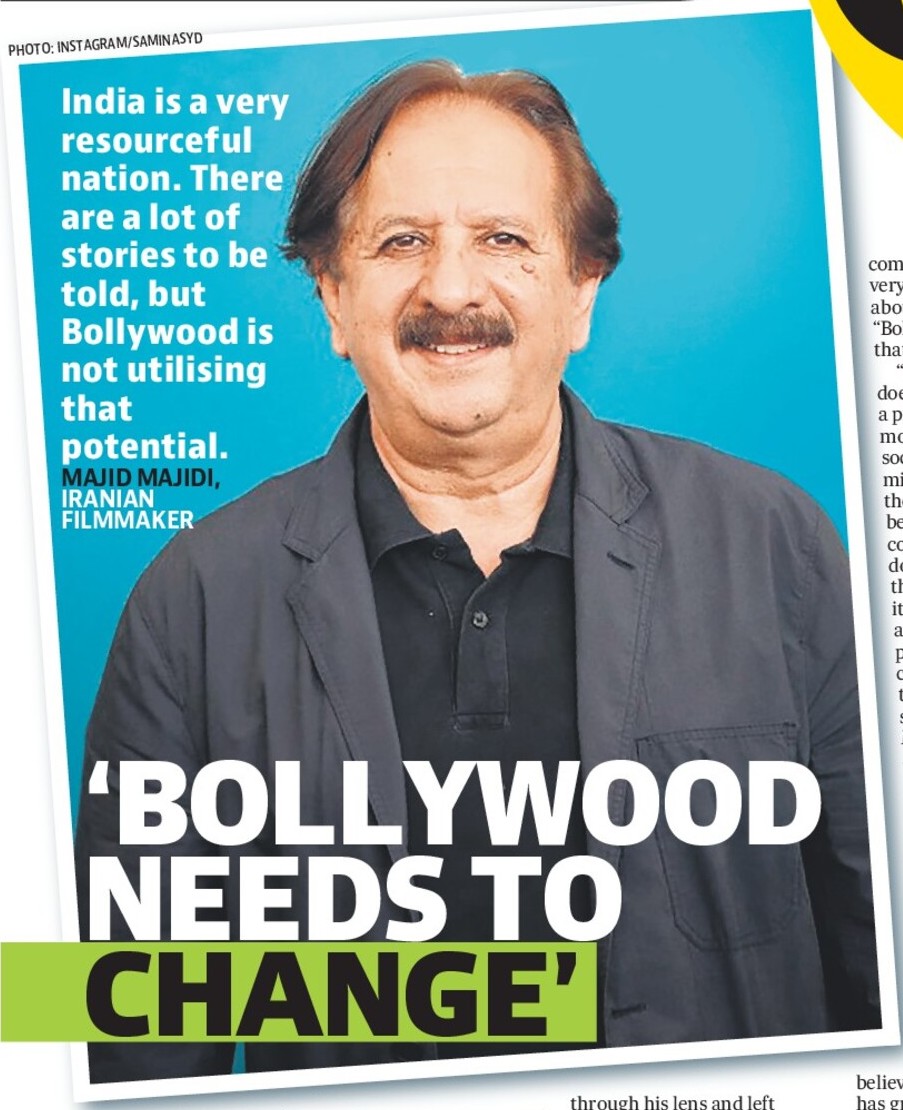
Majid Majidi hopes India’s potential in filmmaking is better utilized
Syeda Eba Fatima (HINDUSTAN TIMES; August 13, 2023)
With Beyond The Clouds (2018), starring Ishaan Khatter, Iranian filmmaker Majid Majidi portrayed an Indian story through his lens and left cinema lovers mesmerized. As audiences await another Hindi film by him, the Oscar-nominated director — who was in Delhi for a film festival — assures that he will “come up with something soon”.
India, according to Majidi, has “great talent and enormous potential when it comes to filmmaking and a very rich culture to talk about”. However, he feels “Bollywood is not utilizing that potential”.
“If Bollywood cinema does not improve, it will be a problem. People today are more aware because of social media. Their mindset has changed and they are more evolved beings. If Bollywood continues with what it’s doing, I am afraid that in the next four to five years, it will not have as much audience as it enjoys at present. It needs to change something about the stories; its content,” says The Children of Heaven (1997) director, adding, “Bollywood should change and make films that can cater to the audience of today’s time.”
Here, Majidi clarifies that he is “not against Bollywood at all”. “There are many filmmakers who are doing great work. However, people across the globe don’t know about them yet,” he says, adding, “I believe this young generation has great potential and if you empower them, they will do wonders.”
Another change he wishes to see is the perception of Bollywood films in society at large. “For them, Bollywood is all about songs and dance. I am well aware that there is much more to Indian movies,” Majidi signs off.
I love the fact that I got to audition for my debut film, and it chose me on merit, no other reason-Ishaan Khatter
8:35 AM

Ishaan Khatter talks about his varied project choices, his views on OTT release for films
Rishabh Suri (HINDUSTAN TIMES; September 4, 2020)
Actor Ishaan Khatter’s three-year-old acting career has been as unconventional as it could get. How many newcomers have started off with an international, non-masala film like Beyond The Clouds (2018), then done a typical romantic drama Dhadak (2018), and again taken off to the West for Mira Nair’s series, based on the novel A Suitable Boy?
Contrary to what people might think, he had to audition for his first film, and didn’t bag it just because he was from a filmi family. Khatter tells us, “I didn’t even know what the future had for me. All I knew was that I am terribly in love with cinema. I love the fact that I got to audition for my debut film, and it chose me on merit, no other reason.”
As for his different choices, he tells us he has heard a variety of opinions. “People who are important to me were very supportive. I think my mother always understood more closely where my choices come from, but most people are also understanding, with time, why I make certain choices. I got questions from the start, people still say use labels like ‘unconventional’. I am trying to not sound pompous. I know it may be unprecedented that a young actor starts with an international film. For me, I never sought the sensational aspect of that,” confesses the 24-year-old.
Currently, Khatter has his hands full with horror-comedy Phone Bhoot, war drama Pippa, and waiting for the release of his next, Khaali Peeli.
Amid the Coronavirus pandemic, many films had to forego a theatrical release and opt for a digital one. There are rumours of Khaali Peeli, also starring Ananya Panday, heading the same route. Ask Khatter his take on this, and he says, “I think these are decisions that are more relevant for producers. They are the ones who understand the economics and invest the money into the film. Though as an actor, I think the vision of the film is a priority for me, and the way we imagined Khaali Peeli was always that it would be seen in theatres. We made it like that.”
However, considering the current crisis, and how theatres are still closed, Khatter seems prepared for anything. So, is he okay with an OTT release? He says, “Right now, we are not in a situation where one can be indulgent. Like I said, I would much prefer it in theatres if we can wait it out. It depends entirely on how the next few weeks and months will go, so I am not going to be childish and adamant about things.”
Khatter tells us that the film has been made in such a manner that a theatre going audience would have enjoyed it a lot. “The story has a large appeal. It’s an entertaining film, thrilling and interactive, the kind of film to watch in theatres. So far, anyone closely related to the film who has seen small bits, they said yeh toh cinema mein dekhni hai,” he confesses.
I have never seen any of the characters [I played so far] as heroes-Ishaan Khatter
8:08 AM

Gearing up to shoot pending portion of Khaali Peeli, Ishaan Khatter on how the film marks his first outing as mainstream Bollywood lead
Uma Ramasubramanian (MID-DAY; August 19, 2020)
"It's a funny position to be in," admits Ishaan Khatter, who has been waiting for the past five months to complete a day's shoot and call it a wrap on Khaali Peeli. The endless wait seems all the more unbearable for the actor who counts the Maqbool Khan-directed venture as his first brush with mainstream Hindi cinema. Cherry-picking projects such as Majid Majidi's Beyond The Clouds (2017), Shashank Khaitan's Dhadak (2018) and Mira Nair's A Suitable Boy, Khatter believes he has stayed away from the trappings of a Bollywood hero, so far. "It's my first hero role, so to speak. I have never seen any of the characters [I played so far] as heroes; that's not how they served the stories. But Khaali Peeli is an entertaining Bollywood movie, so the rhythm of my character is inspired by the Hindi film [protagonist]," he observes.
Hushed whispers suggest that producer Ali Abbas Zafar is seeking a digital premiere of the movie, which also features Ananya Panday. However, Khatter says he belongs to the old school of thought and romanticises the experience of going to the cinema. "As an actor, the screen size shouldn't matter. But as an audience, watching a film in a cinema changes the experience. Films made for big screens are shot in a certain way, and every aspect of the film is built taking into account that it will finally be experienced in a large dark auditorium. I hope Khaali Peeli has a theatrical release because we always imagined it as a [big-screen] outing."
I don’t think it’s all about talent in the film industry-Ishaan Khatter
8:25 AM

Rishabh Suri (HINDUSTAN TIMES; July 29, 2020)
At just 24, actor Ishaan Khatter has managed to create his own space with films such as Majid Majidi’s Beyond The Clouds (2018) and the latest being the series A Suitable Boy with acclaimed filmmaker Mira Nair. He has literally grown up being surrounded by the art form (his parents are actors Rajesh Khattar and Neelima Azeem, and Shahid Kapoor, his brother). While he has come so far in such less time, Bollywood itself is seen as a place where there are not equal opportunities for everyone, and talent maybe isn’t the only thing required to make it big.
And not mincing any words the actor says, “No, of course not, there are so many factors and things that weigh in to your success, or your positioning or recognition, whatever it is that people define success by. Opportunities are not always equal, but everybody has their own journey. Sometimes, people are given opportunities before their time, or above their capabilities, and they are not able to make much of it. Sometimes, people get opportunities despite the fact that they deserve more than what they’ve been offered. They make their place through their hard work and consistency.”
Adding that “it’s not one’s business to mull and cry too much about opportunities”, Khatter adds, “Anyone could do that, and could be like ‘mujhe yeh nahi mila, woh nahi mila’, but I feel what’s more important is to make the most of what you get. And eventually yes, if you really have the legs you will get your space and light, your moment. That’s what I believe. But no, I don’t think it’s all about talent, there are many other factors.”
Elaborating more on these factors, the actor says he has personally seen people who are hard workers, surpass talented people. “I know of people who are talented but didn’t quite develop it into a skill. So yes, it depends. While there is a lot of judgment outside, I don’t think people fully understand how things work. It’s really an amalgam of so many factors — hard work, luck, being at the right place at the right time and preparation — that result in you getting your space,” reveals Khatter who has Khaali Peeli opposite Ananya Panday, and Phone Bhoot with Katrina Kaif lined up next.
Currently garnering praises for his act in A Suitable Boy opposite Tabu, he reveals that at one point, he was almost not going to be able to do it. Khatter tells us, “I was in talks for another thing when this came around. It was one of those things destined to happen. It all started when I was called in to audition for the part of Maan. This was back when my first two films hadn’t released. I think it was in March of 2018, just before Beyond The Clouds. I was asked to read for a part and I auditioned. I didn’t know very much about the book, I only knew Mira Nair was directing it. After the first audition, my second meeting was with Mira di. She decided she wanted me to play the part. It always started off with the opportunity of working with her, and then Tabu playing Saeeda Bai. It was a very exciting opportunity.”
I haven’t been corrupted yet. Corruption, to me, is making a film with wrong intentions-Amar Kaushik
8:32 AM

Neha Maheshwri (BOMBAY TIMES; November 7, 2019)
When your directorial debut turns out to be the biggest sleeper hit of the year, the pressure on the second outing can be daunting. So, how is Amar Kaushik of the Stree (2018) fame dealing with it, now that his second film Bala, which stars Ayushmann Khurrana, Bhumi Pednekar and Yami Gautam, is about to release? Bala has already had its fair share of controversies, including accusations of plagiarism. However, in a chat with BT, the filmmaker says that he is unfazed, and all he cares about is staying true to his craft. Read on...
‘BALA IS NOT JUST ABOUT BALDING’
When producer Dinesh Vijan approached Amar with a rough draft of the story, the latter was entrusted with developing the script, as a creative producer. From there to actually helming the project was a result of him falling in love with the story. Amar says, “The original story was set somewhere else, but I moved it to my hometown, Kanpur. While developing the script, maine isme bahut apnapann daal diya. I showed my writer around the city to make him understand the Kanpur wala vibe, dialect and swag. The process lent a personal touch and that’s when I decided to direct it.”
For him, Bala was never the story of just a man facing premature balding. He wanted to tell a lot more than that, and that’s how Bhumi’s character — that of a dark-skinned lawyer — came into the picture. Amar asserts, “It’s not just about being dark, short or bald. We assume that a fair person has it easy in the world, but by calling him/her gora, aap wahin discriminate kar dete ho. We often poke fun at tall people by asking them, ‘Oopar ka taapmaan kya hai?’ Our conditioning doesn’t let us stop and think that such terms could be hurtful. I have tried to explore all these complexities and not just premature balding in the film.”
‘SMALL-TOWN HUMOUR HAS SHAPED MY SENSIBILITIES’
Having said that, the director is not keen on ‘correcting the wrongs’ of society through his films. Amar tells us that it’s the small-town attribute of not taking oneself too seriously, that has helped him tell stories that people can relate to.
He says, “Preachy isn’t my style. I always try to look at the humour in any situation; it’s easier to empathise that way. I was once partying with a couple of friends till late night when the cops arrived and picked us up. On the way to the police station, the bizarreness of it all hit me, and I started laughing. One of the cops was flummoxed and asked me what I found so funny. I told him that it was quite hilarious to be heading to a police station after partying with friends. He found it funny, too, and dropped us by the road after that.”
‘I HAVEN’T BEEN CORRUPTED YET’
The filmmaker says that he will not choose a script just because it is safe. “Money is important, as you can’t expect your producers to make losses on a film. Mujhe paise nahi kharaab karne, par mujhe apna cinema bhi kharaab nahi karna. I don’t want to make a film just because the script is safe and will work. A lot of people ask me about the Stree sequel, as they are certain that it will work. It would be a disservice to my craft if I start taking popular conjecture seriously and get on with a sequel, even though the script is not in place. That’s when corruption will win over my craft! I haven’t been corrupted yet. Corruption, to me, is making a film with wrong intentions. I have retained my innocence as a filmmaker in Bala. Woh innocence jis din jaayega, main corrupt ho jaaunga aur main kharaab film banaane lagoonga. Following the success of Stree, I felt the pressure to work on a different film, but I realised that I needed to ensure that whatever I am making should have my complete focus and honesty,” he says.
It’s not difficult to figure out the inspiration behind his worldview. He has assisted the likes of Raj Kumar Gupta and Onir, who are known for making films they resonate with. He says, “I feel fortunate to have worked with the right people, who moulded my thought process. They taught me that cinema is more important than making money. I am forever hungry to learn, which is why I assisted Majid Majidi on Beyond The Clouds (2018). I wouldn’t mind assisting renowned filmmakers, like Sriram Raghavan, to hone my skills, whenever I feel that I am slipping. Ek success ke baad aapko bahut chadhaane wale mil jaate hain. So, I have brought my old friends closer, as I can always depend on them for honest reviews.”
‘KUCH TOH AAJ DHAMAAL KARENGE’
Amar says that the absence of a superstar in his cast has never been a roadblock for him. “I haven’t worked with a superstar yet, to talk about the pressure or ease one feels around them. For me, everyone who is hungry to do some good work, and everyone who thinks at the start of their day, ‘Kuch to aaj dhamaal karenge’, is a star. I see that hunger in Raj (Rajkummar Rao), Ayushmann, Bhumi and Yami. When we started working on Stree, we were told that we don’t have a big star. I said that we have so many stars that they will leave us blinded by their light when they shine together,” he reminisces.
‘COPYING SOMETHING IS AGAINST MY UPBRINGING’
The run-up to Bala’s release hasn’t been smooth; the film was mired in controversies after the makers of Ujda Chaman, which also revolves around premature balding, accused them of copyright violations. So, how did he deal with the sudden hullabaloo? Amar replies, “It’s against my upbringing and ethics to copy anything. We spent over six months developing Bala and suddenly, someone calls it a copy… it does feel bad. However, I maintained a dignified silence or it would have turned uglier. After all, you know that you haven’t done anything wrong and people will see it in theatres.”
Ask him if he has watched the other film to understand whether their allegations are justified and he says, “No, I haven’t. I watched the Kannada film, Ondu Motteya Kathe, whose rights they (makers of Ujda Chaman) bought to remake it in Hindi. I realised that we were making a completely different film. They started shooting 20-25 days after we wrapped up Bala. After we announced our release date, they announced theirs, which was scheduled to release before ours. However, that’s a producer’s call.”
With Ayushmann top-lining the cast, did he ever feel that his film has an edge over the other? “If a film is good, it will work irrespective of its cast. So, the fact that Bala has Ayushmann and hence it will do better, didn’t cross my mind,” he concludes.

I’d been dying to work with Ishaan Khatter-Ananya Panday
8:34 AM

Ananya Panday on her co-star, why she hadn’t been in a kali peeli until recently and venturing out of comfort zone
Himesh Mankad (MUMBAI MIRROR; September 26, 2019)
 On September 11, Ananya Panday and Ishaan Khatter kicked off Ali Abbas Zafar’s maiden home production, the Maqbool Khan-directed Khaali Peeli. The romantic action-thriller is primarily set in Mumbai and co-stars Jaideep Ahlawat, known for films like Raazi, Raees and Gangs of Wasseypur, as the antagonist.
Ananya informs that she has been shooting for the film in night shifts ever since it went on the floors. “We are filming majorly at real locations all over Mumbai. If you see two crazy kids driving around in a taxi on the streets, you know it’s us (Ishaan and I),” the actress says. She goes on to reveal that the film, which also has Zee Studios and Himanshu Kishan Mehra as the producers, is quite a new space for her after the love triangles, her debut film Student Of The Year 2 and the followup Pati Patni Aur Woh. “The character is completely out of my comfort zone as she doesn’t speak the way I do in real life. It’s interesting because I had to adapt to a new lingo and a different tone. We have experimented with my look as well,” she explains, adding that the Mumbai kaali-peeli plays an important role in the “gritty thriller” besides her and Ishaan.
To get the nuances of her character right, Ananya worked closely with her director and co-star. “I had been juggling between the Pati Patni Aur Woh shoot and workshops for Khaali Peeli. Ishaan and I had a lot of reading sessions which helped me get comfortable. I carried the script along during the Lucknow schedule (of Pati Patni Aur Woh) too, and would rehearse my lines aloud,” she smiles.
When asked if she’d travelled in a kaali peeli cab, which is a prominent part of Mumbai roads, before signing the film, the Bandra girl answers in the negative, explaining, “I’ve travelled in autorickshaws as they’re more readily available in the neighbourhood I live in.”
While she waxes eloquent about Ali’s “great commercial sense” and his positive vibe, Ananya has a confession to make about her costar. “I had been dying to work with Ishaan ever since I watched him in Beyond The Clouds. I hope his energy reflects in my performance as well. He is such a talented actor. Both of us are young and it’s a lot of fun with youthful energy on set,” she signs off.
Ishaan Khatter tells Rajkummar Rao to ‘be wary’ of Janhvi Kapoor
7:45 AM

The actors spilled each other’s secrets during a show recently
Natasha Coutinho (MUMBAI MIRROR; May 9, 2019)
 In an almost unheard-of new friendship in B-Town, actors Rajkummar Rao and Ishaan Khatter made an appearance together on Neha Dhupia’s Colors Infinity chat show as BFFs and had a lot to say about each other.
Ishaan started off by quelling reports that he is dating his Dhadak co-star Janhvi Kapoor by saying, “I am in a relationship with coffee,” going on to reveal that he likes “girls who are honest, funny, real, relaxed, chilled out and passionate. I guess, I would like anyone to be that way. I look for the same qualities in a friend as well.” When prodded by Neha on the matter, Raj said with a chuckle, “Ishaan is a sensible boy. He can find his own perfect girl. He will, or maybe he already has.”
Incidentally, Raj is gearing up to work with Janhvi in Dinesh Vijan’s upcoming horror comedy, Rooh-Afza, which is expected to kick off in June in Uttar Pradesh. Ishaan had an important tip for Raj before he starts work with the actress. “He needs to be wary because she is obsessed with him. She is a keen learner. I think he must’ve already observed that about her and she genuinely is very fond of his work, as am I. Both of us once sat down and watched his scenes closely,” Ishaan said, finally throwing in the towel. “What tip can I give Raj, really? He’s been around and worked with different actors. He would know best. Perhaps he can give me some tips!”
Meanwhile, Raj spoke of the only time he “felt jealous” of the younger actor. It was when he got to work with the acclaimed Iranian filmmaker Majid Majidi in his first film, Beyond The Clouds.
Majid Majidi's second film in India to roll next year?
8:07 AM

The Iranian filmmaker’s second Hindi project is a light-hearted story; will take off next year
Avinash Lohana (MUMBAI MIRROR; February 28, 2019)
Last year, acclaimed Iranian filmmaker Majid Majidi made his Hindi film debut with Beyond the Clouds, which also marked the acting debut of Shahid Kapoor’s brother, Ishaan Khatter, in the role of a street hustler and drug dealer. It also featured cinematographer KU Mohanan’s daughter, Malavika Mohanan.
Now, Mirror has learnt that Majidi is returning to India for his next film. A light-hearted human-interest Hindi film, it is based on true events, and will be produced by Shareen Mantri Kedia and Kishor Arora. A source close to the development informs, “It’s a story that Majidi came across on his previous trips to India and has already started scripting the film. It revolves around a male protagonist in the age group of 25-30 years, is set in a small town and will go on the floors in the first half of 2020. Majidi will first start shooting for his next Iranian film after which he will begin recce and casting for the Indian film.”
Earlier, the producers and Majidi had announced a film titled Gold Mine as their second collaboration, but the source reveals that the filmmaker intends to start on the untitled film before he revisits Gold Mine. Meanwhile, Kedia and Arora are to take Pa Ranjith’s next, which is based on the life of revolutionary leader Birsa Munda, on the floors.
Kedia confirmed the news but refused to divulge further details.
I couldn’t get up from my chair when I met Shah Rukh Khan for the first time-Malavika Mohanan
8:08 AM

Riya Sharma (BOMBAY TIMES; November 10, 2018)
She made her debut in Hindi films with Oscar nominated director Majid Majidi’s Beyond The Clouds. For Malavika Mohanan, daughter of the popular cinematographer K U Mohanan, acting happened by chance as she had no intentions of joining the industry. The actress is currently shooting for her next film Petta with superstar Rajinikanth. The film also stars Nawazuddin Siddiqui and Vijay Setupati. The actress says that she is very ‘greedy’ and wants to do all kinds of movies across the country, irrespective of the language. She also spoke to us about her first meeting with Shah Rukh Khan and a project called, ‘Chappal Marungi’ that she started in her college.
HAD NO PLANS TO PURSUE ACTING
Though her father is a popular cinematographer in Bollywood, Malavika had no plans to join the industry. However, she was always fascinated with the creative side of the industry. “I was always intrigued by the creative aspect. I was always more inclined towards painting, ad films and those kind of things. I didn’t plan to pursue acting at all until I was offered my first film, Pattam Pole, which was a Southern film. I took that up, and other films happened and I felt that I was enjoying it. My parents and I, we all live in Mumbai, so I thought if I am doing it, I might do Hindi films as well. This is how Beyond The Clouds happened. My journey has been fun so far. When you live in Mumbai, you learn so much about different kinds of things. In that sense, it has been incredible. I have grown up visiting my father’s sets. I still remember when he was doing Don, and being a huge Shah Rukh Khan fan in Class IX, I had gone on the sets to meet him. That was the first time when I saw SRK. I was so petrified and nervous when he came to say hello that I could not get up from my chair. And when he left, my parents were like, ‘Shah Rukh Khan comes to say hello, and you can’t even get up!’ I was like, ‘I am sorry. I was so nervous.’
EXCITED TO WORK WITH RAJINIKANTH
The actress, who is shooting with Rajinikanth for Petta, says, “I am very excited to work with Rajini sir at such an early point of my career. It’s an amazing role and very challenging, performance-wise. It was even tougher for me because I don’t speak Tamil. But I wanted to be true to my character, so I hired a language teacher and trained with her. Rajini sir is an absolute delight to work with and is so humble and down to earth. I am very excited to be a part of this project as it’s an out-and-out commercial film, and different from all the projects I’ve done previously.”
LANGUAGE NO BARRIER
Talking about the films that she had done in South, Malavika adds that she wants to do films that excite her and the language does not matter. “I haven’t done many films down South, I have done about four films, which by South standards is nothing. Films over there get completed so fast, they shoot for 20 days for one movie. I have always aspired to do things in Hindi, so this is where I see myself, even though I see myself doing films all over the country. As long as it is a film that excites you, the language does not matter,” she points out.
MALAVIKA’S ‘CHAPPAL MARUNGI’ CAMPAIGN IN COLLEGE
The actress studied at Wilson College in Mumbai and tells us that she was part of a project called, ‘Chappal Marungi’, which was against molestation. “We were in the final year of our college and it started off as a project. The whole project was about sexual harassment — all girls who would take the Mumbai local faced it at some point. Comments like ‘Item’, ‘Chalegi kya?’ — that girls usually ignore — I feel that is where it grows, because people think if she is not saying anything then it’s okay even if I touch her, and if I touch her, it is okay if I do more. I feel that’s where the thought grows and becomes very serious when people get molested or raped. We can’t ignore that anymore. If someone says something that makes you uncomfortable, just ask the person to shut up. We are not continuing with the project now since all of us are busy. But as somebody who is doing films and wants to reach out to a wider audience, I really want to do things like continuing the campaign or starting a new movement to speak about the issues that women are facing today, especially in our country,” says Malavika.
Janhvi Kapoor is like a child in so many ways-Ishaan Khatter
8:19 AM

Chaya Unnikrishnan (DNA; July 18, 2018)
Ishaan and Janhvi’s cute chemistry in the trailer and songs of Dhadak is creating a lot of buzz. The two youngsters have also been uploading funny dance videos from the making of the film and sweet moments from their promotions. The duo obviously shares a great equation. Says Ishaan, “The first time I met Janhvi on the sets, I took her to watch La La Land, because she hadn’t seen it. Soon, we started bonding over cinema — both of us are film buffs — and we realised we share a natural equation.”
PLAYING THE SENIOR CARD?
While it is Janhvi’s debut movie, Dhadak is Ishaan’s second outing after Majid Majidi’s Beyond The Clouds. So, did he behave like a senior to her on the sets? “No, I never behaved like a senior or junior. The only way it (Beyond The Clouds) was with me was it contributed everything to my growth as an actor. I was brimming with that energy, but I was excited to share what Janhvi and everybody else in the cast had to offer,” says Ishaan modestly. He adds that the 21-year-old actress has wonderful energy. “She brings a smile to people’s faces. She is dedicated, sincere, curious and is passionate about acting,” enthuses Ishaan.
WE HAVE A SIMILAR SENSE OF HUMOUR
As part of the prep, the two spent a lot of time together going on recces (in Rajasthan) along with their director Shashank Khaitan. “We had a whale of a time as both of us have a similar sense of humour. Janhvi is a goofball,” says Ishaan fondly. “She is unintentionally funny sometimes,” he laughs and then quickly adds, “Even intentionally, to give her due credit!” He recalls that on the sets there were days she would get so caught up in something that she would goof up the simplest instructions, but crack the more complicated things. “If she had to turn from the right, for eight takes, she would give the correct shot, but in the final shot she’d turn from the left! But she had her revenge on me as it rubbed off on me. A month-and-a-half into shooting, I ended up doing something right for six takes but in the actual shot exited from the wrong side of the camera,” he laughs.
Tell him that the picture he is painting of Janhvi is in sharp contrast to what the general impression about her is, thanks to her paparazzi pictures where she looks like a shy, demure girl, and he quips, “That’s because she carries herself well. It’s something she has inherited and not necessarily strategised.”
JANHVI IS A BIG FOODIE
Looking at her svelte figure you wouldn’t believe it, but Ishaan tells us that Janhvi is a big foodie! “She would take off on excursions in search of laal maas. It became a daily ritual. She would also go often to Johri Bazaar during our prep because she enjoyed spending time with the locals. However, she would get lost every now and then! She is like a child in so many ways. But over the making of the film, she became family to all of us, in fact, we all became like a family,” he signs off.
We didn’t make Dhadak to outdo Sairat-Ishaan Khatter
6:52 AM

Neha Maheshwri (BOMBAY TIMES; July 13, 2018)
Ishaan’s choice of his debut film, Beyond The Clouds (BTC), which released earlier this year, was unconventional and rare. However, his performance grabbed eyeballs and he left the audience impressed and eager to see more of him. Now, his second film, Dhadak, which is the Hindi adaptation of the Marathi blockbuster, Sairat, has added to the buzz around him. In an exclusive interview with BT, the young actor talks about Dhadak being compared with Sairat, his equation with co-star Janhvi, who is making her Bollywood debut, and why he is not bothered about being judged. Excerpts…
Sairat had amassed much acclaim from the critics as well as the masses. Since it has set such a high benchmark, are you feeling the pressure to live up to expectations?
Usually, I tend to feel the pressure more for other people than myself. However, this time around, I am feeling more pressure than during my first film, BTC. Having said that, the pressure doesn’t come from a negative space. It’s just that there is a lot of anticipation, nervous energy and excitement. The way the film is being presented and the banner (Dharma Productions) that’s backing it, make it rather overwhelming. Janhvi and I are deeply attached to this film, mostly for what we have been through during its making.
Talking about pressure, how are you dealing with the comparisons between Sairat and Dhadak on social media?
I have been enjoying some of the trolling, but it’s important to maintain your perspective amidst all of that. People are judging a full-length feature film on the basis of a two-and-a-half minute promo. What matters will be the opinions that come after one has seen the film. While the key elements of Sairat have been retained, Dhadak is a new film in itself. In fact, it’s the characterisation that makes it fresh. Shashank’s (Khaitan, director) imprint on Dhadak is huge. He has brought a lot of his own life into it. It’s his interpretation of Sairat, which is also a kind of template for the films we have been watching over the years, be it Romeo And Juliet or Qayamat Se Qayamat Tak. We didn’t make Dhadak to outdo Sairat. The idea is to present a story that will resonate with a larger audience. Sairat was a phenomenal film because besides being engaging, entertaining and artistic, it also had a socially relevant message. However, Dhadak is not its copy or made under its shadow. Sairat has inspired us to do something of our own.
Many feel that Sairat worked because of its raw treatment and the fact that it was a small-budget film. Dhadak, on the other hand, looks mounted on a larger canvas, and with faces like Janhvi and you..
I don’t completely understand the term ‘Bollywoodise’. According to me, it means a certain production value, feel and projection. But I think what’s important is to understand the film that you are making and the reality of the characters and their world. Also, the tonality of our film and the promo so far have been largely of the first act of the film, which is slightly dreamy and fantastical. I don’t think any attempts were made to Bollywoodise this film or to de-Bollywoodise it.
There is a perception that today’s generation isn’t capable of falling in love like the characters in Sairat and Dhadak...
I don’t agree with that perception. We live in a world where there are over seven billion people and there are many stories that make you hopeful and optimistic about love. The fact that we are making a film about love, with conviction proves that it exists. I am not somebody who can trick myself into believing something, though that’s an actor's job. Doing a film, which is primarily about unconditional love, would be a farce if I were just pretending. So, I do believe that the kind of love we are talking about, exists. Love is in smaller gestures. I am a romantic at heart, and I think I can fall in love like my character… I am capable of that (smiles!)

BTC wasn’t watched by a lot of people. Having said that, these are labels that people give. I have heard too many since childhood — star kid, industry insider, so on and so forth. I don’t use these terms. For me, Dhadak is a film and I am an actor. I got the opportunity to do BTC and felt strongly about it. Majidi Sir wanted me in the film and Karan (Johar, producer) was kind enough to allow me to it first. Then Dhadak happened and again, I am very happy to be a part of it. I am just 22 and feel very fortunate that I get to act. I always wanted to start early and I am just trying to grow.
One of the main highlights of Dhadak is your pairing with Janhvi, who is making her debut with this film. Tell us about your equation with her...
Janhvi is quite a comic relief on the set. She keeps doing these funny things unintentionally, cracking all of us up. She might seem a bit quiet, especially when she is representing the film, but that’s because she has her game face on. She is quite notorious (laughs!). When she feels at home, she is her uninhibited best and becomes a prankster. Actually, we played a lot of pranks and had great fun on the set. It’s been perhaps the most delightful experience of our lives so far, if I can say that on her behalf. We had a wonderful time prepping for the characters together. We got a lot of time to understand the cultural milieu, the mind-set of the characters and we also got a feel of Udaipur. We interacted with a lot of local people there. We were able to walk around without any restrictions.
Soon, you will be a known face, who probably won’t be able to walk around the streets without being noticed or being captured by the paparazzi. How prepared are you for this phase of life?
If people have to judge me, let them do it. I do believe that it’s important to protect your personal space. Encroachment into personal life is not something any celebrity asks for. Having said that, it’s important to be aware that people will have an opinion on your personal decisions as well.

Dhadak was tougher to do than my debut film Beyond The Clouds-Ishaan Khatter
8:47 AM

Ishaan Khatter on films, family and his favourite co-star
Natasha Coutinho (MUMBAI MIRROR; July 10, 2018)
Ishaan Khatter managed to impress even perfectionist Majid Majidi with his effortless acting in his debut film, Beyond the Clouds. As he gears up for the release of his second, more commercial Hindi film Dhadak, the actor admits that the offer from Karan Johar took him by surprise. Excerpts from an interview:
Karan Johar has said he spotted you on the Jhalak Dikhhla Jaa set when he was shooting with your brother Shahid Kapoor.
True. And because I’m so unassuming, I never imagined he’d consider me for a role in his film. But soon after I visited the Jhalak set and interacted with him briefly, bhai told me that KJo had asked him for my number.
Did he call?
He did. He’d seen some of my videos on social media and told me he’d like to have a sit-down and get to know me better. I visited his office a few times. During those meetings he tried to assess how serious I was about films.
You started out with a really difficult film, Majid Majidi’s sibling drama Beyond the Clouds. Was Dhadak easier?
Dhadak was equally challenging as certain characteristics made Madhukar different from the person I am. I’d say this film was tougher to do than my debut.
What was director Shashank Khaitan’s brief to you?
Shashank was on his way to a screening of Sairat and seeing me spontaneously told me that he wanted to make this film with me. He moved the location to Rajasthan to create a new film. This meant the cultural milieu changed too and shaped Madhukar’s personality. We had a lot of discussions on the script and concluded that I should play the character as a young, naive, unambitious boy born and brought up in Udaipur who hadn’t seen too much of the world and was seemingly content with life.
What was your prep like?
I was underweight when I started my meetings with Janhvi (Kapoor, co-star) and Shashank because of Beyond the Clouds and he told me he wanted a robust, khaata-peeta Rajasthani boy. So, I piled on a few kilos, got my ears pierced, lightened the colour of my hair and got myself some lenses. Then there was the Mewari dialect. We had to find the perfect balance between that and Hindi so the film didn’t become too colloquial. Janhvi and I joined Shashank on the recce twice, spending a lot of time in Udaipur and Jaipur, borrowing directly from our interactions with the locals.
Did Janhvi and you meet directly on the set?
We’d interacted a few times but grew close during the prep. She comes with light-hearted energy and makes everyone around cheerful. She’s a goofball but she loves acting and spends a lot of time thinking about her character.
You are known to be a good dancer. Did you get to flaunt your skills in this film?
There aren’t any conventional song situations, but I got to do a bit of choreography. It was important to dance like the character, not get carried away and make the steps look clean and practiced. “Zingaat” was already a widely loved song and the idea was to just enjoy it and be true to the moment.
Any tips from Shahid?
Bhai was aware that I was doing Dhadak even before he knew about Beyond the Clouds but we didn’t discuss it much. He’d liked Sairat and was waiting to see what perspective I’d bring to the adaptation. My mom (Neelima Azim) has been involved from the beginning. She was at the readings and look test, and came on the set a few times. I’ve had a lot of discussions about the character with her unlike my first film when I was totally isolated.
Karan has launched many actors. What’s your take on your mentor?
He’s an incredible mentor with years of experience. The magnitude of the work he’s done and his understanding of cinema is amazing. He’s generous and gracious, contributes a lot and gives you his exclusive attention. He also has a great sense of humour.
Politics has an expiry date, art doesn’t. An artiste should stay away from political games-Majid Majidi
8:02 AM

Madhureeta Mukherjee (BOMBAY TIMES; April 20, 2018)
His stories are deep-rooted in reality; the emotions are raw, unadulterated and simple, yet, they have the power to move you deeply. Iranian filmmaker Majid Majidi has spent the last two decades crafting some of the most enchanting stories (like Oscar nominee Children Of Heaven, The Color of Paradise and Baran), which stem from the culture and fabric of the country he comes from. This time, he has looked way beyond, towards India. In his latest offering and his first Indian film, Beyond The Clouds, he has captured Mumbai’s streets, slums, creeks and chaos with charming realism — which is his forte. Like his other celebrated Iranian films, this one too, reflects the life of those trapped in poverty, but it clutches on to that one word —hope. The filmmaker reminds us, “Hope is the biggest reference point, not only for me, but for whole of humanity.” In an interview with BT, Majid Majidi talks about his views on Bollywood cinema, how he idolises the legendary filmmaker Satyajit Ray, and his perspective on how art and artistes should remain depoliticised. Read on...
Most of your films show compassion for the underprivileged. You seem to have a deep connect with such subjects...
The middle class and the lower middle class form the majority of any society, so from my point of view, they are the most important and the most vulnerable, too. As a society and as filmmakers, we do not pay enough attention to their stories and lives. The people belonging to this level of society do not have as many opportunities to come out and talk about their trials and troubles, so it is our responsibility as artistes to draw attention to their problems. In India, women have a great role to play in society, but at the same time, they are oppressed and become victims in the same environment. My stories shed light on the bitterness that a human being goes through in life. It is common everywhere. Everyone needs hope, and that is my aim; to bring hope in each and every aspect of my character and my film. So, hope is the biggest reference point, not only for me, but for the whole of humanity.
The common thread in your films is the focus on a strong value system within the family and how that can stand the test of difficult times and circumstances…
Family as an institution has always been a very important part of my films. I believe that protecting and preserving this institution is a crucial function of any society. If cracks appear in the institution of the family, it gets reflected in society. Very often, the disorders that we see around us, is a reflection of the state of the family system. I think before we can build a proper society, we need to put our energies into building a solid family.
What were the challenges of shooting in real locations in Mumbai? Did you explore the length and breadth of the city while conducting recce for locations?
The first day when I showed my crew the locations where we would be shooting, they were taken aback. They said, “We cannot shoot here!” Unless there is no option, I shoot on real locations. I really enjoyed shooting at Dhobi Ghat, though it was a big challenge. Now I know Mumbai better than you (laughs!). I visited almost every place in the city during my previous trips, before I started filming. Since then, I have been observing the city and its people closely. Mumbai is a real city. I find it very fascinating to see the wealthy and the poor living side by side and co-existing. You can rarely see this anywhere else in the world. This is a unique and an absolutely remarkable feature of this city. In every other society, there is a clear geographical divide in the city between the rich and the poor, but in Mumbai it is all mixed up, which makes the city so dramatic and fascinating.
You did hundreds of auditions before signing on Ishaan Khatter and Malavika Mohanan. We also heard that you often identify interesting faces and people around you and go ahead and cast them in your movies?
Yes, besides the location, the casting process is very important for my films. My crew helped me a lot by reaching out to different actors, and showing me pictures that fit the brief for my characters in the film. I even met some extremely popular actors like Deepika Padukone, who is a superstar and a loving personality. For this film, there was no opportunity for us to work together; I hope we can make it happen in the future.
We did a lot of auditions and we were facing a tough time finding the perfect male lead. When Ishaan came to me, he was all beefed up and flexing his muscles. I looked at him and said that everything about him was good, except his amazing physique (laughs!). So my brief to him was to lose all the muscle and become a thin-looking boy. Ishaan is a talented actor; he grabbed this opportunity to the fullest. Even Malavika is a fine actress; I think both of them will shine in Bollywood. The child artiste Asha (played by Amruta Santosh Thakur) in the film, I found her playing outside while scouting for locations. I was so fascinated by her that I requested if I could click a picture, as she fit the character in my film beautifully. There is another lovable child artiste Chotu (played by Shivam Pujar), I lost my breath because of him. He was the director on the set, I wasn’t! Whenever we were ready with the shot, he was in a mood to play, so we all had to wait for him. I think everywhere in the world, children are the same. We have to make the environment comfortable to bring out the best in them.
What is your view of Indian cinema? Our country is very diverse, and so is our cinema. The popular Bollywood fare is what rules the box office mostly, though we’ve seen a growing trend and interest in different kinds of cinema , too, which goes beyond song, dance and drama .
India has all the potential to make good cinema; you have good actors, directors and technicians. India also has plenty of great stories that are deep rooted in their culture, which can resonate strongly with the audience. Let’s say that there are about thousand films that are made in India every year, but only about 200 of them are successful at the box office and the rest don’t even make it there. Remember that there are two key players in the global film industry — Hollywood and Bollywood. Overall, Hollywood has been able to strike a balance between commercial and art cinema. Bollywood has been more inclined towards commercial cinema, even though there is some great art house/parallel cinema being made here. So, even while there is an audience for different kinds of films, the balance has tilted in favour of commercial cinema. India needs to find the right balance between mainstream and parallel cinema as it has the potential to emerge as a major player globally. The youth of India have very strong opinions and they know what good cinema is, hence, they need to be shown more of that as they are the future of this country.
Did you ever deliberate over the language of the film, whether it should be made in Hindi or English?
I was contemplating this when I first came here. There were other creative people who said that I should make the film in English for an international audience. I took my time and thought about it. I felt that this is an Indian film and I am making it for the people of India. So, I was ready to take that risk and make it in Hindi. After the film was made and it was translated into English, I knew I had made the right decision.
How important is it for you to see your films reach out to the world, beyond your country? Would you ever make a film with Western sensibilities so that it appeals to a larger section of the audience?
For every filmmaker, it is a dream to be accepted by the audience around the world. But the important thing is that, if a filmmaker wants worldwide acceptance, he needs to tell a story about his or her own culture. Yes, I want my films to be viewed by a wider audience, but I don’t make films just so that they can travel to festivals. I know that all my films are deep-rooted in culture. Even with Beyond The Clouds, I knew that it was a risk making the film in Hindi, but I was aware that it would make it culturally richer and would eventually pay off. For instance, let’s talk about dance. Over the years, you might have seen films which showed their culture through dance. But right now, the dance that we see in movies is very Westernised, which is not a part of our culture. If you want to show that, you can. There’s nothing bad in doing that, but it would also be great to see your own traditional dance forms in your movie.
You have said that you are inspired by the genius filmmaker Satyajit Ray. His stories too, stemmed from the lives of real people, and they were hard-hitting subjects that were a reflection of our society. Is there any one film of his that has impacted you deeply?
One of my favourite Satyajit Ray films is Pather Panchali (1955). It ranks in my top 10 list of most favourite movies. Every time I watch it, I feel like I am discovering something new. Watching Pather Panchali is like going through an entire term of college. I can take a masterclass on the film and discuss every aspect of it for hours and days, because it is not a film, it’s a study of life itself. Even after watching it over fifty times, the acting, direction, cinematography and story doesn’t cease to amaze me.
Iranian filmmakers have often faced opposition and resistance from the government; in some cases they have been banned and imprisoned for their films. Some filmmakers have even moved out of Iran, because of the censorial policies of the nation. Do you ever feel creatively stifled as a filmmaker in your country?
I think art should not be contaminated with politics, because politics is ever changing. So, if I make a movie which makes a political statement, after one year, when the politics change, people will ask, ‘Why did he do this?’ So, an artiste should stay away from politics. That way, your art will not have an expiry date. Politics has an expiry date; art doesn’t. So, an artiste should stay away from political games. I have not seen any successful films by filmmakers who have migrated from Iran to other countries.

(Crisp) Movie Review: BEYOND THE CLOUDS by FENIL SETA
10:18 AM

Beyond The Clouds is an entertaining and touching saga that is bound to move and touch viewers. The first half shockingly is shaky at many places and director Majid Majidi doesn’t seem to be in control of his content. But it has some great sequences that set a balance and in the second half, the film gets much, much better. Majid Majidi’s direction has some glitches but overall it’s simple and heartening and once again, he manages to extract some great performances from his child actors. But the actor who steals the show is undoubtedly Ishaan Khatter. He has the ‘aam aadmi look’ and hence suits the character to the T, look wise. And talking about his performance, he’s confident and first-rate. Also check out his dance moves which come up unexpectedly in a crucial scene. This guy is a star and if he has done so well here, one can’t help but expect a lot from Dhadak, which will be a true-blue commercial Hindi film. Malavika Mohanan gets a bit overboard in an initial scene but later on, she gives a fine performance. G V Sharada (Jhumpa) is marvelous and moreover, she has such sad eyes that one can’t help but sympathize with her. Dhwani Rajesh (Tanisha) also does well. A R Rahman’s music is subtle though this won’t be counted as one of his memorable works. Anil Mehta’s cinematography is terrific, as always. Do give Beyond The Clouds a chance and you’ll surely won’t be disappointed!
My rating - *** ½ out of 5!
Fenil's Bollywood Talk # 513
10:02 AM

2 SMALL FILMS TO RELEASE TOMORROW; BEYOND THE CLOUDS HAS CHANCES TO SCORE!
It will be the lull before the storm this Friday. 2 films will hit theatres tomorrow and both of them are going to face a very tough time. There were 3 more films that were going to hit screens tomorrow – High Jack, DaasDev and Omerta. Better sense prevailed and all 3 of them have been pushed forward, although High Jack could have had a release. My views on the films releasing tomorrow:
BEYOND THE CLOUDS: It is directed by acclaimed Iranian filmmaker Majid Majidi and it’s the launch vehicle of Shahid Kapoor’s half-brother Ishaan Khatter. He’s going to probably rock the show in a few months with Dhadak, a Karan Johar production. Beyond The Clouds also stars Malavika Mohanan, daughter of acclaimed cinematographer K U Mohanan and has music by A R Rahman. The film looks real and gritty and has got noticed due to Ishaan’s presence and the fact that Majid Majidi has made it. The opening would still be poor but it would have the best opening of all the films releasing tomorrow. Also, it has the most chances of exceling in the weekend, provided reports are positive.
NANU KI JAANU: It stars Abhay Deol, Patralekhaa and Manu Rishi Chadha and is a horror comedy. The trailer starts off very well and the horror bit is nicely shown. But then the promo begins to show Abhay as a rowdy gangster kind of a person and it takes away the charm of the film. The buzz for the film is just not there, though Patralekhaa’s interview with Rajeev Masand on the struggles in Bollywood got a lot of respect and appreciation. But the opening will be very low and if the film has adequate humour and horror, then only it has a chance.
WHICH FILM WOULD YOU LIKE TO SEE AND WHY? DO LET ME KNOW!
Unfortunately in my opinion, Slumdog Millionaire had a very touristy look-Majid Majidi
7:59 AM

DNA (April 19, 2018)
To a cinema-loving audience, Majid Majidi doesn’t need an introduction. His cinema, both Iranian and indi, transcends all barriers. His Iranian film Children of Heaven (1992) got him an Oscar nomination.
And, though Children Of Heaven lost the trophy to Roberto Benigni’s Life Is Beautiful, Majidi’s was the first Iranian film to make it to the prestigious Academy Awards.
The Iranian filmmaker, who has been wooed by Indian studios to make a film here, finally makes his India debut with Beyond The Clouds, starring Ishaan Khatter (Shahid Kapoor’s brother) and Malayalam actress Malavika Mohanan, who is also daughter of cinematographer KU Mohanan (Jab Harry Met Sejal, Raees and Talaash).
We chatted with the celebrated director about his beautiful offering. Excerpts from the conversation...
Beyond The Clouds really touched our hearts. How do you manage to get people moist-eyed especially when you make a film in a language (Hindi) you don’t speak at all.
For years, I have been planning to make a film here in India. I was interested in the ambience, culture and atmosphere here. Do you know that culturally, India and Iran are close? Iran is a very dramatic country as is India. I spent time in Mumbai to get a deep understanding of the vocations here. And what I learnt, inspired me to make a film here. One of the companies here has been following up with me for some years.
So, during my trips to India, I got an idea, which I developed into a script. I did my research in Mumbai, and set it here.
Then came the most challenging part. I decided to make the film in Indian language and not in English. Especially, because of the characters and the cultural aspect, the film had to be a local movie. Language is not a barrier. When you mention emotion, it is very important in the film; you should transport that emotion to the audience.
That’s what your film does..
I believe emotion is the first thing that can touch the audience. That is the most important thing you should do in a film, take the audience with you. I had this concern; that the language of the film should be Hindi, because it is close to this culture. That’s also why I selected my crew from India and not from Iran. They could help translate that cultural and emotional aspects on the screen. This was a big challenge, making the movie in real ambience, real locations and not inside studios. Fortunately, we could make it happen. The other aspect was casting, with the team here I could get the right actors for the characters. I believe a big part of acting is when you select good and proper actors.
Yes, of course. The right actors make that difference.
So, after extensive research and casting correct actors, we mounted the film with Ishaan. As for the other characters, like Jhumpa and the kids; do you know that other little girl? I found her while walking on the streets. She is a common kid.
Even the other boy, in the jail sequences; he is also a fabulous actor.
He was a big challenge as well. He was barely a few years old; and to make him act was very difficult.
While there is no comparison between Beyond The Clouds and Slumdog Millionaire, coincidentally both are based in Mumbai slums. Have you seen Slumdog Millionaire?
Yes, and unfortunately in my opinion, that had a very touristy look.
What has been your approach for the movie?
I’ve tried to take a really realistic and correct look into the city. All the characters are real. In this film, we can see the real Mumbai.
One can feel that besides the actors, the place also is a character and has a soul.
Yes, that was very important for me. I wanted you to see Mumbai through my film.
Is there anything else you consider as a reward or award, having won many awards internationally, like in Montreal, Cannes among others?
Usually, when I make film, I try to reach the common audience and the specific audience. In this case, I’ve tried to keep a balance between both sides. And then, winning or not winning is another aspect.
Considering that you don’t speak the language, how much of Indian cinema have you seen?
I’ve mentioned it before, I knew Indian cinema for long time. I’m a big fan of Satyajit Ray’s cinema. When you watch Pather Panchali, you get such a strong feeling, it’s like magic. After watching the film, you can visualize local Kolkata culture from wherever you are. Mostly, I know the art cinema of India. And Shyam Benegal makes beautiful films.
I’d love to do a film with Shah Rukh Khan or Ranbir Kapoor-Malavika Mohanan
7:57 AM

Nayandeep Rakshit (DNA; April 19, 2018)
People say that children usually follow in their parents’ footsteps. But for Malavika Mohanan, it was just the opposite. While her dad K U Mohanan is a celebrated cinematographer, the young lady is ready for a career in front of the lens. The actress talks to us about her maiden Hindi venture, Majid Majidi’s Beyond The Clouds (BTC), her wish list of actors as well as directors and how she plans to take her filmi career ahead from here. Over to her...
Beyond The Clouds is quite an unconventional choice for a debut. Did you always want it this way?
Like everyone else, even I wanted a grand debut. When I say grand, I mean an A-league team. And it can’t get more A-league than this. I had Majidi sir leading the pack, Vishal Bhardwaj has written the dialogues and Ishaan (Khatter) is a newcomer, but he is a fantastic performer. So the team was kick-ass and it was an amazing experience. Today, even in Bollywood, things are changing and a lot of focus is on performances instead of naach-gaana.
The line between conventional and unconventional cinema is blurring now. Comment.
Previously, there was a strong divide between indie and masala films, but yes, now the lines are getting blurred. The change is great because it opens up different avenues for actors like me who can do a Beyond The Clouds and an Imtiaz Ali film side by side. We can fit into different movies and I hope I get a diverse range of roles. And why not? In Hollywood, actors get all kinds of roles, so it’s high time that in Bollywood, too, we start exploring new stuff rather than just sticking to massy formula films.
Does it mean you are averse to doing a movie in the masala space?
I grew up watching Karisma Kapoor and Shah Rukh Khan’s movies. So, I respect them and their cinema, too. I want to work in a team that looks after you. There’s Karan Johar and I have loved his films, so why won’t I do that? I was seven or eight when Kuch Kuch Hota Hai released. I want to work with Dharma and even with Vishal sir because he does different cinema. I got into my costume and character in BTC. If I can do that, I should be able to do the others as well. I would like to believe that today, there’s a huge space for newcomers like me. Look at Ishaan, he already has a lot of attention and has signed a film before this. But he was interested because he was hungry as an actor. To be directed by Mr Majidi is the cherry on the cake. Only an idiot would think twice about doing his film. Today, there’s no formula to becoming a star. So you might as well do what you love.
Have you already planned your next project?
I’m in talks with a few filmmakers and I need to decide which project to do next. But I don’t want to get stereotyped, but play interesting characters.
Any plans of doing an international film?
Not yet. I have been too consumed with this project. We have travelled with it to a bunch of film festivals, but I haven’t given Hollywood a thought as of now. All the movies I’m in talks for currently, are in Hindi. But, yes, the walls are getting thinner and people like Priyanka Chopra are doing stuff that’s not been done before.
Given a chance, which actor would you work with in a movie?
I love Ranbir Kapoor and Shah Rukh Khan and would readily do a film with them. Also, because we have grown up watching SRK. My dad (K U Mohanan) shot Don 2, Raees and whenever he’s shooting, I keep going on set. I have met Shah Rukh several times and every time I meet him, I have my fangirl moment. Maybe when I meet him next, I’d talk to him about working in a film together.
I come from a privileged family and the least I can do is to make it on my own-Malavika Mohanan
7:55 AM

Neha Maheshwri (BOMBAY TIMES; April 18, 2018)
Malavika Mohanan began her acting career with Malayalam cinema, but she admits that Bollywood has always been her goal. Now, as she is all set to realise her dream with Iranian filmmaker Majidi Majidi’s Beyond The Clouds (BTC), the young actress talks to BT about being self-critical, finding sexist films really uncool and how she doesn’t judge a film by its label. Excerpts...
Everyone is looking forward to Majid Majidi’s first film in India. Considering that the movie features a fine ensemble cast, it could be very intimidating for an actor who is fairly new to the industry...
There isn’t much nervousness because the people involved are masters in their craft, right from Majidi sir to Rahman (A R Rahman, music director) sir. There’s a sense of security, faith and excitement, because the film has been made with so much love and passion. Our focus was always on the story, which is the real hero of the film. Having said that, I do get a bit apprehensive when I watch my scenes. As an actor, I keep thinking that I could have performed better. I am extremely self-critical of my work, and I need to get over that habit (smiles).
There’s a lot of buzz around the movie, but do you feel that a lot of times, films that win critical acclaim don’t necessarily get the success they deserve at box office?
That was never a reason for worry. In fact, I was excited to be a part of this film, because for any actor, it’s a once-in-a-lifetime opportunity. How often does Majid Majidi come to India to make a film? I was particular about beginning my innings in Bollywood with a good film, because the kind of people you start your journey with is very crucial. I feel blessed that everything fell into place. I have never judged a film by its label or stereotypes; I don’t understand them and prefer not to use tags to define films. For me, it’s either a good film or a bad film. What really annoys me are sexist films, where stalking a girl, kissing her against her will or even slapping her butt is portrayed as heroism. I find such films really uncool. I hope that as an industry, we put an end to it, because films do influence young minds.
Considering the fact that BTC is being touted as Ishaan Khatter’s debut, were you apprehensive of being overshadowed?
It indeed is Ishaan’s debut, but I hope that all the actors get their share of attention. I came on board just 10 to 15 days before the shoot commenced. Once you sign a film, you need time to mentally prepare yourself for the role; 10 days were hardly anything. So, at that point, my attention was solely on the script — I wanted to deliver my best and prove to Majidi sir that I am a good actor. I never bothered about the other aspects and I hope that doesn’t change. There was so much scope to perform in this film and I believe that if you do your job well, you will succeed. I hope people like my performance, because a lot of hard work has gone into it. It was emotionally and physically challenging.
Despite a great start in Malayalam cinema with Pattam Pole, you didn’t follow it up with a spate of films. For a newcomer, you have been rather selective...
In the South industry, it’s normal for actors to do five-six films in a year. However, I didn’t want to lose my focus by doing too many films. My long-term goal has always been Hindi cinema, but that doesn’t mean that I won’t act in Malayalam films. I have grown up in Mumbai and I feel a sense of belonging to this city. My father (K U Mohanan), too, works in this industry, but I never took his help, because he is very shy. He came from a very small town in Kerala without any money and support, and today, he is one of the top cinematographers in India. I come from a privileged family and the least I can do is to make it on my own. I have spent a lot of time in Mumbai meeting casting directors. Nobody offers you a film on platter here, very rarely do you get spotted and cast.
As someone who has worked in both industries, how different are Mollywood and Bollywood?
I feel that the vibe of BTC is similar to that of a Malayalam film. It’s like one big family; even during lunch break, nobody retires to their respective rooms. In fact, there are no vanity vans on Malayalam movie sets. Everyone, including the biggest stars, sits together for lunch. Everyone is treated as an equal. However, on the sets of Hindi films in which my father has worked, actors return to vanity vans after their scene has been shot. Here, you sometimes see a kind of discrimination where people don’t interact with those who are junior to them (as far as their position in the industry is concerned). On the set of BTC, we ate and spent time together. Also, like Malayalam movies, we gave utmost importance to the story. I feel that a lot of Hindi films get lost in ego tussles ki kisi ko please karna hai...
You seem to be extremely outspoken about your views. In college too, you had come out strongly against eve-teasing with your ‘Chappal Maarungi’ campaign...
It started as a college project and was widely covered in the media. College girls are the most vulnerable to eve-teasing. Unfortunately, a lot of girls have this attitude ki chhodo rehne do, what can we do? So, it was just our way of saying that it’s not okay. You have to retaliate if a man touches you inappropriately and without your consent. I have had friends who have slapped the miscreants. At some stage, I would like to revive the campaign.

Subscribe to:
Posts (Atom)