Showing posts with label Ashok Saraf. Show all posts
Showing posts with label Ashok Saraf. Show all posts
Alia Bhatt to return to Cannes Film Festival; Ammy Virk to make his debut
10:42 AM

Abhimanyu Mathur (HINDUSTAN TIMES; May 6, 2026)
The 79th Cannes Film Festival, set to run from May 12 to 23 in France, will see a strong Indian presence this year, spanning Bollywood representatives as well as regional voices.
Actor Alia Bhatt, who made her debut at the festival last year, is set to return. She will be joined by actor Aishwarya Rai Bachchan. Filmmaker Karan Johar will also be there, along with actor Tara Sutaria, who is making her Cannes debut. Actors Mouni Roy and Pooja Batra will also be present.
India’s official delegation will be represented by filmmaker Ashutosh Gowariker as the newly appointed director of the International Film Festival of India (IFFI).
Punjabi cinema will make its debut with singer-actor Ammy Virk and actor Roopi Gill. From Marathi cinema, veteran actor Ashok Saraf and his wife, actor Nivedita Saraf, will attend the festival. Gujarati cinema will be represented by actor-producer Manasi Parekh, while from the Malayalam film industry, filmmaker Chidambaram will present his film Balan: The Boy at the Cannes market.
Ashok Saraf began as a banker and so did many other reputed Marathi actors like Vijay Kadam, Vijay Patkar, Shivaji Satam
4:00 PM
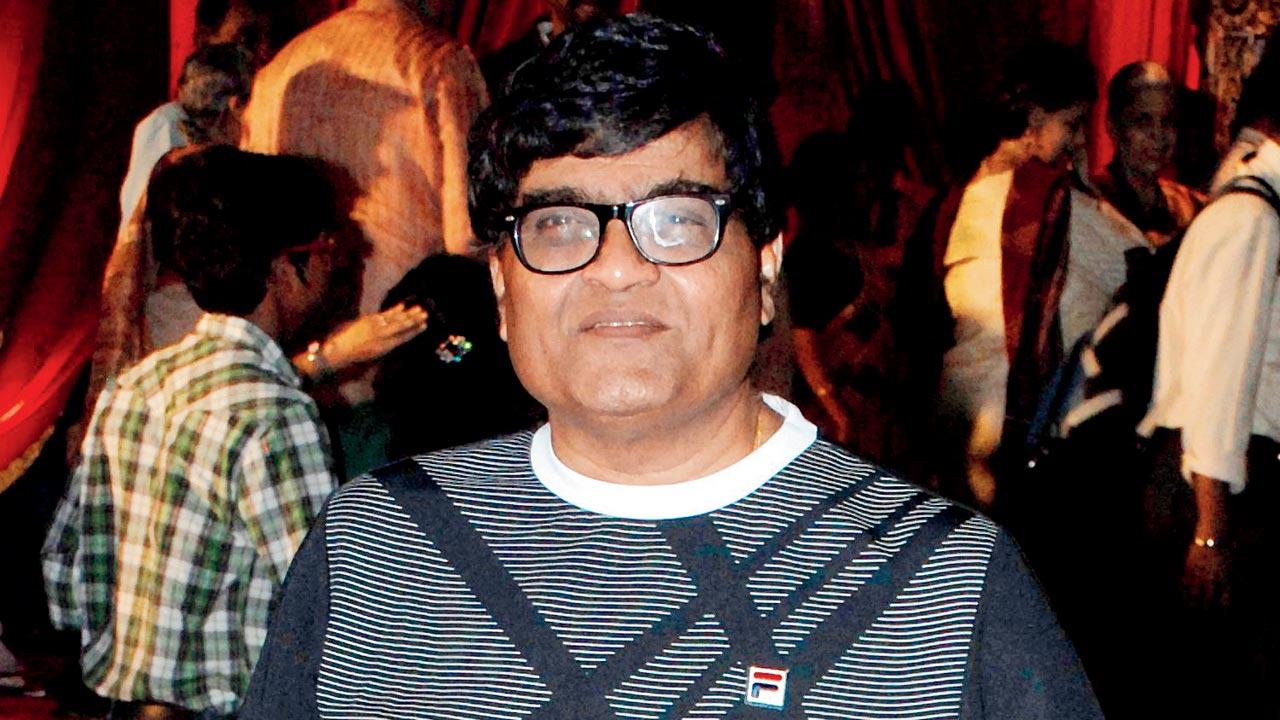
Ashok Saraf began as banker, and was honoured with the Maharashtra Bhushan recently. He represents a generation of actors who also balanced passbooks
Gautam S Mengle (MID-DAY; February 4, 2024)
At a Marathi-language comedy show several years ago, veteran actor Ashok Saraf appeared as guest along with fellow actor Sachin Pilgaonkar. The host told Saraf that he was responsible for a bank opening up in his village. How so? “Everyone thinks you have to work in a bank to become Ashok Saraf,” the host quipped, “and that’s all that the youth in my village ever did.”
The 66-year-old veteran was conferred the Maharashtra Bhushan award earlier this week, much to the delight of crores of fans everywhere. And a certain section of actors, too, watched the news with glee—everyone who ostensibly held respectable (albeit homely) jobs in government banks, but slipped out after the teller closed to pursue starry dreams.
For countless aspiring and upcoming actors in the late 80s and early 90s—before banks were corporatised and the system allowed much more latitude—a job at the neighbourhood branch was sought after not just for stability.
“It was like a quota,” says actor Shivaji Satam, who started out at the Central Bank of India in 1973. “Government banks would hire those who excelled at drama competitions, just like sports quota in college or the Railways. And it helped that all of us were fuelled by passion, not minding the dual work, long hours, sudden travel for tours and modest pay.”
Satam shared screen space with Saraf in the 2018 crime thriller, Mi Shivaji Park, and was the face of hit serial CID for years, while appearing frequently in Marathi and Hindi cinema.
“Banks were overflowing with staffers back in the 80s,” says actor Jaywant Wadkar, whom we last saw in Shiv Sena leader Anand Dighe’s biopic Dharmaveer. “There would literally be seven to 10 extra employees in every department, and we had nothing to do. Plus, we were already active in the theatre circuit and our managers knew about our dreams. Unless it was a really busy day, they’d happily allow us to go to rehearsals or shows.”
Wadkar’s story is shared by countless others from his generation, such as Vijay Patkar, Vijay Kadam, Pradeep Patwardhan and Amol Palekar, to name a few. Wadkar tells us that Palekar acted in Rajnigandha and Chhoti Si Baat while being an employee at Bank of India, same as him. Not just men, there was also a slew of female actors as well as some writer and directors who started out as bankers, we learn.
Budding stalwarts, Patkar and Kadam, were Wadkar’s colleagues. All of them had already nourished the acting bug at school and college, more actively in the latter for the benefit of directors would come to recruit fresh talent. “My first play was while in kindergarten,” Kadam, whose last big screen appearance was in Anurag Kashyap’s Kennedy, tells us. “By the time I was in Class V, my teachers had recognized my talent and by the end of college, I directed plays for inter-collegiate festivals. From there to commercial theatre, was but a small step.”
Kadam first broke onto the Hindi film industry with Tiger, an eponymous serial on Door Darshan, centered around a private detective. Kadam played his trusty sidekick, a resourceful man who could procure or facilitate anything; aptly called Genie.
The same held true for Patkar, who acted with Wadkar in the 1988 hit Tezaab. Both starred as members of Anil Kapoor’s merry band of loafers. Patkar is still remembered as Krack to Boman Irani’s Jack for the salted biscuit brand commerials. “The only condition,” he chuckles, “was that we make our bank proud at the annual inter-bank drama competitions. And for exactly this reason, banks were happy to take on as many stage actors as possible. They’d get bragging rights for every successful actor on their roster.”
This was important to the banks as well as the actors. For the actors, it was part of their path to success. The victories at competitions brought small articles in newspapers which directors and producers looked for. It also let them network with other actors and theatre personalities.
Patkar, who joined Bank of India in 1985, concurs that there were too many employees and too little work in banks of the 1980s, unheard of today.
“It really was a golden period for actors,” he says. “Bunking work didn’t have as serious consequences then as now.”
“My manager would even allow me to come to work earlier than others, or stay back later than the rest so that I could make up for the hours taken up by theatre and earn my salary,” Satam recalls.
And despite all the progress and the glamour, this crop of stars never forgot their roots. And this is not just a symbolic statement. Many of them stayed on as employees for years after they became stars.
“Are you kidding me?” Wadkar exclaims when we ask why he didn’t quit after his first big break. “I was the master of reconciliation (the practice of balancing an account statement) in my branch in Fort. When I applied for voluntary retirement in 2000, my manager called me up to ask me if I had lost my mind.”
Did fame affect work? “Yes, but not negatively,” Wadkar laughs, “My branch would enlist me to collect documents from other banks, as they were more willing to oblige me than other employees.”
Wadkar and Patkar both took voluntary retirement in 2000, while Patwardhan served his full tenure of 60 years before retiring in 2020. He passed away a year later after a brief illness.
“Of course, the reliability of the pay cheque mattered, but more than that, we owed the bank our fame and success,” says Patkar loyally.
This dual life wasn’t without its share of problems. There were jealous colleagues and sniggering about some employees “earning dual incomes”.
“It wasn’t unwarranted,” says Kadam, who took voluntary retirement in 1994 to become a full-time actor. “There were so many unauthorized leaves that my bosses called for my records. The running joke was that it took two peons to carry my roster. It was no longer like the olden days when bosses would remind me that it was time to go to rehearsals. I read the room and got out.”
He proudly tells us that 2024 is his 50th year of being an actor.
What lessons did they learn?
“That stage is the best place to start [acting],” says Wadkar promptly. “Nothing shapes you as an actor like theatre. We were luckier than most because we were already acting in school and college before being picked up by commercial theatre directors. They honed our talent into a craft.”
Kadam agrees.
“When I quit my job, I told my family that they don’t need to support me [financially],” the indefatigable 66-year-old tells us. “And I have kept my word. Theatre trained me like nothing else. At times, I’ve walked onto a set for an audition only to be told that the script has changed, and still taken the set by storm at the first take. I still get calls from people who have watched Kennedy at various film festivals since it released last year, even though I haven’t attended a single screening myself.”
As Satam puts it, “We are theatre actors first. The screen just happened to us.”
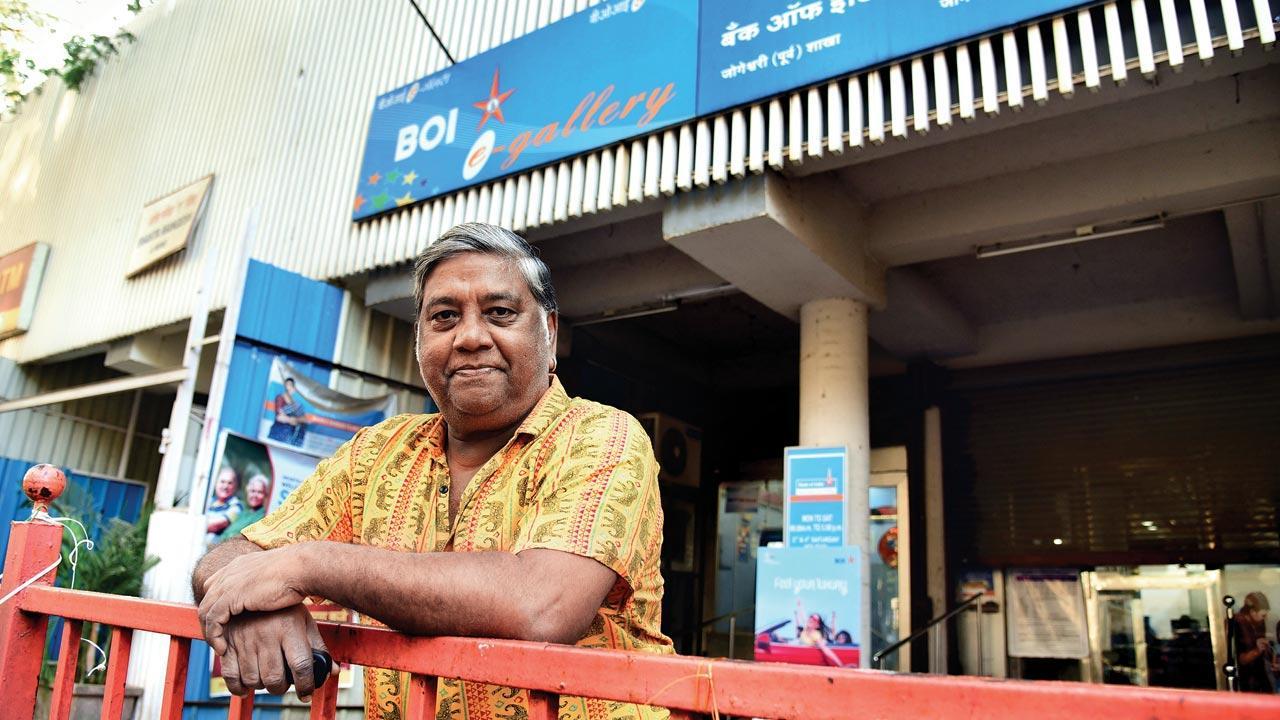
An entire generation of actors from theatre and cinema started off as bankers in Mumbai. Jaywant Wadkar, who we last saw in the 2022 film Dharmaveer, worked with the Bank of India for 17 years. Pic/Nimesh Dave

Vijay Kadam, Vijay Pakar and Shivaji Satam
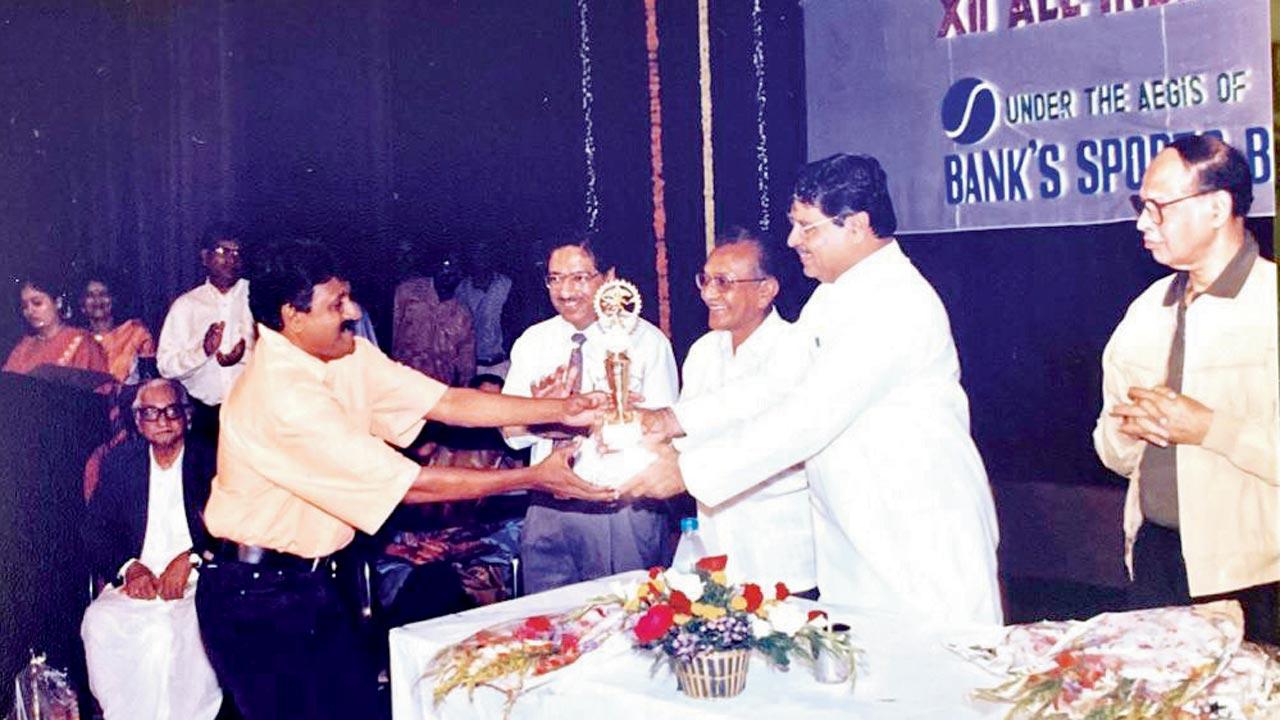
In the 1980s, nationalised banks preferred hiring actors who would make them proud at inter-bank drama competitions, like Patkar in this picture
My efforts have paid off, says Ashok Saraf on winning the Maharashtra Bhushan Award 2023
10:08 AM

HINDUSTAN TIMES (February 1, 2024)
Veteran actor Ashok Saraf, who’s a known name in the Hindi and Marathi entertainment circuits, was conferred with the Maharashtra Bhushan Award 2023 for his contribution to the arts. It is the highest award given by the state government. The chief minister of the state, Eknath Shinde, shared the news on X on Tuesday and congratulated the actor.
Reacting to the news, in a chat with ABP Majha, the actor said, “Thanks to this award, I feel that my efforts till now have finally paid off. Audience should like the roles I play and all my work, that’s always my aim. I am thankful to everyone who has supported and helped me in this journey. I also want to thank Nivedita (Saraf, wife; actor) on this occasion.”
Celebs like cricketer Ajinkya Rahane and actor Amit Behl also congratulated him on X.
Saraf entered showbiz in 1969 with a Marathi film, Janaki, and in a career spanning more than five decades, he’s starred in almost 200 films. On TV, he is known for shows like Hum Paanch. Some of his noted Hindi and Marathi films are Karan Arjun (1995), Joru Ka Ghulam (2000), Ashi hi Banwa Banwi (1988) and Chaukat Raja (1991). He was also a part of Genelia Deshmukh’s Ved (2022).
Ashok and Nivedita Saraf thank cops with aamras and puris
8:09 AM

Ashok and Nivedita Saraf express gratitude to frontliners of Coronavirus fight at Oshiwara police station with a hearty meal
Vinay Dalvi (MUMBAI MIRROR; May 20, 2020)
 While the country, and the city in particular, is grappling with the Coronavirus pandemic, Bollywood has been supporting its frontline workers, including the Mumbai Police. Akshay Kumar has donated Rs 2 crore to the Mumbai Police Foundation and is donating 1000 wrist bands to help in the early detection of Covid-19. Hrithik Roshan has delivered a package of hand sanitisers to police personnel on duty while Farhan Akhtar has contributed 1000 PPE kits. Rohit Shetty has arranged for space in eight hotels across the city for on-duty policemen to rest and have meals, while the Producers Guild of India has donated fully-equipped tents and vanity vans of Bollywood stars to the force, particularly female cops, across 22 key locations in Mumbai, in an initiative called Mission Suraksha.
On Tuesday, in a heart-warming gesture, actor Ashok Saraf and his wife Nivedita sent 175-180 plates of puri and aamras for policemen on duty at Oshiwara police station, informed senior police inspector Dayanand Bangar. The actor, who stays in the nearby Lokhandwala Complex, which is in the jurisdiction of Oshiwara police station, told Mirror, “We’ve always respected policemen but now it has doubled after seeing them work in such tough conditions. Now that mango season is here, we decided to give them a meal of aamras and puri with the help of a local caterer.”
Some constables admitted that this year, due to the lockdown, they have not been able to enjoy mangoes and described the meal as “tasty”.
I did lose my identity. I was just the ‘voice of Amitabh Bachchan’-Sudesh Bhosle
8:16 AM

Sudesh Bhosle takes to stage, singing in the one voice that the world recognises him for. Wife Hema and their kids make the production a family affair
Aastha Atray Banan (MID-DAY; October 4, 2015)
"At one point, I did lose my identity. I was just the ‘voice of Amitabh’. No one offered me jobs to sing for any other actor,” says the soft-spoken Sudesh Bhosle when we meet him and his family at their Goregaon home on a hot Thursday afternoon. “But then, I realised that I was an entertainer, and the job of an entertainer is to give the audience what it wants. It wants Amitabh Bachchan songs, sung in Amitabh’s voice. So, that’s what it gets,” says the 53-year-old, who has been singing for almost 30 years now.
Sudesh has sung with the likes of Kishore Kumar and dubbed for Sanjeev Kumar but earned his fame when he sung Jumma Chumma De De for Bachchan in the 1991 movie Hum. Ever since, he has sung for the veteran in almost all his movies, the last one being the February release, Shamitabh. Now, he is touring India with his production Amitabh Aur Main. The next show scheduled is for October 10, a day before Bachchan’s birthday, at Sion’s Shanmukhananda Hall.
Expectedly, Sudesh will deliver Bachchan hits, in varied moods, including Rim Jhim Ghire Sawan and Khayike Paan Benaras Wala and the more recent Jhoom Barabar Jhoom. Bachchan, Sudesh says, was supposed to attend the show but is busy. “But, he has given his blessings and approved all content.” The show is a family affair with Sudesh’s wife Hema (47), and their son Siddhant (21) and daughter Shruti (23) pitching in with individual talents, both on and back stage.
Siddhant will take the stage, singing along with his father, giving old classics a modern twist, adding guitar riffs and edgy arrangements. Hema, as producer, is responsible for logistics, but also plays the piano. Hema used to play with her father Ashok Saraf’s band, Melody Makers in the 80s, and that is where she met Sudesh. Shruti, a JJ School of Art graduate, handles the set design with the company Dot Line & Space, and is responsible for styling her father and brother.
It’s because of her, Shruti quips, that her father looks well turned out on stage. “He is very laidback about his look but I keep coaxing him. The last time, he wore a red coat on my insistence. That’s new for him. It’s us women who make all the noise. These two just want to sing.” The family laughs, but agrees.
The brain and motivation behind the production — the first show kicked off in May — is Hema, who eggs everyone on. “She is the one responsible for the concept and ensuring that everything runs smoothly,” says Sudesh.
Sudesh is a competent mimicry artiste, and can do a mean Sanjeev Kumar and Ajeet, but since 1991 when he sang for Bachchan in Ajooba, his career has been tied-up with that of the actor. “First, I sang Ya Ali Ya Ali in my own voice. Laxmikantji (of Laxmikant-Pyarelal) told Shashi Kapoor, the director, that I could imitate Amitabh’s voice and sing in it. When Amitji heard the song, he said now that he has found someone who sounds like him, he won’t sing again. But, he has started singing again,” he laughs. “He is a good singer and he knows music. And he has the first right to his own voice!” The show, the family admits, attracts a largely older audience.
But, the Bhosles want to make it hip. This is where Siddhant comes in. The singer and guitarist of Red Seems Right, who wants to be an international popstar some day, says, “I add guitars riffs to make the songs feel modern. I also do mash-ups, and sing them my own voice. Not a lot of young people come for the show, but that will change.” Sudesh adds, “Youngsters may not know the likes of Shashi Kapoor or Rajendra Kumar, but they all know Bachchan.” Yet, they play to a packed hall on most nights, says Hema. “I think along with the songs, people also love when Sudesh mimics Bachchan. He says the dialogue before My Name is Anthony Gonsalves, and then the Kabhi Kabhie dialogue. People really connect with that.”
Even though it’s Bachchan who is his muse right now, Sudesh was a Kishore Kumar when growing up. That he worked with him was a landmark event. “I did shows with him, where I used to be the host. We even used to sing together. I am his biggest fan.” That being said, it’s Amitabh Aur Main that is the mainstay for this family now. Sudesh says shyly, “Even Lataji has said that if she had to sing Yeh Kahaan Aa Gaye Hum, she could do it either with Amitji or me. No one else will do.”
In March, the family is set to take the production to America where, they are sure, it’ll do well. “Audiences in the States react even better than those here. It’s because it reminds them of home,” says Hema. “They laugh, they shout and they cry. It’s like we are bringing a part of India to their doorsteps."
Subscribe to:
Posts (Atom)