Showing posts with label Arjun Rampal interview. Show all posts
Showing posts with label Arjun Rampal interview. Show all posts
Arjun Rampal breaks silence on viral DJ controversy: "I’ve been spinning since I was 17"
2:38 PM

Onkar Kulkarni (BOMBAY TIMES; May 13, 2026)
In a society still shaped by conventional ideas of marriage and family, Arjun Rampal and Gabriella Demetriades have quietly built a relationship on their own terms. Together since 2018 and parents to two sons, Arik and Ariv, the couple have come to represent a modern blended family — grounded in companionship, commitment and co-parenting, without feeling bound by traditional timelines.
In December 2025, Arjun surprised many when he casually revealed on a podcast that the couple was officially engaged. Asked about the development, the actor smiled and said, “One step at a time.”
Arjun recently also found himself at the centre of a viral social media moment after videos of him playing DJ at a Gurugram nightclub surfaced online. While many praised his effortless stage presence and passion for music, others questioned whether he was genuinely trained as a DJ or if it was simply a publicity-driven appearance.
‘An entire community that follows electronic music started showing up and supporting me’
Clearing the air, Arjun said, “Oh Lord! I’ve actually been spinning music since the age of 17, so this is definitely not something new for me. Music, especially electronic music, has always been a huge passion in my life. I’ve had my own decks at home for years and I genuinely enjoy the whole culture around it. In fact, I even had a nightclub at one point that was dedicated entirely to that kind of music. Over the years, I’ve had a lot of close DJ friends, and I’ve learned so much from them. What started as something I enjoyed privately slowly became more public, because people who had heard me play began inviting me to perform at places. From there, it all just grew organically.”
He added, “There’s this entire community and cult following around electronic music, and people who connect with that vibe started showing up and supporting me. It just snowballed from there. Honestly, I really enjoy doing it. Right now, I’m trying to do as many gigs as I can because once I get fully back into my film commitments, I won’t really have the time to perform as a DJ.”
‘Filmmaking is collaborative; it is never about one person’
On the work front, Arjun has been receiving considerable attention following the success of Dhurandhar. Ask him whether the reaction to film has altered the way he now approaches scripts and projects, and the actor insists success alone cannot dictate creative decisions.
He said, “When we were making Dhurandhar, none of us knew what the outcome was going to be. All you can do as an actor is give absolutely everything you have to a film and hope that you’re surrounded by a team that shares the same passion and commitment.”
People still come up to me and talk about films like Dil Ka Rishta or Dil Hai Tumhaara-Arjun Rampal
9:49 AM

Onkar Kulkarni (BOMBAY TIMES; November 19, 2025)
Once the quintessential Bollywood hero, Arjun Rampal has evolved into an actor who thrives in the grey zone. From cold-blooded villains to conflicted anti-heroes, his attempt is to infuse a human touch to every villainous role. In a conversation with us, Arjun reflects on embracing intensity, finding balance, and staying grounded through the highs and lows of the industry.
‘I try to find something humane even in the villain’
Ask him what draws him to such dark and intense roles, and Arjun explains that it’s the way directors perceive him. “I think the filmmakers see me in a certain light. I suppose they think I make the bad look good, so they cast me in those roles. When you play a baddie on screen, you’re operating in a grey area where you need to enhance certain traits. But the driving force has to come from a humane place. I try to find something humane even in the villain. I look for his foundation and belief system, where he’s come from. I always trace it back to what could’ve shaped him into who he is. That touch is what makes the villain believable. Honestly, sometimes it works, sometimes it doesn’t,” he shares.
‘You can channel a lot of your pent-up energy into intense roles’
Many believe playing intense roles takes a toll on actors emotionally, but Arjun finds the process healing.
The actor, who was seen playing villainous roles in films like Dhaakad and Crakk, and the recent web show Rana Naidu S2, says, “Doing intense roles can be therapeutic, because you’re out there doing something crazy. You might have a lot of pent-up energy that you can channel into such a role. By the time you are done, you’re as calm as you can be. It also depends on what phase of life you’re in. I think every character leaves something with you, and in the process, you evolve a little as a person too.”
‘You need to cut out the noise’
Reflecting on his journey, Arjun, who has been in the industry for over two decades, acknowledges the emotional impact criticism has on actors.
He explains, “I remember some of my films being panned; it made me feel like I was the worst actor. But years later, people still come up to me and talk about films like Dil Ka Rishta or Dil Hai Tumhaara — they say nice things about those films. If someone had told me back then that this would happen, I would have felt differently. Maybe I wouldn’t have gone through certain lows or made some of the decisions I did. That’s why you need to cut out the noise. Don’t let anyone tell you who you are. Be your own judge and don’t judge others either. Only you can make things right for yourself; no one else can. That’s what I did. I pushed through. I think I was like a bull — you need to grow a bit of thick skin in the industry. Those going through something tough should know that it’s not the end of the world.”
I want to stay fit and be there for my four kids-Arjun Rampal
2:28 PM

Onkar Kulkarni (BOMBAY TIMES; June 14, 2025)
Arjun Rampal is a father to four children across two generations – daughters Mahikaa (23) and Myra (20) with his ex-wife, Mehr Jesia, and sons Arik (6) and Ariv (2) with his partner, Gabriella Demetriades. As he’s enjoying fatherhood in his early 50s, Arjun reflects on how parenting, and he himself, have evolved over time. With honesty, he opens up about the lessons learned from his own childhood, the challenges of raising children in a changing world, and the deep bonds he shares with each of his kids.
‘Daughters are sweet, sons are badmaash’
Ask him how fatherhood felt back then, vis-à-vis 20 years later, and Arjun says, “The birth of every child felt like a miracle. When Mahikaa was born, I didn’t know how much effort goes into being a parent. Back then, I was busy trying to provide them a good life, so I couldn’t be around as much as I would have wanted to. But when Arik was born, I really enjoyed it, and I told myself that I would spend more time with my kids and be more hands-on.”
He laughs and adds, “I think daughters are very sweet. Sons are badmaash. They have too much energy, whereas daughters are like angels. But all of them are just nautankis. It’s fun to observe how each child is drastically different from the other.”
‘Parenting has evolved over the years’
Has he evolved as a father through his journey as a parent to four children? “Definitely. Your children teach you a lot. My daughters are now teaching me a lot. It’s a different generation and the world has changed so rapidly around them, and you have to grow with it — you listen more, become more sensitive, more patient. Now they are both independent and on their path. I think parenting has evolved so much from the time my parents raised us to how we are raising our children. Scolding and raising your voice are things that don’t work, because when you do that, they start imitating you,” Arjun says.
‘I loved my dad, but unfortunately, at some point, he became addicted to alcohol’
Ask him about his equation with his father while growing up, and the Rock On actor reveals. “I loved my dad, but unfortunately, at some point, he became addicted to alcohol. My initial years with him were great, then in the middle, due to the addiction, there wasn’t any communication between us. I distanced myself, and the relationship got strained. Towards the end, in the later stage of his life, I started helping him. I took him to rehab and got him connected back with his family. I had not spoken with him for years. We started writing letters to each other, and that’s when we revived our relationship. But then, he got really ill, suffered a heart attack and passed away. I wish he could have spent more time with us. My dad left, then my mom passed away, and that’s when they sent me my baby boy to fill that void,” he says.
‘Addiction of any kind comes from a lot of pain or trauma’
Did his experiences with his father shape the way he views fatherhood? “I don’t think any parent wants to let their children down. I don’t think that was my father’s intention. Addiction of any kind comes from a lot of pain or trauma, which that person must have gone through in their past. I wonder what it was that took him down that route. Sadly, I could never get down to the root of that. I openly talk to my kids about it, as I don’t want them to ever fall into addiction,” he shares.
‘50 is the new 30’
Arjun stepped into a new phase of fatherhood in his late 40s. However, he believes age is just a number. “Ariv was born when I was 50, and 50 is the new 30 (laughs). But really, it’s just a number. What I do is take good care of my health, as I want to stay really fit and be there for them,” the actor says.
‘One of the hardest things is letting go of your kids’
Talking about watching his children fly the nest, Arjun says, “You can’t keep protecting them and letting go is one hard thing you have to do as a parent. When Mahikaa had to go to London to study, I couldn’t take it. I made sure all my shoots were in London so I could spend more time with her. Now Myra’s gone to study, and I’m happy to see how responsible she’s become. A lot of that credit goes to Mehr. She’s been amazing with them.”
‘Right now, the closest to me is Arik’
Each child holds a unique place in his heart. He shares, “Both the girls have had a rough time because their parents are not together. In that situation, to grow so maturely and embrace my life so beautifully… I’m very fortunate to see the way they’ve embraced Gabriella, too. They’re like her best friends. Mahikaa, being the firstborn, knows there’s always that tenderness I have towards her. Myra has me wrapped around her finger. She’ll be aloof and then come back and get everything she wants from me. Right now, the closest to me is Arik, because he’s at that stage where he is clingy and really wants to hang out with me. Ariv is a baby, and he’s really at that cute and cuddly stage.”
Gabriella and he make quite a modern family. Ask if they want to take it a step ahead and tie the knot, and he smiles and replies, “Well, think there are some surprises on the way and let’s leave it at that.”
In the 90s, there was a significant stigma that models can’t act. The pressure was immense-Arjun Rampal
4:41 PM

Onkar Kulkarni (BOMBAY TIMES; December 21, 2024)
Supermodel of the 90s, Arjun Rampal, made a successful transition into movies. He gives us a glimpse into the modelling scene back then and talks about designer Rohit Bal’s influence on his career...
I moved to Mumbai in 1993, and the following year, Bombay Times was launched. One of its standout features was Page 3, which quickly became a sought-after space. It offered a fresh perspective on urban India, showcasing a side of the city that had never been highlighted before. Being featured on Page 3 felt like a significant accomplishment. Meanwhile, Bombay Times itself evolved rapidly, just like my own journey began after moving from Delhi.
Back in the 90s, modelling wasn’t seen as a serious career. Even I didn’t know where it would take me. I was doing it because I enjoyed it. I had the privilege of meeting incredibly creative individuals like Gudda (Rohit Bal), Bharat Sikka, Prabuddha Dasgupta, Rafique Sayed, Shahab Durazi and Tarun Tahiliani. Slowly, respect for the profession grew, and a fan following began to form. People started attending fashion shows not just for the designers, but to see the models. This was when fashion truly came into the spotlight, with designers establishing themselves and the supermodel culture emerging from the West. It was a golden era for fashion editorials. Even legends (American photographers) like Bruce Weber, Herb Ritts, Richard Avedon and Steven Meisel were pushing boundaries.
One of the most influential people in my modelling career was Gudda. Without his support, I’m not sure I would have made it to where I am today. He recognized something in me and made me his muse for a long time. Oddly enough, my mother and his sister-in-law had gone to school together, which added another layer of comfort to our collaboration. The three of us — Gudda, Bharat (Sikka) and I — created some of the most talked-about fashion shoots of that time. Gudda not only taught me about grooming and styling but also about how to stand in front of the camera with confidence. Coming from a small town, I had no knowledge of the industry, but his mentorship was invaluable. Gudda remained a constant presence in both Bombay Times and Delhi Times. It’s sad that he’s no longer with us.
The era was also significant for me personally, as I made the transition from modelling to acting. I was shooting a commercial with Shekhar Kapur when he suggested that I consider acting. He told me that my modelling career had reached its peak and that it might be time to train as an actor. Making the transition into acting wasn’t easy. In the 90s, there was a significant stigma that models can’t act. The pressure was immense. However, one film led to another and then, there was no looking back.
I want to maintain that intrigue around me just as it was with stars of yesteryears-Arjun Rampal
9:41 PM
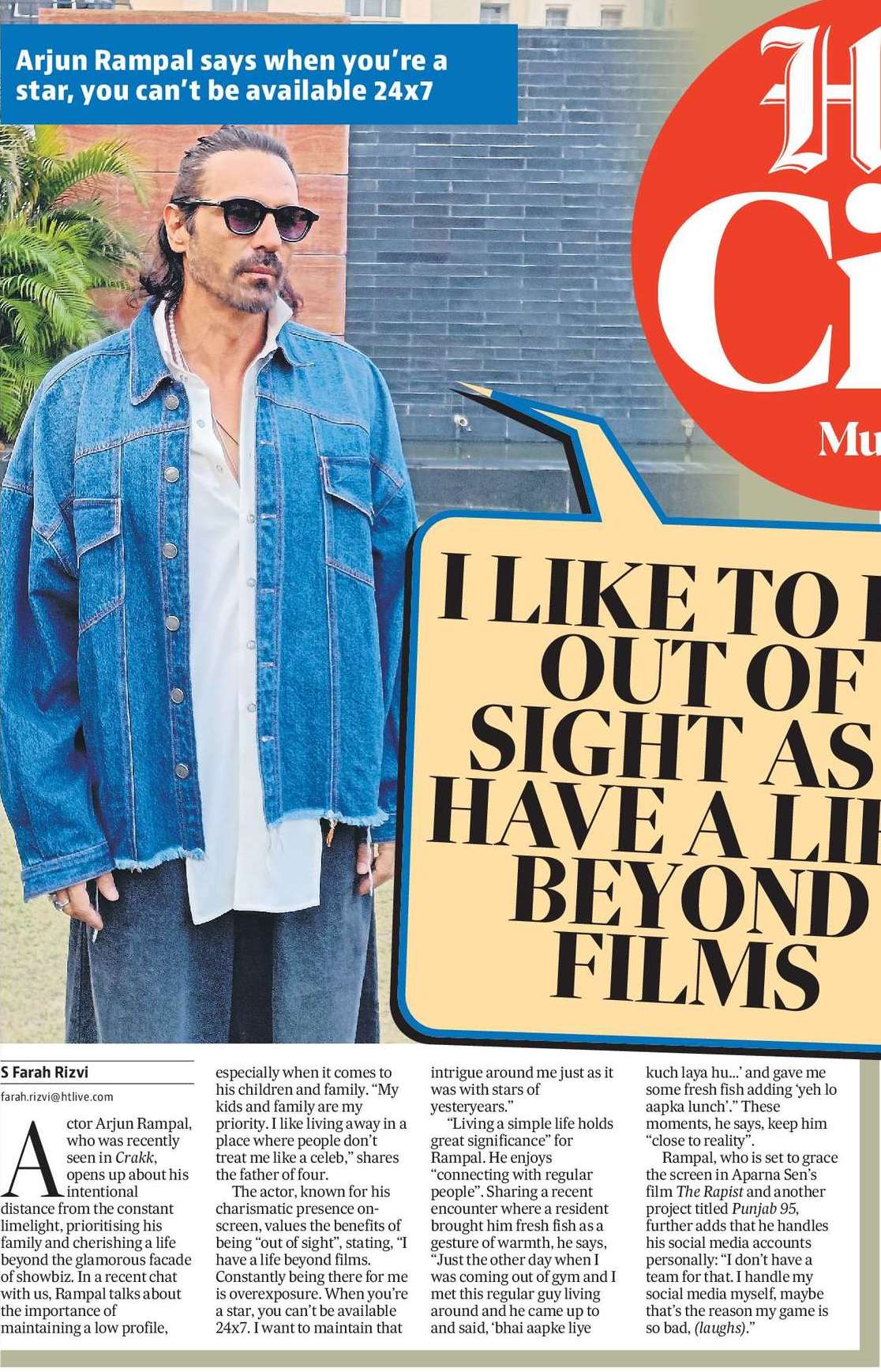
Arjun Rampal says when you’re a star, you can’t be available 24x7
S Farah Rizvi (HINDUSTAN TIMES; March 6, 2024)
Actor Arjun Rampal, who was recently seen in Crakk, opens up about his intentional distance from the constant limelight, prioritizing his family and cherishing a life beyond the glamorous facade of showbiz. In a recent chat with us, Rampal talks about the importance of maintaining a low profile, especially when it comes to his children and family.
“My kids and family are my priority. I like living away in a place where people don’t treat me like a celeb,” shares the father of four.
The actor, known for his charismatic presence on-screen, values the benefits of being “out of sight”, stating, “I have a life beyond films. Constantly being there for me is overexposure. When you’re a star, you can’t be available 24x7. I want to maintain that intrigue around me just as it was with stars of yesteryears.”
“Living a simple life holds great significance” for Rampal. He enjoys “connecting with regular people”. Sharing a recent encounter where a resident brought him fresh fish as a gesture of warmth, he says, “Just the other day when I was coming out of gym and I met this regular guy living around and he came up to and said, ‘bhai aapke liye kuch laya hu...’ and gave me some fresh fish adding ‘yeh lo aapka lunch’.” These moments, he says, keep him “close to reality”.
Rampal, who is set to grace the screen in Aparna Sen’s film The Rapist and another project titled Punjab 95, further adds that he handles his social media accounts personally: “I don’t have a team for that. I handle my social media myself, maybe that’s the reason my game is so bad, (laughs).”
My daughters are my friends, and they are very naughty and are always pranking me. And I am always falling for it-Arjun Rampal
8:48 AM

Madhureeta Mukherjee (BOMBAY TIMES; June 19, 2022)
They are one modern, happy family. Unconventional, yes. Unshakebly close, absolutely yes! They don’t live under the same roof at all times, but they are one tightly knit unit. They beautifully blend in and proudly stand out. While Arjun Rampal has finely reinvented himself in this current phase of his career, in his personal life, too, the dad of three wonderful children Mahikaa (20), Myra (17) and Arik (2), is learning new things about fatherhood every day, all over again. And he is cherishing it! Arjun talks to BT about parenting in these times and what it takes to be a cool dad and a buddy, who they can lean on. Read on...
You became a father at 28, with Mahikaa’s birth, then at 32 with Myra’s birth. Then at 46, Gabriella (Demetriades) and you had Arik. How different was it being a dad in your mid-40s, which probably is a more settled phase of your life?
It was absolutely different. If I had to go back to the time when I was 28 again and relive my time with Mahikaa, I would do it exactly how I am doing it with Arik.
I feel at that point in time (in your 20s), you are so nervous when you have a child, you are young and it’s all so new. You are also in that state of mind where you are figuring things out and trying to please people in the work space. So, you tend to focus more on making a life for your children rather than spending your life with them. And I think what’s most important with any family is spending time together. Now, I get to do that with all three of them and it is wonderful. They are my friends, and they are very naughty and are always pranking me. And I am always falling for it. Mahikaa is the biggest prankster and so is Myra, and now, even Gabriella has joined the gang.
With Arik, do you find yourself learning new things about fatherhood and getting a hang of daddy duties all over again? Raising a baby amid the pandemic must come with its challenges?
A lot of things happened out of the ordinary with Arik. To have him at the age that I am at, and then the fact that he was born little before the pandemic... it was a period that changed all of us. We were stuck in a house; we couldn’t step out and meet people. So, when you are spending so much time, obviously the way you observe a child is different. If it weren’t for the pandemic, I probably wouldn’t have been able to be around him as much. For Gabriella, to have this baby, at first, she was like, ‘Oh, I don’t know how I will be as a mother’. She is young and was wondering how she would manage this new phase in her life. So, we have been parenting together, which was fantastic. It all happened during scary times, but spending all that time together, also naturally made our bond so special. Arik also has two wonderful sisters who got to hang out with him a lot. We all spend a lot of time as a family. We talk a lot, express our feelings and share our thoughts with each other.
Mahikaa and Myra have grown up now, and they belong to the new generation of kids who are exposed to a lot more. They are confident and cool, do they make you feel cooler? Do they teach you their new-age lingo?
We have conversations about a lot of things. But I tell them that their lingo is rubbish and I have no interest in it. Of course, they look at you like, ‘Oh, you don’t know anything!’ But I turn around and tell them that I know a lot more and I am far cooler than they will ever be (laughs!).
So, when you sit back and look at your family – your two girls who are really close, the way they have grown to love their little brother, and how Gabriella and you relate to them – it all seems like one happy, comfortable, modern family. How do you feel about it? Content?
It’s the best feeling! I feel I should have a few more children (laughs!).
Go on…
God has been kind. Touchwood! It’s not just me, Mehr (Jesia) has done a fabulous job with bringing up the girls so well. So, I feel extremely blessed. Even the rest of my family, my sister, nephews — all of them, we are really close. I value things a lot more now. My kids and my family teach me to value life more each day.
Are you an overprotective dad? How cool and comfortable are you discussing topics like love, relationships, boyfriends, et al, with Mahikaa and Myra?
I think they would be scared in the beginning, but then they would get down to talking about it. Well, they have pranked me with some really terrible stories and they thought I would react differently. But I was very mature and dignified about it and I said... ‘okay, let’s see how we deal with this.’ And they were like, ‘No way, this can’t be your reaction!’ They are my friends and we are open to all kinds of conversations. Today, parenting has changed. The way our parents were with us was different from the way we are with our children. And somewhere, I think, back then, there was a lot of love, but there also was a lot of forced respect. It came out of fear, like how will dad react, aur mummy kya bolegi? Today, children have a lot of exposure, which they have succumbed to as they don’t have a choice. That’s how the world has developed, and if you aren’t part of it, you are considered a freak. So, the best thing to do is to be a friend to your child. To have a child who can trust you wholeheartedly and vice versa is very important.
How did it feel to watch Mahikaa leave the nest to go and pursue her dreams (she is in the UK studying filmmaking)?
For me, it was earth-shattering when she went there. She has always led such a protected life, but she made the transition so gracefully. As parents, we realise that we also need to give them their space. I ask myself, can I trust them? The answer is yes. Are they grounded? Yes, I think they are pretty grounded. It’s fine to go wild and make mistakes; everyone does that. It is part of life and learning. But as parents, you know that you will always have their back and that’s not going to change. The whole world can change, but as a father I will always have my kids’ back and that is the one thing which will never change.
Do you feel settled with Gabriella and love the life and home that you have built with her?
I think she has been a complete blessing in my life. We both met at a time when there was a lot going on in both our lives. There is a saying in one of the series that I recently did, ‘After absolute chaos comes absolute silence.’ I hope we are beyond the chaos levels of our life. Somewhere, I feel we have helped find each other and formed the connect that we have.

I would love it if male actors support my kids if and when they decide to be in the movies-Arjun Rampal
7:56 AM
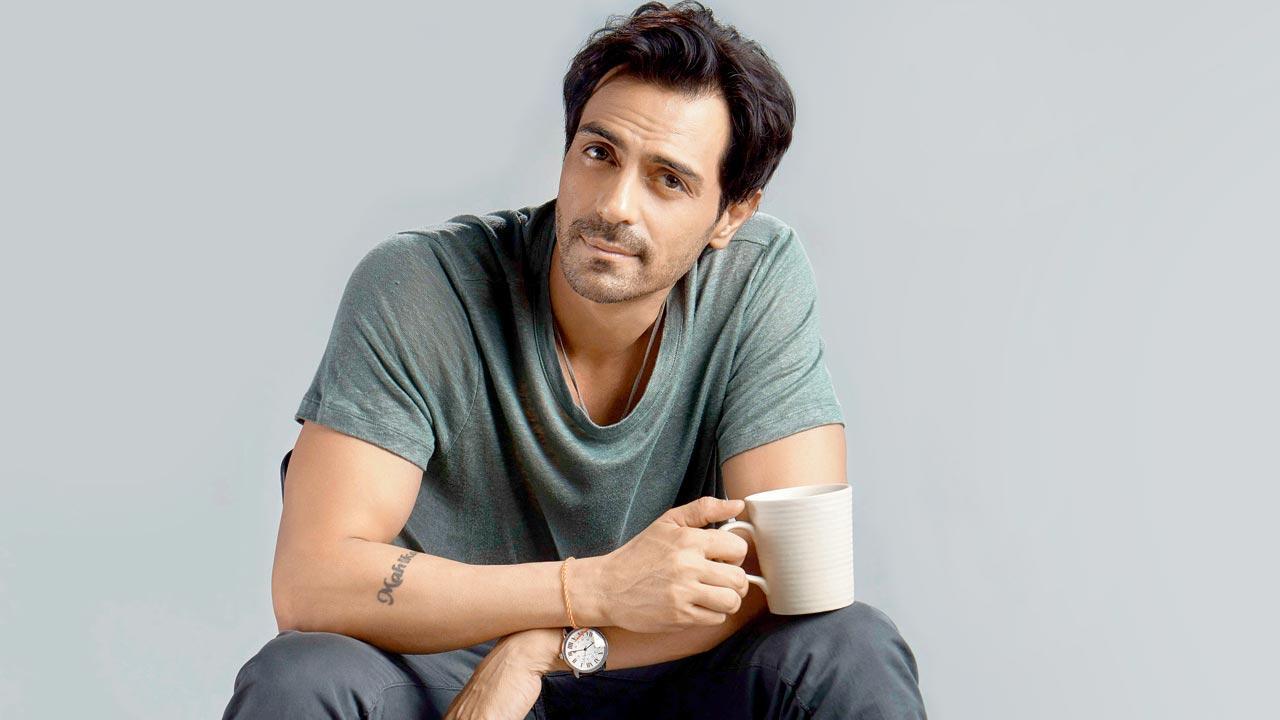
Arjun, who plays a villain in Kangana-starrer Dhaakad, says he backs female-led movies keeping his daughters in mind
Mohar Basu (MID-DAY; May 18, 2022)
I am deeply satisfied with what I have done,” starts off Arjun Rampal, as he sits down to talk all things Dhaakad. The actor plays the sinister Rudraveer, the antagonist to Kangana Ranaut’s Agent Agni in Razneesh Ghai’s directorial venture. To Rampal, the spy thriller is the beginning of a conscious shift he is making with regard to projects.
He explains, “I liked the director’s vibe. The friendship is key to making the film better than we had envisioned. The movie gets so much right — from the brilliant camera work to the styling, and the scale of action. Another important reason for me [to say yes] was that it’s a female-led film. We have seen men do action all the time. But have we ever seen a woman do it? A female star is never given this kind of opportunity.”
It’s not often that leading men step aside to have the spotlight shining on their female counterparts. Yet, Rampal is comfortable in his skin to do that. After Dhaakad, he will join Konkona Sen Sharma in another woman-oriented story, The Rapist. His decisions are influenced by his need to create a gender-neutral environment for daughters Mahikaa and Myra.
“As a male actor and father to two daughters, I want to make this industry more conducive to women. I would love it if male actors support my kids if and when they decide to be in the movies. Plus, my support system was my mother [Gwen]. She made a lot of sacrifices for me. I have done several women-oriented subjects — Dil Hai Tumhaara [2002], which was Preity’s [Zinta] movie more than mine, or Tehzeeb [2003] led by Urmila [Matondkar]. I have seen the period in Bollywood when women didn’t have a voice. I have a responsibility to back movies like Dhaakad.”
At this stage, the actor says he is doing films that speak to him. “I don’t want to make a point or please people. Now, I want to do characters that appeal to me, and I am happier for it.”
When Dhaakad makers told me Kangana Ranaut is the protagonist, I knew that she would put her everything into it-Arjun Rampal
8:17 AM

Madhureeta Mukherjee (BOMBAY TIMES; May 14, 2022)
We have seen many shades of Arjun Rampal — across platforms — grey too, but this time, like the actor reveals, ‘Evil has a new name. ’ The antagonist of the action spy thriller Dhaakad, who has gone really dark, has turned on the heat with a platinum blonde style, looking hotter than ever! And he has the protagonist, Agent Agni, loaded with ammo, played by Kangana Ranaut, to battle. With the film gearing up for release on May 20, Arjun talks to us about how cinema jargon has changed, the way actors have broken the shackles and how stories packed with woman-power attract him. He is all guns blazing. Read on…
In a film where the protagonist is so fiery and powerful, the antagonist has to be as deadly, or more, right? Would you say this is your deadliest avatar of sorts? In a social media post you had said, ‘Evil has a new name.’
Yes, I think so. My character, Rudraveer, is quite vicious, and he has a mission, as he comes from a space where everything is taken from him. So, he is protective about all that he has achieved so far. He gathers a lot of loyalty amongst his people, and he is anti-system. Somewhere, his heart is dark, but he doesn’t think he is doing anything wrong because this is the world he has created. When you get a character like this to play, it is lethal, and also, sometimes scary…
…Because it takes you into a different mental space? Dark, perhaps?
It does take you into a different mind space. It makes you think. When you are performing, until you don’t feel it, whether it is a small or large part, it doesn’t come across. You can do it on a superficial level, but that’s not what you want to do. For me, to feel him was important, and when you do that, you get in touch with those emotions and get into that mind frame. It has an impact on you. You become aware of what really evil is and how bad it can get. It scares you. I’m glad it scared me, because you know that your mind can never tread in that direction, ever, where you slam or shoot someone and feel no emotion. There is this one montage shot where I have to go and hack someone, and Razy (director, Razneesh Ghai) told me to just go for it.
So, at that point, what do you think about?
You probably think of the anger which is there inside of you, if any, and you tap into that and let it out. It took me a while to get into that scene, and when I did, they didn’t say cut, and I kept going on and on. Now when I see those eyes, I am like, ‘Wow, this is me!’ That came from somewhere.
There is not as much of the action spy thriller genre seen in our movies, theatricals, especially. Then, here you have a woman leading the show, doing hardcore action. A superb idea, but rare in our cinema. How did you react when you were pitched this concept?
I was excited because I could tell that Razy is a filmmaker with a distinct style and visual sense, which is captivating. Also, from the time that we have been making our films, we follow a certain style that often alienates a certain generation of moviegoers, like Gen Z, which includes my children who consume different kinds of content. They have been exposed to OTT so much more, so they feel that often what they see on screen is a watered-down version, especially in this genre. The action in this film is of a different level. We had action choreographers from Korea, the US, as well as India. The action sequences and visuals are something that will stay with you. Another thing that struck me was that the film is going to have such a different feel with a woman doing all this action. You have seen a man do this on the screen so many times, the novelty of the whole film is seeing a woman do such hardcore action...
Go on...
Every time I do a film led by a woman, I think of what my mom did for us and the sacrifices she made. As a single mom, she took brave and drastic steps in her life, at a time when women did not have that kind of voice. If she hadn’t made those choices, then I wouldn’t have been here today. I have done films like The Rapist, Dhaakad, Kahaani 2, and way back, Dil Hai Tumhaara, Tehzeeb and Dil Ka Rishta, and I would always wonder why such roles attracted me. Then I figured out that somewhere I have this innate feeling inside me. I also have two daughters (Mahikaa and Myra) and have been around women who are so incredible. Also, today, it’s about the film and not about you. We have so many opportunities, I am doing two big action films as the protagonist, and people will see me in that light, too. When they told me that Kangana is the protagonist, I knew that she would put her everything into it. She has trained really hard for this film. In our first schedule together for the film in Bhopal, she had to do one difficult take where she had to dismantle this whole pistol and use it as a weapon to stab a man. She did it in two takes. It was hardcore, and I was like, ‘Wow, she is on fire!’
For a theatrical film, the vision of a story can sometimes get diluted because filmmakers have that constant pressure to deliver a certain number at the box office, while catering to various sensibilities and markets. Hence, at times it compels them to play it safe to ensure payback on their projects. On the other hand, the digital medium gives far more room for flexibility, experiments and surprises. Would you agree?
All that jargon we had… that we have to make a film for this audience and that, and we have to please everyone just because it’s a big-screen release — that time is over! That audience has gone. Today, the audience will reject your movie as they know exactly what you are trying to do. We have seen that happen now. The audience has outright rejected films that have been made with calculations and tropes that try to please them. Today, with huge competition from OTT, to pull people out of their homes and bring them to the theatres, we have to make films that create an intrigue in people, where they will say, ‘Yes, I want to watch this movie on the big screen.’
It appears like there is less pressure when a film or show releases in the digital space. But is that true?
Given that the reach of the digital medium is so wide, if you don’t hit the mark, there is a larger audience that will notice it. And vice-versa. In the entertainment business, there is no one way. Everything is a double-edged sword. You are right, in the OTT space, it might seem that there is no box-office pressure, but there is a huge amount of pressure at a different level, and how well you have done is also measured differently. They (the digital platforms) calculate how much their subscriptions have gone up; they can even tell you on which episode engagement level. So, that decides if they want to do the second season of a show. It’s business, after all, so there is immense pressure to achieve what they have set out to do.
Would you say that this medium has let you reinvent yourself, helped you stay relevant and find a new audience?
Not only find a new audience, but also do a lot that I wanted to do, but could not, as there were restrictions — because of the reasons we discussed earlier... like filmmakers wanting to play it safe for BO returns. We weren’t getting opportunities to do exactly what we wanted or a chance to push the envelope. With OTT, that has changed. It has smashed all those mirages that caged you as an artiste. It has opened up new avenues not only for actors who want to experiment, but also for new talent.
The filters and parameters that you use while big-screen film, are they any different?
Honestly, the question that I ask myself when I am signing a project is, am I going to be satisfied as an artiste? This creative satisfaction is what I was always looking for, and that’s why I kept jumping between genres and working with filmmakers with different sensibilities. Now, I know where and how to find what I am looking for, whether it’s on OTT or the big screen, it doesn’t matter. As an actor, every film for me is a big one, irrespective of the medium.
Do your daughters, Mahikaa and Myra follow your work closely? Are there discussions about cinema at home?
Mahikaa and I have interesting conversations about cinema. She is 20, she is studying acting and films in the UK, and really enjoying it. We talk a lot about technique, what we do and how we do it. If she needs to make a big speech, she will call me and do it for me, if I am lucky. I get interesting insights from her, which I can apply to my work. We analyse scenes that I have done, and she asks me, ‘What you were thinking while doing this? I think the expression worked here.’ So, we mostly have discussions like that.
As an aspiring artiste, gearing up to step into the world of cinema, what kind of advice do you dole out to her, as a father and actor?
I tell her to not fall into the trap of trying to impress anyone. That’s what we tend to do; we try to impress and impress, and eventually, we start hating our job and get prone to be disillusioned by ourselves. But actually, you’ve already been disillusioned as you are working to please someone else and not doing what is right for the part. So, if you are honest with your part, everything else will fall into place. This is the advice I would give any actor — remove all the noise and focus on what you are supposed to do, purely and honestly. For Mahikaa, too, it is important to understand this. We are constantly trying to prove ourselves, but you don’t have to do any of that. Just let go. You have to say, this is my work, and if someone doesn’t like it, they don’t like it. You are entitled to your choice, but I am also absolutely entitled to not agree with your choice (laughs!).
My Telugu debut is going to be on the scale of Pushpa, RRR, and Baahubali-Arjun Rampal
8:29 AM
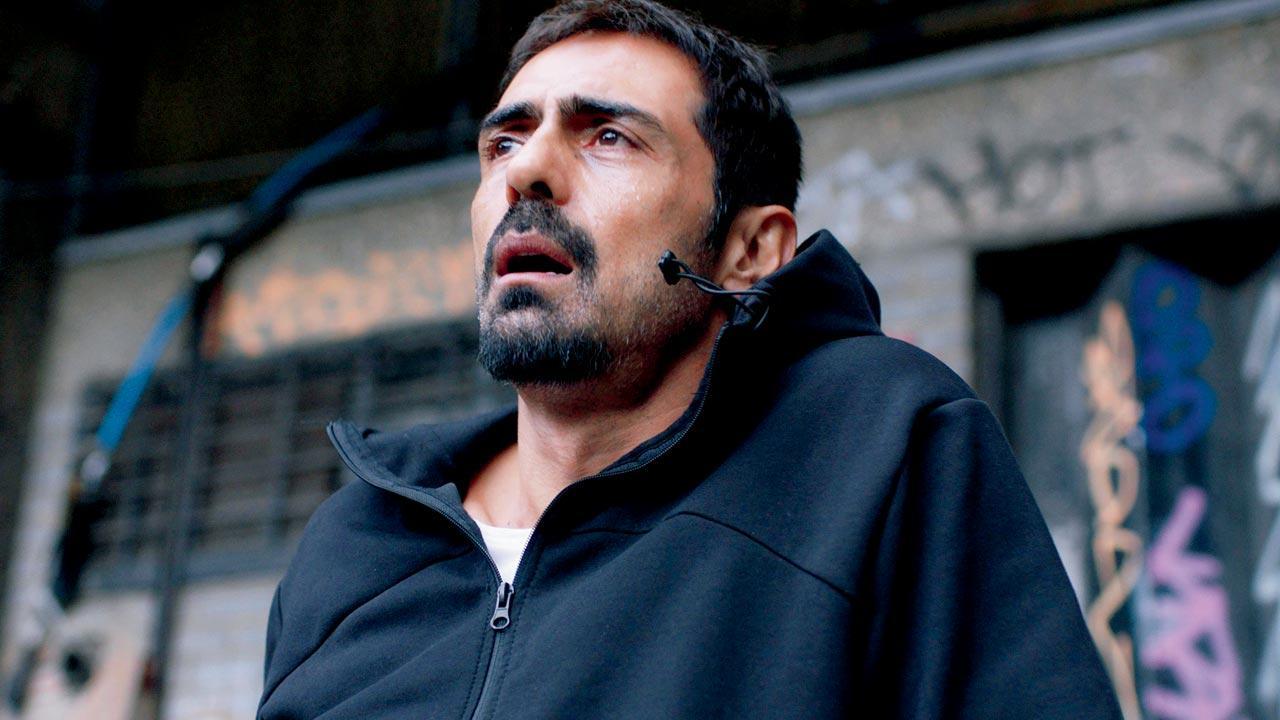
Arjun Rampal on playing a dysfunctional cop in London Files that touches on immigration, depression and parenting
Letty Mariam Abraham (MID-DAY; April 19, 2022)
A quick look at his career graph, and it’s easy to see Arjun Rampal’s fascination for complex roles. He assures that London Files is another addition to the list. The actor, who plays a dysfunctional cop in Voot Select’s upcoming series, says the role demanded considerable prep. Over to Rampal as he dissects why he was drawn to the series, and his evolution as an artiste.
Edited excerpts from the interview.
What was novel about the show that attracted you to it?
Om Singh is by far the most interesting character I have played in my career. He is a dysfunctional cop. The story highlights a lot of issues that people are facing. It depicts how parenting affects children today. What happens when the government suddenly passes the anti-immigration bill and takes away the rights of people who have migrated and been given citizenship in a foreign country? What happens when [countries] start shutting their borders? A lot of issues have been cleverly written in the show with the help of layered characters.
Do you gravitate towards intense roles over slice-of-life stories?
This is definitely a slice-of-life story [laughs]. Sometimes, you just attract certain things, and you say yes, hoping you can do the part. I love slice-of-life shows. If a good script comes along, I’ll do it. But right now, I lean more towards dystopian, issue-based and gritty stories.
Tell us about your prep for the character.
With London Files, I have spent a lot of time [with the core team] when [the script] was coming alive. A lot of contribution has come in [from the director, Sachin Pathak] on how to do a scene. We are showing a guy who worked in the London police force, so you cannot have the British chief talking in Hindi. So, we did those scenes in English. I haven’t done many English films, but I aspired to make it look real. You have to do a lot of workshops, and understand the world you portray to make it more real.
There are two types of actors — one who lives the part, and one who can switch on and off. Which one are you?
For me, it’s a combination of the two. You have to switch off at some point, or you will get exhausted. It is important to detach; it can give you new ideas about the character, but at the same time, I can’t completely switch off. I have to be in the zone. That is why I do one project at a time. Sometimes, it is difficult to switch off because the character stays with you. But as you start prepping for the next project, you let the earlier character go.
How do you feel you’ve evolved as an actor?
Sometimes, I feel on top of the world. Just when I start feeling that way, I go to the set and do a terrible scene [laughs]. There have been times in my career when I have done scenes on a superficial level. Now, I take every character and make it a part of me. It could also be [attributed to] being inexperienced and the choices I have made. [Earlier], I didn’t get parts that I could go deeper into. The choices I make today allow me to do that.
You are making your Telugu debut.
I am walking into the unknown. It is going to be [on the scale of] Pushpa, RRR, and Baahubali. I want to work in [the south industry]. The film stars Pawan Kalyan and I am playing a larger-than-life character. I’m nervous; I don’t know what to expect, but I am going out there to experience something.
Quitting smoking was hard-Arjun Rampal
8:06 AM

Digvijay (HINDUSTAN TIMES; May 31, 2021)
This World No Tobacco Day marks nearly a year of giving up smoking for actor Arjun Rampal. The actor, who was a chain smoker, quit during the pandemic, last year. It was quite hard and every day was a battle, he admits.
“When I wanted to quit, it was the most difficult thing to do — I’d get cranky and irritated. It’s not something that one can overcome easily,” he shares.
The Rock On actor started smoking when he was in boarding school. Reflecting on the times, he adds, “I used to be an athlete. I got hurt doing some hurdles while training for races, and couldn’t compete. I was upset and saw my friends smoking, and tried it for fun. I smoked one and got this head rush for the first time; it felt really good.”
Being around his baby boy, Arik, motivated the actor to quit cigarettes. “I was sitting with Arik during the pandemic, and I thought I was playing with my health. How can I be so irresponsible to go and pick up a baby, while smelling of tobacco?” says Rampal.
He feels the urge hits when you see someone smoking. “That one drag is exactly like the feeling when you started smoking in the first place. So, don’t get into habits that are going to be fatal,” Rampal signs off with a piece of advice for those trying to quit smoking.
What’s the point of doing a film no one watches?-Arjun Rampal
8:13 AM

Rishabh Suri (HINDUSTAN TIMES; February 9, 2021)
Actor Arjun Rampal prefers his own pace in his career. He entered Bollywood in 2001, but has since, slowed down on the number of projects he takes up. He hasn’t had a theatrical release in almost three years. “Sometimes, you take a long gap, as you want to be patient that something good is going to come. When you go in front of the camera (after this while), you think you’ve forgotten everything,” he laughs.
He recently starred in Nail Polish, a web film which got good reviews. Wasn’t he worried that out of sight for such a long time could have led to being out of the audience’s mind too? He admits people did tell him that. “I said, ‘What’s the point of doing a film no one is going to watch, and you are going to hate having in your filmography?’ Because you are still out of sight if you have done something terrible, no one watched it,” says the 48-year-old.
One might think being in the industry all this while, he may have taken a decision which he realised wasn’t wise in hindsight. But Rampal disagrees. “I don’t regret saying no to films, because it’s your instincts. Sometimes, you say no to a film and it goes on to become a blockbuster, and you think, ‘Oh my God, was that a bad choice?’ Every part in a film is predestined, as to which actor is going to play it, even though it was written for a particular actor in mind,” he reasons.
Giving the example of one of his own films, he adds, “The best example is Rock On!! (2008). The part was not for me, it had gone to two different actors before it came to me. That was predestined for me, to be in my filmography. I look at it as purely that.”
The industry has given mea lot, takes a lot as well-Arjun Rampal
8:34 AM

Arjun Rampal completes 20 years in Bollywood, intends to write an autobiography as he has ‘experienced a lot’
Rishabh Suri (HINDUSTAN TIMES; January 3, 2021)
Having spent two decades in the film industry, Arjun Rampal has had quite the journey. The actor, who was a model before he joined Bollywood, is now planning to write an autobiography to share his experiences with the rest of the world.
“I will definitely [write an autobiography], because there’s so much I have experienced! This industry has given me a lot; it takes a lot as well. I came to an industry... totally an outsider, got a lot of love, went through a phase of complete transition as well,” says Rampal, who has over 40 films to his name.
The 48-year-old started his Hindi film career with Pyaar Ishq Aur Mohabbat in 2001, and over the years, did a large variety of roles on the big screen. Some highlights of his career are Aankhen (2002), Om Shanti Om (2007) where he played the antagonist, and of course Rock On!! (2008), which got him a National Award for Best Supporting Actor.
In fact, Rampal considers the National Award as the highest point in his career. “It came out of the blue,” he shares.
Asked about the lows in his career, the actor says, “The lowest point is when you are looking for work, and you don’t find the kind [of projects] you really want to be a part of. It either doesn’t exist or it is taken away from you. Those low points hit you, you get confused, and confusion, I think, is the worst thing to have. It seeps in levels of insecurities, your confidence goes down, you become uncertain.”
Talking more about how much of a roller coaster ride it has been for him as an actor, Rampal continues, “Everybody joins the industry to become a star, and it looks so glamorous from the outside. You feel this is going to be a great life, but it’s a lot of hard work, sacrifice, commitment and dedication. A lot of getting knocked down, and having the courage to get up again, it has been all of that for me.”
And the tenacity and hard work paid off for him. “I am still here, and in the best zone of my life right now, especially as an actor. For me, my journey was about wanting to be known for my work, and remembered for that. The choices I make now are purely with that in mind,” he concludes.
Arjun Rampal stuck in Karjat with family, but feels secure as there are zero cases in the vicinity
8:21 AM

Caught in Karjat with family amid the lockdown, Arjun Rampal on keeping his tot away from state's hotspots amid pandemic
Uma Ramasubramanian (MID-DAY; April 22, 2020)
Not many can convert life's lemons to lemonades as seamlessly as Arjun Rampal can. Caught in Karjat where he was shooting when the lockdown was announced last month, the actor decided to extend his stay at his lavish home, instead of scurry back to Mumbai.
"I thought it would be better to operate from here instead of travel at this point. I have a house here, so it worked out well," says Rampal, who is accompanied by partner Gabriella Demetriades and their son, Arik.
That Karjat has, so far, remained largely unscathed by Coronavirus was another bonus. "We decided to stay back for my son's safety. While he is too young now, this will be a story to tell him when he grows older. Besides, Mumbai is just a few hours away, and hence, easily accessible in case of an emergency."
Spending two months in the lap of nature has converted him into "a farmer", of sorts, he jokes, adding that his family is making the most of the hiatus. "Since there are no cases here, we are secure. We have an open space and [are enjoying] being amid nature instead of confined to an apartment," says the actor, adding that he is also keeping tabs on his daughters Mahikaa and Myra, who are with ex-wife Mehr in Mumbai. "They are doing their work online, and I am constantly chatting with them."
I have accidentally been self-quarantined (on the outskirts of Mumbai)-Arjun Rampal
8:27 AM

Arjun Rampal, who is accidentally self-quarantined on the outskirts of Mumbai, shares his thoughts about what’s going on in the world around us, and tells us that after we are past all this, we will always view life as BC/AC — life Before Coronavirus and life After Coronavirus
By Arjun Rampal (BOMBAY TIMES; March 29, 2020)
So, here we are, Day 10 of quarantine for me. But let’s level here, so we shall consider it as Day 5, post the compulsory national lockdown was announced. No, this is not the Janata Curfew as we all witnessed, we know how that panned out, with a bunch of morons who defeated the good of all disciplined citizens, by doing a victory lap in thousands as if they had defeated the coronavirus.
Yet, all is not lost, and now, we all realise the magnitude of the problem that surrounds us. I am in a quaint town on the outskirts of Mumbai, where I have been filming for the past two months. I have accidentally been self-quarantined here, since the curfew was imposed on the day I was supposed to leave. The delay happened because I had set up home here with my personal team, dogs and gym equipment, and was taking a few days to get everything back home, but by then, everything had changed. The team left, including my eight-month-old baby’s nanny.
Out of no choice of mine, or maybe some divine intervention, the people who ended up staying were Gabriella (Demetriades), Arik (Arjun’s son), Babblu and Santosh (staff members), my three dogs — Faff, Dean, Brando — and, of course, my gym equipment. Lucky me. So, that’s my current situation. But this is not what the article is about; hopefully, it shall make sense as we proceed.
Sitting here with nature and two bars of 4G on my phone, which I get only under the fifth coconut tree on this property. I find myself lost under that tree, worrying about all the people I care about, getting in touch with them, and thinking that my life could end, less likely by COVID-19 and more likely by a coconut. I see the panic mankind has gotten into, as if we were immortals facing mortality. Why? Is it just that we have assumed that we all are going to live forever, or is it that we just want to live more, since we are not done consuming. We all have had the same complaints, during our normal existence, too, much work and no time for family. Now, locked down with our family, we can’t wait to get the hell out and work. We work all our lives and spend most of our income to make beautiful homes, and once we are confined to them, we feel jailed.
Then, we are bombarded with an overload of information about the virus. Lots and lots of theories, conspiracies, stories, fake news, panic messages, economic meltdown, biological warfare, new treatments, celebrities who have been infected (Oh my God, they get it, too!), party apps, crazy videos, memes, fear, fear and more fear. All this floods our social networking timelines. The interesting thing is that, now BC and AC have donned a new definition — of life Before Coronavirus and life After Coronavirus. Some very affluent writers and intellectuals go to the extent of saying that the world will never be the same, we would need to choose a new world order, which would mean we lose our freedom (which we have now, being quarantined), our privacy — maybe by getting chipped or through some biometrics — people can check our body temperatures and use facial recognition, which would then allow governments to monitor our every move, and know our reaction towards anything we process. They will know that we are falling sick even before we know it. Bit by bit, we will be given some of our freedom back. But overall, take this time to put in a new order, a new way of life. Wow, a bit too overwhelming. A great way to control and distract, considering that we were on the cusp of a global economic meltdown, regardless of COVID-19.
Environmentalists have been screaming from rooftops about global warming, deforestation continues at an alarming rate to fulfil human needs and species getting extinct is just another day at the office. News today, gone tomorrow. Governments, the world over, have indulged in building great armies and weapons of mass destruction, but have failed when it has come to healthcare. No nation has prepared itself for a pandemic like this. So yes, it’s true that now they have the opportunity to take away all of our freedom. Implement technologies that will monitor us 24X7. That will be the world we shall leave for generations to come. All these thoughts buzz through my mind. Making me feel hopeless, knowing how easily humans adapt, as I look up through the shade of the coconut tree, almost willing a coconut to crash my skull for just being so redundant. I then see the sky so blue, smell the air which is so clean, listen to the birds, who are audible, and not a mash-up of vehicles, people talking, news reporters screaming or people rioting. And all I can do is hope and pray that life after coronavirus is one where we aren’t so greedy, voiceless and selfish, we can call out the dishonest and we can protect our Earth for generations to come. A life where we aren’t so gullible and we will live and love each other as we do today. We move more towards inner peace than the hoax of materialistic happiness. We shall be humbled by nature, as nothing and nobody is greater than that. We will be satisfied, because if we aren’t, then today will just be the trailer, and the movie will tell another story. I realise that maybe this coronavirus is nature’s vaccine towards a virus called humans.
It’s time for us to acknowledge that and time for all of us to give back. You are at home under that roof with your family, and yet, you feel jailed! Ask yourself why? Because you want to run around those mountains, breathe the freshness in the air, swim in the lakes, rivers and oceans and travel the world. A world in synergy and sync with one another. Not a toxic waste dump.

I did The Final Call to create awareness about depression-Arjun Rampal
4:13 PM

Arjun Rampal talks about why he chose The Final Call over a period drama on Taj Mahal as his web debut
Sonil Dedhia (MID-DAY; March 5, 2019)
Bollywood's romance with the digital platform continues, with Arjun Rampal being the latest star to jump on the bandwagon. The actor opens up on his maiden web project and why it was a "draining" experience. Edited excerpts from the interview:
You were in talks for a web series on Taj Mahal. What made you choose The Final Call over it?
I was quite excited to do Taj Mahal, which would have seen me play Shah Jahan. But when I read the first two episodes, I wasn't convinced. Luckily, Tarun Katiyal [CEO, Zee5] and I were on the same page regarding the material. He then suggested that I read the script of The Final Call. I realised that it would be one of the most challenging characters I've played.
The show deals with depression, something that is not often discussed on screen.
One of the main reasons I did the show was to create awareness about the subject. Since it has dropped online, I have got several messages saying that we have depicted it with sensitivity. Depression is a mental condition that can occur due to various reasons, including stress. Sometimes a person harbours negative feelings because things aren't going his way. In some cases, it is a chemical imbalance; at other times, it could be bipolarism. So, it's important to recognise the issue and seek help accordingly. In our society, many feel that going to a psychiatrist is taboo, but it is necessary for a person to discuss his emotional state.
Was it tough to get into the psyche of a troubled pilot?
Understanding the mind of a character requires you to draw from different experiences. It was a draining process. Vijay Lalwani [director] read up about what happens to fighter pilots. He told me how most fighter pilots go into depression after retirement. It can be because of the missing adrenaline rush or simply, post-traumatic stress disorder. Many of them don't sleep with their family because they have nightmares and fear hurting them in their sleep. I tried to bring in this struggle in my character.
This is the first time that you have explored the OTT platform. What has been your understanding so far?
The digital platform is a completely different ball game. It is a great medium because it allows creative minds to showcase their work, which otherwise wouldn't have seen the light of day. While it has a wider reach, the competition is also stiff. That's why quality is paramount. We have to compete with the likes of House Of Cards and Game Of Thrones. We don't have the same budgets, but we cannot put out anything that looks shabby or cheap.
In the long run, do you think OTT will replace theatres?
Cinema isn't going anywhere; it is the mother of all formats. The OTT platform cannot replace it. It has surely raised the bar and made filmmakers conscious of showcasing good content, failing which the audience will not come to cinema halls. So, the way forward is to make larger-than-life films or provide interesting content.
It’s sad to see the army being maligned; they are like Gods in uniform-Arjun Rampal
8:02 AM
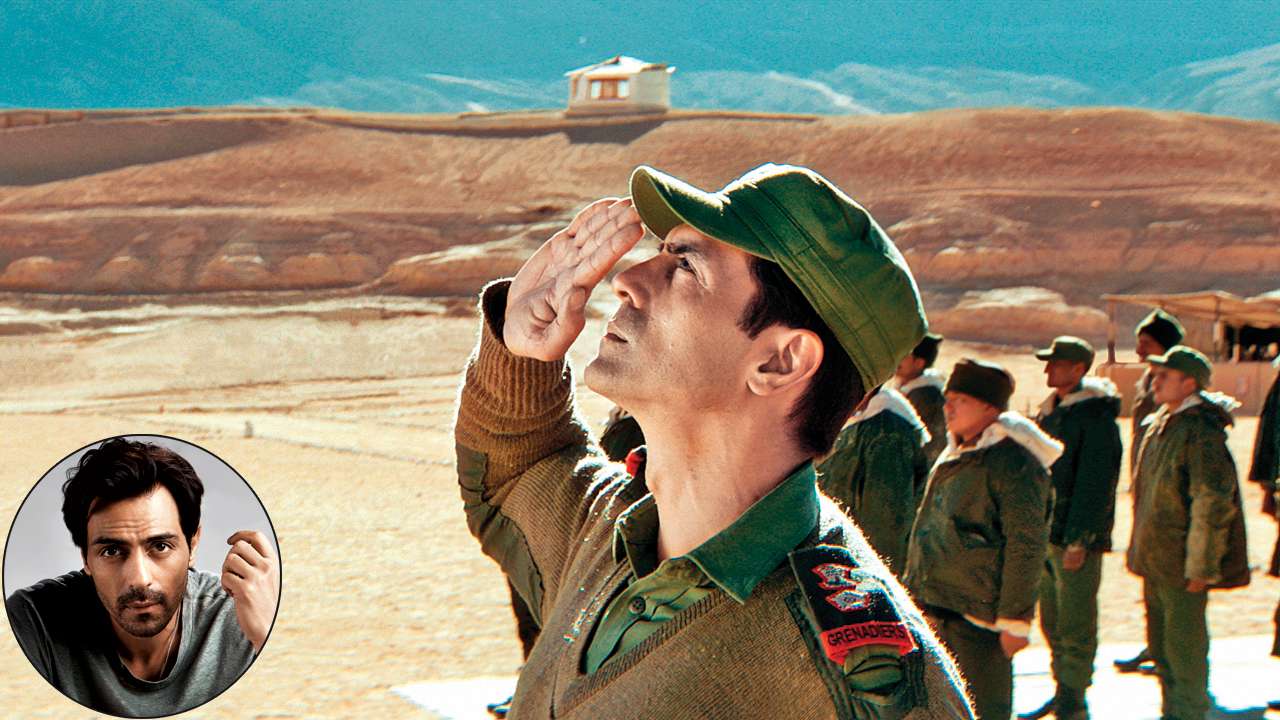
Hiren Kotwani (DNA; August 25, 2018)
The one thing constant about Arjun Rampal in the 18 years that he has been in the film industry is his cheerful disposition. Irrespective of what may be playing on his mind, he always has a smile on his face and is brimming with optimism. Last seen in Daddy (2017), which he also produced, the actor is gung-ho about his upcoming release, J P Dutta’s Paltan, which is backed by Zee Studios. He plays Lt Col Rai Singh, the Commanding Officer of 2 Grenadiers who played an important role in the 1967 Indo-China clash at Nathu La along the Sikkim border.
In a freewheeling chat, he talks about the importance of this chapter in India’s history, the armed forces’ dedication at the border and in times of natural calamities like the recent Kerala floods as well as his production plans. Yes, even though his biopic on the gangster-turned-politician didn’t fare well commercially, Arjun remains undeterred in making movies on stories that he wants to tell. Read on...
What does playing a man in a uniform mean to you?
It depends on the film you’re doing. If it’s something like Paltan, in which you are portraying a real-life character, then your responsibility increases tremendously. If you’re playing a fictional person, then you can take liberties. This movie is based on true incidents. When I first heard about it from J P sir, I was shocked that there was a fight between India and China in 1967, after 1962, in which our soldiers were massacred. It was a brave feat and this chapter should be included in our history books. It’s extremely special for me to tell this kind of a story. In fact, most of us who star in the film have some connect with the armed forces. Either someone’s grandfather, father or uncle had been in the army, so they’ve lived in cantonment areas and interacted with the personnel on a day-to-day basis.
How do you see the 1967 Nathu La and Cho La clashes as compared to the Battle of Longewala on the basis of which JP made Border (1997) or the Kargil war that was made as LOC Kargil (2003)?
In 1967, Sikkim was not a part of India. The King of Sikkim had asked Indian forces to give them protection. So, we were protecting a territory that was not a part of the nation. After 1962, there was a lot of anger, fear and conflict with China. When you speak to someone like J P sir, who is well-versed with history, the way he talks of 1962 makes sense. That was not a war. For a war to happen, a chain of events lead to that situation, both sides are alert, they prepare themselves and warn each other before the first attack.
In 1955, Pandit Nehru had suggested that Chairman Mao Zedong-led China be made a part of the United Nations Security Council (UNSC). We were trying to maintain good ties with our neighbours. But in 1962, they attacked us all of a sudden and massacred not just our soldiers, but also killed many civilians. In 1967, we had gone to protect Sikkim, knowing the history of 1962 and gave China a bloody nose. Maj Gen Sagat Singh and Lt Col Rai Singh, the characters played by Jackie Dada (Shroff) and me respectively, say ‘Let’s put a fence and seal the border.’ That’s a conflict, both the countries were prepared and it led to the clashes. In 1971, too, there was conflict. We knew the Pakistan troops were coming. All talks had gone down the drain and it was important to have our army there. I don’t think 1962 gave us a fair chance.
Why do you think it’s important to tell this story?
For the morale of our army. When you talk of making a film on unsung heroes, these are our unsung heroes. If we had not held our ground, as Jackie Dada’s character says in the trailer, ‘We cannot leave Nathu La,’ then the ground reality there would have been different today. It was eight years after this clash with China that Sikkim formally became a part of India in April-May 1975. The whole map would have changed if this event had not happened.
What do you attribute the flawed historical narrative over the years to?
It was all politically manipulated. When you see the film, you will know.
Do you see this film being a part of the course correction?
I want it to be and I hope so. I don’t know why it’s not there, but it’s an important part of Indian history. What our soldiers had done then, is there for you to see today. If you go to Nathu La, you’ll find the barbed wire fence there. There are statues of our soldiers and roads are named after them. They were awarded Param Vir Chakra and Mahavir Chakra for their bravery.
While you feel a sense of pride and responsibility in playing characters based on real soldiers, do people’s extreme views about the army upset you?
Definitely. I think the army is one organisation that works beautifully without interference. If more people get involved in its business, corruption will seep in. The army should remain an incorruptible institute. People who try to influence deals by immoral ways should be kept away. Being in the army is a selfless and honourable job. They are risking and sacrificing their lives to make sure all of us have a good life and make this nation grow. So, yes, it is upsetting when people try to malign the army. I think they should be protected by us civilians as well as politicians and bureaucrats who are required to be in touch with them. Take the Kerala floods for example; they are like Gods in uniform. The kind of work our soldiers are doing is commendable and should be lauded.
Tell us about the challenges that you faced while shooting in a rough terrain like Ladakh.
At a point beyond Khardung La, which is the highest point, the temperature was minus 28 degrees. We were told that we can expose ourselves to this climate only for two hours, following which water would start filling our lungs. Marching through while shooting the song was tough. Another challenge was using real guns and bullets. We had to be careful and ensure that we didn’t hurt anyone. The reason behind using real arms and ammunition was that you have to feel you are in a war. Otherwise, we’ve seen how actors fire all around when fake guns and blanks are used. Here, you could see where the bullets were leaving their marks.
J P Dutta has a reputation of being a tough taskmaster, too.
That’s what I thought before I met him. But he is the most amazing director to work with. His knowledge about cinema, armed forces, his personal connect with them and his passion are inspiring. He wanted to get this film out in its purest form. The only request he makes is you have to submit yourself to him, let him take you on this ride and he knows what he wants. The clarity and focus he works with, his intent is very pure. However, not many know that he has a terrific sense of humour. Also, he’s always on his feet. So, while filming, we would be standing, too, hoping he would sit so that even we could. For him to complete a trilogy of war films with Paltan is a correct choice and I’m glad to be a part of it. In fact, the whole Dutta family looked after us and made us feel a part of the family.
Indian cinema, more so the Hindi film industry doesn’t make too many war movies or historicals. Do you think there’s a certain cynicism or skepticism about our past?
I don’t know. It’s up to the filmmaker and how he can capture it well on screen. It also depends on how such films fare commercially. If Paltan does well, it will encourage more filmmakers to tell our historical stories. Not war films per se, but about incidents that many people don’t know much about. We have such a vast history, full of diversity — the Mughal invasion, British coming in as traders and ruling us, our fight for independence. There are so many stories to tell. It’s now the responsibility of the younger generation of actors. Besides, with many actors also being producers, hopefully, we’ll see more such movies.
What’s next after Paltan?
There are three movies, but I’m contemplating which one to start first. Two of them are my productions — one is a fantasy film and the other is a thriller. So, we’ll begin prep after mid-September. I wanted to finish Paltan first. After its release, I’ll have a clearer idea. Web is also an exciting phase. The idea is to create good content, experiment with diverse genres and stories. The kind of scripts I’m getting, some are real stories — one is a horror story and if done correctly, it will make for interesting viewing. There’s also a true story of a conman that I’m reading.
Audiences want to go to theatres only to watch a spectacle-Arjun Rampal
8:02 AM

Lasyapriya Sundaram (BOMBAY TIMES; June 21, 2018)
In a quick chat with BT, Arjun Rampal talks about his upcoming films Paltan and Nastik, how his choice of roles have changed and why it’s tougher today to attract audiences to the theatres. Excerpts...
Your next is Paltan, a film that revolves around the Indo-China War. Even your last project Daddy (2017) wasn’t a typical commercial film. You seem to be at a stage, where you’re willing to take some risks to make the kind of cinema that you believe in...
Paltan is based on a true incident. My character is based on a person named Colonel Rai Singh. The story revolves around India and China and because my grandfather was an army man, I have seen that life very closely while growing up. In fact, I was referred to as the ARTY boy by the Ladakh Scouts as my nanaji was in the artillery. And there is no better person than JP Dutta to make a film about the army. On the other hand, Nastik, directed Shailesh Varma, is a slice-of-life film. I play a cop who is a loner. The people of his town have faith in God, while he is an atheist. The story revolves around the concept of faith vs doubt.
Today, the audiences have various avenues to consume content. As a producer, does it get tougher to draw viewers to the theatres?
Audiences want to go to the theatres only to watch a spectacle. It’s a great time to be a producer because all kinds of films are being watched on various platforms. There was a time when people would make a film and it would end up in a can, but that’s not going to happen anymore. The availability of multiple platforms is a game changer in the sense that your film will see the light of day. More venues to watch indie films need to be created. The ticket prices need to be kept low to attract people to the theatres. It’s better for a film to release than for it to not be seen at all.
At the same time, the focus should be on creating good content and putting out interesting subjects to be lapped up. Today, a film helmed by a big name doesn’t necessarily get the footfall...
When you have a big star, you are guaranteed a certain opening because they have a huge fan base and people come to watch their films. They have cultivated a loyalty among audiences. When a film doesn’t work, the audience has rejected it because they haven’t been able to connect with it and that can happen to any actor.
Despite content being hailed, writers are not given their due in the industry...
We don’t have a culture of holding workshops for writers and neither do we encourage script doctoring. Most directors write their own scripts. You could be a great director, but an awful writer and that’s what happens with us. The script is the backbone. Also, everybody loves a narration and nobody likes reading scripts in our industry. So, the writer has to be an orator who is able to tell the story to the actors. I think that’s one of the reasons why writers in our industry are not being able to realise their full potential. However, things are changing.
You are one of the few male actors who didn’t shy away from playing a supporting role in a film whose narrative is driven by a woman — case in point being Heroine (2012) with Kareena Kapoor Khan and Kahaani 2 (2016) opposite Vidya Balan…
I believe in the film’s subject, which I consider to be the hero. I don’t listen to people who think otherwise. Also, doing a variety of roles helps one grow as an actor. Male actors might not want to play a supporting role in a film, which is headlined by a female star because they think it could affect their image. Another reason could be that they don’t want to break out of their comfort zone. I don’t believe in succumbing to an image and I like being experimental.
Raajneeti taught me how to stand in front of the audience and address them right-Arjun Rampal
5:33 AM

As told to Natasha Coutinho (MUMBAI MIRROR; February 19, 2018)
I’ve always wanted to play the guitar but never got down to learning it till I signed Rock On!! The director, Abhishek Kapoor, was very clear that all of us who were part of the rock band Magik had to get close to the instruments we were playing. For Purab Kohli it was the drums, for Luke Kenny the keyboard and for Farhan (Akhtar) and me it was the guitar. I took a lot of classes, around three-four hours of practice every day.
And that wasn’t all. I was also required to watch a lot of videos so the guitar would seem like an extension of me. I remember I saw a lot of Steve Vai videos and also bought a Steve Vai guitar of my own, one that I was comfortable playing. We had to make my character, Joseph Mascarenhas, look like one of the boys from the by-lanes of Bandra, with a guitar strung on his back and I think I eventually pulled Joe off on screen because the performance bagged me the National Award for Best Supporting Actor and also the Filmfare Black Lady.
 Another character that I could really dive into was Prithvi from
Raajneeti. He was a politician and the film’s director, Prakash Jha,
described him as a “caged tiger”, underlining the fact that he wanted
Prithvi to move in a particular way, with arrogance and aristocracy
since he came from a second or maybe it was third generation of a family
of politicians. I researched history of certain political families to
figure out how these guys dressed, their gait and the confidence with
which they spoke. At the same time, Prithvi was also a people’s person
so he had to be out there. Usually I’m more comfortable in a space where
I don’t have to overact but this character couldn’t be subtle and
underplayed. I had to make him loud without being a caricature.
Another character that I could really dive into was Prithvi from
Raajneeti. He was a politician and the film’s director, Prakash Jha,
described him as a “caged tiger”, underlining the fact that he wanted
Prithvi to move in a particular way, with arrogance and aristocracy
since he came from a second or maybe it was third generation of a family
of politicians. I researched history of certain political families to
figure out how these guys dressed, their gait and the confidence with
which they spoke. At the same time, Prithvi was also a people’s person
so he had to be out there. Usually I’m more comfortable in a space where
I don’t have to overact but this character couldn’t be subtle and
underplayed. I had to make him loud without being a caricature.When it came to his look, all the ideas came from Prakash Jha. He always wanted me to wear a stole and I was petrified because the last time I had carried one was on the ramp, during my modelling days and I was hoping that wouldn’t become an impediment. I realized later that the way the stole was draped made the character larger-than-life. My one input was to wear sneakers with kurta-pajama. I had observed that all politicians wear sneakers when they go campaigning because of the amount of walking they need to do. But the one thing that Raajneeti really taught me was how to stand in front of the audience and address them right. Actors also have to learn and deliver lines but a speech is something else. You know why politicians take long pauses between lines? It’s because they are waiting for the echo of loudspeakers and the noise of applause to die down before moving on.
 For Ashim Ahluwalia’s Daddy it was a different challenge. Since this
time I was playing a real-life character (Arun Gawli), I had to be as
close to him as possible. It was difficult because I didn’t get to spend
too much time with Mr Gawli as he is serving a jail sentence. Whenever
he came out, I would meet him and observe him like a hawk. I had about
three meetings with him but watched a lot of footage to learn his body
language and mannerisms. I also used prosthetic to look like him. We
flew down an amazing makeup team from Italy who worked with me for weeks
before we went on floors to get the look absolutely right. I also had
to lose a lot of weight, look smaller, because Mr Gawli isn’t very tall
while I am. So I had to shrink my body by stooping and hunching. But the
most important prep was getting the language right.
For Ashim Ahluwalia’s Daddy it was a different challenge. Since this
time I was playing a real-life character (Arun Gawli), I had to be as
close to him as possible. It was difficult because I didn’t get to spend
too much time with Mr Gawli as he is serving a jail sentence. Whenever
he came out, I would meet him and observe him like a hawk. I had about
three meetings with him but watched a lot of footage to learn his body
language and mannerisms. I also used prosthetic to look like him. We
flew down an amazing makeup team from Italy who worked with me for weeks
before we went on floors to get the look absolutely right. I also had
to lose a lot of weight, look smaller, because Mr Gawli isn’t very tall
while I am. So I had to shrink my body by stooping and hunching. But the
most important prep was getting the language right.I had studied Marathi at my school in Deolali since standard eight so I was familiar with it and only had to brush up on it by reading a lot of Marathi, and listening to people speak so I would get the words and accent right. Since it was a Hindi film at the end of the day I didn’t have to speak the language fluently, it was making it sound colloquial that was the real challenge.
I have nothing against romcoms as long as they are driven by the leading lady-Arjun Rampal
7:49 AM

Lasyapriya Sundaram (BOMBAY TIMES; January 6, 2018)
While the general perception is that most romantic comedies are hero-centric, Arjun Rampal stresses on the fact that it’s the leading lady who should take charge as opposed to her male counterpart in films of this genre. His belief can’t be misplaced as the actor, who won critical acclaim for his turn as Arun Gawli in last year’s hard-hitting and gritty gangster saga, Daddy, is thinking of producing a romcom next. Even as he admits that he’s drawn to stories rooted in reality, Arjun seems to have decided to change tracks for his next. He says, “It’s an interesting story — a love tale that revolves around different generations of people. I’m only thinking of producing it; I don’t think I will be acting in it. The film will require a good and experienced actress.”
Given his undoubtedly good looks and acting chops to boot, Arjun would make for the ideal leading man in a romcom. So, why doesn’t he want to act in the film? He promptly replies, “I have nothing against romantic comedies as long as they are driven by the leading lady.”
Meanwhile, the actor-producer seems undeterred by Daddy not drawing in the crowds at the cinemas, even though he had hoped that it would. “We got good reviews. It is a unique film and I am proud to be associated with it as a producer and an actor. The film is getting nominations in all departments of filmmaking. We went out to do something with integrity and it’s been appreciated,” says Arjun. Admitting that he was disappointed that the movie didn’t do well outside Maharashtra, he sums it up, saying, “People didn’t go into the theatres to watch the film in the North and the South. Perhaps, they didn’t connect with the character. As a producer, it was disappointing that the film didn’t get the box office going, though it was good. But you live and learn.”
I would be very embarrassed if I walk around and no one recognizes me-Arjun Rampal
7:54 AM

Arjun Rampal on destiny, stardom, and his daughters who have him "wrapped around their fingers"
Deebashree Mohanty (TIMES LIFE; October 8, 2017)
Would you say you had a very filmi struggle story?
I haven't had an easy one for sure. And I am happy that way. If that journey was easy, you would end up being extremely ordinary. I know a lot of people who have it all right at the beginning or get stuck in a particular image and start believing in it. So, I am glad I have gone through this tough drill because there are a lot of good things that happen on the way.
A lot of things in your life happened due to one happy accident getting spotted at a nightclub by Rohit Bal...
I don't think anything is an accident. I strongly believe in destiny; certain things are predestined. Now, when I look back at my modelling days and what it lead to, I feel as if I was made for the world of glamour and cinema.
Have you ever found it hard to continue with the struggle in B-town?
I am a bull. I don't give up. If I believe something can get better, I will give it my all. The industry has helped in making me stronger. A slew of misses can teach you a lot.
Your takeaway from the failures...
I would rather be hated for someone I am than be loved for somebody I am not. To be real and original, and not be lost, is the biggest life lesson. The other thing I have learnt the hard way is not to fly too high because eventually you will fall. How you rise in the industry is also important. If you have got to the top by stepping on someone or pulling someone down, remember that there is a possibility that you will meet them again. That meeting is not going to be very pleasant.
But sudden failure can hurt...
It can be very, very depressing. Every artiste is yearning for an opportunity to work, and when they die out, it's frustrating. I've also had a low phase. I remember walking into a room full of successful people and wondering why I don't have it. There was even a time when I thought all my movies were jinxed. Thankfully, those days are gone.
Do you feel insecure about being a part of ensemble films?
I don't get insecure about anything because I am confident and smart enough to choose the best role in any given film.
Do you like the fame that comes with your profession?
I love it. That's why I am here. I love people's adulation. In fact, I would be very embarrassed (and sad) if I walk around and no one recognizes me. But I want to be in the news for my work and not for being a regular handsome hunk! I don't crave for that kind of fame all the time.
What's the most disturbing thing about Bollywood?
The fact that we don't make world cinema. Why do we only have to think of territories? The other thing that irks me is the importance attached to whether a film will work or not. I don't think it can be calculated. They have to be made from the heart.
How do you deal with controversies regarding your marriage, link-ups...
I have stopped taking them to heart. Nothing irks me anymore. I just recognize the truth and reality of the situation and move on.
Do you think true friendship exists in Bollywood?
This is a close-knit industry, but if you are very giving, you often end up giving too much. Sometimes, you have to take a step back.
Do you indulge your daughters?
Yes I do and I don't feel guilty. My daughters know what to do exactly to get my attention. Like when they shop online, they come to me for the credit card. This is one moment when they have me around their little finger.
Are you a protective father?
My girls are like my buddies. Both of them have a good sense of humour. I think this new generation is very different from what we used to be as kids. My daughters are responsible too.
Subscribe to:
Posts (Atom)