Showing posts with label Anand. Show all posts
Showing posts with label Anand. Show all posts
Noted Marathi-Hindi film actor Seema Deo passes away
8:20 AM
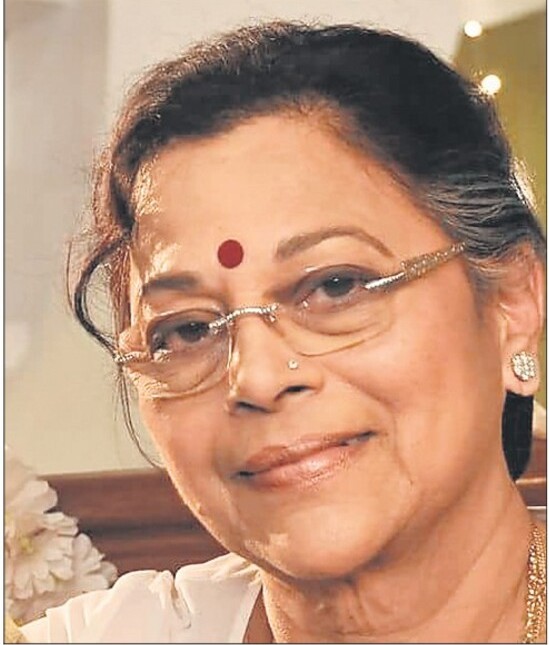
Bella Jaisinghani (THE TIMES OF INDIA; August 25, 2023)
Mumbai: Seema Deo, who acted in over 80 Marathi and Hindi films in a career spanning more than six decades, passed away at her Bandra residence on Thursday. She had been suffering from several age-related ailments including Alzheimer's. She was 81.
Her notable movies include ‘Jagachya Pathivar’, ‘Juna Te Sona’, ‘Anand’, ‘Bhabhi Ki Chudiyan’, ‘Kora Kagaz’, ‘Apradh’, ‘Janaki’, ‘Bezubaan’, ‘Koshish’, ‘Sansar’ and ‘Yehi Hai Zindagi.’
Born Nalini Saraf, her gentle manner and warm smile often led her to being typecast as the sweet sister, daughter-in-law, mother or aunt or a hostel warden as in 'Bezubaan'. In producerdirector Sadashiv J Row Ka vi’s hit, ‘Bhabhi Ki Chudiyan’ (1961), which had Meena Kumari and Balraj Sahni in central roles, she was paired opposite Shailesh Kumar as a young couple in love.
Seema's husband, actor Ramesh Deo, died in February 2022. In a TV interview, Ramesh once recounted how he had proposed marriage on a bullock cart during a shooting. "Seema's mother knew I was fond of her so she kept a close watch on her during our shoots. One day we were filming a bullock cart scene. I drove the cart out of sight of her strict ‘helicopter’ mother! Seema thought it was part of the scene. But I said no, I have brought you here to persuade you to marry me. Now say you will marry me. And she agreed!"
Seema and Ramesh recreated their real-life partnership in 20 movies such as ‘Anand’, ‘Kora Kagaz’, ‘Jagachya Pathivar’, ‘Vardakshina’, and the Marathi hit, Molkarin. Many would remember the scene in Anand where Rajesh Khanna lip syncs ‘Maine tere liye hi saat rang ke sapne chune’ as Amitabh Bachchan and the Deos listen in attention. In an odd instance, Seema also played Ramesh’s sister in 'Saraswatichandra'. The couple was conferred the Raja Paranjape Lifetime Achievement Award in Pune in 2014.
Seema is survived by two sons, actor Ajinkya Deo and adman-director Abhinay Deo. Abhinay told PTI, "My mother passed away at 8.30-9.00 am at her residence in Bandra due to old age. She had withdrawn completely, and eventually it was just old age. Alzheimer's is such a thing that you stop figuring out how to function. She had dementia leading up to Alzheimer's and she was suffering from it for over three years."
"There's no specific reason (for her death). Due to Alzheimer's and dementia, the person forgets how to walk. The muscle memory starts coming down and one by one, the organs start shutting down."
Maharashtra CM Eknath Shinde and various film celebrities, including actor Ashwini Bhave, offered condolences. The last rites were scheduled to be held at Shivaji Park crematorium at 5.00 pm on Thursday.
------------------------------------------------
HINDUSTAN TIMES (August 25, 2023)
Yesteryear actor Seema Deo, known for her roles in iconic films such as Anand (1971) and Kora Kagaz (1974), died on Thursday morning due to age-related ailments, her filmmaker son Abhinay Deo said. She was 81. The actor, who acted in over 80 Hindi and Marathi films, passed away at her Bandra (Mumbai) home. She was suffering from Alzheimer’s disease for over three years.
“She passed away around 9 am. Alzheimer’s is such a thing that you stop figuring out how to function. She had dementia leading up to Alzheimer’s and she was suffering from it for over three years. She had withdrawn completely. There’s no specific reason [for her death]. Due to Alzheimer’s and dementia, the person forgets how to walk. The muscle memory starts coming down and one by one, the organs start shutting down,” Abhinay told PTI.
Her husband, Ramesh Deo, also a veteran of Hindi and Marathi cinema, died in 2022 at the age of 93. She is survived by two sons — actor Ajinkya and Abhinay.
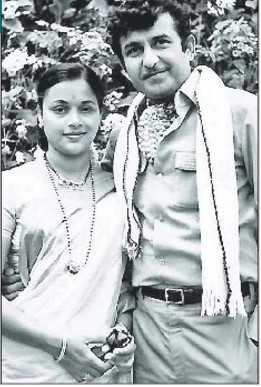
Ramesh Deo passes away at 93
8:02 AM

Avijit Ghosh (THE TIMES OF INDIA; February 3, 2022)
Actor Ramesh Deo, who enjoyed a popular and prolific career in Marathi and Hindi films over a staggering seven decades, died of heart attack at a Mumbai hospital on Wednesday. He was 93.
Several roles performed by Deo remain vivid as ever. The only and wily distant relative who sweet-talks an elderly Meena Kumari to move in with them, only to reduce her to a house help in ‘Mere Apne’ (1971). The amiable but worldly-wise doctor, who sits with his wife (real-life wife too, Seema) in ‘Anand’ (1971) as Rajesh Khanna sings ‘Maine Tere Liye Hi Saat Rang Ke Sapne Chune’.
Who would have forgotten the scene where ‘Jumping Jack’ Jeetendra sings and whips him in the same breath, belting out the title track in ‘Jaise ko Taisa’ (1973). Only a first-rate actor could have displayed the different shades that these roles required with such effortless ease. Deo, also a performer of repute in the Marathi theatre world, did it with ease and elan.
Born in Kolhapur, Deo went to school and college there and got a break in the Marathi film industry as a junior artist in the early 1950s. He went on to set up his own production house: Ajinkya Theatres. Deo became a top star. ‘Umaj Padel Tar (1960), ‘Vardakshina’ (1962), ‘Molkarin’ (1963) and ‘Aparadh’ (1969) are just four of his memorable films.
Director Phani Majumdar’s superhit, ‘Aarti’ (1962), the first film produced by Rajshri Films, was among his early Hindi films. He got the much heftier part of a senior police officer in the thriller ‘Love And Murder’ (1966) directed by the famous Marathi director Raja Paranjpe. The veteran was to play a cop in dozens of other Hindi films, ‘36 Ghante’, a desi remake of Hollywood’s ‘The Desperate Hours’, being one of them.
Deo was the lead villain in the Amitabh Bachchan-Hema Malini starrer ‘Kasauti’ (1973), a box-office hit. Deo continued to be a familiar face in Hindi films over the decades. Some years ago he was a regular on TV, endorsing products like Surf Excel, Vijay Sales and Lufthansa. It helped that with his sons, he also ran a vastly successful ad production house. According to IMDB, his last film, ‘Jeevan Sandhya’ (Marathi) was released in 2021.
Deo’s grandfather came to Kolhapur to work as an engineer for Rajarshi Chhatrapati Shahu Maharaj and his father worked as a legal advisor to the Kolhapur Sansthan. According to his company website, Deo acted in over 285 Hindi films, 190 Marathi films and 30 Marathi dramas. He is survived by wife Seema, and sons Ajinkya and Abhinay. Ajinkya is an actor too and Abhinay is known for directing films such as ‘Delhi Belly’.
Deo contested the 1996 Lok Sabha election from Kolhapur at the insistence of Sena supremo Balasaheb Thackeray but lost in a triangular fight.
Many people don’t know that Amitabh Bachchan’s role in Anand was initially offered to Soumitra Chatterjee-Suman Ghosh
8:23 AM
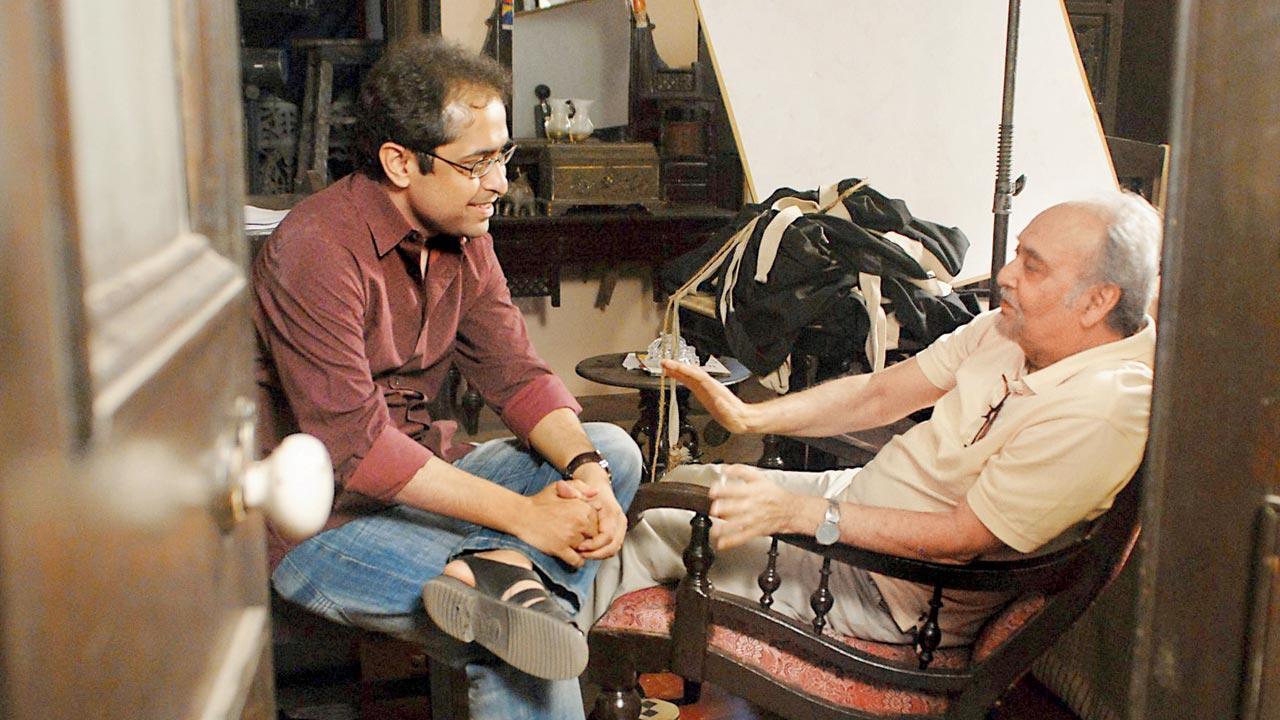
A filmmaker recollects experiences of working with acclaimed Bengali actor Soumitra Chatterjee in a book that aims to introduce him to a wider audience familiar only with his work with Satyajit Ray
Sucheta Chakraborty (MID-DAY; January 9, 2022)
In November 2020, in the days following actor, poet, playwright, painter and singer Soumitra Chatterjee’s passing, filmmaker and professor of Economics Suman Ghosh remembers being mired in sadness. Around this time, Shantanu Ray Chaudhuri, editor-in-chief at Om Books International, who had previously written on the themes of memory, ageing and death in Ghosh’s films with Soumitra Chatterjee, proposed the idea of a book on the director’s personal and artistic relationship with Chatterjee. While initially hesitant, given that the book would be a daunting one, not least because it would be his first, Ghosh realised that this would offer the cathartic release he needed at the time.
“Rather than lament his passing, I thought why not share my experiences with people and help them get an intimate glimpse of the man,” says the director. Soumitra Chatterjee: A Film-Maker Remembers, which released last week to commemorate the actor’s birthday this month, traces Ghosh’s observations and interactions through five films over 15 years with “the last of Bengal’s Renaissance men”.
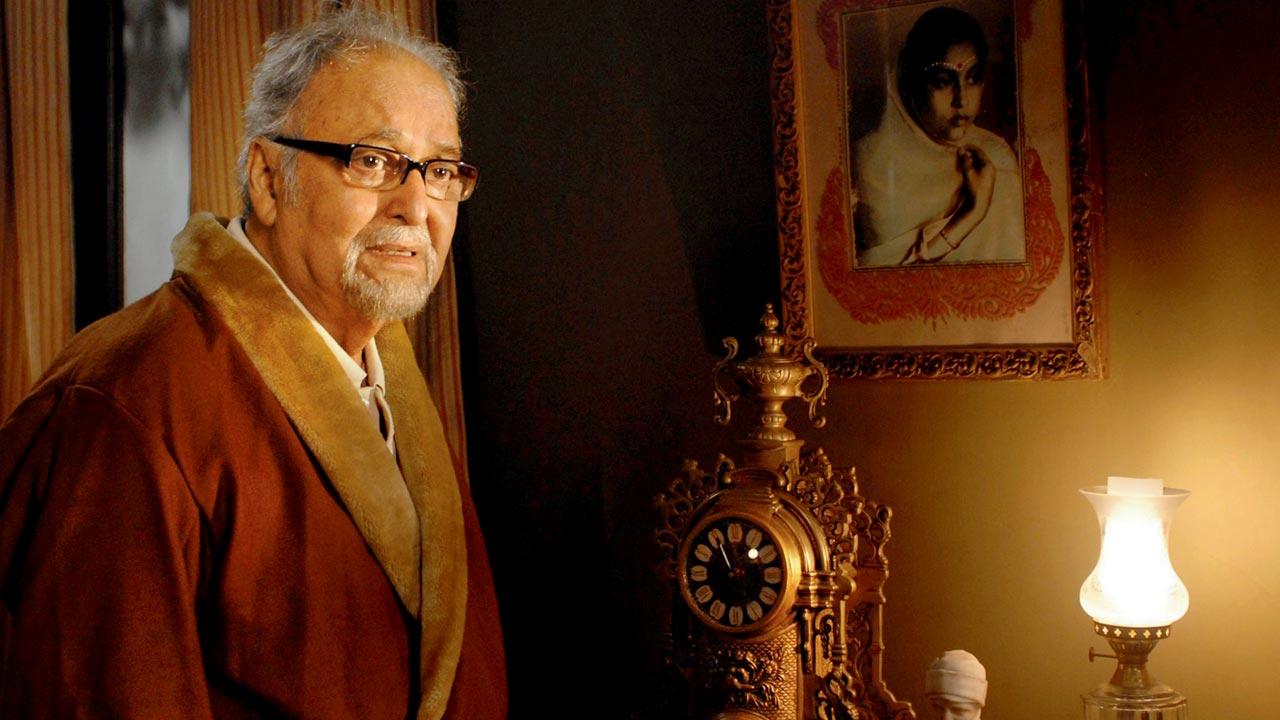
Ghosh writes about being in awe of Chatterjee’s stature as he watched the actor during shoots at a time when he was still a PhD student at Cornell, eager to venture into filmmaking. “I never expected to form a personal relationship with him. He had achieved so much in life, why would he be interested in giving a hundred per cent in a film with a debutant filmmaker like me?” wondered Ghosh who cast Chatterjee in Podokkhep (Footsteps; 2006) about a retired man and his bond with a little girl in a film inspired by F Scott Fitzgerald’s story The Curious Case Of Benjamin Button about a man aging in reverse.
While the sharpness of his craft was expected, what surprised Ghosh about the thespian was his hunger to work with younger directors and with newer mediums and formats right till the end. There was also, he recalls, a child-like curiosity in him for the mysteries of life, a quality he says he has observed in other greats like Amartya Sen, the subject of an early documentary. He remembers how the last conversation he had with the actor was a few months before his passing when the actor, a well-known workaholic, was forced to sit at home during the pandemic.
“He was reading a book on the young Galileo, and discovering how his father who was a musician impacted him,” he shares. “I marvelled at this man who in spite of a pandemic ravaging the world and making people mentally and physically sick could still hold on to his sense of wonder.”
Everything from cricket and Garry Sobers to Satyajit Ray, the Masai tribes of Africa and the new Bengali literature and cinema interested him, he says, their conversations on these myriad subjects a generous source of nourishment for the director. “… It was as if he wanted to perpetually soak in the delirium of life and be bathed in all its beauty. His mind was like a blank canvas, ready to be painted with colours,” writes Ghosh in the book, pointing to how this receptiveness also informed his work as an actor.
In one of the book’s many interludes, Ghosh writes fondly about Chatterjee’s visit to his home and his mother’s trepidation over the lunch being served even as she grappled with the fact that the man she had watched growing up in such classics as Charulata and Apur Sansar would be in her home. Among other memories of the artiste Ghosh holds dear are those of his Rabindra Sangeet sessions with cinematographer Barun Mukherjee in between shots.
“Many people don’t know that Amitabh Bachchan’s role in Anand was initially offered to him by Hrishikesh Mukherjee and that Shashi Kapoor wanted to cast him in Junoon,” says Ghosh, when we ask him about how he thinks his book will add to the rich legacy the actor has left behind. While Chatterjee remained loyal to Bengal’s cinema, Ghosh believes that film lovers nationally didn’t get to appreciate his talent adequately.
Even directors like Shoojit Sircar and Anurag Basu tried to get him to act in Hindi films and lament that they could not take his talent outside Bengal which he deserved, he says. “He was probably more famous internationally than in India apart from Bengal, and the national audience too only knows him through Satyajit Ray’s films,” he says, his book offering a list of some of his favourite films not directed by Ray featuring the actor.
He was a popular star, he points out, delivering superhits as well as artistically refined films even in his 80s. “The book is a way to provide a glimpse of this person to a national readership so that they are inclined to follow up on his work,” says Ghosh. “That’s why I wrote it in English.”
Gujarati film Chaal Jeevi Laiye sets a new record; completes 2 YEARS in CINEMAS
5:31 PM

At a time when people are of the belief that cinema business is going to diminish from here on, it’s heartening to see that the Gujarati blockbuster film Chaal Jeevi Laiye has managed to excel in cinemas, and how! Believe it or not, this film has completed 2 years in cinemas! Yes, you read it right. Today, that is, February 1 marks its second anniversary. Needless to say, not just the makers but even the exhibitors screening the film are grinning from ear to ear.
In fact, so happy are the multiplexes that for the anniversary week, they decided to increase the shows. Ritesh Laalan, CEO of Coconut Motion Pictures says, “The multiplexes have added the shows on their own. We haven’t told them to do so. The film this week is running in more than 200 shows across the country. Till last week, it had 50 shows, in Gujarat and Mumbai.”
A quick glance at the ticketing website, Book My Show, shows that the shows of Chaal Jeevi Laiye have indeed increased in places like Ahmedabad (currently running with 27 shows in a day), Surat (24 shows), Vadodara (17 shows) and Anand (12 shows). In Mumbai, it has the third highest number of shows, at 23. Interestingly, Chaal Jeevi Laiye has re-released in Pune, Bengaluru and Delhi-NCR with 3 shows each and in Hyderabad with 2 shows. In Kolkata, it will have one show daily. And very surprisingly, the city of Patna, too, has one show daily this week. The prices of most of these shows are priced at less than Rs. 100.
The collections of Chaal Jeevi Laiye till date are expected to be around Rs. 44-45 crore net. In comparison to Bollywood and South films, it might not seem significant but it’s a feat for a Gujarati film to reach till this mark. Also, what sets it apart is that the film has managed to find audiences for two years and yet, it’s not showing any signs of slow down. Ritesh Laalan adds, “In the week of Makar Sankranti, the collections had doubled as compared to the previous week.”
It’s no wonder that the makers are ecstatic about this feat. A success bash was organized yesterday in Ahmedabad and another one a week later, in Mumbai for the cast and crew.
Chaal Jeevi Laiye is the story of a workaholic son who takes his terminally ill father on holiday to the Himalayan state of Uttarakhand to fulfil his last wish. On the way, they meet a young woman named Ketki and the trio undertake the most unexpected but satisfying journey of their lives. Starring Siddharth Randeria, a star of Gujarati theatre and cinema, along with Yash Soni and Aarohi Patel, the film has been directed by Vipul Mehta with music by popular composer duo Sachin-Jigar.
Last year, the makers had revealed that they plan to remake this film in Hindi. In fact, they had spoken to Rishi Kapoor and were about to get Ranbir Kapoor on board as well. However, the plans went kaput after the veteran actor passed away, on April 30, 2020. Yet, the remake plan is on and they are currently hunting actors for the lead characters.
Write about something that moves you, and not just something that will sell-Boman Irani
8:43 AM

Actor and aspiring screenplay writer Boman Irani has been using every day of the lockdown to mentor young writers in a novel learn-some, teach-some experiment
Aastha Atray Banan (MID-DAY; October 4, 2020)
When you hear the name Boman Irani, you think, ace actor. Although a late start in the movies at age 44, he held his own from his very first film, the 2001 indie venture, Everybody Says I'm Fine!
And yet, it's in fact screen writing that he says, that has held his fancy from the start. "I had always wanted to write my own screenplay. When you do movies, and want to do something different, sometimes, you end up helping with the writing, here and there. But when I started to write a screenplay, I knew I needed to reinvent myself. Working in the industry as an actor doesn't automatically make you qualified to be an actor-director. You have to work at it."
And so the prep began. For the last eight years, Irani has been studying screenplay writing; researching the subject, and working with 2014 Oscar winning screenplay writer Alexander Dinelaris, who wrote Birdman. "I met Dinelaris when he hadn't yet written Birdman, and we became friends. He has been helping me with the craft since. I speak to him every day. In 2019, when I launched my production house Irani Movietone, I decided that instead of having a party, why not fly him down for a huge writing workshop. So many screenwriters, and students attended. It was a great time. And then just when we were going to start filming, the lockdown began."
Pandemic or not, the participating writers weren't about to leave him alone. Requests from amateur screenwriters poured in, so one day, he collected a bunch on Zoom.
Ever since, in the last six months, Irani has been holding a daily free screenwriting masterclass, called Spiral Bound. He has gone through 160 sessions with over a hundred students. Irani is helped by his nephew, novelist Anosh Irani, who the actor says, is his partner in crime. "He helps distill everything I say, and sometimes makes it more comprehensible."
Alfred Hitchcock once said, "To make a great film you need three things—the script, the script and the script". But what should the script centre around?
For Irani, it's all about the hero, or the central character. "Don't tell me a story via the plot. Tell me a story through the hero's journey. We have to get to the heart of the lead character. The story is not about incidents. It's about the anguish and challenges that the hero faces." He's certain that every good movie has almost always been about the central character's journey and struggle. "Lagaan is not about the British rule and a cricket match. It's about a man who dared to rebel, and then had to rally the troops. What's your favourite movie?" he asks this writer.
"A Few Good Men."
"Right. That film is not about a fight between a lawyer and an army officer. It's about a young man who has to rise beyond the shadow of his father. This is such a fun game! Every good movie ever is about the character."
Irani also corrects us when we say that the focus on the script is a new development in Bollywood. "No, think of movies like Anand. It's not about a man who has cancer. It's about his attitude and his passion for life depicted in every scene."
Other than the main character, he places importance on structure. "The structure starts from the moment you say the story will end," he says. And, it's all about dividing the script into three parts. "Act 1 is setting it up. The day he accepts a challenge, that's when Act 2 begins." It's here where he gets the most questions from students. "They want to know what happens in this empty marshland, the space between Act 1 and 3. How do they write it? We have been watching movies to get a hang of it. We have to start the journey, start working around the obstacles, maybe there is a new obstacle. We all fall into trouble in that marshland."
From his own career, he remembers the scenes from Khosla ka Ghosla, written by Jaideep Sahni, as magical. "The scenes in this movie are so tight and correct in how the action rises from each moment."
The sessions have also seen some big names from the industry pop in as guest lecturers. Other than Denelaris, Rajkumar Hirani, made an appearance. "With Raju, we all went on a journey. He said when he wrote Munnabhai, he would go and sleep with his friends who worked at the hospitals. He saw the real patients. So he said, observe life around you, and make it personal. Write about something that moves you, and not just something that will sell."
With Dinelaris, the focus was on keeping the conflict alive in each scene. "He spoke about the character surprising you as a writer. He said, 'Yeah, the character gave me the line. He spoke back to me'. That's truly fascinating."
Irani also sees the workshops as a bonding exercise, especially in the times we live in. "Apart from learning, we are sticking together as a family. The circumstances we find ourselves in have been debilitating. And this has helped us know we are all in it together."
Want to attend a session? Drop a mail to yash@iranimovietone.com
Hrishikesh Mukherjee would insist on travelling by train, by second class sleeper-Romu Sippy
8:03 AM

Roshmila Bhattacharya (MUMBAI MIRROR; October 1, 2020)

“Dada was a simple, unassuming gentleman with no demands. A producer’s director, he kept a hawk-eye on the film’s budget and never indulged. Even when my father, Dada, and I went location hunting, he would insist we check into a no-frills PWD guesthouse for the night. If my father walked into a five-star hotel, he’d chide him, saying, ‘Why are you wasting money?’” Romu ji reminisces, sharing that, at times, Hrishi da would insist on travelling by train, occasionally by second class sleeper, because “if life took a downturn, I should not find it difficult to return to my roots”.
He informs that it was on the behest of singer-composer Hemant Kumar that his father collaborated with Hrishi da on the 1965 period drama, Do Dil, featuring Biswajeet as a prince who, while touring his kingdom in the guise of a common man, learns about women being harassed and back in the palace, when he tries to put an end to this, is drawn into a life-threatening fencing duel with his villainous minister, played by Pran. “During the Jaipur schedule, Pran saab designed and choreographed those sword fights,” reveals Romu ji. Do Dil was followed by Aashirwad three years later. It was memorable for Ashok Kumar’s rap song, “Rail Gaadi” and bagged him the National Award and the Filmfare Award for Best Actor, along with the National Award for Best Feature Film in Hindi.

He confides that there are two films from their library that he holds close to his heart. One is Hrishi da’s Anand , the other, his brother Raj Sippy’s Satte Pe Satta, because neither has got boring, slow, or outdated with time. “Even today, if you watch Anand, it will make you cry, while Satte Pe Satta will still make you laugh,” he reasons, recalling an anecdote from Anand. “I’m told Amitabh (Bachchan) had a problem with the kurta he was wearing in a scene. He complained about the fit or maybe the length to Dada who, nodding his head sagely, told him, “Don’t worry, we will fix your problem,” and removing his own kurta, offered it to him, saying he could wear it. Amitabh never took the chance of complaining again,” he chuckles at the memory.
Gol Maal brought on the laughs too, and Romu ji believes its enduring appeal has a lot to do with Amol Palekar’s character Ram Prasad Sharma whose one lie forces him to fabricate a twin, Lakshman aka Lucky and occasionally masquerade as him. “The character is so true-to-life that it’s easy for people to identify with him. Amol’s performance was complemented by Utpal Dutt’s; he was absolutely fabulous as Bhavani Shankar, the boss Ram tries to hoodwink,” he smiles.
I love every one of Hrishi da’s films and being a Bengali, can trace the roots of Chupke Chupke to the Uttam Kumar-Madhabi Mukherjee laugh riot, Chhadmabeshi, which came four years earlier. Bawarchi is a remake of Golpo Holeo Shotti with Rajesh Khanna stepping in for Rabi Ghosh to play the cook who reunites the Sharma family. I remember Hrishi da telling me that Raghu was a lot like his own father. “Baba was a student of chemistry who had graduated first class first,” informed one of my favourite directors, who himself had graduated in chemistry, taught mathematics and science, before signing up with Kolkata’s New Theatres studio because he enjoyed photography. “He loved cooking, and thanks to his science background, he sometimes made cosmetics for the women in the family.”
That was Hrishi da’s world which his films mirrored. No wonder it’s hard to forget them or him.
Hardik Pandya, Natasa Stankovic welcome baby boy
8:23 AM

MUMBAI MIRROR (July 31, 2020)
 On Thursday, around 4 pm, Hardik Pandya took to the social media to inform that he and Natasa Stankovic were blessed with a baby boy, along with a picture of the newborn holding his finger. While everyone is tight-lipped, reportedly their son was born at a hospital near Anand, on the outskirts of Vadodara, in the morning.
The announcement comes exactly two months after the duo first shared news of the pregnancy. Sharing pics from a baby shower, Hardik had written, “Together we are excited to welcome a new life into our lives”.
The couple has had several photoshoots since. Their social media accounts are replete with loved-up pics of Natasa flaunting her bump and the cricketer looking suitably smitten. He had taken everyone by surprise when he posted pictures with the Serbian model-actress from their Dubai vacation, stating that he was starting the year with his “firework”. A day later, they announced their engagement.
A month later, on February 14, Hardik described his fiancée as his “Valentine for life”. Now, with their son, the happy family picture is complete.
Writer-lyricist Yogesh passes away at age 77
7:56 AM

The Lucknow boy hit pay dirt with Anand and went on to work on many slice-of-life films
MUMBAI MIRROR (May 30, 2020)

The lyricist-writer stuck to slice-of-life films, going on to write many more memorable songs, like “Rimjhim Gire Saawan” (Manzil), “Maine Kaha Phoolon Se” (Mili), “Jaaneman Jaaneman Tere Do Nayan” (Chhoti Si Baat), before moving on to television to write for shows. Yogesh’s last big release was the 1995 film, Bewafa Sanam. The veteran made a comeback in 2017 with the NFDC film Angrezi Mein Kehte Hain, which was directed by Harish Vyas. He penned the lyrics for the songs “Piya Mosey Rooth Gaye” and “Meri Ankhein”, which was sung by Shaan.
Lata Mangeshkar, who had given playback for many of his songs, on hearing the sad news, tweeted, “Mujhe abhi pata chala ki dil ko chunewale geet likhnewale kavi Yogesh ji ka aaj swargwas hua...Yogesh ji bahut shaant aur madhur swabhav ke insan the.”
He may have passed away but his song from Anand, “Zindagi Kaisi Yeh Paheli Haaye”, likening life to a riddle, which makes you laugh and cry in turns, written for a man who knows he has only six months to live, will resonate forever.
On this day, Amitabh Bachchan's first film Saat Hindustani released in Mumbai
8:16 AM
Box Office India Trade Network
On this day exactly 49 years ago the first Amitabh Bachchan film SAAT HINDUSTANI hit Mumbai. The date was 21st May 1971 and the film released at Maratha Mandir in matinee shows only. It was a low key release as it was earlier released in Delhi/UP and fared very badly.
Coincidentally, the film clashed with a release of the box office king of that time Rajesh Khanna. HAATHI MERE SAATHI also released in Mumbai on 21st May 1971 though the film had released earlier in Delhi/UP and East Punjab. This film became the first film in history to collect 1 lakh nett in Mumbai on day one. It was released on 27 theatres and Rajesh Khanna beat his own day one record in Mumbai city which was set with SACHAA JHUTHA in 1970.
SAAT HINDUSTANI was the first release of Amitabh Bachchan but it was not the first time that Mumbaiites got to see the star that was going to become a future megastar. The other coincidence that in Mumbai the first sight of Amitabh Bachchan also came in a Rajesh Khanna starrer which was released a couple of months before Saat Hindustani in Mumbai city. The film was called ANAND.
Another point here is that last year there were celebrations of fifty years of Amitabh Bachchan hitting the big screen and that was not the case. The fifty years were actually hit a couple of months back. It was funny to see fifty years of SAAT HINDUSTANI celebrated when the film did not even release in 1969. It showed a lack of knowledge with these commentators and even the millions of fans but they cant really be blamed as the media has a tendency to follow what is out there rather than actually collect facts. Then the fans follow what the media has to say. Its understandable that the date of the first film is not known of some small actor but this is Amitabh Bachchan who is the biggest star the country has seen till date.
The fifty years of Amitabh Bachchan were hit on 27th March 2020 as SAAT HINDUSTANI first released in Delhi/UP on 27th March 1970. Amitabh Bachchan made his debut in 1970 and not 1969 as it is claimed by the media. The main cinema for SAAT HINDUSTANI was Sheila and it also released in Eros, Minerva, Amba, Ajanta and Radhu Palace as well as some theatres in UP. The release in Delhi of 6 cinemas was a good release as it was a small film and the biggest films released on around 8 theatres in the city at that time. The collections were horrific with just Rs. 10,000 apprx coming on day one with capacity of around Rs. 40,000. The film was out of theatres very fast and next it went to Mumbai a year later but the response in Delhi meant it was more of a token gesture release. The other circuits saw a release when Amitabh Bachchan had become a star with more creative posters keeping in mind the image Amitabh Bachchan but it was a black and white film and pretty much an art film so had no takers.
Just like SAAT HINDUSTANI had no takers, there will not be many takers that Amitabh Bachchan actually debuted in 1970 as there has already been a false picture painted by the media but facts are facts and anyone with access to genuine sources can do the research and easily check what is fact and what is fake.
Group of rural management institute alumni come forward with financial aid for Vanraj Bhatia
7:49 AM

Sanjay Panigrahi and Praveen Morchhale with Vanraj Bhatia
Group of rural management institute alumni, including National Award-winning filmmaker Praveen Morchhale, has come forward with financial aid for Vanraj Bhatia
Himesh Mankad (MUMBAI MIRROR; September 24, 2019)
Mirror was the first to report (September 15) that veteran composer Vanraj Bhatia, who had won the National Award for Govind Nihalani’s TV series, Tamas, is virtually penniless and suffering from debilitating health issues. Soon after, the Javed Akhtar-led Indian Performing Rights Society came to his aid by releasing funds. Now, we have learnt that the alumni of the Anand-based Institute of Rural Management (IRMA) has also come forward with help.
The group raised Rs 2.80 lakh in five days and handed over the cheque to Bhatia on Monday morning. “We met him around 8.30 am at his residence and spoke to him for about an hour. He was extremely happy to see us and accepted the bouquet we had brought him with a smile and asked the assistant to place it somewhere nicely,” says National Award winning filmmaker Praveen Morchhale, who was a part of the group, adding that the veteran seemed to be in good spirits. “He even remembered the towers of our institute and recalled the two tunes he had created for the building. I also showed him a video from last year’s convocation, when his song, “Mero Gaam Katha Parey”, was played. He happily spoke of the good old days.”
Sivakumar Surampudi, another IRMA alumnus, goes on to reveal that that the music of Shyam Benegal’s 1976 directorial, Manthan, composed by Bhatia, remains integral to the institute. “It features in the induction program for new batches on the campus. The song, 'Mero Gaam Katha Parey', is like an anthem for rural management professionals, urging youngsters to work in the countryside,” he shares.
Hrishikesh Mukherjee had filmed just 9,000 feet of Anand's reel when we submitted for National Awards-Romu Sippy
8:03 AM

Hrishikesh Mukherjee with Rajesh Khanna and Amitabh Bachchan during Namak Haraam; Samit Bhanja and Jaya Bhaduri in Guddi (below)
Roshmila Bhattacharya (MUMBAI MIRROR; August 30, 2018)
The name Hrishikesh Mukherjee instantly brings to mind some much-loved classics, from Anand, Guddi and Bawarchi to Mili, Chupke Chupke, Gol Maal and Khubsoorat. But there is one other name, or rather two, that are invariably overlooked when we talk about these movies, that of N C Sippy who produced them with Hrishida, and his son Romu who was the executive producer on some of them. “I’ve yet to see a relationship like the one Dada and my father shared. They did what each specialized in without any questions asked,” says Romu.
 While Hrishida picked his subject, developed the script, spoke to
the actors and shot the film the way he wanted, N C Sippy raised money,
sold the film and gave it a good release, no one interfering with the
other. “So close were they personally and so congenial professionally
that they formed a production company, Rupam Chitra, which started with
Anand and Guddi, launched at the same time and released in 1971. The
partnership ended only after my father’s demise. With his friend gone,
Dada didn’t want to produce films anymore and we settled things amicably
between us,” the veteran filmmaker informs.
While Hrishida picked his subject, developed the script, spoke to
the actors and shot the film the way he wanted, N C Sippy raised money,
sold the film and gave it a good release, no one interfering with the
other. “So close were they personally and so congenial professionally
that they formed a production company, Rupam Chitra, which started with
Anand and Guddi, launched at the same time and released in 1971. The
partnership ended only after my father’s demise. With his friend gone,
Dada didn’t want to produce films anymore and we settled things amicably
between us,” the veteran filmmaker informs.
He reveals that none of Anand’s songs, “Kahin Door,” “Zindagi Kaisi Hai Paheli”, “Maine Tere Liye” or “Na Jiya Lage Na”, were composed for the film. Salil Chowdhury had some unused compositions and they bought the rights of four. “We wanted to enter Anand for the National Awards and it was imperative that the film be completed by December 31. Hrishida had filmed just 9,000 feet of film reel when we submitted it. It was completed later. It won the National Award for Best Feature Film in Hindi,” says Romu.
The film is remembered for Rajesh Khanna’s performance as the cancer patient who wants to live life to its fullest till his dying day, which bagged him the Filmfare Award for Best Actor. Amitabh Bachchan also caught the eye as happy-go-lucky Anand Saigal’s dour babumoshai, Dr Bhaskar Banerjee, and took home Filmfare’s Black Lady for Best Supporting Actor. “Om Prakash who had worked with him in Parwana which had Amitabh as the antagonist, was very impressed with him and recommended him to Hrishida who signed him for both Anand and Guddi,” narrates Romu, adding that three reels of Guddi had been shot when one day Hrishida asked him to send a plane ticket to a gentleman in Kolkata. “I learnt later that he was the Bengali actor Samit Bhanja who would be replacing Amitabh as Navin in Guddi, as the latter had got busy with other films. Hrishida, who started a film with every detail planned, including the release, didn’t want to wait.”
Hrishida himself didn’t like travelling by planes and once when Romu booked him a first class train ticket to Kolkata, he insisted he wanted to travel by the second class sleeper coach because it reminded him of where he’d come from and what he’d been. “I don’t want to lose touch with my roots. If I were to suffer a financial setback some day, I won’t have to make too many adjustments in my lifestyle then,” he reasoned.
Raving about Hrishida’s simplicity and lack of airs, Romu recalls how once when they went for a shoot to Jaipur in the peak of summer, he was reluctant to be put up at an expensive five star hotel, insisting that Romu see if he could get them rooms in a PWD guest house. “He was also an ardent chess player who’d be playing quietly in a corner while a shot was being taken. While everyone assumed he was clueless about what was happening, he would tell the actor later exactly where he had done wrong,” he says.
Romu adds that Dada was a stickler for punctuality who hated it when anyone turned up late. “Once when one of actors whom I won’t name, came at 2 pm for a 9 am call time, profusely apologetic, he embraced him, saying soothingly, ‘Don’t worry, you just gave me the title of my film, Namak Haraam, since you obviously have little respect for a producer’s money,’” he adds.
Romu met Dada for the last time when he went to invite him for his sister’s wedding. “By then, he was very unwell and I knew he wouldn’t be able to make it to the wedding, but no occasion was complete without his blessings. He was a part of our family till the very end,” Romu says.
47 Years Of Anand: Remembering this cinematic gem with a smile and a tear
7:55 AM

Roshmila Bhattacharya (MUMBAI MIRROR; March 15, 2018)
I have grown up on Hrishikesh Mukherjee stories: Musafir, Guddi, Mili, Bawarchi, Anupama, Chupke Chupke, Gol Maal and many more. But the film that epitomises Hrishida is perhaps Anand because by the time I connected with him, the filmmaker was crippled by arthritis, confined to the bed, and disenchanted with life after losing his wife and son. He was a man waiting to die. He ended every interview saying, “Perhaps this is our last meeting.” I’d assure him of many more meetings, and we did meet each other many times.
Hrishida, however, wasn’t Anand who, after making lymphosarcoma of the intestine a household name, continued to radiate sunshine in the face of an impending end. For me, he was the dark, dour and seething Dr Bhaskar Bannerjee, played to perfection by Amitabh Bachchan. The lanky six-foot actor landed the role when he accompanied his mentor Khwaja Ahmad Abbas to Hrishida’s bungalow to visit the ailing director. While Abbas chatted animatedly, he stood silently by the side of Hrishida’s bed, his eyes dark and brooding, his expression intense and unsmiling. Looking up at him, Hrishida knew instinctively that he’d found his counterpart to Anand and bestowed on the surprised struggler the nickname of ‘Babumoshai’ that bestie Raj Kapoor had given him many years ago.
The duo had met in Moscow and connected instantly. Hrishida went on to direct RK in Anari and Aashiq. Anand was an ode to their friendship and the stray thought that flashed through Hrishida’s mind as he watched his asthmatic friend gasping for breath was how empty life would be without the smiling, always chatting RK. The film was to be made under the RK banner but a superstitious Hrishida couldn’t watch his friend die even in reel life and took the role to Bengal’s matinee idol, Uttam Kumar, actor-singer Kishore Kumar and Raj’s brother Shashi twice before Rajesh Khanna heard about it, insisted on a narration, slashed his remuneration from Rs 8 lakh to a lakh and promised that he’d be punctual, professional and give him no cause for complaint. He kept his word. The film was done in 28 days.
Forty-seven years later, Anand’s climax still makes me cry. Recalling it during Piku, in which his character was also named Bhaskor Banerjee, Big B shared that while filming the death scene, he’d wept inconsolably, his head buried in Anand’s chest as the tape recorder played his last words, “Babumoshai, zindagi aur maut uparwale ke hath mein hai…” And realised, Khanna was shaking with laughter.
“My hair was tickling Rajesh Khanna who was laughing silently. Soon I joined him. Fortunately, it was a top angle shot so nobody could see our faces,” he revealed, giving that iconic cinematic moment a different vibe.
Today, when I flashback to Anand, I hear Salil Chowdhury’s melodious “Zindagi Kaisi Hai Paheli Haye, Kabhi Toh Hasaaye, Kabhi Yeh Rulaaye” playing as Anand chases after a clutch of balloons, wiping away a tear with his back turned on his Babumoshai. That’s how I’d want to remember Hrishida and RK too, with a smile and a tear.
Jackky Bhagnani’s next Anandwaa is an ode to Rajesh Khanna’s Anand
7:50 AM

Natasha Coutinho (MUMBAI MIRROR; December 26, 2017)
 After the 2015 film Welcome to Karachi, Jackky Bhagnani is set to
return to the marquee with Anandwaa, a comic satire exploring the
journey of a man who chooses to cope with a life-altering situation with
humour.
After the 2015 film Welcome to Karachi, Jackky Bhagnani is set to
return to the marquee with Anandwaa, a comic satire exploring the
journey of a man who chooses to cope with a life-altering situation with
humour.Producer Prernaa Arora says, “Jackky was our first choice because we felt he would be able to portray the role of Anandwaa with sensitivity and the right comic timing. The project goes on the floors in February 2018.”
Screenwriter-filmmaker Abir Sengupta, who made his debut with the Bengali film Jomer Raja Dilo Bor, is on board to direct the film. “I have written this script as homage to the classic Anand but it’s in no way a remake. It’s about a man who learns to make the most of his life,” he informs.
It's not going to change the equation we have-Amitabh Bachchan on Deepika Padukone bash 'row'
8:52 AM

Amitabh Bachchan also talks about the Ray connect with Piku
Roshmila Bhattacharya (MUMBAI MIRROR; June 6, 2015)
It's a little past noon and Amitabh Bachchan bounds in from the gym upstairs with the energy of a 16 year old. Looking at him, it's hard to imagine that the 72-year-old actor, who is spearheading a Hepatitis B campaign, has been diagnosed with cirrhosis of the liver. The ailment isn't the fallout of alcohol addiction but of a blood transfusion. After an accident on the Coolie sets in 1982, he needed 60 bottles of blood, one of which carried the Australian antigen. By the time he learnt of its presence, it had eaten away 25 per cent of his liver.
That hasn't stopped Bachchan from living and campaigning for a healthy life. He promotes diabetes detection vans and polio vaccines, even sets himself up as a medical specimen to prove that TB is not a "poor man's disease" or incurable.
He's focussed on health without being obsessed with it, unlike his recent screen avatar, Bhashkor Banerjee in Piku whose emotions are linked to his motions and whose world revolves around isabgul, homeopathy pills and a litany of ailments. Till, inspired by a Japanese veteran, he spends a day pedalling through Kolkata, revisiting old haunts, snacking on kachori and jalebi, and finishing off with the best motion ever. After that, he has nothing more to live for.
"Shoojit (director Shoojit Sircar) and I had planned that Bhashkor would die with a smile but later this seemed somewhat contrived. So, he just passes away peacefully in his sleep, evoking empathetic smiles from the viewer, many of whom would wish their dear ones to go away just as painlessly," says the actor who has died many times in reel life or watched a co-star pass away.
He recalls filming the death scene in Anand, weeping inconsolably with his head buried in his buddy's chest as the tape plays out his last words, Babumoshai, zindagi aur maut uparwale ke hath mein hai jahapana... "My hair was tickling Rajesh Khanna who started laughing silently and I joined him. Fortunately, it was a top angle shot so nobody could see our faces," he reminisces.
Nostalgia, he points out, needs no provocation. Piku, made without a story, focussing on the ambience and chatter in a regular Bengali household, brings back a flood of memories. The film, which culminated in a homecoming, took the actor back to Kolkata where he'd headed in the '60s in search of a job.
"Every morning I'd wake up, put on my jacket, knot my tie, and visit offices with my bio-data. During monsoons, I'd roll up my trousers and wade through kneedeep water in Esplanade. Dinner was sometimes four anna phuchka at the Victoria maidan. Money was short and I didn't want to borrow from my parents," he flashbacks.
After marrying Jaya Bhaduri, his circle of friends extended to include comedian Rabi Ghosh whose risque jokes still make him guffaw. He's sad that some of the laughing banter in Piku was edited out because Shoojit felt typically Bangla phrases would be unintelligible to people outside the state. "Who would understand a phrase like ghorar dim? Horse's egg? What nonsense! That's what it literally means," he chuckles.
Kolkata reminds him of conversations with Satyajit Ray in his room strewn with books and papers. "He knew exactly where every paper was," he marvels. "Today, when Jaya tells me my study is a mess, I remind her that Manikda's was a mess too."
He's watched the maestro play the piano. In a scene in Piku he has replicated the same simple notes on his sitar which had played in the opening scene of Charulata as Madhabi Mukherjee moves from one window to the next, watching Kolkata meander.
Piku, which is in the Rs 100-crore club, has forged a connect with the audience who sees their dada, nana or baba in his character. "Even Jaya who is normally reticent about offering her opinion on a film, loved it and pointed out that it didn't feel like a film, it was more like watching a family who'd entered your home," he beams.
There's been talk about him not being invited by Deepika Padukone to a party to celebrate Piku's success. "Let's not stretch this matter anymore, enough has already been written and said. It happens sometimes. It's not an issue and is not going to change the equation we have. Deepika is a wonderful girl, cultured with good upbringing," he asserts, reciting a verse from his father Harivansh Rai Bachchan's poem, "Jo beet gai so baat gai, Jeevan mein ek sitara tha, Maana woh behad pyaara tha, Woh doob gaya toh doob gaya, Amber ke aangan ko dekho, Kitne iske taare toote, Kitne iske pyaare choote, Jo choot gaye, phir kahan mile... Par bolo toote taaron par, Kab amber shok manata hai... Jo beet gai, so baat gai...."
Currently, he isn't doing any film, apart from a 'special appearance' in R Balki's next. He says he's in talks with several makers but is waiting to get the shooting schedule of KBC before he allots dates to Sujoy Ghosh's production and to Balki with whom he'll make another film in which he has a central role. He adds, "I've also had a meeting with Anurag Basu for Jagga Jasoos but he's still in the writing process."
He'd like to do more TV despite Yudh's failure. "Maybe it was too sophisticated or the story was wrong. A lady said that when she can see a well-dressed me on KBC why would she want to see me ill on another show," he says gravely.
For now, it's the gym again as he bounds out of the room. The man is indefatigable!
Amitabh Bachchan's Piku has a strange connect with his 1971 hit Anand
7:50 AM

Roshmila Bhattacharya (MUMBAI MIRROR; April 1, 2015)
Amitabh Bachchan's character in Piku is called Bhaskar Bannerjee. When did we last hear him addressed by the name? In Hrishikesh Mukherjee's Anand, 44 years ago.
Point this out to director Shoojit Sircar and he sounds surprised: "Really? It's just a happy coincidence. Neither Juhi (writer Juhi Chaturvedi) nor I consciously forged the connection. For both of us, Mr Bachchan was always Babumoshai in Anand. In fact, I don't recall Mr Bachchan reacting to it, though he did occasionally reminisce about Hrishida's style of working."
Well, Piku's elderly hypochondriac, whose emotions are connected to his motions, is the absolute opposite of Anand's dour doctor. But there's one similarity. "I remember Hrishda's film, one of my favourites, for Mr Bachchan's subtle performance. While everybody around him was a little loud, he was grounded," Sircar reasons, referring to the climax where he cries over Anand's dead body even as the tape recorder plays out his friend's last lines, 'Babumoshai, zindagi aur maut uparwale ki haath mein hai jahanpanah. Usse na to aap badal sakte hain, na main. Hum sab toh rangmanch ki kathputliyan hain, jinki dor uparwale ki ungliyon mein bandhi hain. Kab, kaun, kaise uthega yeh koi nahin bata sakta hai.' It was his performance that made the film so real and while his character in Piku is very different, there's a subtlety here even in the exaggerated portions. I'd say he's an older Babumoshai."
He recalls the veteran actor's delight when the film took him back to the City of Joy. "He was all charged up and the crowds responded to his excitement. He was supposed to return to Mumbai after a few days but stayed on in Kolkata through the 19-day schedule, revisiting favourite haunts and catching up with all his friends," Shoojit smiles. "He would often drive or cycle around the city in the middle of the night."
Subscribe to:
Posts (Atom)