Showing posts with label Amar Akbar Anthony. Show all posts
Showing posts with label Amar Akbar Anthony. Show all posts
I’m not too fond of the fact that lot of people have made it into a business to report numbers-Abhishek Bachchan
8:46 AM
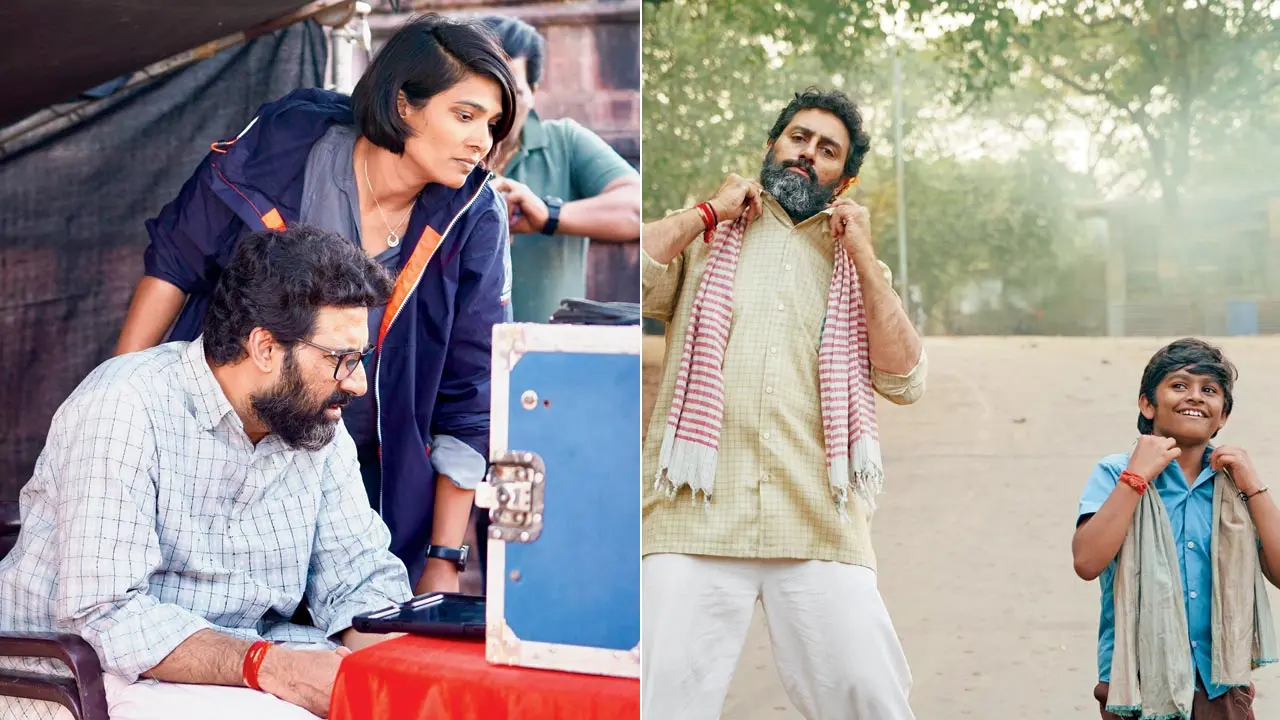
Abhishek Bachchan on director Madhumita’s unique storytelling lens and emotional clarity, and his young co-star Daivik Bhagela
Letty Mariam Abraham (MID-DAY; July 8, 2025)
When this reporter saw Kaalidhar Laapata, our first reaction was to go home and ask our parents what is on their bucket list. When we ask the same of Abhishek Bachchan, who headlines the Zee5 film, he says there are too many things he wants to do but refuses to tell us what exactly. “I feel if I talk about it, then it doesn’t happen.”
The film, written and directed by Madhumita, is the Hindi adaptation of the Tamil film K.D (2019). It follows a middle-aged man experiencing memory loss and a sense of abandonment after overhearing his family’s plan to leave him behind during a religious gathering. He then embarks on a journey during which he meets an eight-year-old orphan, and they set out to fulfil items on his bucket list. In conversation with mid-day, Bachchan talks about what drew him to the film, why Daivik Bhagela was the right choice as his co-star, and why understanding the economics of films is important.
What was your initial reaction to the narration of the story of Kaalidhar Laapata?
I just loved the way Madhumita had written the film and the way she wanted to tell the story more than just the subject matter. I loved her approach to it; she made it very human. I loved the fact that she was going to end up saying some very profound things — things that stay with you long after the film is over. But [she said] it in such a casual manner. The conduit of all of this is a 10-year-old kid. I found that very interesting.
We’ve often noticed that you have great chemistry with child co-stars. It somehow brings out the child in you. Do you agree?
You feel that? [Laughs] They do, right? I mean, just by their countenance alone, they kind of make you very carefree because they’re so innocent and not inhibited at all. So I think that does bring out a lot of the child in you.
Is that how you felt working with Baghela?
Daivik is very sweet, but he’s an old soul. Immensely well-prepared. He’s a wonderful actor and has got a very bright future ahead of him. A lot of that has got to do with the fact that he comes from a very renowned theatre troupe in Bhopal, where we shot the film. His confidence is something else. When we were casting, Madhumita said that she needed a kid who just has to be the character — confident to the point of being overconfident and chalu. How do you cast a kid like that? And in walked Daivik. Before he could say anything, we were sure this is the guy. He had that X-factor in him, which was brilliant.
What was his reaction to you?
I don’t think it was anything much. Everybody told me that he might be intimidated, so I’d have to be careful and make it casual for him. So I thought I would have to handle him. Daivik walked in — he was totally cool. I was very happy with that. You always think, with kids you have to behave in a particular way. He was like a normal co-star. I’m not saying he’s mature or that he has grown up too fast. I’m saying that he was very well-prepared and embodied all the qualities that the character needed. He was not precocious at all.
What was it like working under Madhumita’s vision?
I had a truly wonderful time working with Madhumita. Her crystal-clear vision for the film, and especially how she intended to adapt the script from page to screen, was something I thoroughly enjoyed and found incredibly inspiring. I also deeply appreciated her insightful notes and her consistent focus on the emotional depth of the characters in every moment. It was a genuine pleasure collaborating with her.
What do you want people to see in Kaalidhar Laapata — the film, your performance, the child actor?
It’s always the film. It can’t be about me or the kid. No one aspect of the film is larger than the entire film. I just hope they enjoy it. If they have a smile on their face at the end of it, I’m already happy. I’m going to go tell Nikkhil [Advani, producer] and Madhumita that I’m done. [If people have] watched the film, gone home and asked their parents, ‘Hey, I’ve never asked you. You’ve done so much for me. What can I do for you? What’s on your bucket list?’ Then we’re flying.
Do you follow the economics of moviemaking?
Of course. You have to. I think it’s very important for people within the film industry too. I don’t agree that it’s important for people outside the film industry, though. When I go to a movie, I’m not going to see a hit or flop film. I go to see a good film or a bad film, and that’s what the audience should do too. I’m not too fond of the fact that today a lot of the film industry and media houses have made it into a business to report the numbers. That can’t be the discussion. The discussion has to be around: did you enjoy the film or not? I’ve seen Amar Akbar Anthony [1977]. I don’t know how many times I’ve seen it. I don’t know the collections of the film. I just know that it’s a very entertaining and fun film. So that’s the way a film should be for the audience. But as an actor or somebody who is part of the film industry, it’s very important to be cognizant of the economics because it is a commercial art. You’re selling a ticket; you owe them their money’s worth. So you have to be aware of that.
I watched Amitabh Bachchan give 14 perfect takes of that famous drunken scene-Shabana Azmi
7:58 AM

Roshmila Bhattacharya (MUMBAI MIRROR; May 30, 2020)
 He was one of the wizards of Wonderland who made me believe in miracles. I grew up convinced that Sai Baba could restore eyesight, that blood transfusions from three different donors simultaneously could save a life and that Anthony Gonsalves lived in Roop Nagar, Prem Galli, Kholi No 420. If you haven’t yet guessed that I’m speaking about Manmohan Desai’s now-iconic 1977 action-comedy, Amar Akbar Anthony, then, excuse me please, you are not a Bollywood buff.
Forty-three years later, when I asked Shabana Azmi, who’d played one-time crook Lakshmi who wins the heart of cop Amar, about the film, she revealed that she had almost completed Parvarish and they had a blast. One day, Manmohan Desai came to Ranjit Studio, where she was shooting. He told her in his usual candid manner, “Shabbo, I’m producing a film, usmein there is no khaas role for you, magar woh Vinod Khanna meri jaan kha jayega ki ‘why is there no heroine opposite me when both Amitabh and Rishi have’. Toh you please do the film for me!” The National Award-winning actress almost fell down laughing and said “yes” immediately.
Shabana goes on to inform that Neetu Singh, Vinod, Amitabh Bachchan and she were simultaneously shooting Parvarish and Amar Akbar Anthony on two different floors of the R K Studio. “MD and AB would flit from one floor to the other! In fact, I watched AB give 14 perfect takes of that famous drunken scene where he puts bandage on his reflection in the mirror. He got it right each time, but it was difficult for the camera because it was complicated. AB didn’t express his frustration even once. Then, both of them hopped over to the next floor to the Parvarish set, where the climax was being filmed. If you narrate this to a Hollywood star, he would faint!” she points out.
Kiran Kumar, whose father Jeevan played the role of the crime don Robert/Albert, saw the film, “a total masala entertainer with fantastic performances”, recently during the lockdown and loved it again. “Manmohan Desai’s power of conviction could make anhoni ko honi and honi ko anhoni. Daddy loved to shoot with him because Pran uncle and he were his friends. Whenever they shot in Mumbai, khana hamare ghar se jaata tha,” he reveals. His mother excelled in Kashmiri cuisine, and a huge tiffin carrier with a meal for not just Jeevan saab and Manji, but all the actors who relished her koftas and paaya, was dispatched to the studio at lunchtime.
Kiran ji’s sister, Nikki, the youngest of the kids and a self-confessed brat, remembers going to Pune for the film’s climax shoot. She was around eight and when she learnt that her daddy would be gone for 20-22 days, afraid ki ab bahut maar padegi for her pranks without him around, she went sobbing to him, asking to be taken along since Man ji was the only person from the film industry, the girls were allowed to interact with.
Nikki ji was studying at St Joseph’s Convent and initially, her principal was aghast when Jeevan saab asked for permission, but when he pointed out that he hadn’t produced a fake medical certificate, the nun, who was fond of him, granted her leave. And she landed up at Hotel Blue Diamond, where Man ji’s son, Ketan, was also around. He instructed everyone that the bachchi should get everything she wanted and Nikki ji had a blast ordering room service. Also, once the chivalrous Mr Bachchan learnt that they shared the same birth date, October 11, she got chocolates and wafers from him.
Vinod Khanna was associated with Osho Rajneesh back then, and looking at the glow on his face, Nikki ji would wonder whether to approach him and he would flash her a lovely smile. She remembers Rishi Kapoor as a livewire and the leading ladies as “so beautiful”. She got friendly with Parveen Babi “who wouldn’t eat as she had to get into a tight yellow maxi and run through the sugarcane fields”. The shoot was a picnic, and on her return, Nikki ji was a star in school when she boasted to the kids, their parents and the teachers, that she’d met ‘the’ Amitabh Bachchan. The only irritant was that after the film’s release, due to scenes like the one where Jeevan saab spills whisky on his shoes and asks Pran saab to wipe it with his sleeve, the kids would wonder if her daddy was as bad even in real life. “When I went crying to him, he told me, ‘Bachcha, ask your friends, if anybody knows their daddies like they know me.’ That was all the answer I needed,” chortles Nikki ji, who went on to become a teacher while Kiran ji followed in their father’s footsteps.
Four decades on, “Humko Tumse Ho Gaya Hai Pyaar Kya Karen” still resonates. The song created cinematic history, bringing together four legends, Lata Mangeshkar, Mukesh, Kishore Kumar and Mohd Rafi. Pyarelal (Sharma), who scored the music with Laxmikant, persuaded Man ji to change the name of Mr Bachchan’s character from Anthony Fernandes to Anthony Gonsalves so the film’s other chartbuster, “My Name Is Anthony Gonsalves”, could be a tribute to his guru, Anthony Prabhu Gonsalves, a music arranger, composer and teacher from Goa who taught him to play the violin.
While this is well-known, literary critic, writer, editor and historian Saquib Salim shared another little-known trivia in a tweet on May 27: The film’s opening line, “sophisticated rhetorician intoxicated by the exuberance of your own verbosity”, spoken by Anthony when he emerges from the Easter egg, is from a speech in the British Parliament by Prime Minister Benjamin Disraeli in 1878. And to think that there are some who describe this lost-and-found tale of three brothers, propagating communal harmony, as a nonsensical comedy.
Rishi Kapoor's first film Bobby was a 500-crore grosser at the average ticket rate of 2018
8:26 AM

Box Office India Trade Network
Rishi Kapoor is among the ten actors in the Hindi film industry to have given 25 HITS as male lead in the 100 year history of Hindi cinema. The other nine being Dilip Kumar, Dharmendra, Rajesh Khanna, Jeetendra, Amitabh Bachchan, Mithun Chakraborty, Salman Khan, Akshay Kumar and Shah Rukh Khan. This is not counting the HITS given as character artistes which will add to the numbers. These actors are the biggest that the Hindi film industry has ever seen.
The biggest BLOCKBUSTER of Rishi Kapoor is BOBBY (1973) which was also his first film as main lead. The film will have business of 500 crore nett plus based on its footfalls at the average ticket rate of 2018. The film was a huge craze celebrating around 30 silver jubilees across the country. In Mumbai it went silver at Metro and Broadway while in Delhi it hit 25 weeks at Regal and Moti. The film actually had a late release in Delhi as the initial release came in Mumbai and East Punjab circuits and both circuits saw record breaking initial. The East Punjab centres of Haryana like Gurgaon and Rohtak saw groups of youths coming from Delhi (where the film was yet to be released) to watch the film only to struggle for tickets. But the East Punjab exhibitors were famous for allowing the theatres to go over capacity by putting seats up on the sides and aisles which meant some of the Delhi crowd was able to watch.
Many of the Rishi Kapoor blockbusters are musicals and this is where the actor scored heavily. A sign of a popular actor in India is the comfortabilty in songs and Rishi Kapoor excelled here. The songs are the toughest part in Hindi cinema because it is very easy to look out of place and very few have managed to succeed here and this is proven by the fact that every generation has so few genuinely popular actors. Actually in India its the ability to perform in songs that separates the greats with the others. Its one of the reasons that in the 100 year history of Hindi cinema that many actors have been called great by the media but the audience never put them on the same pedestal and this will continue in the future also as the audience demands the near perfect hero. All the actors in the 25 plus HIT group above were supremely comfortable in songs whether they could dance or not;
The list of Rishi Kapoor films which will have a value of 200 crore nett or today is below. All the films listed below will have a classification of SUPER HIT or higher. The numbers are apprx and grouped as the films have not been entered into the database to get the exact number.
500 crore plus
1. Bobby (1973)
400 crore plus
2. Coolie (1983)
3. Naseeb (1981)
300 crore plus
4. Amar Akbar Anthony (1977)
5. Laila Majnu (1976)
250 crore plus
7. Hum Kisise Kum Naheen (1977)
8. Prem Rog (1982)
9. Kabhi Kabhie (1976)
10. Sargam (1979)
11. Nagina (1986)
200 crore plus
12. Kaatilon Ke Kaatil (1981)
13. Henna (1991)
14. Chandni (1989)
15. Deewana (1992)
I never thought I would be picking up dog poop-Swara Bhasker
8:35 AM

Swara Bhasker has been self-isolating in her Mumbai home for more than 10 days. Away from her family, she only has her pets for company — her three cats and newly-adopted dog
As told to Riya Sharma (BOMBAY TIMES; April 2, 2020)
 I have been in self-isolation since March 20. Strangely, I ended up getting a five-month-old rescue pup literally two days before the lockdown. His name is Godot. I go for walks with him and that has become a part of my lockdown routine. I never thought that I would be picking up dog poop or that I’d ever be in close contact with dog sh**. But now, everyday when I take my dog for a walk, I have a scooper to pick up his poop like a responsible pet owner.
I have watched Amar Akbar Anthony, Notting Hill and You’ve Got Mail — all feel-good films to lift my spirits. I have been re-reading (for the nth time) Enid Blyton’s The Faraway Tree series.
My big takeaway from this lockdown is gratitude. I have learnt to be grateful every single day for everything that I have. I have learnt to count my blessings, to cherish my blessings. I have learnt to be kind and empathetic towards those who do not have it.
 The most disturbing news that I read during this pandemic is how thousands of migrant labourers are walking back to their villages. What is heartbreaking is that some of those who have managed to reach their villages are not being accepted back because people are scared that they might be carrying the virus. So, apart from the health fallout due to the Coronavirus, the social fallout is also so heartbreaking. It is such a stark contrast, the rich and poor divide in India is so glaring and the poor are so horrendously vulnerable.
I have found a network of people who are working on ground to provide food to the migrant labourers and made some private donations. That is the most that I have been able to do at the moment. Our bigger responsibility is to be better and responsible citizens, stay at home and allow the government, doctors and health infrastructure to do their job and contain this pandemic.
The only advice that I want to give people is STAY HOME. I have also noticed people using this time to troll others. I just want to say that the whole world is facing perhaps the darkest moments of our time. Let’s forget our political differences and petty fights, and let’s rise above that and unite. If there is one thing that the Coronavirus has shown us, is that illness and a virus like this does not care about religion, caste, creed, political opinion, gender, rich and poor. Let’s remember our humanity and rise above petty differences. Let us unite and get over this virus and hopefully see each other on the other side of this lockdown.

Tributes to Shashi Kapoor, Vinod Khanna & Sridevi at IFFI 2018
8:33 AM

Lasyapriya Sundaram (BOMBAY TIMES; November 6, 2018)
 The 49th International Film Festival of India (IFFI) will honour three stalwarts from the Hindi film industry. Tributes will be paid to Dadasaheb Phalke Award winners, Shashi Kapoor and Vinod Khanna and National Award-winning actress Sridevi.
A retrospective of Vinod Khanna’s films will be part of the festival this year. The line-up of movies include his critically-acclaimed film Achanak (1973), in which he played the role of a military officer who turns fugitive, the mystery drama Lekin (1991), where he played a government employee who travels to Rajasthan to make a list of items of an abandoned haveli, and the blockbuster Amar Akbar Anthony (1977) in which he essayed the role of a policeman. Khanna’s wife Kavita and sons Rahul and Akshaye are expected to be present at the festival to kick-off the retrospective of films.
Meanwhile, homage will be paid to the late superstar of Hindi cinema, Sridevi. The actress breathed her last in late February this year and also received her first National Award posthumously in May for her role in Mom. Her husband Boney Kapoor will be present on November 21 at IFFI when the actress will be honoured. Boney says, “She deserved this honour and I am grateful to the Government of India and the International Film Festival of India for recognising her contribution to Indian cinema.” The presence of her daughters Janhvi and Khushi is yet to be confirmed.
Tribute will also be paid to late actor Shashi Kapoor, who passed away in December last year, for his contribution to cinema. His son Kunal Kapoor is expected to be there for the same.

For me the armed forces represent the kind of integrity that I have seen in my father-Swara Bhasker
10:10 AM

Anshul Chaturvedi (BOMBAY TIMES; August 15, 2018)
Swara Bhasker has been in an intense love/hate relationship with social media over the past year. Some see her as an outspoken defender of free speech and liberal values. Her critics slam her as an extreme leftist ‘anti-national’. A tweet by her has led to sedition cases in multiple courts. Ahead of 15th August, we ask her to explain what a ‘seditious’ JNU-ite who is also the daughter of a Naval officer has to say about being charged with defaming the uniformed forces.
Controversy and you aren’t strangers, Swara, but even by your benchmarks, sedition cases being filed is a new benchmark. How did you manage that?
Yes, controversies are something that I’m used to, especially of the kinds that originate on Twitter. But honestly, this particular one, I had no idea what was going on because I’m on a month long trip in Europe. I had done a series of tweets with #ButLiberalsAreFanatics. I suppose sarcasm is lost in the world of hashtags. But I was just trying to be sarcastic about it and wry. So, I put out this tweet which was in reference to the Una case of the Dalits being tied to a jeep and flogged, and how that was recorded and circulated, and I mentioned ‘big caste pride’ and of course it’s a case I feel very angry about and I used an expletive, I said ‘a**holes’, and I thought that it was pretty evident because I’d mentioned the word ‘caste pride’, and ‘tying to a jeep and flogging’, and I tweeted it.
And because I was travelling I didn’t even look at my Twitter, and then my father actually, who’s himself a retired Naval officer, called me the next day and said, listen, have you tweeted something because there’s this news that you abused the army. And I was like, what?! And even at that moment, I didn’t realise that it was this tweet that was being talked about. And then I went back to it and realised oh, this is being interpreted in this wrong way. And I didn’t know if it was willfully being interpreted in a wrong way or people were just making mischief, and then of course I was like, oh my God. So then I put out a clarification saying that obviously I was talking about Una and read the papers or use your brains or don’t, whatever. And then I thought okay, I’ve clarified, and I forgot about it. And then again, the next day a friend sends me this article from a factchecking agency, and when I read the article I realised that ministers had tweeted about it, like of course all these fake news sites had picked it up. I was just like, wow. I mean there’s a Twitter storm going on but I’m sitting by the beach in Portugal and I had no idea. Of course, I never said that, I don’t know how they assumed that I was talking about the army. Frankly, it shows their lack of faith in the army. My father is an armed forces officer and I’ve grown up in that whole culture. Nobody can have more faith in that institution than the people who’ve grown up within it, and who know it in a personal sense.

My poor father, he said I think you should put out a clarification, which I had done anyway. And he said — my father is very mild, he’s not dramatic at all — he said, well, as an aside, thanks to you, I get a lot of spite on my Twitter timeline. Poor guy (laughs), I felt so bad because my identity on Twitter and all my social media activism has led to my father being in the line of fire a lot. So, I told him that maybe you should change your account and not let people know that I’m your daughter, but I suppose it’s too late for that. And he was like, no, no, this is the good fight, and I think he thought it was kind of, I think all of us now realise that it’s a very odd time we live in where even the smallest things can — everything is inflammable, almost, you know. Even the smallest, most innocently made statement, most unpremeditated statement can be misinterpreted or can be wilfully twisted to mean something else. Of course that’s something that happens to me repeatedly. We’re living in a culture where it is so polarised and everyone is trying to discredit the other person or the other side in whatever way possible. Frankly, I do feel that liberals are under attack.
But I think it’s quite ridiculous, because the tweet nowhere implies anything at all like it has been twisted to mean. I know that I have nothing to defend on this because it didn’t even strike me, literally that thought didn’t even come into my mind, I didn’t even associate it with the Major Gogoi incident in Kashmir, till these people started tweeting. I think my father knows very well that obviously I did not mean that and would not ever say that, so he was — apart from making a wry comment about the spite that he receives on my behalf on Twitter, poor guy — has been very supportive. My mother did tell me though, to watch my language on social media and I got a bit of a lecture over there.
Is the JNU/fanatical liberal branding necessarily the same as being hostile to the men in uniform? What do the uniformed forces mean to you?
Firstly, I think that all these brandings, you know whether it’s JNU, or ‘tukde tukde gang’, or ‘libtard’ or ‘AAPtard’ or ‘sickular’ or ‘presstitute’, I think that all these brandings and all the stereotypes that come with them, I don’t buy into them. Frankly, they are hollow and coming from a very toxic place and coming from a place that is trying to discredit people and therefore, discredit their opinions. And to me, it’s a very undemocratic kind of a stand already. So, I don’t buy into that, either JNU branding or a liberal fanatic branding. Thing is, I’m an actress, so I have to hear all kinds of things from all kinds of sides. So if you say something, you’re either publicity hungry, or some group will say you’re a liberal fanatic, I’ve been accused of all kinds of things. So I don’t buy into these brandings. To me, JNU is an institution which is a very precious institution, it is one of the most stellar institutions of this country and the most valuable thing about JNU is that as a centre of learning, it has — it had, at least when I was there — an atmosphere where nothing was considered too outrageous to ask. Because the whole idea is that you can only learn in an atmosphere where questions can be asked without fear. And I think that that critical mindset, and that mindset towards critical questioning, is a very important thing for a democracy to have and to preserve.
As far as what the uniformed forces mean to me, as I said, for me, the uniformed forces — like at the very earliest part of my childhood — have meant to me my father. I always look at the armed forces through the lens that my father was in the armed forces. I have almost a sentimental, and a very emotional kind of a nostalgic outlook towards the armed forces. I have grown up listening to stories of my father’s experiences in the forces, in his training in the NDA, stories about his friends, his colleagues. My father always made it a point to say that the armed forces as an institution are loyal to the constitution of the country and not to any one government or political party. So in that sense, the armed forces are an institution that owes its allegiance to the Constitution of our country. And I think this is a really important point to make. I think we live in a very, it’s almost like this Kafka-esque kind of time where you don’t know what is right, you don’t know what is wrong, now there’s so much fake news you don’t know what is the truth, you don’t know what is fake. So to me, at this point, for me the armed forces represent the kind of integrity that I have seen in my father, and he always made it a point to tell me that the armed forces were very disciplined, they were very secular, they believed in the spirit of fraternity along with discipline, and more than anything they believed in the spirit of empathy and humanity and justice. So even if you have shot an enemy in a war situation, you will treat that dead body with respect because it is the body of a soldier, even if he’s from a different country, and you will lay them down with proper rites and with the respect that is due to a soldier — even if that soldier doesn’t belong to your country. This is my association with the armed forces.
The cliched question — how is your interpretation of Independence Day different from that of your trolls and critics? Are you a cynic or a proud Indian? Can you be both or is it an either / or?
Of course, I’m a very proud Indian, and I was never a more proud Indian than when I was the narrator of this TV series called Samvidhaan, which Shyam Benegal sir had directed, because it really made me understand what a valuable and precious document that is, how our political forefathers were not just far-sighted, but also so empathetic, so humane, so progressive in their thinking, the vision that they laid down in that document. And the fact that in 1947, without a doubt they were able to give equal rights, the promise — at least the vision — of equal opportunity to all the citizens of the country, to women, to Dalits, to the backward castes, to minorities. I think we really have something very special in our Constitution and it’s something that we must respect and love and believe in. I also feel that true love is one which is not blind. True love is one which would be very disturbed when you see the one you love going down on a dark path. If you see a friend or your child going on a very dark path, or doing wrong things or becoming a bad person, if you love them, you will stop them. And you will make them realise that what they’re doing is wrong. It’s the same thing with your country. If you see the social ills in your country or if you see something wrong, or injustice or oppression taking place in your country, and you’re silent in the face of it, and you don’t step up to correct it or call it out, you actually don’t love your country. And I think that you can be a very proud Indian and you can equally be an aware Indian citizen who is also active and who keeps calling out the wrongs that happen around her or him. And an Indian citizen who engages with the democratic process and keeps calling out the government every time the government does something that seems to be not in the spirit of the Constitution. I think that is the greatest sign of being a citizen who loves her country. And so, whoever shot at Umar Khalid — I’d say that is an anti-national action. An act that does a huge disservice to our country.
Which is the one movie you’d sit down to watch on August 15?
I think that I would, my friend gave a very good suggestion, that on the 15th of August, all of us should sit and watch Samvidhaan again, Shyam Benegal sir’s show which I hosted. That’s a great thing to watch and feel proud of our country. I’d watch Chak De! India, Shah Rukh sir’s film, because I think that showed the spirit of patriotism, but also equally looked at the problems in our country in a very nice way and brought it all together very nicely. I’d also watch Amar Akbar Anthony, because, as nostalgia for what the vision of India was, and what perhaps at one point it was, and what it should be and could be.

A young Swara Bhasker at The Garhwal Rifles Regimental Centre in Lansdowne
This generation refers to me as Ranbir Kapoor's father-Rishi Kapoor
6:01 PM

Asserting that his love for his craft is enough, Rishi Kapoor says he will "never" explore direction again
Shaheen Parkar (MID-DAY; May 6, 2018)
Rishi Kapoor is not one to evade questions, but he does tire of repetition. "How many times can I answer the same questions over and over again? It's either about the role or the film? Ask me kuch alag." So we ask him "kuch alag". We ask him to reflect on his past ventures, like, maybe, Ranbhoomi (1991), also starring Jeetendra and Shatrughan Sinha. "Why are you reminding me about it," he groans. "It was an awful film, which is better forgotten. Ask me something else."
Seated with the veteran at a Juhu hotel, we're instantly reminded about how this place was once the hotspot for stars, including him. "Yes it was, years ago. This was the happening place. Today, every memory of my life is at least 30 to 40 years old. This generation refers to me as Ranbir Kapoor's father. That's fine. I live in the present. I'm not one to keep saying, 'Hamara bhi zamaana tha.' You must move on with the time."
Moving on in his career, however, has landed Rishi Kapoor back in time. His recent venture, 102 Not Out, sees him collaborate with an artiste he shared screen space with 27 years ago. "Amit ji [Amitabh Bachchan] has played my step father-in-law, brother and buddy. Now, I am playing his son. I have been working with him for 44 years. It is not that I haven't met him throughout these years. We catch up at social gatherings. He is a challenging and delightful actor. I consider myself a student of cinema, so I continously learn from him."
Even though their collaboration has given the industry masterpieces like Kabhi Kabhie (1976), Naseeb (1981) and Coolie (1983), among others, Kapoor singles out Amar Akbar Anthony (1977) as a film that's special. "People tell me today that [even] children love watching it. It is a timeless film, it is like watching Charlie Chaplin. You can watch it over and over again."

Amitabh Bachchan has previously been seen as his brother in Amar Akbar Anthony
Kapoor not only gives credit to audiences' sensibilities when appreciating the films the like, but also points out that they are too evolved to accept poor content offered to them by filmmakers. "In the past, every film had the underlying lost-and-found theme. Every actor had at least four films that followed the 'bachpan mein bichad gaye' theme, and those films worked. At that time, the audience was forgiving. Today they will not accept anything. There is so much exposure," he says, pointing towards the inevitable competition they face from Hollywood. "Viewers want chic films, interesting stories, the best popcorn and top amenities at the multiplex. Their demand is justified, given that they shell out Rs 400 for a ticket."
While the veteran loves to entertain those turning up at cinema halls with his acting prowess, he says they will "never" be witness to his abilities as director again. After wielding the directorial baton in 1991 for Akshaye Khanna and Aishwarya Rai Bachchan starrer Aa Ab Laut Chalen, he confesses he'd rather "leave the stress" on set when working on a film. "An actor is a king. People will do salaam to you when you enter and exit the set. Directors or producers have to endure many hassles. I don't want to go through the stress of acquiring great box office collections. I am 65 and have been working for over four decades. Why would I take on something more challenging than I can handle?"
Acting he says, is his passion, even if he never permitted his parents to notice how excited he was when he first harboured the thought of being an actor. When his father, the late Raj Kapoor casually spoke about including a young Rishi in his project, he was thrilled. "I ran into my room, took a sheet and started practising signing autographs. Cinema has his own charm. Movies are magical."
It's probably this admiration that he has for the industry that keeps him going. Even at 65, he has his hands full with his projects. He recently wrapped up Anubhav Sinha's Mulk, and Leena Yadav's Rajma Chawal, and will soon kickstart work on Malayalam director Jeetu Joseph's Bollywood debut. He is also invested in the stage play based on his autobiography, Khullam Khulla.
"I have done shows in Dubai, Hong Kong, Bahrain and London. Most of the audience comprises people who are above 45 years of age, that's a lot that has grown up watching my films, ones who know me." But Kapoor's is a name known across age groups. The young folk on Twitter know him as the man who can't stop ranting. The actor has mastered the art of tackling trolls. "I keep taking panga on social media," he smirks, adding, "But, what I tweet is straight from the heart."
When trolls messed with Rishi
> In 2017, trolls suggested that "primary education" be made mandatory in nepotistic Bollywood when Kapoor inadvertently shared a math troll meme that read: "If you add your age to your birth year, you will arrive at 2017. This happens once in 1000 years."
> Throwing up names like Jack Daniel and Black Label, twitterverse questioned the actor what liquor was he consuming when he joked about wanting a repeat of former Indian Cricket captain Saurav Ganguly's shirtless celebration at the Women's World Cup final last year.
> Kapoor irked fans of Twinkle Khanna when he wished her on her birthday while reminding her that she was in her "mums tummy when I was serenading her in Bobby "Aksar koi Ladka" In 1973 (sic)."

I'd love to play Vinod Khanna's part in Amar Akbar Anthony remake-Karan Nath
7:45 AM

Karan Nath talks about his last cinematic outing with the late actor who passed away on April 27
Avinash Lohana (MUMBAI MIRROR; May 5, 2017)
Karan Nath, son of filmmaker Rakesh Nath, who was once managed Anil Kapoor and Madhuri Dixit, made his Bollywood debut with Joy Augustine’s Paagalpan in 2001. He was last seen in Aruna Raje’s 2004 thriller, Tum - A Dangerous Obsession and is now all set to return to the screen after more than a decade with Shekkar Suri’s Guns Of Banaras. The film also features the late actor Vinod Khanna as Karan’s father.
“It was my dream to work with Vinod sir. I was really nervous when I had met him for the first time. But during the shooting I got to know him well. He made me really comfortable, urging me to be a good listener and believe in myself. I will always cherish the time I have spent with him,” says Karan, who was at Khanna’s funeral last week. The 70-year-old actor, politician and longtime Rajneesh devotee succumbed to cancer on April 27.
He plays Guddu, who comes from a middle-class family in Benares. The action film revolves around his relationship with his father and his beloved. The film should release by the year-end.
Quiz Karan on his favourite VK film and he instantly zeroes in on Manmohan Desai’s 1977 Indian action- comedy, Amar Akbar Anthony.
“The way he played Amar was incredible. I love the film. If anyone ever remakes that film, I would really want to be cast as Amar,” says Karan, adding that the late actor treated him like his own sons, Akshaye and Rahul. “I also looked upto him as a father.”
Subscribe to:
Posts (Atom)