Showing posts with label Ajay Bahl. Show all posts
Showing posts with label Ajay Bahl. Show all posts
For Blurr, we wanted to cast visually impaired people but couldn’t do so due to pandemic-Kavish Sinha
8:18 AM

Initially keen to cast visually impaired people for Taapsee’s Blurr, casting director on how pandemic thwarted plans
Upala KBR (MID-DAY; December 6, 2022)
Shooting for one’s maiden production is never easy. The road only got tougher for Taapsee Pannu who took Blurr on floors during the pandemic. The adaptation of Spanish film Julia’s Eyes (2010) sees Pannu play a woman who is rapidly losing her sight while she tries to decode the mystery behind her twin sister’s death. While the makers had initially considered roping in visually impaired people for certain pivotal parts, the plans went awry due to the Coronavirus pandemic.
Casting director Kavish Sinha reveals, “We started casting for Blurr when the second wave of COVID-19 hit. Offices were shut, physical auditions were not happening. We cast actors locally from Uttarakhand by watching their self-shot tapes. [For certain] characters [that were depicted as] completely blind, I wanted to cast people from the National Association for the Blind, and other organizations. But we couldn’t do so because of the pandemic. So, we had to make actors play visually impaired characters.”
Sinha credits Pannu for being a hands-on producer. “While she watched all the auditions, the final call rested with director Ajay Bahl. Taapsee shows trust in all her department heads. All selections were done by the director, who didn’t want big [stars], but good actors who will shine in their roles.”

What drew me to Kuttey was that Aasmaan Bhardwaj wasn’t trying to ape his father-Arjun Kapoor
8:22 AM

Arjun Kapoor, who was to team up with Vishal Bhardwaj a few years ago, is happy to step into the filmmaker’s universe with his son Aasmaan’s 'Kuttey'
Mohar Basu (MID-DAY; July 13, 2022)
Usually, instinct is at play when choosing films. But Arjun Kapoor has been selecting his projects carefully, after winning acclaim for his act in 'Sandeep Aur Pinky Faraar' (2021). While the massy 'Ek Villain Returns' is up for release, the actor has shot for Aasmaan Bhardwaj’s 'Kuttey' and Ajay Bahl’s 'The Ladykiller'. “I am trying to strike a balance. That was what prompted me to [sign] 'The Ladykiller' and 'Kuttey'. I joke with Aasmaan, saying, ‘Baap ne Kaminey banayi, beta Kuttey bana raha hai,’” he laughs.
The shadow of director-father Vishal Bhardwaj may be looming large, but Aasmaan has a unique voice, asserts Kapoor. The actor is impressed by Aasmaan’s clarity of vision. That he has got artistes like Naseeruddin Shah, Tabu, and Konkona Sen Sharma on board speaks volumes about the film’s merit.
“When Vishal ji and Aasmaan narrated the film, what drew me was that he wasn’t trying to ape his father. There is reminiscence of the learnings he has had from his dad. The father-son [duo] have overlapping qualities. Vishal ji has been an involved producer,” says the actor.
With the satire, Kapoor has realised his dream of being a part of a Vishal production. “I was close to working with him in the past, but it didn’t work out. His energy and atmospheric storytelling is inspirational. When you are surrounded by such people, you aspire to chase quality and not just commerce. Vishal ji is a great listener who allows a discussion and takes your inputs. He doesn’t have a chip on his shoulder.”
If the actor is attempting a black comedy in 'Kuttey', 'The Ladykiller' opposite Bhumi Pednekar has him exploring a noir thriller. His admiration for 'Section 375' (2019) and 'BA Pass' (2012) made him eager to collaborate with director Bahl. “The film deals with the toxicity of passionate relationships. It is about a Casanova, who is in a relationship that has a certain degree of combustibility. Bhumi and I have explored a different side of our personalities,” says Kapoor.
The locals wait until the shoot is over to click selfies and get autographs-Ajay Bahl
8:08 AM
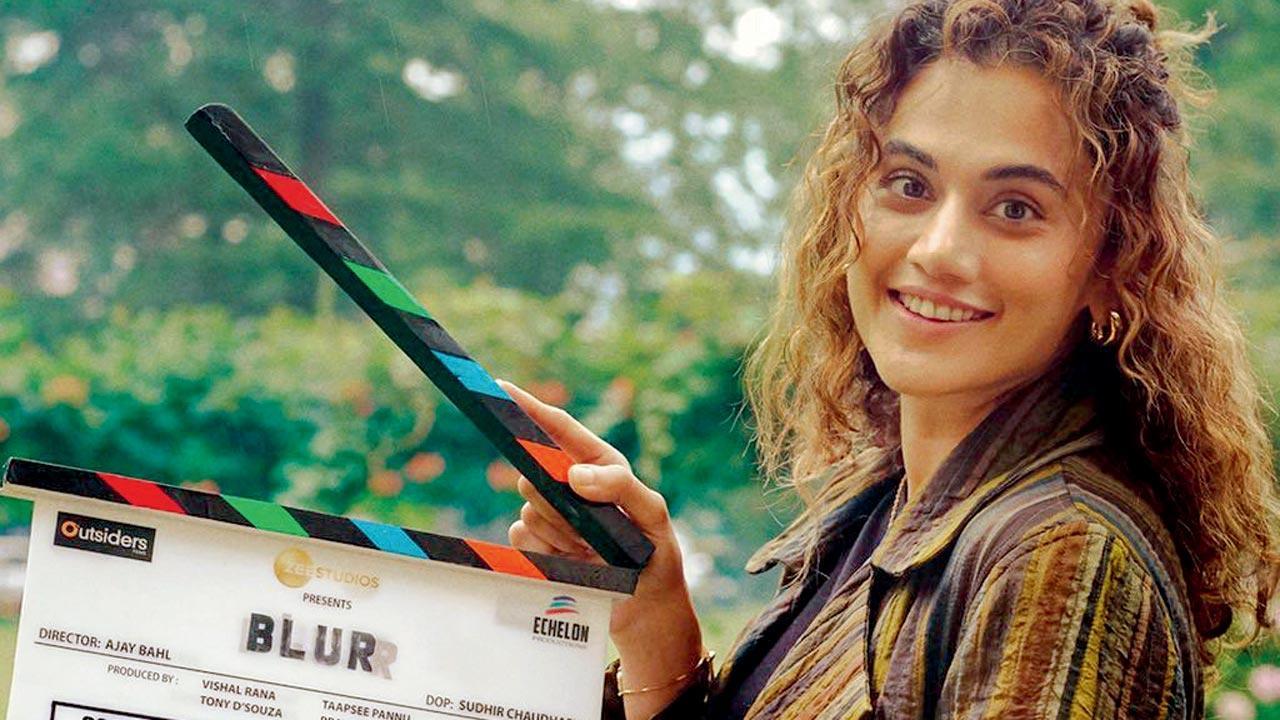
Fearing overcrowding on set, director Bahl films Taapsee-led Blurr at night in Nainital hotspots, including Mall Road
Uma Ramasubramanian (MID-DAY; August 20, 2021)
Given her keen eye for scripts, it was only a matter of time before Taapsee Pannu would take on the role of a producer and back stories she believed in. Last month, the actor kicked off her maiden production venture, Blurr, in Nainital under the watchful gaze of director Ajay Bahl. Shooting in real locations with celebrities can pose difficulties in terms of crowd management. The director, who is filming crucial sequences at Mall Road in the hill station, reveals that the team has been shooting at night to avoid overcrowding.
“The script of Blurr demanded [a hilly] landscape, and we have found perfect locations like the Mall Road and Nainital Lake to shoot at. Both these places are tourist hubs,” shares Bahl.
He walked into the shoot fully aware of the possible difficulties, but was pleasantly surprised by the outcome. “Shooting in real locations with a popular celebrity like Taapsee can be challenging, but thankfully, everyone has been patient. The locals wait until the shoot is over to click selfies and get autographs.”
The first project rolled out by Pannu’s Outsiders Films also stars Gulshan Devaiah. With the studio, the actor-producer hopes to empower new talent who “come with no [filmy] background like me.”
Kartik Aaryan not replaced by Ayushmann Khurrana in Aanand L Rai’s next project
8:07 AM

Contrary to various reports that suggested that he was ousted, the filmmaker clarified that the rumours are ‘baseless’
Renuka Vyavahare (BOMBAY TIMES; June 2, 2021)
Kartik Aaryan has been in the news lately, following his exit from Dostana 2 and alleged fallout with Dharma Productions over creative differences. Last week it was reported that Kartik lost out on another big project — Red Chillies Entertainment’s Freddy, to be directed by Ajay Bahl, and on Monday, it was reported that he was replaced by Ayushmann Khurrana in Aanand L Rai’s next production. There have been various theories doing the rounds online on Kartik’s sudden exit from various projects since then.
On Dostana’s front, both parties maintained a dignified silence, barring a Dharma statement that said, ‘Dostana 2 will be recast due to professional circumstances’. Red Chillies chose not to comment on Freddy. However, Rai was quick to deny the story and called it ‘baseless rumours’. He clarified that they had met Kartik for a different film and are still in talks. In a statement, he said, “We have taken another film to Ayushmann and this is a complete mix up.”
About the recent turn of events, an industry insider told Bombay Times, “Kartik parted ways with Red Chillies’ Freddy in January. Things didn’t work out. There was no bad blood. That film hasn’t taken off yet and the makers themselves wanted changes in the script and director Ajay Bahl was clear that he won’t make any. No one has been signed for it, so Kartik saying no to being cast alongside Katrina Kaif is bizarre. Why are these stories coming out now?” While the production house hasn’t commented yet, a source clarified, “Yes, Kartik has returned the money and the production house has no issues with him. The film will take off this year with Bahl, but they haven’t cast anyone yet.”
As far as Rai is concerned, the insider adds, “He had narrated a different story to Kartik, which he wasn’t excited about. It’s common for directors to pitch multiple stories to actors and then brainstorm on what they want to make. Nothing concrete happened in that meeting. The story offered to Ayushmann was totally different, so there is no question of Kartik being replaced.”
Kartik’s upcoming line-up has Ram Madhvani’s Dhamaka, Bhool Bhulaiyaa 2 with Anees Bazmee, Hansal Mehta’s next and Sajid Nadiadwala’s upcoming love story.
Kartik Aaryan no longer a part of Shah Rukh Khan’s next production?
8:12 AM

BOMBAY TIMES (May 28, 2021)
Kartik Aaryan was recently in the news for his fallout with Karan Johar’s production house. Reportedly, after 20 days of shooting for Dostana 2, he had disagreements with the producers over the script, which led them to parting ways subsequently. Dharma Productions even issued a statement in which they said, “Due to professional circumstances, on which we have decided to maintain a dignified silence — we will be recasting Dostana 2, directed by Collin D’Cunha.”
In a recent development, the Pati Patni Aur Woh actor is reportedly no longer a part of Shah Rukh Khan’s production house, Red Chillies Entertainment’s film Freddy. The movie was to be directed by Ajay Bahl, who had previously helmed BA Pass. Kartik was supposed to star opposite Katrina Kaif in the venture.
Sources have it that, this time again, the actor demanded some changes in the script, which didn’t go down well with the makers. The argument lies in the fact that the actor has been raising concerns about the scripts and his roles after signing on the dotted line. However, fortunately, in this case, he hasn’t shot for the film yet, and apparently, he has also returned the signing amount.
We reached out to Kartik as well as the production house. While the actor didn’t wish to comment, there was no response from the production house till the time of going to press.
More than 25 films registered with words ‘Section’ & ‘Article’ in titles
8:09 AM

Niharika Lal (BOMBAY TIMES; February 8, 2020)
Section’ and ‘Article’ seem to be the new favourite words in film titles as producers are making a beeline at the production association offices to register the titles of their films. Last year, after the central government revoked Article 370 (which granted Jammu and Kashmir special status), the associations received multiple applications for titles with Article 370 as well as Article 35 A, and Dhara 370 in them. An official of Indian Film and TV Producers Council (IFTPC) says, “Those titles which are registered with us are Section 364, Section 376, Section 302, Section 420, Section 484, Section 424, Article 14, Article 370, Article 35A, Dhara 370.”
An official of the Indian Motion Picture Producers’ Association (IMPPA), says, “IMPPA has received around 20 applications for the title of films which include the words ‘Article’, ‘Dhara’, ‘Section’ in them. As the films Article 15 and Section 375 created quite a buzz, many producers are also interested in having these words in the titles. A committee will look into the plot and other aspects of the films and then decide who should be granted the titles.”
A source from the Indian Film & Television Directors’ Association (IFTDA), says, “We’ve registered 15 titles with ‘Section’ and ‘Article’ in them for feature films. We also have several other applications for titles including Citizenship (Amendment) Act in them.” Gautam Chintamani, a film historian says, “It’s not surprising that filmmakers are making a beeline for these titles because filmmakers and audience both find movies with such titles intriguing. Also, titles with ‘Section’ or ‘Article’ are good for social media campaigns – in forming hashtags and get the film trending, making it topical. Article 15 should get the credit of coming up with the title first.”
PEOPLE INITIALLY WONDERED WHAT KIND OF NAME IS ARTICLE 15 FOR A FILM: ANUBHAV SINHA
While film experts now praise the film Article 15 for its title, director Anubhav Sinha says that his judgment was questioned when people from the film industry first heard about the title of his film. Speaking at a session in Delhi, he said, “When I named my film Article 15, people in the industry were wondering, ‘What kind of a name is this for a film?’ But that film did more business than many big budget movies and what’s more important is that the title Article 15 struck an emotional chord with the audience.”
Ajay Bahl, director of the film Section 375, adds, “When Manish Gupta wrote the film, he titled it Section 375 because that was the story (based on Section 375 of Indian Penal Code) , and it made perfect sense. But honestly, I thought that we should use another title instead. But we couldn’t come up with anything better than this for this film, so we kept it. And it worked.”
Pointing out how Bollywood has the habit of following trends, Gautam Chintamani, says, “Knowing the Bombay film industry, it’s likely that producers will tell the writers to just go through the Constitution and see on which Article/Section a film’s title can be based!”
There are several film producers’ associations and to avoid duplication of titles, all these associations cross-check with each other before registering the film titles.
KEY TITLES REGISTERED AND WHAT THEY MEAN
Section 364: Kidnapping or abducting in order to murder
Section 376: Punishment for rape
Section 302: Punishment for murder
Section 420: Cheating and dishonestly inducing delivery of property
Section 484: Counterfeiting a mark used by a public servant
Section 424: Dishonest or fraudulent removal or concealment of property
Article 14: Equality before the law or equal protection of the laws within the territory of India
Article 370: The recently abrogated article acknowledged the special status of the state of Jammu and Kashmir in terms of autonomy and its ability to formulate laws for the state’s permanent residents
Article 35A: The recently abrogated article empowered the Jammu and Kashmir state’s legislature to define “permanent residents” of the state and provide special rights and privileges to those permanent residents

With Section 375, the idea is to make room for a counter narrative in the dialogue-Richa Chadha
8:01 AM

Swearing her support to #MeToo India, Richa Chadha on why Section 375 doesn't hinder the movement
Mohar Basu (MID-DAY; September 19, 2019)
 Of late, the world of cinema has seen a raging debate: Should a film be viewed only in its immediate context, or within the larger construct of society? Richa Chadha's latest release, Section 375, is the latest to be drawn into this debate. The courtroom drama released at a time when the #MeToo India movement could have done with unflinching support. Even as a section of the audience lauded director Ajay Bahl for his balanced view, many feminist groups questioned the stance of the film, which depicts how women often abuse the very law that was made to protect them.
"What if the motive of the film is to evoke fear in men who are in a position of power and coerce young women to have sex with them? The point was to educate people about the law, which is complex because it takes a position of power into account in the victim-aggressor dynamic. I have been a big supporter of the #MeToo movement and my empathy lies with the survivors. The intention was to never run down what they are feeling," clarifies Chadha, adding that she will continue to champion the movement.
Knowing the sensitive nature of the story, the actor signed the film only when fully convinced of its message. "When the script came to me three years ago, the movement hadn't hit India then. So, at the time, the film was set in a different context altogether, strictly taking on the law. The script evolved a lot after Ajay came on board. It was a moral dilemma for me, so much so that at one point, I almost said no to it. But I had faith in Ajay's intention."
Question her if she feels that the movie, unintentionally, serves as a setback to the movement, and she reasons, "The idea is to make room for a counter-narrative in the dialogue. Feminism is about creating an equilibrium in society, and that balance can never be achieved in the absence of an alternative opinion. Meera [who plays the complainant] is unapologetic for a reason, and the film sides completely with the law."
Rumours suggest that Chadha, who has Panga lined up for release, has been signed on for director Subhash Kapoor's next Madam Ji. "If we are talking about the rehabilitation of alleged rapists, we recently had Alok Nath in a mainstream movie. I was shocked to see that after three women corroborated accounts of his predatory nature. As far as a collaboration with Subhash is concerned, I will put out my statement soon."
Not working is an uncomfortable experience for me-Akshaye Khanna
8:34 AM

Akshaye Khanna on changing his work strategy, doing more than one film a year and his latest outing Section 375
Sonil Dedhia (MID-DAY; September 15, 2019)
Akshaye Khanna is a man of few words. The actor, who stole hearts with Taal (1999), Dil Chahta Hai (2001) and, more recently, Mom (2017) and Ittefaq (2017), accepts that the nature of filmmaking is changing because the "audience is evolving". Khanna sits down with mid-day to discuss his latest release Section 375, how it's a conversation starter and why the film is open-ended.
Excerpts of the edited interview.
What prompted you to take up Section 375?
I was particularly thrilled with the script because it was well written and an intelligent film, where everything was sketched out thoroughly. As opposed to films which tackle similar topics. Section 375 doesn't take sides or a moral stand. It allows the audience to decide. It takes you through a case and shows the different perspectives of the society, judges and the lawyers. I believe, if a film doesn't take a stand, the audience is bound to make an opinion. I don't know to what extent the film will be watched, but it would be a good thing if it encourages a conversation.
Do you feel that the film can bring about a change in the society?
Having a difference of opinion means controversy and it's not necessarily a bad thing. Controversies have been termed as a bad connotation but in this particular instance, if you would like to label it controversial, which it is, then let's look at it positively and start a conversation about it. It will have an influence on people from the legal fraternity or people in the parliament —basically people who matter. What happened in the Nirbhaya case? The law was forced to change because public opinion was strong and immovable. Section 375 encourages the conversation by citing one particular case.
NGOs and activists have been raising awareness about fair treatment to the victim and accused. They are of the opinion that law is tilted towards women.
As an individual, I am aware that a section of people feel this law is skewed in the favour of women. I am sure people debate over the laws of rape worldwide. These debates will go on as the society evolves. As a collective consciousness, we have to decide the direction in which we need to change.
Did you personally research about rape laws in the country?
It was not required thanks to writer [Manish Gupta] and director's [Ajay Bahl] extensive research.
How did you prep for the role without any homework?
It's difficult to put it in words as it's an internal process for me. As an actor, I am always absorbing things and noticing behaviour. So, I am constantly, but not consciously doing it. For me acting is being in the moment. If I am true to it, then I have done my job.
Since your first film in Bollywood, how do you think content in films has changed?
The audience drives the change in filmmaking. The changes are never internally driven by the film industry. Films are almost like politics. Politicians follow in the direction of the majority. Take the example of Kabir Singh. It has smashed the perception of how a typical Hindi film hero should be. The character was seriously flawed but the film was widely accepted by people; and now you will see many such characters coming in. Even Uri: The Surgical Strike was an amazing subject. Films are breaking stereotypes because the audience is ready to accept them.
Does the success of these films affect your film choices?
Yes, it does influence the decision making. It plays in your mind and registers as important indicators while choosing roles as an actor.
Is it a conscious decision to be less frequent on screen?
It's something I personally want to change. I want to reduce the gaps between films and be prolific in the amount of work I do. I am also open to OTT platforms because it is the future. People are watching more content on the web than the silver screen.
Does it have to do with the fact that you are not as socially active as your contemporaries?
I don't think so. If only everything was in my control, including the scripts. [Going forward] I'd like to do two to three films a year. Contrary to the popular belief, I am not a person who does not like to work. My entire adult life has been about work, so not working is an uncomfortable experience for me. People assume that I enjoy relaxing but that's not true.
Why did you decide to hire a PR manager to promote your work, something you've never opted for in your entire career?
There are certain things I am good at and I am not at the rest. The most obvious one is having a public relations manager. I resisted it for a long time but it is pointless and stupid not to have one now. Instead of doing it myself [interacting with the media], for which I lack skills, it's better to hire a professional. I feel it's a step in the right direction.
I have my own opinion on the subject discussed in Section 375, but I’ve not let it trickle into my work-Ajay Bahl
8:01 AM

Rachana Dubey (BOMBAY TIMES; September 12, 2019)
As a filmmaker who has spent five years between his first and second film, Ajay Bahl comes across as someone who doesn’t let ups and downs affect him. After making the acclaimed BA Pass in 2013, it took him a few years to reach a studio floor again. As a proud feminist, the directorwriter admits that he didn’t let his views on a sensitive subject like rape clutter his thoughts while filming Section 375. In a conversation with BT, Ajay spoke about hassles faced by women while battling rape cases and why a man, even when not found guilty, can seldom roam freely in society. Excerpts:
You had to wait five years after making a film like BA Pass to find your next assignment as a director. Didn’t the long interval get to you? It didn’t! What are friends for?
There was not one dull day; they would all come to my house and we would party. Aise karte karte, paanch saal beet gaye. After BA Pass, I had signed a film called Citylights, which didn’t work out. I have learnt one thing: never say no to a film and never leave a project midway. In the last five years, I wrote scripts that no one wanted to produce. I also spent time educating myself in different things. I came aboard Section 375 a year ago, with a friend’s recommendation. He’s a co-producer on this and he introduced me into the set-up. If that friend hadn’t helped, I doubt anyone would have thought of me to helm this film.
A film like this has the potential to be accused of taking sides, are you prepared for such feedback?
Look, the film doesn’t generalize anything and it’s silly to do that. It revolves around the proceedings in a single case. With this film, we’re definitely not trying to say that men are not guilty. There are thousands of guilty men all over the place. The issue at hand in the film is a complex one, and both sides think that they are right. The film doesn’t, however, take sides. We’ve left a lot for the audience to decide. As a man, I have my own opinion on the subject discussed in the film, but I’ve not let it trickle into my work. I am a feminist; but it’s a different story that feminism is itself a misconstrued idea today. Not everyone understands what it entails.
Was it very difficult for you to disallow your own views from interfering with the narrative?
Yes, it was. When you make a film like Section 375, you can’t let your feelings dominate the narrative, ever. If you let that happen, it becomes propaganda. I’m like many other people in society, whose views on the subject change with the passage of time, and with more and different kinds of instances being reported. Complex issues like the cases in the #MetToo movement can be seen in two different ways — emotionally where you immediately want to take the accused to task, and objectively where the law and facts become the lens.
Days after the trailer of your film released, a court in Pune summoned your team (including actors) and you for allegedly showing lawyers in a negative light...
The person who raised an objection didn’t realise that when Meera Chopra’s character is being questioned, she is with a medical examiner and a policewoman in the hospital, and not with a lawyer in court or at a police station. In the film, we have also explained why she was being examined by a male and not a female practitioner. The questions she’s asked are a part of the medical assault history, which needs to be corroborated with physical examination. The gaps between the two can benefit an accused. It’s a harrowing procedure, but for the want of justice, one has to bear with it. As for showing lawyers in poor light, I think we always show cops taking bribes and politicians being corrupt; if everyone starts objecting to their portrayal in cinema, we won’t be able to make films. There are all kinds of people in every field. So, that claim doesn’t hold value. It’s not fully shown, but even the proceedings in the film are shown happening with a two-judge bench in camera, behind closed doors. Only people in the room are the ones who have a direct connection with the case. We had a high court lawyer present on the set to ensure that we do not show any proceedings incorrectly.
Women in the film industry or the audience will not accept a frivolous rape scene in a movie anymore-Ajay Bahl
8:08 AM

Rachana Dubey (BOMBAY TIMES; September 10, 2019)
In the last decade, the depiction of rape in cinema has gone through a sea change. From being used loosely in a film, as a tool of revenge or a trope to titillate, such scenes now occupy a more sensitive space in a film’s narrative and are central to the plot. For instance, director Ajay Bahl’s courtroom drama, Section 375, revolves around the hearings in a rape case involving a Bollywood director, who is accused by a female member from his crew of raping her at his residence. Akshaye Khanna plays advocate Tarun Saluja, who represents the accused, while Richa Chadha will be seen as prosecutor Hiral Gandhi, representing the victim. Besides Akshaye and Richa, the film also features Meera Chopra and Rahul Bhat.

‘DEPICTION OF RAPE IN FILMS IS NO LONGER FRIVOLOUS’
 Talking about the depiction of rape in Hindi cinema, Ajay Bahl says, “Indian cinema has become far more sensitive when it comes to crimes, particularly in the depiction of rape and their placement in the narrative. It’s not frivolous anymore and it’s not just another plot point. I think the change in perspective happened towards the end of the 1990s. I can’t put a finger on what triggered it, but today, if there’s a rape scene in a film, it has to be important to the narrative. I would credit the change to the new generation of filmmakers, who think everything through before incorporating something in their stories. The audience, too, has evolved as they are widely exposed to all kinds of content. They are quick to perceive the intent if you’re doing something to titillate them. Cinema has changed from its formulaic ways to clearer and cleverer narratives. It’s sad, but at one point, rape was the ultimate revenge device in a story. But not anymore, thanks to education and awareness. Besides, the presence of women in powerful positions in the industry — as writers, technicians, editors and marketing heads — doesn’t leave room for anyone to act insensitively towards issues like rape. No woman in the system or in the audience will accept a frivolous rape scene in a film anymore.”
 ‘IN THE COURT OF LAW, IT’S ABOUT WHAT YOU CAN PROVE’
The film also explores the mindspace and the thought process of criminal lawyers. Elaborating on the latter, Ajay says, “This film presented an opportunity to explore the legal system and the world that these lawyers operate in. I got a chance to understand how a prosecutor thinks and how a defence counsel prepares arguments. Before this, my understanding of a criminal lawyer was similar to that of a layman. Even I wondered how could they sleep peacefully after defending someone, who seems to be a criminal. I’ve realised that they have a role to play in keeping the checks and balances, because everyone deserves a trial. Lawyers on both sides are clinical in their approach and they both argue to win. In the court of law, it’s about what you can prove.”

‘AKSHAYE KHANNA IS A MYSTERY TO ME’
Talking about Richa and Akshaye, who play strong characters in the film, Ajay says, “I don’t think anyone can do what they have. This film needed them.” He adds, “I knew just how much Richa was labouring to get into her character. She chose to hang out in courts and draw inspiration from Marcia Clark (lead prosecutor in the OJ Simpson murder case) to nail her role, but Akshaye is still a mystery to me. We met a few times and discussed the part and the film. And on the first day of the shoot, he was totally in character. I suspect that he kept meeting lawyers secretly. It is really strange, but even when he would take pauses between his lines, he would breathe like a lawyer in the thick of an argument. That’s why Section 375 could not be made with another set of actors.”
SCIPL presents Section 375, a Panorama Studios Production. The film is produced by Kumar Mangat Pathak, Abhishek Pathak and SCIPL, and co-produced by Sanjeev Joshi and Aditya Chowksey. The Anand Pandit Motion Pictures, PVR Pictures and Panorama Studios International release, hits the screens on September 13.

With the kind of roles I’ve played, it’s a miracle I still have a career-Richa Chadha
8:25 AM

Rachana Dubey (BOMBAY TIMES; September 7, 2019)
In the last 11 years, not once has she played the quintessential Bollywood heroine — romancing her hero in the mountains, draped in a chiffon sari. Richa Chadha has always prided herself in playing characters that had layers and were seldom straight-jacketed. And, her career seen various ups and downs. “My entire backlog, including films that were stuck, has been cleared. Saare purane paap dhul chuke hain…” she says, while talking about her professional choices. Richa, who will be seen as a lawyer in Ajay Bahl’s Section 375, talks about the statistics of rape cases in India, the law and its implementation, the #MeToo Movement and assesses where her career stands today. Excerpts:
 You debuted with Oye Lucky! Lucky Oye! (2008), and have completed 11 years in the industry. From being an outsider to an independent insider, the journey has not been easy, especially with the kind of roles you’ve chosen to play. Are you happy with the way your career has shaped up?
I didn’t know what else to do. As a child, I was inclined towards performing arts. I knew that this hobby will become my profession. When I came to Mumbai, I only wanted to act in films, which continues to make me happy and drive me even to this day. My goal was to become a credible actor, who stays relevant beyond her youth. Thankfully, my ambition was never to dance on a hill, clad in a chiffon saree. In the last two-three years, I have had some ups and downs. On several occasions, I’ve felt like my career is winding up. My roles were snipped, and I wasn’t treated fairly. I’ve experienced all these things, but now, finally, I feel that with all the work in the pipeline, I am in a happy space. Trust me, with the kind of roles I have played, it’s a miracle that I still have a career.
Why do you say that?
Who plays a 60-year-old at the age of 24? I have consistently played older women, tough and non-glamorous characters. I have not done a remarkable romcom; I should be grateful I still exist after all of this. I remember, people had refused to represent me when they discovered I was playing Nawazuddin Siddiqui’s mother in Gangs of Wasseypur (GoW). I would go for meetings in shorts and sports shoes to remind people that I am not the character that I am playing on the screen. On so many occasions, I was told that I have no future here. Today, when I’m asked if I feel I have not got my due, I feel great because I still have a lot to achieve. I don’t want to be a replaceable prop. I’ve seen many such entries in show business — arrival with a bang, glam roles and an eventual marriage with a businessman when the career fades. In my case, I didn’t have too many options. But if you are sincere, you will get work and earn respect and credibility. I continue to have my filters. People think I am crazy, but I can’t care much. I was offered a hefty sum for a film that had sexual innuendos. I refused it; I’m selective and although I have made professional mistakes, I can’t afford more. The new slate of roles that I now have resonates with me.
In Section 375, you’re playing a lawyer, who has an idealistic bend of mind. It’s probably a difficult space for you, given that almost all your roles so far have had a twisted side to them...
I have not played an idealist before. I don’t care if people don’t like me in it, but I am happy with the role. My lawyer friends helped me in a big way. I also observed a lot of these women who are operating in the machinery that’s largely run by men. They carry themselves in a certain manner. Apart from the alarming statistics around rapes, I also studied how women lawyers function in the courtrooms. Ajay Bahl (director) treated the material at hand very cautiously. He once took me aside and said, ‘Mazaa nahi aa raha hai. You were so good in Gangs of Wasseypur and Masaan. What happened to you?’ I realised that I had probably forgotten how to act, or maybe I was not doing what was required. From that day onwards, I pushed myself harder. I realised that I didn’t have to act; I had to be the person I was playing. I value a director like Ajay, who demands something solid out of you.
Films like yours have to walk a tightrope because you can’t sound preachy, and at the same time, it has to stick to the core idea that will keep the audience invested in the story.
The film might spark off controversies, but no part of Section 375 is biased. It’s an objective take on what really goes on when a rape case is being heard. People will draw parallels with real-life cases, but we are prepared for that. We read about incidents of rape, but often, they just remain headlines for us. In a complex country like India, a lot of cases go unreported. There is a social stigma around rape, and sadly, we have a culture of victim-shaming. Naak kat gayi and izzat lut gayi are common phrases used. With such stigma, who in their right mind, would want to seek justice? In another ecosystem, like Bollywood, why do you think women don’t come forward with their #MeToo stories as often? It’s for the same reason. Rape cases go unreported because the perpetrators are often known to the family; it could be a friend or relative. No one wants that ‘shame’ attached to their khandaan. In rape cases, the identity of a victim is protected, purely because there is a stigma attached to the incident. Having said that, even from the cases that are reported, there is a percentage that is fake. It’s a heinous crime and you would wonder why a woman with a sound mind would accuse someone falsely? But statistics say that bad break-ups, rivalries between families or communities are settled using the law (related to this crime). Keeping these circumstances in mind, our film had to be nuanced, balanced and forthright without taking sides.
According to a recent Supreme Court judgement, in every case, a man cannot be accused of rape when he fails to marry a woman despite a promise even if they have been in a sexual relationship. How do you process a this judgement, which can be misused?
The laws pertaining to rape have undergone changes in recent times. People are trying to understand them. I’m aware of the judgement, but law is open to interpretation. Now, there are times when a man puts a woman through duress to have sex. Legally, the woman can accuse him of rape. She gave consent, but it was not her will. People are complicated and so are the laws; interpreting them is even more complex, which is the reason a film like Section 375 is not easy to watch.
In a previous answer, you mentioned the #MeToo Movement. The general perception is that it has lost its steam in India within a year.
I have been unequivocal with my support for it. Recently, I refused to go to an event, which was being chaired by someone with allegations of harassment. In recent times, I have seen a lyricist friend suffer, thanks to a fake case. In Karan Oberoi’s case, we know he had a stalker. Having said that, I disagree when someone says the #MeToo Movement has lost steam. It’s not just a twitter trend. Azaadi ke liye hum 200 saal lade the na? This, too, will take some time. The change that has occurred in the system is irreversible. The cat is out of the bag. Women know that they have been wronged. Men know that though they have done this assuming that they will never get penalised, but they can now be severely punished if found guilty. Today, if you go to a casting director or a filmmaker’s office, they all have CCTV cameras for their own good. No one wants trouble. Of course, it’s not like one size fits all; even men are at a risk. While the law is trying to protect victims, it does get misused. The #MeToo Movement has just scraped the surface and it will have a long run; justice is not instant.
But for a movement to go on, and for a case to be fought in court, the victim needs to come forward. In a certain filmmaker’s on-going defamation case, the said victim, at least in the initial hearings, didn’t appear in the court. She reportedly sent her statement through her counsel, requesting not to be made a party in the case. While victims can request anonymity, this also makes such cases complicated…
Through my conversations with my lawyer friend, I have understood certain things. By the time cases come up for hearing, the women have moved on from that terrible crime. Their families don’t want to be put through grief. In some cases, women fear losing their livelihood if they decide to either come out with their #MeToo stories or fight a battle in court. And some women cannot afford the battle monetarily. No one should ever judge these women or their reasons. Victims that don’t want to lose their anonymity can always demand closed-door proceedings, if they have any apprehensions. But I agree that when a victim doesn’t come forward, the battle becomes even more complicated. We take three steps forward and half a step back. The only way to treat this problem is to treat a survivor with respect and kindness.

Akshaye Khanna had a narrow escape on the set of Section 375
7:55 AM

BOMBAY TIMES (September 6, 2019)
It was sheer luck that saved Akshaye Khanna from a major accident during the shoot of his upcoming film, Section 375. The incident took place when a top-angle shot of the actor walking in an empty courtroom was being filmed. The camera was supposed to move with Akshaye and capture the sequence. The rehearsals went off fine, and finally, when the team started shooting the scene, something totally unexpected and shocking happened.
The camera, which was placed above and weighed around 85 kilos, fell on the floor. And, it would have fallen right on Akshaye, had the actor, for some inexplicable reason, not moved to the side. Now, that is what you call a stroke of luck!
Talking about the incident, director Ajay Bahl says, “I still shudder when I think about that day.” The courtroom drama, which aims to shed light on the rape laws in India and the Indian Penal Code, will see Akshaye and Richa Chadha play lawyers. It also stars Meera Chopra and Rahul Bhat in pivotal roles.
SCIPL presents Section 375, a Panorama Studios production. It is produced by Kumar Mangat Pathak, Abhishek Pathak and SCIPL, and co-produced by Sanjeev Joshi and Aditya Chowksey. An Anand Pandit Motion Pictures, PVR Pictures and Panorama Studios International release, the film will hit theatres on September 13.
Why is rape phrased as 'izzat lootna'?-Richa Chadha
8:01 AM

Pointing out the stigma attached to rape, Richa Chadha on how Section 375 argues both sides of the crime
Mohar Basu (MID-DAY; August 21, 2019)
A courtroom drama that sees Richa Chadha play a prosecution counsel in a rape case, Section 375 shines a spotlight on how the law is sometimes misused in India. Even as she is a strong critic of gender crimes, Chadha argues that the Akshaye Khanna starrer opens a dialogue that is vital in the post-MeToo era. Arguing that the film doesn't take sides, she asserts, "The law is clear that the burden of proof lies with the accused. In this case, the law is friendlier so that women can report their sexual harassment cases. However, there are myriad problems in India when it comes to reporting these crimes. Rape cases often don't get reported because of the social stigma attached to them. Why are phrases like izzat lootna or naak katna used to describe rape? There needs to be a multifaceted approach to fix this. No law is made without context, so after the Nirbhaya rape case, there were amendments made to the clauses of rape law. But to what extent it is implemented is crucial in determining how successful rape law is."
Reiterating that the Ajay Bahl-directed film approaches the subject with deep sensitivity, the actor describes it as her career's most challenging role. "I did extensive research, and Ajay had a lot of material on reported versus unreported rape cases. The material of UN Women was available for reading. Some women lawyers also guided me on how to approach cases of sexual violence."
BA Pass director Ajay Bahl to shoot his crime drama near Indo-China border
7:38 AM

Sanyukta Iyer (MUMBAI MIRROR; August 4, 2015)
 Ajay Bahl, who made his directorial debut in 2013 with the much talked
about erotic drama, B.A. Pass, is ready with his next film: a passionate
thriller.
The yet-untitled film is a dark crime drama set in the northern hinterland. "It's a burning love story between two star-crossed people who love each other to death, quite literally," says Ajay, the film's producer, director, writer and cinematographer.
It will be shot in Himachal Pradesh, near the Indo-China border. "Since snow is a key element in the plot, we roll this December," Ajay added.
Casting is underway. Prep will be complete by the end of the month. Prod him on whether his leading actress from B.A. Pass will make an appearance in this film too and he says, "No, Shilpa Shukla will not be a part of this one."
Mirror had earlier reported (August 1) that MA Pass, a film about a small town girl who moves to Mumbai to become an actress, is currently on the floors, being directed by Shadaab Khan and produced by Narendra Singh. Ajay is quick to point out that it is not a sequel of his critically acclaimed debut film. "Neither me nor my film B.A. Pass has anything to do with that film. MA Pass is not a sequel to B.A. Pass. I will start working on the sequel right after I finish shooting this film," Ajay reveals.
Shilpa Shukla not leaving with hubby anymore; has soft spot for Ajay Bahl?
8:32 AM

Vickey Lalwani (MUMBAI MIRROR; June 10, 2014)
Chak De India's Bindiya, Shilpa Shukla, has separated from her husband Mohit Tripathi. Buzz is, the actress and her B.A. Pass director Ajay Bahl are now more than friends.
Ask Shilpa about her marital status and she confesses that Mohit and she are no longer man and wife. "We are still friends but we don't live together. He is in Delhi while I'm here in Mumbai," she says.
However, the duo is unlikely to file for a divorce as Shilpa doesn't believe that an official stamp on a piece of paper is important to nullify their marital status. "Mohit and I are giving each other space and are doing things which we might not have been able to do if we were together," she reasons. "I am on my own today and marriage has taken a new meaning, which I didn't understand earlier."
According to her, she can't be bound within the four walls of a house and stresses that her parents as well as Mohit understand this. "There's no bitterness between Mohit and I," she is emphatic.
Mohit was an associate director on B.A. Pass and watched Shilpa perform some steamy scenes. Did that create the awkwardness? "No, both of us are artistes first. Working on a film never made either of us uncomfortable," she reiterates. She admits that her association with Ajay is special but refuses to say that they are in a "relationship". "I don't want to demean our relationship by putting a label on it. When you do a film, the people you work with become family. With Ajay, I feel like I've know him for years," the actress says.
She continues, "There are some questions to which I have no answers. I have become more spiritual of late and freed myself from worldly materialism. There is a drive towards renunciation. It's a peaceful space to be in and I can't describe the joy I feel."
Away from her husband, is she currently living a life of celibacy? Pat comes the reply, "No, I am not!"
BA Pass 2 to go on floors in September with all-new cast
7:49 AM

Ankur Pathak (MUMBAI MIRROR; April 25, 2014)
His directorial debut scored both critical acclaim and box-office success with its mix of sex and intrigue. And Ajay Bahl is continuing with the formula in the sequel to BA Pass.
Mirror had earlier reported that Bahl would be teaming up with his heroine Shilpa Shukla again for the film Hotel Grand. But the film has been put on the back burner for now as it requires a lot of pre-production.
Revealed a source, “Hotel Grand has a complex structure and needs at least three more months of work. For now, Bahl is ready with the script of BA Pass 2, which should go on the floors by September.”
Bahl confirmed the news saying, “We will have a fresh cast, but BA Pass 2 will be similar in spirit to the earlier film. I am currently doing the recce for the film in Rajasthan and Nainital. The film is likely to be set in one of these places.”
Bahl will be collaborating with Pawan Sony, who has previously written the indie drama, Sixteen. “Pawan has written a refreshing script. The space is the same – a noir thriller with erotic undercurrents. We’ll be done with the casting in a few weeks. The idea is to make a franchise out of BA Pass,” said the filmmaker.
Shilpa Shukla in BA Pass director's next, Hotel Grand
7:51 AM

Rachana Dubey (MUMBAI MIRROR; April 15, 2014)
After opting out of Citylights following creative differences with Mukesh Bhatt and the team of Vishesh Films, director Ajay Bahl has finally started work on his second movie. Titled Hotel Grand, it’s a noir thriller on the subject of ambition and greed. While the rest of the cast is yet to be finalised, Shilpa Shukla, who came up with an applause worthy performance in his debut film B.A. Pass, will play the lead.
Confirming the news Ajay says, “Shilpa is definitely playing an important character in Hotel Grand. We will be talking to other actors next week. The film should roll post monsoons.”
Shilpa too is happy to associate with Ajay again. I will play a central character in this racy romantic thriller which explores the darker side of human emotions. It’s another challenging role.”
Buzz is, it’s another bold avatar and just as unconventional. Shilpa retorts, “I can assure you that the story is as unique as B.A. Pass and nothing like what you’d expect from this genre.”
Shilpa Shukla in Ajay Bahl-Prakash Jha's Parivar Time
7:54 AM

Ankur Pathak (MUMBAI MIRROR; April 12, 2014)
After exploring her dark side in Ajay Bahl’s critically-acclaimed noir drama BA Pass, for which she won the Critics Choice Filmfare award for Best Actress, Shilpa Shukla has now been signed by Prakash Jha for a comedy that he is producing. The film is tentatively titled Parivar Time and is set in Mahabaleshwar. A source from the sets describes it as a “crazy caper” revolving around a dysfunctional family.
It will be directed by Ritesh Menon, who had previously dabbled in documentaries. He was also the associate director on several projects helmed by Santosh Sivan. Parivar Time is expected to hit the theatres in November.
Lyricist Swanand Kirkire will also be making a full-fledged acting debut with this film. He plays Shilpa's brother who is constantly at loggerheads with her.
Revealed the source, “It’s a quirky, situational comedy about a Punjabi family who live in Mahabaleshwar. Shilpa plays a wannabe with a tendency to overdramatises everything that she does.”
Shilpa confirmed the news saying, “It’s a refreshing change for me. I’ve always wanted to explore comedy as a genre but I was mostly approached for serious roles. Now, I can finally experiment with one.”
Meanwhile, Jha is contesting the Lok Sabha elections from the Bettiah constituency in Bihar. But despite his hectic schedule, he is supervising this project.
The Mastram effect: Erotica comes of age in Indian Cinema
12:02 PM

As Indian audiences gear up for Mastram, we take a look at how erotica in our films is slowly coming of age
Urmimala Banerjee (MID-DAY; March 2, 2014)
With
sex and sexuality being hush-hush topics in India, any film with some
amount of skin show generates curiosity, which, often transcends into
‘healthy’ (pun intended) good opening collections at the ticket windows.
After all, nothing sells like sex.
People still remember Mandakini’s shower act in Raj Kapoor’s Ram Teri Ganga Maili, Rekha’s bathing sequence in Girish Karnad’s sensuously crafted Utsav and Zeenat Aman’s cleavage show in Satyam Shivam Sundaram. In recent times, films such as Jism 2, Murder and B.A. Pass created waves online as well as in theatres.
The latest film to explore the theme of erotica is Akhilesh Jaiswal’s Mastram. A biopic of legendary Hindi porn writer, Mastram whose books were read by young men across India in the ’80s, the film tries to explore the writer’s conflict with his creative aspirations and society. The idea is novel with the trailer evoking interest among the Internet savvy audience.

Shashi Kapoor and Zeenat Aman in the 1978 film Satyam Shivam Sundaram
When fact meets fiction Out in the open Akhilesh Jaiswal, the director of Mastram says, “Like many young North Indian men, I too grew up reading Mastram’s books. I used to wonder how this guy would be like and what would he be telling people about his profession. It was just a thought that later formed the base for my film. We did a lot of research but could not find any links to the ‘actual’ Mastram. Most of the old bookstalls that sold his stuff had shut shop or the owners had died, so I could not establish any contact.”
Working on a film based on the life of a porn writer would not have appealed to many Bollywood heroes but Jaiswal says that the initial reaction wasn’t that negative either.
“I did not approach any big star but 90 per cent of those I asked were kicked about the script. When Nawaz (Nawazuddin Siddiqui) heard it, he loved it and so did Rajkummar Rao. Unfortunately, they could not be a part of the film due to other commitments.

Mandakini took a shower under the waterfall in a transparent white saree in Raj Kapoor’s Ram Teri Ganga Maili (1985)
Adult topics are slowly finding their way into Indian cinema, be it the theme of sperm donation in Vicky Donor or live-in relationships in Shuddh Desi Romance. Vivek Agnihotri, whose film Hate Story had some steamy sequences featuring Bengali actress Paoli Dam (right) opines, “The media has played a huge role in opening up people’s minds towards bold subjects. And it’s not just about sex. Topics such as gay relationships, premarital sex, abuse, etc are being talked about in open forums. This has made it easier for the middle class to accept such films.” Ajay Bahl, who made the critical and commercial hit B.A. Pass also feels the same, “Indian society is rapidly evolving and people are exposed to foreign content, this has brought about a change in perceptions.”

Beyond titillation With news of a heroine wearing a bikini still making for great PR material, the maturity of the industry when it comes to erotica is highly debatable. The young generation of filmmakers seems to have a common view — sex without content in a film is not going to hold the audiences attention. Bahl states, “In my opinion, only visually erotic content does not guarantee a good opening at the box office. The vibe of a film is very important. Filmmakers now hopefully know that mere titillation will get them nowhere. The idea is to tell a great story and if it falls under ‘erotica’ then so be it. Audiences have been accepting indirect sensual content for a long time in the form of songs and even TVCs.”
The logic seems to hold true. With porn being available at the click of a button, the idea of enduring a trashy film for three hours just for some hot scenes is just fading away. “The world watches porn for gratification and once it’s achieved they shut it off. It’s simply because porn does not have the story or dramatic content to hold their attention. Films are all about drama, it works if the drama works, erotic or not,” says Bahl.
The modern audience wants to see all genres of films. And erotica is catching up, especially after the success of books like CL James’ 50 Shades Of Grey, both in the print and online version. A lot of erotic content is available in e-books and lapped up by both the sexes.
Agnihotri says, “I made a suspense film (Chocolate) and a sports drama, (Dhan Dhana Dhan Goal) and I wanted to test my audience with Hate Story. I don’t come from a camp that makes such films or own a erotic thriller franchise, it was an independent effort.”
Pushing limits While big budget erotic thrillers do get marketed well, smaller films find it tougher. B.A. Pass (right, below), which earned Rs 4.30 crore in the first weekend had to be released by Bahl himself. “It was not easy to sell the film as no corporate wanted to touch it. In fact, we never sold B.A. Pass. I released it myself with help from Bharat Shah’s distribution company. Making an erotic film just for profitability is in the domain of ‘B’ and ‘C’ grade category. I don’t think any good filmmaker approaches the genre in this fashion.”
 Dealing with the Censor Board is another hassle. “I feel
they live in an archaic world. The members are totally out of sync with
what is preferred by the modern adult audience. The board should be
done away with.” However, things seem to be in a transition mode.
Director Ashim Ahluwalia who never expected his film Miss Lovely to get a
release in India was glad when the Board passed it with only four cuts
earlier this year. In 2013, they had asked Ahluwalia for 157 cuts. In
India, the Censor doesn’t allow frontal nudity, hardcore lovemaking
scenes or graphic content, so as a veteran director opines, “What we see
is not really erotica!”
Actors’ take
While Mallika Sherawat’s act in Murder classified her as ‘hot’, Shilpa Shukla wowed the audience and critics alike with her sexy Machiavellian act in B.A.Pass. Agnihotri explains, “Shooting an intimate scene is not challenging. Actors hardly have any dialogues in such sequences. It’s more about playing with the lighting, camera angles and art direction.” Such films have given a boost to many new starlets and revived flagging fortunes.
Bahl says, “My actors were exceptional performers who were mature enough to realise what the film’s actual message was. Thematically, B.A.Pass was based on the premise that society feeds on its own weak and that is the film we made. I don’t think any good actor in their right mind would want to do a (s)exploitation flick. However, if they find material, which digs deeper on an intellectual and emotional plane and a story, which moves them, then today’s actors are brave enough to go further.”
Bollywood's most erotic films 1. Kamasutra: Exotic sets, softcore lovemaking scenes and raw sensuality made this Mira Nair film a much talked about one.
2. Utsav: This 1984 film was based on the play Mrcchakatika and produced by Shashi Kapoor.
3. Satyam Shivam Sundaram: Zeenat Aman’s skimpy outfits and smooching scenes with Shashi Kapoor created quite a furore.
4. Ram Teri Ganga Maili: Besides the shower act, Mandakini also did a very sensuous bedroom scene with Rajiv Kapoor.
5. Anubhav: Post Utsav, Shekhar Suman again did intimate scenes with co-star Richa Sharma in this film that also had Padmini Kolhapure

Girish Karnad’s 1984 Rekha-starrer Utsav combined love, politics, erotica and comedy
People still remember Mandakini’s shower act in Raj Kapoor’s Ram Teri Ganga Maili, Rekha’s bathing sequence in Girish Karnad’s sensuously crafted Utsav and Zeenat Aman’s cleavage show in Satyam Shivam Sundaram. In recent times, films such as Jism 2, Murder and B.A. Pass created waves online as well as in theatres.
The latest film to explore the theme of erotica is Akhilesh Jaiswal’s Mastram. A biopic of legendary Hindi porn writer, Mastram whose books were read by young men across India in the ’80s, the film tries to explore the writer’s conflict with his creative aspirations and society. The idea is novel with the trailer evoking interest among the Internet savvy audience.
Shashi Kapoor and Zeenat Aman in the 1978 film Satyam Shivam Sundaram
When fact meets fiction Out in the open Akhilesh Jaiswal, the director of Mastram says, “Like many young North Indian men, I too grew up reading Mastram’s books. I used to wonder how this guy would be like and what would he be telling people about his profession. It was just a thought that later formed the base for my film. We did a lot of research but could not find any links to the ‘actual’ Mastram. Most of the old bookstalls that sold his stuff had shut shop or the owners had died, so I could not establish any contact.”
Working on a film based on the life of a porn writer would not have appealed to many Bollywood heroes but Jaiswal says that the initial reaction wasn’t that negative either.
“I did not approach any big star but 90 per cent of those I asked were kicked about the script. When Nawaz (Nawazuddin Siddiqui) heard it, he loved it and so did Rajkummar Rao. Unfortunately, they could not be a part of the film due to other commitments.
Mandakini took a shower under the waterfall in a transparent white saree in Raj Kapoor’s Ram Teri Ganga Maili (1985)
Adult topics are slowly finding their way into Indian cinema, be it the theme of sperm donation in Vicky Donor or live-in relationships in Shuddh Desi Romance. Vivek Agnihotri, whose film Hate Story had some steamy sequences featuring Bengali actress Paoli Dam (right) opines, “The media has played a huge role in opening up people’s minds towards bold subjects. And it’s not just about sex. Topics such as gay relationships, premarital sex, abuse, etc are being talked about in open forums. This has made it easier for the middle class to accept such films.” Ajay Bahl, who made the critical and commercial hit B.A. Pass also feels the same, “Indian society is rapidly evolving and people are exposed to foreign content, this has brought about a change in perceptions.”

Beyond titillation With news of a heroine wearing a bikini still making for great PR material, the maturity of the industry when it comes to erotica is highly debatable. The young generation of filmmakers seems to have a common view — sex without content in a film is not going to hold the audiences attention. Bahl states, “In my opinion, only visually erotic content does not guarantee a good opening at the box office. The vibe of a film is very important. Filmmakers now hopefully know that mere titillation will get them nowhere. The idea is to tell a great story and if it falls under ‘erotica’ then so be it. Audiences have been accepting indirect sensual content for a long time in the form of songs and even TVCs.”
The logic seems to hold true. With porn being available at the click of a button, the idea of enduring a trashy film for three hours just for some hot scenes is just fading away. “The world watches porn for gratification and once it’s achieved they shut it off. It’s simply because porn does not have the story or dramatic content to hold their attention. Films are all about drama, it works if the drama works, erotic or not,” says Bahl.
The modern audience wants to see all genres of films. And erotica is catching up, especially after the success of books like CL James’ 50 Shades Of Grey, both in the print and online version. A lot of erotic content is available in e-books and lapped up by both the sexes.
Agnihotri says, “I made a suspense film (Chocolate) and a sports drama, (Dhan Dhana Dhan Goal) and I wanted to test my audience with Hate Story. I don’t come from a camp that makes such films or own a erotic thriller franchise, it was an independent effort.”
Pushing limits While big budget erotic thrillers do get marketed well, smaller films find it tougher. B.A. Pass (right, below), which earned Rs 4.30 crore in the first weekend had to be released by Bahl himself. “It was not easy to sell the film as no corporate wanted to touch it. In fact, we never sold B.A. Pass. I released it myself with help from Bharat Shah’s distribution company. Making an erotic film just for profitability is in the domain of ‘B’ and ‘C’ grade category. I don’t think any good filmmaker approaches the genre in this fashion.”

Actors’ take
While Mallika Sherawat’s act in Murder classified her as ‘hot’, Shilpa Shukla wowed the audience and critics alike with her sexy Machiavellian act in B.A.Pass. Agnihotri explains, “Shooting an intimate scene is not challenging. Actors hardly have any dialogues in such sequences. It’s more about playing with the lighting, camera angles and art direction.” Such films have given a boost to many new starlets and revived flagging fortunes.
Bahl says, “My actors were exceptional performers who were mature enough to realise what the film’s actual message was. Thematically, B.A.Pass was based on the premise that society feeds on its own weak and that is the film we made. I don’t think any good actor in their right mind would want to do a (s)exploitation flick. However, if they find material, which digs deeper on an intellectual and emotional plane and a story, which moves them, then today’s actors are brave enough to go further.”
Bollywood's most erotic films 1. Kamasutra: Exotic sets, softcore lovemaking scenes and raw sensuality made this Mira Nair film a much talked about one.
2. Utsav: This 1984 film was based on the play Mrcchakatika and produced by Shashi Kapoor.
3. Satyam Shivam Sundaram: Zeenat Aman’s skimpy outfits and smooching scenes with Shashi Kapoor created quite a furore.
4. Ram Teri Ganga Maili: Besides the shower act, Mandakini also did a very sensuous bedroom scene with Rajiv Kapoor.
5. Anubhav: Post Utsav, Shekhar Suman again did intimate scenes with co-star Richa Sharma in this film that also had Padmini Kolhapure
Girish Karnad’s 1984 Rekha-starrer Utsav combined love, politics, erotica and comedy
German audience liked One By Two a little more than our desi viewers-Abhay Deol
7:59 AM

Roshmilla Bhattacharya (MUMBAI MIRROR; February 14, 2014)
Now that One By Two, your first production, is behind you, what’s keeping you busy?
For the next couple of weeks I’m only going to read the scripts lying in my cupboard.
Buzz is, you are in talks with Kumar Mangat, have signed Ajay Bahl's next, and given the nod to Ashwini Chaudhury’s action film set in Chambal.
I've been meeting people, some whom you mentioned. I don’t like talking about a film till I've signed it. I’m told Ajay’s BA Pass was good. But I’m yet to catch it!
Will you continue to produce?
The focus now is on the acting. But if something interesting comes up, I will produce it. Maybe I can sketch out an idea and give it to a writer to develop. It’s been a while since I came up with the concept for Dev D. Production isn’t easy but then neither is acting.
One expected the box-office performance of the film to have put you off production. Reportedly, the satellite rights are going for Rs 50 lakh.
I’ve stopped looking at the figures.
Did going against Bhushan Kumar and turning up for a press conference with a cosmetically designed black eye, hit the film adversely? Not only did you not earn from the music rights but even the songs weren’t promoted?
I did what I felt needed to be done to highlight a larger issue. I wanted to focus some attention on the ongoing tussle between composers and music companies over the issue of royalty.
The film premiered officially on Facebook on the day of its release and is available to overseas viewers at $4.99 for 48 hours rental. Has this first-of-its kind move for Indian cinema helped you recoup a part of your investment?
That’s hard to say. We're only in the second week. But it has given filmmakers a new platform to showcase their work. I'm always looking to explore new avenues. Recently, on a panel discussion on joint collaborations with foreign producers and the Secretary of the Information & Broadcasting Ministry, I learnt that a co-production treaty between India and Canada was signed recently after years of discussion. It’s good to see that our government is keen to promote India as a shooting destination and open to collaborations.
One By Two engaged the viewers initially with its novel concept but then the story meandered off...
Beauty lies in the eyes of the beholder. What I like, you may not. Some of it is constructive criticism, some is spiteful criticism. I prefer to focus on the former.
If you had a chance to remake the film, what changes would you implement?
I would make the boy and girl interact a little more with the audience, spell out the story more. But it's time to move on.
How do you react to the One By Two jokes on radio and the social networking sites?
(Laughs) I haven’t heard any yet. And ignorance is bliss!
Will your next production also be with a debutant director?
As an actor, I’ve done a lot of work with debutants. Anurag Kashyap and Prakash Jha were the only two experienced ones. And I’ve learnt since then, what sets an experienced director apart, is not talent but experience. So maybe next time I will work with one of the directors I have already collaborated with.
What was the response to your film at the 64th Berlin International Film Festival?
The German audience liked it a little more than our desi viewers. (Laughs) I tried to marry traditional Bollywood with something more contemporary. And marrying an alien to an earthling is difficult!
You've always been averse to marriage, yet you were dancing with girlfriend Preeti at cousin Ahaana Deol’s wedding?
I’m not anti-marriage. When the time is right maybe I’ll go through with it too. And weddings are a time to party!
Subscribe to:
Posts (Atom)