Showing posts with label Aditya Rawal. Show all posts
Showing posts with label Aditya Rawal. Show all posts
Silence between Paresh Rawal and Aditya Rawal's characters in Pastt Tense is explosive-Ananth Mahadevan
9:22 AM

Priyanka Sharma (MID-DAY; August 2, 2026)
The joy of seeing one’s film travel to an international festival never fades, regardless of how long one has been in the industry. Filmmaker Ananth Mahadevan affirmed that when mid-day caught up with him to discuss Pastt Tense, his upcoming feature that is set to have its world première at the Indian Film Festival of Melbourne (IFFM).
“Once I started doing films like Red Alert: The War Within [2010], Staying Alive [2012], Gour Hari Dastaan [2015], all my films right up to Phule [2025] have been featured at international festivals. So now if it doesn’t feature, I would be disappointed. But then, I wouldn’t make a film that is not considered for global standards,” he said.
A newspaper report sparked the idea for Pastt Tense. While the core story of a son searching for the biological mother who abandoned him at birth came from the report, the filmmaker said “everything else I developed on my own”.
Making an intense drama right after a socially relevant biopic like Phule marks a departure, but Mahadevan said the decision was intentional because he doesn’t like repeating himself. “I want to surprise myself first. It has nothing to do with the audience because [they] would probably lap it up. But my conscience will not allow it. I am the most stringent and uncompromising with myself. So, that’s why [after] Phule, I shifted to Pastt Tense which is a complex film about social guilt and conscience. I felt I could dig deeper into the human psyche.”
On shooting with the Rawals
“The silence between their characters is explosive. Both have different approaches. Paresh Rawal is hungry for roles that would challenge him. There was a burst of spontaneity in him that surprised me. Aditya’s eyes speak a lot. But the seriousness with which the father and son approach their roles and study their parts is similar.”
Shafi Inamdar, Rakesh Bedi taught me the choicest Hindi gaalis-Swaroop Sampat
3:21 PM

Back on stage after 25 years with Jaane Pehchaane Anjaane, Swaroop Sampat reflects on the choices that defined her life
Faheem Ruhani (MUMBAI MIRROR; July 7, 2026)
If you were old enough to watch television in the 1980s, you know Renu Verma. During the pandemic, you met her again. She was the witty, level-headed neighbour from Yeh Jo Hai Zindagi, the 1984 Doordarshan sitcom that found a new audience on OTT. The character became one of Indian television’s most enduring icons, thanks to former Miss India Swaroop Sampat.
Now, after a 25-year break from theatre, Sampat is back on stage opposite Anupam Kher in the musical Jaane Pehchaane Anjaane. We meet at a rehearsal studio where she talks about the lessons she learnt from Shafi Inamdar and Rakesh Bedi, and why she believes no other actress could have achieved what she has outside cinema.
A return to the stage
Director Gajendra Ahire first thought of casting Sampat after visiting her home to meet her younger son, Aditya Rawal.
“I was amazed that someone so accomplished was serving us tea so casually,” he recalls. When Anupam Kher decided to adapt Ahire’s Marathi play Shvegyachya Shenga into Hindi, Ahire suggested Sampat for the lead.
The offer left her conflicted. Husband Paresh Rawal warned that theatre demanded too much after such a long gap. Her sons were divided. “Anirudh said, ‘I don’t know if you should do it, but it will be nice if you do.’ Aditya said, ‘Come what may, you have to do it.’ They weren’t much help!” she laughs.
Then Kher sent her a brief voice note: “Aap toh aise na the, Swaroop ji.” She gave in.
The play marks her first stage appearance since Shaadi@Barbaadi.com, in which she starred with Paresh Rawal 25 years ago. Yet theatre was her first home. Her father, Bachu Sampat, was Chief Producer of the Indian National Theatre, and she practically grew up backstage.
“By nine, I had learnt make-up by watching theatre doyenne Sarita Joshi. I also learnt how to change saris in seconds. In this play, I have nine costume changes, and I think of her every night.”
The woman behind Renu
After winning Miss India in 1979, Bollywood came calling. But she turned away from most offers. “The films being made in the 1980s did not match my sensibilities.”
She appeared in Naram Garam and Nakhuda, but it was Yeh Jo Hai Zindagi that made her a household name. Behind the scenes, she says, the cast became family. “Shafi Inamdar and Rakesh Bedi taught this South Bombay girl the choicest Hindi gaalis,” she laughs.
Although she stepped away from the spotlight to focus on family, she never entirely left acting. She later appeared in All The Best, and more recently in Ki & Ka and Uri: The Surgical Strike.
“Now, Aditya Dhar is the kind of director I’d love to work with. I’m also open to OTT if the role and the project excite me,” she says.
A different legacy
Interestingly, some of her most significant work happened far from film sets.
A conversation with Paresh Rawal inspired her to complete her education after dropping out years earlier. She eventually earned a PhD in Education from the University of Worcester on a full scholarship. Her doctoral research, The Role of Drama in Enhancing Life Skills in Children with Disabilities, became the foundation for years of work in education policy and classroom training across India. She taught life skills to children in some of the country’s most remote regions, including Bindevpada, a village whose name translates as “A Place Without God”.
“I am ambitious, and I chose to do what truly made me happy,” she says. “No actress could have done what I’ve done in education.”
The remark is neither boastful nor defensive. It is simply how she measures success.
Moments later, rehearsal calls. Despite nursing an injured foot, Sampat heads upstairs for another run-through. The tour will soon take Jaane Pehchaane Anjaane across the US and Canada. After decades away, the stage once again feels like home.
This character of Prince was my small ode to my father-Aditya Rawal
8:44 AM

S Farah Rizvi (HINDUSTAN TIMES; March 22, 2026)
Actor-screenwriter Aditya Rawal, the son of actor Paresh Rawal and theatre performer Swaroop Sampat, is currently riding high on the recognition coming his way after the release of the web series Daldal, where he plays Sajid and the film Subedaar, where he plays the antagonist, Prince. The 32-year-old shares his perspective on success, family legacy, and the effort required to carve his own path.
“The feeling has been overwhelming. I have never been part of something this big; seeing my work being discussed like this is surreal,” Aditya says of the positive response to his roles.
Speaking of his father’s reaction, Aditya says, “He enjoyed my performance and praised my work. But as it’s said, you have never arrived, so I feel abhi bhi bahut time hain. This character of Prince was my small ode to my father and the antagonistic roles he played back in the ‘90s.”
Addressing the topic of nepotism early on, Aditya adds, “I am my father’s son, and privilege remains. This fact surely gives us access to the industry that other people will not have in the same space.” However, he quickly clarifies his family’s approach to his career. “In our family, we never expected our parents to create a path for us, or for my father to go to town trying to find me work. So I knew I had to put my head down and keep walking.”
Aditya, who co-wrote films like Panipat (2017) with Ashutosh Gowarikar, reveals that he intentionally maintained a low profile early in his career. “I always knew I could write and act both. People always say I made a silent entry in the industry, maine aapne jab tak koi kaam nahin kiya toh uss level ka dhindhora kya pitna,” he adds.
Sharing details of his upcoming works, Aditya also mentions that he is eager to collaborate with his father. “Other than Hansal Mehta’s Gandhi, there are two more projects, one is a film opposite Sanya Malhotra and the other a series. There are also two scripts that I am working on. If all goes well with the first one, I have my father in mind, and we can share the screen for the first time.”
Aditya had written several films before debuting as an actor in Bamfaad (2020).
I was intimidated because I have looked up to Bhumi Pednekar-Samara Tijori
10:51 AM

Oshin Fernandes (MID-DAY; February 5, 2026)
While Bhumi Pednekar makes a commanding return to OTT in Amazon Prime Video’s Daldal, she finds an almost formidable counterpart in Samara Tijori. As the mercurial serial killer Anita/Anant Acharya, the actor has earned significant acclaim for her portrayal of a ruthless antagonist masquerading as a journalist. Reflecting on the reception, Tijori admits the response has been profound: “It is overwhelming; my heart is full,” she notes with evident gratitude.
Samara Tijori chopped her hair for the part
Samara, who wanted to pursue criminology, thinks she subconsciously manifested getting the part. Her dedication knew no bounds. She chopped her hair for real. Ask her why, and she explains, “When I went in for the look test, we tried a wig. I remember being like, ‘This is not really making me feel anything.’ When the wind was flowing, the hair was not moving. It wasn’t looking real. I thought to myself, ‘This is a part that I have, and I’m going to give 150 per cent to the performance on an emotional and physical level.’ As soon as I cut my hair, it was helpful to be Anant. It helped me detach, and it was certainly a good decision that I made.”
Samara Tijori on working with Aditya Rawal and Bhumi Pednekar
In the series, Samara shares a close bond with Aditya Rawal. With an evident onscreen chemistry, she asserts that they had become each other’s safe space while filming. “I love him to bits. We immediately clicked as friends. We watched a couple of films together because we had no reference point and had to enact the vulnerability,” she says.
As for her senior, Bhumi Pednekar, Samara recalled working as an AD on Bhoot – Part One: The Haunted Ship (2020) that starred the former. But things were different now that they were co-actors. She says, “I definitely was intimidated because I have looked up to her for a very long time. I met her the first time at the reading. And she literally hugged me and said, ‘I'm so happy that we are doing this together.’”
Deepak Tijori's advice to daughter Samara
Samara, who is the daughter of veteran actor Deepak Tijori, says that she had to shoot the climax earlier than expected, which left her petrified. But one phone call to her dad added a massive dose of encouragement. “He has always told me to be patient because it’s not always hunky-dory. I saw good and bad days with my father, and what I took from that is resilience. He emphasizes being ready because when something comes, you shouldn't be slacking,” she says.
Samara is aware of the pressures that come with great work. But she believes in going with the flow. “For a change, I would like to play happier roles,” she laughs. “If I can access these parts of myself and express them as an actor, there is nothing more fulfilling than that. But I am definitely in a space where I want to see where this takes me. It's not like some 50 things are flooding me. It’s very soon,” she signs off.
Paresh Rawal, Aditya Rawal on craft, clashes & strange intimacy of making theatre across generations
9:48 AM

Jane Borges (MUMBAI MIRROR; November 23, 2025)
As a theatre veteran and proud parent, Paresh Rawal has followed his son Aditya’s work closely. At the recent Prithvi Theatre Festival, where Aditya, 32, premiered The Queen, set in 1567 in the fictional kingdom of Banasvan during Akbar’s reign, Paresh attended an earlier show that week and then returned to see it again. Seated just an aisle below this writer, he watched the entire performance and later stood with the audience as the cast received a standing ovation.
“It was a thrilling experience,” says Paresh, 70, when I meet him at Aditya’s Juhu residence days later. “I’d seen the play when it was first staged in America [Theatre for the New City in New York] back in 2016, but was keen to experience it again, because I knew he’d made several changes to make it tighter, more effective, and more impactful.”
Was he pleased with the result? “Very happy,” he says, smiling at Aditya. “He is on the right path.”
Aditya is a spitting image of his father. “There’s an old picture of my father standing on stage, from 1979, I think… everything from his posture, the body structure, the height, even the hair, reminds me of me,” Aditya says. What Paresh passed on is not only resemblance but instinct for the stage.
Aditya has worked in film. He co-wrote Panipat in 2019, acted in Bamfaad in 2020 and won the Filmfare Award for Best Debut Male for Faraaz in 2023. Yet theatre remains home. “I don’t find anything more glamorous than 300 people who’ve come to see your play, talk to you right after the show is done. We are buzzing, they are buzzing, hopefully. It beats the high of a red carpet any given day.”
Life, arranged in acts
The apartment reflects a life built around theatre. Minimal furniture sits pushed aside. “We rehearse here often,” Aditya says. A bookshelf covers one wall, next to a metal trunk that catches Paresh’s eye. “What’s inside it?” he asks. “Some of the costumes and props for the play.”
Three more shows of The Queen are lined up at Prithvi. He says it “keeps evolving with every performance.” Directed by Daniel D’Souza and produced by his mother, Swaroop Sampat, the story follows Durga, once adored as queen and counsel, now numbing herself with drink after her husband Amar takes another wife. When Amar must decide whether to join Akbar in battle against his own kin, she becomes the mind he turns to.
His influences include Macbeth and Medea. “I never understood how she could do that to her children, until I actually wrote The Queen,” he says. Paresh nods. “As a writer, he is quite radical. On the one hand you have Siachen and on the other hand, you have The Queen.” Aditya responds lightly. “And as actor, my father knows exactly what will work for the stage.”
The first cue
Paresh’s association with theatre began when he was nine. “There were these open-air dramas that would be staged in the ground next to my building in Vile Parle East. They would go on till 2 or 3 in the morning, and I’d strain my ears to listen to the dialogues,” he recalls.
Soon he turned up for rehearsals. “Since my memory was good, I’d sometimes help with prompting and even moving around stage furniture.”
A small part followed. “I got bitten by the keeda… I couldn’t imagine doing anything else,” he says. His formal debut came in 1972 with the Gujarati play Vairi (Hasty Heart).
Aditya’s path was less direct. He first pursued football at a professional level. “When I wasn’t training, I was filling up my days writing stories,” he says. Theatre had already seeped in; he grew up watching his father on tour, seeing Kishan Vs Kanhaiya almost 30 times. Eventually he chose the stage, leaving for New York University to study drama.
In the wings
Paresh hopes his son will take on more acting roles, while Aditya prefers to keep writing and performing separate. “Aditya also has this Leftist leaning, you know, and that happens with every artist,” Paresh says. “I had it once, too. There’s this rebel streak in us. But hopefully he is balanced and can analyze things for himself.”
Talk turns to Paresh’s recent release The Taj Story, criticized as “right-wing propaganda.” He dismisses the label. “When this script came to me, I was zapped by the research. It was very meticulous,” he says. “The writer even provided me all the primary resources… I don’t like doing anything for the sake of sensationalism.”
His son listens, quietly. “As an artiste, I truly have an advantage… I can come home and have a two-hour conversation about my work with somebody who has done 100-plus plays, 5,000-plus shows,” he says. Paresh laughs. “But normally, you don’t have this two-hour conversation with me, ha.” “Yes, normally we don’t, but at least for the interview we can say it,” Aditya replies.
Their laughter lands in the same rhythm. A collaboration, they agree, would be the perfect sync to their parallel acts.
New York has 200 legit venues; hence, their theatre scene is rich; I'm already a better writer than Paresh Rawal-Aditya Rawal
8:19 AM

Debarati S Sen (BOMBAY TIMES; March 28, 2025)
On World Theatre Day (March 27), three theatre artistes who come from families deeply entrenched in performing arts — Girija Oak (theatre veteran Girish Oak’s daughter), Aditya Rawal (Paresh Rawal’s son) and Zahan Kapoor (Shashi Kapoor’s grandson) — came together to reflect on the enduring magic of theatre.
In a freewheeling conversation at the iconic Prithvi Theatre in Juhu, they speak about the unique rigour of live performance, the irreplaceable connection with a living audience, and why, even as AI and OTT reshape entertainment, theatre remains timeless. From personal lessons passed down by their legendary families to hopes for creating a more sustainable theatre ecosystem, they share what keeps them rooted to the stage — and why they believe theatre’s best days may still lie ahead. Excerpts…
World Theatre Day isn’t just a moment to celebrate the stage, but to also reflect on its influence. How has theatre shaped you?
Zahan: We celebrate theatre every day. Being part of Prithvi, where the ethos is to constantly honour the arts, theatre has shaped me by showing that the performing arts are a celebration of life itself.
Aditya: Theatre has always been a primary form of self-expression. From school plays to endless rehearsals, it’s where I could be my most uninhibited self. As an actor, it’s shaped me profoundly — there’s nowhere to hide on stage. Unlike film, where you can rely on close-ups or cuts, in theatre, you’re fully exposed. That’s the best kind of training for any actor.
Girija: It’s been part of me since birth — my father literally left a play’s rehearsal to see me when I was born! I grew up backstage, and there’s even a story of me bawling to get on stage as a toddler. Theatre feels like home — it's where I feel most alive. Like Aditya said, it's an art form where you can’t fake it. You have to be present, honest, and vulnerable — and in a world full of distractions, that truth is rare and precious.
Today, when digital platforms are demanding so much attention, where does theatre stand in the entertainment landscape?
Zahan: Theatre is much bigger than any of us — it has survived and thrived for thousands of years. And honestly, I think this is one of the best times to be working on stage. The magic of live performance feels more urgent now than ever. With so much saturation in digital spaces and AI around the corner, what’s real, what’s live, and what’s shared in the moment will hold even more value. I’m excited about where theatre is headed.
Aditya: Exactly. In an age where AI will blur lines between real and fake, what’s live and present — theatre — will become even more precious. For over a century, cinema has trained us to believe what we see on screen. But with AI, the value of what’s on a screen will diminish. What will always matter is what’s right in front of you — real human connection. Theatre has existed for thousands of years. It’s going to be fine — but for it to truly thrive, we need more spaces and financial support. Most productions today are semi-professional because people can’t afford to focus solely on theatre. If we want better theatre, we have to pay artists enough to devote themselves fully. We also need more affordable, high-quality venues. Look at New York — there are over 200 legit venues, and that's why their theatre scene is so rich. If we build that kind of ecosystem, Indian theatre will grow exponentially.
Girija: Theatre has survived for thousands of years and will continue long after us. But yes, if we want more professionals to stay in theatre, we need a sustainable model. There’s always been this theatre and gareebi ka romance. I think it's time to change that perception. And many people are already working toward that. There are all kinds of theatre happening — not everything is struggling. But to strengthen the ecosystem, better infrastructure and more supportive venues are crucial. If we can all come together — artists, institutions, patrons — we can make that happen.
Each of you comes from families with deep artistic and cinematic roots. While legacy can open doors, it also comes with expectations. How have you carved your own unique space within the theatre space?
Girija: Yes, my father, Girish Oak, has been a theatre actor for over 40 years, and recently won awards for two different plays in the same year — that’s the level of legacy I come from. So when I perform, if I falter, it's not just my failure — I risk dragging down his name too. Marathi theatre is a close-knit world, so stakes are high. To navigate that, I made a conscious choice early on — I started doing theatre in languages other than Marathi, like English, Hindi, and Gujarati. It helped me step out of his shadow and earn my own stripes, even though people still recognize me as his daughter. It’s a double-edged sword — you carry the weight, but also the pride.
Aditya: There are definitely advantages to coming from a family in the field — access, guidance, emotional support — all of that. But as for pressure, honestly, what pressure? I'm already a better writer than Paresh Rawal! My parents have been in this field for 30-40 years. I’ll do my time too, and eventually, after my 40 years, people can compare. Right now, I’m just focused on doing the work.
Zahan: Honestly, there’s no pressure — no one from my family has been on stage in over 50 years! So, in a way, the fact that I'm doing theatre is a big deal in itself. The pressure I feel comes more from the outside world, but not from home.
Theatre creates a unique, unrepeatable connection between the performer and the audience — something no other medium can replicate. What, according to you, makes this live experience so powerful and intimate?
Aditya: The sort of understanding is that you'll take out your time and come I'll take out my time and come I'll do it in front of you. It's a commitment from both parties which is what ensures that you can't be swiped, flicked away or whatever.
Zahan: It is an act of communion from both sides in the present and is grounded in the present.
Girija: Theatre is alive. It's palpable. It's happening right in front of you. I did something and you got it. It's all there. And it's only for you today, no one will ever see this particular show again!
Girija, how does the immediacy and intimacy of theatre impact you as a performer compared to the camera? What does theatre give you that other mediums don’t?
Theatre gives you a kind of presence no other medium does — you can't be picked away with a remote. Once the audience is in, they're committed, and that brings a reverence to the whole experience, for them and for us as actors. What I love most is the magic of it. You don’t need a real box to show a box — you mark a spot and everyone respects it. I can walk on stage and say, "This is my palace," and people will believe it. That’s the beauty of theatre — it lets you create entire worlds with just belief. It’s always alive, always evolving. It’s an immersive space — for the actor and for the audience — and that’s what makes theatre magical for me.
Zahan, coming from a family synonymous with Indian cinema, what made you choose theatre — and what has theatre taught you that perhaps no other medium could?
Theatre has taught me rigour — the discipline of doing something again and again, that sense of riyaaz. As actors, we often don’t practise like musicians or dancers do, but theatre humbles you into respecting that process. Initially, I thought I’d get bored repeating the same performance night after night. But I’ve realized it's the opposite — theatre challenges you to surprise yourself, to rediscover the material every time. It’s an act of deep listening, in the truest sense. Historically, people went to hear a play (audience), not just watch one — and that idea really resonates with me. In a world obsessed with visuals, theatre reminds me to listen — to the story, to my fellow actors, to the audience. And that’s a lesson that spills into every other art form.
Aditya, how has writing shaped your approach to acting on stage? Do you find that understanding a script from a writer’s lens makes you more sensitive as an actor?
Absolutely. I think writing, acting, and editing are where real storytelling happens — and knowing one sharpens the other. As a writer, if I can't say what I've written out loud or find the dramatic thread in a scene, how can I expect an actor to do it? And as an actor, when you approach a script — whether great or flawed — you learn to find layers, subtext, and meaning that might not be obvious. But I’m very careful not to mix the two while working. If I’m writing, I’m not thinking like an actor. And when I’m acting, I throw the writer’s hat away — otherwise, you end up overthinking and second-guessing, which kills spontaneity. That said, doing both is a huge advantage — and honestly, it’s fun. If someone’s letting you pretend to be other people on stage, and then you get to sit at a desk and make up stories — why not? We’ll do this till we die. Marte dum tak!
Girija, tell us about your special connection to Royal Opera House.
The first show of my play Gauhar was at the Royal Opera House — the same stage where Gauhar herself performed in 1905! Stepping onto that stage felt surreal. It was like sharing space with history.
Zahan, your journey into theatre has a fascinating beginning. How did your first play come about?
I had been trying to start acting since 2012-13 — attending workshops, rehearsals, anything I could find. By 2018-19, I was so frustrated nothing was working out and I was desperate to be on stage — even if it meant performing under a tin shed! Coincidentally, Max sir (Makarand Deshpande), who had given me the script of PitaJi Please two years earlier, ran into me at Prithvi and asked what I was up to. I said, “Sir, I’m still reading your script!” That's how it began. It came together organically — Max sir decided to direct it, Swanand sir wanted to collaborate, and suddenly we were rehearsing. The first shows were at Prithvi, and then, unexpectedly, our third show was at Royal Opera House — a place my grandfather Prithviraj Kapoor’s theatre company used as its first office. I was the first Kapoor since his generation to perform on that stage. I realized, standing there, that I was literally walking in their footsteps. That’s the magic of theatre — spaces hold history, and when you perform, you become part of that story.
Aditya, as someone deeply rooted in both theatre and cinema, how do you reflect on the legacy of spaces like Royal Opera House?
You know, a film gets immortalized — it’s captured forever, but the set is torn down. In theatre, nothing is recorded in the same way, but the energy lingers in the space. Standing on a stage like Royal Opera House, where legends like Prithviraj Kapoor and Gauhar once performed, you feel that history. Being from Bombay, we forget how historic the city’s theatre scene really is.
Have your parents ever shared any advice that has stayed with you particularly in the context of performance or fame or the craft itself?
Girija: My father told me two things right at the start. First, "Never expect me to put in a word for you." He was clear — if I wanted to make it, I had to do it on my own. In fact, there was a time they were looking for an actor my age for a film he was part of, and when asked for suggestions, he gave them eight names — none of them mine! Eventually, they found me through someone else and were surprised to discover he was my father. But that was his point — when I’m 60 or 70, I should be able to look back and know I built my career myself. That’s a bigger gift than any one project. The second thing he told me, maybe because I was a young girl starting out at 16, was: "Learn to say no." He never imposed restrictions or treated me differently because I was a girl — our family is very progressive that way. But he was aware of how the world works. He said, "If something makes you uncomfortable, say no — politely, kindly, but firmly." And that advice has stayed with me.
Aditya: All of our parents have this way of keeping us grounded. You know, if someone praises you in front of them, they’ll say, "Aap ghar aake dekh lo, naalayak hai yeh!" But the one piece of advice that’s stayed with me is what my dad says: "Don’t hold on to anything that isn’t permanent — and nothing is." Whether it’s a high or a low, whether you've done an amazing show or a terrible one — move ahead. Even if you hit every beat perfectly on stage, great, but move on. If you don’t, still move on. Whether you're on top or at rock bottom, keep going. And this comes from his own complicated relationship with fame. I’ve seen how people chase fame and validation, but he’s always kept it at arm’s length. I once asked him about it and he said, "If you fall in love with fame, you start holding on to it, and then it controls you. Better to enjoy it when it comes, but never depend on it." So that’s something I try to remember — don't let anything define you, because none of it lasts.
Zahan: The one thing my dad always says is: "Keep at it, no matter what. Don’t expect handouts — earn your place." Dedication is everything. The result? Not so much. He’s always pointed out to me what real excellence looks like — whether it’s watching Naseer Saab, Ratna Ma’am, or others. "Look at how they speak, how they move — listen carefully," he’d say. Not just acting — but also the craft, the discipline, the technical side, lighting, sound, music, even Western influences. He encouraged me to watch and learn from all of it. But at the end of the day, it’s on you. Just knowing isn’t enough — you have to do the work. And that’s something I try to live by.
Paresh Rawal, Aditya Rawal to share screen space for the first time in Ananth Mahadevan's Past Tense
8:35 AM
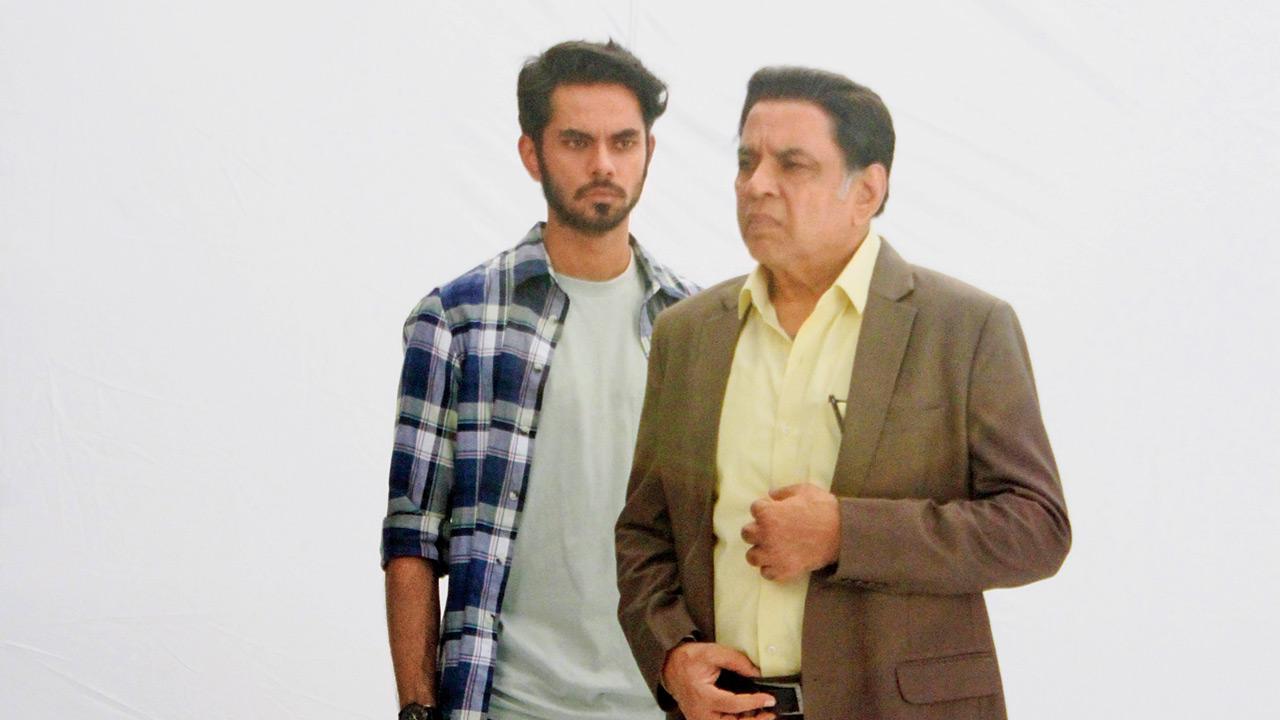
Director Ananth Mahadevan on how Paresh Rawal and Aditya shed their father-son mindset to play strangers in Past Tense
Upala KBR (MID-DAY; December 16, 2024)
Director Ananth Mahadevan’s next, Past Tense, sees father-son Paresh Rawal and Aditya Rawal share screen space for the first time. What makes their on-screen dynamics interesting is that they play two strangers confronting each other in the human drama. The director says that he had gone to narrate the script to Paresh at home, when he met Aditya.
“As I started conversing with Aditya, I realized he was the perfect fit for Past Tense. Rarely do you find an actor so sensitive to his socio-economic environment, and having cinematic sensibilities,” says Mahadevan of the actor, who was last seen in Bambai Meri Jaan (2023).
Inspired by a real-life episode, Past Tense revolves around a young man, who lives with his adoptive parents and is consumed by the desire to know why his biological parents abandoned him. “The newspapers had reported about this boy, who had discovered that he was abandoned by his biological parents [and set out to find them]. The media reports didn’t go that deep, but I took it beyond the abandonment and discovery. It’s a mistake he makes because sometimes the truth can hit you so badly that you wish you had never sought it,” shares the director.
While Aditya plays the protagonist, Paresh essays one of the five pivotal characters he meets on his journey. Mahadevan says the two actors had to undergo workshops to slip into their roles. “Their chemistry was intriguing to watch. They had to shed the father-son mindset. Since it was the first time they were acting together, it must have taken them a lot of energy to assume their volatile parts.”
The film also stars Adil Hussain and Sharib Hashmi.
There is a risk in depicting a religion that you don’t belong to-Aditya Rawal
8:20 AM
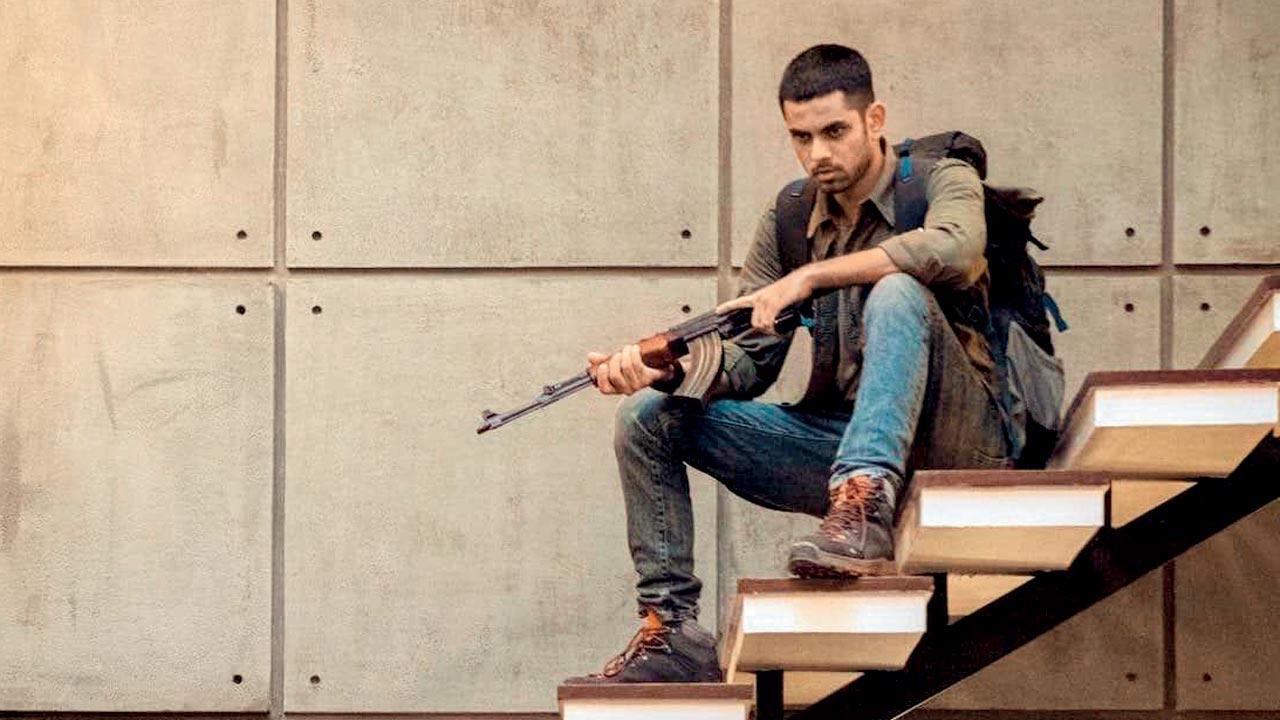
Faraaz actor Aditya says director Hansal Mehta made them undergo workshops to ensure they presented Islamic practices accurately
Priyanka Sharma (MID-DAY; February 2, 2023)
Going into Faraaz, Aditya Rawal understood the responsibility of playing a character that belongs to a religion, which has been unfortunately stereotyped in Hindi cinema. The actor, who plays radicalised youngster Nibras in the hostage drama, wanted to make sure that he portrayed different aspects of Islam correctly. That is where director Hansal Mehta stepped in, approaching the subject with the sensitivity and accuracy it deserves.
“There is a risk in depicting a religion that you don’t belong to. So, Hansal sir roped in the film’s associate writer, Ekhlaq Ahmed Khan, for workshops. [He taught us] how to recite suras, [helped us] understand some facets of the religion, and how the same point can be interpreted in two ways, which is also what the film is about,” begins the actor.
Faraaz, starring debutant Zahaan Kapoor in the titular role, revolves around the 2016 attack at the Holey Artisan Bakery in Dhaka, where terrorists held customers hostage for over 12 hours before killing over 20 of them. Noting that a story so sensitive could be easily misrepresented, Aditya credits Mehta, and writers Kashyap Kapoor, Raghav Kakker and Ritesh Shah for infusing it with empathy.
“From our first meeting, Hansal sir and I sensed the direction we wanted to take for Nibras. A lot of radicalized youngsters are vulnerable, lonely and get [influenced by] the wrong kind of people. They are intelligent, driven boys who could have become world leaders. Instead, they were taken down this dark path.”
While the film is set to release tomorrow, Aditya — who was recently seen in Aar Ya Paar — has earned a nod of approval from actor-father Paresh Rawal. He says he will treasure his father’s compliment for years to come. “My father was quite moved by the film. He said that I should consider myself lucky as actors usually get such stories after spending years in the industry.”
I don’t know whether Akshay Kumar is doing Hera Pheri 3, but I know that Kartik Aaryan was part of it-Paresh Rawal
2:47 PM
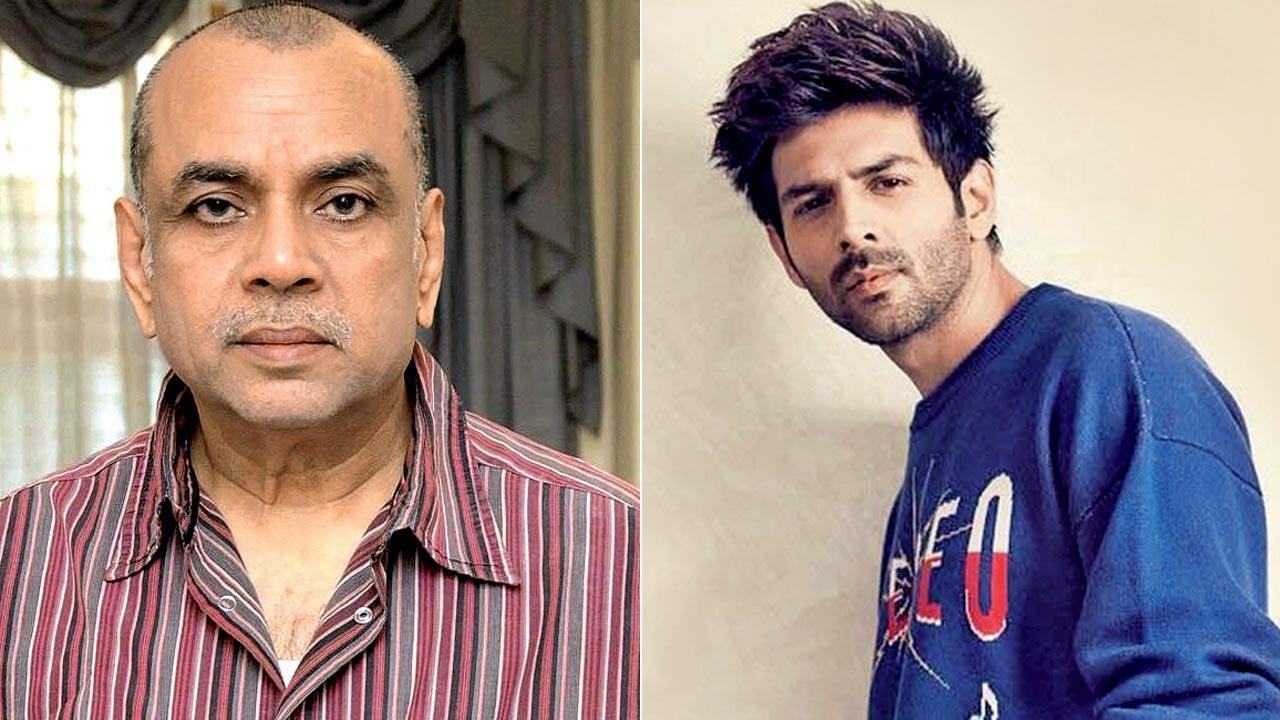
Paresh, who stirred controversy by revealing that Aaryan has joined Hera Pheri 3, says there is no clarity about Akshay reprising his role
Upala KBR (MID-DAY; January 15, 2023)
A string of releases is in the pipeline for Paresh Rawal. While The Storyteller is doing the rounds of international film festivals, Shehzada and Dream Girl 2 are on the anvil. However, it is his fourth venture, Hera Pheri 3 that has everyone’s attention. Last November, the veteran actor made headlines when he revealed that Kartik Aaryan had joined the upcoming instalment of the comedy. Soon, it was learnt that Akshay Kumar would not reprise his role as the street-smart Raju in the franchise—a decision that caused heartbreak among fans.
A string of releases is in the pipeline for Paresh Rawal. While The Storyteller is doing the rounds of international film festivals, Shehzada and Dream Girl 2 are on the anvil. However, it is his fourth venture, Hera Pheri 3 that has everyone’s attention.
Last November, the veteran actor made headlines when he revealed that Kartik Aaryan had joined the upcoming instalment of the comedy. Soon, it was learnt that Akshay Kumar would not reprise his role as the street-smart Raju in the franchise—a decision that caused heartbreak among fans.
In the weeks after Rawal’s revelation, Kumar had confirmed his exit from Hera Pheri 3, stating that he was “not satisfied” with the script. However, rumours suggest that co-star Suniel Shetty is trying to convince him to return to the project. “I don’t know whether Akshay is doing the film, but I know that Kartik was part of it. It happened in front of me. That’s why I said it’s true. Once the script is complete, things will become clearer,” adds Rawal.
The past year has been significant for the actor whose son Aditya—after debuting with Bamfaad (2020) – was seen in Aar Ya Paar. Soon, he will feature in Hansal Mehta’s Faraaz. While star kids are usually launched in a grand manner, Rawal says he was clear that Aditya would have to carve his own path.
“I don’t believe in nepotism. If my son wants to be an actor, I will do whatever I can to help him. But it is the public, not me, who will make Aditya the star. We have seen big producers launching their sons who fizzled out because the public didn’t accept them. I have given him an education, good values—now he has to carve his own journey. He is level-headed, tenacious and hard-working.”
There was no question of my parents launching me-Aditya Rawal
8:27 AM
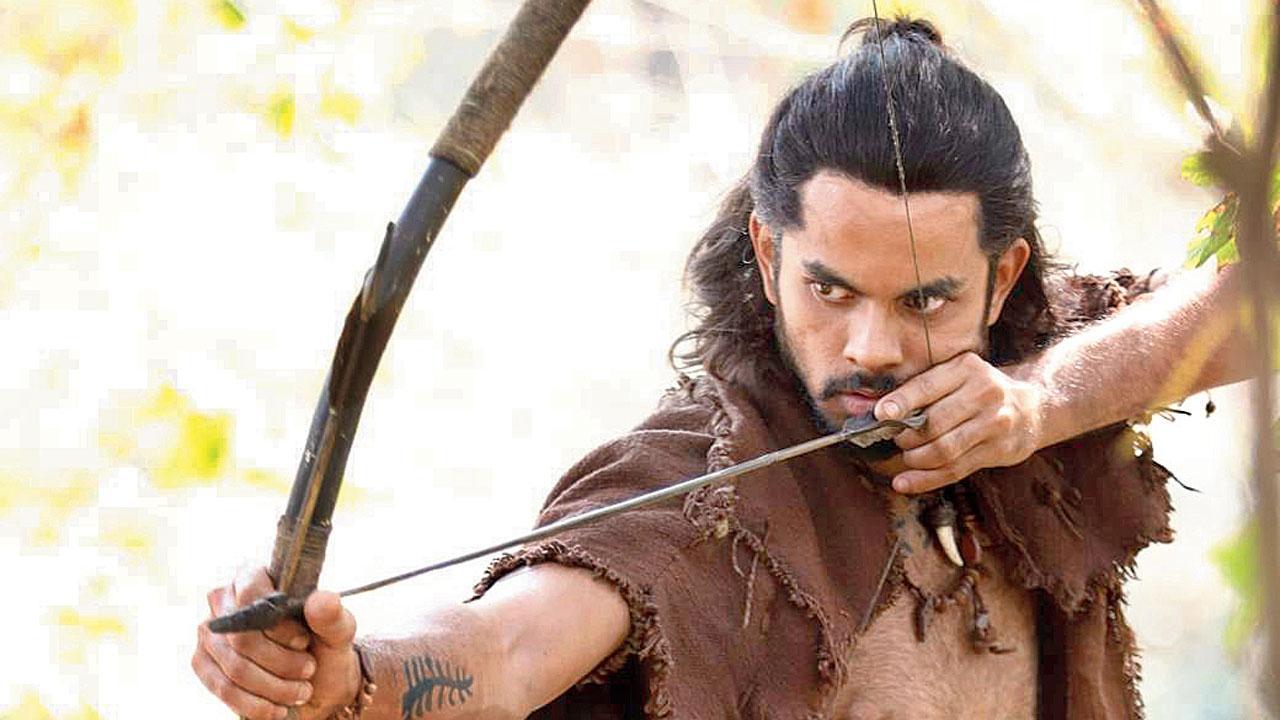
Aar Ya Paar actor Aditya says he wants to build his career by ‘going out there and auditioning’, instead of relying on the privileges of being Paresh Rawal’s son
Priyanka Sharma (MID-DAY; December 24, 2022)
No grand launch, no social media splash. Unlike the hullabaloo created around a star kid’s launch, Aditya Rawal — son to actors Paresh Rawal and Swaroop Sampat — made a quiet debut in 2020 with Bamfaad. Two years on, he is gearing up for his web series debut with Aar Ya Paar. Director Siddharth Sengupta’s thriller, also starring Sumeet Vyas and Patralekhaa, sees Aditya in the role of a tribal archer.
“Siddharth sir has a vision. So, you know that there will be a story that is [making a larger statement], and is not scattered. Another big draw was my character’s journey, from being a member of an isolated tribe to getting involved in global crime,” he says of the Disney+ Hotstar offering.
Besides Aar Ya Paar, Aditya has Hansal Mehta’s hostage drama Faraaz in the pipeline. As he takes baby steps in the industry, the actor is happy to build his path on merit and patience, rather than connections.
“There was no question of my parents launching me. I never expected that. That’s not how we function as a family, nor would I want it because I would feel as if I’ve not earned it. It was always about going out there, auditioning, and hopefully, getting parts I can sink my teeth into.”
That said, Aditya doesn’t dismiss the privilege that comes with being Paresh’s son. He is well-aware that it enables him to get a foot in the door. “I absolutely agree that it is easier for [star] kids. If there are filmmakers I want to meet, I might get the opportunity to meet them. If as a writer, I want a production house to read my script, chances are they will read it. But after a point, that levels out. You might bag one film or one show, but if they don’t like [your work], you won’t get another chance.”
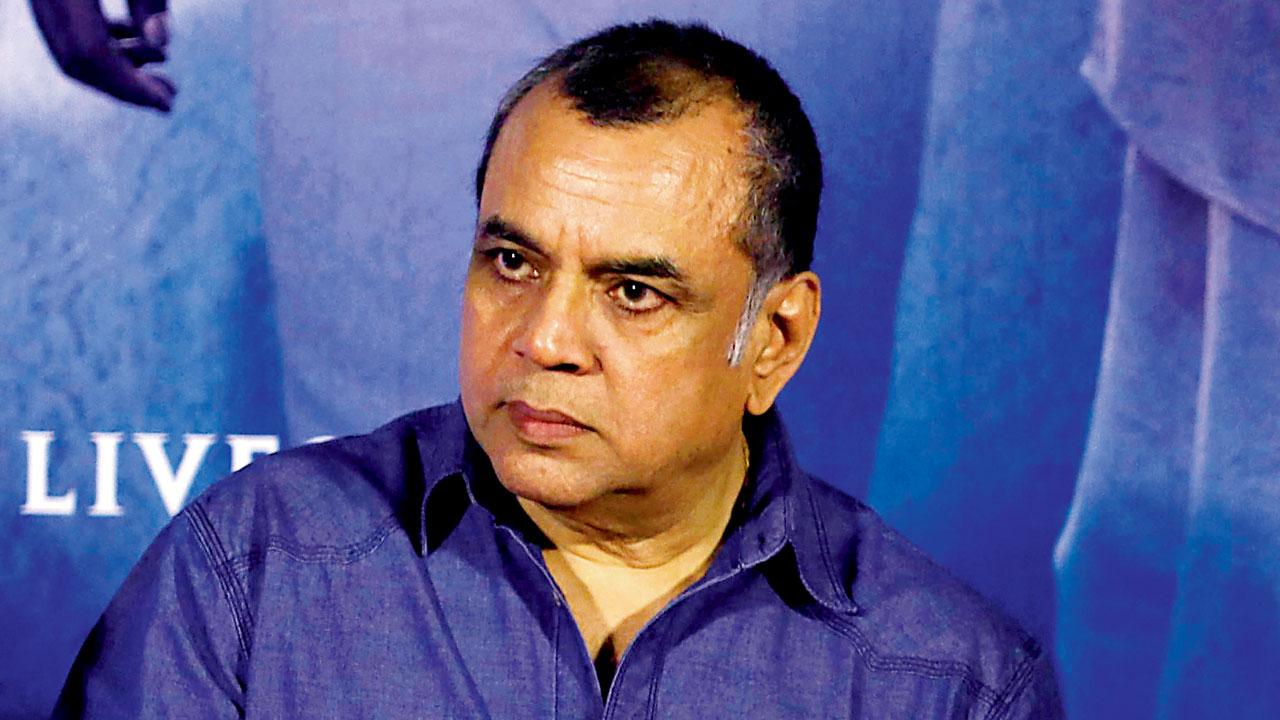
Success has emboldened me to continue being fearless-Hansal Mehta
9:39 AM
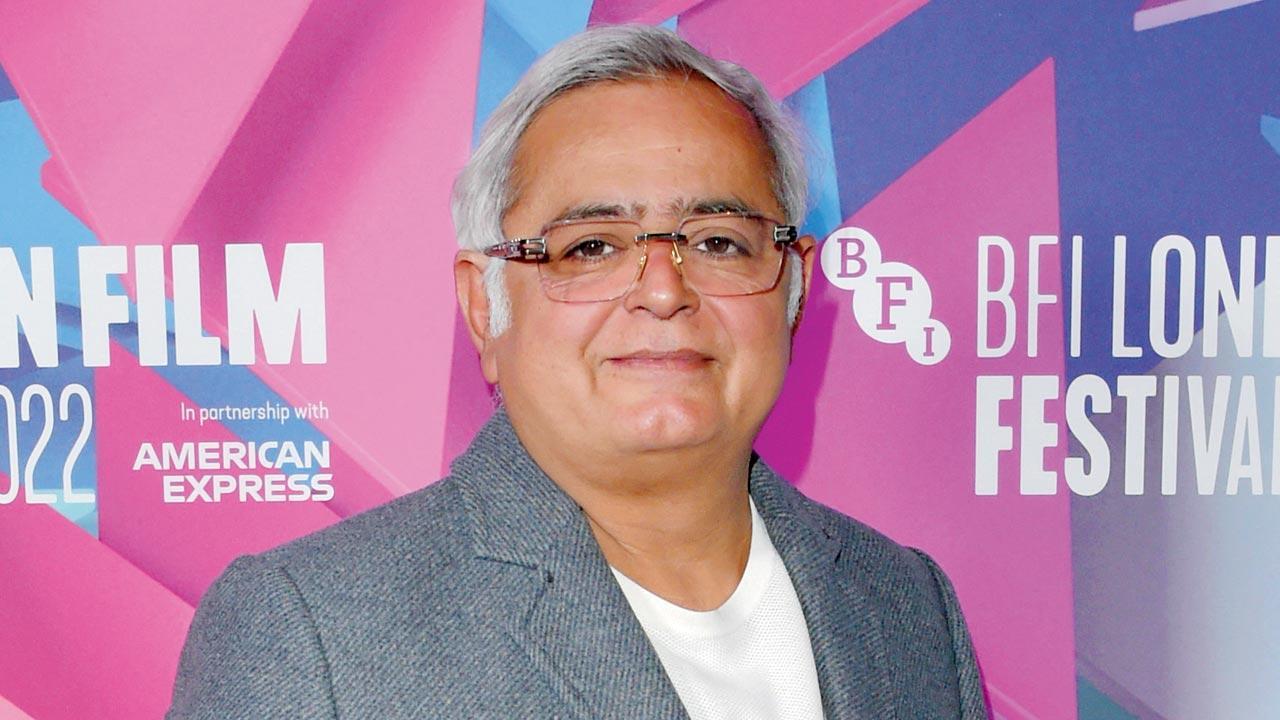
After helming the hit show, Scam 1992, Hansal Mehta on shifting gears to make hostage drama, Faraaz, with new faces
Mohar Basu (MID-DAY; November 6, 2022)
Hansal Mehta, who had a smashing success in Scam 1992: The Harshad Mehta Story (2020), believes that the biggest upside of success is telling stories with abandon, without falling prey to compromises. “What has obviously changed for me is that I make some money,” he quips. “Besides that, I will always do what I do best—tell stories fearlessly. Success has emboldened me to continue being fearless.”
His pursuit for brave stories has led him to Faraaz. After Scam 1992 that caught the nation’s interest, Mehta has shifted gears to make an admittedly “small” film featuring Zahaan Kapoor and Aditya Rawal. The film—which recounts the 2016 terror attack in Holey Artisan Bakery in Dhaka, where armed gunmen held customers hostage for 12 hours before killing over 20 of them—was premiered at the BFI London Film Festival last month.
“It was a conscious decision that the moment Scam 1992 comes out, I will get this film going [regardless of the former’s fate]. I have made it exactly how it should be made. It has no trapping, no stars. Casting for the movie wasn’t easy. We took months to get Aditya and Zahaan. Along with them, there are five new faces in the film. There was an exhaustive audition process; we then workshopped for months. Even when we shot, I would constantly shift the scenario. I wanted people to respond to the scenes in an impromptu way. The film is an example of exceptional casting.”
The hostage drama is set to release at a time when the world around us is increasingly sensitive. What are the challenges of telling stories that have a social impact, at such a time? “Shahid [2013] is on YouTube right now, and is completely mutilated as a movie. It hurts me as a maker. The film begins with the riot sequence eliminated. The challenge is to continue telling stories and find like-minded collaborators. On Faraaz, I lucked out. I found Anubhav Sinha and Bhushan Kumar to back the film. Given the socio-cultural climate we are in, the challenge is to release the film. Even business-wise, these are challenging times and we have to maximise a film’s potential to reach the masses and minimise monetary risk.”
Is OTT era the end of the star reviews?
8:29 AM

With no box office numbers to lean on, the focus may shift from a film’s stars to its story
Juhi Chakraborty (HINDUSTAN TIMES; August 30, 2020)
 The Coronavirus pandemic, which brought the entertainment industry to a standstill, also made producers realise that releasing new films digitally is the best option for now. And films have been making a beeline to get a release on OTT platforms. But in the absence of box office numbers or any indicators to determine a film’s success or failure, there is no clarity on which actor’s film is faring better than the other’s, thus leaving the ‘star’ system redundant .
Ad filmmaker-turned-Hindi film director Vinil Mathew says since we don’t have any way to measure the popularity of a film or an actor, “it does kind of dilute and affect the brand value of an actor. I think till one devises parameters, there is no way to assess an actor’s value any more on the basis of his films. A star is a product of theatrical releases and, without it, obviously it would affect their stardom”.
 The lack of box office figures makes OTT releases an entire game of perception management since there is little authentic data to back it up. “Anybody can say ‘these many people have watched my film on the first three days’, there is no way to authenticate it. Stardom is out of the question now. One important component of stardom was pulling people to the theatres, there is nothing like that on OTT platforms. The push, pull and aura of stardom have completely vanished on OTT,” says film marketeer Varun Gupta, founder-director of MAX Marketing.
 Not all are complaining, though. Actor Amyra Dastur, who has starred in a web-only released film Rajma Chawal (2018), says things are better now than ever before because everything is based on word-of-mouth, not just box office collections. “Now you have to do everything based on talent. Yes a big star’s name is going to garner more interest but, at the end of the day, it is all about how good the content is. All you care about is whether it was good or not, just like in old times,” shares the actor.
The democratic nature of OTT platforms is what might make the star system and the concept of star value obsolete, feels actor Nimrat Kaur.
Agrees ad filmmaker Prahlad Kakar, who says that the OTT platforms have made the star system “very open”. “People will respect you if they relate to you, if not then they will diss you. Now with the OTT (releases) there is a breath of fresh air. It is all about content and a star does not matter,” he explains.
“Value is dependent on how you measure it. For both, the actors and us, ” expresses Aparna Acharekar, programming head, ZEE5 India, while adding, “We have had plenty of stars whose debut films premiered on the platform and the response has been phenomenal! For instance, Shalini Pandey and Aditya Rawal received immense appreciation for their roles in Bamfaad and we left no stone unturned when it came to talking about their hard work. The reach that we, as a video streaming platform are able to provide not just in India, but globally, is immense and talent – newcomers or established – are seeing this as a huge opportunity.”
Paresh Rawal is not as mad as his Hera Pheri character, but he’s great fun to grow old with-Swaroop Sampat
8:24 AM

With Paresh and Swaroop Sampat Rawal’s son, Aditya, making his acting debut, the family talks about adapting to the times and the changing face of cinema
Kunal Guha (MUMBAI MIRROR; May 17, 2020)
The only “silver lining” in the nationwide lockdown so far, says Swaroop Sampat Rawal, is that the family has got a chance to watch Aditya’s acting debut in the web film, Bamfaad.
“After watching it, Aditya and [older son] Aniruddh spoke to Paresh at length about cinema and acting. It was like being part of an in-house masterclass,” says the 61-year-old actor and education counsellor, who made her comeback on the big screen with Uri last year.
Surprisingly, Aditya’s father, veteran actor and former Lok Sabha MP, Paresh Rawal, only learnt about his son’s decision to face the camera five hours before he went on set. “For some reason, he decided not to tell me earlier,” says Rawal Sr, whose only bit of acting advice for his son was “to preare hard and be spontaneous”.
Before his debut, the 28-year-old had pursued the dramatic writing programme at the Tisch School of the Arts, New York, and an initiation course in theatre and performance at the London International School of Performing Arts. He also wrote and directed The Queen, a stage production about a 16th century Rajput queen who is abandoned by her husband for a younger woman. The play, which premiered in New York, was to be staged in Mumbai, but had to be postponed due to the Coronavirus pandemic. It did, however, enjoy a 12-week run in the Big Apple, and earned him the New York Innovative Theatre Award.
Reflecting on her son’s debut, Swaroop points out how the entertainment industry has become a lot more organised now. “In my time, it was just luck by chance. I became Miss India in 1979 and shortly after, landed two roles with Yash Raj [Dilip Naik’s Nakhuda, 1981] and Hrishi da [Hrishikesh Mukherjee’s Naram Garam, 1981],” she says, of her memorable onscreen turns. “Even Paresh got one of his early breaks in Arjun (in 1985) because the one of the producers [Karim Morani] was in college with him.”
Swaroop says she took a break from films in the mid-1980s, when she felt she was seen as “too old to play the heroine”. “I have a problem of not being able to look old. Even when I played an older character, I would look as young as the heroine,” she laughs, adding that her decision to turn away from films was also to be a full-time mum. “Paresh was working two to three shifts a day. Someone had to be at home with the boys.”
Aditya says his childhood was far removed from the world of cinema, where conversations about films and theatre were few and infrequent. “In fact, the only time I remember being on a film set while Dad was shooting was OMG Oh My God [2012], where I was an assistant director,” says the youngster, who has also assisted Ashutosh Gowarikar with the story and screenplay of Panipat [2019]. But he does have his share of memories of his father speaking fondly about theatre and acting in plays. “My favourite performance of his is Khel [2000], with Naseeruddin Shah. Watching them together was fabulous and enlightening. They are both so passionate about their craft,” says Aditya, referring to the Hindi adaptation of British playwright Anthony Shaffer’s Sleuth.
In recent years, Swaroop has delved into experiential learning, which essentially employs her skills as an actor in teaching. Having received a full scholarship from a UK university, she completed her doctorate in education on the role of drama in enhancing life skills. Last year, Swaroop trained 2.5 lakh teachers in the subject over a four-day workshop in Gujarat, and plans to conduct a similar session for nearly five lakh teachers in Maharashtra soon. She has also visited tribal areas in the country and taught life skills through drama to children from low income households.
“They were so excited to learn from me that they went home and proudly told their parents, ‘Our teacher is a Miss India’,” she says. Her newly-discovered passion for teaching has had a profound effect on her. “While narrating a story in a classroom, you have to be louder than usual, which makes Paresh often ask me, ‘why are you so animated?’ In fact, when I’m on screen now, I have to readjust my levels,” she says, adding that her work in cinema has given her a lifelong training in adapting to new things. “I remember Hrishi da would explain a whole scene and ask me to do it in one take… and if I protested, he would say, ‘you guys are theatre actors, you should manage it’.”
Her return to films has been smooth, even though she sometimes “feels like a dinosaur” on the sets. “I didn’t grow up in the digital age. I was thrown into it. We had huge cameras and lights then, and now, the camera has shrunk so much that you don’t even feel its presence,” Swaroop says.
Even a veteran actor like Paresh Rawal finds it tough at times to keep up. At 64, he feels there’s “plenty to learn and even more to unlearn”. “You realise that a lot of what you’ve picked up over the years is rubbish,” he says, lauding contemporary actors such as Nawazuddin Siddiqui, Ayushmann Khurrana, Rajkummar Rao and Adil Hussain for their compelling work. “When you look at them, you can see that the standards of acting have also changed.”
Films, too, have come a long way since he made his debut in 1982 with Naseeb Ni Balihari, says the Padma Shri recipient. Earlier, films were clearly categorised as either commercial or arthouse and parallel cinema, the latter being dominated by heavyweights such as Shyam Benegal, Ketan Mehta, Govind Nihlani and Syed Mirza. “Now, films are not so segregated,” he says. “Another blessing is that since the foreign companies have opened offices here, we can no longer copy from their films, lest we get penalised,” he says with a chuckle. “This is also why we have begun mining our own stories and histories.”
Known for his comic timing, Paresh likes to subject his family to his one-liners. “Often, his sense of humour lands us in sticky situations,” Aditya says, referring to his father’s tweets. “He’s not as mad as his Hera Pheri character, but he’s great fun to grow old with,” says Swaroop.
Not many actors get such a unique launch-Aditya Rawal
8:36 AM

As his debut film Bamfaad eyes direct-to-web release due to lockdown, in his first press interview, Paresh Rawal's son Aditya on being launched sans fanfare and following in dad's footsteps
Mohar Basu (MID-DAY; April 8, 2020)
 A star kid's foray into B-Town is all about razzmatazz, complete with a promotional spree and the youngster's face being splashed on billboards across the country. In sharp contrast, Aditya Rawal — the son of veteran actor Paresh Rawal — finds himself getting the most unusual Bollywood break amid the Coronavirus lockdown as his debut vehicle, Bamfaad, directly drops on Zee5.
"Not many actors get such a unique launch. Going forward, I hope to have the regular round of promotions, but I am relishing what I have," says the actor. Witnessing one's maiden venture play out on the big screen and dropping by Gaiety Galaxy over the first weekend to gauge the film's performance are almost a rite of passage for B-Town hopefuls. But he does not begrudge the lack of it all. "I did not want a traditional break. Being on the big screen has its appeal, and I will get there in the future. Once the lockdown is lifted, there will be a flood of movies, and in the process, many films may get lost. So, I'm glad that Bamfaad is releasing at a time when the hunger for content is more than ever."
With the film being backed by Anurag Kashyap, Aditya is proud that his first work has the stamp of approval from his mentor. "He has a massive library of books and DVDs, so I had assumed he hadn't read or watched even half of those. But Anurag sir has read all the books thrice over and watched the movies on loop. He has so much knowledge to impart."
With one of the finest talents of Indian cinema for his father, Aditya knows he has big shoes to fill. "There is the pressure to live up to his name, but he is so far ahead in the game. I will worry about it 40 years later when I have done half the work that he has. I am thankful that everyone is curious about me because I happen to be his son. But I need to carve my own identity."
Paresh Rawal's son Aditya to make his debut in Anurag Kashyap's Bamfaad
7:58 AM

Anurag Kashyap will be presenting the passionate love story which is set in Allahabad and has Arjun Reddy’s leading lady Shalini Pandey opposite him
Natasha Coutinho (MUMBAI MIRROR; January 22, 2019)
 Actors Paresh Rawal and Swaroop Sampat’s son Aditya is all set for a big screen launch in a film that Anurag Kashyap (right) will be presenting. Titled Bamfaad, the film is being directed by debutant Ranjan Chandel (left; below). Shalini Pandey (bottom), the leading lady of the Telugu film, Arjun Reddy, which is currently being remade in Hindi as Kabir Singh, is being introduced to Bollywood opposite Aditya. The film was shot in Kanpur towards the end of 2018, amidst utmost secrecy. It is now in post-production.
 Anurag confirmed the news, saying, “Ranjan has been a long-time collaborator as writer and assistant. Producer Ajay Rai and I worked together on Gulaal and Dev D. I am fully involved with the project with the producers Ajay, Pradeep Kumar and Alan McAlex.”
When quizzed on his choice of newcomers, Ranjan insisted that both his casting director Taran Bajaj and he felt that Aditya and Shalini were best suited for the script. “We met some experienced actors but eventually zeroed in on them. Shalini has done some films down South but this will be her first Hindi film as the lead. Aditya comes from a film background, both his parents are big names, yet he surrendered himself to my vision completely. We had a one-month workshop before the film went on the floors and Aditya accompanied me on my recee as well. Both are fantastic actors and very involved with the project,” he exults. The film also has Vijay Verma and Jatin Sarna playing significant roles.
Speaking about the unusual title, he explained that it is a passionate love story set in Allahabad. “Bamfaad is a North Indian slang for an explosion and aptly describes these characters and their world,” he asserts, saying the film will release in the next few months though they are yet to finalise the date.

I have been feeling the pinch of having not worked with Rajkumar Hirani-Paresh Rawal
8:30 AM

Having rejected the role eventually played by Boman Irani in Hirani's Munna Bhai MBBS, Rawal confesses he was eager to work with "fantastic" filmmaker before Sanju came his way
Shaheen Parkar (MID-DAY; June 10, 2018)
Politicking hasn't slowed down Paresh Rawal's Bollywood outings. The veteran actor says life is all about juggling various roles, and striking a balance. The Bharatiya Janata Party MP visits his constituency, Ahmedabad East, at least four times in three months. "I shuffle between Mumbai and Ahmedabad. I come from a theatre background, so, I am used to hopping from city-to-city for shows."
Presently, Rawal is promoting his next, Rajkumar Hirani's Sanju. Sanjay Dutt's biopic sees him play the late Sunil Dutt. We meet Rawal at Hirani's office on the Andheri-Kurla road. The air conditioner isn't working properly. It's hot, but he isn't perturbed. He is used to finding himself in sticky situations — literally, in this case — especially after entering politics in 2014. Social media savvy, he often finds himself trolled for taking on the opposition. "Now, everything's out in the open. You can discuss about any topic," he reasons. Last seen in Tiger Zinda Hai (2017), Rawal says, off late, he picks films he genuinely wants to invest time in.
"At this stage in my career, I don't want to work on any [and every] film. I don't want to waste time doing something I may not end up liking. I have done my share of masala films. Now, the makers and the subject matter. There is really good cinema being made." Hirani's Sanju certain qualified as one among them. "I know that there were many actors who were considered [for this part] before me."
Hirani had approached his 3 Idiots (2009) and PK (2014) actor Aamir Khan for the role. But, Hirani had said that since Mr Perfectionist had already played a father in Dangal (2016), he did not want to take on another role that saw him as one. Khan told him he would only be given roles of similar nature if he agreed to do so. But while playing Sunil Dutt was reason enough for Rawal to give his nod to the role, another factor was instrumental in sealing the deal. "Raju had approached me for Munna Bhai MBBS (2003) for the part that was eventually played by Boman Irani. But, I could not do it then. Over the years, I have been watching his films, and feeling the pinch of having not worked with him. His films are well made, and the results are fantastic."
This is Rawal's first collaboration, not only with Hirani and writer Abhijat Joshi, but also with Ranbir Kapoor, who plays the titular role. Rawal says that while it was stated to Kapoor that he must resemble Sanjay, no such demand was made of him. Rawal had briefly interacted with the late actor on matters concerning the Nargis Dutt Cancer Foundation. Even his collaboration with him in Rajkumar Kohli's Virodhi (1992) did not lead to much communication since the two did not share screen space.
"Once, Dutt saab sent me a birthday card, out of the blue. I still have it. I always wondered why he had sent it to me when we barely knew each other. Strangely, I am now playing him." Rawal has not tried to ape his mannerisms. "Dutt saab had an affable personality and a unique voice. I looked up to him as an actor, and person. He went through a lot in life, wife [Nargis] coping with cancer, son battling with drugs. He endured it because of his strong personality." As for the film's protagonist goes, Rawal says Hirani has been particular about showcasing the man without sugar-coating his actions.
"He has not hidden any aspect of his life. Usually, a biography paints the protagonist as a noble man. I am told, Sanjay's precondition was to show his life with honesty." He is hoping that he has done justice to Dutt saab's character, which he feels is a father-son story. Coming up next for Rawal is Aditya Dhar's Uri based on the 2016 attacks in which he plays National Security Adviser Ajit Doval. He is also part of Ashutosh Gowariker's Dear Dad, based on his ongoing play by the same name. A Priyadarshan film is also lined up. Rawal terms his political outing as a "pilgrimage". "The coming months are crucial in the run-up to the 2019 general election. Ask him about rising petrol prices and he says, "We have to repay the debts of the past government. Only if people had raised their voice earlier, we would not have to see such days due to the past government's heavy, indiscriminate borrowings from the World Bank." Now, he is ready to take the plunge again in the electoral fray next year.
Junior Rawals eyeing Bollywood
Rawal's sons, Aditya and Aniruddh are also Bollywood-bound. Aditya studied script writing in New York while Aniruddh, who worked as an assistant director on Sultan (2016) and Tiger Zinda Hai (2017) is keen to be an actor. “I will not be launching them, they will have to find their own way." Rawal's actor-wife Swaroop Sampat will be seen in a web show, The Great Indian Dysfunctional Family. “She is engrossed with her life skill programmes for healthy living,” says Rawal.

Rawal with his family at a book launch in the city
My films have nothing to do with my political ideology-Paresh Rawal
7:38 AM

Hiren Kotwani (BOMBAY TIMES; July 6, 2017)
He's undoubtedly one of
Bollywood's best actors. Comedies, tear-jerkers, negative roles - there's
little Paresh Rawal hasn't done in his career spanning three-and-a-half
decades. And to say that he has performed each role with aplomb is, as
the cliché goes, an understatement. While he's a delight to watch on
screen, off it, he's known
for his brutal honesty.
Clearly, the actor-politician doesn't believe in being politically correct. As he says during the course of the interview, “If I'm not aware of something, I won't comment. Main gol gol jawab nahin doonga.“ Rawal recently courted controversy when his comments on writer-activist Arundhati Roy sparked a national debate. We caught up with him in the midst of promotions for his upcoming entertainer, Guest Iin London, which releases this Friday. Excerpts...
It has been two years since your last release, Welcome Back. Have you become extra choosy?
Not extra choosy per se, but kuchh dhang ki script toh ho yaar. Kabhi mil jaati hai... I have a good line-up now. Rajkumar Hirani's biopic on Sanjay Dutt, Tiger Zinda Hai, Ananth Mahadevan's film based on Satyajit Ray ... I'm happy with the movies I'm working on. Like my next film, Guest Iin London, is a family entertainer in which I have a good role. The fact that it has people I love working with was an added temptation. After so many years, you become confident that you have some control over your craft. So, I look for roles that can challenge that confidence. Money is not the criteria. In fact, I'm doing a couple of limited-budget movies; the biggest joy is to be associated with good cinema.
This time around, you play an unannounced guest in the house of a young couple (played by Kartik Aaryan and Kriti Kharbanda) in London...
In Atithi Tum Kab Jaoge (2010) too, Ajay Devgn and Konkona Sen Sharma were younger than me. I love working with younger actors. Today's generation is focused and career-oriented. They are not greedy to sign 10 films. They are selective and don't mind waiting to do good work.
Talking about the younger generation, are your sons planning careers in movies?
My younger son Aditya is into screenplay writing. He has completed his graduation from New York University . My elder son Aniruddh is an assistant director. I will support and encourage them the way my parents supported me, but if they expect me to launch them, that won't happen. They should make it on their own.
On a lighter note, your character in Guest Iin London is that of an unannounced guest. How do you treat such visitors in real life?
Honestly, I hate anyone except friends coming unannounced to my home. I never pay surprise visits to people. In fact, even when I call up someone, I ask if they are free to talk. Yeh toh ghar par jaane ki baat hai! So, if someone drops in suddenly, I tell them that I'm stepping out. I'm blunt that way. Kyun faaltu ka jhelna!
As a guest, do your hosts go out of their way to please you, keeping in mind your celebrity status?
I don't like being given extra attention. If I am coming over for lunch or dinner, cook whatever you would have prepared for yourself. Don't show me your culinary skills. Main milne jaata hoon, khaana khaane nahin. Milne ka mazaa aana chahiye. If you get good food, then you're busy eating and don't get time to talk. Uss mein mazaa nahin hai.
Coming back to movies, does being a Member of Parliament (he is a Lok Sabha member from Ahmedabad East) influence your choice of roles?
Not at all. My films have nothing to do with politics or political ideologies. My work as an actor is different from my work as an MP. I don't mix the two.
Be it the content or the way of functioning, Hindi cinema has undergone drastic changes over the years. Have you ever had difficulty adapting to them?
No, this is the golden era of cinema. There are talented actors, and writers and directors with fresh ideas. Work ethics have also changed. Financial dealings are structured and every actor gets a bound script. It's all very professional now and it's a joy to work in this atmosphere.
Do you mean that you miss nothing about the previous decades?
Earlier, we used to shoot on raw stock and producers would be worried about unnecessary retakes. Now everything is digital, so shots are taken from all angles. Direction kum aur coverage zyada ho gaya hai. Kabhi kabhi thodi boriyat ho jaati hai. What happens is that certain key scenes lose their purity and emotional intensity after three-four takes. From that aspect, I miss the raw stock days. However, the scenario has improved overall.
Nowadays, marketing and promotion play an important role in generating buzz around a film's release. Compared to yesteryears, do you find it all a tad too aggressive?
It is necessary to promote films, irrespective of whether I like it or not, but how innovative we are and how we capitalise on the available avenues depends on us. For example, I am okay with interviews, but if you ask me to visit malls to promote a film, I won't do that. That's foolishness; the crowd in malls doesn't translate into ticket sales. I won't take names, but there was this actor who promoted his movie at a mall packed with people who had gathered to catch a glimpse of him; but despite all that, his film sold only 83 tickets. See, stars will do whatever they are asked to, but it's better to utilise that money on advertising spots.
You are known for not mincing words. As an MP of the ruling coalition, what is your take on the government's stance on various industry-related issues, including the censorship controversy?
Shyam Benegal sahab has given his views; let's see when they will get implemented. It will take time, as the government cannot change its decisions frequently. Some people insist on removing Pahlaj Nihalani (the Censor Board chief). Where is the guarantee that there will be no issues when someone else is appointed in his place?
Gajendra Chauhan's appointment as the head of FTII (Film and Television Institute of India) was also controversial. Students strongly opposed it and even went on strike...
I agree that Gajendra Chauhan's body of work is not up to your expectations, but every actor has done bad films. That is not a yardstick to measure his managerial abilities. You first listen to him and his plans before accepting or rejecting him. You talk about democracy, toh democratically usko suno toh sahi.
When it comes to controversies, your tweet that writer-activist Arundhati Roy should have been tied to the jeep to avoid stone-pelters in J&K (Jammu and Kashmir) evoked a lot of criticism, and raged a debate on social media. Reportedly, Twitter wanted you to delete the post, too...
Well, they asked me to delete it, but I didn't. My first attack was on her lies. Usne jo anaap-shanap baka tha, uska proof post kiya tha maine. I'm not apologetic about Arundhati Roy at all. She has no right to abuse the army.
But your tweet was seen as inciting violence towards a woman...
Like I explained, if she had been tied to the jeep, no one would have pelted stones. She is their wellwisher. Maine to shaanti ka kabutar chhoda hai. Arundhati knows the condition in which the army works. Jo 'Bharat tere tukde honge' ka sloganeering karte hain, woh violence failate hain.
You were planning a biopic on our Prime Minister, Narendra Modi. Is it still on?
I'm yet to nail the script. It's not easy to write a script for a biopic on Narendra Modi. Where do you put the full stop? Generally, biopics are made on those who are on the shelf, yeh toh ongoing hai.
Clearly, the actor-politician doesn't believe in being politically correct. As he says during the course of the interview, “If I'm not aware of something, I won't comment. Main gol gol jawab nahin doonga.“ Rawal recently courted controversy when his comments on writer-activist Arundhati Roy sparked a national debate. We caught up with him in the midst of promotions for his upcoming entertainer, Guest Iin London, which releases this Friday. Excerpts...
It has been two years since your last release, Welcome Back. Have you become extra choosy?
Not extra choosy per se, but kuchh dhang ki script toh ho yaar. Kabhi mil jaati hai... I have a good line-up now. Rajkumar Hirani's biopic on Sanjay Dutt, Tiger Zinda Hai, Ananth Mahadevan's film based on Satyajit Ray ... I'm happy with the movies I'm working on. Like my next film, Guest Iin London, is a family entertainer in which I have a good role. The fact that it has people I love working with was an added temptation. After so many years, you become confident that you have some control over your craft. So, I look for roles that can challenge that confidence. Money is not the criteria. In fact, I'm doing a couple of limited-budget movies; the biggest joy is to be associated with good cinema.
This time around, you play an unannounced guest in the house of a young couple (played by Kartik Aaryan and Kriti Kharbanda) in London...
In Atithi Tum Kab Jaoge (2010) too, Ajay Devgn and Konkona Sen Sharma were younger than me. I love working with younger actors. Today's generation is focused and career-oriented. They are not greedy to sign 10 films. They are selective and don't mind waiting to do good work.
Talking about the younger generation, are your sons planning careers in movies?
My younger son Aditya is into screenplay writing. He has completed his graduation from New York University . My elder son Aniruddh is an assistant director. I will support and encourage them the way my parents supported me, but if they expect me to launch them, that won't happen. They should make it on their own.
On a lighter note, your character in Guest Iin London is that of an unannounced guest. How do you treat such visitors in real life?
Honestly, I hate anyone except friends coming unannounced to my home. I never pay surprise visits to people. In fact, even when I call up someone, I ask if they are free to talk. Yeh toh ghar par jaane ki baat hai! So, if someone drops in suddenly, I tell them that I'm stepping out. I'm blunt that way. Kyun faaltu ka jhelna!
As a guest, do your hosts go out of their way to please you, keeping in mind your celebrity status?
I don't like being given extra attention. If I am coming over for lunch or dinner, cook whatever you would have prepared for yourself. Don't show me your culinary skills. Main milne jaata hoon, khaana khaane nahin. Milne ka mazaa aana chahiye. If you get good food, then you're busy eating and don't get time to talk. Uss mein mazaa nahin hai.
Coming back to movies, does being a Member of Parliament (he is a Lok Sabha member from Ahmedabad East) influence your choice of roles?
Not at all. My films have nothing to do with politics or political ideologies. My work as an actor is different from my work as an MP. I don't mix the two.
Be it the content or the way of functioning, Hindi cinema has undergone drastic changes over the years. Have you ever had difficulty adapting to them?
No, this is the golden era of cinema. There are talented actors, and writers and directors with fresh ideas. Work ethics have also changed. Financial dealings are structured and every actor gets a bound script. It's all very professional now and it's a joy to work in this atmosphere.
Do you mean that you miss nothing about the previous decades?
Earlier, we used to shoot on raw stock and producers would be worried about unnecessary retakes. Now everything is digital, so shots are taken from all angles. Direction kum aur coverage zyada ho gaya hai. Kabhi kabhi thodi boriyat ho jaati hai. What happens is that certain key scenes lose their purity and emotional intensity after three-four takes. From that aspect, I miss the raw stock days. However, the scenario has improved overall.
Nowadays, marketing and promotion play an important role in generating buzz around a film's release. Compared to yesteryears, do you find it all a tad too aggressive?
It is necessary to promote films, irrespective of whether I like it or not, but how innovative we are and how we capitalise on the available avenues depends on us. For example, I am okay with interviews, but if you ask me to visit malls to promote a film, I won't do that. That's foolishness; the crowd in malls doesn't translate into ticket sales. I won't take names, but there was this actor who promoted his movie at a mall packed with people who had gathered to catch a glimpse of him; but despite all that, his film sold only 83 tickets. See, stars will do whatever they are asked to, but it's better to utilise that money on advertising spots.
You are known for not mincing words. As an MP of the ruling coalition, what is your take on the government's stance on various industry-related issues, including the censorship controversy?
Shyam Benegal sahab has given his views; let's see when they will get implemented. It will take time, as the government cannot change its decisions frequently. Some people insist on removing Pahlaj Nihalani (the Censor Board chief). Where is the guarantee that there will be no issues when someone else is appointed in his place?
Gajendra Chauhan's appointment as the head of FTII (Film and Television Institute of India) was also controversial. Students strongly opposed it and even went on strike...
I agree that Gajendra Chauhan's body of work is not up to your expectations, but every actor has done bad films. That is not a yardstick to measure his managerial abilities. You first listen to him and his plans before accepting or rejecting him. You talk about democracy, toh democratically usko suno toh sahi.
When it comes to controversies, your tweet that writer-activist Arundhati Roy should have been tied to the jeep to avoid stone-pelters in J&K (Jammu and Kashmir) evoked a lot of criticism, and raged a debate on social media. Reportedly, Twitter wanted you to delete the post, too...
Well, they asked me to delete it, but I didn't. My first attack was on her lies. Usne jo anaap-shanap baka tha, uska proof post kiya tha maine. I'm not apologetic about Arundhati Roy at all. She has no right to abuse the army.
But your tweet was seen as inciting violence towards a woman...
Like I explained, if she had been tied to the jeep, no one would have pelted stones. She is their wellwisher. Maine to shaanti ka kabutar chhoda hai. Arundhati knows the condition in which the army works. Jo 'Bharat tere tukde honge' ka sloganeering karte hain, woh violence failate hain.
You were planning a biopic on our Prime Minister, Narendra Modi. Is it still on?
I'm yet to nail the script. It's not easy to write a script for a biopic on Narendra Modi. Where do you put the full stop? Generally, biopics are made on those who are on the shelf, yeh toh ongoing hai.

Kuku Mathur actor beat Paresh Rawal's son, Saqib Saleem to bag the role
7:57 AM

Vickey Lalwani (MUMBAI MIRROR; May 16, 2014)
Little did Ekta Kapoor know what lay in store when she walked into Juhu's Prithvi theatre last year to watch a play, Hero. By the time the curtains came down, she knew who to cast in the lead in one of her next films, Kuku Mathur Ki Jhand Ho Gayi.
Seems Siddharth Gupta beat Paresh Rawal's son Aditya and Huma Qureshi's brother Saqib Saleem (last seen as the coach in Hawaa Hawaai) to the role after a series of auditions.
Ekta had no idea Siddharth is the younger brother of Vikas Gupta who once worked with her and is now the programming head in a music channel.
Siddharth plays a guy from a lower middle class family in his debut film who feels he is jinxed. "Uska bad luck bahut strong hai, issi liye uski jhand hoti rehti hai," says Siddharth who is a qualified engineer. "I wanted to become an actor so I joined a theatre group and landed a three-film contract with Balaji."
Subscribe to:
Posts (Atom)