Showing posts with label Zoya Akhtar interview. Show all posts
Showing posts with label Zoya Akhtar interview. Show all posts
We need respite, not sponsored sunsets-Zoya Akhtar
10:55 AM

Natasha Coutinho (HINDUSTAN TIMES; October 31, 2026)
Filmmaker Zoya Akhtar, born and brought up in Mumbai, has always been vocal about developments in the city and concerns citizens face. Recently, the Maharashtra Maritime Board (MMB) invited tenders to introduce floating advertising barges and illuminated hoardings along Mumbai’s coastline, and Zoya opens up on her thoughts on it.
“This city is bursting at the seams, with its population, construction, traffic, pollution, noise, garbage, lack of open spaces, felling of trees etc. It’s already an assault on the senses. We are in desperate need to connect with nature, and not disconnect further. And we need respite, not sponsored sunsets! Why would people want to look at ugly hoardings when sitting by the water,” she shares.
Zoya adds that citizens should have a say before such installations are approved. “People pay through their noses for homes with a view and even if they don’t live by the sea, they spend a considerable amount to live in Mumbai. Their opinion has to matter.”
Concerns have also been raised about the impact of such advertising on Mumbai’s coastal environment and marine life. Separately, the growing presence of commercial signage raises another question: where should one draw the line between creative advertising and visual pollution? “Please mark certain areas for commercial advertising and limit it to that. A city must not have signage everywhere. It’s mentally taxing, we don’t realise but to be bombarded with constant messaging is very stressful for the mind,” Zoya ends.
Zoya Akhtar just wanted to follow around three boys, no hair/make-up for Zindagi Na Milegi Dobara-Reema Kagti
8:36 AM
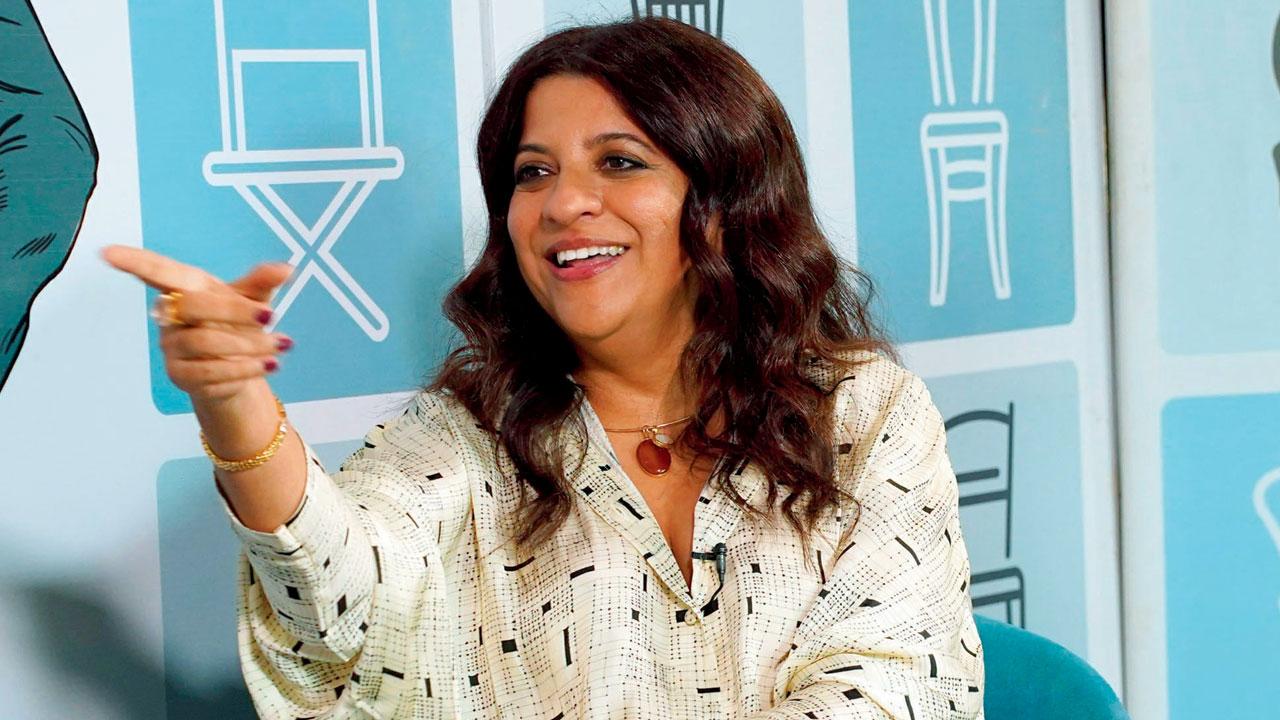
Bollywood’s top screenwriter plus producer duo, Reema Kagti, Zoya Akhtar, decode the craft behind their art
Mayank Shekhar (MID-DAY; January 20, 2024)
Made In Heaven, that’s wrapped two seasons on Prime Video—surely, you’ve seen it already—is an episodic series. In the sense that ensemble characters and stories change, with each episode, while the leads remain the same.
That is, Tara (Sobhita Dhulipala) and Karan (Arjun Mathur), who are BFFs/soulmates, single, sharing life together—also business and creative partners, at a wedding planning firm. Which involves stressful planning and production, some scripting, and creativity, too. Not very different from filmmaking itself.
It’s only while watching the show’s second season that it occurred to me—hey, these two protagonists could be inspired by the life of the screenwriting plus producer duo, Reema Kagti, Zoya Akhtar, who are behind the show themselves; no?
“No. Well, work-wise, yes. But not [so much] socially,” Zoya argues, when I bring this up. Although Reema concedes, “When we were discussing [the show, with co-writer], Alankrita [Shrivastava], this did come up—if we have set the people on ourselves. Definitely the friendship, where they are also kinda soulmates. Not that Zoya and I are soulmates.”
They are “professional soulmates,” they concur. So, the social lives are largely separate? “We do have the same gang, when we hang out. But let’s just put it this way: Zoya is extremely social. I’m absolutely anti-social,” Reema laughs.
The two have remained friends and colleagues for over two-and-half decades. Starting out as assistant directors (ADs) on Kaizad Gustad’s Bombay Boys (1998). And with a combined filmography of over 10 films/shows as credited writers on the screen, since.
Yet, while we know enough about Zoya’s background, famously daughter of writers Javed Akhtar and Honey Irani—we barely know anything about Reema.
I’ve scoured the Internet, before meeting them. It hasn’t helped much. Most of her video interviews online are with Zoya. Reema’s calmingly chilled, securely quiet. Which sufficiently explains the “anti-social” self-description, doesn’t it?
Reema says she grew up in Assam. Went to a boarding school, Loreto Convent, in Shillong, Meghalaya: “Back then, there were hardly any good schools in Assam, so it was common for parents to send their kids off to boarding schools. Unlike in bigger cities, where only the naughty kids got sent!”
She was admittedly a naughty kid, though: “I used to make my parents’ lives hell. But they were supportive.” Not as much for her filmmaking ambitions, initially.
“I think my father had this very 1980s, ’90s notion of Bollywood. He was very disappointed [with my career choice]. It’s only when I got him to watch Lagaan, that I was an AD on, that he said, okay—if this is the kind of films you want to make.”
Reema’s father was an engineer at an oil company, before leasing out a 350-acre land to farm, “four hours’ drive from China”. The umbilical cord with her home-state remains.
“You can’t really outgrow your roots. My cook is Assamese. I eat Assamese food. My family is back in Assam.” Reema had moved to Bombay for college, at Sophia, and thereafter a course in social communications at the media school, Sophia Polytechnic.
“At some point, I bumped into Zoya. We liked the same kinda films, had a lotta common ground, we began writing small stuff together” she trails off.
To be more precise, this was during the auditions for Bombay Boys (1998), where Reema was already an AD. Zoya had dropped in for the same position.
Zoya had been an AD on Dev Benegal’s Split Wide Open (1999), after returning from a diploma in filmmaking from New York University (NYU). She had assisted in the costume department on Mira Nair’s Kama Sutra (1996), before NYU.
“Only, the director, Kaizad, was keen to test Zoya for Tara Deshpande’s part in Bombay Boys,” Reema recalls. She was staffing the audition. Right after which, Zoya told Reema, “I’m the world’s worst actor!” Reema replied, “Listen, I don’t think you’re getting this job either!” Well, she got the job she wanted.
Which was as a freelance AD, the rotating culture of which only spawned in Bollywood in the late ’90s, early ’00s: “We were moving into a phase of sync-sound on the sets, shoots getting wrapped in a single schedule. To pull that off, you needed a more structured system. Unlike before, when films would take years to finish, and everyone just hung around in offices—there would be 12 ADs, and everybody did everything,” Zoya says.
Reema had earlier worked on Rajat Kapoor’s directorial debut, Private Detective: Two Plus Two Plus One (1997): “That was my film school. I got to dabble in all departments of filmmaking.” But there was one thing both Zoya and her were clear about—they were not going to assist only one person, throughout, which was, at the time, the common practice.
Zoya says, “I don’t know how we had the guts to take that call. Back then, ADs were associated with particular filmmakers, or even production houses, when it came to advertising. There was a ‘chhaap’ [creative trademark] of that director, that remained with you, even once you left them and went your own way.”
Sensing a trap, neither wished to mirror particular mentors. Writing and directing their own movie was the end-goal, anyway. They got to work on multiple sets, when they did; and wrote their own scripts, when they didn’t. It was around this time they decided to script a short film together.
Zoya remembers, “We almost killed each other—let’s do this, let’s not do that, etc. Later, I wrote Luck By Chance (2009). Reema started writing Honeymoon Travels Pvt Ltd (2007). We gave our scripts to each other for feedback. She finished the portions I got stuck at. Likewise, me with Honeymoon. While we hadn’t credited each other, we were on each other’s films. Because this worked out so well—plugging holes in either script—after that, we just wrote together. Talaash (2012) was the first script we developed [as a team], from scratch.” Zindagi Na Milegi Dobara (ZNMD, 2011), arguably the finest Bollywood entertainer in the ’10s decade, was their second.
It’s not like the creative bickering, if you may, has stopped, or receded. Zoya admits, “People around have just got used to it in our office.”
Reema laughs, “This one time [producer] Ritesh [Sidhwani] told us, you should just not work with each other anymore. During ZNMD, [Zoya’s mom] Honey aunty got a call from the neighbours—something is going on in your house; please, it’s really scary, people are shouting!”
The art of their conflict management is pretty simple, though: “Show up at work. If we are writing, it’s 10 am. No muse is gonna come. If nothing is happening, we just do other things, watch movies, just chat, gossip… Also, you should never be afraid of scrapping what you’ve done, and starting all over again,” Zoya says.
With Reema, it’s even simpler: “If you’re stuck with an idea, and neither is able to resolve it, let it stay—move on to other things. Later, you return to those ideas, and the better argument, once it stays with you, eventually wins. It works well, if you have the story first.” They’re sure of the story’s end, beforehand; working themselves backwards.
In terms of agreeing to disagree, between them, the one who’s directing the film, gets the final say: “Otherwise, we will never stop arguing.”
For instance, in the Netflix original, The Archies (2023), Reema wasn’t convinced about the placement of a song that would break the narrative: “But once I saw the way Zoya had outdone herself with the visualization, I knew she was right. It is my favourite song.”
In terms of success stories among screenwriting pairs, none beat Salim-Javed in Bollywood still. As in, script starring Salim Khan and Javed Akhtar, in the opening credits. The latter, of course, being Zoya’s father.
Only lately has Javed begun to decode how the partnership worked, having kept mum, since it broke up at the turn of the ’70s decade.
It’s clear now that Salim was the scenarist and the plot-guy, while Javed was the man of words. For instance, as Javed has mentioned before, the greatest twist in Chandra Barot’s Don (1978)—the fake don reveals, inside the jail, that he’s not the real one.
Wherein, the cops don’t believe him still. But his consiglieres, for inmates, instantly do. The dilemma worsening for the protagonist—he’s stuck between both lots, who’re gonna kill him, regardless. Now, that was Salim’s idea!
But, say, the Don’s line, “Mujhe do tarah ki ladkiyan pasand nahi aati. Ek woh, jo mere pass aane mein bahut der lagayein. Aur ek woh jo bahut jaldi aa jayein. (I don’t like women who take too long or too little time to attract).” Now, that’s decidedly Javed!
It’d be great to hear Zoya-Reema similarly break down their own scripts. Firstly, Zoya exclaims, “This comparison is freaking me out. Nothing of the sort [of Salim-Javed] had happened before, or will happen again. They were 22 blockbusters down. Let’s not put us in the same sentence!”
“[That said], our strengths are very different. We talk, talk, talk. We align on themes, characters, story, and what the film is about. Then, Reema is very strong and succinct with structure and screenplay. She gets to the point. I tend to soak.”
Reema couldn’t agree more, “The editing! You give Zoya a 100-page script, she’ll send you back 120 pages. I’m, like—what have you edited, you’ve added! But she’s better at nuances, layering, characters. And dialogues, of course.”
“Zoya feels all my characters sound like me! But she can be lazy. Zoya will refuse to write the first draft of the screenplay, once the events have been fleshed out. So, on the dialogues, I just make everyone sound like me. Because I know she will fix it!”
Zoya adds, “I get lazy, yes, but once Reema does the barebones, I take it, and juice it. I write the dialogues in English. If you want to shoot the film in English, the screenplay is completely ready.”
“Then, it goes to one of my family members—brother, Farhan (ZNMD, Dil Dhadakne Do, The Archies); father, Javed (Luck By Chance), or Vijay Mourya (Gully Boy)… They know what I want, putting it into the syntax that works best in Hindi.”
The Archies, in that sense, for the way the audiences would have watched it globally, is closest to the original screenplay with English dialogues then? “The person subtitling might approach it differently, but the English draft is the template for it,” Reema says.
While writing, per se, is a solitary job—it’s in the parleys between each other, bringing out personal experiences and influences—that the Zoya-Reema script essentially comes together.
I ask Zoya to quote examples, where there’s fully Reema in a script, that she’s directed. She points to Alia Bhatt’s part in Gully Boy (2019): “Safeena was the character, from Dharavi, in a script, that Reema had written for her movie. That film didn’t happen. But I fell in love with her. I asked her if I can just take Safeena. Yeah, why not! We supplanted and then adapted her to fit into the world of Gully Boy.”
For something more specific, in terms of moments, Zoya cites, “The scene in ZNMD, with Laila (Katrina Kaif) chasing Arjun (Hrithik Roshan) down on the bike, and kissing him! The point of the film was to follow your dreams; live in the now. Reema said Laila needed to do something [to capture that essence]. She can’t just say it. Let’s have her kissing him outside, and let her leave!”
This ready-to-film screenplay cooked between partners is also how Salim-Javed operated, staying within the realm of screenwriting still—a reason some ’70s directors fell off the crevice, once Salim-Javed were unable to send them bound scripts any longer.
For Zoya-Reema, it’s merely the end of a process: “A big hurrah moment,” as Zoya puts it. The actual movie can’t film itself. How’re they different as directors from thereon, I ask Reema, who has, thus far, directed Honeymoon, Talaash, Gold (2018), two seasons of Made In Heaven, the series, Dahaad, and the feature, Supermen Of Malegaon, that’s on its way.
She says, “Zoya visually references a lot. I tend to arrive at the visual world, after recce-ing [locations].” Zoya agrees, “It is, after all, a visual medium. I like to find a visual tone, seeing the film from before, and start recce-ing it, accordingly; to lift it off the page.”
Zoya, evidently, has her clear list of dos and don’ts as well. For instance, she was certain before the filming of Gully Boy, set in the slums, that there will be none of Bombay’s tarpaulin-blue throughout the film: “I just don’t like the colour.”
Likewise, with The Archies, the setting would be dreamy, hence, visually, story-book like: “full framing, wide-lensing, classical shots, like 1950s-60s photography.” With Dil Dhadakne Do: “mainly mid-shots and long shots, because the picture is from the POV of Pluto, the family dog.”
Besides screenwriting and direction, there’s the graduating aspect to their creative careers, which is as producing partners. Gully Boy was the first film with Zoya-Reema’s film company, Tiger Baby.
The name, by the way comes from “the nickname that Anurag [Kashyap] and all” gave Zoya: “It’s my spirit animal!” Left to Reema, the company would’ve been called Balls of a Brass Monkey: “Zoya is like, don’t be ridiculous! Also, Tiger Baby is fierce and feminine. It has a nice ring to it.”
Even as producers, the two couldn’t be as complimentarily separate from each other. As Zoya deciphers, “I’m the one meeting with the actors, Reema doesn’t wanna go anywhere. She’s better with budgets, and numbers. But both of us are into mentoring scripts. She’s better at creative packaging and producing. I handle the Tiger Baby social media.” Reema sighs, “I can barely do mine.”
An upcoming production of Tiger Baby is a documentary on Salim-Javed.
If you were to strain yourself to find connecting dots, if not a larger link, between each of Zoya-Reema scripts, it might be the fact of alternating worlds, perhaps.
Say, in the OTT space, their two releases in 2023 were Made In Heaven S02, and Dahaad (both on Prime Video). One is set around the blingy world of posh, New Delhi weddings.
The other is a police-procedural in the rugged terrains of Rajasthan, following missing women, and a serial killer on the loose.
Likewise, with films, The Archies, on Netflix—with “idealism for its point”, in the near-perfect, imaginary world, mimicking the American comic book, in 1960s India—comes after Gully Boy, that went deep into Mumbai’s underclasses. Which, in turn, came after Dil Dhadakne Do, dealing with importantly familial, but First World issues.
Zoya-Reema obviously don’t see it this way: “We just follow the world our characters live in. It’s about being authentic to the world you’re trying to create,” Reema says.
Zoya adds, “We are avid readers and movie watchers, fans of various kinds of filmmakers, not fixated on a genre. For instance, I’m actively looking for something in the big crime/underworld space. It’s exciting to be scared [trying new things]. I’ll be bored waking up for work, otherwise.”
The ideas, of course, can come from anywhere, Reema argues: “Supermen Of Malegaon was a documentary. Gully Boy came from a music video. With ZNMD, it was road trips taken [by us]. We’d also gone on a Europe tour, with Zoya and a bunch of friends. Zoya just wanted to follow around three boys, no hair/make-up, for ZNMD. Of course, it didn’t end up that way.”
One of those inspiring trips was when Reema, a “broke AD”, was in Goa, having spent all her money, with none left for a bus-ticket back to Bombay. She hitched “a car-ride with the sister of a friend. Throughout, [the host was] cautious of a plastic bag in the backseat, because it had an expensive vase, or something. We named that bag, Priscilla.”
This is how Bagwati in ZNMD came into the scene. Only, Reema hadn’t even heard of a Birkin: “What’s that Berk, Berk, whatever. When Zoya told me about it—I’m like, why would someone pay lakhs for a bag? I wanted [the motif] to be something breakable in the film. Zoya’s the director. I had to go with her!”
With ZNMD, Zoya says she was looking at a low-budget, easy-peasy production, given she had just got off a huge ensemble cast debut, Luck by Chance.
Which was about an actor getting a shoe-in to showbiz. The Archies, in that sense, is her coming full circle, since the film launched seven debutants. If she was to make Luck by Chance, how different would it be, a decade-and-half later, give how much entertainment as an industry itself has changed since?
“If I have to revisit, rewrite, I don’t know what [Luck By Chance] will be. But, thematically, it’ll still be about success, and failure. That’s what the film is about—how do you define success, and failure? Is your self-worth determining both? The rest is backdrop.”
A widely shared clip online, from Luck By Chance, is superstar Shah Rukh Khan’s (SRK) cameo in it, where he gives life’s lessons to the lead character (Farhan Akhtar). Given The Archies marked the acting debut of SRK’s daughter, Suhana, I wonder if Zoya ever got SRK over to the set, for a Chak De India type pep-talk, to a full team of debutants? “No. That is supposed to be my job!”
That pep-talk in Luck By Chance was essentially about never leaving behind those who’ve known you from before success/stardom—when it appears that you’ve probably moved ahead. Zoya says, “Shah Rukh, as a person, typifies that.” In terms of rallying the OG troops around her, so does she.
Zoya sorta admits, “I do like working with the same crew. Because they’re great at their job. There is trust, and a sync of aesthetics. Which is not to say I won’t work with someone new.
“Suzanne [Caplan Merwanji] was the set-decorator, when I was a production assistant, on Kama Sutra. [Editor] Anand Subaya and I went to school together; [costume designer] Arjun Bhasin, [hair stylist] Avan Contractor… So many around me have been friends since teens and tweens.”
“There’s Ritesh [Sidhwani], Farhan… Also, then, I enjoy going to work. I work a lot. I don’t want life passing me by, while I’m isolated, working 13-14 hours, a day. The friends are there.”
Friendships also being a recurring theme in Zoya-Reema scripts, if you casually glean through them. They could claim a friend-verse of their own. Starting out, Zoya-Reema worked as ADs on Farhan’s Dil Chahta Hai (DCH, 2001). Both believe Farhan, their former boss, to be the more methodical director, sharp with his final edits, even while on set.
Together, with DCH, and ZNMD, Netflix placed three hoardings in Mumbai, before the film Kho Gaye Hum Kahan (KGHK) dropped on the platform—terming them movies that defined friendship for their respective decades. I kinda agree.
Tiger Baby’s KGHK, directed by debutant Arjun Varain Singh, is probably the only Zoya-Reema script that neither has filmed. It peeks into the life of GenZ, through three buddies (Ananya Panday, Adarsh Gourav, Siddhant Chaturvedi), who also somewhat embark on a professional partnership together.
This is not a love triangle. It’s about friends, who are also family. They are not seeking healthy romance, but fulfilling companionship.
You sense that mental intimacy with the male-female leads over two seasons of Made In Heaven as well. I reckon, that’s the future of relationships. Zoya-Reema get that. Better than others.
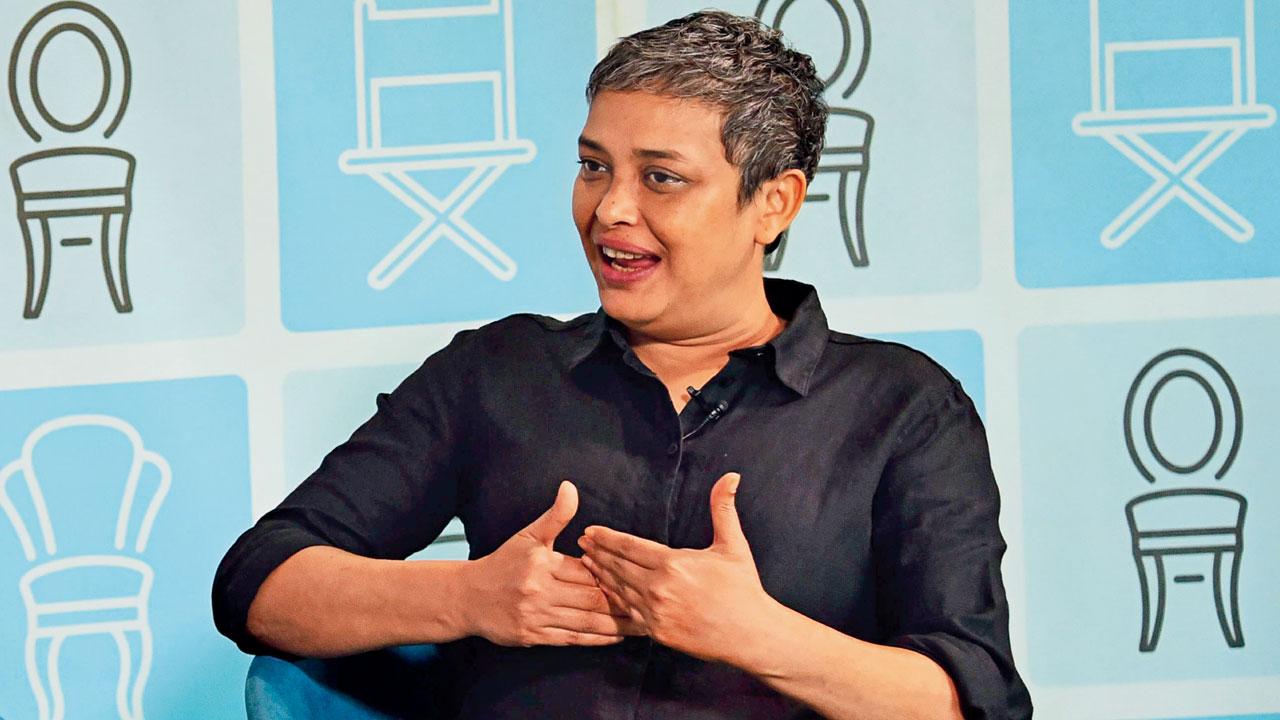
I’m kinda vicariously re-debuting with the cast of The Archies-Zoya Akhtar
11:42 AM

How director Zoya Akhtar travelled to Brazil with the youngling cast of The Archies, her first period film—that too with all debutants
Mayank Shekhar (MID-DAY; June 23, 2023)
Standing behind us at the check-in counter to the flight to Sao Paulo, from Mumbai, was young Navya Naveli, actor Amitabh Bachchan’s grandchild, and sister of Agastya Nanda, who was to make his onstage debut at Tudum, Netflix’s slate-launch event, in Brazil.
It would be the first time Nanda would make a public appearance. We notice that even on Google, the image that shows up for him is that of Zoya Akhtar, the director of his debut film, The Archies (that will drop on Netflix in November).
Not that we personally know Navya, so we didn’t say hi. But it’d be fair to assume she was travelling to Sao Paulo for her brother’s big night. Casual eavesdropping revealed she was off to Dresden instead (if we heard it right).
The seven-member, youngling, debutant cast of The Archies were on their own, without any minders, travelling on a regular flight. Which probably makes Akhtar, in a sense, the principal of Riverdale High, chaperoning these children on a school trip abroad?
Akhtar is clearly not pleased with this random analogy! “This is not the Von Trapp family. I am not their governess. I’m doing my own thing. They’re doing their own thing! I’m making a film about teenagers, so in that sense, they are teaching me. I’m too truant to be their principal,” she says.
We’d of course love to know all that she’s doing in Brazil. At the recent G20 convention in Srinagar, on films and tourism, what perhaps got discussed the most was how Indians travelling to Spain and Turkey had evidently shot up several times since the release of Akhtar’s Zindagi Na Milegi Dobara (ZNMD, 2011), and Dil Dhadakne Do (DDD, 2015). It could be the same for Brazil, if Akhtar was to shoot her next film/series here! Has she been ‘recce-ing’?
She has been to Brazil as a tourist before, she says, “This time, it was for work, so it’s very different. I don’t think there is any filmmaker in the world, who wouldn’t want to shoot a film in Brazil. Everywhere you go, it’s just ‘character’ and ‘feel’.” Only half the globe apart from India, of course.
Akhtar was in Sao Paulo to represent The Archies, her next release, that she’s still working on. It was the only Asian content showcased on the Tudum stage. Her cast performed to the film’s dance number, This In My Story, Suno.
Couldn’t help but wonder, what if one of the newbies had slipped, or fumbled—it can happen, and there are no retakes on a live show. What a global embarrassment it’d be to live down! Of course, none of that happened.
The kids did fine. They had apparently rehearsed for two months for this live act, that lasted all of 40 seconds on stage.
Which is just as well. Netflix is a stickler for time. We got five-odd minutes for the interview with Akhtar as well!
Calling them kids, although Akhtar points out, “They’re young adults. But they’re adults!” They still look like such teenagers, even adorable mannequins, in fact—given that they walked down the Tudum red-carpet, as a group, in The Archies’ make-up and costume.
Hardly saying a word to the cameras. “It’s too early for them to meet the press,” Akhtar says, as she takes us through all that went into turning them into onscreen characters.
“They’ve worked really hard to do what they were meant to, and were born to. They went through a lot of screen tests to get here, firstly. What followed was a proper ‘boot camp’ over six months—acting workshops, with three-four different people, dance lessons with Bosco Caesar, [practicing] cycling, skating, for the girls…”
“They had to learn to sing. They’re lip syncing in the musical. But that too requires training. There’s an art to it. I just wanted them to feel free, so they’re not conscious on the set.”
In her decade-and-half long career, Akhtar has essentially worked with established actors, at least for the lead roles. She waited for years, searching for stars to headline her directorial debut, Luck By Chance (LBC, 2009). This is her first time with an entire bunch that’s never been on screen before.
She says, “I’m kinda vicariously re-debuting with them. Because there is nothing like the experience of your first movie—you tend to forget that, get jaded [thereon], and start worrying about different things.”
“I felt a little spoilt, with a cast that’s so enthusiastic. At the same time, they’re not coming with any star-fittings. They’re literally part of the crew, that happens to be in front of the camera. There’s no baggage; only hunger and joy.”
Also, she adds, “It’s my first period film [set in 1964]—a musical, in terms of form and format. And it’s capturing something iconic—an adaptation, that I haven’t done before. Something new is what you always wanna do.”
The Archies is based on the American comic series, pure, peak pop-culture: “It was our portal to the West. The only comic about teenagers—it wasn’t about super heroes, but regular kids. When this came to me, I thought—how often do you get paid to relive your childhood? And have fun with it! The concept of adapting a comic book, which means a mix of the real and fantasy, was enticing.”
Not in as many words, but Archie has already been adapted in various shapes in Bollywood. Think Jo Jeeta Wohi Sikandar (1993). Or consider Karan Johar’s Kuch Kuch Hota Hai (1998)—what else was it?
Shah Rukh Khan, 33 then, practically played Archie Andrews in the film’s first half. Khan’s daughter, Suhana, debuts as Veronica Lodge in The Archies, with Nanda as the protagonist, and Khushi Kapoor (Sridevi’s daughter), as Betty Cooper.
Akhtar says, “Thematically, yes [we have dealt with this before]. But this is the OG Archies! So you can’t stay away from the [love] triangle, or Jughead [Vedang Raina] liking food, and there is Midge [Dot], Dilton [Yuvraj Menda]…” Big Moose too? “Of course.”
There is also the obvious trolling online that the film has been through, because of its lead cast, that are essentially Bollywood’s homegrown next-gen, although the rest are from outside the film industry as well. The other kind of barbs the film has attracted is something that Akhtar also faced before the release of DDD—that it was too much about stinking rich people!
She says, “I don’t know if [the trolling] is about my films. It’s about all films now. Everyone gets trolled!” A funny tweet we came across about The Archies was about how Akhtar had finally shown Indians for what they always wanted to be—white people!
She’s understandably not pleased to hear that: “Well, they are all Indians [on the screen]. Are you saying fair [skinned] people aren’t Indians? How do we define what an Indian looks like? It could be Hrithik Roshan. It could be Mr Rajinikanth, Diljit Dosanjh, or Mary Kom. That’s the beauty of India.”
That the film’s first trailer premiered at Tudum, Akhtar asks us what we thought of it. It doesn’t matter. It’s a long way before release. Plus, we tell her, she’s the only Indian filmmaker we know, who hasn’t once laid an egg, yet—from LBC, ZNMD, DDD, Bombay Talkies, Lust Stories, Gully Boy, down to her last release, as writer, Dahaad (on Prime Video). Seriously. No pressure. Just saying!

Everybody in my family has a National Award except me-Zoya Akhtar
8:52 AM

Bollywood's most loved filmmaker Zoya Akhtar looks back during the lockdown
Mayank Shekhar (MID-DAY; May 15, 2020)
 Consider writer-director Reema Kagti (Gold, Honeymoon Travels Pvt Ltd) as an Australian male Ricardo Fernandes, looking for his lost brother in Mumbai, while filmmaker Zoya Akhtar is the local don Mastana's hot moll. That's really how Zoya first met Reema, during the audition for Kaizad Gustad's Bombay Boys (1998).
Reema, as the casting assistant, was standing in for Rahul Bose. Zoya, opposite her, was actually testing for the film's female lead role—mainly to humour Gustad, because he was keen she read for the part, that finally went to Tara Deshpande. Zoya was clear she wanted to AD on the movie.
AD, meaning assistant director—both a proper noun and an active verb on a film set. It's been over two decades since Bombay Boys, where Reema and Zoya were second ADs. Their partnership, as writers over the past decade though, counts amongst its achievements, Gully Boy (2019), the Amazon series Made In Heaven (2019), Dil Dhadakne Do (2015), Talaash (2012), and Zindagi Na Milegi Dobara (2011).
Bollywood wise, they could well be—albeit slightly Bonzai—versions of the '70s super-hit, Salim-Javed (Zanjeer, Deewar, Don, Sholay, Mr India)—the most successful writing pair ever, comprising Salim Khan and Zoya's father, Javed Akhtar.
I say this, while Zoya is talking to us from where Salim-Javed used to work out of—the study in her Bandra family home—that she now uses as her bedroom: "I'm just absorbing them," she smiles. She also drops a hint at working on a talkathon/documentary project of sorts to do with Salim-Javed themselves, as part of her newly launched production company.
But it's too early to talk about, she insists. Much is naturally made of Zoya as poet-lyricist Javed's daughter, eighth generation writer from the Akhtar family. Her love for films, as she points out, flows first from her mother's fine collection of world to latest cinema, projected on the screen at home, growing up.
Also the fact is that it's her mom, Honey Irani, who's the Bollywood insider in the family, having literally grown up in showbiz (Javed had moved from Bhopal).
Wikipedia rather exaggeratedly lists her as the child-star of 72 films!
Honey would've done minimum 20-30 movies as the much loved kid-face of the big screen—graduating much later to screenwriting, with popular titles like Yash Chopra's Lamhe (1991), Aaina (19993), Darr (1993), Rakesh Roshan's Kaho Naa Pyaar Hai (2000), Koi… Mil Gaya (2003), Krissh 3 (2013).
Zoya reminisces, "Now, everybody has a camera to record their children. But people in my generation did not have footage of when their parents were three years old. I was one of the few kids, who had my mother from the time she was two, to when she was 16! I've seen my mother animated [on the screen], with different expressions, speech, seen her change, and grow. It's really interesting even now, to see her like that. She was darn cute, man! She, and my aunt Daisy [Irani]!"
She rues in jest, "Everybody in my family has a National Award— my mother, father, brother [Farhan Akhtar], step-mother [Shabana Azmi], cousin [Farah Khan], everybody. Except me!" Which film did her mom get a National Award as the kid-lead? "I don't know, if it was for Pyaar Ki Pyaas or Taare Zameen Par, one of the two." There was a yesteryear film called Taare Zameen Par? "Zameen Ke Tare! Both my mom, and my aunt."
The mom's acting gene, Zoya contends, went to her younger sibling, Farhan: "He is a bona-fide performer—he always had that. I hate being on stage, or before the camera. My first thing to do with the arts was to write—watching both my parents work at home, discussing scripts… That was one of the first things [in my head]. Directing came later."
Held over video-call for the first time, Zoya is also the first filmmaker to feature on our unscripted conversation series, Sit With Hitlist—so far limited to Hindi cinema's lead actors. Reason for that of course is that she's arguably Bollywood's most loved filmmaker, and therefore a star in her own right.
That apart, little is known about her life up until her rather belated directorial debut at 36-plus, with Luck By Chance (2009), although she'd been working as a film professional for around 18 years before that. Very little worth knowing, Zoya casually reckons, jogging back to age 19, when she started interning for a copy-writer's job at a creative agency—simultaneously reading sociology at Bombay's St. Xavier's College.
"I remember watching Salaam Bombay (1988), being madly in love, and going: I want to direct. And I don't know what I'm going to make. Because Hindi films were not my scene then. Out of the blue, when I was about 21, I got a job with Mira Nair on [the sets of] Kamasutra (1996)." You can find her in a cameo appearance as one of the Kamasutra girls, "an extra part," as she puts it, because ADs are frequently expected to fill-in or add to the human backdrop on shoots.
Of all her past associates, Mira as director appears to have left a strong impression on Zoya: "Mira is just special, you can see that. When she is talking to you, you are the only person in the world. She makes people feel special. She knows everybody on a crew by name. I love that about her. And I love her aesthetics."
Post Kamasutra, Zoya recalls, "I started working mainly on American projects that came to India. Went to NYU [New York University] for a diploma [in filmmaking]. Stayed back in New York. Got a job, thanks to Ismail Merchant, in a small, cool, indie film called Side Streets, directed by Tony Gerber."
She returned to Bombay as a freelance, professional AD, of which there were only four in all of Bollywood, who did a lot of foreign films and Indian work: "Reema [Kagti], [director] Apurva Lakhia, and me. Then Kiran Rao came in." Zoya's credits during this phase include Mahesh Mathai's Bhopal Express (1999) and Dev Benegal's Split Wide Open (1999). She chose to specialise in the casting department, because there, "you get to direct actors, with a script," and that's what she ever wanted to learn/master anyway.
She was the casting director on Farhan's first film Dil Chahta Hai (DCH, 2001), and thereafter Armaan (2003), her mother Honey's directorial debut. Okay did she personally pick/cast that balloon-lover boyfriend in Dil Chahta Hai? "Oh that's actually Hassan, a childhood friend of Farhan. But we handpicked everyone, so to speak. There are very interesting cameos. Kiran Rao is one of the girlfriends in Goa. She'd come to do all the extras' casting for the film's Goa leg!"
Between freelance AD-ing, Zoya had been ideating all along for her debut feature. It's mildly ironic that while so cued into casting, she was unable to kick off her first film for want of a lead actor, for almost a decade that she'd been ready to direct. And the one she eventually cast for the lead role, in her directorial debut (Luck By Chance, 2009) was her brother, Farhan, who'd been around all along!
"You cannot cast someone, unless they are ready. And feel that they want to do this. It took Farhan a while to get there—that he wants to act, and that he is a really good actor." While practically the entire Bollywood A-list came down for cameos in Luck By Chance, including both Shah Rukh Khan and Aamir Khan (guessing, for the first time in the same film, although not in the same frame), Farhan was the seventh star to read/consider/hear the script. Hrithik Roshan played the second lead. "Luck By Chance is a book that I am going to write one day, about how that film got made," Zoya sighs.
Can't wait. It'd be quite a telling tinsel-town tale, given that nobody in Bombay does it. And Zoya is perfectly positioned to—not just as the quintessential insider, but as someone who can surprise you with her adorably random zaniness, on occasion. Recently at an interview she called herself the love-child of directors Karan Johar and Anurag Kashyap. What does that mean? "That I am halfway between Indie and commercial, you know."
One time I remember getting a smoke with a group, outside a closed-door meeting with director Oliver Stone who was in Bombay then, and Zoya casually mentioned, "You know, there are four kinds of people in the world—John, Paul, George and Ringo." What?
I bring that up again: "That is a line from a Tom Robbins book. Have you read Tom Robbins? I love him. I don't remember what the context of that conversation was. You can look at everyone, and be like—that's a Paul, Ringo, George. I am a John, for sure!"
And while her films primarily deal with real, human, often raw emotions, there is this carefree cattiness that inevitably slips in too. It's only fair that we dig into a couple of stories behind some stellar, surprising choices she's made so far. For example, why/how/when did a ladies' bag, called Bagwati, bag a proper part in the breezy masterpiece Zindagi Na Milegi Dobara?
"That comes from Reema and a close friend of ours, Shai Heredia, who's an academic, award-winning documentary filmmaker, and hysterically funny. She and Reema were on a road trip, and they kept talking to Shai's bag. Think they were just tripping! We just put it into Zindagi."
It was Zoya's second film, with Farhan and Hrithik back on her frame, but in a much wider canvas, although the script started out in her head as a small, cathartic, road movie, about three boys in a car—for all the road trips she's taken in her life. Over time, of course, the script "developed a life of its own".
The film she co-wrote after was Reema's Talaash. It's a supernatural thriller that, by the way, was based on a true story, that happened to her! "You have to stop. I am going to be the crazy lady that goes on interviews and says all this shit. I know it sounds really crazy, and I don't want to be propagating this nonsense. But, I had a strange experience on Haji Ali, while a bunch of us were driving back from a nightclub. We thought we had hit a naked woman in the middle of the road. Everybody was freaking out. This is something I told Reema about, and where Talaash came from. I am not going to repeat this story, ever again!"
Okay how about the dog called Pluto, who's the narrator/POV of Dil Dhadakne Do; where does he come from? "From my super-smart, intelligent beagle Zen, who passed away last year. You can find him on my Insta page, Zen Akhtar. Zen would look at us as though he is watching National Geographic—that we are the animals, and he is like, 'What are they doing?' That's Pluto. Even the way the film is shot [as a result] is observational—there are no close ups, only 'wides'."
After a preview screening for Aamir Khan and his wife, Kiran Rao, both of whom Zoya makes it a point to get a feedback from before her film's final cut, she asked Aamir if he'd like to voice the dog: "He was, like, after these many years, you have offered me the voice of a dog? I said, please do it. He was, like, yeah, totally! And he just came [on-board], like a sweetheart. It was great!"
Is there anything she'd like to change about Dil Dhadakne Do? "I think the title. Would have been nicer [if it had] a little more gravitas." How about the climax (that was rather OTT, compared to the rest of the film's tone)?
"I actually liked the climax (of the mom, dad, sister jumping off the ship, with lifeboats to chase down brother/Ranveer Singh's character). The whole metaphor of the trip is that you can't get rid of anyone. Family is what you are stuck with. You can't just walk out the door. Eventually, when shit hits the fan, they are the only ones who will pull you up too. So when everyone tells me, I don't like the climax; I am like, cool, so what would you do? Till now nobody has given me a better ending. If there is one, I'd be like, damn!"
What did upset Zoya even before the release of Dil Dhadakne Do though was people taking the piss out of the picture for it being centred on lives of the super-privileged—intended also as a barb against movies that Zoya had directed thus far.
"Firstly I don't think it was criticism. There is nothing for me to take home from it. It is like somebody seeing a trailer of Gully Boy and saying, oh, this is about poor people. And I made Made in Heaven, along with Gully Boy. And that is about very rich people!"
"I was being interviewed by this woman wearing diamonds and solitaires, and she was telling me, it [the film] is about rich people. I was, like: Would it bother you, if your husband has an affair? Why? But you have solitaires on, it shouldn't bother you! What does it even mean?"
Before Gully Boy — set in a Mumbai slum and the city's underground rap scene—released, it got roundly compared to the American ghetto, hip-hop biopic, 8 Miles. Did that bother her? "The two people I spoke to [to base the film on their lives] are living here. You can talk to them. So, no, I didn't get into it. It bothered me, when they compared Zindagi to Hangover [producer Ritesh Sidhwani had to respond to Warner Bros]. Now, I think that's what they do."
Inspirations from dogs and spirits apart, what makes Zoya's filmmaking process special—given what we've managed to gauge so far—is she is capable of working backwards. Where she must know end, before she locks her script. Which isn't true for many filmmakers, who often arrive at the conclusion, as they navigate the story or characters' journeys: "I have to set a goal. That goal may change. But I when I set off, I have to know where I am taking the film. Otherwise I meander. I need a direction I am shooting at, you know!"
The other thing is her complete clarity on the point she's trying to make—so much so that she can distill each film into a single line, which is different from a log-line that describes a plot: "Of course Gully Boy is about a Muslim kid from Dharavi, who expresses himself through rap. It is a rags-to-riches, coming-of-age story. You can pin it down in any log line. But at the core of it, the film is about class. Luck By Chance is really about self-esteem. Zindagi is about living, seizing the day. Dil Dhadakne Do is a film about projection—who we actually are, and what we tend to project. It is what lenses the film, creates the base."
This sort of sharpness of thought, cutting through fluff, getting to the point, is also something Zoya shares with her father Javed, as a communicator in general—whether it be his works as lyricist, screenwriter, people's poet, or popular orator. He's possibly India's finest conversationalist—whose quick repartees and general gyan stick with you, if not go viral online.
Is there something Zoya remembers he told her that she's held as talisman? "Little things, you know. That when you are writing a script, whatever your story is, you've got to be able to lift your viewer. By the end of it, just lift your viewer! Don't resort to cheap shit to get a laugh or clap. Say it in the most base-denominator way, if you have to. But find a higher level of communication." It's tough, bohot hard.

I stick to a human story in my films-Zoya Akhtar
7:58 AM

Monika Rawal Kukreja (HINDUSTAN TIMES; January 28, 2020)
Zoya Akhtar is a no non-sense director who understands her craft and knows what she wants from her actors. She has never put her films into any box of genres. Perhaps that’s why, when after films such as Zindagi Na Milegi Dobara (2011), Dil Dhadakne Do (2015) and Gully Boy (2019), she directed an anthology, Ghost Stories, it came as no surprise. Zoya reveals what was on her mind while making a horror film and how it felt to team up with fellow filmmakers.
After Bombay Talkies (2013) and Lust Stories (2018), this is your third anthology. How easy or tough is it to collaborate with people with different cinematic sensibilities?
The one thing common with all of us (Anurag Kashyap, Karan Johar and Dibakar Bannerjee) is that we really believe cinema should be whatever the individual artiste wants it to be. So, when everyone is liberal, it’s easy to collaborate because there’s a healthy respect for each other and there’s genuine camaraderie. Our anthologies have something for everyone because we’re so different. I’m happy to be part of this gang.
How relatable was it for you to make something in the horror genre that’s not something everyone consumes or creates?
You don’t think so much about who’s consuming it when you’re making a film because it’s a popular genre. Also there’s enough of an audience, so you don’t have to worry about that. Any story that you work on, at the end of the day, operates out of some kind of human emotions, only then it moves you, at least that’s what I want to do. So, if this is even the genre, I stick with a human story and pay attention to it in every film. But yes, here you design a move, a look, a vibe, a mood through lighting, design and sound — these are the tools you can play with.
Making a horror film can be risky where one wrong move can make someone laugh instead of scaring them. Did you have that thought while making Ghost Stories?
See, you take the treatment of the film from the story you’re telling. My story is such that it doesn’t need jump scares. It’s a slow mood story, so I treated it in a particular way and played with the camera accordingly. Just because I need to be scary, I’ll try to put that kind of effect on this, it’s not going to work. So, you’ve to decide the pitch, tone and pace of your film and be aware of it, consistent and stick to it throughout.
What made you cast one-film-old Janhvi Kapoor for your anthology?
When casting for a film, besides age and physicality, I look for that core quality in an actor that fits the character. When I saw Janhvi in Dhadak (2018), I felt there’s an innocence and a pathos she has in her. At the same time, she’s got a bit of sexiness. So, she has got a nice blend of that precocious young girl who’s also sensitive. Later, when I met her to narrate Ghost Stories and the reactions she had to the material, I knew she is on. Also, when you collaborate with an actor who has just walked in and says ‘Do what you want do, I’m here’, it makes it worth.
We had to import 16 tonnes of tomatoes from Portugal because local tomatoes had yet to ripen-Zoya Akhtar
8:11 AM

Roshmila Bhattacharya (MUMBAI MIRROR; July 20, 2019)
 Eight years ago, Zoya Akhtar took us on a journey through life… A life-changing journey of three lives. And since then, every time we ask someone to get a life, we say it with the title of the film, “Zindagi Na Milegi Dobara.”
The story revolved around a road trip through Spain that three young men—copywriter Imran, financial broker Arjun and Kabir whose family owns a construction business—take off. Kabir’s ‘mistaken’ fiancee, Natasha, joins them on the way, as does Laila, a Bohemian diving instructor, and Nuria, a local girl and Imran’s love. Zoya’s brother Farhan, (who wrote the dialogues and co-produced the film with Ritesh Sidhwani) Hrithik Roshan and Abhay Deol lived the roles of Imran, Arjun and Kabir.
For Zoya they were the natural choices: “I’d worked with Farhan and Hrithik before (in her first film Luck By Chance), while Abhay was in Reema Kagti’s (who wrote the story and screenplay with her) debut directorial (Honeymoon Travels Pvt. Ltd.). Also, Farhan’s into sky-diving, Hrithik is a certified deep-sea diver and Abhay is an athlete.”
She turned to her friend, Kalki Koechlin for Natasha and cast Ariadna Cabrol after seeing her in a Spanish film Eloise’s Lover as Nuria. “Katrina whom I knew socially, was apt for Laila. She and Hrithik were also a fresh pair. Interestingly, while the boys were confused, the girls, as different as chalk and cheese, were very clear about what they wanted from life,” she points out.
Shankar-Ehsaan-Loy’s songs, from the zingy rock track “Dil Dhadakne Do” and the lilting “Khaabon Ke” to “Senorita” crooned by Flamenco singer Maria del Mar Fernandez with Hrithik, Abhay and Farhan and “Ik Junoon” are still hummed. Zoya recalls how the whole town of Alajar, including the mayor, joined the “Senorita” shoot. Prod her on the La Tomatina festival of Bunol, recreated for “Ïk Junoon” and she shares, “We had to import 16 tonnes of tomatoes from Portugal because local tomatoes had yet to ripen and after getting permission, we couldn’t delay things”.
The film also has snatches of Javed Akhtar’s verses which Imran, a closet poet, sprouts. “Ek baat hoton tak hai jo aayee nahin, Bas aankhon se hai jhankti, Tumse kabhi, mujhse kabhi, Kuchh lafz hain woh maangti, Jinko pehanke hoton tak aa jayee woh…”
Zoya points out that many young boys internalise their deepest feelings. “I thought poetry could be a gentle way for Imran to articulate emotions and the essence of the film,” she says.
Will ZNMD return, dobara? “I don’t want to spin a sequel just for money. If I stumble on a story that resonates with me, I’ll be happy to go on the road again,” she promises.
Ranveer Singh is generous, Alia Bhatt is special-Zoya Akhtar
8:25 AM

Meena Iyer (DNA; February 13, 2019)
Zoya Akhtar has an impressive body of work, including feature films like Luck By Chance (2009), Zindagi Na Milegi Dobara (2011) and Dil Dhadakne Do (2015) as well as anthologies such as Bombay Talkies (2013) and Lust Stories (2018).
The writer-filmmaker is known for her attention to detail and presenting well-etched characters with an emotional graph. She is also the talent behind the Ranveer Singh-Alia Bhatt Valentine Day-release Gully Boy, which is currently the talk of the town. Frankly, her plumes need no further polishing. In a freewheeling chat, the pleasant yet candid award winner talks about her independent banner, teaming up with Ranveer for the second time and more.
Your banner name Tiger Baby is intriguing. Is Gully Boy your first production?
Well, we co-produced one movie with Ritesh (Sidhwani) earlier and also did Made In Heaven with Amazon, which is dropping on March 8. Gully Boy is our third offering.
Why Tiger Baby?
My partner Reema (Kagti) and I liked the name. I love the tiger, it’s extremely Indian. It’s fierce, feminine and most of all, it’s specific to us.
Coming back to Gully Boy, the film is tracking extremely well. Does that make you nervous?
Yes and no. Of course, you are happy, because when you put out content, you want everyone to respond to it. Now we’re just hoping they come in to watch our movie and enjoy it. So obviously, there is nervousness because people are excited about the film. But, we’ve crossed the first hurdle.
The voice of the movie is young, it’s inspirational. It seems like a Slumdog Millionaire kind of a story…
It is an underdog story. It’s also talking about a section of society that doesn’t normally get represented in the mainstream.
It speaks of rap, an art form that came up from the street, like anywhere else in the world. These people use music as a tool, they’re all poets, they speak truth to power, so, it’s exciting. Hopefully, it will resonate with a larger section of the audience than just the youth.
Was Ranveer always your first choice?
Yes, he was my first choice, so was Alia, actually.
You’ve watched Ranveer from his Dil Dhadakne Do days. What would you say about his growth as an actor?
I knew Ranveer even before he did his first film. I always got along with him. I liked his energy and what he brings to any situation that he’s in. When I did Dil Dhadakne Do, we got along so well. I’m extremely comfortable with him. He is a real collaborator. He is a generous actor and a good co-creator of the character. He comes without any ego. At the core of his stardom, he is an actor who wants to do well. He understands the role, the script, and reads between the lines. He knows exactly where I’m coming from and brings stuff to the table. We can say yes or no to each ther’s ideas. I find that really exciting. He lifts the characters up. Usually, people just see the flamboyant and slightly larger-than-life side of him, but he’s got a lot of depth and sensitivity. I like being on a film set with him.
And, Alia...
Alia is special, she operates from an instinct that is so powerful. She follows her gut. She is so centered within herself that it comes through in her performances. In fact, it’s evident in everything. She is in the moment. I think that allows her to make her choices and play the characters she does. She is a dream to work with. I can’t wait to collaborate with her again.
Both, you and your brother Farhan Akhtar have a good body of work. Is it possible for you to say who is better?
No, it’s not. There’s nothing as better. Honestly, we’re not even halfway through our body of work. We still have so many films to make, so many stories to tell.
So, there’s never been any sense of competition with him?
No, never. And there can’t be because my film is his film. He’s either acting in it or he’s producing it or writing it. So, the ownership is always there.
There’s also a common soul in your father, in Javed Akhtar saab, who is also associated with your work.
Of course, I feel extremely privileged.
And who is the apple of his eye; you or Farhan?
I’d say it’s me (smiles). I’m the first born and a girl... so we have a different equation like my mother (Honey Irani) and my brother have a different dynamic. I feel blessed and lucky with my family, not because of the privilege, of course, I’m grateful for that as well that we never wanted anything. But what is a real privilege is that we (my brother and I) were treated equally. I was treated with equal amount of opportunity, freedom and confidence as him.
We were allowed to make mistakes. I mean that is a real privilege, to be able to go your own way, find your voice, just have a support system that allows you to do all that.
How involved is your partner Reema (Kagti) in this film?
She has co-written it; so yes, she is very much involved; from the research till the script was ready.
What did you think of her film Gold (2018)?
I cried at the end; It was a massive film. It was nicely made. I think there were certain things that went wrong for her, in terms that she wasn’t happy with the effects. There was not enough time and things went off there. But the film really moved me and I cried. I’m happy that it got made.
There was also talk of similarities between Gully Boy and Eminem’s 8 Mile (2002). Do you see it as unfortunate?
It’s not unfortunate, it’s obvious because 8 Mile is the biggest reference for rap. So people will look at it and be like, ‘Okay, this and that...’ Like during Zindagi Na Milegi Dobara’s release, everybody was saying it’s The Hangover (2009). But it was not The Hangover and I got upset. However today, I don’t feel that way about this film. I know that when Gully Boy opens in cinemas, they will understand that it’s specific to people from our space. I think what they are talking about is the rap battle, but those things are common everywhere. So, I’m not reacting to that.
Ranveer has done a good job rapping in the film. While you say he was your first choice for the role, was it the same case with his rapping, too?
It’s better na, because rap is spoken word. You can’t have another voice, it’s better that he do it himself. And he does rap, he also writes. So, there’s a certain sense of it. But we needed to know how he would flow with the sound that we were producing. I’m so happy that he’s in this film.
Did you get a chance to watch Simmba?
No, I was in post-production. I missed it but I will watch it once my film releases. Because when you’re in the last lap of post-production, you don’t have the space.
You, Karan Johar, Anurag Kashyap and Dibakar Banerjee have been collaborating on short films. Will that association continue?
Yes, definitely.
Who is your favourite filmmaker among them?
They or should I say all of us are unique. There isn’t another Karan. You can’t replace Anurag. They’re my gang, my friends. We have so much fun together. We’re a good bunch when we are together. And that’s what I mean; you can’t compare them, they are incomparable. Who will you replace Dibakar Banerjee with? There isn’t another one. We are four unique voices.
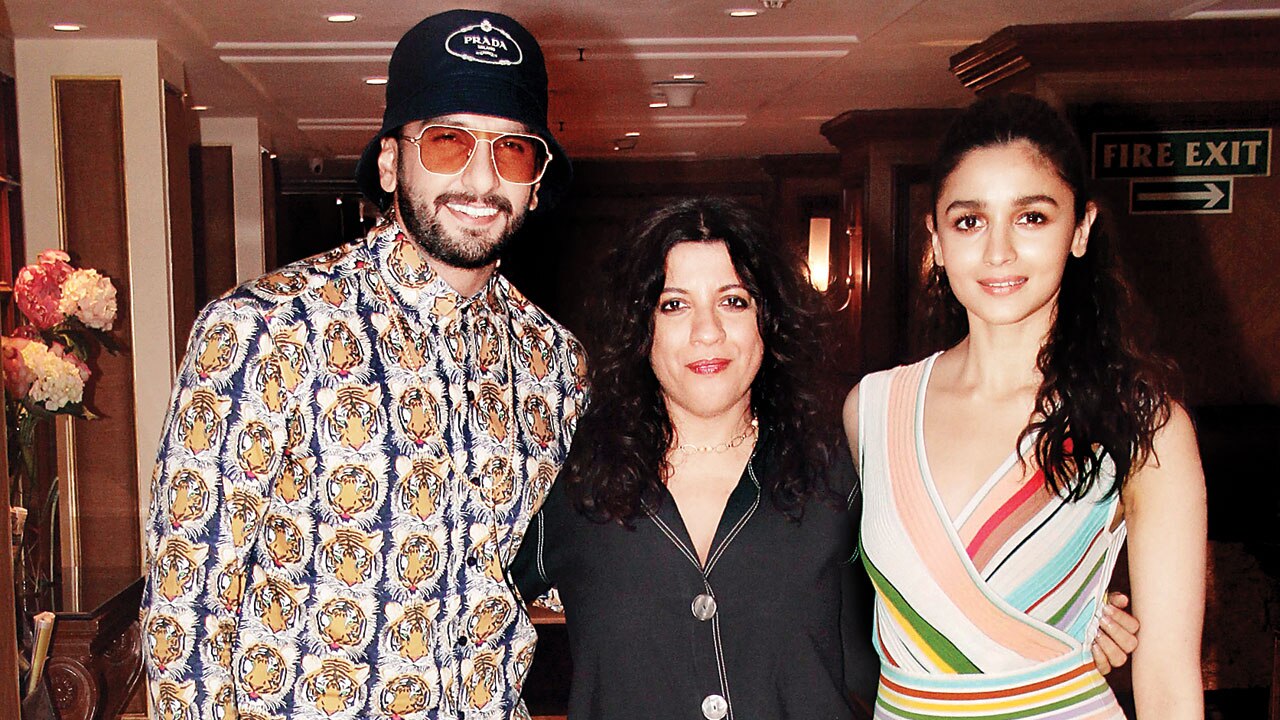
Rappers Naezy and Divine are hard core feminists-Zoya Akhtar
8:34 AM

Gully Boy director Zoya Akhtar on why the inspiring story of the two underground rappers moved her to make a movie that she hopes will change the rap scene
Aastha Atray Banan (MID-DAY; February 10, 2019)
It was while editing her 2015 film, Dil Dhadakne Do, that director Zoya Akhtar's editor Anand Subaya made her watch the video of young rapper Naezy's song, Aafat. "I was like 'this is legit!' I just wanted to meet him." So she called up musician Ankur Tiwari, who used to work at MTV Indies at the time, and asked him to arrange a meeting. "He came over to Ankur's house and Reema [Kagti, the writer of the movie] and I chatted with him for hours."
Cut to a few days later, when she went to the erstwhile BlueFROG to watch Naezy perform. It was there that she met Divine, an upcoming rapper then who had then opened for Naezy. "I went backstage and my reaction was 'who you!!!' He was such a kid when I first met him. I asked him to come over to meet Reema and me as well, and that too, ended up being a five-hour meeting," says Akhtar.
Today, Divine could be considered the biggest rapper in India, after his stint with Sony Music, with whose support he released Jungli Sher, that catapulted him to mega fame. Naezy, who is considered one of the pioneers of the Indian underground hip hop scene, went off the grid for a few years, but is back on the scene now.
Four years later, those meetings have culminated into Gully Boy, inspired by their stories but not a biopic, which releases on February 14. It tells the story two Mumbai underground rappers trying to make it, and stars Ranveer Singh and Alia Bhatt. Akhtar says she did listen to hip hop artists like Tupac and Eminem, but had never interacted with the Indian scene ever before.
"Both Naezy and Divine have very distinct styles - their singing, writing, flow is different. What's common is that they both are from the minority community and have come from hard places. But, Naezy grew up with a lot of family, while Divine didn't. What was also appealing was that they speak the truth, and they engage with their socio economic space - they really speak for a lot of people."
For Akhtar, who has been vocal about the #MeToo movement, what was most attractive though was that she thinks both the rappers are hard-core feminists. "I don't think they know the word. But it's in the way they talk about women, and also in the way they don't talk about them. There is also no cynicism in them, and they are all about making a change."
But the story finally shaped up when Akhtar sat down with Kagti to write it out. "You have to create the drama, juice it - there needs to be a girlfriend. It's not a biopic, but it couldn't be authentic without them. We just kept doing drafts after drafts, and kept developing it further." She also spent a lot of time in the gullies to get the tapestry of her movie right. "I have been there before. I worked on Meera Nair's Migration, which I wrote and have done ads there as well. At the end of the day it depends on your aesthetic, and your eye, and your design team."
For Akhtar, though, the point of the movie was to also get some attention to the indie music scene, which she feels is grossly neglected. "I hope after the movie, there is an interest in the music scene that doesn't depend on a star. I hope the rap scene grows. I hope the boys get whatever they want, but remain as authentic and true as they are. I hope they don't have to sell out, but still get the perks of everything. And in the end, I hope people understand the importance of the art, and how vital it is for society. That's what I hope," she says.

Zoya Akhtar with Divine on the sets of Gully Boy
Digital Cinema Package (DCP) won't curb piracy-Zoya Akhtar
7:59 AM

Filmmaker questions Censor Board dictum
Sonali Joshi Pitale (MID-DAY; August 24, 2016)
Zoya Akhtar has spoken out against the new format of movie submissions introduced by the Central Board of Film Certification (CBFC) to curb piracy. CBFC chief Pahlaj Nihalani recently made it mandatory for films to be submitted in an encrypted form — DCP or digital cinema package, which is password-protected and time-coded following back-to-back leak of films pre-release. While one producers’ body welcomed the move, another raised alarm over the “expensive” option (as reported ‘IMPPA slams Censor Board over DCP’, in hitlist on August 12).
During a media interaction, Zoya said, “It can be costly for small time and regional producers, but I don’t know the money part of it. However, DCP isn’t the answer to piracy. Many a time, films get leaked during post production stage; the studio staff gets paid to do so. So, what we need are strict laws
to curb piracy. Also, there should be more screens and low ticket pricing.”
The filmmaker says offenders should get exemplary punishment. “The government should treat piracy as a non- bailable offense. That’s how the industry will grow, and not the business of bootleggers.” Zoya also talked about starting her own production house. “I am a writer-director, so beyond a point, I need to own my work to be able to sustain. We are like freelancers and it is better to have another production house. I will co-produce my next with Farhan (Akhtar, brother) and Ritesh (Sidhwani). I am co-writing it with Reema (Kagti),” she adds.
Zoya admits there are no plans to make a sequel to her last directorial venture, Dil Dahdakne Do. She is also not ready to talk about her next film, Gully Boys, with Ranveer Singh. She, in fact, says the casting is yet to be done. “As far as Ranveer goes, we would be happy to work together.” Is a collaboration with Ranbir Kapoor on the cards too? “We have to been talking about a film for a while, but I can’t tell you more. Hopefully, at some point, we will work together. I am keen to work with him,” she says.
No one has been signed yet for my next film-Zoya Akhtar
7:48 AM

The director spills details on her next, her new stint in front of the camera and how the digital medium suits her filmmaker sensibilities better than TV
Avinash Lohana (MUMBAI MIRROR; June 21, 2016)
Ever since Zoya Akhtar's Dil Dhadakne Do featuring Farhan Akhtar, Ranveer Singh, Priyanka Chopra and Anushka Sharma released, speculations have been rife about her next. Buzz is, it's about an underdog who rises from Mumbai slums to become a rapper fashioned after real-life artistes, Divine and Naezy, and will have Ranveer as the lead.
"We are in the process of locking the script but no one has been signed yet. Divine and Naezy are consulting on the script but it isn't inspired by anyone in particular. We should be rolling by next year and will make an announcement on the casting soon," reveals Zoya who is currently serving as the community ambassador for a soon-to-be launched English movie channel, Sony Le PLEX HD, which will air award-wining films including Spotlight, Taxi Driver, Gladiator, Philadelphia, among others.
The writer-director recently shot for a promo as well. Does she enjoy being in front of the camera as much as she likes being behind it? "Acting isn't my thing and I love doing what I do as it comes naturally to me. I am, of course, comfortable in front of the camera while doing press interviews and here I was playing myself, so it was fine," she laughs, admitting that TV is a great medium but she feels the digital platform would suit her sensibilities as a director better.
"I have grown up watching shows like Malgudi days, Buniyaad, Yeh Jo Hai Zindagi, but it's not the same anymore. Now, I only watch the news on Indian TV," reveals the Luck By Chance director.
When asked if she ever gets influenced by the work of her friends, Anurag Kashyap, Reema Kagti, and Vikramaditya Motwane whose gritty films are diametrically opposite from her own slice-of-life films, Zoya says, "I absolutely loved Anurag's Black Friday, Vikram's Udaan and Reema's Talaash and I wished I could make those films but one should make a film on a story that interests them and not try to be like another filmmaker. But I am sure one day I will find a story I will be compelled to tell," she concludes.
Dil Dhadakne Do to have a grand World Television Premiere tonight
8:33 AM

BOMBAY TIMES (October 24, 2015)
 Zoya Akhtar spoke to us on
the world television premiere of her film Dil Dhadakne Do that premieres
tonight at 8 pm on Zee Cinema. This family entertainer is replete with
relatable characters and has an ensemble star cast that includes Anil
Kapoor, Priyanka Chopra, Ranveer Singh, Farhan Akhtar, Anushka Sharma
and Shefali Shah. What makes the film unique is that it has been narrated
through the perspective of a dog, Pluto. Excerpts from our conversation
with Zoya:
How easy was it to convince Aamir Khan to be the voice of Pluto in the film?
I really got lucky with Aamir. I always show him the rough cut of my movies because he is honest and gives great feedback. He never ever gossips about what he has seen. He liked the film a lot and I asked him if he would give a voiceover to Pluto and he agreed.
How was the whole experience of shooting the film on a cruise?
It was extremely tough but very beautiful at the same time. We had to adhere to the ship's rules and schedules that brought certain challenges. We had to work around other travellers and at times it felt like as if we were not in control. It was beautiful because we sailed across the Mediterranean to Africa every week. The entire crew was together all the time and all of us shared a close bond. The chance of working around dolphins and whales lunging in the wild was definitely a once-in-a-lifetime opportunity.
Who was your personal favourite from the ensemble cast?
I cannot choose one favourite actor because I got along with all of them. Plus, they are amazing performers and thorough professionals. But, if you put a gun to my head, I'll pick Pluto.
Every single actor commented that you are one of the best directors that they had ever worked with. Does direction come easily to you?
I am usually clear about what I want but the times when I don't know something, I tell my actors that I am not sure and we would co-create the moment together.
DDD is another collaboration with Shankar-Ehsaan-Loy. How was the experience of working on the music of this film?
I love working with them as I'm not the most articulate person when it comes to explaining music. They understand my random clues. So, I guess we have a special sync.
Can you share some of your family quirks?
We're a family of four writers, so things are crazy. When one has a script, the other three read it and give their respective feedback. At times like this, one sometimes wishes that the family wasn't as honest as ours is. Also, my mother and brother are similar when it comes to being organised, while my dad and I are both chaotic. Other than that, we are all obsessed with food.
Tune-in to Kindle Presents World Television Premiere of Dil Dhadakne Do Co-Powered By AskMeBazaar.com and Bajaj CT 100 tonight at 8 pm only on Zee Cinema.
Emotional dependency that Ranveer-Priyanka have on each other similar to Zoya & me-Farhan Akhtar
9:29 AM

Priya Gupta (BOMBAY TIMES; June 14, 2015)
With her latest film Dil
Dhadakne Do, Zoya Akhtar has proven that she is a
director with a unique cinematic voice. The film is not just being loved
by the audiences, but what is beautiful about it is how Zoya without
being preachy has dealt with the extremely relevant subject of gender
equality. While the 'Mehras' in the film are extremely different than
the Akhtars' in real life, the brother-sister unspoken bond and support that Ranveer Singh and Priyanka Chopra have for each of other in
the film is what Zoya shares with her own bother, Farhan Akhtar. Zoya
and Farhan's love, support and respect for each other shows up
immediately when you meet them together. While they are from opposite
planets when it comes to being organised, as Farhan borders on having a
cleanliness OCD to a Zoya who thrives on being messy, and while Zoya
may be emotionally more expressive than Farhan, the fact is that they
share their
core values in life, including their strong support to gender equality. The extremely talented, bright and sorted siblings together in an
exclusive conversation with the Bombay Times. Excerpts:
In Dil Dhadakne Do, one of the most special things you take back is the unspoken bond between Ranveer Singh and his sister Priyanka Chopra and his support to her, given the highly patriarchal family they are a part of. Is there an echo from your own relationship even though you come from an extremely liberated background?
Zoya: I don't think it is sometimes protection from an external force, but most times it is about emotional support. Our lives are completely different than the Mehras as our parents are completely different. We don't belong to that world and are only observers to that world. But yes, Farhan and me give each other a lot of emotional support.
What would each of you rely on the other for?
Zoya: I think I tend to sometimes get very confused whether I should do this or that. Farhan is very clear and I rely on him to get my own clarity and focus.
Farhan: Because of our history of living together for so many years, Zoya is somebody who really gets me. She can get me just seeing my face if something is not right, which I have difficulty at times in speaking to other people about what I am feeling, but I find it very easy to speak to her. Our lives are totally different from the 'Mehras', but the kind of communication and the dependency that Ranveer and Priyanka have on each other for their emotional support is very very similar to Zoya and me. With her, I don't ever have to go to her and tell her something is up, the moment she will see me or hear my voice, she will know. I am really comfortable with her and the confusion that she has for self doesn't exist when she has to give me advice. I find her much more clear on the emotional front on things that you are feeling or need to deal with. She is more clear and honest about what she is feeling, that for me takes a really long time to arrive at that point.
Farhan, your love for Zoya comes through in the way you so comfortably play just a supporting role in her film.
Farhan: I would do it for any director that I would trust and yes, of course, I trust Zoya and that is beyond her as a director. The fact is that I was making my sister's film by producing it, but I didn't have to be in it but I wanted to be a part of it. It's not very often as an actor that you get well-written material to be a part of. Also, I kind of liked his value system, be it his take on gender or not having a predefined role for a woman and the fact that she does not have to take permission to work, which is very different from the kind of pool that the 'Mehras' are swimming in. I somehow liked the kind of poetry in the fact that Kamal Mehra (played by Anil Kapoor) is the guy who has sent Sunny away and he has come back with such a different perspective for his own daughter. Sunny's values are what I connect with beyond the script level in my real life. For instance, the Mard initiative that I have been doing talks about these things and for me, it was a nice extension of that and a great way of reaching the message to millions across the world through the film and that too, being an Indian man. Also, I enjoy working with Zoya and like the films she makes and how each character contributes to the larger story.
Zoya: We work in an industry where actors do special appearances and cameos, so it's not a great thing that Farhan has done by doing this part. If you give an actor good scenes and they are essential, they do stuff. When Reema Kagti and I wrote the character of Sunny, we thought of Farhan first as it is very like him.
Farhan, you are obviously aware that girls were going weak in their knees every time you gave your killer look to Priyanka in the film?
I honestly did not think of that kind of stuff, but for whatever it's worth, it's nice to hear. At the end of it all, the best compliment anyone can give you is, 'I wish there was more of you on screen.'
Zoya says that you can easily zip your mouth up. Is that being diplomatic?
Zoya: There is a beautiful quote that says, 'What other people think about me is none of my business.' That applies to him.
Farhan: In all honesty, with all things that I have nothing to do with me or my immediate family, I am not concerned with. For me, there is that one inner circle that is sacred to me. Outside of that, who am I to comment on?
Did you face gender inequality while growing up?
Zoya: We are really blessed as for us, there was absolutely no demarcation of being a girl or a boy ever. That was true even in our extended family. All women in our family work and everyone is independent. I was 15 years old when I got into college and started going out at night when I, for the first time, met other people and figured that as girls they were being treated differently from their brothers. It was a shock to my system. They would say, 'I am not allowed.' I would say, 'But your brother is coming, it makes no sense to me at all.' It was my first tryst with any kind of gender imbalance and skew.
Farhan: It comes from your parents. Your family environment makes your thought process at that core level.
When you see how your father treats your mother, how he treats your sister and then how you treats you, that's where it comes from. I would have friends who would party all night and they would get really upset if their sister came out. Or if they saw their sisters talk to a boy, they wanted to beat him up, whereas they were cool to talking to girls. It was so bizarre. That time I was too young to realise what was wrong with it and also this whole conversation about gender rights exists today, it didn't exist that time. Today, when I see gender inequality, it angers me which is what Mard is about. If you don't know which is the right way to be, then how do you know what is wrong. It really comes from your education and your family.
Farhan, do you have any double standards when it comes to being liberal with your two daughters or your attitude versus your wife?
In all honesty I have never had any double standards versus what men and women should do. To me, I saw Zoya getting as much freedom as I did which I assumed is normal to any person. I want my daughters to be safe but they are kids and we have all been through our adventurous times and no matter what as parents you say, there are certain things you have to be prepared for. But the fact is that they should not feel the need to do it behind your back as you have restricted them and that will happen if you communicate with them. When I met Adhuna, she had a job, I didn't, that's really where it began. And again the amazing thing about her is that she is completely independent. She has come here when she was really young and has built a business of her own and to me that is supremely attractive. Somebody that has that confidence in themselves and the ability to do it, and till now, she is still working and everything is the same. So long as everyone is aware of their responsibility to work, to family, to their friends, it's totally fine.
The film industry has too much discrimination between the male stars and the female stars.
Farhan: That is changing slowly, but surely. There was a time when if you just said that you wanted to be an actress, you would be considered having loose morals. And while the change will not happen overnight, the actresses today are doing very well for themselves. And not just actresses, we have female directors, DOPs, even editors who are doing so well.
Zoya: And thank God we have given up the law on only men being able to do make up. I honestly believe that actresses should be paid more. They don't get as much credit as they should, given that they are now even huge box office draws. It's always considered the male actors' films which I don't think is fair and I think they need to put their foot down versus their pay scales that versus male actors is very skewed. That discrimination is not there for a director or any other technical depart ment, as there it is based on talent or your experience.
Farhan, as a producer would you ever pay an actress equal or even higher than a male star?
I think I would pay an actress whatever she thinks she deserves so far as it works for the project. At the end of the day, there will be five actresses doing really well as far as casting goes. Also, actresses should make projects for themselves as it is completely viable for them to do so, just like Anushka Sharma has so successfully done in NH10. I will be happy if an actress produces a film and comes to me saying, 'Will you direct it for me?' I will happily direct it, but you have to have that ris -taking ability and belief in yourself. And as an actor, I would not have a problem if an actress is paid more than me in a film.

We always say that my pet is a bit of a philosopher or an anthropologist-Zoya Akhtar
8:05 AM

The story behind Zoya Akhtar's 'philosopher' star who has made his breed a favourite with pet lovers
Avinash Lohana (MUMBAI MIRROR; June 11, 2015)
Zoya Akhtar's recently released film, Dil Dhadakne Do, may have a line-up of A-listers in its heavyweight star cast, including Anil Kapoor, Farhan Akhtar, Ranveer Singh, Priyanka Chopra, Anushka Sharma, Shefali Shah and Rahul Bose, but surprisingly, it is "the only sane member of the Mehra family", Pluto, who has been getting loads of puppy love from viewers. The director admits that since the film's release, the bullmastiff has suddenly become really popular with pet lovers across the globe.
"I just hope everyone who gets a dog, or for that matter any pet, treats it like a member of the family. Dogs are loving, loyal, intelligent and sensitive beings and people should only adopt one if they can honour the relationship like the Mehras do," asserts Zoya.
She admits that Pluto was her co-writer Reema Kagti's idea. Since both of them have dogs for pets, they decided that they would give the Mehras one too.
"Pluto is like my Beagle Zen who is quiet and observant. We always say that he is a bit of a philosopher or an anthropologist. He is constantly watching us and it's funny to imagine what he thinks," says Zoya.
She adds that Pluto was initially called Plato after the Greek philosopher. But then they figured that no one would get the connection and settled for Pluto instead.
The dog was already well-trained and had done several commercials earlier. His owner is his trainer and that made shooting with him easy. But on the sets, Zoya still gave him the space to be himself.
"The set was kept as empty and quiet as possible when Pluto was around. And we'd just shoot him doing what he was doing and edit around it," she explains, adding that if Pluto was not in the mood, they did not shoot with him. "Anil called him Brando as he was the biggest star on set."
It was a stroke of genius to lend the canine Aamir Khan's voice. "I needed a clean, young sounding voice. And I love Aamir's voice. There is so much sincerity, it's a voice you believe. I showed Aamir the film, he loved it and the rest was easy."
Pluto has since returned to his home in England but Zoya admits that given a choice, she would keep every dog she meets with her forever.
Rajkumar Hirani can take a bitter truth and make it into a sweet pill-Zoya Akhtar
8:11 AM

Priya Gupta (BOMBAY TIMES; May 28, 2015)
Zoya Akhtar is a woman with a
distinct cinematic voice. But unlike strong women, who are, for
some reason, seen as bad women, Zoya is loved as she is a people's
person with a lot of warmth and emotion. She is bright and perceptive
and a master at managing
diverse egos of great actors in an ensemble cast film. She tells us
what she likes about each of her actors in Dil Dhadakne Do and other
directors that she admires. And while every actor wants to work with a
Zoya Akhtar, she tells us who she wants to work with. Excerpts from a
three-minute conversation we had waiting outside a loo.
Tell us about working with each of your stars in the film.
Anil Kapoor's energy is infectious. He is hungry, hard-working, competitive and he cares. Ranveer Singh is adorable and supremely talented. He is a baby, who is caring, sweet and sensitive. Anushka Sharma is cute, honest and she is a bit of an innocent. She is bright, very very polite, is good, keeps her mouth shut and does not bitch. Priyanka Chopra is a freaking powerhouse. She can do any job on the set and be good at it. She could be an assistant director, a producer, a camera assistant. I think she can even shoot the film. She is a team player and is generous. Farhan Akhtar is great energy on set, super fun and for me, least homework, so I find him to be the easiest actor to deal with as he has been with me from the script stage, so I don't have to work so much with him. Shefali Shah is a genius. She does the least amount of prep, has the least amount of paraphernalia and whatever mood she is in, she will come there and kick the ass out of everything and leave.
As a director yourself, which directors do you admire the most?
Rajkumar Hirani, as he takes a bitter truth and makes it into a sweet pill. Anurag Kashyap because he has tremendous style. He's got a freedom, as in he is free in his head, he has balls, he can make a film in eight days if he wants to and he will take it somewhere, he pushes it and he is not scared to fail. I admire that and I feel he is special and unique. I can't imagine the industry without him as he balances it out. I love Farhan not just because I have worked with him and know him, but because I feel he is ridiculous. He is a chameleon, is versatile and can make any genre.
All actors want to work with you. Who do you want to work with?
Amongst the women, I want to work with Rani Mukerji, Kangana Ranaut and Deepika Padukone. Amongst the men, I want to work with Ranbir Kapoor, Nawazuddin Siddiqui, Irrfan and of course, Mr Amitabh Bachchan.
The Mehras are really different than the Akhtars-Zoya Akhtar
9:07 AM

Priya Gupta (BOMBAY TIMES; May 23, 2015)
Zoya Akhtar, 42, is a
director with a distinct cinematic voice. She likes making mainstream
cinema, but stays away from following a formula. She is emotional,
sensitive and warm and her love for people is what makes her make films
with ensemble casts. She is fiercely honest as she thinks she is a bad
liar. She is a happy person, who
loves adventure and lives to travel. Over an hourlong conversation,
ahead of her much-awaited family entertainer Dil Dhadakne Do,
she talks to Bombay Times about her brother Farhan Akhtar's contrasting
traits, her non-judgemental mother and why Reema Kagti remains her best
friend for 20 years. Excerpts:
What made you make Dil Dhadakne Do?
I wanted to do a family drama because it's a genre that interests me. Firstly, drama is my favourite genre and I just wanted to do a family story with a sibling story at the core of it. I think there is nothing more important in forming a human being than your family. It is how you have been brought up and been taken care of that eventually is how you will deal with and treat the world. And India is so big on family, so it made sense to me.
The 'Mehras' seem to be a dysfunctional family. Is there anything in the film that echoes from your own life?
Do you know any family that is not dysfunctional? So actually, it's a normal family in India. They are not dysfunctional in an American sense. It's what Indians consider being totally normal. I don't really know a normal family. In fact, I don't know a perfect person. So, how can a family be perfect and frankly if there are any, they will be very boring like I won't want them over for dinner. The Mehras are really different than the Akhtars. If I put the Akhtars on screen, I don't think anyone would believe it. It would not be film friendly. The Mehras are much more rooted in tradition, whereas we, the Akhtars, are a bit too left of centre for the Indian mainstream. The only thing similar to my real life is a good sibling bond. Though our problems, conflicts and fights are all different.
Talk about your bond with your younger brother Farhan Akhtar?
He is just a year younger and we grew up together. We are very different and very similar. We have different traits and skills, like he is extremely meticulous while I am extremely chaotic. From our desks, you can tell me and him clearly. He has OCD and I am completely the opposite. I am not dirty, but I am messy. He has a strong talent and is very good with music, I am not. I love music, but can't hold a note in a bucket. I can't sing, can't play an instrument. Farhan taught himself to play a guitar, with me there is no chance. He is way more disciplined than me. If he wants to do something, he will just do it and will make the time to do it and it will become a part of his agenda. He is not lazy, whereas I am and if I can push something to the last minute, I will. I can just prolong it or will think of a smarter way of doing it. He has more physical intelligence than me in terms of sport and he is a much better cook than I am. Basically, he has a lot more skills than I have. People joke about it that if he decides, in five years, he could turn himself into a doctor. I don't have those things. He is way more mature, he got his stuff together earlier than me, he got his film earlier than me, he got married and became a parent earlier than me. But we are similar with our values, have the same views on politics, be it on women's issues or humanity, we both have the same sense of aesthetic and we both end up liking the same movies.
Is marriage a priority for you?
I definitely want a partner and would like to spend the rest of my life with somebody, but I don't care if am married or not. I have never woken up to feeling that 'Shit I wish I want to be married' but yes, I have woken up to feeling 'Shit I want to make a movie.'
Do you see yourself coming into politics?
No, as I don't think I will survive. But I look forward to being a Member of Parliament, but not a member of a party.
Who constitutes your emotional ecosystem?
My parents, Farhan and my friend Reema Kagti. I go to each of them for different things. I am not clingy, but I need my friends and family. I need my space and fortunately, I am surrounded by people who need their space, so it works out very well.
How emotionally difficult was the separation of your parents?
I just look around and I just feel like I have so many people in my life whose parents are still together and those kids are really messed up. So, I think at the end of the day, if you are loved and really taken care of and can depend on your parents emotionally and no matter what the situation is, if they respect each other, you are fine. I know people whose parents live together and they will never get separated and the kids are really affected.
Your father Javed Akhtar told me how you get your discipline from your mother?
I think I am more leaning towards my dad ... procrastination!!! Though of course, I am better than him. My mother and Farhan are damn responsible.
What do you look upto your father for?
I feel he is fair, he is hungry, he is learning and even now is open to discovering stuff.
Are you diplomatic?
I am a director, so I don't have a choice. I can be diplomatic when I have to be. Half your job as a director is dealing with people and I have figured that I am a skilled diplomat.
What do you depend on your mother for?
Everything. My mother is the only person in my life who has never judged me. We have been allowed to make mistakes and learn from them. She needs a lot of space and she takes a lot of space. And that makes us very compatible.
You made your first film only when you were 35. Did it frustrate you?
At 19, I started as a copywriter and at 21, started assisting Mira Nair, then I went to NYU and did film production and came back and thought that if there was anyone who was going to make a film, it was me. Not that I was ever rude, but now when I look back, it was arrogance. I had established actors and filmmakers who were concerned about me giving me advice, but in my head I was like you don't know me, you going to want to work with me someday. I went through a really low period emotionally from when I was 28 to 31, as I couldn't make a film. It took me so much time to make my first movie Luck By Chance. And now I look back and think what was I thinking? How did I survive? But I think I survived as I was arrogant. No one wanted to act in my movie at that time, no one was getting it and they thought it was not commercial and they were right. But in my head I would think I will make movies and I don't care a shit what you think. I would meet people who were extremely accomplished, but in my head I would be thinking I don't even understand what you are saying. I am a filmmaker. So yes, it took me very long to make my movie, but then I did it and I am so happy that Luck By Chance was my first film, as I learned so much from it.
Reema Kagti is your best friend for 20 years. What do you like about her the most?
She gets me the most. She is awesome, super cool and the bravest person I know. Coming from a random farm of Assam, with no connections in the industry and she says I want to go to Mumbai and make movies. And comes to Mumbai, makes movies, buys her self a house, is sorted and is possibly, the most authentic person I know. She is what she is and she never ever plays any games.
Are you a feminist?
I find it strange when people say they are not, as if you believe in equality of men and women, if you believe that women should be educated, that they should have autonomy of their own body and have equal opportunity and be paid as much as men for the same job, you are a feminist.
Who do you consider your other friends in the industry?
Anurag Kashyap and Karan Johar. Karan, as I have known him all my life and we really get along though we are very very different. He is a juggler whereas I am the person who will do one thing. He wears many hats, I don't have that much energy.
Are you competitive?
Yes, in the sense that I want to be good. For me it's not about I wanting my movie to make more money than that movie or that I want to be the highest paid director, but I want people to come out of my movie and feel that I am good. I want to be the best I can be.
Do awards matter to you?
They don't matter, but they are fun to receive. So, I am not going to cry if I don't win, but will I get happy if I win, yes.
Does box office matter to you?
Of course, because I feel that if someone has bet on me and put money on me, I feel accountable for it. I feel actors trust me, they do roles that they normally don't do, so I feel responsible for that too. But box office should not matter to an audience.

Subscribe to:
Posts (Atom)