Showing posts with label Zanjeer. Show all posts
Showing posts with label Zanjeer. Show all posts
Bobby Deol reveals why dad Dharmendra turned down Zanjeer
10:40 AM

HINDUSTAN TIMES (April 19, 2025)
Last year, veteran writer duo Javed Akhtar and Salim Khan (Salim-Javed) revealed that Zanjeer (1973) was originally offered to Dharmendra before Amitabh Bachchan stepped into the iconic role of Vijay Khanna. Now, actor Bobby Deol has shed light on why his father chose to walk away from the film that ultimately launched Bachchan’s stardom.
In a recent interview with Instant Bollywood, Bobby shared, “My father did Satyakam (1969) for my aunt’s husband. They were going through a financial crisis, and my dad gave them Rs. 25 lakh.”
He went on to explain how a family situation influenced Dharmendra’s decision to turn down Zanjeer: “When Zanjeer was offered, dad wanted to do it. However, humari ek cousin sister thi, unki shayad koi problem hogyi thi (director) Prakash Mehra ji se. She came to the house one day and said, ‘Aapko meri kasam, agar apne yeh film ki, toh aap meri dead body dekhoge’.”
Back in 2022, Javed briefly addressed Dharmendra’s refusal, saying, “The script was written for Dharmendra ji, but for some reason, he refused to work on it.”
Later, Dharmendra took to X with a poetic response: “Javed… dikhave ki iss duniya mein haqeeqaten dabi rah jaati hain… Dilon ko gudgudana khoob aata hai… kaash sar chad ke bolne ka jaadu bhi seekh liya hota.”
Women would take the dirt from Rajesh Khanna's car tyres and apply it to their foreheads as blessing-Amitabh Bachchan
3:14 PM
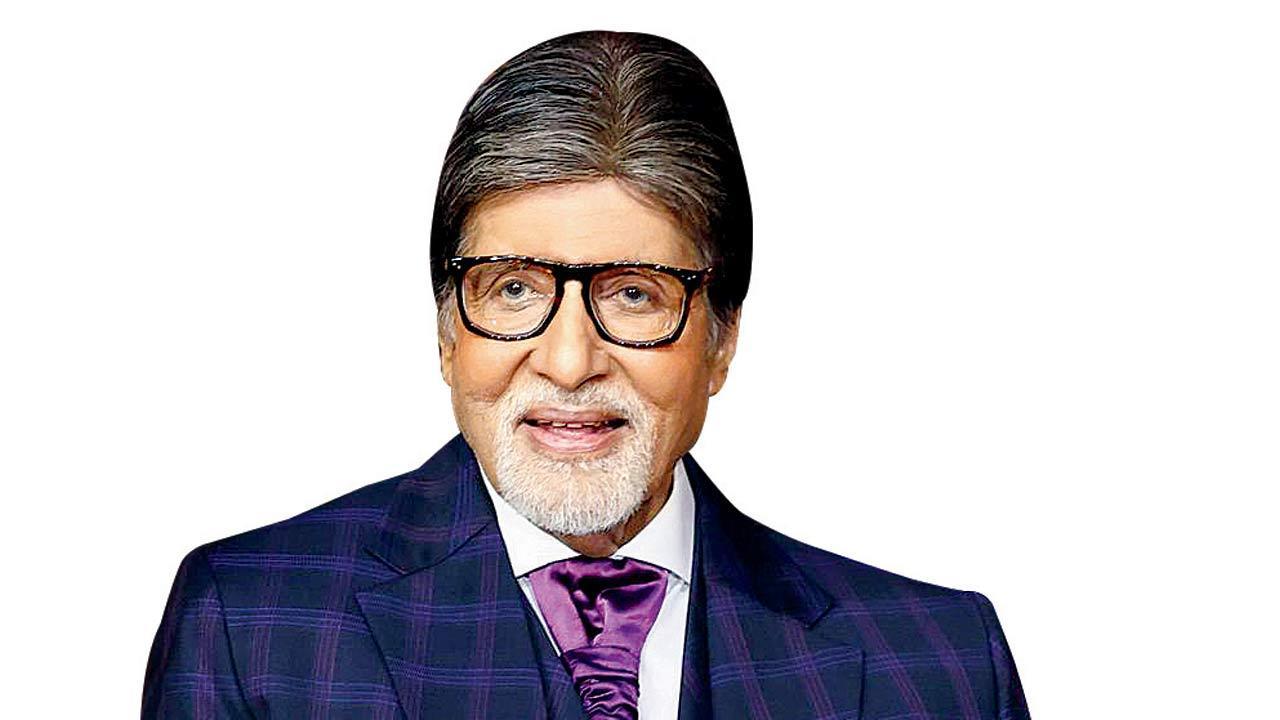
Celebrating 25 years of Kaun Banega Crorepati, Amitabh Bachchan recounts his journey to stardom and breakthrough role in Zanjeer
Upala KBR (MID-DAY; January 19, 2025)
It has been 25 years; Amitabh Bachchan has been sitting across the hot seat, quizzing contestants while subtly giving them hints and keeping Kaun Banega Crorepati entertaining with anecdotes. Next week, the reality quiz show kicks off the celebration, Gyan Ka Rajat Mahotsav, on January 20. Contestant Vinay Gupta from Kathu takes the hot seat as a representative of his village, becoming the first-ever contestant from his hometown to feature on KBC. The cherry on the cake comes when he gets Bachchan to spout one of his iconic dialogues from Zanjeer (1973).
Bachchan gets into action mode and recites the dialogue, “Jab tak baithne ko na kaha jaye, seedhi tarah khade raho. Ye police station hai, tumhare baap ka ghar nahi.” After the thunder of applause, he smiles and explains how he had to say this dialogue on the first day of shooting. “I was initially hesitant to say these lines to Pran sir, a man of extraordinary talent, but he was extremely supportive.”
Written by Salim Khan and Javed Akhtar, Zanjeer was the turning point of Bachchan’s career after his debut with Saat Hindustani (1969). The senior actor confesses that, at that time, the late actor Rajesh Khanna was the biggest superstar in India.
“Kya aura tha, kya following thi… His presence was so powerful that women would take the dirt from his car’s tyres and apply it to their foreheads as a blessing. I was a nobody, but Salim-Javed came to meet me and offered me the story. Javed saab said he had seen me in a scene from Bombay To Goa [1972], where Shatrughan Sinha and I were sitting in a restaurant and he slapped me. When I stood up, I was still chewing the sandwich I had been eating. That moment made Javed saab believe that I could handle the role in Zanjeer.”
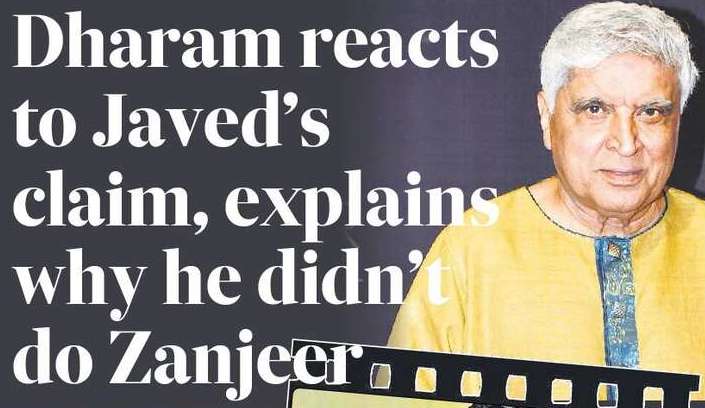
Dharmendra reacts to Javed Akhtar’s claim, explains why he didn’t do Zanjeer
8:37 AM
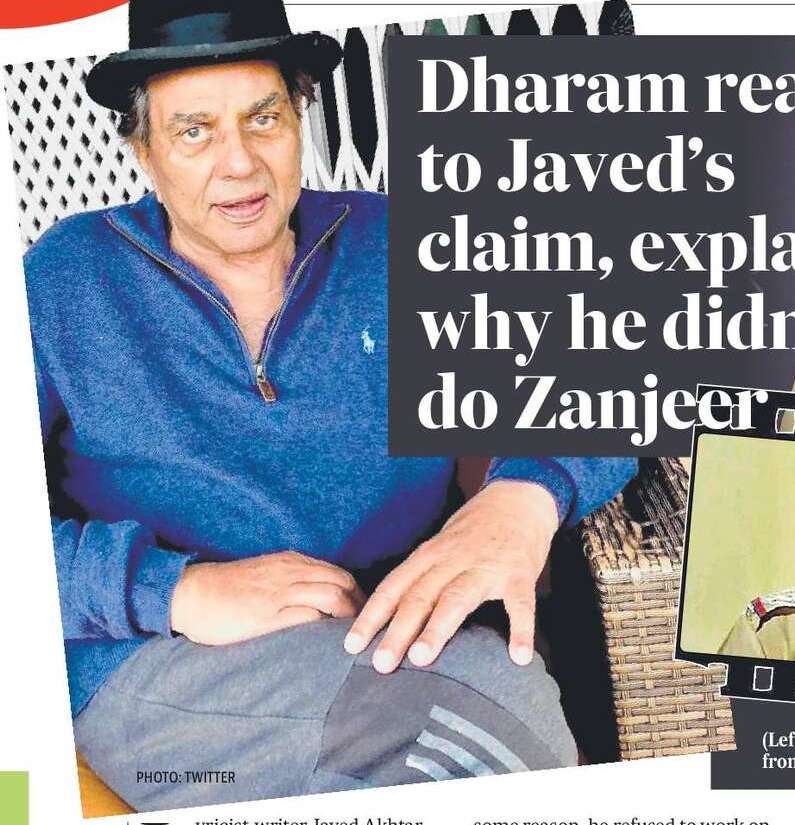
HINDUSTAN TIMES (October 12, 2022)
Lyricist-writer Javed Akhtar stirred up a hornet’s nest when, in a recent interview to mark actor Amitabh Bachchan’s 80th birthday, he said that instead of Big B, actor Dharmendra was the first choice for the film, Zanjeer (1973).
Akhtar claimed that the Apne (2007) actor turned down the role, among other actors. “Amitabh Bachchan was actually the last choice for Zanjeer. The script was written for Dharmendra ji, but for some reason, he refused to work on it. Prakash Mehra (the film’s director) had a script, but no leading man. He went from actor to actor to offer the role. Everybody refused to do the film,” Akhtar, 77, told India Today.
He added that many actors turned down the film as it had “no romance angle or comedy” and the lead character “was supposed to be a very grim, serious, bitter person”.
When HT City tweeted about the lyricist’s comments, the 86-year-old replied, “Javed, kaise ho... dikhave ki iss duniya mein haqeeqaten dabi rah jaati hain. jeetey raho... Dilon ko gudgudana khoob aata hai….. kaash sar chad ke bolne ka jaadu bhi sekh liya hota….. (sic).”
Soon after social media users started deciphering the tweet, Dharmendra clarified that his post wasn’t meant to signal any jibe: He wrote, “Refusing Zanjeer, was an emotional hurdle which i have mentioned in aap ki Adaalat. So please don’t misunderstand me. i always love Javed and Amit (sic).”
Amitabh Bachchan was an untapped dynamo before we paired-Salim Khan
8:22 AM

Salim Khan with Bachchan and Dilip Kumar
In a conversation with Mohammed Wajihuddin, writer Salim Khan deconstructs the myth behind the legend
Mohammed Wajihuddin (THE TIMES OF INDIA; October 11, 2022)
Q: Why did Bachchan personify the angry young man of India?
A: Cinema mirrors society. The youth of 1970s were disillusioned with corruption, nepotism. Amitabh became the hero who took on the forces that polluted the system. Disenchanted with pervasive hopelessness, the masses identified with Amitabh’s characters--the common man who wanted to right the wrongs and didn’t mind if he broke a few rules in the process.
Q: Why did established actors of the day refuse Zanjeer?
A: Before Zanjeer (1973), Amitabh had several flops and just two hits — Bombay To Goa and Anand. It was an era when films were made around stories of love and betrayal punctuated with melodrama and songs. Rajesh Khanna ruled. When we wrote Zanjeer, initially no one would touch it because it was so devoid of romance that the hero doesn’t hold the heroine’s hand even once. Dharmendra, Dev Anand, Dilip Kumar, Raaj Kumar — they all refused, they found the plot dry and not much for themselves in it. Once Dilip saab told me that he regretted refusing three films—Pyaasa, Baiju Bawra and Zanjeer.
Q: Was Zanjeer a gamechanger for both Bachchan and Salim-Javed?
A: Amitabh was immensely talented and needed a breakthrough script. When we created the character of police inspector Vijay Khanna, it suited the lanky figure with a booming baritone. I remember telling producer-director Prakash Mehra during the first day first show that the film would create history.
We were watching the scene where Sher Khan (Pran) visits the inspector and tries to sit. Vijay fumes: “Jab tak baithne ko na kaha jaaye, sharafat se khade raho, yeh police station hai, tumhere baap ka ghar nahin.”
Watching that scene, I told Prakash Mehra the film would be a hit. The intensity with which Amitabh delivered this line told us he had a lot of fire that needed to be tapped. We did it in subsequent films (Deewar, Trishul, Sholay...).
Q: He carried the roles that Salim-Javed wrote for him...
A: Amitabh was an untapped dynamo before we paired. He was educated and hugely talented but had not got the scripts to use his potential. Our scripts gave him ample opportunities.
Q: Why do we have a dearth of good scripts these days?
A: Today writers don’t read. When I came from Indore (Akhtar came from Bhopal) to Bombay to become an actor, I soon realized that acting would not take me to the peak. I turned to scriptwriting. A public library in Mahim became my second home. I read books and watched films voraciously.
Anti-establishment, dangerous, prone to crime...yet audiences loved the Angry Young Man
8:17 AM
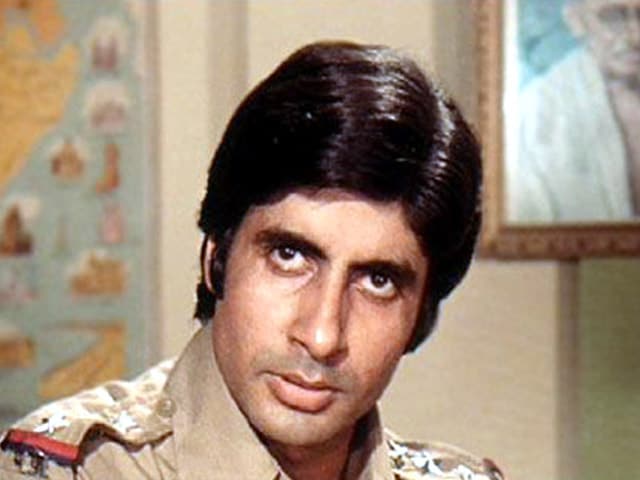
Recent south films have shown that the brawny, alpha male hero is alive and kicking (some butt)! While these films break records and rake in hundreds of crores, Bollywood seems to have given up on evergreen movie tropes. Yet, kasam paida karne waale ki, it was Hindi cinema that introduced the most enduring potboiler themes – the Angry Young Man, the double roles, the heinous villain. In a special series, we examine what made these films click over the decades. With Zanjeer’s 50th anniversary coming up next year, here is the first instalment – on Amitabh Bachchan as the Angry Young Man
BOMBAY TIMES (July 18, 2022)
‘TODAY’S INDIAN CINEMA HAS MORE ACTION HEROES THAN ANGRY YOUNG MEN’: JAVED AKHTAR
Back in the 1970s, thanks to the socio-economic and political realities, society was in a state of flux. But while writing characters like Vijay (Deewaar, Zanjeer, Trishul and more), we were not just looking at this situation, we also wanted to break the mould.
As a matter of fact, when we thought of this character (of the Angry Young Man), Rajesh Khanna was the god of moviegoers. He was giving one superhit after another, with great albums by R D Burman and Laxmikant-Pyarelal. At that time, these two young writers (Javed Akhtar and Salim Khan) naively thought of a character who would not romance, sing, dance, smile or do comedy. We had no idea that so many people would agree with and like the character! Fortunately, society was on the same page, so it clicked. But frankly, we did not consciously decide that the character should mirror contemporary social realities.
Speaking of today’s characters, I wonder if they are angry, or just violent. They don’t have any cause to be angry. They fight villains; they are extremely courageous and possess great strength. I believe they are more action heroes than angry young men. They are popular because action has always been admired, and now technology helps enhance the action scenes. So, they are just upgraded action heroes like Rocky or Rambo. However, if you see Deewaar, it had only one fight or say Trishul, which had more drama than action. The Angry Young Man has a point of view, he has a stand, while an action hero just fights off villains or other negative characters.
If Vijay were to return today, I don’t know if he would be as popular as before. He may not even be the same character. There would be some changes in ideation, according to the sentiments of the current times. But even today, if you show a man who doesn’t put up with nonsense, I feel people would want to watch him.
‘A VIJAY IN ZANJEER OR DEEWAR WAS NOT A REBEL WITHOUT A CAUSE’: SALIM KHAN
When we speak about the Angry Young Man, we must note that he always had a cause for anger – for instance, he would defend the honour of a lady if she was in trouble. He would not be a bystander and witness injustice being perpetrated. But there is a difference between anger and temper. Chhoti baaton pe gussa dikhana, haath uthana, gaali dena, cheezein utha ke phenkna is a sign of temper. Our characters did not show temper. A Vijay in Zanjeer or Deewar was not a rebel without a cause; the wrong that had been done to them turned them against the establishment.
Ittefaqan yeh character tab chal gaya, par sabka ek time hota hai. It was something very new back then, there was suspense, and people rooted for the hero to win, which got them hooked. If moviegoers feel it is just the acting that defined the trope and made the character popular, I tell them that script achhi nahi hoti toh kisi ko pasand nahi aata. The better the script, the more popular the movie.
After our films, many filmmakers saw this as a tried-and-tested formula and almost everyone wanted to use it, but itihas gawah hai, not every film worked the same way a Zanjeer, Trishul or Don worked. This also proves that just showing an angry man would never work – a convincing story was needed to keep the audience on the edge of their seat, with a feeling ab kya hoga, iss situation mein hero kya karega. Without this, hat could the actor or director work with?
FIVE MEMORABLE FILMS THAT CEMENTED AMITABH’S ANGRY YOUNG MAN IMAGE
ZANJEER (1973):
The one that started it all. Amitabh is Vijay, a police officer and a tortured soul, who is haunted by images of his parents’ murder in his childhood.
DEEWAAR (1975):
Amitabh is one of two brothers (the other is Shashi Kapoor, playing a cop), who has become a criminal after the injustices and poverty he faced in his childhood.
MUQADDAR KA SIKANDAR (1978):
Amitabh plays Sikandar, who was wrongfully accused of theft as a child and banished, which is the reason for his angst.
TRISHUL (1978):
Amitabh is Vijay, who comes back in his adult life to take revenge on his biological father (Sanjeev Kumar) as he had abandoned his family for money and professional success.
SHAKTI (1982):
Amitabh as Vijay grows up as a resentful man who becomes a criminal after his police officer father (Dilip Kumar) puts morals and duty above family ties.
I can never pick my favourite Lata Mangeshkar song, but making Don together was memorable-Anandji
8:07 AM
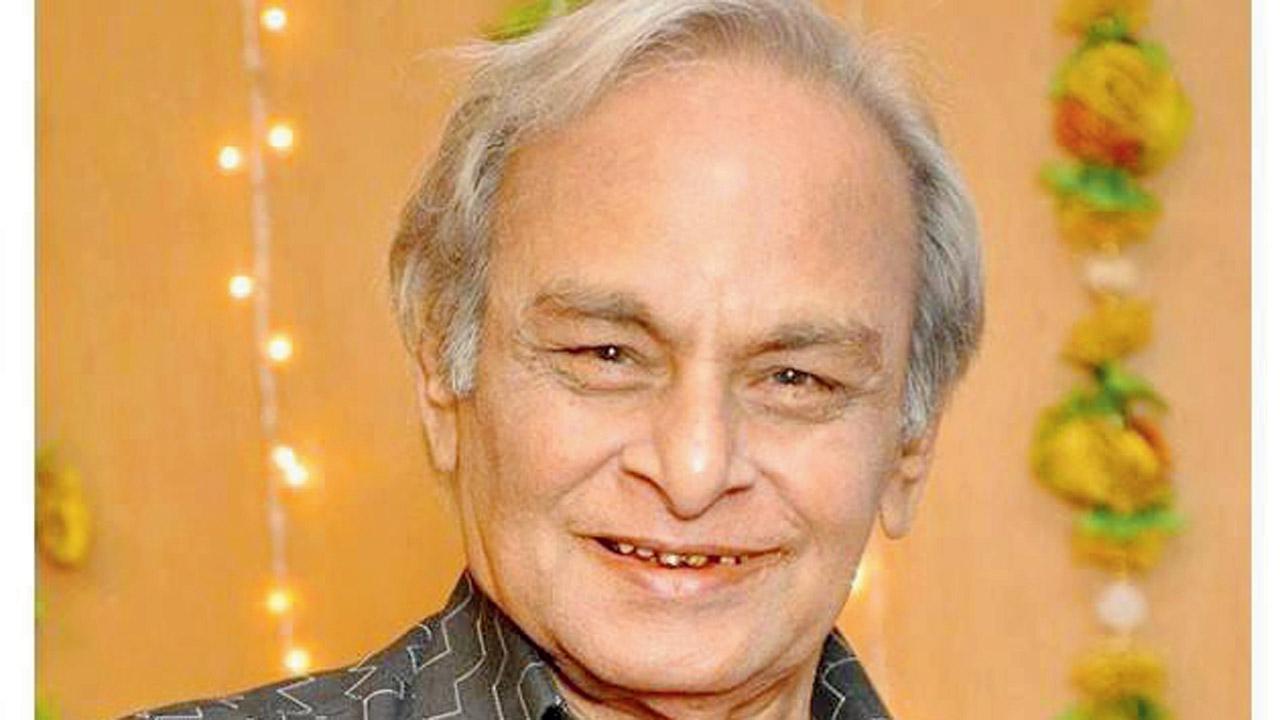
As told to Mohar Basu (MID-DAY; February 7, 2022)
When you’ve worked with someone for five decades, you don’t have just one memory that you cherish. Lata ji is someone I grew up with. We lived close by, and back then, she wasn’t Lata Mangeshkar — the Nightingale of India for us. Nor were we the hit duo of Kalyanji-Anandji. We were all newcomers, bonding as peers who love music.
Studios were basic then, and we used to record two songs in a day. Because of the noise [during the day], we would record only at night. Photographic recording was the norm when we worked. So, we could never hear, what we’ve recorded, on the same day. There was no option to rewind. Lata ji had worked with musicians pre-independence, so she had to ability to mould herself based on the musician’s style. She picked up in no time. She was the smoothest to work with because of her experience. She never lost her hunger to work harder. As a singer, she had only a singular aim — to creatively satisfy her music director.
I can never pick my favourite Lata song, but making Don [1978] together was memorable. In a film that is a thriller and not a romantic outing, a song of hers [Jiska mujhe tha intezaar] stands out because she made the material her own. The same stands true for Zanjeer [1973]. She made our music popular with her voice. Every song of hers lives beyond her. She is immortal because her art lives on. I love Kora Kagaz [1974]. Her songs feel like a life philosophy.
One has to go of course, but Lata is immortal because of her legacy. She was disciplined, dedicated and grounded till the end. Even in the last ten years when she wasn’t singing actively, she would never give in to food indulgences. She never thought she is brilliant at what she did. She always turned around and asked if it was good enough, wondering what more we needed.
I wondered why Rishi Kapoor won the Filmfare award for Best Actor only once-Pritish Nandy
8:04 AM

Remembering the actor who went from a teen heartthrob to one of Hindi cinema’s finest
Pritish Nandy (MUMBAI MIRROR; May 1, 2020)
 Rishi Kapoor was a clever, witty man always ready to discover a repartee even when there was no reason for one. He enjoyed the art of one-upmanship, particularly when it came to conversations. And yet bonhomie was not just part of his craft as an actor, it was second nature for him.
Rishi entered movies a decade before I came to this city. It was 1973 and his father, the legendary Raj Kapoor, launched him opposite a stunningly beautiful Dimple Kapadia in a teenage romance called Bobby which he directed on the basis of a flimsy K A Abbas story that went on to become the year’s biggest hit-- and the second biggest hit of the seventies. Adjusted for inflation, Bobby is still one of the twenty biggest hits of Hindi cinema.
In the same year, another young man who also started his career with a K A Abbas film, found his defining role in a Salim-Javed scripted actioner called Zanjeer that went on to become a big hit. Though Zanjeer collected much less at the box office than Bobby, it launched a new trend for action movies that made Amitabh Bachchan the popular star he soon became. So, 1973 was the year when both the hottest teenage romance and the Angry Young Man hit the ground running. A decade later, when I took charge of Filmfare, they were both at the top of their careers. The critics swore by Rishi. But Amitabh had an unparalleled fan club that ensured the focus never shifted from him.
They worked together in quite a few films, most famously in Manmohan Desai’s Amar Akbar Anthony, Naseeb and Coolie. And then 36 years later, I watched them together in 102 Not Out. It wasn’t much of a film but the two of them were a riot together. Curiously, over the years while Amitabh got embroiled in controversies, in movies as much as in politics, Rishi stayed away from the limelight and continued to build his repertoire of remarkable roles. He chose few and he chose wisely, and his reputation as an amazing actor kept growing.
The last film of his that I watched and loved was Mulk. It was about a Muslim family trying desperately hard to reclaim its lost honour when one of its members is accused of being involved in terrorism. Rishi’s was a compelling act and, as I watched the film mesmerised by his performance, I wondered why he won the Filmfare award for Best Actor only once and that too for his debut film 46 years ago. He was an actor who deserved many more. But then, as Rishi once asked me over a long phone conversation, are all Best Actor Awards really meant for best actors or only big stars who get their fan clubs to vote en masse? I really had no answer for him then. I still don’t have one today. But yes, I would have loved him to win the Filmfare Best Actor Award for Mulk.
He was always one for the ages. The romantic teenager who stole our hearts eventually turned into one of our finest actors, one who will be forever remembered for the roles he made so memorable. There are some things that even the Grim Reaper cannot take away from us.

Shahenshah, Satte Pe Satta remakes: Bollywood is ready for the return of Angry Young Man
8:09 AM

With Shahenshah, Satte Pe Satta, among others, B’wood ready for new wave of Bachchan remakes
Himesh Mankad (MUMBAI MIRROR; April 14, 2020)
 After Don, Agneepath, Zanjeer and Sholay, among others, 2.0 versions of several yesteryear hits featuring Amitabh Bachchan are under consideration. An industry source tells Mirror that Tinnu Anand, who directed the 1988 vigilante-drama Shahenshah, has been approached by many for the remake rights of the film. “He is yet to part with them. Another one of his directorials, Kaalia, is also a strong contender, with a lot of industry insiders keen to put a modern-day spin on the action-entertainer,” informs the source.
Meanwhile, we hear negotiations are underway for the rights of Prakash Mehra’s 1982 comic-caper, Namak Halaal, which featured the Big B, Shashi Kapoor and Smita Patil. “It’s a timeless comedy and multiple producers are in talks. If the deal is locked, one of them is looking to approach a top actor-star kid, whose forte is comedy, to step into Bachchan’s shoes,” the source shares.
Bhushan Kumar had announced a remake of Hrishikesh Mukherjee’s Dharmendra and Bachchan-starrer classic, Chupke Chupke, with Rajkummar Rao as botany professor Parimal Tripathi, who masquerades as chauffeur Pyare Mohan to hoodwink his wife’s (Sharmila Tagore) protective brother-in-law (Om Prakash). The actor, who will step into Bachchan’s shoes to play literature professor, Sukumar Sinha, is yet undecided.
Rohit Shetty is bank-rolling a Satte Pe Satta remake, with Farah Khan in the director’s chair. The 1982 original was top-lined by Bachchan in a double role—as Ravi Anand, who lives with his six brothers, and the antagonist, Babu. Farah was keen to have Hrithik Roshan step in for the Big B for the second time after Agneepath. After several rounds of discussions, the actor walked out, reportedly due to differences over the script. The director then approached Salman Khan, who was skeptical about playing a character previously essayed by the veteran actor. Buzz is, the makers are now in talks with Ajay Devgn for the part.
“It’s challenging to get such a huge ensemble in place. An official update on the film is expected once the Coronavirus pandemic subsides,” adds the source.
-------------------------
OTHER REMAKES
SHAKTI
A few years ago, a filmmaker was planning a remake with Bachchan Sr. playing DCP Ashwini Kumar, originally portrayed by Dilip Kumar, and Abhishek Bachchan stepping in to play the son, Vijay Kumar. Sanjay Gupta was to direct the film which was shelved before reaching the rewrite stage.
DO AUR DO PAANCH
In the 2010s, Vashu Bhagnani was planning to revamp the Rakesh Kumar-directed comedy, which also featured Shashi Kapoor, Hema Malini and Parveen Babi. After the success of Karan Johar’s Dostana, the producer approached John Abraham and Abhishek Bachchan but the film, to be directed by debutant Akshai Puri, never saw the light of day.
My father was a chain smoker and one day, he quit overnight-Pran's son Sunil Sikand
8:58 AM

Roshmila Bhattacharya (MUMBAI MIRROR; February 12, 2020)
 Today, Pran saab would have turned 100 and even though he took his final curtain call seven years ago, at the age of 93, he remains unforgettable. I remember, as a young girl, I had been fascinated by the perfect smoke rings he blew on screen. The first time he did it was back in 1949 in the teary melodrama, Bari Behen, which featured Suraiya and Geeta Bali as sisters. It went on to become his trademark.
A couple of days ago, when I asked his son how he did it, Sunil Sikand appeared surprised by the query. “He was doing it even at home, when we were kids. My father was a chain-smoker and at one time had smoked 100-120 cigarettes a day. Then, one day, when he was 57, he quit, overnight. I never saw him smoke again. He was usually an easy-going, amiable man, but he could be strong-willed when he wanted, and that showed in his work too. He was dedicated to his craft, asking for the song on a cassette and listening to it several times, even learning the words, before he went for the shoot,” he recounts.
Sunil adds that when he started assisting Manmohan Desai (he worked with the director in Amar Akbar Anthony, Parvarish, Dharam Veer and Suhaag), his father told him that the best AD is one who, when he is not around, makes his director feel his absence.
His favourite films from his father’s repertoire are Halaku and Shaheed , a picture in contrasts. The former was a 1956 period drama with Pran saab in the title role, as the imperious Mongol invader, grandson of Chengiz Khan, whose obsession with a Persian beauty in love with another man, makes him wilful and vengeful, but cannot completely erase his sense of honour. Manoj Kumar’s Shaheed was a smaller role, of a death row convict, daku Kehar Singh, who meets Bhagat Singh at Lahore Central Jail. He goes to the gallows wondering why a dacoit and a freedom fighter should be meted the same punishment.
“My father enjoyed doing both these films, along with others like Jis Desh Mein Ganga Behti Hai and Upkar. But he never watched any of his films, apart from the scenes featuring him during dubbing. He accidentally stumbled upon Zanjeer one afternoon on television, 20 years after its release, and called up Amitabh (Bachchan) to tell him he had liked his performance,” smiles the younger Sikand.
Interestingly, Sunil directed Amitabh and his father in a reincarnation drama titled Karishmaa. “It also featured Shashi Kapoor, Sharmila Tagore, Parveen Babi and Danny Denzongpa, but since I had known Amitabh for a long time, I decided to take the first shot on my father and him,” he informs. The film flagged off in 1978 but for some reason, was shelved.
Long before mothers began using the spectre of Gabbar Singh to instilterror and put their little ones to sleep, Pran saab would make them cower, clap their hands over their eyes, as soon as he appeared on screen. They would return to the film only after he was gone. Did the dreaded khalnayak of the movies keep to himself even in real life, you wonder, and Sunil exclaims, “On the contrary, he was a man who enjoyed the company of his friends, even our friends.” Dilip Kumar, whom his father opposed in films like Azaad, Devdas, Madhumati, Dil Diya Dard Liya and Ram Aur Shyam, lived in bungalow close by and Sunil remembers that when he was around 14-15 years, Dilip saab, sometimes alone, sometimes accompanied by his sisters, would drop by for a game of dumb charades with the Sikand family.
“Despite his intense roles, my dad was a light-hearted man. Even his villainy in later years had a touch of comedy, in films like Kashmir Ki Kali and Khandan. In the latter, his character Naurangi Lal, was a spoof on Hitler, complete with a toothbrush moustache,” says Sunil who went on to direct Pran saab in two other films, Farishta and Lakshmanrekha.
In Lakshmanrekha, he played Naseeruddin Shah’s father who is killed by Danny and puts his son on the road to revenge. It had Jackie Shroff as a cop. Farishta, which came in ‘84, was written and directed by Sunil, with Pran saab in a small role of Khan chacha. “My father insisted on getting contact lenses and painting them over, so he’d looked convincing as a blind man,” reveals Sunil. And that’s what made him a visionary in B-town.
In Article 15, Ayushmann Khurrana is a heroic yet super realistic cop-Anubhav Sinha
8:01 AM

Himesh Mankad (MUMBAI MIRROR; June 13, 2019)

Hailing the film as one of the most socially relevant stories he has come across in his career, the actor says, “We are yet to see a film based on the caste system that says things as they are. I had seen a documentary called India Untouched four years ago. It is so intriguing, and Anubhav told me that he had been trying to find an actor who could feel for these things. So, we decided on this film, and he developed the script further.”
Ask Anubhav about his decision to cast Ayushmann, considering he is primarily known for social comedies, and the director says, “Ayushmann was an absolute natural while playing a cop. There was this irresistible urge to veer close to the popular heroic versions earlier played by Ranveer (Singh), Salman (Khan) and Anil Kapoor but somehow Ayushmann managed to tread into unchartered territory to carve out a heroic yet super realistic cop.”
He goes on to liken his leading man’s portrayal with that of Amitabh Bachchan in the 1973 drama, Zanjeer. “The last time I saw this combination in a performance was by Mr Bachchan. And yes, Ayushmann’s cop is angry too,” the director signs off.
Ayushmann Khurrana inspired by Amitabh Bachchan’s, Aamir Khan’s and Manoj Bajpayee’s no-nonsense cop acts
8:52 AM
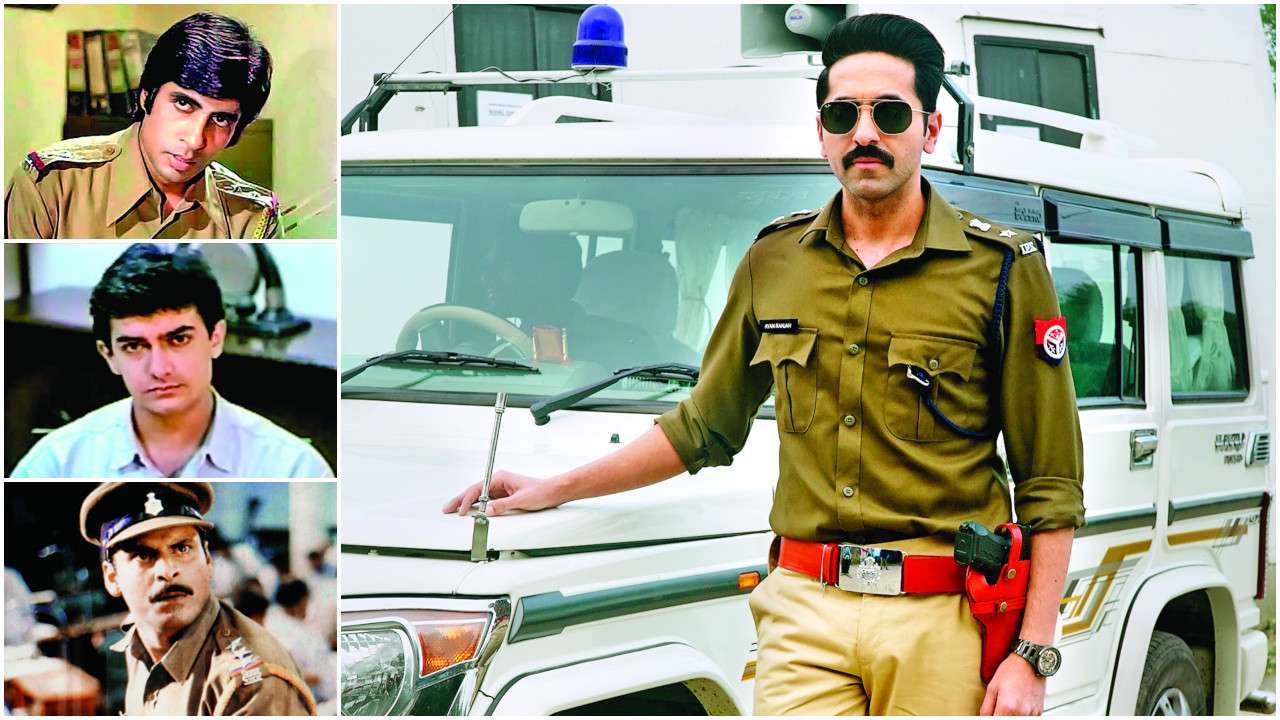
Hiren Kotwani (DNA; June 3, 2019)
The teaser of Article 15, which recently released, has resonated with cinegoers and also got Ayushmann Khurrana a lot of praise for his portrayal of a no-nonsense cop. Given that it’s an honour for every mainstream actor to essay a police officer on screen, Ayushmann, too, has always desired to don the khaki uniform for a movie role.
What is interesting to note is that he sought his inspiration from the characters of Amitabh Bachchan’s Vijay Khanna (Zanjeer, 1973), Aamir Khan’s Ajay Singh Rathod (Sarfarosh, 1999) and Manoj Bajpayee’s Samar Pratap Singh (Shool, 1999). That’s why he preferred to wait for a strong subject. And going by the response the teaser has generated, it looks like it has been worth the wait. Ayushmann essays a unique cop who’s zealous about bringing about a change in society in this Zee Studios production.
The AndhaDhun actor says, “My idols for playing a cop on screen are Amitabh Bachchan sir from Zanjeer, Manoj Bajpai sir from Shool and Aamir Khan sir from Sarfarosh. I wanted to go the realistic way and show the vulnerable side of cops. More than that I was keen to meet real cops and then portray my character in a certain way. Thankfully, I was in touch with lot of real-life officers... one of which is Manoj Malviya — a senior IPS officer from Delhi. It is part of the bucket list for every actor to play a cop on screen and I was waiting for the right script.”
The investigation drama premieres at the 10th London Indian Film Festival later this month. The Anubhav Sinha directorial will open the fest.
Noor Jehan had called me at least 10 times before boarding the plane-Pran
7:50 AM

Roshmila Bhattacharya (MUMBAI MIRROR; February 15, 2018)
I met him a couple of months after he had brought in his 78th birthday on February 12, 1998. I went expecting the bad man of my celluloid nightmares but found instead a frail fatalist reeling from his first visit to a hospital and the trauma of learning that one of the valves of his heart had shut down. Despite the youthful green of his kurta, Pran looked like a tired old man, often running out of breath, but unwilling to cut short our conversation.
As we meandered down memory lanes, he spoke about being discovered outside a ‘paan’ shop in Lahore by Wali Mohammed Wali, a leading script, dialogue and song writer of the time. Wali saab offered him the role of the villain in his upcoming Punjabi film, Yamla Jat, along with the address of Pancholi Studio where he promised to set up a meeting for him with his boss and the film’s producer, Mr Pancholi. But to the writer’s horror, the teenager did not turn up for the appointment the next day, convinced that the movie offer had been made in an inebriated state and not worth following up on. So instead of the studio, Pran Sikand headed to his photography shop and it was business as usual.
But the following weekend, he bumped into Wali saab again, at the Plaza theatre, and after cursing him roundly for the embarrassment he’d caused, the industry bigwig collared him to the studio the next morning, where Pran was signed for a monthly salary of Rs 50. The pre-Partition drama also featured M Ismail, Durga Khote and Noor Jehan as the heroine’s younger sister.
Yamla Jat which was unveiled in 1940 was a jubilee hit and two years later, Pran was signed as the leading man of Khandan opposite Noor Jehan. Their romance was limited only to the screen, a painfully shy Pran taking to his heels every time he was instructed to run after his heroine, but a real-life love story was playing out away from the camera. The film’s director, Shaukat Hussain Rizvi, was captivated by 17-year-old Noor Jehan and they tied the knot the same year and shifted to then Bombay. But after the Partition, Noor Jehan chose to move to Pakistan where she was born, settling down in Karachi. She mothered three children, before Rizvi and she separated in 1953. Later, she married Ejaz Durrani, a Pakistani actor-filmmaker popular for his portrayals of Ranjha and Mirza in Heer Ranjha and Mirza Sahiban, nine years younger than her, and took the curtain call after Ghalib in 1961 but never stopped singing. That marriage too ended in a divorce after three more children.
Meanwhile, Pran had married Shukla in 1945 and two years later was happily settled in Lahore, the proud father of a son, when communal fires that were sparking off across the city led to him sending his wife and young son to family in Indore. He promised to join them in time for the lil’ one’s first birthday and reached Indore on August 11 with a small suitcase. He never returned home and after the Partition, moved to Maximum City.
He was without a job for a few months, then in a span of three days signed four films—Ziddi, Apradhi, Grihasti and Wali Mohammed Wali’s own production Putli— going on to become one of Bollywood’s most hated khalnayaks. This was reiterated by the findings of a survey in the’60s across three states—Maharashtra, UP and Punjab—that threw up the startling fact that not a single school or college-going child had been named Pran during the time.
Over the years, the badmash metamorphosed into the widely respected Malang Chacha after Manoj Kumar’s Upkar and a much-loved Sher Khan after Prakash Mehra’s Zanjeer. When he was honoured with a Lifetime Achievement Award years later, he brought the audience to his feet and their standing ovation brought tears to his eyes. “Destiny, that’s the deciding factor. What has to happen will happen, even God cannot change your taqdeer…” These lines came not from any dialogue sheet but from his conviction that what’s written in the stars cannot be kept away from you.
Interestingly, while Pran was making box-office history this side of the border, his first leading lady was making history as Pakistan’s Malika-e-Tarannum (Queen of Melody) for lending her voice to the maximum number of film songs and becoming the country’s first female director. He never went back to Lahore but Noor Jehan did fly down to Mumbai to attend a musical gala in 1982, ‘Mortal Men, Immortal Memories,’ as the chief guest. “She was really nervous about that trip and had called me at least 10 times before boarding the plane. I reassured her that I’d be waiting for her at the airport here with a special bus,” Pran had reminisced. As her “Awaaz De Kahan Hai” resonated through Mumbai’s Shanmukhananda Hall memories came flooding back, of a time when borders hadn’t been drawn and countries hadn’t been divided.

Kapil Sharma's dog Zanjeer passes away; Preeti Simoes accuses vet of negligence
7:55 AM

His ex-creative head believes the death resulted from negligence; plans legal action again Dr Hitesh Swali who administered the last injection
Natasha Coutinho (MUMBAI MIRROR; January 22, 2018)
 Zanjeer, the dog that served the
police force for four years and was adopted by the team of The Kapil
Sharma Show, featuring in several episodes, passed away last Thursday.
The Labrador was nine and had been taken for treatment to an Andheri
clinic where he was treated by Dr Hitesh Swali and given antibiotics. He
was given an injection as part of the treatment after which he suffered
seizures and was taken to another vet, Dr Chousalkar, in whose clinic
he died.
Zanjeer, the dog that served the
police force for four years and was adopted by the team of The Kapil
Sharma Show, featuring in several episodes, passed away last Thursday.
The Labrador was nine and had been taken for treatment to an Andheri
clinic where he was treated by Dr Hitesh Swali and given antibiotics. He
was given an injection as part of the treatment after which he suffered
seizures and was taken to another vet, Dr Chousalkar, in whose clinic
he died.Preeti Simoes, former creative head of The Kapil Sharma Show, who looked after Zanjeer, has accused Dr Swali of negligence and plans to initiate legal action against him. “This is not the first time this man has done this to a pet. There are many groups in Mumbai with whom I have been sharing my story who have told me that Dr Swali has killed their cats and dogs with wrong medication. When a dog dies on the table, there is no way you can get paperwork done unless you take him to the Bombay Society for Prevention of Cruelty to Animals (BSPCA). There too doctors are not very supportive. Zanjeer lived like a hero and died like one. His death will not go unchallenged. Dr Swali will have to answer for it,” Preeti says.
She has reached out to other pet owners for support. “Zanjeer gave us so much happiness, every celebrity who shot with us and our crew will remember him,” she grieves.
Dr Swali told Mirror that Zanjeer came to him on Sunday afternoon with dog bites in multiple places. He had been bitten by a stray dog, he was told by the caretaker. “After cleaning the wounds with iodine, I administered an injection for post-bite therapy and gave him tablets. After an hour, the owner, Preeti Simoes, called and told me that her dog was completely vaccinated and I asked her to send a copy with her household help. The caretaker had left the dog loose and it had got into a fight,” he informs.
He admits to calling the dog for a follow-up on Tuesday when the caretaker told Zanjeer had been itchy and showed him a video of the dog scratching himself. “Upon inspection, I found he had fleas and showed them to the caretaker who admitted he roamed in the garden a lot and must have picked up the fleas from there. I told him to wash the dog and bring him back for anti-flea treatment,” he said, saying he sent the dog home.
An hour later, he got a call informing the dog was panting heavily, followed by another call from Neeti, Preeti’s sister, asking him why he had given Zanjeer an injection. “I’m innocent and have discussed the matter with Dr Chousalkar who thinks Zanjeer suffered a heat stroke and his platelet count was down to 50000. He believes Zanjeer’s death was caused by stress or acute poisoning which needs to be investigated,” says Dr Swali, adding that Zanjeer was already being treated by Preeti’s cousin Michelle who is also a vet before being brought to him.
It was very difficult to get a studio on board, because I was not making a Mary Kom-Apoorva Lakhia
7:43 AM

Rachana Dubey (BOMBAY TIMES; September 18, 2017)
 When he's not making movies,
he's either a sous chef in a restaurant or jumping off airplanes and
relishing his sky-diving lessons. So far, he has recorded 123 solo jumps
which he is happy to flaunt. He likes the slow pace of work - an average
of one film in three years. Apoorva Lakhia, who admittedly has a
long-running affair with crime-action films, particularly those dealing
with gangsters, is back after a four-year gap with another one in a
space he's familiar with: Mumbai's underbelly. The only difference this
time is that Haseena Parkar is not about a Bhai, it's about Aapa. We
take you through the filmmaker's journey with 'Haseena' in his own
words. Excerpts...
When he's not making movies,
he's either a sous chef in a restaurant or jumping off airplanes and
relishing his sky-diving lessons. So far, he has recorded 123 solo jumps
which he is happy to flaunt. He likes the slow pace of work - an average
of one film in three years. Apoorva Lakhia, who admittedly has a
long-running affair with crime-action films, particularly those dealing
with gangsters, is back after a four-year gap with another one in a
space he's familiar with: Mumbai's underbelly. The only difference this
time is that Haseena Parkar is not about a Bhai, it's about Aapa. We
take you through the filmmaker's journey with 'Haseena' in his own
words. Excerpts...THE HASEENA I KNOW...
Haseena Parkar was one of the 12 children born to Ibrahim Kaskar, a constable in the police force. Her formative years were spent in a tiny quarter with 11 siblings. She was extremely close to Sabir and Dawood, and the only member of the Kaskar family who stayed back in Mumbai after her marriage and the bombings. There was no evidence of her involvement in the case. It's a tragic character - she lost her husband young, she lost her son and watched her brother Sabir perish in a gang war. She became a godmother to many and remained a gangster for some. With 88 cases against her, she has been to court just once. She was supposed to go to the court for anticipatory bail. To avoid being arrested, she came with four other women in burkhas and no one could figure which one of them was her. She played it really smart. When her husband was shot 17 times, she carried him on her shoulders and put him in a taxi, which proves that she was a strong-willed woman.
THE WAITING GAME...
Although I was offered to do Dawood's biopic, in the course of my research, I felt Haseena Parkar's story was far more interesting and hadn't been tapped. When I was shooting Zanjeer at Film City, I was expected to meet Haseena and her family at someone's place in Malad at 7 pm. I reached the venue at 9 pm. Kadir, who was always with her, told me, 'Aapko maalum hai aapne kisko intezar karwaya hai?' I went into the house. Haseena was in the next room but she also made us wait for two hours. Meantime, I dozed off on the couch in my shorts because I was drained after the shoot. In the meeting, she didn't talk much, people around her did. My writer Chintan Gandhi, she and I were the only people seated in the room while everyone else remained standing. She was hesitant when I told her that I wanted to make a movie about her life. But eventually, she agreed and also opened up with us in our subsequent meetings.
NOT HASEENA'S SHOWREEL
We had a clear understanding that we were not venturing out to make a resume or a show reel for her. Like every other film of mine, I knew even this one will be scrutinized. I had told her that after talking to her, I will be talking to several others and on the basis of what I lay my hands on, I will draft the narrative. We will put in everything that can be corroborated which her family and she agreed to. I met several cops, including Meera Borwankar, who was in charge of her interrogation. I realised the police department loves India and left to their devices, they would eradicate everything anti-national. They are not happy to hear Dawood's name and feel that he is India's no 1 enemy. It's such a dichotomy: she was Nagpada's godmother and a gangster in the eyes of the law. The judge, during her hearing had noted that it's difficult for anyone to say if she's a victim of circumstances or the smartest woman on earth. And whether her problems are because of her brother or was he shielding her. Nothing could be proven; she got an anticipatory bail.
ANGRY TO BE CALLED DAWOOD'S FRIEND
In the last four years, I was offered several gangster and action films. Maybe I attract them or I get attracted to this kind of films pretty easily. But it's amusing how people speak about it. I was shooting with Shraddha Kapoor and Ankur Bhatia in Pune where a cinema hall owner told his kid, 'Yeh Dawood ka best friend hai. Yeh ussi pe picture banata hai.' That line angered me, but I didn't lose my cool on it because I didn't want to lose focus of my shoot.
 TOUGH START FOR HASEENA
The industry weighs you on your last Friday's outcome. Suddenly, after two flops, people look at you as the dark horse which they can't place their bets on. They conveniently forget that you have worked before this. Even relatively newer people question your ability to pull it off. This is a director's medium. A director may not be as big as the star but he will take the fall for the film. Although I was advised to change my path and explore other genres, I stuck to what I knew best. In these four years, my film was nearly written off a few times. I am not saying this is a great subject and I am making path-breaking cinema. This film was up my alley. The only thing I was unsure about was how I would work with an actress who had to play my hero.
NO REAL LOCATIONS
It's impossible to shoot at real locations in Mumbai. I couldn't even get an exterior shot of Nagpada because there are hoardings and tall buildings in the neighbourhood which didn't exist during those days. We shot exteriors in Pune because it has the old world charm of Nagpada.
NO FINANCE DESPITE BEING A WOMAN-CENTRIC FILM
No one backed my film financially for a very long time. It was very difficult to get a studio on board, because I was not making a Mary Kom. It wasn't a patriotic film where everyone could stand up and clap at the end of the film with our flag flying high. I was making a film about a woman in a grey area. I am criticized for making such films, but look at the subject matter I had. Here's a woman with 88 cases with not one proven by a massive judiciary. I just saw the material for what it is and presented both sides of the coin.
THE PARKARS HAVEN'T SEEN THE FILM
At the onset, I categorically told Haseena Parkar that I won't give her a narration. I had told her that she's known as a gangster and I won't mess with facts. Like her father was arrested for corruption charges which she didn't agree with, but there is an FIR to prove that. I told her I would include such facts in the film which can be substantiated. After the first draft, we went over to ask for the NOC, but she and her folks wanted a narration. I refused and left. Four days later, I met her alone. She again asked for the script. I showed her what I had in my hand and she signed the deal, maybe because she was morally bound by her word. To this day, I haven't shown the film to her family and neither were they allowed on my set every day.

Dawood Ibrahim's sister's story more interesting than his-Apoorva Lakhia
7:44 AM

Apoorva Lakhia on choosing to tell Haseena Parkar's story and why the Zanjeer remake didn't work
Avinash Lohana (MUMBAI MIRROR; September 11, 2017)
Apoorva Lakhia had been
approached to make a film on Dawood Ibrahim and met the don's family as a
part of the prep. During his conversations with his sister, Haseena
Parkar, he learnt how they had lived in a 12-ft x12-ft chawl, their
childhood and her relationship with her brothers. “I found her story
more interesting and asked if I can
make a film on her. She agreed after a week to 10 days. This was
three-and-a-half years ago,“ reminisces Apoorva admitting that he'd
struggled to find a studio to back the biopic but once he had the
producer and his heroine, Shraddha Kapoor, on board, he finished the
film in 42 days.
 Quiz him on why he zeroed in on Shraddha who looks
nothing like Haseena and he points out that after the first poster and
promo this
debate quickly died down. “I had seen her in Haider and knew she was my
Haseena,“ asserts the maker who did three months of extensive rehearsals
with the actress, which included costume trials, body suits and
prosthetic tests. “We even hired an acting coach, Samar Singh, who
analyses scripts, goes into the back stories of characters and develops
them with the actors. Siddhanth Kapoor and Ankur Bhatia spent a
month-and-a-half with him and Shraddha did a
two-week extensive rehearsal with him and me. In those three months, we
really got the character going.“
Quiz him on why he zeroed in on Shraddha who looks
nothing like Haseena and he points out that after the first poster and
promo this
debate quickly died down. “I had seen her in Haider and knew she was my
Haseena,“ asserts the maker who did three months of extensive rehearsals
with the actress, which included costume trials, body suits and
prosthetic tests. “We even hired an acting coach, Samar Singh, who
analyses scripts, goes into the back stories of characters and develops
them with the actors. Siddhanth Kapoor and Ankur Bhatia spent a
month-and-a-half with him and Shraddha did a
two-week extensive rehearsal with him and me. In those three months, we
really got the character going.“
He adds that Siddhanth and Shraddha's sibling chemistry really helped the film, maintaining that in Hindi cinema, and maybe not even in Hollywood, a brother-sister duo has replayed their real-life roles. “Siddhanth's very protective about Shraddha while she looks up to him and that comes across on screen,“ says Apoorva, reminiscing about a scene in which Haseena and Dawood's father beats the latter with a belt in front of the family. “The noise of the fake belt sounded very real and Shraddha began crying. And in the scene where he meets her at night before leaving the country the lines are so emotional both Siddhanth and she started sobbing and we had to empty the set till they were composed.“
Sonakshi Sinha was initially supposed to play Haseena and the film was to roll last September. But John Abraham's injury pushed Force 2 forward. “So, one day Sonakshi and I sat down and decided she and I would do something else together in the future,“ says Apoorva.
Even though the film is yet to release, there's been talk of him glorifying Dawood and Haseena. He dismisses it saying it's easy to post something on the social media. “The film may be titled Haseena but it's not a one-sided view. There were 88 cases registered against her. I have done my research, met crime branch officers, lawyers and police commissioners, I have copies of the FIRs. But more than all this, the film is about a happily married girl with four kids whose life was affected by the shadow of her brother's personality. It's about what lead to her becoming Haseena Parkar,“ he says.
Flashback to 2013 and his last directorial, the Zanjeer remake, with Telugu superstar Ram Charan and Priyanka Chopra playing modern-day Amitabh Bachchan and Jaya Bhaduri. Where did he go wrong with that? “There were so many court cases that the budget just ballooned and it was impossible to make money. Also, people didn't like it anyway,“ Apoorva says.
When he's not making movies he goes globe-trotting and jumps out of planes. “My latest hobby is sky-diving. I've done 112-solo jumps,“ he beams. “Cooking is another passion. I took a year off after Mission Istaanbul to get a chef's degree from a French culinary institute in US. I also like playing cricket and play for two teams.“ So, what's next? “A long holiday for now,“ he laughs.
Quiz him on why he zeroed in on Shraddha who looks
nothing like Haseena and he points out that after the first poster and
promo this
debate quickly died down. “I had seen her in Haider and knew she was my
Haseena,“ asserts the maker who did three months of extensive rehearsals
with the actress, which included costume trials, body suits and
prosthetic tests. “We even hired an acting coach, Samar Singh, who
analyses scripts, goes into the back stories of characters and develops
them with the actors. Siddhanth Kapoor and Ankur Bhatia spent a
month-and-a-half with him and Shraddha did a
two-week extensive rehearsal with him and me. In those three months, we
really got the character going.“He adds that Siddhanth and Shraddha's sibling chemistry really helped the film, maintaining that in Hindi cinema, and maybe not even in Hollywood, a brother-sister duo has replayed their real-life roles. “Siddhanth's very protective about Shraddha while she looks up to him and that comes across on screen,“ says Apoorva, reminiscing about a scene in which Haseena and Dawood's father beats the latter with a belt in front of the family. “The noise of the fake belt sounded very real and Shraddha began crying. And in the scene where he meets her at night before leaving the country the lines are so emotional both Siddhanth and she started sobbing and we had to empty the set till they were composed.“
Sonakshi Sinha was initially supposed to play Haseena and the film was to roll last September. But John Abraham's injury pushed Force 2 forward. “So, one day Sonakshi and I sat down and decided she and I would do something else together in the future,“ says Apoorva.
Even though the film is yet to release, there's been talk of him glorifying Dawood and Haseena. He dismisses it saying it's easy to post something on the social media. “The film may be titled Haseena but it's not a one-sided view. There were 88 cases registered against her. I have done my research, met crime branch officers, lawyers and police commissioners, I have copies of the FIRs. But more than all this, the film is about a happily married girl with four kids whose life was affected by the shadow of her brother's personality. It's about what lead to her becoming Haseena Parkar,“ he says.
Flashback to 2013 and his last directorial, the Zanjeer remake, with Telugu superstar Ram Charan and Priyanka Chopra playing modern-day Amitabh Bachchan and Jaya Bhaduri. Where did he go wrong with that? “There were so many court cases that the budget just ballooned and it was impossible to make money. Also, people didn't like it anyway,“ Apoorva says.
When he's not making movies he goes globe-trotting and jumps out of planes. “My latest hobby is sky-diving. I've done 112-solo jumps,“ he beams. “Cooking is another passion. I took a year off after Mission Istaanbul to get a chef's degree from a French culinary institute in US. I also like playing cricket and play for two teams.“ So, what's next? “A long holiday for now,“ he laughs.
When I look back, I feel that my story is similar to Urmila Matondkar's in Rangeela-Ankur Bhatia
1:11 PM

Rachana Dubey (BOMBAY TIMES; September 10, 2017)
A well-paying job in New
York's financial sector is a dream, but Ankur Bhatia had different
goals. He left it to become an actor. A chance meeting with Apoorva
Lakhia drew him back to India. “Mumbai is like New York; the only
difference is that people look and sound familiar here,“ says Ankur, who
plays Ibrahim Parkar, Haseena Parkar's husband, in the biopic of the same name. He spent a considerable amount of time trying to find his
feet. BT met the Bhopal-bred actor, who, after a bit role in Zanjeer
and a supporting role in Sarbjit, is ready for his third outing.
Excerpts...
 It's hard to recall the work that you have done so far. Could there have been a better start?
Yes, but let's look at the positive side - I had a decent start. I'm not from a film family to get a crackling launch. Zanjeer was a stepping stone in terms of mainstream movies since I had done independent work in the US. I met director Apoorva Lakhia while I was in America. I returned to India but he didn't have work for me then. I spent two months meeting people, but nothing worked out. The day I was about to leave Mumbai, Apoorva cast me in a role that had been abandoned by another actor. It was a five-day shoot that took 18 months. I did two Telugu films in the interim. Those three films became my learning grounds. Then came Sarbjit for which I grew a beard and put on weight since the character had an age graph. I got decent reviews, but no one recalls me because of my look. That movie, and working with Aishwarya Rai Bachchan, Randeep Hooda and Richa Chadha filled me with confidence.
How did you land a role in Haseena Parkar?
I met Apoorva when he was planning it. He told me that although I fit the bill appearance-wise - Ibrahim Parkar was also 6 feet tall - I needed to audition. He also made me do thorough research. I went over to Jairaj Lane where the family stayed and Ibrahim ran a restaurant, the only vegetarian eatery in the Muslim-neighbourhood that catered to Maharashtrian mill workers. Given his physique, he also doubled up as a Bollywood stuntman. He used to mimic actors and tease Haseena. He had a swagger and held his own wherever he was. He was a lovely, lively guy. I had a different picture of him in my head when I landed the film. Ibrahim is a pivotal part of Haseena's story, and I earned the role for myself.
While working with actresses like Aishwarya Rai Bachchan (Sarbjit) and Shraddha Kapoor (Haseena Parkar), does their star power intimidate you?
Once you start shooting, everything changes. During Sarbjit, I was a tad nervous while I was in the vanity van, but once I stepped out, I started seeing everyone as the characters they play. Aishwarya was Dalbir and I was her husband. It's only because of that attitude that I could hold her hand firmly and tell her, 'Aaj gayi, to phir wapas mat aana.' That scene looks convincing because I wasn't intimidated. My first big scene with Shraddha in Haseena Parkar was our wedding night sequence, but since we had a comfort zone, it fell into place. I understand that I am an actor and so are the others. I am confident in my shoes, no matter who I share the screen with.
Is the industry more open to newcomers now?
There are more avenues for newcomers and auditions have made the casting process more transparent, but there's still time for the dust to settle. Auditioning for roles worked for me, but there are many aspirants who are not so lucky. When I look back, I feel that my story is similar to Urmila Matondkar's in Rangeela - she goes from being a background dancer to the leading lady. I was in a similar space in Zanjeer and today, I'm playing a pivotal role.
Has your family come around with your change in profession?
My father was aghast when I left my job in America, but later, he and my mother came around. After I returned to India, my father suffered a cardiac issue and my mother was diagnosed with cancer. So, thanks to this job, I was here when my parents needed my brother and me the most. That's why I believe that everything happens for a reason.
Yes, but let's look at the positive side - I had a decent start. I'm not from a film family to get a crackling launch. Zanjeer was a stepping stone in terms of mainstream movies since I had done independent work in the US. I met director Apoorva Lakhia while I was in America. I returned to India but he didn't have work for me then. I spent two months meeting people, but nothing worked out. The day I was about to leave Mumbai, Apoorva cast me in a role that had been abandoned by another actor. It was a five-day shoot that took 18 months. I did two Telugu films in the interim. Those three films became my learning grounds. Then came Sarbjit for which I grew a beard and put on weight since the character had an age graph. I got decent reviews, but no one recalls me because of my look. That movie, and working with Aishwarya Rai Bachchan, Randeep Hooda and Richa Chadha filled me with confidence.
How did you land a role in Haseena Parkar?
I met Apoorva when he was planning it. He told me that although I fit the bill appearance-wise - Ibrahim Parkar was also 6 feet tall - I needed to audition. He also made me do thorough research. I went over to Jairaj Lane where the family stayed and Ibrahim ran a restaurant, the only vegetarian eatery in the Muslim-neighbourhood that catered to Maharashtrian mill workers. Given his physique, he also doubled up as a Bollywood stuntman. He used to mimic actors and tease Haseena. He had a swagger and held his own wherever he was. He was a lovely, lively guy. I had a different picture of him in my head when I landed the film. Ibrahim is a pivotal part of Haseena's story, and I earned the role for myself.
While working with actresses like Aishwarya Rai Bachchan (Sarbjit) and Shraddha Kapoor (Haseena Parkar), does their star power intimidate you?
Once you start shooting, everything changes. During Sarbjit, I was a tad nervous while I was in the vanity van, but once I stepped out, I started seeing everyone as the characters they play. Aishwarya was Dalbir and I was her husband. It's only because of that attitude that I could hold her hand firmly and tell her, 'Aaj gayi, to phir wapas mat aana.' That scene looks convincing because I wasn't intimidated. My first big scene with Shraddha in Haseena Parkar was our wedding night sequence, but since we had a comfort zone, it fell into place. I understand that I am an actor and so are the others. I am confident in my shoes, no matter who I share the screen with.
Is the industry more open to newcomers now?
There are more avenues for newcomers and auditions have made the casting process more transparent, but there's still time for the dust to settle. Auditioning for roles worked for me, but there are many aspirants who are not so lucky. When I look back, I feel that my story is similar to Urmila Matondkar's in Rangeela - she goes from being a background dancer to the leading lady. I was in a similar space in Zanjeer and today, I'm playing a pivotal role.
Has your family come around with your change in profession?
My father was aghast when I left my job in America, but later, he and my mother came around. After I returned to India, my father suffered a cardiac issue and my mother was diagnosed with cancer. So, thanks to this job, I was here when my parents needed my brother and me the most. That's why I believe that everything happens for a reason.
Here's why Shah Rukh Khan, Akshay Kumar, Amitabh Bachchan are buying the rights to their films
7:50 AM

Upala KBR (DNA; June 12, 2017)
For the past few years, Shah Rukh Khan has been buying the negative rights to all his films.
Amitabh Bachchan and Akshay Kumar have followed suit. The older generation of actors may not have known the value of owning the prints or library of their films, but the digital and streaming media boom has made this relevant today.
Good business sense
This generation of actors have business acumen and are buying the rights to their current as well as earlier films, including clippings. Trade analyst Atul Mohan says, “Today, film rights are an asset because a remake of the film or telecast on a digital or satellite medium fetches the owner royalty money.” So, if anyone wants to use material from the films, he would now need to approach the actor and not the producer.
Future investment
Trading of film rights has a number of benefits. Mohan explains that by buying the rights, the stars are making investments for their future. “Actors buy the rights at a good price. As actors or producers get older and do fewer films or become inactive, they can generate an income by selling the rights.” For instance, Amitabh Bachchan couldn’t cash in on the Zanjeer, when it was remade since Prakash Mehra’s family owned the rights.
Personal library
Trade analyst Amod Mehra says that sometimes it’s not just for investment purposes. “SRK wants to be remembered for his good films. He may have made a few bad films that he does not want exposed, so he can buy them for his personal library.” Amod adds Shah Rukh has most of the rights of his films, except those made by Yash Raj Films and Dharma Productions, “He also wanted to buy the film rights of Anjaam, but the price he quoted was too little, so the producer Rahul Rawail sold it to someone else.”
Changing business models
Filmmaker Subhash Ghai has been approached by leading channels and distributors to accrue rights of films for specified periods such as three or five years. However, no star has approached him to buy the right yet. “Mukta Arts has a library of over 40 films, with maximum blockbusters. Business models keep changing, and we will do to the best in the interest of the company.” The producer-director chooses not to reveal whether Shah Rukh wanted to buy the rights of Pardes and Trimurti.
Shekhar Kapur told me to head to Mumbai, try my hand at films & earn money-Manoj Bajpayee
8:19 AM

Shilpi Mahapatra (MID-DAY; January 1, 2017)
I was in awe of Bachchanji (Amitabh Bachchan) after watching Zanjeer. It was that moment that I decided to become an actor. And so, during my college days, I started doing theatre. I wanted to join the National School of Drama, but couldn’t. So I attended workshops conducted by the Sambhav Theatre Group for almost a year. I would still keep trying to break into NSD, but I reckon it wasn’t destined. So, a friend, N K Sharma, and I started our own theatre company.
It was in 1992 that something that filmmaker Shekhar Kapur said changed my life. He told me to head to Mumbai and try my hand at films. He said that though theatre would satisfy me creatively, I would need the money for when I had a family. And so, I decided to take the plunge. Once in Mumbai, I started my struggle. It was tough since I didn’t know anyone. Luckily, I was called to act in Kapur’s Bandit Queen (1994) as a dacoit. I had auditioned for the lead role, which ultimately went to Nirmal Pandey.
After Satya (1998) released, there was no looking back, until a few year ago when I injured myself. For two years, I had to lay low and read false media reports about me. Everyone had written me off and I lost many projects. I was down to my last penny. And then Prakash Jha offered me Raajneeti, and subsequently, Aarkshan. It was the most challenging phase of my life, but it made me stronger and wiser.

Salman Khan offers Ram Charan Teja 2-hero project with him; advises against solo roles?
8:49 AM

Subhash K Jha (DNA; October 24, 2015)
After Telugu superstar Ram Charan Teja’s disastrous
Bollywood debut in Zanjeer there are rumours that he will do an action
film co-starring his Bollywood mentor Salman Khan, next.
As it turns out, Salman has advised Ram against getting on board another solo project. Says a source, “Salman and Ram are very close. He has promised the younger actor that he will work with him in a two-hero project featuring them both in tailor-made roles.” The project will go on floors next year.
At the moment, Ram has said yes to two Telugu films to be directed by Surender Reddy and Gautham Menon. The Telugu superstar is very excited about doing the Telugu version of the Tamil superhit Thani Oruvuan, where he again plays a cop.
Ram says he feels no trepidation about getting into khaki even after the Zanjeer fiasco. He says “I am certainly not put off by the failure of Zanjeer. In fact, I’ll be doing another Hindi film very soon. One experience can’t put me off Bollywood for a lifetime.”
Also, there was talk of Ram doing Ashutosh Gowariker’s historical Mohenjo Daro. The Telugu star admits there was indeed a chance of him of him being in the historical. “Yes, there were talks for that project. But that didn’t work out. Very soon, I’ll be doing another Hindi film,” he announces.
Box Office Disasters in recent years
2:17 PM

Box Office India Trade Network
HAPPY ENDING is one of the high profile distasters in the last few years. Below is a list of major films that became commercial disasters since 2010 and the nett business they accumalated:
Happy Ending (2014) - 21 cr (expected)
Gori Tere Pyaar Mein (2013) - 14 cr
Zanjeer (2013) - 18 cr
Players (2012) - 30 cr
Joker (2012) - 20 cr
Tezz (2012) - 16 cr
Game (2011) - 7.50 cr
Khelein Hum Jee Jaan Sey - 4.75 cr
Guzaarish (2010) - 30 cr
The above films are the biggest box office disasters in the last few years amongst the major releases. All the above films cost over 50 crore to produce and release apart from GAME and KHELEIN HUM JEE JAAN SEY which were in the 35-40 crore region but the business of these two was a total washout.
The list does not include the umpteen releases week in week out which become box office disasters as they hardly have a release.

Subscribe to:
Posts (Atom)