Showing posts with label Yun Hota Toh Kya Hota. Show all posts
Showing posts with label Yun Hota Toh Kya Hota. Show all posts
I am not averse to songs, I am just not too fond of Hindi film music-Naseeruddin Shah
8:22 AM

Seventeen years after his last directorial effort left him frustrated, Naseeruddin Shah returns with a tender short film about relationships, casting family and friends
Jane Borges (MID-DAY; August 27, 2023)
In the early noughties, when filmmakers were successfully experimenting with ensemble casts and multiple plot threads, Naseeruddin Shah, with a reputation for being sagacious in his choice of films, joined the fray with his directorial debut, Yun Hota Toh Kya Hota (2006), a 9/11 hijack drama that was a collage of four inter-twined stories.
We meet the 73-year-old at his Bandra West residence, on a day when the sun and rain clouds are playing hide-and-seek. Shah is dressed in a multi-coloured checked shirt and was only minutes before our interruption, deep into a book; he looks back at the film as a mixed bag. “I was hurried into it [making the film],” he remembers, “And I didn’t get the time to consult anyone about the screenplay.”
In hindsight, he says, “I should have.” “I should have waited,” he repeats, “But the producer kept this carrot on a stick in front of me, and said, ‘we’ll launch it on your birthday’. I got tempted by the idea, became rather sentimental. It was released on my birthday… Not that it lasted very long at the box office.” If there’s any disappointment, Shah coats it with his dry humour.
Several years followed, during which theatre, and big and bit roles in the movies served as Shah’s creative fuel. “I was nervous about making another film,” he says. “I preferred [directing for] theatre, which is a living thing. You can keep adding to, subtracting from, improving upon, and it keeps evolving as you keep rehearsing and performing. Whereas a film is fixed in stone. Once it’s out, you cannot revise it.”
But Yun Hota Toh Kya Hota never really left him. “I have been thinking about it a great deal. It did not turn out quite as I had hoped.
Shah says the movie fell short on many scores—he had wanted to make something more “cohesive” where the four stories overlapped, and where characters of one story would appear in the other. “The Irrfan [Khan] story I was particularly most unhappy about, because there was so much more I could have given a great actor like him to do. I realized that you can’t have a central character do nothing; that’s exactly what he was. Lucky for me, Irrfan didn’t hold it against me.” He sums it up: “I was not really well prepared enough.”
While the film had left him with a terrible sense of frustration, Shah confesses he always itched to get back to direction. Dissatisfaction with some of the movies that he had acted in drew him to it in the first place—“I would try and think about how I could repair some of the absolutely ghastly scenes that I was forced to enact.”
The opportunity came recently with Man Woman Man Woman, which is also theatre company Motley Productions’ first short film production, with Trigger Productions and Royal Stag Barrel Select Large Short Films. Starring spouse Ratna Pathak Shah, son Vivaan, Saba Azad and Tarun Dhanrajgir, the 25-minute film is a tender story about relationships and second chance at happiness. It released on Large Short Films’ YouTube channel on Friday.
Shah says he was more prepared this time around, with Ratna and Vivaan contributing with suggestions to his script, and older son Imaad taking the reigns as associate director, helping with everything from the screenplay to the music, which he composed with Samar Grewal. “There’s [just] one song in the film… I am not averse to songs, I am just not too fond of Hindi film music,” shares Shah.
When Ratna, who has joined us for the interview with Vivaan, first read the script, she found it “charming and simple”. “It was also a story that required the actors to behave in an utterly natural and comfortable manner… those are things that Naseer is really good at. And there were lovely parts for each one of us. They were short and brief, but the scenes had enough meat in them.”
What helped a great deal, she says, was that everyone on the set were either friends or family. Sanah Abbott was second assistant director; Anil Mehta was cinematographer, and Hina Saiyyada, editor. “We’ve known everyone for years. It was really a carry forward of the way we do things at Motley, where the work is done in a collaborative fashion… eventually, it’s a bunch of friends making a film together.”
Actor-singer Saba Azad, who plays Ratna’s daughter in the film, she says, “is practically daughter to me”. She and Imaad have been musical partners for years as electro funk duo Madboy/Mink. At this point, the doorbell rings. It’s Saba who rushes to hug Shah and Ratna—her ‘Baba’ and ‘Mama’. They break away briefly from talking about the film to discuss her recent freezing cold holiday in South America. “The transfer of affection doesn’t have to be underlined there,” says Ratna reeling us back in, “These are the kind of moments that came naturally to us when we were performing.”
Saba, who has been looking for material that challenges her as an actor, says she was drawn to the film because she found it to be an “inclusive love story”. “It’s also unusual… we don’t often talk about older love and sexuality.”
The challenge for Shah was to translate that idea on screen in a shorter format, and “getting rid of the flab”. Film, as a medium, makes tremendous demands of a director. Shah describes the role as more “organizational and exhausting” than creative. Ratna says that while Naseer has been successfully directing theatre for several years now, to put those lessons aside and re-learn and re-invent for film was a hard-fought experience.
“It was more traumatic for him, than it was for us; we were frankly having a party,” Ratna laughs. Saba adds, “I think theatre functions in a more controlled environment than films; there are so many more variables on a film set. I remember the first scene, the rain came down on us, and it happened again and again.”
She says working with a meticulous director like Shah was an experience. “He knows exactly what he wants from the actor. I don’t know if this is something that comes from years of directing for theatre.”
The entire script was written keeping Ratna, Vivaan and Saba, in mind, except the elderly man, says Shah. “I was certain I would not play the role,” he says. Shah offered it to well-known actors, “but I realized they bring too much baggage.”
Ratna suggested Tarun Dhanrajgir, whom they knew from their early years as theatre actors. “We hadn’t met for close to 40 years. He was a slim lad back then, who had turned into a portly, personable, white-bearded, handsome gent. I had faith in his acting because we had worked together in two plays way back in 1982 and ’83.”
Dhanrajgir, who is based out of Hyderabad, joins us over a call and says he was a bundle of nerves because he hadn’t faced the camera in years, except for short roles in Telugu movies. “But it was an emotional moment for me… going back and working with Naseer and Ratna after all this time.”
Vivaan, who aside from acting in theatre and films, has also been writing novels (his third novel, The Forsaken Wilderness released earlier this year), says he and his father are great collaborators. “So much of my immersion in literature is thanks to what I have learnt from my parents. Baba is a brilliant storyteller. I remember, as a kid, when we used to go on these long car rides, he would synopsize the entire plot of Shakespeare. That’s how I was first exposed to The Merchant Of Venice and Macbeth,” he says and adds, “Another very interesting thing about him is his ingenuity as a dramatist. That really harks back to all his theatre work.”
Vivaan says his father’s adaptation, restructuring and re-formulation and of pre-existing literature for the stage, sets him apart. “That’s really what great screenplay writers do. It’s wonderful to witness Baba apply the same ingenuity as a dramaturge into this film.”
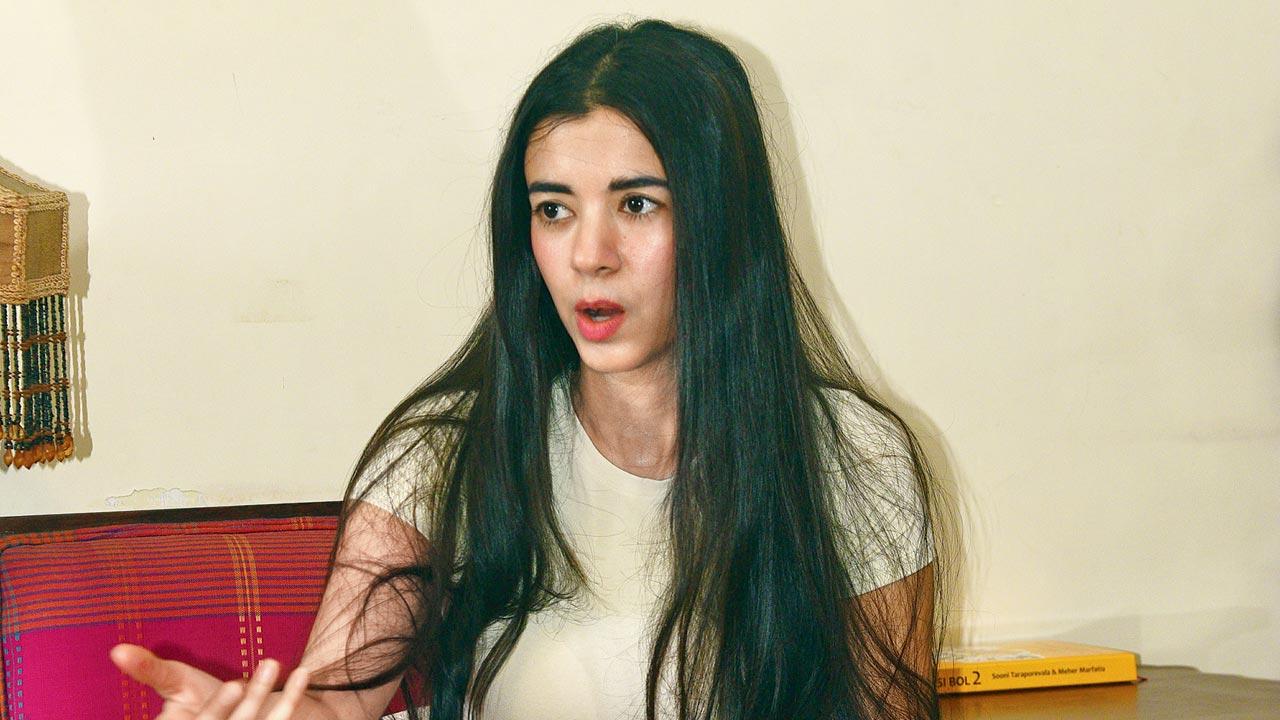
Actor-singer Saba Azad plays Ratna Pathak Shah’s daughter in the film
After 17 years, Naseeruddin Shah turns director for short film Man Woman Man Woman
8:35 AM

Helming a short 17 years after his first directorial venture Yun Hota Toh Kya Hota, Naseer says its failure made him wary of creating features
Upala KBR (MID-DAY; August 18, 2023)
If Naseeruddin Shah is in front of the camera, you can be assured he will be a scene-stealer. Going behind the camera, however, is something he is wary of. Over 17 years since his maiden directorial venture, Yun Hota Toh Kya Hota (2006), the senior actor has picked up the directorial baton again for Man Woman Man Woman. The short film features his actor-wife Ratna Pathak Shah, son Vivaan Shah, Tarun Dhanrajgir and Saba Azad.
The veteran actor wrote the relationship drama with wife Ratna, and shot it in October over six days. At the writing stage itself, he envisioned Ratna and Vivaan in the central parts. He says, “Ratna plays a woman with a sense of humour, determined to enjoy every moment in her life, and who doesn’t cower down to people. For Vivaan’s role, I wanted him to shed his intensity as he had to play a quieter and more laidback person.”
Naseeruddin’s elder son Imaad Shah served as an associate director on the project. So, how was it collaborating with the family? “They are all actors on sets and don’t behave like family. Sometimes, they take a little liberty with me. Vivaan and Ratna have worked with me as a director, and know what to expect. In fact, at one point, I got angry and Vivaan gave me a hug and said ‘Baba, cool it.’”
Even as he enjoyed making the short film, the scars of Yun Hota Toh Kya Hota remain. The drama featured some of Hindi cinema’s finest actors, including Konkona Sens Sharma, Paresh Rawal, and the late Irrfan Khan.
“I was disappointed with the way the film turned out, and I take all the blame for it. I was focusing only on the actors, but fell short as far as imagining the scenes [was concerned]. Irrfan’s story was a big blunder. I feel terrible that I wasted a marvellous actor like him. I apologized to him as many of his scenes got cut. I won’t make a feature film again, though I may direct another short.”
I want to set it right by directing short film-Naseeruddin Shah
8:25 AM

14 years after his directorial debacle Yun Hota Toh Kya Hota, Naseeruddin Shah keen to take baby steps towards filmmaking
Uma Ramasubramanian (MID-DAY; September 1, 2020)
 Always game for a new adventure, Naseeruddin Shah sealed his place in the digital world with Amazon Prime Video's Bandish Bandits. Even as his performance in the musical drama is winning praise, the veteran has set his sights on a new goal — to helm a short film. The actor, who had previously tried his hand at direction with Yun Hota Toh Kya Hota (2006), says its failure had put him off filmmaking.
"My confidence as a filmmaker was badly shaken by the film I made. I am not able to summon the confidence to direct again. It's not a movie I am proud of; it didn't turn out well because of my shortcoming as a director," says Shah. However, 14 years since, he wants to take baby steps towards exploring the art again. "I want to set that right by directing a short film."
For now though, Shah is taking in the joys of digital entertainment. He believes the medium is liberating for writers and filmmakers. "They don't have the burden of censorship or having to take a saleable route [for box-office numbers]. For actors, [working on a web series] is like living a long film; it is almost like doing a Shyam Benegal film."
Irrfan Khan is a poem. A poem he himself read out loud-Raja Sen
8:14 AM

Film critic Raja Sen pays tribute to the actor who strove for the precise pitch and could make every gesture appear special
Raja Sen (MUMBAI MIRROR; May 3, 2020)
Cocaine. It was the first thing I spoke to Irrfan Khan about. It was 2006, on the sets of Life In A Metro. 20-something and childishly eager, I asked whether he’d done cocaine in order to play an addicted stockbroker in his last, Yun Hota Toh Kya Hota? “Yeah,” he nodded, “I had to.” The recorder was on. Irrfan saw my face and laughed. “See, as an actor you have to understand what it does. To your behaviour, movements. It was new to me toh… examine karna pada.” He didn’t enjoy it (“kaafi hectic hai”) and I wondered why he’d do that for a middling film. “Because it is new! Ek nayi cheez… Why else do we act, yaar? Plus, the film is by Naseeruddin Shah. Who knows what he will notice? What he will expect?” I remember the way he tapped his nose. “Isiliye… homework.”
The way he tapped his nose. Those words make you picture him, visualise how he must have done it, that ephemeral Irrfan-ness rendering the moment impossible to forget or mimic. Where do we begin to talk about an actor who made every gesture special? Perhaps one hails the movements themselves: the way Irrfan sculpted the silent beats, the way he reacted to actors around him when they spoke, the way he let his eyes do the heaviest lifting. Good actors deliver loaded dialogue in ways that make the words sing — Irrfan made us read between the lines.
In The Lunchbox, he unwraps food from a brown paper bag and picks up a novel as he eats. The care with which he smoothens the dog-eared page and straightens his spectacles before he starts shows how ritualistically the widower has done this for years. In Slumdog Millionaire, he supervises the electrocution of the young hero, but finds an instant to look away, discreetly and distastefully. In The Darjeeling Limited, as a villager whose young son’s body is brought to him, his first alarmed act is to lift the entire body, hoisting the boy’s chest to his ear like an errant pocketwatch, to see if he still beats. In Paan Singh Tomar, he collapses after breasting the tape in an early race, taking a telltale pause before he falls, as if looking to see if it’s okay to let go, okay for the runner to finally fall.
Irrfan is a poem. A poem he himself read out loud.
He strived for the precise pitch, the sur, the mot juste. There was always authenticity to be plumbed and sought, and he hungered both to learn and unlearn. He cultivated screen presence to deliver blockbuster punchlines, then discarded it to play an unassuming Bengali man. His was not a linear life, looping from early art cinema to popular television, from independent English films to Hindi masala to global art house success, and then, finally and delightfully, to a confluence of both, commercial and radical cinema hand in hand. The actor of his generation? That feels too prosaic for a man whose performances crept up on us, touching us in ways films or viewers could scarcely predict.
That Irrfan face. Those electric eyes, that slack jaw, the mouth ever ajar, especially in the earlier films, as if unsaid sentences live on the tip of his tongue. His words, deep and lyrical lines delivered with a languor that suggested his mind lay in a hammock. In the real world, he had the swagger of a cowboy, shoulders preceding footsteps, but on screen it was about those he played — the complicated, tentative, un-spotless men — and he gave up his gait for theirs.
In 2016, sitting at his new apartment and discussing the TV series Fargo, I asked him about winning an Oscar — a hypothesis that given his trajectory I considered an eventuality. “That is an award that can change everything,” he had said, briefly chewing on the idea. “It can open up every choice for an actor.” Ah, Irrfan… so many marks left unmade.
Talking to him was always a rush. The self-awareness, the philosophical digressions, the boundless curiosity — how he deconstructed a character, how keenly he engaged with criticism. Fingers perpetually busied with rolling paper, he spoke unhurriedly, with many an ellipsis, plucking the right phrase out of thin air. The mot juste. Even without cameras, there was economy and precision.
Think of Piku. Where he, as the owner of a transport firm, is stung as he sits in the driver’s seat with hired help in the front, while the clients sit behind. He looks pointedly at Deepika Padukone in the rearview mirror. It is a slippery moment; what, after all, is wrong with the boy sitting up front? Irrfan doesn’t glare, instead compels her by holding her gaze. Fury would make his character appear classist, but this quiet, unyielding indignation makes it evident Irrfan is feeling disrespected. He doesn’t start the car till he gets his way. Here, his way is to persuade the audience and win the benefit of their doubt.
That is a masterclass — and that doesn’t just mean something for actors to learn from. Great performers offer up mirrors to lives like ours so we can steal from their characters, from perspectives to mannerisms, from reactions to epiphanies. Irrfan Khan, conqueror of the unknown, gave us all so much to observe, so much to understand. His performances, his fluidity, his tenderness, his existential silences. Thank you for the movies, Irrfan. Thank you for waging a war against the obvious. We’ll watch you forever. We’ll learn, forever. Thank you for the… homework.
I had never been so conscious of my religion until now-Naseeruddin Shah
8:05 AM

Naseeruddin Shah on being trolled for his pro-Pak stance, the 'award vapsi' trend and why, at times, he prefers working with newcomers over former colleagues
Sanyukta Iyer (MUMBAI MIRROR; November 6, 2015)
Last month, Naseeruddin Shah made headlines with his candid take on Indo-Pak relations at the controversial launch of former Pakistani foreign minister Khurshid Mahmud Kasuri's new book, Neither a Hawk Nor a Dove: An Insider's Account of Pakistan's Foreign Policy. "I've been to Pakistan to perform and none of my shows were ever cancelled or disrupted. I wish we could have extended a similar courtesy to Kasuri sahab," he had said.
His comments caused a furore online and the 66-year-old actor was described as "biased" and branded a "Pakistani". When asked what it felt to be trolled for his pro-Pak remarks, Naseer points out that he was targeted only because he is a Muslim. "It really pains me but I had never been so conscious of my religious identity until now. Four generations of my family have lived in India. I am a proud Indian and won't allow anyone to question my patriotism. If I say Imran Khan (cricketer) is great, does that make Sunil Gavaskar any less a cricketer?" he reasons.
One of the most decorated actors of his time - he's won the Padma Shri, Padma Bhushan, the Sangeet Natak Akademi award, and three National Awards (for Sparsh, Paar and Iqbal) - Naseer reveals that he doesn't understand the concept of returning awards. He doesn't approve of writers returning their awards in protest against the Dadri lynching and murders of eminent rationalists. "I wish they would assume a stronger tone in their writing instead of returning their awards. Awards mean nothing to me so I won't bother returning them," he explains.
Naseer will next be seen in Manish Srivastava's Charlie Kay Chakkar Mein, a thriller in which he plays a cop trying to decipher a rare case of multiple homicides. He is quick to explain that 'Charlie' in the title refers to a popular form of cocaine, and while he has experimented with a lot of things, he wouldn't recommend it to anyone. "But I also think there's a 'demonisation' of the phenomenon," he says.
Quiz him about his actor-musician son Imaad, who is known to be a party animal and he reasons, "The youth have always lived life on their own terms, experimenting with things regardless of parental policing. I always did what I wanted to despite my strict father. Luckily, I acquired a sense of wrong and right with time and experience. I have great faith in today's youngsters; they're far more evolved than my generation was."
The actor, who featured in Abhishek Chaubey's Ishqiya and Dedh Ishqiya, denies signing any more sequels, including Anees Bazmee's follow-up to Welcome Back. He is keener to work with younger directors. "Each experiment has its pitfalls though. Still, working with former colleagues isn't always a great idea, working with fresh talent, generally is," he says.
This approach may have something to do with the fact that the veteran, who admits to not being a fan of Hindi films, loved two recent directorial debuts - Neeraj Ghaywan's Masaan and Chaitanya Tamhane's Court, which is India's official entry to the Oscars 2016.
His own directorial debut, Yun Hota Toh Kya Hota, (2006) sank without a trace. Does he intend to return to filmmaking anytime soon? "That film is a blot on my cinematic record and I have to set it right. But I really don't know how to do that," he sighs.
Wouldn't it be great to document everything that he has learnt from professional misfires and personal experiences in a biopic? "I want Shekhar Kapur to direct a biopic on my life, but he probably won't be interested," Naseer laughs.
Subscribe to:
Posts (Atom)