Showing posts with label Yudh. Show all posts
Showing posts with label Yudh. Show all posts
Jackie Shroff did not even know how to grow a flower, but now he gives me lectures on gardening-Danny Denzongpa
8:13 PM

Natasha Coutinho (BOMBAY TIMES; August 4, 2024)
They may be a decade apart in age, but Danny Denzongpa (76) and Jackie Shroff (67) have been best friends for years. Danny lives in Sikkim now and travels to Mumbai only occasionally, but neither distance nor work commitments can keep these dosts apart. This Friendship Day, the veteran actors share their little-known buddy stories with us. Excerpts:
How did the two of you meet, and what were your first impressions of each other?
Danny Denzongpa: I met Jackie when he was working on his launch film, Hero. We met at a hotel, where I saw him wearing cowboy boots, with his feet up on the table. He was looking very shabby, because that’s how the character was. We shook hands and I hugged him, wishing him the best and I liked his confidence. Though he was a newcomer, he was very likable, and we clicked. After Hero became a big hit, I went to meet him at Teen Batti chawl in Mumbai, where he stayed. I was already a star then and a crowd had gathered around me. Jackie stepped out shirtless with just a towel around his waist, asking people to step away. He was like a dada those days. I was surprised to see that he lived in a one-room chawl, though his movie had become a hit, and he could have moved out. I met his mother as well and we became close friends. Later, I also met his then girlfriend, now wife Ayesha, and she became my rakhi sister.
Jackie Shroff: The first time I saw Danny saab on-screen was in Mere Apne and I identified with him – the kurta-pyjama, long hair and bag on his back. (Not the bomb in the bag, but the rest of the look!) When I became an actor later, we got the opportunity to work together in films like Andar Baahar and we really bonded. We were shooting on an oil rig near the Gateway of India and for a week, we would travel together by boat. Post shoot, Danny saab would often drop by and have a cup of tea with my family. He calls me “sangeet ka dushman”, because he likes to sing while I just hum my lines. Both of us share a common interest – cooking.
Danny: We shot for Yudh in Kathmandu and travelled to Pokhara, where we shot for 15-20 days. I would take off for a nearby lake after the shoot, and park myself in a boat in the middle of the lake. When Jackie found out about it, he started joining me. We would go off to beautiful locations, watch the sunset and sing songs, and that’s how our friendship progressed - Danny Denzongpa
Danny, you were one of the few people invited to Jackie and Ayesha’s wedding and now both of your children are friends too.
Danny: When they got married, Jackie invited just five-six close friends, including Subhash Ghai, Rajinikanth, Anupam Kher and me. A year later, Tiger was born, and Jackie called me up at 4 am to give me the news! I took glasses and champagne bottles in my icebox and went to the hospital. Then, Jackie, some of his friends and I went to a dhaba for an idli-vada breakfast, and we popped the champagne there. When my kids were born, the four children – Tiger-Krishna and Rinzing-Pema – would spend time together at his home or mine.
Jackie: Rinzing is more like my son; for me, there is no difference between him and Tiger and it’s the same for Danny saab. Both of us see Pema and Krishna as sisters; they are in the same age group and buddies as well.
Both of you share your enthusiasm for growing organic plants and vegetables and protecting the environment.
Danny: I ran away from Mumbai’s polluted air and water and now I live in Sikkim. While spending time with me, Jackie started taking an interest in nature and started planting organic fruits and rice. He did not even know how to grow a flower, but now he gives me lectures on gardening (laughs).
Jackie: He is the one who made me learn all about respecting nature, and that every plant and tree is different. That’s how I started propagating the message about being environmentally conscious.
How do you keep in touch despite the distance?
Danny: Jackie visited me last October and stayed for a week. When it gets cold in Sikkim I come and stay at Jackie’s farmhouse near Mumbai.
Jackie: We go down to Mahabaleshwar or Matheran together and every memory is special, or I go to Sikkim sometimes. We have a lot to talk about, be it jhaad-paan (plants), waterfalls and other facets of nature. I’m waiting for him to finish his work and come meet me soon.
What has kept your friendship strong even after all these years?
Danny: The best thing about our relationship is that we have no expectations from each other – it’s pure. We sit together for hours without talking; it is the kind of relationship I had with my mother. I used to lie down in her lap as she said her prayers and our communication would go on though we weren’t talking. Jackie, too, isn’t very talkative and that is why the relationship is special.
Jackie: We are more than brothers and ours is a friendship that will never change. He is a pure soul. It's difficult to find a person like Danny saab – so dignified and with no malice towards anyone. He has a sense of decorum and grace, wherever he is. He is very smart and refined, and I’m surprised he is my friend. I'm not polished at all like him, but we are the best of buddies.
Fracas over jhakaas: As Anil Kapoor seeks to protect his 'personality rights', experts speak up
8:28 AM
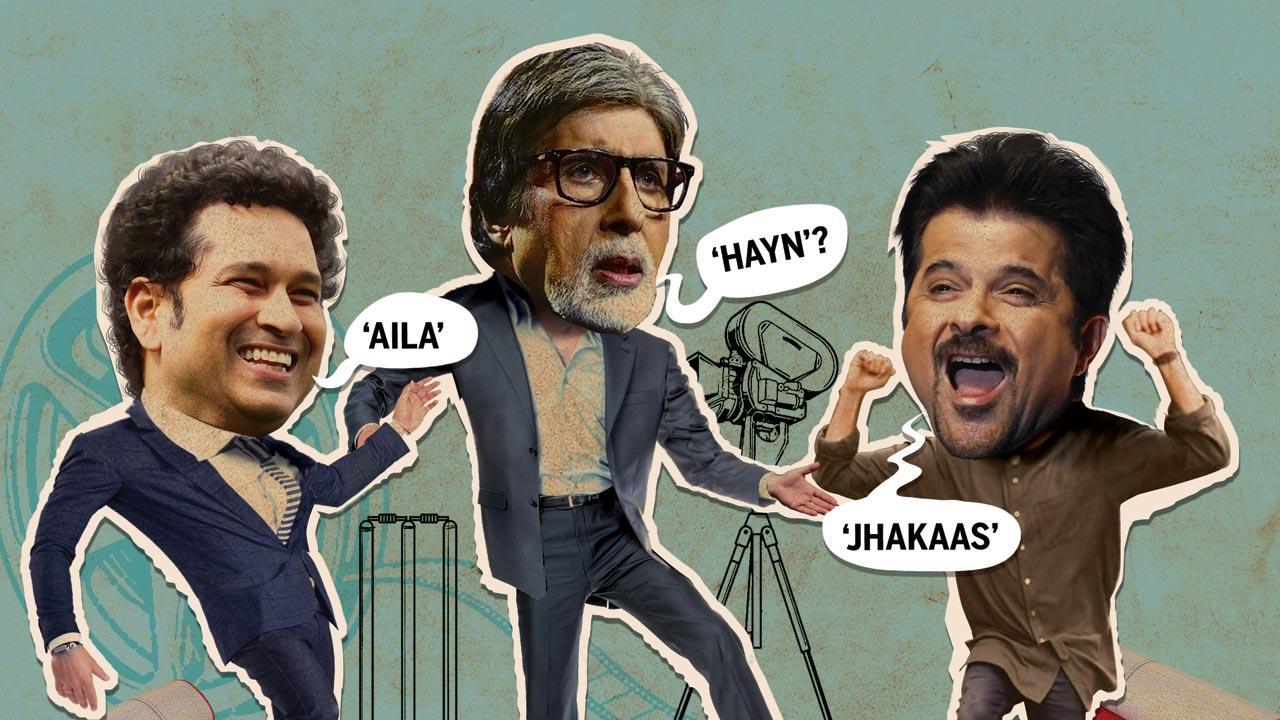
Growing fear of AI deep fakes and misuse of their celebrityhood online is making public figures seek restrictions on use of their name, voice, photos, even dialogues. But is their brand theirs alone?
Gautam S Mengle (MID-DAY; October 1, 2023)
Actor Anil Kapoor had recently filed a suit before the Delhi High Court, seeking protection of his “personality rights”. In an interim order passed on September 20, the bench headed by Justice Pratibha M Singh restrained 16 defendants named in Kapoor’s petition from using his name, likeness, image, voice, personality or any other aspects of his persona, including gestures, for commercial purposes.
In its order, the bench observed that, “The Plaintiff also claims that the expression ‘Jhakaas’, which is a Marathi slang word, roughly translated as ‘fantastic’, ‘awesome’ or ‘superb’ in English, was popularized by him through one of his Hindi movies, namely ‘Yudh’. A perusal of the press reports and videos would show, that the manner in which he delivers the said word while speaking a dialogue, and the nature of expression is exclusively synonymous with the Plaintiff’s energetic and enthusiastic persona.”
Yudh, released in 1985, was the directorial debut of filmmaker Rajiv Rai, and starred Kapoor in a double role, as two brothers separated at birth. While one grows up as a law-abiding citizen, the other becomes a henchman for the villain—played by Danny Denzongpa—and uses the word Jhakaas with a particular intonation. The word became so famous that a decade later, when CBS released an animated series on The Mask, the central character’s catchphrase “smokin” was dubbed “jhakaas” in the Hindi version.
Rai, who was one of the three writers of the screenplay for Yudh, in a telephonic interview, tells mid-day, “An actor’s claim over his personality has to be respected and there is no doubt about that.” However, he says, it “is also important to bear in mind that dialogue from a particular film, even though it may have been made famous by the actor, belongs to the producer, who holds the copyright”.
“Dialogues are framed by the writers, with words that are in common usage at the time, which they feel will resonate with the audience. The actor’s contribution to it is undeniable but the producer holds first rights towards it,” he says.
He adds that any dialogue or song in a film is the outcome of several people brainstorming for days together. “A lot of people put their intellectual property into the making of a film. They are duly compensated for their hard work and in return, the producer holds the copyright of the film as a property,” says Rai.
The development though, has given rise to mixed emotions in the performer community, particularly, celebrated mimics who have made a career out of copying their favourite stars. Many of them have been appreciated by the stars themselves, but with first Bachchan and then Kapoor going to court to protect their personality rights, performers wonder whether celebrities are going too far.
“At the end of the day,” says Balraj Singh Ghai, founder of The Habitat Studios, “you become a celebrity because you are celebrated, not feared. For that matter, even Jackie Shroff [coincidentally Kapoor’s co-star in Yudh] is mimicked a lot. There are so many memes based on certain words used by him. It depends on the stand that the artiste takes.”
The Habitat hosts a wide range of performances regularly, including mimicry shows. “Jhakaas, for example, is hardly a derogatory word. If I say something is jhakaas, I say it in praise. Plus, it has recall value. Kapoor made the word famous and whoever mimics it, is only letting people relive that moment that he created,” Ghai continues.
Legal action like this, also robs mimicry artistes of the dignity of their work. “It is because we as artistes have loved those characters, have watched them during our own evolution, that we start mimicking them. We first do it in front of our family and friends and only then do we take a stab at it on a professional level,” says Arindam Thapliyal, who goes by Jagat Didi on Instagram, and is wildly popular for his impressions of stars like Katrina Kaif and Deepika Padukone.
“Besides,” adds Sumedh Shinde, “if the actors like your act, they themselves share it on their social media. If tomorrow, I were performing and I saw my favourite actor in the audience, I would definitely do a short mimicry. That would be my tribute, not a mockery.”
Shinde is a well-known voice artiste and has dubbed for Anil Kapoor’s character in the Marathi version of The Night Manager.
There’s also a thriving ecosystem of celebrity memes that are bound to be affected if actors start invoking the law. According to Hardik Kanteliya, head of content, RVCJ Digital Media, a digital company that helps client with social media engagements for their products and services, and will be hosting the first ever Meme Utsav in December, “memes are catalysts for community discussions and attention, akin to rapid, organic promotional tools”.
“Even negative memes can inadvertently yield positive publicity, as acknowledged by figures like The Great Khali. However, it’s equally valid to opt out of meme engagement, recognizing that creators may not fully grasp the complexities of others’ lives, and such participation can amplify stress for some,” he says.
An important aspect of Kapoor’s petition, though, which the Delhi HC, too, has taken note of, is the potential misuse of the actor’s likeness via Artificial Intelligence. Scams in the name of Bachchan’s popular quiz show, Kaun Banega Crorepati, have already been proliferating for at least the last five years. Pictures of Bachchan and the KBC logo are regularly sent to unsuspecting victims via WhatsApp, telling them that they are eligible for a “bonus round”, which will help them win significant amounts of money. All they have to do, the messages claim, is to click on the link attached. Needless to say, this is a phishing link aimed at letting cybercriminals worm their way into the victim’s bank accounts.
“The technological tools that are now freely available make it possible for any illegal and unauthorized user to use, produce or imitate any celebrity’s persona, by using tools including Artificial Intelligence. The celebrity enjoys the right of privacy, and does not wish that his or her image, voice, likeness is portrayed in a dark or grim manner, as portrayed on the porn websites. Moreover, the Plaintiff’s image is being morphed along with other actresses in videos and images generated in a manner, which are not merely offensive or derogatory to the Plaintiff, but also to such other third party celebrities and actresses,” the Delhi HC’s interim order on Kapoor’s petition states.
The bench also referred to GIFs—short, moving images used on social media—that are already in circulation and the possibility of advanced AI being used to generate realistic visual and voice clones.
In its July 23 edition, mid-day had reported how AI-based voice scams were no longer just a possibility but a reality, with 72-year-old PS Radhakrishnan from Kozhikode having fallen prey to it. mid-day’s report also mentioned a study by McAfee, a US-based cybersecurity company, which showed that 53 per cent adults shared their voices on the internet in some form or another, making them freely available for misuse.
“Up until maybe a year ago, an individual would have required access to exorbitantly priced devices to render graphics, considerable technical knowhow to train face-swapping models, and adequate source material in form of videos of the subject’s face to create a convincing deepfake. Now, however, the technology has improved quite significantly, and deepfakes, even believable ones, can be created with a single image of a subject. With these advances, an individual could create a convincing deepfake of Anil Kapoor without breaking the bank or first becoming an expert in the training of deep-learning based ace swapping models,” says AI expert Karan Saini.
“It is trivially easy to clone voices today, and generate them in real-time like an actual voice conversation,” adds Additional Director General of Police Brijesh Singh, an expert on cybersecurity and AI.
“We have models that can generate text-to-speech, speech-to-text, text-to-image and even text-to-video now. However, technological detection, too, is equally possible. The same algorithm that creates these deepfakes can be used for detecting them as well. As real as the concerns of AI being misused are, it is equally possible to detect such misuse and also forensically prove it through an investigation.”

The concerns of celebrities are not entirely unfounded, case in point being the ‘KBC frauds’, where people are scammed using Amitabh Bachchan’s popular quiz show as a lure
Our film Dobaaraa has nothing to do with Stranger Things-Pavail Gulati
8:30 AM
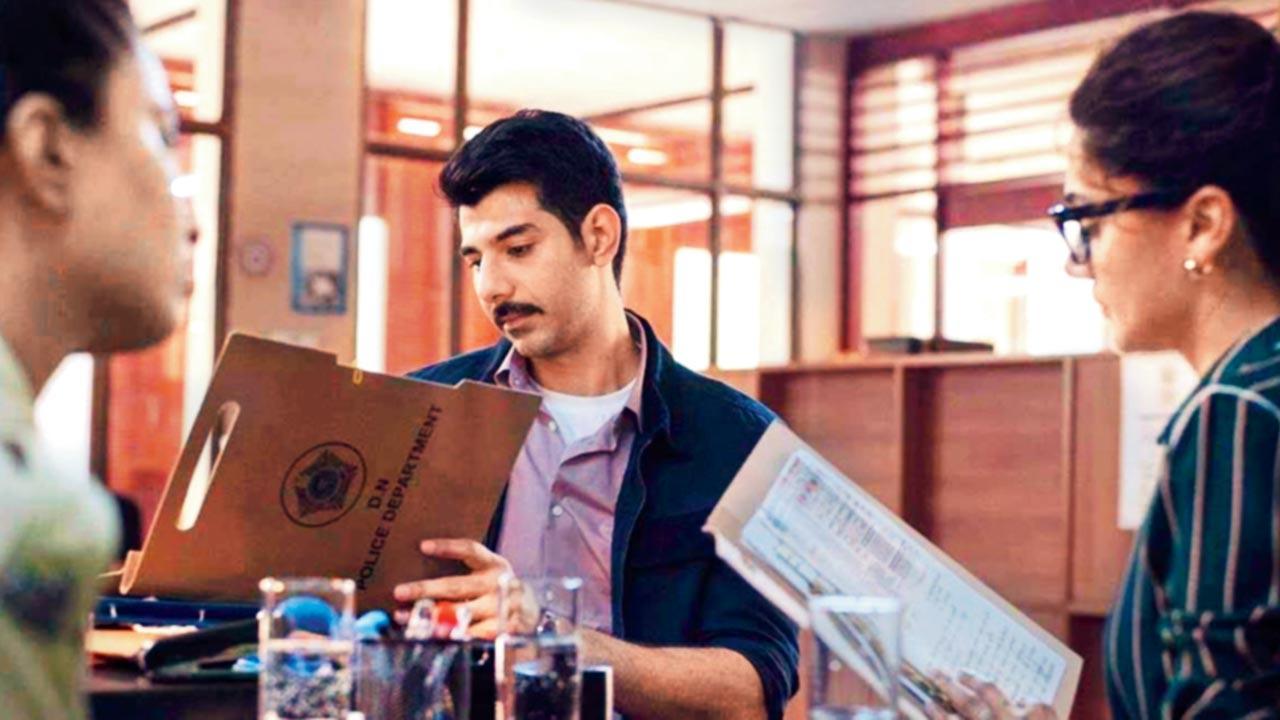
Pavail Gulati recounts how Anurag Kashyap offered him Dobaaraa after being impressed by his performance in Made In Heaven
Mohar Basu (MID-DAY; August 12, 2022)
The first time Pavail Gulati received a congratulatory text from Anurag Kashyap was when he worked on Yudh (2014). Years later, the filmmaker reconnected with him after watching his performance in Zoya Akhtar’s Made In Heaven (2019). “He texted me, saying, ‘I loved you in the show. You deserve bigger and better.’ He asked me to meet him after 10 days,” recounts Gulati.
At the time, he had little idea that the meeting would set the stage for the upcoming thriller, Dobaaraa. “I followed up 10 days later, and he texted back at 1.30 am, calling me for a meeting at that hour. He was shooting for Sacred Games 2. I assumed he’d give me a part in it, but then, he told me about Dobaaraa. He said I would play a cop in the film. At the end of the meeting, he said, ‘Lead role hai.’”
A highlight of working on the project was reuniting with Taapsee Pannu after Thappad (2020). “She is so mean to me, and gets immense joy from being so. But that’s the bond we have built over the years. She has become a support system for me.”
Making the adaptation of the Spanish movie, Mirage (2018), was thrilling. “We didn’t see the original film until much later. When you work with Anurag, you have to know how to not prepare. One day, I had a long scene and was fully ready with prep. He scrapped the scene completely. He is eccentric and impulsive, but also encouraging. Every time you do a good scene, he is ready with warm hugs,” laughs Gulati.
After the trailer dropped online, netizens had a field day with memes suggesting that the movie shares similarities with Stranger Things. Are the comparisons daunting? “It is just that one shot [of a child cycling down the road]. Our film has nothing to do with the series.”
Everybody thinks ki film school se nikalte hi producers and directors ki line hogi to sign you-Pavail Gulati
8:19 AM
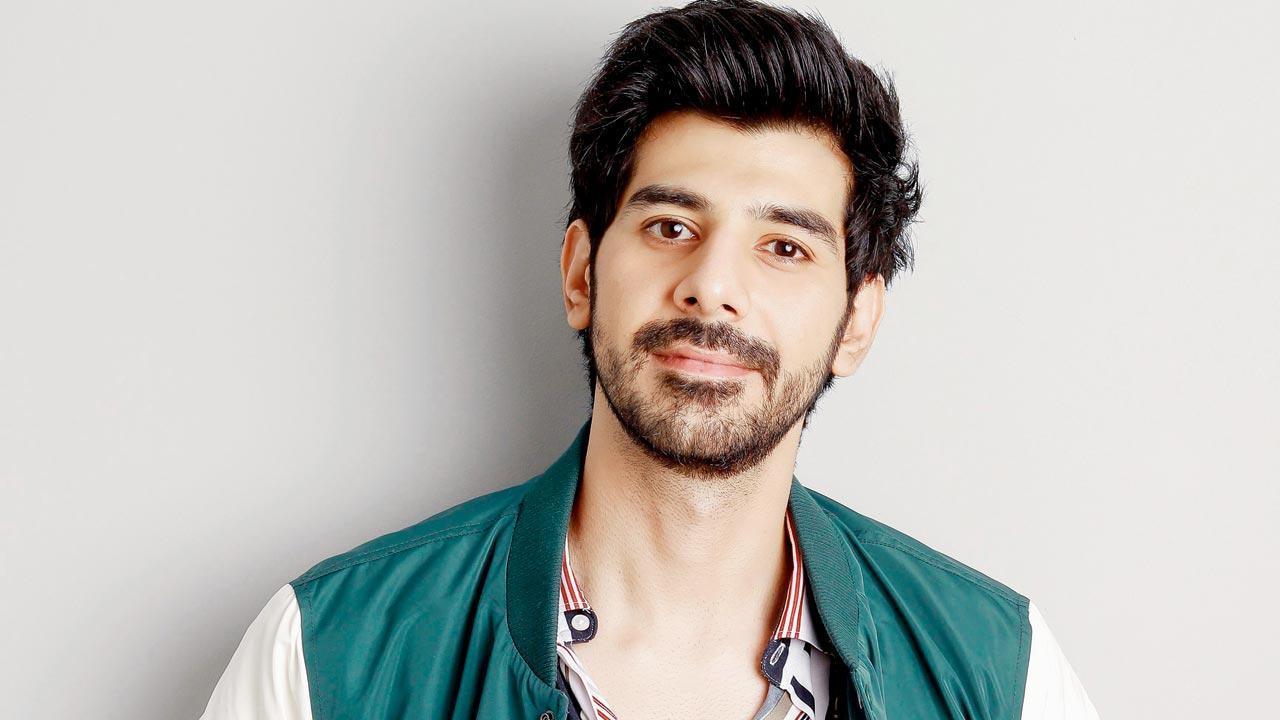
Riya Sharma (BOMBAY TIMES; August 1, 2022)
Delhi boy Pavail Gulati credits the city in a big way for helping him find his calling as an actor. Pavail says it’s his summer workshops at the National School Of Drama (NSD) and his family’s love for cinema and theatre – along with his experiences at film school, behind the camera (as assistant casting director for My Name Is Khan), and on stage – that helped pave the way for roles in films like Thappad and web series like Made In Heaven. During a chat, he traced his journey in showbiz so far and spoke about learning from, and acting with, veterans like Naseeruddin Shah and Amitabh Bachchan. Excerpts:
‘I GREW UP WATCHING A LOT OF PLAYS’
Though he lives and works in Mumbai now, Pavail says Delhi played a huge role in him choosing a career in acting.
“My father, Kanwar Deepak Gulati, is a theatre practitioner, so I grew up watching a lot of plays. I did summer workshops at NSD and learnt dance with Shiamak Davar, so everything that led me to becoming an actor, started from Delhi,” he shares.
‘I STARTED OUT AS AN ASSISTANT CASTING DIRECTOR IN MY NAME IS KHAN’
Not many know that Pavail started as an assistant casting director. “I was training to become an actor and after film school, when that period comes when you have to struggle and go for auditions, I knew that it is not going to be easy. Everybody thinks ki film school se nikalte hi producers and directors ki line hogi to sign you, but I knew that’s not going to happen because my parents told me ki aisa nahi hota. So, I thought it’s better that I start giving auditions on one side, and also learn from the other side how casting really happens.”
He adds, “I was Shanoo Sharma’s first assistant. I started with the film My Name Is Khan. I was working on a big budget film, but that was my first learning ground. It was my first experience of working on a film and how casting takes place and that made me learn about how actors perform in an audition, what are the dos and dont’s of it, etc. That gave me a head start, and helped a lot in terms of getting to know the craft. I was then assisting on ads to make money and editing short films. I also assisted Mukesh Chhabra and did theatre with Naseer sir on the side. Thode bohot paise aa jaate thay and that was the whole grind until Thappad happened,” explains the actor.
‘FILM SCHOOL WAS LIKE DISNEYLAND FOR ME’
Talking about his experience in film school, he says, “Film school or no film school, it actually depends on the student. At the end of it, if I am in films, I am learning for the rest of my life. Every film teaches me something. So, you can go to the best film school in the world and yet learn nothing. Naseer sir used to tell us that acting can be learnt, it cannot be taught. Film schools give you the basic confidence. You watch a lot of stuff, you pick it up critically, and it builds your foundation really fast. I think it gives you a little edge over the others. I was a good student because I have grown up watching films. My parents still watch movies in theatres every Friday, Saturday and Sunday, so going to a film school was like Disneyland for me. It was a beautiful experience,” he says.
‘MR BACHCHAN MAKES YOU A BETTER ACTOR’
Pavail, who has recently finished shooting for Goodbye, a movie where he shares screen space with the likes of Amitabh Bachchan and Neena Gupta, among others, tells us, “Mr Bachchan and I had worked in a show called Yudh (2014). I remember, at that time, I was young and really nervous to meet him. But this time, I had such a beautiful experience working with him. He is the kindest actor ever and I love doing scenes with him because he makes you a better actor. He rehearses so much and while doing a scene, you are in awe of him and he likes to compete with you. That’s what I love about him, he is a hungry actor that when you are doing a scene with him, he is a scene stealer. That competition sort of makes you work better, and harder.”
It took me 10 years to get where I am, and I want to make the most of it-Pavail Gulati
8:12 AM

Onkar Kulkarni (BOMBAY TIMES; April 5, 2021)

Pavail is happy that Anurag did not only push him to do better, but also provided him with a project to showcase his talent with this film. “When I met him for Dobaaraa, he told me that he has an interesting role for me. It was only when I was leaving post the narration, that he called me back and informed me that I was the male lead in it. I had signed Dobaaraa before Thappad, it’s just that the latter released first.”
So, would he have preferred to have Do Baaraa release before Thappad, a film that went on to win critical acclaim and awards? “I am just happy that roles and films like these are coming my way. I can’t sit back and think on these lines because I am an outsider and there was no grand launch that would have happened for me,” he says, adding, “I don’t have any baggage, not many people know me, so it is good when people show confidence in me and offer projects like these.”
Pavail is being extra cautious with the work that he is taking on. He explains, “I started my journey in this space with a film like Thappad. It was a credible project. So, I want to be extra careful about the work I do. It took me a good 10 years to get into the space that I am in today and I want to make the most of it. So, the pressure is not about choosing only lead roles, but also about choosing the right projects and not taking things for granted. I want to experiment and grow as an actor. I want to work with the best people who I have looked up to all these years. Even if I get a minuscule part in Raju sir’s (Rajkumar Hirani) film, I will take it up.”
Pavail is excited to share screen space with his Thappad co-star, Taapsee, once again. Talking about their equation, he says, “While shooting for Thappad itself, we knew that we were going to be working together for a longer period of time. We bonded well on the first day itself. We both hail from Delhi, and that helped us get along. I like that Taapsee is extremely straightforward and honest, and those are also the things I hate about her (laughs!). Sometimes, whatever she says can sound beautiful, and at times, it can pierce through you. We are very comfortable around each other and it leads to us performing well on camera.”

I suggested that I stand on my toes while yelling at Abhishek Bachchan-Ishtiyak Khan
8:08 AM

Sharing screen space with Abhishek Bachchan and Pankaj Tripathi, Ludo actor Ishtiyak on being the thread that weaves the assorted stories together
Upala KBR (MID-DAY; November 15, 2020)
Playing the character that weaves the four assorted stories together in Anurag Basu's Ludo offered a unique advantage to actor Ishtiyak Khan — he could share screen space with actors belonging to each of them. As the cop that pieces the film together, Khan, who has played pivotal roles in films like Phas Gaye Re Obama, Tamasha, and Anaarkali of Aarah, says that while Pankaj Tripathi taught him how to create chemistry between characters, Abhishek Bachchan was always open to suggestion.
"I have worked with Amitabh ji on two occasions, once in Anurag Kashyap's Yudh, and then for a TV commercial. So, working with his son was [special]. Since I am shorter than him, I was apprehensive about not looking convincing enough while yelling at him. I suggested that I stand on my toes while pulling off those scenes, and he would welcome [such] suggestions, even going on to ensure all preparations were done before the shot," says Khan.
He credits director Basu for his fine musical sensibilities, pointing out that he constantly "works on the background music while shooting a scene". "I always wondered how he creates such beautiful music, and I realised that his background in theatre [enabled him to create a] connection with music." As for his National School of Drama contemporary Tripathi, he says, "We improvised a lot. There's a lot of give-and-take in our scenes. Because we have done several plays together, we had good chemistry. His speciality is that he can 'become' the character easily."
95% of this industry are outsiders, 5% insiders, but mainstream is dominated by this 5%-Avinash Tiwary
8:30 AM

The actor, who tweeted about outsiders not getting equal opportunities, says that the nepotism debate is flawed. The casting process and what the audience consumes are also to be blamed, and not just star kids, he feels
Renuka Vyavahare (BOMBAY TIMES; July 20, 2020)
 Recently on social media, actor Avinash Tiwary, known for his work in Sajid Ali’s film Laila Majnu and web films, Bulbbul and Ghost Stories, reacted to R Balki’s take on nepotism. A few days ago, in an interview talking about the debate on nepotism, Balki had said, “Find me a better actor than Alia Bhatt and Ranbir Kapoor and we’ll argue.” Addressing the filmmaker’s views, director Shekhar Kapur tweeted, “Have huge respect for you, Balki. But I just saw Kai Po Che again last night. Three new young actors at that time. And stunning believable performances by each (sic).”
While writer and editor Apurva Asrani agreed with Avinash, filmmaker Anubhav Sinha defended Balki, and said, “I think what he meant was that they are both truly deserving stars despite their illustrious pedigree. And I agree with that.”
Speaking about his response to Balki and the nepotism discussion at large, Avinash in a chat with Bombay Times reasoned, “Everyone who is talented should get an opportunity. When I read Mr Balki’s statement, it almost said that yehi do log talented hain (Ranbir and Alia). I am not saying that look at me, I am more talented, but there are others who could be, but do they get a chance? I got my first film as a lead actor (Laila Majnu) after toiling for 15 years. I gave 21 screen tests for it and waited for three years for it to be made. Not many people can even afford to sustain this long. I am glad we have casting directors now, but how many casting directors cast the lead actors of a big film? Has Mr Balki found a casting director to cast his leads? The lead actors are often selected by the filmmakers. So, how would he know if there are better actors out there or not?”
He further explained, “Of course, Alia and Ranbir are brilliant actors and they would stand out even if they were outsiders. If Ranbir wasn’t from a film family, he would have probably taken 10 years to get a Rockstar, but he would have still bagged that kind of a film. Talent will shine through, and good work will be rewarded, but it isn’t a level playing field. Ayushmann Khurrana has taken eight or nine years to be a mainstream hero, Kartik Aaryan delivers 100-crore films today, but he too has been acting since 2010. That doesn’t happen with someone like Sara Ali Khan, who has a Simmba even before the release of Kedarnath. That’s an amazing privilege to have.”
Avinash, however, argues that we cannot blame the star kids here. “If my father was a big actor or producer, why wouldn’t I make use of my privilege? I hold the media and the audience accountable. The audience is the consumer. If they pay and watch cinema that is also being made beyond the mainstream, then it equalises things. Laila Majnu didn’t last in theatres even for a week. Why didn’t the audience go and watch Sushant’s Sonchiriya in theatres? It was a good film. Ab sab behti Ganga mein haath dho rahe hain. Ab yeh nepotism ka trend chal raha hai, so let’s talk about it,” he said.
The actor pointed out that the film industry is big enough to accommodate everyone, so the real issue lies in the casting of big-budget films. He explained, “Around 95 per cent of people in this industry are outsiders, 5 per cent may be insiders, but the mainstream is dominated by this 5 per cent, and all the eyeballs are on them. Most star kids assure filmmakers the returns as there’s so much media attention on them. The nepotism argument is flawed. We can’t blame a few individuals for nepotism. It’s the system and culture that needs to change. As an outsider, you are just happy to get an opportunity. My fight is not for validation. It’s for acknowledgement of my existence as an actor.”
When asked what is his take on the flak that Karan Johar has been drawing in the past month, he said, “Karan Johar gets a lot of flak for nepotism, but it was he, who cast me in Ghost Stories without even taking my screen test. I didn’t know him. I am not the kind to approach people easily either. So, I have seen both sides.”
Elaborating on his beginnings in showbiz, the actor said, “I started with a Doordarshan show for the acclaimed filmmaker, the late Lekh Tandon. In 2014, I did the TV show Yudh, starring Amitabh Bachchan. I thought it will change my life, but nothing happened as no one saw it. In 2015, I did a lovely ensemble film, Tu Hai Mera Sunday. I met Sajid (Imtiaz Ali’s brother) at the end of 2015 for Laila Majnu. They liked my screen test and verbally told me that I was their guy. I was barred from doing other work. But the whole of 2016 they kept auditioning other actors as I wasn’t mainstream enough. I remember telling Sajid that there could be better looking actors than me, but there’s no one who can play that part better. It took three years to make the film and within a week of its release, it disappeared from theatres. So, you are obviously upset. Aur kitna ladein? So, over the years, you learn to let go and focus on bigger things and life beyond movies.”
We have many examples of outsiders making it big in Bollywood, and insiders fading out-Pavail Gulati
8:47 AM

In this series, which gives an insight into the struggles of actors who are perceived as ‘outsiders’, Pavail Gulati talks about what kept him going to pursue his Bollywood dreams despite many hardships
Onkar Kulkarni (BOMBAY TIMES; July 3, 2020)
 It took Pavail Gulati 12 years of struggle to fulfil his dream in Bollywood — that of becoming a lead actor. Today, while he is happy with the appreciation he garnered for his performance in Thappad, he can’t forget the hard work that has gone into reaching this point in his career. Pavail tells us, “The problem is, there’s no formula to become an actor. Sometimes, I feel it is easier to become an astronaut than an actor. For the former, you know what the academic qualifications and eligibility criteria are. But, here, there are no fixed rules. I can’t follow Ayushmann Khurrana or Nawazuddin Siddiqui’s path, expecting the same amount of success. What worked for them might not work for me.”
While the actor agrees that nepotism exists, he is also of the opinion that the industry gives a fair chance to many outsiders. He elaborates, “We have so many examples of outsiders making it big in Bollywood, and insiders fading out in a short span of time. Shah Rukh Khan, Irrfan Khan and Rajkummar Rao are a few, who came from nowhere and made a name for themselves. On the other hand, there are so many industry kids who disappeared after one or two films. We can’t keep complaining! If my dad is running a business, he will pass it on to me, right? So, nepotism exists everywhere.”
Though he has always wanted to be a hero, Pavail says that over the past 12 years, he never sat idle waiting for a meaty role to come his way. “Acting was my aim, but I took up whatever came my way to earn money, make contacts and polish my skills,” he explains. He began his career by assisting a couple of casting directors, and also acted in a few ads and the TV show, Yudh, starring Amitabh Bachchan. His meeting with Anurag Kashyap became a turning point in his career. “Anurag sir saw my performance in a web show and gave me a role in a digital series he was making. Anubhav Sinha (Thappad director) saw my audition for that and asked Anurag sir about me.”
The mantra to survive in Bollywood, Pavail says, is patience! “I survived, because I have seen my parents face the same struggle to pursue their passion. For 20 years, they were in government service, and lived in a 4-BHK house with two lawns. But, one day, they gave it all up and shifted to a 1-BHK apartment, because they wanted to follow their true interests. Today, my dad is a theatre actor-director, while my mom is a radio producer. Yes, I went through depressing times, too, but my parents and friends kept me going,” he shares.
It’s an icky feeling to slap someone without reason-Pavail Gulati
8:15 AM

Pavail Gulati knows where to draw the line; justifying his actions in his first film saying his character Vikram is not a wife beater
Ankita Chaurasia (MUMBAI MIRROR; February 19, 2020)
 At an age when his classmates were aspiring to become engineers and architects, Pavail Gulati announced that he wanted to be a hero. His father was a documentary filmmaker, his mom a radio producer, so Bollywood cropped up regularly in conversations. Pavail took theatre and dance classes, and an Akshay Kumar-fan, he also learnt taekwondo and went on to become a Delhi state champion, believing the big break would happen soon. But after two years of film school and a 10-year struggle, the only thing that kept him from returning to Delhi was the absence of a plan B. “I did theatre with Naseeruddin (Shah) sir and two films, which never released. I played Mr (Amitabh) Bachchan’s son in the TV series Yudh, but nobody watched it,” he confides.
The actor, who makes his debut with Thappad was on his way to London to shoot for an Anurag Kashyap short when, during a layover in Abu Dhabi, he noticed a flurry of missed calls from the maker and his manager. “Since I couldn’t return them, I assumed I was being replaced or that the film had fallen through,” he laughs. On reaching London, he learnt that he’d landed the lead in Anubhav Sinha’s next. “Anubhav sir liked my audition tape and called Anurag who gave me a sparkling recommendation.”
He plays Vikram, Taapsee Pannu’s husband who slaps her in the film and triggers off a chain reaction. Pavail found himself justifying his character’s actions even as they shot. “Vikram is not a wife-beater,” he avers, adding his “teddy bear” director and he had long debates on Vikram on a set dominated by women, who bullied him since he was a newbie, but in good humour.
Prod him on the ‘slap’ and he admits he was sweating, scared that the firebrand Taapsee, who had become his back-slapping buddy, would return the favour. “When I was in the 4th grade, a girl had slapped me hard and I had retaliated, boasting about how I’d made her cry to my mother when I returned home. She made me walk 7 kms to apologize to her. Since that day, violence was to be avoided at all costs,” he shares, adding that Taapsee hugged him after the shot and told him to chill.
But surely, he was apprehensive about playing a guy who slaps his wife in his first film? “That apprehension dissipated when I read the script. There’s a Vikram is all of us. We make mistakes and misbehave because we take relationships for granted. For instance, when our mother goes out of her way to do something for us, we think it’s her duty. It’s not. The same applies to romantic relationships,” he asserts, admitting he got a lesson in appreciating everyone when an air hostess reminded him to say “please” when he asked for water. “Since then, I use ‘please’, ‘sorry’ and ‘thank you’ generously.”
Now that he has slapped his co-star on camera, would he be okay playing a slaphappy doctor like Shahid Kapoor’s Kabir Singh? The debutant chooses his words carefully, “I’m okay with playing the character but without slaps. There has to be a reason to slap someone, and it can’t be love or passion. It’s an icky feeling to slap someone without reason,” he signs off.
Everyone thought that I was talented because I was standing next to Amitabh Bachchan-Avinash Tiwary
8:01 AM

Titas Chowdhury (HINDUSTAN TIMES; February 11, 2020)
Avinash Tiwary, who earned rave reviews for his performance in Laila Majnu (2018), believes that filmmakers now, have a certain faith in him and the fraternity’s attitude towards him has changed. “Earlier, people would want to work with me but they didn’t have the faith. But now, people are thinking that maybe, times have changed. I hear these things but I don’t understand them. I’m the same actor with the same talent, but now they look at me differently,” he says.
However, Avinash is practical and feels that the film industry changes every few years with the influx of new talent. He explains, “Five years down the line, their perception about me will change again. It’s about how relevant I can stay and how they will look at me. I’m in an unknown territory. I don’t know how the industry functions.”
The actor, who was last seen in the digital anthology film, Ghost Stories, says that he wants to reach a place where his name is enough to pull the audience to the theatre. “People were excited for Ghost Stories because there’s a Karan Johar in it. They are excited for The Girl On The Train because of Parineeti Chopra and Aditi Rao Hydari. The same thing had happened with Yudh. Everyone thought that I was talented because I was standing next to Mr (Amitabh) Bachchan. But from here on, I want to get into a space where I can get the audience to come and watch me. That’s something that I’m striving for,” he elaborates.
Avinash shares that he’s still getting used to the ways of showbiz and often finds himself questioning his next step. “When you don’t have a film, you can urge them to give you one opportunity. Now that I have done a couple of films, I don’t know what to do next. I used to keep wondering if I’ll ever get a film. Imtiaz (Ali; filmmaker) sir had once said to me, ‘I can only do the films that I’m allowed to and you can only do the films that come to you’. And that’s the biggest truth,” he signs off.
Everyone from the producer to the spotboy loved Jackie Shroff-Rajiv Rai
8:02 AM

Roshmila Bhattacharya (MUMBAI MIRROR; January 29, 2020)
He started his career as an uncredited junior artiste, fleeing away from a swarm of bees in Dev Anand’s Swami Dada in 1982 but Jackie Shroff was born to be a hero. A year later, Subhash Ghai re-launched him as the leading man of his Hero. Keen that his protégé should have at least one good film before Hero’s release, Subhash ji spoke to his Vidhaata producer, Gulshan Rai, and recommended Jackie for his son Rajiv’s directorial debut, the action-thriller Yudh. “Subhash ji was my father’s friend, that was enough for me. So, even before Hero’s release, without any audition, I signed Jackie on, blind,” Rajiv recounts from Los Angeles.
Since his hero lived in Teen Batti, close to his Napean Sea residence, after ‘pack-up’, they’d sit together and chat and Rajiv soon grew fond of this straightforward guy who spoke his mind and lived life on his terms. “Though he didn’t belong to the film industry, everyone from the producer to the spotboy loved Jackie, who, even after he became a star, didn’t change. He still smoked his Charminar cigarettes, understood struggle, was fun-loving and hard-working. Not a single person has a bad thing to say about him because Jackie is pretty much flawless,” gushes the filmmaker who reunited with him four years later in Tridev.
Rajiv reveals he’d have cast Jackie in Vishwatma too, but his son Tiger had just been born and he didn’t want to go on a long outdoor. “I was in a hurry, I had dates and we were shooting in foreign locations, so I took Chunky Panday instead,” he says.
They met last year, on December 26, at a party at Sohail Khan’s house, and with a jadoo ki jhappi, continued their dosti from where they’d left off. “He was always a handsome guy and is still fit and sharp. And no matter what his character or the film’s fate, the audience loves him and wants to see more of him,” points out Rajiv.
Quiz him about the new hero, and Rajiv agrees Tiger is as hardworking and good-looking as his dad. “I’ve only seen his work, but I can tell you that physically what Tiger is doing on screen is not easy. He’s by far the most promising young actor in Bollywood today and certainly the most dependable. His son has done Jackie proud,” he asserts, reminding me of when Jackie had turned up for the Filmfare Award with Tiger in his arms and without his pass. The security guard had almost turned him away. While daddy accepted his first Best Actor award for Parinda, his son slept in his arms.
There’s a lot Rajiv knows about his Bindaas Bhidu. But as a vegetarian and a man who confesses to not being a foodie, he hasn’t met Jackie, the master chef yet. But I had him personally serve me poha at his Bandra residence, insisting I squeeze a slice of lime and add a sprinkling of green chilllies before taking the first spoonful. From his proprietary pride, I figured the recipe was his. When I had told him his mirchi was spicier that the ones I bought, he explained that only the dark green ones have a bite.
On February 1, Jackie Shroff turns 63. And he’s still the hero of so many prem kahanis.
I think someone went and filled Aamir Khan's ears-Anil Kapoor
9:11 AM

The indefatigable Anil Kapoor talks about his endless energy, refusing Chandni because he had to sit in a wheelchair, feeling gutted that he didn't do more endorsements and, of course, the Mr. India sequel!
Mayank Shekhar (MID-DAY; August 10, 2018)
Suzie, we're told, is a popular, heavily priced cocaine doing the rounds of Juhu - the effects of which include indefatigable energy levels that last you for every second that you're up and still snorting. The high seems natural. The party never stops, and life seems positive, and happy, and fun, all the time. Which is pretty much the state that has defined the public profile of actor-superstar Anil Kapoor, 61, for decades that he's entertained millions at a stretch. And continues to. What keeps him going? He hasn't tried Suzie, he tells us. Well, just for fun, we checked:
Have you ever done drugs?
I've had hash - ganja. Nahi, charas bolte hain. This was when I was in college, just finished school. Once I had hash, a few times, actually. I've had grass [ganja/marijuana] also. That's it.
But those are [usually] downers. You're on a constant upper!
To be honest, because they were downers, I didn't like them - they made me feel low, sleepy. I said I don't need this.
Were you much of a drinker though?
I've had beers, and [other] drinks; but never done anything excessive.
I'm only trying to get at what drives you (and if there's an external substance that we could recommend to readers!).
This is the way I naturally am. It's just the profession, the whole entertainment business, or show-business - cameras, films, ADs, working with the director, writers, actors, actresses, producers; interacting with media, doing different roles… Everything surrounding me makes me feel positive, gives me energy. It's exciting, pulsating, also edgy - because you're not sure what's going to happen. You're insecure. You do your best; feel it's not the best. But people say it is! I'm just so happy that I don't do a 9-to-5 desk-job.
Which you never have.
Never. I can sit down for half-hour, or an hour; not longer. I have to be standing, walking, running; or sleeping, so that I'm fresh again!
And you've been working like this for 40 years?
I think so. I [recently] called up my producer-director Umesh Mehra to ask, "When did we start the film [Humare Tumhare]?" It released in 1979. Think we would have started [shoot] two years before. So, if I started my acting career in '77, it's been 40 years [plus]. He [Mehra] is also trying to find out exactly which date we started. The film had Sanjeev Kumar, Rakhee. There were 10-12 children in it. I was one of them.
Was that the one where you played the young Shashi Kapoor?
No, that was in 1973 [for the shelved film Tu Payal Mein Sangeet]. I was in the seventh standard. That was the first time I faced the camera, but only as a child actor. By Humare Tumhare, I had done my acting course. And then I did [M S] Sathyu's Kahan Kahan Se Guzar Gaya [1981], [Lekh Tandon's] Ek Baar Kaho [1980]...
A lot of people don't know that you were also the lead in Mani Ratnam's directorial debut.
Pallavi Anu Pallavi [1983; in Kannada], yes, his first film. Balu Mahendra was the cameraman, the visuals were stunning. I was in Bangalore recently, and people still remember the film. Ilaiyaraaja's music in it had become very popular.
All of this before Woh 7 Din (where you first got majorly noticed)
Yes, I started working on Woh 7 Din in 1982. I was not getting any work in Mumbai as an actor - besides bit roles. I thought I was cut out for bigger things. So I said, let me start helping out my brother [Boney] with production in Chennai. He was taking over dad's work in Hum Paanch. Being the eldest, he was looking after finance, while I did all the odd jobs. I would also stand-in for actors while the scenes were being set up. Bapu saab was the director. I would show him how good I could give a shot. He would observe. That's when he offered me the Telugu film [Vamsa Vruksham]. And then he directed my first [Hindi] film [as lead], Woh 7 Din, with the script written by K Bhagyaraj.

Your early stories are actually all about astounding persistence. You could stand around [hoping to get noticed] for hours (at a stretch).
Yes, I've stood behind the camera on Subhash Ghai's sets a lot, hoping, "Abhi dekhega shayad," and that as soon as his [Ghai's] eyes meet [mine], I'll go, and meet him. Then I'd get to know that he's at Holiday Inn. So I would stand in the lobby. Then I'd think, "Why lobby? Let me just go up." So then I would be there in the corridor. I wouldn't have the guts to go and chat with him though. I've sat around at Rajshri Productions office [in Prabhadevi] a lot. It was very tough to meet the Barjatyas, so I became friendly with the production guys - Mr Gupta, Mr Zaki... Suddenly Gupta tells me Zaki wants to make a film. I say, why not cast me? Before I could meet the Barjatyas, the production guy was making a film called Prerna with me, which got stuck. But, I was the leading man. Likewise, while I was trying to meet Subhash Ghai, one of his assistants, Kukoo Khanna, Usha Khanna's brother, pointed me towards a small film. So I sat in David Dhawan's Vespa, went over, and signed up for a film called Rachna, which ran for one-day, one-show, in the theatre!
Did you have a Plan B?
After about four or five years, I did think of a Plan B, but, in films - like writing scripts, or doing anything else to be in the films.
Well, you are from a film family; if I'm not mistaken your father was an AD on Mughal-e-Azam. He also managed Geeta Dutt's work, thereafter Shammi Kapoor's.
He was a very honest, decent, introverted kind of good man - not one of those pushy, aggressive, filmy ones. And he once clearly told me that he cannot do anything for me. I never expected him to either. From that day, I felt, instinctively, it's time for me to go out into the battlefield, and fight.
If the battlefield means sitting around hoping for someone to notice you, it would get quite tiring, right?
It was exhausting, frustrating. I looked and felt my worst in those days - sitting with friends having rum.
Could you channel that eventually in your work; a film like Awaargi [1990], for instance?
Yes, [Mahesh Bhatt's] Awaargi, and even before that, [Subhash Ghai's] Mashaal. Then there was [Bhatt's] Thikana, where I play an alcoholic. This is when Mahesh Bhatt was trying to find himself; it was a pleasure and fun working with him. Both Awaargi and Thikana turned out to be disasters though.
But you basically ended up with a 40-plus years' career, without a sabbatical. Ever thought of taking one?
I did, once. I spoke to Amit ji [Amitabh Bachchan], while we were shooting for Armaan [2003]. He had taken a break for five years. His advice was: Whatever you do, keep on working.
Also, since you began in the '80s, which was all about over-the-top performances, that you cracked, to decades later, when the kind of films being made are vastly different, you would've had to constantly reinvent yourself too?
When I started my career, they used to tell me I'm an English actor. First they used to say, "Zara loud bol. Underline it. Punch de usko. Punch de!" I'd be like, 'What punch are you talking about? I'm just being myself, real. But the sound-recordist would tell me it doesn't work. That I had to start pitching - so you're not speaking, or making conversation. You're talking at them [the audience]. But, obviously, working with good directors, films becoming successful, you get the confidence. Initially, I was not that comfortable, to be honest with you.
You were not always the 'jhakaas' guy?
No, I was not. In fact at the time [of the release of Yudh, 1985], 'jhakaas' didn't become that popular. The film was an average success. They said that I was the best thing in it, and wished there was more of me. The film was more about Jackie [Shroff's character]. That 'jhakaas'; and my character stood out. People were talking about it. But I didn't take it seriously enough to cash in on it.

Would you say that 'jhakaas' image was more a Subhash Ghai creation; with a Ram-Lakhan [1989]: One two ka four, four to ka one stuff?
No, I did Tezaab [1988], before Ram Lakhan. And of course, I had done [Yash Chopra's] Mashaal [written by Javed Akhtar], where there was realism, and a star-quality [to the character] - a combination that you notice in Salim-Javed scripts. The foundation got laid in Mashaal [1984].
If we go back to your entire body of work, a lot of people would say Mr India was a perfect 10. Would you agree?
I feel the first half of Mr India was much more organic, human, beautiful. In the second half, I felt, there were certain portions that seemed really forced. You could say we did this to make it massy. The casting of the children, the scenes were picture-perfect, yes. The same was the case with Ram Lakhan. The first half was brilliant.
Lamhe [1991]?
Well, Lamhe, people liked the second half better. The first half, I found to be unnecessarily slow. A film must hold you from the beginning to the end. People say climax theek nahi tha. I feel it was ahead of its time. And Sridevi was magnificent in both Mr India and Lamhe. She was beyond perfect in Mr India. Or, for that matter, even Judaai, if you've see her in the film, she is exceptional.
Speaking of Sridevi, the tragedy earlier this year was heartbreaking. How did you deal with it?
It is one of the most unfortunate things to have ever happened. Every night, my wife and I talk about her. There's not a single day when we don't miss her. [Pause]
Going back to Lamhe, while it didn't do well in India, it actually opened up a whole diaspora market for Bollywood, isn't it?
Both [Yash Chopra's] Lamhe and [Vidhu Vinod Chopra's] 1942: A Love Story [1994] were game-changers [for me]. I signed both the films simultaneously. I'd had an accident, and was bedridden, nursing my leg, for two-and-half months. It was a turning point in my life. I was running fast, but going nowhere. I just wanted films, one after other - doing films that I didn't care much for.
You've spoken about how you've done a few films like an Andaaz or say Mr Azaad purely for the signing amount.
No, not the signing amount; for the whole thing - advance mein. But the past is past. Why should I say now, why I did them? But 1942 and Lamhe were the kind of exciting films that were not being made [back then]. Yash ji wanted to do something post-Chandni, since it was a success.
And I hear you'd said no to Chandni. Why?
I had said no to Chandni, because I didn't want to sit in a wheelchair.
It would be hard to contain you in a wheelchair!
I was just not in a frame of mind to sit in a wheelchair through an entire film. I was, in fact, one of the first people to call Yash ji and tell him, "Picture hit hai!" He couldn't believe it. I had done two films [Mashaal, Vijay] with him, and both hadn't done well.
So post-accident, you became more conscious of the scripts you'd pick up?
Conscious, yes; but I also started getting offered more films of the sort that I wanted to do. Certain films I did for the kitchen, family, children…
Do you have a clear distinction between a film for kitchen, and craft?
I do.
So when you do a Race 3, for instance...
There are other reasons as well. I have to like my role. And who is producing it, acting in it.
Going back to what makes you special, besides being around for 40 years; you're also a rare Bollywood superstar with a moustache. No?
No, there was Raj Kapoor, Charlie Chaplin, and Shatrughan Sinha.
Exactly, that's it. Did Manmohan Desai ever say that a man with a moustache can never be a hero?
I read it in an interview. He called me up after Eeshwar [1989], and said, "I thought you'd never become a star. You are just an actor." He said he wanted me to do his films. He had said Jackie Shroff is a star, and I am just an actor.

You've had a lot of such stuff thrown at you, isn't it?
I was lambasted, even when there was no social media. But I've always looked at the marathon, the longer run. I didn't go for the 100 metre dash. Well, I did in the '80s, and then I came back. Because the 100 metre dash is too tiring and exhausting. I knew I'd burn myself out.
And was doing television, with 24, probably a marathon thing to do?
Yes, it gave me a role away from the cinemas. And it wasn't the role of a reality-show judge. It gave me creative satisfaction, to work on a great story.
Did you also see LA as a longer-run thing to do? How serious were you about pursuing that as a career option?
Yes, it was a longer run thing: [looking at] legacy, learning, education, meeting different people, creative people, business minds. I was reliving my struggling days. I used to actually go, and audition. I auditioned for David O Russell, Sacha Baron [Cohen], for fun. Whenever I audition, I don't get selected. Everything I did happened without audition! We are not cut out for auditions. It is also an art. We have to work towards it.
How serious are you still about pursuing Hollywood though?
I am at a certain age and time, as far as family is concerned, when I can't pursue it aggressively. If it comes, good; but I can't move base. If I get an offer for which I have to leave for a year, obviously I will have to say no. It has to be on my terms and conditions.
Well, there's so much for you to do here. Could you be the Dev Anand of this generation?
No one can be him. I am so glad I could meet him. I still see his songs, and they make me so happy.
(Speaking of which], you are a singer yourself; even cut an album [with Salma Agha that many people may not know about).
It was horrible. People like to see, and not hear us sing. I used to do ghazals, nazms. So, I sang in Chameli Ki Shaadi [1986]. And then that album [Welcome; 1989]. After which, I decided, 35 years back, that I won't ever sing!
The new lot in showbiz, in fact, juggles multiple things, while they also act in movies. Their main income might well come from endorsements. Why did you never do ads through most of your career?
Raj Kapoor, Dilip Kumar, Amitabh Bachchan never did ads. We were brought up [with the thought] ki, "Main actor hoon. Salesman nahin". This is until my children grew up, and Sonam started doing ads. The standard of ads also got better. But by that time, I had already missed out on the best ones. Now I feel terrible about it!
Audience: It's clear that you are getting younger by the day. Can you share some thoughts on fitness with us?
It's all about intake, and outtake; and also workouts. To give you an example: 1,000 calories a day is, say, your intake. So you should work out for six days a week, to make sure you maintain a balance. There shouldn't be far more calorie intake than what you have really burnt out. If you want to indulge on a particular day, you should see to it that for the next two to three days, you balance it out. Don't let loose, and say that for the next three months, I'm just going to keep eating. Then it becomes difficult to bounce back. Also, you can do different kinds of exercises, depending on what makes you happy. Keep changing it. If you find any exercise boring, don't do it. Find something that you can have fun with. And I don't feel that's difficult.
At which point of time in your career did you particularly start focusing on your health, fitness?
I think it was during 1942 A Love Story. I didn't want to do the film as usual.
Is saying no your instant response to an offer?
Yes. I told Vidhu [Vinod Chopra]: "Tu pagal ho gaya hai kya? You are making me a romantic hero. I am a father of three kids! Aamir ko le le tu." I told him I'll call Aamir. But he said, "Aamir phone pe hi nahi aa raha hai." [Laughs]. So then I suggested he should take Bobby Deol, since he was coming up. He met Bobby as well. Then Vidhu's brother, Vir Chopra, made me hear all the songs, and I really loved them. There is a scene in the film, inspired from Romeo and Juliet, where we [the hero and the heroine] are in a balcony. I was working with Manisha Koirala, who was, I guess, 20 years younger to me. And I had done all 'tapori' and 'mawaali' roles until then. Suddenly I was playing this [suave] character. That is the time I started paying attention to fitness. And after that, I didn't stop.
Audience: Anil sir, last year Boney Kapoor announced that he wants to make the sequel to Mr India. Has it ever been discussed with you?
It's a tough film to make. Obviously we have discussed it. But being the kind of people we are, it has to be something really special. So whenever it has to happen, it will. Boney and I are really positive people.
She called you Anil sir, do you like being called sir at all?
You can call me anything. Kuch bhi bolo yaar. I never react.
Another unique thing to mention: You actually don't have a popular nickname, unlike most of your contemporaries who've been around for decades -Amitabh Bachchan is Big B, Shahenshah; Shah Rukh Khan is Badshah, King Khan; Salman Khan is Sallu; Sanjay Dutt is Sanju, or Baba, Jackie Shroff is Jaggu Dada...
Find a nickname for me. It's never too late. Never give up. Main bhi ek nickname launga. Let's have a poll! A lot of people call me AK, including my staff, manager, and many friends. At least Rhea doesn't refer to me as dad. For a daughter to call [the father by his initials] isn't common. But there are too many AKs in the industry.
Audience: Parinda [1989] had some stalwart performers like Nana Patekar, Jackie Shroff and Anupam Kher. Did you feel the need to come up with the best performance, or do anything different for the film?
I was doing five films at that point in time. I was at my busiest, running from one film to another - Parinda, Ram Lakhan, Tezaab, Eeshwar…. Obviously I was trying to do my best in every film. But how much can you do? Everybody else was doing less work back then, and I was doing the maximum, just running from one studio to the other.
I think she wants to know if you're an insecure actor.
I had to be competitive. You have to be, and why should you not? I feel a person who isn't competitive, can't be in the business. And whoever says that they aren't, is lying.
As a result of which there is far more politics in show business? Would that be correct to say?
I try to stay away from it as much as possible. Ignorance is bliss - pataa hi nahi kya ho raha hai. Especially my wife, she doesn't know anything; so that's great fun. When she comes home, people call up to say, "Your husband has signed a film," and then she asks me, "Baby you have signed this film?" [Laughs].

It has to be said that even at the peak years of gossip press in the '80s, '90s, we heard absolutely nothing that was gossipy about you, unless there was, and we've forgotten, which is even better. But there is one incident that relates to Filmfare Awards, 1993. The Best Actor needed to be given out. Dimple Kapadia went up on stage. She refused to open the envelope, almost as a signal to the audience that this is possibly rigged. She announced your name for Beta. Aamir Khan has never attended a Bollywood award show ever since. Take us through that moment?
Let me be very honest. If you see my interviews from back then, when people asked me who will win Best Actor, I had always said Aamir Khan for Jo Jeeta Wohi Sikandar, because it was really a different kind of film, out-of-the-box, and I could make out that everyone had worked really hard. I saw the film at Gaiety, and loved it. And then the Filmfare Awards happened, where I won Best Actor award, and I was surprised. I won it, because it was the biggest box-office success of that time. If you look back, it had earned more than any film that year. So there was something special about that performance. I didn't respect that performance myself, but everybody else did. I was also riding so high that everyone wanted me to lose. I also found out from Dimple that it [me getting the award] was taken for granted. It is not that she had anything [else] in mind [while not opening the envelope]. Usne aise hi bol diya. Then I found out from an insider regarding the [Filmfare] poll that was taken, and why there was so much controversy. I was really innocent, and frankly, Beta aur Jo Jeeta Wohi Sikandar ka koi comparision nahi tha, in terms of vote shares. And I think the jury might have taken a decision to give Anil Kapoor the award. They had no axe to grind with anyone, and they didn't do me a favour either. They never gave me an award for Ram Lakhan, or Eeshwar, when I was nominated for both [in the same year]. They had given it to Jackie Shroff [for Parinda]. They said the poll had got divided between the two films. These, I guess, are just excuses. You can't take awards seriously. It's naseeb [destiny], also luck. And do you think I would have time to do all this for an award? Mil gaya toh mil gaya; nahi mila toh nahi mila. Among all my friends and colleagues I know, I don't see anybody taking awards so seriously.
Was there bad blood between you and Aamir after that though?
I think someone went and filled his ears. Kisi ne purposely nahi kiya tha.
Did you guys speak to each other?
About this? We have never spoken. We are great friends, and this is too small a thing.
Also, I guess it happened in 1993...
No, even if it happened in 2018, I don't think it would matter. There are so many bigger things in life that you do for a film, or a performance. With Dil Dhadakne Do [2015], for instance, I heard that the film had not even reached Delhi for the National Awards. I was quite surprised. I met a few jury members who said we haven't seen the film. I called up these people [the producers], and they said that they have sent the film to Delhi. So, sometimes, the films don't even reach. It's all luck. Sometimes you get an award, when you don't expect it. But it's not as serious as you think. Some people got upset, but that was the age and the time. I won Best Actor for Tezaab and Bachchan saab didn't get it for Hum or Shehenshah, you think I deserved it? No. But it's okay.
He was also in contention in 1993 for Khuda Gawah.
Yes, and if you see the craft, and compare both our roles, then in a way, you can say his performance was better. So it doesn't mean anything. Sometimes koi actor ki film bahut zyada chal rahi hai, uska craze zyada hai, kisi ka kum hai. For Pukar, I won the National Award, but I didn't win any other awards. They gave it to Hrithik Roshan [for Kaho Naa... Pyar Hai]. Can you compare those performances? I was not even nominated! It depends on your phase of life, and career. Sometimes they feel we should reward smaller films, rather than commercial films. I think this is all over the world, and not in India alone.
Well, at the Oscars, you're supposed to [openly] lobby...
Exactly, the whole structure is like that. But we don't have it. I wish we had that structure with members voting, there would be healthy lobbying. You are only making people aware, asking them to please come and watch our film.
To end on a more positive note, we're absolutely certain you'll be around for at least 40 more years in showbiz. Is there something that still remains an ambition for you?
Everything: As an actor, producer, businessman, father, husband, citizen of this country, and being a global citizen - if there's anything I can do to contribute, something that nobody has done before, and something special; why not?
Will you ever take a break?
I don't know. You never know what happens next. Life is too short. So many of my colleagues are unfortunately… Kuch bhi ho sakta hai na aaj? Kal kya hona hai kisko malum? This year has been especially very tragic, and upsetting. So I feel I should have fun, and enjoy myself, and do as much work - be nice to people, don't fight; compromise, thoda adjust kar lo. You never know what is going to happen.

It was Mr Bachchan who suggested that we shoot TE3N in Kolkata-Ribhu Dasgupta
7:33 AM

Hiren Kotwani (BOMBAY TIMES; June 6, 2016)
 Despite receiving an
encouraging response on the festival circuit, director Ribhu Dasgupta's
debut film, Michael, didn't release in theatres across India. However,
the young filmmaker is hoping that his second venture, Te3n, will please
critics and audiences alike. The emotional thriller, which sees Amitabh
Bachchan and Nawazuddin Siddiqui share screen space for the first time
and Vidya Balan in a pivotal guest appearance, has already piqued the
interest of viewers. In an exclusive chat with Bombay Times, the young
filmmaker, who is the son of Bengali director Raja Dasgupta and grandson
of Harisadhan Dasgupta, the renowned documentary filmmaker, talks about
his foray
into Bollywood and why Te3n doesn't share any similarities with Kahaani.
Excerpts...
Despite receiving an
encouraging response on the festival circuit, director Ribhu Dasgupta's
debut film, Michael, didn't release in theatres across India. However,
the young filmmaker is hoping that his second venture, Te3n, will please
critics and audiences alike. The emotional thriller, which sees Amitabh
Bachchan and Nawazuddin Siddiqui share screen space for the first time
and Vidya Balan in a pivotal guest appearance, has already piqued the
interest of viewers. In an exclusive chat with Bombay Times, the young
filmmaker, who is the son of Bengali director Raja Dasgupta and grandson
of Harisadhan Dasgupta, the renowned documentary filmmaker, talks about
his foray
into Bollywood and why Te3n doesn't share any similarities with Kahaani.
Excerpts... How did Te3n happen?
I was working with my father, in Kolkata. Later, I came to Mumbai when Anurag Kashyap was making Black Friday and assisted him. After a few years, I decided to direct Michael. Though it was screened at various film festisvals, it never saw the light of the day in India. Then, I got an opportunity to direct the TV series, Yudh, which marked Mr Bachchan's debut in the a fiction genre on the small screen. At that time, I met Sujoy Ghosh and we brainstormed about the kind of film we wanted to do with the legend of Hindi cinema. Both of us were supposed to make a another film titled Kerala with him. When we were about to start its pre-production, we discussed the idea of Te3n with him. He liked it and then we thought, 'Let's do this first'. That's how this movie happened.
How did you come to terms with your debut film's fate?
(After Michael) I felt that nothing was happening right. Such phases in life are tricky. They can easily compel you to do something that you wouldn't do otherwise. Luckily, my mind was in the right place and then TV happened. Yudh was well received and I was getting more offers. However, I wanted to try something different. It had been a few years since I made a film, so I decided to get back to writing after I met Sujoy.
Were Nawazuddin and Vidya obvious choices since Sujoy, who is Te3n's creative producer, had worked with them previously in Kahaani?
Nawaz had a cameo in Yudh and after Mr Bachchan gave his nod to the film, he was the first actor we wanted to cast. As for Vidya, Sujoy asked if we could pitch the idea to her, 'Are you joking?' He countered, 'Do you want her in the film?' I said it would be great if she comes on board. So, we sent her the script and met her only after she had read it. The fact that she said yes, even though it's a special appearance, means the script mattered to her.
Why did you choose Kolkata as the setting?
I love Kolkata since I come from there. But when you write a film, it's important to set the story at the right place. After all, the characters should be rooted to the social, political and cultural milieu they belong to. In fact, we wanted to set the film in Goa, but there were some logistical issues. It was Mr Bachchan who suggested that we shoot in Kolkata.
Even Kahaani was a thriller set in the City of Joy. Weren't you apprehensive that this film may look similar to it?
No, because the Kolkata you saw in Kahaani is not what you will see in my film. Sujoy didn't accompany me for the recce. But when he saw the photographs of the places I wanted to shoot at, he wondered how I found those areas. Even Vidya said she hadn't seen those locations before. In Kahaani, her character comes from another city. So you see the metropolis from an outsider's point of view. In Te3n, the characters have been living in Kolkata all along. When you watch it, you'll realise that the city plays the fourth character in the story.
Since you shot at real locations and in natural light, what was the most challenging part?
While we got support from the state government to secure permissions and shoot at various locations, the public would throng to see Mr Bachchan, Vidya and Nawaz at work. Every day, we had about 400-500 cops on location and we'd have to walk through huge crowds before we could actually begin shooting. Yes, the people of West Bengal love cinema and would cooperate when we'd ask them to. But with those huge crowds, darr toh lagta tha.
Though the buzz about your film is encouraging, reports have been rife about your next film. Apparently, you'll be working with Amitabh Bachchan again and are even casting Kareena Kapoor Khan for it.
Who wouldn't want to work with Mr Bachchan again? Right now, till June 10, there is so much happening that there is no time to think about anything else.
Akshara Haasan is fearless, like an innocent child-Sarika
7:52 AM

Sarika talks about her younger daughter Akshara who will take a bow as Balki's baby
Roshmila Bhattacharya (MUMBAI MIRROR; December 30, 2014)
 Her younger daughter, Sarika
admits, has always been artistically inclined,
impressing with sketches since a young age. So, it didn't come
as a surprise when Akshara decided to figure out her true calling by
turning an assistant to Rahul Dholakia on Parzania and later Society.
Her younger daughter, Sarika
admits, has always been artistically inclined,
impressing with sketches since a young age. So, it didn't come
as a surprise when Akshara decided to figure out her true calling by
turning an assistant to Rahul Dholakia on Parzania and later Society.“She's a hardcore actress; this is what she wants to do. Even before she decided to be one, she was spoofing films on home videos. She has a great sense of humour, a clarity of vision and a sense of responsibility which will work to her advantage. Her decision didn't surprise us but it had to come from her,“ says the proud mother,“ says the proud mother.
Sariika was delighted when R Balki presented Akshara with a “brilliantly original“ script and the opportunity to work with two National Award-winning actors, Amitabh Bachchan and Dhanush, in her debut film, Shamitabh.
“It was like going to university and Akshara took it in the right spirit. As an actor she has the fearlessness of an innocent child. Anything different, even if it's dark, excites her,“ says Sarika, who like her former husband Kamal Haasan, has always been open to daring, offbeat subjects. “But at the end of the day every child is an unique individual and this fearlessness is a part of Akshara's character rather than her legacy.“
Talking of legacies, Sarika sympathises with the fact that being the youngest, Akshara has to constantly field questions about her parents and elder sister Shruti. “But she's putting up with the three of us rather gracefully,“ she laughs.
Interestingly, Sarika is yet to see her daughter on screen and has been on the sets only twice. “I was dying to see her everyday but when your parents are from the same industry, it's inevitable that they would know the people you are working with. I was working simultaneously with Mr Bachchan for a TV series, but it was important for Akshara to think of him as her co-star and the rest of the Shamitabh team as hers. So though we discussed work, at the end of the day, professionally she was Balki's baby.“
When I saw Kick's trailer, I felt that this is better than any other 'wood'-Amitabh Bachchan
9:03 AM

Priya Gupta (BOMBAY TIMES; July 14, 2014)
You can meet this superstar
as many times, but every time you meet him, you are left struck in awe
by his aura, his professionalism and his humility. As basic as it may
sound, but this tallest legend of India gets his high when he knows that
he has given a good shot. He is impressed by all the new talent around
him and has thoroughly enjoyed working with Anurag Kashyap and Shoojit
Sircar on his upcoming fictional show Yudh.
Excerpts from a conversation with the man you can only respect more and more with each passing day.
Excerpts from a conversation with the man you can only respect more and more with each passing day.
Sir, what does TV as a medium mean for you?
It is something that has been expanding ever since it has been introduced in India. We earlier had only one state channel, the Doordarshan. But now we have 800 channels. And I believe that there are applications for 300 more, perhaps, in one country the number of channels put together as that of the universe. That's one. The other thing is that the turnover of television is three times that of films, which apart from the commercial side reflects that there are a lot of people interested in watching television, which is also a medium that reaches you directly at home. Anything that is happening in the rest of the world today is now accessible to you at a press of a button on your television much like the internet. In time to come, everyone is saying that the mobile will be the final mode of communication but at the moment television is huge. When I did KBC, it was new to me and I was unaware of it and I did it as someone said to me, 'Do it' and I said, 'Fine'. TV is a very potent medium and has a potential to grow even bigger. The very reason that India used to be criticised for its population has today become our USP in many aspects of consumption, be it in consumer goods or entertainment.
While it will be a treat for your audience to see you on the fictional show Yudh on TV, what made you do it?
I was wanting to attempt to do something that has not been done before. And let's see if people get attracted to what we have done. If they like what we are doing, we will be very happy and perhaps do more of it. If not, then we will see where we went wrong and try again. The idea of doing Yudh was to create finite fiction. It is not something that we are inventing every day on set. The decision that the creative team took was that we would shoot from start to finish before we did the broadcast, which is something novel and new. It gives you an opportunity to be in the character and is an extended version of a film that we will be broadcasting over almost two months of time. In a film, you just have two hours to tell a story.
Talk about Anurag Kashyap?
With Anurag, I was getting a lot more time to think out, to feel and invent something that does not necessarily follow the pattern of the written word. And which is the brief that Anurag gave me. He said, 'There are dialogues and a story, but I really would not be too shocked if you were to not say those lines. I would rather you feel what you have read in the form of the dialogue and if you feel like saying something that relates to that, I will be happy with it'. That for me was unique. It's happened for some scenes in the past, but not like this. Javed sahab had said to me for the death scene of Deewar that, 'I can't write for a death scene as I don't know what a man goes through just before he is dying and what he is supposed to say'. So, he gave me a broad concept and then we just adlibbed. The cricket commentary from Namak Halaal - I can talk English, I can walk English... was all spontaneous. It was the first shot of the film. I used to shoot 2-3 shifts in those days. I was in China creek doing an action sequence, came at about 2 o'clock and went to Mohan Studios to shoot Prakashji's (Prakash Mehra) Namak Halaal. Prakashji used to start laughing if he saw something funny being enacted and that would disturb us, so, we sent him out, with him saying, 'Yaar camera on kar do' and I said, 'I will try and make up something'. And that happened. The other factor is that today everything is digital, so you don't waste film. For almost 45 years, we lived with this fear that when you say action, you have to quickly start and the moment you say cut, you have to quickly cut as you are saving film that way. That does not happen today, so, even when they say action, you can take your time to think of what you want to say. Even when you are speaking and there are time gaps, someone like an Anurag will even capture that. Earlier the fear that you have to get it in one take as you may not get that opportunity again. With Hrishida (Hrishikesh Mukherjee), we would request, 'Can we do another one? Please Hrishida'. And he would say no and say, 'Yeh second take ka paisa tum dega'.
Another thing Anurag told me was, 'Sir, never ask me where the camera is and don't perform for the camera'. This again was something that is different from a film where we are told that this is where the camera is and this is where the trolley is. Anurag would say, 'Just do as you want to do. I will place the camera where I want.' So, in a couple of rehearsals he would see me and would then place his camera. With Anurag, even if you are not seen in the camera and you are doing something, it is registering for him. Anurag is very passionate about cinema and that is without a doubt. He is very keen on doing things he believes in personally the content of which he feels the need to put out. And it comes through when I find him on set. I may be the one on whom the camera is on. But if there is somebody sitting out of focus playing around with his fingers, that interests him, he will capture that too. These are little things we observe when we are being directed. The old format was more theatrical as cinema was a replication of theatre at that point in time. So, there was this whole attitude of speaking out your lines in a theatrical manner facing the camera but that's just gone. Now it's about being yourself. It's just wonderful and has been a new and fresh experience for me that I have really enjoyed.
Your experience working with Shoojit Sircar?
I have worked with him on many occasions. He is very sure about what he wants to do. I like his approach. The good thing about Shoojit is that he himself is an actor, so he understands an actor. He will somehow play that moment for you that gives you a kind of a hint on how you should be performing it and that is very helpful. He is very well organised, but yet if you give him an alternative he would gladly accept it and is not rigid. It's a joy for me to be working and interacting with this generation.
Sir, do you find a difference between acting for film versus TV?
The material that I have been involved in, I don't find too much difference. Today, we have the liberty of time to engage in a particular scene knowing fully well that you are not wasting time or film. You are given an opportunity to feel for that moment, rather than feel precise. To give that expression without having time was very difficult. When we were told about Vyjayanthimalaji and her dance expressions and how she had given four expressions in a couple of seconds and that too in one take. That is the admiration we had for an artiste. I remember Raj Kumarji once having a conversation with me. At that time, we used to have the Mitchell camera that was a huge machine. He would say, 'Give a close up on a 75 mm lens on a Mitchell camera and then I will know your calibre'. To express with that huge machine in front of you, it was very difficult. And now you can be by yourself and the camera could be about 100 metres away, but still catch you in close up giving you the space and time to do that.
Sir, would you ever look at doing theatre?
No. I have done amateur theatre, but to do theatre now, it really is the toughest thing in the world. And I really admire those who can do film and theatre at the same time. I have worked with many artistes who do a film and then go and do a show in the evening. How they manage, I don't know. Theatre is very exciting, but most difficult. I really have to find time to do more recitations of my father's poems for which we get requests from across the world. I want to create a ballet for Madhushala.
All youngsters today look forward to receiving your flowers and letter of appreciation for their work. What makes you do that?
I am just overjoyed. And so impressed when I see this talent as I don't have it. They are there in the very first attempt and they are 110% correct. I can't find fault in it and that just amazes me and I just feel like complimenting them and telling them how good they are. We are going through a fantastic period. The kind of artistes we are getting every Friday, somebody new and different, be it a writer, a story or a film. We are going through a great phase where even a small film, which has good content with a small budget, does not need to be looked down upon and there is equal patronage for it just like the big blockbusters, which have an entertainment value. It's just wonderful.
It was so gracious of you to have tweeted for Salman Khan's Kick.
When I saw it, I felt that gosh this is better than any other 'wood'. It looks magnificent. This is the kind of material and finesse that one hopes to be associated with in your lifetime. When you see it in somebody else's film, you cannot stop appreciating it. The way it has been shot... aahhh. In our time, every film did not even have a trailer and even if it did, we never got to see it. We were never allowed inside to see the editing or the camera. You had to feed the unit if you accidentally looked into the camera. It was a penalty. You were not even allowed two miles close to an editing room. Only when the film was out, did you get to see it.
Sir, even after achieving so much, what gives you a high at 72?
You take a project, it's a commitment and once that is there, you want to give it your 100%. You feel nice when you go in front of a camera, get a good scene and you enact it. And that is not necessarily when the whole unit claps for you or the director tells you that you have done well. I think artistes know within themselves whether they have done well or not.
It is something that has been expanding ever since it has been introduced in India. We earlier had only one state channel, the Doordarshan. But now we have 800 channels. And I believe that there are applications for 300 more, perhaps, in one country the number of channels put together as that of the universe. That's one. The other thing is that the turnover of television is three times that of films, which apart from the commercial side reflects that there are a lot of people interested in watching television, which is also a medium that reaches you directly at home. Anything that is happening in the rest of the world today is now accessible to you at a press of a button on your television much like the internet. In time to come, everyone is saying that the mobile will be the final mode of communication but at the moment television is huge. When I did KBC, it was new to me and I was unaware of it and I did it as someone said to me, 'Do it' and I said, 'Fine'. TV is a very potent medium and has a potential to grow even bigger. The very reason that India used to be criticised for its population has today become our USP in many aspects of consumption, be it in consumer goods or entertainment.
While it will be a treat for your audience to see you on the fictional show Yudh on TV, what made you do it?
I was wanting to attempt to do something that has not been done before. And let's see if people get attracted to what we have done. If they like what we are doing, we will be very happy and perhaps do more of it. If not, then we will see where we went wrong and try again. The idea of doing Yudh was to create finite fiction. It is not something that we are inventing every day on set. The decision that the creative team took was that we would shoot from start to finish before we did the broadcast, which is something novel and new. It gives you an opportunity to be in the character and is an extended version of a film that we will be broadcasting over almost two months of time. In a film, you just have two hours to tell a story.
Talk about Anurag Kashyap?
With Anurag, I was getting a lot more time to think out, to feel and invent something that does not necessarily follow the pattern of the written word. And which is the brief that Anurag gave me. He said, 'There are dialogues and a story, but I really would not be too shocked if you were to not say those lines. I would rather you feel what you have read in the form of the dialogue and if you feel like saying something that relates to that, I will be happy with it'. That for me was unique. It's happened for some scenes in the past, but not like this. Javed sahab had said to me for the death scene of Deewar that, 'I can't write for a death scene as I don't know what a man goes through just before he is dying and what he is supposed to say'. So, he gave me a broad concept and then we just adlibbed. The cricket commentary from Namak Halaal - I can talk English, I can walk English... was all spontaneous. It was the first shot of the film. I used to shoot 2-3 shifts in those days. I was in China creek doing an action sequence, came at about 2 o'clock and went to Mohan Studios to shoot Prakashji's (Prakash Mehra) Namak Halaal. Prakashji used to start laughing if he saw something funny being enacted and that would disturb us, so, we sent him out, with him saying, 'Yaar camera on kar do' and I said, 'I will try and make up something'. And that happened. The other factor is that today everything is digital, so you don't waste film. For almost 45 years, we lived with this fear that when you say action, you have to quickly start and the moment you say cut, you have to quickly cut as you are saving film that way. That does not happen today, so, even when they say action, you can take your time to think of what you want to say. Even when you are speaking and there are time gaps, someone like an Anurag will even capture that. Earlier the fear that you have to get it in one take as you may not get that opportunity again. With Hrishida (Hrishikesh Mukherjee), we would request, 'Can we do another one? Please Hrishida'. And he would say no and say, 'Yeh second take ka paisa tum dega'.
Another thing Anurag told me was, 'Sir, never ask me where the camera is and don't perform for the camera'. This again was something that is different from a film where we are told that this is where the camera is and this is where the trolley is. Anurag would say, 'Just do as you want to do. I will place the camera where I want.' So, in a couple of rehearsals he would see me and would then place his camera. With Anurag, even if you are not seen in the camera and you are doing something, it is registering for him. Anurag is very passionate about cinema and that is without a doubt. He is very keen on doing things he believes in personally the content of which he feels the need to put out. And it comes through when I find him on set. I may be the one on whom the camera is on. But if there is somebody sitting out of focus playing around with his fingers, that interests him, he will capture that too. These are little things we observe when we are being directed. The old format was more theatrical as cinema was a replication of theatre at that point in time. So, there was this whole attitude of speaking out your lines in a theatrical manner facing the camera but that's just gone. Now it's about being yourself. It's just wonderful and has been a new and fresh experience for me that I have really enjoyed.
Your experience working with Shoojit Sircar?
I have worked with him on many occasions. He is very sure about what he wants to do. I like his approach. The good thing about Shoojit is that he himself is an actor, so he understands an actor. He will somehow play that moment for you that gives you a kind of a hint on how you should be performing it and that is very helpful. He is very well organised, but yet if you give him an alternative he would gladly accept it and is not rigid. It's a joy for me to be working and interacting with this generation.
Sir, do you find a difference between acting for film versus TV?
The material that I have been involved in, I don't find too much difference. Today, we have the liberty of time to engage in a particular scene knowing fully well that you are not wasting time or film. You are given an opportunity to feel for that moment, rather than feel precise. To give that expression without having time was very difficult. When we were told about Vyjayanthimalaji and her dance expressions and how she had given four expressions in a couple of seconds and that too in one take. That is the admiration we had for an artiste. I remember Raj Kumarji once having a conversation with me. At that time, we used to have the Mitchell camera that was a huge machine. He would say, 'Give a close up on a 75 mm lens on a Mitchell camera and then I will know your calibre'. To express with that huge machine in front of you, it was very difficult. And now you can be by yourself and the camera could be about 100 metres away, but still catch you in close up giving you the space and time to do that.
Sir, would you ever look at doing theatre?
No. I have done amateur theatre, but to do theatre now, it really is the toughest thing in the world. And I really admire those who can do film and theatre at the same time. I have worked with many artistes who do a film and then go and do a show in the evening. How they manage, I don't know. Theatre is very exciting, but most difficult. I really have to find time to do more recitations of my father's poems for which we get requests from across the world. I want to create a ballet for Madhushala.
All youngsters today look forward to receiving your flowers and letter of appreciation for their work. What makes you do that?
I am just overjoyed. And so impressed when I see this talent as I don't have it. They are there in the very first attempt and they are 110% correct. I can't find fault in it and that just amazes me and I just feel like complimenting them and telling them how good they are. We are going through a fantastic period. The kind of artistes we are getting every Friday, somebody new and different, be it a writer, a story or a film. We are going through a great phase where even a small film, which has good content with a small budget, does not need to be looked down upon and there is equal patronage for it just like the big blockbusters, which have an entertainment value. It's just wonderful.
It was so gracious of you to have tweeted for Salman Khan's Kick.
When I saw it, I felt that gosh this is better than any other 'wood'. It looks magnificent. This is the kind of material and finesse that one hopes to be associated with in your lifetime. When you see it in somebody else's film, you cannot stop appreciating it. The way it has been shot... aahhh. In our time, every film did not even have a trailer and even if it did, we never got to see it. We were never allowed inside to see the editing or the camera. You had to feed the unit if you accidentally looked into the camera. It was a penalty. You were not even allowed two miles close to an editing room. Only when the film was out, did you get to see it.
Sir, even after achieving so much, what gives you a high at 72?
You take a project, it's a commitment and once that is there, you want to give it your 100%. You feel nice when you go in front of a camera, get a good scene and you enact it. And that is not necessarily when the whole unit claps for you or the director tells you that you have done well. I think artistes know within themselves whether they have done well or not.

Subscribe to:
Posts (Atom)