Showing posts with label Yasser Usman. Show all posts
Showing posts with label Yasser Usman. Show all posts
I’m not a sweet and simple middle-class girl I played in movies-Deepti Naval
7:57 AM
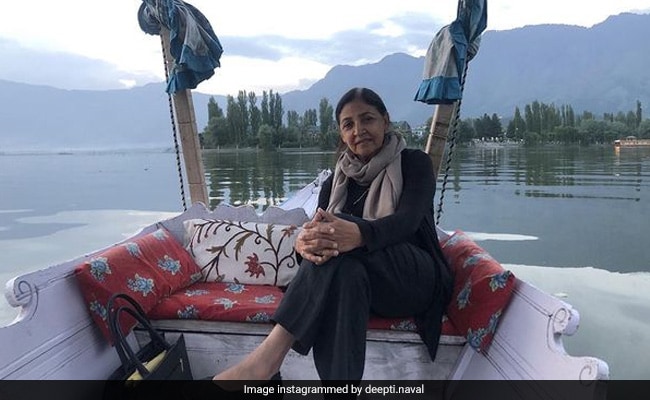
In her conversation at the Times Litfest in Delhi, Deepti Naval spoke about how films have wrongly represented the middle-class girls
Niharika Lal (BOMBAY TIMES; February 17, 2023)
As soon as Deepti Naval came on the stage at Times Litfest in Delhi, someone from the audience screamed ‘Chamko!’ The actress, who was called Miss Chamko in 1981’s Chashme Buddoor, laughed and said, “This is the last thing I wanted to hear today.”
Deepti, who was at the fest to talk about her latest book, A Country Called Childhood, which is about her childhood memories, told the audience to read it like a literary work. She said, “I was not writing as a celebrity. This is the work of a writer.”
The actress, who has played the role of a “sweet and simple” middle-class girl in films like Chashme Buddoor and Saath Saath, told the audience that her off-screen personality is different from her onscreen image. “Meri jo screen image hai, main usse kaafi opposite hoon. Yeh jo formula hai humare yahan that ‘she is so sweet and simple’, yeh mere par toh nahi baithta. I’m neither simple nor sweet,” she said, adding, “Middle class girls have big dreams. They are determined and are ready to fight it out with society, starting with their parents. They are not going to sit back and accept that whatever I will get in life, I will live with that. That’s a false representation of how middle-class girls are. They are feisty, they know what they want and are out there to achieve what they want.”
Author Yasser Usman, who interacted with her, told the audience that even though the book is not about films, it does mention how she gravitated towards films from an early age. He also shared that Deepti had phases when she was smitten by Meena Kumari, Rajesh Khanna and Sharmila Tagore while growing up, and she ran away from her home because she didn’t want to live in the walled city of Amritsar. After watching films like Kashmir Ki Kali and Arzoo, she felt that Kashmir is the place to be, so at the age of 13, she ran away on a train, but fortunately was found at Pathankot and returned home.
Prasoon Joshi, Meghna Gulzar, Vikramaditya Motwane debate: Has content trumped star power in Bollywood?
8:16 AM

At the Times Lit Fest 2018 in Delhi, Prasoon Joshi, Meghna Gulzar and Vikramaditya Motwane discuss how the market is forcing Bollywood to give importance to content
Abhimanyu Mathur (BOMBAY TIMES; December 4, 2018)
The second day of the Times Lit Fest 2018 in Delhi saw some of the leading names in Bollywood come together to discuss the ‘Changing Face of Indian Cinema’. Moderated by film journalist and author Yasser Usman, the panel comprised Prasoon Joshi, Meghna Gulzar and Vikramaditya Motwane.
The session began with Yasser asking the panellists if the ‘deewar’ between star power and content still existed in the film world. “I don’t think ki yeh deewar abhi hai,” Meghna responded, “The difference is that earlier, stars used to be given greater importance as compared to the script. Now, the script is given just as much importance, not only by directors, but also by the stars. I think that content is becoming the crucial element in a film.” When asked who the bigger star of her recent film Raazi was, Alia Bhatt or the script, Meghna replied, “I think the epicentre of Raazi is the story, which comes from the book. That is the most important element that made Raazi what it is. Having said that, if it wasn’t Alia or a star, maybe the trajectory of the film would have been very different. You can’t deny that.”
 Giving examples about how stars today are more open to new content, Meghna said, “Three years ago, nobody would have expected that Varun Dhawan would do October. My next film is on acid violence, where Deepika Padukone plays an acid attack survivor whose face is disfigured. I don’t think anyone would have imagined that Deepika would agree to play this role jahan aap apna face disfigure kar rahe ho. When we see all this, we realise that our thinking and creative thought in films have opened up,” she said.
Prasoon added that this change wasn’t as spontaneous as everyone believed. He said, “Not all stars are making that conscious change. Many are being forced to give importance to the script because that is what the market is telling them. The day this change comes spontaneously is when I will believe that content is truly becoming more important.”
When Yasser asked about actors interfering with the film’s script, it got a few laughs from the filmmakers. Vikramaditya said, “Nahi yaar, that’s collaboration, not interference. People who are seen on screen are the actors, and there’s a misconception ki actor aayega, kaam karke nikal jayega. But actually, actors are very smart and very involved. They know their image, and they are playing towards that. They have to do that as it is a part of their persona. It is a part of the magic of films.”
Explaining why he thinks that the market is the driving force behind content-driven cinema, Prasoon said, “The lives of the people watching films have changed. People are snacking on entertainment the whole day now. A guy will watch a clip on social media, and then go online for some more content. He also has greater access to his favourite stars through social media, toh ab woh parda bhi nahi reh gaya hai star se. At the end of it all, he is so saturated with content, that he wants something different in films, something new, and that is driving this change.”
Vikramaditya added, “Also, we shouldn’t think of it as a paradigm change. If you talk about 2018, and say that smaller films have outdone bigger films like Thugs Of Hindostan, that’s not entirely correct. Of the smaller films that have worked, only two are serious films — October and Raazi. All the others are either comedies or family films. So, even though smaller films like Badhaai Ho are working, and that’s a good sign, they still have their own niche and slots. There is still a slight formula there that we can’t ignore.”
Both Meghna and Vikramaditya have made films based on real subjects or individuals. Prasoon, too, has written Bhaag Milkha Bhaag, the biopic of the legendary athlete, Milkha Singh. The filmmakers touched upon the importance of telling a real story with the respect and sensitivity it deserved. Meghna explained, “Any time you’re telling a story based on a true event, or a real character, you have a big responsibility on your shoulders that you don’t disrespect or disregard anyone. Particularly, when I was making Talvar, I was telling the story of a young girl and a man, both of whom were deceased. Speaking about them, I had to be cautious ki unki memory ko thes na pahunche.”
After an engrossing 40-minute discussion, the panellists took questions from the audience. Vikramaditya, who made Bhavesh Joshi Superhero, was asked why superhero movies are not popular in India. He answered, “That’s because superheroes are not an Indian concept. They were born in the 1930s in the US as a response to the crime wave there. People felt they needed Superman and Batman to fight that crime. You can’t borrow something that’s from another country and put it here. Even Bhavesh is a very borrowed kind of thing. Our superheroes are not masked beings. If you look at mythology, our superheroes are powerful beings, but they have their own faces. That is why, our superhero is Baahubali. That’s a genuine Indian superhero, not Krrish.”

When Anupam Kher called Rekha a 'national vamp' & Subhash Ghai slammed her heavily
8:10 AM

A new biography on screen goddess Rekha throws light on her disturbed marriage to Mukesh Agarwal, which culminated in his suicide, and the misogynistic backlash that followed
MUMBAI MIRROR (September 4, 2016)

As the gates opened, you were transported into a private little dreamworld, a sanctuary, where you were confronted by a split-level home of stone and glass built on a hill, surrounded by greenery.
This was the residence of Mukesh Agarwal. Born into a middle-class Bania family, Mukesh had abandoned studying at the age of 13. For many years he did odd jobs. Then, in the late 1970s, at the age of 24, he started a company of his own that manufactured kitchenware under the brand name Hotline. Sifting through the pages of Mukesh's past, I came upon Neeraj Kumar, Mukesh's one-time friend. A retired Indian Police Service officer, Neeraj Kumar had served as Delhi's commissioner of police. Mukesh's and Neeraj Kumar's paths had crossed at the time that Hotline made ripples in Delhi due to its success. According to Neeraj Kumar, 'Mukesh Agarwal belonged to that breed of entrepreneurs who made it big at a time when others had not emerged. All these start-up scenarios had not happened.' From an ordinary background, Mukesh had always wanted to break into the circles of Delhi's elite. Craving for social prominence, he threw lavish parties for Delhi's socialites. He made it a point to invite every film celebrity who happened to be in town. Neeraj Kumar remembers Mukesh as a 'very nice guy, very kind, but he had a complex. The complex was that he wanted to show that he has arrived. He did not believe in keeping a low profile.' Mukesh was known for his eccentricities; he'd do practically anything to catch a celebrity's eye.
There was a time in Delhi when the glamorous Rekha and the famous fashion designer and socialite Bina Ramani would catch up with each other often. Over one such meeting, Rekha expressed a desire to get married and to settle down. All she sought then was a man who could be her partner for life. It was early 1990. One evening, Rekha's phone rang. It was Bina Ramani from Delhi. She wanted Rekha to talk to her 'crazy fan'. Bina told Rekha that this crazy fan of hers was a well-known businessman from Delhi, and also a very good human being. 'His name is Mukesh Agarwal. Shall I give him your number?' Rekha told her not to. Instead, she took his number.
The first conversation between them was formal but it is said that Mukesh was completely enamoured by Rekha's husky voice. He was also over the moon that a woman worshipped by millions in India had rung him up. Rekha had taken the first step. A series of phone calls between the two then followed. Rekha's Delhi-based friend Surinder Kaur was witness to this relationship since its beginning. Surinder was an air hostess and was very close to Rekha at that time. She wanted to see Rekha settled down. Bina and Surinder repeatedly coaxed Rekha: 'He is a great guy...don't let this chance go by.' Rekha and Mukesh met for the first time in Bombay within a month of their first phone call. For Rekha, tired of the pretenses and demands of showbiz, Mukesh was a pleasant change. His simple and honest demeanour signalled a rare genuineness to her. Clearly star-struck, Mukesh paid her dazzling compliments, something that Rekha had always loved. He left no stone unturned in wooing her, and lavished her with affection. As with everything else in his life, Mukesh went overboard.
He persuaded Rekha to visit Delhi, and she did. Soon, she stood at the centre of attention in his sprawling farmhouse in Chhatarpur, Basera. This was a welcome change from the glitz of Bombay. One could easily get used to the fawning respect, adulation and attention she got. A bond grew between the two of them: he loved her queen-diva image and she loved his till-death-do-us-part devotion.
Sunday, 4 March 1990. It had been just over a month since Rekha and Mukesh had first met. He was restless. Noon found him sitting in Rekha's house along with Surinder Kaur. Without preamble, he proposed marriage. 'Surinder goaded me into saying yes to Mukesh when he came over to Bombay again,' Rekha said recalling that day. Mukesh couldn't control his excitement. Jumping up with joy he said, 'Let's get married right away!' Neither of their families were in Bombay; still, they decided that the wedding had to take place that very day. It was as if they were scared that if not then, it might not happen at all. Rekha was finally getting married. After a lifetime of seeking, Rekha, born out of wedlock, had finally got what she most desired: a legitimate surname.
The initial days in London were beautiful. That was the first time that Rekha and Mukesh had spent so much time together. But it took only a week for Rekha to realise that they were very different people. She was also shocked to see Mukesh taking several pills a day. Still, she thought, now that they had to spend the rest of their lives together, such matters would have to be overlooked. 'I've to make [a] success of it,' she told herself. 'Can Rekha fail in anything she attempts?' They had been in London for more than a week. Rekha could see that something was troubling Mukesh. And then, one day, a gloomy Mukesh looked deep into her eyes and said, 'There's an AB in my life too.'
BREAKING BAD
While everybody knew who Rekha's AB was, the AB in Mukesh Agarwal's life was Akash Bajaj. She was his psychotherapist and had been treating him for the last ten years. She had also been involved with him personally. Neeraj Kumar remembered, 'Mukesh was a chronic patient of depression and, if I'm not wrong, it ran in his family.' Mukesh's sister and a few other members of his family had suffered from depression, making him genetically predisposed to the condition. His was a severe case, and it was Akash who was responsible for him getting better. Neeraj Kumar remarked, 'She had kind of nursed him back from [the] absolute brink of despair.' Back in Bombay, Rekha and Mukesh threw a small party for close friends to celebrate their wedding. Mukesh was then going through a phase of depression. According to Neeraj Kumar, 'I clearly remember it was Santa Cruz Centaur Hotel. Mukesh was on [the] phone line with me, saying that “Neeraj, I'm going to jump off!“' Mukesh's depression had been manifesting in strong suicidal tendencies. Neeraj Kumar tried to talk him out of it, and reminded him of his recent wedding. 'He felt there was no meaning to his life and he wanted to end it. This had been a regular occurrence with Mukesh and was getting tiresome for people close to him,' remembered Neeraj Kumar.
 Meanwhile, Rekha had been giving
interviews in which she proclaimed Mukesh as the love of her life. 'My
first reaction to his name - Mukesh Agarwal - it didn't have that ring of
romance to it. It was so far removed from what I had ever dreamt of. But
today Mukesh Agarwal is the name for me,' Rekha said.
The glow of the relationship held for a few more months, till the reality of life caught up with the couple. On her weekend visits to Delhi, Rekha would often find that Mukesh had plans to party. Though desperate to spend some alone time with her husband, she found herself mostly surrounded by loud crowds. These incidents made her feel like she was probably nothing more than a trophy wife for Mukesh, who constantly wanted to show her off to the world. The two, of course, were the talk of the town, and Mukesh left no opportunity to flaunt Rekha, have her by his side.
The year they got married, 1990, saw a worldwide financial crisis and Mukesh too suffered setbacks in his business, though he kept Rekha in the dark about them. When she found out, disillusionment set in. Cracks were beginning to appear in their marriage. Mukesh was a man of extremes, and Rekha was only just beginning to realise this. A mere two months after their wedding, Rekha's visits to Delhi started becoming infrequent. Mukesh couldn't bear her long absences and even wanted her to stop working in films, a demand that was not just irrational but violated their agreement at the time of the wedding. 'I'll quit only when I'm pregnant,' Rekha had told Mukesh.
The Mukesh who had appeared mature and sincere at the beginning of their association now behaved like a teenaged fan. When Rekha cut down on her visits to Delhi, Mukesh began spending more time in Bombay. Rather than paying attention to his failing business, he idled away time on Rekha's shoots and at Bollywood parties. Acquaintances would often ask Rekha in disbelief: was this the guy she had married? Mukesh's behaviour was becoming a source of embarrassment for Rekha, but he didn't realise it. Obsessed with the glitz of tinseltown, he just couldn't help himself.
Three months into the marriage, the magnitude of her folly dawned on Rekha. She took a step back from the all-consuming relationship, and bought some time to think things through. But when making sense of the situation proved to be too difficult, she started distancing herself from Mukesh and his family. She stopped taking his phone calls. For a depressed Mukesh, this came as a huge blow. Reports of chinks in their relationship found their way into various publications, with headlines like 'Rekha Exposed' and 'The Shocking Past of Rekha's Husband'. The impact of his actions, however, was the exact opposite of what he had hoped: Rekha receded into her shell and pushed him further away. Divorce papers were being prepared in Bombay. Mukesh was desperate, frustrated and chronically depressed. On 10 September 1990, when Mukesh called Rekha she took his call. They talked and agreed to get divorced by mutual consent, just six months into their marriage. On 26 September, Rekha left for America to be part of a stage show.

On 2 October 1990, nearly seven months after his marriage to Rekha, Mukesh seemed rather happy. 'He woke up early in the morning and came to lie down in my room. We had breakfast together. He even told my wife to prepare some lunch as he'd be coming home at about 1.30 pm,' Mukesh's brother Anil Gupta recalled. He left home to meet his close friend Akash Bajaj. Then he went to his farmhouse, Basera. Smiling, he told his cook that he was famished and asked for his favourite dishes to be made. 'I am going to sleep in my room. Do not wake me up till the food is ready,' Mukesh reportedly said and retired to his room. He picked up Rekha's dupatta and fashioned a noose out of it. Climbing on top of his bed, he tied one end of the dupatta to the ceiling fan, pulled the noose around his neck and hanged himself.
Earlier, in 1986, the fantasy film Nagina, where Sridevi played an ichchhadhari nagin, shape-shifting snake, proved to be a mammoth blockbuster, catapulting her to superstardom. With Sheshnaag (1990), Rekha also jumped on to the nagin bandwagon. A little after its release, Mukesh's death made headlines. People started to blacken Rekha's face on Sheshnaag posters. At some places, they even threw dung at it. And so started a national witch hunt.
 The press lapped up
the sensational story of Mukesh's suicide and featured reports with
outrageous headlines like 'The Black Widow' (Showtime, November 1990)
and 'The Macabre Truth behind Mukesh's Suicide' (Cine Blitz, November
1990). An angry Anil Gupta said, 'My brother loved Rekha truly. For him
love was a do or die attempt. He could not tolerate what Rekha was doing
to him. Now what does she want, does she want our money?'Akash Bajaj,
too, remarked, 'I am angry at his death and absolutely furious with the
person who caused this to him. I want to lash out and ask why?' The
reaction of the film fraternity was vociferous: 'Rekha has put such a
blot on the face of the film industry that it'll be difficult to wash it
away easily. I think after this any respectable family will think twice
before accepting any actress as their bahoo,' said Subhash Ghai. 'It's
going to be tough even professionally for her. No conscientious director
will work with her ever again. How will the audience accept her as
Bharat ki nari or insaf ki devi?' Subhash Ghai added. 'She's become the
national vamp. Professionally and personally, I think it's curtains for
her. I mean I don't know how will I react to her if I come face to face
with her,' said Anupam Kher, her co-star in several films of that time.
The national obsession with Rekha's love life had overnight morphed into a national hatred of her. She was branded a witch, a heartless man-eater who did not think twice before killing her husband. There was no future for her, it was deemed. She had no major films in hand, and the industry was unanimous that it didn't want her back. Rekha was projected as a symbol of everything that was wrong and unacceptable in Indian society.
Rekha: The Untold Story by Yasser Usman has been published by Juggernaut. The Juggernaut app is available on the Android and iOS.

From a forced smooch to a sindoor stunt: 3 things you didn't know about Rekha
7:58 AM

In a new book, author Yasser Usman shows a new side of the Bollywood diva
THE TIMES OF INDIA (September 4, 2016)
The shooting of Anjana Safar
was underway in Bombay's Mahboob Studio. Raja Nawathe was the director
and cinematographer of the film. In the very first schedule of the film,
Kuljeet Pal (the director), Raja and Biswajeet (the lead actor) had
hatched a plan, with Rekha as the unsuspecting victim. That day a
romantic scene was to be filmed between Rekha and Biswajeet. Every last
detail of the strategy had been decided before the shoot. As soon as the
director Raj Nawathe said 'action', Biswajeet took Rekha in his arms
and pressed his lips on hers. Rekha was stunned. This kiss had never
been mentioned to her. The camera kept rolling; neither was the director
ordering 'cut' nor was Biswajeet letting go of her. For all of five
minutes, Biswajeet kept kissing Rekha. Unit members were whistling and
cheering. Her eyes were tightly shut but they were full of tears.
Recalling the day, Biswajeet referred to the incident as Raja Nawathe's idea. Raja had insisted that he kiss Rekha, not yet fifteen, catching her by surprise. Biswajeet maintained that it was not his fault, that he was merely working on the director's instructions. 'It was not for my enjoyment, but important for the film. Rekha felt betrayed and was furious,' admitted Biswajeet.
Chappals for the new bride
After getting married in Calcutta, Vinod Mehra and Rekha returned to Bombay, and drove straight to Nibbana from the airport. But a storm was waiting to assail them there. Here's what happened that day at the Mehra residence according to a film-maker: As soon as the new bride bent to touch her mother in-law's feet, Kamla Mehra angrily pushed her away. She refused to let Rekha enter her house. She lost her cool and abused and humiliated Rekha, who was standing at the front door. Vinod tried to intervene but Kamla was livid, so angry that at one point she took off her chappal and almost beat up Rekha with it. The poor girl was numb and confused. A crowd started to gather around the flat, and Rekha, stunned, hurt and shook up, started to run towards the lift, her eyes burning with tears. Vinod followed and told her to stay at her house till his mother calmed down.
Drama at Rishi-Neetu shaadi
22 January, 1980. The occasion was Rishi Kapoor and Neetu Singh's wedding. Neetu was a close friend of Rekha's. The whole of R K Studio was grandly bedecked. The biggest names of the industry were in attendance, including Amitabh Bachchan, his wife, Jaya, and his parents. The party was in full flow. Amitabh was talking to Manmohan Desai in a corner and Jaya was sitting with her mother-in-law, Teji Bachchan, when Rekha made a sensational entry. Dressed in a magnificent white sari, Rekha had a bright red bindi on her forehead. But what caught everyone's eye was the generous dabbing of sindoor in her hair.
The cameras instantly pivoted away from Rishi Kapoor and Neetu Singh, and frenetically photographed Rekha's curious new look. The dull drone of everyone murmuring and whispering filled the evening air; everyone wanted to know: had Rekha married? According to the Cine Blitz report, after congratulating Rishi and Neetu, Rekha went and stood bang in the middle of R K Studio's garden. When had she ever shied away from attention, or controversy? But her eyes kept darting towards Amitabh every other second.
Gathering courage, Rekha took hold of her close friend Snehlata Pandey, the doctor who is credited with introducing Rekha to aerobics and better diets, and went over to where Amitabh was standing. All eyes, quite naturally, followed her. They were seen chatting formally for a few minutes. According to a report in Stardust, 'Jaya tried to keep a stoic front for a long time, but eventually she had to bend her head and let the tears roll down.' A few moments later, Rekha exited the party, leaving behind a trail of unanswered questions. In a somewhat anticlimactic interview, Rekha later cleared the air: that evening, she had come to the reception straight from a shoot. The sindoor and mangalsutra she was wearing were part of her get-up for a film, which she had forgotten to remove.
But according to a report published in Movie in June 1982, at a National Awards function, Rekha, who was being honoured with the award for best actress for Umrao Jaan (1981), was asked by then president Neelam Sanjiva Reddy, 'Why do you have sindoor in your maang?' Rekha promptly replied into the mike, 'In the city I come from, it's fashionable to wear sindoor.'
Edited excerpts from Rekha: The Untold Story with permission from Juggernaut Books

Subscribe to:
Posts (Atom)