Showing posts with label Women's Day. Show all posts
Showing posts with label Women's Day. Show all posts
Feminism is misunderstood when it is wrongly represented or conveniently represented-Shruti Haasan
11:08 PM

Neha Maheshwri (MUMBAI MIRROR; March 9, 2026)
On International Women's Day yesterday (March 08), conversations around empowerment often centre on rights, representation and opportunity. For Shruti Haasan, however, the starting point is more personal: recognising that your voice matters. The actress and musician speaks about discovering that confidence early in life, the evolving space for women in creative industries, and why feminism is often misunderstood.
She believes the ability to trust one’s voice often begins with overcoming self-doubt. She says, “We live in a time where there is so much overload of information that everyone doubts their abilities and true potential. But society does have a way of making women feel doubly unsure. At the same time, we are hearing more voices rising, with women becoming certain of who they are and how they look and finding the courage to stand against the system. I think I was around 17 or 18 when I realized that my voice matters, that I could use it and stand up for myself.”
Looking at how the space for women has shifted in cinema and music over the years, Shruti acknowledges that the industry has made visible strides, even as the larger goal of empowerment continues to evolve. She shares, “Representation has definitely been changing, and opportunities have been evolving. At the same time, I think the industry can work further towards empowering women.”
When asked what she would tell young women hoping to build careers in music or acting, she stresses that passion alone is rarely enough without persistence and direction. She says, “It’s challenging to build a career in fields like music and cinema for many reasons. But if you are passionate about something, in any field, it’s important to make a plan to pursue it. And it’s equally important to have the willpower to see it through.”
Shruti also feels that public conversations around feminism often lose nuance when the idea is presented selectively. “Feminism is misunderstood when it is wrongly represented or conveniently represented. It’s very important to understand the history of feminism, to be grateful for the rights we have today, and to remain conscious of what still needs to be done moving forward,” she concludes.
In a free Iran, I will return home when women can have a voice-Elnaaz Norouzi
10:32 AM

Vishakha Pandit (HINDUSTAN TIMES; March 8, 2026)
As tensions around Iran continue to dominate global headlines, Iranian-German actor Elnaaz Norouzi says the moment is also a reminder of why women’s voices must be protected and amplified. Speaking on International Women's Day, she reflects on the importance of free expression, particularly for women living in societies where that freedom remains restricted.
“The one thing that’s really important is the fact that we live in times where, in most countries and especially in the country that we live in right now, we have a voice. That is something we shouldn’t take lightly,” she says, adding, “Even today, in many countries, women are literally fighting to have a voice or say what they stand for.”
Born in Iran, Norouzi has frequently spoken about the situation in her homeland, a stance that has often invited criticism. Yet she believes standing up for what one believes in matters more than seeking universal approval. “When you’re standing for something you firmly believe in, and you know what you’re standing for is right, then it doesn’t matter how many people oppose you,” she says.
The 33-year-old says her views echo the sentiments of millions of Iranians who cannot speak freely. “I’m not just speaking about what I feel, I’m speaking about what 75 million Iranians are thinking. I’m trying to be the voice of the voiceless, because in Iran you don’t have a voice.”
Despite living and working in India, Norouzi says her ties to Iran remain strong. “In a free Iran, I will return home to my country and see my family.”
My ambitions have gotten bigger after I became a mother-Kanika Dhillon
9:57 PM
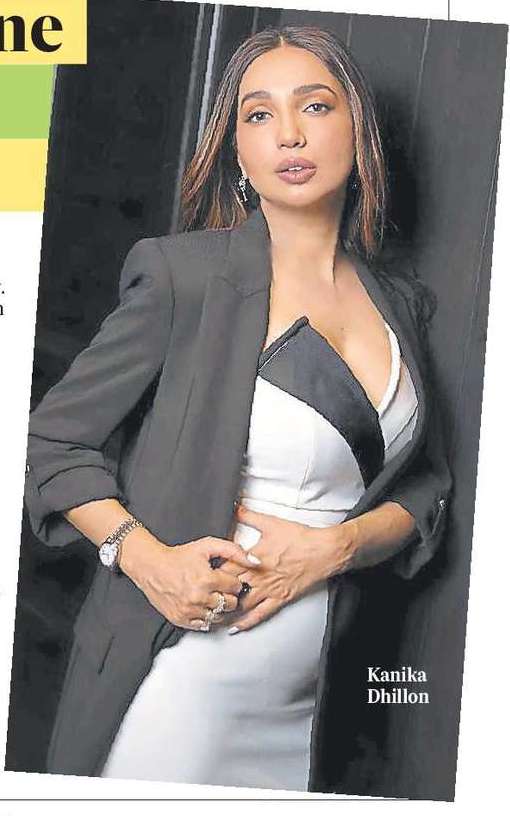
Akash Bhatnagar (HINDUSTAN TIMES; March 8, 2024)
Writer-producer Kanika Dhillon has been the name behind films like Manmarziyaan (2018), Haseen Dillruba (2021) and Dunki (2023). Yet, it has been a difficult career journey for her. “I refuse to live someone else’s idea of what an ideal successful woman is and that has been my biggest challenge as well as my biggest victory,” says Dhillon.
On International Women’s Day today, talking about representation of women in cinema, the 39-year-old states, “In popular culture, the ideal woman image has dominated, and we’ve had a narrow definition of being a woman.”
She adds that while things are changing for the better, there is still a long way to go. However, Dhillon also points out how women themselves pose danger for their own gender. She says, “We have a patriarchal narrative with men, but the women who are pandering to it and are hypocritical about it, are the bigger problems today. As women, when we pull other women down, we are doing a bigger disservice. This hypocrisy by women is more dangerous than men.”
Dhillon and husband-writer Himanshu Sharma welcomed their baby boy Veer in 2021, and while she loves being a mother, she points out the bias against working moms. Revealing a shocking incident, she shares, “I was in a meeting with a man who wanted to renegotiate my contract’s commercial terms because I was pregnant, and he thought I won’t be able to fulfil my responsibilities.”
Yet, Dhillon calls becoming a mother “the best thing that has happened to me.” “Opposite to what is said, my ambitions have gotten bigger after I became a mother,” she concludes.
Ram Charan is secure enough to be in my shadow when I shine-Upasana Kamineni Konidela
8:25 PM
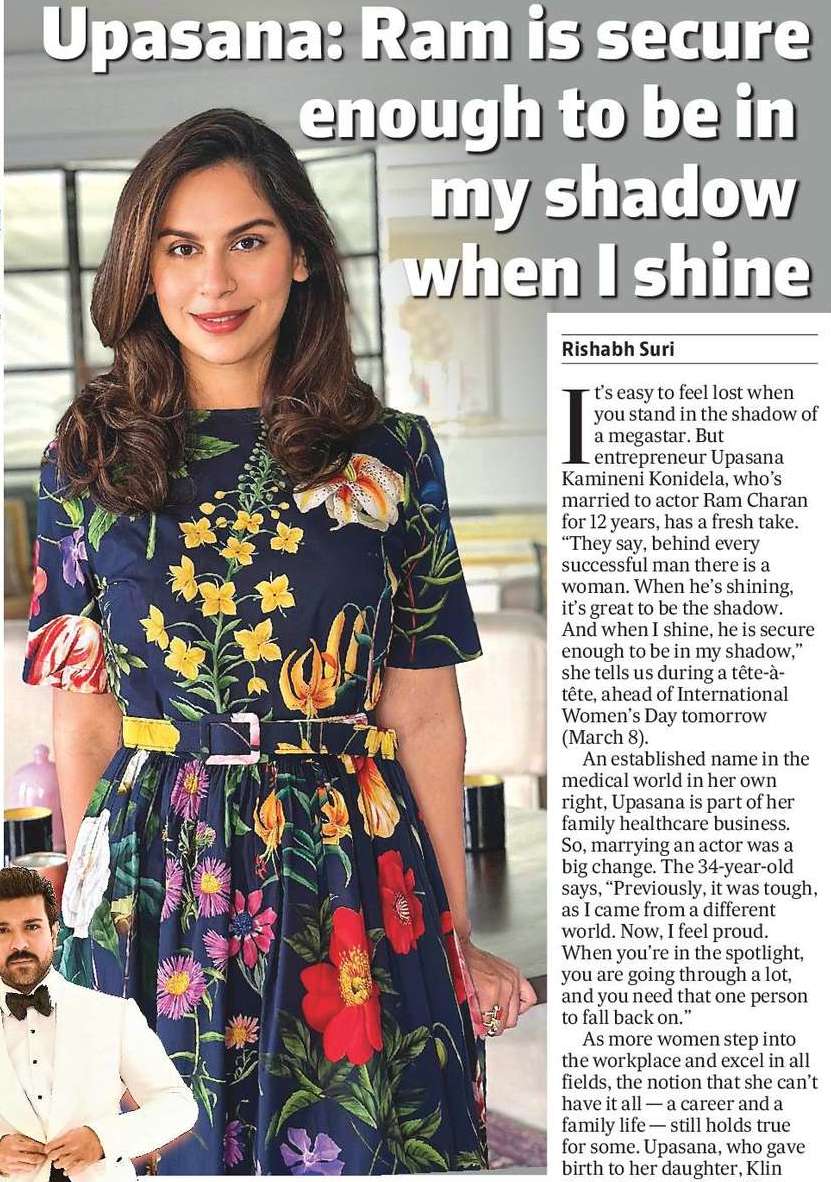
Rishabh Suri (HINDUSTAN TIMES; March 7, 2024)
It’s easy to feel lost when you stand in the shadow of a megastar. But entrepreneur Upasana Kamineni Konidela, who’s married to actor Ram Charan for 12 years, has a fresh take. “They say, behind every successful man there is a woman. When he’s shining, it’s great to be the shadow. And when I shine, he is secure enough to be in my shadow,” she tells us during a tête-à-tête, ahead of International Women’s Day tomorrow (March 8).
An established name in the medical world in her own right, Upasana is part of her family healthcare business. So, marrying an actor was a big change.
The 34-year-old says, “Previously, it was tough, as I came from a different world. Now, I feel proud. When you’re in the spotlight, you are going through a lot, and you need that one person to fall back on.”
As more women step into the workplace and excel in all fields, the notion that she can’t have it all — a career and a family life — still holds true for some. Upasana, who gave birth to her daughter, Klin Kaara, last year, says, “As a mum, it’s a battle for me to be as productive at work as I was before. The mindset and the corporate culture in India need to change to make it easier for women.”
Sharing what worked for her, Upasana adds, “Women should save their eggs by insurance. I saved my eggs too, and I am proud to say Ram and I made a choice to have a child when we were in a comfortable space,” she wraps up.
RAM ON UPASANA
“Beyond being my wife, Upasana is my rock and the force that keeps us together. Whether it is with our family at home or contributing to her philanthropic projects, she excels in all roles due to her unwavering commitment and deep-rooted family values. Upasana has beautifully carried forward her family legacy.”
We're no longer defined by the men in our lives-Vidya Balan
8:09 PM

What Vidya says is echoed by an increasingly large number of people from the industry. On Women’s Day we explore how Indian cinema is reflecting this
Niharika Lal (BOMBAY TIMES; March 8, 2024)
‘Why can’t substantial roles for women be the mainstay?’
Vidya Balan, who has films like Kahaani, The Dirty Picture, Sherni, Shakuntala Devi and Tumhari Sulu to her credit, said recently, “For me, it was never a conscious decision to break the glass ceiling. I didn’t see the glass ceiling; I just saw the sky. We had Meena Kumari, Rekha, Jaya Bhaduri, Sridevi, Hema Malini, Smita Patil, Tabu – invariably, every female actor had just one or two of those (lead) films in their entire career, spanning decades. I wondered, ‘Why can’t it be the mainstay? Why can’t women be just doing substantial films?’… I think maybe the world was moving in that direction, and that’s why I had the desire in me, too. It all aligned. The universe responded with great opportunities. And today, we have a situation that is far better for women.”
‘Writers and makers are now ensuring that women characters have individuality’
A big reason for more realistic female characters is the evolved writing. Veteran writer Anjum Rajabali tells us, “Filmmakers like Bimal Roy, Mehboob Khan, Gulzar, and Vishal Bhardwaj have shown that there is enough space even in popular cinema to write individualistic, non-stereotyped female characters. In recent times, this is precisely what the newer generation of filmmakers has begun to ensure that women characters are characterized with individuality and are not stereotyped.”
Anu Singh Chowdhury, who has written Aarya and Grahan, adds, “The awareness that we need to tell our own stories has led to a lot of women pushing their way into the writers’ room by putting the proverbial foot in the door. Many such aspects have led to so many wonderful female characters now being loved and leading the show. We as writers now focus on closing character arcs of each character, and that has definitely led to adding more nuances instead of the cardboard (or stereotypes of) women characters one would often see, especially in mainstream cinema. That’s a huge win, I would say. Thankfully not just women writers, but even the male writers are becoming more aware of this.”
‘It is her decision’
Mrunmayee Lagoo, who has written Thappad, says that the film’s team had many discussions, reflections, and drew from their personal experiences to debate if ‘just one slap’ is grounds for divorce. They realized that whatever Taapsee’s character does is her decision. It can’t be everyone’s decision. Not everyone is in a position to take such a step. But for her, even if it is ‘just’ one slap, it’s not okay. Elaborating on the part of the story when the husband doesn’t even acknowledge that what he did was wrong, she says, “That period was very important for us to keep. And that’s how she decides that I don’t know what I want to do, but I know that I don’t want to be in this space with you now.”
‘Earlier, even when women had agency, they stayed subordinate to men’
Strong women characters in our films are not new. In films such as Bandini (1963) and Sujata (1959), the women characters were strong and had agency. However, writers say that the perception of what’s a women’s place in the society was so entrenched that even when strong roles were written for them, their position within the gender dynamic remained that of a subordinate, which has now changed.
“Bimal Roy always ensured that his female characters were sharply defined, had a personality and a strong sense of individualism. Whether in Parakh, Bandini, or Sujata, there was nuanced layering,” says Rajabali. However, he says that even in films like Bandini, “no matter what the woman is in life, when it concerns the gender equation, there is a certain position that she naturally occupies.”
Similarly, Shabana Azmi has spoken about how for Arth (1982), distributors insisted on changing the last scene where her character refuses to take back her unfaithful husband. She said, “Distributors said it’s a very powerful film, but you have to change the end. Hindustani mard apni biwi se maafi maang raha hai, biwi kaise maaf nahi karegi? Anyway, Mahesh Bhatt and I decided that this is what we want to do, and didn’t change the end. I won the National Award for that film.”

Women's Day Special: Celebrating women behind the scenes in Bollywood
8:26 AM

Today, on International Women’s Day, let’s celebrate women who may not appear on the big screen, but are the most significant part of a film. These women are the true heroes behind the magic we see on screen
Juhi Chakraborty, Rishabh Suri, Titas Chowdhury, Vinay MR Mishra (HINDUSTAN TIMES; March 8, 2022)
Juhi Chaturvedi, Writer
It is a welcome change to have more women around me. But it is not about the number. If I have talent, then I should get the opportunity and not be discarded on the basis of my gender. That change is slowly happening. It’s good to see women getting their due.

Priyanka Borkar, Hair stylist
For far too long, the film industry and hairstyling department have been largely male-dominated. I’ve been here for 14 years and can say that there has been a significant rise in the number of women. I like seeing more women getting into the industry, doing great work. I believe there is equality now.

Deepa Bhatia, Film editor
Women are becoming increasingly visible in the industry, notably in post-production departments. When I first started working, the only woman editor was Renu Saluja. I looked up to her and she was an inspiration to me since we didn’t see many women in that position at the time. More women are participating now than ever before.

Dolly Ahluwalia, Costume designer
Whatever the profession, there has to be equality and respect, for both men and women. Even families didn’t support women entering the industry earlier, but now there is so much awareness. And even in the field of costume design, there were very few women in the past. Bhanu Athaiya ji was the first, followed by Neeta (Lulla) and others. Now, it’s incredible to watch young ladies become great designers.

Sanober Pardiwalla, Stunt woman
When it comes to the industry, there are many women today working in all divisions, and I’m not only talking about stunts. Earlier on set, 80% of the crew were men, and women were only spotted in the costume department. That, however, has changed. Women are involved in every phase of the filming process, from lighting to art direction. The mentality has also become more open, with equal respect given to all. It is no longer a question of whether you work for a guy or a woman.

Savleen Manchanda, Makeup artist
There was a time when hair used to be a woman’s thing and makeup was a man’s job. With time, we have all become comfortable with both sexes and have now become a team. Bollywood has been really accepting.

Ridhi Anand, Assistant director
I began working in the film industry in 2014, and I now see more women on set than I did previously. Filmmaking is no longer solely a man’s domain. Fortunately, I’ve never experienced any type of gender bias in the profession. However, when I first started, I would see a man and a woman doing the same job as the second AD, but the man would get paid more. That, I believe, is beginning to change. To some extent, the battle for better pay has receded.

Meenal Agarwal, Production designer
When I started in 2001 with production designer Suzanne Caplan Merwanji, there weren’t many girls working on the set of a mainstream film. I’ve witnessed a set transition from having no women to having so many of them. Despite this, mansplaining continues to exist. To this day, several studios lack clean women’s restrooms. I intend to continue working for these basic rights. However, the industry now has more educated, civilised people that respect me and my profession, which is a blessing.

Shruti Mahajan, Casting director
People were hesitant to work with female technicians at first, but now they realise that women can handle all sectors. They are strong not just physically, but emotionally as well. I think the casting department belongs to women. Compassion, intuition and instinct come naturally to us. Most actors come and say, “You hear us out,” and that makes a lot of difference.
Shelly Sharma, Cinematographer
I consider myself more privileged than women before me. I’ve been on teams with no women, and now I’m on a team with a lot of women. So, times are changing. I’d also like to thank the Indian Women Cinematographer Collective (IWCC) for raising awareness about female cinematographers. Many young women write to me, asking for advice on how to pursue a career as a cinematographer. That is a great thing.

I won’t allow women to be depicted regressively-Anushka Sharma
8:06 AM

On Women’s Day, actor-producer Anushka Sharma discusses how she has tried to change female portrayal on screen by telling stories from feminist gaze
Mohar Basu (MID-DAY; March 8, 2021)
In her 13-year career so far, Anushka Sharma has showcased different shades of women — from the ambitious wedding planner in Band Baaja Baaraat (2010) to the spirited Aarfa in Sultan (2016) and the self-reliant Mamta in Sui Dhaaga (2018). Though the characters resided in different universes, a common thread tied them — each had a strong head on her shoulders and the agency to take life decisions. Sharma stepped up her efforts to change the depiction of women in Indian cinema as she launched her production house in 2015 and backed female-led stories.
As she puts her weight behind another powerful story Mai, the actor-producer says she knew early on in her career that she didn’t want to be boxed as the leading man’s arm candy. “I have been conscious enough to select roles that I felt could contribute towards changing the portrayal of women on screen. I was done seeing myself as an accessory. I vowed that as a producer, I will not allow women to be depicted regressively,” she says. Sharma admits it wasn’t easy to swim against the tide. “It took a lot of self-belief, but it was liberating to do this for myself.”
Her productions are proof that she walked the talk. If NH10 (2015) told the story of a woman raising her voice against honour killing, Bulbbul (2020) depicted the folklore of a blood-thirsty witch from a feminist gaze. Her upcoming offering Mai, headlined by Sakshi Tanwar, revolves around a mother who accidentally gets sucked into the world of violence and power. Sharma says that with each project, she aims to challenge society’s patriarchal ways. “Movies have the power to impact change and help people determine what is right and wrong. By being clear about how we will depict women in cinema, we can alter the mindset of people, and shatter age-old beliefs and customs. My film choices and productions are a testimony to the fact that I’m committed to sparking a conversation in society about equality, self-respect and empowerment.”
Subscribe to:
Posts (Atom)