Showing posts with label Waiting For Godot. Show all posts
Showing posts with label Waiting For Godot. Show all posts
People will be so fed up of OTT, they’ll happily go back to theatres-Ratna Pathak Shah
8:28 AM

Juhi Chakraborty (HINDUSTAN TIMES; July 14, 2020)
Theatre is actor Ratna Pathak Shah’s first love. But that love has seen a massive dent, as the Coronavirus crisis has kept her away from performing for a live audience “It is particularly painful for me, a theatre person,” she admits, adding, “The idea is to perform in front of a live audience, that’s what I’ve grown up on, that’s what I want to do all my life. To have that taken away is such a big shock to me.”
And given the present scenario, the theatre industry, like many others, has also gone digital. While she agrees online platforms have brought a lot of new people into the business, she’s quick to say, “My big fear with the OTT is that I don’t like plays being online. It is nowhere close to what the real experience is like.”
The actor feels OTTs will be around for quite some time. “But when things clear up, everyone will be so fed up of OTT that they would happy to go back to the theatres,” says Shah, 63, whose last film Thappad had a short theatrical run owing to the pandemic and eventually made its way to an online streaming platform.
Shah’s next, Jayeshbhai Jordaar, was slated to release this year, but has now been pushed. She was also gearing up for the performance of Samuel Beckett’s Waiting For Godot this month, but that, too, stands postponed indefinitely.
“This period has been hard, like for everyone else, to change one’s way of thinking, working and living. I suppose it has given everyone a comprehensive idea of what retirement will look like,” says Shah, who recently served as a jury member of the Lockdown Film Festival.
I want to do plays that sock you in the gut-Naseeruddin Shah
8:22 AM
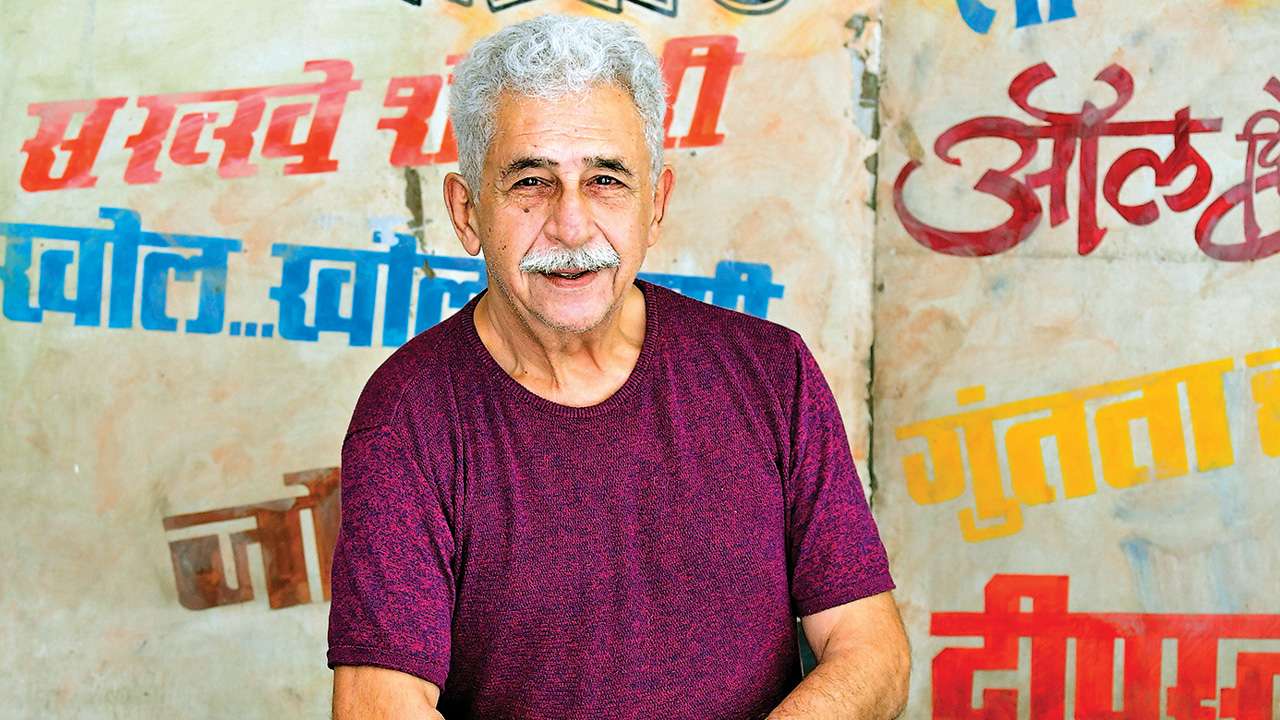
Naseeruddin Shah talks about the past, present and future of his theatre group, Motley, which celebrates its 40 years this month
Deepali Singh (DNA; July 15, 2019)
Circa 1978. Naseeruddin Shah and Benjamin Gilani sat in a small coffee shop in Lucknow and decided to make plays that aroused their curiosity. On July 29, 1979, they opened their first play, Samuel Beckett’s Waiting for Godot at the newly-inaugurated Prithvi Theatre in Juhu, although they didn’t have a name in mind for their group yet. Forty years and 42 productions hence, Motley continues to stage plays that resonate with them. They are now staging some of their most popular ones, including Manto Ismat Haazir Hain, Aurat Aurat Aurat, Dear Liar and Ismat Apa Ke Naam among others, and also doing a couple of readings at the Motleyana Festival to celebrate the milestone. We caught up with Naseer to tell us more…
The line in the 40 years celebration logo, ‘In Godot We Trust’, is quite apt for Motley. Who came up with it?
I did! It’s actually a meme that’s going around. Initially, there was something about the 40-year celebrations but I wanted this motto because if it hadn’t been for Waiting For Godot, Motley wouldn’t have existed. We owe Godot a great deal. We performed it for so many years. We will be reading portions from it for one of the shows and introducing all the actors who were in it — those who are still alive and around. Some who are not in India will be sending video messages. The people who played the boy are now all grown up, like Akarsh Khurana, Imaad (Shah, his son) and others. We will talk about the fun we had doing the play. I believe people should attempt drama they don’t necessarily understand. The process occurs only when you tackle the script.
Can you rewind to the early days of performing it?
There was no Motley name when we first performed it! Om (Puri) had a theatre group called Majma for which I had done several plays. We didn’t have a banner, so he said, ‘Do it for Majma’.
It wasn’t a particularly tough time. Ben chose Godot because he thought it would be a practical play to do, not because of its greatness. He said it’s just four men and we needed a child actor. He knew cinematographer Ishan Arya had a 10-year-old son called Sameer, so, we went ahead with it. The play was so difficult to comprehend and we didn’t know what the hell we were doing! Gradually, the references to Chaplin, circus, religion and all began to strike us. So, we tried to convey those as best as we could. I think it cost us around Rs 3000. We had to get one suit made, while the rest of us were in rags. We just produced our old clothes for that.
Please continue...
We didn’t expect it to make money but we did it because we wanted to do it and found more and more meaning to it. Then it began to get us revenue with full houses in Prithvi Theatre and other venues. And that’s how Motley established itself. I don’t remember it as being a very traumatic time. Tom (Alter) had a very large apartment in Juhu and we would often rehearse at his or Ben’s place. Sometimes, while working with Om, we have rehearsed on local trains, buses, at Juhu Beach, wherever we could find space. Looking back, even then it was great fun as we were doing what we loved.
Can you tell us about the influence theatre doyens Ebrahim Alkazi and Satyadev Dubey had on your works?
I spent my childhood in places like Ajmer, Aligarh, Meerut and Nainital. I studied at Aligarh University, where I met some inspiring teachers who introduced me to modern literature and encouraged my dreams. The plays we did there were shabby productions. There were hardly any resources or money. Then a teacher of mine took me to National School of Drama in Delhi and I was dazzled by the plays I saw! I didn’t know theatre like this happened in India but Alkazi was doing it. They were spectacular productions staged at the Red Fort and Talkatora Stadium, with a cast of 50-60 people. Every detail, right from the rings and shoes they wore, was looked after. That is what I have absorbed from him.
Then I saw Dubey’s plays. He often did works that Alkazi had done, but with no budgets at all. I consider his production of Hayavadana as one of the most memorable things I’ve seen on stage. There were Amrish Puri, Amol Palekar, Priya Tendulkar and Kalpana Lajmi among others. It was a spectacular play with nothing on stage but the actors. He and Alkazi detested each other and I can understand why now (laughs). I’ve learnt from both equally but I follow Dubey’s path. I want to do what he did — to reach out to an intimate audience, do plays that sock you in the gut, not ones which dazzle you. There are so many rudiments of staging I picked up from them. Alkazi was a genius at crowd scenes, while Dubey was great at handling actors and creating moments of dynamism on stage. The value of the word is what I learnt from Dubey most.
You rely a lot on the spoken word…
I love the spoken word. I believe it is the most important thing on stage. I admire well-spoken languages, whichever they may be. I’m not dismissing physical theatre. I admire it but unfortunately, I’m incapable of doing it. So, I stick to what I am good at — the spoken word.
What’s the one thing that’s been a constant for Motley in these 40 years?
To do the plays that we want to do. We once tried to do a crowd-pleaser — The Odd Couple. That was at a time when comedies were popular and we wanted to make some funds. All we did was lose money because nobody came to see it (laughs). So, we want to do the plays we feel the urge to do and that’s a rule we have followed. Sometimes we succeeded, sometimes we failed. Doing Julius Caesar was a dream I had since school. We attempted it, we failed. I think I was a little muddled in my head as to what kind of play it should be. It was part Alkazi, part Dubey. The mix didn’t work.
Is there a play on your wish list?
Saint Joan by George Bernard Shaw that I will certainly do at some point. It needs 15 male actors, all of whom have extremely important parts. It’s a tough task to find 15 outstanding male actors who can speak well. I’m also yet to find an actress who can play Joan. I’m gradually accumulating the cast but I want to be certain how to do the play, so I haven’t launched into it.
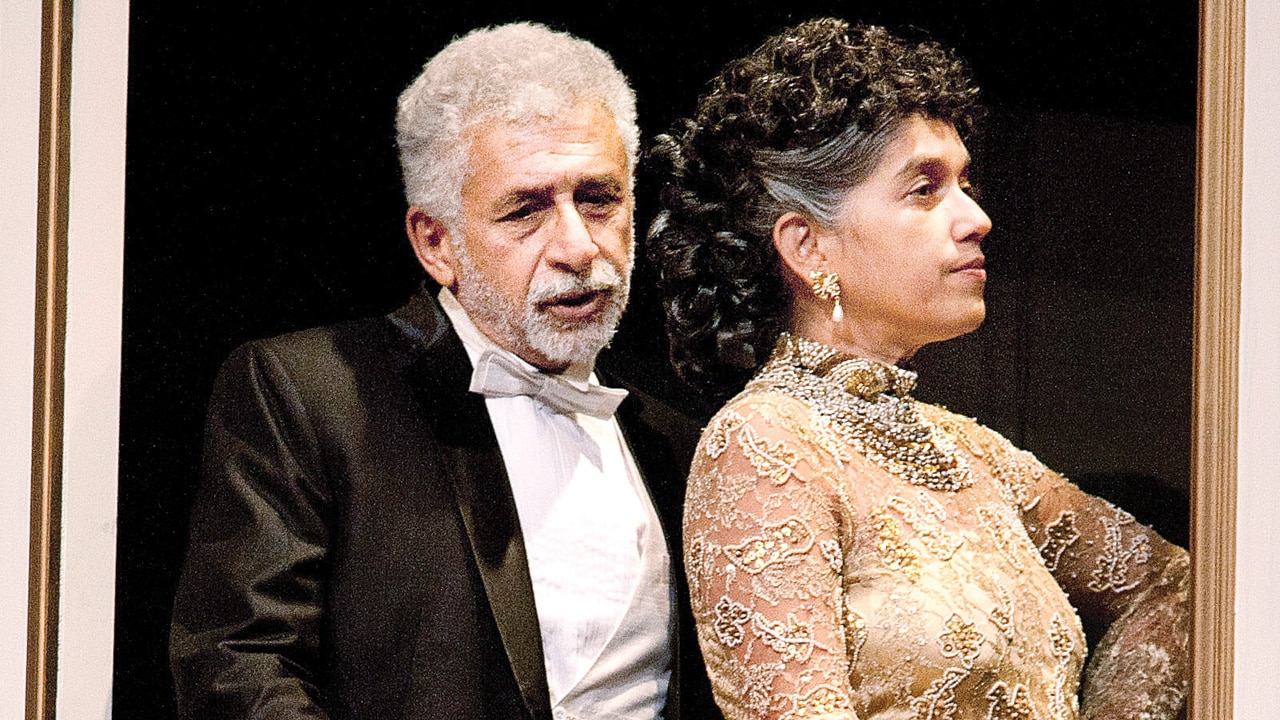
The actor with Ratna Pathak Shah in Dear Liar
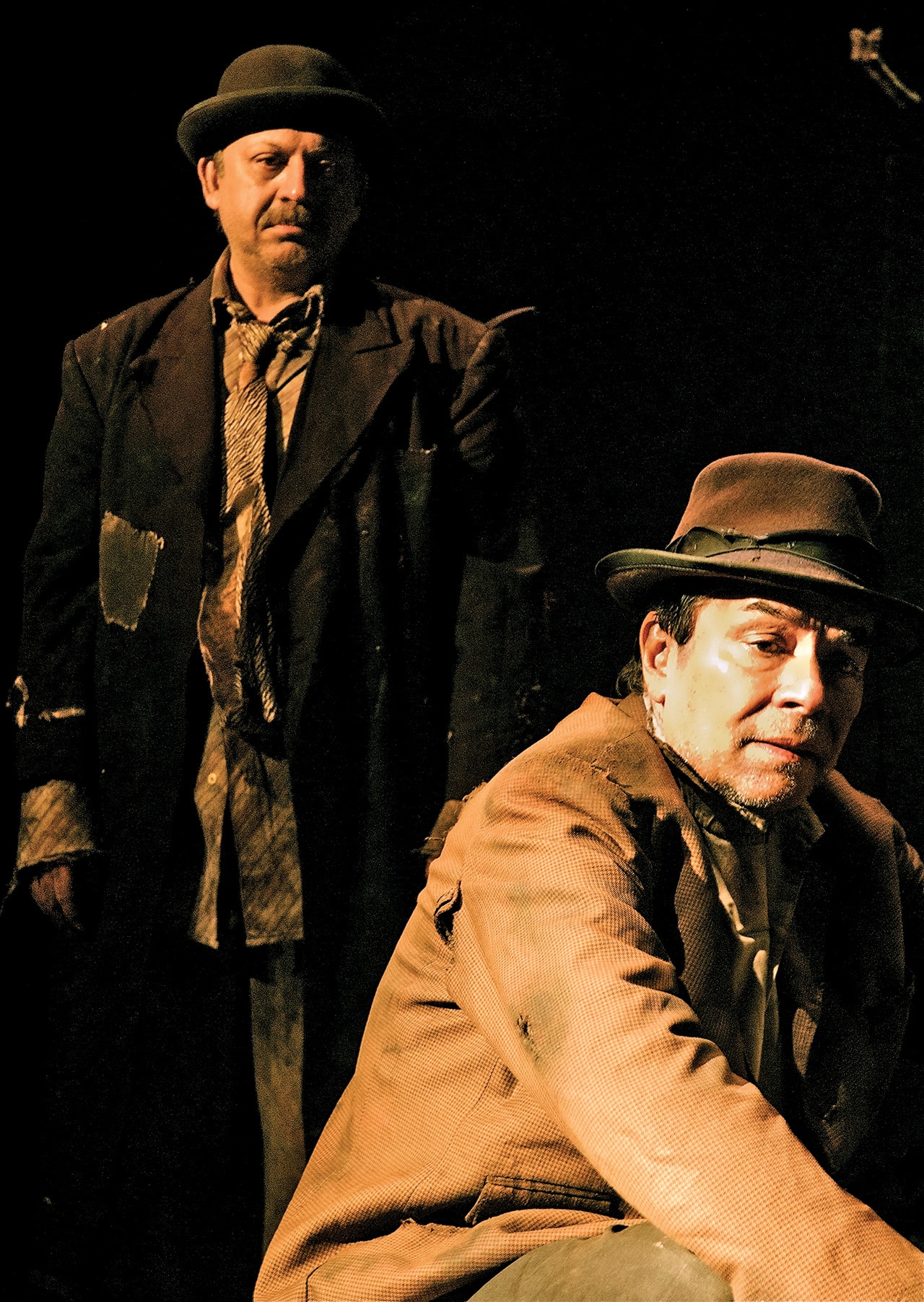
Akash Khurana and Benjamin Gilani in Waiting For Godot
Naseeruddin Shah and Benjamin Gilani's Motley theatre group still stands strong after 40 years
8:43 AM

The Motley family: Jairaj Patil, Akash Khurana, Naseeruddin Shah and Benjamin Gilani with Ratna Pathak Shah. Pic/Shadab Khan
Four decades after Waiting for Godot's debut at Prithvi Theatre, Naseeruddin Shah and Benjamin Gilani's theatre group shows no signs of slowing down. As they get ready to revisit five of their plays at Prithvi next month, they revisit their first act
Ekta Mohta (MID-DAY; June 30, 2019)
Naseeruddin Shah, looking like Einstein, and Benjamin Gilani, now sporting a wig, are discussing cricket and women like 40 years haven't passed. In the hippie decade, the two became college buddies at FTII, Pune; then co-actors in Shyam Benegal's Junoon, 1978; and then co-founders of the theatre group, Motley, in quick scene-changes. Gilani, who had been part of The Shakespeare Society in St Stephen's College, recalls, "He asked me, 'How come you haven't done any theatre in Bombay in the last five years?' I said I can't afford it." So, they started with a play that was easy on the pocket: Waiting for Godot by Samuel Beckett.
Since then, Motley has done 44 productions, including The Caine Mutiny Court-Martial (1990), Dear Liar (1994), Ismat Apa Ke Naam (2000) and The Father (2017). They celebrate 40 years next month, the party for which includes reviving five of their plays at Prithvi Theatre. Along their journey, the twosome also became a family, with producer Jairaj Patil, and actors Ratna Pathak Shah and Akash Khurana onboard. When we sit with them to trace their early days, they've just gone over the same questions and memories with another journalist. But Shah says, in theatre parlance, "Once more with feeling."

Julius Caesar
'What Was The Cheapest Classic We Could Do?'
In July 1979, when Motley's Waiting for Godot debuted at Prithvi Theatre, Shah played Didi and Gilani played Gogo, the two clowns. Khurana says, "That was the cheapest classic we could do. It had a huge budget by those standards: Rs 5,000. But, that was the only play that had one dirty tree, with a leaf sometimes, and tattered costumes. I did four shows as Didi, and I wore the same costume."
Naseeruddin Shah: I'm not the only one in the world who did not understand Waiting for Godot. I wrote an essay [in NSD, Delhi] that this play is absolute nonsense. The writer is making a fool of everybody. I got thoroughly blasted for writing such a thing. But, when we started working on it, and concentrated on the words and not worry so much about the meaning, it began to make sense. Like in any great poetry, it states things in a very simple, recognisable and brief way.
Benjamin Gilani: Didi and Gogo have been together for 50 years. When you think of 50 years, that play should have been as thick as the Bible. Prithvi Theatre was being built at that time. During the shooting of Junoon, I asked Jennifer Kendal Kapoor, "What are you going to do with this theatre?" She said, "I don't know. Take it. It's yours." Three sentences. So, we started off and Godot fell into place, by chance, not so much by design. When people actually came to see the play, we hadn't hit a goldmine, but we started doing short plays: Chekhov, Pinter, Genet, Mortimer. There was something as difficult as The Lesson [by Eugène Ionesco]; and on the other hand, we had Chekhov's The Bear.
Ratna Pathak Shah: But frankly, we were just blundering. We all learnt on the job. There was nobody to tell you how to do anything. We were all lucky that we at least got Satyadev Dubey, in terms of his ideas and not letting poverty get in the way of perfection. There were times when there was nobody backstage. Everyone was either onstage or in the light booth.
Shah: Nothing lonelier than the backstage of Godot.

The Caine Mutiny Court-Martial
'Naseer Wanted To Do Julius Caesar In Jeans And T-Shirts'
The group performed The Caine Mutiny Court-Martial by Herman Wouk and Julius Caesar by Shakespeare in 1990 and 1992 respectively. When asked about their favourite plays, Khurana says, "I think if you take a consensus from the older lot, you will find Godot and Caine emerging as winners." Julius Caesar was an important milestone as well, but for entirely different reasons.
Shah: I bought a copy of Caine Mutiny for Rs 5 on the pavement at Churchgate station. It was a tattered paperback, and it lay around with me for years, like the Einstein script [by Gabriel Emanuel], like A Walk in the Woods [by Lee Blessing]. One day, I picked it up and I was electrified.
Gilani: It involved a large number of people — at least by Motley's standards — 17 people. And, there were 70 people in Julius Caesar. The youngest was 4, the oldest was 74. There were three generations [of one family]. The logistics was the biggest challenge.
Pathak Shah: How many sandwiches do I order today? Starting from there to: how do you get everyone dressed backstage in Sophia Bhabha Hall, in Roman costumes with shields, swords and banners? Where do you store that stuff?
Gilani: Originally, Naseer wanted to do it in jeans and T-shirts. But, Julius Caesar was on the course of 13 schools, and they didn't want to see Brutus in jeans.
Shah: I was muddled as a director, I have to admit. I had [NSD director Ebrahim] Alkazi on my mind. Alkazi did these grand productions with 30 people carrying flaming torches onstage. Meanwhile, I got introduced to Dubey's method. And, I was torn between the two. It didn't really work, and I had edited the play, changed a few things, which appalled a lot of the teachers. One teacher said, "What about reference to context? If you have given Cassius's speech to Brutus, students will get confused." I said, "You've been teaching this play for one year and your students will get confused with one performance? What kind of a teacher are you?"

Waiting for Godot
'We Had No Message, No Political Agenda'
In the last two decades, Motley's focus has shifted to storytelling theatre, and also, plays in Hindustani. Starting with Ismat Apa Ke Naam (2000), they have interpreted the works of Ismat Chughtai and Manto extensively, and also opened up the platform for more roles for women.
Gilani: There were no Hindi plays. Even now there are very few. As Naseer had pointed out then, and I agree 100 per cent, if you're going to translate from one language to another, you need to know both languages like a grammarian.
Shah: The translator must be of the same level. How many times can you do Aadhe Adhure and Andha Yug, which are the only two worthwhile original plays in Hindi? Ghashiram Kotwal and Sakharam Binder are in Marathi. Tughlaq is in Kannada and so on. The plays we wanted to do happened to be in English. Then we started feeling limited. That's why I felt the need to perform in Hindustani. But, shortage of plays is still there.
Gilani: It's a matter of economics. Where does a writer earn money, unless you happen to be Chetan Bhagat? And, that's not really writing of any calibre, that's promotion.
Pathak Shah: The playwriting issue is a big one in our country. And now, with the invasion of your personal equipment with all kinds of information and entertainment, it's going to be very hard for live arts to stay around. [Regarding the lack of roles for women], it wasn't a deliberate attempt to keep women out. I was the only girl around, and I don't think I was much liked as an actress. And rightly so, because my skills in early Motley days were very, very basic. I have also grown since then, and fortunately, Dubey trusted me. He found plays for me. We were making do with whatever we had around us. And there were no other girls around. Maybe they got scared of me and ran away.
Shah: You can only cast in a play somebody you can trust with your life. You cannot take a chance of a person not turning up or not delivering the goods.
Gilani: That's one word that operates very strongly: 'trust'. If we didn't trust each other implicitly, we wouldn't have stuck around, and we're going back 45 years.
Shah: I think a strong reason for me [to start Motley] was to be able to spend time with people I enjoyed spending time with and produce something creative. Instead of sitting in a party or chatting, you're sharing creative juices with people you like. What greater joy can there be? And it's really because of friends that we continue, the encouragement and support we receive, the belief they had in our work, which initially was shabby and amateurish. Dubey used to say, "I do theatre for the 10-15 people I love. I don't give a damn about the rest." And, it's really true to a large extent. We had no message, no political agenda, no profound reason for doing theatre. We were not exploring or trying to understand the nature of theatre. We were content with what we knew. And, we had great fun.
Gilani: [I remember], in Godot, we had this young boy, who is a very famous cinematographer now, Sameer Arya. The boy comes twice, and in the second act, we have started and Sameer went off to sleep. And, Naseer and I are waiting. Somehow we managed to get the play together. After that, Sameer was holding on to his mother, thinking he's gonna get a mouthful from Naseer. Though I had directed the play, Naseer was the one who would give mouthfuls at the time. Naseer didn't say a word. Now, this guy (audience member) comes and says, "I particularly liked your second act's interpretation. You didn't bring the boy. It was a touch of genius."
Khurana: This other time, we were in Bengaluru, and in the middle of an intense scene, this lady in sari and perfume says, "Yeh car number kiski hai? It's been parked there. Bataiye, aisa hota hai? Sorry, but we have to stop this show." And the curtain came down. In five minutes, we resumed, and something very interesting happened. The next few lines, whatever we said, coincided in context with what had happened. So, she became a star in absentia. She became Godot in a sense. It brought the house down.
The Influence Of Satyadev Dubey
Akash Khurana says, "For me, he was a bridge for Motley. At that time, Dubey was in his Renaissance phase. He cast me in Abe Bewakoof, and he hated my performance, because he was supposed to cast Amrish Puri. I had my wardrobe [ready], part of my wedding stuff, so that was great for Dubey because impoverished theatre: costume ke saath aaya hai. I tried to sound like Puri sahab and screwed my vocal chords. And Chhabildas Hall, that's another legend: you could hear hawkers shouting, TVs blaring, windows open, fans creaking, and I'm in a three-piece. But Naseer liked what I did. Cut to a few years later, theatre, struggle, job, house-hunting, which is another trauma, and we were homeless. I had a kid, a suitcase and no place to go. He called us over and I lived with him for 11 months. What happened there was not just the sharan (shelter) I got, but an exclusive gurukul. You sleep, wake up, read and drink rum with Dubey. I was getting an oral history of Bombay's theatre. Talk about influences."

I’m allergic to selfie hunters after my show-Naseeruddin Shah
8:01 AM
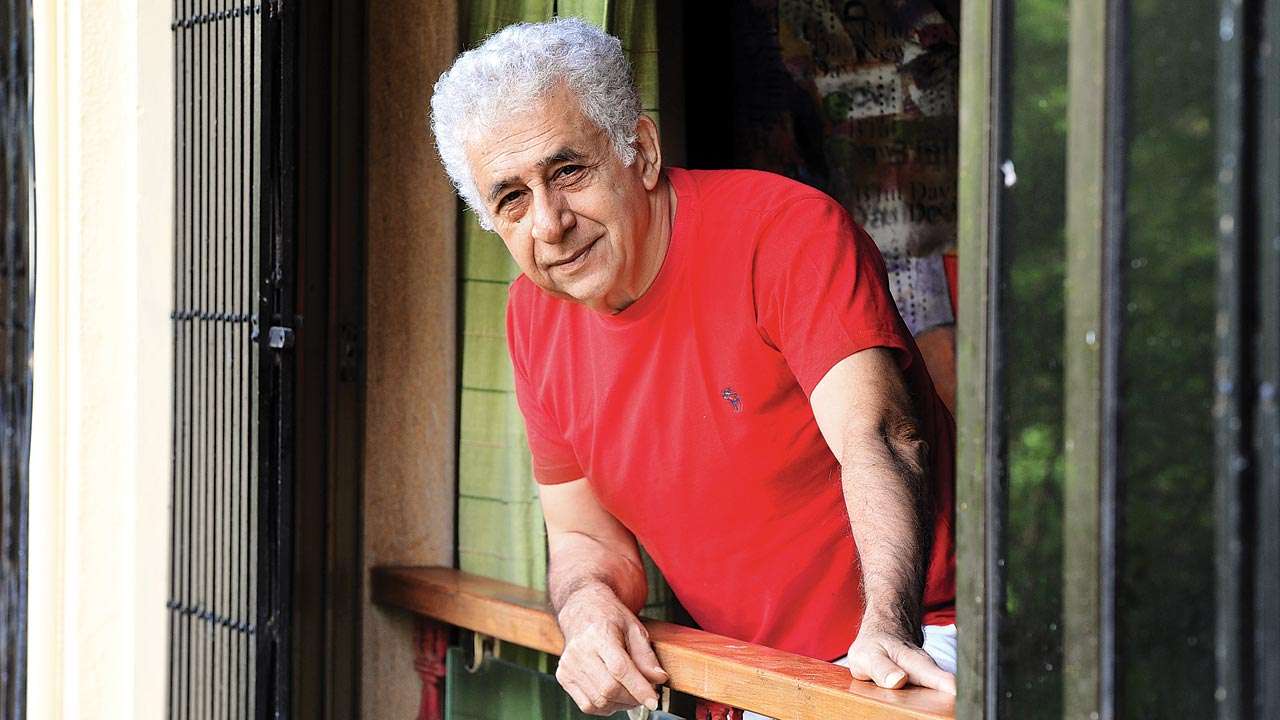
Deepali Singh (DNA; September 8, 2018)
Naseeruddin Shah has been busy of late. Between his play The Father that’s having a month-long run at the NCPA Experimental Theatre, conducting acting classes, swimming and playing tennis, he’s got it all sorted. But the one thing he isn’t doing is acting in movies. “I’m out of work,” Naseer states simply, when we meet him for a chat at his Bandra residence, adding that he’s glad he doesn’t have films at the moment, as it’s giving him time to do what he wants. Over to the veteran actor...
You may not be acting in films but are you watching a lot of movies?
I’m happy with some of the movies I have seen in recent times like Shubh Mangal Saavdhan, Nude, Dum Laga Ke Haisha and Kaun Kitne Paani Mein — the latter was a totally unknown film which I saw on TV one day. Several other films like Anarkali Of Arrah, Ankhon Dekhi, A Death In The Gunj and Newton were also good. But all these filmmakers get snapped up so fast by the Bollywood machine. It chews them up and spits them out. They made these movies out of conviction, but the moment one of these movies succeeds, they get snapped up by the movie-making factories and then they have to conform.
The boundaries between commercial and art cinema have been blurring now...
It’s a good thing. Films don’t get stamped as art films and the audience doesn’t need any help in deciding. They smell it out, as Dubey ji (Satyadev Dubey) used to say. ‘Audience soongh leti hai kaunsi film kaisi hai’. It’s true. Even among the ones being made now, I know which ones I want to see and that has been the case since school. ‘Six months from now, Shammi Kapoor ki jo film aa rahi hai woh dekhni hai!’’
Have you been offered any projects on the digital platforms?
I’ve been offered a few things but I didn’t find them interesting. I’ve been doing some short films with young people and that’s been great fun.
After month-long runs at Prithvi Theatre and NCPA last year, you’re back on the stage with your play, The Father...
Yes, and by the time this month ends, we would have completed 80 shows. Then we’ll need to do a few more to make a 100. We’re planning to take it to Bengaluru and also to Pune, so we will achieve that figure. It’s quite an achievement because we have managed to do this in a-year-and-a-half. It took us about 20 years to do 100 shows of Waiting For Godot! (laughs)
Do you think the success of the play will encourage other theatre companies to follow suit with the format?
I always felt that it’s possible to do it, but the problem is most theatre companies don’t have the resources. One has to book a theatre for a month which means a fat amount of money. And now these theatres cost a lot. Then the actors have to be available for a month. So, I don’t expect that everybody will start doing it. I did it because I could afford to do it. The actors I chose have all given their commitments and it’s been great fun.
When you were doing the play for the first time, you had said that it’s a complex one, but you never underestimate the intelligence of the audience.
Absolutely, and the response has been very encouraging. At the same time, there are always walkouts in every show. I don’t mind. Maybe those people found the play confusing, which is actually the playwright’s purpose, to put you into the mind of the character. So if you’re confused at the end, it’s intended, provided the experience has given you something of seeing this man. But the majority of audience stay on and that has been really good to see.
What’s the kind of feedback you have received from audience members?
So many of them come and tell me about some member of their family, or some relative. And everybody knows what it’s like, because at some some point or the other, one feels that their parents have grown old, and that they don’t understand them. So, it’s easy to empathise with the situation where this man has receded to this point that nothing he does is making sense to anybody. They come and say ‘it must be so hard for you’, but it’s not hard for me. I’m just telling them a story. It’s hard on the audience.
You have always maintained that you don’t like audience members coming backstage to talk to you post a show, but seems like it was different this time...
I’m allergic to selfie-hunters after the show! But this time, I actually had meaningful conversations with people. A number of youngsters have come to me, some of them went away when I told them ‘no selfies’. But some stayed and spoke to me. That has been really wonderful. One of them actually said ‘thank you for doing this because today, I understood my grandmother. She was just like this’. I don’t feel that I have achieved perfection or anything close to it. But I have at least managed to convey the essence of this play and that’s what I feel happy about.
What next?
I’m planning a month-long run of a play called Old World for November next year. It’s a lovely play which I had seen, enacted by my heroes Mr and Mrs Kendall of Shakespearana Theatre Company.
Subscribe to:
Posts (Atom)