Showing posts with label Vivek Agnihotri interview. Show all posts
Showing posts with label Vivek Agnihotri interview. Show all posts
I don’t know why I’m not afraid. I have nothing to lose-Vivek Agnihotri
9:51 AM

Yashika Mathur (HINDUSTAN TIMES; October 6, 2025)
Filmmaker Vivek Agnihotri has often drawn polarized reactions for his work, the most recent being The Bengal Files. While his subjects are frequently termed controversial, Vivek says he isn’t afraid of backlash.
“I don’t know why I’m not afraid. I have nothing to lose because I have no needs and I don’t care about glamour, money, and all those kinds of things. That’s why I don’t get losing anything and that’s why I’m able to do that,” the 51-year-old tells us.
But confidence in his storytelling, he admits, also makes him prone to being misunderstood: “Anyone who has met me says I am a very different person. People think I am a certain way, but in reality, I am very chilled-out and philosophical. I’m a poet at heart, but because of my films, there is a persona that is created and people misunderstand me because of that.”
However, the National Award-winning filmmaker sees an upside to such perceptions being created.
“I don’t spend time creating an image, and I don’t have a social circle that can announce that fake image like typical Bollywood film stars do. That’s perhaps why I’m misunderstood, but I’m also very happy because it gives me space to make these sort of films. It’s better to be misunderstood but my films are not misunderstood, and that is important,” he ends.
What we need right now is for all politicians to shut up for five years-Vivek Agnihotri
3:33 PM
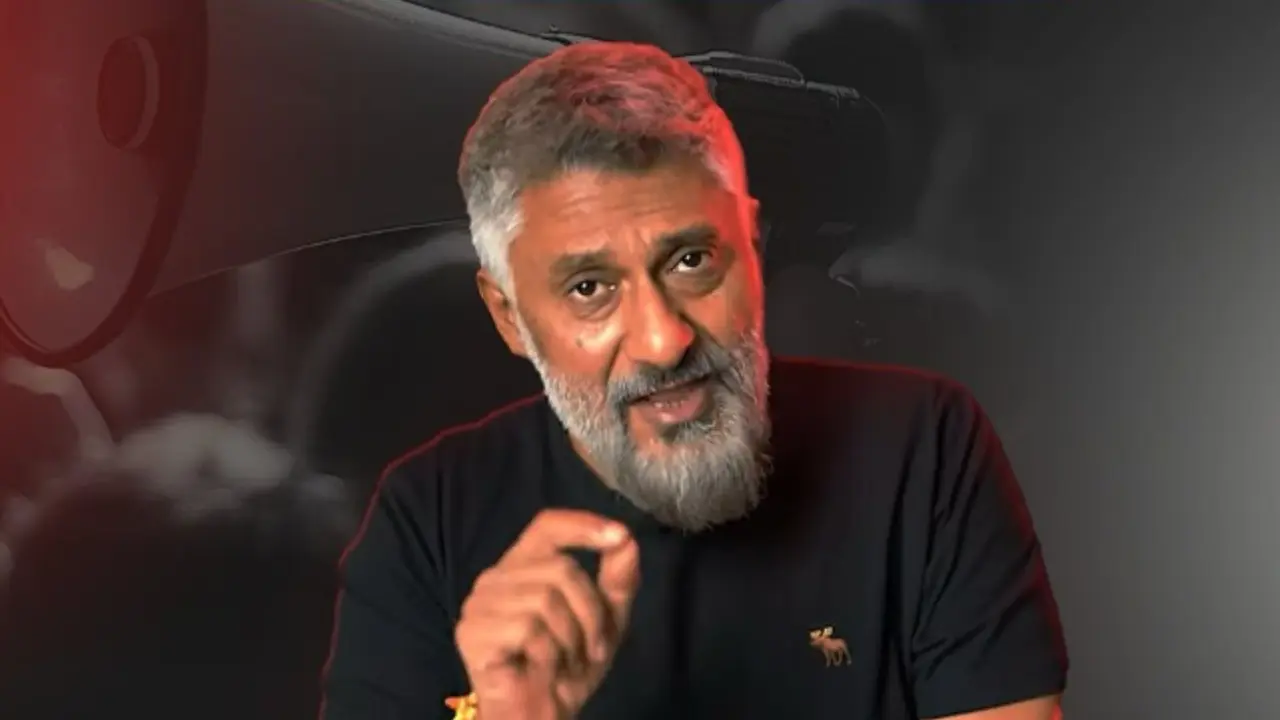
Chandrima Pal (BOMBAY TIMES; September 4, 2025)
Vivek Ranjan Agnihotri likes to make all the right—pun intended—moves. Ahead of the release of The Bengal Files, the third instalment of his Files series, he picks a Bengali-themed restaurant in suburban Mumbai for an interview, tells us that he likes Kishore Kumar’s Bengali songs and settles down for a Bengali meal with shukto and fish paturi . Excerpts from the conversation.
Let us imagine you had zero opposition to The Bengal Files, which releases in theatres tomorrow. That you had no political outfit, entity or individual to name and blame in your interviews. How would you promote your film?
I would have felt suffocated. I would have failed. My idea was to pick up taboo subjects, and in my mind the problem was that even after 78 years of Independence, we are still fighting with the same problems that led to the Partition. Unless you acknowledge there is a problem there can be no healing, no solutions. The purpose, the whole objective of my movies is to start a conversation. Since the trailer has launched, everybody is writing about Direct Action Day or Gandhi’s role, they are dissecting the film. Many Bengali Hindus are now admitting that their parents or grandparents had spoken about Direct Action Day and the Partition trauma. This, I believe, marks the beginning of healing from a generational wound.
No other place has sacrificed as much as Bengal: it was the cradle of the Renaissance, the wellspring of nationalism in all its shades—Congress, communist, centrist—with both Vande Mataram and Jana Gana Mana emerging from here. Bengal gave India its cultural crown, from cuisine and poetry to cinema, the Bengal School of Art shaped by Abanindranath Tagore. For me, Bengal is India’s lighthouse. My purpose was to shock people into realising how much we’ve lost.
How can you connect Bengal’s loss of cultural and intellectual capital directly to the Hindu– Muslim conflict at the heart of your storytelling? Isn’t it too much of an oversimplification?
That’s a very deep question. Which other state in the world has been divided three times? Without Direct Action Day or the Noakhali genocide, there would not have been Partition. Gandhi himself spent seven months in Noakhali, yet afterwards Bengalis were told not to speak of their pain—silenced by political forces that wanted to take India on a different path.
Later, communist ideology took deep root in Bengal, but it viewed everything only through oppressor versus oppressed. That western lens does not fit India, where the so-called majority was ruled and persecuted by minorities for 1,200 years—our literature, music, architecture, everything was distorted. That is why, I argue, Bengal’s decline cannot be seen separately from communal fault lines.
Films have been made on the Holocaust, Hiroshima, slavery— always with a core of humanism, empathy. Many feel your films don’t address that.
First, let’s be clear—which lot of people? Viewers? Critics? I am very research-oriented. And why should I force closure when history itself has none? Lal Bahadur Shastri’s death has no closure. Kashmir still has no closure—people were killed in Pahalgam just recently. But this film does have closure. What I believe should be done, that’s the closure.
Suppose this film triggers unrest. Would your role as a filmmaker end with reopening certain chapters in history?
Look at The Kashmir Files. People warned it would cause unrest. Nothing happened. Instead, I received thousands of emails from Kashmiri Pandits saying the film began their healing process. I can guarantee Bengali Hindus will say the same after this film; they already are, across screenings in the US.
Both communities suffered losses. Isn’t everyone part of the healing process?
Of course. Healing belongs to everyone. But not everyone had the luxury of moving on. Many were forced. Did we really move on? Germany and Poland confronted their past—they outlawed Nazi glorification, built museums, preserved Auschwitz.
Should India simply say “move on”? Or acknowledge that we have a genuine Hindu–Muslim faultline—Partition, Bombay blasts, Pahalgam killings, constant election rhetoric. If America could confront slavery through films, articles, debate, why are we in India told to stay silent about our own history?
Some of the cast members of your film — Saswata Chatterjee and Sourav Das — are facing backlash for being part of the film.
What backlash? Sourav and I had lunch recently. He never distanced himself. A journalist twisted his words, and he immediately asked, “Show me my tweet, quote me if I said that.” Same with Saswata. He never disowned the film.
Saswata did say he wasn’t told the full context.
That’s media manipulation. Do you think an actor of his calibre would sign without reading the script? He has to say things to survive in Bengal. I even spoke to his family—they shrugged it off. Look, he speaks Bengali throughout, eats paturi maach, plays a Murshidabad MLA. He knew what he was doing. After Nana Patekar in Parinda, we have not had such a cold-hearted villain in our cinema.
You say there will be closure at the end of the movie. What kind of closure?
Cinematic closure. But let’s be real—I cannot close the Hindu– Muslim conflict in Bengal or India. Who am I?
You often say you listen to your audience, pick stories that people want told. There are so many other stories that need to be told.
Honestly, what India needs right now is silence. All politicians should shut up for five years. Dalit leaders, Brahmin leaders, Muslim leaders, TV anchors— everyone. Just shut down the noise. And focus only on eradicating corruption. Solve that and 90% of India’s problems vanish.
Do you have political ambitions?
I’d rather die than join politics. But yes, I understand politics deeply. My father was a freedom fighter, I’ve debated politics since childhood. That’s why I can say what I say; most filmmakers can’t.
Many filmmakers, despite festival acclaim and dealing with socially relevant issues, can’t get theatrical releases. You always manage to make controversial films and take them to your audiences. What’s your secret?
Conviction. A filmmaker must guard their work like a mother rabbit protecting her babies from vultures. Most filmmakers lack that instinct. I don’t. I fight till the end.
But is it right to say they do not have the conviction to fight for their creative freedom?
Look, if you make a film on caste, someone’s offended. On women’s persecution, men are offended. On Muslims, Hindus are offended. Everyone is offended. But cinema cannot be hostage to sentiment. Honestly, I do not understand Muslim trauma or pain. Maybe if I am born as a Muslim in my next life, I would. But I still have the right to tell stories drawn from history and testimony.
And when films like Santosh don’t make it to audiences?
Then I fight for them. I don’t know why they don’t come to me, I would be happy to fight for them. Even my ideological enemies, I defend their freedom of speech. I fought for comedians like Kunal Kamra and Samay Raina.
Would you speak up for Umar Khalid?
He’s in jail, it’s sub judice, so I won’t comment.
Gopal Mukherjee aka Gopal Patha is a complex character. North Kolkata always remembered him as one of those powerful, street-cred strongmen—like Fata Keshto.
Yes, yes. They were the fiercest. Part of the akharas, too.
Utpal Dutt wrote in Towards a Revolutionary Theatre that after Direct Action Day, leaders used people like Gopal Patha to settle political scores—a muscleman on hire. He ran a family meat business, he ate meat, he spoke Bengali, he was no saint. You have said that after this film, kids will see him as a hero. Given the ideology to which you are aligned, are you okay with glorifying a figure like that?
Why? Bengalis eat meat. What’s wrong with that? Hindus in Kerala eat beef, Kashmiri Pandits ate meat too. India is not a vegetarian country; 73% of Indians eat non-veg. To reduce Gopal to food habits or language is just superficial politics. I believe in total freedom of food, speech, lifestyle.
----------------------------------
‘I hate disclaimers. They assume audiences are stupid’
Trailers don’t need disclaimers. The film will have one, because the law demands it. I hate disclaimers. They assume audiences are stupid. Does a painting carry a disclaimer? Cinema is art. My disclaimer will be the usual: “based on true incidents, survivor accounts, historical texts… intention not to hurt anyone.” Plus the silly statutory warnings—smoking kills, animals unharmed, etc. But because Jinnah was a chain-smoker, I was forced to add two extra minutes of anti-smoking ads.
----------------------------------
‘I am a storyteller, not a social scientist’
I am nobody to find answers. I am not the Prime Minister, not a social scientist. I am a storyteller. My job is to observe and narrate, not to prescribe solutions. People expect too much from filmmakers. Journalists often ask me — why don’t you rehabilitate Kashmiri Pandits? I tell them, I am not a politician. It’s like asking Satyajit Ray after Pather Panchali to eradicate poverty. That’s not how art works.
Bollywood needs government support to nurture bold storytellers-Vivek Agnihotri
8:46 AM

Vivek Ranjan Agnihotri pens an open letter to Union Commerce and Industry Minister Piyush Goyal
HINDUSTAN TIMES (April 7, 2025)
Dear Piyush Goyal ji,
Your recent remarks at the Startup Mahakumbh about Indian startups needing introspection and real value-addition in the face of global competition — especially against China’s strides in EVs, semiconductors, and robotics — were deeply resonant. Your push to move beyond superficial ventures like “fancy ice cream and cookies” and focus on meaningful innovation is timely. In this vein, I wish to highlight a sector with immense cultural and economic potential — Indian cinema — which, despite its legacy, is failing to innovate, compete globally, or harness its soft power potential like South Korea or Japan.
Globally, cinema and OTT thrive on bold storytelling and technological disruption. Films like Boyhood (shot over 12 years and released in 2014), the single-take illusion of 1917 or the social commentary of Parasite (both 2019) and even a raw, real-time dive into teenage chaos shot in one take such as that in Adolescence, showcase how innovation drives cultural influence.
Today, K-entertainment contributes over $12 billion (approximately Rs. 1,200 crore) to Korea’s economy, while Japan’s anime industry exceeds $20 billion (about Rs. 2,000 crore) in revenue. Hollywood dominates through streaming platform Netflix’s $31 billion (Rs. 3,100 crore) content budget, making it a global content empire.
Meanwhile, Indian cinema remains stagnant — copying formats without mastering their essence. We are the world’s second-largest film producer, yet ironically, most of our content ends up being sold to American platforms. It’s the East India Company syndrome all over again — we create the raw material, but others own and profit from our stories.
The decay is evident. Studios are shutting down; producers flee to real estate. Visionary filmmakers struggle to survive, while the system promotes non-actors better suited to making Instagram reels or dancing in weddings than meaningful cinema. Rooted, Indic stories are missing. Bollywood, once a soft power beacon, is now “flower power” — style without substance.
The viewer experience is equally dismal with outdated multiplex screens, exorbitant ticket and food prices, and theatres that now resemble food courts. Cinema, once a middle-class joy, is now an unaffordable luxury with diminishing returns. I speak from experience. The Kashmir Files (2022) — a non-starrer, risky narrative — broke Bollywood’s formulaic mould; but this came at a personal cost: fatwas, security threats, relentless backlash and character assassination. If truth invites such hostility, how can we expect innovation?
The industry needs government support — funding, incentives, and platforms — to nurture bold storytellers, not just star-driven fluff. Indic cinema can be the biggest startup of India, with potential to generate jobs, export cultural capital, and build global influence just as South Korea’s entertainment industry has done. Just as startups must prioritize real value, Bollywood must shift from elite appeasement to global relevance. Cinema can be an economic and cultural powerhouse, India’s leading soft power but only with introspection and disruptive innovation.
I urge your intervention to empower filmmakers who dare to dream—help Indian cinema reclaim its place as a global leader, not a copycat.
Sincerely,
Vivek Ranjan Agnihotri
Indic Filmmaker
Disclaimer: The views shared in the above article belong solely to the author
People don't cry when politically motivated-Vivek Agnihotri
8:33 AM
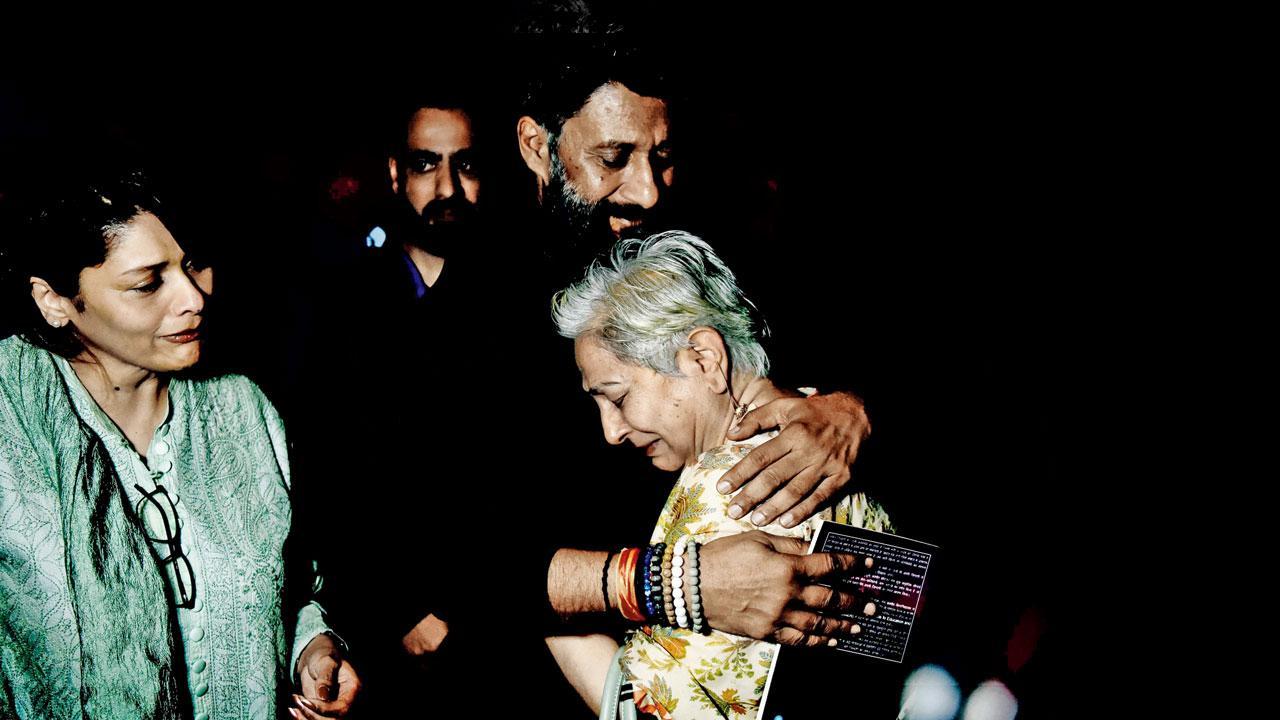
The most controversial man of the week, director Vivek Agnihotri says outpouring of emotions to his film is proof that this side to Kashmir’s insurgency had to be bared
Aastha Atray Banan (MID-DAY; March 20, 2022)
It's post noon on a Wednesday, when we manage to connect with director Vivek Ranjan Agnihotri. By then, it has been five days since the release of his controversial film, The Kashmir Files, based on the exodus of Kashmiri Hindus from the Valley following violent processions by Kashmiri Muslims who wanted an Islamist state. On day eight, its box office collections cross Rs. 116 crore. But, Agnihotri who describes himself as a “free thinker” on Twitter, an account which he deactivated briefly last month after he claimed to have received threatening messages to stop the release of this film, is drawing mixed reactions.
The emotions are raw, like in the videos of Kashmiri Pandit viewers crying inside theatres, as they sink in the torment that Anupam Kher’s Pushkar Nath experiences in the film. In a rare moment for the leader of a country, Prime Minister Narendra Modi applauded The Kashmir Files, and chose to meet the director and his actor wife, Pallavi Joshi, who plays JNU Professor Radhika Menon in the film. “His endorsement has come as a surprise. When the highest office has put faith in your work, it makes you even more responsible,” Joshi later told this writer.
But certain quarters have called out the film for being “exploitative”, “displaying half-truths” and being “anti-Muslim”. Agnihotri is unruffled by the hate. “I see only one opinion. There is no other view. Everybody seeing the film is crying... it was the biggest tragedy. These are the only reactions I have seen. There is no Left or Right wing, there is only the ‘India wing’, the humanity wing... terrorism has no side. People who see other sides are either naive, vicious or political,” Agnihotri says emphatically over a telephonic call.
He is speaking to us from the New Delhi airport, where our interview is interrupted once too many by approaching travellers, who we overhear thanking him for making the film. Two days after this interview, this in-person expression of fandom would have been restrained with the director being granted Y category security by the Ministry of Home Affairs (MHA).
For most part, Bollywood has been silent, with only a handful showing their support if any. Agnihotri doesn’t consider himself part of this tribe, he clarifies.
“When we [Pallavi and I] decided to quit Bollywood, and become independent filmmakers, we didn’t care about reactions [from people]. We want to make movies and tell stories that everyone else is scared to tell.”
Agnihotri says the film is important and had to be made. “What we know of Kashmir is through the media and the political lens. Everybody has spoken about the Kashmiri Pandits and their genocide, but nobody has spoken to them,” he says.
With very little material available to fall back on for research due to what Agnihotri claims is insufficient documentation, he decided he’d start by tracing the first-generation survivors. “Just like the Holocaust, where the testimonials of the victims were recorded, we decided to interview the survivors, who were directly impacted [by the events]—whose parents and children were killed, and houses burnt. We hunted them down all over the world—went to their homes, ate with them, spent time with them, and once they were comfortable, we recorded long-format video testimonials. We found the most common stories between them, and corroborated facts using available books, clippings, [conversations with] historians and documents, which are very few,” he adds. What, he says, he arrived at are facts “that can’t be disputed”. “Even the terrorists will admit this happened... we based the movie on that.”
The director feels that the first step to justice is to acknowledge what happened. “The thing about genocide is that you have to admit there has been a genocide. For 32 years, nobody has done that. Now that we have spoken to them [survivors], the process of healing has begun. People have told me that they didn’t speak about it [the event] out of fear, and now it’s out there. We are healing broken hearts.”
Even as several states, especially those ruled by the BJP, have made the film tax free, a political slugfest has erupted. Some have panned the BJP for looking at the Kashmir problem as a Hindu-Muslim one, rather than an issue of territory. But Agnihotri doesn’t hesitate to pin the blame. “Indira Gandhi was a Kashmiri Pandit. I can share a letter where it is clear what she thought. Everyone knows the truth. The slogan at the time was, ‘Ralive, tsaliv ya galive’, which means ‘either convert to Islam, run or die’. Is this a Hindi Muslim slogan, or one that addresses territory? Muslims are the majority. [But] Kashmir was originally a Hindu civilisation. The dispute was created by the British,” Agnihotri argues.
When this writer points out how there has been criticism over the film vilifying the entire Muslim community, he interjects, “It’s a wrong question. You are asking this, because your brain is wired in a certain way... Could you have written an article about the Nirbhaya [Delhi gang rape] case without vilifying the rapists? Terrorists must be vilified. In the case of Kashmir, the terrorists have been Muslim.”
Does that justify videos from inside Indian theatres roaring with “anti-Muslim” chants, surfacing on social media? “I haven’t seen them. But, I can’t expect people who have been affected, to control their emotions. They have the right to say it out loud. People don’t cry when they are politically motivated. They cry when they are emotional. After Schindler's List released, Jews came out on the streets. When you break open the lie, pent-up emotions will surface. And it’s important for society to heal.”
Agnihotri thinks to ask an audience to react to the film rationally, intelligently, is an elitist call. “It’s irrational. We make movies to evoke emotions, to portray the reality. People have the freedom to react how they want. I don’t support this snobbery.”
We remind him that some quarters have expressed concern over possible violence. “You are assuming that will happen. It’s the state that needs to maintain law and order. My job is to tell the truth, and if the truth is evoking a response, I am no one to control it. This question is not for me, but someone else.”
Kapil Sharma and IMDB ratings
Agnihotri had claimed in a tweet that his film was not promoted on the Kapil Sharma show because it didn’t have big stars, its producers were allegedly told. Sharma has denied the allegation on social media. Anupam Kher later clarified that he was called, but turned down the offer because the mood of the film didn’t befit a sketch comedy. “Kapil must have invited Anupam two to three months ago, and that was when the third wave was on, and they had no other celebrities available. I know what happened,” Agnihotri tells mid-day.
Online film and television database, IMDB said it had changed its rating method after noticing “unusual voting” on The Kashmir Files—the film now has an 8.3 rating. Agnihotri says, “I don’t understand algorithms. I have never decided to watch a movie after checking its IMDB rating. I read that people went and rated it 1,” adding, “They are vandalising it [the film]—some terrorists are with guns, some [dabble] with ratings.”
The Kashmir Files is one of Anupam Kher’s best films after Saaransh-Vivek Agnihotri
8:31 AM
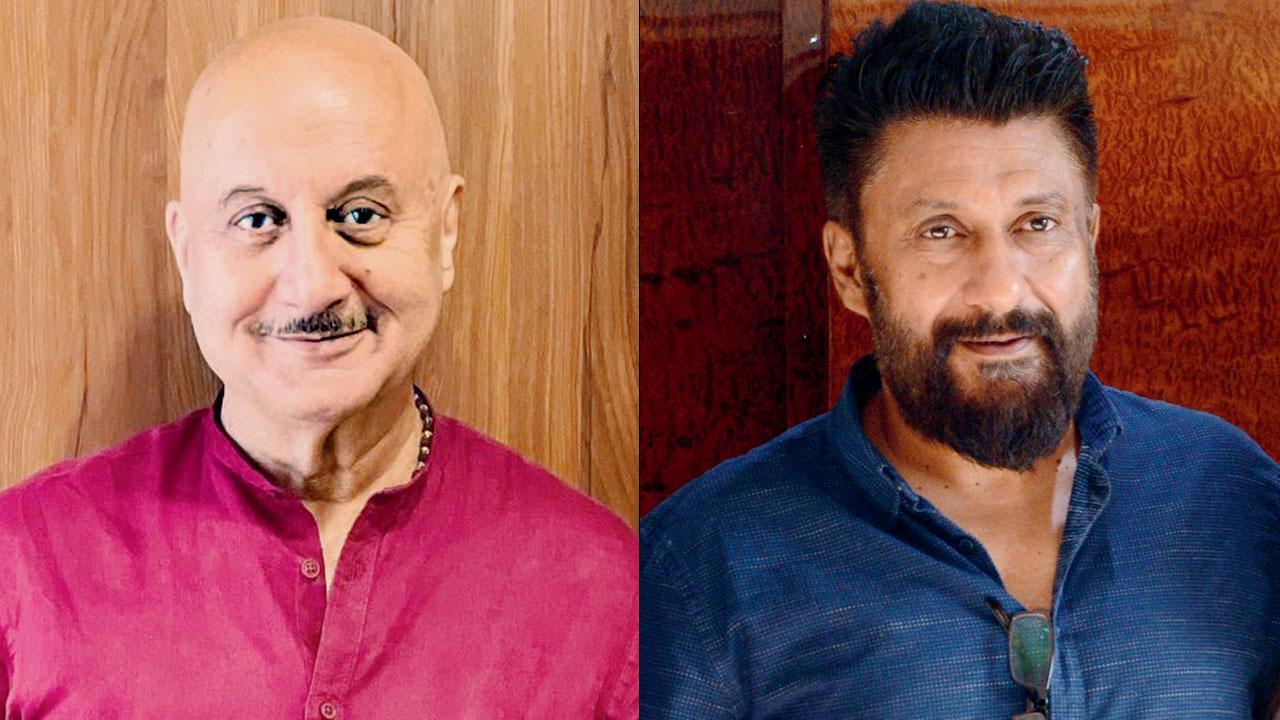
The Kashmir Files director Agnihotri on casting Anupam Kher for film that resonated with him
Uma Ramasubramanian (MID-DAY; January 4, 2021)
Following his 2018 offering on the death of Indian politician Lal Bahadur Shastri, filmmaker Vivek Agnihotri delves into another political offering. The Kashmir Files, backed by a powerful cast including Anupam Kher, Mithun Chakraborty, Pallavi Joshi, and Darshan Kumaar, sheds light on the killing of Kashmiri Pandits in 1990.
Agnihotri tells mid-day, “The biggest challenge in making this film was that nobody wants to finance a film that can [lead to] controversy. But, somebody has to do it. We want cinema to become the brand ambassador of India. This [is the kind of] cinema that takes the cause forward. The biggest compliment that we are receiving is that this is the most balanced and honest film on the subject,” he says of the response he’s received from audiences following several screenings in the US.
Kher’s casting in the film stands out as somewhat peculiar given that the ace actor is also a Kashmiri Pandit. Did his roots make him an ideal fit for the part?
“My selection criteria is to have actors who can easily become the characters. In Bollywood, characters become actors. I was lucky to have veterans be part of it. They are all National Award-winners. I think this is one of Anupam’s best films after Saaransh. Since he is a Kashmiri, it was easier for him to speak the language. He understands the pain, and it reflects in his eyes.”
His love for the genre, he admits, stems from the skewed world of politics. “Politics is [messy] because of political games. Everybody is part of that, without realizing that they are. I love to explore that deeply.”
Sad that political leaning affects casting these days-Vivek Agnihotri
8:05 AM

Juhi Chakraborty (HINDUSTAN TIMES; December 13, 2021)
Filmmaker Vivek Ranjan Agnihotri, who won the National Award for best screenplay – dialogues for The Tashkent Files (2019), says that casting actors for films isn’t an easy process anymore, as the decision is no longer just based on the goodness of the script. In fact, a filmmaker’s political inclination is also a huge factor these days.
“There are some young actors, who want to work with me, but they’re also doing big films with some big banners, and those producers and directors are politically active. They give the actors a choice between me and them. Obviously, I am not making such big commercial films and those actors have stakes over there,” shares Agnihotri.
He further adds that this is a new phenomenon, something that he has not seen or experienced before. “Actors have started choosing films based on the other person’s political inclination. It is a sad commentary. This has never happened in the history of Indian cinema. People would never think about someone’s political inclination while doing a film. But now, actors are blackmailed and threatened… a lot of young actors out of the FTII and NSD tell me that this is the problem that if they do a film with this person, that person does not want to cast them,” he adds.
Agnihotri, who is currently in the US along with wife, actor-producer Pallavi Joshi, for the pre-release screenings of his latest film, The Kashmir Files, says he did face it first-hand while casting for his film. “We had planned to take an actor as lead and the person was threatened by other producers and he told me about it. I then cast (actor) Darshan Kumaar,” he says, adding, “There is no dearth of good actors.”
Now no one will question my ability-Vivek Agnihotri
7:57 AM

Juhi Chakraborty (HINDUSTAN TIMES; March 25, 2021)
Winning the National Film Award for Dialogue writing for his film The Tashkent Files (2019) is a victorious moment for filmmaker Vivek Ranjan Agnihotri for many reasons.
“It feels great. A National Film Award is something else altogether. I would be lying if I say I am not elated,” he says.
He also notes how this will now bring more credibility and respect for him as many had criticised the film and called it too verbose. “At least nobody can now challenge me about my script writing and dialogue writing. The Tashkent Files was stuck for a long time as everybody said this film will not work because it has no screenplay, no climax, no proper ending and it has too many dialogues. People were criticizing the screenplay and dialogues so much, but now look it got an award for that very aspect. Now people will not question me about my capabilities or my work,” shares the 47-year-old.
It is a double treat for Agnihotri as his wife, Pallavi Joshi, won Best Supporting Actress for the thriller on the death of former Indian Prime Minister Lal Bahadur Shastri.
“We both do very little work. Pallavi did this film after a gap of six years. She is very choosy. Even I make films araam se. This film took about four years to make. We put in so many years, so much money, emotions and passion has gone into it. When you get awards like this it gives you the courage and patience to make another film,” the director says.
On how he celebrated the win at the 67th National Awards, Agnihotri shares he went straight back to work. “People celebrated in office but I went inside the edit room and kept editing my next film, The Kashmir Files. I realised it has to be far better than The Tashkent Files. That responsibility is also on me now,” he adds.
Due to Coronavirus scare, there will be trained health professionals on set-Vivek Agnihotri
8:09 AM

The Kashmir Files director Vivek Agnihotri on precautions being taken to tackle COVID-19
Mohar Basu (MID-DAY; March 12, 2020)
It was on August 15 last year that Vivek Agnihotri announced his upcoming offering, The Kashmir Files, on the mass exodus of Kashmiri Hindus in the '90s, promising to present it "next year, same time, on our 73rd Independence anniversary".
Even in the wake of the Coronavirus health scare, Agnihotri wants to keep his date with audiences. While he hasn't called time on the shooting schedule of The Kashmir Files, his team will take precautions to ensure the unit's safety, before rolling in Delhi next week. "Keeping in mind the sensitive situation, I've decided to do a pre-shoot workshop with the crew to discuss hygiene measures, and precautions that must be followed. There will be trained health professionals on set, and we will keep a list of ambulance numbers, as well as names of nearby hospitals, handy. We will also create awareness about fitness, and the importance of maintaining a healthy lifestyle," says the director, also adding that the team will get an insurance for every crew member.
"We are getting a general insurance [for the crew]. There's no specific insurance for Coronavirus yet. Initially, I panicked, but I [choose to] focus on creative health. Human beings [must] be emotionally strong to be physically strong. We couldn't delay the shoot, because of the Kashmir schedule. The central government is promoting tourism in Kashmir, so there will be more people in the region later which will making shooting difficult," says Agnihotri, adding that the unit will divide filming between Kashmir and Mumbai.
It takes an idiot or someone guilty to call The Tashkent Files propaganda-Vivek Agnihotri
10:47 PM

Vivek Agnihotri, whose directorial The Tashkent Files featuring Naseeruddin Shah and Mithun Chakraborty is releasing today, discusses the genesis of the film
MUMBAI MIRROR (April 5, 2019)
How did you research the subject of your film, which revolves around the death of former prime minister, Lal Bahadur Shastri?
The idea was conceived when I expressed my frustration about the fact that October 2 is known only as Mahatma Gandhi’s birthday, when it is also Lal Bahadur Shastri’s birthday. People reached out to me and asked me to make a film on the Shastri ji’s mysterious death. After I started researching, I realised the most authentic way to dig deeper would be to ask the government and I decided to become a whistle-blower. For almost a year, I filed around two dozen RTIs with the Ministry of Home Affairs, the Foreign Ministry, the PMO with the Parliament and national archives. To my surprise, nobody could furnish any information on Shastri ji’s death.
I was aghast. How could we not have documents or information on India’s second prime minister, who went to the USSR immediately after winning a war with Pakistan. That’s when I decided that I must make the film and crowd-source the research, asking anyone who knew anything on the subject to share it with me. Thousands and thousands of people sent me links, books, ideas, articles, context and I started getting connected from one person to the next.
Did you speak to the Shastri family as well?
Yes, they have been involved in the process right from the beginning. His sons, grandchildren and a whole lot of other people who knew him were consulted, including veteran journalist Kuldeep Nayyar, who passed away recently and was present when Shastri ji died. I also got a lot of inputs from people who had worked closely with Shastri ji or knew somebody who had worked closely with him. So, in a way, I had access to the entire close ecosystem.
People are saying this is a propaganda film that attempts to portray the Congress party in a bad light...
I haven’t met anyone from the general public who thinks it’s a propaganda film; people don’t look at films like that. Yes, some people from the media and politics are claiming so. But then the media people who are saying this are doing propaganda for somebody else. So, it doesn’t matter. It takes an idiot or someone guilty to call it propaganda, because let’s not forget, Shastri was a Congress prime minister. If there’s any party which is going to benefit by revealing the truth of Shastri ji, it is going be the party he belonged to, unless they are guilty. It’s like you have a senior citizen in your family—your grandfather or somebody—they die mysteriously and 53 years later somebody comes and tells you the truth behind his death. Would it be against you or in your favour? I think this kind of talk can come only from people who are guilty or idiots.
It was an advisory jury; IFFI is a government initiative-Steering Committee convener Vivek Agnihotri
8:05 AM

Convener of the IFFI screening committee defends the Ministry’s decision to drop Nude and S Durga from the line-up and addresses the row over an aggrieved jury
Roshmila Bhattacharya (MUMBAI MIRROR; November 16, 2017)
Why has the Information & Broadcasting Ministry overruled the jury’s decision and dropped two films—Ravi Jadhav’s Marathi film Nude and Sanal Kumar Sasidharan’s Malayalam film S Durga—from the final list of 26 feature films to be screened in the Panorama section of the International Film Festival of India (IFFI) which unveils on November 20?
The jury was to send 22 from a list of 153 films of which the Ministry could select 20. A couple of films would have been dropped anyway. If not these two, then two others, and then their makers would have been upset too.
But wasn’t the jury’s decision final as underlined by Clause 8.5 of the Indian Panorama 2017 Regulations? Yet the Ministry reportedly made no attempt to even consult the jury on their choices before announcing the final list.
IFFI is not a film industry initiative. It is a Government of India initiative which wants to showcase Indian stories covering a range of socio-political themes on a global platform. This was an advisory jury and the Ministry was well within its right to decide on Pihu as the opening film. We haven’t had many children’s films being made and this one tells the story of a child sensitively. It is an apt choice.
What was wrong with Nude which reportedly was the jury’s unanimous choice as the opening film?
Nude came to us with a rider from the former chairperson, Sujoy Ghosh, that it was an incomplete film. I’m told the jury had a long deliberation on its inclusion in the list in the first place.
Director Ravi Jadhav admits he submitted a screener to the Directorate of Indian Film Festivals (DIFF) three months ago but since then he has had his DCP ready and was waiting for someone to get in touch for the completed film. He even applied for a censor certificate on Tuesday.
He could have written to the Ministry or the jury. What was he waiting for? No film festival will accept an incomplete entry. It’s a competition after all.
The Cannes film festival does. Besides, Nude was among the 153 films chosen by the DIFF and the National Film Development Corporation (NFDC).
Cannes is not a Government of France festival. On how Nude came to be chosen, I wouldn’t know but the Ministry went by Sujoy Ghosh’s rider that it was an incomplete film.
And what is the explanation for S Durga’s exclusion? It was screened at the MAMI Film Festival recently and was passed with a U/A certificate by the censors after its title was changed from Sexy Durga to S Durga…
I repeat, the Ministry had the option of dropping two films. S Durga is a good film and so it was included in the 153 films selected.
Why was Nude included in the list of 153 if it was an incomplete film?
I have no idea. But the decision to drop it is based on the chairperson’s rider.
What has been the reaction to Sujoy Ghosh’s resignation, followed by that of two other jury members, Apurva Asrani and Gyan Correa?
I wish they had informed the Ministry and the other jury members. After all it is a collaborative process.
Zid is not the film I was asked to make-Vivek Agnihotri
7:51 AM

Zid director Vivek Agnihotri says he wants nothing to do with what the film has ended up as
Subhash K Jha (DNA; November 28, 2014)
 Zid might come across as a sleazy erotic thriller now,
but director Vivek Agnihotri says the film started out as the remake of
The Good Neighbour, a 2011 German film.
Zid might come across as a sleazy erotic thriller now,
but director Vivek Agnihotri says the film started out as the remake of
The Good Neighbour, a 2011 German film.Vivek, who is currently shooting Junooniyat in Kashmir, is livid that his name is still attached to the project. He says, “Anubhav Sinha, who is an old friend of mine, came to me with the proposal to remake the German film The Good Neighbour. He was distressed as three directors had already left the project. He asked me to step in. I couldn’t say no.”
He continues, “I finished the first schedule. When I returned, to my horror, they had shot erotic content behind my back. I was horrified. If you see The Good Neighbour there is no room for sex or erotica. The protagonists don’t even meet in the original story. How can they make love?”
Vivek tried to reason with Anubhav. But to no avail. “He told me, the minute the erotic content was announced, Zid was sold to the distributors, because my erotic thriller Hate Story was a hit. I’ve nothing against shooting erotica. Agar mujhe erotic film banaani hogi toh main danke ki chot par banaaoogna (if I’ve to make an erotic thriller I’ll do so without apology). But it has to be part of the story. Sex and nudity are not part of The Good Neighbour. How can they be a part of the remake?”
Vivek suspects the steamy scenes have been shot only for the teaser trailers. “I don’t know how or when Barbie or Mannara or whatever she calls herself now and her co-star Karan shot these scenes. But this is not the film I was asked to make. This is not The Good Neighbour. It’s something else. And I don’t want any part of it. I’m speaking about this now only because they’ve refused to remove my name from the credits.”
Subscribe to:
Posts (Atom)