Showing posts with label Vishal Bhardwaj interview. Show all posts
Showing posts with label Vishal Bhardwaj interview. Show all posts
When I look back, I feel so fortunate that I could register my time with Haider-Vishal Bhardwaj
8:08 AM

Niharika Lal (BOMBAY TIMES; October 3, 2024)
Haider, based on Hamlet and set in 1995 during the peak of militancy in Kashmir, narrates the story of a family against the backdrop of politics. Talking about filming it in Kashmir, Vishal Bhardwaj says, “At that time, the average Kashmiri youth felt that Bollywood had cheated them, always portraying them as terrorists in phirans with AK-47s. So, they weren’t very cooperative. But later, when they saw the film, they called me.”
As the film completes 10 years, Vishal feels it was destined to be made. He says, “Now, when I look back, I feel so fortunate that I could register my time with Haider.”
As the film completes 10 years, we spoke to co-writer, director, composer, and producer Vishal Bhardwaj about the making of Haider, which has inspired numerous dissertations and research papers.
How Haider came into being
Vishal says, "I had been planning a Shakespeare trilogy and was working on Hamlet. Earlier, I had a different setting in mind for Hamlet. It was set in an espionage background. But when Gulzar Sahab read it, he mentioned that it felt like just another CIA movie with the tragedy of Hamlet in it. He was absolutely right. Then, simultaneously, things happened. I remember Rekha (Bhardwaj) reading Basharat’s book (Bashrat Peer's Curfewed Night) and her reaction to it. After that, I read the book and realized that, for a long time, I had also wanted to make a film about Kashmir. All these things came together. The structure became clear, we knew our characters, and of course, the history was there. It didn't take much time because there was so much clarity in our thoughts and in what we wanted to create."
Vishal Bhardwaj says that there are multiple scenes in the film that are not just memorable from the film, but from his entire career. He says, "And I'm not just talking about Shahid's monologue, which is very obvious. It was written for the gallery. But there are also 2-3 scenes between Tabu and Shahid, where they're in the Chinar Bagh before the interval, when they confront each other. Then there's a moment in the film when Shahid finally finds his father’s grave, and he breaks down. That scene was really... I had prepped Shahid, and we wanted to shoot with a telephoto lens, so the camera was really far. I told Shahid, 'Don't feel insecure because it's not a close-up. It's actually a very big close-up, and creatively, we want to shoot it with the tele-lens from very far'. He performed that scene so beautifully. He started crying, and we had two cameras capturing it. The way he was crying, I didn’t have the heart to shout cut. The camera was 400 meters away, and in the snow, I walked up to him, let him cry, and then hugged him, saying, 'It's cut, Shahid. It's done'."
Recalling another moment, he says, "We were shooting in the basement of a bungalow. So, -5°C felt like -15°C. Just as we were about to take the shot, Irrfan came to me and said, 'These lines are too few. Earlier, there were just 1-2 lines. I feel like saying more. I wish there was a poem written here'. I said, 'Okay, give me an hour, and I'll write a poem'. Everybody waited, and I wrote the poem right then and there. And then Irrfan performed it. My God, the way he performed it! When Shahid is leaving, and he recites that Faiz line, - Gulon mein rang bhare, baad-e-naubahaar chale, chale bhi aao ke gulshan ka karobaar chale. The way he says it - such a beautiful romantic couplet - and the way he performs it like a coded message in an espionage film. Irrfan ki kami na, every day in some way or the other, I feel the void of him not being here."
'I told Tabu that such parts are rarely written and that I'd be in pain all my life if she didn't play the role'
For casting, Vishal says, Tabu and Irrfan were both in his and Basharat's mind when they were writing those parts. He says, "But it took a long time to woo Tabu into that. She was very reluctant to play the mother. She rejected it twice, saying, 'No, I’m not going to play this. Why do you keep coming back to me? ' When I wrote the first draft and we started casting, after the rest of the cast was finalized, I went to her again, and she said, 'No, I’m not playing the mother.' The third time I went to her, I said, 'I'm coming to you because you're my friend; otherwise, I would have taken it on my ego. But you're my friend, and I want you to know that you're being blinded by the fact that you're playing a mother. Why don't you see it as Gertrude? See it as Gertrude's role, not Hamlet's mother'. I think that struck her. When she realized that, I told her that such parts are rarely written and that I'd be in pain all my life if she didn't play the role. And then she agreed to do it."
As for Irrfan, he says,"Uska toh jawab hi nahi tha. When he read the script, he said, 'This is such an important film to be made'."
One of the scenes in Haider was shot at a location where no film was shot in 30-35 years
The film was shot by cinematographer Pankaj Kumar, who was also the cinematographer for Ship of Theseus and Tumbbad. Vishal recalls, "At that time, Tumbbad hadn’t been released yet, and I was very impressed with the work on Ship Of Theseus. I then requested Anand Gandhi to show me some parts of Tumbbad, and when I saw it, I knew Pankaj was going to be my cameraman. I decided to shoot on location."
Haider’s ‘Hum hai, ya hum nahi’ monologue at Lal Chowk reminded people of Hamlet’s ‘To be or not to be’ and introduced the Indian audience to ‘chutzpah’.
About the scene’s shoot, Vishal says, “At that time, Lal Chowk was a different zone, and we were shooting behind Lal Chowk in the Press Club. And we shot it! It was destined. This film was destined to be made.”
Vishal recalls that there were multiple such locations. He says, “We went and shot at the Zaina Kadal Bridge, and nobody had shot there in the last 30-35 years since militancy started. And we went there and shot with mainstream stars like Tabu, Shahid, and Irrfan.”'
Jhelum hai ya Khul Kabhi, uss tarah ke gaane - that's the pace of my soul. It’s actually a texture of me'
Vishal Bhardwaj says that music was very close to the script of the film. He says,"Uss tarah ke deep romantic gaane banana, ya uss pace ka gaana banana jis tarah ka gaana Jhelum hai ya Khul Kabhi, uss tarah ke gaane - that's the pace of my soul. My real self is songs like Khul Kabhi Toh or Paani Paani Re (from Maachis) - those kinds of songs. It’s actually a texture of me."
Jhelum
"Jhelum gaana mera bahut purana composition hai. It had such a deep connection. The day my father died, I had composed the song that morning. I was sitting with him, and in the afternoon, he passed away. That song had such an emotional bond with me that I didn’t have the courage to use that composition for 30 years. Then Haider, being a father-son story, felt like the right place to use it. I never told this to anyone. That’s why Jhelum remains a very, very special song to me."
Bismil Bismil
"We created this song like a mousetrap where Shahid performs a play within a play. I wanted to create our own Ek Hasina Thi, Ek Deewana Tha moment in my way for Hamlet (laughs). Karz had a similar situation where Rishi Kapoor performs in front of Simi Garewal about the murder. Sukhwinder ko bahut khula gaane ki aadat hai - he's used to improvising a lot - but I told him, 'Is gaane mein track pe gaana padega, this is like an opera. We are telling a story in it'. Itna khoobsurat Gulzar sahab ne likha hai. I had only given him the phrase Bismil bismil bulbule bismil, and from that, he wrote an entire epic. He’s a master."
'Bismil is so un-Bollywood like'
The song was choreographed by Sudesh Adhana, who is a professor of contemporary dance in Norway at Oslo University. Vishal Bhardwaj met him when he was directing an opera in Paris at the Châtelet Theatre called The Flowering Tree.
Vishal says, "In that opera, I used long, oversized puppets by Dadi Pudumjee, a great puppeteer, and he introduced me to Sudesh. I worked with them for two months continuously in Paris, and right after that, I started shooting Haider. I brought all the sensibilities I learned during the opera, working with Dadi Pudumjee and Sudesh. It was so unconventional, so un-Bollywood-like. I'm saying this and I belong to Bollywood. And Sudesh won a National Award for that choreography."
Vishal shares, "There was a guy who was president of (student union) Kashmir University. When we were shooting in the university, a lot of problems occurred - there was a lathi charge, bottles were thrown, pata nahi kya-kya hua. The CRPF had to take us out and safeguard us. It felt like a battle between students and cops. The next day, we were shooting at another location, and that guy was there. We were showing the court chamber, and there was a character of a stenographer, and he was playing that role. After the shoot, he came to me and said, 'I was in disguise and wanted to check what you were shooting! (laughs). I think we made a mistake. You're not making the kind of film people usually come here to make'. When the film released, he somehow found my number and apologized to me for half an hour."
Did You Know?
-In July, when Vishal attended a tourism conference in Kashmir, he was told that after the film, the Martand Sun Temple where Bismil was shot became a popular tourist attraction, which prompted the ASI (Archaeological Survey of India) to remove encroachments from the site.
- Gulzar shot the song Tere Bina Zindagi Se Koi Shikwa Toh Nahi; at the same Martand Temple where Bismil was filmed.
- Khul Kabhi song from the film was Arijit Singh's first collaboration with Vishal Bhardwaj
We’re an insensitive society, giving trash to our kids as entertainment-Vishal and Rekha Bhardwaj
8:22 AM

Chandrima Pal (BOMBAY TIMES; June 28, 2024)
For the World Music Day concert in Kolkata, multi-hyphenate power couple Rekha and Vishal Bhardwaj took time off from their hectic schedule and many interactions with fellow artistes and filmmakers to speak to us. In a cosy room with a piano, family portraits and antiques, the duo shared their views on cinema, poetry, music and more.
There is considerable excitement around music and musicians being discovered on digital platforms. You have collaborated with some of them as well. Some argue that social media has no scope for a deeper engagement with music. What is your take on it?
Vishal Bhardwaj: I don’t mind using any means to reach out to as many people as possible with my work. That’s how you sell profound and aesthetic ideas like literature and music. It is like meethi dawai.
‘OTT broke the myth that everything has to be in English to be successful’
Rekha Bhardwaj: Besides, there are so many Instagram handles that are sharing good poetry, actors are reading from scripts, reciting couplets. I have discovered some very good music and talent in the process. Our film work gets a wider audience anyway. I see an opportunity in using the apps and various social media platforms to get people to discover the more serious and niche aspects of our craft.
The two of you met at Delhi University. Music and poetry brought you together and defines your relationship even today. Now when you visit college campuses or interact with young students, do you see the same passion and commitment towards music or poetry among them?
RB: It’s a bit of a mixed bag, really. You meet some people who are still very rooted and there are those who are not seriously invested into music. There are purists and there are people who have ‘jawani ka josh.’ There are very few who are taking up music and poetry seriously. Like the Kabir Cafe in Delhi, who seem to have some potential.
So if an aspiring musician comes to you, seeking your advice, would you encourage them to pursue music as a career? Or give them a sense of reality?
RB: I would first hear him or her out to see if there is talent and the inclination to do the hard work that is required to be successful. You see, if your definition of success is being liked by everyone, you are likely to be unhappy with whatever you do or achieve. If you get 100 followers, you will crave for a thousand more. And even then you will sulk. We have never craved numbers. But focussed on our art and people just came along, connected with our work. Like Gulzar Saab has always told us, “Success on your terms.”
VB: When we came up, they were very dark times. Now there are so many platforms to showcase your work. At that time there were only recording companies and they were advocating only popular music. Perhaps rightfully so. For them it was commerce. For us it is art. There’s a huge difference. But if you are really talented you can defy the odds with your perseverance and hard work. There is no room for arrogance or shortcuts here.
My question to you Vishal is why have Indian filmmakers stopped making films and music for children? Your composition Jungle Jungle Baat Chali Hai (lyrics by Gulzar) for Jungle Book still resonates. And after your Ruskin Bond adaptations, you did not return to the genre. Why is that?
(Smiles) I started this movement with Makdee and The Blue Umbrella and somewhere went on to do different kinds of work. We are a very insensitive adult society. We do nothing for our children, and in the name of entertainment we give them the trash of Bollywood, the really bad dubbed versions of foreign shows. But yes, we are planning a sequel of Makdee, and Shweta Prasad (played a double role) will be involved in the making of the film.
Isn’t there better scope for children’s movies and shows on the OTT platforms?
It is worse. OTT is not interested because they say they work on subscriptions and children are not their subscribers. They’ll never make any investments for Indian content for that age group. I tried working with Ruskin Bond’s Mr Oliver’s Diary (a gun-toting, violin playing headmaster, a leopard and other creatures). My long-time associate Aditya Nimbalkar and I had a script. I went to everyone. Trust me, no one was interested.
There is a lot of interesting work happening with languages on OTT though. We see productions with multilingual casts and stories that reflect the plurality that is India. Does this excite you as a filmmaker and composer?
I have been using various dialects and actors from the time I made Kaminey. There was a Bengali gangster, and a Nigerian one. I love all languages and dialects and the authenticity that they bring to any film. The biggest positive of OTT is this, they broke this myth that everything has to be done in English to be commercially successful. And I had a big problem with it. I had an issue with Richard Attenborough’s Gandhi. Because it was made in English by a Hollywood studio to appease the world market. In the film, beggars are begging in English in Indian streets. I felt so disconnected with it even though it was a beautiful cinematic experience. It just did not have that authenticity.
RB: Even in Slumdog Millionnaire…
VB: That’s right. In slums we do not speak in English or read Three Musketeers. I had a problem with that.
Vishal on his version of Patta Patta Buta Buta
I have been trying to work with this song for four decades. The lyrics are universal; you can put it in any context. It could be political or personal. Patta patta buta buta haal hamara jaane je…(hums) every leaf, every plant knows my state of mind except the flower…We are happy that we finally managed to give this classic our own touch, and released it on World Music Day.
------------------------------
"It was a beautiful concert in Kolkata. Vishal and Shubha Mudgal, Papon and I blended Kabir and Lalan Fakir, Amrita Pritam and Sahir Ludhianvi respectively" - Rekha Bhardwaj.
"Meera and Kabir, it is good in a way. Chalo shuruwat toh ki hai!"- Vishal Bharadwaj
Vishal Bhardwaj, Vikramaditya Motwane, Rohan Sippy talk about changing landscape of Indian cinema
10:59 PM

Vishal Bhardwaj, Vikramaditya Motwane and Rohan Sippy talk about the changing landscape of Indian cinema and how filmmakers are dealing with it
Renuka Vyavahare (BOMBAY TIMES; May 29, 2024)
Cinema is considered as a medium of change and diverse new voices only contribute to elevating the artform. As part of MAMI Mumbai Film Festival’s initiative, five emerging filmmakers Archana Atul Phadke, Faraz Ali, Prateek Vats, Saumyananda Sahi, and Saurav Rai were mentored by Vishal Bhardwaj, Vikramaditya Motwane and Rohan Sippy, to help them redefine cinematic norms.In an exclusive interview with Bombay Times, the celebrated trio addressed some raging issues like stifling of creative freedom, censorship, corporate interference and more. Excerpts…
‘Private sector censorship has become more drastic than the CBFC’
Always the one to challenge the status quo, Vishal Bhardwaj confessed that times are volatile for filmmakers. “It is totally strangulating. You can’t say anything. Do you know what has happened? As filmmakers, we are self-censoring ourselves. Whenever a thought arises, you first wonder what the money men will think. Will they finance us to get this idea across? This is what the system wanted. Before going to CBFC we self-censor.”
Vikramaditya Motwane nodded in affirmative and stated, “You start second guessing everything and that’s bad. Lawyers run the studios in a way.”
Rohan Sippy added, “It happens at a corporate level. You are not independently distributing anymore so you are always dealing with large companies that are sensitive to anything that is deemed controversial. Private sector censorship has become more drastic than the CBFC. You don’t know what lies ahead so you feel it’s safer to not go down that path.
‘In filmmaking, the filmmaker becomes naked on screen, actors hide behind their characters’
The mentors ranked honesty high as a trait for filmmaking. “As a filmmaker, you must follow your heart and be completely honest with your feelings. In filmmaking, the filmmaker becomes naked on screen, actors hide behind their characters. Be it his political views or world views, you can see through the filmmaker. It is he who is seen. You can fake it as an actor. You cannot fake it as a filmmaker. Parda faash ho jata hai”, said Vishal.
Rohan begged to differ. He countered, “It’s also okay to do the opposite of what Vishal said. Author Hunter S Thompson modelled himself on Ernest Hemingway early in his career. In the beginning, it’s okay to look at others’ work and figure out what you want to do but don’t delay that start.”
Vikram explained, “There are no set rules. If you want to be a filmmaker, be a filmmaker. Go out and shoot 100 bad shorts until you make that one great short film. That’s what I did. I was lucky to get a video camera for my wedding when I couldn’t afford one. I used that to shoot everything. Be it a friend’s wedding, car racing. Read a lot and explore life, that shapes you into a good filmmaker.”
‘You can’t fight technology’
Film vs digital has been an ongoing debate. Christopher Nolan has been a champion of traditional techniques known for shooting on film. However, not everyone gets the budget he does, believes Vishal. “We can’t fight technology. When the sound became digital, we used to say the warmth of tape is not there. I don’t think that’s the case at all. Likewise, smartphones have revolutionized filmmaking. I shot a (short) film called ‘Fursat’ (starring Ishaan Khatter and Wamiqa Gabbi) on an iPhone and I was happy. In fact, whenever we do guerrilla shoots, for instance shooting in a train without permission, we use phones. Steven Soderbergh has shot his entire feature films like ‘Unsane’ and ‘High Flying Bird’ on a smartphone and he did it years ago. Nolan gets such huge budgets, he can afford to say anything (smiles).”
‘Not all filmmakers have the privilege of huge budgets like Nolan’
Agreeing with Vishal, Vikram explains, “Nolan can afford to have Imax cameras. Kodak created a completely new format of its black-and-white film for scenes in 'Oppenheimer'. Yaha pe you can’t afford to ask for extra film from the producer. Kaha se milega?”
There is a certain romance associated with shooting on film but whether it is better than digital is no longer relevant, he feels. “Digital is cost effective and easier to work on. I’d love to shoot something on film if it makes sense financially. I don’t see anything wrong with the digital format”, he says.
Rohan Sippy believes film and digital can co-exist instead of an either-or situation. “It’s great to have different religions in filmmaking and people like Nolan championing ‘film’. Francis Ford Coppola said this 40 years ago, that ‘people who normally wouldn't make movies are going to be making them and for once this whole professionalism about movies will be destroyed and it will become an art form’. That’s the beauty of digital technology. It makes filmmaking handy. How people consume it is up to them. At the same time, we are happy to see some are keeping the tradition alive and looking into conservation of film. You cannot deny the change though. You must embrace it.”
‘Cinema needs new voices’
There has been a generational shift, believe the makers. Vishal concluded by saying, “Cinema ko hamesha se hi new voices ki zaroorat hai. Every ten years ek nayi soch aa jaati hai and if we can give them a platform, why not?” Vikram pointed out, “The kind of realism the new generation is bringing to storytelling and performances is admirable.”
Rohan summed up, “The whole landscape is so different today. I remember we didn’t have multiplexes back then and Nagesh Kukunoor’s Hyderabad Blues (1998) turned out to be a game changer. It created new ways of thinking.”
Aadha lagta hai Irrfan Khan ke bina-Vishal Bhardwaj
10:07 AM

At an event titled Irrfan: A Retrospective, Vishal Bhardwaj and Naseeruddin Shah came together to talk about Irrfan’s unforgettable performance in Maqbool and share other anecdotes about the actor
Harshada Rege (BOMBAY TIMES; February 1, 2024)
It’s impossible to think of Maqbool without Irrfan, but few know that the actor was not the first or even the second choice for the role. Filmmaker Vishal Bhardwaj shared, “Ek actor ke liye toh Naseer bhai ne bola tha ke tumhe goli maar doonga (laughs).”
After the recent screening of Maqbool at an event titled ‘Irrfan: A Retrospective’, filmmaker Vishal Bhardwaj and Naseeruddin Shah shared many such anecdotes from the making of the film, which clocked in 20 years on January 30, and spoke about their association with the actor, who passed away in April 2020.
The first thing that struck me about Irrfan was his eyes: Naseer
Remembering his first meeting with Irrfan, Naseer said, “I met him for the first time when he was rehearsing for a play with Ratna (Pathak Shah). People had told me that he liked me a great deal. When I was introduced to him, he was very matter of fact, there was no fawning. Like everybody, the first thing that struck me about him was his eyes. He had absolutely amazing eyes. I had no idea of the depth of his range. There couldn’t have been a better choice to play Maqbool than Irrfan. Personally, he was very affectionate towards me, and I was very fond of him, but we didn’t meet very often. So, I can’t say that we were close friends, which is something I missed out on, but I continuously admired his work and his attitude towards it.”
Irrfan understood the silences in the script: Vishal
Vishal said, “During Maqbool, we were all discovering ourselves. Naseer bhai supported me a lot and did many workshops. The thing about Irrfan was that he was so effortless that at times, you would feel he hadn’t prepared for the scene at all. He understood the silences in the script so well. Dosti, dosti mein saara kaam ho raha tha, aur lag raha tha ke kuch special ho raha hai. We were grappling with many things, jaise ke paise kam the. Film release hone ke baad jo reaction aaya tab realize hua ke bahut extraordinary kaam hua hai.”

I wasn’t being modest when I said that I envied Irrfan as an actor: Naseer
Talking about Irrfan’s brilliance as an actor, Naseer had once said that he envied him. Elaborating on that, the actor said, “He always seemed to be performing so effortlessly, never did I feel, while watching him perform, that he was straining for an effect or trying to make an impact. My feelings about his movies are uneven. I haven’t liked them all, but there has never been any moment of falseness that I have detected in Irrfan’s work anytime. I wasn’t being modest or anything; I genuinely meant it when I said that I envied him because I know that at his age, I certainly was not that capable or had that much of an understanding of the craft of acting.”
No box-office success can match the pride that Maqbool gives me: Vishal
During the evening, Vishal played a song that Irrfan had sung and sent him during his cancer treatment that brought everyone to tears. The filmmaker said, “Irrfan had a great sense of humour. Even when he was unwell, he would make fun of the doctor. He had caught the doctor’s gestures and would mimic them. Sutapa would keep scolding him ke tameez se baat karo, tumhara ilaaj kar raha hai. Har baat mein Irrfan ka… Main toh andar se toot gaya hoon, kyunki aadha lagta hai Irrfan ke bina. Jab bimar the, tab mujhe messages bahut bhejte the aur gaane bhi gaake bhejte the…”
When asked if he would make any changes for better performance at the box office, Vishal said, “This reminds me of an actor who, after reading the script, said that the hero is a loser (laughs). No box-office success can match the pride that it gives me now.” Is there is anything he would change if the film were made today, Vishal said, “The only thing I would change is bring Irrfan back, but that isn’t possible.”
Vishal and Irrfan’s nok-jhok
Reflecting on the relationship they shared over their many collaborations, Vishal said, “Abhishek Chaubey ki ek film thi Ishqiya, uske pehle Anurag Kashyap ki ek film thi No Smoking. Both the producer and the director wanted me to be associated with it, toh maina apna naam de dediya. That movie flopped badly. After that, when we started shooting Ishqiya, Irrfan told me that he had given away all the dates meant for Ishqiya. He said, ‘Aapki film toh flop ho gayi, toh mujhe laga aap toh aage banaoge nahi.’ Toh mein bahut gussa hua, aur hum dono ki do-teen saal baat bandh hui thi.
Phir main jab 7 Khoon Maaf bana raha tha, I was unable to cast for the part that he eventually played. When I called him for it, I told him that I had a small role for him. He said, “Aap jo bhi bolenge main karunga, mujhe toh aapko manana hai.” Par jab editing ka time aaya, toh woh role kaatna pada. He got angry.”
He added, “For Haider, when I spoke to him, tab unhone kaha ke pehli shart yeh hai ki jo part kaata tha 7 Khoon Maaf mein usse YouTube pe release karo. Maine kaha theek hai, par aaj tak woh nahi mila. Haider ke waqt unhone kaha ke main paise bahut loonga tumse, kyunki tumne mere saath yeh gadbad ki thi. I said the role is yours and the money is also yours because I knew nobody could play the Ghost. After the trial of the show, he said, ‘Agar aisi entry deni thi toh paise kyun diye?’”
Sutapa's memory of Maqbool
Irrfan’s wife, Sutapa Sikdar, and son Babil were also present at the event. Sharing her memory of Maqbool, Sutapa said, “They were shooting the film in Bhopal, and I was pregnant with our younger son Ayaan. Suddenly, the doctor said that I might have the child. So, Irrfan rushed back, once he reached here, he started speaking to Ayaan, ke bahut nuksaan ho jayega Vishal ka, tu aisa mat kar. And the child actually seemed to have heard him. He was born two months later.”

Every time Shah Rukh Khan and I meet, he repeats, we have to do a film together-Vishal Bhardwaj
9:02 AM
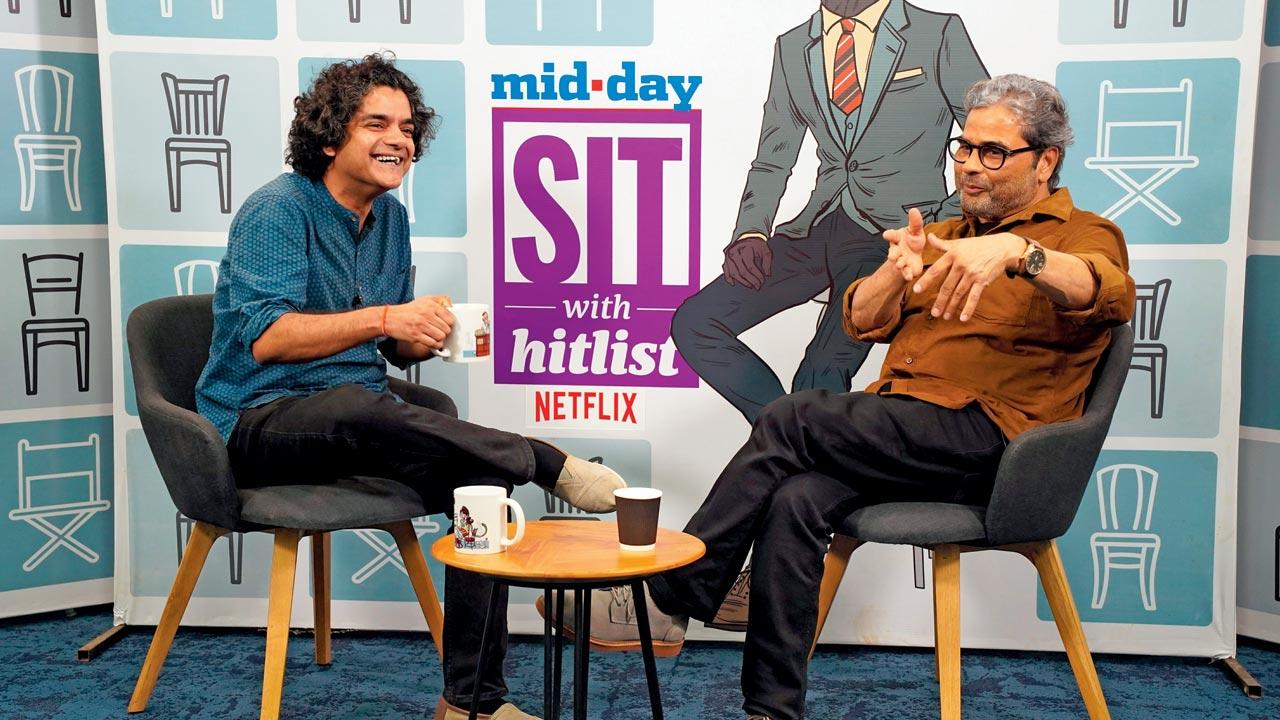
One of India’s greatest filmmaking talents ever, polymath Bhardwaj, opens up on the man behind the movies
Mayank Shekhar (MID-DAY; December 16, 2023)
Gulzar-Vishal Bhardwaj's musical combo is top of the charts’ stuff. But Vishal’s first mentor, from the world of poetry was, in fact Dr Bashir Badr, whom he calls the “greatest poet of the century, an asset to [his hometown] Meerut,” who had to flee Meerut, however, because of the riots in 1984.
Bashir Sahab had heard rumours of a likely attack on his house in Shastri Nagar. His home was indeed burnt down by a raging mob later.
In the rush that he fled for Bhopal, Bashir Sahab left behind his diary, with all his poetry, written over the past year. When he briefly revisited Meerut, he asked for two people—one, Mr Bhandari, who was 70 years old, and the other, Vishal, who was 19 then.
He asked both if they remembered the ghazals and his poetry from the destroyed diary. Bashir Sahab had gone into depression. Between the old man, Bhandari, and teenager, Vishal, they recalled all of the great poet’s works to him, word for word as he penned them back again: “This is how Bashir Sahab got out of depression.”
Vishal used to spend every evening, listening to Bashir Sahab’s words of the day. With poetry, he says he has a photographic memory: “At one point, I could recite the entire book of Gulzar.”
This Bashir Badr story I’d heard before, over drinks, with his former associates once. As is with such nights, I’d forgotten most of it the next morning.
Including details of the tragic events preceding Vishal’s father Ram Bhardwaj’s demise—which he recounted in detail, before a live audience, during this conversation. Only, a few weeks later, he sent in a word if that anecdote could be omitted. It’s about father and son. Too sensitive. We left it at that.
Earlier, he would cry, recalling the incident to do with his father’s death. But he says, “I found my catharsis in that scene in Haider [2014], when Shahid [Kapoor] returns to his home that’s burnt down, and he’s holding a cricket bat.”
The other story about Vishal that I have stored in my hazy memory, hanging with his former colleagues, is about how, as a kid in Meerut, he was caught in a crossfire, and he saw a dead gangster, right in front of him.
“Oh, those are actually two separate incidences,” Vishal says. “There was Tyagi Hostel in Meerut, where all these gangsters used to live. There was a wall, with a hole, between my school and the hostel. That’s the short-cut route we took to get to school. This is where the [chief] gangster used to live in the warden’s house. The warden used to live in the hostel!”
“On my way, I would see him lay out and dry his bullets, guns, grenade, in the sun. The gangster was very fond of me and other kids. He would offer us to hold his gun, tease us with pulling the trigger.”
“Once, during school exams, we heard gunshots fired. We went over to the gangster’s courtyard after. And he was lying dead, right there, with fresh blood, killed by cops, in a gang war! That’s the first time I saw a dead body. I was in Class VII, so must’ve been 12 or something.”
The other incident has to do with Hindu-Muslim riots, which Vishal says was common enough in Meerut: “But even then, the level of enmity [that we see now] didn’t exist.”
Vishal’s house was next to a Muslim family’s: “They had a large bungalow. The father was a learned gentleman. He had three daughters. My landlord was a police sub-inspector, with 10 children. Those kids decided ki hum Muslim kama lete hain, meaning score/kill Muslim people [during the riots]. That’s how it worked. I even heard them plan on going after one of the daughters.”
“There was word from the police station that these boys had an hour [to do whatever they liked]—kama lo toh kama lo. That’s before the police would charge in. This is also how it worked. I knew about these boys’ plans. They had bought country-made pistols. They intended to enter the house, and blast the gas cylinder.”
“The Muslim man inside had a Donali [double-barrelled gun] that he shot in the air. During what ensued, I got caught in the crossfire, and found my way out of it, into another house. My family got worried, because I had gone missing.”
This is when Vishal naturally pauses in the chat: “That’s the psyche of a mob. I have seen it. You ask an individual to kill another? They won’t. You get 50 people to do the same, without taking on guilt and moral responsibility? They will. This is why incidences like lynching and mob behaviour pain me. The support comes from the system.”
As with many great artistes, you only have to dig into Vishal’s past to figure what informs his life as a filmmaker and public figure too. Although pretty much all of his films, as a director, have been based on works of literature.
It might be fair to say, that’s only on paper. Consider his last feature, Khufiya (2023, on Netflix). It’s adapted from Amar Bhushan’s novel, An Escape To Nowhere.
I first read the book in 2013, basis a recommendation in Swapan Dasgupta’s column in The Times of India. Page for page, the film barely reflects the original text, which was more a survey of bureaucrats, fighting over foreign postings. Which is probably what R&AW really is, on a daily basis, anyway. Rather than Salman/SRK like James Bond agency, banging it in the killing fields.
Vishal says, “The book is a cold account of a surveillance operation. The detailing is so good. [Author] Amar Bhushan-ji was once the counter-espionage chief himself. Now, such a book is not even possible. Because the government has placed a ban. No officer can write such a book anymore.”
What about the leap of faith that he takes thereon from the book—surely, he had R&AW agents/officers vet the script, in case it seems too far-fetched? The original research, Vishal says, came from “seven to eight years spent”, working on a film based on the IC 814 hijacking (of 1999).
“I met Mr Ajit Doval [currently India’s national security adviser] several times. He had then retired [as the Intelligence Bureau chief]. Doval Sahab is a fascinating man, and a great storyteller! I also interacted extensively with ex-R&AW chiefs, Mr [A S] Dulat, Mr [C D] Sahay… Along with Mr [Vivek] Katju, the foreign secretary—these were the gentlemen chiefly negotiating with the hijackers. In any case, they really tell you what they want to. They might make you believe they’re answering your questions. But they’re not. It’s their point of view.”
Vishal’s film on the IC 814 hijack subsequently got shelved: “After the Tandav episode, Amazon Prime Video got paranoid. They pulled the plug on the project. They said they don’t want to touch anything political. The film actually had nothing to do with politics. The whole country was humiliated in that episode. It had nothing to do with a party. Now, Anubhav Sinha is making a series on it for Netflix.”
During the IC 814 homework, Vishal also met the IPS officer Arun Kumar, who was associated with the incident. In 2008, Arun became the first investigating officer from the CBI on the Aarushi-Hemraj Noida double-murder case (still unsolved, by the way).
Hence, Meghna Gulzar’s Talvar (2015), which Vishal produced and scripted, with precious/incisive details from Arun who, in turn, inspired late Irrfan’s character in the film.
Tabu, Vishal’s other muse, plays the lead in Khufiya, while the spy-thriller follows this R&AW sleuth’s story of love and loss with her Bangladeshi handler. None of which, of course, exists in the novel that the film is based on.
Citing his Shakespearean adaptations (Maqbool, Haider), to works of Ruskin Bond (The Blue Umbrella, Susanna’s Seven Husbands), Vishal says he’s essentially keen on the basic plot: “I have to know the drama I’m creating—and find a three-act structure, voice, characters, and my own politics and social environment in it.”
To illustrate this best, no better example than to go back to the aforementioned Tyagi Hostel, along with Meerut’s Kachehri Road, full of gangsters, Anand Shukla, Rampal Tyagi, et al. All of whom treated Vishal as their “blue-eyed boy.” Because he could sing and play cricket well. Watch them placed together in Omkara (2006), i.e. Othello. Shakespeare feels like an excuse.
One of the gangsters Vishal knew there was Langda Rathee, who got onscreen as Langda Tyagi. And that’s Saif Ali Khan, in what was easily the greatest casting-against-type for the decade. Vishal thanks Aamir Khan for this unusual choice.
Around the time, Aamir and him were zeroing in on a script, Mr Mehta & Mrs Singh, to work together: “Aamir was seeing the film a certain way. When we were close to the shoot of Mr Mehta & Mrs Singh, he was uncomfortable about how I was seeing the film. We are both headstrong people. We parted ways. But he’s great fun to spend time with, and during our chats, I told him about Langda Tyagi, the character I was writing.”
Aamir was fascinated by the world (of Omkara), and Langda Tyagi’s language, in particular, and wished to be considered for the part. He got busy with his next (Rang De Basanti).
Vishal was too eager to hit the set, rather than wait for Aamir, which would take long. But he realised, “Aamir is intelligent, and commercial. If this role can excite him, I’m sure it should excite another star.” Hence, Saif 2.0 (post Dil Chahta Hai).
There’s been was a similar hit-and-miss between Vishal and Shah Rukh Khan. They were to adapt Chetan Bhagat’s 2 States together (later filmed by Abhishek Varman on Arjun Kapoor, Alia Bhatt). What happened there?
Vishal says, “We had differences over the setting. I wanted to set the film in a bank like ICICI, and not in a college, or elsewhere, that Shah Rukh would’ve preferred. We felt the pain, though. I recently wished him for Jawan. Every time we meet, he repeats, we have to do a film together.”
While his sensibilities are innately artistic, it’s evidently clear, Vishal has throughout aimed for a spot in the mainstream, and achieved it, in his own right. He emphasizes, “Maqbool [2004] opened the doors for me!”
----------------------------------------------------
An apt way to introduce Vishal, as we did in this conversation, is as one of India’s greatest filmmaking talents, ever. There have been few polymaths with that many hyphenated top-end talents, within desi filmmaking—director, producer, music composer, singer, lyricist, writer of screenplays, and dialogues (often separate in Hindi cinema, because most don’t hold an equal command over language).
Vishal writes dialogues in pen on A4 sheets. But gets confused with his own handwriting later. One thing he misses his former associate Abhishek Chaubey (Ishqiya, Udta Punjab) for is deciphering what he’s written. Now, he has to figure it out himself. The instructions on the screenplay he keys directly into the computer.
The greatest polymath of all in Bombay was probably Kishore Kumar who, Vishal tells me, he shares his birthday with (August 4)!
But much before all of the above, Vishal was an “all-rounder” cricketer once—batter, and right-arm spinner—with an eye on international cricket. Former Test player Gursharan Singh spotted him in a match in Meerut, and suggested he move to Delhi. Which is the reason he did.
“I couldn’t have made it to the Indian team from UP. It was too big a state then [Uttarakhand hadn’t been bifurcated]. The facilities weren’t up to the mark. And the UP team barely made it up the chain in the Ranji Trophy. So, I would have never got noticed.”
In Delhi, he played with the likes of Manoj Prabhakar, Maninder Singh, Sunil Walson, Tilak Raj (who Ravi Shastri hit for six sixes), Chetan Sharma… Speaking of the latter, did Vishal whack Chetan out of the park, ever? “Yeah, I did.” That’s one thing he has in common with Javed Miandad!
Reminiscing those times is a lot like, as Vishal quotes Ghalib: “Yun hota toh kya hota!” Dealing in ‘counter-factuals’: “I came to Delhi. Right before the match, I broke my thumb. Couldn’t play the whole year. Next year, my father died. If cricket hadn’t left me, though—how would I have been in music, or the movies then? This world has no retirement age!”
“Since then, I’ve learnt that if something unlucky happens to me—a greater reward awaits. I feel bad, of course, when something happens. But I don’t get disappointed.” From an early age, Vishal used to dabble in musical instruments lying around. Music was internal to his home.
Although with a day-job, Vishal’s father Ram—“everyone called him Ram Sahab”—was a lyricist in Bollywood. He would often visit Bombay, from Meerut, with family.
This is when Vishal spent time with film/music folk in Bollywood. On one such evening, his dad mentioned to his friends about how Vishal, “around 18 then”, had composed a short tune over his father’s lyrics.
His dad’s friends were hugely impressed. They got composer Usha Khanna on the phone to hear it. Usha loved it enough to include it in the final composition.
“That someone like Usha-ji took my tune to expand into a whole song gave me my first validation. That validation gave me confidence.” The song, Khuda Dosti Ko Nazar Na Lage, is from the film, Yaar Kasam (1985). At 19, Vishal recorded his first composition. Asha Bhosle was on the microphone.
After college in Delhi, he moved to Bombay with a job at a music label to pursue music, professionally. Vishal also had a brother, Rajeev, seven years elder to him, in Bombay—struggling to make it in films as a producer: “He had no money. But he wanted to produce movies. How do you?”
Rajeev passed away early. Decades later, Vishal became a formidable producer in Bollywood. I wonder if he feels, in some ways, it’s the story of two siblings coming full circle? He just wishes his brother was around to see it.
Filmmaking itself was an invisible milestone in his head, he says. “I had no intentions. I had seen nothing. Manmohan Desai to Blue Lagoon [for the sex scenes] was the range of my film knowledge!”
It was during the making of Maachis (1996) that he was composing music for, Vishal recalls, “Gulzar Sahab told me, I’ll become a director in five years. He actually pushed me into it. I used to ask him too many questions during the filming, editing…” The children’s film Makdee (2002) marked Vishal’s directorial debut.
Given he was a musician first, isn’t it strange that he’s never attempted a proper musical in films? He reasons, “In my earlier movies like Omkara, Maqbool, I did have actors lip-sync to songs. Because I also wanted to retain my power as a composer. With time, the purity of cinema took over. How do you then justify lip-syncing? The background score is the director’s voice. Anyway, India has a long tradition of cinema and music. Even if I do a musical, it would have to be on a subject that is totally non-musical.”
By the looks of it, his current obsession may be mystery/thrillers. After Khufiya on Netflix, his series Charlie Chopra & The Mystery Of Solang Valley, based on Agatha Christie’s The Sittaford Mystery, dropped on Sony LIV. Which, he says, happened primarily because of the pandemic.
“The world was under lockdown. I was convinced we were in it for five to 10 years, or perhaps forever. How does one survive creatively for that long? Many years ago, I had been offered Agatha Christie’s entire library of Hercule Poirot and Miss Marple titles to adapt. Well, this is what we could do, I thought—shooting in constrained settings [during a pandemic]. I got back to the person, who had connected with me back then.”
What does he find in common between films and music, I ask Vishal. He says, “That they both work on the three-act structure, inspired from life, of course—bachpan, jawani, budhapa [childhood, youth, old age].
“Also, like with films, we don’t know what works in music. It cannot be calculatedly recreated, even though there are really seven notes.”
How about films and cricket—what does he find similar between the two: “Captainship. That you take along a team, especially when things aren’t going right. And they seldom do.
“Also, to accept defeat gracefully, and learn from the defeat.” Are there instances from his films that he’s learnt from, in terms of failure?
“It would be on the technical aspects. Take Rangoon [2017]. The release date was set. But we were not getting the VFX for the final scene right. I should have put my foot down. Held the release, like Sanjay Leela Bhansali does. I was making a Rs 70 crore film in a Rs. 35 crore budget. I had become overconfident from all that we had managed to achieve, even on the VFX front, coming from Haider.”
----------------------------------------------------
There is genuine integrity/sincerity that Vishal exudes during conversations, and in general too, as his former peers/associates always testify, when his name crops up.
At a recent concert in Mumbai with singer-wife Rekha Bhardwaj, their first time together—they met at Delhi’s Hindu College in the ’80s—she called him a “genius”. Which was one way to put it, as we watched Vishal go from soft ghazals to unexpectedly banging it with the vocals to Kaminey’s Dhan Te Nan on stage!
But along with the ‘shayrana’ mellow, there is also a hardcore side to his personality, I reckon. For instance, I point to him a tweet I came across long ago, where he made a political statement. A troll in the comments section taunted him, asking who did he thinks he was?
Normally, people ignore response, when none is merited. Scrolling down the screen, I noticed Vishal, 58, tell the troll: “Tera baap hoon [I’m your pop].”
He laughs, but declaims, in all seriousness: “There is a gangster in me. Maybe in retirement, the poet is taking over. But the spirit is there—against injustice, or if things aren’t going my way.” Consider this untold story of Maqbool (2004), his breakout film, that is on its 20th year.
One of the things I noticed about Maqbool, seeing it after long, is how little Bombay there is, in terms of live location, in a film about the Bombay underworld. Which can also be said for Mani Ratnam’s Nayakan (1987), upon re-watch.
Some of this is deliberate, Vishal says: “By 2002-03, the Bombay underworld scene had shifted to terrorism. We actually wanted to show a more old-world mafia with Maqbool.” He had knocked on every door to fund the film. Including the possible cast—for instance, Kamal Haasan was the original choice for the title role.
IDBI Bank had launched a scheme to finance films then. Vishal applied there as well. Producer Manmohan Shetty was on its script consultation committee. As was producer Bobby Bedi.
Manmohan had him over for a drink, simply to tell Vishal that he had saved his ass: “You have actors like Naseer, Om Puri, Pankaj Kapur… How would you’ve ever recovered a Rs 2.86 crore loan? I did you a favour, by rejecting it.”
Bobby, however, showed interest in the script, to come on board, with the funds. That’s how Maqbool kickstarted. How does one arrive at the old-world look?
Vishal says, “I had seen a haveli in Bhopal, which is exactly where we needed to shoot [Don Abbaji’s world]. So, 25 days in Bombay, 25 days in Bhopal. That was the shoot.”
“Only, that once we got to the Bhopal leg, Bobby said there was no budget for it. And that there is a mansion at the Films’ Division office [on Pedder Road in Mumbai]—it’s colloquially called the ‘Films Division haveli’—where we could shoot. I said I won’t. He said he won’t make the film then. I said, let’s not make the movie!”
It was a Friday evening, Vishal remembers. He got home, made himself a few stiff drinks, and switched off his phone for the next two days. Bobby came knocking at his door on Monday, asking why he’d gone incommunicado?
“I told him, what’s the point of meeting? My fees for the film, including music composition, direction, script, was Rs 30 lakh. Bobby suggested that the Bhopal shoot would cost Rs 60 lakh. And that he was willing to put in Rs. 30 lakh, and I could put in my Rs 30 lakh.
“I just said—if you had told me earlier, I wouldn’t have drunk so much on Friday! Even to this day, while I was the producer, I didn’t make a single penny from Maqbool. But how does it matter? Look at all that I earned!”
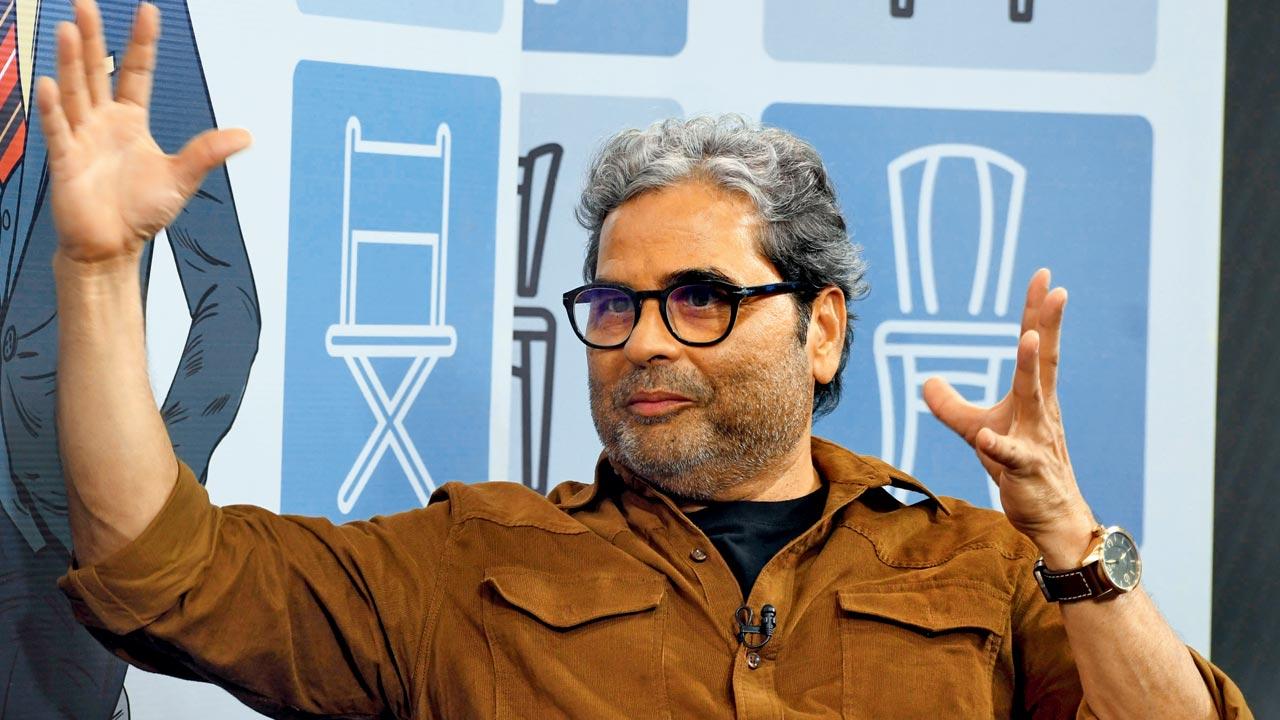
It’s been our dream to perform together on stage-Vishal Bhardwaj, Rekha Bhardwaj
8:48 AM

Debarati S Sen (BOMBAY TIMES; November 10, 2023)
Music brought Vishal and Rekha Bhardwaj together, and their passion for music has only strengthened their bond over the years. The duo always dreamt of singing together on stage, but that never really happened until now. After over three decades of being together, the couple will perform for an upcoming concert this month for a special cause.
In an exclusive conversation, filmmaker-composer-singer Vishal Bhardwaj and singer Rekha Bhardwaj talk about their love for music and what keeps them connected and rooted.
During your Hindu College days, music was what brought you both close. That was decades ago. What took you both so long to come together on stage?
Vishal: I never thought I was a good singer, I always considered myself to be a composer. Later in my career, I started singing tracks. I used to sing Lata ji’s (Lata Mangeshkar) dummy tracks. I would sing to explore songs with musicians on track and then the singer would dub. In that process, mujhe bahut zyada experience aaya gaane ka. Kai baar aisa hua ki sab logon ne bola ki yeh meri awaaz mein accha lag raha tha. So, maine apni singing bahut late in life discover ki. Rekha is classically trained, and I am not. Mujhe stage fright bhi tha bahut zyada. Jab mere shows hone lage, mujhe stage ka confidence aaya. So now, I can dare to sing with her.
Rekha: It’s always been a dream. Vishal aur hum bahut saalon se chah rahe thay ki we should perform together. Aur Gulzar saab bahut kehte hain ki saath mein program karo, hum log saath kartein hain. Pankaj Udhas and his daughter Nayaab planned this concert for the welfare of Thalassemia patients, and we are happy to support the cause.
Vishal: What Naayab and Pankaj Ji is doing (for Thalassemia patients) is commendable and great. Iss cause ki ladai pata nahi kab khatam hogi. Pata nahi kab iska ilaaj ho payega. If we can contribute even a little from our side in this fight, it will be great.
While this will be the first time the two of you will be singing together on stage, you must’ve sung together earlier, too?
Vishal: Long ago, we had sung a duet together. When the Copyright Act was passed in 2012, we had performed for Parliamentarians at the Parliament House. Kapil Sibal sahab liked old songs, toh unki farmaish pe maine aur Rekha ne Haal Kaisa Hai Janab Ka gaya tha. Bahut maza aaya tha.
Have you both been doing a lot of riyaaz for this performance?
Vishal: Riyaz nahi, hum log tayyari kar rahein hain. Bahut mehnat kar rahein hain. We are doing this for the first time, toh kafi nervousness bhi hai. It should be extraordinary. The other thing is that hamare keys ka bhi issue hai. Rekha has a low-pitched voice and mine is a high pitched one jo normal male voice hota hai. So we have to design a duet ki kaise hum log ek middle ground mein aa jayein ki Rekha ke liye high na ho aur mere liye bahut low na ho.
Rekha: We will also sing solos along with duets. Aisa nahi hai ki saare duets hi honge.
What keeps two creative people like you going so strong for over three decades? Just like everyone you must have also faced challenges and hiccups in your relationship. How have you dealt with them?
Rekha: Actually, four decades. We’ve known each other since 1984. During college, we were friends, and then we started dating. Yes, mushiklein aatien hain relationship mein. But I think the emotional bonding and our compatibility, jo music ko lekar hai, helps. Now, we have started giving each other space. Beech-beech mein problems aatien hain. There is no formula for a perfect relationship. You have to accept the other person with all his or her good and bad.
Vishal: Yes. There is a formula. You have to keep working on your relationship and on yourself every day. That’s the only formula. When you are in a relationship, then you have to do both these things. You may have a different point of view on various things – brushing you teeth, waking up in the morning, reading at night or watching laptop, then you have to work towards that. Relationships are a everyday work. Auto pilot pe rakkh diya yeh kabhie nahi ho sakta hai.
Rekha: I have realised that jaise jaise expectations kam hone lagtien hain, that helps a lot. Otherwise you keep expecting the other person to react the way you want them to.
Vishal: You should never want to change the other person. You have to be ready to change yourself and then the relationship will work.
Rekha, in an Instagram post, you said, ‘What kept us close was the crazy streak we both have, perhaps still have’. Tell us more about this crazy streak…
Rekha: When we met in college, Vishal was singing for a programme. Later, at the annual function, all the participants had to sing Ramaiya Vastavaiya on stage. Hum dono do corners mein they, and we went really crazy. Hamara kya hain na, we get carried away. We don’t care for the world and just do our own thing. It’s not that ki we plan it. Aaj tak hum aisa kartein hain. Hum emotionally bhi carried away ho jaatein hain. While singing also hamare mazak jo chalta hai, bahut funny sa ho jata hai. Masti mein pagalpan ho jata hai.
Wouldn’t you like to add anything to this?
Vishal: Nahi, nahi, bol hi diya hai inhone. (laughs)
Rekha: Saari details toh share nahi ki jaa sakti hai. (laughs) Hamara ek bada cute sa memory hai. Earlier, when Vishal wouldn’t be so busy, our son Aasmaan was fond of DJing and he would put on music after our meals and we would all dance! There were times when we have stood on his windowsill and danced! We have had wild times.
You have played state-level cricket Under 19. You have a passion for cricket. What do you feel about the ongoing World Cup?
Vishal: India is playing so well. I hope that we win the world cup!
She asked me to relax and treat her like a newcomer. This was the greatness of Lata Mangeshkar-Vishal Bhardwaj
8:37 AM

Without Lata Mangeshkar, Indian film music wouldn’t have sounded the same, actresses wouldn’t have looked so beautiful on screen and the stories would have been insipid
Vishal Bhardwaj (THE TIMES OF INDIA; February 7, 2022)
When I first came to Mumbai, I had two dreams: The first was to do a song with Gulzar Saab and the second was to have Lata ji sing a composition of mine. The first dream was realised in 1992 when I composed a song that was penned by Gulzar Saab – the Jungle Book song ‘Chaddi Pehen Ke Phool Khila Hai’.
To realise my second dream, I had to wait for some time as Lata ji had become particular about the songs she chose. On one occasion, Gulzar Saab spoke to her on my behalf about a song that I had composed and she asked him to send the song on tape to her. After listening, she called me personally to tell me that the song was beautiful and that she would sing it. Although the film was eventually shelved and the song remained unreleased, this was the beginning of my relationship with her.
I had worked with almost all the big singers of the time except Lata ji and I was amazed at our first recording session. For this first song of mine, she was so well prepared – she had learnt and prepared the entire song and had it written by hand. Her homework was excellent and this was something rare.
By that time, the multitrack recording system had come into play and singers would sing maybe 1-2 lines at a time but never the full song in one go as they would not be prepared. (Today, the singers sometimes do 1 word at a time.) However, Lata ji came fully prepared and did the full song in one go.
In our first recording session, I was overwhelmed by her and very nervous. So she called me to the recording booth and asked me to relax and treat her like a newcomer. This was the greatness of Lata Mangeshkar. To give confidence to a newcomer, she became one herself. In a recording session, first she would sing a little away from the mic and when she came to the mic to sing, it was pure magic. She even had a very unique way of appreciating the composer and his composition.
Every song has a special section which makes it unique. Lata ji instinctively recognized this section and when that section would arrive, she would smile so subtly that only the composer would understand that gesture. She was a very precise artist, totally dedicated to her craft. Every syllable and word was well-measured before being delivered. So once she had sung the song, and you asked for one more take, she would bring her reading glasses down to the tip of her nose, stare penetratingly at you and ask “Why?”, a stare that would rattle even stalwarts.
After I had gotten to know her better, I asked her about her infamous stare. She explained that once she had delivered her best, she needed to know what was missing in order to do another take.
I came to know her better as a person as I continued working with her and soon came to know that she had a great and sharp sense of humour. We used to look forward to her recordings because she would always come with two great jokes every time. One joke before the recording and one joke after the recording, both of which would crack us up for half an hour at least.
Another signature of hers was the keychain, the chaabi ka guchcha, that would hang on her saree and would chime with the slightest movement of her hand. Initially, in mixing the song, we would filter it out but later, I realised how musical and mysterious it made the song sound so we stopped filtering it out from the song.
What separated her from all the rest was that she was not just a playback singer there to do a day’s job. She had an acute understanding of the drama of the song, the mental state of the character. This allowed her to contribute beautifully to the music.
A year back, I chanced upon a goldmine where I found the long-lost tape of a recording of Lata ji, which was done 26 years ago. The film was shelved and the song remained unreleased. It was a multitrack recording and we were able to retrieve her voice. I rearranged the song and planned to release it on her 92nd birthday in 2021. Before doing so I had to get her approval and in the process, I had a chance to speak to her after a very long time.
She heard the song, titled ‘Theek Nahi Lagta’ and immediately called me. She started by saying that the song was very good but the lyrics were wrong. I was baffled as I had no way of altering her voice or the lyrics. I asked her what was wrong in it. And she replied – “The song is very nice so why am I repeatedly saying ‘Theek Nahi Lagta’?” I cracked up, But she didn’t stop at that. She had a bouquet of jokes ready for me.
Her sense of humour had gotten even sharper with age. She was going to be 92 a few days later but she sounded like a 9-year-old. There was a child in her that never lost her innocence. And that’s why she remained so full of life till the end.
She remains with us every day on all occasions – no matter whether we are sad or happy. Recently, I discovered another dimension of the Nightingale. On shoots, when things are chaotic and everything is going crazy, I put on my headphones and listen to one of her songs. I am immediately transported to another world and even though I am physically in the chaos, I am still completely disconnected.
For us, Lata ji is a goddess. Without her, Indian film music wouldn’t have sounded the same, the actresses wouldn’t have looked so beautiful on screen and the stories would have remained insipid. And that’s not just because of her voice or training or the craft but because of her soul, which she poured into the song along with her technique.
Science says that there are billions of suns in our galaxy, but our Earth witnesses only one. Many singers may come and go but this Earth will only witness one Lata Mangeshkar.
I feel so fortunate that I lived in the times in which Lata Mangeshkar lived. And I know I can be with her whenever I want, through her songs. And that makes me say today, “Tere bina zindagi se koi, shikwa, to nahi … tere bina zindagi bhi lekin, zindagi, to nahi.”
Vishal Bhardwaj and Gulzar to release Lata Mangeshkar’s lost song from the ’90s on her birthday
8:20 AM
Niharika Lal (BOMBAY TIMES; September 26, 2021)
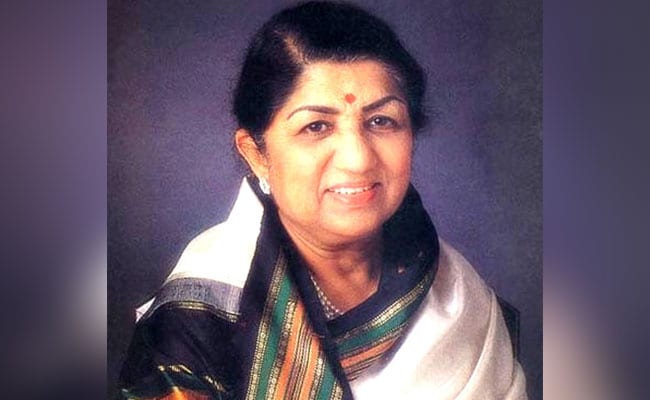
On Lata Mangeshkar’s 92nd birthday (September 28), her fans will receive a surprise gift from Vishal Bhardwaj and Gulzar — a song. This unreleased number, called Theek Nahi Lagta, was sung by Lata Mangeshkar in the 1990s, penned by Gulzar, and composed by Vishal. The romantic song was supposed to be for a film that Vishal-Gulzar were working on at the same time as Maachis (1996), and was to be filmed on Aishwarya Rai Bachchan. The film eventually got shelved and the song was never released. Vishal tells us the story of how the song, which was recorded when he was just starting off in the industry, was lost and found.
‘I SEARCHED FOR THE SONG 10-12 YEARS AGO BUT COULDN’T FIND IT, THEN TWO-THREE YEARS AGO A STUDIO CALLED ABOUT A TAPE THEY HAD FOUND’
In the ’90s, when Vishal was new in the industry, he started as a composer, and was working with veterans like Lata Mangeshkar and Gulzar. “Along with Maachis, I was doing another film which was also written by Gulzar saab, but the film never got made. Maachis release ho gayi, aur main busy ho gaya,” he tells us, adding that it was for this shelved film that the song was recorded. When we point out that the song reminds one of Maachis’ music album, Vishal says, “Maybe because I was in that zone at that time.”
Sharing the story behind the song, he says, “I always used to think that that song was very good. Uss zamane mein cassette hua karte thay toh kahan release karte? Baat hoti rahi ki film banegi, and before I knew it, 8-10 years had passed. Phir woh gaana kahin kho gaya. Then, around 10-12 years ago, I started looking for that song. Lata ji ne gaana bhi kam kar diya tha, so that was another reason to find that song, ki unka gaaya hua hai. Maine bahut dhundha, par woh mila nahi.”
Continuing the story after a pause, Vishal adds, “Then two-three years ago, I got a call. It was from a studio that was about to be closed, and they said, ‘Aap ke naam ka ek tape mila hai, agar aap ko lena ho toh le lijiye nahi toh humlog fenk denge.’ There were many songs in that tape, and this song was among them. I retrieved Lata ji’s voice from that song and usko contemporarise kar liya.”
About his plans for the song, he says, “We will be releasing this song on Lata ji’s birthday. Later, I will use it (in a film). Some of the musicians who have worked on this version were not even born when it was originally recorded.”
VISHAL BHARDWAJ’S HUNT FOR LOST SONGS
Vishal says that one of the reasons he created his label was to find old gems and contemporarise and release them. He says, “I’ve been hunting for several such songs which have been lost. One of the songs which is really close to me, which I recorded when I was just 19, was with Manas Mukherjee.”
He pauses to ask, “Do you know who Manas Mukherjee is? He is Shaan’s father. Asha ji sang that song. Then there was a duet of Lata ji and Asha ji. Since they sing very few songs now, those songs are more precious. I have been looking for it for years. Kai aise gaane hain jo kho gaye hain.”
Vishal says that he wants to retrieve those voices to contemporarise them. He says, “We have the technology to retrieve even Begum Akhtar’s voice from her recorded songs. So, technology-wise, we have come really far. How musicians and singers work has also changed over the years. Now, every musician has their own studio, but in those days, musicians had to wait for dates of studios, and then the orchestra, singer and everyone used to come together to create music. Ab hardware toh sabke paas hai lekin woh collective energy missing hai. We’ve definitely lost that spontaneity.”
-------------------
WHEN LATA MANGESHKAR AGREED TO SING THE SONG
Vishal explains that even 25-26 years back, Lata Mangeshkar was not taking on many projects. When he sent her the song he didn’t know if she would agree to sing it. He recalls, “Lata ji sab ke liye gaana nahi gaati thi. First you had to send the song and then wait to hear back. I still remember when she called and said,‘Theek Nahi Lagta toh theek hi lagta hai’ (laughs!). Lata ji jab bhi phone karti hain toh hamesha ek joke sunati hain. Unke pass hamesha joke hota hai. Phir baad mein woh gaana jab release nahin hua, she would tell me, ‘Theek Nahi Lagta aaya nahi ye theek nahi hai’ (laughs!).”
He adds, “Now when I sent her the finished song, tab bhi unhone ek joke sunaya. Unko gaana bahut pasand aaya aur unhone kaha ki ise agar kisi film mein lein toh aur bhi achha hoga.”
New proposals on cinema censorship are wrong, unnecessary. Film board and courts are enough-Vishal Bhardwaj
10:01 AM

POSTER OF A RAY FILM: Remember, cinema is art
Vishal Bhardwaj (THE TIMES OF INDIA; June 30, 2021)

Included in proposed amendments of the Cinematograph Act, 1952, is the provision that on the complaint of any member of the public, the government can recall an already certified film to re-examine it and if it, unfortunately, agrees with the member of the public, a new process of certification shall start.
Why is this not necessary?
A few months back, the tribunal court in the film certification process was abolished. The reason given was that if a filmmaker is not satisfied with the certification board or a revision committee’s decision, they can challenge the verdict in courts. Why can’t the same reason be applied to the supposedly aggrieved member of the public who has problems with a film? Why is the autonomy of the board of film certification being diluted? What’s the purpose or motive behind?
Why is the certification board enough?
Let’s understand the formation of the film certification board. The board’s members are eminent people from various sections of society. These members are selected by the I&B ministry along with the chairperson of the board, who is also selected by the ministry. Usually, every film is seen and certified by a committee of these members along with an authority from the board.
It’s very hard to understand that when everyone is selected by the government and they represent various social groups, ranging from a professor to a homemaker, why should a film be recalled for examination, just because a member of the public feels unhappy about any aspect of the film.
Why is it futile to expect no disagreement?
In a healthy democracy, different opinions on the same subject will always exist. People will question, contradict, agree or doubt and there has to be a fair way to deal with their objections. Each person has the option and liberty to like and dislike a film, and if offended, take it to court. Authorities should honour and respect the decision taken by board members selected by them. The autonomy of institutions like these is a must for the health of the democracy of our country.
What is good about the proposed amendment?
There are also some long overdue good amendments, which should not be left unacknowledged, like a rating system based on the age of the viewer, stringent punishment for piracy of films, and many other recommendations made by a panel of experts headed by the legendary filmmaker, Shyam Benegal. I’m sure this recalling of the certification process was not proposed by Benegal’s brigade.
What strange rules have been proposed by other governments?
Let’s go back in time and review a farcical amendment made by the health ministry of the previous government which enforced a rule that a ticker of a statutory warning should run on the screen whenever a character uses tobacco products. This rule made us the only country in the world that imposes such an extreme measure that disrespects the art of cinema. In international film festivals, people laugh while watching our films. I wished that authorities treated the root of the disease rather than clipping branches.
Instead of forcing an unaesthetic and impractical ticker on the beautiful frame of a film, make tobacco products so expensive that they go beyond the reach of the majority. But, it seems that the tobacco lobby is much stronger than the film guilds of our industry.
How can new censor rules really complicate matters?
The proposed amendment will give the right to recall any film from the past. What if someone has a problem with creations of Satyajit Ray or Adoor Gopalakrishnan or Ritwik Ghatak and their films are recalled for recertification? What will happen if someone has a problem with Dadasaheb Phalke’s Raja Harishchandra?
How should we approach censorship?
By accepting cinema as a form of fine art. In fact it is an amalgamation of all the fine arts put together – painting, music, dance, drama and poetry. Let’s hope that the I&B ministry and bureaucrats work towards creating a space where cinema can flourish rather than chaining and caging it.
In a democracy we must learn to coexist with our nemesis. We must learn to agree to disagree.
The writer is a film director and music composer
Before Mask Kho Gaya song, I had personally never used music as a tool for change-Vishal Dadlani
8:04 AM

Filmmaker-composer Vishal Bhardwaj and composer-singer Vishal Dadlani collaborated on a song that gives a satirical view of the pandemic situation
Rachana Dubey (BOMBAY TIMES; November 28, 2020)
Filmmaker-composer Vishal Bhardwaj and composer-singer Vishal Dadlani recently collaborated on the single, Mask Kho Gaya. They released an interesting animated video for the song, which is written and composed by Bhardwaj and sung by Dadlani.
Talking about the idea behind the track, the filmmaker says, “When the lockdown started, we had a whole lot of songs that were about beating the virus, jeetna, harana, yudh jeetenge... it irritates me that whenever we are faced with a crisis, we start exploiting that instead of sharing what we really feel inside. The Coronavirus pandemic has forced us into leading a confined life. For some of us, the issues were that we were not getting our vegetables and essentials easily. On the other hand, the migrant labourers, who walked long miles to reach home faced bigger issues. That’s when we had thought of coming up with a satirical view on the situation. When I thought about the song, I felt that Vishal would be perfect for it.” In August, Bhardwaj had released the track Dhoop Aane Do, penned by veteran lyricist Gulzar, which was about being hopeful even during grim times.
Dadlani recalls recording the song from a village near Kamshet on the outskirts between Pune and Mumbai. “Recording the song took me only a few hours, but sending it out became an issue due to technical reasons. I would make trips to Lonavala just to try and send it to Vishal sir,” he says.
Vishal Dadlani says, “I had friends from different independent bodies working to help people facing a crisis during the lockdown, and I was trying to help them in some way, too. It’s a limitless task. It was getting depressing to see so much pain around us. This medium of satire and being able to say things with a unique perspective helped me break away from that. Before this song, I had personally never used music as a tool for change, but I am glad that I am a part of a song like this that addresses so many issues without being bleak.”
Bhardwaj adds, “This song has given me a different perspective and a new way forward. I have realised that anger ka kya faayda... It doesn’t help. I would rather use satire, use the language we know best as artistes and take things forward to express emotions aptly. I didn’t know it could give an artiste so much joy and comfort.”
Dadlani has previously collaborated with Bhardwaj for compositions like Dhan Te Nan (Kaminey) and Aao Na (Haider). When asked how it was to work on a single this time, the filmmaker says, “I love what Vishal does in films and independently, too. Some singers do a great job with their vocals, and then there are singers like Vishal, who grasp the soul of a song.”
Dadlani sums up saying, “I always come into our collaboration as a fan, straight up. It all started in 1994 or 95 when Pentagram (Vishal Dadlani’s band) was competing in a college competition. A crowd that had gathered to listen to English rock bands swayed and cheered for Chappa Chappa Charkha Chale from Maachis. This is the beauty of music that transcends language and genre. He’s the perfect example of a composer who maintains authenticity in music.”

Excited I’m now going to explore Agatha Christie, like I did with Shakespeare-Vishal Bhardwaj
7:51 AM

Anshul Chaturvedi (BOMBAY TIMES; October 19, 2020)

“I had hoped this will be over in two or three months. But then I realised that this is not going to go away so soon. And as a filmmaker, I became very confused as time went by. How will I make the films I had planned to? How do I shoot? How do I shoot a scene in a public place? If I have a crowd in the backdrop, they will all be wearing masks. And in what time period is a film set — if it is post Coronavirus, will all characters be wearing masks? I became very confused,” he narrates the frustration of a locked-in filmmaker.
Denied the option to do what he had planned to do, he explored what he could do, where he was – in the hills, largely locked in.
“My location and my situation gave me an idea – of the sort of movie that can be made in such a situation,” he cheerfully narrates. “For a long time, I have had a love for murder mysteries. I am a big (Alfred) Hitchcock fan. He made films inside a single home – have you seen Rope? He made that film in nine shots! And that meant nine reels – each shot was the maximum length of a reel. That was the mastery of Hitchcock. And then there was Psycho, North By Northwest, The Man Who Knew Too Much – I loved those films!”
Then he comes to the other master of these situations, the one he is engrossed with presently.
“And I love Agatha Christie. India has a huge fan base of hers. And people of our generation, those who did not grow up with mobile phones and social media – you know we lived on novels! Summer vacation, libraries... those memories, wishing that the book never ends!”
But those with mobiles and social media – have they been able to escape her influence altogether?
“No, perhaps they haven’t. After speaking to my son and a few others, I realised that even the current generation is a fan of hers. Agatha Christie has not faded with time. Now, it so happened that about a couple of years back, there was an outreach, they wanted to bring their franchise to India. But I was busy, things did not really move ahead. But now, as we were all locked indoors in Coronavirus, I realise that there is only one type of film that can be made without too much trouble in this situation – the Agatha Christie murder mystery type. I love Hercule Poirot, I love Miss Marple. So I got in touch with them again...”
Er, who exactly is they and them?
“Agatha Christie Limited is a big estate and Agatha’s great grandson, James Prichard, is the Chairman. Did you know that after Shakespeare, she is the second largest selling author in the world? And I felt very honoured, very fortunate, that I have worked with Shakespeare’s works and now I will have a chance to work on an Agatha Christie project... So many movies have been made on Agatha’s stories all over the world. And many of her stories are already taken. Recently, the British director Kenneth Branagh, the one who made Murder On The Orient Express and Death On The Nile – he has acquired the rights for all Hercule Poirot stories, for instance.”
“Anyway, in this lockdown, I contacted the estate. We started discussing if we could make a movie in India. We clicked well, but it was a very long process. They offered me many novels, out of which I picked the first one (he attempts to keep the title a secret, for now).”
And this first film will introduce a young heroine thrown into solving a murder, who teams up with an unlikely companion to unravel the case. Future films will follow the duo as they continue investigating multiple murder mysteries.
“I proposed to the estate that I want to take two characters from the story, a boy and a girl who are not professional detectives, and make a franchise out of them – and they loved the idea! I’m going to place the story in Auli since the whole plot is rooted in mountains, and the mountains are a character in the story (fans, here’s your hint).”
Does he look at her works differently now than he did in the school summer vacations?
“When I first read her novels, I am not sure I fully appreciated her skill. Today, when I read her again, I marvel at the characters she created – you look at it differently when you are also a writer. The dysfunctionalities, the motivation – I realised that she wrote such great human dramas. Even if you take away the murder mysteries from her stories, the relationships are so deep and layered that you can still make a film on them.”
He pauses, then exclaims: “I am so excited because this gives me an opportunity to explore Agatha Christie in our context – like I have been doing with Shakespeare with Haider and Maqbool and Omkara. Place them in our social, political backdrop.”
A Hindi film based on an Agatha story?
“Bilkul! Iss mein gaane bhi honge!”
Why not a bilingual, perhaps? To sell Agatha back to an English audience, globally?
“But now the language barrier has been broken, hasn’t it? Narcos, Fauda and so many shows on digital platforms – they have broken the language barrier. It doesn’t really stop you anymore.”
Point. Has the casting been done?
“We are still in that process.”
I cannot resist a question here. Will they be genuine new talent, or will they be an extension of – well – nepotism?
Vishal breaks into boisterous laughter that pauses the conversation for a couple of minutes.
“I have a different take on nepotism. I came from outside, so I cannot be a supporter of it, right? But I don’t agree with the branding of our industry. Nobody says anything to the biggest industrialists in the country if one generation takes on the work of the earlier one. In our space, it is a very fair deal actually – your break does not make you a star. It is such a cut-throat business. Why does everyone only count the names of those who have survived and grown? Count the list of names who are from within the industry and who have failed. Woh list barabar ki hai – actually uss se zyada hi milegi aap ko. Aap nahi bana sakte kisi ko star! And if someone has talent – maine aaj tak kisi ko rukte hue nahi dekha. In our country, we enjoy commenting on cricket and cinema. And our cricketers, they don’t say anything political, anything controversial. They stay apolitical and so they largely stay out of trouble. We filmmakers speak out on things and so hamara yeh hashra kiya jaata hai.”
As a filmmaker, and as an outspoken one at that sometimes, what does he find troublesome? Online trolling?
“I don’t care for trolls. I don’t read the comments after I write something. And if (spouse) Rekha or (son) Aasman see anything about me, I have told them, if it’s something good, let me know, else don’t bother. In fact, I want to make a film on the troll army.”
That’s a smart comment, or a straight one?
“No, genuinely. I really want to make a film on them. I want to acknowledge the sincerity of their efforts, the great job they are doing, every single day. The organisation, the dedication, the commitment – hats off to them! They should be given due credit.”
Making NOCs mandatory for films based on the armed forces is no solution-Vishal Bhardwaj
8:17 AM

Reacting to the Defence Ministry’s letter to the CBFC, advising all films, documentaries and web series based on armed forces to obtain an NOC from the ministry, Vishal Bhardwaj says that getting any NOC is a long-drawn and frustrating process and that framing strong guidelines for projects on armed forces through dialogue with filmmakers will yield better results
Rachana Dubey (BOMBAY TIMES; August 5, 2020)
A few days ago, the Ministry of Defence (MoD) had raised strong objections to the depiction of our armed forces personnel in some web shows, after it received many complaints in this regard. The ministry also wrote to the Central Board of Film Certification (CBFC), stating that production houses may be advised to obtain an NOC (No Objection Certificate) from them before telecasting any film, documentary or web series with the armed forces as the theme. Reacting to the development, filmmaker Vishal Bhardwaj, who is known for films like Maqbool, Haider and Omkara, took to social media and urged for a dialogue between the ministry officials and filmmakers, to discuss the guidelines. In his tweet, Vishal tagged the CBFC chief, Prasoon Joshi, Minister of Information and Broadcasting, Prakash Javadekar and Rajnath Singh, Minister of Defence. In a chat with BT, he stressed on the importance of initiating a dialogue at the earliest. Excerpts:
From your recent tweet, it’s evident that you feel a sense of urgency to address this issue...
As a filmmaker, I have been frustrated for the past many years. For example, the CBFC had accepted the guideline that a smoking scene will have to carry a disclaimer. We are the only country in the world to carry something like that on screen. When our films go out to festivals, we are embarrassed before the international community. I don’t know why everyone feels that all the wrong in the world is thanks to our films. Films have traditionally been blamed for the increasing instances of dacoity, smoking and drinking. Once a rule comes into practice, it is almost never pulled down. After the disclaimer on smoking, it became mandatory to get an NOC from the Animal Welfare Board of India if an animal had been employed in the film. We understand the concern of all these ministries — tobacco is bad for health and animals should not be treated badly. But, making NOCs a mandate has only added to the corruption in the system. It gives rise to middlemen, who can ‘negotiate’ the NOC for the filmmaker. In Pataakha’s trailer, there was a shot jis mein ghode ka kaan dikh raha tha. I was asked to procure an NOC to get that passed. It’s such a joke! In our country, animals sometimes become a part of the frame without us doing anything — dogs running in the frame, kabhi haathi chala gaya peeche se ya gaai road pe baithi hai. We have to produce an NOC for that also, which is harassment. We have the greatest regard for the armed forces and owe our lives to them. But, is it fair to penalise the whole industry for something a few filmmakers may have gone wrong with? The MoD has said that it has received complaints about bad portrayal of the armed forces, but those complaints could be anything. I wonder if the ministry officials have examined these complaints themselves. Making NOC mandatory is no solution to the problem. Even if something related to the armed forces makes it to the final cut of the film by chance, the CBFC will ask for the NOC before passing it. Framing strong guidelines and SOPs (Standard Operating Procedure) through a dialogue with the filmmakers will yield a better solution. Let there be a clear line, which cannot be crossed and which makes every filmmaker research thoroughly, and exercise caution from the beginning. We need to deal with this matter with maturity, because no Indian wants to show the armed forces in poor light.
Do you think that the ministries should consult filmmakers before making such NOCs a mandate?
A minister can answer this correctly, Rajnath Singh in this case. The thing is, we don’t see films as a part of literature. You won’t hack the works of Rabindranath Tagore, Surendra Mohan Pathak or Premchand to pieces. Cinema is also a form of literature. Till people don’t change their perception about cinema, and give it more respect, this attitude won’t change. If we don’t stop things now, gradually, it may boil down to taking NOCs from every ministry or industry for depicting them in a film. I plead that we should not set off a wrong precedent with one more NOC. Who knows! Some day, I might even make a film called NOC, jis mein hero ka character filmmaker hai jiski script se moti NOCs ke file hai.
Have you received any reaction for your tweet from the industry?
I don’t see the responses on Twitter, because there are also nasty comments. Trolls ka hamla hota hai uss mein. So, I keep myself safe. I say what I have to on social media, and then I don’t read the comments.
Have there been any offline conversations with other filmmakers in this regard?
I think filmmakers ko andaaza hi nahi hai ki hua kya hai. I sincerely hope that they wake up now. The Producers’ Guild will take it up with the ministry concerned, and we will try to make it a collaborative effort with more accountability on the filmmaker.
------------------------------
When approached for a response to the point raised by Vishal on Twitter, Aman Anand, PRO, Indian Army, said, “The letter of the MoD is self-explanatory and there is nothing more to say on the subject.”
Subscribe to:
Comments (Atom)