Showing posts with label Vipul Shah interview. Show all posts
Showing posts with label Vipul Shah interview. Show all posts
The Kerala Story 2 producer Vipul Shah defends U/A nod amid backlash
9:37 AM

Yashika Mathur (HINDUSTAN TIMES; February 21, 2026)
The Kerala Story 2: Goes Beyond has been granted a U/A certificate by the CBFC, a move that has sparked mixed reactions. The U/A classification allows for unrestricted public exhibition for viewers aged 14 and above. Critics — including Kerala CM Pinarayi Vijayan — have called the film, based on religious conversion, “poisonous propaganda” that could damage the state’s image.
Amid the debate, producer Vipul Amrutlal Shah shares, “CBFC told us to make 15-16 changes, including some words and dialogues, and only then did they grant a U/A. They have taken all precautions to make sure that the film is suitable to be shown to a U/A audience.”
Ask how the sequel secured a U/A when the first film, The Kerala Story (2023), received an A rating and he says, “In the first film, there was a brutal rape sequence which my director was not ready to remove, so it had to get an A certification. This time, we took extra care to ensure that there is no such sequence.”
The trailer of The Kerala Story 2 was released on Thursday, the same day it received a U/A certificate, which has now come under legal scrutiny. According to Live Law, the Kerala High Court issued a notice to the makers in a writ petition challenging the certification.
The All India Muslim Jamaat (AIMJ) President Maulana Shahabuddin Razvi Bareilvi told ANI, “The Kerala Story 2 is a story based on fake narratives, and nowadays a trend has started among film directors to earn money in any way possible. The films these days are increasing communal tension and destroying the Hindu-Muslim brotherhood. All these things are being done as part of a planned effort to defame Muslims.”
Responding to the criticism, producer Vipul Amrutlal Shah says, “I am surprised that all Muslim organizations are saying that this is a lie. In the last half year alone, there have been cases such as Jalaluddin alias Chhangur Baba, who is now in jail and had allegedly converted thousands of girls. There was also Umar Gautam, who has been given life imprisonment for converting more than a thousand girls. UP Police launched Mission Asmita and alleged that a racket to convert thousands of girls was running across eight to twelve states.”
He adds, “When such stories come out, I expect Muslim organizations to condemn these acts and say this is not what should be happening. But I haven’t heard any such comment. When a film tries to show a certain reality, everybody raises an objection, that’s like shooting the messenger. If there is evidence that these cases are false, then there is no need for another Kerala story.”
After Aankhen, I always wanted to make another film on a bank heist-Vipul Shah
9:30 AM

Upala KBR (MID-DAY; February 21, 2026)
Three blind men rob a bank. That premise led to a gripping heist drama in filmmaker Vipul A Shah’s Aankhen (2002). With his next, Hisaab, the director promises a bank robbery “with a twist”. The cherry on the top is its cast — Jaideep Ahlawat and Shefali Shah.
“After Aankhen, I always wanted to make another film on a bank heist, but I was not getting the right idea. Hisaab is as unique a story as Aankhen was — a kind of heist film that India has not seen before. It’s taken us a long time to write it. Comparisons with Aankhen are unavoidable, though there is nothing common between the two films [except] the bank robbery. So, we wanted to make something that had strong content,” shared the director.
An ace up Vipul’s sleeve is the casting, as he has reunited Ahlawat and Shefali after their tender love story, Three Of Us (2023). In them, the director found the strong performers he was seeking.
“Jaideep and Shefali are two phenomenal actors who can deliver performances with ease and depth. [No matter] whether they have done Three Of Us or 30 films together, they will be a pair to watch out for. The scenes light up when they are together, and it’s beautiful for me as a director to watch it happen.”
With the shoot complete, Hisaab is being readied for a theatrical release. The director will zero in on a release date after his production, The Kerala Story 2: Goes Beyond — a film through which he wants “to be the voice of the victims” — arrives in cinemas.
I have made 20-odd films and 18 of them featured a Hindu villain. Does that make me anti Hindu?-Vipul Shah
2:54 PM

Neha Maheshwri (BOMBAY TIMES; March 14, 2024)
“Just because I am depicting certain aspects in films like ‘The Kerala Story’ or ‘Bastar - The Naxal Story,’ does not mean I am dividing the country. Our people are mature enough not to turn against each other because of a film. Sometimes, fault lines can bring people together” – Vipul Amrutlal Shah
Vipul Amrutlal Shah’s journey as a filmmaker of star-studded commercial capers took a turn with the film ‘The Kerala Story’.
The film, both successful and controversial, delved into the sensitive subject of religious conversion. Now, with ‘Bastar - The Naxal Story’, which releases tomorrow, he once again ventures deep into risky terrain – the world of Naxalites. In an interview with BT, he sheds light on his new film (directed by Sudipto Sen and featuring actress Adah Sharma in the lead role) and what drives him to produce films on these sensitive, hard-hitting subjects. Excerpts:
When addressing such a complex subject, how do you ensure that the narrative is balanced and depicted solely based on facts?
The emergence of the Naxal movement, particularly in Chhattisgarh, was fuelled by the oppressive behaviour of government babus towards the locals. However, they (Naxals) became worse oppressors after seizing control of the situation. ‘Bastar’ is not a one-sided story. As a filmmaker, you take into account the other side as well when conveying the truth. Attempts to break our country can’t be allowed at any cost. In the end, people will discern the truth, especially with access to abundant data today. Our depiction is backed by verifiable documents available online. Our portrayal is rooted in concrete evidence.
When the protagonist in the film (IPS Neerja Madhvan, played by Adah Sharma) makes a statement like, ‘Inn vaampanthiyon ko sadak par khada kar sar-e-aam goli maar doongi, chadha dena phaasi par’, don’t you think it could incite people?
It’s an expression of a frustrated cop stopped from taking action against perpetrators. Also, we are talking about ‘unn vaampanthiyon’, who are trying to break our nation. When someone fears losing 76 jawans, and yet can’t get enough backup to fight the Naxalites, a strong reaction is inevitable. It’s crucial to capture the intense emotion and the sense of betrayal felt by that cop.
When you make films like ‘The Kerala Story’ and ‘Bastar: The Naxal Story’, people view you as a propaganda filmmaker. How do you respond to it?
The film is not about politics; it’s a portrayal of a human tragedy on a massive scale. People label it political because they don’t have a logical counterargument to these facts. How can depicting the endless suffering of people be political? Exposing an ideology backed by facts and data doesn’t make it one. In our country, there is a fear of telling the truth; we tend to dilute narratives and make politically correct films. I have made 20-odd films and 18 of them featured a Hindu villain. Does that make me anti-Hindu? When I made those films, I was believed to be the torchbearer of secularism. However, when I show a group of people involved in something dangerous, I am branded anti-Muslim, due to the prevailing political narrative.
Politically sensitive movies often elicit polarized reactions. What’s your view on that?
We live in a time where reactions are often based on incomplete information, and these very people may dismiss the film as inauthentic. When tackling such subjects in filmmaking, it’s common for people with vested interests to target us, labelling our work as political propaganda. Despite being open to scrutiny, critics may resort to baseless arguments, such as attributing the film’s timing to upcoming elections. It’s such a bizarre argument. Elections are fought on the performance of the government, not a film. Having said that, I don’t care about them or the criticism. I know that it is not going to be an easy journey when you are speaking the truth. You face isolation, attempts are made to discredit your efforts and there are threats to your life.
Is it challenging to bring together a cast for films like ‘The Kerala Story’ or ‘Bastar - The Naxal Story’? How open are actors to such subjects?
I don’t know if they are averse, but many artistes and technicians get scared as they don’t want trouble and threats coming their way. Some artistes might not want to engage in a film that could spark a political debate, while others may not want to associate with us after watching these films. Ultimately, it’s their decision, and we must respect their choices. I believe truth prevails, and you eventually win them back. It may take time, but it happens.
One reviewer wrote that 2 of the worst films of 2007 were Ram Gopal Varma Ki Aag & Namastey London-Vipul Shah
8:28 AM

The filmmaker says the sizzling chemistry between actors Akshay Kumar and Katrina Kaif was the soul of the film
Titas Chowdhury (HINDUSTAN TIMES; March 23, 2022)
Akshay Kumar and Katrina Kaif-starrer romantic drama Namastey London (2007) clocks 15 years of its release today. Though the chemistry between the lead pair and the music album continue to remain etched in the minds of the audience till date, the film opened to mixed reviews before it could travel by word-of-mouth and become a box-office success.
Filmmaker Vipul Amrutlal Shah recalls, “Some of the reviewers really criticised the film. I, especially, remember one reviewer who said that two of the worst films of the year were Ram Gopal Varma Ki Aag (2007) and Namastey London.”
What also makes the film special was that it marked the first successful collaboration of Kumar and Kaif. Shah says, “When I was about to start shooting, a lot of people told me that their last film (Humko Deewana Kar Gaye; 2006) didn’t do well and asked if I was sure about casting them. But I couldn’t imagine anyone else. Eventually, their chemistry really sizzled on screen, which became the heart and soul of our film.”
Quiz Shah about what he thinks has made the movie memorable over the years, and he says, “We wanted (director of photography) Jonathan Bloom to look at the film through a lens, which was not typically an Indian way of looking at cinema. This gave it a different visual quality.”

Shefali and I were planning to send our kids back to Spain, but decided not to-Vipul Shah
8:08 AM

Rachana Dubey (BOMBAY TIMES; June 10, 2021)
Last year, filmmaker Vipul Amrutlal Shah and his wife, actress Shefali Shah had to put in a lot of effort to bring their sons, Aryaman and Marya, back home from Spain where they are enrolled for higher studies and professional training in football. It has been a year since then, but their sons have not been able to go back to Spain.
Vipul, who has several films including Sanak and Commando 4 in the pipeline, says, “Every situation has some positives and negatives. It was a challenging time for everyone when our children came back home last year, but we got a lot of family time together. I understand my wife and my kids better today, because we got a lot of time to sit and talk to each other with no work beckoning for a long time. Gradually, we all went back to work. From doing readings online to going back to shoots, and then being pushed back into lockdown again, the last 12-14 months have taught us a great deal.”
He adds, “Everyone is battling this pandemic and looking for their own solutions. The idea is to embrace changes as fast as possible and make them a way of your way of life. My children have not gone back to university as Spain is also recovering from the pandemic situation. We were planning to send them back, but decided not to. This one year has been completely wasted for them. For football trainees and even for kids in general, the loss of a year is big. But then, it‘s important for them to be safe. We can figure out things when we get to the other side.”
Shefali says, “The last year took away precious moments from children. Aryaman missed his graduation ceremony. Just when we thought he could go back to his studies and his training, we went into a lockdown again. These are important moments in a kid’s life — to be able to attend a university of his choice, pursue education or train in sports. Kids were deprived of it. I am sure it is taking a toll on them, too, because in my kids’ case, soccer is a part of their life. They are putting up with losing out on it. They do realise that there are bigger things at stake right now.”
I have waited 16 years to find a script that I can approach Shefali with-Vipul Amrutlal Shah
8:05 AM

The filmmaker, who had directed his wife Shefali Shah in the 2005-film Waqt: The Race Against Time,is all set to direct her after a long gap
Rachana Dubey (BOMBAY TIMES; May 29, 2021)

Talking about reuniting with his wife in the capacity of a director, Vipul says, “Shefali had a role in Commando 2, but I hadn’t directed the film. I think it took us so long to work with each other as a director and actor, because the kind of cinema I was involved in didn’t have anything challenging for her to do. She didn’t want to do something that didn’t make her happy. When I found something crackling, I went to her with it, and now I am directing her in my show. I knew she wouldn’t be able to turn down this script.”
Vipul further adds, “The thing is as individuals married to each other, you should not take the other person and their work for granted. There is a reason I refrained from approaching her with something that did not suit her calibre. I have waited 16 years to find something that I could approach her with. I also hope to work with her in a movie soon. It’s my responsibility to write something worthy of her. It’s work in progress right now. Hopefully, next year we should be able to do a film together.”

In the last couple of years, Shefali has found a stronger footing in the business, thanks to her interesting and variety of ventures in cinema and on digital platforms. Talking about his wife’s new innings as an artiste, Vipul says, “I admire her talent and tenacity — she made so many difficult decisions without batting an eyelid. She’s finally getting the work she rightfully deserves. I must give her credit that she has turned down several projects across mediums in the last many years, because she had made up her mind to not take up anything that she would not be happy about at a later date. After Dil Dhadakne Do, she didn’t want to play a mother again. She was offered some beautiful films in that capacity, but she didn’t want it to become a stereotype. So, she had to let them all go. Eventually, she has a lot of amazing work coming her way. The fact remains that, irrespective of the size of the role, each time that Shefali comes on screen, she gives an outstanding performance. It’s the industry’s loss that her talent was not recognised so far. In the next couple of years, you will see her come into her own.”

Commando has been one of the most difficult franchises-Vipul Amrutlal Shah
8:16 AM

Onkar Kulkarni (BOMBAY TIMES; November 28, 2019)
During his long innings in Bollywood, filmmaker Vipul Amrutlal Shah has collaborated with established stars as well as newcomers. The filmmaker has not only helmed projects, but has also mentored first-time directors and new actors. In a conversation with BT, Shah spoke about upcoming film Commando 3, collaborating with Vidyut Jammwal and his plans to make Commando 4. Excerpts:
When you decided to make Commando in 2013, did you plan it as a franchise?
Commando has been one of the most difficult franchises because we wanted to start a unique action series in India with this. Action is a very expensive genre. We had a Vidyut Jammwal playing the lead, but to make it big, we needed resources. So, we decided to make at least three films under the franchise, and we planned to make every movie bigger than the other. The first film was based in a jungle, and it did well, so we shot the second in Bangkok on a bigger scale. This time around, we have shot Commando 3 in London. And looking at the results, I believe that probably Commando 4 is on the cards. Let’s see how big we can make that film.
You gave Vidyut a break in Bollywood with Force (2011) where he played the antagonist opposite John Abraham. Then, you signed him for the Commando franchise. Why did you think he was the right choice to shoulder a franchise so early in his career?
When I saw Vidyut’s audition for Force, I thought he was hero material, but, we filmmakers are greedy. We want what is best for the film. Force was my first collaboration with John, and a remake of a popular south film (Kaakha Kaakha). While I thought Vidyut deserved to be a hero, I launched him as a villain. During the course of the shoot, I was very clear that I will cast him as a hero and start an action franchise with him. The idea of Commando and how do we take it forward with Vidyut was playing on my mind constantly. Vidyut deserved to be the hero and that’s how Commando came into existence. It is a pleasure to work with someone who is gifted. Sometimes, when you work with newcomers, you feel responsible for their career. In fact, at some point in time, I would like to direct him. But, I want to find something unique for a collaboration in that space. Vidyut and I have exchanged a few ideas, but they didn’t materialise into a film. One of the ideas we discussed was to make a film without any action in it. There was not even a slap in the movie. However, I was not satisfied with the script, and so, we didn’t go ahead. I feel no actor should be limited to one genre. I think Vidyut deserves the opportunity to explore his talent in other genres as well.
When it comes to making the next film of an action franchise like Commando, do you feel the pressure to take it a notch higher every time?
No, it actually gives you more strength, because people already know the franchise, they are connected with it and want to see the next film. To try and better yourself is a process, which is constant. And that holds true for every project and not just a franchise. Sometimes you are successful, and sometimes you aren’t. No matter what the result is, you don’t stop that process.
In terms of the storyline, what can people expect this time around?
When we started making this film, the subject was such that people said, ‘You are a dreamer’. The film portrays that when the nation is under attack, Hindus and Muslims always unite and fight any challenge. This country is united because they live together in peace and harmony. A lot of people questioned my thinking. I am not a dreamer, but a realist. I think this is the best possible time to make a film like Commando 3. We talk about girls being at par with guys, and in this film, the audience will get to see the same. Adah Sharma and Angira Dhar will be matching up to an action star like Vidyut Jammwal. He is difficult to match up to, but both the actresses have done their stunts very well. I am also happy to introduce Gulshan Devaiah as the antagonist. The exchange of dialogues between Vidyut and Gulshan is one of the highlights of the film.
Though Vidyut has been a part of all the films made of the franchise, you have opted for a new director for each project. Why did you feel the need to do that?
I feel that every script requires a certain kind of treatment, and you have to select the right director for that particular story. For Commando 3, I felt that Aditya (Datt) was the best choice. If Deven (Bhojani, director of Commando 2), was directing Commando 3, he would probably see it as an extension of Commando 2. Aditya, as a new director, brings freshness to the table.
You have collaborated with actors like Akshay Kumar, John Abraham, and now, Vidyut Jammwal repeatedly, but that doesn’t seem to be the case with actresses…
I am working with Adah Sharma for the second time; she was a part of Commando 2, too. I have also worked with Katrina Kaif in Namastey London (2007) and Singh Is Kinng (2008). I had also met her for Namaste England (2018), but we felt that the role wouldn’t suit her, so we didn’t collaborate on that. I want to work with her again. In fact, I would also like to work with Aishwarya (Rai Bachchan), Priyanka (Chopra) and Sonakshi (Sinha) again. When I find the right script, I will reach out to them.
You have worked with established actors as well as fresh talent. How do you balance it out?
It is always great to work with people like Akshay Kumar and John Abraham. I have also worked with Salman Khan, Amit ji (Amitabh Bachchan) and Ajay Devgn. They are amazing and it is always a privilege to work with them. When it comes to newcomers or the young bunch, I like the kind of energy they bring with them. They want to go all out to prove themselves. Which is why I introduced Aditya Roy Kapur with London Dreams (2009) and I had cast Freddy Daruwala as the negative lead in Holiday: A Soldier Is Never Off Duty (2014). In Force 2 (2016), we had Tahir Raj Bhasin, and in Commando 3, we have Gulshan Devaiah, who has done an excellent job as the antagonist.

I’d love to work with Akshay Kumar who’s at his peak-Vipul Shah
8:10 AM

Vipul Shah refutes rumours of a fallout; reveals he got a clean chit on #MeToo allegations and that message of his new film is communal amity
Hiren Kotwani (MUMBAI MIRROR; November 12, 2019)
One would expect a commando to tackle terror attacks from outside but going by the trailer of Commando 3, your protagonist is on a mission of uniting communities within the country. Is it a reflection of what’s happening for real?
India has 90 crore Hindus and around 22 crore Muslims living together, amicably. Yet, people talk about communal disharmony. If we have managed to coexist all these years, it’s because Muslims are as patriotic as Hindus and whenever there is an attack on our sovereignty from outside forces, they fight together. When 26/11 happened, people didn’t ask those they were helping which religion they belonged to. That’s the film’s core message, which goes beyond just the action and the thrills.
When such an issue is addressed, it could be an admission to a problem. Do we have to emphasize the fact that Muslims are as patriotic as Hindus?
For a long time, certain perceptions have been created, not by filmmakers but by groups with an agenda in mind. They need to be countered and I believe, the audience is smart enough to see through a script and figure for themselves if the maker’s intention is genuine or for shortterm gain. I feel we’ve conveyed our message with conviction and people will connect with the film.
Given that your lead actor comes up with innovative stunts, what’s the novelty factor this time around?
Commando 3 has some trademark Vidyut Jammwal stunts and some new action pieces. He trained with a team from Hollywood for two-three weeks prior to filming. Also, in Hindi films, we don’t usually see the leading ladies fighting, but both Adah Sharma and Angira Dhar will surprise with their skills. We set the first film in a small town in North India. We wanted to graduate to a city with the second outing and take the third abroad. But after the first did well, we went to Bangkok with Commando 2 and to London with Part 3. Making an action film is expensive but the series has turned out exactly as we planned. We hope to expand with the fourth instalment.
Where do you think you failed with your last directorial, Namaste England?
It’s difficult to analyse, but from what I have gathered, the second half didn’t work and when the screenplay fails, everything else starts falling apart. The story had happened to someone we know, so in a way it was inspired. But what Ritesh (Shah), Suresh (Nair) and I wrote, probably didn’t connect with viewers.
Akshay Kumar and you have given many hits together. Is he going to be your first choice for your next directorial?
I’d love to work with Akshay who is at his peak, not only in terms of performances and success, but also the kind of subjects he’s pulling off. I’ll reach out to him, it would be wonderful if he accepts.
Last year, you were accused of sexual harassment by Elnaaz Norouzi in the wake of the #MeToo Movement. What’s happening?
I didn’t give a statement when the controversy erupted but requested two committees to look into the allegations; one was IFTDA (Indian Film and Television Directors Association) and the other an independent external panel. I didn’t go to an internal complaints committee myself because I wanted the process to be fair and unbiased. I didn’t speak even after both the committees gave me a clean chit. The episode is behind me now. It’s time to move on.

Even in an apparently modern and evolved society, girls don’t have the freedom they deserve-Vipul Shah
8:01 AM

Lasyapriya Sundaram (BOMBAY TIMES; October 19, 2018)
Filmmaker Vipul Amrutlal Shah is back in the director’s chair after a gap of eight years, with the Arjun Kapoor and Parineeti Chopra-starrer Namaste England. He says that the film addresses the patriarchy that exists in our society and speaks about how every girl has the fundamental right to make her own choices. In a candid chat with BT, he also discussed how the process of filmmaking has evolved in the past decade. Excerpts...
Given its title,is Namaste England a companion film to Namastey London (2007)?
On one hand, Namastey London was a film that made a comment about the difference between India and the West, and on the other, it was also the story of a girl whose dreams were suppressed by her parents. They get her married to a boy she doesn’t like and rebels against that. Namaste England, too, is about a girl and her dreams. She wants to live a middle-class life, but wants to be able to make her own decisions. She wants freedom, which has been denied to her because of the social structure. When she faces challenges, she decides to go to London, thinking that will give her the freedom she craves for. The film talks about how every girl has the fundamental right to make decisions about her own life.
Both men and women are endorsers as well as victims of patriarchy. How do you think you can convey this complex idea within the framework of a commercial Hindi film?
The audience is extremely sensitive and they understand nuances. They might not be able to articulate it, but they feel the emotion. As a filmmaker, when you are portraying the problems girls face in our country, I can’t give a permanent solution. What I can do is show the problem and suggest a path which could be taken. Every girl’s problem is different, so, there can’t be one common solution. While women don’t have the right to work in some families, in others, they have to work because the family needs the additional income. Even in some modern families, women dancing at parties are frowned upon. They are told, ‘Hamare khandaan ki ek reputation hai’. But there are different rules for men and if they dance, the reputation of the family is not at stake. I have seen this happening in front of me. The man can wear whatever he wants, but the woman has to drape a sari and wear a particular kind of jewellery. This is a result of the patriarchal mind-set that exists in our society and it is about suppression of women. Even in an apparently modern and evolved society, girls don’t have the freedom they deserve.
The last film you directed was Action Replayy, which was eight years back. What made you take a sabbatical from direction for such a long time?
I have been working constantly for the past 25 years, without taking a break. When Action Replayy didn’t do well, I wanted to reinvent myself as a writer, director and producer. The digital age was upon us and filmmaking was also evolving with people shooting on their mobile phones. I realised that cinema was going through a paradigm shift and I had to adapt to the changes. The films that I was backing as a producer were taking up my time. It was an exciting journey for me to observe the manner in which storytelling and characterisation was evolving in cinema. I hope, all that I have observed and imbibed has been reflected in Namaste England. I hope that the eightyear break from direction has helped me mature as a director.
Your films, Aankhen(2002) and Waqt: The Race Against Time (2005) featured Amitabh Bachchan. But you haven’t teamed up with him since…
I have told him many times that I can’t see him doing roles, which aren’t incredible. I have been looking for material which will do justice to him, but unfortunately, I haven’t been able to do so. When I worked with him, I was a fanboy and even today, I am just a fan. Earlier, if I thought of an idea, I would send him a message even in the middle of the night. However, I don’t do that anymore, because I feel it’s wrong to disturb him. I can’t thank Amitabh Bachchan, Akshay Kumar and Paresh Rawal enough for agreeing to do my first film as a director. I was a television director and in those days, the film industry didn’t have that kind of faith in people like us who were making a smooth transition to film direction. All these actors are responsible for my transition into cinema as a director and I will be indebted to them emotionally.
You have also donned the producer’s hat since 2008. How do you think filmmaking, from the point of view of a producer, has evolved over the last decade?
Change can sometimes be seen as disruption. When studios invested in films, people felt that as corporates what will they know about filmmaking? But today, can we imagine the industry without the studios? They put a lot of systems in place. There is no black money in the film industry, thanks to the studios. In fact, they have put a stop to cash dealings and all transactions are through cheques. Their risk appetite is amazing. There are also independent producers operating simultaneously along with the big studios. Producers like working as partners and their collaborations have helped the industry immensely.

Arjun Kapoor and Akshay Kumar have a lot of similarities-Vipul Shah
8:16 AM
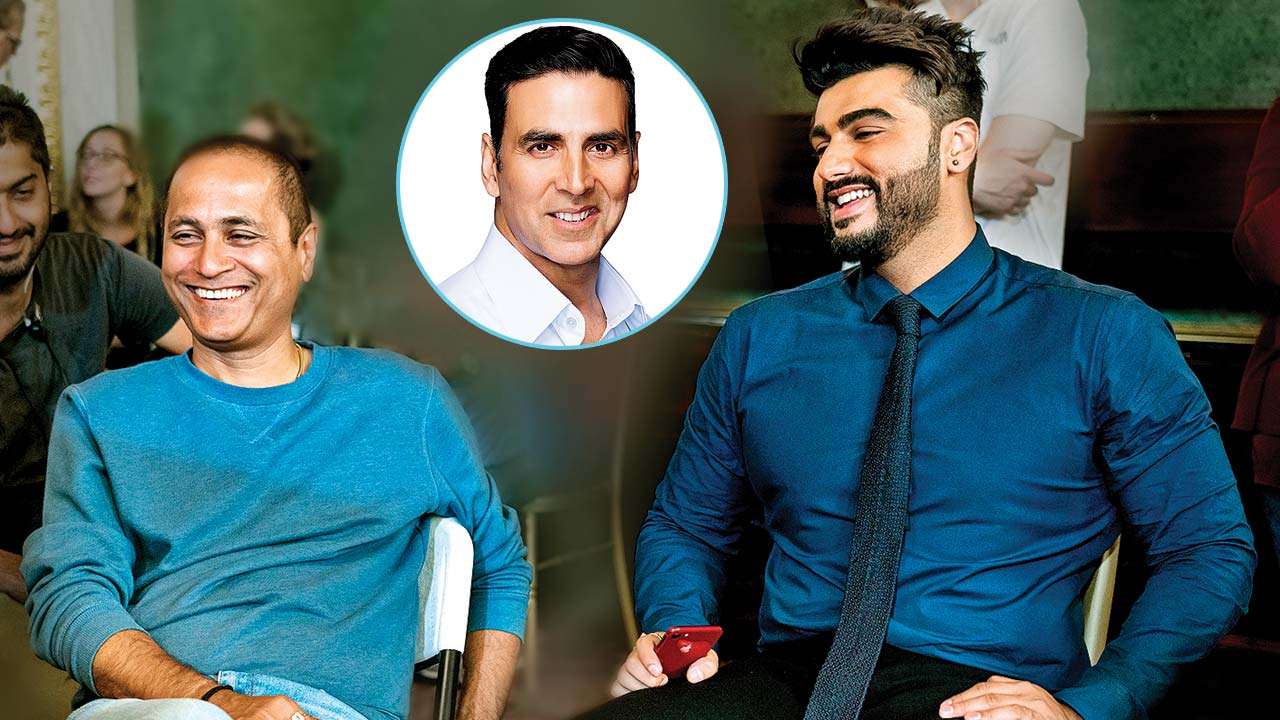
Meena Iyer (DNA; October 9, 2018)
The walls of filmmaker Vipul Shah’s office in Andheri recount a glorious tale. There are countless posters of movies, some produced by him and others backed as well as directed by him. The man behind mainstream entertainers, which include Aankhen (2002), Waqt: The Race Against Time (2005), Namaste London (2007), Singh Is Kinng (2008) and Holiday: A Soldier Is Never Off Duty (2014) was on top of things for over a decade and these framed pictures bear testimony to this fact. However, for reasons best known to him, he took an eight-year-long sabbatical from film direction. He is back now (looking a bit pale though because he is recovering from dengue) with his latest offering, the romantic-comedy titled Namaste England with Arjun Kapoor and Parineeti Chopra, which releases on October 19, Dussehra.
Confident that he will get the audience interested in his latest offering, Vipul, who is nattily dressed in an orange hoodie, settles in a comfortable-looking chair in his fashionably-done up office and begins to talk. Here’s handing over the mic to him then. Excerpts...
What’s playing on your mind currently?
The lead up to the film is the fact that now it’s all coming together. It’s obviously the most exciting and anxious phase. Now that I’m seeing the entire movie, I’m looking forward to see how the audience reacts to it.
Why the long gap in direction?
When I decided to take a break after Action Replayy (2010), I hadn’t planned it to be such a long one. I had just thought it would be for a year or two. I felt I would utilise the time to learn something that I should, considering the changes that cinema was undergoing. Simultaneously, my other productions were also happening. One day, yeh karte karte, I realised seven years had gone by. I thought I would stop production and get back to direction. Other productions like Force, Holiday and Commando were time-consuming. I didn’t want to do two things — producing and directing — at a time. I kept learning while all this was happening... I believe I have learnt something and hope Namaste England shows that.
Your storytelling has always resonated with an audience or so it seemed, going by your track record.
Subject-wise, even Namaste England, seems like a simple film. But the audience will be surprised. I was talking to my team about running a contest saying that if you guess the film’s interval point, we will send you to London. There’s a lot of content in the movie that is not a part of the trailer. There is a serious amount of twists and turns.
When I talk about learning, I’m referring to the process of evolving. In the last seven-eight years, the digital world has evolved a great deal and with so much content coming in, there are various experiments happening and the format of storytelling is changing the world over. So, I wanted to know if I could adapt myself to this new way of storytelling while keeping my own grain intact. I didn’t want to leave my strength, but at the same time, I also wanted to imbibe something new. People are making films and editing on their cell phones, which is fantastic. The characters have changed, all because of evolution through the digital world. I wanted to learn something new and try to incorporate that into my film. At the same time, I was making the movie for the Indian audience, so I had to balance both. That’s a constant process of reinvention — how you don’t lose yourself but also add something that is dramatic and closer to your roots. Six months ago, what was new is old today.
This film comes after several years since Namastey London.
It comes after a gap of 11 years. We had to have a script to take it forward. In Namastey London, there was a strong point about the girl being able to dream and following it to see where it takes her. When I was writing it with Ritesh Shah and Suresh Nair, a lot of people told me that these kinds of stories don’t work in India. For me, that was a journey of the girl who was forced by her father to marry someone against her will. She fights for her dream and in the process, falls in love with the same guy.
I wanted a female-oriented script that had a strong male lead as well. In this film, Arjun’s character is such that every girl will feel her boyfriend/husband should be like him. He is affectionate, understanding and has a good sense of humour. But he is also someone who can kill for his or his family’s honour. Apart from that, he is able to understand the girl’s dream and fight with the whole world to see that it’s realised. So, it was important to find a story where the girl’s dream becomes a big thing.
There’s a distinction between a girl wanting to work and her wanting to have the freedom to decide what she wants to do with her life. Largely, we have overcome the working issue, but we haven’t come to terms with the issue of giving full freedom to her. We have given it to the boy, but the girl doesn’t have the full freedom to make decisions about her life. When I found a story with this idea at the centre, I thought I must make the sequel and the time is right.
You have stuck to the same writing team all these years.
Yes, all my films are written by Suresh and Ritesh. We get along well. We rarely meet, but the relationship we share is great. I’m happy with the synergy we have and I appreciate the kind of work they put in my scripts.
Did you in any way miss working with Akshay Kumar and Katrina Kaif?
Akshay and I have worked together so much. I miss him every single day of my shooting. I can’t imagine a day without him. We did six films together. It’s been a wonderful association. He’s such a fun guy, he puts an extra effort to make the set a happy place. He can call me Sundy, Sethji, sometimes he calls me by some random names. That’s how it has been from the beginning. I also miss working with Katrina. She is extremely professional and passionate, the whole drive and passion towards her work are commendable. When I met her for the first time, I was doing Waqt. I told her that ‘I would really like to work with you but your Hindi is an issue for a movie like Waqt.’ And I was truly impressed because the next time she met me, she was able to read Hindi. She had worked hard on it and learnt so much in that short span of time. She blew me over with her dedication.
In Namaste England, I enjoyed working with Arjun and Parineeti equally, if not more. Sometimes you had to tell Arjun to calm down and chill. He is fully charged 24/7. I haven’t seen a moment where he is dull or tired.
He is Ranveer Singh’s best friend, so we’re guessing he has the same energy levels!
Arjun is a cylinder of energy. When you are with him, you constantly feel that please, give me a breather because you are on a different high. He’s extremely disciplined. In that sense, he and Akshay have a lot of similarities. Arjun is never late, he likes to be involved and keeps the environment on the set easy. If someone makes a mistake, he will find a solution. If a shirt is not fitting well, he won’t throw a tantrum or make a fuss. He is like, ‘Fix it and let’s go’. Parineeti, as we know, is a supremely talented actor. One thing I believe is that even if people don’t like the film, they will love the lead actors’ chemistry. Arjun-Parineeti showed it in Ishaqzaade (2012) and I’m surprised they didn’t do another film together after that. They have the capability of becoming one of the most popular pairs.
Their chemistry is liked by Arjun’s grandma (Nirmala Kapoor) so much that she feels he should get married to her. Parineeti is wonderful and doesn’t realise how good she is at what she is doing. It was great fun working with both of them.
Will you wait to see how Namaste England fares at the box office to announce your next directorial?
I’m keen to watch it with the audience to find out whether I’ve been able to reinvent myself in terms of the time and effort that I’ve invested. I’ve got a few scripts ready for my next. But first, I want to see how I have fared as a director and then decide.
Akshay Kumar came up with the story of Namaste England-Vipul Shah
8:07 AM

Vipul Shah admits Kumar was first choice for Namaste England, chronicles how he found his hero in Arjun Kapoor
Shaheen Parkar (MID-DAY; October 5, 2018)
Barring the Salman Khan-Ajay Devgn starrer London Dreams (2009), Vipul Amrutlal Shah has always collaborated with Akshay Kumar for his directorial ventures. Naturally then, eyebrows were raised when he roped in Arjun Kapoor for Namaste England. More so, since the prequel — Namastey London (2007) — featured the superstar and was a runaway hit.
The filmmaker reveals it was Kumar’s idea to take the franchise ahead. “Akshay came up with the story of Namaste England. I had planned to make it with him. However, things did not work out due to his busy date diary. In fact, it was Akshay who suggested that I roll the film with someone else,” recalls Shah.
It was then that he considered roping in an actor from the younger crop. “When I approached Arjun, I told him at the outset that the film had been conceived for Akshay. But he loved the subject and agreed to come on board.”
Given their long-standing friendship, it was not surprising that Kumar even gave away the title — that was registered with his production house — to the filmmaker for the Parineeti Chopra starrer.
Shah says he has no patience for rumours that suggest a fallout between the duo. “My relation with Akshay and Amit ji [Bachchan] goes beyond work. They were part of my Hindi debut film [Aankhen], so there is an emotional connect. Just because Akshay did not do my film does not mean we have fought.”
He pooh-poohs the buzz by citing an example. “A few days ago, we were doing a photo shoot at Mehboob Studios. Akshay was also at the studio, shooting for an ad. We both met each other warmly; Akshay even insisted on taking pictures with Arjun and Parineeti.”

I had to defy the doctor’s orders in order to complete Namaste England-Vipul Shah
8:05 AM

Vipul Shah on the challenges he faced while making his next
Natasha Coutinho (MUMBAI MIRROR; September 6, 2018)
Vipul Amrutlal Shah was hospitalised twice in the last few weeks after being diagnosed with dengue and typhoid, and a subsequent relapse. The filmmaker is back home now but already at work as his next, the Arjun Kapoor-Parineeti Chopra-starrer Namaste England, is set for an October 19 release. “I was not supposed to step out and had been told to rest, but the final mix of the trailer was waiting so I had to defy the doctor’s orders and go to the studio. I’m glad that I did because it was a wonderful change from everything I’ve been through in the last 15-20 days,” he smiles. The film is produced by Vipul, Jayantilal Gada and Shibasish Sarkar.
Vipul wrapped up the shoot in June, way ahead of schedule, following which the release was pushed forward from December 7 to October 19. “I had a fantastic team in Arjun, Parineeti, Mannan Shaah (composer) and my DoP Yaani, a London-based guy who matched the madness of the team. It’s a bright, festive film and Dusshera is a good time to bring it out,” asserts the filmmaker.
The film’s team shot across Punjab, Brussels, Paris and London, and even mid-sea. “The fact that we still finished early says a lot about the team’s spirit though Parineeti would groan jokingly, ‘Sir, your speed is not good for my health, I will fall ill,’” he laughs, recalling that they moved from chilly Paris at 5am to sweltering Brussels with Arjun still in his leather jacket.
Quiz him on his leads, and Vipul describes Arjun and Parineeti as “Tom and Jerry” who are constantly pulling each other’s leg. “People will talk about their chemistry long after this film for sure,” he promises.
His next production, Commando 3, with Vidyut Jammwal went on the floors on Wednesday in London. “I’m sad I could not be with my team today. I was supposed to be there but couldn’t go because of my health issues. I spoke to everyone and they are all charged up to make a wonderful film,” he concludes.
Action is the biggest genre in Hollywood, but here, it is dismissed as mindless cinema-Vipul Shah
8:12 AM

Neha Maheshwri (BOMBAY TIMES; March 2, 2017)
They may have been friends
for decades, but on the set of their upcoming film Commando 2: The Black
Money Trail, producer Vipul Amrutlal Shah and Deven Bhojani, who
is making his directorial debut in Bollywood with this film, were true
blue professionals. The camaraderie, they say, would start only when the
camera stopped rolling. Recounting those moments in an informal chat
with Bombay Times, the duo throws light on their collaboration...
Deven, as someone synonymous with comedy, what was your reaction on being offered an action film?
Deven: While it's natural for people to associate me with my comic roles on TV, not many know that I've been directing shows for the past 15 years and have explored various genres. I had earlier directed a mini action-drama series, Pukaar, for Vipul. But still, when he offered me the film, I was taken offered me the film, I was taken aback and told him that I needed time to think it over. Vipul knows my capabilities as we've been friends for a long time now. Also, I realised that there couldn't be a better beginning than Commando 2 to help me break the mould.
Did you watch action films to draw inspiration?
Deven: Many directors speak about their inspirations, but I don't relate to it. I'd rather go with the flow than emulate somebody else's work. Firstly, I don't watch many films and to add to it, I have a poor memory. Also, I don't conform to generalisations - in my case, the perception is that one who does comedy can't direct an action film.

Considering the fact that the original, Commando: A One Man Army, was received well, did you feel any pressure while directing the second installment?
Deven: I did. After all, I have to take the franchise to the next level. Besides, I am also directing Vidyut (Jammwal), one of the best action heroes today. A lot of money has gone into making this film. I didn't worry about the box-office figures when I was shooting, the pressure builds up after that. Having said that, I am not too ambitious. I want to contribute to cinema in my own little way. I don't aspire to bag an Oscar or a National Award. If I bag one, it would be nice, but that's not my goal. I just wanted to become a film director and I am glad to be one today.
Vipul, was your friendship with Deven instrumental in getting him on board as the director?
Vipul: I keep my personal and professional life separate. For example, I haven't cast my wife (Shefali Shah) in most of my films. I won't go to her unless the role demands it; the same rule applies to Deven as well. We have known each other since our college days; he is like a brother, but you can't work on the basis of friendship. If I had offered him something he wasn't comfortable with, he would have made a bad film, which would have been detrimental for the entire project. Since he has a certain screen image, the decision to have him as the director might seem misplaced, but I am against stereotyping people. Alfred Hitchcock was not aggressive, but he made the best horror films of all times.
Deven: Nobody is doing anybody a favour. Friendship helped only because Vipul knows my capabilities better than outsiders. Dosti mein birthday gift dega koi - maybe an expensive watch or a diamond set, but not a film.
Vipul, why did it take three years for the sequel?
Vipul: I have to redefine action if I am making a series of action films. It's challenging because you don't want to repeat the stunts. Unfortunately, people write off this genre as maar-dhaad films. Comedy is tough in terms of getting the timing right, but action is tough on the whole team.
Isn't making a film without any big name a huge risk?
Vipul: If you have a strong script and a good actor, I don't see why a film with a newcomer cannot work. Also, I wouldn't have reached so far if Amitji (Amitabh Bachchan) or Akshay Kumar hadn't agreed to do Aankhein when I was new. Every newcomer should get a fair chance, the industry is unfair to outsiders. People called the first installment of Commando a C-grade film as it featured a new guy. It's offensive to judge a film, just because the actor doesn't belong to an illustrious film family. Newcomers risk their career by entrusting you with it and it's a big responsibility, because if something goes wrong, they suffer more than anybody else. It's immensely satisfying when the risk pays off. I find casting only stars limiting, as it feels like a safety net. Am I not capable of making a successful film on my own?
Unlike Hollywood, Bollywood doesn't take the action genre seriously...
Vipul: Action is the biggest genre in Hollywood, but here, it is dismissed as mindless cinema. The amount invested in an action film is huge. Our mindset is the problem. It's changing, but it needs to change faster. A Hollywood film is reviewed better than a Hindi film unless it has big stars. What Keanu Reeves does in John Wick is considered A-class, but it's substandard if Vidyut does the same. I am not calling John Wick a bad film, but the same perspective won't be applied to a film like Commando. Somebody has mastered the art after 20 years of hard work and is putting his life at risk. Don't rubbish it just like that.
Deven, as someone synonymous with comedy, what was your reaction on being offered an action film?
Deven: While it's natural for people to associate me with my comic roles on TV, not many know that I've been directing shows for the past 15 years and have explored various genres. I had earlier directed a mini action-drama series, Pukaar, for Vipul. But still, when he offered me the film, I was taken offered me the film, I was taken aback and told him that I needed time to think it over. Vipul knows my capabilities as we've been friends for a long time now. Also, I realised that there couldn't be a better beginning than Commando 2 to help me break the mould.
Did you watch action films to draw inspiration?
Deven: Many directors speak about their inspirations, but I don't relate to it. I'd rather go with the flow than emulate somebody else's work. Firstly, I don't watch many films and to add to it, I have a poor memory. Also, I don't conform to generalisations - in my case, the perception is that one who does comedy can't direct an action film.
Considering the fact that the original, Commando: A One Man Army, was received well, did you feel any pressure while directing the second installment?
Deven: I did. After all, I have to take the franchise to the next level. Besides, I am also directing Vidyut (Jammwal), one of the best action heroes today. A lot of money has gone into making this film. I didn't worry about the box-office figures when I was shooting, the pressure builds up after that. Having said that, I am not too ambitious. I want to contribute to cinema in my own little way. I don't aspire to bag an Oscar or a National Award. If I bag one, it would be nice, but that's not my goal. I just wanted to become a film director and I am glad to be one today.
Vipul, was your friendship with Deven instrumental in getting him on board as the director?
Vipul: I keep my personal and professional life separate. For example, I haven't cast my wife (Shefali Shah) in most of my films. I won't go to her unless the role demands it; the same rule applies to Deven as well. We have known each other since our college days; he is like a brother, but you can't work on the basis of friendship. If I had offered him something he wasn't comfortable with, he would have made a bad film, which would have been detrimental for the entire project. Since he has a certain screen image, the decision to have him as the director might seem misplaced, but I am against stereotyping people. Alfred Hitchcock was not aggressive, but he made the best horror films of all times.
Deven: Nobody is doing anybody a favour. Friendship helped only because Vipul knows my capabilities better than outsiders. Dosti mein birthday gift dega koi - maybe an expensive watch or a diamond set, but not a film.
Vipul, why did it take three years for the sequel?
Vipul: I have to redefine action if I am making a series of action films. It's challenging because you don't want to repeat the stunts. Unfortunately, people write off this genre as maar-dhaad films. Comedy is tough in terms of getting the timing right, but action is tough on the whole team.
Isn't making a film without any big name a huge risk?
Vipul: If you have a strong script and a good actor, I don't see why a film with a newcomer cannot work. Also, I wouldn't have reached so far if Amitji (Amitabh Bachchan) or Akshay Kumar hadn't agreed to do Aankhein when I was new. Every newcomer should get a fair chance, the industry is unfair to outsiders. People called the first installment of Commando a C-grade film as it featured a new guy. It's offensive to judge a film, just because the actor doesn't belong to an illustrious film family. Newcomers risk their career by entrusting you with it and it's a big responsibility, because if something goes wrong, they suffer more than anybody else. It's immensely satisfying when the risk pays off. I find casting only stars limiting, as it feels like a safety net. Am I not capable of making a successful film on my own?
Unlike Hollywood, Bollywood doesn't take the action genre seriously...
Vipul: Action is the biggest genre in Hollywood, but here, it is dismissed as mindless cinema. The amount invested in an action film is huge. Our mindset is the problem. It's changing, but it needs to change faster. A Hollywood film is reviewed better than a Hindi film unless it has big stars. What Keanu Reeves does in John Wick is considered A-class, but it's substandard if Vidyut does the same. I am not calling John Wick a bad film, but the same perspective won't be applied to a film like Commando. Somebody has mastered the art after 20 years of hard work and is putting his life at risk. Don't rubbish it just like that.

John Abraham is subtle and sticks close to reality. He suits my wavelength-Abhinay Deo
8:06 AM

Neha Maheshwri Bhagat (BOMBAY TIMES; November 15, 2016)
 Though Force 2 happens to be
their maiden venture together, director Abhinay Deo and filmmaker Vipul
Amrutlal Shah got along like a house on fire. No creative combat for
these men, who worked seamlessly to bring alive their vision for the
muchanticipated John Abraham Sonakshi Sinha-starrer. Here are excerpts
from an interview with Vipul and Abhinay before the release of the
high-octane, action
packed sequel to Force, which opens in cinemas this Friday.
Though Force 2 happens to be
their maiden venture together, director Abhinay Deo and filmmaker Vipul
Amrutlal Shah got along like a house on fire. No creative combat for
these men, who worked seamlessly to bring alive their vision for the
muchanticipated John Abraham Sonakshi Sinha-starrer. Here are excerpts
from an interview with Vipul and Abhinay before the release of the
high-octane, action
packed sequel to Force, which opens in cinemas this Friday.The car-lifting sequence has become the talking point of your film...
VIPUL: Ever since John lifted the bike in Force, the sequence has become synonymous with the franchise. Everyone expects him to do something spectacular and big. I remember people thought the bike-lifting sequence was a cheat shot. So, John lifted the bike at an event to prove it and it became a talking point. We had to push the envelope in our quest to take the legacy ahead. We made him lift a car this time. We knew it would work, but the film is not just about lifting heavy weights. It has a bigger concept - it's about spies and what happens to them and their families when the country disowns them..
ABHINAY: It's a big moment in the trailer, but the film is bigger and more intense than a particular scene. Having said that, the sequence defines an important aspect of the protagonist - that he is not only righteous, but also physically solid.
Vipul, what made you cast Sonakshi, considering there is no apparent love track between her and John in the film?
VS: Abhinay didn't want to explore a typical love story. It's high time we started taking the relationship between a boy and a girl beyond the romantic angle. It is a modern and interesting take. We could have easily made it a two-hero film as there is no apparent love story, but girls are at par with boys in every aspect, so we wrote a female character. It was an unanimous decision to cast Sonakshi, because she has the personality to pull off the role of a RAW agent convincingly. Besides, everybody knows that she can do action really well.
Given the ongoing tension between India and Pakistan, do you think the relevance of the subject will attract moviegoers?
VS: It's a bad way to make a film with the idea of capitalising on the political situation of a country. Had that been the case, we would have added a few sequences bashing the other country. Some subjects are too real to be judged through their commercial viability. And any situation which deals with the Army or spies shouldn't be seen through the prism of commercial success/failure. If Force 2 can improve the situation for even a handful of spies and their families, it will be a bigger reward than its box-office collection. The subject should reach a wider audience, as this country needs to wake up to the reality of spies and their families being ignored.
But do you think demonetization might hamper its box-office collection?
VS: A big decision like demonetization might affect a film, but it would be a small sacrifice on our part in the larger interest of the country - which is to clean up black money and corruption. I have faith that we have made a good film and even if we lose out on the first day, we will be back in business eventually. We are proud of the film and demonetization won't affect its business.
Abhinay, while working with Vipul as a producer, was there any creative interference as he is also a director?
AD: Such thoughts do crop up, but Vipul has trusted my creative vision and I trusted him with the production aspect. That's the bond we have developed over time. At times, we have worn each other's hat as well. Sometimes, the budget and the vision don't come together, which was the case with this film - the vision was bigger than the budget. If my producer came half way and did not worry about the money, on my part, I too sacrificed my fee. It's important to share the same vision, and ours was to make a mindblowing film. There was no scope for discord.
VS: Force 2 belongs to Abhinay as much as it belongs to me. No one has charged a single penny in these 18 months. Abhinay has stood by me at all times.
Abhinay, Nishikant Kamat, who directed Force, said he is done and dusted with the film. What pushed you to take it on?
AD: That's his opinion and I can only speak for myself. Nishikant is a friend and he did a swell job in the first film. Sometimes, you need a fresh perspective to take a film to the next level and that's exactly what I have tried to do.I have taken it from where he left and steered it into a different direction. We never get tired of a genre and there is no limiting it. A subject can be explored in multiple ways.
John is known for his tough physique and action skills. Do you think his action-hero image overshadows his acting talent?
AD: Every person has his strengths and weaknesses. As a director, I needed to play up John's strengths. We extracted the best out of each other during the course of the film. Each actor has a distinct way of emoting. Our films tend to overdramatize everything, but that is not my style. OTT (over the top) as a concept doesn't exist for me. It might be in a situation, but never in the performance. John is subtle and sticks close to reality. He suits my wavelength as I like realistic filmmaking.
Abhinay, do you aspire to enter the Rs 300-crore club like other directors? After all, even superstars chase them...
AD: I want to be a director who is sought after by actors for the right reason, which is good cinema. It shouldn't be based on the business my last film did. If that's the case, I would question their judgement. I would like my films to make Rs 300 crore, but these clubs don't make sense to me. I define a film's success with people gaining something from the storytelling. That's more gratifying to me, even if it's pure and simple entertainment. What mark it crosses isn't my lookout. If it makes money in the process, I would be happy for the producer and myself. I wouldn't stop myself from making a Rs 10-crore film just because another film of mine did a Rs 300-crore business. The business doesn't govern my talent of storytelling.
Vipul, how was it to co-produce the film with John, who is also the face of the film? Did that give him an advantage?
VS: I want my actors to work on a film with a sense of ownership. I am happy that John and I are working as co-producers because it makes the experience personal for him as well. I haven't looked at the financial aspect yet. Maybe I would do that when the numbers start rolling in. When we make films, we build relationships. You can choose to be a producer who deals with situations either clinically or with empathy. If you can maintain a good relationship with the team, success and fame will follow. But if you burn bridges with people, you will be alone on the day of the premiere.
Abhinay, Delhi Belly is a cult film and one expected a sequel. Why didn't you cash in on its success?
AD: It's a film waiting to be made into a second part and I would love to do it. But I am neither driven by money and fame nor is filmmaking time bound. I take time to discover a big idea. Akshat Verma (the writer of the film) took nine years to write the first script. We have a nine-year plan, so we have another four more years to go for the sequel (laughs).
Vipul, the failure of Action Replayy (2010) must have been a major setback. Do you plan to get back to direction?
VS: That was my first genuine failure as a director and it taught me a great deal. I decided to take a long break from direction to reinvent myself. I am returning to direction soon, and I know it will feel like my first film, as I will be approaching it with a fresh perspective. I am in discussion with Akshay (Kumar) for a project. I am writing the script, and will narrate to him soon.
Pukaar will leave people enthralled, engaged and entertained-Vipul Shah
7:43 AM

MUMBAI MIRROR (November 25, 2014)
After a long hiatus Vipul Amrutlal Shah will be back on television with Pukaar, a series that promises to get the 70mm straight into your television...
Pukaar promos are looking rather impressive, what are your expectations from it?
Television as a medium has a lot of scope of getting bigger and better, I am just attempting my bit in giving that to them. Here's a never seen before story, said in a way that will impress the audience after a long day of hard work, straight in their living room.
There was Commando, Force and Holiday on the silver screen and now there is 'Pukaar'. Why this fascination for the armed forces?
Why not? There is something extremely fascinating about the armed forces. After all, not everyone has it in them to leave their loved ones, live in extreme conditions and protect what they treasure.... It is this life they lead that makes them heroes, makes them gentlemen and makes them pillars of the society. And when in trouble, we are bound to fall back on these pillars for support. That is exactly the premise...
A premise you are set to turn grand, with your production standards we hear...
Of course, when I have the means then why should I not give it my all. We are a well-oiled system at work, on sets and I am used to working like that, so I have just brought that back into the small screen. Yes, the budgets and standards are higher than that seen on television but I have in no way gone overboard. Yes, I am setting a high standard but that's well deserved. After seeing all the reality television, we believe that our true-to-its-word fiction should make up for things! What I want to give the audience is a movie they come home to, except like most movies it is not a two and a half hour affair, it is a 24 hours film on television.
That explains the death-defying action?
As a filmmaker I believe in pre planning, rehearsals, only then any action can be well executed and can be death defying. So Deven, Allan Amin, Rannvijay and I sat together to plan, rehearse and design actions. Like there is this sequence where Rannvijay is chasing someone, and he has to take a leap, I told them the 15 storey building is looking too dangerous, so they relented and did it on a 20 storey building without a body double! While that did leave me with my heart in my mouth, I am assured all that my cast and crew have done for the series, will leave the audience enthralled, engaged and certainly, entertained.
Subscribe to:
Posts (Atom)